


Abstract
Axial variations in irradiation conditions along elongated fuel assembly components can produce locally different irradiation-induced material states and, consequently, different post-irradiation thermal responses. The present study investigates EI-847 austenitic steel from a BN-350 reactor’s spent fuel assembly displacer irradiated to approximately 50 dpa. Material was sampled at axial positions of −175, 0, and +175 mm relative to the reactor core midplane, corresponding to irradiation temperatures of approximately 326, 351, and 377 °C, respectively. The three axial states were compared in the as-irradiated condition and after identical post-irradiation annealing at 470 °C for 100 h. Density, Vickers microhardness, tensile properties, microstructure, and fracture surfaces were examined to assess axial heterogeneity and subsequent thermal response. In the as-irradiated condition, the lowest microhardness and yield strength (YS) occurred at +175 mm, whereas the minimum density was measured at the core midplane. After annealing, microhardness decreased by 13.5%, 15.1%, and 6.3% at −175, 0, and +175 mm, respectively. The YS decreased by 20–28%, while the ultimate tensile strength (UTS) decreased by 10–15%. Total elongation (TE) increased from 10% to 29% at −175 mm, from 16% to 27% at the core midplane, and only from 19% to 21% at +175 mm. Predominantly ductile dimpled fracture was retained in all conditions. These results show that identical post-irradiation annealing produces different degrees of softening and ductility recovery depending on axial position and the irradiation-induced state established during reactor operation.
1. Introduction
The performance of fuel assemblies (FAs) in sodium-cooled fast reactors (SFRs) is governed not only by the radiation resistance of structural materials but also by the local thermal–hydraulic conditions during operation [1,2]. The FA temperature field is shaped by the combined effects of power and coolant-flow distributions, interchannel mixing, the geometry of the fuel-pin bundle and peripheral region, and geometric changes in FA components during service [3,4]. The peripheral region is particularly important: changes in the position and geometry of displacers can noticeably affect the temperature of peripheral fuel pins, while interchannel mixing controls the equalization of local coolant-temperature nonuniformities [5]. Accordingly, elongated components in the FA peripheral region can provide spatially resolved information on the local thermal and irradiation history of the material.
BN-350, the world’s first industrial sodium-cooled fast reactor, played an important role in the development of sodium technology and generated operating experience that informed subsequent fast-reactor development [6,7]. BN-350 was permanently shut down in 1999 and subsequently entered decommissioning [8,9].
The BN-350 spent nuclear fuel (SNF) was prepared for long-term storage and, in 2010, transported from Aktau to a dedicated long-term storage site at the “Baikal-1” research reactor complex of the National Nuclear Center of the Republic of Kazakhstan (NNC RK) in Kurchatov [10,11]. 60 UKKh-123 metal–concrete storage casks, forming part of the TUK-123 system, are stored at the “Baikal-1” site, and their condition is periodically monitored using radiation, temperature, and operational parameters [10,11,12].
In this context, examination of actual components from spent BN-350 FAs provides valuable data on the condition of structural materials after prolonged exposure to actual reactor neutron and temperature fields and on their subsequent evolution. One such material is EI-847 austenitic stainless steel, which was used in BN-350 FA components. EI-847 is also important in the development of austenitic materials for fast reactors because it served as a basis for more irradiation-resistant steels. EP-172 was developed by modifying EI-847 with boron, while ChS-68 was developed with additional alloying aimed at improving irradiation stability [13].
A substantial body of reactor irradiation data on EI-847 has been reported [14,15,16]. Studies of EI-847, EP-172, and ChS-68 irradiated over the temperature range of 330–700 °C and damage-dose range of 20–96 dpa demonstrated a pronounced temperature dependence of swelling and irradiation creep [14]. For Fe–16Cr–15Ni–Mo–Nb steel irradiated in BN-350, applied stress was also shown to significantly enhance irradiation swelling and affect irradiation creep [15]. Comparisons between EI-847 and ChS-68 revealed differences in the evolution of the irradiation-induced microstructure; the higher swelling resistance of ChS-68 was associated, among other factors, with greater stability of faulted dislocation loops at high damage doses [16].
Irradiation temperature is particularly important for EI-847. In a comparative study of austenitic steels irradiated in BN-350 to 57–59 dpa at 390–490 °C, Porollo et al. showed a marked effect of irradiation temperature on the mechanical behavior of EI-847; EP-172 and ChS-68 also exhibited greater resistance to high-temperature radiation embrittlement [16]. Studies of actual BN-350 FA components have also shown that irradiation-induced material changes can be strongly spatially heterogeneous. Maksimkin et al. reported complex variations in void swelling, microstructure, microhardness, and mechanical properties within a 12Cr18Ni10Ti fuel assembly shroud irradiated in BN-350 to 59 dpa [17]. These observations show that material sampled from different locations of a single reactor component cannot necessarily be treated as having experienced an identical irradiation history. For an elongated structural component, this is especially relevant because irradiation temperature, damage dose, and dose rate vary with axial position in the core. Consequently, different sections of the same component can reach different post-irradiation states despite identical chemical composition and a common manufacturing history.
The irradiation-induced material state can continue to evolve after removal from the reactor. Rofman et al. showed that long-term natural aging of irradiated BN-350 austenitic steels at room temperature reduced hardness by approximately 10–25% [18]. Previous work within our BN-350 materials research program examined austenitic structural steels from reactor core components, including EI-847 steel from an in-channel displacer, and showed that the recovery of mechanical properties during post-irradiation annealing depends strongly on temperature and exposure time [19]. At elevated temperatures, such changes can proceed much more rapidly. For example, post-irradiation annealing of EP-450 ferritic–martensitic steel from BN-350 spent FA wrappers at 470 °C reduced hardness and YS, with the degree of recovery depending on annealing time [20]. Although EI-847 and EP-450 belong to different classes of steels, these results underscore the importance of assessing the thermal stability of material states formed under prolonged neutron irradiation.
Taken together, previous studies establish the temperature sensitivity of EI-847, the spatial heterogeneity that can develop in actual BN-350 structural components, and the possibility of post-irradiation thermal recovery. However, the combined effect of these factors has received much less attention. In particular, it remains unclear how different local axial irradiation histories within a single elongated EI-847 component affect its response to the same subsequent thermal treatment. A fuel assembly displacer is particularly suitable for this purpose because it allows sections with a common manufacturing history but different axial irradiation conditions to be compared.
The present study addresses this gap by examining whether differences in local axial irradiation history within a single EI-847 displacer from a BN-350 spent fuel assembly (SFA) result in different post-irradiation material states and different responses to the same subsequent thermal exposure. By comparing material from three axial regions of the same reactor-operated component, the study isolates the influence of local irradiation history while minimizing differences associated with chemical composition and manufacturing history.
2. Materials and Methods
2.1. Investigated Material and Irradiation Conditions
The investigated material was a displacer from the standard C-1sp SFA of the BN-350 reactor, manufactured from EI-847 austenitic steel (Cr16Ni15Mo3Nb09). The displacer was an actual reactor-operated component recovered from the SFA after service in the BN-350 reactor; the investigated material was therefore neither newly produced nor commercially supplied steel. All three investigated axial sections were sampled from the same displacer. The nominal chemical composition of EI-847 steel was, wt.%: 0.04–0.06 C, 0.4–0.8 Mn, <0.4 Si, 15–16 Cr, 15–16 Ni, 2.7–3.2 Mo, and <0.9 Nb. These values correspond to the nominal specification range for EI-847 steel; the original chemical analysis of the production heat used to manufacture the investigated displacer is not available in the surviving documentation. The original manufacturer’s certificate and pre-irradiation mechanical-property data for this historical displacer are also not available in the surviving documentation. The displacer was a 1.5 mm diameter elongated element located in the peripheral region of the fuel-pin bundle, between the peripheral fuel pins and the inner surface of the hexagonal FA wrapper. For materials characterization, sections were sampled at axial positions of −175, 0, and +175 mm relative to the reactor core midplane.
The location of the displacers in the peripheral region of the FA is associated with the hydraulic characteristics of the peripheral subchannels. In this region, the flow-area geometry differs from that of the internal subchannels, requiring additional equalization of the local coolant-flow and temperature distributions. The displacers occupy part of the free volume between the peripheral fuel pins and the hexagonal wrapper, thereby modifying the flow area in the near-wall region and redistributing the sodium coolant flow. In fast-reactor FAs, the use of displacers in peripheral subchannels is considered a design approach for equalizing coolant heating across the FA cross-section. The geometry of the peripheral region strongly affects the sodium coolant velocity and temperature distributions; numerical studies have shown that displacers in peripheral subchannels promote a more uniform temperature field, whereas changes in their position or deformation can alter the thermal conditions of peripheral fuel pins [21,22].
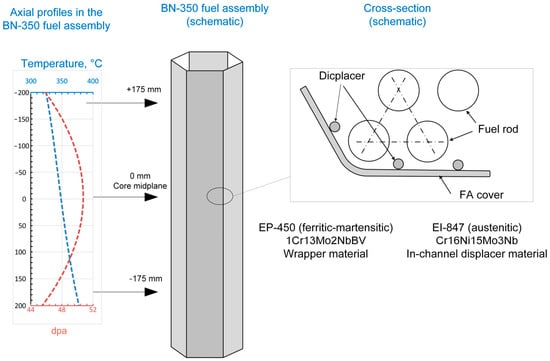
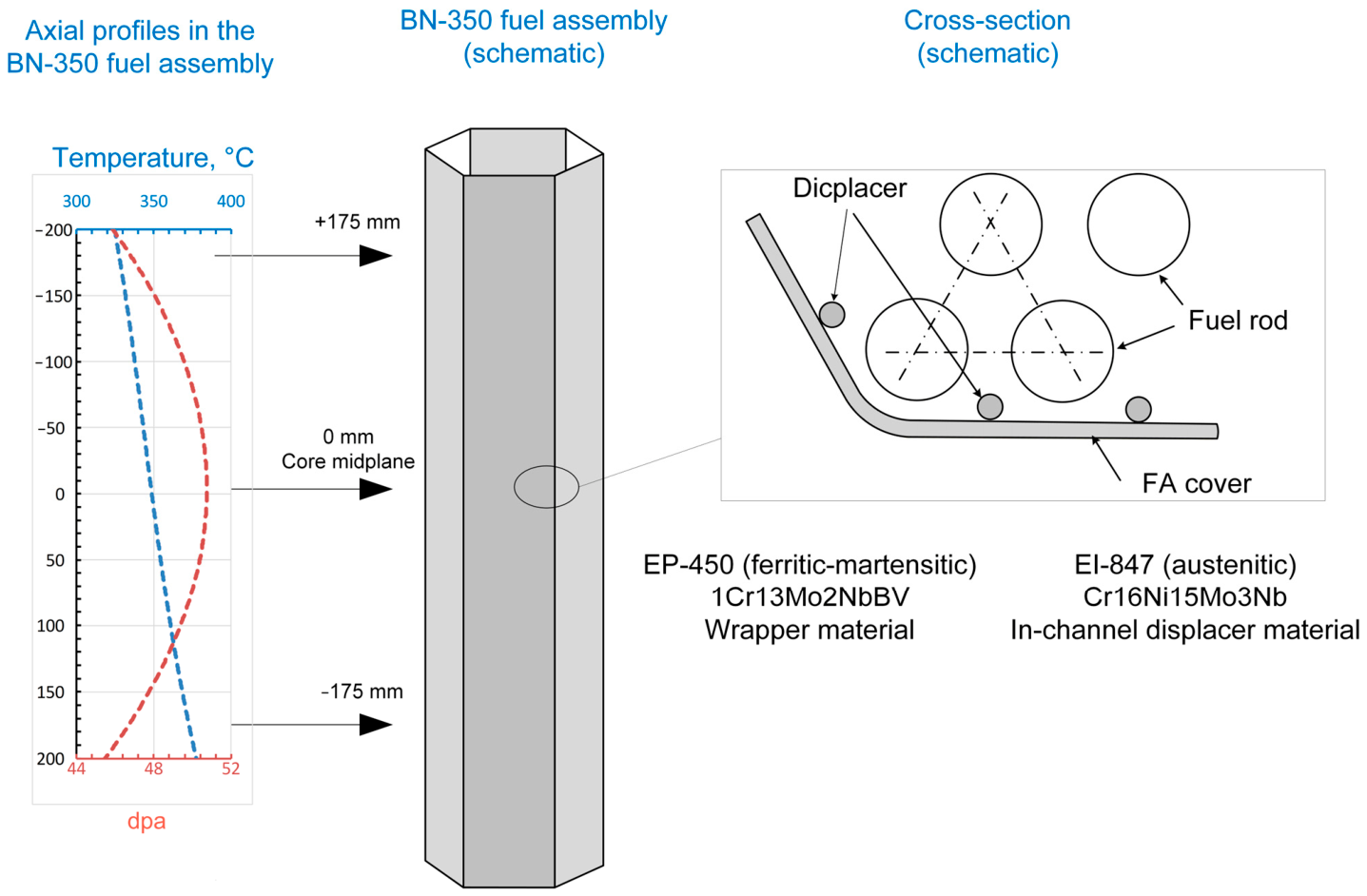
The location of the investigated displacer relative to the fuel-pin bundle and FA wrapper, the axial positions of the sampled sections, and the temperature and displacement-damage profiles along the investigated region are schematically shown in Figure 1.
Figure 1.
Schematic representation of the axial temperature and displacement-damage profiles in the BN-350 fuel assembly, the positions of the investigated displacer sections relative to the reactor core midplane, and the location of the displacers in the peripheral region of the fuel-pin bundle.
According to the reactor operating data, the displacer was exposed in the BN-350 reactor for 323.2 effective full-power days (EFPD) and accumulated a high displacement-damage dose during neutron irradiation. The irradiation temperatures used in the present study were taken from the surviving archival reactor-service records for the C-1sp component and were not calculated independently in this work. The main irradiation parameters and archive-calculated temperatures for the three axial positions are summarized in Table 1.
Table 1.
Main operating and neutron-irradiation parameters of the investigated C-1sp fuel assembly displacer.
2.2. Specimen Preparation and Microstructural Characterization
The displacer material was sectioned separately for the regions sampled at −175, 0, and +175 mm relative to the reactor core midplane. Cutting was performed by wire electrical discharge machining (wire EDM) using a Model 4531 machine (Kirovakan Precision Machine Tool Plant, Kirovakan, Armenian SSR, USSR). Specimens for metallographic examination and mechanical testing were prepared from each axial position. For metallographic characterization, cross-sectional and longitudinal sections of the displacer were prepared.
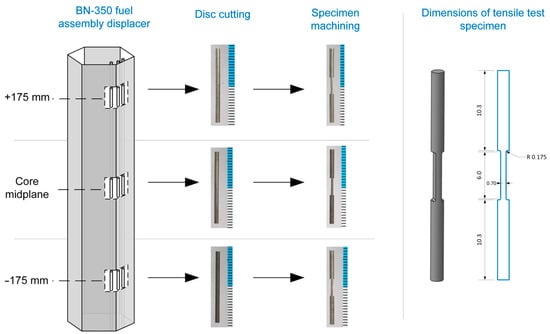
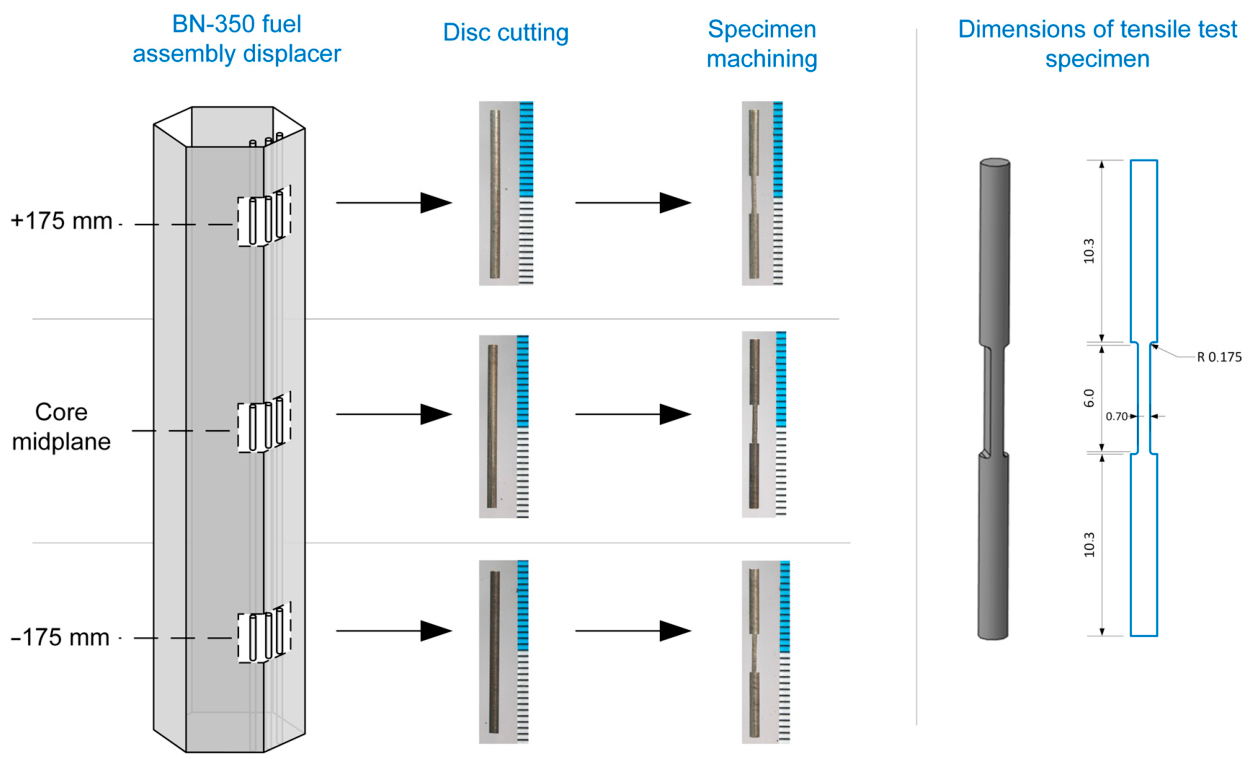
The blanks for mechanical testing had an initial diameter of 1.5 mm and a length of 27 mm. Miniature dog-bone-shaped specimens for uniaxial tensile testing were subsequently machined from these blanks by EDM in accordance with GOST 1497-84 [23]. The material sampling scheme for the three axial positions, the sequence of miniature-specimen preparation, and the dimensions of the final tensile specimen are shown in Figure 2.
Figure 2.
Schematic of material sampling and miniature tensile-specimen preparation from different axial positions of the BN-350 fuel assembly displacer; the dimensions of the final specimen are shown on the right.
For microstructural examination, the metallographic specimens were chemically etched for 10–30 s in a solution containing 30 mL HCl and 10 mL HNO3. Microstructural characterization was performed using an ICX-41M optical metallographic microscope (SopTop, Shenzhen, China) in bright-field mode at magnifications up to ×1000. Image processing and analysis were carried out using Altami Studio software, version 3.5, (Altami Ltd., St. Petersburg, Russia). The general procedure for metallographic specimen preparation and optical characterization followed the methodology previously applied to BN-350 SFA wrapper material [20].
2.3. Post-Irradiation Isothermal Annealing
Post-irradiation annealing was performed using an ampoule device installed in the heating chamber of an SNOL 8.2/1100 laboratory muffle furnace (SNOL-TERM Ltd., Tver, Russia). The design of the experimental setup and the procedure for isothermal testing were described in detail previously [20]. The working section of the ampoule was made of quartz tubing, and the specimens were placed in ceramic boats mounted on a stainless-steel holder. Temperature was monitored using a K-type thermocouple, while the two-zone heating system was controlled by independent proportional–integral–derivative PID controllers (Omron Corporation, Kyoto, Japan).
Before annealing, the ampoule was evacuated to a residual pressure of approximately 10 Pa and then filled with argon to an overpressure of 1.5 atm. Annealing was performed at (470 ± 2) °C for 100 h in a closed, static argon atmosphere without gas flow. The temperature of 470 °C was selected with reference to previous thermal analyses of BN-350 spent fuel under dry-storage conditions. In Ref. [11], the maximum calculated fuel temperature for the most conservative of the considered storage configurations was ~472 °C. Accordingly, 470 °C was used here as a conservative post-irradiation thermal exposure rather than as a direct reproduction of the actual storage temperature of the investigated displacer. This temperature is also higher than the archive-calculated irradiation temperatures of the investigated sections (~326–377 °C), thereby providing an accelerated treatment for assessing the relative thermal stability of their irradiation-induced states. The 100 h holding time was selected as a prolonged exposure consistent with previous BN-350 post-irradiation studies [20].
For each axial position of the displacer (−175, 0, and +175 mm), three final-machined miniature tensile specimens, with an overall length of 26.6 mm, a gauge length of 6.0 mm, a gauge diameter of 0.70 mm, and a transition radius of 0.175 mm, were used: one was retained in the as-irradiated condition, while the other two were subjected to post-irradiation annealing at 470 °C for a total of 100 h.
2.4. Density and Microhardness Measurements
The density of EI-847 steel was determined in the as-irradiated condition for displacer sections sampled at −175, 0, and +175 mm relative to the reactor core midplane. Measurements were performed by hydrostatic weighing using an MS205DU analytical balance (Mettler Toledo GmbH, Greifensee, Switzerland) with a readability of 0.01 mg; distilled water was used as the immersion liquid.
Vickers microhardness was measured using a Qness Q10A+ automatic hardness tester (ATM Qness GmbH, Golling, Austria) at an applied load of 0.1 kgf (HV0.1). In the as-irradiated condition, measurements were performed on both longitudinal and cross-sectional surfaces for all three axial positions. The change in microhardness after post-irradiation annealing was evaluated at the same load by comparing the HV0.1 values before and after annealing at 470 °C for 100 h. Similar equipment and the same general approach to hardness measurements of highly irradiated BN-350 materials were previously used in [20].
2.5. Mechanical Testing and Fractography
The strength and ductility of EI-847 steel were evaluated by uniaxial tensile testing of miniature specimens with the geometry shown in Figure 2. The use of miniature specimens was dictated by the limited amount of highly irradiated displacer material and enabled mechanical testing of material sampled from the specified axial positions.
Tensile tests were performed at room temperature using an Instron 5966 universal electromechanical testing machine (Instron, Norwood, MA, USA) at a constant crosshead speed of 2.5 mm/min. The specimens were held using Instron 2736 Series manual wedge action grips equipped with interchangeable diamond-serrated jaw faces. The wedge mechanism increases the gripping force as the tensile load rises, thereby preventing specimen slippage during testing of high-strength metallic materials. The grip geometry enabled initial specimen clamping without displacement of the jaw faces relative to the specimen.
Engineering stress–strain curves were recorded during testing using Bluehill 3 software (Instron, USA). The 0.2% offset yield strength (YS), ultimate tensile strength (UTS), total elongation (TE), uniform elongation (UE), and post-uniform elongation (PUE) were determined from the recorded curves. For each axial position, one specimen was tested in the as-irradiated condition and two specimens after post-irradiation annealing at 470 °C for 100 h. After exclusion of tests in which fracture occurred outside the gauge section, the quantitative tensile properties for each condition were based on a single valid specimen. Therefore, standard deviations were not calculated, and the reported values should be interpreted as single-specimen measurements rather than statistically averaged mechanical properties.
After tensile testing, the overall appearance of the fractured specimens and the fracture location relative to the gauge section were documented. Fractographic examination of the fracture surfaces was performed by scanning electron microscopy in secondary-electron mode using a VEGA3 scanning electron microscope (TESCAN, Brno, Czech Republic). Specimens from all three axial positions, −175, 0, and +175 mm, were examined in both the as-irradiated and post-irradiation-annealed conditions.
3. Results
3.1. Axial Heterogeneity of EI-847 Steel in the As-Irradiated Condition
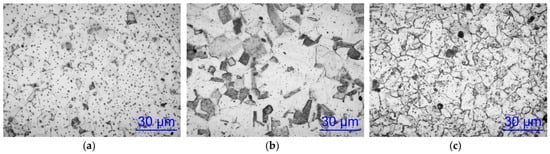
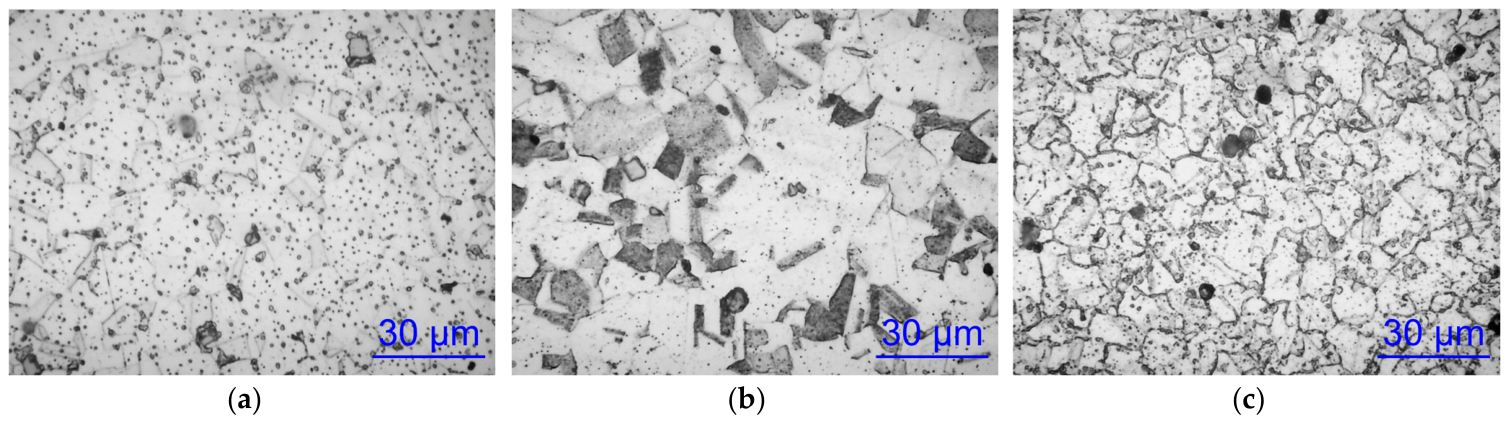
Optical metallography (Figure 3) revealed differences in the microstructural appearance of EI-847 steel among the three investigated axial positions of the displacer. At all positions, the microstructure consisted predominantly of equiaxed austenitic grains containing numerous fine and larger inclusions. At −175 and 0 mm, the grain boundaries were predominantly straight, and twins were clearly visible. In the material sampled at +175 mm, the austenitic grains exhibited more rounded contours, while pronounced twins were rarely observed in the optical micrographs. No preferential orientation of the austenitic grains was evident in the longitudinal sections; however, a weak banded arrangement of the larger inclusions was observed.
Figure 3.
Microstructure of transverse sections of EI-847 steel from different axial positions of the C-1sp fuel assembly displacer relative to the reactor core midplane: (a) −175 mm, (b) 0 mm, and (c) +175 mm.
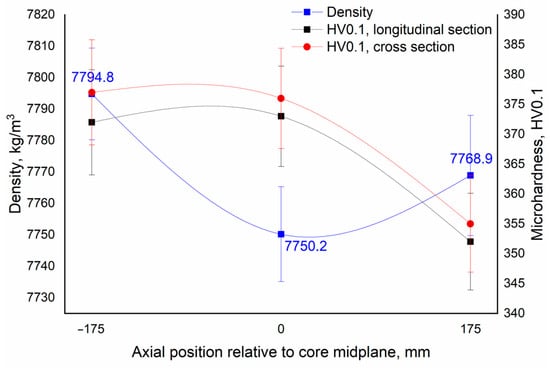
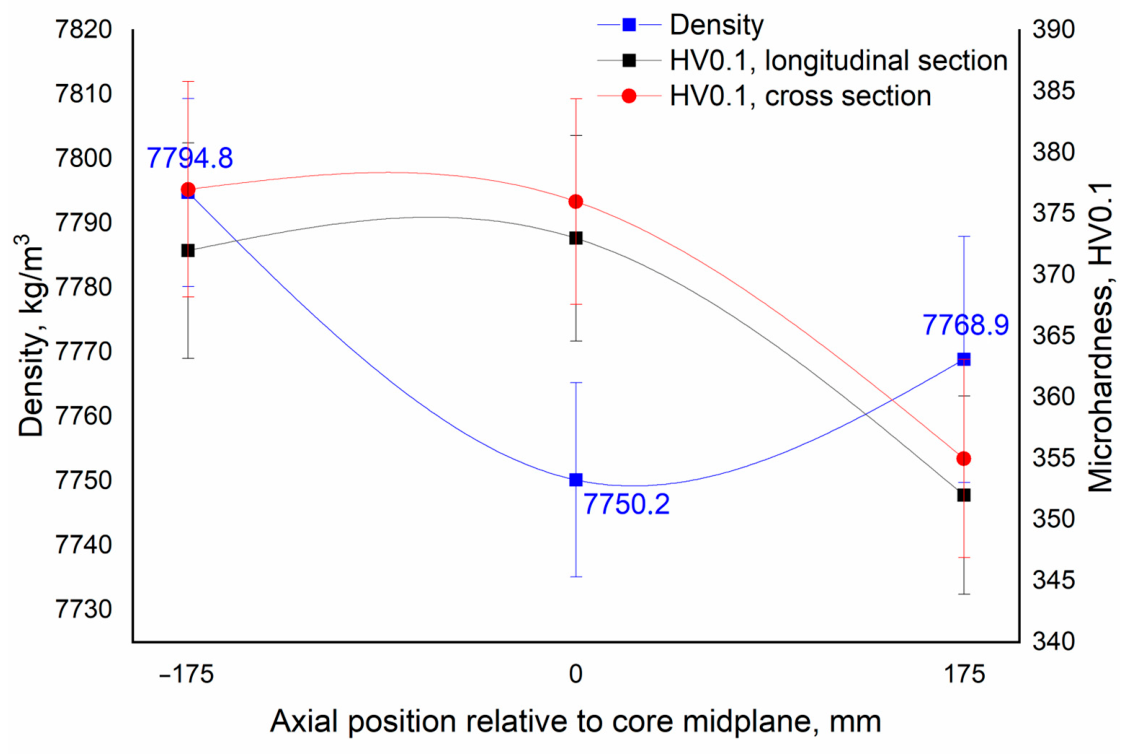
Axial heterogeneity was also reflected in the density and microhardness measurements (Figure 4). The highest mean density, 7794.8 kg/m3, was measured at −175 mm. At the reactor core midplane, the density decreased to 7750.2 kg/m3, approximately 0.57% lower than that at −175 mm. At +175 mm, the density was 7768.9 kg/m3, intermediate between the values measured at the other two positions. Thus, the axial density profile exhibited a distinct minimum near the reactor core midplane rather than a monotonic variation.
Figure 4.
Axial distribution of density and HV0.1 microhardness of EI-847 steel in the as-irradiated C-1sp fuel assembly displacer.
The Vickers microhardness (HV0.1) exhibited a different axial dependence. At −175 and 0 mm, the values were nearly identical: 372 and 373 HV0.1 in the longitudinal sections and 377 and 376 HV0.1 in the transverse sections, respectively. At +175 mm, the microhardness decreased to 352 HV0.1 in the longitudinal section and 355 HV0.1 in the transverse section, corresponding to a reduction of approximately 5–6% relative to the two lower axial positions. At each axial position, the values obtained in the longitudinal and transverse sections differed by no more than 3–5 HV0.1, indicating no pronounced dependence of microhardness on section orientation.
Taken together, these results show that the state of EI-847 steel after reactor service was heterogeneous along the length of the displacer. The different properties did not exhibit identical axial distributions: the minimum density occurred near the reactor core midplane, whereas the most pronounced decrease in microhardness was observed at +175 mm. At the same time, the observed morphology of the austenitic microstructure also varied with axial position.
3.2. Changes in Microhardness After Post-Irradiation Annealing
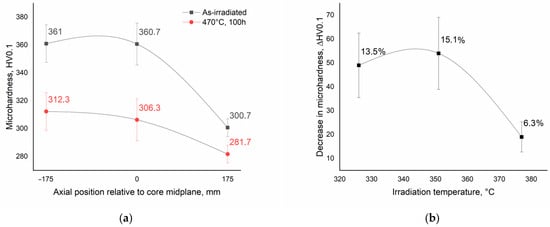
Post-irradiation annealing at 470 °C for 100 h resulted in a decrease in HV0.1 microhardness at all three investigated axial positions of the displacer; however, the degree of softening differed substantially (Figure 5a). At −175 mm, the microhardness decreased from 361.0 to 312.3 HV0.1, while at the reactor core midplane it decreased from 360.7 to 306.3 HV0.1. The change was considerably smaller at +175 mm, where the microhardness decreased from 300.7 to 281.7 HV0.1.
Figure 5.
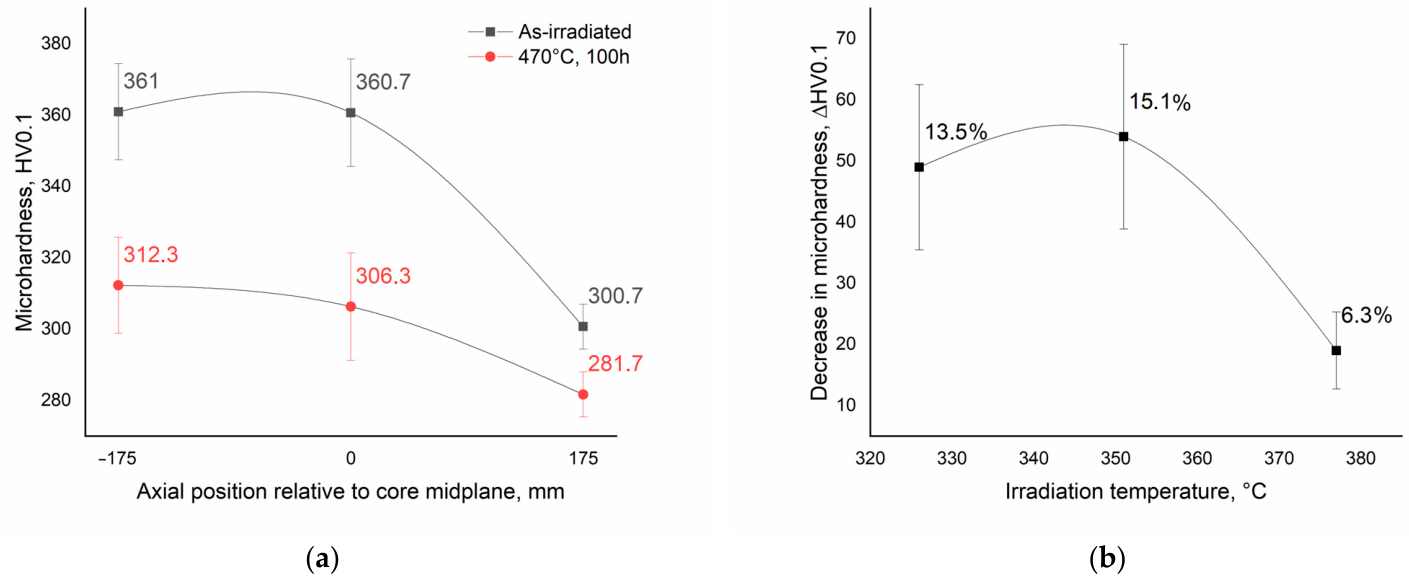
Changes in the HV0.1 microhardness of EI-847 steel after post-irradiation annealing at 470 °C for 100 h: (a) microhardness in the as-irradiated and annealed conditions at the three axial positions; (b) decrease in microhardness as a function of the archive-calculated irradiation temperature.
The absolute decreases in microhardness were 48.7, 54.3, and 19.0 HV0.1 at −175, 0, and +175 mm, respectively. The largest relative decrease, 15.1%, was observed at the reactor core midplane. A similar reduction of 13.5% was measured at −175 mm, whereas the decrease at +175 mm was only 6.3%.
Comparison of ∆HV0.1 with the archive-calculated irradiation temperature reveals a non-monotonic post-irradiation thermal response (Figure 5b). As the irradiation temperature increased from approximately 326 to 351 °C, the decrease in microhardness increased from 48.7 to 54.3 HV0.1. In contrast, for the material irradiated at approximately 377 °C, the decrease was only 19.0 HV0.1. Thus, identical post-irradiation heat treatment produced markedly different degrees of softening in the three axially distinct states of EI-847 steel.
3.3. Changes in Strength and Ductility After Post-Irradiation Annealing
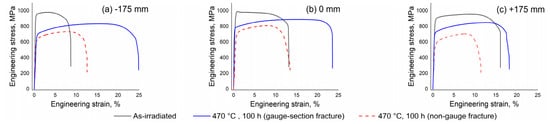
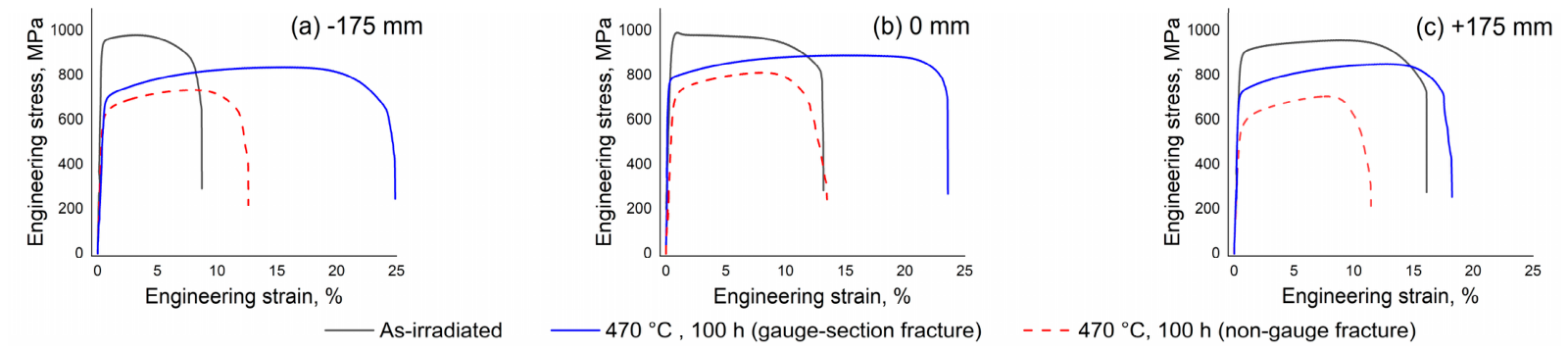
Engineering stress–strain curves for specimens sampled from the three axial positions of the displacer are shown in Figure 6. For each position, one specimen was tested in the as-irradiated condition and two specimens after post-irradiation annealing at 470 °C for 100 h. For all three axial positions, annealing resulted in lower stress levels and greater strain to fracture; however, the magnitude of these changes depended strongly on axial position.
Figure 6.
Engineering stress–strain curves of miniature EI-847 steel specimens in the as-irradiated condition and after post-irradiation annealing at 470 °C for 100 h for axial positions of: (a) −175 mm; (b) 0 mm; and (c) +175 mm relative to the reactor core midplane.
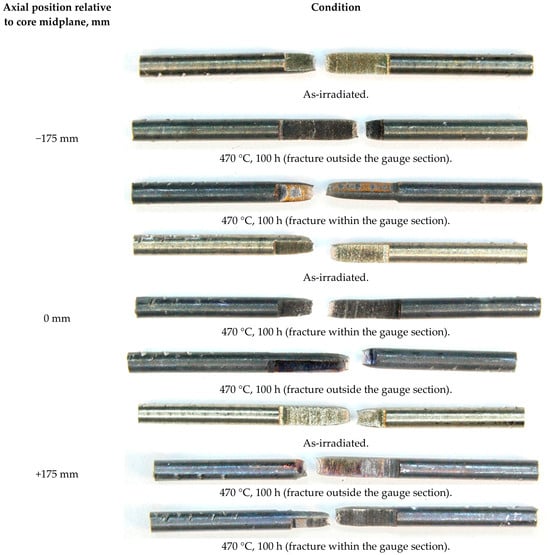
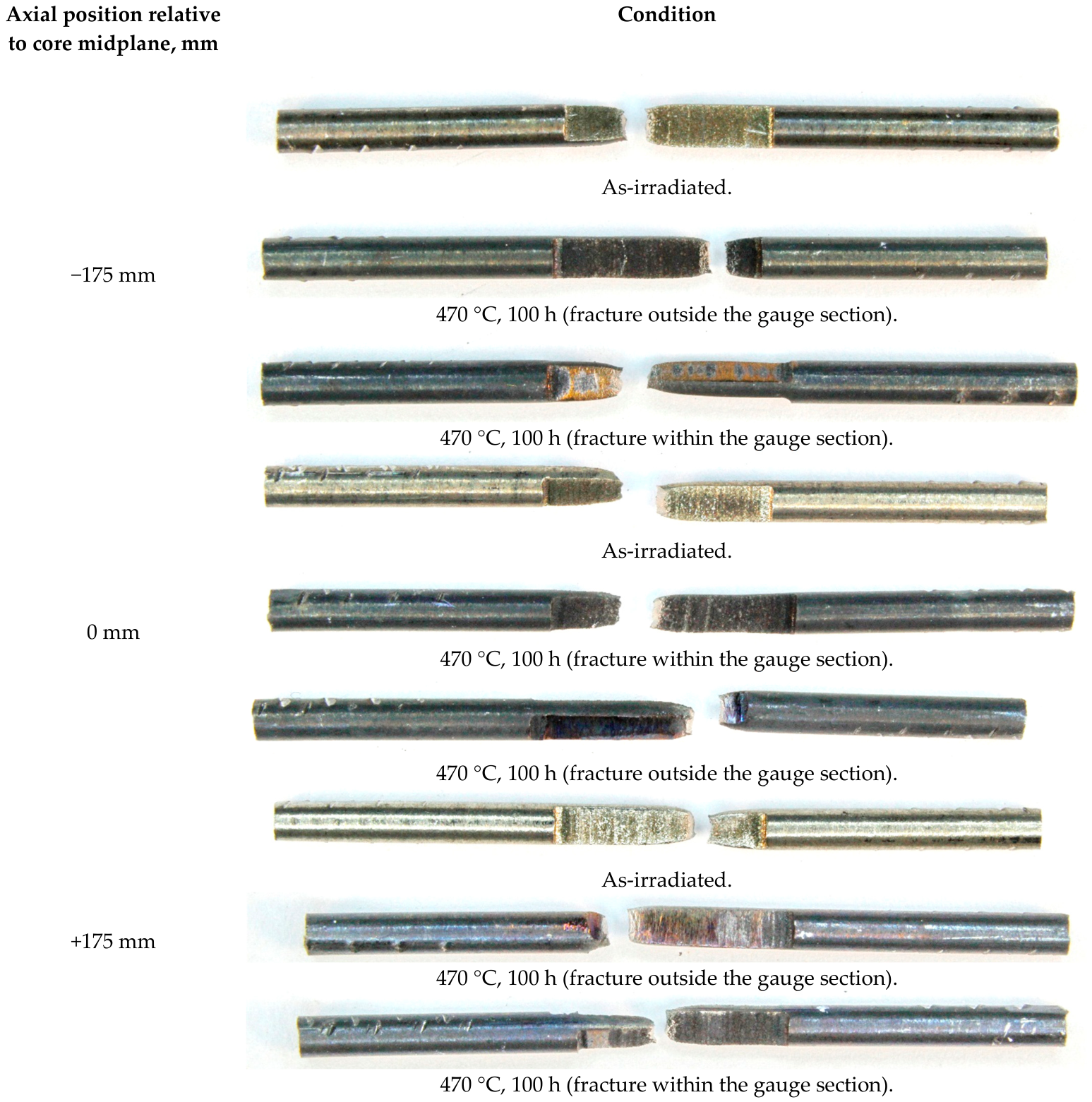
For one of the two annealed specimens at each axial position, fracture occurred outside the gauge section, in the transition region between the gauge and grip sections. The appearance of the specimens after tensile testing is shown in Figure 7. The corresponding engineering stress–strain curves are retained in Figure 6 as part of the complete experimental dataset; however, the strength and ductility values derived from these tests were excluded from the quantitative comparison.
Figure 7.
Appearance of miniature EI-847 steel specimens after uniaxial tensile testing for axial positions of −175, 0, and +175 mm in the as-irradiated condition and after post-irradiation annealing at 470 °C for 100 h. For some annealed specimens, fracture occurred outside the gauge section.
The transition region of the miniature specimen is potentially sensitive to local stress concentration because of the change in cross-section and the small transition radius. Surface condition after EDM machining, minor geometric deviations, and specimen alignment during gripping may also contribute to non-gauge fracture. The available data do not allow the dominant factor to be identified unambiguously. However, because the companion annealed specimen at each axial position, subjected to the same 470 °C/100 h treatment, fractured within the gauge section, the observed non-gauge fractures cannot be regarded as a systematic consequence of annealing-induced local weakening.
The quantitative mechanical properties of the specimens that fractured within the gauge section are summarized in Table 2.
Table 2.
Strength and ductility properties of EI-847 steel in the as-irradiated condition and after post-irradiation annealing at 470 °C for 100 h.
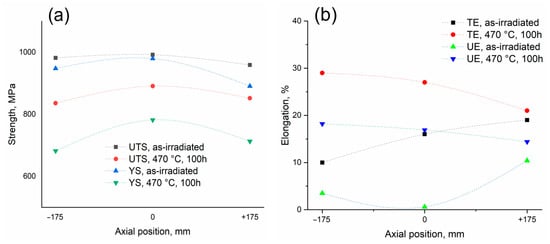
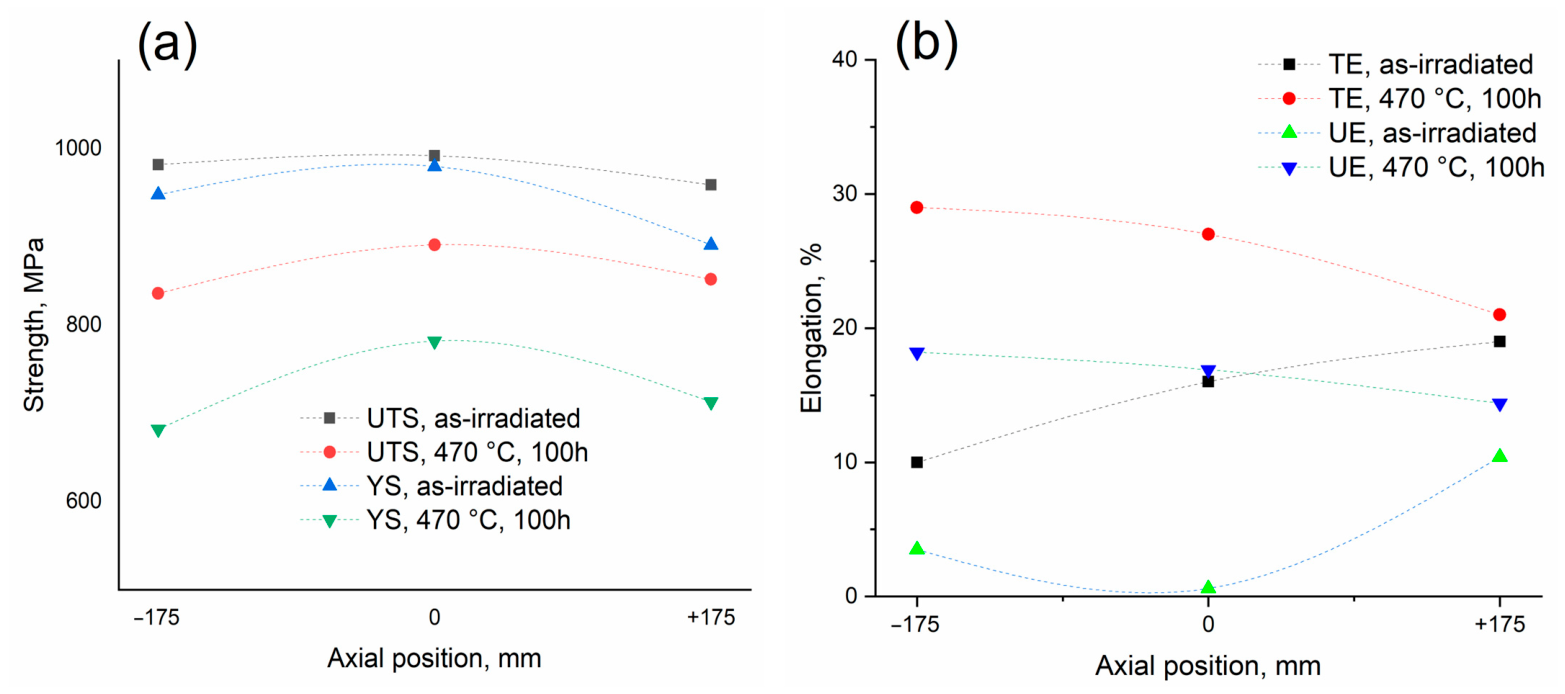
In the as-irradiated condition, UTS varied relatively little along the investigated region, with values of 982, 992, and 959 MPa at −175, 0, and +175 mm, respectively. A more pronounced axial variation was observed in YS. Its maximum value of 980 MPa occurred at the reactor core midplane, whereas values of 948 and 891 MPa were measured at −175 and +175 mm, respectively (Figure 8a).
Figure 8.
Axial distribution of the mechanical properties of EI-847 steel in the as-irradiated condition and after post-irradiation annealing at 470 °C for 100 h: (a) UTS and YS; (b) TE and UE.
After post-irradiation annealing, both strength parameters decreased at all three axial positions. UTS decreased to 836, 891, and 852 MPa at −175, 0, and +175 mm, respectively, corresponding to reductions of approximately 14.9%, 10.2%, and 11.2%. The decrease in YS was considerably larger: YS decreased from 948 to 682 MPa at −175 mm, from 980 to 782 MPa at the reactor core midplane, and from 891 to 713 MPa at +175 mm, corresponding to reductions of approximately 28.1%, 20.2%, and 20.0%, respectively.
The reduction in strength was accompanied by substantial changes in ductility (Figure 8b). At −175 mm, TE increased from 10% to 29%, while at the reactor core midplane it increased from 16% to 27%. The change was much smaller at +175 mm, where TE increased only from 19% to 21%. Even more pronounced differences were observed in UE. After annealing, UE increased from 3.5% to 18.2% at −175 mm and from 0.6% to 16.9% at the reactor core midplane, whereas at +175 mm it increased from 10.4% to 14.4%.
PUE exhibited a different trend. At −175 mm, PUE increased from 6.5% to 10.6%, whereas it decreased from 14.7% to 10.2% at the reactor core midplane and from 8.2% to 5.8% at +175 mm. Thus, post-irradiation annealing altered not only the overall ductility, but also the relative contributions of uniform and PUE.
Taken together, the results show that identical post-irradiation heat treatment produces different mechanical responses in the three axially distinct states of EI-847 steel. At all three positions, the reduction in YS was greater than that in UTS, whereas the recovery of ductility was most pronounced for material from −175 mm and the reactor core midplane and was minimal at +175 mm.
3.4. Fractographic Features of Fracture
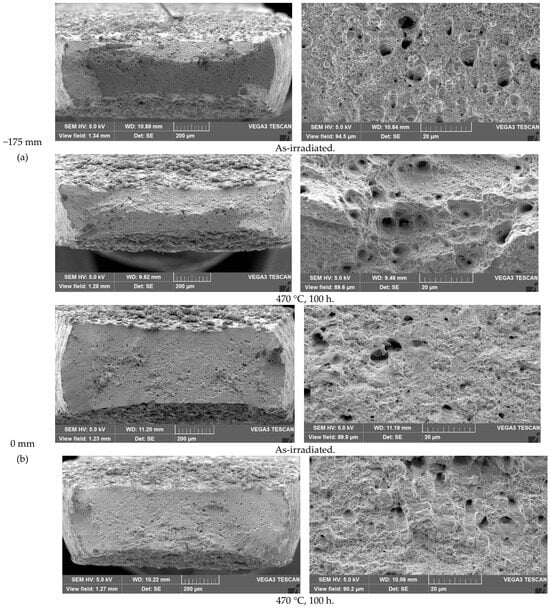
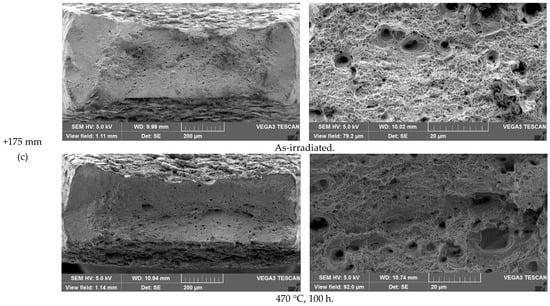
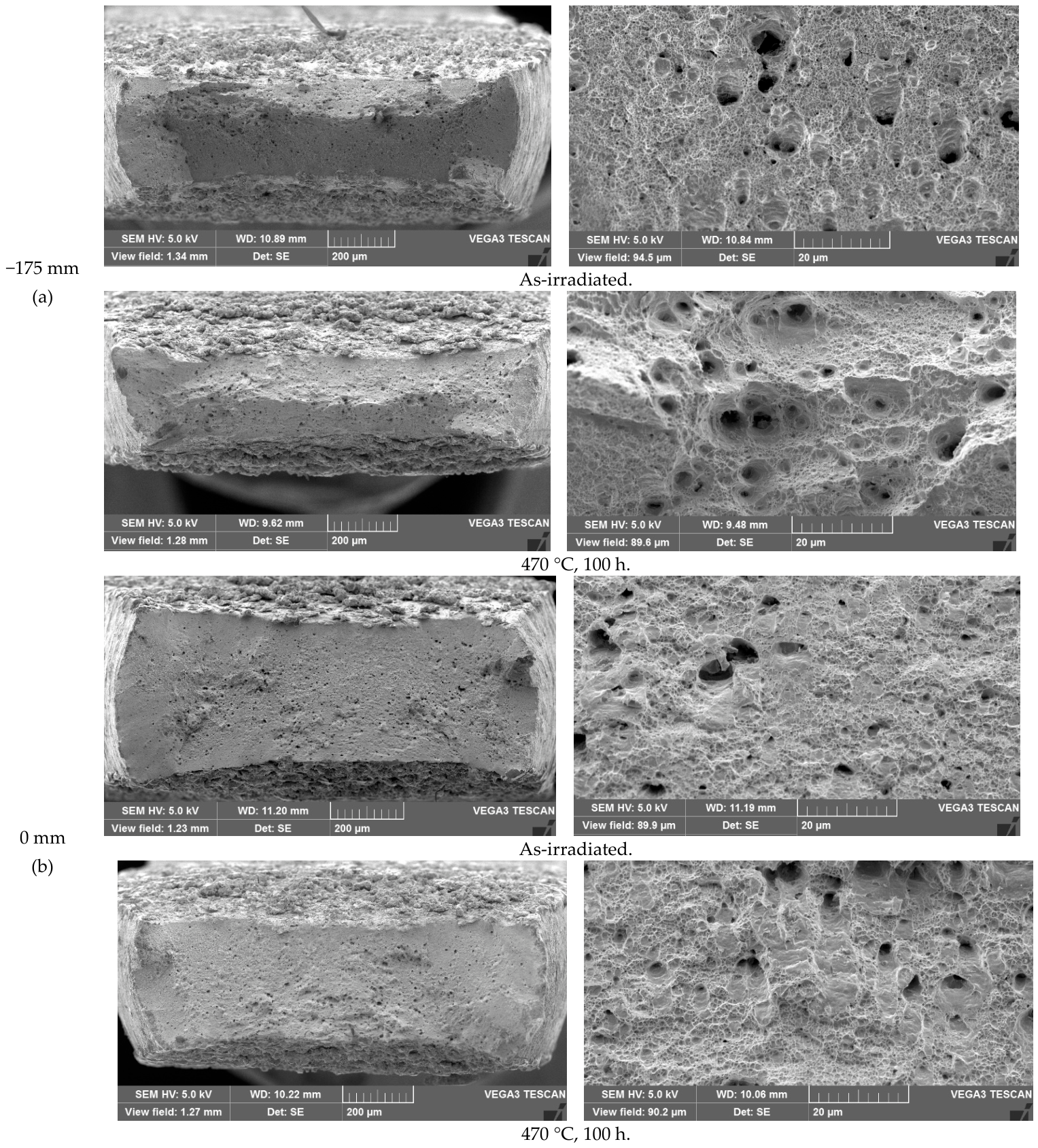
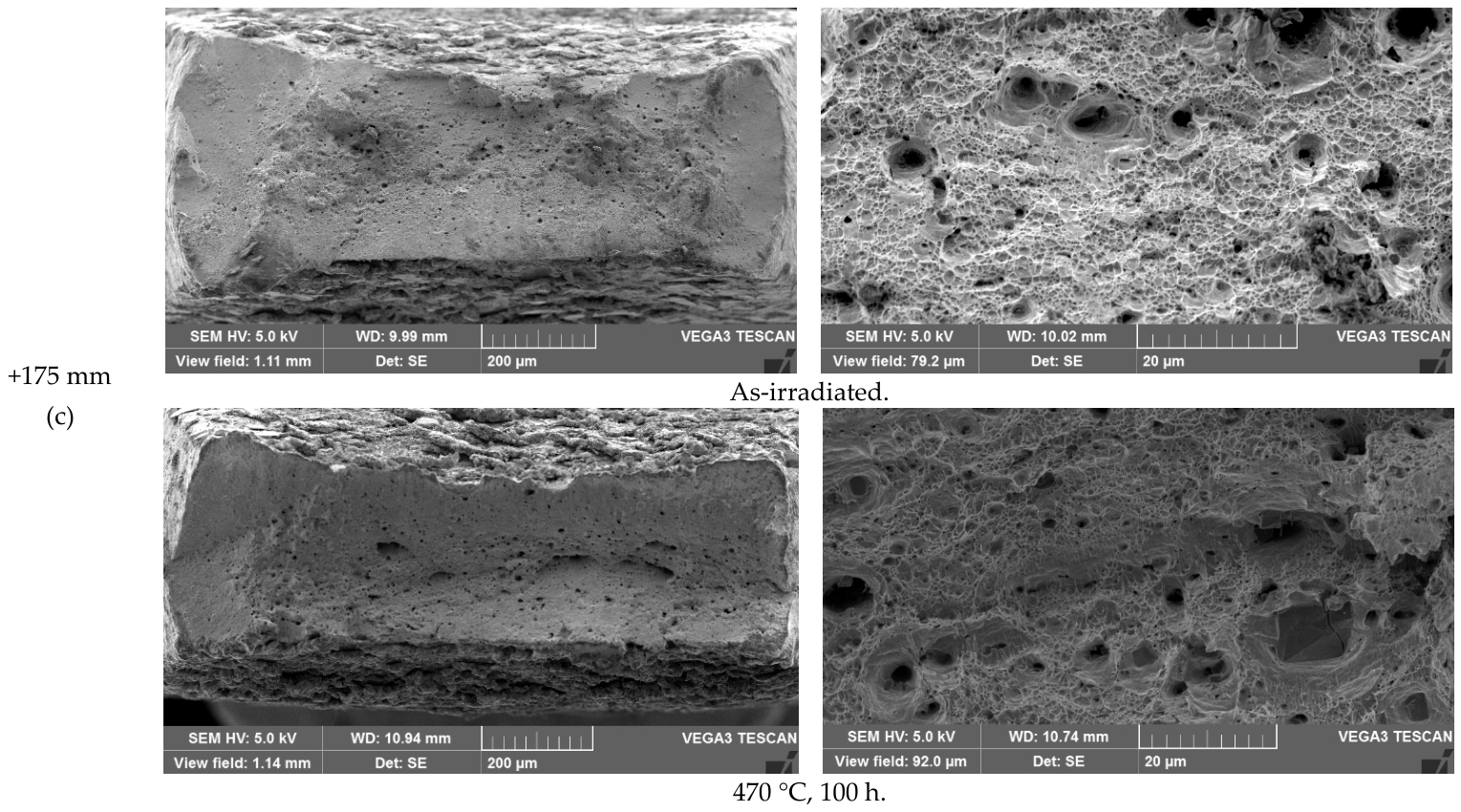
Fractographic examination showed that the fracture surfaces of EI-847 steel specimens from all three axial positions exhibited a predominantly dimpled morphology both in the as-irradiated condition and after post-irradiation annealing at 470 °C for 100 h. In the overview images, the fracture surfaces were characterized by a relatively uniform central region and a more developed relief in the peripheral areas. At higher magnification, the fracture surfaces showed a combination of numerous fine dimples and individual substantially larger cavities.
For the −175 mm position, the as-irradiated condition was characterized by a dense fine-dimpled relief with individual large and deep cavities superimposed on this background (Figure 9a). After annealing, the dimpled character of the fracture surface was retained; however, the distribution of relief features became more heterogeneous, with a greater fraction of large rounded cavities separated by areas with a finer dimpled structure.
Figure 9.
Fractographic images of the fracture surfaces of miniature EI-847 steel specimens sampled from different axial positions relative to the reactor core midplane: (a) −175 mm, (b) 0 mm, and (c) +175 mm. For each axial position, the as-irradiated condition and the condition after post-irradiation annealing at 470 °C for 100 h are shown at two magnifications.
At the reactor core midplane (0 mm), the initial fracture surface was likewise dominated by fine dimples with occasional larger depressions (Figure 9b). After annealing for 100 h, the overall fracture morphology remained essentially unchanged and consisted of a well-developed dimpled surface containing both fine and larger cavities. In the higher-magnification images obtained after annealing, the heterogeneity in dimple size and areas with a more developed plastic relief became somewhat more pronounced.
For the +175 mm position (Figure 9c), the as-irradiated condition was also characterized by a pronounced fine-dimpled background with isolated larger cavities. After annealing, the fracture surface remained dimpled; however, at high magnification, larger and locally irregularly shaped depressions were observed. In the bottom of some of these cavities, individual particles or inclusions were clearly visible.
Overall, post-irradiation annealing at 470 °C for 100 h did not result in a qualitative change in fracture morphology. At all investigated axial positions, the fracture surfaces retained a predominantly dimpled character. The observed differences were manifested mainly in the relative proportions of fine and large dimples and in the degree of heterogeneity of the fracture-surface relief.
4. Discussion
The present results show that the condition of EI-847 steel varies substantially along the investigated displacer after service in the BN-350 reactor. Axial heterogeneity is manifested simultaneously in density, microhardness, and mechanical properties, although these characteristics do not vary in a strictly consistent manner. The minimum density occurs near the reactor core midplane, whereas the lowest HV0.1 microhardness and YS in the as-irradiated condition were recorded at +175 mm. Thus, the post-irradiation state of the material is determined not by a single parameter but by the combined effects of the local irradiation conditions.
Such behavior is consistent with that expected for an elongated component located in the peripheral region of a fuel-pin bundle. The temperature field of a fast-reactor fuel assembly is governed by the distributions of power generation and coolant flow, interchannel mixing, and the geometry of the peripheral region, while displacers are used directly to equalize coolant heating in the near-wall region of the fuel assembly [3]. The −175, 0, and +175 mm sections can therefore be regarded as three local states of the same structural component formed under different combinations of irradiation temperature, damage dose, and damage rate.
The observed axial heterogeneity is interpreted primarily in terms of the different local irradiation histories experienced by regions of the same reactor-operated displacer. Although the three investigated sections share a common manufacturing history, their archive-calculated irradiation temperatures differ substantially (~326, ~351, and ~377 °C), while displacement damage and damage rate also vary axially within the reactor field. Temperature, accumulated damage, and damage rate act jointly in austenitic steels by controlling point-defect mobility and recombination, dislocation-loop and cavity evolution, irradiation-induced segregation, and precipitation. Their individual contributions therefore cannot be separated from the present data, and a simple monotonic dependence of all measured properties on irradiation temperature should not be expected.
This interpretation is supported by post-irradiation studies of actual BN-350 components. Pronounced axial variations in microstructure, swelling, density, microhardness, and mechanical properties have been associated with position-dependent irradiation temperature, dose, and dpa rate [17,24,25]. The strong sensitivity of closely related Fe–16Cr–15Ni–3Mo steels to displacement rate has also been demonstrated [26]. EI-847 itself exhibits a pronounced dose- and temperature-dependent swelling response, including substantial swelling after BN-350 irradiation at 335–365 °C [27,28]. Similar effects of irradiation-temperature and dose gradients on microstructural evolution have been reported for other neutron-irradiated austenitic stainless steels [29]. These results support the interpretation of the present density, hardness, tensile-property, and post-annealing differences as manifestations of distinct local irradiation-induced states rather than as responses controlled by temperature alone.
The axial variation in density is of particular interest. Porollo et al. [13] demonstrated a pronounced temperature dependence of volumetric changes in neutron-irradiated EI-847, EP-172, and ChS-68 austenitic steels. For cold-worked conditions, the swelling maximum was generally observed at approximately 420–460 °C, whereas for solution-annealed materials it could shift toward higher temperatures [13]. Earlier experiments on Fe–16Cr–15Ni–Mo–Nb steel irradiated in BN-350 at 480 °C to 60 dpa also revealed substantial void swelling, which increased markedly under applied stress [14]. The archive-calculated irradiation temperatures of all three sections examined in the present study are below this swelling-temperature range. The reduced density observed near the reactor core midplane should therefore be regarded as an integral indication of the irradiation-modified material state rather than attributed directly to a single volumetric-change mechanism.
A clearer trend is observed in the initial strength-related properties. From the reactor core midplane to +175 mm, the microhardness decreases from approximately 361 to 301 HV0.1 and YS from 980 to 891 MPa, whereas TE and UE increase. Thus, the material irradiated at the highest temperature investigated (~377 °C) exhibits a less pronounced hardened state. More broadly, this behavior is consistent with the known temperature sensitivity of the irradiation response of austenitic steels: increasing irradiation temperature enhances point-defect mobility and alters the evolution of the dislocation and phase structure during irradiation [13,16].
The effect of irradiation temperature on EI-847 has previously been demonstrated directly in BN-350 irradiation experiments. Porollo et al. investigated EI-847, EP-172, ChS-68, and 08Cr18Ni10Ti steels irradiated to 57–59 dpa at 390–490 °C and showed that irradiation temperature had a particularly pronounced effect on the mechanical behavior of EI-847 and 08Cr18Ni10Ti; a shift in the temperature range of high-temperature radiation embrittlement was also observed for EI-847 [16]. Although the testing temperatures and initial material conditions differed from those in the present study, these results confirm the inherent sensitivity of EI-847 to its irradiation-temperature history.
Comparative studies of EI-847, EP-172, and ChS-68 are particularly informative in this respect. EP-172 was developed from EI-847 by boron addition, whereas further compositional modification led to ChS-68, which contains Ti, V, B, and a higher Si content [13,15]. These subsequent alloys exhibited improved irradiation stability. Comparison of the microstructures of EI-847 and ChS-68 showed that, at temperatures close to the swelling maximum, the evolution of their dislocation structures differed: defect loops were no longer observed in EI-847 at approximately 50 dpa, whereas they persisted in ChS-68 up to 82–84 dpa [15]. In EP-172, which differs from EI-847 primarily by its higher boron content, loops also persisted to higher damage doses [15]. These observations are relevant to the present study because they demonstrate that the thermal stability of an irradiation-induced microstructure can be strongly affected even by relatively modest differences in composition and initial structural state.
The most important result of the present study emerges after identical post-irradiation annealing at 470 °C for 100 h. If the extent of thermal recovery were governed mainly by the temperature difference between reactor irradiation and subsequent annealing, the greatest softening would be expected for the −175 mm section, which experienced the lowest irradiation temperature. Experimentally, however, the HV0.1 decrease was 13.5% at −175 mm, reached a maximum of 15.1% at the reactor core midplane, and decreased to only 6.3% at +175 mm. Thus, the thermal response is governed not simply by the temperature difference but by the material state established before post-irradiation annealing.
This is particularly evident for the +175 mm section. Even before annealing, this material exhibits the lowest microhardness and YS, and the highest UE among the three investigated positions. After 100 h at 470 °C, the reduction in HV0.1 at +175 mm is approximately 2.5 times smaller than that at the reactor core midplane. At the same time, the TE increases only from 19% to 21%, compared with increases from 10% to 29% at −175 mm and from 16% to 27% at the reactor core midplane. Thus, even before post-irradiation heat treatment, the material from +175 mm is in a state that is markedly less responsive to further thermal exposure.
The ability of irradiated austenitic steels to undergo substantial property changes during prolonged exposure, even at low temperatures, is supported by studies of the natural aging of BN-350 materials. Rofman et al. reported a 10–25% decrease in the hardness of irradiated austenitic steels after approximately 15 years of storage at room temperature [18]. The post-irradiation state of an austenitic steel should therefore not be regarded as structurally frozen; its subsequent evolution depends on both temperature and exposure time.
The changes in mechanical properties after annealing are consistent with the microhardness results but provide a more detailed picture of the softening behavior. At all three axial positions, the reduction in YS is substantially greater than that in UTS: YS decreases by approximately 20–28%, whereas UTS decreases by only 10–15%. At the same time, TE and, in particular, UE increase. Post-irradiation annealing therefore primarily reduces the resistance to the onset of plastic flow and restores the ability of the material to undergo uniform plastic deformation, while the maximum tensile strength is affected to a considerably smaller extent.
This relationship between hardness and YS is consistent with the general behavior of irradiation-hardened austenitic steels. A close relationship between changes in hardness and irradiation-induced increases in yield strength has previously been demonstrated for these materials [30]. In addition, studies of post-irradiation annealing of neutron-irradiated 304L stainless steel showed that the reduction in hardening is associated with a decreasing contribution of irradiation-induced obstacles to dislocation motion, while different defect populations exhibit different thermal stabilities [31]. For EI-847, the relative contributions of individual defect populations may differ; nevertheless, the concurrent changes in HV0.1, YS, and ductility are consistent with partial recovery of the irradiation-hardened state.
It is also useful to compare these results with recent data for EP-450 ferritic–martensitic steel from BN-350 SFA wrappers. At the same annealing temperature of 470 °C, the decrease in hardness was accompanied by a reduction in YS, whereas UTS changed considerably less after the initial decrease [20]. The similarity in the macroscopic response of the two steels points to a common contribution from the reduction in irradiation hardening during post-irradiation thermal exposure. However, the extent of recovery in EI-847 and EP-450 should not be compared directly because the materials differ in crystal structure, initial condition, and irradiation-induced microstructure.
The fractographic observations further show that the changes in mechanical properties are not accompanied by a qualitative change in fracture mode. A predominantly dimpled fracture morphology is retained in all investigated conditions. The substantial increases in TE and UE after annealing should therefore be associated primarily with an increased capacity for plastic deformation prior to fracture rather than with a transition between fundamentally different fracture modes.
Taken together, the results indicate that the axial heterogeneity of the displacer reflects the different thermal and irradiation histories experienced by its individual sections. Importantly, the initial hardness alone does not fully determine the subsequent response: the −175 mm and reactor-core-midplane sections have nearly identical initial HV0.1 values but exhibit different reductions in hardness and different changes in mechanical properties after identical annealing. Likewise, the minimum density at the reactor core midplane does not coincide with the minimum hardness at +175 mm. Accordingly, assessment of the residual state of such an elongated structural component requires consideration of multiple material characteristics together with the local conditions experienced during reactor operation.
Thus, the principal finding of the present study is the identification of an axial dependence of the post-irradiation thermal stability of EI-847 steel. Material from −175 mm and the reactor core midplane exhibits pronounced softening and ductility recovery after 100 h at 470 °C, whereas the +175 mm section, which was irradiated at the highest temperature, responds much less strongly to the same thermal treatment. This demonstrates that identical post-irradiation annealing does not produce the same degree of recovery in different sections of a single irradiated structural component and that the thermal response is governed by the material state established during reactor service.
5. Conclusions
The present study demonstrated pronounced axial heterogeneity in the condition of EI-847 austenitic steel from a BN-350 spent fuel assembly displacer, formed during reactor irradiation. Differences among the −175, 0, and +175 mm positions were reflected in density, microhardness, strength, and ductility and persisted during subsequent thermal exposure. Identical post-irradiation annealing at 470 °C for 100 h did not produce an identical material response: the most pronounced softening and ductility recovery occurred at −175 mm and at the reactor core midplane, whereas the +175 mm section, which had experienced the highest archive-calculated irradiation temperature, showed substantially smaller changes. The decrease in YS was greater than the decrease in UTS, while a predominantly dimpled fracture morphology was retained in all investigated conditions.
Thus, the post-irradiation thermal stability of EI-847 steel is governed not only by the subsequent annealing conditions but also by the material state established under local reactor operating conditions. These results demonstrate the importance of accounting for axial heterogeneity when assessing the residual condition of elongated fuel assembly components and extend the available data on the irradiation behavior of EI-847 steel in actual sodium-cooled fast reactor components.
Author Contributions
Conceptualization, Y.S. and Y.K.; methodology, Y.S.; software, Y.S.; validation, K.S., Y.S. and Y.A.; formal analysis Y.S., K.S. and Y.K.; investigation, Y.S., K.S. and Y.A.; resources, Y.S. and Y.K.; data curation, Y.A.; writing—original draft preparation, K.S.; writing—review and editing, K.S.; visualization, Y.S.; supervision, Y.K.; project administration, Y.S.; funding acquisition, Y.S. All authors have read and agreed to the published version of the manuscript.
Funding
This research was funded by the Committee of Science of the Ministry of Science and Higher Education of the Republic of Kazakhstan, grant number BR24993104.
Data Availability Statement
The original contributions presented in this study are included in the article. Further inquiries can be directed to the corresponding author.
Acknowledgments
The authors express their gratitude to the specialists of the Institute of Atomic Energy Branch of the National Nuclear Center of the Republic of Kazakhstan for their professional assistance and advice in obtaining the results.
Conflicts of Interest
The authors declare no conflicts of interest.
Abbreviations
| FA | Fuel assembly |
| SFA | Spent fuel assembly |
| SFR | Sodium-cooled fast reactor |
| dpa | Displacements per atom |
| EFPD | Effective full-power days |
| EDM | Electrical discharge machining |
| YS | Yield strength |
| UTS | Ultimate tensile strength |
| UE | Uniform elongation |
| TE | Total elongation |
| PUE | Post-uniform elongation |
References
- International Atomic Energy Agency. Structural Materials for Liquid Metal Cooled Fast Reactor Fuel Assemblies—Operational Behaviour; IAEA Nuclear Energy Series No. NF-T-4.3; IAEA: Vienna, Austria, 2012. [Google Scholar]
- Gordeev, S.S.; Sorokin, A.P.; Denisova, N.A. Features of Formation of the Temperature Field of a Fast-Neutron Reactor Core during the Campaign. Probl. At. Sci. Technol. Ser. Nucl. React. Constants 2018, 3, 213–239. (In Russian) [Google Scholar]
- Gordeev, S.S.; Sorokin, A.P.; Tikhomirov, B.B.; Trufanov, A.A.; Denisova, N.A. Method of Calculating the Temperature Regimes of Fuel Elements in Fuel Assemblies Taking Account of Inter-Channel Coolant Mixing and Random Deviations of the Parameters. At. Energy 2017, 122, 19–28. [Google Scholar] [CrossRef] [Scilit]
- Sorokin, A.P.; Kuzina, Y.A.; Denisova, N.A. Thermal Hydraulic Studies of the Temperature Regimes of the Fuel Assemblies of Fast Reactor Core (on the 50th Anniversary of the Start-Up of the NPP with the BN-350 Reactor). Probl. At. Sci. Technol. Ser. Nucl. React. Constants 2023, 4, 120–145. (In Russian) [Google Scholar]
- Sorokin, A.P.; Sorokin, G.A.; Kuzina, Y.A.; Denisova, N.A. Formation of the Temperature Regime of Fuel Assemblies in Fast Reactor Core under Influence of Various Factors. Probl. At. Sci. Technol. Ser. Nucl. React. Constants 2026, 2, 263–319. (In Russian) [Google Scholar]
- Mukhamedov, N.; Toleubekov, K.; Vityuk, G.; Bekmuldin, M.; Dolzhikov, S. Decommissioning of the BN-350 Fast Neutron Reactor: History Review and Current Status. Energies 2025, 18, 3486. [Google Scholar] [CrossRef] [Scilit]
- Troyanov, V.M.; Kamaev, A.A. Evolution of Fast Reactors. The Role of a BN-350 Reactor. At. Energy 2025, 136, 222–232. [Google Scholar] [CrossRef] [Scilit]
- International Atomic Energy Agency. Power Reactor Information System (PRIS): AKTAU. IAEA PRIS—AKTAU. Available online: https://pris-stats.iaea.org/reactor/414 (accessed on 8 October 2026).
- World Nuclear Association. Aktau. Available online: https://world-nuclear.org/nuclear-reactor-database/details/AKTAU (accessed on 8 October 2026).
- Sapatayev, Y.; Samarkhanov, K.; Yakovlev, V.; Prozorova, I.; Bochkov, V.; Pospelov, V. Radiation Characteristics and Safety Assessment of the BN-350 Fast Reactor’s Spent Nuclear Fuel Model Under Long-Term Dry Storage Conditions. Appl. Sci. 2026, 16, 4764. [Google Scholar] [CrossRef] [Scilit]
- Koyanbayev, Y.T.; Skakov, M.K.; Ganovichev, D.A.; Martynenko, Y.A.; Sitnikov, A.A. Simulation of the Thermal Conditions of Cask with Fuel Assemblies of BN-350 Reactor for Dry Storage. Sci. Technol. Nucl. Install. 2019, 2019, 3045897. [Google Scholar] [CrossRef] [Scilit]
- Sapatayev, Y.; Samarkhanov, K.; Yakovlev, V.; Azimkhanov, A.; Pospelov, V.; Bochkov, V. Monitoring and Condition Assessment of the TUK-123/UKKh-123 Casks Containing BN-350 Spent Nuclear Fuel. Appl. Sci. 2026, 16, 8060. [Google Scholar] [CrossRef] [Scilit]
- Porollo, S.I.; Shulepin, S.V.; Ivanov, A.A.; Konobeev, Y.V.; Budylkin, N.I.; Mironova, E.G. Swelling and Radiation Creep of Austenitic Corrosion-Resistant Steel Irradiated by Neutrons in Wide Dose and Temperature Ranges. At. Energy 2011, 110, 248–258. [Google Scholar] [CrossRef] [Scilit]
- Vorobjev, A.N.; Budylkin, N.I.; Mironova, E.G.; Porollo, S.I.; Konobeev, Y.V.; Garner, F.A. Irradiation Creep and Stress-Enhanced Swelling of Fe–16Cr–15Ni–Nb Austenitic Stainless Steel in BN-350. J. Nucl. Mater. 1998, 258–263, 1618–1622. [Google Scholar] [CrossRef] [Scilit]
- Porollo, S.I.; Konobeev, Y.V.; Garner, F.A. Swelling and Microstructure of Austenitic Stainless Steel ChS-68 CW after High Dose Neutron Irradiation. J. Nucl. Mater. 2009, 393, 61–66. [Google Scholar] [CrossRef] [Scilit]
- Porollo, S.I.; Ivanov, A.A.; Konobeev, Y.V.; Shulepin, S.V. High-Temperature Radiation Embrittlement of Neutron-Irradiated Austenitic Stainless Steels 08Kh18N10T, EI-847, EP-172, and ChS-68. At. Energy 2020, 128, 82–87. [Google Scholar] [CrossRef] [Scilit]
- Maksimkin, O.P.; Tsay, K.V.; Garner, F.A. Inhomogeneity of Microstructure, Mechanical Properties, Magnetism, and Corrosion Observed in a 12Cr18Ni10Ti Fuel Assembly Shroud Irradiated in BN-350 to 59 dpa. J. Nucl. Mater. 2015, 467, 899–910. [Google Scholar] [CrossRef] [Scilit]
- Rofman, O.V.; Maksimkin, O.P.; Tsay, K.V.; Koyanbayev, Y.T.; Short, M.P. The Natural Aging of Austenitic Stainless Steels Irradiated with Fast Neutrons. J. Nucl. Mater. 2018, 499, 284–293. [Google Scholar] [CrossRef] [Scilit]
- Koyanbayev, Y. Applying the Hollomon-Jaffe Parameter to Predict Changes in Mechanical Properties of Irradiated Austenitic Chromium-Nickel Steels during Isothermal Exposure. AIMS Mater. Sci. 2024, 11, 216–230. [Google Scholar] [CrossRef] [Scilit]
- Sapatayev, Y.; Koyanbayev, Y.; Samarkhanov, K.; Kukushkin, I.; Aryngazy, Y. Time-Dependent Thermal Recovery of Irradiation Hardening in EP-450 Steel from BN-350 Spent Fuel Assembly Wrappers During Isothermal Annealing at 470 °C. Metals 2026, 16, 1073. [Google Scholar] [CrossRef] [Scilit]
- Budov, V.M.; Beznosov, A.V.; Farafonov, V.A. Main Equipment of Nuclear Power Plants; Gorky Polytechnic Institute: Gorky, Russia, 1979; p. 72. (In Russian) [Google Scholar]
- Budov, V.M.; Farafonov, V.A. Design of the Main Equipment of Nuclear Power Plants; Energoatomizdat: Moscow, Russia, 1985; p. 264. (In Russian) [Google Scholar]
- GOST 1497-84; Metals. Methods for Tensile Tests. State Committee of the USSR for Standards: Moscow, Russia, 1984. Available online: https://vsegost.com/Catalog/46/4616.shtml (accessed on 8 October 2026).
- Maksimkin, O.P.; Tsai, K.V.; Turubarova, L.G.; Doronina, T.; Garner, F.A. Characterization of 08Cr16Ni11Mo3 Stainless Steel Irradiated in the BN-350 Reactor. J. Nucl. Mater. 2004, 329–333, 625–629. [Google Scholar] [CrossRef] [Scilit]
- Maksimkin, O.P.; Tsai, K.V.; Turubarova, L.G.; Doronina, T.; Garner, F.A. Void Swelling of AISI 321 Analog Stainless Steel Irradiated at Low dpa Rates in the BN-350 Reactor. J. Nucl. Mater. 2007, 367–370, 990–994. [Google Scholar] [CrossRef] [Scilit]
- Budylkin, N.I.; Bulanova, T.M.; Mironova, E.G.; Mitrofanova, N.M.; Porollo, S.I.; Chernov, V.M.; Shamardin, V.K.; Garner, F.A. The Strong Influence of Displacement Rate on Void Swelling in Variants of Fe–16Cr–15Ni–3Mo Austenitic Stainless Steel Irradiated in BN-350 and BOR-60. J. Nucl. Mater. 2004, 329–333, 621–624. [Google Scholar] [CrossRef] [Scilit]
- Porollo, S.I.; Vorobjev, A.N.; Konobeev, Y.V.; Dvoriashin, A.M.; Krigan, V.M.; Budylkin, N.I.; Mironova, E.G.; Garner, F.A. Swelling and Void-Induced Embrittlement of Austenitic Stainless Steel Irradiated to 73–82 dpa at 335–365 °C. J. Nucl. Mater. 1998, 258–263, 1613–1617. [Google Scholar] [CrossRef] [Scilit]
- Bykov, V.N.; Dmitriev, V.D.; Kostromin, L.G.; Porollo, S.I.; Shcherbak, V.I. Empirical Dependence of Swelling of 0Kh16N15M3B Steel on Irradiation Dose and Temperature. At. Energy 1976, 40, 293–295. [Google Scholar] [CrossRef] [Scilit]
- Edwards, D.J.; Simonen, E.P.; Garner, F.A.; Greenwood, L.R.; Oliver, B.A.; Bruemmer, S.M. Influence of Irradiation Temperature and Dose Gradients on the Microstructural Evolution in Neutron-Irradiated 316 SS. J. Nucl. Mater. 2003, 317, 32–45. [Google Scholar] [CrossRef] [Scilit]
- Busby, J.T.; Hash, M.C.; Was, G.S. The Relationship between Hardness and Yield Stress in Irradiated Austenitic and Ferritic Steels. J. Nucl. Mater. 2005, 336, 267–278. [Google Scholar] [CrossRef] [Scilit]
- Jiao, Z.; Hesterberg, J.; Was, G.S. Insights into the Sources of Irradiation Hardening in a Neutron-Irradiated 304L Stainless Steel Following Post-Irradiation Annealing. J. Nucl. Mater. 2019, 526, 151754. [Google Scholar] [CrossRef] [Scilit]

Disclaimer/Publisher’s Note: The statements, opinions and data contained in all publications are solely those of the individual author(s) and contributor(s) and not of MDPI and/or the editor(s). MDPI and/or the editor(s) disclaim responsibility for any injury to people or property resulting from any ideas, methods, instructions or products referred to in the content. |
© 2026 by the authors. Licensee MDPI, Basel, Switzerland. This article is an open access article distributed under the terms and conditions of the Creative Commons Attribution (CC BY) license.