


Abstract
Bayer red mud is a highly alkaline, fine-grained solid waste generated at ~180 million tons per year, posing persistent environmental hazards while containing recoverable Fe, Al, Ti, and rare earth elements. This review critically evaluates selective metal recovery from an environmental chemical engineering perspective. We link metal/alkali occurrence to leachability and selectivity, and position dealkalization as an essential pretreatment to mitigate hazards and enable downstream recovery. Pyrometallurgical, hydrometallurgical, and bio-based routes are compared for recovery performance, energy/carbon footprint, and secondary pollution risks. We further discuss prediction-guided optimization using artificial neural networks and atomistic simulations (DFT) to reduce trial-and-error and improve process transferability. Finally, we propose a hazard-controlled, closed-loop valorization framework integrating staged recovery, reagent/water recycling, and harmonized sustainability metrics. This review provides green guidance for transforming red mud from an environmental liability into a safer secondary resource.
1. Introduction
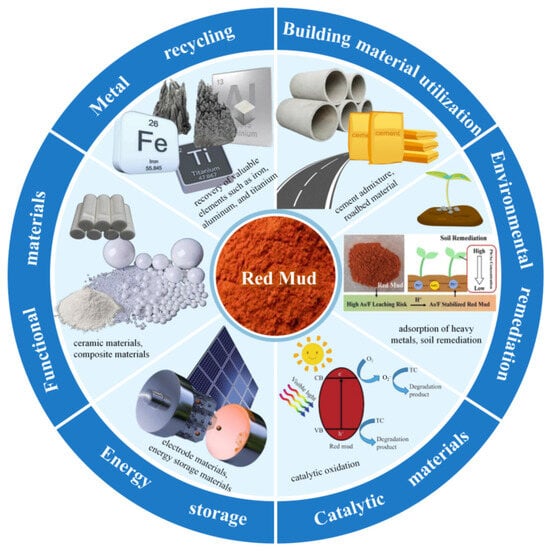
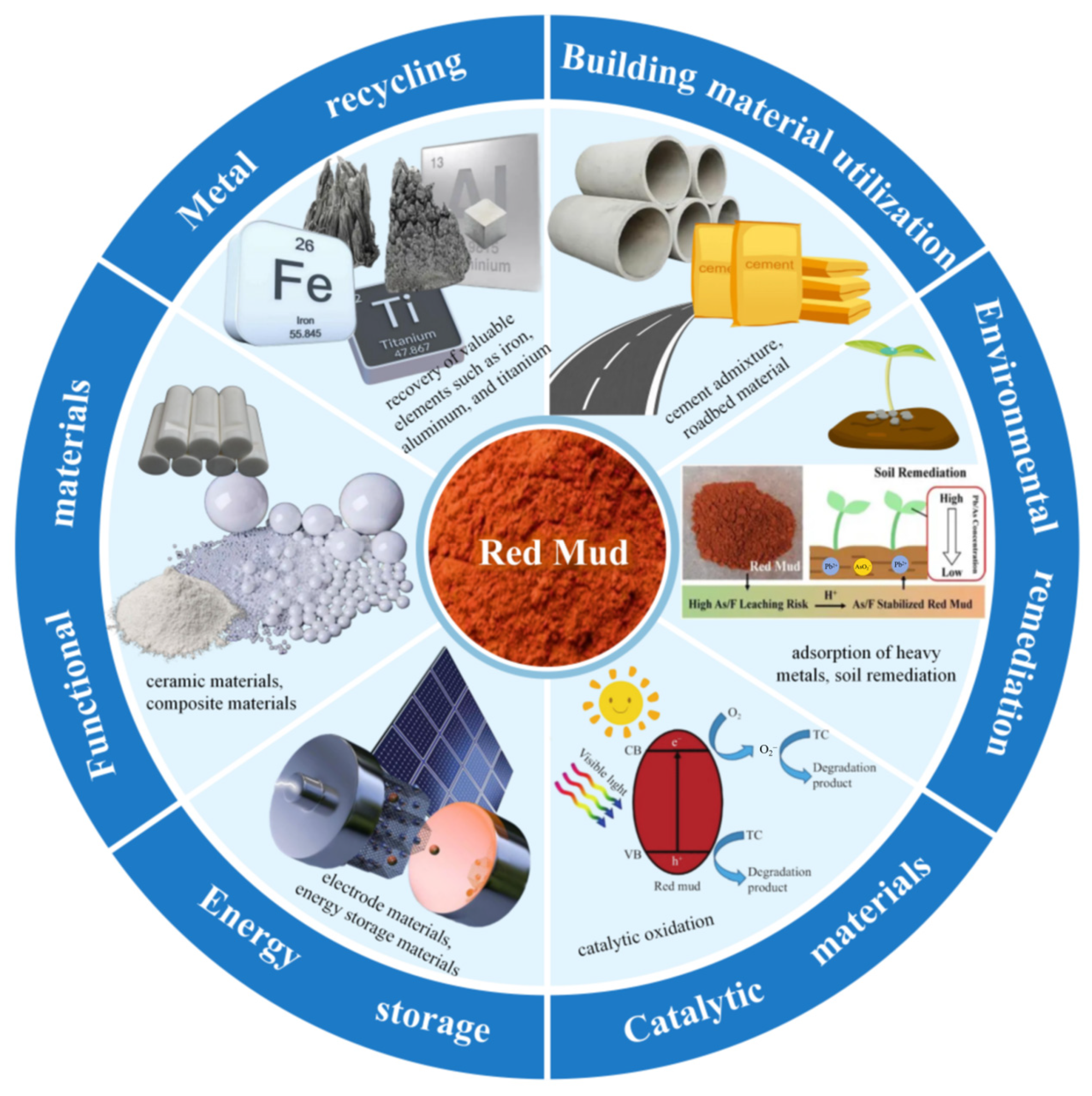
Red mud, also referred to as Bayer residue, is a highly alkaline solid waste generated during alumina production [1]. Approximately 0.8–2.0 t of red mud is produced per 1 t of alumina, and Bayer-process red mud accounts for ~90% of the total generation [2]. In China, major accumulations are observed in the Yellow River basin (Shandong, Shanxi, and Henan) and in bauxite-rich or alumina-intensive provinces in the south (Guangxi, Guizhou, and Yunnan) [3]. With sustained economic growth, China has become the world’s largest producer and consumer of alumina in recent years, and its red mud discharge is reported to exceed 54.3% of the global total [4]. Consequently, the development of efficient resource recovery strategies for red mud is regarded as an urgent priority [5].The utilization of red mud resources is shown in Figure 1.
Figure 1.
Overview of resource utilization of red mud.
As a representative bulk industrial residue from the alumina sector, red mud contains appreciable amounts of metals, particularly Fe, Al, Ti, and REEs [6], and is therefore widely considered a potential “secondary metal resource” [7]. The global stockpile is estimated to have reached ~4.0 billion tons, with an annual generation of ~180 million tons [8], highlighting the vast scale of this residue stream [9]. Nevertheless, under the dual pressures of declining fossil resources and tightening metal supply, the global green utilization rate of red mud remains below 10% [10]. This low utilization is mainly attributed to the pronounced variability in composition and properties among red muds from different regions, together with their shared characteristics of high alkalinity and complex mineralogical structures [11]. In addition, the entrained alkaline liquor typically contains strongly caustic species, with Na2O contents of 3–12%; the pH generally ranges from 10 to 13, with an average of 11.3 ± 1.0 [12]. Such alkaline features substantially constrain process recyclability and complicate downstream metal recovery.
At present, metal recovery from red mud is primarily approached via three technological routes: pyrometallurgical recovery [13], hydrometallurgical leaching [14], and emerging bio-based processes [15]. Pyrometallurgical treatment is typically centered on reductive roasting and is mainly applied to the separation of major metals such as iron and aluminum [16]. Hydrometallurgical recovery relies on the selective dissolution of target metals in acidic or alkaline media and is particularly suited to the enrichment of REEs [17]. Bio-based techniques exploit metabolites produced by microorganisms to leach metals under mild conditions, offering advantages in terms of lower energy demand and improved environmental compatibility [18]. Importantly, high alkalinity is widely recognized as the primary barrier to efficient metal recovery from red mud. Accordingly, dealkalization is positioned as a prerequisite step that facilitates subsequent recovery routes by mitigating process interference [19], reducing equipment corrosion, enhancing biocompatibility, and lowering environmental risks [20]. The recovery of valuable metals from red mud not only alleviates pressure on primary resources but also provides a practical pathway for detoxification and high-value utilization.
In summary, the valorization of red mud is not only integral to carbon neutrality targets but is also a key direction for the green and sustainable development of the aluminum industry. On the basis of a critical review of the fundamental properties of red mud and its associated environmental concerns, the current progress and mechanistic principles of valuable-metal recovery technologies are systematically analyzed herein. The strengths and limitations of representative approaches are compared, predictive analyses of metal-recovery mechanisms are discussed, and priority research topics and future development directions are proposed, with the aim of providing a scientific basis and technical guidance for efficient, green, and integrated recovery from red mud.
Distinct from many previously published reviews that only focus on a single metallurgical technique for red-mud treatment, the present work takes the occurrence modes of metals and alkali as a core logical thread and couples dealkalization pretreatment with downstream selective metal recovery. We clarify that dealkalization is not merely a waste-disposal step but an indispensable pretreatment unit for metallurgical processing. This review constructs a “mechanism-data-driven” optimization framework integrating atomistic simulations (DFT, MD) and machine-learning algorithms, and further puts forward a hazard-controlled closed-loop valorization concept featuring occurrence-oriented staged recovery, reagent-water closed-loop circulation and multi-dimensional sustainability evaluation metrics. From an environmental chemical-engineering perspective, this paper delivers critical assessment of process performance together with carbon-footprint and secondary-pollution-risk analysis, offering practical operational guidance for engineering practice.
The literature analysed in this review was retrieved from Web of Science, Scopus and CNKI databases using search terms including “Bayer red mud/bauxite residue”, “dealkalization”, “rare-earth recovery”, “pyrometallurgy”, “bioleaching”, “DFT”, “artificial neural network”, covering publications from 2010 to 2025. Peer-reviewed original research articles and high-quality reviews were prioritized, with preference given to studies containing experimental data, mechanistic discussion or pilot-scale test results. Purely descriptive non-experimental reports were excluded. Both English and key Chinese research outputs were included to capture case studies focusing on Chinese red-mud resources.
2. Environmental and Physicochemical Characteristics of Red Mud
Red mud is a collective assemblage of solid-phase residues generated from the Bayer process through digestion [21], separation, and settling. Its environmental behavior and valorization potential are governed by four hierarchical levels: elemental composition, mineral phases, microstructure, and interfacial chemistry [9]. Understanding these characteristics is not only essential for process design but also critical for assessing the long-term environmental risks associated with red mud storage and reuse [22].
From a macroscopic perspective, red mud typically exhibits the coexistence of strong alkalinity and fine particle size. The solids are predominantly present as fine flocs and aggregates; approximately 90% of the particles are smaller than ~75 μm, and a relatively large specific surface area (ca. 64.1–186.9 m2 g−1) is commonly observed [23]. Such features impart both high reactivity and pronounced environmental sensitivity during storage and utilization. At the element–phase level, red mud is not a single mineral but a multicomponent, multiphase composite containing major, minor, and trace elements. The chemical composition of red mud in different regions of the world is shown in Table 1. Major constituents are dominated by oxides of Fe, Al, Si, Ca, Na, and Ti, and critical metals such as REEs are frequently associated [24]. For example, Wang et al. [25] have reported that the dominant chemical components of red mud are Fe2O3, Al2O3, SiO2, CaO, Na2O, TiO, K2O, and MgO. Juzsakova et al. [26] have quantified potentially recoverable REEs and have indicated that valuable trace “critical” species such as V2O5, SrO, and ZrO2 are also present. In addition, Gu et al. [27] have demonstrated that a high-iron “GX” red mud contains > 1015 μg g−1 lanthanides, 313 μg g−1 yttrium, 115 μg g−1 scandium, and 252 μg g−1 niobium. Owing to variations in bauxite feedstock and process conditions, elemental partitioning within the solid phase is markedly heterogeneous; metals are commonly incorporated into distinct crystal lattices via isomorphic substitution and/or dispersed as fine-grained, discrete microphases. From an environmental perspective, the mobility of these metals under acidic or alkaline conditions is highly dependent on their host phases. For instance, REEs hosted in acid-soluble carbonates or phosphates are more readily mobilized than those incorporated into refractory aluminosilicates. This differential mobility directly influences the selection of leaching strategies and the assessment of long-term release risks from disposal sites.
Table 1.
The main chemical composition of red mud in different regions [6].
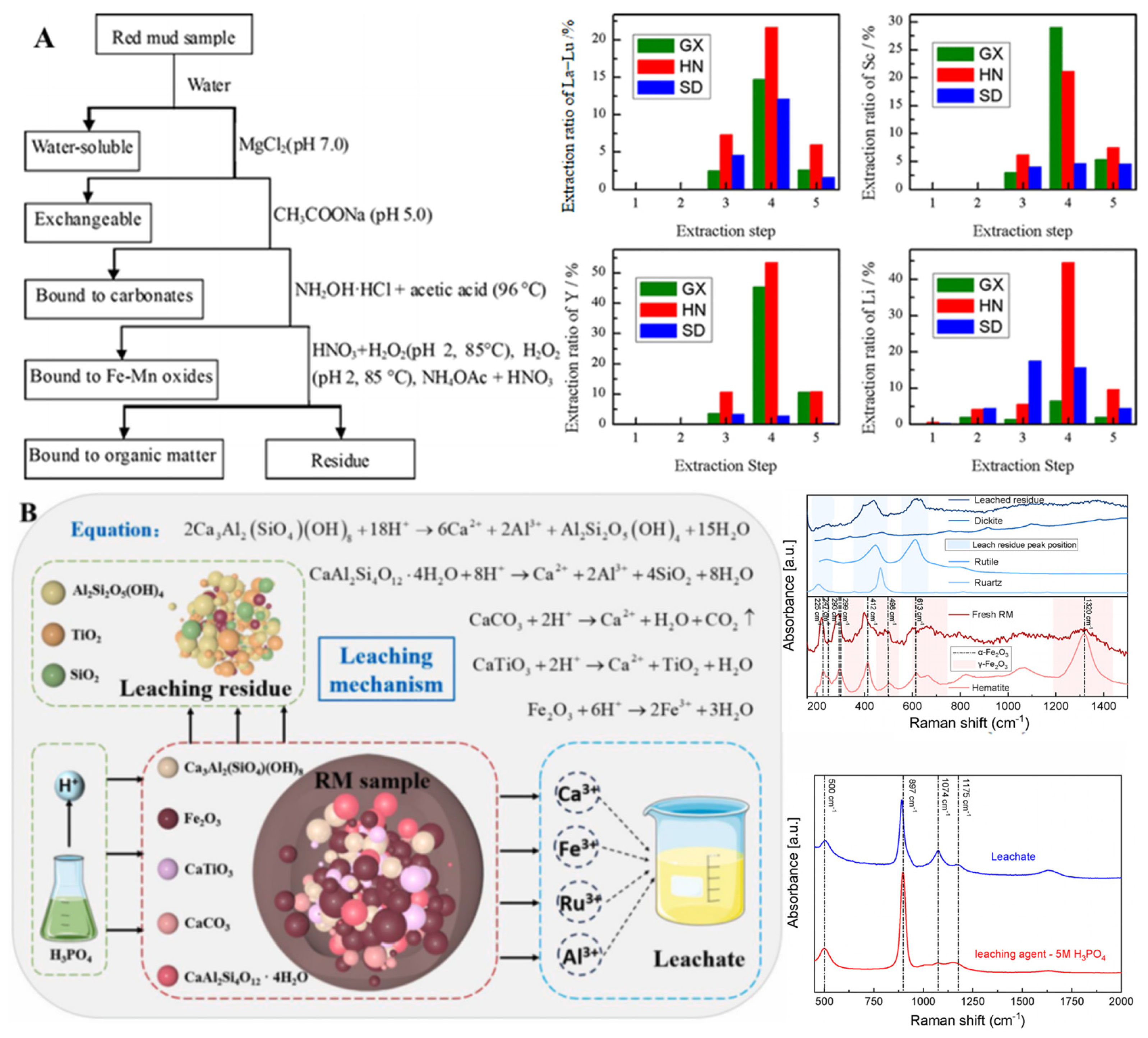
In terms of phase constitution, red mud is characterized by an intergrowth of crystalline and amorphous components rather than a single mineral phase. Typical crystalline phases include iron-bearing minerals, aluminum-bearing phases, titanium-bearing phases, as well as Bayer-induced sodium aluminosilicates. Carbonates and sulfides may also be present. Rivas et al. [35] have performed quantitative phase analysis and have observed crystalline phases such as hematite, nepheline, sodalite, perovskite, and pseudobrookite over 1023–1523 K. In XRD-based identification, a pronounced “hump” background is frequently detected, indicating a substantial amorphous fraction. This amorphous component is often regarded as a “hidden reservoir” for Na, heavy metals, and portions of Al/Si, thereby exerting stronger control over long-term leaching and environmental release. For instance, Samouhos et al. [36] have investigated microwave-induced mineral transformations and have identified an initial broad endothermic peak at ~128 °C, which is attributed to the removal of free water, whereas other endothermic features are associated with the dehydroxylation of gibbsite and boehmite. Yadav et al. [37] have compared mineralogical changes before and after carbonation and have reported phases such as boehmite, cancrinite, pyrite, hematite, and gibbsite; for RM 11, a carbonation capacity of 5.3 g CO2 per 100 g is reported. Ma et al. [38] have analyzed structural evolution during phosphate leaching and have shown that the solid-phase spectra before and after leaching exhibit close agreement with hematite phonon lines (e.g., at 225, 498, and 247 cm−1), while strong dipole–dipole interactions are suggested in the H3PO4-H2O system (Figure 2A). Importantly, the occurrence of REEs in red mud follows a “trace concentration–high value” pattern: besides lattice substitution in iron/aluminum silicates, REEs can occur as discrete minerals, such as fluorocarbonates and phosphates. Moreover, REE concentrations commonly reach the order of hundreds to thousands of ppm, and scandium is often relatively enriched, providing a mineralogical basis for subsequent selective leaching and enrichment. Prusty et al. [39] have reported that ~77% of the particles are <45 μm, with a total REE content of 433 ppm; La, Ce, Nd, and Sc are identified as the primary contributors to the overall REE value.
Figure 2.
(A) Flow sheet of the sequential extraction procedure for the red mud samples and Partitioning of valuable elements in GX, HN, and SD on applying the modified Tessier’s extraction procedure (Copyright [2018] Springer Ltd., London, UK); (B) Mechanism diagram of H3PO4 leaching RM, Raman spectra of solid phase and liquid phase before and after leaching (Copyright [2025] Elsevier Ltd., Oxford, UK).
The sources of alkalinity in red mud are not singular and are generally categorized into soluble alkali and structurally bound alkali. Soluble alkali predominantly originates from entrained/adsorbed Bayer liquor and surface adsorption layers, and is present mainly as OH−, CO32−, Na+, and Al(OH)4−, which governs the rapid response of slurry pH and ionic strength. In this context, Khaitan et al. [40] have quantified species such as OH−, CO32−, and Al(OH)4− by rapid and long-term acid titration of red mud slurries to defined pH endpoints (Figure 2B). In contrast, structurally bound alkali is immobilized within mineral lattices or quasi-lattice environments, with typical carriers including sodalite, cancrinite, and certain calcium aluminate/carbonate phases. Its release is slower, yet it plays a decisive role in long-term buffering capacity, sustained leaching behavior, and associated environmental risks.
The heterogeneity in metal and alkali occurrence directly maps onto the central contradiction in red mud valorization. The ease of metal liberation is governed by the stability of the host phase and the availability of mass-transfer pathways, whereas the efficiency of separation is determined by differential responses of metals to mineralogical and interfacial-chemical controls. From an environmental engineering perspective, this heterogeneity also dictates the long-term release behavior of contaminants when red mud is used in construction materials, soil amendments, or landfill covers. Therefore, integrated metal recovery cannot be evaluated solely from bulk elemental contents; instead, process routes are required to be designed and optimized in an occurrence-oriented manner, with explicit consideration of the governing phase chemistry, microstructural constraints, and post-process residue stability to prevent secondary pollution.
3. Sustainable Technologies for Metal Recovery and Dealkalization
The integrated recovery of metals from red mud is constrained by its compositional complexity, and its high alkalinity markedly reduces the overall utilization efficiency of this secondary resource. Accordingly, dealkalization strategies and metal-recovery technologies have been developed and are being optimized to enhance the extraction of valuable constituents from bauxite residue.
3.1. Integrated Metal Recovery Routes from Red Mud
3.1.1. Pyrometallurgical Routes: Phase Transformation and Iron Enrichment
At present, metallurgical pathways for integrated metal recovery from red mud are generally classified into three categories: pyrometallurgy, hydrometallurgical leaching, and emerging bio-based technologies [41] (Table 2).Beyond these mainstream routes, electrochemical treatment represents an emerging laboratory-scale alternative. Electrochemical approaches rely on applied potential to drive anodic dissolution of target metals and cathodic electrodeposition separation. Electrochemical routes avoid excessive chemical reagent consumption; however, high specific energy consumption and limited handling capacity restrict large-scale deployment, and most investigations remain confined to lab-scale batch tests. In addition, construction-material-oriented valorization realizes bulk red-mud consumption for cement, ceramics and composite oxidic building materials. Nevertheless, high inherent alkalinity necessitates dealkalization pretreatment, and long-term heavy-metal leaching risks must be strictly evaluated. Construction-material utilization is more suitable for final tailings after valuable-metal extraction rather than raw red mud.
Table 2.
Environmental-performance comparison of major technological routes for valuable metal recovery from red mud [42].
Pyrometallurgical recovery is typically centered on reductive roasting and/or smelting reduction and is more suitable for Fe-rich red mud to produce iron concentrates or metallic iron [43]. Under high-temperature conditions, metal oxides in red mud are reduced and coalesce, followed by enrichment via magnetic separation and/or phase segregation [44]. This route is often regarded as direct, relatively simple in process configuration, and supported by an established industrial basis; the canonical reduction pathway of iron is commonly described as Fe2O3, Fe3O4, FeO, Fe, whose performance is jointly governed by temperature, residence time, reductant dosage, additive chemistry, and reactor configuration [45]. Meanwhile, reactions between Fe-bearing phases and Na, Si, Al components may form refractory phases with limited reducibility, thereby imposing intrinsic constraints.
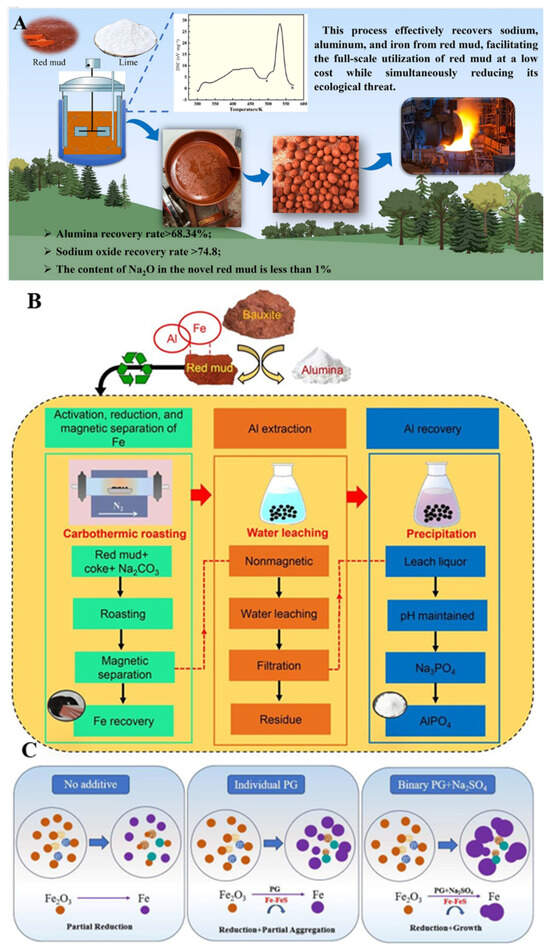
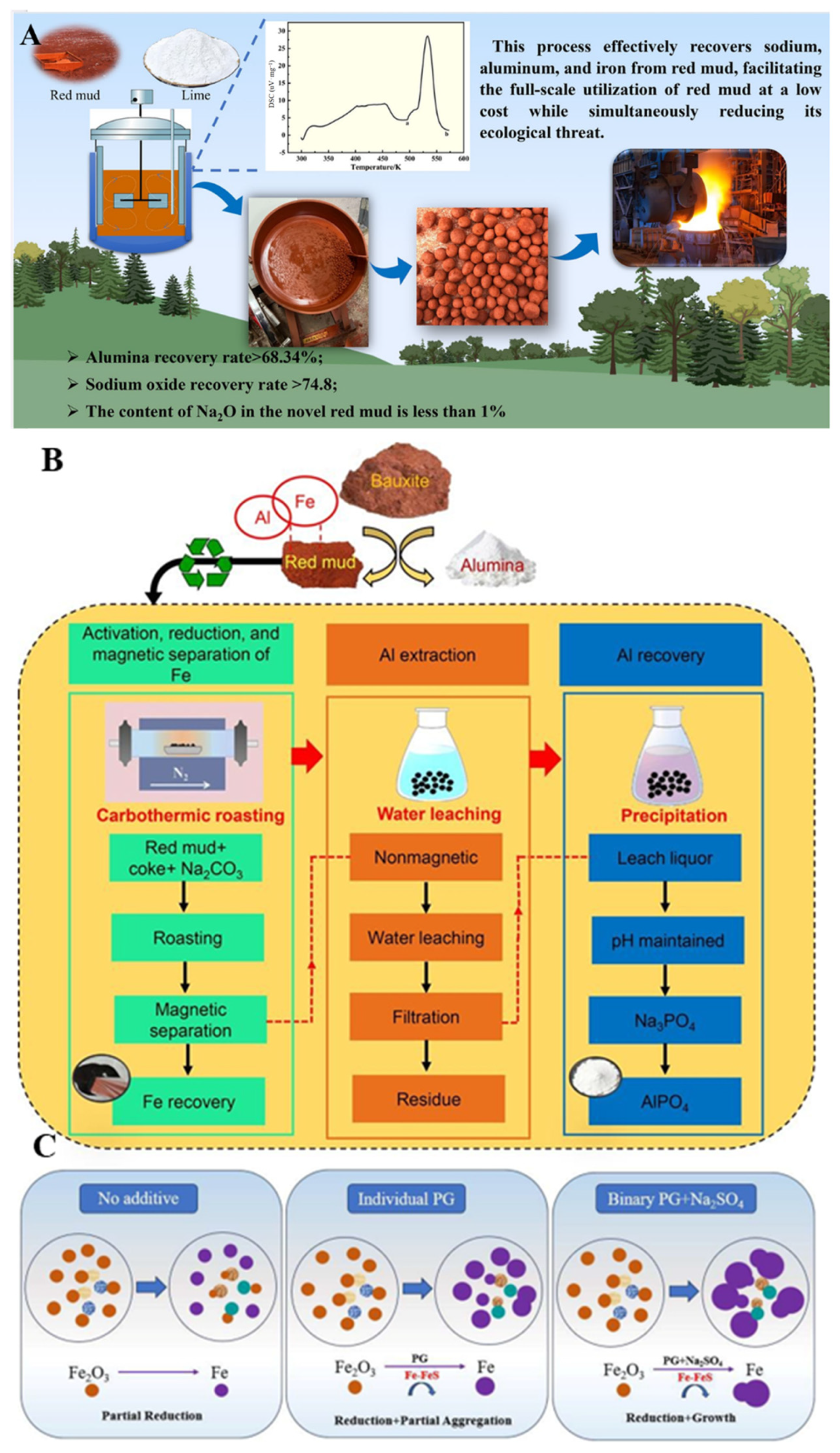
Representative investigations have demonstrated that process intensification through calcination/roasting control can substantially reshape red mud chemistry and facilitate subsequent recovery. Specifically, the team led by Guozhi Lu at Northeastern University have first adopted a high-temperature calcification strategy based on a “source-intercept” concept to treat gibbsitic bauxite, by which a new red-mud structure with extremely low alkalinity is generated; this modified residue is enriched in iron oxides and exhibits low Na2O contents, and iron-bearing pellets are thus enabled, which is beneficial for cleaner alumina production [46]. Subsequently, the same team have proposed an integrated route combining high-temperature calcification conversion and leaching to achieve efficient recovery of Na2O and Al2O3 from red mud, and recovery efficiencies of 68.34% for alumina and 74.8% for sodium oxide have been reported [47] (Figure 3A). Metal recovery has also been enhanced through roasting regulation; for example, Guo et al. have obtained high-grade iron nuggets by roasting carbon-bearing red mud–coal pellets at 1400 °C for 30 min, where an Fe content as high as 96.52% has been achieved. In addition, Yang et al. [48] have proposed a microwave fluidized roasting strategy for efficient iron recovery from red mud, in which the Fe content is distinctly increased and a morphological transition from dense blocks to porous and loosely packed agglomerates is observed, thereby favoring the conversion of iron minerals. Moreover, Habibi et al. [34] have reported that, after roasting at 1350 °C under an optimized coal blending ratio, an iron recovery of up to 91% and an iron grade of 81% are achieved after magnetic separation, whereas Ti, Al, and part of the rare earths are preferentially retained in the non-magnetic fraction. To reduce the operating temperature and/or promote iron grain growth and liberation, additive engineering is regarded as critical. For instance, Liu et al. [49] have introduced diatomite as a functional sorbent into Bayer-process red mud and, by combining SEM-EDS characterization, have elucidated the intrinsic mechanisms governing strength development and heavy-metal immobilization, thereby visually locating the dominant reaction sites. Alternatively, Cheema et al. [50] have employed Na2CO3-assisted reduction and have achieved a recovery of 95.6% for magnetic components and 92.5% for metallic iron under appropriate conditions (Figure 3B). Furthermore, Yu et al. [51] and Ding et al. [52] have demonstrated that additives such as phosphogypsum or sodium sulfate promote reductive decomposition and crystal-nucleus growth, thereby improving roasting–magnetic separation performance (Figure 3C); meanwhile, Grudinsky et al. [53] have indicated that suitable alkali-salt additions lower the process temperature by 100–150 °C.
Figure 3.
(A) SEM and EDS mapping results of calcified slag under different C/S (Copyright [2025] Springer Ltd.); (B) Extraction of Fe and Al from red mud using carbothermic reduction followed by water leaching (Copyright [2024] Elsevier Ltd.); (C) Comparison of the process of recovering iron from red mud using phosphorus containing gypsum additives (Copyright [2024] Elsevier Ltd.).
From the standpoint of energy efficiency and equipment, plasma heating and microwave heating are widely explored as intensification options. Plasma systems are characterized by rapid heating and potentially reduced secondary pollution, although stringent requirements are imposed on equipment robustness and operating conditions. Microwave heating enables volumetric energy deposition, accelerates heating rates, decreases the apparent activation energy, and improves iron grade and recovery within shorter times and at lower carbon consumption. For instance, Samal & Blanco et al. [54] have reported that, after microwave treatment for 10 min under optimized conditions, an Fe concentrate containing 47% Fe is produced with an Fe recovery of 88%, which is clearly superior to the muffle-furnace route; similarly, Agrawal et al. [55] have demonstrated the effectiveness of microwave-assisted processing for enhancing iron recovery performance.
In conclusion, key barriers for pyrometallurgical routes are imposed by high-temperature energy demand and associated carbon emissions, refractory corrosion driven by the strong alkalinity of red mud, and the need for further treatment of post-iron tailings. Consequently, this route is more appropriately positioned as an upstream enrichment unit within a “Fe-first, multi-metal later” flowsheet, and should be integrated with additive optimization, waste-heat/carbon management, and downstream tailings upgrading to realize practical engineering deployment.
3.1.2. Hydrometallurgical Routes: Selective Leaching and Downstream Separation
Hydrometallurgical leaching is defined as the selective dissolution of target components via aqueous-phase reactions and is regarded as a key route for recovering dispersed metals and rare earth elements from red mud [56]. In a typical flowsheet, metals are first transferred into solution by acid leaching and are subsequently concentrated and purified through ion exchange, solvent extraction, and/or selective precipitation [57]. The leaching efficiency is mainly governed by the acid type and concentration, temperature, liquid-to-solid ratio, and particle size.
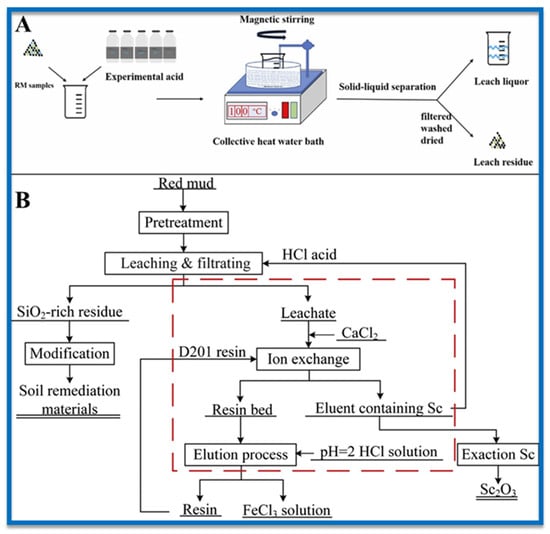
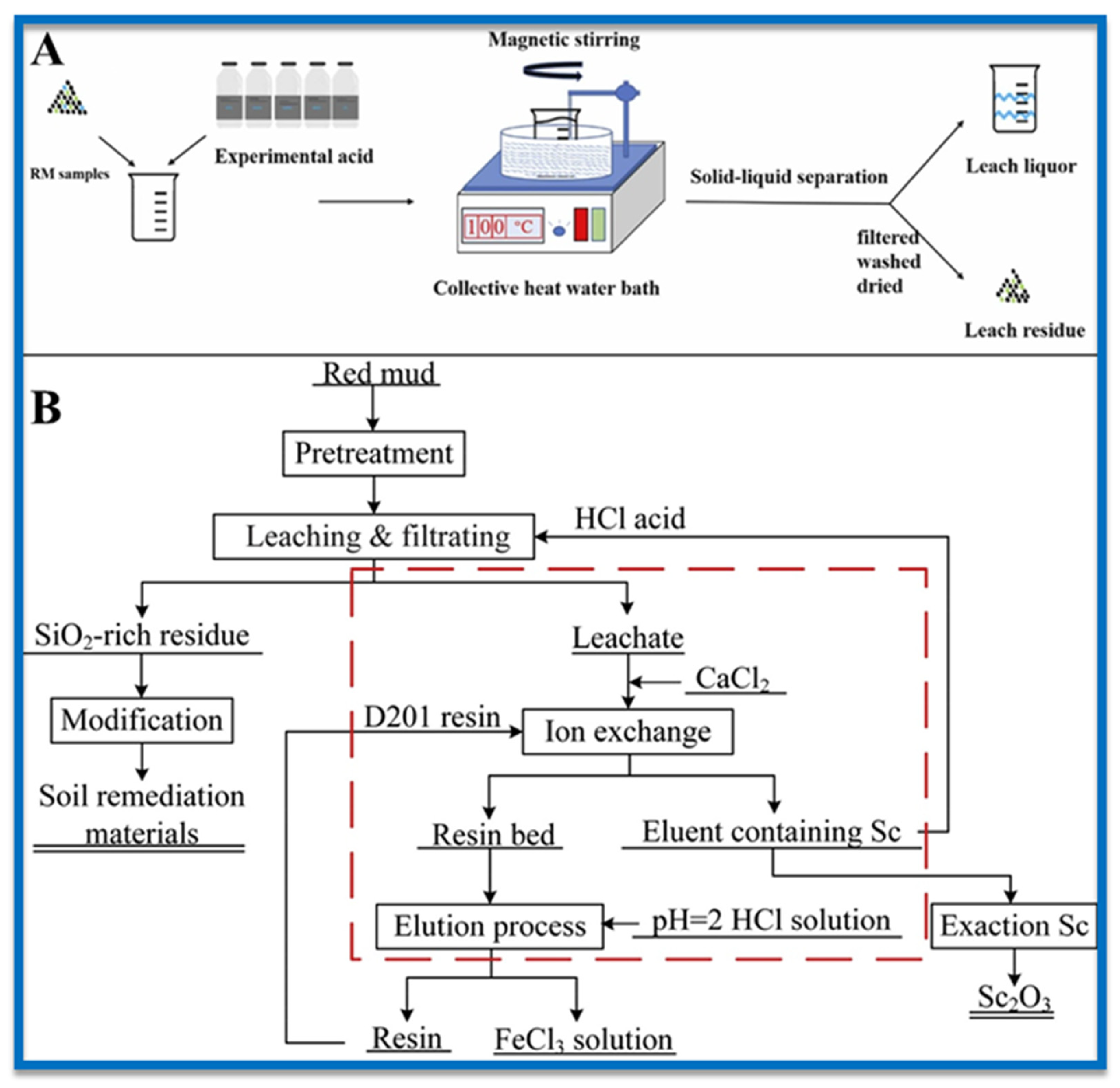
In a typical flowsheet, metals are first solubilized by acid leaching and are then enriched and purified via downstream unit operations such as ion exchange, solvent extraction, and selective precipitation; the leaching performance is governed by acid type and concentration, temperature, liquid-to-solid ratio, and particle size, among other factors. In representative cases, Lu et al. [58] have demonstrated that an HCl leaching–ion exchange sequence achieves high extractions of Ga and Al under relatively mild conditions (e.g., 94.77% Ga and 88.34% Al under optimized parameters). Zhu et al. [59] have shown that H3PO4, as a comparatively mild lixiviant, yields Ga extraction approaching 96%, while the resulting leaching residue is amenable to conversion into phosphate-containing products (Figure 4A). A major challenge in hydrometallurgical separation is “iron interference”, because the high abundance of Fe tends to co-dissolve and consume reagents and complicate selective recovery. To address this issue, Zhang et al. [60] have introduced CaCl2 after HCl leaching to form Fe-compatible species and, in combination with resin adsorption, have achieved efficient separation of Fe from other metals (Fe adsorption efficiency > 96% with minimal uptake of coexisting metals) (Figure 4B); importantly, CaCl2 has been highlighted as recyclable, thereby improving process selectivity. For REEs and dispersed metals, the advantages of hydrometallurgy become more pronounced. Rivera et al. [61] have reported that high-pressure acid leaching (HPAL) at intermediate-to-high temperatures enables selective REE extraction, where Sc recoveries of 90% at 150 °C in H2SO4 and 80% at 120 °C in HCl are achieved, and Y, La, and Nd extractions exceeding 95% are obtained in HCl systems. In addition, Li et al. [62] have compared different acid systems and have concluded that H3PO4 provides superior separation of Sc from impurities, while subsequent enrichment of Sc is facilitated by extractants such as P204. Oxalic acid has also attracted attention in red-mud hydrometallurgy because selectivity can be improved under relatively mild conditions. Specifically, Yu et al. [63] have demonstrated that oxalate participates in complexation and reductive transformation and promotes the formation of filterable ferrous oxalate precipitates, enabling reagent recycling and improving overall process “greenness” and flowsheet integrity.
Figure 4.
(A) Schematic diagram of the experiment process (Copyright [2024] Elsevier Ltd.); (B) Experimental procedure for the selective removal of iron in chloride leaching solution of red mud using coordination-ion exchange method (Copyright [2020] Elsevier Ltd.).
Nevertheless, the engineering bottlenecks of hydrometallurgical routes remain evident: the flowsheets are often complex, acid consumption is substantial, and acidic, metal-rich effluents may be generated with potential co-mobilization of toxic heavy metals. Without closed-loop circulation and by-product valorization, secondary environmental burdens are likely to arise. Accordingly, future optimization is expected to focus on reducing acid demand, integrating acidic solid wastes as auxiliary reagents, and developing alkali leaching/selective leaching coupled with “re-extraction–reutilization” closed-loop management of process liquors.
3.1.3. Bio-Based and Hybrid Routes: Mild-Condition Leaching and Process Synergy
Emerging bio-based technologies are typically represented by process-intensified routes such as bioleaching and bioflocculation [64]. Their fundamental rationale is that metals are solubilized and ionic species are enriched under comparatively mild conditions through microbially generated metabolites, including organic acids, chelating agents, and/or alkaline substances [65]. Consequently, lower energy input and reduced secondary pollution are often enabled, and these approaches are regarded as promising options for decreasing energy demand while minimizing harmful by-products. However, practical implementation is constrained by intrinsically slow kinetics and the need to establish robust alkali-tolerant microbial systems; therefore, synergy with chemical pretreatment is frequently required [66]. In addition, the operating temperature is bounded by microbial viability, and kinetic acceleration by heating is thus limited. Microbial performance is also sensitive to nutrient limitation, heavy-metal toxicity, and high slurry loading. Owusu-Fordjour have reported that these constraints collectively limit the robustness and productivity of bio-based routes in alkaline red-mud systems [67].
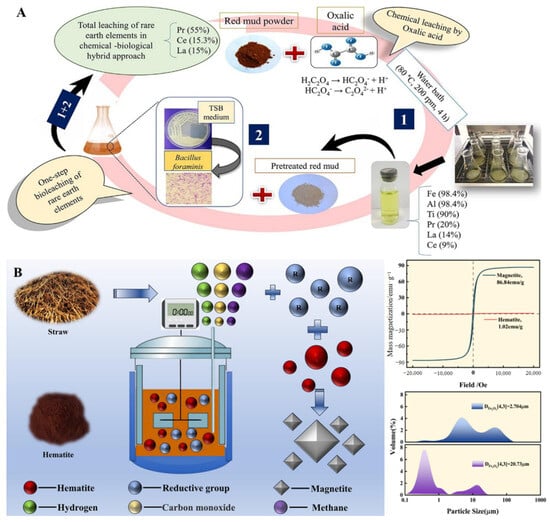
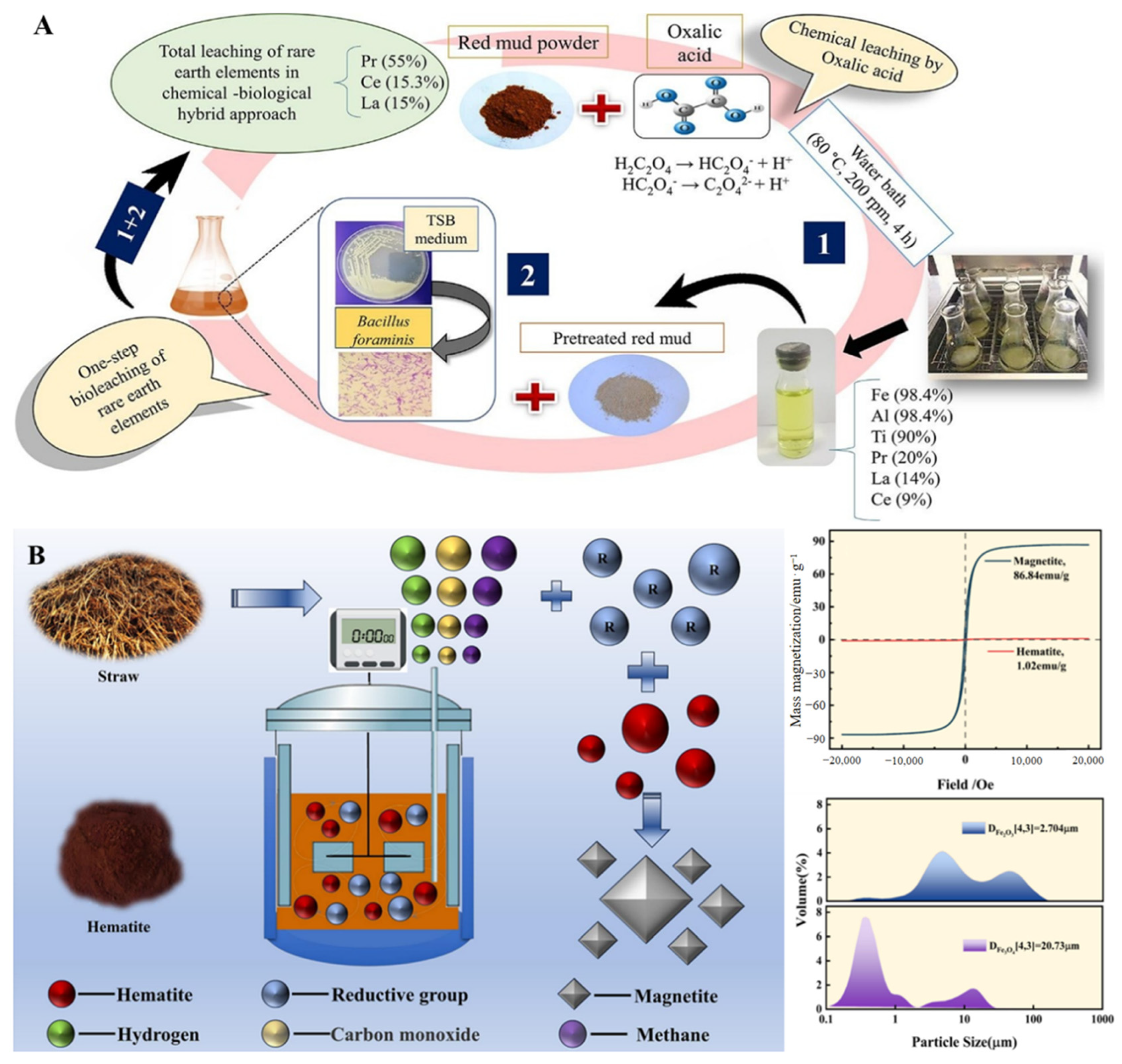
Accordingly, a more practical direction is increasingly oriented toward chemical–biological synergistic schemes. For example, Ilkhani et al. [68] have employed oxalic-acid pretreatment to disrupt the compact, complex powder matrix of red mud and subsequently have introduced alkali-tolerant microorganisms for bioleaching. As a result, the leaching efficiencies of Fe, Al, Ti, and selected REEs are simultaneously enhanced; specifically, 98.4% Fe, 98.4% Al, and 80% Ti are leached from red mud using an organic agent (Figure 5A). Mechanistically, this combined strategy is interpreted as “structural deagglomeration + improved bioaccessibility”, which compensates for the efficiency and kinetic limitations that are typically encountered when chemical leaching or bioleaching is applied alone. Looking forward, Panda et al. [69] have proposed that, to establish a sustainable industrial closed-loop, bio-based technologies should be advanced through (i) screening and engineering of highly efficient alkali-tolerant strains, (ii) elucidation of intrinsic leaching mechanisms using bioinformatics and metabolic engineering, and (iii) intensification of microbe–red mud interfacial interactions to improve controllability and scalability of the process.
Figure 5.
(A) Efficient chemical biological mixing method for leaching base metals (Fe, Al, Ti) and rare earth elements (Ce, La, Pr) from red mud (Copyright [2024] Elsevier Ltd.); (B) Magnetic hysteresis loops of hematite and magnetite and the particle size distribution of hematite and magnetite (Copyright [2025] Elsevier Ltd.).
In parallel with microbial routes, bio-derived reductants from biomass have also been explored as low-carbon enabling agents for phase transformation. For instance, He et al. [70] have utilized agricultural straw as a reducing agent and, by coupling a one-step dissolution protocol with a Bayer-process framework, have achieved the transformation of hematite into magnetite. Substantial improvements are reported for the transformed magnetite, where the saturation magnetization and average particle size are increased by more than 80-fold and 10-fold, respectively, reaching 86.84 emu g−1 and 20.73 μm (Figure 5B). Such findings are considered to provide actionable insights for mitigating red-mud accumulation and promoting the sustainable development of the alumina industry.
In summary, although pyrometallurgical and hydrometallurgical routes are relatively mature, they are respectively constrained by high energy demand/emissions and by high acid consumption coupled with the burden of acidic, metal-laden effluents. Bio-based technologies are therefore regarded as promising alternatives; however, further advances are still required in the development of alkali-tolerant strains, process intensification, and scalable implementation.
3.2. Dealkalization as an Enabling Pretreatment for Integrated Recovery
Excessive alkalinity is a key factor that constrains the large-scale, integrated utilization of red mud. During alumina production via the Bayer process, sodium-alkali losses account for 20% [71]. Sodium alkali is the principal deleterious impurity in red mud and is generally classified into soluble alkali and chemically bound alkali; typical contents are 0.3–0.8% for entrained/attached alkali, 2.9–3.8% for chemically bound alkali, and 0.4–0.6% for lattice-adsorbed alkali [72]. Soluble alkali is readily dissolved in red-mud slurry to form free Na+, whereas lattice-adsorbed alkali is present at lower levels but is difficult to remove; chemically bound alkali exhibits low solubility and is stably immobilized within the red-mud matrix [73]. To reduce the alkali content effectively, extensive efforts have been undertaken worldwide, and representative dealkalization routes include lime-based wet treatment, lime-based thermal treatment, and novel Ca2+-exchange processes.
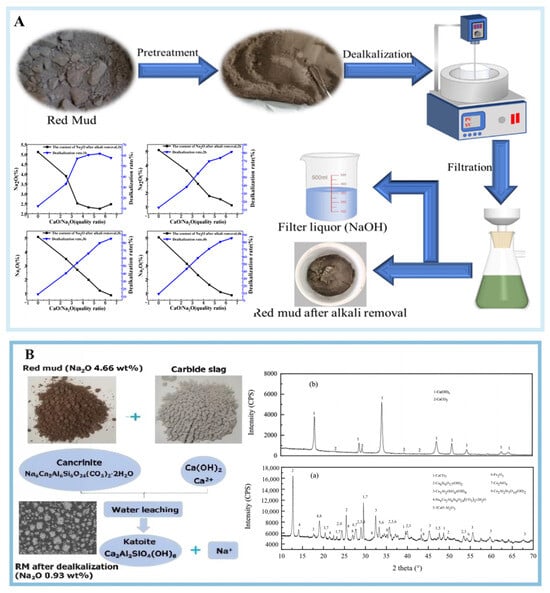
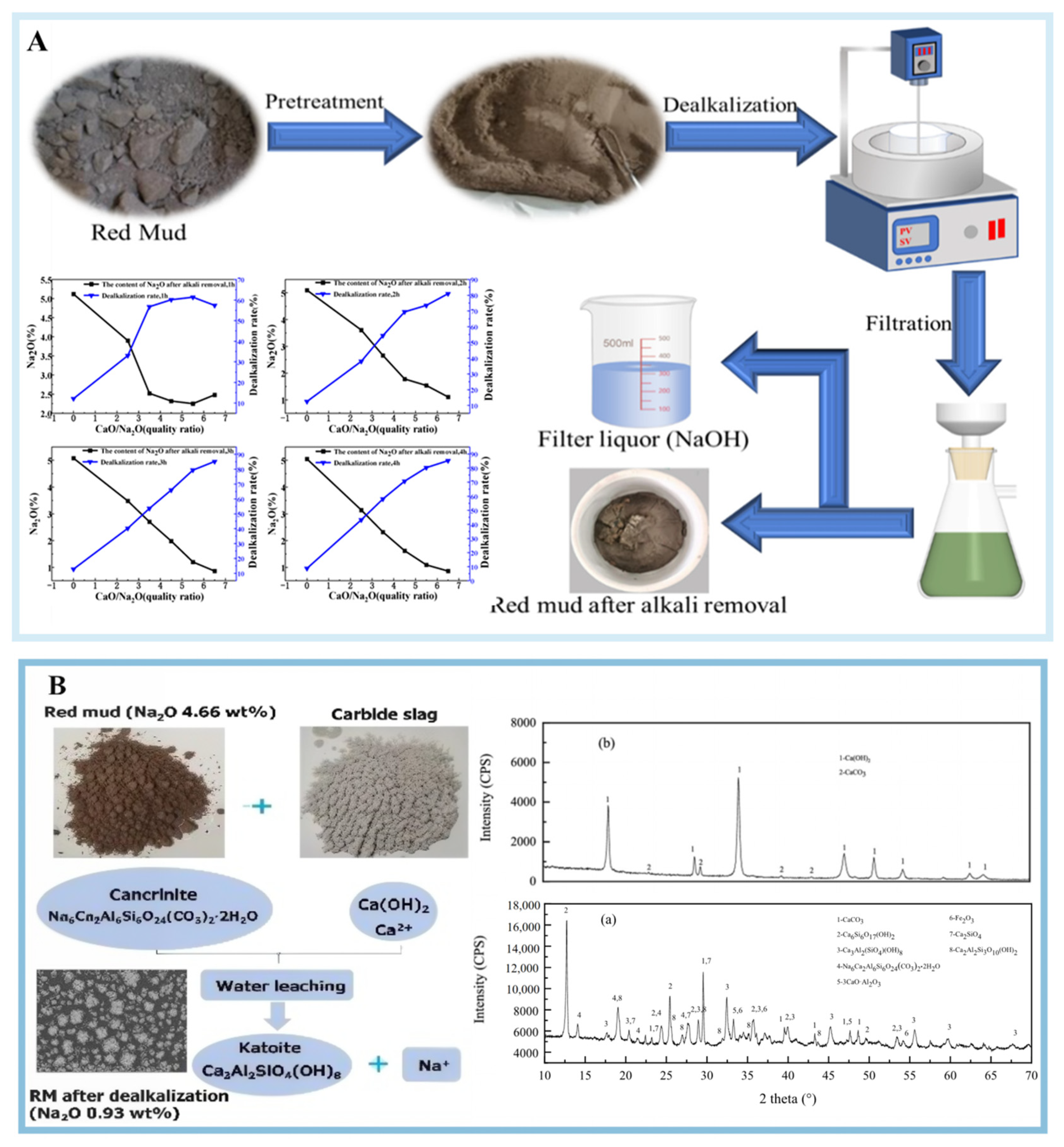
In lime-based wet dealkalization, China Great Wall Aluminum Co. has implemented an atmospheric-pressure lime treatment since 1997. In this process, finely ground red-mud slurry is pumped into a dealkalization tank, homogenized by agitation, and heated to the required temperature; quicklime is then added to initiate the dealkalization reaction. The treated residue is subsequently used for cement production, thereby improving the utilization rate of red mud [74]. Substantial progress has also been achieved at Zhengzhou University. For example, Yang et al. [75] have investigated lime dealkalization for sintering red mud and have achieved dealkalization efficiencies of 70–80%; the dealkalization liquor is further concentrated by repeatedly washing the red mud. At Kunming University of Science and Technology, advances in lime dealkalization have also been reported: Yan et al. [76] have studied calcification-based dealkalization of red mud and have reduced the residual alkali content to 0.61% under 5 h reaction time, CaO/Na2O = 6.5, liquid-to-solid ratio of 4 mL g−1, and 95 °C (Figure 6A). In addition, Zhong et al. [77] have employed pressurized lime leaching at 170 °C and 0.9 MPa for 2 h and have decreased the Na2O content to 0.9%. De-sodiation has also been conducted in a low-pressure autoclave at 100 °C after lime-red mud mixing, and the Na content is lowered to 1.49%.
Figure 6.
(A) Experimental procedure and effect of CaO on dealkalization rate (Copyright [2022] MDPI Ltd.); (B) Effect of Carbide Slag on Removal of Na+/K+ from Red Mud Based on Water Leaching and XRD pattern of the RM (a) and carbide slag (b) sample (Copyright © 2022 The Authors. Published by American Chemical Society. This publication is licensed under CC-BY-NC-ND 4.0.).
For novel Ca2+-exchange processes, a “calcification-carbonation” route has been proposed by an innovation team in special metallurgy at Northeastern University to overcome limitations imposed by the equilibrium structure of Bayer red mud. In this process, the conventional red-mud structure is reconfigured, and the equilibrium phase assemblage is modified through three core steps, thereby enabling detoxification of red mud and effective aluminum recovery and filling a technological gap for calcification–carbonation processing [78]. In addition, Hu et al. [79] have developed a rapid, efficient, and low-cost dealkalization process for Bayer red mud from an alumina refinery in Shandong, where a “sulfuric acid and CAM” system is employed; moreover, soilization of the treated residue has been investigated to enable in situ ecological remediation of red-mud disposal sites. A dealkalization efficiency exceeding 95% is achieved, the leachate composition is relatively simple, secondary pollution is less likely to occur, and industrial implementation is thereby facilitated.
So, lime-based dealkalization effectively removes both free alkali and combined alkali; however, lime consumption is substantial and the dealkalization efficiency is generally below 80%. The dealkalization performance is governed by the dissolution capacity of CaO and the Ca2+ release rate and is, to a large extent, limited by specific surface area effects and ionic-strength constraints. In this respect, carbide slag is regarded as a high-quality calcium-based secondary resource. When dissolved in water, a strongly alkaline environment is generated; reactive CaO or Ca(OH)2 is produced, and these species are key to valorizing carbide slag. If such secondary resources are integrated into dealkalization schemes, substantial economic and environmental benefits are expected. Huang et al. [80] have investigated carbide slag as a dealkalization agent and have reported a post-treatment Na2O content of 0.93% (Figure 6B). In summary, relative to conventional practices, dealkalization methods that markedly improve solid-surface structure, generate new reactive interfaces, establish homogeneous solution environments, and intensify mass transfer and reaction kinetics are regarded as key future directions and are essential prerequisites for the valorization, minimization, and integrated management of red mud.
4. Prediction-Guided Process Analysis and Optimization
Metal recovery from red mud is jointly governed by mineral-phase assemblages, alkali occurrence modes, and multiple operating parameters, and is therefore characterized by pronounced nonlinearity and multiscale coupling; consequently, stable scale-up across red muds from different sources cannot be reliably achieved by empirical correlations alone. Accordingly, this chapter incorporates two complementary predictive toolsets within a “mechanism-data” paradigm: on the one hand, leaching/dealkalization behaviors are predicted using artificial neural networks; on the other hand, key reactions and interfacial mechanisms are elucidated by atomistic simulations, such as DFT, to support process optimization and risk management.
4.1. Atomistic Simulations: Interfacial Reactions and Selectivity
With the rapid development of computational chemistry and artificial intelligence, analytical chemistry has evolved beyond mere detection and measurement toward predictive capabilities that can complement or even reduce experimental work [81]. By integrating advanced analytical data with computational simulations and machine learning [82], the properties, reaction pathways [83], and long-term behavior of red mud and its treatment products can be predicted at micro and even atomic scales.
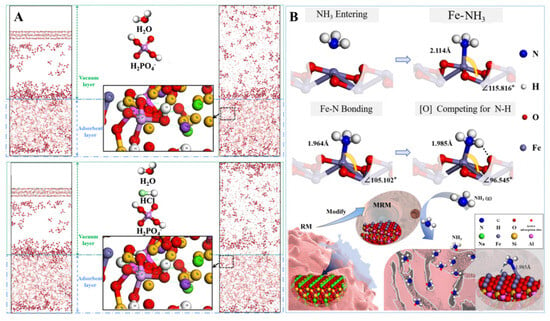
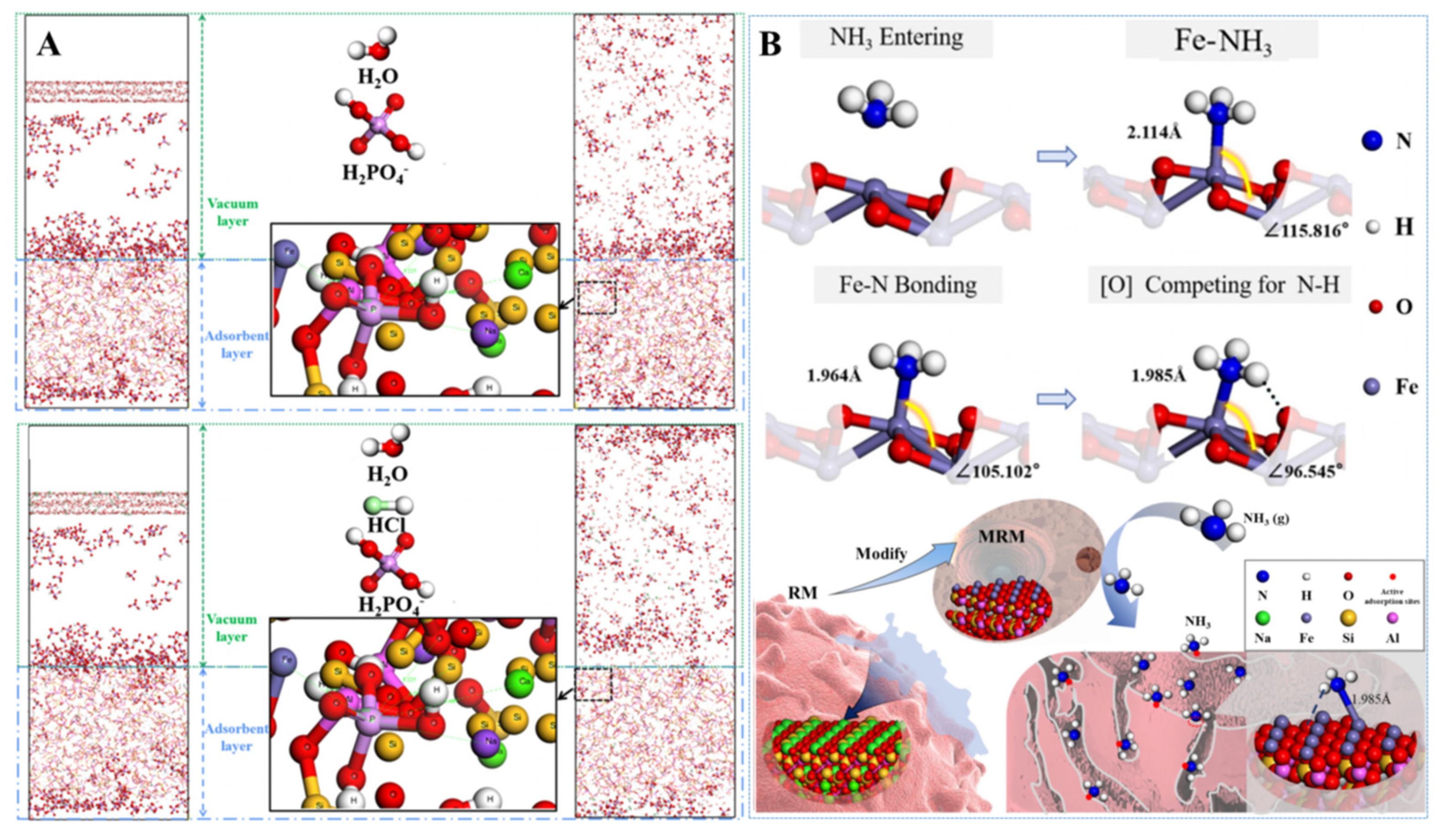
MD simulations can reveal adsorption, diffusion, and reaction kinetics of water molecules and ions (e.g., Na+, OH−) at red mud mineral surfaces or interfaces (e.g., sodalite, cancrinite), providing atomic-scale explanations for leaching or ion-exchange mechanisms [84]. For example, Yang et al. have used MD to simulate the desorption of phosphate from modified red mud used as an adsorbent, with hydrochloric acid and deionized water as eluents [85] (Figure 7A). Quantitative outputs from atomistic simulations can directly provide bond-breaking energy, adsorption energy and reaction-barrier parameters, avoiding large-scale blind laboratory exploration. Validated DFT-MD simulation workflows have been reported to reduce trial-and-error experimental workload by approximately 40% for mineral-residue reaction systems, by pre-screening potential reagents and identifying kinetically-inert mineral phases before wet tests. For instance, in MD elution simulation, HCl addition reduces interfacial bond strength between adsorbate and red-mud mineral surface by 22–31 kJ/mol compared with pure-water elution. DFT calculation can quantify adsorption energy and barrier height: in reported NH3 adsorption on modified red-mud α-Fe2O3 surfaces, the Fe-N bonding adsorption energy reaches −82.6 kJ·mol−1; Fe4-cluster active sites can lower the H2 dissociation barrier by 94.8%, which alters the overall reaction rate-determining step. Compared with conventional one-factor-at-a-time experiments, atomistic simulations reveal atomic-scale interfacial mechanisms that cannot be easily obtained by laboratory characterization alone, and provide theoretical guidance for reagent modification and mineral phase regulation. Simulations showed that deionized water alone could desorb phosphate only from the adsorption surface, whereas the addition of HCl decreased system stability by disrupting ionic bonds between O atoms in hydrogen, H2PO4−, and active red mud particles containing reactive metals and oxygen atoms. MD thus not only elucidates mechanisms but also provides theoretical guidance for engineering applications, reducing experimental costs. Al-Awsh et al. have employed a novel molecular modeling approach to construct a bottom-up model integrating different nRM components [86]. Their simulations demonstrated that the atomic model could accurately predict the strength and stiffness of cement-nRM composite materials, offering predictive insight into material performance.
Figure 7.
(A) Modelling of desorption in deionised water and HCl: deionized water before desorption model and after-desorption model, HCl before-desorption model and after-desorption model (Published 12 April 2024 • © 2024 The Author(s). Published by IOP Publishing Ltd.); (B) The simulation of NH3 adsorption process on the surface of α-Fe2O3 (110) and the adsorption mechanism of NH3 on MRM surface (Copyright [2025] Elsevier Ltd.).
DFT calculations can be used to investigate interactions between typical red mud mineral surfaces and reactants (e.g., CO2, H+, phosphate), including adsorption energies, reaction barriers, and electronic structure changes [87]. Such studies fundamentally clarify the selectivity and feasibility of reactions like carbonation or acid neutralization, providing theoretical guidance for designing efficient modifiers or catalysts. For example, Zhang et al. have explored the adsorption mechanism of high-concentration NH3 on modified red mud surfaces. On Fe2O3, NH3 forms Fe-N bonds, strengthening adsorption; during the process, the Fe-N bond length decreased from 2.114 Å to 1.985 Å, indicating a strong Fe-N interaction [88] (Figure 7B). Deng et al. have proposed an innovative red mud doping strategy and used DFT to elucidate the catalytic mechanism of Fe4 clusters during CaCO3 hydrogenation. Results showed that the Fe active sites significantly enhanced H2 interactions with the CaCO3 surface, reducing the H2 dissociation barrier by 94.8% and altering the rate-limiting step, advancing sustainable red mud utilization [89].
In summary, macroscopic monitoring ensures reliable process operation, while microscopic predictive techniques reveal underlying principles and guide innovation. Their integration marks a transition of red mud analytical chemistry from a “descriptive science” to a “predictive and design-oriented science,” opening new avenues for high-value, precise utilization of red mud.
4.2. Machine Learning: Process Prediction, Uncertainty, and Optimization
High alkalinity is not only a primary source of environmental risk but also a major “process-interference term” that compromises metal separation and enrichment. Accordingly, dealkalization is commonly positioned as a prerequisite for downstream metallurgical recovery: equipment corrosion and parasitic side reactions are mitigated, while a more stable chemical window is provided for selective leaching, extraction/precipitation, and bio-based operations [90]. Nevertheless, whether the response metric is expressed as metal recovery/leaching efficiency or as dealkalization efficiency/residual alkali (Na2O), the governing mechanisms are jointly dictated by mineral-phase assemblages, microstructural features, and multiple operating variables (e.g., temperature, residence time, liquid-to-solid ratio, acid/alkali concentration, and additives). Such strong nonlinearity and multiscale coupling generally prevent robust extrapolation across different red mud sources when single empirical equations are adopted. In this context, ANNs serve as high-value surrogate models by learning the high-dimensional mapping from input variables to target responses in a data-driven manner [91]. When experiments are costly and variable interactions are complex, ANN-based models can effectively “interpolate” discrete datasets into continuous response surfaces, thereby enabling key-factor screening, contraction of the feasible process window, and multi-objective trade-off analysis (e.g., high recovery, low acid consumption, and low residual alkali). Consistently, Akcil et al. [14] have emphasized that red mud exhibits substantial variability in origin and composition and that rare-earth hydrometallurgical recovery typically involves long process chains (leaching–purification–separation–regeneration), for which modeling tools capable of handling multivariable coupling and rapid evaluation are inherently required; in this sense, ANNs can function as a process–performance bridge to provide computational decision support for coordinated metal recovery and dealkalization.
Well-trained ANN surrogate models for red-mud leaching and dealkalization can achieve determination coefficient R2 > 0.94, with mean absolute prediction error generally below 3.2 percentage-points for target response variables. When coupled with genetic-algorithm (GA) multi-objective optimization, the ANN-GA framework has demonstrated simultaneous performance improvement: target-metal leaching recovery can be increased by 5–12%, whilst reagent-acid consumption is cut down by 15–22%, according to published solid-waste metallurgical cases. Compared with conventional Response Surface Methodology (RSM), which is mostly limited to single-objective optimization and low-order fitting, the combination of machine-learning surrogate and atomistic simulation can handle strong nonlinear multi-variable coupling effects. This capability is especially critical for red-mud systems with highly variable mineralogical properties from different bauxite sources, and helps narrow the gap between lab-scale results and practical process scale-up.
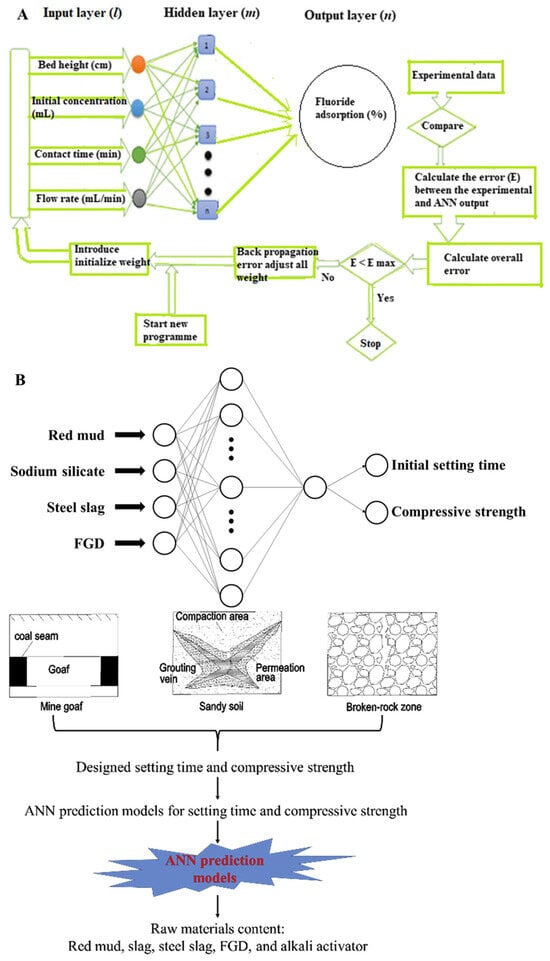
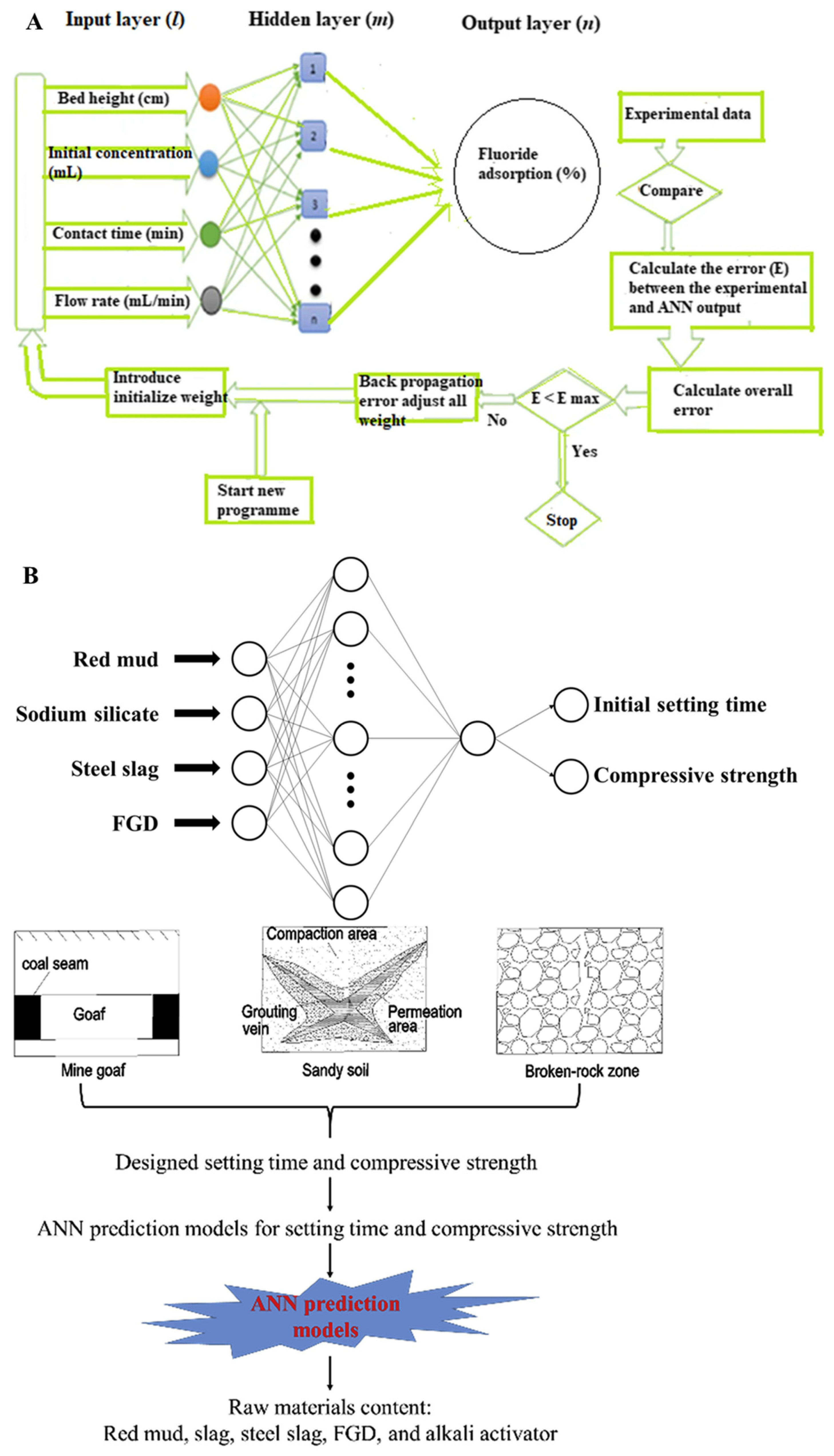
The operational logic of ANN-based prediction for metal leaching or dealkalization can be summarized as feature input, nonlinear approximation, error backpropagation, and generalization validation. First, a feature matrix is constructed at the input layer to represent both material attributes and operating conditions. Material-side descriptors may include chemical composition, Na2O/alkalinity indicators, particle size/specific surface area, and proxy variables for mineral-phase characteristics, whereas process-side descriptors may include leaching temperature, time, acid concentration, liquid-to-solid ratio, stirring intensity, and roasting temperature/additive dosage. The output layer is then configured to match the target metrics, such as the leaching efficiency of a single metal, a vector of multi-metal recoveries, dealkalization efficiency, or residual alkali content. Next, nonlinear activation functions in hidden layers are used to approximate complex response surfaces; during training, the discrepancy between predicted and measured values is minimized via backpropagation, and the model is subsequently evaluated using an independent test set to verify generalization. As a representative example, Giri et al. [92] have employed a backpropagation-learning algorithm for fluoride removal in a fixed-bed system using neutralized/activated red mud and have established a clear training–inference workflow, where inputs such as bed height, initial concentration, time, and flow rate are used and near-unity R2 values are obtained, thereby demonstrating that stable process-response patterns can be captured under multifactor coupling (Figure 8A). More importantly, this “process-variable input” to “removal/transform efficiency output” paradigm can be directly transferred to modeling metal leaching efficiency or dealkalization performance: once bed variables are replaced with leaching/dealkalization conditions and intrinsic red-mud descriptors, rapid prediction of metal or sodium migration behaviors becomes feasible.
Figure 8.
(A) Optimum ANN model with a flowchart of the backpropagation algorithm for the prediction of F− removal efficiency (Copyright [2022] Springer Ltd.); (B) Architecture plot of ANN model and ANN prediction models for grouting engineering (Copyright [2020] Elsevier Ltd.).
To address the recurring practical challenge of “many variables but limited training data,” experimental-design strategies can be embedded into ANN modeling to maximize information gain. In this regard, Kumar et al. [93] have integrated RSM with ANN training, where Bayesian regularization is adopted and connection-weight sensitivity analysis is performed; reliable predictive performance is maintained while the required experimental dataset is reduced. For red-mud metal recovery and dealkalization, this suggests that orthogonal designs or Box-Behnken designs can be used to prioritize high-information-density sampling, after which ANNs can learn nonlinearities and interaction terms; sensitivity analysis can further identify controlling factors (e.g., interactions among acid concentration, temperature, and initial alkalinity), thereby converting “black-box prediction” into interpretable process levers. In addition, by reporting confidence intervals alongside point predictions of recovery performance and coupling the trained ANN surrogate with optimizers such as genetic GA, Pareto-frontier exploration can be conducted to balance competing objectives, including high recovery, low acid consumption, and minimal impurity co-leaching. For example, Zhang et al. [94] have demonstrated an “ANN prediction and GA optimization” workflow in red-mud-based multi-solid-waste cementitious systems, where setting time and compressive strength are predicted by ANN and the optimal mix design is identified by GA, yielding a toolchain that is directly deployable for engineering design (Figure 8B). When this framework is migrated to metallurgical scenarios, outputs such as leaching/dealkalization efficiency, acid consumption, and residue properties can be treated as multi-objective targets, thereby enabling an intelligent optimization scheme for flowsheet design and process integration.
5. Summary and Perspectives
5.1. Summary
Bayer red mud is a massive alkaline solid waste containing recoverable metals (Fe, Al, Ti, REEs), but its fine particle size, complex mineralogy, and high alkalinity cause persistent environmental risks. This review has linked red mud hazards to its occurrence-controlled reactivity and critically assessed major recovery routes from an environmental engineering perspective. Metal and alkali speciation—distributed among crystalline phases, amorphous components, and interfaces—governs leachability, selectivity, and process stability. Soluble and structurally bound alkali coexist and must be addressed together. Pyrometallurgy effectively recovers iron from Fe-rich red mud but suffers from high energy consumption, CO2 emissions, and corrosion. Hydrometallurgy enables selective recovery of REEs and dispersed metals, yet it is constrained by high acid consumption, impurity co-leaching, and generation of acidic metal-laden wastewater. Bio-based routes are low-carbon and mild but limited by slow kinetics and alkali tolerance; chemical–biological coupling is often needed. Dealkalization is not merely waste treatment but an enabling pretreatment that reduces alkalinity-driven hazards, mitigates corrosion, and creates a favorable window for downstream selective recovery. To achieve green and circular valorization, five priorities are proposed. First, dealkalization should be designed as a hazard-mitigation module that removes both soluble and structural alkali using calcium-based secondary resources to stabilize residues and reduce long-term leaching risks. Second, closed-loop reagent and water management must be implemented—recycling acids/alkalis, controlling salt buildup, and minimizing wastewater to avoid shifting pollution from solid waste to liquid effluents. Third, occurrence-oriented staged recovery should match process selection to metal occurrence modes and validate post-process residue safety through stabilization or carbonation. Fourth, prediction-guided process optimization using artificial neural networks for multi-objective optimization (balancing recovery against reagent/energy use) and DFT/atomistic simulations to rationalize interfacial reactions can reduce trial-and-error and improve transferability across different red mud sources. Fifth, harmonized sustainability metrics are needed-assessing energy/carbon footprint, wastewater toxicity, residue leachability, and regulatory compliance alongside recovery yields, supported by techno-economic and life-cycle analyses. In addition to metal-targeted recovery technologies, construction-material-oriented valorization including cement, ceramics and cementitious composites represents an important route for bulk-scale red mud consumption. Nevertheless, such applications are restricted by the inherent high alkalinity of red mud and require prior dealkalization pretreatment. Long-term heavy-metal leaching risks also need rigorous evaluation. This review mainly focuses on valuable-metal recovery from red mud; construction-material preparation can be coupled with metallurgical workflows as a feasible disposal option for tailings generated after metal extraction. In conclusion, red mud valorization should be reframed as hazard-controlled resource recovery. Integrating occurrence chemistry, dealkalization-enabled selective separation, and prediction-guided optimization can minimize secondary pollution, stabilize residues, and transform red mud from an environmental liability into a safer, higher-value secondary resource.
5.2. Future Research Perspectives
5.2.1. Advanced Dealkalization Technology Utilizing Secondary Calcium-Containing Solid Wastes
The current bottleneck in red mud dealkalization lies in the large lime dosage required by conventional lime-based dealkalization and the difficulty of fully removing structurally bound alkali trapped in sodalite/cancrinite, which limits downstream metallurgical performance. Therefore, future research should explore carbide slag, phosphogypsum, and other calcium-rich industrial by-products as low-cost dealkalization agents, conduct continuous pilot-scale long-run experiments to verify residue stability and wastewater recycling performance, and develop a combined calcification–carbonation process to evaluate its adaptability to red mud from multiple origins.
5.2.2. Integrated Multi-Stage Coupling Metallurgical Flowsheet for Scale-Up Demonstration
The existing bottleneck is that single pyrometallurgical, hydrometallurgical, or bio-leaching processes have inherent drawbacks, while combined routes remain underexplored in terms of process connection, reagent matching, and material balance, and most laboratory results cannot be directly scaled to pilot or industrial levels. Therefore, it is necessary to establish a staged recovery framework of “dealkalization pretreatment–pyro-enrichment–selective hydrometallurgical separation,” solve mass-balance and reagent-cycling issues in coupled systems, and emphasize pilot-scale testing as well as tailings stabilization after metal extraction.
5.2.3. Engineering Implementation of Mechanism-Data-Driven Computational Prediction Tools
The existing bottleneck is that DFT-MD atomistic simulations and ANN-GA machine-learning optimization are mostly validated only on laboratory datasets, with no unified multi-source red-mud mineral-chemistry database and no field-data calibration. Therefore, future research should construct a shared experimental database covering diverse red-mud deposits, integrate mineralogical characterization data to improve feature-input quality for machine-learning models, and calibrate simulation predictions against pilot-plant operational data to enable on-site process auxiliary-decision support.
5.2.4. Closed-Loop Circulation and Systematic Sustainability Assessment System
The existing bottleneck is that many lab-scale studies neglect wastewater and salt accumulation risks, and unified sustainability evaluation standards for red-mud metallurgical routes are still lacking. Future research should therefore investigate membrane separation and solvent regeneration for closed-loop reagent-water circulation, introduce life-cycle assessment (LCA) and techno-economic analysis (TEA), and establish unified assessment indicators that include carbon emissions, wastewater hazards, and residue leaching risks in addition to simple metal-recovery rates.
5.2.5. Environment-Safe Disposal and High-Value Utilization of Post-Extraction Tailings
The existing bottleneck is that residual tailings after valuable-metal extraction still contain residual alkali and trace heavy-metal elements, and improper disposal may create new environmental risks. Future research should explore carbonation curing, soil-formation modification, and building-material preparation for metallurgical tailings, while conducting long-term leaching-risk monitoring to achieve full-chain risk control from raw red mud to final solid residues.
Author Contributions
Conceptualization, W.G., Y.L., Y.C. and S.Y.; methodology, W.G., Y.L., S.L. and S.Y.; investigation, W.G., Y.C., S.L. and S.Y.; data curation, W.G., Y.L. and Y.C.; writing—original draft preparation, W.G. and Y.L.; writing—review and editing, W.G., S.L. and S.Y. All authors have read and agreed to the published version of the manuscript.
Funding
This work is supported by Yunnan Major Scientific and Technological Projects (Grant No: 202402AB080004).
Data Availability Statement
The original contributions presented in this study are included in the article material. Further inquiries can be directed to the corresponding author.
Conflicts of Interest
Author Ying Chen was employed by Yunnan Wenshan Aluminum Co., Ltd. The remaining authors declare that the research was conducted in the absence of any commercial or financial relationships that could be construed as a potential conflict of interest.
Abbreviations
| REEs | Rare Earth Elements |
| RM | Red Mud |
| CAM | Calcium-containing double salt |
| DFT | Density functional theory |
| MD | Molecular dynamics |
| nRM | Nano red mud |
| ANNs | Artificial neural networks |
| RSM | Response surface methodology |
| GA | Genetic algorithms |
References
- Chen, B.; Guo, Y.; Du, H.; Wang, S.; Liu, B.; Li, L. Review of Vanadium Production Part II: Secondary Resources. Min. Metall. Explor. 2025, 7, s42461. [Google Scholar] [CrossRef] [Scilit]
- Suman; Tripathy, A. CO2 Capture Using Red Mud: A Review of Process Variables, Mechanisms, and Post-Carbonation Challenges. Greenh. Gases Sci. Technol. 2025, 10, 158–174. [Google Scholar] [CrossRef] [Scilit]
- Ma, T.; Dong, Y.; Lin, H. Red mud-based all-solid-waste cementitious materials: A review of synthesis, heavy metals immobilization and feasibility application. J. Environ. Chem. Eng. 2025, 13, 117999. [Google Scholar] [CrossRef] [Scilit]
- Liu, W.; Wang, S.; Zhang, T.; Zhu, H.; Chang, N.; Zhang, L.; Hu, Z. A Review of Preparation of Low-Carbon Cementitious Materials from Chemically Activated Red Mud: Synergy, Hydration Mechanism, Rheological Properties and Applications. Langmuir 2025, 41, 15735–15751. [Google Scholar] [CrossRef] [Scilit] [PubMed]
- Li, Q.; Lv, G.; Wang, S.; Li, X.; He, X.; Zhang, T. Summary of Research Progress on the Separation and Extraction of Iron from Bayer Red Mud. J. Sustain. Metall. 2025, 11, 186–213. [Google Scholar] [CrossRef] [Scilit]
- Jammulamadaka, H.S.; Rezaee, M.; Pisupati, S.V. Unlocking scandium from red mud: A critical review of challenges, opportunities, and recovery methods. Hydrometallurgy 2025, 236, 106522. [Google Scholar] [CrossRef] [Scilit]
- Rangappa, H.S.; Eke, S.O.; Kumar, M.; Cho, P.P.; Thatikonda, S.; Subrahmanyam, C.; Lin, C. A systematic review on the uses of red mud as feedstock to make catalysts, coagulants and conditioners for treatment of contaminated water. Chemosphere 2026, 394, 144794. [Google Scholar] [CrossRef] [Scilit] [PubMed]
- Hua, Y.; Heal, K.V.; Friesl-Hanl, W. The use of red mud as an immobiliser for metal/metalloid-contaminated soil: A review. J. Hazard. Mater. 2017, 325, 17–30. [Google Scholar] [CrossRef] [Scilit] [PubMed]
- Liu, X.; Yang, J.; Ma, S.; Wang, D.; Zhou, W. From hazardous solid waste to resource utilization: A technical review of efficient iron resource recovery from red mud. Rev. Chem. Eng. 2026, 42, 113–133. [Google Scholar] [CrossRef] [Scilit]
- Wu, Y.; Wu, J.; Long, Q.; Wu, Q. Application of Red Mud as Environmental Protection Field: Actuality, Prospects, and Challenges. Comment. Inorg. Chem. 2025, 46, 275–301. [Google Scholar] [CrossRef] [Scilit]
- Padhan, A.; Paul, B. Unlocking the potential of red mud: Advanced strategies for economic optimization and sustainable recovery of critical minerals. J. Environ. Manag. 2025, 389, 126040. [Google Scholar] [CrossRef] [Scilit] [PubMed]
- Li, Q.; Geng, C.; Zhang, H.; Shi, X.; Liu, J.; Chen, C. The large-scale sustainable utilization status of bauxite residue (red mud): Challenges and perspectives for China. Environ. Rev. 2025, 33, 1139. [Google Scholar] [CrossRef] [Scilit]
- Cao, W.; Yang, Z.; Rohani, S.; He, M.; Gao, Y.; Jin, X.; Qin, Z.; Jiang, Y.; Liu, Q.; Lv, X.; et al. Towards sustainable scandium Production: Advances in extraction and solvent extraction Technologies. Sep. Purif. Technol. 2025, 375, 133795. [Google Scholar] [CrossRef] [Scilit]
- Akcil, A.; Swami, K.R.; Gardas, R.L.; Hazrati, E.; Dembele, S. Overview on Hydrometallurgical Recovery of Rare-Earth Metals from Red Mud. Minerals 2024, 14, 587. [Google Scholar] [CrossRef] [Scilit]
- Zhang, Q.; Song, M.; Xu, Y.; Wang, W.; Wang, Z.; Zhang, L. Bio-based polyesters: Recent progress and future prospects. Prog. Polym. Sci. 2021, 120, 101430. [Google Scholar] [CrossRef] [Scilit]
- Du, P.; Wang, P.; Zhang, X.; Wen, G.; Wang, Y. Properties, hazards and valuable metal recovery technologies of red mud: A review. Particuology 2024, 93, 328–348. [Google Scholar] [CrossRef] [Scilit]
- Ansari, K.; Siddique, S.; Shahzad, S.; Khalid, H.R.; Hanif, A. Efficient utilisation of spent pot lining, aluminium dross and red mud as supplementary cementing materials: A comprehensive review. Eur. J. Environ. Civ. Eng. 2026, 30, 2617992. [Google Scholar] [CrossRef] [Scilit]
- Yan, Z.; Qin, L.; Liu, X.; Huang, M. Bio-based glutathione production: Microbial strategies and challenges. Bioresour. Technol. 2026, 443, 133882. [Google Scholar] [CrossRef] [Scilit] [PubMed]
- Abdul, F.; Isworo, G.; Mahaputra, R.; Pintowantoro, S. Possible strategies for red mud neutralization and dealkalization from the alumina production industry: A review for Indonesia. Int. J. Environ. Sci. 2025, 22, 5159–5178. [Google Scholar] [CrossRef] [Scilit]
- Yang, J.; Liu, X.; Cui, K.; Lyu, J.; Liu, H.; Qiu, J. Hazards and Dealkalization Technology of Red Mud-A Critical Review. Minerals 2025, 15, 343. [Google Scholar] [CrossRef] [Scilit]
- Wang, M.; Liu, X. Applications of red mud as an environmental remediation material: A review. J. Hazard. Mater. 2021, 408, 124420. [Google Scholar] [CrossRef] [Scilit] [PubMed]
- Liu, X.; Han, Y.; He, F.; Gao, P.; Yuan, S. Characteristic, hazard and iron recovery technology of red mud-A critical review. J. Hazard. Mater. 2021, 420, 126542. [Google Scholar] [CrossRef] [Scilit] [PubMed]
- Zhuang, Y.; Wang, X.; Shah, K.J.; Sun, Y. A Review on the Preparation of Catalysts Using Red Mud Resources. Catalysts 2025, 15, 809. [Google Scholar] [CrossRef] [Scilit]
- Ge, C.; Liu, S.; Jiang, K.; Yang, S.; Liu, C.; Huang, M.; Bao, S. Strategic decarbonization of aluminium value chains: A life cycle assessment review for sustainable transition pathways. Renew. Sust. Energ. Rev. 2026, 226, 116478. [Google Scholar] [CrossRef] [Scilit]
- Wang, P.; Liu, D.-Y. Physical and Chemical Properties of Sintering Red Mud and Bayer Red Mud and the Implications for Beneficial Utilization. Materials 2012, 5, 1800–1810. [Google Scholar] [CrossRef] [Scilit]
- Juzsakova, T.; Redey, A.; Cuong, L.P.; Kovacs, Z.; Frater, T.; Csavdari, A.; Raduly, I.; Lauer, J.; Nemeth, J.; Sebestyen, V. Determination of the Rare Earth Metals in the Red Mud for Possible Utilization. Environ. Eng. Manag. J. 2018, 17, 2001–2009. [Google Scholar] [CrossRef] [Scilit]
- Gu, H.; Wang, N.; Hargreaves, J.S.J. Sequential Extraction of Valuable Trace Elements from Bayer Process-Derived Waste Red Mud Samples. J. Sustain. Metall. 2018, 4, 147–154. [Google Scholar] [CrossRef] [Scilit]
- Zhou, J.; Ma, S.; Chen, Y.; Ning, S.; Wei, Y.; Fujita, T. Recovery of scandium from red mud by leaching with titanium white waste acid and solvent extraction with P204. Hydrometallurgy 2021, 204, 105724. [Google Scholar] [CrossRef] [Scilit]
- Zhang, N.; Li, H.-X.; Liu, X.-M. Recovery of scandium from bauxite residue—Red mud: A review. Rare Met. 2016, 35, 887–900. [Google Scholar] [CrossRef] [Scilit]
- Zhu, X.; Li, W.; Xing, B.; Zhang, Y. Extraction of scandium from red mud by acid leaching with CaF2 and solvent extraction with P507. J. Rare Earths 2020, 38, 1003–1008. [Google Scholar] [CrossRef] [Scilit]
- Anawati, J.; Azimi, G. Integrated carbothermic smelting—Acid baking—Water leaching process for extraction of scandium, aluminum, and iron from bauxite residue. J. Clean. Prod. 2022, 330, 129905. [Google Scholar] [CrossRef] [Scilit]
- Shoppert, A.; Loginova, I.; Napol’skikh, J.; Valeev, D. High-Selective Extraction of Scandium (Sc) from Bauxite Residue (Red Mud) by Acid Leaching with MgSO4. Materials 2022, 15, 1343. [Google Scholar] [CrossRef] [Scilit] [PubMed]
- Borra, C.R.; Pontikes, Y.; Binnemans, K.; Van Gerven, T. Leaching of rare earths from bauxite residue (red mud). Miner. Eng. 2015, 76, 20–27. [Google Scholar] [CrossRef] [Scilit]
- Habibi, H.; Piruzian, D.; Shakibania, S.; Pourkarimi, Z.; Mokmeli, M. The effect of carbothermal reduction on the physical and chemical separation of the red mud components. Miner. Eng. 2021, 173, 107216. [Google Scholar] [CrossRef] [Scilit]
- Rivas Mercury, J.M.; Cabral, A.A.; Paiva, A.E.M.; Angelica, R.S.; Neves, R.F.; Scheller, T. Thermal behavior and evolution of the mineral phases of Brazilian red mud. J. Therm. Anal. Calorim. 2011, 104, 635–643. [Google Scholar] [CrossRef] [Scilit]
- Samouhos, M.; Taxiarchou, M.; Tsakiridis, P.E.; Potiriadis, K. Greek “red mud” residue: A study of microwave reductive roasting followed by magnetic separation for a metallic iron recovery process. J. Hazard. Mater. 2013, 254, 193–205. [Google Scholar] [CrossRef] [Scilit] [PubMed]
- Yadav, V.S.; Prasad, M.; Khan, J.; Amritphale, S.S.; Singh, M.; Raju, C.B. Sequestration of carbon dioxide (CO2) using red mud. J. Hazard. Mater. 2010, 176, 1044–1050. [Google Scholar] [CrossRef] [Scilit] [PubMed]
- Ma, Y.; Hu, C.; Jin, Y.; Zhen, H.; Wu, J.; Yang, L. Recovery of ruthenium resources from red mud via phosphoric acid leaching: A comprehensive investigation of leaching effects and kinetics. J. Clean. Prod. 2025, 486, 144423. [Google Scholar] [CrossRef] [Scilit]
- Prusty, S. REE-mineral phases in Indian red mud from the east coast bauxite deposit. Curr. Sci. 2023, 124, 753–757. [Google Scholar] [CrossRef] [Scilit]
- Khaitan, S.; Dzombak, D.A.; Lowry, G.V. Chemistry of the Acid Neutralization Capacity of Bauxite Residue. Environ. Eng. Sci. 2009, 26, 873–881. [Google Scholar] [CrossRef] [Scilit]
- Zhou, G.-T.; Wang, Y.-L.; Qi, T.-G.; Zhou, Q.-S.; Liu, G.-H.; Peng, Z.-H.; Li, X.-B. Toward sustainable green alumina production: A critical review on process discharge reduction from gibbsitic bauxite and large-scale applications of red mud. J. Environ. Chem. Eng. 2023, 11, 109433. [Google Scholar] [CrossRef] [Scilit]
- Liu, S.; Liu, Z.; Zhu, H.; Wang, Z.; Guo, J.; Zhang, X.; Yu, H.; Yue, X.; Ning, P.; Li, B. The roles of red mud as desulfurization and denitrification in flue gas: A review. J. Environ. Chem. Eng. 2023, 11, 109770. [Google Scholar] [CrossRef] [Scilit]
- Zhang, C.; Zhang, Y.; Zhang, Z.; Zhang, G. Effective separation and recovery of valuable metals from copper slag: A comprehensive review. Environ. Res. 2025, 283, 122145. [Google Scholar] [CrossRef] [Scilit] [PubMed]
- An, Z.; Zhang, B.; Zhang, Y. Research Progress on Pyrometallurgical Recovery Processes of Rare Earth Elements from Solid Waste. J. Chin. Soc. Rare Earths 2025, 43, 256–267. [Google Scholar]
- Wan, X.; Zhou, L.; Chen, Z.; Shen, L.; Chen, M. Review on Pyrometallurgical Smelting Options for Recycling Precious and Platinum Group Metals from Secondary Resources. Metall. Mater. Trans. B-Process Metall. Mater. Process. Sci. 2025, 56, 6118–6144. [Google Scholar] [CrossRef] [Scilit]
- He, X.; Lv, G.-Z.; Wang, S.; Zhang, T.-A. An eco-friendly process of high-temperature calcification transformation process for sustainable alumina production from gibbsitic bauxite. React. Chem. Eng. 2025, 10, 2067–2079. [Google Scholar] [CrossRef] [Scilit]
- He, X.; Lv, G.-Z.; Yun, Z.-Z.; Gu, Z.-H.; Zhao, B.-Q.; Li, Q.-D.; Zhang, X.-L.; Zhang, T.-A. Unlocking the Potential of Red Mud: High-Temperature Calcification for Sodium Oxide and Alumina Extraction and Alkaline-Free Red Mud Transformation. J. Sustain. Metall. 2025, 11, 4668–4681. [Google Scholar] [CrossRef] [Scilit]
- Yang, J.; Zhou, W.; Yu, X.; Qin, Y.; Ma, S.; Wang, D. New technology of microwave fluidization roasting for enhancing iron recovery from red mud: Mineral phase transformation mechanism. Sep. Purif. Technol. 2025, 367, 132932. [Google Scholar] [CrossRef] [Scilit]
- Liu, Y.; Yang, Q.; Zhou, S.; Gan, J.; Li, R.; Tang, X.; Wang, Y. Synergistic solidification-adsorption in diatomite-modified red mud based cementitious materials: Performance improvement and leaching toxicity reduction. Constr. Build. Mater. 2025, 501, 144310. [Google Scholar] [CrossRef] [Scilit]
- Cheema, H.A.; Ilyas, S.; Farhan, M.; Yang, J.-H.; Kim, H. Extraction of Fe and Al from red mud using carbothermic reduction followed by water leaching. J. Ind. Eng. Chem. 2024, 136, 201–210. [Google Scholar] [CrossRef] [Scilit]
- Yu, H.; Liu, L.; Liu, M.; Zhang, H.; Mao, R. Waste control by waste: Recovering iron from red mud with the effect of Phosphogypsum-included additive. Resour. Conserv. Recycl. 2024, 206, 107641. [Google Scholar] [CrossRef] [Scilit]
- Wei, D.; Jun-Hui, X.; Yang, P.; Si-Yue, S.; Tao, C. Iron Extraction from Red Mud using Roasting with Sodium Salt. Miner. Process. Extr. Metall. Rev. 2021, 42, 153–161. [Google Scholar] [CrossRef] [Scilit]
- Grudinsky, P.; Zinoveev, D.; Yurtaeva, A.; Kondratiev, A.; Dyubanov, V.; Petelin, A. Iron Recovery from Red Mud Using Carbothermic Roasting with Addition of Alkaline Salts. J. Sustain. Metall. 2021, 7, 858–873. [Google Scholar] [CrossRef] [Scilit]
- Samal, S.; Blanco, I. An Overview of Thermal Plasma Arc Systems for Treatment of Various Wastes in Recovery of Metals. Materials 2022, 15, 683. [Google Scholar] [CrossRef] [Scilit] [PubMed]
- Agrawal, S.; Rayapudi, V.; Dhawan, N. Comparison of microwave and conventional carbothermal reduction of red mud for recovery of iron values. Min. Eng. 2019, 132, 202–210. [Google Scholar] [CrossRef] [Scilit]
- Ng, L.Y.; Choo, E.H.; Chiang, A.K.M.; Ng, C.Y. Recovery of rare earth elements: A comprehensive review from the perspective of secondary sources and potentially greener leachants. Sep. Purif. Technol. 2026, 382, 135752. [Google Scholar] [CrossRef] [Scilit]
- Cheng, M.; Li, L.; Xiao, Y.; Liu, H. Hydrometallurgical Recovery Technology for Rare Earth and Iron Separation from Spent NdFeB Magnets. Metals 2025, 15, 1227. [Google Scholar] [CrossRef] [Scilit]
- Liu, F.; Xiao, T.; Lin, J.; Li, A.; Long, Q.; Huang, F.; Xiao, L.; Li, X.; Wang, J.; Xiao, Q.; et al. Recovery of gallium from Bayer red mud through acidic-leaching-ion-exchange process under normal atmospheric pressure. Hydrometallurgy 2018, 175, 124–132. [Google Scholar] [CrossRef] [Scilit]
- Zhu, Y.; Ge, W.; Zhang, Y.; Liu, J.; Han, W.; Zhang, Q. Gallium extraction from red mud via leaching with a weak acid. Process Saf. Environ. 2024, 182, 740–751. [Google Scholar] [CrossRef] [Scilit]
- Zhang, X.; Zhou, K.; Wu, Y.; Lei, Q.; Peng, C.; Chen, W. Separation and recovery of iron and scandium from acid leaching solution of red mud using D201 resin. J. Rare Earths 2020, 38, 1322–1329. [Google Scholar] [CrossRef] [Scilit]
- Rivera, R.M.; Buhle, X.; Ghania, O.; Koen, B.; Bernd, F.; Tom, V.G. Selective rare earth element extraction using high-pressure acid leaching of slags arising from the smelting of bauxite residue. Hydrometallurgy 2019, 184, 162–174. [Google Scholar] [CrossRef] [Scilit]
- Li, G.; Ye, Q.; Deng, B.; Luo, J.; Rao, M.; Peng, Z.; Jiang, T. Extraction of scandium from scandium-rich material derived from bauxite ore residues. Hydrometallurgy 2018, 176, 62–68. [Google Scholar] [CrossRef] [Scilit]
- Yu, Z.-L.; Shi, Z.-X.; Chen, Y.-M.; Niu, Y.-J.; Wang, Y.-X.; Wan, P.-Y. Red-mud treatment using oxalic acid by UV irradiation assistance. Trans. Nonferrous Met. Soc. China 2012, 22, 456–460. [Google Scholar] [CrossRef] [Scilit]
- Diao, X.; Weng, Y.; Huang, Z.; Yang, N.; Wang, X.; Zhang, M.; Jin, Y. Current status of bio-based materials industry in China. Sheng Wu Gong Cheng Xue Bao = Chin. J. Biotechnol. 2016, 32, 715–725. [Google Scholar] [CrossRef] [PubMed]
- Jiang, H.; Li, X.; Gao, Q.; Zhang, H. Analysis of Bio-based Materials Development and R&D Trend. Chin. Biotechnol. 2024, 44, 142–151. [Google Scholar]
- Chang, G.; Shi, P.; Guo, Y.; Wang, L.; Wang, C.; Guo, Q. Enhanced pyrolysis of palm kernel shell wastes to bio-based chemicals and syngas using red mud as an additive. J. Clean. Prod. 2020, 272, 122847. [Google Scholar] [CrossRef] [Scilit]
- Owusu-Fordjour, E.Y.; Yang, X. Bioleaching of rare earth elements challenges and opportunities: A critical review. J. Environ. Chem. Eng. 2023, 11, 110413. [Google Scholar] [CrossRef] [Scilit]
- Ilkhani, Z.; Vakilchap, F.; Sadeghi, N.; Mousavi, S.M. Base metals (Fe, Al, Ti) and rare earth elements (Ce, La, Pr) leaching from red mud through an efficient chemical-biological hybrid approach. Min. Eng. 2024, 208, 108603. [Google Scholar] [CrossRef] [Scilit]
- Panda, S.; Costa, R.B.; Shah, S.S.; Mishra, S.; Bevilaqua, D.; Akcil, A. Biotechnological trends and market impact on the recovery of rare earth elements from bauxite residue (red mud)—A review. Resour. Conserv. Recycl. 2021, 171, 105645. [Google Scholar] [CrossRef] [Scilit]
- He, X.; Lv, G.-Z.; Liu, B.-S.; Li, Q.-D.; Zhang, X.-L.; Yun, Z.-Z.; Zhang, T.-A. Straw-induced hematite-to-magnetite conversion in alkaline media: Experimental study and potential in Bayer process. Min. Eng. 2025, 234, 109723. [Google Scholar] [CrossRef] [Scilit]
- Ma, S.; Liu, X.; Zhang, Z.; Zhu, L.; Wang, J. Removal, conversion and utilization technologies of alkali components in bayer red mud. J. Environ. Manag. 2025, 373, 123781. [Google Scholar] [CrossRef] [Scilit] [PubMed]
- Lyu, F.; Hu, Y.; Wang, L.; Sun, W. Dealkalization processes of bauxite residue: A comprehensive review. J. Hazard. Mater. 2021, 403, 123671. [Google Scholar] [CrossRef] [Scilit] [PubMed]
- Zhu, X.; Li, W.; Guan, X.; Ma, J. Research Status on Dealkalization of the Red Mud by Bayer Process. Bull. Chin. Ceram. Soc. 2014, 33, 2254–2257. [Google Scholar]
- Pan, H.; Li, T.; Feng, G. Research on Recovery of Sodium Oxide from Sodium—bearing Siliceous Residue By Hydration of CaO. Conserv. Util. Miner. Resour. 2001, 3, 40–43. [Google Scholar] [CrossRef]
- Yang, J.; Li, J.; Xiao, Y.; Luo, Z.; Han, Y. Research on dealkalization of sintering process red mud by lime process at normal atmosphere and mechanism thereof. Inorg. Chem. Ind. 2012, 44, 40–42. [Google Scholar]
- Yang, W.; Ma, W.; Li, P.; Liu, Z.; Yan, H. Alkali Recovery of Bauxite Residue by Calcification. Minerals 2022, 12, 636. [Google Scholar] [CrossRef] [Scilit]
- Zhong, L.; Zhang, Y.; Zhang, Y. Extraction of alumina and sodium oxide from red mud by a mild hydro-chemical process. J. Hazard. Mater. 2009, 172, 1629–1634. [Google Scholar] [CrossRef] [Scilit] [PubMed]
- Li, R.; Zhang, T.; Liu, Y.; Lv, G.; Xie, L. Calcification-carbonation method for red mud processing. J. Hazard. Mater. 2016, 316, 94–101. [Google Scholar] [CrossRef] [Scilit] [PubMed]
- Zeng, H.; Lyu, F.; Hu, G.; Tang, H.; Wang, L.; Sun, W.; Hu, Y. Study on New Process of Removing Alkali from Red Mud by Bayer Process and Its Soil Formation. Conserv. Util. Miner. Resour. 2019, 39, 1–7. [Google Scholar] [CrossRef]
- Huang, X.; Zhang, Q.; Wang, W.; Pan, J.; Yang, Y. Effect of Carbide Slag on Removal of Na+/K+ from Red Mud Based on Water Leaching. ACS Omega 2022, 7, 4101–4109. [Google Scholar] [CrossRef] [Scilit] [PubMed]
- Deihimi, N.; Irannajad, M.; Rezai, B. Prediction of removal percentage and adsorption capacity of activated red mud for removal of cyanide by artificial neural network. Geosyst. Eng. 2018, 21, 273–281. [Google Scholar] [CrossRef] [Scilit]
- Satyanarayana, G.; Naidu, G.S.; Babu, N.H. Artificial neural network and regression modelling to study the effect of reinforcement and deformation on volumetric wear of red mud nano particle reinforced aluminium matrix composites synthesized by stir casting. Bol. Soc. Esp. Cerám. Vidr. 2018, 57, 91–100. [Google Scholar] [CrossRef] [Scilit]
- Geyikci, F.; Kilic, E.; Coruh, S.; Elevli, S. Modelling of lead adsorption from industrial sludge leachate on red mud by using RSM and ANN. Chem. Eng. J. 2012, 183, 53–59. [Google Scholar] [CrossRef] [Scilit]
- Zhang, M.; Deskins, N.A.; Zhang, G.; Cygan, R.T.; Tao, M. Modeling the Polymerization Process for Geopolymer Synthesis through Reactive Molecular Dynamics Simulations. J. Phys. Chem. C 2018, 122, 6760–6773. [Google Scholar] [CrossRef] [Scilit]
- Li, L.; Yang, Z.; Qiu, Y.; Wang, Y. Phosphorus adsorbed by HCl desorption-activated red mud adsorbents: A molecular dynamics studys. Mater. Res. Express 2024, 11, 045507. [Google Scholar] [CrossRef] [Scilit]
- Al-Awsh, W.A.; Al-Osta, M.A.; Bahraq, A.A.; Ahmed, H.-U.-R.; Drmosh, Q.A.; Al-Amoudi, O.S.B.; Ahmad, S.; Saleh, T.A. Development of an atomistic model of cement-incorporated nano-red mud material. Build. Eng. 2023, 79, 107902. [Google Scholar] [CrossRef] [Scilit]
- Mishra, S.; Kamal, N.; De, A.K.; Sinha, I.; Panda, A.P.; Dey, R.K.; Bal, R. Use of red-mud (MRM) in industrial catalysis: Selective conversion of biomass derived furfural to furfuryl alcohol using Ni-MRM—Preparation, characterization and activity studies—Elucidating mechanism of hydrogenation using DFT. Mol. Catal. 2024, 569, 114617. [Google Scholar] [CrossRef] [Scilit]
- Zhang, Y.; Chen, Y.; Liu, W.; Li, J.; Wang, J.; Yan, K.; Wang, F. Adsorption mechanism of high concentration NH3 on modified red mud surface. Fuel 2025, 394, 135128. [Google Scholar] [CrossRef] [Scilit]
- Deng, Y.; Wu, J.; Yang, Y.; Zhang, Y.; He, Z.; Jing, Y.; Li, Y. In Situ CO2 Conversion by Hydrogenation of Red Mud-Doped Limestone: Experimental and DFT Investigation. Adv. Sustain. Syst. 2025, 9, 1002. [Google Scholar] [CrossRef] [Scilit]
- Yang, L.; Chen, Y.; Lei, L.; Liu, Y.; Wang, Q.; Yang, Q.; Shen, T. Artificial intelligence algorithms and its applications in pyrometallurgy: A review. Min. Eng. 2025, 234, 109677. [Google Scholar] [CrossRef] [Scilit]
- Duric, I.; Mihajlovic, I.; Zivkovic, Z.; Keselj, D. Artificial neural network prediction of aluminum extraction from bauxite in the Bayer process. J. Serbian Chem. Soc. 2012, 77, 1259–1271. [Google Scholar] [CrossRef] [Scilit]
- Giri, A.K.; Mishra, P.C. Application of artificial neural network for prediction of fluoride removal efficiency using neutralized activated red mud from aqueous medium in a continuous fixed bed column. Environ. Sci. Pollut. Res. 2023, 30, 23997–24012. [Google Scholar] [CrossRef] [Scilit] [PubMed]
- Kumar, S.; Prasad, A. Strength retrieval of artificially cemented bauxite residue using machine learning: An alternative design approach based on response surface methodology. Neural Comput. Appl. 2019, 31, 6535–6548. [Google Scholar] [CrossRef] [Scilit]
- Zhang, J.; Li, S.; Li, Z. Investigation the synergistic effects in quaternary binder containing red mud, blast furnace slag, steel slag and flue gas desulfurization gypsum based on artificial neural networks. J. Clean. Prod. 2020, 273, 122972. [Google Scholar] [CrossRef] [Scilit]

Disclaimer/Publisher’s Note: The statements, opinions and data contained in all publications are solely those of the individual author(s) and contributor(s) and not of MDPI and/or the editor(s). MDPI and/or the editor(s) disclaim responsibility for any injury to people or property resulting from any ideas, methods, instructions or products referred to in the content. |
© 2026 by the authors. Licensee MDPI, Basel, Switzerland. This article is an open access article distributed under the terms and conditions of the Creative Commons Attribution (CC BY) license.