


Abstract
The rapid development of the new energy industry has led to a significant increase in the demand for lithium. The electrolytic aluminum industry generates a large quantity of lithium-bearing waste slag each year. Long-term stockpiling of this slag not only poses a threat to the ecological environment but also results in a waste of valuable resources. This study proposes a process to extract lithium from electrolytic aluminum slag (EAS) via mild AlCl3 leaching and subsequently prepare lithium carbonate products. The leaching kinetics of Li+ during lithium extraction were systematically investigated, and the Li2CO3 preparation process was optimized accordingly. The results show that the leaching process for lithium extraction from EAS is a solid–liquid two-phase reaction process, which conforms to the unreacted shrinking core model. The Li+ leaching process exhibits temperature-dependent rate-controlling characteristics. The mixed control equation best describes the 80–95 °C data, and the rate-controlling step at 60–70 °C cannot be assigned. At 95 °C, under different AlCl3 concentration conditions, the Li+ leaching process is mainly controlled by mixed diffusion. The lithium-bearing filtrate obtained after leaching was subjected to modulated aluminum precipitation, evaporative crystallization, and carbonation for lithium precipitation to obtain a Li2CO3 product with a purity of 98.6%, which complies with the relevant national standards for industrial-grade lithium carbonate. This research provides theoretical guidance and data support for the industrialization of extracting lithium from electrolytic aluminum carbon slag and preparing lithium carbonate products.
1. Introduction
Against the backdrop of the global energy transition toward cleaner, lower-carbon sources, lithium-ion batteries have become core energy carriers in areas such as battery electric vehicles (BEVs), plug-in hybrid electric vehicles (PHEVs), energy storage systems, and portable electronic devices, owing to their high energy density and long cycle life. This has driven global lithium demand into a phase of explosive growth, positioning lithium as a critical strategic energy metal for the 21st century [1]. According to data from the International Energy Agency (IEA) and industry research institutions, global lithium demand exceeded 1.5 million tons of lithium carbonate (Li2CO3) equivalent in 2024. With the global penetration rate of new energy vehicles expected to exceed 50% by 2030, annual lithium demand is projected to rise to 3.0–3.5 million tons, while the supply gap from existing lithium ore and salt lake brine sources will widen to over 40%. The intensifying global supply–demand imbalance has made the diversified development and recycling of lithium resources a critical issue for ensuring the security of the global industrial chain [2].
The electrolytic aluminum industry, as a fundamental raw material sector worldwide, has seen a year-on-year increase in primary aluminum production. With the extensive exploitation of low-grade bauxite containing lithium, lithium becomes enriched during alumina production and aluminum electrolysis. In addition, LiF is added during aluminum electrolysis to improve current efficiency. However, the uneven combustion and selective oxidation of the carbon anode, together with electrolyte erosion, can cause carbonaceous particles to detach from the anode and enter the molten electrolyte, resulting in the formation of carbon-containing electrolytic aluminum slag (EAS). Lithium originating from lithium-bearing alumina and the added LiF can consequently become enriched in EAS, resulting in a Li content of 1–2.7%, which is roughly equivalent to that of spodumene. It is estimated that 10–25 kg of EAS is generated per ton of primary aluminum produced in the electrolytic aluminum industry, and China produces more than 400,000 tons of EAS annually [3,4]. Since EAS contains the toxic and hazardous element fluorine, it is classified as hazardous waste [5]. However, in terms of the current global disposal practices, approximately 70% of EAS is still disposed of through extensive methods such as stockpiling and landfilling. Recovering lithium from EAS can not only reduce the impact on the human ecological environment caused by landfilling, but also effectively alleviate the pressure on lithium mineral resources, offering high added value [6]. Therefore, extracting lithium from EAS can effectively improve the comprehensive utilization rate of hazardous waste from the electrolytic aluminum industry, with significant economic and environmental benefits.
The main mineral phases in EAS include cryolite (Na3AlF6), fluorite (CaF2), cryolithionite (LiNa2AlF6), alumina (Al2O3), and carbon (C) [7]. Currently, the methods for extracting lithium from EAS mainly include the combined process of thermal activation followed by acid leaching or water washing and the aluminum salt leaching method [8]. Tang et al. roasted spent aluminum electrolyte in 59% H2SO4 solution at 325 °C for 2.5 h, followed by water leaching of the roasted slag at 80 °C for 1 h with a liquid–solid ratio of 8 mL/g, yielding a Li+ leaching efficiency of 87.55%. The leachate was treated via a process of evaporation concentration, freeze crystallization, and lithium fluoride precipitation to produce battery-grade cubic lithium fluoride with a purity of 98.78%. Although this process can effectively achieve the destruction of the cryolite phase by roasting spent aluminum electrolyte with H2SO4, it suffers from drawbacks including high acid consumption, high roasting temperature, and high operational cost for subsequent impurity removal [9]. Zhang et al. extracted lithium from spent aluminum electrolyte using an H2SO4-Al2(SO4)3 mixed solution. Under the operating conditions of an Al3+ concentration of 31.30 g/L, pH of 2.5, liquid–solid ratio of 6 mL/g, and temperature of 95 °C, the leaching was performed for 90 min, yielding a lithium leaching efficiency of 85.32% [10]. Wu et al. roasted spent aluminum electrolyte with Na2CO3 at 650 °C for 2.5 h, during which the Na2LiAlF6 phase was converted into LiF. The roasted slag was subsequently leached using 2 mol/L HNO3 solution at a liquid–solid ratio of 10 g/g and 60 °C for 3 h, achieving a lithium extraction efficiency of 73.1%. Correspondingly, the Li content in leaching residues decreased from 2.20% to 0.71%. CaO and Na2CO3 were added to the leachate to neutralize and purify F− and Ca2+, and a Li2CO3 product with a purity of 98.8% was finally obtained. Although this route can effectively recover Li from spent aluminum electrolyte, it is limited by low single-pass lithium extraction efficiency and high energy consumption in the roasting stage [11]. This research team further proposed a calcification roasting-sequential leaching process in subsequent investigations. The spent aluminum electrolyte contained potassium mainly in the form of elpasolite (K2NaAlF6), and the K content in the sample used in their study was 2.43%. After roasting with 80% CaO addition at 700 °C for 1 h, followed by water leaching, the K extraction efficiency reached 98.7%, whereas merely 6.6% of Li was leached, realizing effective separation between Li and K. The water-leached residue was then subjected to leaching using 1.2 mol/L HNO3 at 25 °C with a liquid–solid ratio of 10 mL/g for 1 h. This step yielded a Li leaching efficiency of 98.8%, and a CaF2 by-product with a purity of 98.1% was obtained. This route achieves staged extraction of Li and K as well as resource recovery of fluorine [12]. Nevertheless, it is limited by a relatively high roasting temperature and a complicated flowsheet. To mitigate the aforementioned drawbacks, researchers developed an aluminum salt leaching process for lithium extraction from EAS. In this method, aluminum salts and inorganic acids serve as leaching agents, and subsequent alkalization, concentration, and crystallization are performed to prepare lithium products [13,14]. Compared with the concentrated sulfuric acid roasting-acid leaching route, aluminum salt leaching offers advantages in terms of process cleanliness and efficiency, while avoiding the direct discharge of major waste streams. The Al-F-containing precipitate generated during pH adjustment, mainly consisting of aluminum hydroxyfluoride and cryolite, shows potential for recycling into the aluminum electrolytic cell, while the NaCl-rich solution can be further treated by evaporative crystallization to recover NaCl [15]. In previous work, the authors’ research group employed AlCl3 and HCl as leaching agents to recover lithium from EAS. The Li+ leaching behavior during mild AlCl3 leaching was investigated, and a maximum Li+ leaching efficiency of 88.3% was attained. Furthermore, the lithium release mechanism from EAS was elucidated at the molecular level, and the critical function of introduced Al3+ in disrupting lithium-bearing mineral phases of the slag under acidic environments was clarified [16]. However, the research into the preparation of Li2CO3 products from EAS still has problems such as an unclear mechanism of mineral phase transformation during the resource utilization process and unclear reaction control steps, which result in limited efficiency of EAS resource utilization.
Studying the reaction kinetics of lithium extraction from EAS by aluminum salt leaching can provide insight into the Li+ dissolution behavior and the main rate-limiting steps in the complex system. However, few studies have been reported on this topic to date. This work focuses on the leaching kinetics of Li+ at different temperatures and AlCl3 concentrations during the extraction of lithium from EAS using AlCl3 as the leaching agent. A process for the preparation of Li2CO3 was established, comprising modulated aluminum precipitation, evaporative crystallization, and Li2CO3 precipitation. The chemical composition and mineralogical phase analysis of the EAS raw material and products were carried out by inductively coupled plasma optical emission spectrometry (ICP-OES), X-ray diffraction (XRD), and scanning electron microscopy (SEM), based on which the leaching and transformation mechanism was investigated. The main objectives of this study are to investigate the leaching reaction kinetics, elucidate the main rate-controlling steps in the lithium extraction process, and verify the feasibility of the process for extracting lithium from EAS and preparing Li2CO3 products to provide a theoretical basis for industrial application. The entire process of extracting lithium from EAS by aluminum salt leaching and preparing Li2CO3 products operates under mild and environmentally friendly conditions. This enables the resource-oriented and high-value utilization of hazardous waste from the electrolytic aluminum industry, thereby achieving the goal of environmental protection.
2. Experimental
2.1. Raw Materials and Reagents
The EAS used in this study was obtained from an electrolytic aluminum company in Lvliang, China, and was from the same batch as the raw material used in previous studies. The raw material was first crushed and then further ground by ball milling (Hebi Jingzhong Technology Co., Ltd., Hebi, China), followed by sieving through a 180-mesh screen and drying to ensure that the particle size of the sample was uniformly smaller than 88 μm. The contents of C and F in the EAS were determined by X-ray fluorescence (XRF) (Rigaku Corporation, Akishima, Tokyo, Japan), and the contents of Na, Al, Ca, and Li were analyzed by ICP-OES (ICP-OES, Agilent 5800, Agilent Technologies) (Santa Clara, California, USA). The elemental composition of the EAS was F (43.89 mass%), Na (25.4 mass%), Al (15.5 mass%), Ca (1.34 mass%), C (7.99 mass%), Li (1.43 mass%), and other components (4.45 mass%), as summarized in Table 1. The XRD and SEM analysis results of this raw material have been presented in previous studies, showing that its main mineral phases are cryolite (Na3AlF6), fluorite (CaF2), cryolithionite (LiNa2AlF6), alumina (Al2O3), and carbon (C). Among these phases, cryolithionite was identified as the main Li-bearing crystalline phase, with Li incorporated into its structure through isomorphous substitution [16].
Table 1.
Main elements content of EAS (mass%).
All chemical reagents used in the experiments were of analytical grade. Aluminum chloride hexahydrate (AlCl3·6H2O, ≥99%), sodium hydroxide (NaOH, ≥97%), and anhydrous sodium carbonate (Na2CO3, ≥99.5%) were purchased from Shanghai Aladdin Biochemical Technology Co., Ltd. (Shanghai, China), Hydrochloric acid (HCl, 37%) was purchased from Sinopharm Chemical Reagent Co., Ltd. (Shanghai, China), Deionized water was used throughout the experiments.
2.2. Experimental Methods
2.2.1. Experimental Process and Analytical Calculation
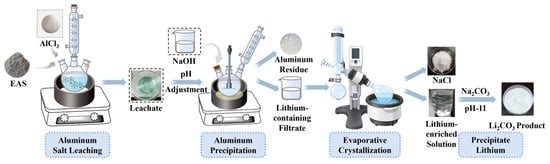
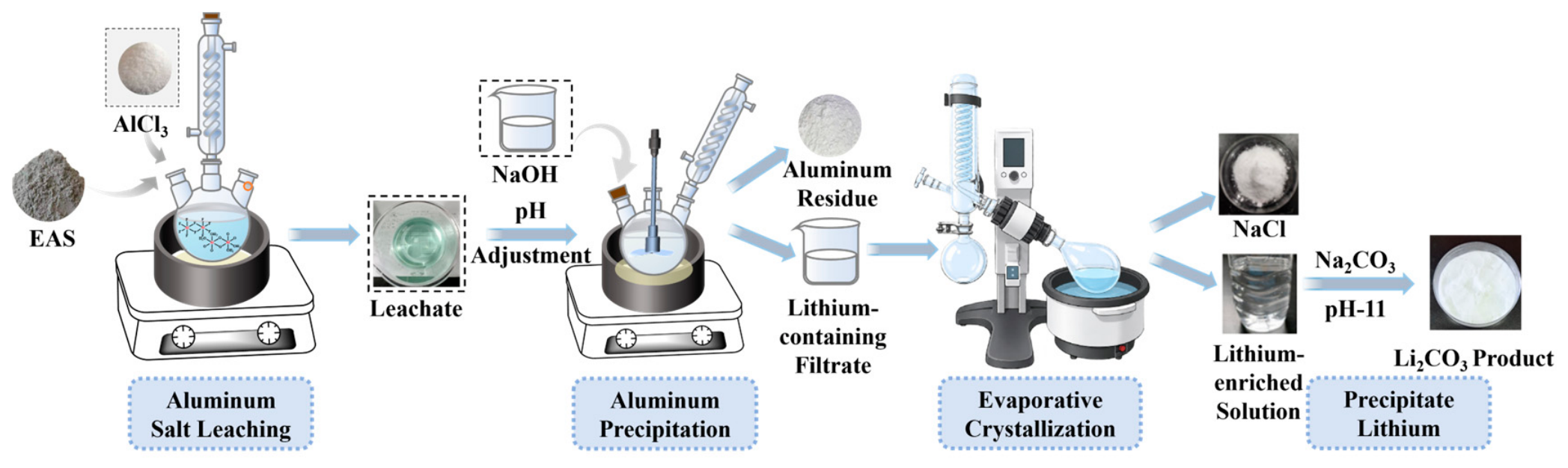
This study employed AlCl3 to leach lithium from EAS under acidic conditions for the subsequent preparation of Li2CO3. The overall process flow is illustrated in Figure 1 [16]. The process employs EAS as the raw material, which is first subjected to AlCl3 leaching to obtain a lithium-containing filtrate and a solid residue. Leaching experiments were carried out in a jacketed constant-temperature magnetic stirrer equipped with a temperature control system (DF-101S, Gongyi Yuhua Instrument Co., Ltd.) (Gongyi, China). First, 150 mL of AlCl3 aqueous solution was prepared at the required concentration (0.4, 0.6, or 0.85 mol/L), and its initial pH was adjusted to 0.5 with HCl at room temperature. The prepared solution was then transferred into a three-necked flask and heated to the target leaching temperature, after which 50 g of EAS was added, corresponding to a solid-to-liquid ratio of 1:3 g/mL. The solid–liquid mixture was then vigorously stirred at 500 rpm using an electric stirrer (HD2010W, Shanghai Sile Instrument Co., Ltd.) (Shanghai, China). After leaching, the slurry was filtered through a vacuum filtration to achieve solid–liquid separation. The concentrations of Li+, Ca2+, Na+, and Al3+ in the leachate and washing solution were determined by ICP-OES. The leaching efficiency of each element was calculated according to Equation (1) [16].
where Ei is the leaching efficiency of element i (%), Vi is the volume of the leachate (L), Ci is the concentration of element i in the leachate (g/L), mi is the mass of the EAS raw material (g), and Wi is the content of element i in the raw material (%).
Figure 1.
Flowchart for Li2CO3 production via lithium extraction from EAS by AlCl3 leaching. Adapted from Ref. [16].
The lithium-containing filtrate obtained after AlCl3 leaching was adjusted to the desired pH with NaOH solution to precipitate Al3+. The resulting solution was then evaporated and crystallized to remove sodium as NaCl and simultaneously enrich Li+. For lithium precipitation, the pH was raised to 11 with NaOH, followed by the gradual addition of solid Na2CO3. After aging for 30 min, the precipitate was collected by vacuum filtration. The filtered crude product contains water-soluble impurities such as Na2CO3, which can be removed by washing several times with hot water at 95 °C. After repeating the washing 2–3 times, the product was dried at 70 °C for 8 h to obtain the final Li2CO3 product.
2.2.2. Leaching Kinetics
Based on the characteristics of the leaching reaction, this process is classified as a typical non-catalytic solid–liquid two-phase reaction that can be described by the unreacted shrinking core model. This model has been widely used to study leaching kinetics of solid–liquid systems in hydrometallurgy [17,18]. According to the overall leaching performance and reaction conditions, the AlCl3 leaching for lithium extraction can be described by three kinetic models: internal diffusion control, chemical reaction control, and mixed control. Internal diffusion control means the overall leaching rate is predominantly governed by the diffusion of leaching reagent through the solid product layer on EAS particle surfaces to the unreacted core, and the outward diffusion of soluble products through this solid layer; raw material particle size is the key influencing factor. Chemical reaction control indicates that the leaching rate is limited mainly by the interfacial chemical reaction between leaching reagent and unreacted solid, where temperature and reagent concentration dominate the leaching behavior. Mixed control indicates that the leaching rate is jointly restricted by mass transfer processes, and stirring intensity, temperature, and reagent concentration all affect the leaching rate [19]. The specific control equations are as follows [20]:
Internal diffusion control kinetic equation:
Chemical reaction control kinetic equation:
Mixed control kinetic equation:
where α is the extraction of Li+, %; ke is the chemical reaction rate constant; and t is the reaction time, min.
2.3. Characterization Methods
The concentrations of Li+, Ca2+, Na+, and Al3+ in the liquid phase were determined by inductively coupled plasma optical emission spectrometry (ICP-OES, Agilent 5800, Agilent Technologies) (Santa Clara, California, USA). The standard spectral lines used for each metal element were Li (670.78 nm), Al (396.15 nm), Ca (396.85 nm), and Na (589.59 nm). Prior to measurement, all samples were diluted with 1% HNO3 to keep the concentrations within 30 ppm and filtered through a 0.45 µm membrane to remove any visible suspended solids, thereby preventing blockage of the sample introduction and outlet tubes as well as salt deposition on the torch. The fluoride ion concentration in the leachate was determined using a fluoride ion meter (PXSJ-216F, Leici-Shanghai INESA Scientific Instrument Co., Ltd.) (Shanghai, China). Prior to measurement, the aluminum content in the solution was diluted to below 50 mg/L, and total ionic strength adjustment buffer (TISAB II) was added at a 1:1 volume ratio to eliminate the interference caused by the formation of aluminum–fluoride complexes on fluoride detection.
The phase structures of the solid samples were determined by X-ray diffraction (XRD, D/Max-2200, Rigaku) (Akishima, Japan) using graphite-monochromatized Cu-Kα radiation as the X-ray source, and the test results were analyzed by X’pert High Score Plus 3.0 software and the database of PDF 2-2004 [21]. The micromorphologies of the aluminum precipitation residue and the Li2CO3 product were characterized by scanning electron microscopy equipped with energy-dispersive X-ray spectroscopy (SEM-EDS, JSM-IT500HR, JEOL) (Akishima, Japan), in order to reveal the surface changes in the samples before and after aluminum salt leaching. Prior to measurement, all samples were dried under vacuum to ensure complete removal of moisture and volatile organic compounds from the sample surface.
3. Results and Discussion
3.1. Kinetic Analysis of Lithium Extraction from EAS
Previous experimental studies have shown that leaching temperature and Al3+ concentration are the key factors affecting the Li+ leaching efficiency from EAS. Therefore, to identify the main controlling step in the Li+ leaching process, this section uses macrokinetic fitting and microscale mechanistic analysis of leaching datasets obtained under varied conditions, using the unreacted shrinking core model.
3.1.1. Leaching Kinetics of Li+ at Different Temperatures
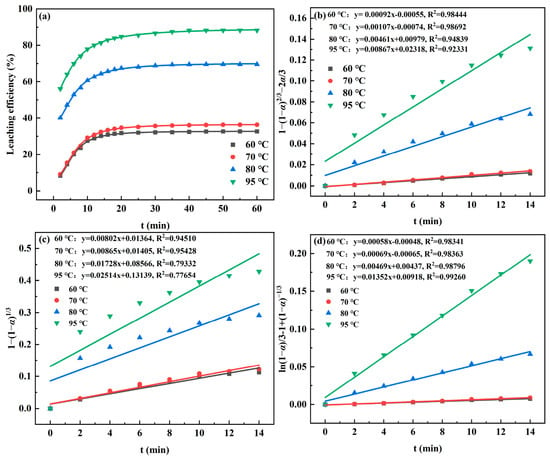
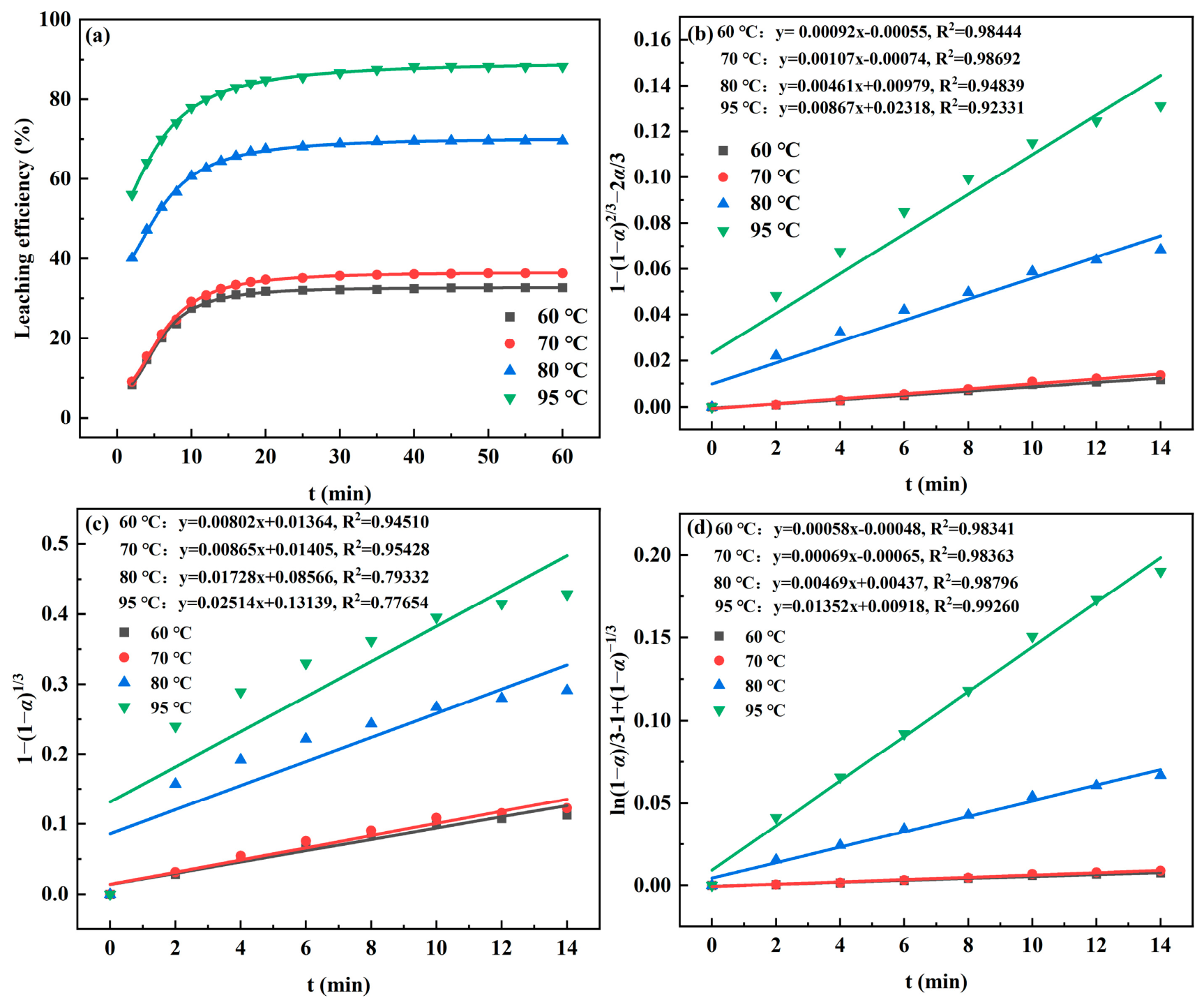
Because low temperatures result in poor reaction activity between the leaching agent and EAS, leading to low Li+ leaching efficiency, leaching kinetics were investigated at 60 °C, 70 °C, 80 °C, and 95 °C under the conditions of an Al3+ concentration of 0.85 mol/L, S/L ratio of 1:3, and initial leachate pH of 0.5. Here, “reaction activity” refers to the ability of the leaching agent to attack the lithium-bearing mineral lattice and to promote interfacial chemical reactions. According to the mechanism proposed in previous work, proton attack on cryolithionite (LiNa2AlF6) can weaken the Al-F framework and induce ion-exchange processes (e.g., H+/Li+ exchange), thereby facilitating the release of Li+ into solution. In addition, the addition of AlCl3 to water increases the ionic strength of the system, which raises the activity coefficients of the dissolved species and further promotes the dissolution of lithium-bearing phases [16]. The results are shown in Figure 2. As shown in Figure 2a, increasing the reaction temperature significantly enhances the Li+ leaching process, and the Li+ leaching efficiency reaches a maximum of 88.3% at 95 °C. This is because elevated temperatures boost reaction activity, raise the frequency of effective interphase molecular collisions, accelerate the surface chemical reaction rate, and thereby improve leaching efficiency [22]. The kinetic curves exhibit distinct stage characteristics: at the same leaching temperature, the Li+ leaching efficiency increased rapidly during the first 14 min as the reaction proceeded, then the increase slowed down between 14 and 40 min, and after 40 min the increase in Li+ leaching efficiency was no more than 2%. This is because, at a given temperature, the chemical reaction between the solid and liquid phases tends to reach equilibrium as the reaction time increases. Therefore, the Li+ leaching kinetics can reach equilibrium within 60 min.
Figure 2.
(a) Variation in Li+ leaching efficiency with reaction time at different temperatures. Relationship between rate control steps and leaching time at different temperatures: (b) internal diffusion control, (c) chemical reaction control, and (d) mixed control.
To accurately characterize the Li+ leaching kinetics, the lithium extraction efficiency data obtained within the initial 14 min at different temperatures were fitted to the three kinetic equations, and the fitting results are shown in Figure 2b–d. At 60–70 °C, the R2 values of the internal diffusion model and mixed control model are very close. Based on the present kinetic data, the rate-controlling step in this temperature range cannot be unambiguously distinguished. At 80–95 °C, the mixed control model (Figure 2d) had the best R2 performance, suggesting that the leaching process at this time transformed into a mixed control mechanism. As the temperature increased, the rate of interfacial chemical reactions significantly accelerated, and the interfacial reaction resistance was comparable to the internal diffusion resistance. The leaching was now controlled by internal diffusion and chemical reaction mixed control [23]. The kinetic fitting in this work only used data from 0 to 14 min. At 80 °C and 95 °C, this fitting interval covers the early-to-middle stage of leaching, and non-zero intercepts are observed in the fitting results. This behavior originates from the rapid formation of a product layer on the surface of EAS particles and heterogeneous dissolution of mineral phases on particle surfaces, which is a common limitation when applying the shrinking core model to solid waste leaching systems. This finding further confirms from a kinetic perspective that raising the leaching temperature and AlCl3 concentration can effectively overcome the energy barrier of chemical reactions and lower diffusion resistance, thereby substantially improving the lithium leaching efficiency.
3.1.2. Leaching Kinetics of Li+ at Different AlCl3 Concentrations
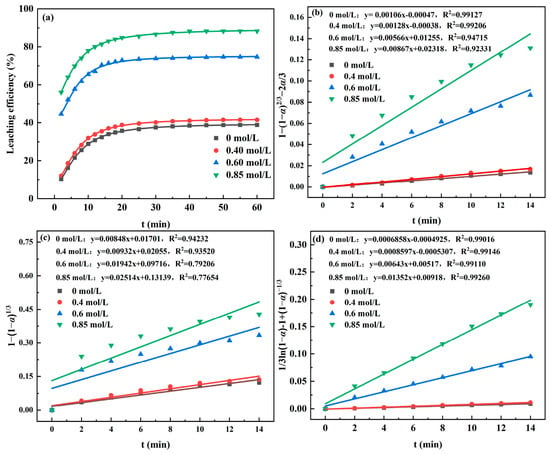
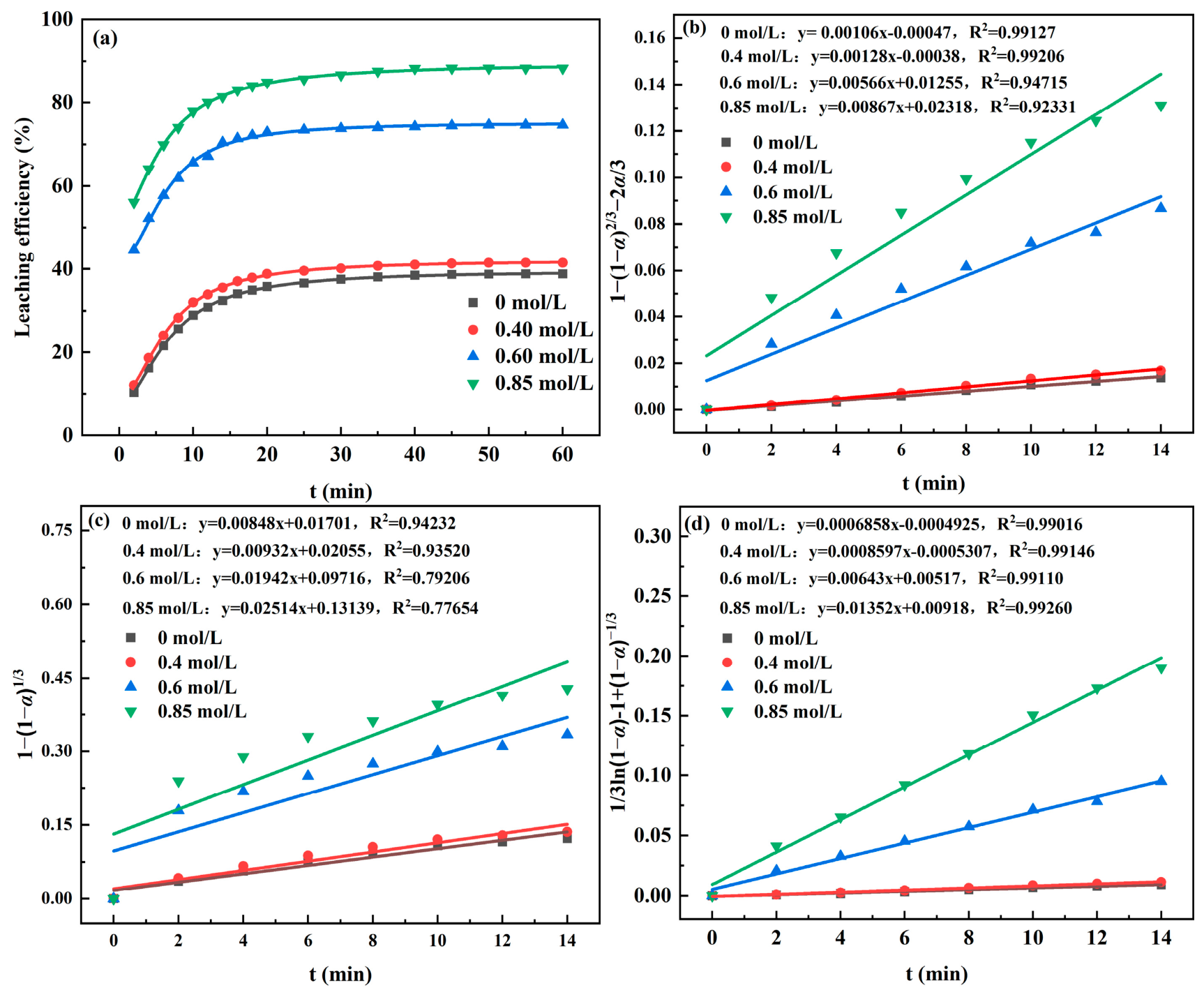
With the leaching temperature fixed at 95 °C, solid–liquid ratio (S/L) of 1 g: 3 mL, and initial leaching agent pH of 0.5, the Li+ leaching kinetics at varying AlCl3 concentrations were investigated, and the results are presented in Figure 3. As illustrated in Figure 3a, increasing AlCl3 concentration markedly improves Li+ leaching efficiency within a given reaction time, which is consistent with the promotional effect of temperature. During the initial 14 min of the reaction, the leaching efficiency rises rapidly. The growth rate then slows over 14–30 min, and the Li+ leaching efficiency plateaus after 30 min, with further increments generally below 2%. This phenomenon mainly arises because, as the reaction proceeds, readily leachable lithium-bearing phases on EAS particle surfaces are gradually decomposed. Meanwhile, the thickening inert product layer formed on particle surfaces greatly increases internal diffusion resistance across the solid film, such that the leaching system essentially reaches its maximum extraction limit within 60 min.
Figure 3.
(a) Effect of initial AlCl3 concentration on Li+ leaching efficiency. Linear fitting plots of different kinetic models for the initial rapid leaching stage: (b) internal diffusion control (c) chemical reaction control, and (d) mixed control.
Since the Li+ leaching behavior is most prominent within the initial 14 min, data collected from 0 to 14 min were fitted to the three classical kinetic equations derived from the unreacted shrinking core model to elucidate the kinetic mechanism of this stage. The fitting results are presented in Figure 3b–d. The mixed control model yields the highest correlation coefficient (R2). By fitting the mixed control Equation (4) against time, the apparent rate constants ke corresponding to AlCl3 concentrations ranging from 0.4 to 0.85 mol/L were calculated, as summarized in Table 2.
Table 2.
ke values at different AlCl3 concentrations.
The apparent rate constant increased from 0.00086 to 0.00643 and 0.01352 as the initial AlCl3 concentration increased from 0.4 mol/L to 0.6 mol/L and 0.85 mol/L, respectively. However, this increase was clearly nonlinear. Previous structural characterization of the same AlCl3 leaching system showed that increasing AlCl3 concentration progressively disrupted the [AlF6] structure of cryolite/cryolithionite and promoted the formation of new Al-F-containing phases [16]. The observed concentration dependence is therefore consistent with a concentration-dependent structural transformation rather than a simple power-law relationship. Accordingly, no single reaction order is assigned in the present study.
3.1.3. Leaching Mechanism
The leaching of lithium from EAS involves two coupled pathways: (i) proton-assisted dissolution and ion exchange, and (ii) Al-F complexation. In the acidic aqueous environment (initial pH 0.5), H+ can promote the dissolution of Li-bearing fluoride phases by attacking the Al-F framework and promoting the exchange of Li+ with H+ at the solid–liquid interface [24]. This proton-assisted process alone, however, is insufficient to achieve high lithium recovery, as evidenced by the relatively low leaching efficiency in the absence of AlCl3 (0 mol/L, Figure 3a).
The addition of AlCl3 provides Al3+, which exhibits a strong thermodynamic affinity for F− and can preferentially coordinate with the fluorine species released from the LiNa2AlF6 framework, forming stable Al-F complexes in solution. This Al-F complexation continuously consumes F−, shifts the dissolution equilibrium of LiNa2AlF6 toward the solution side, and thereby promotes the decoupling and release of Li+. In addition, the dissolution of AlCl3 in water increases the ionic strength of the system, which raises the activity coefficients of the dissolved species and further favors the dissolution of lithium-bearing phases. Therefore, the acidic aqueous environment provides the initial proton attack and ion-exchange pathway, contributing to the dissolution of the Li-bearing phase, while AlCl3 sustains and amplifies the dissolution process through Al-F complexation. The two mechanisms are therefore not independent but synergistic.
3.2. Preparation of Lithium Carbonate Product
After AlCl3 leaching and hot water washing of the EAS raw material, lithium is transferred into the leachate as Li+, accompanied by the co-leaching of Al3+, Ca2+, Na+, and F−. In this section, the leachate and wash water obtained from the above AlCl3 leaching experiments (major ion concentrations summarized in Table 3) were adopted as the feed solution and sequentially treated via pH adjustment for aluminum precipitation, evaporative crystallization, and Li2CO3 precipitation, aiming to achieve efficient impurity separation and ultimately produce Li2CO3 products.
Table 3.
Concentration of major ions in leachate (g/L).
3.2.1. Aluminum Precipitation
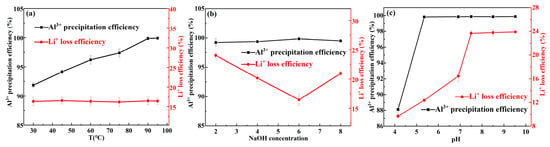
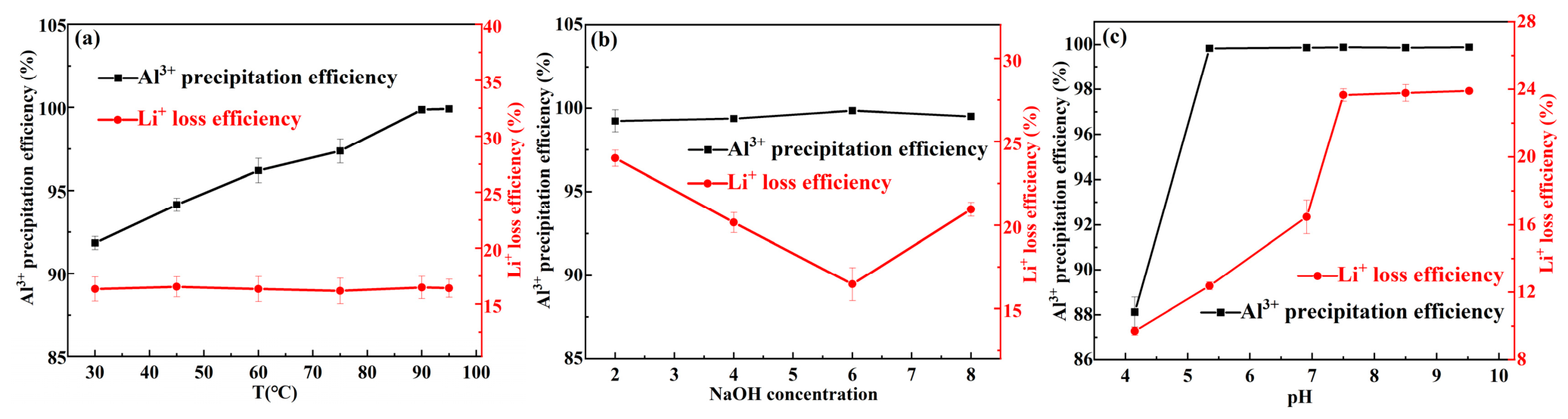
The initial lithium-containing leachate exhibits strong acidity, with a pH ranging from 0.8 to 1.0. This pH increase from the initial 0.5 is mainly attributed to the consumption of H+ via proton attack on cryolithionite and the associated ion-exchange/dissolution reactions, as well as the release of F− and the formation of Al-F complexes. Based on the thermodynamic characteristics that impurity ions such as Al3+ and F− readily combine with OH− at higher pH to form sparingly soluble salts or hydroxide precipitates, NaOH solution was employed to adjust the system pH in this study, thereby achieving the precipitation and separation of Al3+ and F− for deep purification. To optimize the impurity removal process and minimize the co-precipitation loss of Li+, this section systematically investigated the effects of reaction temperature, NaOH concentration, and final pH on the precipitation and separation of Al3+ and Li+. The results are shown in Figure 4.
Figure 4.
Effect of (a) temperature, (b) NaOH concentration, and (c) pH on Al3+ removal efficiency and Li+ loss efficiency.
As shown in Figure 4a, Al3+ precipitation efficiency increased with increasing temperature because higher temperatures facilitate a higher reaction rate. Temperature exerted a comparatively minor influence on Li+ loss efficiency. This is because higher temperatures accelerate precipitate formation while simultaneously reducing the precipitate’s specific surface area and weakening its adsorption capacity; these two effects ultimately offset each other. When the temperature exceeded 90 °C, the Al3+ precipitation efficiency essentially reached a plateau. As shown in Figure 4b, at a fixed final pH, the overall Al3+ precipitation efficiency exceeded 99%, whereas the Li+ loss efficiency exhibited a trend of first decreasing and then increasing. The NaOH concentration had little effect on the Al3+ precipitation efficiency, because Al3+ precipitation depends mainly on OH− in the system. For Li+ during impurity removal, when the NaOH concentration was relatively low, the precipitation driving force was insufficient, and the resulting precipitate was mostly amorphous colloidal flocs, whose high specific surface area provided strong surface adsorption for Li+ in solution, leading to a relatively high Li+ loss efficiency. An appropriate increase in NaOH concentration promoted the transformation of the precipitate toward a dense crystalline state and reduced the adsorption loss. However, when the NaOH concentration was too high, the supersaturation in the local system increased sharply, triggering explosive nucleation and readily causing severe mechanical entrapment, which enclosed a large amount of Li+ within the precipitate and caused the loss efficiency to rebound [25].
As shown in Figure 4c, the final pH is a key parameter controlling the separation of aluminum and lithium. When the pH increased from 4.15 to 5.35, the Al3+ precipitation efficiency changed abruptly, increasing from 88.12% to 99.83%, and then remained stable. However, the Li+ loss efficiency increased with increasing pH and remained stable when the pH exceeded 7.50. Taking these results into consideration, the optimal conditions for modulated aluminum precipitation in this study were determined as a temperature of 90 °C, a precipitant of 6 mol/L NaOH solution, and an optimal pH of 5.35. Under these conditions, the Al3+ precipitation efficiency reached 99.83%, with a Li+ loss efficiency of 12.38%. When the pH is lower than the inflection point (5.35), the OH− supply in the system is insufficient, and the hydrolysis and precipitation reaction of Al3+ are incomplete, resulting in a small amount of precipitate products. Therefore, the precipitation efficiency of Al3+ is relatively low. When the pH rises to 5.35, the hydrolysis reaction of Al3+ proceeds rapidly and almost completely, and a large amount of aluminum hydroxyfluoride phase is generated. The precipitation efficiency of Al3+ increases sharply, forming a curve inflection point. For Li+, when the pH is lower than 5.35, the amount of solid-phase precipitation is limited, and the carriers that can adsorb or encapsulate Li+ are few, resulting in a low loss of lithium. When the pH is higher than 5.35, a large amount of aluminum hydroxyfluoride precipitate is released. On the one hand, it captures Li+ through surface adsorption, and on the other hand, the rapid aggregation process of the precipitate will carry away liquid-phase Li+, and the Li+ loss rate continuously increases with the increase in pH. When pH is greater than 7.50, Al3+ has basically completely precipitated, the ability to adsorb and encapsulate Li+ no longer significantly changes, and the lithium loss curve tends to be stable.
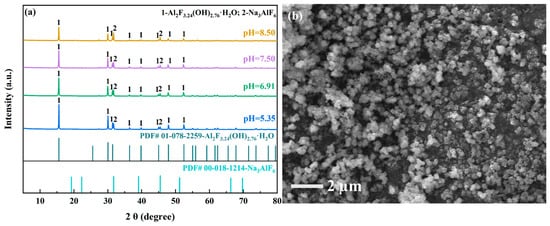
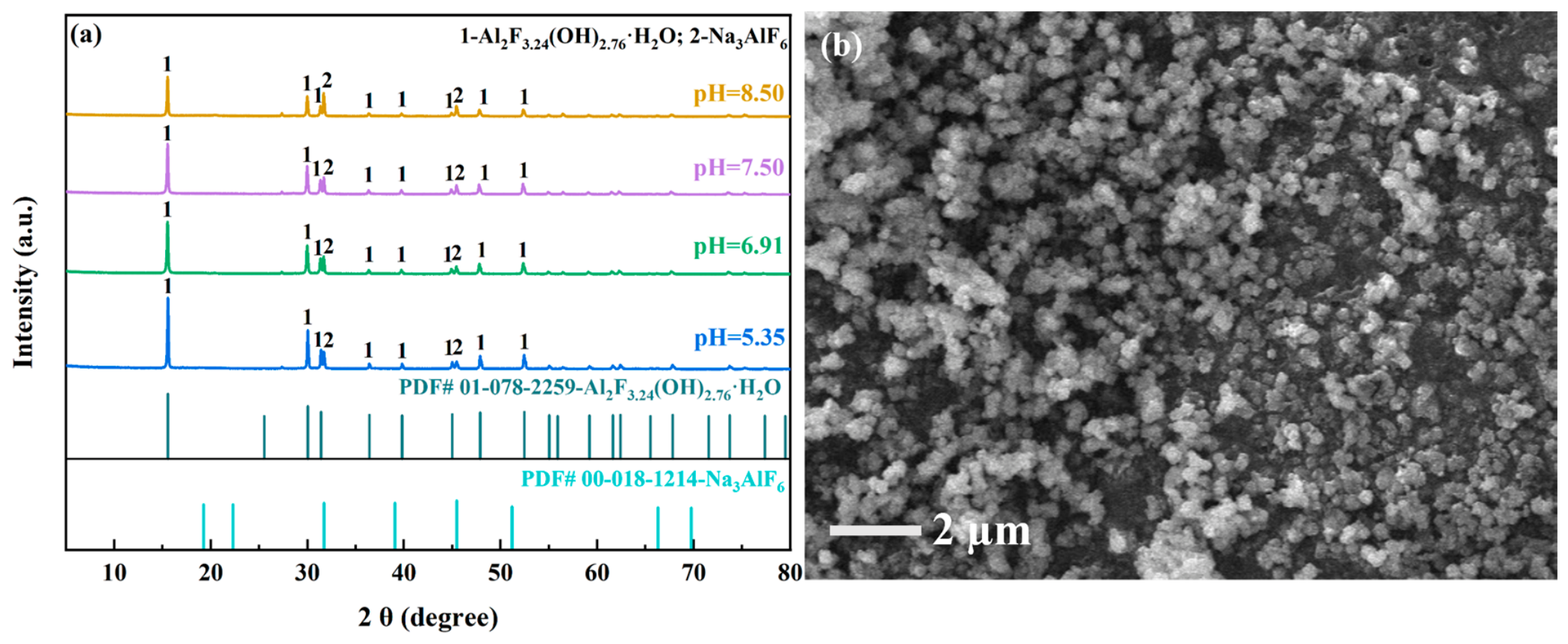
To elucidate the phase transformation mechanism underlying the impurity removal process, XRD characterization was carried out on the aluminum precipitation residue harvested under conditions yielding high Al3+ precipitation efficiency, with the results presented in Figure 5a. The XRD pattern reveals that the aluminum precipitation residue is predominantly composed of crystalline Al2F3.24(OH)2.76·H2O, accompanied by minor diffraction peaks corresponding to Na3AlF6. In the crystal structure of Al2F3.24(OH)2.76·H2O, the crystal plane corresponding to the 2θ≈25° diffraction peak is highly sensitive to the occupancy ratio of F−/OH−. After the aluminum is precipitated with NaOH, OH− has entered the Al2F3.24(OH)2.76·H2O lattice in large quantities, resulting in the substitution of F− by OH−. The periodic atomic arrangement of this crystal plane is disrupted, the coherent scattering is weakened, and the diffraction peak disappears [26]. Such fluorine-rich aluminum residue possesses notable resource recovery potential. Aluminum hydroxyfluoride can be transformed into smelter-grade AlF3 and Al2O3 via calcination. Furthermore, SEM was employed to investigate the micromorphology of the aluminum precipitation residue prepared under the optimized modulated aluminum precipitation conditions, as displayed in Figure 5b. The residue comprises regularly shaped particles that are mutually agglomerated. The submicron spherical particles are identified as aluminum hydroxyfluoride, whereas the layered stacked structure corresponds to cryolite [27].
Figure 5.
XRD (a) and SEM (b) of precipitated aluminum residue.
3.2.2. Evaporative Crystallization
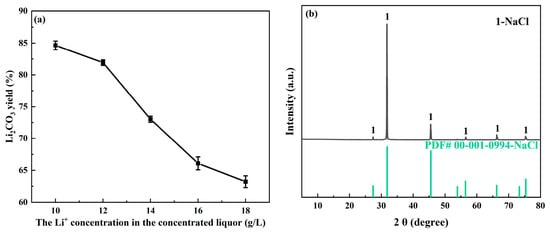
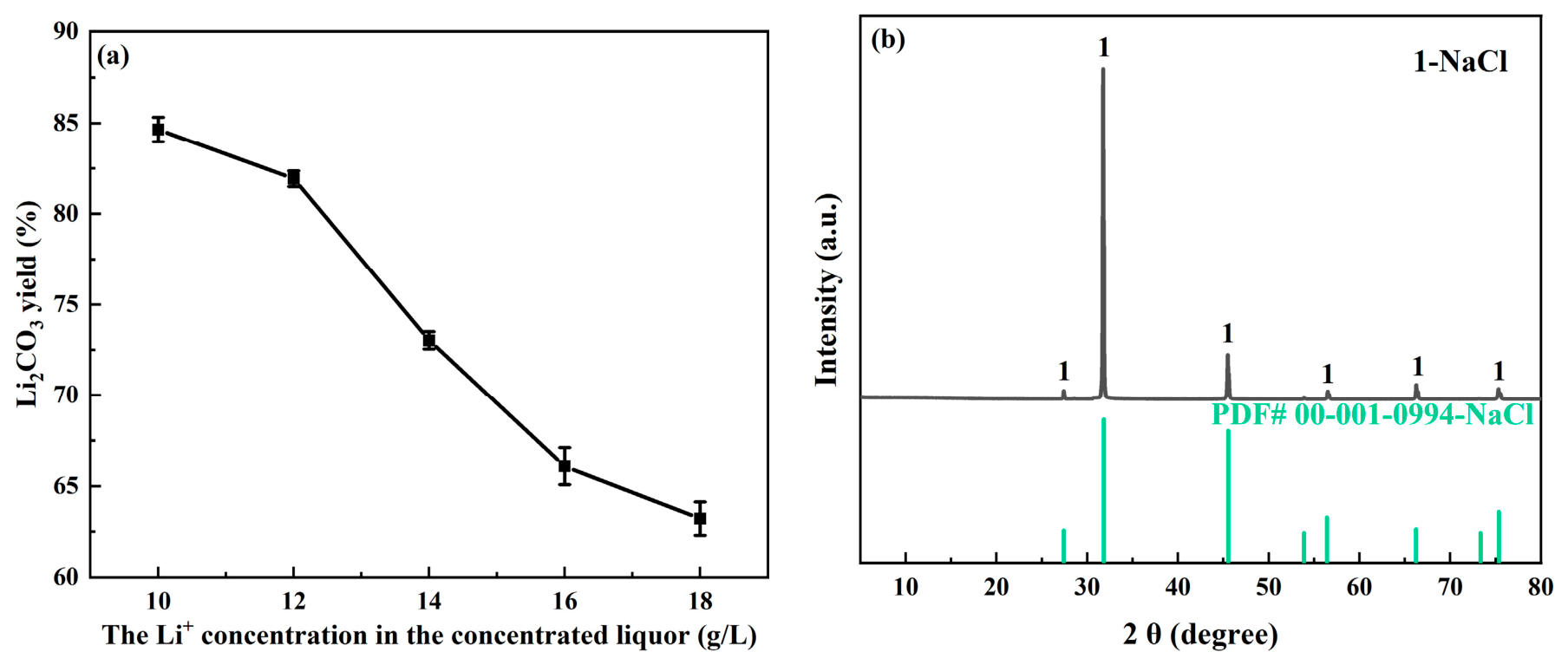
Since the Li+ concentration of the concentrated liquor obtained from evaporative crystallization exerts a considerable impact on the product yield in the subsequent Li2CO3 precipitation stage, the effect of Li+ concentration in the concentrated liquor on the Li2CO3 yield during carbonation-based lithium precipitation was investigated, and the results are shown in Figure 6a. The results indicate that as the Li+ concentration in the concentrated liquor increased from 10 g/L to 18 g/L, the yield of the Li2CO3 product after lithium precipitation exhibited a pronounced downward trend. This is attributed to the phase transformation and physical entrainment effects of the complex salt system during deep evaporation. The previous impurity removal step introduced a large amount of Na+, and to obtain a higher Li+ concentration, deep dehydration evaporation was required, which caused a large amount of NaCl in the solution to reach supersaturation and precipitate sharply. As the solid content of the system increased dramatically, the large amount of precipitated NaCl formed a dense crystal network, resulting in severe mechanical entrapment and capillary entrainment that enclosed the Li+-enriched solution within the filter cake [28]. This irreversible physical loss significantly reduced the effective Li+ available for subsequent precipitation, thereby substantially lowering the overall yield. Therefore, to balance evaporation energy consumption against lithium recovery efficiency, the Li+ concentration at the end point of evaporation was controlled at 10 g/L in this study. At this concentration, the system can effectively enrich lithium while avoiding the mother liquor entrainment caused by explosive NaCl crystallization, achieving the optimal Li2CO3 yield of 84.65%.
Figure 6.
(a) Effect of the Li+ concentration in the concentrated liquor on the yield of Li2CO3; (b) XRD analysis of NaCl products.
In addition, XRD characterization was performed on the NaCl separated from the evaporative crystallization stage, and the results are shown in Figure 6b. All diffraction peaks of the product match well with the standard card of sodium chloride (PDF# 00-001-0994). The XRD pattern exhibits a smooth baseline and sharp diffraction peaks, without any miscellaneous peaks originating from lithium salts or other impurities. This observation not only confirms that the recovered by-product is high-purity NaCl with the potential to be reused as an industrial-grade by-product, but also indirectly demonstrates that efficient separation of Li+ and Na+ was achieved under moderate evaporation conditions.
3.2.3. Carbonation for Lithium Precipitation
Following modulated aluminum precipitation for impurity removal and evaporative crystallization, a relatively pure lithium-enriched solution was obtained, which could be further used to prepare Li2CO3 products. The sodium carbonate (Na2CO3) precipitation method is widely adopted for industrial Li2CO3 production owing to its low production cost and straightforward process. Its core principle is the precipitation reaction between Li+ and CO32− (Equation (5)) [29]. Therefore, the Na2CO3 precipitation method was selected in this study to prepare Li2CO3.
2Li+ + CO32−→Li2CO3↓
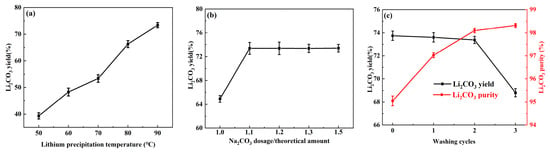
In this section, the effects of lithium precipitation temperature, Na2CO3 dosage, and washing cycles on the Li2CO3 yield were investigated, and the results are shown in Figure 7. As illustrated in Figure 7a, the Li2CO3 yield increased markedly with rising lithium precipitation temperature. This can be attributed to the fact that elevated temperature facilitates the reaction between Li+ and CO32− to form Li2CO3 precipitate. Meanwhile, the solubility of Li2CO3 declines with increasing temperature, which provides a strong supersaturation driving force for crystallization. In contrast, the solubility of the main impurity salts in the system, such as NaCl and unreacted Na2CO3, shows a positive correlation with temperature, and the impurities remain in solution in ionic form during filtration. Therefore, high-temperature precipitation can not only maximize the precipitation of Li2CO3 but also effectively inhibiting the co-precipitation of impurity ions, achieving highly selective solid–liquid separation.
Figure 7.
Effects of (a) lithium precipitation temperature, (b) Na2CO3 dosage/theoretical amount, and (c) washing times on the yield of l Li2CO3.
As shown in Figure 7b, when the amount of Na2CO3 added was 1.1 times the theoretical amount, the Li2CO3 yield reached reaction equilibrium. Further addition of Na2CO3 failed to improve the yield, because the precipitation reaction had essentially proceeded to completion and the yield had reached a plateau. During the carbonation-based lithium precipitation process, water-soluble impurities such as NaCl tend to become entrained on the product surface, which degrades the purity of the Li2CO3 product. Given that the solubility of these impurities varies with temperature in the opposite direction to that of Li2CO3, hot water washing was employed in this study for purification. As depicted in Figure 7c, the product purity increased with an increasing number of washing cycles, whereas the Li2CO3 yield gradually decreased. This is because Li2CO3 itself is a sparingly soluble compound, and part of the lithium redissolves into the washing liquid during the washing process, leading to a decrease in the final yield.
Therefore, by comprehensively balancing the product purity and the economic efficiency of lithium extraction, the optimal lithium precipitation conditions were determined as follows: a reaction temperature of 90 °C, a Na2CO3 dosage of 1.1 times the theoretical stoichiometric value, and two hot-water washing cycles. Under these optimized parameters, the final Li2CO3 yield reached 73.38%.
3.3. Product Analysis
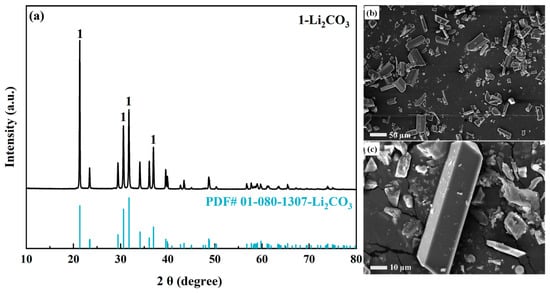
Through the sequential steps of modulated aluminum precipitation, evaporative crystallization, and carbonation-based lithium precipitation of the leachate, the Li2CO3 product was finally obtained. To identify the phase composition and micromorphology of the product prepared under the optimal conditions, the product was dried at 80 °C and characterized by XRD and SEM, and the results are presented in Figure 8. As shown in the XRD pattern in Figure 8a, the characteristic diffraction peaks of the product match well with those of the Li2CO3 standard PDF card (PDF# 01-080-1307). The pattern exhibits a flat baseline and sharp diffraction peaks, with no miscellaneous impurity peaks are detected, indicating that the obtained Li2CO3 has high crystallinity and favorable phase purity. Figure 8b and c display SEM micrographs at magnifications of 500× and 2500×, respectively. It can be seen that the prepared Li2CO3 product mainly exhibits a typical long columnar crystal structure with heterogeneous particle sizes, possessing regular crystal faces and sharp crystal edges. The observed particles exhibit a morphology consistent with the characteristic crystal habit of monoclinic Li2CO3. The surfaces of the individual crystals are smooth and dense, without noticeable fine amorphous impurities adhered among the crystals. Such morphological features are highly consistent with the crystallization characteristics of high-purity Li2CO3 reported in relevant literature [30].
Figure 8.
The Li2CO3 products: (a) XRD analysis, and (b,c) SEM analysis.
Further, following the Chinese national standard “Methods for chemical analysis of lithium carbonate, lithium hydroxide monohydrate, and lithium chloride” (GB/T 11064.16-2013) [31], the chemical purity and trace impurity elements of the product were quantitatively analyzed using ICP-OES, with the results summarized in Table 4. The analytical results show that the purity of the main component Li2CO3 reached 98.6%. The concentrations of critical metallic impurities, including Fe, Na, Ca, and Mg, were effectively controlled. Compared with the national standard for lithium carbonate (GB/T 11075-2013) [32], all trace element indexes of the recovered product meet or exceed the specified limits. Its overall quality satisfies the requirements for the second-grade industrial-grade lithium carbonate (Li2CO3-2), suggesting its potential for direct commercialization or further purification into battery-grade materials.
Table 4.
Comparison results of ICP-OES test for Li2CO3 products.
4. Conclusions
This study proposes a process for lithium recovery from EAS using AlCl3 as the leaching agent to produce Li2CO3. The Li+ leaching kinetics under varied temperatures and AlCl3 concentrations were systematically investigated to elucidate the complex dissolution behavior of Li+. The results demonstrate that the Li+ leaching process exhibits temperature-dependent rate-controlling characteristics. The mixed control equation best describes the 80–95 °C data, and the rate-controlling step at 60–70 °C cannot be assigned. At 95 °C, under different AlCl3 concentration conditions, the Li+ leaching process is mainly controlled by mixed diffusion. The lithium-containing filtrate obtained after leaching was treated via modulated aluminum precipitation, evaporative crystallization, and carbonation-based lithium precipitation to prepare Li2CO3 product. To improve the Li+ recovery, the processes of modulated aluminum precipitation and carbonation-based lithium precipitation were optimized. The minimum Li+ loss was achieved under the following optimal conditions: precipitation temperature of 90 °C, NaOH concentration of 6 mol/L, final aluminum-precipitation pH of 5.35, Li+ concentration of 10 g/L in the concentrate, Na2CO3 dosage of 1.1 times the theoretical value, and two washing cycles. The purity of the Li2CO3 product reached 98.6%, which conforms to the Chinese national standard for industrial-grade lithium carbonate (GB/T 11075-2013). This study provides a theoretical foundation for the harmless, resource-oriented, and high-value utilization of EAS.
Author Contributions
Conceptualization, X.C. and L.C.; methodology, L.C.; software, G.L.; validation, D.W. and Y.H.; formal analysis, X.C.; investigation, Y.H.; resources, G.L.; data curation, Y.H.; writing—original draft preparation, X.C.; writing—review and editing, D.W.; visualization, D.W.; supervision, L.C.; project administration, L.C.; funding acquisition, X.C. and L.C. All authors have read and agreed to the published version of the manuscript.
Funding
This work was supported by the National Key R&D Program of China (Grant No. 2024YFC3907501), the National Natural Science Foundation of China (52500168), the Natural Science Foundation for Young Scientists of Shanxi Province (202303021222027), the Shanxi Scholarship Council of China (2025-003).
Data Availability Statement
The original contributions presented in this study are included in the article. Further inquiries can be directed to the corresponding author.
Conflicts of Interest
The authors declare no conflict of interest.
References
- Cao, Y.; Zhou, C.; Gao, F.; Huang, Y.; Zhu, W.; Liu, G.; Wang, J. Lithium recovery from typical coal-based solid wastes: Critical technologies, challenges, and prospects. Chem. Eng. J. 2024, 498, 155121. [Google Scholar] [CrossRef] [Scilit]
- Zhang, Y.; Zhang, J.; Wu, L.; Tan, L.; Xie, F.; Cheng, J. Extraction of lithium and aluminium from bauxite mine tailings by mixed acid treatment without roasting. J. Hazard. Mater. 2021, 404, 124044. [Google Scholar] [CrossRef] [Scilit] [PubMed]
- Dong, L.; Jiao, F.; Liu, W.; Wang, C.; Wang, D.; Qin, W. A novel approach for extracting lithium from overhaul slag by low temperature roasting-water leaching. Chem. Eng. J. 2024, 481, 148571. [Google Scholar] [CrossRef] [Scilit]
- Liu, F.; Lv, H.; Zuo, Z.; Xie, M.; Li, R.; Zhao, H. A Denitrification-Phase Transition and Protection Rings (DPP) Process for Recycling Electrolytic Aluminum Dross. ACS Sustain. Chem. Eng. 2021, 9, 13751–13760. [Google Scholar] [CrossRef] [Scilit]
- Deng, L.; Qiu, Y.; Jiang, J.; Zhu, Z.; Che, D. Co-combustion characteristics of electrolytic aluminum waste and coal. Fuel 2022, 325, 124890. [Google Scholar] [CrossRef] [Scilit]
- Tang, Y.; Ma, L.; Qiu, Z.; Yang, W.; Chen, B.; Lin, Y. Research on synergistic disposal and high-value utilization of secondary aluminum dross and spent carbon anode. Process Saf. Environ. Prot. 2024, 184, 1094–1105. [Google Scholar] [CrossRef] [Scilit]
- Meng, L.; Hao, T.; Xu, E.; Miao, Z.; Jiang, X.; Zhao, S.; Wang, H.; Song, Z. Green and efficient separation of fluorine from spent aluminum electrolyte by aluminum sulfate solution: Leaching behavior and mechanism. Sep. Purif. Technol. 2025, 357, 130089. [Google Scholar] [CrossRef] [Scilit]
- Dong, L.; Jiao, F.; Liu, W.; Wang, D.; Wang, C.; Qin, W. Selective preparation of lithium carbonate from overhaul slag by high temperature sulfuric acid roasting-water leaching. J. Environ. Manage. 2024, 359, 120963. [Google Scholar] [CrossRef] [Scilit] [PubMed]
- Tang, C.; Wang, J.; Yang, S.; Zhang, X.; Li, S.; Lai, Y.; Tian, Z.; Jin, S.; Chen, Y. Efficient extraction and recovery of lithium from waste aluminum cryolite electrolyte. Resour. Conserv. Recycl. 2023, 197, 107070. [Google Scholar] [CrossRef] [Scilit]
- Zhang, T.; Guo, Y.; Liu, F.; Chen, Z.; Wang, H.; Chen, F.; Liao, C.; Wang, J. Enhanced extraction of lithium from spent aluminum electrolyte: Comparison based on different sulfuric acid leaching systems. Process Saf. Environ. Prot. 2026, 215, 109206. [Google Scholar] [CrossRef] [Scilit]
- Wu, S.; Tao, W.; Zheng, Y.; Ge, H.; He, J.; Yang, Y.; Wang, Z. A novel approach for lithium recovery from waste lithium-containing aluminum electrolyte by a roasting-leaching process. Waste Manag. 2021, 134, 89–99. [Google Scholar] [CrossRef] [Scilit] [PubMed]
- Wu, S.; Tao, W.; Ge, H.; Yang, J.; Li, J.; He, J.; Yang, Y.; Wang, Z. Stepwise extraction of lithium and potassium and recovery of fluoride from aluminum electrolyte wastes through calcification roasting–two-stage leaching. Environ. Sci. Pollut. Res. 2024, 31, 44348–44360. [Google Scholar] [CrossRef] [Scilit] [PubMed]
- Han, Z.; Wu, Y.; Hao, P.; Tan, X.; Wei, M.; Lv, X. Efficient lithium recovery from lithium-containing spent aluminium electrolyte via NaF fluorination roasting and Al2(SO4)3 leaching. J. Environ. Chem. Eng. 2023, 11, 110948. [Google Scholar] [CrossRef] [Scilit]
- Wu, S.; Tao, W.; Zheng, Y.; Yang, Y.; Yu, J.; Cui, J.; Lu, Y.; Shi, Z.; Wang, Z. Novel process for the extraction of lithium carbonate from spent lithium-containing aluminum electrolytes by leaching with aluminum nitrate and nitric acid. Hydrometallurgy 2020, 198, 105505. [Google Scholar] [CrossRef] [Scilit]
- Ma, L.; Qiu, Z.; Tang, Y.; Yang, W.; Chen, B.; Jiang, J.; Lin, Y. Chemical leaching-Flexible precipitation for sustainable recovery of fluoride from aluminum electrolysis multisource hazardous waste. Chem. Eng. J. 2024, 500, 157138. [Google Scholar] [CrossRef] [Scilit]
- Cui, L.; Wang, W.; Chao, X.; Gao, J.; Cheng, F. Efficient lithium recovery from electrolytic aluminum slag via an environmentally friendly process: Leaching behavior and mechanism. J. Clean. Prod. 2024, 439, 140800. [Google Scholar] [CrossRef] [Scilit]
- Cui, L.; Guo, Y.; Wang, X.; Du, Z.; Cheng, F. Dissolution kinetics of aluminum and iron from coal mining waste by hydrochloric acid. Chin. J. Chem. Eng. 2015, 23, 590–596. [Google Scholar] [CrossRef] [Scilit]
- Randhawa, N.S.; Gharami, K.; Kumar, M. Leaching kinetics of spent nickel-cadmium battery in sulphuric acid. Hydrometallurgy 2016, 165, 191–198. [Google Scholar] [CrossRef] [Scilit]
- Long, P.; Wang, G.; Zhang, C.; Yang, Y.; Cao, X.; Shi, Z. Kinetics model for leaching of ion-adsorption type rare earth ores. J. Rare Earths 2020, 38, 1354–1360. [Google Scholar] [CrossRef] [Scilit]
- Ma, J.; Zhang, Y.; Qin, Y.; Wu, Z.; Wang, T.; Wang, C. The leaching kinetics of K-feldspar in sulfuric acid with the aid of ultrasound. Ultrason. Sonochem. 2017, 35, 304–312. [Google Scholar] [CrossRef] [Scilit] [PubMed]
- El Koulali, F.; Ouzzine, M.; Cano-Casanova, L.; Román-Martínez, M.C.; Lillo-Ródenas, M.A. Use of the HighScore Plus software for an easy and complete quantification of the anatase, brookite, rutile, and amorphous phase content in TiO2. Chem. Inorg. Mater. 2025, 5, 100086. [Google Scholar] [CrossRef] [Scilit]
- Lin, Y.; Sun, H.; Peng, T.; Zhao, D.; Zhang, X. The leaching kinetics of iron from titanium gypsum in a citric acid medium and obtain materials by leaching liquid. Molecules 2023, 28, 952. [Google Scholar] [CrossRef] [Scilit] [PubMed]
- Leng, M.; Li, W.; Liu, Q. Study of lithium extraction and fluoride removal from waste aluminum electrolyte by the roasting-leaching method. J. Ind. Eng. Chem. 2025, 147, 201–209. [Google Scholar] [CrossRef] [Scilit]
- Chao, X.; Li, G.; Yuan, H.; Cui, L.; Wang, L.; Cheng, F. Efficient lithium recovery from aluminum electrolytic slag via HCl solution: Leaching behavior and mechanism. Miner. Eng. 2026, 235, 109848. [Google Scholar] [CrossRef] [Scilit]
- Han, J.; Zheng, M.; Nie, Z.; Wu, Q. Element enrichment and loss of chloride-type oilfield brine under natural evaporation conditions in summer. Carbonates Evaporites 2026, 41, 43. [Google Scholar] [CrossRef] [Scilit]
- Ntuk, U.; Tait, S.; White, E.T.; Steel, K.M. The precipitation and solubility of aluminium hydroxyfluoride hydrate between 30 and 70 °C. Hydrometallurgy 2015, 155, 79–87. [Google Scholar] [CrossRef] [Scilit]
- Wang, C.; Mao, S. Study on the effect of an ultrasound assisted reaction on the crystallization properties of recovered cryolite. RSC Adv. 2023, 13, 35359–35368. [Google Scholar] [CrossRef] [Scilit] [PubMed]
- Naillon, A.; Duru, P.; Marcoux, M.; Prat, M. Evaporation with sodium chloride crystallization in a capillary tube. J. Cryst. Growth 2015, 422, 52–61. [Google Scholar] [CrossRef] [Scilit]
- Zhao, C.; Zhang, Y.; Cao, H.; Zheng, X.; Van Gerven, T.; Hu, Y.; Sun, Z. Lithium carbonate recovery from lithium-containing solution by ultrasound assisted precipitation. Ultrason. Sonochem. 2019, 52, 484–492. [Google Scholar] [CrossRef] [Scilit] [PubMed]
- King, H.E.; Salisbury, A.; Huijsmans, J.; Dzade, N.Y.; Plümper, O. Influence of Inorganic Solution Components on Lithium Carbonate Crystal Growth. Cryst. Growth Des. 2019, 19, 6994–7006. [Google Scholar] [CrossRef] [Scilit] [PubMed]
- GB/T 11064.16-2013; Methods for Chemical Analysis of Lithium Carbonate, Lithium Hydroxide Monohydrate and Lithium Chloride—Part 16: Determination of Calcium, Magnesium, Copper, Lead, Zinc, Nickel, Manganese, Cadmium and Aluminum Content—Inductively Coupled Plasma Atomic Emission Spectrometry. Standardization Administration of the People’s Republic of China: Beijing, China, 2013.
- GB/T 11075-2013; Lithium Carbonate. Standardization Administration of the People’s Republic of China: Beijing, China, 2013.

Disclaimer/Publisher’s Note: The statements, opinions and data contained in all publications are solely those of the individual author(s) and contributor(s) and not of MDPI and/or the editor(s). MDPI and/or the editor(s) disclaim responsibility for any injury to people or property resulting from any ideas, methods, instructions or products referred to in the content. |
© 2026 by the authors. Licensee MDPI, Basel, Switzerland. This article is an open access article distributed under the terms and conditions of the Creative Commons Attribution (CC BY) license.