


Abstract
Al2O3-based inclusions in Ti-bearing ultra-low-carbon steel readily promote stopper-rod accretion and submerged entry nozzle clogging, thereby impairing molten steel cleanliness and casting stability. This study evaluated the performance of an LGTF11 channel-type tundish filter as an alternative to a conventional weir–dam flow-control system under full-scale industrial conditions. A simultaneous two-strand comparison was conducted during a representative six-heat DR07 slab-casting sequence. Filter performance was assessed by total oxygen and nitrogen analysis, automated ASPEX inclusion statistics, small-sample electrolytic extraction, SEM–EDS, filter-deposit characterisation, stopper-rod monitoring, submerged entry nozzle inspection, and hot-rolled product assessment. The filter reduced the mean total oxygen content from 24.0 to 19.0 ppm, a decrease of 20.8%. The total inclusion number density decreased from 28.3 to 12.9 particles mm−2, while the Al2O3-type inclusion density declined from 9.0 to 5.1 particles mm−2, corresponding to reductions of 54.4% and 43.3%, respectively. Reduced nozzle accretion, more stable stopper-rod and mould-level control, and a decrease in the hot-rolled warping-defect rate from 6.7% to 3.4% were also observed. These findings demonstrate the practical potential of the filter; however, they are derived from one representative industrial case and require validation across additional steel grades, tundish configurations, and operating conditions.
1. Introduction
Ultra-low-carbon steels are widely used for automotive sheet, domestic-appliance panels, and deep-drawing applications because of their excellent formability and stringent surface-quality requirements. Production generally involves aluminium deoxidation and, for Ti-bearing grades, titanium alloying, which readily generate fine Al2O3-based inclusions and Al–Ti–O composite oxides. These high-melting-point inclusions are irregular and readily agglomerate. If they are not removed before the molten steel enters the mould, they may deposit on the stopper-rod tip and the inner wall of the submerged entry nozzle, progressively reducing the effective flow area and causing stopper-position drift, nozzle clogging, mould-level fluctuations, and inclusion-related defects in cast slabs and rolled products [1,2,3]. Reducing the inclusion load entering the submerged entry nozzle is therefore essential for improving both molten steel cleanliness and continuous-casting stability.
The tundish is the final metallurgical reactor before molten steel enters the mould and is responsible for flow distribution, temperature homogenisation, inclusion flotation, and the prevention of secondary contamination. Conventional flow-control devices, including weirs, dams, baffles, and turbulence inhibitors, can redistribute bulk flow, suppress short-circuiting, reduce dead zones, extend the effective residence time, and promote inclusion flotation and separation [4,5,6,7,8,9,10,11]. Multi-hole and multiorifice tundish filters have also been investigated as a means of modifying the local flow field and increasing the probability of inclusion removal [12,13,14,15]. However, most previous studies have focused on numerical simulations or physical models of flow, residence-time distribution, and predicted inclusion-removal efficiency [12,13,14,15], whereas systematic full-scale industrial evidence remains limited. In particular, few studies have linked filter-induced flow modification with total oxygen, inclusion populations in molten steel and cast slabs, deposits retained within the filter, submerged entry nozzle accretion, and casting stability. Reported effects of channel number, arrangement, inclination, and casting speed further indicate that filter performance depends strongly on channel geometry and operating conditions and cannot be attributed solely to mechanical interception [12,13,14,15].
To address these gaps, this study investigates a channel-type tundish filter developed for the continuous casting of Ti-bearing ultra-low-carbon steel. The filter forces molten steel through multiple large-diameter cylindrical channels arranged in a side-inlet/upward-outlet configuration. Unlike conventional weir–dam devices, which primarily regulate macroscopic flow, the channel-type filter combines bulk-flow redistribution with controlled inclusion–wall interaction. The extended flow path is intended to suppress short-circuiting and increase effective residence time, while the channel geometry and threaded internal surfaces increase the available contact area and the probabilities of inclusion–inclusion and inclusion–wall interactions [4,12,13,14,15]. The working hypothesis was that improvements in molten steel cleanliness and casting stability arise from the combined effects of flow-field redistribution, inclusion collision and agglomeration, flotation and slag absorption, and adsorption or retention on the channel walls, rather than from simple mechanical interception. This hypothesis was evaluated using three-dimensional numerical simulation and a full-scale two-strand industrial comparison incorporating total oxygen and nitrogen measurements, ASPEX inclusion statistics, small-sample electrolytic extraction, filter-deposit characterisation, and observations of stopper-rod and submerged entry nozzle accretion.
2. Industrial Trial Conditions and Research Methods
2.1. Industrial Trial Conditions
Industrial trials were conducted on a two-strand slab continuous caster producing ultra-low-carbon steels. The principal grades, DX53D, SPHETi-3, and DR07, are high-aluminium, high-titanium Ti-bearing steels that are particularly sensitive to molten steel cleanliness and casting stability. Control of Al2O3-type and Al–Ti–O composite oxide inclusions is challenging, and plant operation has been affected by submerged entry nozzle clogging, stopper-rod accretion, restricted sequence length, and inclusion-related surface defects in rolled products. The channel-type tundish filter was therefore evaluated in several industrial campaigns, with the DR07 trial selected as the representative case examined in detail.
A simultaneous comparison between two strands supplied by the same tundish was conducted during the representative DR07 trial. The operating conditions are summarised in Table 1. The tundish was 7800 mm long, 1500 mm wide, and 1300 mm high. The turbulence inhibitor had an internal diameter of 540 mm, and the baffle wall was 100 mm thick. Both strands used an IF-steel mould flux, and an ultra-clean covering flux was applied to the tundish.
Table 1.
Main operating conditions of the industrial trial.
The same-tundish paired comparison was designed to minimise variations in ladle steel cleanliness, chemical composition, temperature, casting sequence, tundish level, and other operating conditions. Strand 3 retained the conventional weir–dam arrangement and served as the reference, whereas Strand 4 was equipped with the channel-type filter. Samples from the impact zone, upstream of both casting zones, characterised the common incoming steel cleanliness before treatment by the two flow-control configurations. Differences between the two casting zones therefore primarily reflected the combined effects of the respective configurations. However, because the structures were not interchanged between strand positions, a residual effect of strand location or local tundish asymmetry cannot be excluded. Filter performance was assessed by comparing steel cleanliness, inclusion populations, nozzle morphology, and casting stability between the two strands.
The chemical composition and temperature of the tundish steel in the representative DR07 sequence are given in Table 2. All compositions are expressed as mass fractions.
Table 2.
Chemical composition and temperature of tundish molten steel in the representative DR07 trial heats.
2.2. Structure and Arrangement of the Channel-Type Tundish Filter
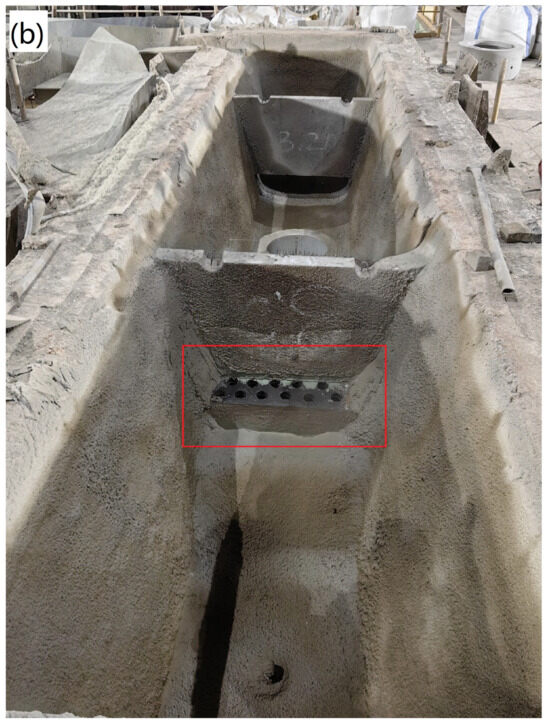
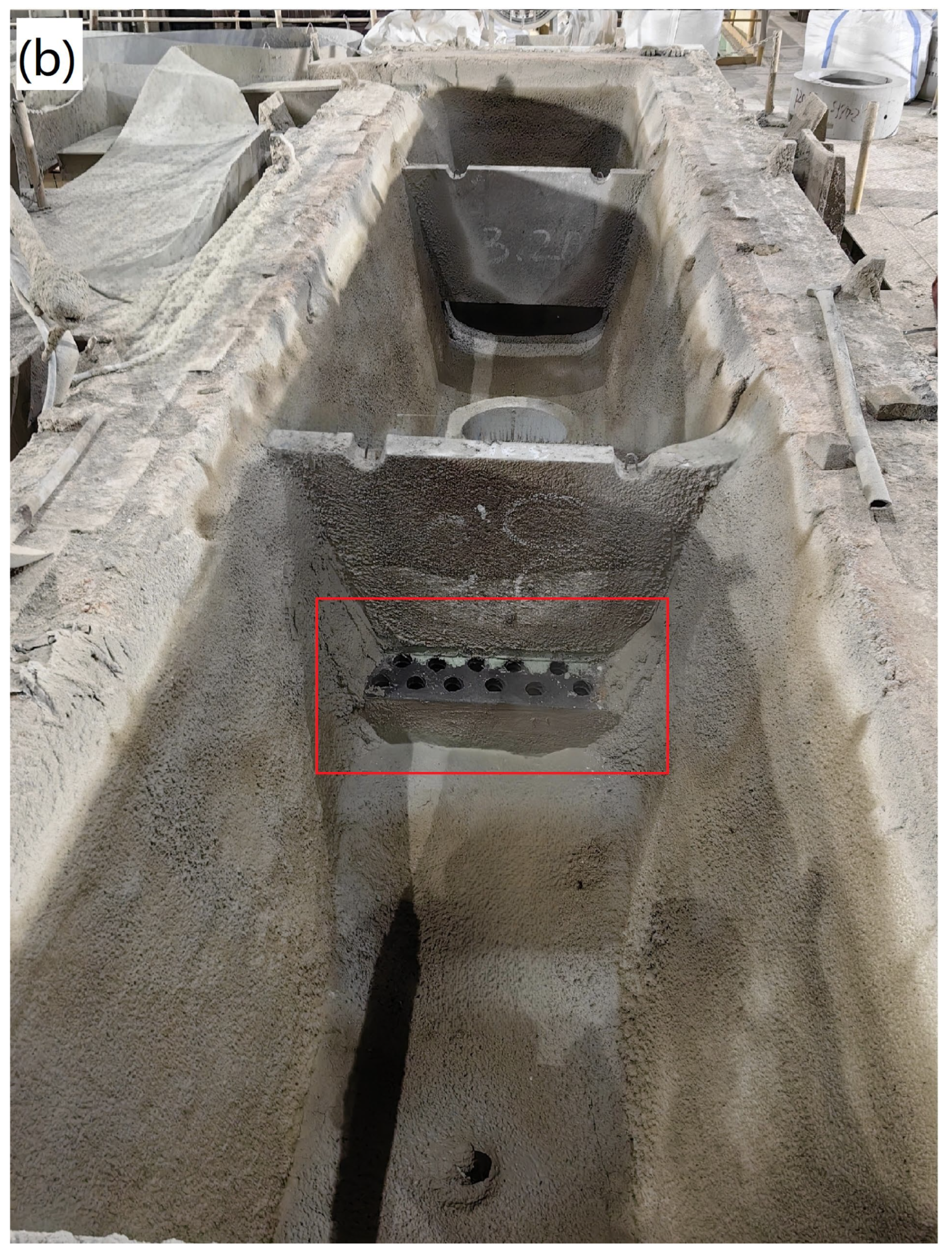
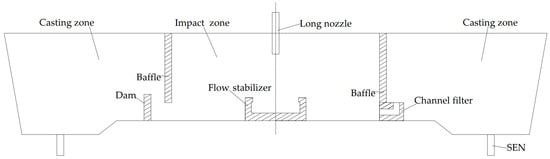
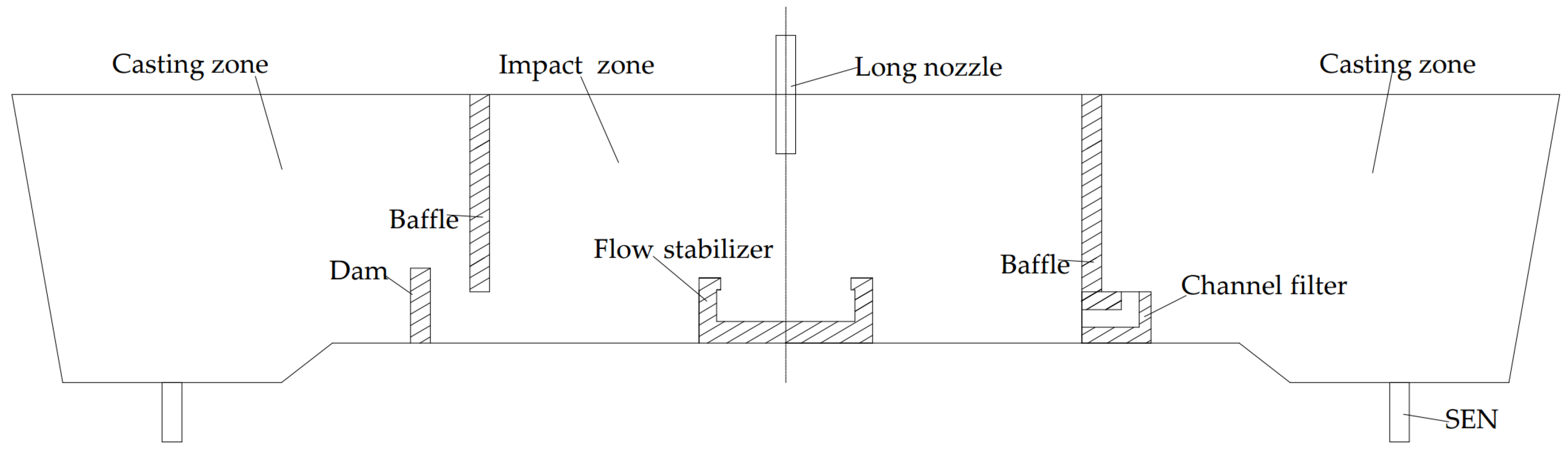
The filter was installed between the impact and casting zones, directly beneath the baffle wall, so that molten steel entering the filter-side casting zone was required to pass through the internal channels. The side-inlet/upward-outlet arrangement redirected the flow, extended the molten-steel flow path, weakened direct short-circuiting towards the outlet, and directed part of the flow towards the upper region of the casting zone, thereby promoting inclusion flotation and absorption by the tundish covering flux.
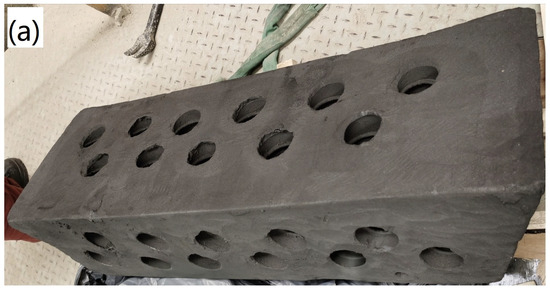
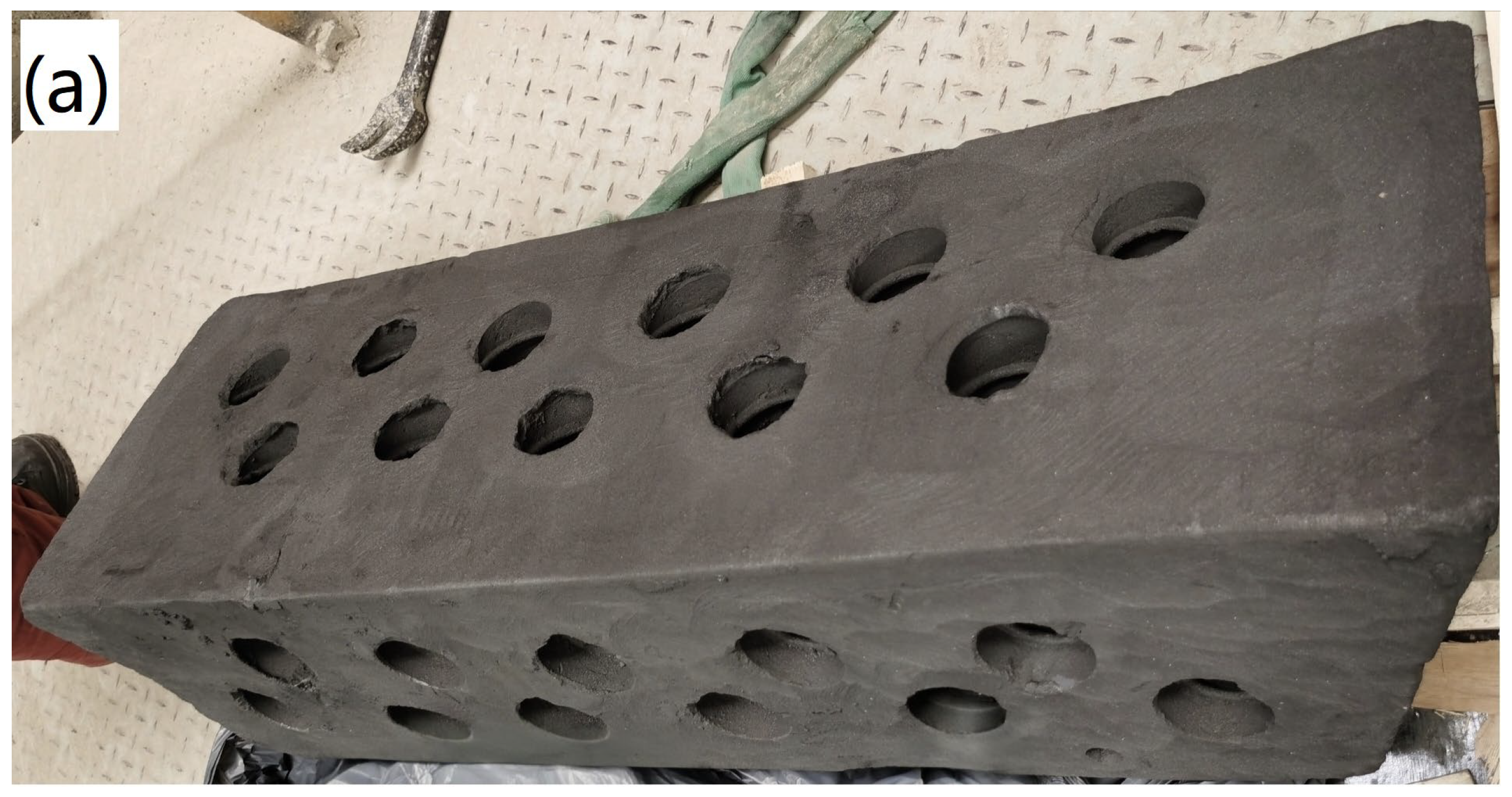
As shown in Figure 1, the LGTF11 channel-type filter was selected to satisfy the geometric and throughput requirements of the industrial tundish. The trapezoidal filter block conformed to the tundish geometry and could be installed securely beneath the baffle wall. Its upper-edge length, lower-edge length, width, and height were 920, 860, 260, and 350 mm, respectively. The filter was manufactured from a carbon-containing composite refractory and contained 11 cylindrical channels, each 68 mm in diameter. The channels maintained the required throughput while redirecting the flow, extending the flow path, and promoting the upward transport of inclusions. Their threaded internal surfaces increased the effective contact area among molten steel, inclusions, and refractory material, thereby enhancing inclusion–wall collision, adhesion, and retention. The LGTF11 filter was therefore designed to combine macroscopic flow-field control with local inclusion–wall interactions.
Figure 1.
Physical structure and on-site installation of the channel-type tundish filter: (a) appearance of the filter; (b) on-site installation.
2.3. Sampling Scheme
As shown in Figure 2, samples and observations were obtained from the tundish impact zone, the two casting zones, the cast slab, the filter element, and the submerged entry nozzle to evaluate the effects of the channel-type filter on molten steel cleanliness, inclusion control, and continuous-casting stability. The defect rates of the corresponding hot-rolled products were also compared.
Figure 2.
Schematic of the sampling positions used in the industrial tundish-filter trial.
The first, third, and sixth heats of the six-heat sequence were sampled. When approximately 100 t of molten steel remained in the ladle, TOS and bucket samples were collected from the two casting zones and the impact zone, respectively, for oxygen, nitrogen, and inclusion analyses.
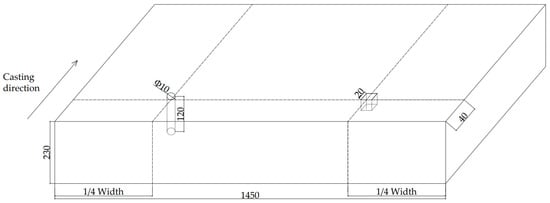
For each strand, a full-thickness slab section measuring 230 mm × 1450 mm × 120 mm was taken from the head of the third cut length of the third heat. A 40 mm layer adjacent to the flame-cut surface was removed by sawing. Specimens measuring 20 mm × 20 mm × 20 mm were then prepared by wire electrical discharge machining from the quarter-width positions on both sides of the inner arc for ASPEX analysis. The corresponding cast-slab sampling positions are shown in Figure 3. Cylindrical specimens measuring φ10 mm × 120 mm were also prepared for small-sample electrolytic extraction.
Figure 3.
Sampling positions in the cast slab.
After casting, one or two pieces of the filter element were recovered during tundish overturning. The channel morphology and attached deposits were examined, followed by chemical analysis. The submerged entry nozzles were also removed and photographed to assess clogging and accretion.
Table 3 summarises the trial configuration, sampling scheme, specimen scope, analytical methods, and evaluation objectives. The first, third, and sixth heats represented the initial, intermediate, and final stages of the six-heat sequence. Tundish-steel analyses were based on these three independently sampled heats, whereas cast-slab ASPEX and small-sample electrolytic extraction were performed on specimens from the third heat only.
Table 3.
Summary of the industrial trial, sampling, and characterisation scheme.
2.4. Recording of Process Parameters and Casting Phenomena
Casting behaviour was documented throughout the trial, with particular attention to real-time stopper-rod displacement as an indicator of accretion. After casting, the submerged entry nozzles from both strands were removed, and their inner-wall deposits, effective flow areas, and accretion conditions were compared.
2.5. Total Oxygen and Nitrogen Analysis
Total oxygen (T.O.) and nitrogen were measured to assess steel cleanliness and the stability of protective casting. Samples from the impact zone characterised the incoming steel before it entered the two casting zones, whereas samples downstream of the conventional weir–dam and channel-type filter configurations were used to compare their effects. Total oxygen served as an indirect indicator of the overall oxide-inclusion level, while nitrogen was monitored as an auxiliary indicator of sampling variability, protective-casting performance, and possible secondary oxidation or nitrogen pickup.
During the DR07 trial, TOS samples were collected from the tundish impact zone, conventional weir–dam casting zone, and filter-equipped casting zone. Before analysis, surface scale and regions in direct contact with the sampler were removed by machining and grinding to minimise surface oxidation and sampling contamination. The specimens were then ultrasonically cleaned in absolute ethanol, dried, and stored in sealed containers.
Total oxygen and nitrogen were measured using a oxygen–nitrogen analyser (Model ONH836, LECO Corporation, St. Joseph, MI, USA) based on inert-gas fusion. The manufacturer-specified analytical ranges were 0.05 ppm–5.0 wt.% for oxygen and 0.05 ppm–3.0 wt.% for nitrogen. Before each batch, the instrument was calibrated using certified steel reference materials spanning the expected concentration range. Instrument blanks and calibration-check samples were also analysed to confirm baseline stability and calibration validity. Identical specimen-preparation and analytical procedures were applied to all samples.
2.6. Automated ASPEX Analysis of Non-Metallic Inclusions
An ASPEX Explorer CeB6 automated scanning electron microscope equipped with an energy-dispersive X-ray spectroscopy detector (Thermo Fisher Scientific, Waltham, MA, USA) was used for automated inclusion analysis of tundish-steel and cast-slab samples. The system was employed to determine the number density, size distribution, morphology, and elemental composition of non-metallic inclusions. Bucket samples were sectioned by wire electrical discharge machining into 20 mm × 20 mm × 20 mm specimens. All specimens were ground and polished following the same metallographic preparation procedure to obtain flat and clean surfaces suitable for automated SEM–EDS analysis.
Automated ASPEX analysis was conducted at an accelerating voltage of 20 kV and a working distance of 10 mm. For each independently prepared surface, three fields of 36 mm2 were scanned, corresponding to an analysed area of 108 mm2 per surface. Four surfaces were analysed for each sample, giving a total analysed area of 432 mm2. The minimum detectable equivalent-circle diameter was 1 μm. Particles satisfying the preset backscattered-electron contrast threshold were automatically identified, and their size, position, morphology, and elemental composition were recorded.
Inclusions were classified from their SEM–EDS compositions. Al- and O-rich particles were classified as Al2O3-type inclusions; particles containing Al, Ti, and O as Al–Ti–O composite oxides; particles containing Ca, Al, and O as calcium aluminates; and particles containing Ti and N as TiN. The inclusion number density for each surface was calculated by dividing the number detected by the scanned area of 108 mm2. The reported value for each sample was the mean of four independently prepared surfaces. The relative standard deviation among the four surfaces was approximately 15%.
2.7. Small-Sample Electrolytic Extraction and Characterisation of Representative Inclusions
Non-metallic inclusions were extracted using a non-aqueous organic small-sample electrolytic method. Cylindrical specimens measuring φ10 mm × 120 mm were prepared by wire electrical discharge machining from the quarter-width positions of the third-heat slabs produced by the conventional and filter-equipped strands. After grinding, all surfaces except the designated working surface were sealed with an insulating coating to restrict anodic dissolution. The specimens were then ultrasonically cleaned in absolute ethanol and dried.
A diphenylguanidine–triethanolamine–methanol electrolyte containing 1.5 wt.% tetramethylammonium chloride, 8 wt.% triethanolamine, 6 wt.% glycerol, 0.8 wt.% diphenylguanidine, and balance absolute methanol was used. The steel specimen served as the anode and a platinum mesh as the cathode. The electrolyte was maintained at 0–10 °C in an ice–water bath to limit heating and minimise dissolution or alteration of the extracted inclusions. Argon was continuously supplied to displace oxygen and prevent oxidation. Electrolysis was conducted at a constant current density of 20 mA cm−2 for 8 h.
After electrolysis, the electrolyte and all rinsing solutions were combined to minimise particle loss. The suspension was vacuum-filtered through a 0.4 μm polycarbonate membrane, which was rinsed with absolute ethanol to remove residual electrolyte and soluble products. After drying and carbon coating, the retained inclusions were examined using a ZEISS ΣIGMA 300 field-emission scanning electron microscope (Carl Zeiss AG, Oberkochen, Germany) equipped with an energy-dispersive X-ray spectrometer. Representative three-dimensional morphologies and elemental compositions were compared between the conventional and filter-equipped strands.
2.8. Analysis of Deposits Retained on the Filter Element
To identify material captured by the filter, deposits attached to the internal channel surfaces were recovered during tundish overturning after casting. Their morphology was examined, after which the material was crushed, ground, and analysed by wet-chemical methods.
2.9. Numerical Simulation of Molten-Steel Flow and Inclusion Transport
A three-dimensional computational fluid dynamics model was developed to examine the effects of the channel-type filter on molten-steel flow, heat transfer, residence-time characteristics, and inclusion transport. Two computational domains reproduced the principal dimensions of the industrial tundish and the respective arrangements of the conventional weir–dam and channel-filter configurations. The model comprised the continuity, Navier–Stokes momentum, energy, turbulence-transport, species-transport, and Lagrangian particle-motion equations [5,8,12,15,16,17].
2.9.1. Continuous-Phase Flow, Heat Transfer, and Tracer Transport
Molten steel was treated as an incompressible Newtonian fluid with constant thermophysical properties. Turbulence was described using the standard k–ε model, with effective viscosity expressed as the sum of molecular and turbulent contributions. The turbulent kinetic energy, k, and dissipation rate, ε, were obtained from their respective transport equations [18]. Heat transfer was calculated from the three-dimensional energy equation, and heat losses through the free surface and refractory walls were represented by prescribed overall heat-transfer coefficients [5,8,19].
The density, dynamic viscosity, thermal conductivity, and specific heat capacity of molten steel were set to 7200 kg·m−3, 0.0062 kg·m−1·s−1, 26 W m−1·K−1, and 700 J kg−1·K−1, respectively. The overall heat-transfer coefficients at the free surface, bottom, long wall, and short wall were 15, 14, 40, and 40 W·m−2·K−1, respectively. The inlet temperature was 1829 K. Outlet flow rates were calculated from the slab cross-section of 230 mm × 1450 mm and a casting speed of 1.25 m·min−1. The inlet turbulent kinetic energy and dissipation rate were specified as kᵢₙ = 0.01uᵢₙ2 and εᵢₙ = 33.33kᵢₙ1.5, respectively. The principal thermophysical properties and thermal boundary conditions are summarised in Table 4.
Table 4.
Principal physical parameters used in the tundish simulation.
After the continuous-phase solution had converged, a passive tracer was introduced at the ladle-shroud inlet and transported through the tundish using the species-transport equation. Tracer concentration at each outlet was monitored as a function of time to determine the residence-time distribution for the conventional weir–dam and channel-filter configurations [8,9,16,17]. The tracer was assumed not to affect the density, viscosity, temperature, or velocity field. This passive-scalar treatment avoided disturbances arising from tracer-induced density differences, which can influence predicted residence-time distributions and dead-volume fractions [16].
A steady flow field was assumed because casting speed, stopper-rod opening, tundish level, and inlet and outlet flow rates remained approximately constant during the normal casting period considered. Short-term variations associated with ladle changes, casting-speed adjustment, stopper-rod movement, and tundish-level fluctuations were neglected [5,8,12,20]. The molten-steel free surface was assumed to be flat; transient deformation and interaction with the covering flux were not resolved. The results therefore represent characteristic flow and transport under stable casting conditions and should not be extrapolated directly to transient stages such as ladle changes or rapid level variations [20].
2.9.2. Inclusion-Particle Tracking and Boundary Conditions
After convergence of the continuous-phase solution, inclusion trajectories were calculated using a one-way-coupled Lagrangian particle-tracking method. The equation of motion included fluid drag and the combined effects of gravity and buoyancy. Turbulent dispersion was represented using the discrete random walk model [19,21]. Because the inclusion volume fraction was low, particle feedback on the continuous phase was neglected. Particle–particle collision, agglomeration, breakup, and changes in particle size or composition during transport were not explicitly modelled [17,21,22].
Inclusions were represented by 100 μm spherical particles. This size was selected to represent relatively large inclusions or agglomerated clusters and to permit direct comparison of transport and flotation under the two flow-control configurations [12,14,15,17,21]. The fixed spherical size simplified the calculation and isolated the effect of flow-field redistribution. Industrial inclusions nevertheless span broad distributions of size, morphology, density, and composition and may undergo collision, agglomeration, fragmentation, and compositional evolution [21,22,23]. The calculated trajectories should therefore be interpreted as representative rather than as a complete description of the industrial inclusion population.
Once the continuous-phase solution had converged, particles were injected uniformly across the ladle-shroud inlet. Their initial velocity and temperature were set equal to those of the incoming molten steel. A total of 5000 particles were released for each tundish configuration, and the discrete-random-walk calculations were repeated using 5000 independent random-number seeds to reduce stochastic variability.
Particles reaching the molten-steel free surface were treated as captured, representing flotation to the steel–slag interface followed by absorption into the tundish covering flux [4,8,12,14,21,24]. A free-surface capture efficiency of 100% was prescribed. This idealised boundary condition terminated a trajectory when the particle reached the surface but did not resolve interfacial deformation, wettability, capillary forces, slag viscosity, or re-entrainment. The calculated free-surface capture should therefore be interpreted as an upper-bound estimate under the assumed stable-interface condition [24].
The rebound condition was applied only to the ordinary tundish lining, including the sidewalls and bottom. In this model, “tundish wall” does not include the internal surfaces of the filter channels. Because the conventional lining and carbon-containing filter material differ in composition, interfacial characteristics, surface structure, and metallurgical function, particle interactions with the two surfaces were treated separately [12,14,15]. Particles striking the ordinary lining were assumed to rebound, whereas particles reaching the filter-channel surfaces were treated as retained within the filter region.
Retention at the filter-channel surfaces was an idealised representation of capture. No adhesion model incorporating impact velocity, particle size, refractory wettability, contact angle, interfacial tension, or surface roughness was included. Consequently, the calculated retention should not be interpreted as an exact prediction of the intrinsic adsorption efficiency of the filter material. The particle model was used principally to evaluate flow-field redistribution, migration towards the free surface, transport through the channels, and the probability of particle–filter contact. Actual inclusion adsorption and accumulation were assessed by combining the simulated transport behaviour with post-casting observations and chemical analysis of deposits recovered from the filter [12,14,15,23].
Particles captured at the free surface or retained on the filter-channel surfaces were classified as removed, whereas those passing through the tundish outlets were classified as escaped. The total predicted removal efficiency was calculated as follows:
where Nsurface is the number of particles captured at the free surface, Nfilter is the number retained on the filter-channel surfaces, and Ninjected is the total number injected. The contributions of flotation and filter-surface retention were also evaluated separately.
ηtotal = (Nsurface + Nfilter)/Ninjected × 100%
2.9.3. Numerical Implementation, Mesh Independence, and Model Validation
The computational domains were discretised using structured hexahedral mesh cells, with local refinement applied in the regions of the ladle-shroud inlet, flow-control devices, filter channels, free surface, and outlets to improve the resolution of local flow features. The governing equations were solved in ANSYS Fluent 2018 (ANSYS, Inc., Canonsburg, PA, USA) using the finite-volume method. A pressure-based solver was adopted for the incompressible Navier–Stokes equations, and pressure-velocity coupling was handled using the SIMPLE algorithm. The calculations were considered converged when the normalised residuals of all solved variables decreased below 10−4, and the monitored outlet flow rates and representative velocity values reached stable values.
Mesh independence was evaluated using three mesh levels, namely coarse, medium, and fine meshes, with cell numbers of the same order of magnitude as approximately 300,000. The maximum velocity, mean residence time, dead-zone volume fraction, and particle-removal efficiency were selected as key monitoring parameters. The differences in these parameters between the medium and fine meshes were less than 5%, indicating that the numerical results were insensitive to further mesh refinement. Therefore, the medium hexahedral mesh was adopted for the subsequent simulations to achieve an appropriate balance between computational accuracy and efficiency.
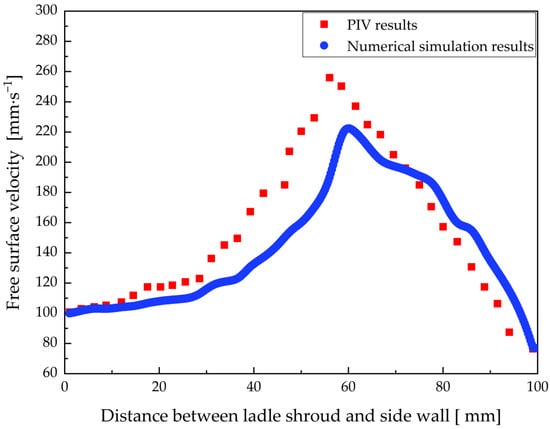
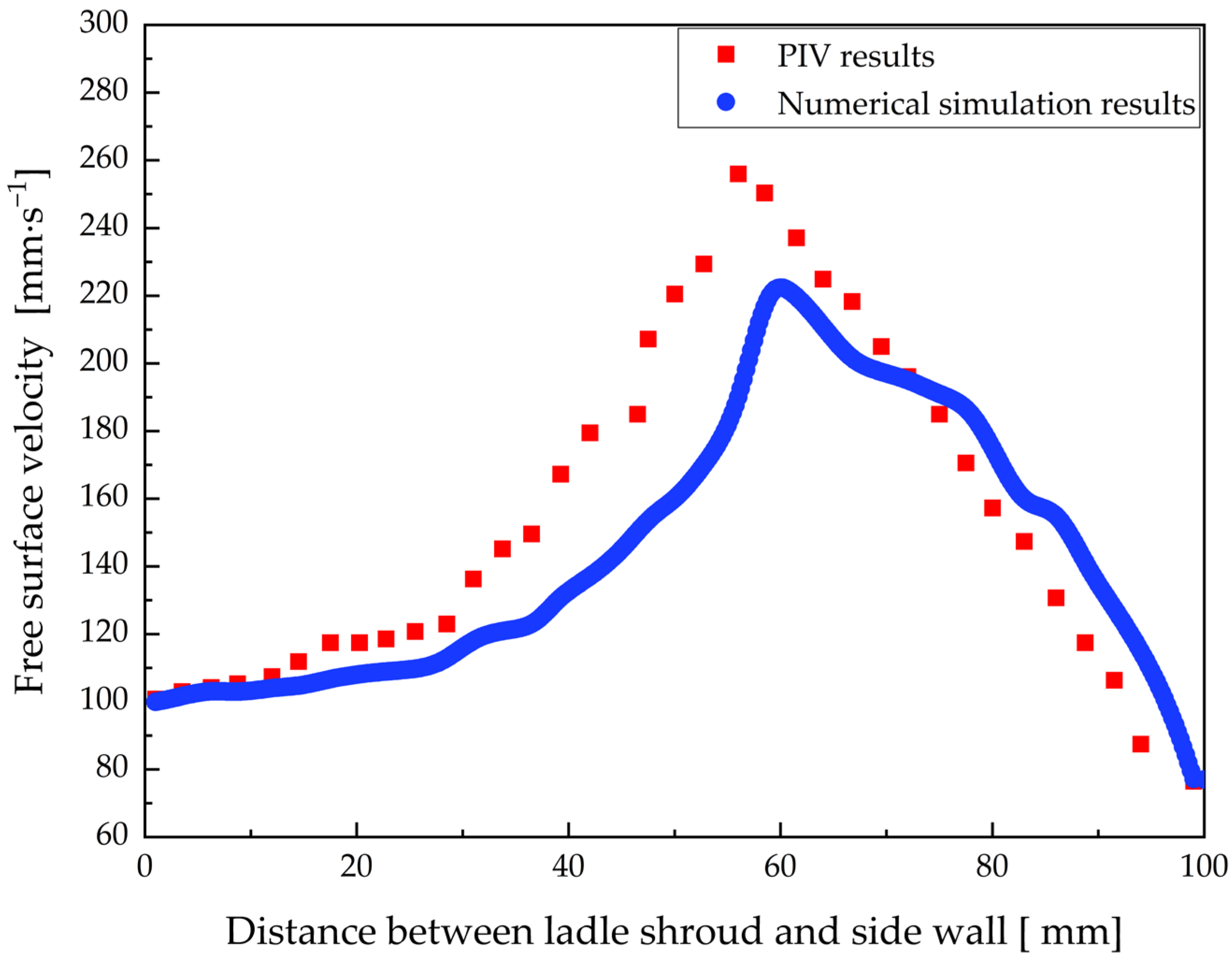
The numerical procedure was benchmarked against published particle image velocimetry (PIV) measurements of free-surface flow in the inlet region of a 12-strand tundish [25]. As shown in Figure 4, both profiles accelerated away from the ladle shroud and then decelerated towards the sidewall. The measured peak velocity was approximately 256 mm s−1 at 56 mm, whereas the calculated peak was approximately 222 mm s−1 at 60 mm, corresponding to a peak-velocity deviation of approximately 13% and a peak-position difference of about 4 mm. Although the model underestimated the sharp experimental peak, it reproduced the overall profile, the position of the high-velocity region, and the downstream decay. The remaining discrepancy was attributed primarily to the steady Reynolds-averaged Navier–Stokes treatment, the flat-free-surface assumption, uncertainty in inlet turbulence, and temporal and spatial averaging in the PIV measurements. Because the reference data were obtained for a different tundish geometry, this comparison benchmarked the numerical procedure rather than directly validating the present industrial tundish. The model was therefore considered suitable for comparative assessment of tundish flow, residence-time behaviour, and inclusion transport.
Figure 4.
Comparison of the calculated free-surface velocity profile with published PIV data from Ref. [25] for the inlet region of a 12-strand tundish. The PIV data were digitized from Ref. [25].
2.10. Assessment of Hot-Rolled Products
Hot-rolled DR07 products corresponding to the trial heats were tracked, and the warping-defect rate associated with steel cleanliness was determined for the conventional weir–dam and filter-equipped strands.
3. Results and Discussion
3.1. Stopper-Rod and Submerged Entry Nozzle Conditions
Al2O3-based inclusions are high-melting, brittle non-metallic particles that require stringent control during the continuous casting of ultra-low-carbon steel. Their irregular morphology and high surface energy promote collision, adhesion, and agglomeration into clusters. After entering the stopper-rod–submerged-entry-nozzle region, these inclusions can deposit and grow on the nozzle wall, stopper-rod tip, and other near-wall low-velocity regions. The resulting accretion may reduce the effective flow area, cause stopper-position drift and nozzle clogging, intensify mould-level fluctuations, and increase the risks of slag entrainment and inclusion-related surface defects. As accretion becomes more severe, the stopper-rod opening must generally be increased to maintain constant throughput, resulting in an upward displacement trend and greater fluctuations [2,3,23,26].
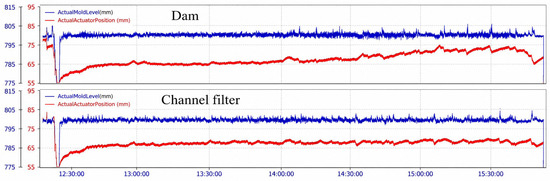
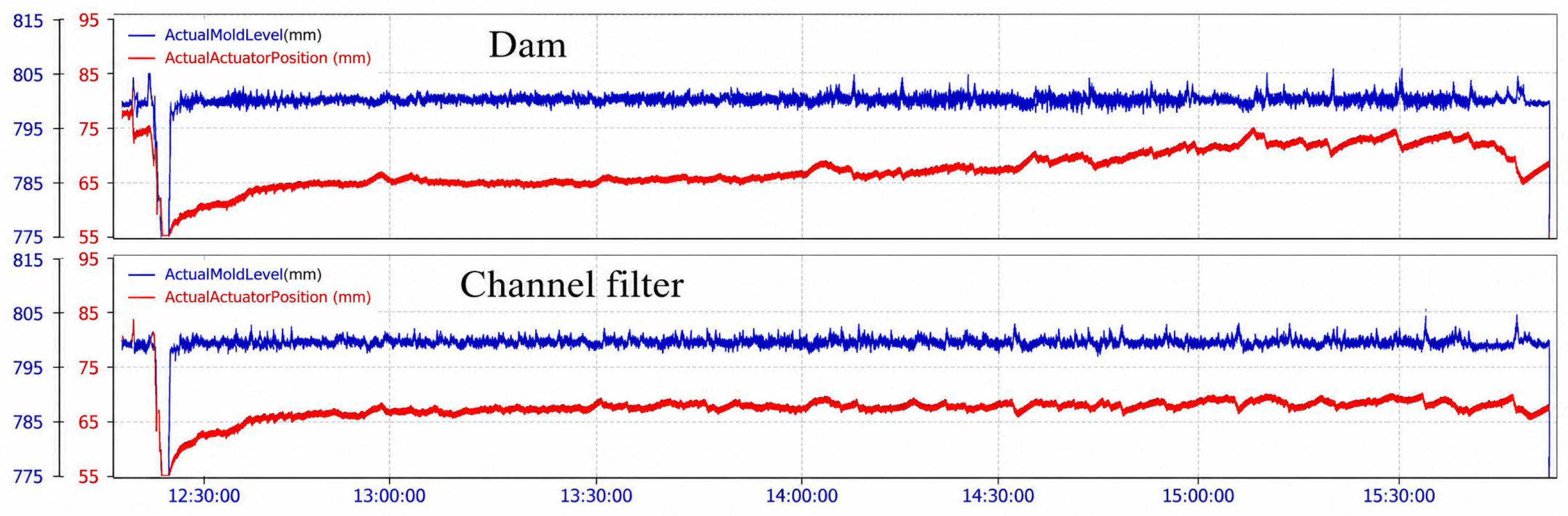
As shown in Figure 5, stopper-rod displacement in the filter-equipped strand remained comparatively stable and fluctuated within a narrow range; the corresponding mould-level signal was also stable. These observations indicate smooth flow from the tundish through the stopper rod and submerged entry nozzle, with limited accretion or clogging. By contrast, the conventional strand showed a progressive increase in stopper-rod displacement and substantially larger fluctuations, particularly late in the sequence, indicating increasing accretion and reduced flow-control stability. The mould-level fluctuation range was also larger in the conventional strand, with several high-amplitude excursions late in casting, suggesting less stable nozzle flow and greater surface disturbance in the mould.
Figure 5.
Stopper-rod displacement and mould-level fluctuation during the industrial casting trial.
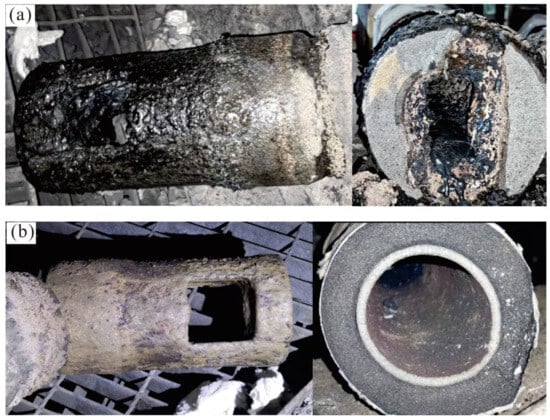
The post-casting submerged entry nozzle morphologies shown in Figure 6 support this interpretation. In the conventional strand, extensive accretion adhered to the inner wall and outlet region, occupying approximately two-thirds of the cavity flow space and markedly reducing the effective flow area. The filter-equipped strand exhibited only limited adhesion, a comparatively clean inner wall, and a largely unobstructed flow passage. Under the investigated conditions, the channel-type filter therefore reduced the inclusion load entering the nozzle region and mitigated the deposition of Al2O3-based inclusions in the stopper-rod and submerged-entry-nozzle region.
Figure 6.
Submerged entry nozzle morphology after casting: (a) conventional weir–dam strand; (b) filter-equipped strand.
Overall, the filter was associated with improved tundish flow, lower inclusion loading, reduced stopper-rod and nozzle accretion, and more stable stopper-rod and mould-level control. These improvements may reduce the need for stopper adjustments, operational intervention, and submerged entry nozzle replacement, thereby supporting longer casting sequences and improved slab and hot-rolled product quality.
3.2. Variation in Total Oxygen and Nitrogen Contents Before and After Filtration
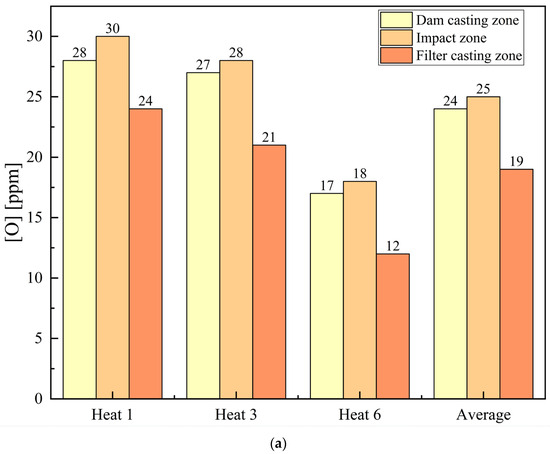
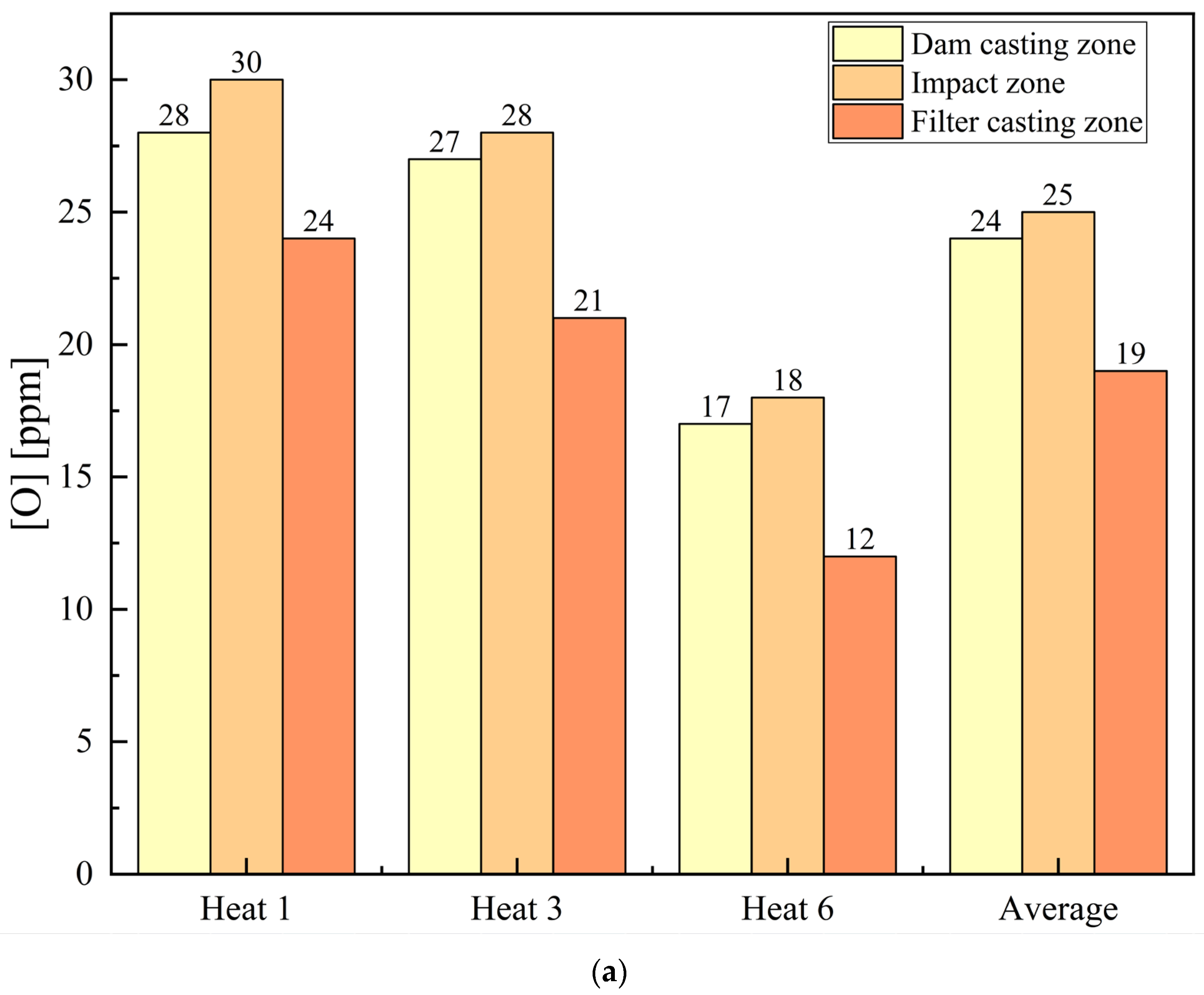
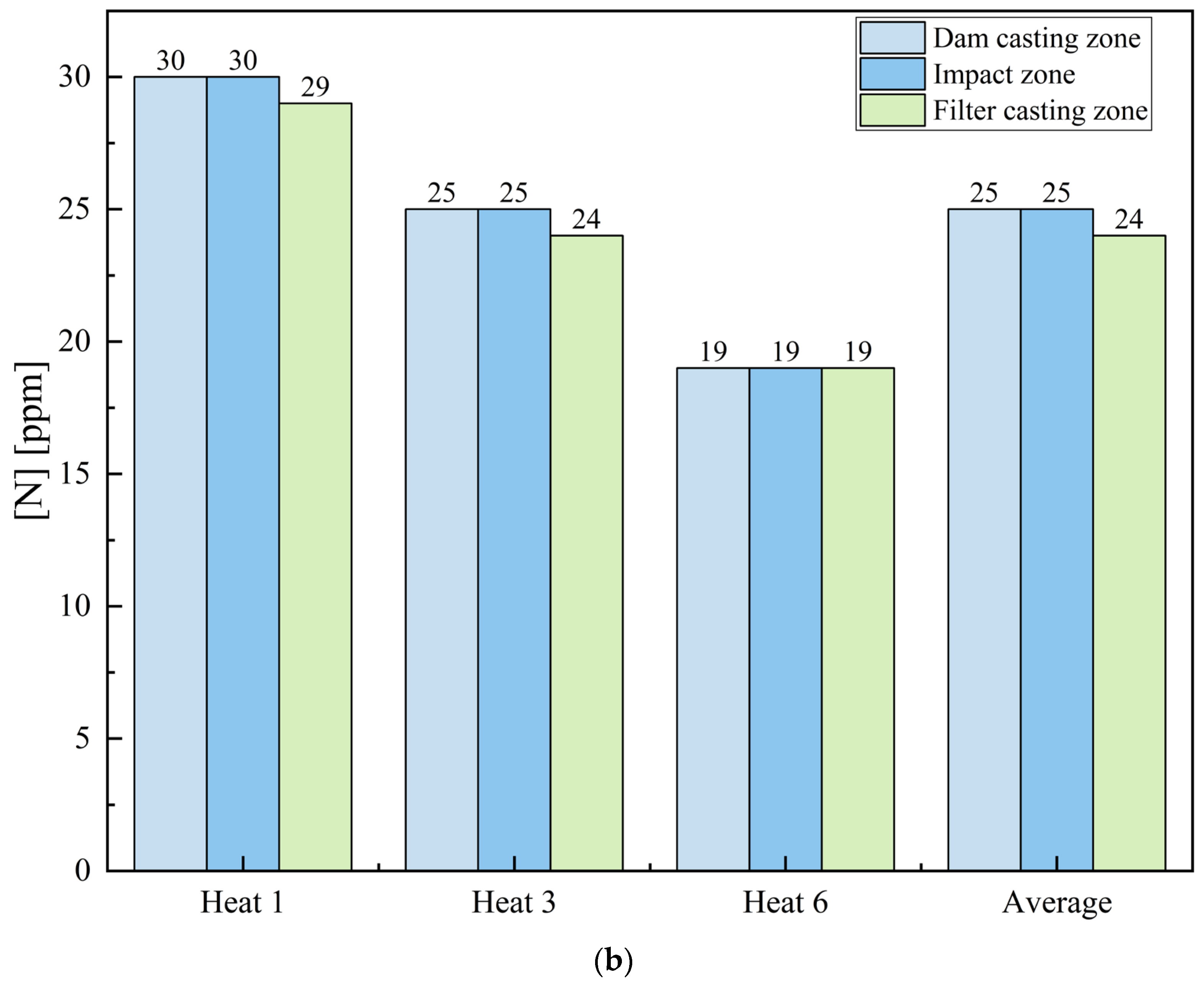
Figure 7 presents the oxygen and nitrogen results for the representative DR07 industrial trial. Values are reported as the mean ± sample standard deviation for the first, third, and sixth heats (n = 3). Total oxygen in the impact zone, conventional weir–dam casting zone, and filter-equipped casting zone was 25.3 ± 6.4, 24.0 ± 6.1, and 19.0 ± 6.2 ppm, respectively. On a paired heat-by-heat basis, filtration reduced total oxygen by 4, 6, and 5 ppm relative to the conventional casting zone, giving a mean paired reduction of 5.0 ± 1.0 ppm. The reduction calculated from the mean values was 20.8%.
Figure 7.
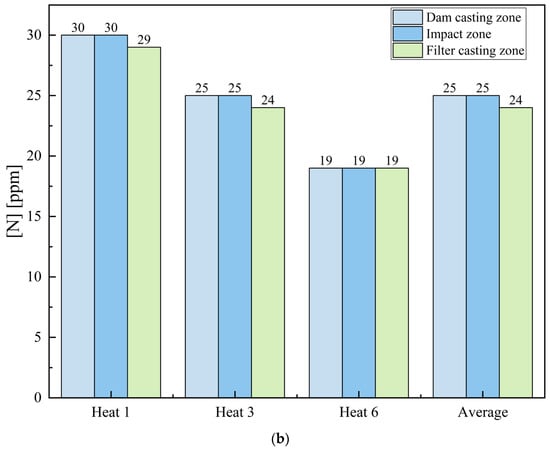
Comparison of (a) total oxygen and (b) nitrogen contents in molten steel at different tundish positions over the sampled heats.
The corresponding nitrogen contents were 24.7 ± 5.5, 24.7 ± 5.5, and 24.0 ± 5.0 ppm, respectively. The small difference between the two casting zones indicates that the improvement in cleanliness was associated primarily with lower total oxygen and hence a lower oxide-inclusion level, rather than with substantial differences in nitrogen pickup or protective-casting performance.
Thus, the principal compositional change associated with filtration was the reduction in total oxygen; nitrogen remained essentially unchanged within the heat-to-heat variability.
In Ti-bearing ultra-low-carbon steel, total oxygen is associated primarily with Al2O3-type inclusions, Al–Ti–O composite oxides, and other oxide inclusions. Molten steel entering the filter-side casting zone was required to pass through the channel-type filter.
The altered flow path can extend inclusion residence time and increase opportunities for collision, agglomeration, flotation, and channel-wall contact. The lower total oxygen measured in the filter casting zone is therefore consistent with a reduction in the oxide-inclusion population under the investigated conditions.
3.3. ASPEX Inclusion Analysis
3.3.1. Tundish Molten Steel
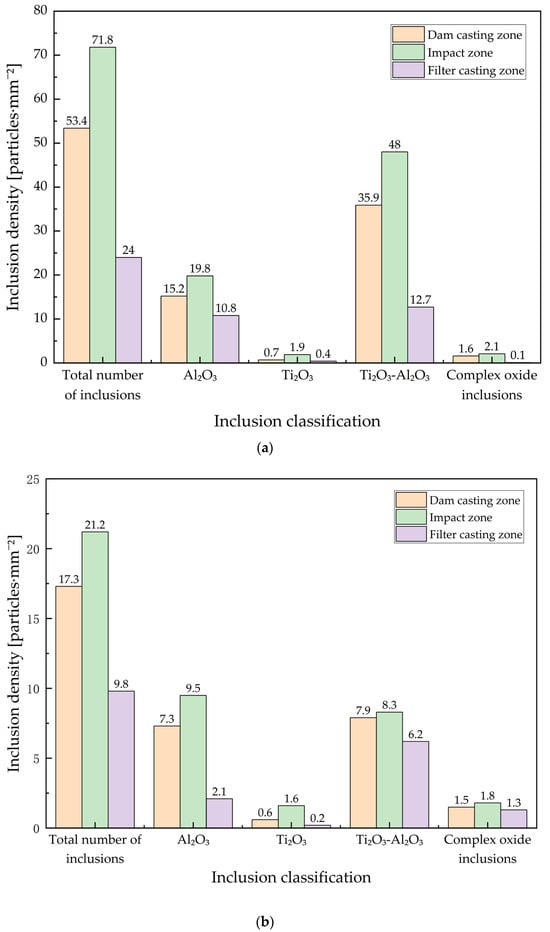
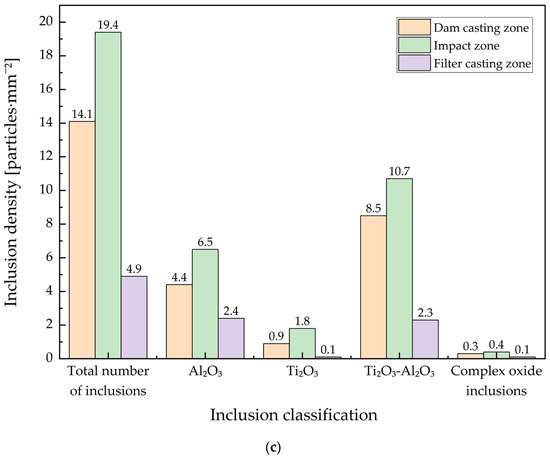
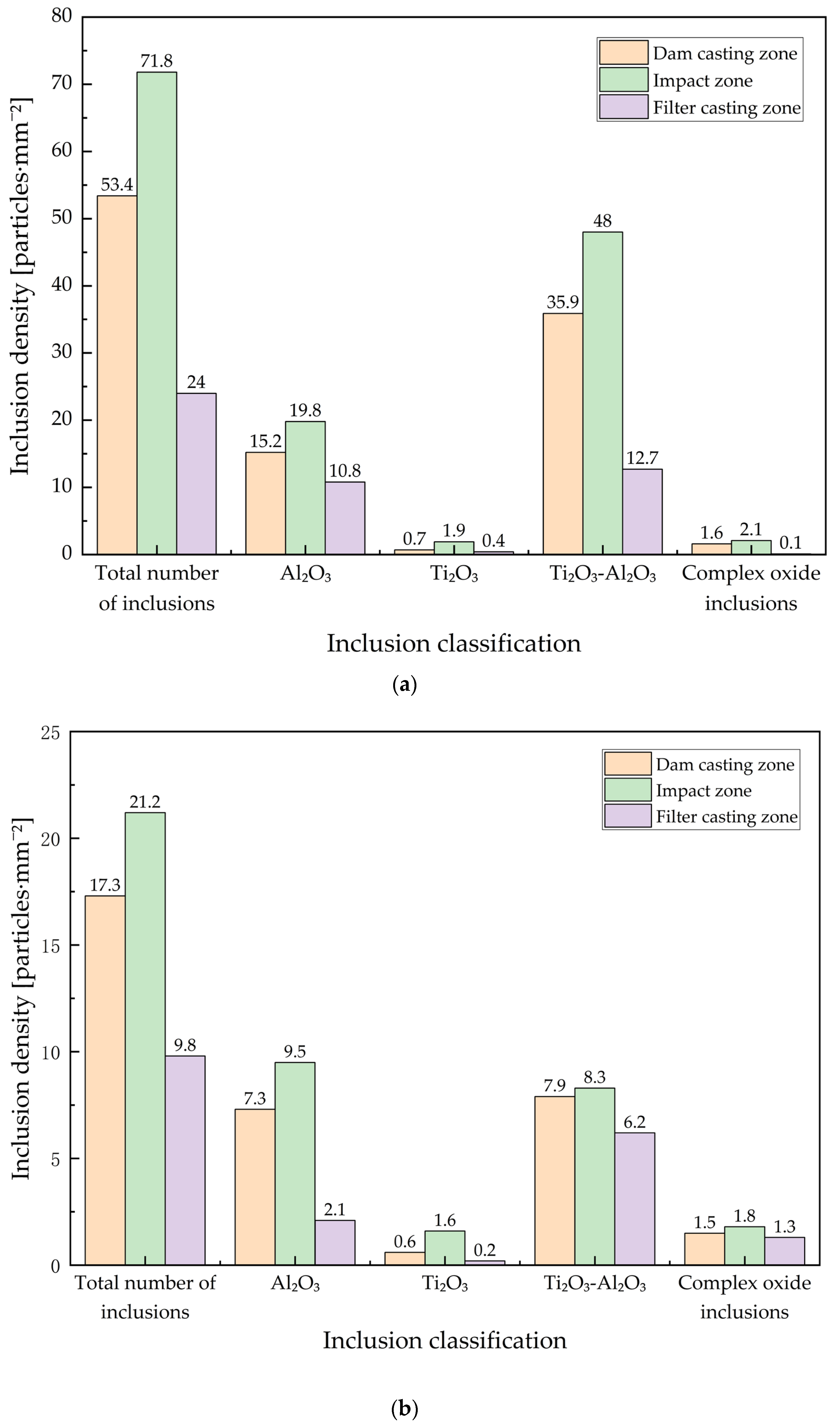
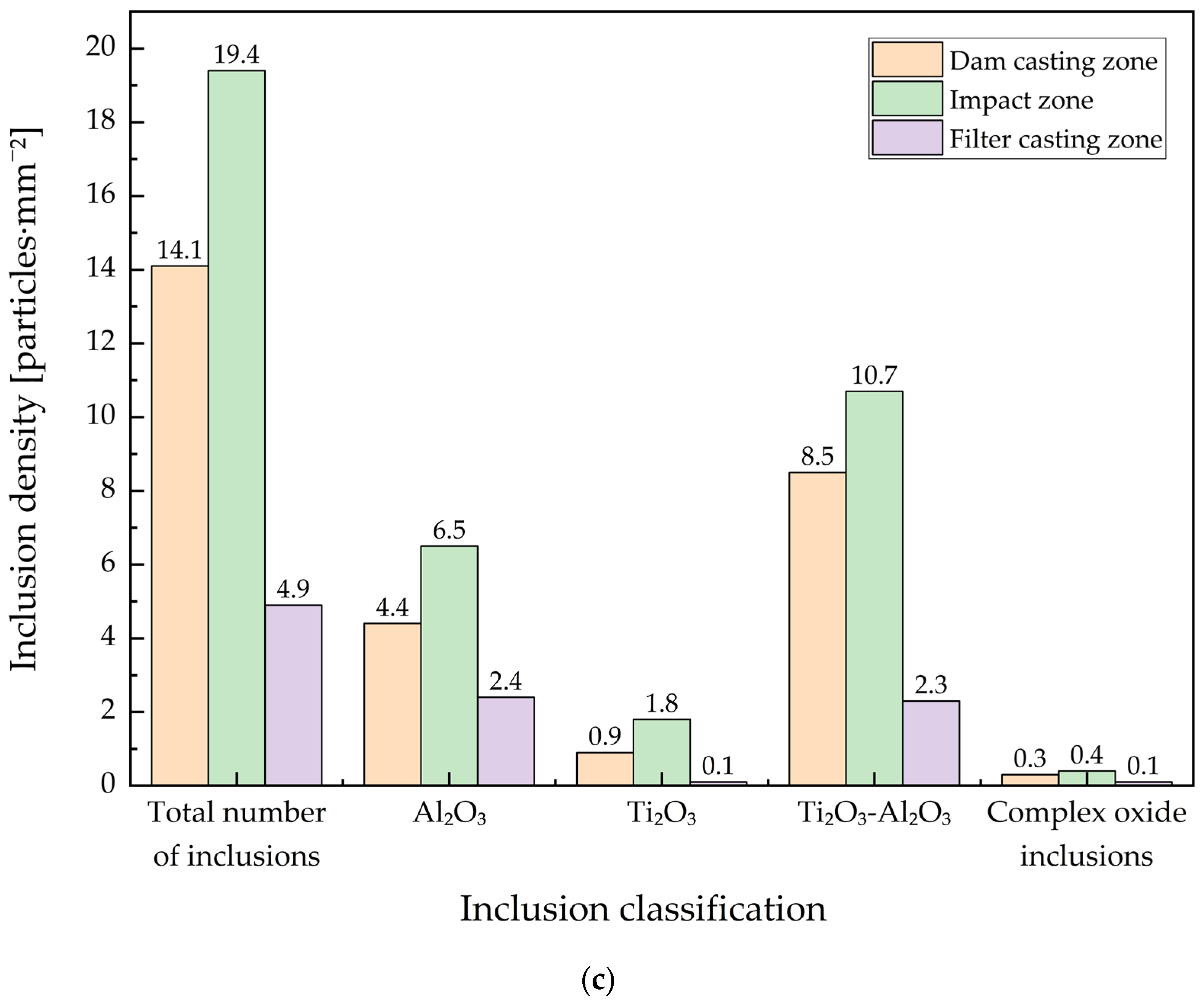
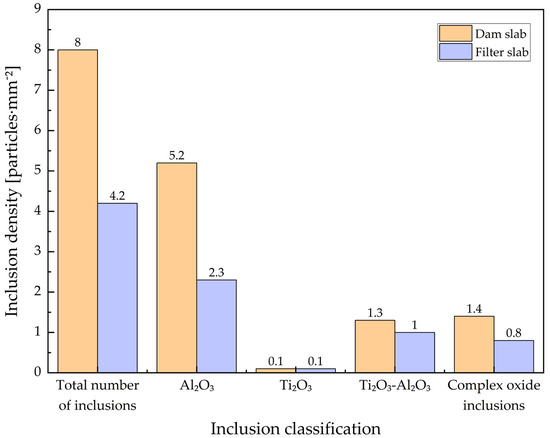
Figure 8 and Table 5 compare the inclusion number densities determined by automated ASPEX analysis. Across the three sampled heats, the mean total inclusion number density decreased from 28.3 ± 21.8 particles·mm−2 in the conventional strand to 12.9 ± 9.9 particles·mm−2 in the filter-equipped strand, a reduction of 54.4% based on the mean values. The mean Al2O3-type inclusion number density decreased from 9.0 ± 5.6 to 5.1 ± 4.9 particles·mm−2, corresponding to a reduction of 43.3%.
Figure 8.
Inclusion number density under the two flow-control configurations for the (a) first, (b) third, and (c) sixth sampled heats.
Table 5.
Inclusion number density in tundish molten steel under the two flow-control configurations.
The relatively large standard deviations reflect heat-to-heat variation in the incoming inclusion level. Nevertheless, both total and Al2O3-type inclusion number densities were lower in the filter-equipped strand for each paired heat. The data therefore show a consistent directional improvement, although additional heats would be required for rigorous statistical inference.
3.3.2. Cast Slabs
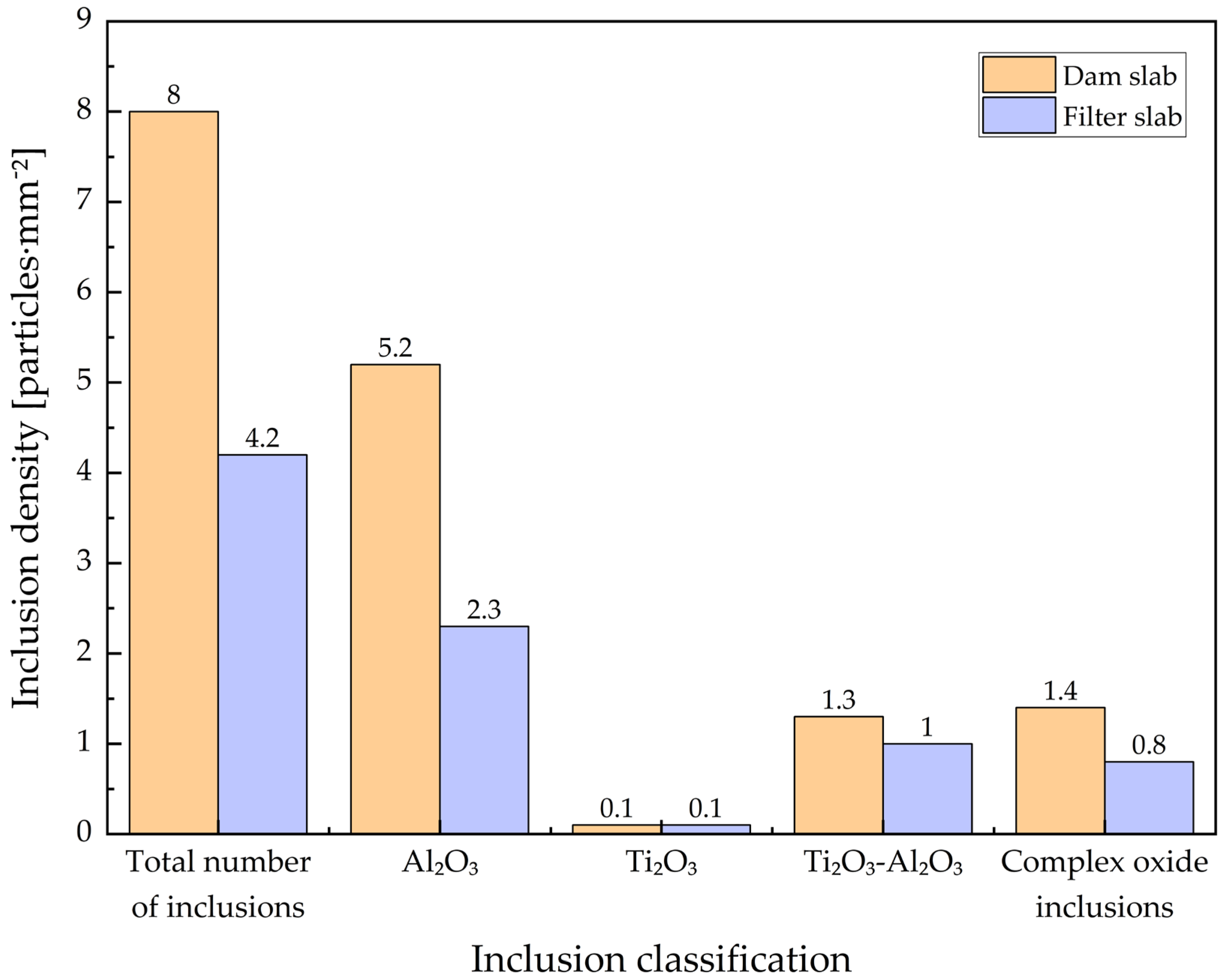
Figure 9 and Table 6 present the ASPEX results for cast-slab specimens from the third heat. The total inclusion number density decreased from 8.0 particles·mm−2 in the conventional strand to 4.2 particles mm−2 in the filter-equipped strand, a reduction of 3.8 particles·mm−2 or 47.5%.
Figure 9.
ASPEX inclusion analysis of third-heat cast-slab specimens.
Table 6.
Inclusion number density in third-heat cast slabs under the two flow-control configurations.
The Al2O3-type inclusion number density decreased from 5.2 to 2.3 particles·mm−2, a reduction of 2.9 particles·mm−2 or 55.8%.
The tundish-steel and cast-slab results indicate that, under the investigated conditions, the channel-type filter reduced both the overall inclusion population and the Al2O3-type inclusion population. The slab results should, however, be interpreted as representative evidence because only the third heat was examined.
In Ti-bearing ultra-low-carbon steel, Al2O3-type inclusions and Al–Ti–O composite oxides are relevant indicators of deoxidation products, secondary oxidation, and inclusion-control performance. The observed reductions are consistent with combined flow-field regulation and channel-wall interaction. The impact-zone jet was partially dissipated before the steel entered the channels; passage through the filter then redirected the flow, redistributed velocity, weakened short-circuiting, and increased the time available for inclusion migration [2,8,13].
The channels may also increase local velocity gradients and particle–wall contact, thereby promoting collision, agglomeration, flotation, and retention. The extended flow path favours the flotation of enlarged inclusions towards the steel–slag interface, where they may be absorbed by the tundish covering flux. Because cast-slab characterisation was limited to the third heat, these results do not constitute a complete statistical assessment of the six-heat sequence.
3.4. Small-Sample Electrolytic Extraction and SEM–EDS Analysis
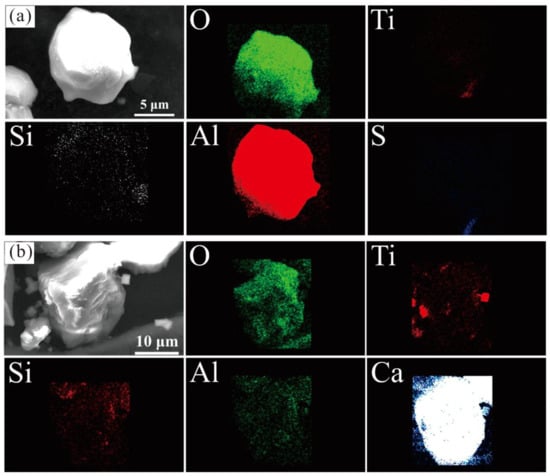
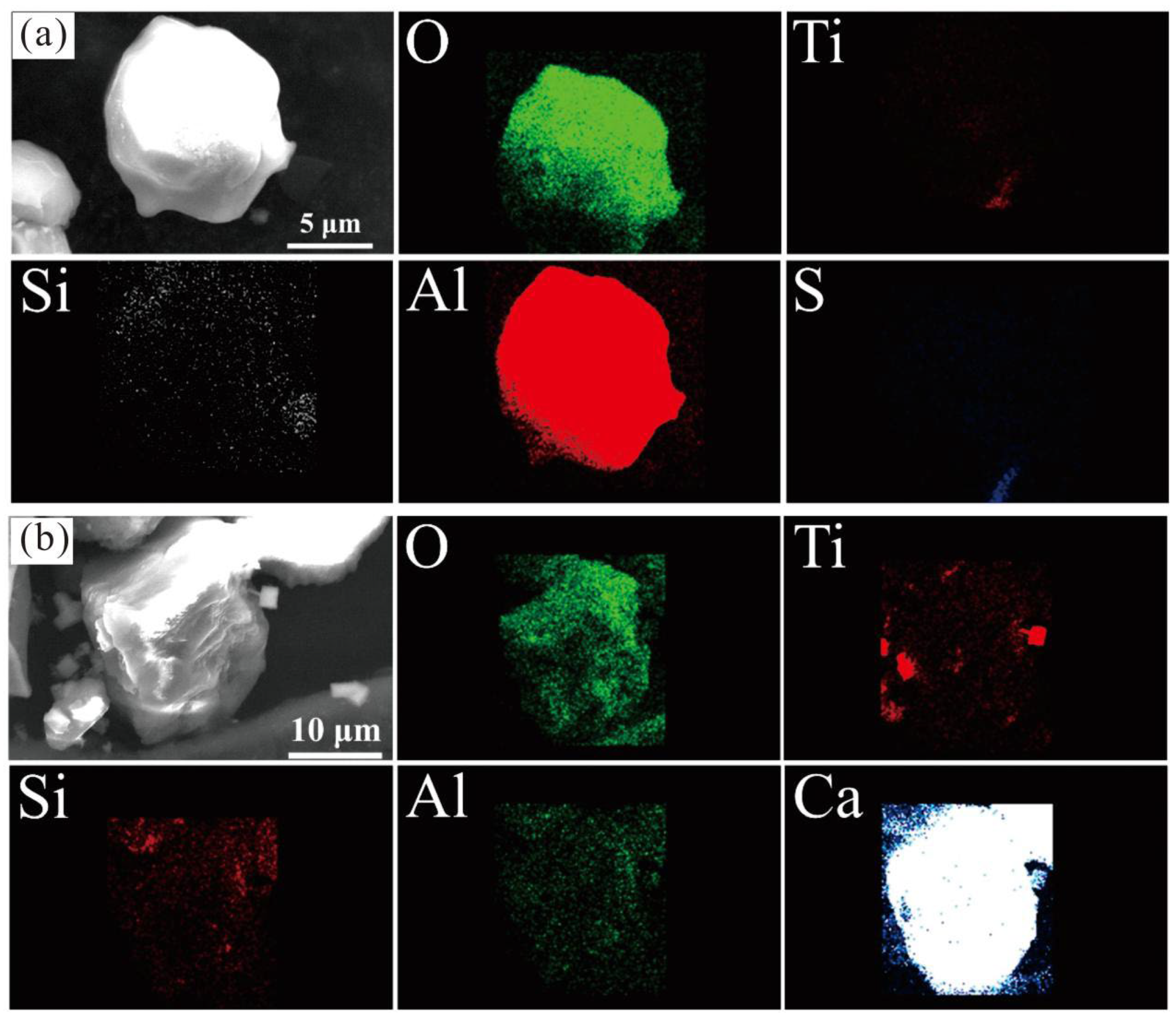
Small-sample electrolytic extraction followed by SEM–EDS was used to characterise representative inclusions. Figure 10 compares the morphologies and compositions of inclusions extracted from cast slabs produced by the conventional Strand 3 and filter-equipped Strand 4.
Figure 10.
Morphology and composition of representative inclusions extracted from cast slabs produced by the conventional and filter-equipped strands. (a) Conventional strand; (b) filter-equipped strand.
The conventional-strand slab contained irregular, agglomerated Al2O3-rich inclusions, which are relevant to nozzle clogging and inclusion-related surface defects in ultra-low-carbon steel. In the filter-strand specimen, fewer large Al2O3-rich agglomerates were observed, while representative CaO-rich composite inclusions and fine TiN particles were also identified. Because this analysis was qualitative and based on third-heat specimens, it supports but does not independently quantify the ASPEX trends.
The electrolytic-extraction observations were broadly consistent with the ASPEX results and support the interpretation that the filter promotes the removal of large Al2O3-rich inclusions through a combination of channel-wall retention and enhanced flotation.
3.5. Chemical Composition of Deposits Retained on the Filter
To assess inclusion adsorption and retention, deposits were recovered from the internal filter channels after casting and analysed chemically. As shown in Table 7, the representative deposit contained 38.89 wt.% Al2O3 and 37.74 wt.% CaO, together with 7.19 wt.% MgO and 10.57 wt.% TiO2.
Table 7.
Chemical composition of representative deposits retained on the filter [wt.%].
Al2O3 and CaO were the principal components of the recovered deposit, with smaller but appreciable MgO and TiO2 contents. This composition is consistent with the oxide-inclusion system expected in the investigated steel and confirms the enrichment of alumina-rich and calcium-aluminate material within the filter channels. The deposit analysis therefore provides direct evidence of inclusion accumulation in the filter region.
The high Al2O3 fraction is consistent with inertial collision, adhesion, and progressive accumulation of alumina-rich inclusions on the channel surfaces. The CaO fraction may reflect captured endogenous calcium-aluminate inclusions and, potentially, products associated with steel–slag interactions. Al–Ti–O composite oxides may also be present in the Ti-bearing steel. Together with the 43.3% reduction in Al2O3-type inclusion number density in tundish steel, these results support a combined mechanism of flow-field regulation and channel-wall retention [23,26,27].
By reducing the load of high-melting, agglomerating inclusions entering the stopper-rod and nozzle region, the filter may mitigate nozzle clogging, stopper-rod accretion, mould-level instability, and inclusion-related defects in downstream products.
3.6. Hot-Rolled Product Defect Rate
Table 8 compares warping defects in the hot-rolled DR07 products associated with the two strands. Of 734.9 t produced from the conventional strand, 49.4 t was classified as defective, corresponding to a defect rate of 6.7%. For the filter-equipped strand, 25.3 t of 735.1 t was defective, corresponding to 3.4%. The defect rate therefore decreased by 3.3 percentage points, equivalent to a relative reduction of 48.8%. Because the comparison represents one industrial sequence, the product-quality result should be regarded as supportive rather than universally transferable.
Table 8.
Warping-defect rates in hot-rolled products from the two strands.
4. Mechanisms of Inclusion Removal by the Channel-Type Tundish Filter
In the representative industrial trial, application of the channel-type filter reduced total oxygen in the casting zone by 20.8%, the total inclusion number density by 54.4%, and the Al2O3-type inclusion number density by 43.3%. The filter-equipped strand also exhibited less submerged entry nozzle accretion, while Al2O3- and CaO-rich deposits were recovered from the filter channels. Collectively, these observations indicate that the filter modified both the flow field and the migration and removal of inclusions.
The numerical and industrial results support a multi-mechanism interpretation involving flow-field optimisation, inclusion collision and agglomeration, flotation and slag absorption, and adsorption or retention on the channel walls [4,13,19,28]. The relative contribution of each mechanism was not independently quantified.
4.1. Flow-Field Optimisation and Increased Residence Time
Molten-steel flow in the tundish strongly influences inclusion-removal efficiency. With the conventional weir–dam arrangement, the ladle-shroud jet can generate local high-velocity paths, allowing part of the steel to reach the casting zone with limited metallurgical residence time. Low-velocity regions may simultaneously form elsewhere, increasing dead volume and restricting inclusion flotation [4,6,28].
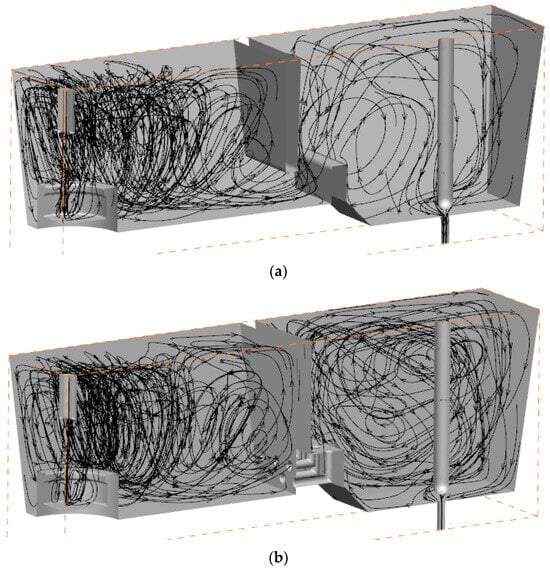
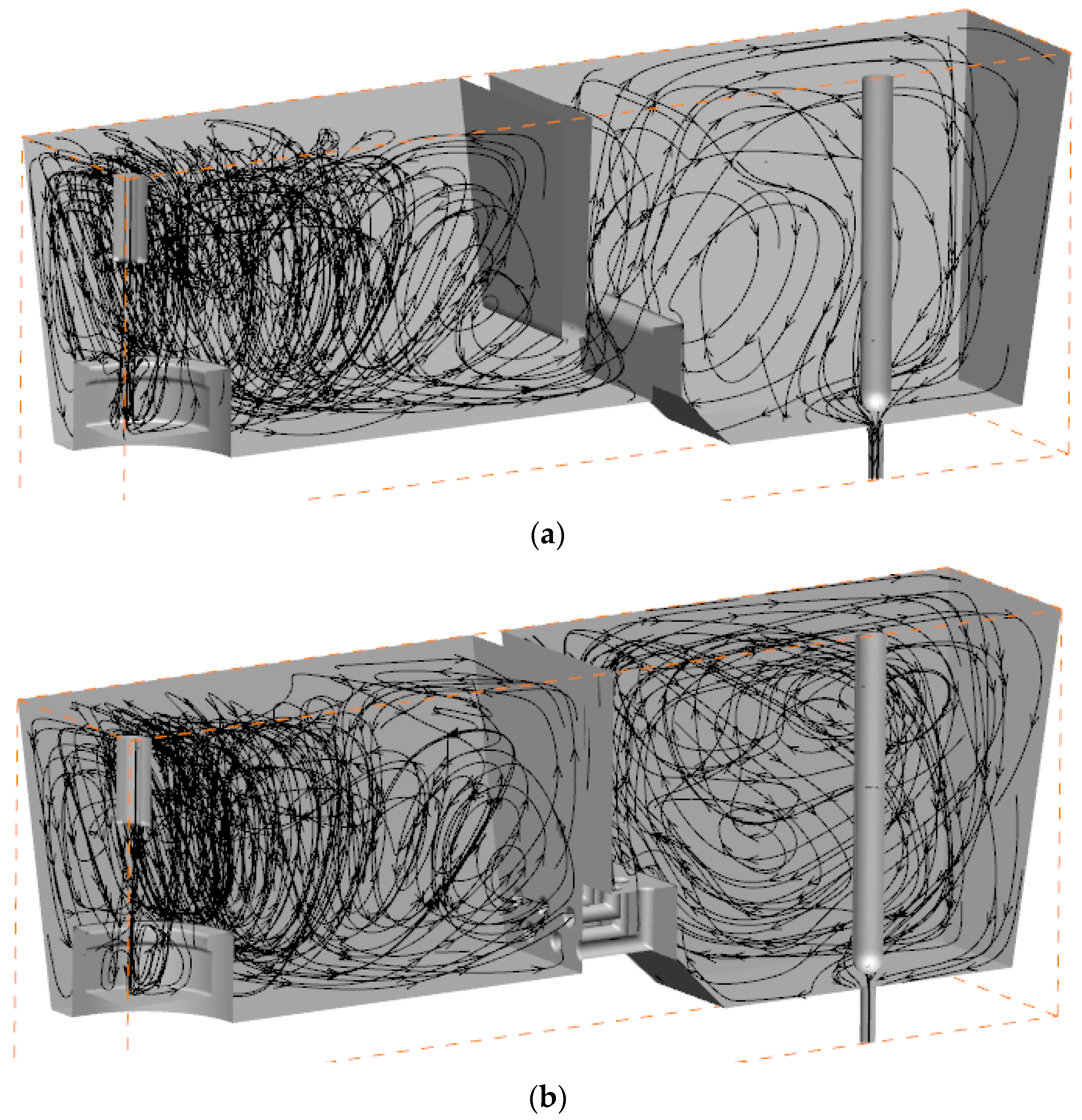
The simulation indicates that the conventional configuration produced a comparatively concentrated flow path with local high-velocity channels. In the filter configuration, molten steel passed through multiple channels before entering the casting zone, extending the flow path, redistributing velocity, and producing a more uniform flow pattern between the impact and casting zones.
As shown in Figure 11, the filter weakened direct short-circuiting, extended the transport path, and increased the time available for inclusion migration and separation. These changes favour subsequent collision, agglomeration, and flotation.
Figure 11.
Molten-steel streamlines under the two flow-control configurations: (a) conventional weir–dam; (b) channel-type filter.
The filter should therefore be regarded primarily as a combined flow-control and inclusion-contact device rather than as a simple mechanical screen. Its contribution to cleanliness arises from both improved residence-time characteristics and local particle–wall interaction.
4.2. Inclusion Collision, Agglomeration, and Growth
Fine Al2O3-type inclusions have low terminal flotation velocities and may not separate completely within the available tundish residence time. Oxide particles ranging from several to several tens of micrometres are therefore difficult to remove by buoyancy alone [9,21,23].
Passage through the filter channels changes the local flow direction and velocity gradients and may increase turbulent fluctuations. These conditions raise the probability of inclusion–inclusion and inclusion–wall contact, thereby promoting agglomeration and growth [13,14,19].
The high surface energy of Al2O3 promotes agglomeration. As fine particles combine into larger clusters, their terminal flotation velocity increases, enhancing their probability of reaching the covering slag or contacting the filter surfaces.
The reductions in total and Al2O3-type inclusion number densities after filtration are consistent with enhanced removal of alumina-rich inclusions. However, the present measurements do not independently distinguish agglomeration from flotation or channel-wall retention.
4.3. Inclusion Flotation and Separation
Final separation of inclusions from molten steel depends principally on flotation to, and absorption by, the covering slag. Terminal flotation velocity increases with particle size [4,18,28].
The filter redistributed the tundish flow, reduced short-circuiting, and increased the time available for flotation. Agglomeration can further increase particle size and terminal velocity. Inclusions reaching the steel–slag interface upstream or downstream of the filter may then be absorbed by the tundish covering flux.
Total oxygen decreased from 24.0 ppm in the conventional casting zone to 19.0 ppm in the filter-equipped casting zone, a reduction of 20.8%. Together with the ASPEX results, this decrease indicates a lower oxide-inclusion level. The recovered filter deposits show that some inclusions were retained in the channel region, whereas others were likely removed through agglomeration, flotation, and slag absorption within the tundish.
Thus, the filter function extends beyond direct capture within the channels and includes enhancement of the conditions required for inclusion flotation and separation.
4.4. Inclusion Adsorption and Retention on Channel Walls
In addition to modifying the bulk flow and promoting flotation, the filter channels provide surfaces on which inclusions may be retained.
As molten steel passes through a channel, particle inertia may cause inclusions to deviate from local streamlines and collide with the refractory wall. Depending on interfacial tension, wettability, and surface condition, some particles may adhere and subsequently act as nuclei for further deposition [22,26].
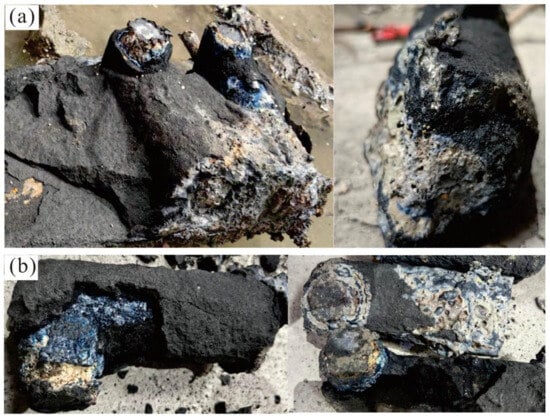
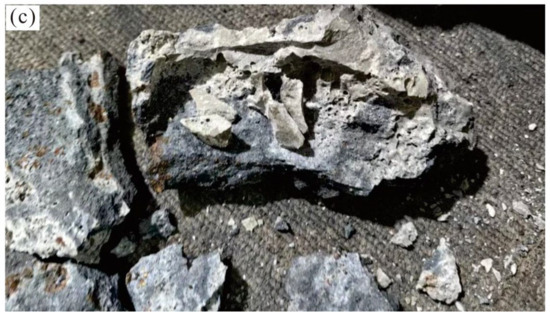
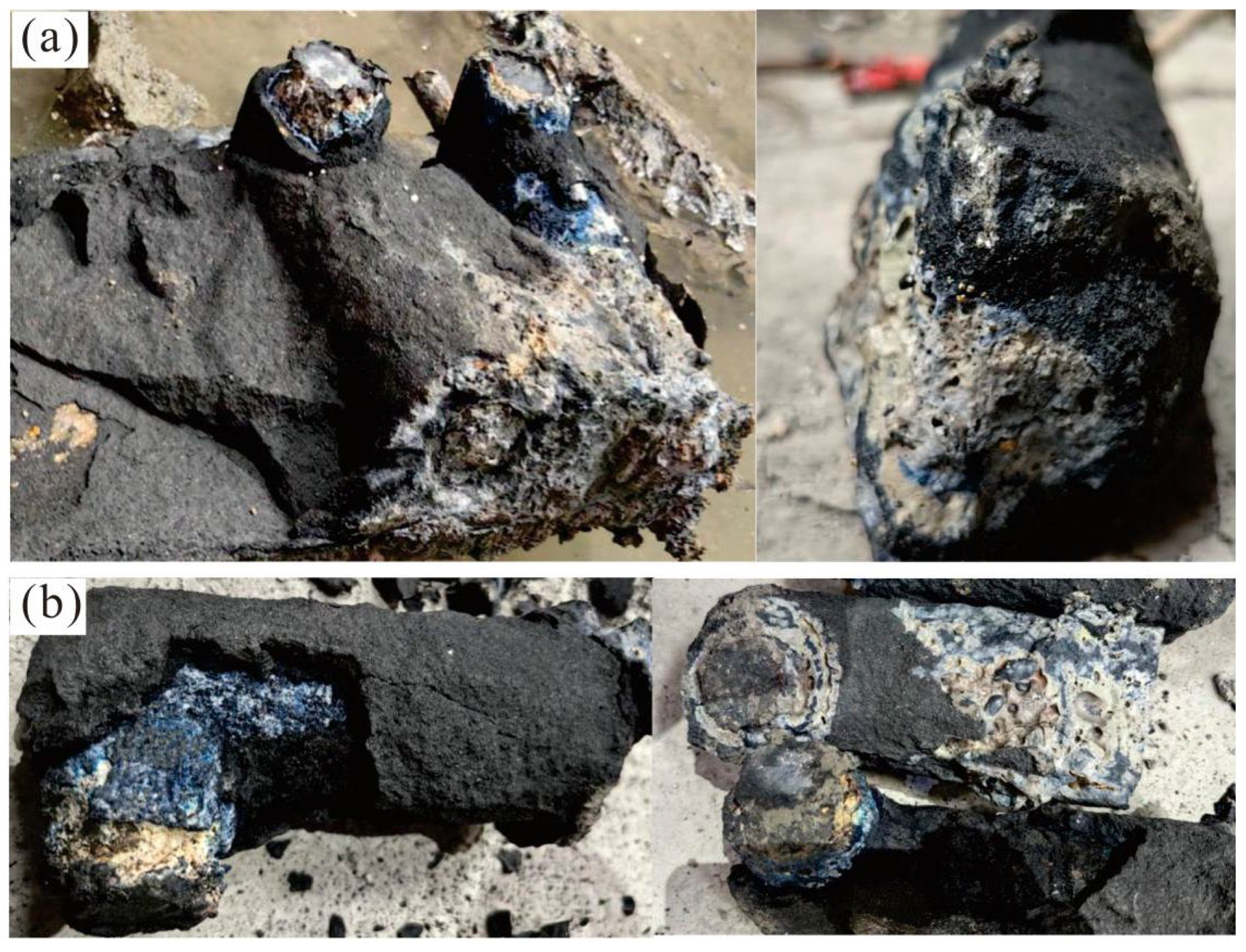
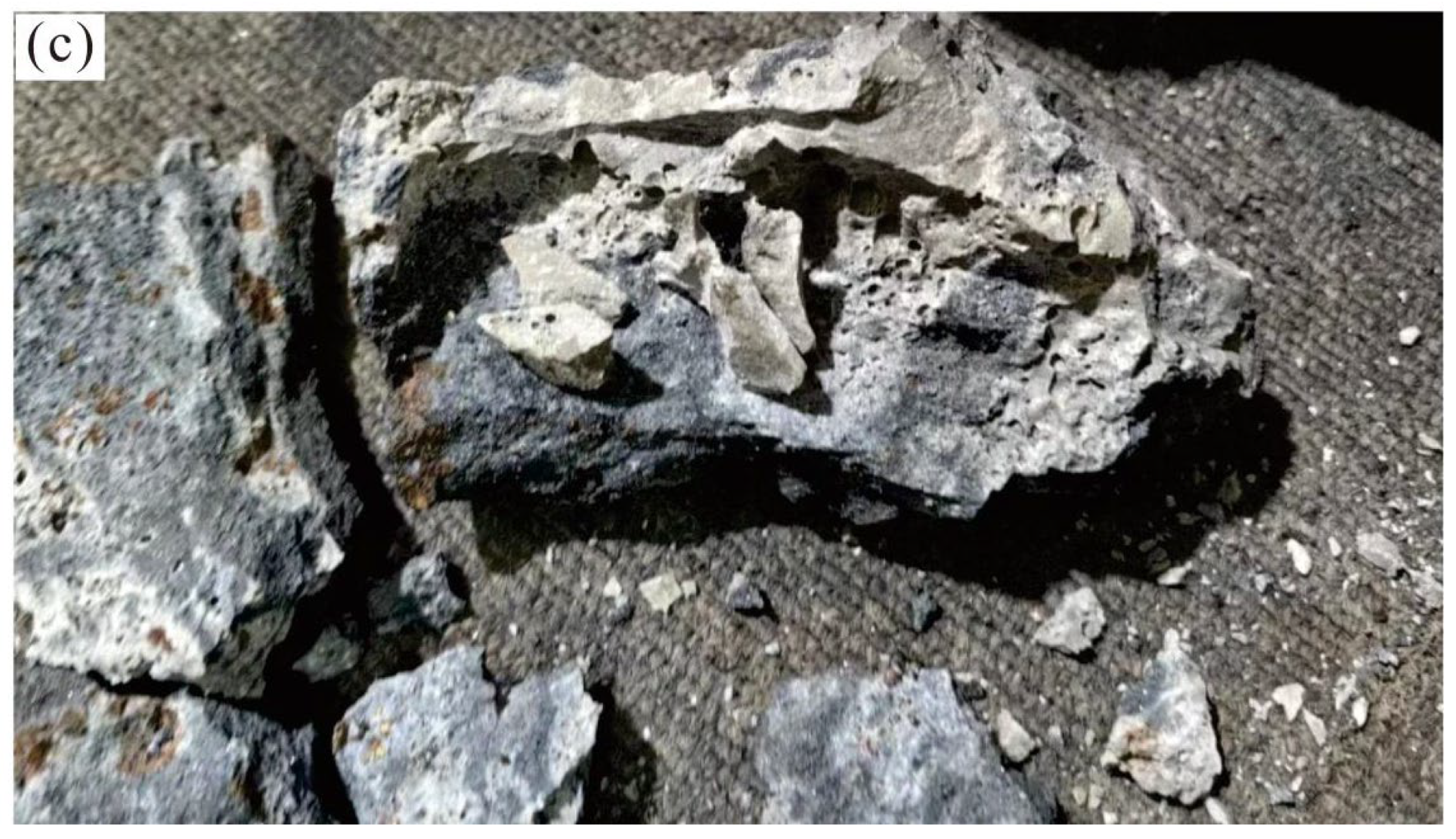
Post-casting examination identified visible deposits adjacent to the filter channels (Figure 12).
Figure 12.
Morphology of the filter element and attached deposits: (a) overall filter morphology; (b,c) deposits adjacent to the channels.
The chemical composition reported in Table 7, together with the decrease in Al2O3-type inclusion number density measured by ASPEX, provides direct evidence that alumina-rich and calcium-aluminate material accumulated within the filter channels. This result supports inclusion adsorption and retention during molten-steel passage through the filter.
5. Conclusions
This study assessed the metallurgical and operational performance of an LGTF11 channel-type tundish filter under full-scale industrial continuous-casting conditions for Ti-bearing ultra-low-carbon steel. A simultaneous comparison was conducted between a conventional weir–dam strand and a filter-equipped strand supplied by the same tundish. Steel cleanliness and casting performance were evaluated using total oxygen and nitrogen analysis, automated ASPEX inclusion statistics, small-sample electrolytic extraction, SEM–EDS characterisation, filter-deposit analysis, stopper-rod monitoring, submerged entry nozzle inspection, and downstream product-quality assessment. The principal conclusions are as follows.
(1) Under the investigated operating conditions, the channel-type filter improved molten steel cleanliness. Mean total oxygen decreased from 24.0 ± 6.1 to 19.0 ± 6.2 ppm, corresponding to a reduction of 20.8%. Nitrogen contents were comparable in the two casting zones, indicating that the improvement was associated primarily with a lower oxide-inclusion level rather than with substantial differences in nitrogen pickup or protective-casting performance.
(2) The ASPEX results confirmed that the filter reduced both the overall inclusion population and the Al2O3-type inclusion population in the tundish molten steel. The mean total inclusion number density decreased from 28.3 ± 21.8 to 12.9 ± 9.9 particles mm−2, representing a reduction of 54.4%, while the Al2O3-type inclusion number density decreased from 9.0 ± 5.6 to 5.1 ± 4.9 particles mm−2, corresponding to a reduction of 43.3%. For the third-heat cast slab, the total and Al2O3-type inclusion number densities decreased by 47.5% and 55.8%, respectively. These results indicate that the improvement achieved in the tundish was transferred, at least for the representative sampled heat, to the cast slab.
(3) Industrial observations demonstrated that the improvement in steel cleanliness was accompanied by enhanced continuous-casting stability. The filter-equipped strand exhibited more stable stopper-rod displacement and mold-level control, while substantially less accretion was observed on the inner wall of the submerged entry nozzle. In contrast, deposits in the conventional strand occupied approximately two-thirds of the nozzle-cavity flow space. These observations indicate that reducing the inclusion load entering the stopper-rod and nozzle region can mitigate accretion and clogging, maintain the effective flow area, and improve flow-control stability during casting.
(4) The combined numerical and experimental evidence suggests that the filter operates through the synergistic effects of molten-steel flow redistribution, extension of the effective flow path, inclusion collision and agglomeration, flotation and absorption by the covering flux, and adsorption or retention on the internal channel surfaces. Deposits enriched in Al2O3 and CaO were identified inside the filter channels, providing direct post-casting evidence of inclusion accumulation within the filter element. Nevertheless, the relative contributions of flow-field regulation, flotation, and direct channel-wall capture were not independently quantified and should not be interpreted as having been conclusively separated by the present study.
(5) From an industrial perspective, the channel-type filter provides a promising engineering alternative to conventional tundish flow-control structures for the continuous casting of inclusion-sensitive ultra-low-carbon steels. In addition to the improvements in molten-steel and cast-slab cleanliness, the warping-defect rate of the corresponding hot-rolled products decreased from 6.7% to 3.4%, representing a relative reduction of 48.8%. These results demonstrate that the filter has the potential to improve both casting continuity and downstream product quality under industrial operating conditions. However, its performance should be regarded as specific to the investigated tundish geometry, filter design, steel grade, and casting conditions rather than as a universally transferable removal efficiency.
The findings should be interpreted in light of the study limitations. The two configurations were not interchanged between strand positions, so residual strand-position or tundish-asymmetry effects cannot be excluded. Tundish-steel measurements covered three heats, whereas cast-slab and electrolytic-extraction analyses were restricted to the third heat. The numerical model used idealised 100 μm spherical particles, complete free-surface capture, and simplified particle–wall interactions; the PIV benchmark was obtained from a different tundish geometry. Further trials with reversed strand configurations, additional steel grades and casting conditions, broader particle-size distributions, and direct industrial residence-time-distribution validation are required before the results can be generalised.
Author Contributions
Conceptualization, Z.L.; methodology, Z.L. and L.X.; software, Z.L. and X.W.; validation, Z.L., X.W. and Y.W.; formal analysis, Z.L.; investigation, Z.L.; resources, Z.L. and L.X.; data curation, Z.L.; writing—original draft preparation, Z.L.; writing—review and editing, Z.L. and Y.W.; visualization, Z.L.; supervision, L.X.; project administration, Z.L. and L.X.; funding acquisition, Z.L. All authors have read and agreed to the published version of the manuscript.
Funding
This research was funded by the Advanced Materials-National Science and Technology Major Project of China, grant number 2025ZD0611200. The APC was funded by General Iron and Steel Research Institute Co., Ltd.
Data Availability Statement
The original data supporting the findings of this study are included in the article. Further enquiries may be directed to the corresponding author.
Conflicts of Interest
Authors Zhihong Liu, Lijun Xu, Xuebing Wang, and Yang Wang were employed by General Iron and Steel Research Institute Co., Ltd. The funders and supporting sources had no role in the study design; collection, analysis, or interpretation of data; writing of the report; or the decision to submit the report for publication.
Nomenclature
| Symbol/Abbreviation | Definition | Unit |
| Alt | Total aluminium | wt.% |
| Als | Acid-soluble aluminium | wt.% |
| ASPEX | Automated scanning electron microscopy–energy-dispersive X-ray spectroscopy inclusion-analysis system | — |
| CFD | Computational fluid dynamics | — |
| EDS | Energy-dispersive X-ray spectroscopy | — |
| IF | Interstitial-free | — |
| PIV | Particle image velocimetry | — |
| RTD | Residence-time distribution | — |
| SEM | Scanning electron microscopy | — |
| T.O. | Total oxygen | ppm |
| k | Turbulent kinetic energy | m2·s−2 |
| ε | Turbulent kinetic-energy dissipation rate | m2·s−3 |
| uin | Inlet velocity | m·s−1 |
| n | Number of independently sampled heats | — |
| ηtotal | Total predicted inclusion-removal efficiency | % |
| Nsurface | Number of particles captured at the free surface | — |
| Nfilter | Number of particles retained on the filter-channel surfaces | — |
| Ninjected | Total number of injected particles | — |
References
- Zhang, L.; Thomas, B.G. State of the Art in Evaluation and Control of Steel Cleanliness. ISIJ Int. 2003, 43, 271–291. [Google Scholar] [CrossRef] [Scilit]
- Basu, S.; Choudhary, S.K.; Girase, N.U. Nozzle Clogging Behaviour of Ti-Bearing Al-Killed Ultra Low Carbon Steel. ISIJ Int. 2004, 44, 1653–1660. [Google Scholar] [CrossRef] [Scilit]
- Yang, W.; Zhang, L.; Ren, Y.; Chen, W.; Liu, F. Formation and Prevention of Nozzle Clogging during the Continuous Casting of Steels: A Review. ISIJ Int. 2024, 64, 1–20. [Google Scholar] [CrossRef] [Scilit]
- Zhang, L.; Taniguchi, S.; Cai, K. Fluid Flow and Inclusion Removal in Continuous Casting Tundish. Metall. Mater. Trans. B 2000, 31, 253–266. [Google Scholar] [CrossRef] [Scilit]
- Thomas, B.G.; Zhang, L. Mathematical Modeling of Fluid Flow in Continuous Casting. ISIJ Int. 2001, 41, 1181–1193. [Google Scholar] [CrossRef] [Scilit]
- Morales, R.D.; Palafox-Ramos, J.; Barreto, J.d.J.; Lopez-Ramirez, S.; Zacharias, D. Melt Flow Control in a Multistrand Tundish Using a Turbulence Inhibitor. Metall. Mater. Trans. B 2000, 31, 1505–1515. [Google Scholar] [CrossRef] [Scilit]
- Ding, N.; Bao, Y.; Sun, Q.; Wang, L. Optimization of Flow Control Devices in a Single-Strand Slab Continuous Casting Tundish. Int. J. Miner. Metall. Mater. 2011, 18, 292–296. [Google Scholar] [CrossRef] [Scilit]
- Quan, Q.; Zhang, Z.-X.; Qu, T.-P.; Li, X.-L.; Tian, J.; Wang, D.-Y. Physical and Numerical Investigation on Fluid Flow and Inclusion Removal Behavior in a Single-Strand Tundish. J. Iron Steel Res. Int. 2023, 30, 1182–1198. [Google Scholar] [CrossRef] [Scilit]
- Wang, Z.; Yang, Z.; Wang, X.; Yue, Q.; Xia, Z.; Xiao, H. Residence Time Distribution (RTD) Applications in Continuous Casting Tundish: A Review and New Perspectives. Metals 2022, 12, 1366. [Google Scholar] [CrossRef] [Scilit]
- Zhao, S.; Zhu, S.; Ge, Y.; Wang, J.; Xu, D.; Li, Z.; Chen, C. Simulation of Fluid Flow and Inclusion Removal in Five-Flow T-Type Tundishes with Porous Baffle Walls. Metals 2023, 13, 215. [Google Scholar] [CrossRef] [Scilit]
- Wang, J.; Liu, W.; Yang, S.; Zuo, X.; Zhao, L.; Li, J. Effect of Tundish Impact Zone Optimization on Inclusion Removal in Steel: Industrial and Simulation Studies. Metall. Mater. Trans. B 2024, 55, 808–820. [Google Scholar] [CrossRef] [Scilit]
- Wang, Q.; Zhang, C.-J.; Li, R. CFD Investigation of Effect of Multi-Hole Ceramic Filter on Inclusion Removal in a Two-Strand Tundish. Metall. Mater. Trans. B 2020, 51, 276–292. [Google Scholar] [CrossRef] [Scilit]
- Lv, A.; Ding, G.; Luo, X. Influence of Elevation Angle of Tundish Filter on Removal Rate of Impurity in Molten Steel. Sci. Rep. 2025, 15, 782. [Google Scholar] [CrossRef] [Scilit]
- Liu, C.; Xiao, A.; He, Z.; Yan, W.; Li, G.; Wang, Q. Numerical Investigation on Motion and Removal of Inclusions in Continuous Casting Tundish with Multiorifice Filter. Steel Res. Int. 2022, 93, 2100818. [Google Scholar] [CrossRef] [Scilit]
- Ding, G.; Feng, D.; Luo, X.; Hou, Q.; Lv, A.; Qi, X.; Qi, D. Numerical Simulation Study on the Influence of Tundish Filter on Molten Steel Flow and Inclusions Removal. Steel Res. Int. 2024, 95, 2300807. [Google Scholar] [CrossRef] [Scilit]
- Dinda, S.K.; Li, D.; Guerra, F.; Cathcart, C.; Barati, M. Continuous Casting Tundish Dead Volume Study by Physical Modeling and Computational Investigation. Steel Res. Int. 2024, 95, 2400125. [Google Scholar] [CrossRef] [Scilit]
- Ding, C.; Lei, H.; Zhang, H.; Xu, M.; Zhao, Y.; Li, Q. New Insight into Relationship between Casting Speed and Inclusion Removal in the Tundish. J. Mater. Res. Technol. 2023, 23, 5400–5412. [Google Scholar] [CrossRef] [Scilit]
- Launder, B.E.; Spalding, D.B. The Numerical Computation of Turbulent Flows. Comput. Methods Appl. Mech. Eng. 1974, 3, 269–289. [Google Scholar] [CrossRef] [Scilit]
- Fang, Q.; Zhang, H.; Luo, R.; Liu, C.; Wang, Y.; Ni, H. Optimization of Flow, Heat Transfer and Inclusion Removal Behaviors in an Odd Multistrand Bloom Casting Tundish. J. Mater. Res. Technol. 2020, 9, 347–363. [Google Scholar] [CrossRef] [Scilit]
- Zhang, Z.-X.; Wang, H.; Qu, T.-P.; Wang, D.-Y.; Li, X.-L.; Hu, S.-Y.; Tian, J.; Zhou, X.-Z.; Yang, Z.-H. Numerical Investigation on Transient Flow and Inclusion Removal Behavior in Tundish During Ladle Change Process. Steel Res. Int. 2024, 95, 2400471. [Google Scholar] [CrossRef] [Scilit]
- Miki, Y.; Thomas, B.G. Modeling of Inclusion Removal in a Tundish. Metall. Mater. Trans. B 1999, 30, 639–654. [Google Scholar] [CrossRef] [Scilit]
- Yang, B.; Lei, H.; Bi, Q.; Xiao, Y.; Zhao, Y. Numerical Simulation of Collision-Coalescence and Removal of Inclusions in a Tundish. JOM 2018, 70, 2950–2957. [Google Scholar] [CrossRef] [Scilit]
- Jin, Y.; Dong, X.; Yang, F.; Cheng, C.; Li, Y.; Wang, W. Removal Mechanism of Microscale Non-Metallic Inclusions in a Tundish with Multi-Hole-Double-Baffles. Metals 2018, 8, 611. [Google Scholar] [CrossRef] [Scilit]
- Zhang, X.; Pirker, S.; Saeedipour, M. Investigation of Inclusion Removal at Steel–Slag Interface toward a Small-Scale Criterion for Particle Separation. Steel Res. Int. 2023, 94, 2200842. [Google Scholar] [CrossRef] [Scilit]
- Song, J.; Chen, C.; Guo, Z.; Geng, M.; Rong, Z.; Wang, T.; Wang, J.; Dianyu, E.; Fan, J.; Sun, Y. Analysis of Flow Field, Temperature, and Inclusion Evolution in a 12-Strand Tundish During Ladle Changeover Process. Metall. Mater. Trans. B 2025, 56, 2700–2714. [Google Scholar] [CrossRef] [Scilit]
- Li, W.; Wang, Y.; Wang, W.; Ren, Y.; Zhang, L. Dependence of the Clogging Possibility of the Submerged Entry Nozzle during Steel Continuous Casting Process on the Liquid Fraction of Non-Metallic Inclusions in the Molten Al-Killed Ca-Treated Steel. Metals 2020, 10, 1205. [Google Scholar] [CrossRef] [Scilit]
- Deng, Z.; Zhu, M.; Zhou, Y.; Du, S. Attachment of Alumina on the Wall of Submerged Entry Nozzle During Continuous Casting of Al-Killed Steel. Metall. Mater. Trans. B 2016, 47, 2015–2025. [Google Scholar] [CrossRef] [Scilit]
- Verma, N.; Pistorius, P.C.; Fruehan, R.J.; Potter, M.; Lind, M.; Story, S. Transient Inclusion Evolution During Modification of Alumina Inclusions by Calcium in Liquid Steel: Part II. Results and Discussion. Metall. Mater. Trans. B 2011, 42, 720–729. [Google Scholar] [CrossRef] [Scilit]

Disclaimer/Publisher’s Note: The statements, opinions and data contained in all publications are solely those of the individual author(s) and contributor(s) and not of MDPI and/or the editor(s). MDPI and/or the editor(s) disclaim responsibility for any injury to people or property resulting from any ideas, methods, instructions or products referred to in the content. |
© 2026 by the authors. Licensee MDPI, Basel, Switzerland. This article is an open access article distributed under the terms and conditions of the Creative Commons Attribution (CC BY) license.