


Abstract
Fe–Cr–Co alloys are deformable hard-magnetic materials that combine high coercivity with the possibility of conventional thermomechanical processing. In this work, the transition from limited ductility to superplastic deformation was investigated in industrial 23Kh15KT (Fe–23Cr–15Co) and 30Kh23K (Fe–30Cr–23Co) alloys by varying phase composition and phase morphology. Tensile tests were conducted at 800–1050 °C and strain rates of 1.6 × 10⁻⁴–1.6 × 10⁻¹ s−1. The microstructures were characterized using optical microscopy, scanning electron microscopy, transmission electron microscopy, and X-ray diffraction to evaluate phase constitution, grain size, and the evolution from lamellar to globular microduplex morphologies. The ultrafine-grained globular structures exhibited features characteristic of superplastic deformation during high-temperature tensile testing. The most favorable tensile response was observed at 900 °C for 23Kh15KT and at 950 °C for 30Kh23K. Under these conditions, the globular microduplex states showed high elongation to failure and strain-rate sensitivity coefficients of approximately m = 0.43 and m = 0.47, respectively. In contrast, the initially lamellar 23Kh15KT structure showed pronounced strain hardening and only partial fragmentation and spheroidization of the lamellae. In 30Kh23K, the lamellar morphology transformed more completely into a fine globular microduplex structure, which was accompanied by stable high-temperature deformation behavior. The results demonstrate that grain refinement alone is insufficient to promote superplasticity in Fe–Cr–Co alloys; the formation of a fine globular microduplex morphology is also required to provide favorable conditions for grain-boundary-sliding-mediated deformation. Complementary compression experiments revealed progressive fragmentation and spheroidization of lamellar structures at elevated temperatures. These findings provide a structural basis for the thermomechanical processing and potential superplastic forming of complex-shaped Fe–Cr–Co alloy components.
1. Introduction
Permanent magnets are key components in modern aircraft manufacturing, rocket engineering, shipbuilding, and instrument making [1,2,3]. Increased power, speed, and operating temperatures place greater stress on magnetic elements, requiring not only high magnetic performance but also good mechanical properties: strength, wear resistance, and impact toughness [4,5,6].
Currently, NdFeB magnets [7,8,9,10,11] dominate the industry due to outstanding magnetic properties. However, their inherent brittleness prevents use under high mechanical loads [12], and their intermetallic structure makes deformation virtually impossible except at very high temperatures (700–1000 °C) [13]. Similar limitations apply to other intermetallic magnets such as Sm-Co [14,15], Sm-Fe-N [16,17], and Al-Ni-Co [18].
Fe–Cr–Co alloys occupy a unique niche among deformable magnetically hard materials: with magnetic properties comparable to AlNiCo, they retain the ability to be processed by conventional metallurgical and deformation technologies [19,20,21], enabling complex-shaped parts (gyroscopes, sensors, navigation systems). High coercivity arises from spinodal decomposition of a supersaturated bcc α-solid solution into a ferromagnetic α1-phase (Fe-Co rich) and a weakly magnetic α2-phase (Cr enriched) at 500–720 °C [22]; the morphology and volume fraction of α1-precipitates (rods/parallelepipeds ~200–300 nm) directly determine coercivity and energy product.
Depending on Cr/Co content and temperature, the equilibrium structure may also contain an fcc γ-phase and an ordered tetragonal σ-phase (stable at 700–1100 °C in highly alloyed grades) [23]. The σ-phase increases hardness but reduces ductility due to its covalent bonding. The presence, fraction, and morphology of γ and σ phases govern deformation behavior, creating a fundamental trade-off: alloying for magnetic performance enhances multiphase complexity and brittle fracture tendency [23].
Recent research has expanded into powder metallurgy [24], additive manufacturing (Laser Powder Bed Fusion (LPBF) [25], Laser Directed Energy Deposition (LDED) [26]), and severe plastic deformation (SPD) [27]. Mo additions segregate to α2, enhancing lattice misfit and magnetic properties [28]; Pt promotes γ-phase formation to pin domain walls [29]; metal injection molding MIM enables low-Co compositions [24]; LPBF of Fe–25Cr–15Co yields magnetic properties comparable to casting despite ~10 wt.% FeO formation [25]. Conventional W/Ga-alloyed grades achieve σ0.2 = 1600 MPa at δ = 6.4% via 5 nm dispersoids [30], while LDED WC/FeCrCo composites show superior wear resistance [26].
SPD (torsion + tension) of Fe–30Cr–8Co and Fe–25Cr–15Co at 700–850 °C produces gradient UFG surface layers (~12 µm, 49% high angle boundaries (HABs)) with σ-phase precipitation and ultimate tensile stress ( UTS) ~970 MPa, retaining magnetic properties [27]. Critically, superplastic behaviour and the mechanisms governing the brittle-to-ductile transition were not analyzed in these studies [27].
In duplex systems, a universal structure–property link is established: a lamellar two-phase morphology correlates with brittle/limited ductility, whereas a globular ultrafine-grained (UFG) microduplex morphology is a prerequisite for superplasticity [31]. For duplex stainless steels (α+γ), lamellar-to-globular transition activates grain boundary sliding (GBS), raising strain rate sensitivity m to 0.4–0.5 [31]. A second phase (carbides, σ-phase, martensite) at 5–20 vol.% thermally stabilizes the UFG structure during hot deformation [32]. Furthermore, superplasticity requires the grain size d to be smaller than the accommodation subgrain size λ, allowing dislocation climb at triple junctions; otherwise (d > λ), dislocations climb to subgrain boundaries and GBS is suppressed [32,33,34]. This principle holds for lean Fe–Mn–Al steels (δ > 1300% at 850 °C) [35] and nano/UFG duplex stainless steels (δ > 800% at 650 °C) [35]. In Fe–24Cr–7Ni–3Mo–0.14N steel, superplasticity accompanies a phase evolution α → α+γ → α+γ+σ → γ+σ, controlled by GBS and dynamic recrystallization [36].
For Fe–Cr–Co alloys, this “phase composition → morphology → deformation mode” map remains absent. Most studies focus on magnetic/processing properties of powder/additive materials or post-SPD strength, while the detailed relationship between phase constitution (α+γ in 23Kh15KT; γ+σ in 30Kh23K), phase morphology (lamellar vs. globular), and high-temperature deformation behaviour (brittle/ductile/superplastic) is lacking. Given that Fe–Cr–Co alloys are two-phase α+γ and γ+σ systems, they are fundamentally analogous to duplex steels, Fe–Mn–Al, and Ti alloys where superplasticity is established [37,38]. This suggests the brittle-to-superplastic transition in Fe–Cr–Co is structurally attainable if the lamellar morphology is deliberately transformed into a globular UFG state.
The present study experimentally tests this hypothesis for industrial alloys 23Kh15KT (Fe–23Cr–15Co) and 30Kh23K (Fe–30Cr–23Co). The objective is to determine how phase composition, phase morphology, and the degree of globularization of the two-phase structure affect high-temperature deformation behavior and enable the transition from brittle to superplastic state. The work comprises comprehensive analysis of initial microstructures, phase composition vs. temperature, structural evolution during deformation (TEM), stress–strain curves, temperature dependence of mechanical properties, and strain rate sensitivity of flow stress. The results are of fundamental interest for deformation physics of heterophase magnetic materials and practical importance for developing superplastic forming technologies for Fe–Cr–Co components with a complex geometries.
2. Materials and Methods
Fe-Cr-Co alloys belong to the class of deformable hard magnetic materials strengthened by dispersion hardening. In this work, the 23Kh15KT and 30Kh23K alloys were used. The chemical composition of the Fe-Cr-Co alloys is given in Table 1.
Table 1.
Chemical composition of Fe–Cr–Co alloys (wt. %).
Tensile and compression tests were carried out on an Instron universal testing machine, model 5982 (Instron, High Wycombe, United Kingdom) at temperatures of 800, 850, 900, 950, 1000, and 1050 °C and at strain rates of 10−1–10−4 s−1. The deformation specimens were cut using an electrical discharge machine. Tensile tests were conducted on flat dog-bone specimens (gauge 12 × 4 × 2 mm). Cylindrical specimens with a diameter and height of 10 mm were used for compression tests. Strain was evaluated from crosshead displacement corrected for machine compliance. Specimens were heated at 10 °C/s and held for 180 s prior to deformation (temperature stability ±2 °C), testing was performed in air, and each condition was evaluated on three independent specimens (n = 3).
The strain-rate sensitivity coefficient, m, was determined from intermittent strain-rate-jump tests conducted at constant temperature in the steady-state deformation regime. It was calculated as the slope of the logarithmic flow-stress–strain-rate relationship at constant temperature and approximately constant true strain:
For two adjacent strain-rate steps, the coefficient was calculated according to:
where σ1 and σ2 are the stabilized flow stresses measured at strain rates and , respectively. The analysis was performed using tensile data at 900 °C for 23Kh15KT and 950 °C for 30Kh23K, at true strains of approximately 0.2–0.5. The strain-rate interval used for the strain-rate jumps was 1.6 × 10⁻⁴–1.6 × 10⁻² s−1. Only stabilized flow-stress values obtained after each strain-rate step were used in the calculation. The experimental scatter of the calculated m values was approximately ±0.03.
Phase identification was performed by X-ray diffraction (XRD DRON 4-08(NPP Burevestnik, St. Petersburg, Russia), Cu Kα, 2θ = 20–120°) on all initial structures (quenched, lamellar, globular) for both alloys. Quantitative phase fractions were determined by image analysis of SEM micrographs (thresholding, ≥10 fields/view). Grain size was determined by the line-intercept method (ASTM E112) [39] on five random fields per sample and is reported as mean ± range; for lamellar structures, the average longitudinal and transverse lamella dimensions (or interlamellar spacing) are reported instead, since a single equiaxed grain-size value is not applicable to an anisotropic lamellar morphology. The morphology of the second-phase particles was further characterized by the mean aspect ratio (AR), measured on the available micrographs for each condition, and each initial structure was additionally assigned a qualitative morphological classification—single-phase, lamellar, or fully globular—consistent with the staged structural evolution observed during compression. A single threshold-based globularization fraction was deliberately not adopted, as no standardized aspect-ratio cutoff exists for this parameter in the literature; instead, the combination of grain size, mean AR, and qualitative morphological classification provides a reproducible basis for comparing the degree of lamellar-to-globular transformation across samples. All quantitative and qualitative microstructural metrics for the initial structures are summarized in Table 2.
Table 2.
Microstructural characteristics of the initial structures.
Microstructural characterization was carried out using an Axio Vert-100A optical microscope (Carl Zeiss Microscopy GmbH, Jena, Germany) and a Tescan Mira 3LMH scanning electron microscope (SEM) (TESCAN ORSAY HOLDING, Brno, Czech Republic) equipped with secondary electron (SE) and backscattered electron (BSE) detectors. The average area (S) and volume fraction (V) of the phases were quantified by computer-assisted image analysis, manually tracing the perimeter of each particle, while the average grain size was determined using the line-intercept method.
TEM foils were prepared by twin-jet electropolishing using a Tenupol-5 facility (Struers ApS, Ballerup, Denmark). Discs of 3 mm diameter were mechanically pre-thinned to approximately 80–100 µm and electropolished to perforation in an electrolyte consisting of 10 vol.% perchloric acid (HClO4) and 90 vol.% n-butanol at −25 °C and 25–30 V. Bright-field imaging and selected-area electron diffraction (SAED) were performed using a JEOL JEM-2100 transmission electron microscope (JEOL Ltd., Tokyo, Japan) operated at 200 kV.
3. Results and Discussion
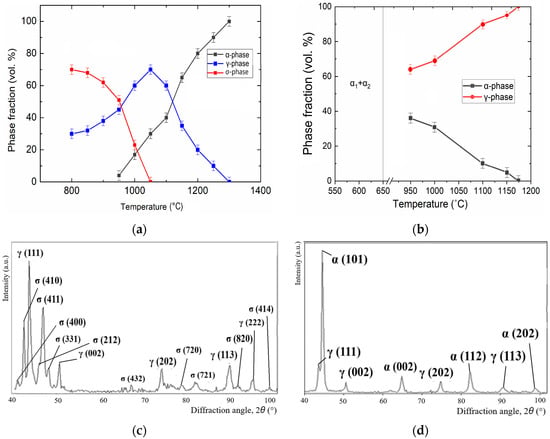
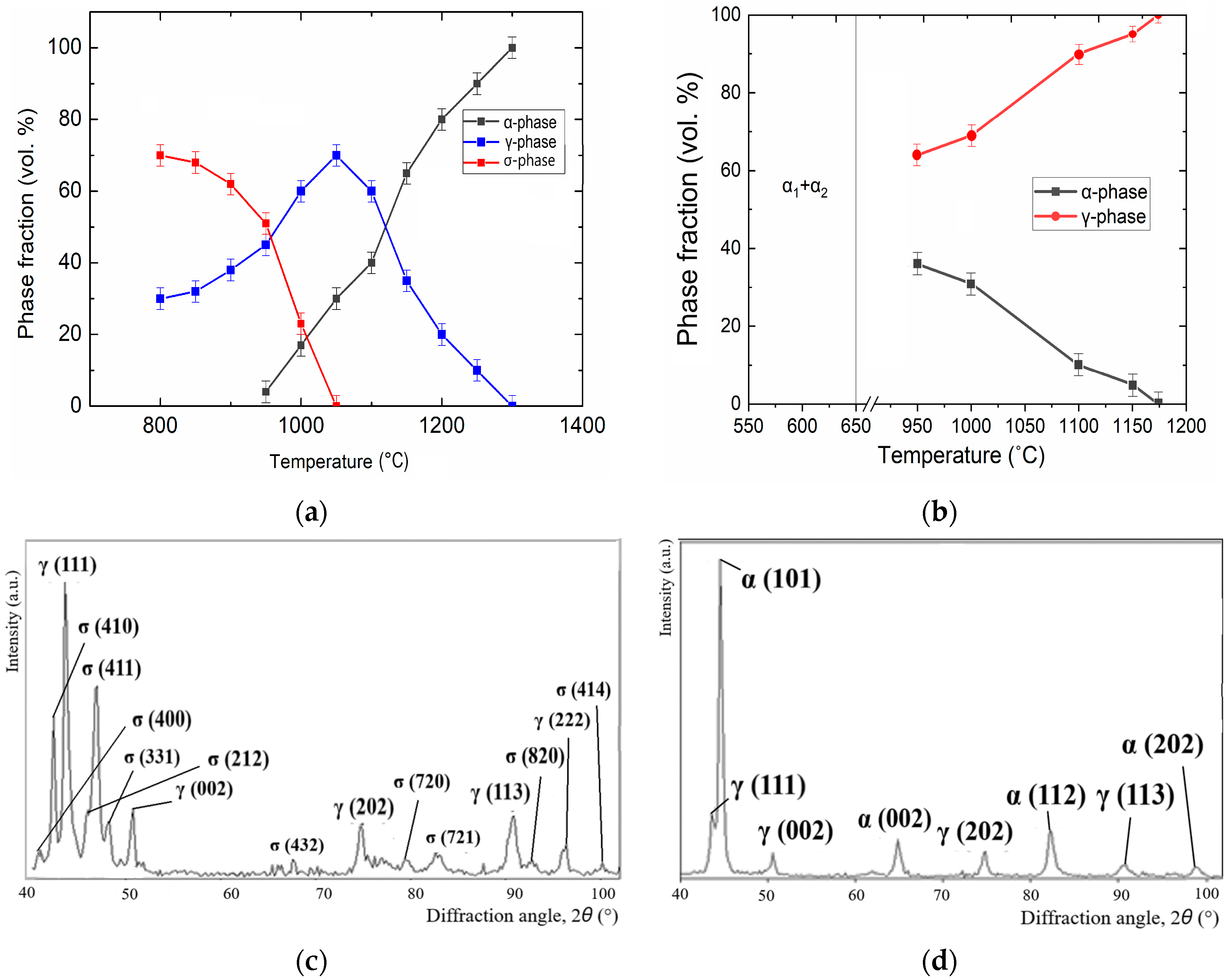
As described in the previous section, depending on the chemical composition, the alloys of this system exhibit different phase compositions in the temperature range 500–1300 °C [22,27,28]. In particular, the following phases are involved: a high-temperature α phase, which is a bcc solid solution; a γ phase with an fcc lattice; an ordered σ phase, which exists as an equilibrium phase in the highly alloyed 30Kh23K alloy in the temperature range 700–1100 °C, and the isomorphic (α1+α2) phases that form via spinodal decomposition during heat treatment on cooling from 720 to 520 °C, leading to a high-coercivity magnetic state. In order to obtain the desired phase composition in these alloys, it is necessary, prior to annealing in the corresponding phase field, to perform quenching from the single-phase α solid-solution region, which lies above 1150 °C for the 23Kh15KT alloy and above 1300 °C for the more highly alloyed 30Kh23K alloy. The evolution of the phase composition with increasing temperature for the 23Kh15KT and 30Kh23K alloys is shown in Figure 1 (a and b, respectively). Representative XRD patterns of the studied alloys are shown in Figure 1c,d.
Figure 1.
(a) Temperature dependence of the phase composition in the 30Kh23K alloy. (b) Temperature dependence of the phase composition in the 23Kh15KT alloy (note the isomorphic α1+α2 phase that forms during spinodal decomposition). Error bars represent ±3 vol.% (typical image analysis uncertainty for two-phase duplex structures). (c) X-ray diffraction pattern of 30Kh23K after heat treatment to produce an α-solid solution at 1300 °C and subsequent annealing at 900 °C. (d) X-ray diffraction pattern of 23Kh15KT after annealing at 950 °C.
3.1. Microstructure Formation in the 23Kh15KT Alloy
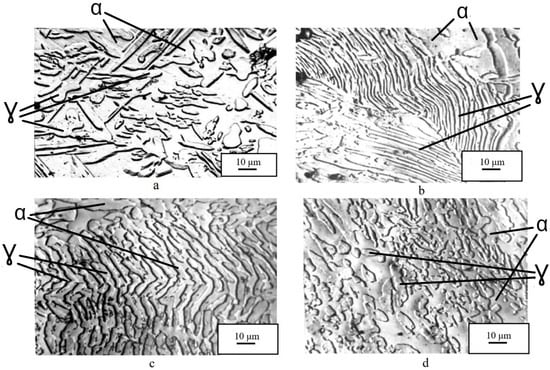
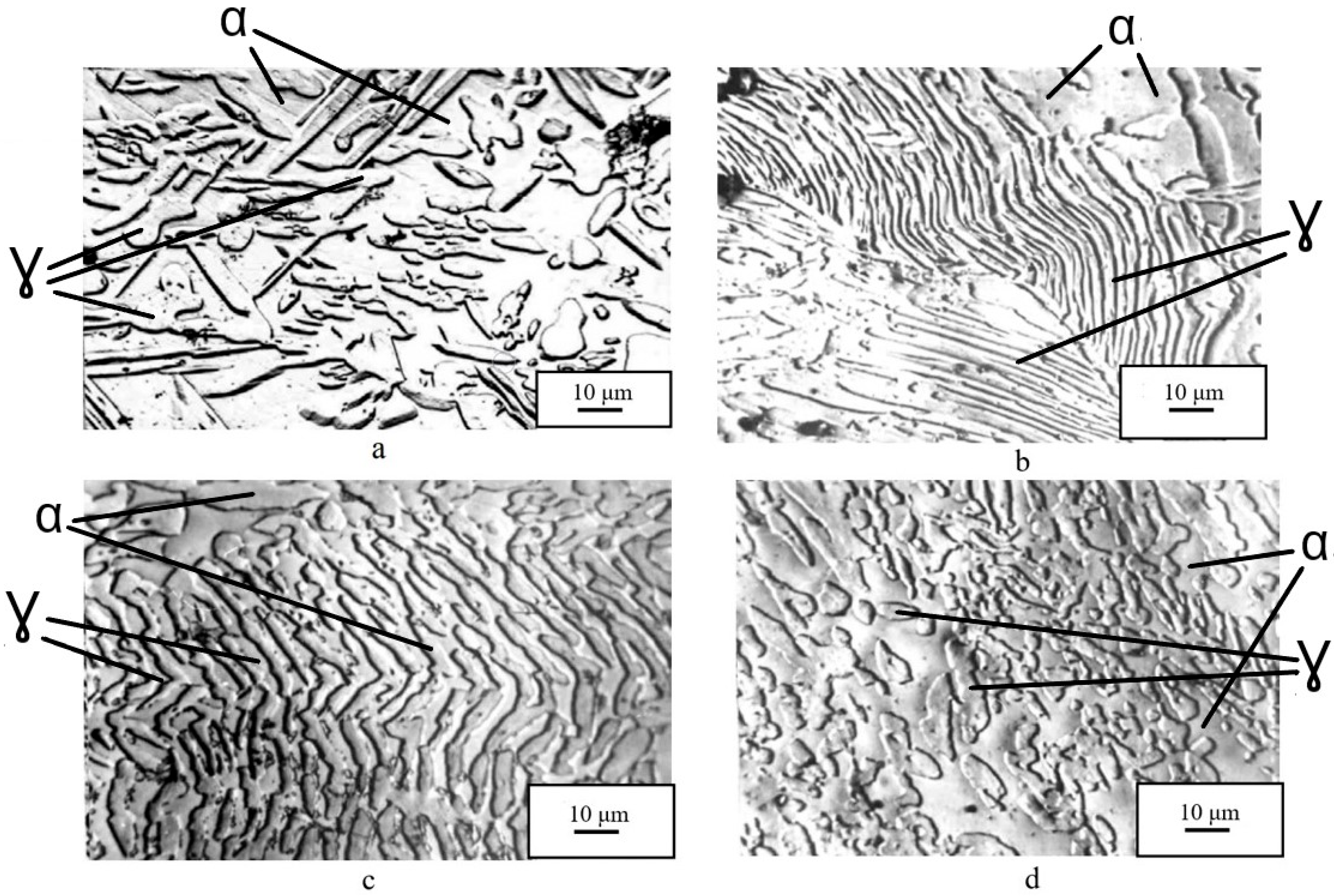
To study the influence of the initial structure on the deformation behavior in both alloys, two types of two-phase structures were obtained: lamellar and ultrafine-grained globular, microduplex type. When heating the 23Kh15KT alloy, previously quenched with an α-solid solution, in the temperature range of 750–1250 °C, corresponding to the (α+γ) phase region in the phase diagram, the γ-phase is released in the matrix grains of the α-phase in the form of lamellar packets. Several lamellar packets are formed within a single α-phase grain, and within a single packet, all γ-phase lamellae have the same orientation. However, such coarse structure has low deformation capacity. As it was shown in [40], the use of preliminary cold deformation allows one to obtain a more dispersed lamellar structure. To obtain such a structure in the 23Kh15KT alloy, blanks quenched with a single-phase α-solid solution were rolled at room temperature and then annealed at a room temperature of 900 °C for 30 min. As a result of such deformation–thermal treatment, an (α+γ) lamellar structure is formed in the 23Kh15KT alloy, consisting of γ-phase lamellae with average linear longitudinal and transverse dimensions of 4.7 and 1.3 µm. The increase in structural dispersion and homogeneity is due to the formation of a homogeneous fine-grained structure by the onset of the α-γ transformation. To obtain a globular (α+γ) structure in the 23Kh15KT alloy, the quenched blanks with a single-phase α-solid solution were subjected to compression. Structural changes during compression depend on temperature, strain rate, and strain degree. As the strain rate increases from 0.8 × 10⁻³ to 3.5 × 10⁻¹ s−1 at a temperature of 950 °C and the strain degree increases, the proportion of fragmented and spheroidized γ-phase increases, while the grain size in the α-phase decreases. Increasing the degree of strain at a fixed rate of 0.8 × 10⁻³ s−1 and a temperature of 950 °C initially leads to bending of the γ-phase lamellae and the appearance of localized constrictions (Figure 2b). Then, at 50% strain, the localized constrictions merge and transform into a chain of elongated, curved γ-phase grains (Figure 2c). Increasing the degree of strain to 70% leads to an increase in the number of fragmented lamellae and the formation of spheroidized γ-phase grains (Figure 2d). It was this structure that was used as the globular one in the tensile experiments.
Figure 2.
SEM images of the microstructure of the 23Kh15KT alloy, with γ and α phases marked. The lamellar structure was obtained by rolling at room temperature followed by annealing at 900 °C (a). Samples were subsequently compressed at 950 °C and a strain rate of 0.8 × 10⁻³ s−1: (b) 30% strain—γ-phase lamellae in the α matrix; (c) 50% strain—partially spheroidized γ-phase lamellae; and (d) 70% strain—spheroidized γ-phase lamellae.
3.2. Microstructure Formation in the 30Kh23K Alloy
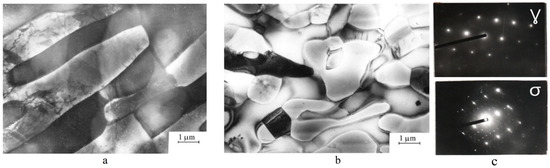
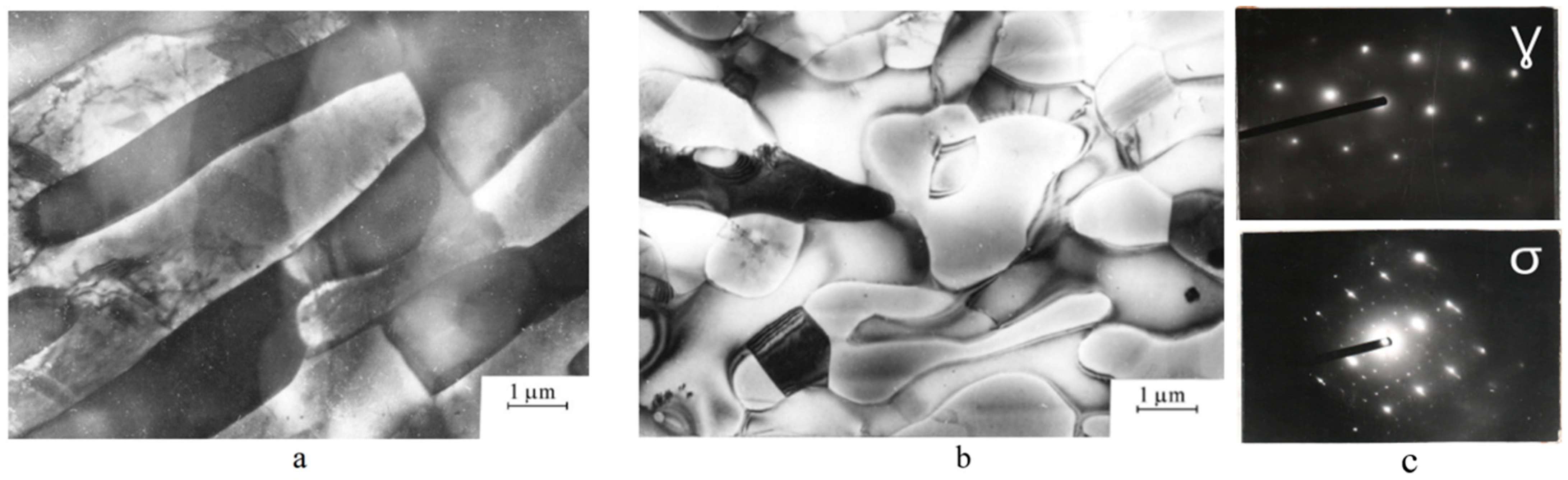
Heating 30Kh23K alloy with an initial α-solid solution structure in the temperature range of 700–950 °C, corresponding to the (σ+γ) region, results in the formation of a quasi-eutectoid-type lamellar structure. For tensile experiments in 30Kh23K alloy, a two-phase (σ+γ) lamellar structure with an average interlamellar distance of 1 μm and an equal volume fraction of the γ- and σ-phases was obtained by annealing the alloy for 1 h after quenching it to form an α-solid solution at 900 °C (Figure 3a). It can be seen that the structure consists of an uneven distribution of lamellar colonies of the γ and σ-phases with an average interlamellar distance of 1 μm.
Figure 3.
TEM bright-field microstructure of 30Kh23K alloy after annealing at 900 °C: (a) sample without deformation treatment, (b) sample pre-rolled at room temperature (adapted from Ref. [41]), and (c) the selected area electron diffraction pattern of σ- and γ-phases.
Annealing 30Kh23K alloy with the initial α-solid solution structure at temperatures of 800–1000 °C after preliminary rolling at room temperature forms an ultrafine-grained microduplex structure. For tensile testing in 30Kh23K alloy, a globular (σ+γ) structure with a grain size of both phases of approximately 1 μm was obtained by annealing pre-rolled 80% room temperature samples at 900 °C (Figure 3b).
It should be noted that when compressing the 30Kh23K alloy in the temperature range of 800–1050 °C and strain rates of 1.6 × 10⁻¹–1.5 × 10⁻⁴ s−1, similar to the 23Kh15KT alloy, typical signs of a gradual transformation from a lamellar structure to a granular one can be observed. Moreover, the linear average grain size of the σ- and γ-phases increases with increasing deformation temperature.
3.3. Mechanical Properties of 23Kh15KT and 30Kh23K Alloys Under Hot Deformation
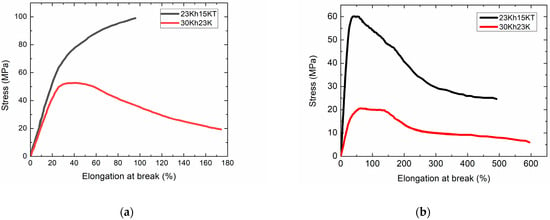
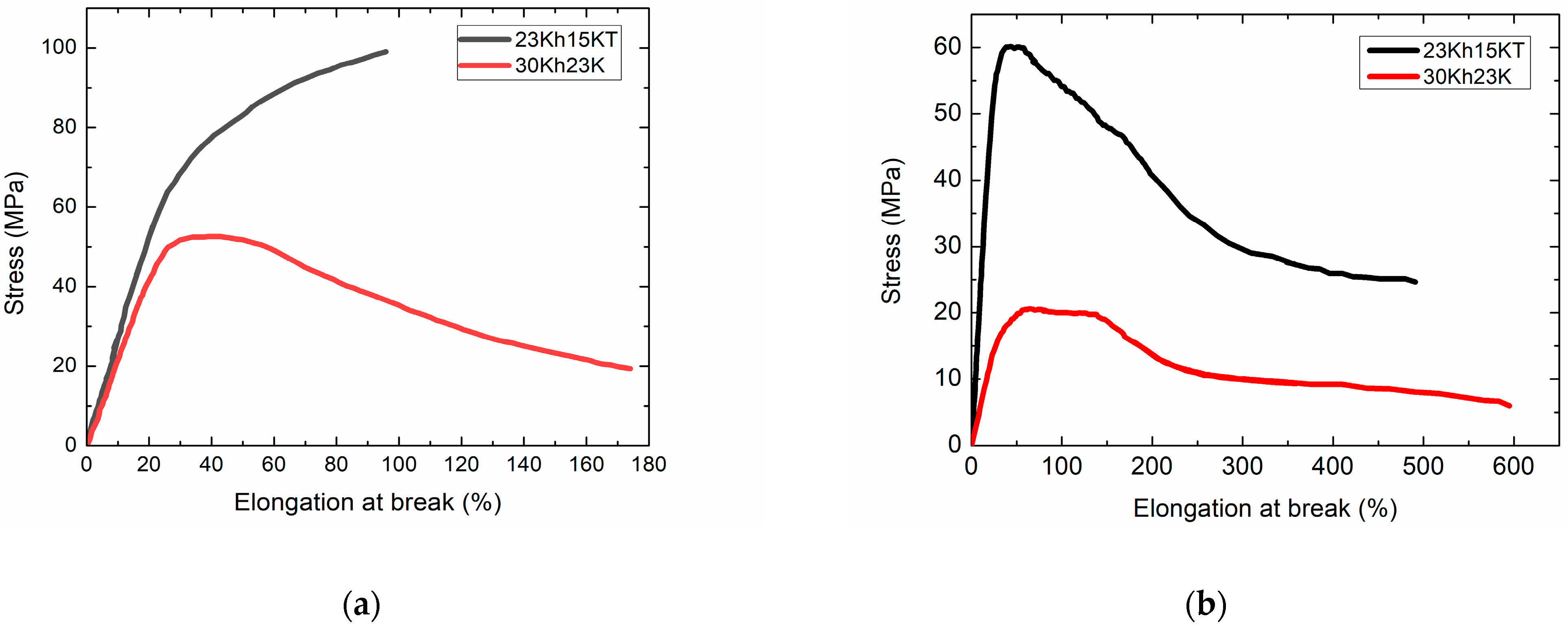
To detect signs of superplasticity, alloy samples with lamellar and globular structures were tested in tension at 800–1050 °C and strain rates of 1.6 × 10⁻¹–1.5 × 10⁻⁴ s−1. Typical curves for both alloys are shown in Figure 4 (a, lamellar structure; b, UFG structure); the 23Kh15KT and 30Kh23K alloys are represented by black and red curves, respectively. In the 23Kh15KT alloy with a fine-grained structure (Figure 4b), a steady-state flow stage began after approximately 25% strain, and deformation proceeded with a gradual decrease in flow stress, characteristic of superplastic flow. In the lamellar structure, sharp strengthening was observed up to 20% strain (Figure 4a), after which the hardening intensity decreased slightly.
Figure 4.
Stress–strain curves for 23Kh15KT (black curve) and 30Kh23K (red curve) alloys with lamellar (a) and UFG (b) structures under tension at 900 °C and a strain rate of 1.6 × 10⁻³ s−1.
In the 30Kh23K alloy with a UFG structure (Figure 4b), the steady-state flow stage is observed at a strain of 50%, and further deformation proceeds without noticeable hardening, indicating superplastic flow. For samples with a lamellar structure, the stress–strain curves show a sharp hardening up to a strain of 10%, followed by a smooth decrease in the flow stress (Figure 4a). The flow stress rate sensitivity coefficient m increases from 0.21 to 0.47 with an increase in the strain from 10 to 120%. This indicates that the deformation acquires characteristics of superplastic flow. Analysis of the structure of the 30Kh23K alloy sample after deformation showed that the lamellar structure was completely transformed into an ultrafine-grained one [42].
3.4. Effect of Temperature on Mechanical Properties
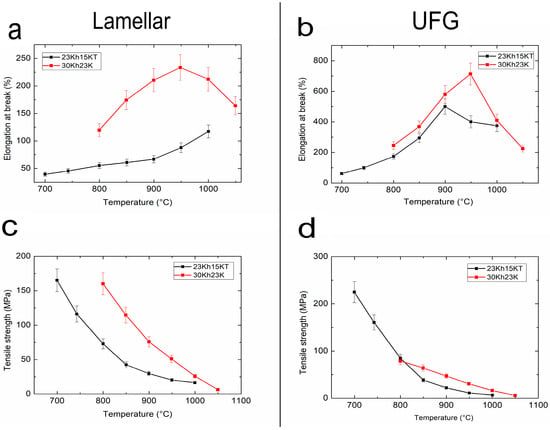
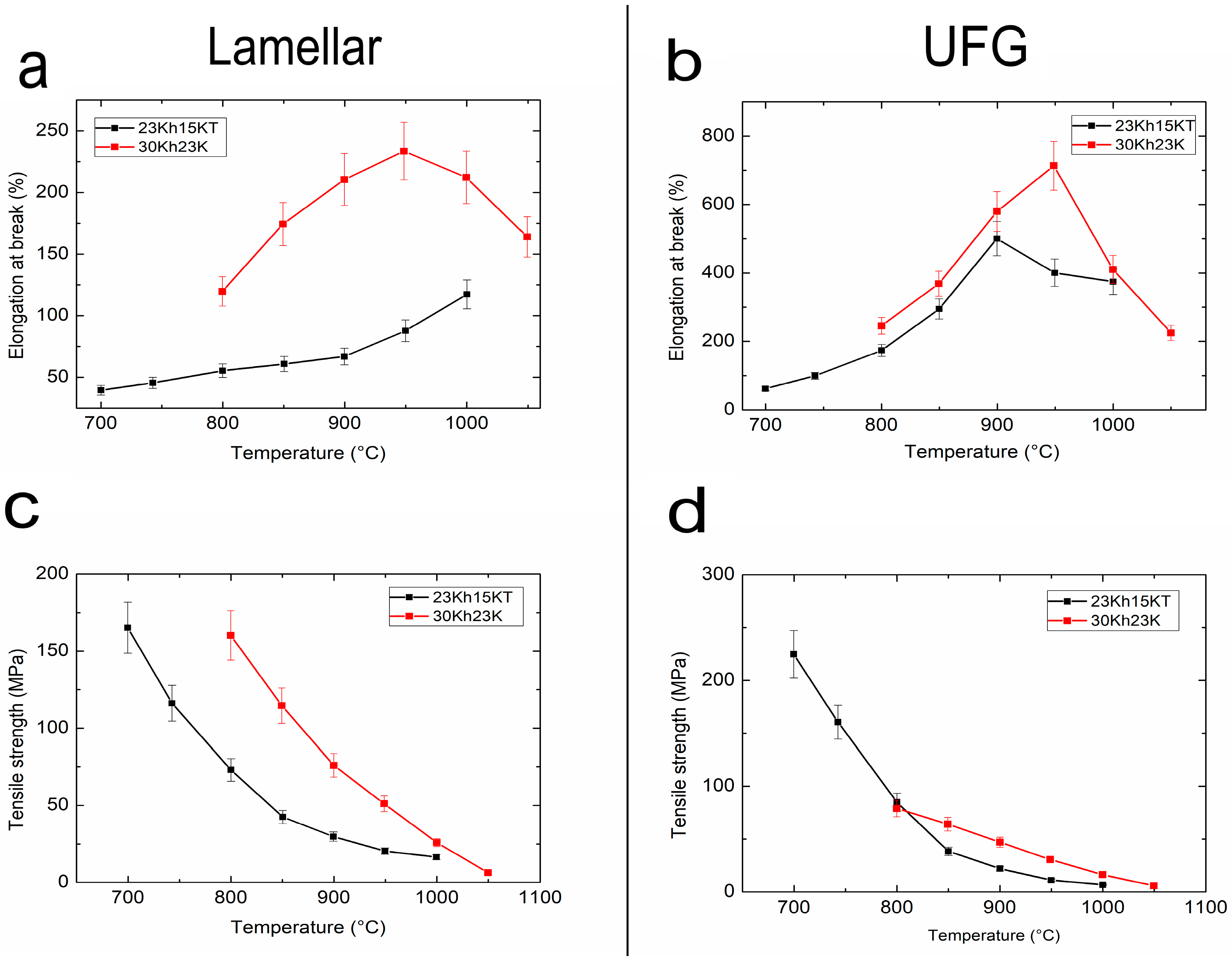
Data on the effect of temperature on the mechanical properties of the alloys are shown in Figure 5. The lamellar structures are shown on the left (a,c) and the UFG structures on the right (b,d); 23Kh15KT is represented by the gray curve and 30Kh23K by the red curve. The UFG curves in Figure 5b show maxima in elongation at break at 900 °C for 23Kh15KT and 950 °C for 30Kh23K. For 23Kh15KT with a lamellar structure, elongation at break increased smoothly from 45% to 120% as the test temperature increased from 700 to 1000 °C. In 30Kh23K with a lamellar structure, the effect of test temperature on elongation at break was less pronounced, with only a weak maximum at 950 °C. The flow stresses decreased with increasing temperature in all cases. In 23Kh15KT with a fine-grained structure, the flow stress was higher than that of the lamellar state at 700–800 °C; at 800–1000 °C, the difference decreased (Figure 5c,d).
Figure 5.
Elongation-at-break–temperature curves (a,b) and flow-stress–temperature curves (c,d) for 23Kh15KT (gray curve) and 30Kh23K (red curve) alloys with lamellar (left) and UFG (right) structures under tension at a strain rate of 1.6 × 10⁻³ s−1.
An analysis of the compression tests results on 23Kh15KT and 30Kh23K alloys revealed, as in tension, a monotonic decrease in flow stress with an increase in deformation temperature, with the sharpest decrease observed with an increase in temperature from 700 to 900 °C.
3.5. Influence of Strain Rate on Mechanical Properties
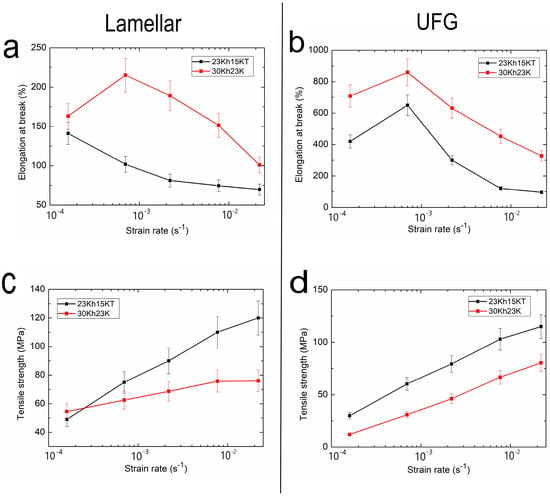
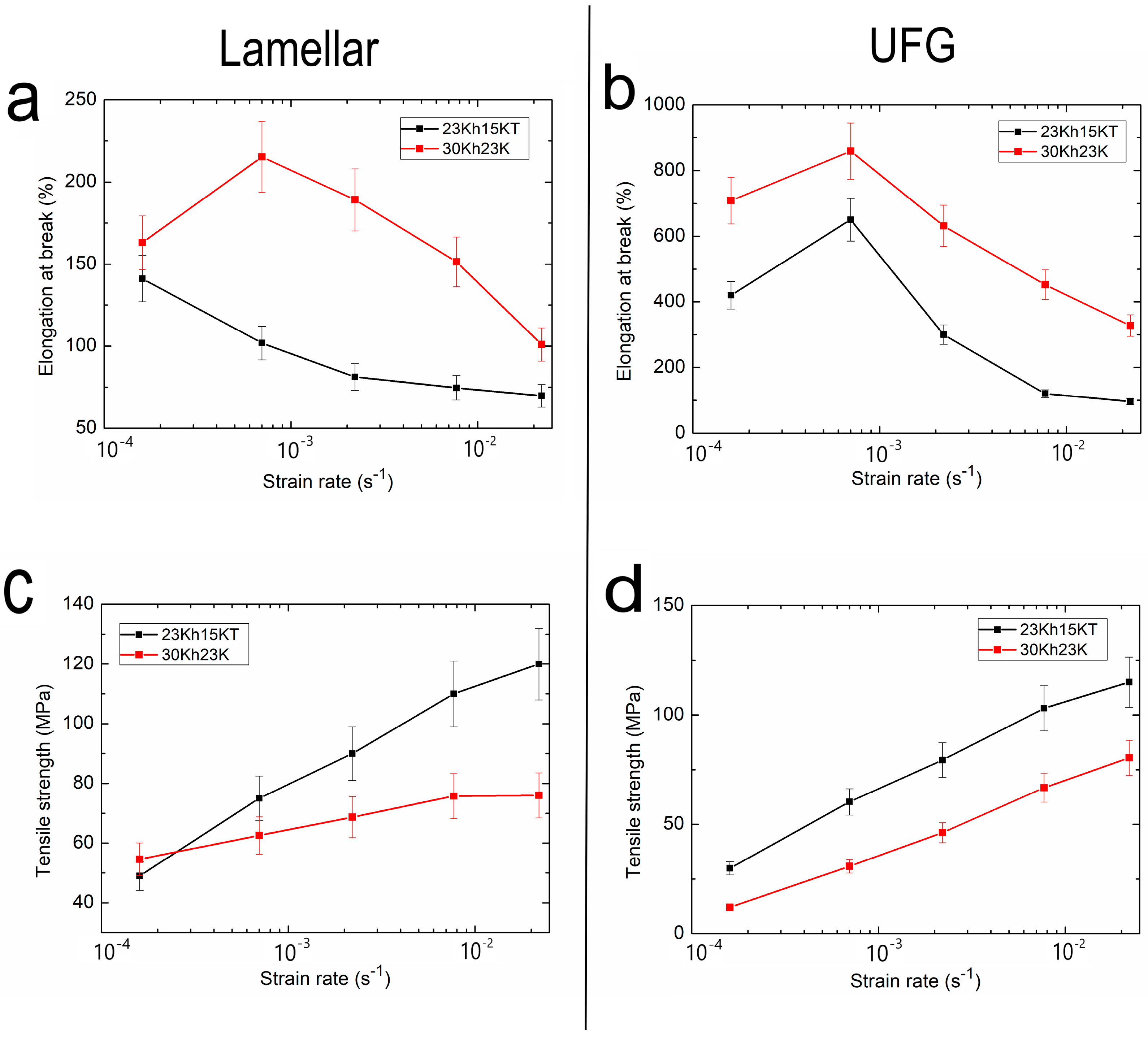
Another characteristic feature of superplastic deformation is the sharp dependence of the flow stress and elongation at break on the strain rate. Significant differences in the properties of alloys with fine-grained and lamellar structures are also revealed by comparing the flow stress rate dependence (Figure 6). In the case of an ultrafine-grained structure, the flow-stress–strain-rate dependence has a characteristic sigmoidal shape with a pronounced region of increased flow stress rate sensitivity, corresponding to the maximum values of the relative elongation at break δ and the flow stress rate sensitivity coefficient m in both the 23Kh15KT alloy and the 30Kh23K alloy (Figure 6b).
Figure 6.
Effect of strain rate on elongation at break (a,b) and flow stress (c,d) of 23Kh15KT alloys under tension at 900 °C and 30Kh23K alloys under tension at 950 °C for lamellar (left) and UFG (right) structures.
The maximum elongation in the 23Kh15KT alloy with an ultrafine-grained structure was 640% at T = 900 °C and a strain rate of 1.6 × 10⁻³ s−1. When the strain rate was increased to 1.6 × 10⁻² s−1 or decreased to 1.6 × 10⁻⁴ s−1, elongation at break decreased to 105% and 440%, respectively.
4. Discussion
4.1. Velocity Sensitivity Coefficient of Flow Stress
Measurements of the flow-stress rate sensitivity coefficient m in the 23Kh15KT alloy at the temperature of maximum elongation (900 °C) showed that, for the fine-grained state, m exhibits an extremum as a function of strain rate, whereas in the alloy with a lamellar structure (at 50% strain) it changes linearly with strain rate. Over the strain range of 20–100%, m for the fine-grained state varies only slightly and is about 0.43, while for the lamellar state at 50% strain, it is 0.12.
In the higher alloyed 30Kh23K, measurements of the strain rate sensitivity coefficient m in tension at the temperature of maximum elongation (950 °C) likewise revealed an extremum of m as a function of strain rate for the fine-grained state. Within 20–100% strain, m in this state changes only slightly and is about 0.47, whereas for the lamellar state, it increases from 0.21 at 20% strain to 0.42 at 150%. This is supported by the fact that the temperature and strain rate dependences of the flow stress, as well as the strain rate dependence of m, differ by no more than 5% in absolute value between these states.
4.2. Structural Changes During Superplastic Deformation
The high strain-rate sensitivity values (m ≈ 0.4–0.5) and the observed subgrain-boundary development (Figure 3) are consistent with grain-boundary-sliding (GBS)-mediated deformation, accommodated by intragranular dislocation processes and possibly dynamic recrystallization. The globular microduplex morphology provides a favorable structural condition for such deformation by improving geometric compatibility between the phases and maintaining stable phase boundaries, whereas the lamellar structure promotes strain incompatibility and local stress concentrations at sharp phase interfaces, thereby impeding GBS.
The dominant structural change during superplastic deformation of the 23Kh15KT and 30Kh23K alloys with an ultrafine-grained structure is a moderate growth of the α, γ, and σ grains, whereas in alloys with an initial lamellar morphology, the key process is the transformation of this lamellar structure into a globular one. Earlier microstructural studies of the 30Kh23K alloy with an initial lamellar γ+σ structure showed that, at the early stages of superplastic deformation, transverse sub-boundaries form within the γ- and σ- lamellae; where these sub-boundaries intersect the interphase boundaries, they promote spheroidization of the γ- and σ- lamellae [41].
With increasing strain up to 100%, fragmentation of the lamellae was completed, and the microstructure contained only globular γ and σ grains. The initial fine lamellar structure, with average linear dimensions of 3.7 and 1.4 µm, transformed after 40% compression at 950 °C and a strain rate of 1.6 × 10⁻³ s−1 into a globular polyhedral structure, in which the average γ and σ grain size was 2.6 µm. Raising the strain to 70% did not cause further growth of the γ and σ phases. At 100% strain, more than 40% of the γ phase had acquired a globular morphology. These structural changes are characteristic of superplastic materials.
The present results show that the high-temperature deformation behavior of Fe–Cr–Co alloys is controlled not only by grain refinement, but also by phase morphology. The globular ultrafine-grained microduplex structure provides geometric compatibility between neighboring phases and promotes grain-boundary and interphase-boundary sliding, whereas elongated lamellae introduce strain incompatibility and stress concentration at phase interfaces. Therefore, the lamellar morphology promotes strain hardening, while the globular structure enables stable superplastic flow.
This behavior is consistent with observations in duplex stainless steels, Fe–Mn–Al steels, and two-phase titanium alloys, where a fine equiaxed multiphase structure is a key prerequisite for superplasticity [31,32,33,34,35,36,37,38]. In these systems, grain-boundary sliding is generally accommodated by intragranular dislocation processes; grain rotation, diffusion; and, potentially, dynamic recrystallization. The high strain rate sensitivity of the present globular states, m ≈ 0.43–0.47, supports GBS-mediated deformation; however, the relative contributions of dislocation climb, grain rotation, and dynamic recrystallization cannot be quantitatively separated from the available microstructural evidence.
The different behavior of the two alloys also emphasizes the role of morphology. In 23Kh15KT, only partial fragmentation and spheroidization of the lamellae occur, and the material retains a strain-hardening response. In contrast, the γ/σ lamellae in 30Kh23K transform into a globular microduplex structure, enabling superplastic flow. Thus, the σ phase is not intrinsically detrimental: coarse continuous σ lamellae can promote stress concentration, whereas a refined globular σ-containing structure may stabilize grain boundaries, similarly to carbides or retained γ phase in other superplastic multiphase steels.
5. Conclusions
- It was established that both 23Kh15KT and 30Kh23K alloys with an ultrafine-grained (UFG) globular microduplex structure exhibit features characteristic of superplastic deformation during high-temperature tensile testing. The most favorable tensile response was observed at 900 °C for 23Kh15KT and at 950 °C for 30Kh23K, within the investigated strain-rate range of 1.6 × 10⁻⁴ to 1.6 × 10⁻² s−1. The UFG globular states showed high elongation to failure and increased strain-rate sensitivity, with m values of approximately 0.43 for 23Kh15KT and 0.47 for 30Kh23K. Complementary compression experiments were used to examine microstructural evolution and revealed progressive fragmentation and spheroidization of the lamellar morphology at elevated temperatures.
- Mechanical test results analysis for the 23Kh15KT and 30Kh23K alloys with an initial lamellar structure showed a fundamental difference in their mechanical behaviour. In the 23Kh15KT alloy, deformation is accompanied by strain hardening, whereas in the 30Kh23K alloy, after a sharp hardening up to about 10% strain, the flow stress gradually decreases to the level characteristic of the ultrafine-grained state, and the deformation acquires features of superplastic flow, manifested in an increase in the strain rate sensitivity coefficient m from 0.21 to 0.47 as the strain increases from 10 to 120%.
- Structural analysis after deformation in the temperature–strain-rate range corresponding to superplasticity showed that, in the 23Kh15KT alloy with an initial lamellar (α+γ) structure, partial fragmentation and spheroidization of the γ-lamellae occur. By contrast, in the 30Kh23K alloy with a lamellar (σ+γ) structure, this morphology is completely transformed into an equiaxed grain structure. The main structural change during superplastic deformation of the 23Kh15KT and 30Kh23K alloys with an ultrafine-grained structure is a certain growth of the α, γ, and σ grains.
Funding
Study was supported by Ministry of Science and Higher Education of Russian Federation (state assignment of IMSP RAS).
Data Availability Statement
The original contributions presented in this study are included in the article. Further inquiries can be directed to the corresponding author.
Conflicts of Interest
The author declares no conflicts of interest.
References
- Zeng, G.; Wu, L.; Wang, T.; Zhao, D. Comprehensive Review of Permanent Magnet Actuator for High and Medium Voltage Circuit Breakers Application: Design, Optimization and Control. Results Eng. 2025, 28, 107776. [Google Scholar] [CrossRef] [Scilit]
- Guo, H.; He, X.; Xu, J.; Tian, W.; Ding, X.; Ju, L.; Li, D. Design and Analysis of a Novel Hybrid Cooling Method of High-Speed High-Power Permanent Magnet Assisted Synchronous Reluctance Starter/Generator in Aviation Applications. Chin. J. Aeronaut. 2023, 36, 285–302. [Google Scholar] [CrossRef] [Scilit]
- Pirzad, S.; Ghadimi, A.A.; Abolmasoumi, A.H.; Jabbari, A.; Bagheri, S. Optimal Mixed Control of Axial Flux Permanent Magnet Synchronous Generator Wind Turbines with Modular Stator Structure. ISA Trans. 2021, 115, 153–162. [Google Scholar] [CrossRef] [Scilit] [PubMed]
- Zheng, D.; Xu, X.; Wei, D.; Zheng, G.; Qi, Z.; Chen, Y.; Chen, G. Mechanical and Magnetic Properties of Soft Magnetic High-Entropy Alloys Based on Nano-Precipitation Regulation. Mater. Sci. Eng. A 2026, 972, 150561. [Google Scholar] [CrossRef] [Scilit]
- Li, H.; He, Y.; Wei, Y.; Qin, B.; Lu, J. Study on Magnetically Controlled Mechanical Properties and Polishing Performance of Magnetorheological Elastomer Polishing Pads for Single-Crystal SiC. Diam. Relat. Mater. 2026, 167, 113851. [Google Scholar] [CrossRef] [Scilit]
- Lv, Z.; Liu, W.; Huang, Z.; Wang, L.; Yuan, H.; Liu, Y.; Zhang, X.; Su, H. Tailoring Mechanical and Magnetic Properties of Fe-Si-Al Soft Magnetic Composites by Pre-annealing: Role of DO3 Ordered Phase. Mater. Today Commun. 2026, 54, 115629. [Google Scholar] [CrossRef] [Scilit]
- Liu, C.; Li, Z.; Zhu, X.; Chen, H.; Wang, R.; Li, H.; Zhang, H.; Sun, W.; Lan, H.; Peng, Z. Direct Ink Writing 3D Printing of Special-Shaped Permanent Magnets via Room Temperature Fast-Curing NdFeB Slurry. Addit. Manuf. Front. 2025, 4, 200210. [Google Scholar] [CrossRef] [Scilit]
- Huang, P.; Zhang, G.; Chen, Z.; He, X.; Lu, Q.; Huang, Y.; Jiao, H.; Feng, T.; Long, Y. Mechanisms of Hot–Cold Thermal Balance Control in Water-Jet-Guided Laser Machining of NdFeB Permanent Magnets. Opt. Laser Technol. 2026, 198, 114879. [Google Scholar] [CrossRef] [Scilit]
- Chen, W.; Zhang, L.; Wu, D.; Jiang, C.; Zeng, S.; Yang, X.; Zeng, S.; Yu, J. Corrosion Resistance, Mechanical and Magnetic Properties of Cold-Sprayed Al Coating on the Sintered NdFeB Magnet after Heat Treatment. J. Magn. Magn. Mater. 2025, 629, 173265. [Google Scholar] [CrossRef] [Scilit]
- Huang, C.-C.; Mo, C.-C. Vacuum Processing Temperature Effect on Highly Coercive Recycled NdFeB Permanent Magnets with Pr-Based Alloy Addition. Mater. Chem. Phys. 2024, 325, 129648. [Google Scholar] [CrossRef] [Scilit]
- Mo, C.-C.; Kuan, C.-C.; Wang, Y.-H.; Lu, Y.-S.; Chang, T.-W.; Liao, W.-Y.; Fang, T.-H.; Tsai, M.-C.; Huang, C.-C. Effect of NdCoGa Alloy Addition to Waste Wind Turbine Magnets to Enhance the Characteristics of Recycled Sintered NdFeB Permanent Magnets. J. Magn. Magn. Mater. 2023, 578, 170808. [Google Scholar] [CrossRef] [Scilit]
- Li, L.; Yang, G.; Li, J. Probabilistic Life Calculation Method of NdFeB Based on Brittle FatigueDamage Model. Comput. Model. Eng. Sci. 2020, 124, 865–884. [Google Scholar] [CrossRef] [Scilit]
- Hioki, K. Development of High-Performance Hot-Deformed Neodymium–Iron–Boron Magnets without Heavy Rare-Earth Elements. Materials 2023, 16, 6581. [Google Scholar] [CrossRef] [Scilit] [PubMed]
- Handy-Cardenas, L.F.; Elbakhshwan, M.; Choi, H.; Anderson, M. Corrosion of Magnetic Bearing SmCo and FeCo Alloys in Molten FLiNaK Salt. Mater. Lett. 2025, 389, 138396. [Google Scholar] [CrossRef] [Scilit]
- Xu, X.; Wang, Z.; Liu, W.; Xu, L.; Liu, L.; Liu, Y.; Guo, Z.; Li, Y.; Li, Y.; Yue, M. Heterogeneous SmCo5/Sm2Co7 Nanocomposites: A Facile Strategy to Strong c-Axis Texture and High Coercivity. Mater. Charact. 2025, 230, 115702. [Google Scholar] [CrossRef] [Scilit]
- Kou, X.C. Coercivity of SmFeN Permanent Magnets Produced by Various Techniques. J. Alloys Compd. 1998, 281, 41–45. [Google Scholar] [CrossRef] [Scilit]
- Zhang, H.; Liu, C.; Zhang, Q.; Lu, T.; Huang, Z.; Li, N.; Ma, C. The Effects of Phase Interfaces in SmFeN/YSZ Composite Thermal Barrier Materials on Electromagnetic Wave-Absorbing Properties. Ceram. Int. 2024, 50, 27586–27595. [Google Scholar] [CrossRef] [Scilit]
- Hu, T.; Liu, L.; Yu, X.; Zhao, J.; Yu, X.; Sun, Y.; Ding, Y.; Yan, A. Positive Temperature Coefficient of Magnetization in AlNiCo Magnets with Dy/Gd/Er Addition. J. Alloys Compd. 2026, 1057, 186943. [Google Scholar] [CrossRef] [Scilit]
- He, Y.; Zhang, H.; Su, H.; Shen, P.; Hou, Y.; Zhou, D. In Situ Alloying of Fe-Cr-Co Permanent Magnet by Selective Laser Melting of Elemental Iron, Chromium and Cobalt Mixed Powders. Metals 2022, 12, 1634. [Google Scholar] [CrossRef] [Scilit]
- Sun, X.Y.; Xu, C.Y.; Zhen, L.; Gao, R.S.; Xu, R.G. Microstructure and Magnetic Properties of Fe–25Cr–12Co–1Si Alloy Thermo-Magnetically Treated in Intense Magnetic Field. J. Magn. Magn. Mater. 2004, 283, 231–237. [Google Scholar] [CrossRef] [Scilit]
- Haider, A.; Khan, M.A.; Jaffery, S.H.I.; Faraz, M.I.; Jameel, M.; Petru, J.; Saydaxmetova, S. Design and Development of Thermo-Electromagnetic System for Spinodal Decompositions of FeCrCo Alloys. J. Mater. Res. Technol. 2024, 32, 1000–1010. [Google Scholar] [CrossRef] [Scilit]
- Okada, M. Microstructure and Magnetic Properties of Spinodal Fe–Cr–Co Alloys; LBL-7668, 6627188; California University: Berkeley, CA, USA, 1978; 176p. [Google Scholar]
- Korneva, A.; Korznikova, G.; Kashaev, R.; Straumal, B. Microstructure Evolution and Some Properties of Hard Magnetic FeCr30Co8 Alloy Subjected to Torsion Combined with Tension. Materials 2019, 12, 3019. [Google Scholar] [CrossRef] [Scilit] [PubMed]
- Arneitz, S.; Bin Ali, W.; Adachi, S.; Horii, S.; Sommitsch, C. Additive Manufacturing of Fe–Cr–Co Magnet Structures with a Functionally Graded Chemical Composition. Prog. Addit. Manuf. 2026, 11, 1187–1201. [Google Scholar] [CrossRef] [Scilit]
- Zhukov, A.S.; Barakhtin, B.K.; Kamynin, A.V.; Gavrikov, I.S.; Kuznetsov, P.A. Features of Structure-Sensitive Hard Magnetic Alloy Fe–25 Wt. % Cr–15 Wt. % Co Manufactured by Laser Powder Bed Fusion. Procedia CIRP 2020, 94, 243–247. [Google Scholar] [CrossRef] [Scilit]
- Gu, H.; Xu, Y.; Liang, Z.; Lu, X.; Dai, G.; Li, G.; Zhang, J.; Li, B.; Sun, Z. Laser-Directed Energy Deposition of WC/FeCrCo Shell-Mimetic Laminated Structure for Enhanced Wear Resistance. J. Mater. Res. Technol. 2026, 42, 9468–9480. [Google Scholar] [CrossRef] [Scilit]
- Korznikova, G.F.; Korneva, A.V.; Korznikova, E.A. Gradient Microstructure of Fe-Cr-Co Based Hard Magnetic Alloy Subjected to Complex Loading. Mater. Lett. 2021, 303, 130320. [Google Scholar] [CrossRef] [Scilit]
- Arneitz, S.; Buzolin, R.; Rivoirard, S.; Sommitsch, C. Additive Manufacturing of an Fe–Cr–Co Permanent Magnet Alloy with a Novel Approach of in-Situ Alloying. Eur. J. Mater. 2022, 2, 475–497. [Google Scholar] [CrossRef] [Scilit]
- Zhao, D.; Xu, X.L.; Cao, Y.; Zhai, M.Y.; Lu, S.; Kang, P.; Liu, J.T.; Yang, X.Y.; Zuo, M.G.; Liu, C.Y.; et al. Improving Magnetic Properties of FeCrCo Films by Facilitating the Internal α-γ Phase Transition through Pt Diffusion. Acta Mater. 2025, 282, 120469. [Google Scholar] [CrossRef] [Scilit]
- Belozerov, E.V.; Shchegoleva, N.N.; Ivanova, G.V.; Mushnikov, N.V. Features of the Post-Deformation Hardening of Fe-Cr-Co Hard Magnetic Alloys with W and Ga Additives. Solid State Phenom. 2009, 152–153, 54–57. [Google Scholar] [CrossRef] [Scilit]
- Sagradi, M.; Pulino-Sagradi, D.; Medrano, R.E. The Effect of the Microstructure on the Superplasticity of a Duplex Stainless Steel. Acta Mater. 1998, 46, 3857–3862. [Google Scholar] [CrossRef] [Scilit]
- Mirzadeh, H. Superplasticity of Fine-Grained Austenitic Stainless Steels: A Review. J. Ultrafine Grained Nanostruct. Mater. 2023, 56, 27–41. [Google Scholar]
- Xu, C.; Furukawa, M.; Horita, Z.; Langdon, T.G. Achieving a Superplastic Forming Capability through Severe Plastic Deformation. In Nanomaterials by Severe Plastic Deformation; Zehetbauer, M., Valiev, R.Z., Eds.; Wiley: Hoboken, NJ, USA, 2004; pp. 699–710. [Google Scholar]
- Langdon, T.G. Seventy-Five Years of Superplasticity: Historic Developments and New Opportunities. J. Mater. Sci. 2009, 44, 5998–6010. [Google Scholar] [CrossRef] [Scilit]
- Han, J.; Kang, S.-H.; Lee, S.-J.; Kawasaki, M.; Lee, H.-J.; Ponge, D.; Raabe, D.; Lee, Y.-K. Superplasticity in a Lean Fe-Mn-Al Steel. Nat. Commun. 2017, 8, 751, Erratum in Nat. Commun. 2018, 9, 197. [Google Scholar] [CrossRef] [Scilit] [PubMed]
- Hong, S.H.; Han, Y.S. Phenomena and Mechanism on Superplasticity of Duplex Stainless Steels. Met. Mater. 2000, 6, 161–167. [Google Scholar] [CrossRef] [Scilit]
- Dyakonov, G.S.; Stotskiy, A.G.; Modina, I.M.; Semenova, I.P. Superplastic Behavior and Microstructural Features of the VT6 Titanium Alloy with an Ultrafine-Grained Structure during Upsetting. Materials 2023, 16, 1439. [Google Scholar] [CrossRef] [Scilit] [PubMed]
- Dutta, A.; Mukherjee, A.K. New Constitutive Equation for Two-Phase Superplastic Titanium Alloys. Mater. Sci. Eng. A 1991, 138, 221–226. [Google Scholar] [CrossRef] [Scilit]
- ASTM E112-13; Standard Test Methods for Determining Average Grain Size. ASTM International: West Conshohocken, PA, USA, 2013.
- Valiev, R.Z.; Korznikov, A.V.; Stolyarov, V.V. Superplasticity of Fe-23%Cr-15%Co-1%Ti alloy for permanent magnets. Izv. Chernaya Metall. 1985, 11, 137–138. [Google Scholar]
- Korznikov, A.V. Structure, Magnetic and Mechanical Properties of Ferromagnetic Metals and Alloys Subjected to Severe Plastic Deformation. Doctoral Dissertation, IMSP RAS, Ufa, Russia, 2000. [Google Scholar]
- Korznikov, A.V.; Pakiela, Z.; Korznikova, G.F.; Kurzydlowski, K.J. The Superplasticity of Hard Magnetic Alloy Fe-23wt.%Co-30%Cr with Submicrocrystalline Structure. Solid State Phenom. 2005, 101–102, 69–72. [Google Scholar] [CrossRef] [Scilit]

Disclaimer/Publisher’s Note: The statements, opinions and data contained in all publications are solely those of the individual author(s) and contributor(s) and not of MDPI and/or the editor(s). MDPI and/or the editor(s) disclaim responsibility for any injury to people or property resulting from any ideas, methods, instructions or products referred to in the content. |
© 2026 by the author. Licensee MDPI, Basel, Switzerland. This article is an open access article distributed under the terms and conditions of the Creative Commons Attribution (CC BY) license.