


Abstract
High-entropy alloys (HEAs) and refractory high-entropy alloys (RHEAs) have received considerable attention as innovative reinforcements to replace traditional ceramics in lightweight matrices. However, understanding how different high-entropy systems interact under ultra-fast consolidation pathways remains an open challenge. This study compares conventional sintering (CS) and high-frequency induction hot sintering (HFIHS) in an Al-4.5Cu-1.5Mg matrix reinforced with AlCoCrFeNiTi (HEA) and WMoTaNbV (RHEA) particles at various concentrations, enabling a direct comparison of both reinforcement types under identical processing conditions. Results show that HFIHS achieves near-theoretical densification within minutes while restricting atomic mobility and precipitate coarsening through sustained pressure and short thermal exposure. Furthermore, the study observes a clear strengthening dependence on reinforcement content, with the HEA system exhibiting unexpectedly superior mechanical performance and load-bearing capacity compared to the RHEA. Finally, the correlations between ultra-fast sintering, phase evolution, and strengthening mechanisms are discussed, highlighting HFIHS as a promising route for developing high-strength lightweight composites.
1. Introduction
Aluminum has been fundamental throughout history and has become a strategic material because of its low density, excellent conductivity, and versatility. In this evolution, the Al–Cu–Mg system has become a pillar of the aerospace industry because of its high strength-to-weight ratio; however, improving its hardness and thermal stability remains a challenge [1]. Although traditional ceramic reinforcements are common, they often exhibit low interfacial compatibility with the metallic matrix.
Ceramic particulates such as silicon carbide (SiC), alumina (Al2O3), boron carbide (B4C), and titanium diboride (TiB2) are widely used to reinforce aluminum matrices because of their high hardness and thermal stability. However, these ceramics have limited wettability with the metallic matrix, leading to interfacial voids and microcracks that drastically reduce ductility [1].
In contrast to ceramic particulates, metal-metal interfaces exhibit intrinsically superior wettability and interfacial adherence with the aluminum matrix, as both phases share metallic bonding character and comparable surface energies, promoting stronger interfacial cohesion and more effective load transfer [2]. Beyond this interfacial advantage, high-strength metallic reinforcements can additionally impart enhanced fracture toughness to the matrix—mitigating the strength-ductility trade-off characteristic of ceramic-reinforced composites—while also conferring improved corrosion resistance and other functional benefits inherent to a multi-principal-element solid-solution structure [3].
Alternatively, High-Entropy Alloys (HEAs) and Refractory High-Entropy Alloys (RHEAs) offer an innovative solution due to their high hardness and structural stability [4]. For this study, two specific systems were selected as reinforcing phases: the AlCoCrFeNiTi HEA, recognized for its ability to form solid solutions and high-hardness phases, and the WMoTaNbV RHEA, a system composed of high-melting-point metals that retain mechanical properties at extreme temperatures [5].
The HEA system AlCoCrFeNiTi predominantly exhibits a body-centered cubic (BCC) structure, along with intermetallic compounds, which collectively provide good creep and wear resistance [6]. In contrast, the RHEA system WMoTaNbV consists of a single-phase BCC crystal structure [7]. Due to its high melting point, this alloy exhibits outstanding thermal stability, making both systems ideal candidates to surpass the characteristics of ceramics.
High-Frequency induction hot sintering operates by applying a high-frequency alternating magnetic field. This magnetic field induces localized currents in the conductive material, resulting in rapid volumetric heating. For consolidating the Al–Cu–Mg composite reinforced with HEA and RHEA particles, this thermo-mechanical process allows the compact to reach the desired sintering temperature. By generating heat internally rather than relying on external thermal conduction, induction achieves ultra-fast heating rates, reducing the sintering cycle from hours to minutes. This drastic reduction in thermal exposure, combined with the sustained applied pressure, restricts atomic mobility and precipitate coarsening within the Al–Cu–Mg system, maintaining a refined microstructure.
This work evaluates the effect of reinforcing the Al-4.5Cu-1.5Mg system, selected to approximate the nominal composition of the commercial Al-2024 alloy used as reference in this study, with HEA and RHEA at concentrations of 1, 3, and 5 wt.%. A comparative analysis of the two sintering methods, applied to the same pair of reinforcing systems, assesses their impact on phase evolution and the composite’s final performance, an approach seldom addressed in the existing literature on high-entropy particle-reinforced aluminum composites.
This research represents a significant breakthrough in lightweight composite design by overcoming the poor interfacial compatibility inherent in ceramics. Incorporating high-entropy particles (AlCoCrFeNiTi and WMoTaNbV) consolidated via a still-scarcely-explored, ultra-fast electromagnetic induction route yields a highly bonded interface that optimizes load transfer and prevents microcrack formation. Consequently, this research offers a framework that connects phase evolution, ultra-fast sintering, and mechanical strengthening, opening new frontiers in manufacturing for aerospace components.
2. Materials and Methods
Composites based on an Al-4.5Cu-1.5Mg system and reinforced with multielement particles were synthesized via mechanical alloying. The raw materials consisted of high-purity elemental powders: aluminum (Al, 99.5%, ~44 µm), magnesium (Mg, 99.8%, ~44 µm), iron (Fe, 99%, ~74 µm), nickel (Ni, 99.9%, ~3–7 µm), titanium (Ti, 99.5%, ~74 µm), molybdenum (Mo, 99.7%, ~74 µm), and tantalum (Ta, 99.9%, ~44 µm), supplied by Alfa Aesar (Ward Hill, MA, USA). Copper (Cu, 99.5%, ~149 µm), cobalt (Co, 99.8%, ~2 µm), chromium (Cr, 99%, ~45 µm), tungsten (W, 99.99%, ~10 µm), niobium (Nb, 99.8%, ~45 µm), and vanadium (V, 99.9%, ~149 µm) were supplied by Sigma-Aldrich (St. Louis, MO, USA).
Al-4.5Cu-1.5Mg system powders were mechanically milled in a high-energy ball mill (SPEX 8000M Mixer/Mill, SPEX SamplePrep, Metuchen, NJ, USA) at its standard clamp speed of approximately 1060 cycles per minute for 5 h. Concurrently, the multielement reinforcing particles were processed separately by high-energy ball milling for 15 h to produce two distinct systems: an equiatomic AlCoCrFeNiTi high-entropy alloy (HEA) and an equiatomic WMoTaNbV refractory high-entropy alloy (RHEA). To prevent powder oxidation and atmospheric contamination during high-energy collisions, we maintained a controlled ultra-high-purity argon atmosphere in the milling containers for all three metallic systems. Mechanical alloying was performed using hardened steel vials and a mixture of 1/2″ and 7/16″ hardened steel grinding balls at a fixed ball-to-powder weight ratio (BPR) of 5:1. Additionally, methanol was used as a process control agent (PCA) in all milling runs to minimize cold welding and reduce excessive particle agglomeration. To prepare the composite mixtures, the pre-alloyed HEA and RHEA reinforcing powders were blended independently with the Al-4.5Cu-1.5Mg matrix. The reinforcing particles were incorporated at nominal concentrations of 1, 3, and 5 wt.%, with the base Al-4.5Cu-1.5Mg system making up the remaining balance of the mixture. Blending was carried out in the SPEX-8000M mill without grinding media for 30 min to ensure homogeneous distribution of the high-entropy particles within the aluminum matrix before sintering.
Following powder preparation, consolidation was carried out using two distinct sintering techniques to conduct a comparative analysis of densification and phase evolution:
- Conventional Sintering Route: The composite powder mixtures were initially cold-compacted uniaxially under a pressure of 887 MPa (corresponding to a load of 3 tons) for 3 min on both sides of the die. The green compacts were sintered at 400 °C for 3 h in a vacuum furnace.
- High-Frequency Induction Hot Sintering Route: The consolidation of the powder mixtures was conducted directly through a single-step thermo-mechanical process. The powders were heated at approximately 160 °C/min and sintered at 400 °C under a continuous uniaxial pressure of 591 MPa (corresponding to a load of 2 tons) for a total dwell time of 3 min using a power supply (Roy 1500, Fluke Electronics, Everett, WA, USA).
Microstructural and structural characterizations were performed systematically on both the synthesized powders and the consolidated bulk compacts. For the initial powder evaluation, 0.5 g samples were analyzed via X-ray Diffraction (XRD) using a Panalytical X’Pert diffractometer (Philips, Amsterdam, The Netherlands) equipped with Cu Kα radiation (λ = 1.5406 Å) over a 2θ range of 20° to 120°, using a step size of 0.016° and a dwell time of 1 s per step, to determine phase evolution and crystal structures. In contrast, separate powder batches were mounted on conductive bakelite for Scanning Electron Microscopy (SEM) using a Hitachi SU3500 microscope (Hitachi High-Technologies Corp., Tokyo, Japan) operated at 10 kV. Particle size distributions were determined from the SEM micrographs using ImageJ software (Version 1.54g, National Institutes of Health, Bethesda, MD, USA), measuring the equivalent circular diameter of a statistically representative particle population for each system.
After consolidation, the bulk density of the sintered compacts was determined experimentally using Archimedes’ principle in distilled water with a density determination kit (YDK01, Sartorius AG, Göttingen, Germany), in accordance with ASTM B962, ensuring reproducibility through triplicate measurements of each sample. For subsequent structural and microstructural characterization, the sintered specimens were mounted in bakelite, sequentially ground using silicon carbide papers from grit sizes #180 to #2000, and polished with 1 µm alumina to achieve a mirror-like finish. Finally, the samples were chemically etched using Keller’s reagent to reveal their microstructure. Phase identification and microstructural distribution were subsequently evaluated via SEM.
The mechanical performance of the consolidated specimens was evaluated through uniaxial compression tests at room temperature, following ASTM E9, using a universal testing machine (3400 Series Model 34TM, Instron, Norwood, MA, USA). Cylindrical specimens with a diameter of 6.5 mm and a height of 13.5 mm (height-to-diameter ratio of approximately 2) were tested. To ensure statistical reproducibility and validity, we tested 42 specimens (21 per sintering method), with three distinct samples per experimental condition. The testing matrix included the unreinforced base system and Al-4.5Cu-1.5Mg matrix composites reinforced with 1, 3, and 5 wt.% of the synthesized HEA and RHEA phases. Furthermore, Rockwell F hardness (60 kgf load) measurements were performed using a Rockwell hardness tester (Wilson Rockwell 574, Buehler, Lake Bluff, IL, USA)to complement the mechanical characterization.
3. Results
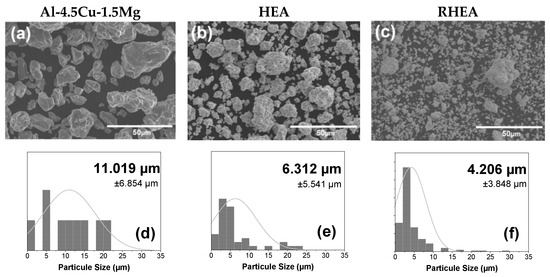
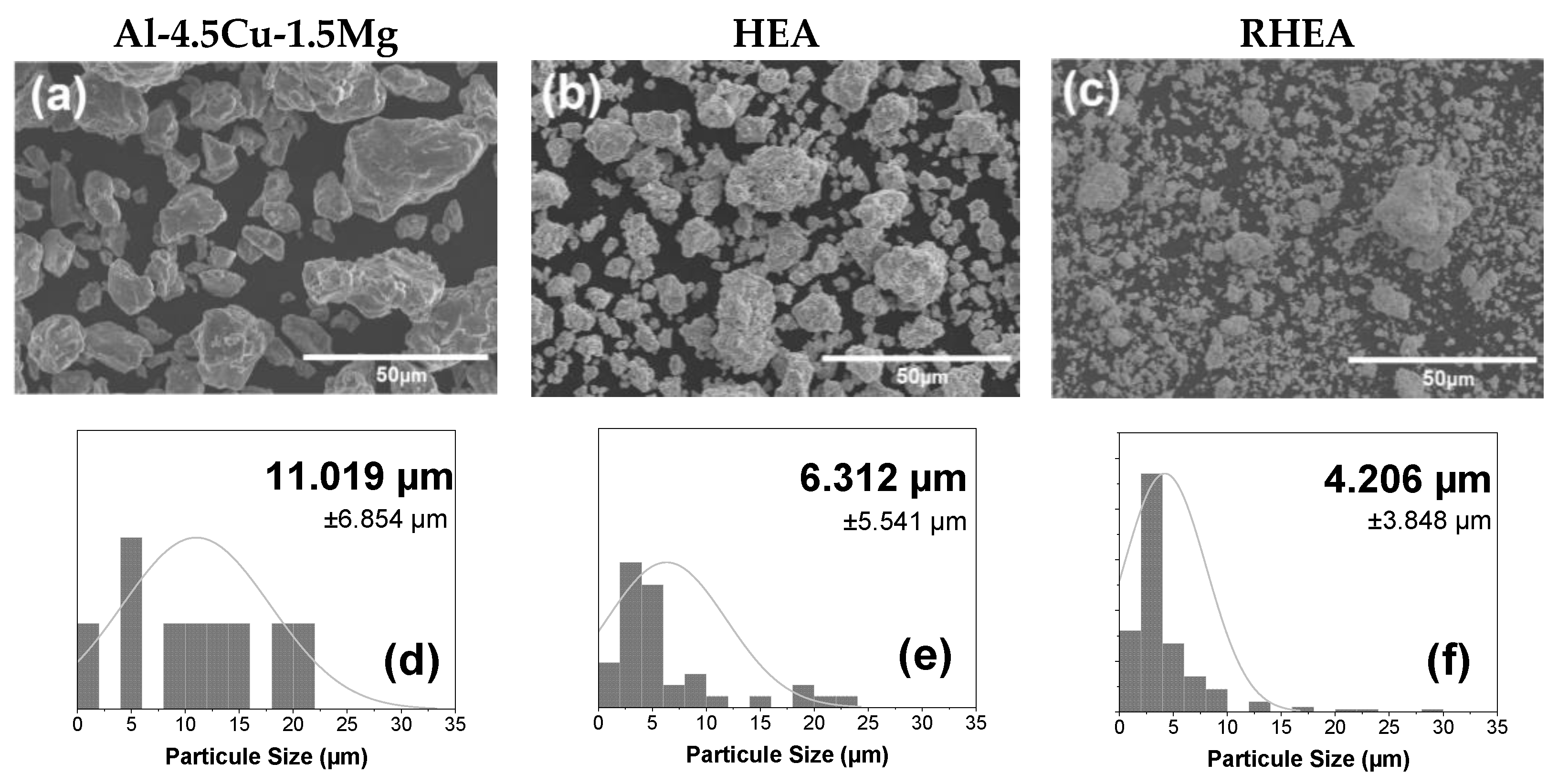
Figure 1 shows the morphology and cross-sectional elemental distributions of the Al-4.5Cu-1.5Mg system, AlCoCrFeNiTi HEA, and WMoTaNbV RHEA powders before their consolidation. The Al-4.5Cu-1.5Mg system (Figure 1a) exhibits a lamellar (flake-like) morphology, accompanied by a relatively broad particle size distribution (Figure 1d), mainly concentrated between 10 and 20 µm; in contrast, the synthesized AlCoCrFeNiTi HEA (Figure 1b) and WMoTaNbV RHEA (Figure 1c) powders demonstrate irregular, highly faceted topologies with pronounced surface roughness. The HEA exhibits a narrower, more homogeneous particle-size distribution (Figure 1e), centered between 1 and 10 µm, due to a balance between fracture and cold-welding cycles. In turn, the WMoTaNbV RHEA powder displays a remarkably refined distribution (Figure 1f), dominated by fine fragments (predominantly <8 µm) accompanied by loose agglomerates.
Figure 1.
Morphology and particle size distribution of the mechanically alloyed powders: (a–c) SEM images; (d–f) particle size distribution histograms of the Al-4.5Cu-1.5Mg system, AlCoCrFeNiTi HEA and WMoTaNbV RHEA powders.
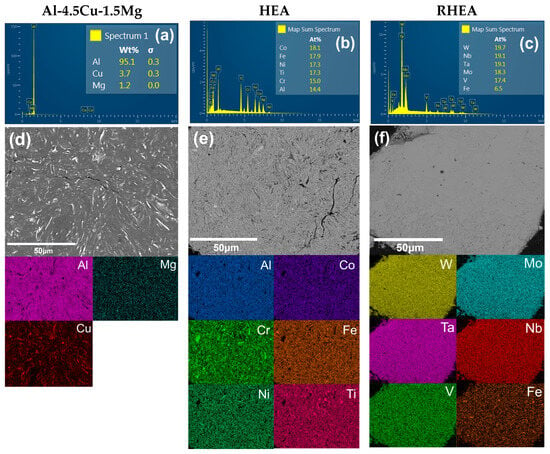
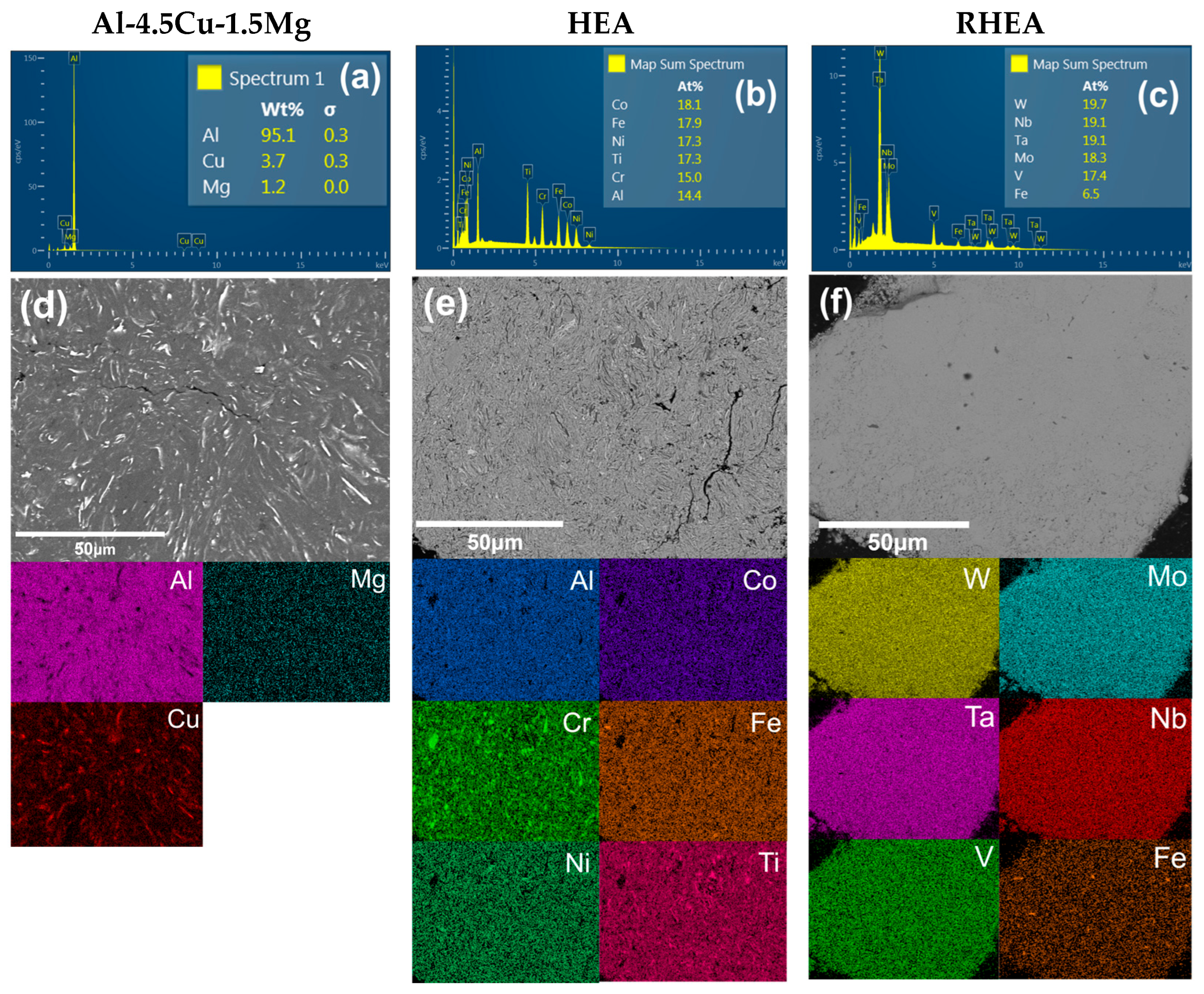
Quantitative EDS spectra (Figure 2a–c) confirmed the expected elemental compositions of the Al-4.5Cu-1.5Mg system, AlCoCrFeNiTi HEA, and WMoTaNbV RHEA powders. Complementary EDS elemental mapping (Figure 2d–f) shows a generally uniform distribution across the three particle types. However, localized microsegregations of copper (Cu) were identified in the aluminum matrix (Figure 2d), as well as chromium (Cr) and titanium (Ti) in the HEA (Figure 2e). Meanwhile, the RHEA particle exhibits an additional signal corresponding to iron (Fe) (Figure 2f).
Figure 2.
Cross-sectional elemental distribution and EDS analysis of the mechanically alloyed powders: (a–c) EDS spectra with quantitative elemental composition; (d–f) BSE images with EDS elemental maps of the Al-4.5Cu-1.5Mg system, AlCoCrFeNiTi HEA and WMoTaNbV RHEA powders.
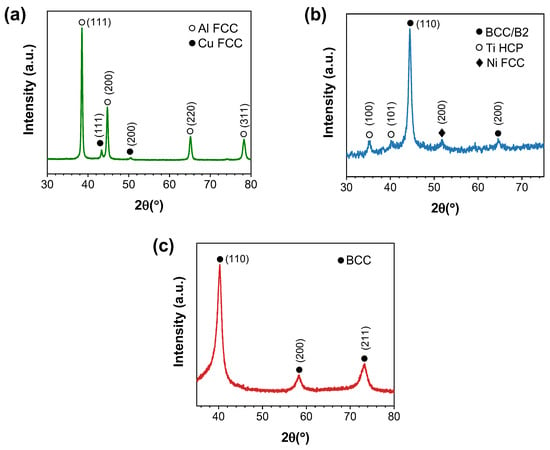
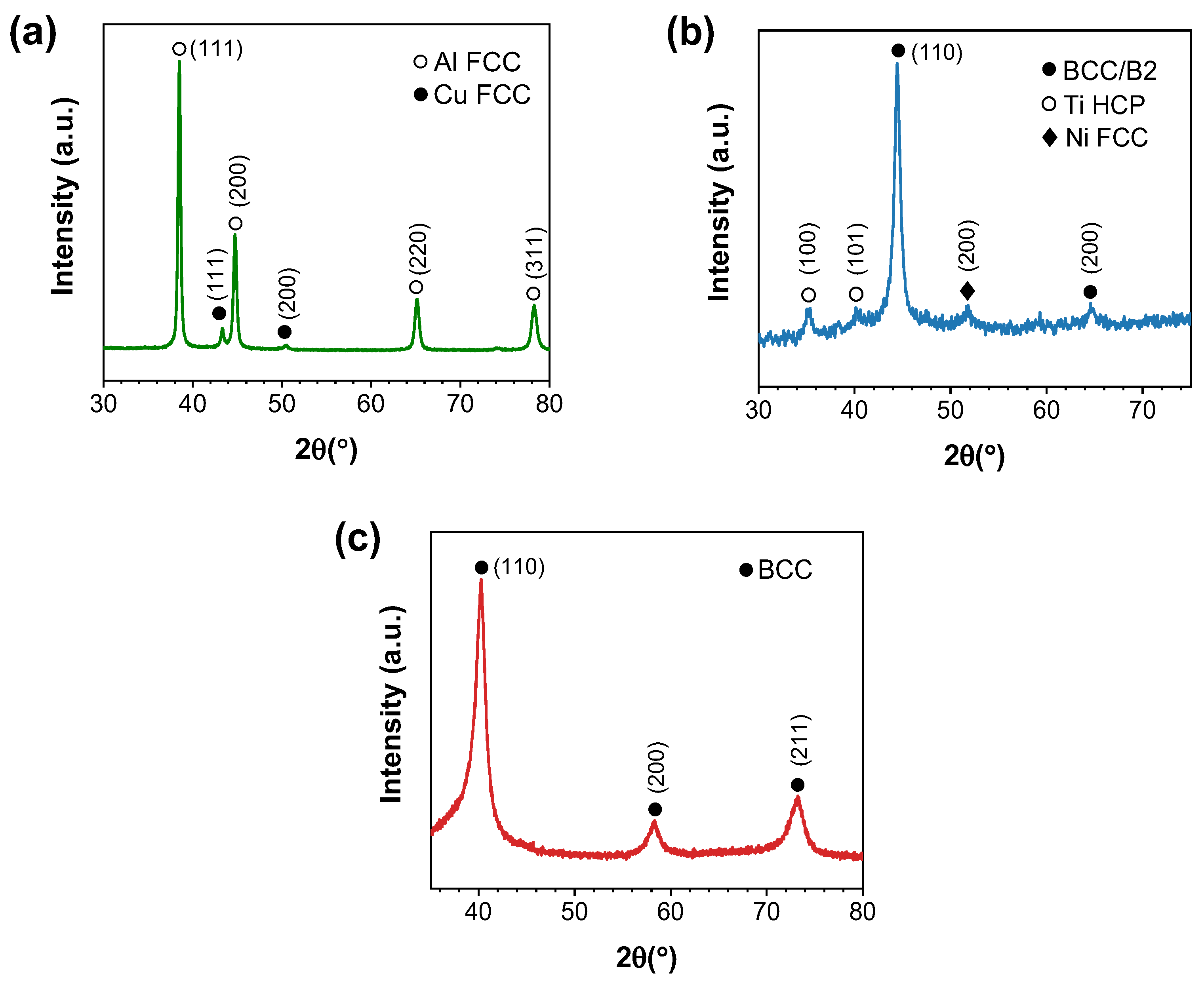
Figure 3 shows the X-ray diffraction (XRD) patterns obtained for the powders processed after mechanical alloying: the Al-4.5Cu-1.5Mg system (Figure 3a), the AlCoCrFeNiTi HEA (Figure 3b), and the WMoTaNbV RHEA (Figure 3c). In the Al-4.5Cu-1.5Mg system (Figure 3a), the characteristic diffraction peaks of the face centered cubic aluminum matrix (FCC) are observed at the (111), (200), (220), and (311) planes; likewise, lower-intensity peaks corresponding to Cu (111) and (200) are observed. For the AlCoCrFeNiTi HEA powder (Figure 3b), the pattern reveals reflections corresponding to a body-centered cubic phase (BCC), along with lower-intensity secondary signals (Ti, HCP) and a face-centered cubic phase (FCC). Meanwhile, the pattern of the WMoTaNbV RHEA (Figure 3c) exhibits the principal reflections of a single body-centered cubic (BCC) structure, with no isolated peaks from the individual starting refractory elements.
Figure 3.
X-ray diffraction of powders processed: (a) Al-4.5Cu-1.5Mg; (b) AlCoCrFeNiTi HEA; and (c) WMoTaNbV RHEA.
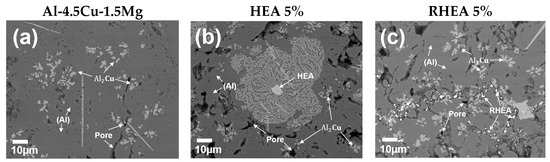
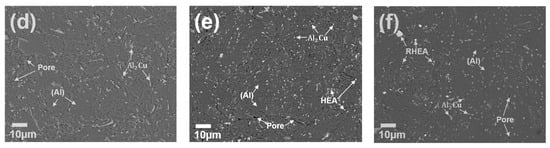
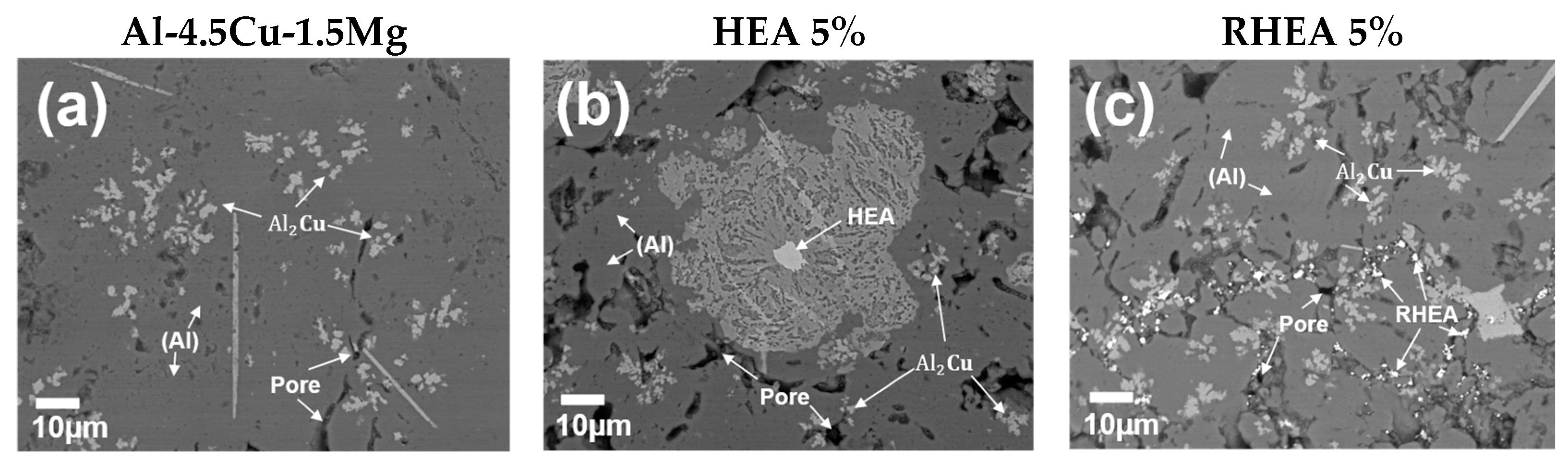
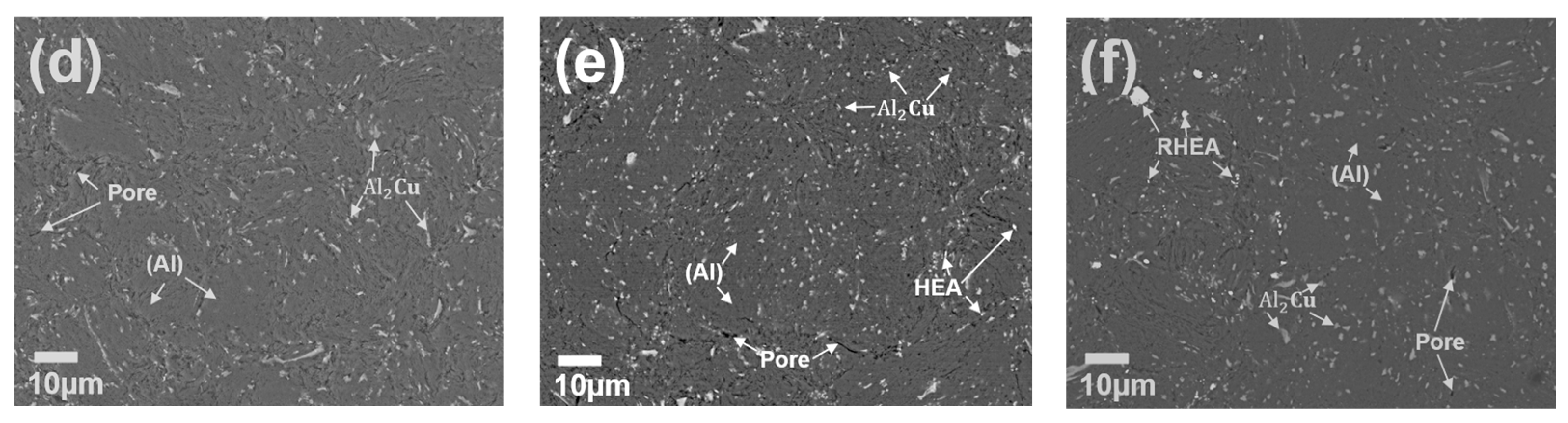
Figure 4 shows SEM micrographs of the sintered samples, allowing direct comparison of how the two sintering pathways (conventional and electromagnetic induction) affect the Al-4.5Cu-1.5Mg matrix and the distribution of the reinforcing particles (5% in this case).
Figure 4.
SEM micrographs of sintered samples: (a–c) Conventional method; (d–f) HFIHS method.
In conventional sintering (Figure 4a–c), the Al-4.5Cu-1.5Mg matrix exhibits a coarse-grained structure with significant porosity (dark regions). The HEA and RHEA particles (bright contrast) are unevenly distributed, with notable agglomerations in some areas. Fine precipitates of copper-rich intermetallic phases (Al2Cu) are observed along the grain boundaries.
In contrast, high-frequency induction hot sintering (HFIHS) (Figure 4d–f) produces a denser, more homogeneous microstructure. Porosity is drastically reduced, and the reinforcing particles are dispersed throughout the aluminum matrix, showing visibly good bonding. The ultra-fast heating suppresses excessive grain growth, maintaining a refined structure. The induction-sintered samples also exhibit a more uniform distribution of secondary phases, with fewer copper-rich agglomerates (Al2Cu).
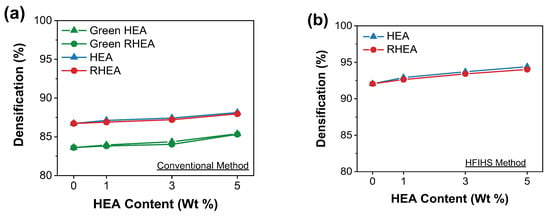
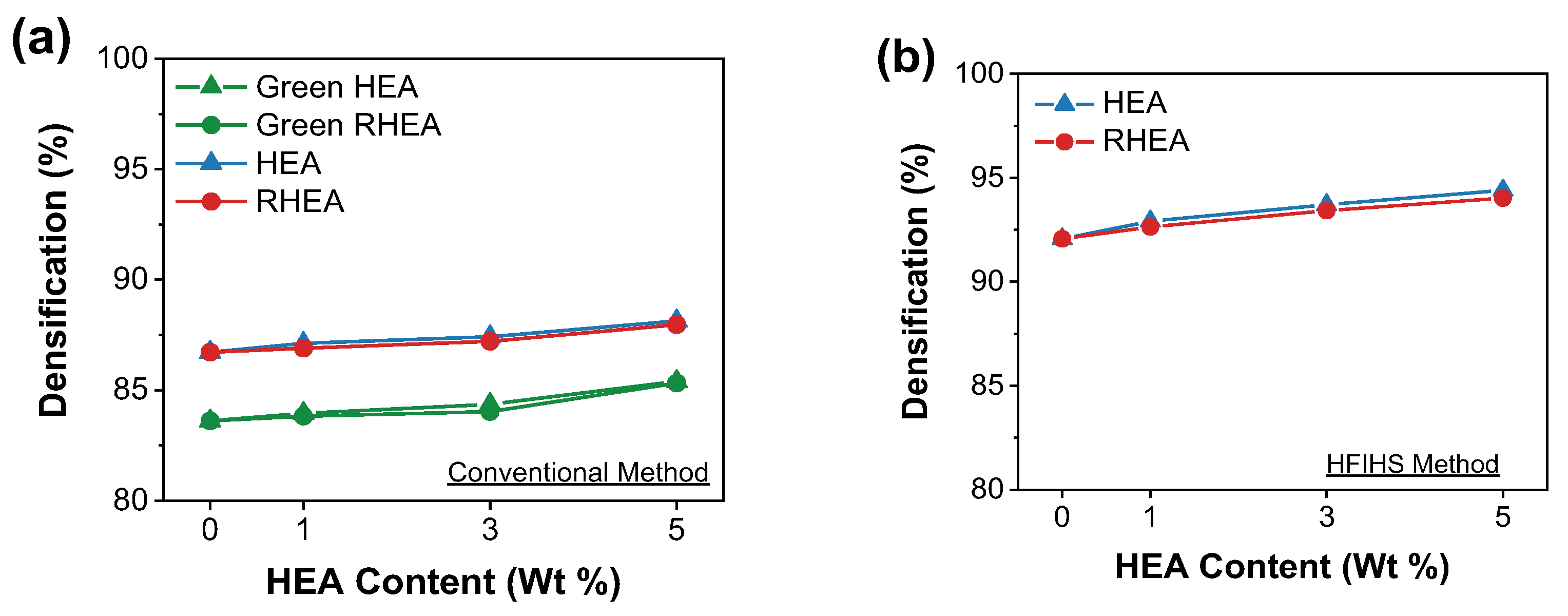
Figure 5 presents density results for the Al-4.5Cu-1.5Mg system with 1, 3, and 5 wt.% additions of high-entropy particles (HEA and RHEA), comparing the conventional and HFIHS methods.
Figure 5.
Densification of Al-4.5Cu-1.5Mg with 1, 3, and 5 wt.% reinforcement: (a) Conventional method; (b) HFIHS method.
Using the conventional method, densification remained consistently between 86 and 88% of the theoretical density across all reinforcement levels, including the unreinforced sample (Figure 5a).
In Figure 5b (HFIHS route), densification likewise remained consistently high across all conditions, exceeding 92% of the theoretical density regardless of reinforcement content or type. The absolute values are higher than those obtained by the conventional route.
When comparing both reinforcement types, for the same wt.% content and consolidation method, composites with HEA show a marginally higher densification than those reinforced with RHEA. Given the narrow margin between both systems, this behavior suggests that densification in this system is governed primarily by the applied sintering parameters (temperature, pressure, and dwell time) rather than by the specific reinforcement chemistry.
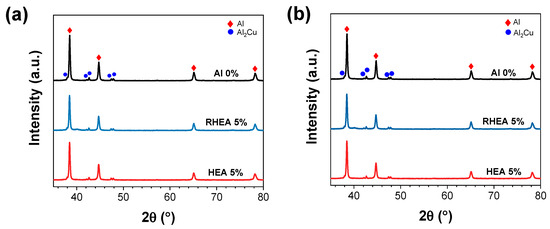
Figure 6 presents the X-ray diffraction (XRD) patterns of the Al-4.5Cu-1.5Mg base system and the composites reinforced with 5% of HEA AlCoCrFeNiTi HEA and WMoTaNbV RHEA consolidated by the conventional method (Figure 6a) and the HFIHS method (Figure 6b). Across all evaluated conditions, the predominant diffraction peaks correspond to the face-centered cubic (Al, FCC).
Figure 6.
X-ray diffraction of Al-4.5Cu-1.5Mg with 0 and 5 wt.% reinforcement: (a) Conventional method; (b) HFIHS method.
In the conventional route (Figure 6a), low-intensity secondary peaks corresponding to copper-rich intermetallic phases, mainly Al2Cu, formed during the prolonged sintering time (3 h), are detected. For the reinforcement particles, the characteristic diffraction peaks of their BCC (body-centered cubic) structures are not observed independently.
Likewise, in the HFIHS samples (Figure 6b), Al2Cu peaks are also present. Similarly, the reflections of the BCC phases of the reinforcements (HEA and RHEA) are not clearly distinguished.
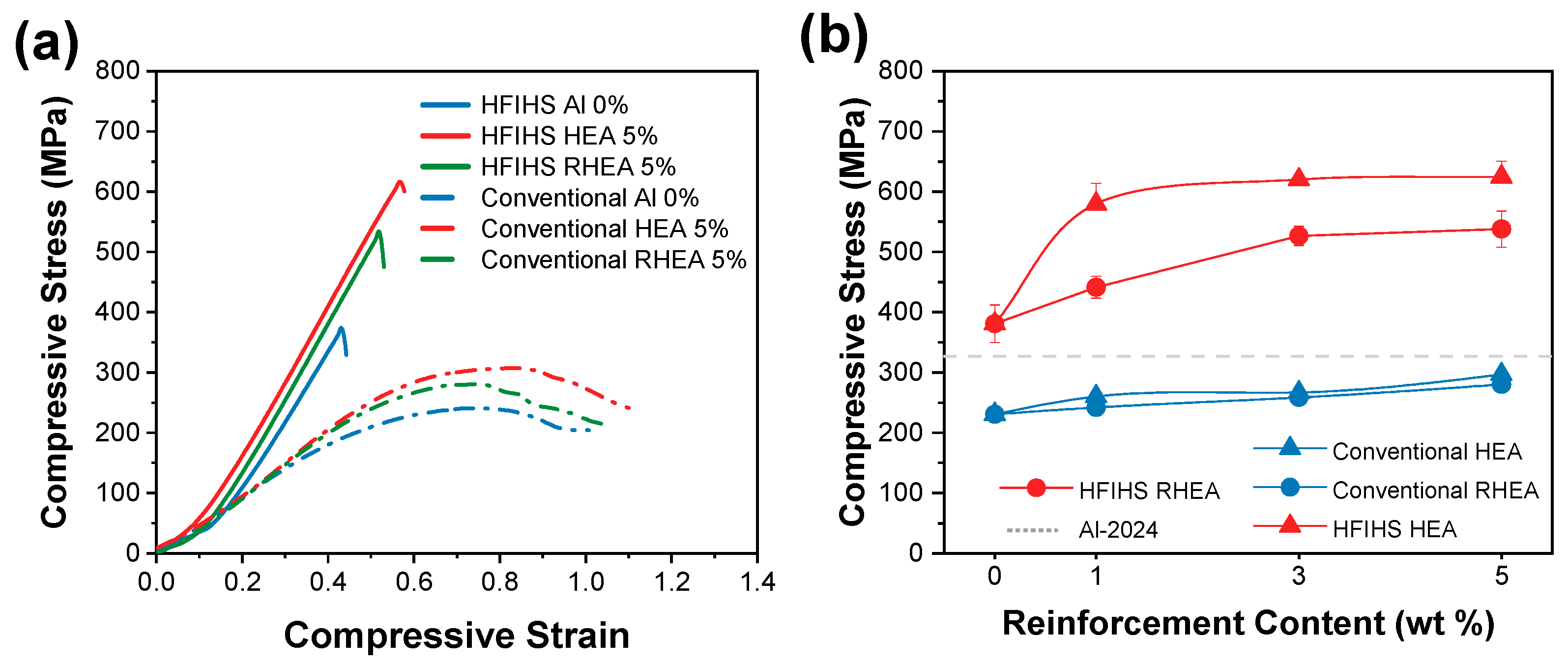
For the Al-4.5Cu-1.5Mg system reinforced with HEA and RHEA particles at 1%, 3%, and 5%, the mechanical strength clearly depends on reinforcement content. A comparative analysis of samples consolidated by both sintering routes shows that increasing high-entropy particle content promotes greater hardening (Figure 7b). This trend is even more evident in samples produced by the HFIHS method, which reach even higher strength levels (Figure 7a). Stress–strain curves from the conventional method for specimens with 0% and 5% reinforcement (Figure 7a) show that, although the samples have lower maximum compressive strength, they exhibit a plastic zone with a gradual decrease in load after reaching the yield strength point.
Figure 7.
(a) Representative compressive stress-strain curves; (b) Average value of compressive strength of Al-4.5Cu-1.5Mg with 1, 3, and 5 wt.% reinforcement by conventional and HFIHS methods.
Conversely, the compression graph for the same concentrations produced by the HFIHS method (Figure 7b) shows that, although consolidation raises the elastic limit and allows a higher maximum load, the material fails. After reaching the maximum compressive stress, the curve shows a pronounced, abrupt decrease in strength following the peak stress, almost eliminating a progressive plastic deformation stage.
A critical point in this study, which contrasts with the initial hypothesis, is the superior mechanical performance of the AlCoCrFeNiTi HEA-reinforced system. The composites incorporating the HEA exhibit a greater load-bearing capacity than those reinforced with WMoTaNbV RHEA under the same processing conditions.
Samples consolidated via conventional sintering show the same trend, with the HEA-reinforced composite demonstrating a higher peak stress than its RHEA-reinforced counterpart (Figure 7a).
To contextualize the mechanical performance of the developed composites, Figure 7b includes the compressive strength of the unreinforced condition (0 wt.% reinforcement), corresponding to the Al-4.5Cu-1.5Mg matrix fabricated in this work to approximate the composition of a 2024 aluminum alloy, for reference.
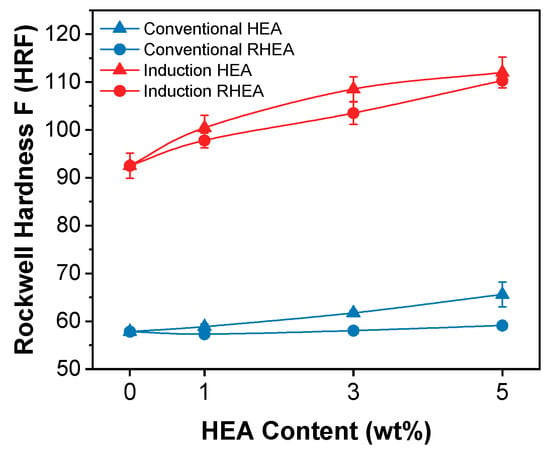
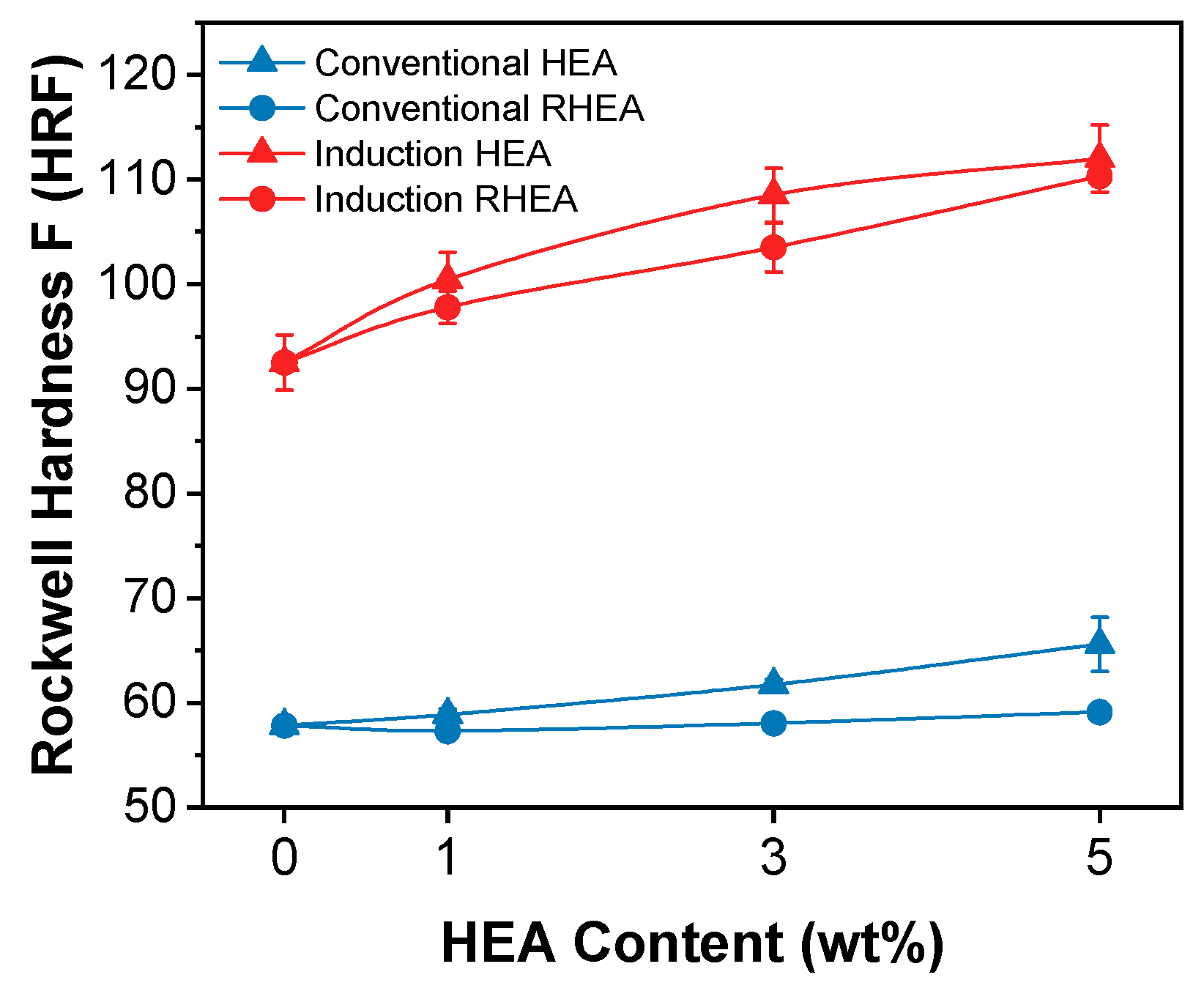
Figure 8 presents the Rockwell F hardness results for the Al-4.5Cu-1.5Mg system reinforced with AlCoCrFeNiTi HEA and WMoTaNbV RHEA particles at concentrations of 1, 3, and 5 wt.%, consolidated through conventional and HFIHS methods. This test provides a bulk hardness value for the composite and is less sensitive to local microstructural heterogeneity, such as individual precipitates and reinforcement particles. The results show a progressive increase in hardness as the high-entropy reinforcement percentage increases, for both reinforcement types and sintering methods.
Figure 8.
Rockwell F hardness of Al-4.5Cu-1.5Mg with 1, 3, and 5 wt.% reinforcement by conventional and HFIHS methods.
Under HFIHS, the unreinforced system reaches 92 HRF, while incorporating 5 wt.% HEA particles raises this value to a maximum of 113 HRF, exceeding the 110 HRF obtained with 5 wt.% RHEA.
Samples synthesized using the conventional method with 5 wt.% reinforcement exhibited Rockwell F hardness values of 99 HRF for HEA and 97 HRF for RHEA, compared with approximately 58 HRF for the unreinforced alloy. Despite this substantial increase relative to the unreinforced condition, these values remained lower than those obtained using HFIHS.
4. Discussion
The search for high-strength, lightweight materials in industry has been a priority and has driven new processing routes to overcome current limitations. The feasibility of reinforcing the Al-4.5Cu-1.5Mg alloy with high-entropy particles (AlCoCrFeNiTi HEA and WMoTaNbV RHEA) using two consolidation methods (conventional and HFIHS) was comprehensively evaluated. This investigation discusses the results in detail below.
In the powder processing stage, more specifically in Figure 1d–f, the competitive mechanisms of mechanical alloying are highlighted, specifically cold welding and repetitive fracture, which dictate the final powder morphology. The Al-4.5Cu-1.5Mg matrix (Figure 1d) exhibits a flake-like morphology. This morphological evolution is typical of ductile metallic matrices subjected to severe plastic deformation, microforging, and flattening during collisions with the grinding media, even though methanol was used as a process control agent (PCA) to minimize excessive agglomeration caused by cold welding [8]. For the AlCoCrFeNiTi HEA system, incorporating multiple principal elements (equiatomic) introduces significant lattice distortion, accelerating work hardening during 15 h of milling. Once dislocation density saturates, the material undergoes a ductile-to-brittle transition in which fracture dominates over cold welding, restricting particle growth and yielding refined fragments [9]. For the WMoTaNbV RHEA system (Figure 1f), the high elastic modulus and inherent brittleness of the body-centered cubic (BCC) structure of the refractory constituents lead to immediate high-energy micro-fragmentation during milling, resulting in particles that are even finer and more angular than those of AlCoCrFeNiTi HEA, along with high specific surface areas [10,11].
In the WMoTaNbV RHEA system, Fe is detected throughout the mapped particle. This Fe presence is well documented and results from abrasive wear during powder processing. During 15 h of milling (SPEX-8000M), the heavy, extremely hard refractory particles (specifically W and Ta) act as an abrasive medium against the walls and balls of the hardened steel vial. The energetic impacts induce micro-spalling of the steel media, leading to the mechanical entrapment of Fe into the refractory powder matrix [12]. This contamination effect is expected to manifest primarily within the refractory alloy itself rather than at the composite interface. Quantitative EDS analysis (Figure 2a–c) indicates an Fe content of approximately 6.5 at.% within the RHEA particles, consistent with values reported for comparable steel-media-derived contamination in other MoNbTaW-based RHEA systems [13]. Considering this incidental incorporation, the synthesized reinforcement is more accurately described as a (W-Mo-Ta-Nb-V)-Fe multi-principal-element refractory system; for consistency with the terminology used throughout this work, it is nonetheless still referred to as RHEA. Nevertheless, the specific influence of such incidental Fe contamination on the RHEA/Al interfacial region remains comparatively underexplored in the literature.
The XRD patterns of the milled powders (Figure 3) show the phase changes that occurred during mechanical alloying. For the Al-4.5Cu-1.5Mg base powder (Figure 3a), the main peaks match the FCC aluminum matrix, with small reflections corresponding to Al2Cu. The broadening of the aluminum peaks mainly results from grain refinement and internal strain from repeated high-energy impacts during milling. In the AlCoCrFeNiTi HEA powder (Figure 3b), milling successfully forms a BCC solid solution, with minor residual Ti and FCC peaks, indicating that 15 h of milling was sufficient to achieve good atomic mixing [6,9,14]. In contrast, the WMoTaNbV RHEA powder (Figure 2c) forms a single-phase BCC solid solution with no remaining individual peaks of the starting elements. This full dissolution is favored by the high solubility among the refractory metals [7,10].
Figure 3 presents scanning electron microscopy (SEM) micrographs of samples sintered via both routes (conventional and HFIHS), in which a significant number of dark regions associated with porosity is observed. This behavior is consistent with Gül B. [15], who observed that conventional sintering of Al composites for 40 min produces a microstructure with higher residual porosity than HFIHS [15]. Because conventional sintering relies exclusively on external thermal conduction over a prolonged 3-h period, the lack of sustained external pressure during heating limits the system’s ability to mitigate voids in the green compact. Furthermore, this extended thermal exposure promotes long-range atomic diffusion, resulting in grain coarsening within the aluminum matrix [15,16,17].
In contrast, the HFIHS samples show a much less porous microstructure, closer to the material’s theoretical density. Gül B. [15] demonstrated that the HFIHS method yields aluminum samples with densification comparable to the conventional route in just 5 min, instead of the 40 min required by the conventional method [15]. This phenomenon is attributed to the combined effect of pressure and ultra-fast induction heating. Maintaining a constant pressure throughout the process forces the material to fill voids as they collapse during the temperature rise due to thermal softening of the matrix. Koç M. [16] corroborate these findings, reporting that the HFIHS method with heating rates of 500 °C/min not only improves density but also prevents the formation of unwanted phases such as Al4C3 (in their case), which typically form during prolonged conventional methods [16]. The conventional samples show some particle agglomeration, which can create local stress concentrations and reduce reinforcement efficiency. By drastically reducing thermal exposure time, the HFIHS method minimizes particle segregation that can occur during the prolonged heating of the conventional route [18]. The drastic reduction in sintering time (from 3 h to just 3 min) is a critical factor explaining the observed differences.
The conventional method is a thermally activated, prolonged process that allows diffusion mechanisms to operate over extended periods, promoting grain growth and pore formation. In contrast, the HFIHS method generates heat internally through induced currents rather than relying on external thermal conduction, achieving ultra-fast heating rates that minimize excessive grain growth and maintain a refined microstructure. This behavior is consistent with previous studies on Al-2024 composites reinforced with high-entropy particles, where electromagnetic induction sintering has been shown to improve microhardness and wear resistance [18]. Regarding densification, the theoretical densities used to compute the relative values discussed above, aluminum (2.76 g/cm3), HEA (5.53 g/cm3), and RHEA (10.21 g/cm3), were obtained from the rule of mixtures based on their nominal elemental composition.
Similarly, the HFIHS method achieved higher densification (greater than 90%) in just 3 min at 400 °C, compared with the conventional route, which was processed at 400 °C for 3 h. This result is consistent with Koç M. [16], who reported improved density and mechanical properties for the HFIHS method compared to the conventional method [16].
Previous studies have reported that relative densification can be sensitive to reinforcement content in comparable systems, decreasing as HEA content increases because consolidating harder particles within the matrix is more difficult [19]. In this study, however, densification remained consistently high across all reinforcement levels within each sintering route, indicating that the sustained uniaxial pressure (591 MPa) maintained throughout the HFIHS cycle, coupled with the thermally softened aluminum matrix, is the dominant factor driving pore collapse and closure, rather than the reinforcement content itself. This is consistent with the well-bonded, void-free particle-matrix interfaces already observed in the SEM micrographs (Figure 4).
The XRD patterns of the sintered samples (Figure 6) illustrate the phases present after consolidation. In both sintering routes (Figure 6a,b), the presence of Al2Cu peaks confirms that atomic diffusion took place during processing, leading to the formation of this intermetallic phase regardless of the consolidation method. Although the nominal reinforcement content (5 wt.%) lies above the typical XRD detection limit, the characteristic BCC peaks of the HEA and RHEA reinforcements are not clearly resolved as separate reflections, likely due to the nanocrystalline, highly deformed nature of the milled high-entropy particles. Rather than a difference in phase presence, the effect of the restricted atomic mobility and applied pressure during HFIHS on precipitate growth is evidenced in the SEM micrographs (Figure 4), which show visibly coarser copper-rich precipitates in the conventionally sintered samples (Figure 4a–c) compared to the finer precipitates observed after the HFIHS method (Figure 4d–f). This behavior is consistent with the ultra-fast heating rate (~160 °C/min) and short holding time (3 min) inherent to HFIHS, which restrict atomic mobility during the thermal cycle, together with the continuous applied pressure (591 MPa), which further constrains precipitate coarsening [16,20].
In mechanical testing, both reinforcement types show clear strengthening relative to the unreinforced matrix, consistent with reports on comparable Al-HEA particulate composites [18]. This behavior is primarily attributed to HEA and RHEA particles acting as obstacles to dislocation motion, generating dispersion strengthening and to load transfer from the softer aluminum matrix to the stiffer reinforcing particles. Precipitation strengthening from the matrix’s own Al2Cu phase provides an additional, route-dependent contribution, consistent with the SEM observations discussed above (Figure 4); the finer and more homogeneously distributed Al2Cu precipitates formed under HFIHS strengthen the matrix more effectively than the coarser precipitates that form under the extended conventional cycle, where they are additionally observed to grow preferentially around the HEA reinforcement particles. These mechanisms act synergistically, as similarly reported for comparable high-entropy particle-reinforced aluminum matrix composites [21].
Looking more closely at the stress-strain curves, the conventionally sintered samples exhibit lower ultimate strength but show gradual plastic deformation until they reach their elastic limit. This behavior is attributed to the long sintering time (3 h), which promotes atomic diffusion and grain growth, resulting in a coarser microstructure that can accommodate greater plastic strain before fracture. Additionally, the absence of external pressure during conventional heating allows dislocation slip mechanisms to operate more effectively, contributing to the material’s deformation capacity [16,22]. Conversely, under the HFIHS method, once the material reaches its ultimate load, which is substantially higher than that of the conventional route, it yields and fails drastically, showing almost no progressive plastic deformation stage. This transition toward brittle failure stems from the short induction sintering time (3 min) and the applied pressure (591 MPa) inherent to this process, which together generate a microstructure with high dislocation density [16]. While this microstructure enhances mechanical strength, it restricts the material’s capacity to accommodate plastic deformation, leading to instantaneous failure once the peak load is exceeded [15].
Furthermore, the AlCoCrFeNiTi HEA-reinforced system exhibits superior mechanical performance compared to the refractory system. Given the substantial density difference between the two reinforcements, the nominal 5 wt.% addition corresponds to a markedly lower particle volume fraction for RHEA than for HEA (approximately 1.4 vol.% versus 2.6 vol.%, respectively), resulting in a lower density of dislocation obstacles and a correspondingly smaller strengthening contribution despite the comparable or finer particle size of the RHEA. In addition, both reinforcements retain well-defined, physically bonded interfaces with no evidence of interfacial reaction products (Figure 4), consistent with the short holding time and moderate temperature (400 °C, 3 min) of HFIHS; complex interfacial reaction phases reported for other Al-HEA systems have generally been associated with substantially longer holding times or higher processing temperatures than those used in this work [21,23]. Finally, HEA inherently has higher deformability than RHEA, which, as a refractory-element system (W, Mo, Ta, Nb, V), exhibits intrinsic brittleness due to its high-stacking-fault-energy BCC structure, which limits its plastic deformation capacity [24].
To further assess the mechanical performance of the developed samples, we compared them with an Al-2024 alloy, which exhibited a peak strength of ~320 MPa [17]. The 5% HEA composites consolidated via HFIHS (624 MPa) surpass the Al-2024 strength by over 95%, whereas the 5% RHEA composites (538 MPa) surpass it by over 68%. Even the unreinforced Al-2024 base alloy processed by HFIHS achieves a higher ultimate compressive strength (381 MPa) than the Al-2024 alloy even sintered by SPS [25], demonstrating HFIHS’s efficiency in achieving competitive mechanical properties in drastically reduced timeframes. This result is consistent with findings by Salifu S. [19,22,26], who observed that incorporating high-entropy particles into aluminum matrices significantly increases in mechanical strength [24,26]. Likewise, recent studies on Al-4.5Cu-1.5Mg composites reinforced with AlCoFeMoNiTi HEA particles and consolidated by electromagnetic induction have reported microhardness improvements of up to 85% at a 5% reinforcement loading [18].
The pronounced reduction in plastic deformation capacity observed under HFIHS should not be interpreted as an interfacial shortcoming, but rather as an inherent consequence of the fine-grained, high-dislocation-density microstructure produced during ultra-fast consolidation. Taken together, these findings support HFIHS-consolidated HEA-reinforced Al-4.5Cu-1.5Mg composites as strong candidates for lightweight, high-strength structural components. However, as an innovative but still scarcely explored consolidation route for this class of composites, further development is needed, particularly on how HFIHS sintering temperature and holding time affect the strength-ductility balance for damage-tolerant applications, such as aerospace components.
5. Conclusions
In this study, an Al-4.5Cu-1.5Mg matrix composite reinforced with high-entropy particles (AlCoCrFeNiTi HEA and WMoTaNbV RHEA) at weight fractions of 1%, 3%, and 5% was successfully consolidated using two sintering routes (conventional and electromagnetic induction). The main conclusions reached were as follows:
- Electromagnetic induction sintering achieved near-theoretical densification (90%) in a short cycle time of 3 min at 400 °C, matching and outperforming the conventional route, which required 3 h at 400 °C.
- The ultra-fast heating rate and sustained pressure during HFIHS restricted atomic mobility and precipitate coarsening, resulting in finer Al2Cu precipitates and lower porosity in the Al-4.5Cu-1.5Mg matrix than in the conventional method.
- The HEA and RHEA particles restricted dislocation mobility through dispersion strengthening, complemented by precipitation strengthening from the finer, more homogeneously distributed Al2Cu phase formed under HFIHS.
- While conventional sintering allowed gradual plastic deformation, the induction route showed sudden failure after reaching peak load, owing to the fine-grained, high-dislocation-density microstructure produced during ultra-fast consolidation, a trade-off between strength and ductility characteristic of this still-developing consolidation route.
- The AlCoCrFeNiTi HEA-reinforced system showed superior mechanical properties compared to the refractory WMoTaNbV RHEA system, attributed to its higher effective volume fraction at equal weight content and to well-bonded, reaction-free interfaces retained under the short HFIHS cycle.
Author Contributions
Conceptualization: S.A.-P., I.I.L.-L. and C.G.G.-R.; Methodology: S.A.-P., I.I.L.-L. and C.G.G.-R.; Validation: J.M.L.-C., R.P.-B., X.A.-S. and R.B.-G.; Formal analysis: J.M.M.-D., I.I.L.-L., A.M.-G. and R.M.-S.; Investigation: S.A.-P., I.I.L.-L. and C.G.G.-R.; Data curation: J.M.L.-C., R.P.-B., X.A.-S., R.B.-G., J.M.M.-D., A.M.-G. and R.M.-S.; Writing—original draft preparation: S.A.-P. and I.I.L.-L.; Writing—review and editing: I.I.L.-L. and C.G.G.-R.; Visualization, S.A.-P. and C.G.G.-R.; Supervision: I.I.L.-L. and C.G.G.-R. All authors have read and agreed to the published version of the manuscript.
Funding
This research received no external funding.
Data Availability Statement
The raw data supporting the conclusions of this article will be made available by the authors on request.
Acknowledgments
The authors thank A.I. González-Jacquez and, K. Campos-Venegas for their valuable technical support throughout the study. The authors also acknowledge the use of the research facilities at the Research Center in Advanced Materials (CIMAV).
Conflicts of Interest
The authors declare no conflicts of interest.
Abbreviations
The following abbreviations are used in this manuscript:
| HEA | High-Entropy Alloys |
| RHEA | Refractory High-Entropy Alloy |
| HFIHS | High-Frequency Induction Hot Sintering |
| BCC | Body-Centered Cubic |
| FCC | Face-Centered Cubic |
| PCA | Process Control Agent |
| BPR | Ball-to-Powder Ratio |
| XRD | X-ray diffraction |
| SEM | Scanning Electron Microscopy |
| EDS | Energy-dispersive X-ray spectroscopy |
References
- Salman, A.A. Wear Behavior of 2024 Aluminum Alloy Reinforced with SiC Particles. Eng. Technol. Appl. Sci. Res. 2024, 14, 17883–17887. [Google Scholar] [CrossRef] [Scilit]
- Huang, X.; Zhang, J.; Miao, J.; Cinkilic, E.; Wang, Q.; Luo, A.A. On the interactions between molten aluminum and high entropy alloy particles during aluminum matrix composite processing. J. Alloys Compd. 2022, 895, 162712. [Google Scholar] [CrossRef] [Scilit]
- Kareem, S.A.; Anaele, J.U.; Aikulola, E.O.; Anamu, U.S.; Koko, A.; Bodunrin, M.O.; Alaneme, K.K. Aluminium matrix composites reinforced with high entropy alloys: A comprehensive review on interfacial reactions, mechanical, corrosion, and tribological characteristics. J. Mater. Res. Technol. 2024, 30, 8161–8186. [Google Scholar] [CrossRef] [Scilit]
- Senkov, O.N.; Wilks, G.B.; Miracle, D.B.; Chuang, C.P.; Liaw, P.K. Refractory high-entropy alloys. Intermetallics 2010, 18, 1758–1765. [Google Scholar] [CrossRef] [Scilit]
- Dada, M.; Popoola, P.; Mathe, N. Recent advances of high entropy alloys for aerospace applications: A review. World J. Eng. 2023, 20, 43–74. [Google Scholar] [CrossRef] [Scilit]
- Lindner, T.; Löbel, M.; Mehner, T.; Dietrich, D.; Lampke, T. The Phase Composition and Microstructure of AlxCoCrFeNiTi Alloys for the Development of High-Entropy Alloy Systems. Metals 2017, 7, 162. [Google Scholar] [CrossRef] [Scilit]
- Chen, S.; Qi, C.; Liu, J.; Zhang, J.; Wu, Y. Recent Advances in W-Containing Refractory High-Entropy Alloys—An Overview. Entropy 2022, 24, 1553. [Google Scholar] [CrossRef] [Scilit] [PubMed]
- Pekok, M.A.; Setchi, R.; Ryan, M.; Gu, H.; Han, Q.; Gu, D. Al-Cu-Mg Alloy Powder Reinforced with Graphene Nanoplatelets: Morphology, Flowability and Discrete Element Simulation. J. Manuf. Mater. Process. 2022, 6, 148. [Google Scholar] [CrossRef] [Scilit]
- Yu, W.; Wang, Y.; Li, R.; Mao, J. Phase Evolution, Microstructure and Mechanical Property of AlCoCrFeNiTi High-Entropy Alloy Coatings Prepared by Mechanical Alloying and Laser Cladding. Metals 2019, 9, 1036. [Google Scholar] [CrossRef] [Scilit]
- Wang, F.; Shi, Q.; Liu, X.; Liu, B.; Tan, C.; Xie, H.; Shen, Z.; Zeng, M. Preparation of WMoTaNbV Refractory High-Entropy Alloy Spherical Powder by Mechanical Alloying-Radio Frequency Plasma Spheroidization. Xiyou Jinshu Cailiao Yu Gongcheng/Rare Met. Mater. Eng. 2024, 53, 3428–3436. [Google Scholar] [CrossRef]
- Liang, J.; Liu, H.; Zhang, Q.; Zhou, L.; Peng, Y. Microstructure and Wear Behavior of WMoTaNbV Refractory High-Entropy Alloy Coating on Ti6Al4V Alloy Surface Prepared by Laser Cladding. Materials 2025, 18, 1770. [Google Scholar] [CrossRef] [Scilit] [PubMed]
- Moravcik, I.; Kubicek, A.; Moravcikova-Gouvea, L.; Adam, O.; Kana, V.; Pouchly, V.; Zadera, A.; Dlouhy, I. The Origins of High-Entropy Alloy Contamination Induced by Mechanical Alloying and Sintering. Metals 2020, 10, 1186. [Google Scholar] [CrossRef] [Scilit]
- Smeltzer, J.A.; Burton, M.-T.; Hornbuckle, B.C.; Giri, A.K.; Darling, K.A.; Harmer, M.P.; Marvel, C.J. Optimization of cryogenic mechanical alloying parameters to synthesize ultrahard refractory high entropy materials. Mater. Des. 2021, 210, 110070. [Google Scholar] [CrossRef] [Scilit]
- Zhang, J.; Xin, S.; Zhang, Y.; Guo, P.; Sun, H.; Li, T.; Qin, C. Effects of elements on the microstructure and mechanical properties of AlCoCrFeNiTi high-entropy alloys. Metals 2023, 13, 178. [Google Scholar] [CrossRef] [Scilit]
- Gül, B.; Gezici, L.U.; Ayvaz, M.; Çavdar, U. The comparative study of conventional and ultra-high frequency induction sintering behavior of pure aluminum. Int. Adv. Res. Eng. J. 2020, 4, 173–179. [Google Scholar] [CrossRef] [Scilit]
- Koç, M.; Zeybek, M.S. Investigation of the Effect of High-Frequency Induction Sintering on Phase Structure and Microstructure of SiC Reinforced Aluminum Matrix Composites. Sak. Univ. J. Sci. 2024, 28, 550–557. [Google Scholar] [CrossRef] [Scilit]
- Mendoza-Duarte, J.M.; Estrada-Guel, I.; Guerrero-Seañez, P.; Guía-Tello, J.; Martínez-García, A.; Juarez-Arellano, E.; Garay-Reyes, C.; Martínez-Sánchez, R. Microstructural evolution and mechanical behavior of Al-Cu-Mg alloy with Li and graphite additions processed via high-energy ball milling and consolidated by high induction sintering. Mater. Today Commun. 2025, 49, 114159. [Google Scholar] [CrossRef] [Scilit]
- Avila-Rubio, G.D.; Baldenebro-Lopez, F.J.; Carreño-Gallardo, C.; Soto-Felix, M.; Leal-Perez, J.E.; Avila-Rubio, M.A. Solid-state manufacturing and microstructural, microhardness, and wear evaluation of 2024 aluminium matrix composites reinforced with high-entropy alloys particles. Mater. Lett. 2026, 404, 139633. [Google Scholar] [CrossRef] [Scilit]
- Salifu, S.; Olubambi, P.A. Influence of HEA reinforcement on pulse electric current sintered Aluminium Composites: Microstructure, Density, and nanomechanical properties. Mater. Lett. 2025, 378, 137563. [Google Scholar] [CrossRef] [Scilit]
- Wu, X.; Zhang, W. A review on aluminum matrix composites’ characteristics and applications for automotive sector. Heliyon 2024, 10, e38576. [Google Scholar] [CrossRef] [Scilit] [PubMed]
- Zhang, Y.; Luo, K.; Lei, G.; Yu, H. Interfacial Characteristics and Enhanced Mechanical Properties of Al0.5CoCrFeNi High-Entropy Alloy Particles Reinforced Al Matrix Composites. Metall. Mater. Trans. A 2022, 53, 4161–4167. [Google Scholar] [CrossRef] [Scilit]
- Salifu, S.; Olubambi, P.A. High entropy alloy reinforced lightweight metal matrix composites: A review of the fundamentals, fabrication, properties, and prospects. Mater. Today Sustain. 2025, 32, 101216. [Google Scholar] [CrossRef] [Scilit]
- Jiang, L.; Zhao, Z.; Wang, G.; Li, Q.; Miao, Y. Heterogeneous Structure and Mechanical Properties of Al0.5CoCrFeNi/Al Composites with Different Reinforcement Content. Met. Mater. Int. 2026; in press. [CrossRef] [Scilit]
- Zhu, D.; Chen, T.; Jin, X.; Wen, H.; Fu, Z.; Qu, S. Quasi-static and dynamic deformation of aluminum matrix composites reinforced by core-shell Al35Ti15Cu10Mn20Cr20 high-entropy alloy particulates. J. Mater. Res. Technol. 2024, 30, 1009–1019. [Google Scholar] [CrossRef] [Scilit]
- Zhu, B.; Li, P. Heterogeneous oxide interface engineering toward simultaneous strength and ductility enhancement of AlCoCrFeNi/2024Al matrix composites. J. Mater. Sci. 2026, 61, 27318–27328. [Google Scholar] [CrossRef] [Scilit]
- Salifu, S.; Olubambi, P.A. Microstructural, Nanomechanical, and Tribological Properties Enhancement of Aluminum Matrix Composite Through High Entropy Alloy Reinforcement. Eng. Rep. 2025, 7, e70091. [Google Scholar] [CrossRef] [Scilit]
Disclaimer/Publisher’s Note: The statements, opinions and data contained in all publications are solely those of the individual author(s) and contributor(s) and not of MDPI and/or the editor(s). MDPI and/or the editor(s) disclaim responsibility for any injury to people or property resulting from any ideas, methods, instructions or products referred to in the content. |
© 2026 by the authors. Licensee MDPI, Basel, Switzerland. This article is an open access article distributed under the terms and conditions of the Creative Commons Attribution (CC BY) license.