


Abstract
The solvent extraction and separation process for scandium(III) (Sc) and titanium(IV) (Ti) from titanium white waste acid (TWWA) was studied. The influences of process parameters, including extractant type, feed solution acidity, and di(2-ethylhexyl) phosphoric acid (HDEHPA) concentration, on the extraction efficiency were systematically investigated. The results demonstrated that under optimized conditions, the extraction efficiency of scandium(III) reached 99.98% via two-stage countercurrent extraction, with a co-extraction ratio of titanium(IV) of 13%, enabling efficient extraction and separation of scandium(III) from titanium(IV). Furthermore, the extraction mechanism was elucidated based on saturation capacity measurements and infrared spectroscopy analyses. It was confirmed that scandium(III) was extracted into the organic phase in the form of an HSc(SO4)2·4HA complex. An aqueous TSC (trisodium citrate)-H2O2 mixture was used as the washing agent to selectively remove co-extracted titanium(IV). Three-stage crosscurrent washing experiments revealed that the washing efficiency of titanium(IV) reached 100%, whereas the co-washing loss of scandium(III) was merely 0.06%. After washing to eliminate titanium(IV), scandium(III) in the loaded organic phase was stripped with NaOH solution, and a cumulative stripping efficiency of 96.80% was obtained via a two-stage crosscurrent stripping process. This work provides a feasible process for scandium resource recovery from TWWA. On this basis, an innovative conceptual flowchart for scandium recovery combining solvent extraction and pyrometallurgical chlorination was proposed.
1. Introduction
Scandium (Sc) and its compounds have extensive applications in national defense, military industries, aerospace, novel materials, new energy, and other fields because of their exceptional physicochemical properties [1,2,3,4]. At present, scandium has been listed as one of the critical strategic metals of great significance to national security and economic development by major economies worldwide, such as the United States, the European Union, Russia, and Japan [5,6].
China ranks first worldwide in both reserves and production of scandium, yet primary scandium deposits are rarely found in nature, and scandium mostly occurs associated with other minerals in low-grade deposits [7]. Accordingly, low-grade associated ores and secondary resources constitute the primary feedstocks for scandium recovery, mainly encompassing waste acid generated from the acid-based titanium dioxide production process using ilmenite and vanadium-titanium magnetite, red mud derived from high-pressure leaching of bauxite, crystalline mother liquor produced during zirconium extraction from zircon, niobium-tantalum tailings and rare earth tailings, tungsten extraction residue via alkaline treatment of tungsten ores, uranium-thorium ores, and fly ash [8,9,10,11,12,13,14].
At present, TWWA generated during the sulfate-process production of titanium dioxide has become the primary secondary resource for scandium extraction in China, with the vast majority of domestic scandium products derived from this source [15]. In 2025, China’s titanium dioxide output stood at 4.72 Mt (of which sulfate process accounted for 84%), enabling the recovery of 180–388 t of scandium oxide (Sc2O3) per year from TWWA.
The core concept behind the development of technology for recovering the rare earth element scandium from TWWA lies in separation and purification [16]. TWWA has the characteristics of high acidity, low scandium content, and multiple high-concentration impurity elements [17,18]. Given these characteristics of TWWA, traditional chemical precipitation and recrystallisation methods are unable to recover trace amounts of scandium [19]. Solvent extraction technology [16] has become a focus of research due to its high extraction efficiency [20] and strong selectivity [21] for scandium.
HDEHPA, EHEHPA (Ionquest 801), Cyanex 272, and TRPO are commonly used extractants for scandium recovery [11,18,22,23,24]. Scandium ions and titanium ions in waste acid from titanium dioxide production have identical electron configurations, resulting in highly similar chemical properties. This often results in the co-extraction of titanium during the extraction of scandium, making it difficult to separate the two effectively [25]; this issue remains a technical bottleneck constraining the recovery of scandium resources. The traditional method of washing titanium from the organic phase using hydrogen peroxide and sulfuric acid not only generates large quantities of low-concentration waste acid but also has a low titanium removal efficiency [26]. The hydrolysis and secondary extraction method employed by Li Hai et al. [27] to separate scandium and titanium increased the mass ratio of scandium to titanium but results in a complex and cumbersome process flow.
This study aimed to separate trace scandium (10 mg·L−1) from TWWA with high H2SO4 concentration (250 g·L−1) and high iron content (37.64 g·L−1) via solvent extraction. Systematic laboratory-scale investigations on the extraction, washing, and stripping behaviors of scandium and titanium were performed to screen the most favorable experimental parameters.
2. Experiment
2.1. Materials and Instruments
HDEHPA (also known as D2EHPA, AR grade) and TBP (tributyl phosphate, AR grade) were sourced from Sinopharm Chemical Reagent Co., Ltd. (Shanghai, China), serving as the extractant and modifier in the experiments, respectively. Industrial-grade sulfonated kerosene was employed directly as the diluent for the experiments with no additional processing. All remaining reagents were of analytical grade (AR). HDEHPA was mixed with TBP and then diluted with sulfonated kerosene at a fixed volume ratio, yielding the mixed extractant at a predetermined concentration. TSC and H2O2 were dissolved in water to prepare washing agents at target concentrations for removing co-extracted titanium. NaOH was dissolved in water to prepare a stripping agent of the required concentration to achieve efficient stripping of scandium.
The metal ion concentrations of all aqueous specimens were quantified using a Prodigy XP ICP-AES instrument (Leeman Labs Inc., Hudson, NH, USA), whereas those in the loaded organic phases were calculated by the mass balance method. Spectral analysis of the organic phases was carried out via FTIR (Thermo Fisher Scientific Inc., Waltham, MA, USA, Nicolet iS50) with a KBr (potassium bromide) window as the test substrate, and spectral signals were acquired within the wavenumber region of 4000–400 cm−1. pH measurements of the target aqueous phases were carried out on a pHSJ-3F pH apparatus equipped (Shanghai Rex Instruments Factory, Shanghai, China) with automatic temperature compensation.
2.2. Procedure
2.2.1. Preparation of Solution
The preparation of the simulated TWWA solution was based on actual waste acid ion concentration data provided by a titanium dioxide plant. This simulated solution was formulated by blending multiple metal sulfate solutions in predetermined proportions, with sulfuric acid added to adjust the acidity to the target value. Its principal constituents were listed in Table 1.
Table 1.
Main compositions of TWWA.
2.2.2. Selective Extraction of Scandium(III)
Scandium(III) extraction, titanium(IV) washing, and scandium(III) stripping experiments were performed using a constant-temperature magnetic stirrer. A beaker served as the water bath vessel, placed on the magnetic stirrer and heated to the preset temperature with a control precision of ±0.1 °C. According to the set phase ratio, the preheated feed solution and the prepared organic phase were transferred into a 200 mL reaction beaker, which was subsequently sealed. The beaker was held in the water bath to maintain the target temperature, and the reaction was initiated under a controlled stirring speed. After a predetermined contact time, the mixture was transferred into a 125 mL separatory funnel with a polytetrafluoroethylene stopcock for static phase separation. Measurements of aqueous and organic phase volumes before and after contact, together with the concentrations of the target element in the aqueous phase, were performed to evaluate the extraction, washing, and stripping efficiencies. This method could also be applied to multistage extraction, washing, and stripping experiments.
2.2.3. Calculating Equation
The extraction efficiency (E, %), washing efficiency (, %), and stripping efficiency (R, %) were calculated using Equations (1)–(3), respectively.
where CF and CR represent the metal ion concentrations of the aqueous feed and raffinate, respectively, and VF and VR stand for corresponding volumes of the aqueous phase prior to and following the extraction reaction. CW denotes the concentration of the co-extracted impurity Z in the loaded washing solution, and CS denotes that of the target extracted species in the loaded stripping solution; VW and VS stand for the corresponding volumes of the loaded washing and stripping solutions, respectively.
3. Results and Discussion
3.1. Extraction Experiments
3.1.1. Selection of Solvent Extraction System
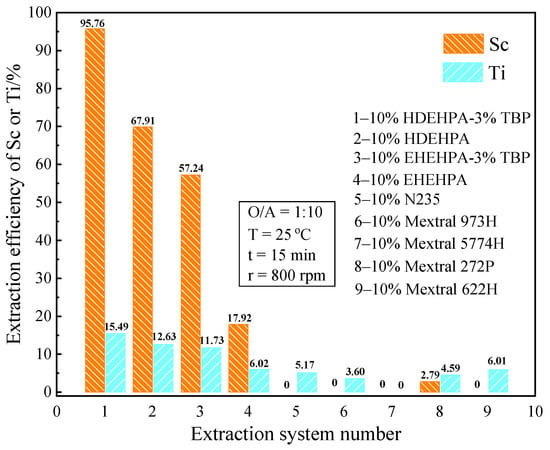
This series of experiments investigated the effects of various conventional (HDEHPA, EHEHPA: 2-ethylhexyl phosphonic acid mono-2-ethylhexyl ester, and N235: tri(octyl-decyl)amine) and novel extractants (Mextral series: commercial extractant) on the extraction behaviors of scandium(III) and titanium(IV) from TWWA. The relevant results of the single-stage extraction experiments are presented in Figure 1.
Figure 1.
Effect of different extractants.
As shown in Figure 1, both extraction system No. 2 (HDEHPA) and extraction system No. 4 (EHEHPA) exhibited excellent selective extraction performance toward scandium(III). Following the addition of the modifier TBP into the system, scandium(III) extraction efficiencies for both extractants increased significantly, a trend corroborated by the experimental data from Groups 1 and 3. This is because a small amount of TBP could coordinate through the P=O bond to form mixed solvated Sc–HDEHPA or Sc–EHEHPA complexes with higher stability and superior solubility in the organic phase, shifting the extraction equilibrium to the right. Meanwhile, TBP inhibits third-phase formation and improved interphase mass transfer, thus increasing scandium extraction efficiency. Notably, the relative increase in scandium extraction efficiency was more remarkable in the EHEHPA-TBP system. This is because EHEHPA, a monoalkyl phosphonic acid monoester, possesses larger steric hindrance than HDEHPA. The as-formed Sc–EHEHPA complex had weaker intrinsic stability; therefore, the performance improvement originating from solvation upon TBP addition was greater in the EHEHPA system. Nevertheless, the HDEHPA-TBP system exhibited superior absolute extraction performance compared with the EHEHPA-TBP system, yielding a scandium(III) extraction efficiency up to 95.76%. Accordingly, after comprehensive evaluation, HDEHPA was chosen as the extractant and TBP as the phase modifier for subsequent scandium(III) extraction experiments.
3.1.2. Determination of Feed Solution pH
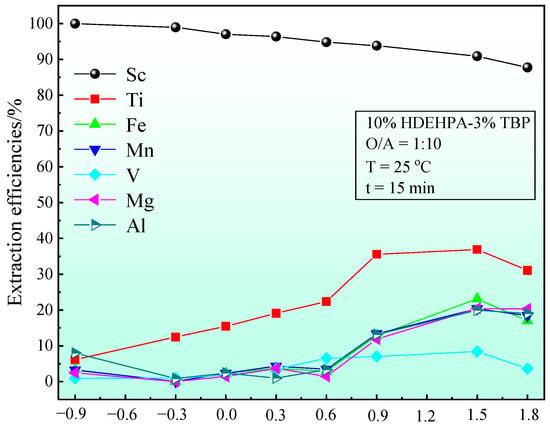
Preliminary tests indicated that when HDEHPA is employed solely as the extractant, the extraction efficiency for scandium(III) remains relatively low. To address this issue, the addition of TBP as a modifier yielded favourable results. However, in TWWA systems with varying pH values, TBP may compromise the selectivity and extraction efficiency of the organic extractant toward target metals. Figure 2 illustrates the pH isotherms of metal extraction.
Figure 2.
Metal extraction pH isotherms.
Within the tested pH range (−0.9 to 1.8), the metal extraction sequence of the HDEHPA-TBP system follows the order of Sc(III) > Ti(IV) > other metal ions. The HDEHPA-TBP system exhibits high selectivity toward scandium(III), with its extraction capacity decreasing as solution pH increases. In contrast, the extraction capability for impurity elements such as titanium(IV) and iron(II) shows the opposite trend. Thus, selective extraction of scandium(III) can be achieved within an optimal pH range. The decline in Sc(III) extraction efficiency is presumably attributed to competitive extraction by impurities including Ti(IV) and Fe(II). Therefore, a lower pH value is more conducive to both scandium(III) extraction and its separation from impurities. Specifically, the scandium(III) extraction efficiency reaches 98.97% when the pH is adjusted to −0.3. Given that raw TWWA exhibits a pH of −0.64, this waste acid was directly adopted as the aqueous feed for subsequent scandium(III) extraction experiments.
3.1.3. Effect Curve of Scandium(III) and Titanium(IV) Extraction Efficiencies
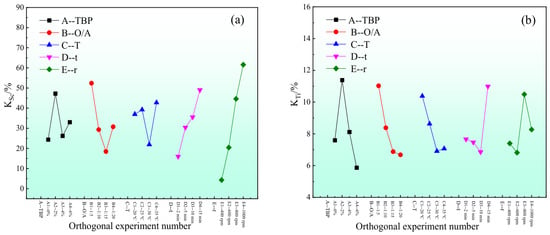
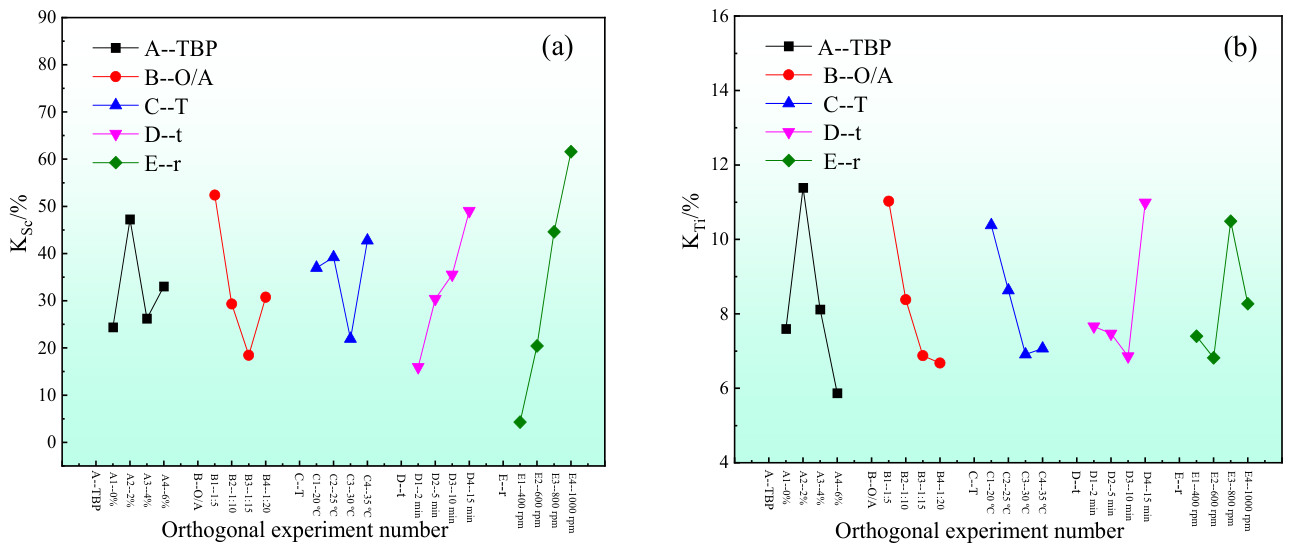
When the concentration of HDEHPA is fixed (set at 5% in this work), the key factors affecting scandium(III) extraction by the HDEHPA/TBP system include the volume fraction of TBP, the phase ratio (O/A), extraction temperature, extraction time, and stirring speed. A five-factor and four-level orthogonal experimental design was employed in this section to guide the subsequent single-factor experiments, as shown in Table 2. The effect curves for scandium(III) and titanium(IV) extraction efficiencies are displayed in Figure 3a and Figure 3b, respectively.
Table 2.
Orthogonal experimental scheme for the extraction of scandium and titanium by HDEHPA system.
Figure 3.
(a) Effect profile of scandium extraction efficiency. (b) Effect profile of titanium extraction efficiency.
Based on the effect curves of scandium(III) and titanium(IV) extraction efficiencies (Figure 3), the single-factor value ranges corresponding to a higher scandium(III) extraction efficiency and a lower titanium(IV) extraction efficiency are listed in Table 3. To ensure a higher scandium(III) extraction efficiency coupled with a lower titanium(IV) extraction efficiency, the optimal experimental parameter ranges are determined as follows: TBP volume fraction = 0–2%, phase ratio (O/A) = 1:5–1:10, extraction temperature = 20–25 °C, extraction time = 5–15 min, and stirring speed = 800–1000 rpm. The results of orthogonal experimental analysis provide a reliable theoretical and experimental basis for the parameter settings of subsequent single-factor experiments.
Table 3.
Single factor range of values.
3.1.4. Separation of Scandium(III) and Titanium(IV)
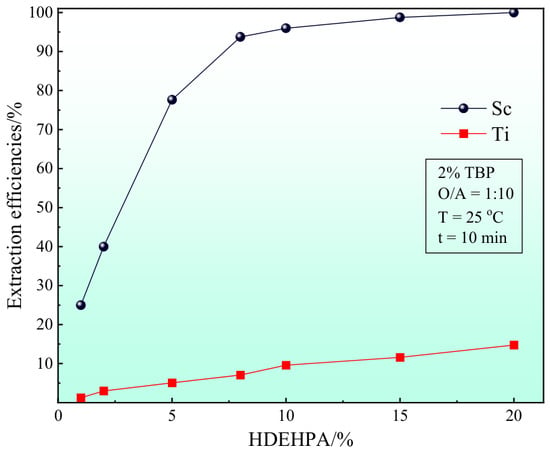
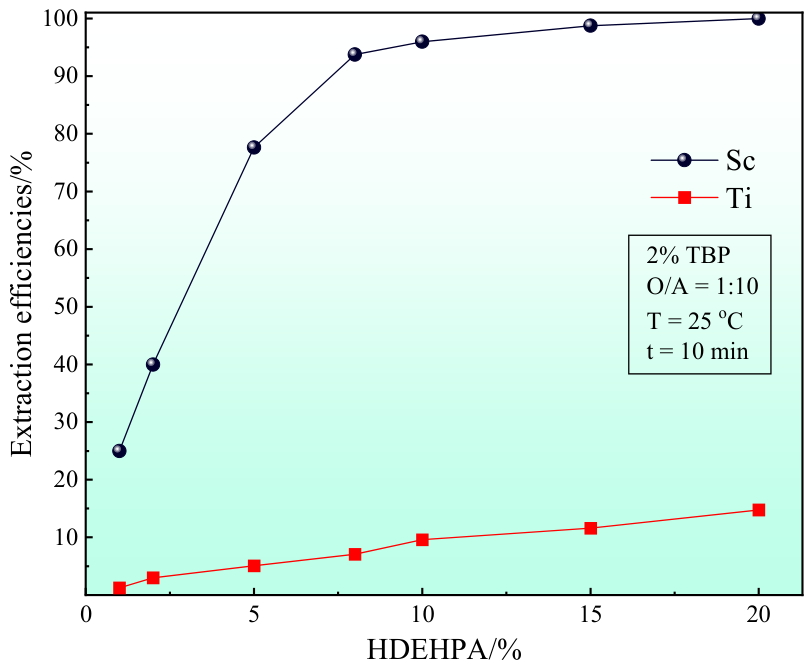
The influences of HDEHPA concentration (1–20%) on the extraction and separation performance of scandium(III) and titanium(IV) are displayed in Figure 4. When the HDEHPA concentration was increased from 1% to 8%, the extraction efficiencies of scandium(III) and titanium(IV) grew from 25.0% and 1.26% to 93.75% and 7.11%, respectively. The obtained results demonstrate that increasing the concentration of HDEHPA effectively enhances the extraction efficiencies of scandium(III) and titanium(IV), particularly that of scandium(III). When the HDEHPA concentration was further raised to 20%, the extraction efficiencies of scandium(III) and titanium(IV) reached 99.98% and 14.79%, respectively. Relative to the condition with 8% HDEHPA, further raising the extractant concentration only achieved a 6.23 percentage point improvement in scandium(III) extraction efficiency, while the extraction efficiency of titanium(IV) impurity increased linearly. To balance high scandium(III) extraction efficiency, low extractant consumption, and satisfactory separation performance, the optimal concentration of HDEHPA is determined to be 8%.
Figure 4.
Effect of HDEHPA concentration.
To achieve efficient extraction of scandium(III), two-stage countercurrent extraction experiments were conducted. Under the optimized conditions (25 °C, 8% HDEHPA, 2% TBP, phase ratio O/A = 1:10, stirring time 10 min), the extraction efficiency of scandium(III) reached 99.98%, with a Ti(IV) co-extraction efficiency of 12.99%.
3.2. Extraction Mechanism of Scandium(III)
3.2.1. Extraction Stoichiometry
To identify the extraction stoichiometry of scandium(III), the saturation capacity method was adopted for experimental investigation. Equal volumes of the organic phase (8% HDEHPA-2% TBP-90% sulfonated kerosene) and the aqueous phase (Sc(III) 0.59 g·L−1, pH = −0.64) were thoroughly mixed under stirring. Upon reaching extraction equilibrium, the scandium(III) concentration in the raffinate was determined. The loaded organic phase was then recontacted with fresh aqueous phase, and the above procedure was repeated until the scandium(III) concentration in the raffinate became practically identical to that of the initial feed solution, signifying the achievement of extraction saturation. The corresponding experimental results are summarized in Table 4.
Table 4.
Saturated capacity experimental results of scandium(III) (g·L−1).
As shown in Table 4, the saturated extraction capacity of the organic system for scandium(III) was about 2.96 g·L−1, corresponding to 0.0658 mol·L−1. The extractant HDEHPA (abbreviated as HA) possessed a molar concentration of 0.2414 mol·L−1. Since HDEHPA exists in the sulfonated kerosene in the form of a stable dimer, the molar concentration of its dimer (HA)2 reaches 0.1207 mol·L−1. The molar ratio of scandium(III) to (HA)2 was determined to be 1:1.83, a value reasonably close to the theoretical stoichiometric ratio of 1:2. Accordingly, it can be inferred that scandium(III) forms complexes with (HA)2 at a molar ratio of 1:2.
3.2.2. FTIR Analysis
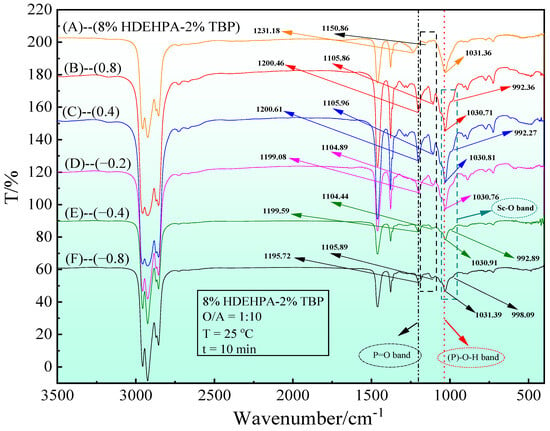
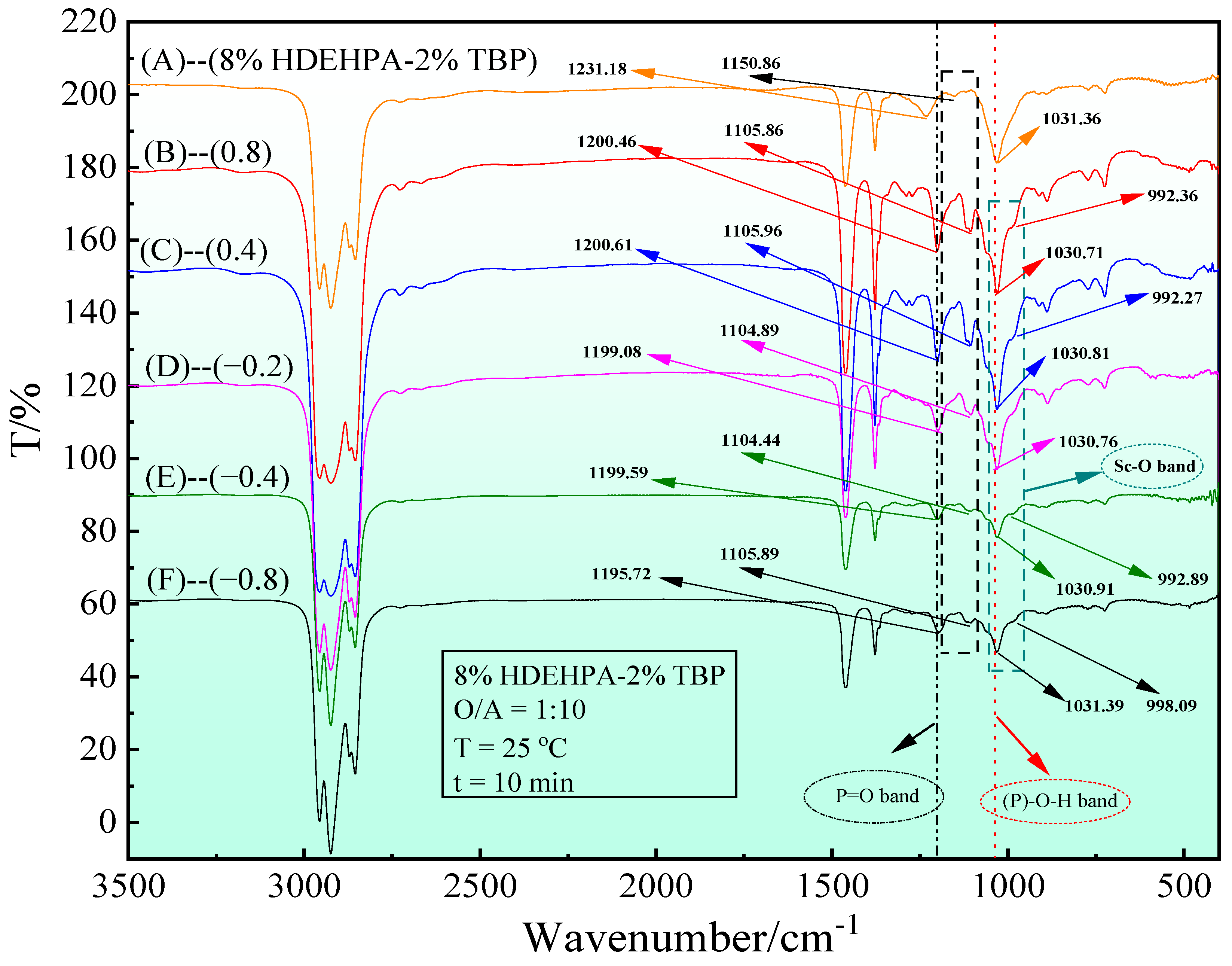
The FTIR spectra of the organic phases were characterized, as illustrated in Figure 5 Curves (A), (B), (C), (D), (E) and (F) in the figure represent the FTIR spectra of the blank organic phase and the scandium(III)-loaded organic phases after extraction under the conditions of pH = 0.8, 0.4, −0.2, −0.4, and −0.8, respectively.
Figure 5.
Infrared spectra of the blank organic phase and extracts at different pHs.
As observed from Figure 5, the infrared spectra obtained at pH = 0.8 and pH = 0.4 show considerable resemblance. Meanwhile, the spectra recorded at pH = −0.4 and pH = −0.8 also display remarkable similarity. At pH = −0.2, the broad peak in the range of 1100–1400 cm−1 is similar to that observed at pH = 0.8 and pH = 0.4. Furthermore, the profile of the strong absorption peak near 1000 cm−1 resembles that obtained at pH = −0.4 and pH = −0.8, accompanied by peak broadening. These observations suggest that a transition in the extraction mechanism occurs at pH = −0.2, at which the predominant solvent-extraction pathway shifts from cation exchange to solvation [28,29,30].
At pH = 0.8, 0.4, and −0.2, the absorption peak for the P=O stretching vibration (originally located at 1231.18 cm−1) shifted to 1200.46 cm−1, 1200.61 cm−1, and 1199.08 cm−1, respectively [31]. Similarly, the absorption peak for the P-O-C stretching vibration (originally located at 1031.36 cm−1) shifted to 1030.71 cm−1, 1030.81 cm−1, and 1030.76 cm−1, respectively [32]. New absorption peaks emerged near 1100 cm−1 and 990 cm−1 (marked by black and green dashed rectangles in the figure), corresponding to the signals of SO42− ions and Sc-O bonds, respectively [33,34]. With increasing sulfuric acid concentration, the amount of extracted SO42− ions increased, leading to the gradual broadening of the P-O-C stretching vibration absorption peak at 1031.36 cm−1.
At pH = −0.4 and −0.8, solvent extraction is dominated by solvation. The absorption peaks for the P=O bond stretching vibration (originally located at 1231.18 cm−1) shifted to 1199.59 cm−1 and 1195.72 cm−1, respectively. Additionally, the absorption peak of the P=O stretching vibration gradually broadened. This may be attributed to the presence of partially unbound P=O bonds that remained at 1231.18 cm−1, whose absorption peaks overlapped with the newly shifted peak, thereby contributing to the broadening observed at this wavenumber. Moreover, the absorption peaks for the P-O-C stretching vibration (originally located at 1031.36 cm−1) shifted to 1030.91 cm−1 and 1031.39 cm−1, respectively, with broadening of the absorption peak. Multiple new absorption peaks emerged near 1100 cm−1 (marked by the black dashed rectangle in the figure), which are attributable to the increased amount of extracted SO42− ions, which consequently broadened the original peak at 1031.36 cm−1. Concurrently, a faint absorption peak remained observable near 990 cm−1, indicating the continued presence of a cation exchange mechanism.
Combined with the above results, the general reaction formula for scandium(III) extraction from strongly acidic solution (pH = −0.64) using the HDEHPA/TBP mixed system can be derived as follows.
HSc(SO4)2 + 2H2A2 = HSc(SO4)2·4HA
3.3. Washing of Co-Extracted Titanium(IV) and Stripping of Scandium(III)
3.3.1. Washing of Co-Extracted Titanium(IV)
TSC is capable of forming coordination complexes with titanium species and has long served as a highly selective masking agent for titanium in complexometric titration. H2O2 also acts as an effective ligand for titanium(IV) ions. In acidic sulfate media, Ti(IV) readily reacts with H2O2 to form stable peroxo-titanium coordination complexes, mainly [TiO(O2)]2+. The formation of such hydrophilic peroxo-titanium complexes changes the existing speciation of titanium(IV). It inhibits the co-extraction of Ti(IV) by HDEHPA, which is beneficial for improving the separation performance between scandium(III) and titanium(IV). Accordingly, an aqueous mixture of TSC and H2O2 was adopted as the washing agent in the present work for the removal of co-extracted titanium(IV).
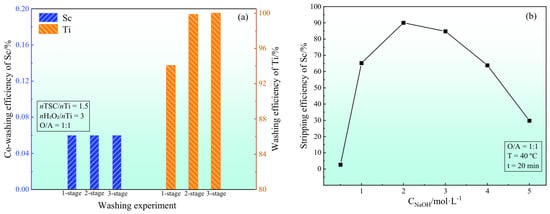
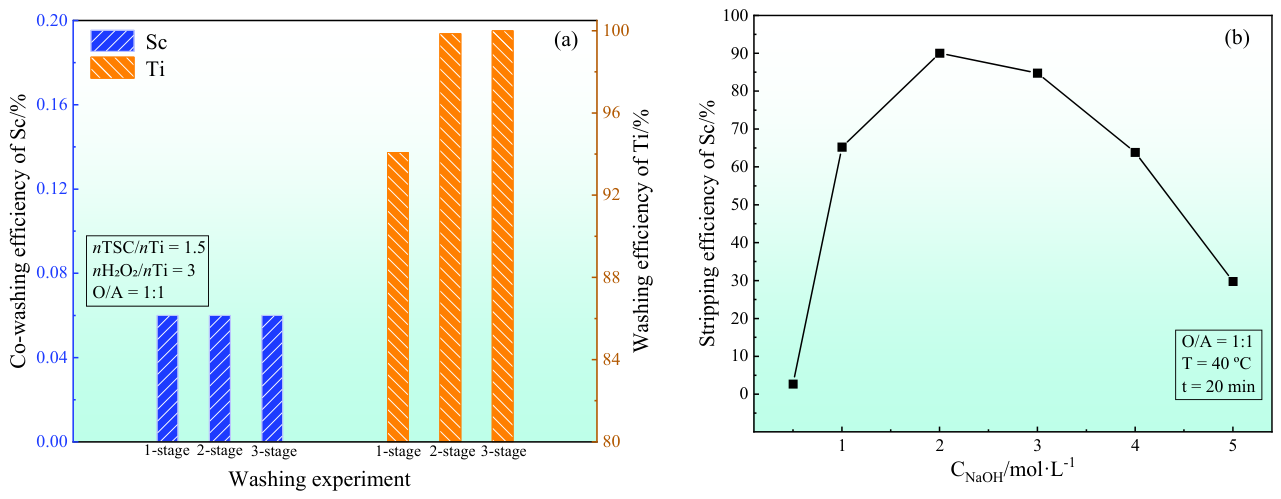
Figure 6a displays the results of three-stage cross-flow washing experiments. As illustrated, the co-washing loss of scandium(III) was merely 0.06%, alongside the complete washing of titanium(IV), indicating that the adopted washing agent exhibits outstanding selectivity toward titanium(IV).
Figure 6.
(a) Results of multi-stage crosscurrent washing experiments; (b) Effects of NaOH concentration.
3.3.2. Stripping of Scandium(III)
To avoid introducing other interfering ions, a NaOH solution was selected as the stripping agent for scandium(III). The impact of NaOH concentration on scandium(III) stripping efficiency is depicted in Figure 6b.
Experimental findings confirmed that NaOH concentration exerted dual effects on scandium(III) stripping. The scandium(III) stripping efficiency first rose and then decreased with increasing NaOH concentration. The maximum stripping efficiency of scandium(III) reached 90.04% at a NaOH concentration of 2 mol·L−1, whereas it decreased to only 29.78% as the concentration rose to 6 mol·L−1. In addition, the experimental observations showed that the stripped aqueous solutions became turbid at 0.5, 1, and 2 mol·L−1 NaOH, with the turbidity gradually intensifying, whereas the solutions remained clear at 3, 4, and 5 mol·L−1 NaOH. This was attributed to the fact that at low NaOH concentrations, insufficient OH− led to a low aqueous pH, which limited the solubility of Sc(III) and triggered partial precipitation of scandium-containing solids. In contrast, excessive NaOH promoted the formation of scandium hydroxyl complexes or hydrates, and these species could be re-extracted into the organic phase, thereby reducing the stripping efficiency of Sc(III). Based on the experimental results and observations, a NaOH concentration of 2 mol·L−1 was identified as the optimal stripping condition.
To achieve the efficient stripping of scandium(III), a two-stage crosscurrent stripping experiment was performed. Under the optimized conditions (T = 25 °C, t = 15 min, r = 800 rpm), the cumulative stripping efficiency of scandium(III) from the two-stage crosscurrent process reached 96.80%.
3.4. Conceptual Flowchart for Recovery of Scandium(III) from TWWA
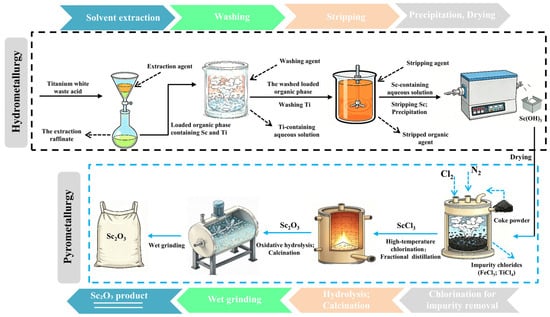
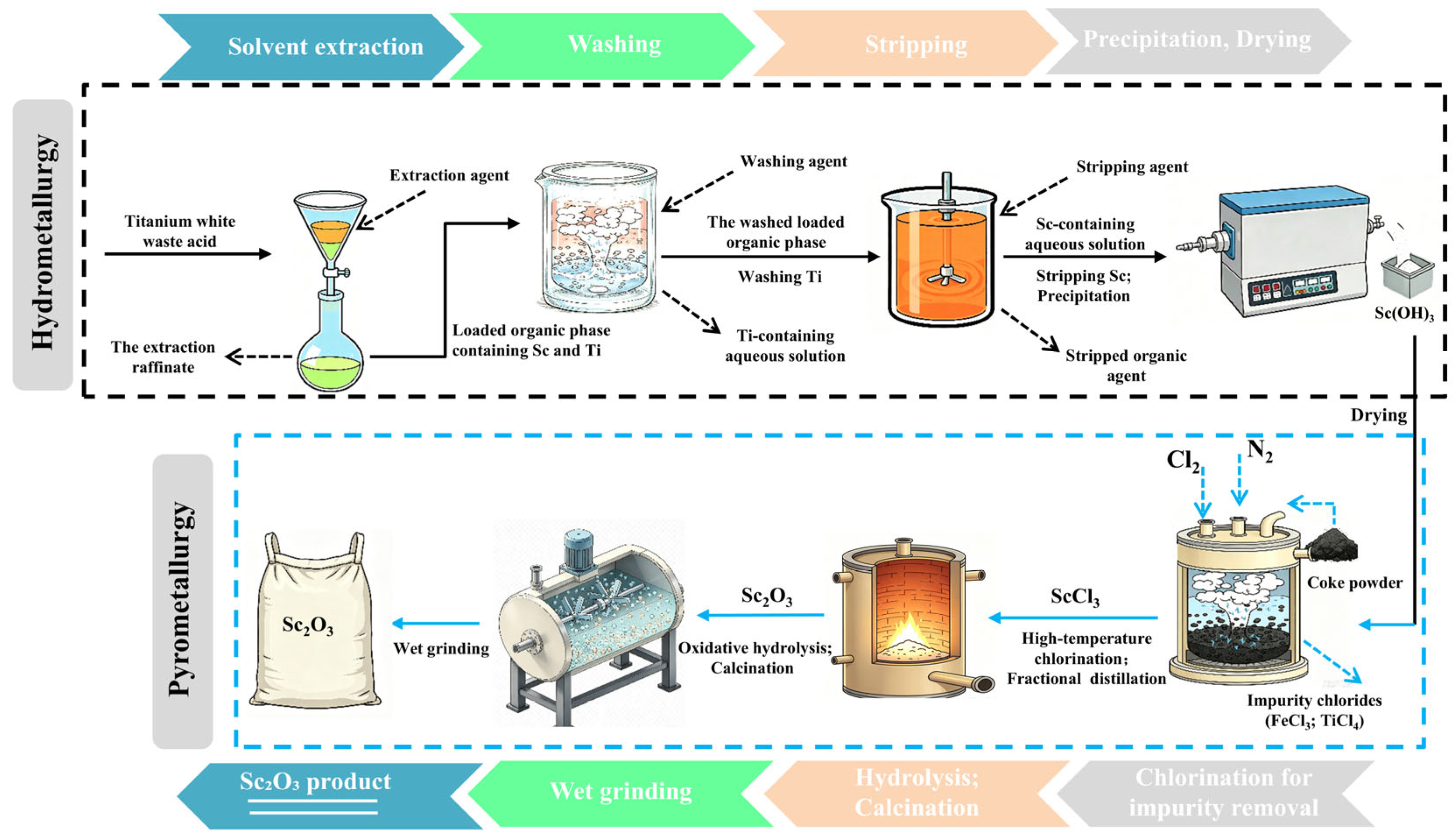
With reference to all research results obtained from the preceding experiments, a conceptual process flowchart for scandium enrichment and recovery from TWWA was proposed, as illustrated in Figure 7. Crude scandium hydroxide (Sc(OH)3) precipitate was obtained via solvent extraction enrichment, deep impurity removal by washing, alkaline stripping, precipitation and drying. In the conventional full-hydrometallurgy process, crude scandium hydroxide undergoes hydrochloric acid dissolution (to prepare refined scandium solution), oxalic acid precipitation and high-temperature calcination to produce final scandium oxide (Sc2O3) products.
Figure 7.
A conceptual flowchart for scandium recovery from TWWA.
The traditional oxalic acid-based wet process has limited impurity removal capacity when preliminary purification is inadequate, resulting in lengthy technological routes, low scandium recovery, and unsatisfactory purity and powder properties of Sc2O3. Accordingly, a novel process integrating hydrometallurgy and pyrometallurgy is proposed in this paper. During the pyrometallurgical stage, a high-temperature chlorination and fractional distillation technique was employed. This technique utilizes the differences in boiling points of metal chlorides to effectively remove hard-to-remove impurities such as titanium and iron, thereby significantly improving product purity. It also simplifies the purification process in the hydrometallurgical extraction stage that requires repeated impurity-removal operations, thereby improving scandium recovery and enhancing production stability. Furthermore, the Sc(OH)3 precursor, which offers controllable performance characteristics, is conducive to the preparation of high-performance scandium oxide powder; the resulting chloride intermediate, scandium chloride (ScCl3), can also be used directly in the preparation of metallic scandium. Meanwhile, this integrated process involves substantial consumption of TWWA, endowing it with both outstanding economic and environmental benefits for industrial-scale applications.
4. Conclusions
- (1)
- The HDEHPA-TBP organic system can selectively extract scandium(III) from raw TWWA solution and achieve effective separation of scandium(III) from titanium(IV).
- (2)
- Experimental results indicated that 99.98% of scandium(III) and 13% of titanium(IV) were enriched in the organic phase via two-stage countercurrent extraction. All co-extracted titanium(IV) was thoroughly removed with TSC-H2O2 aqueous solution through a three-stage crosscurrent washing process. After titanium(IV) washing, 96.80% of scandium(III) retained in the organic phase was stripped through a two-stage crosscurrent stripping process using 2 mol·L−1 NaOH at an O/A ratio of 1:1, a stripping time of 20 min, and a stripping temperature of 40 °C.
- (3)
- Saturation capacity measurements and infrared analysis confirm that the extraction equilibrium for scandium(III) from TWWA containing 250 g·L−1 H2SO4 by the HDEHPA-TBP system can be described as:
HSc(SO4)2 + 2H2A2 = HSc(SO4)2·4HA
The present work demonstrates the technical feasibility of scandium recovery from titanium white waste acid using the HDEHPA-TBP extraction system. Future research will focus on continuous multistage extraction–washing–stripping experiments to improve process stability and overall scandium recovery efficiency. Full-process techno-economic evaluation and wastewater treatment optimization will also be carried out. In addition, the combined hydrometallurgical–pyrometallurgical purification route proposed in this work will be further optimized to prepare high-purity scandium oxide, thereby facilitating the industrial application of scandium recovery from titanium white waste acid.
Author Contributions
Conceptualization: R.-R.Z. and P.S.; methodology: R.-R.Z. and P.S.; validation: R.-R.Z.; investigation: R.-R.Z.; writing—original draft preparation: R.-R.Z.; writing—review and editing: R.-R.Z., P.S. and J.-D.L.; supervision: P.S. and J.-D.L.; project administration: P.S.; funding acquisition: R.-R.Z. and P.S. All authors have read and agreed to the published version of the manuscript.
Funding
This research was financially supported by the College Students’ Innovation and Entrepreneurship Training Program of China (No. S202610146080).
Institutional Review Board Statement
Not applicable.
Informed Consent Statement
Not applicable.
Data Availability Statement
The original contributions presented in this study are included in the article. Further inquiries can be directed to the corresponding author.
Conflicts of Interest
The authors declare no conflict of interest.
References
- Swain, N.; Mishra, S. A review on the recovery and separation of rare earths and transition metals from secondary resources. J. Clean. Prod. 2019, 220, 884–898. [Google Scholar] [CrossRef] [Scilit]
- Riva, S.; Yusenko, K.V.; Lavery, N.P.; Jarvis, D.J.; Brown, S.G.R. The scandium effect in multicomponent alloys. Int. Mater. Rev. 2016, 61, 203–228. [Google Scholar] [CrossRef] [Scilit]
- Rychkov, V.N.; Semenishchev, V.S.; Mashkovtsev, M.A.; Kirillov, E.V.; Kirillov, S.V.; Bunkov, G.M.; Botalov, M.S. Deactivation of the scandium concentrate recovered from uranium leach liquors. J. Radioanal. Nucl. Chem. 2016, 310, 1247–1253. [Google Scholar] [CrossRef] [Scilit]
- Wang, W.W.; Pranolo, Y.; Cheng, C.Y. Metallurgical processes for scandium recovery from various resources: A review. Hydrometallurgy 2011, 108, 100–108. [Google Scholar] [CrossRef] [Scilit]
- Yu, R.; Zhang, W.B.; Zhang, F.L.; Wang, L.L.; Zhang, C.; Zhao, D.J.; Huang, X. Enlightenment on the global mining policy changes in 2023. China Min. Mag. 2024, 33, 29–35. (In Chinese) [Google Scholar]
- Chakhmouradian, A.R.; Smith, M.P.; Kynicky, J. From “strategic” tungsten to “green” neodymium: A century of critical metals at a glance. Ore Geol. Rev. 2015, 64, 455–458. [Google Scholar] [CrossRef] [Scilit]
- Cao, W.; Liu, W.Z.; Yang, Z.; He, M.Y.; Qin, Z.F.; Jiang, Y.; Liu, Q.C.; Xin, Y.T.; Lv, X.W.; Xie, H.J. Extraction of scandium from waste acid leachate using D2EHPA–HEHEHP system: Process optimization and mechanistic insights. Hydrometallurgy 2026, 242, 106673. [Google Scholar] [CrossRef] [Scilit]
- Salman, A.D.; Juzsakova, T.; Mohsen, S.; Abdullah, T.A.; Le, P.C.; Sebestyen, V.; Sluser, B.; Cretescu, I. Scandium Recovery Methods from Mining, Metallurgical Extractive Industries, and Industrial Wastes. Materials 2022, 15, 2376. [Google Scholar] [CrossRef] [Scilit] [PubMed]
- Shao, D.W.; Song, J.; Du, X.B.; Deng, Y.C.; Xue, Z.Y.; Yu, H.D.; Qi, T. Leaching characteristics and kinetics of scandium from Sc concentrate of bayan obo rare earth tailings in sulfuric acid solution. J. Environ. Chem. Eng. 2023, 11, 111037. [Google Scholar] [CrossRef] [Scilit]
- Shao, D.W.; Du, X.B.; Yan, Z.X.; Yu, H.D.; Qi, T. Recovery of scandium from Sc-bearing aegirine by Na2CO3 roasting-water washing-H2SO4 leaching process. J. Environ. Chem. Eng. 2024, 12, 113146. [Google Scholar] [CrossRef] [Scilit]
- Zhou, J.; Ma, S.Y.; Chen, Y.D.; Ning, S.Y.; Wei, Y.; Fujita, T. Recovery of scandium from red mud by leaching with titanium white waste acid and solvent extraction with P204. Hydrometallurgy 2021, 204, 105724. [Google Scholar] [CrossRef] [Scilit]
- Narayanan, R.P.; Palantavida, S.; Mani, J. Red Mud: A Potential Secondary Mine for Scandium. J. Sustain. Metall. 2026, 12, 3276. [Google Scholar] [CrossRef] [Scilit]
- Zhang, N.; Li, H.X.; Liu, X.M. Recovery of scandium from bauxite residue—Red mud: A review. Rare Met. 2016, 35, 887–900. [Google Scholar] [CrossRef] [Scilit]
- Onghena, B.; Borra, C.R.; Van Gerven, T.; Binnemans, K. Recovery of scandium from sulfation roasted leachates of bauxite residue by solvent extraction with the ionic liquid betainium bis(trifluoromethyl sulfonyl)imide. Sep. Purif. Technol. 2017, 176, 208–219. [Google Scholar] [CrossRef] [Scilit]
- Xu, S.Q.; Li, S.Q. Review of the extractive metallurgy of scandium in china (1978–1991). Hydrometallurgy 1996, 42, 337–343. [Google Scholar] [CrossRef] [Scilit]
- Wang, W.W.; Chu, Y.C. Separation and purification of scandium by solvent extraction and related technologies: A review. J. Chem. Technol. Biotechnol. 2011, 86, 1237–1246. [Google Scholar] [CrossRef] [Scilit]
- Zhou, J.; Yu, Q.; Huang, Y.; Meng, J.J.; Chen, Y.D.; Ning, S.Y.; Wang, X.P.; Wei, Y.Z.; Yin, X.B.; Liang, J. Recovery of scandium from white waste acid generated from the titanium sulphate process using solvent extraction with TRPO. Hydrometallurgy 2020, 195, 105398. [Google Scholar] [CrossRef] [Scilit]
- Liu, C.Y.; Chen, L.; Chen, J.; Zou, D.; Deng, Y.F.; Li, D.Q. Application of p507 and isooctanol extraction system in recovery of scandium from simulated red mud leach solution. J. Rare Earths 2019, 37, 1002–1008. [Google Scholar] [CrossRef] [Scilit]
- Zhan, H.H.; Liang, H.L.; Fan, Y.J.; Huang, T.Y.; Guo, D.Q. Two stage neutralization treatment and precipitation of scandium from waste vitriol solution in titanium dioxide production. Nonferrous Met. 2014, 8, 45–47. (In Chinese) [Google Scholar]
- Chen, Y.D.; Ma, S.Y.; Ning, S.Y.; Zhong, Y.L.; Wang, X.P.; Fujita, T.; Wei, Y.Z. Highly efficient recovery and purification of scandium from the waste sulfuric acid solution from titanium dioxide production by solvent extraction. J. Environ. Chem. Eng. 2021, 9, 106226. [Google Scholar] [CrossRef] [Scilit]
- Chi, J.Y.; Wang, C.Z.; Zhou, G.Z.; Fu, X.N.; Chen, X.; Yin, X.Y.; Zhang, Z.J.; Wang, Y.H. A critical review on separation and extraction of scandium from industrial wastes: Methods, difficulties, and mechanism. J. Environ. Chem. Eng. 2023, 11, 111068. [Google Scholar] [CrossRef] [Scilit]
- Cao, W.; Yang, Z.; Rohani, S.; He, M.Y.; Gao, Y.X.; Jin, X.; Qin, Z.F.; Jiang, Y.; Liu, Q.C.; Lv, X.W.; et al. Towards sustainable scandium production: Advances in extraction and solvent extraction technologies. Sep. Purif. Technol. 2025, 375, 133795. [Google Scholar] [CrossRef] [Scilit]
- Zou, D.; Deng, Y.F.; Chen, J.; Li, D.Q. A review on solvent extraction of scandium. J. Rare Earths 2022, 40, 1499–1508. [Google Scholar] [CrossRef] [Scilit]
- Zhou, Z.G.; Ma, B.Z.; Wang, C.Y.; Chen, Y.Q.; Wang, L. Separation and recovery of scandium from high pressure sulfuric acid leach liquor of limonitic laterite. Process. Saf. Environ. Prot. 2022, 165, 161–172. [Google Scholar] [CrossRef] [Scilit]
- Li, Y.H.; Li, Q.G.; Zhang, G.Q.; Zeng, L.; Cao, Z.Y.; Gua, W.J.; Wang, L.P. Separation and recovery of scandium and titanium from spent sulfuric acid solution from the titanium dioxide production process. Hydrometallurgy 2018, 178, 1–6. [Google Scholar] [CrossRef] [Scilit]
- Qiu, H.B.; Wang, M.L.; Xie, Y.M.; Song, J.F.; Huang, T.; Li, X.M.; He, T. From trace to pure: Recovery of scandium from the waste acid of titanium pigment production by solvent extraction. Process Saf. Environ. Prot. 2019, 121, 118–124. [Google Scholar] [CrossRef] [Scilit]
- Li, H.; Tong, Z.F.; Chen, Z.C.; Mao, A.Z. Improvement of extraction process for scandium from titanium white waste acid. Inorg. Chem. Ind. 2006, 38, 51–53. (In Chinese) [Google Scholar]
- Zhang, W.G.; Zhang, T.A.; Lv, G.Z.; Zhou, W.H.; Cao, X.J.; Zhu, H.Y. Extraction Separation of Sc(III) and Fe(III) from a Strongly Acidic and Highly Concentrated Ferric Solution by D2EHPA/TBP. JOM 2018, 70, 2837–2845. [Google Scholar] [CrossRef] [Scilit]
- Koladkar, D.V.; Dhadke, P.M. Solvent extraction of Sc(III) from sulfuric acid solution by bis(2-ethylhexyl)phosphinic acid in toluene. J. Serb. Chem. Soc. 2002, 67, 265–272. [Google Scholar] [CrossRef] [Scilit]
- Wang, C.; Li, D.Q. Extraction mechanism of Sc(III) and separation from Th(IV), Fe(III) and Lu(III) with bis(2,4,4-trimethylpentyl) phosphinic acid in N-hexane from sulphuric acid solutions. Solvent Extr. Ion. Exch. 1994, 12, 615–631. [Google Scholar]
- Cheraghi, A.; Ardakani, M.S.; Alamdari, E.K.; Fatmesari, D.H.; Darvishi, D.; Sadrnezhaad, S.K. Thermodynamics of vanadium(V) solvent extraction by mixture of D2EHPA and TBP. Int. J. Miner. Process. 2015, 138, 49–54. [Google Scholar] [CrossRef] [Scilit]
- Zhang, Y.; Zhang, T.A.; Dreisinger, D.; Lv, G.Z.; Zhang, G.Q.; Zhang, W.G.; Liu, Y. Extraction of vanadium from direct acid leach solution from converter vanadium slag. Can. Metall. Q. 2017, 56, 281–293. [Google Scholar] [CrossRef] [Scilit]
- Weng, S.F.; Xu, Y.Z. Fourier Transform Infrared Spectroscopy Analysis, 3rd ed.; Chemical Industry Press: Beijing, China, 2016; pp. 423–434. [Google Scholar]
- Zhang, L.J.; Chang, X.J.; Zhai, Y.H.; He, Q.; Huang, X.P.; Hu, Z.; Jiang, N. Selective solid phase extraction of trace Sc (III) from environmental samples using silica gel modified with 4-(2-morinyldiazenyl)-N-(3-(trimethylsilyl) propyl) benzamide. Anal. Chim. Acta 2008, 629, 84–91. [Google Scholar] [CrossRef] [Scilit] [PubMed]

Disclaimer/Publisher’s Note: The statements, opinions and data contained in all publications are solely those of the individual author(s) and contributor(s) and not of MDPI and/or the editor(s). MDPI and/or the editor(s) disclaim responsibility for any injury to people or property resulting from any ideas, methods, instructions or products referred to in the content. |
© 2026 by the authors. Licensee MDPI, Basel, Switzerland. This article is an open access article distributed under the terms and conditions of the Creative Commons Attribution (CC BY) license.