


Abstract
The effects of post-diffusion annealing on the microstructure and coercivity of sintered Nd-Fe-B magnets are investigated using a Pr66Tb10(CoAlGa)24 diffusion source. Grain boundary diffusion increases the coercivity from 8.95 to 23.20 kOe, while subsequent annealing at 500 °C for 2 h further raises it to 24.24 kOe. This additional gain of approximately 4.5% is accompanied by a remanence decrease of 0.08 kGs, giving a total decrease of 0.30 kGs relative to the original magnet. Microstructural characterization reveals changes in elmental distribution and grain boundary morphology after annealing. Tb-enriched shells are observed near the diffusion surface. In the magnet interior, where Tb enrichment is limited, chemically distinct Nd-rich and comparatively Fe-rich intergranular regions are present. Ga-containing RE-Fe regions at a depth of approximately 2 mm are tentatively associated with RE6Fe13Ga-related phases. The observed compositional heterogeneity suggests a possible role for local Fe partitioning in improving magnetic isolation between adjacent grains. These findings suggest that the additional coercivity enhancement involves grain boundary modification in the magnet interior alongside changes in the near-surface Tb-enriched regions, with reduced intergranular exchange coupling as a possible contributing mechanism.
1. Introduction
Sintered Nd-Fe-B magnets are widely used in advanced technologies owing to their excellent magnetic properties [1,2]. Maintaining sufficient coercivity is particularly important for applications involving elevated temperatures and strong demagnetizing fields. The grain boundary diffusion process (GBDP) offers an effective means of increasing coercivity while reducing the consumption of heavy rare earth (HRE) elements [3,4,5]. During diffusion, grain boundaries provide pathways for HRE transport into the magnet, enabling the formation of HRE-enriched shells around the 2:14:1 grains [6,7,8]. These shells increase the local anisotropy field and suppress reverse-domain nucleation [9,10,11]. The resulting coercivity also depends on the chemistry and morphology of the intergranular regions, which can be further modified by subsequent heat treatment.
Post-sinter annealing can improve coercivity by redistributing RE-rich intergranular phases and promoting the development of thin, continuous grain boundary layers [12,13,14,15]. Post-diffusion annealing likewise modifies the microstructure established during diffusion, although its effects depend on the alloy composition and the initial microstructural state [16,17,18,19]. Kim et al. reported that annealing promoted Dy redistribution from Nd-rich grain boundary phases into existing Dy-rich shells, producing secondary shells with higher Dy concentrations and further increasing coercivity [16]. Studies of Pr-Cu and Dy-Cu diffusion revealed different annealing responses. Pr-Cu-treated magnets exhibited a pronounced coercivity increase associated with the development of continuous intergranular layers, whereas Dy-Cu-treated magnets showed a smaller additional increase [18]. These findings demonstrate that the annealing response involves changes in both intergranular structure and the distribution of rare earth elements.
Recent studies of multicomponent diffusion alloys have further emphasized the relationship between elemental distribution, grain boundary structure, and coercivity [20,21,22]. In magnets treated with Pr-Co-Al-Ga alloys, continuous grain boundary layers were reported to develop predominantly during annealing at 500 °C [23]. Related work on Pr-Dy-Tb-Fe-Al-Ga alloys examined the diffusion behavior of Dy and Tb and the associated microstructural evolution [24]. These studies provide a basis for understanding how multicomponent diffusion modifies grain surfaces and intergranular regions. For the Pr-Tb-Co-Al-Ga system, an important question is how subsequent annealing changes the elemental distribution and grain boundary structure established during diffusion, and how these changes relate to the additional coercivity gain. Addressing this question requires attention to both the Tb-enriched regions near the diffusion surface and the deeper regions where Tb enrichment is limited.
In this study, a Pr66Tb10(CoAlGa)24 alloy is used as the diffusion source to investigate the relationship between post-diffusion annealing, microstructural evolution, and coercivity enhancement. Magnets subjected to the same diffusion and cooling schedule are compared with and without subsequent annealing. Magnetic measurements are combined with microstructural and compositional analyses at different depths, focusing on the distributions of Pr, Tb, Co, Al, and Ga, the morphology of intergranular regions, and the chemistry of Ga-containing RE-Fe constituents. This comparison links the additional coercivity gain to the observed changes in elemental distribution and grain boundary structure, providing insight into the role of post-diffusion annealing in further magnetic hardening.
2. Experimental
2.1. Materials and Grain Boundary Diffusion Process
The starting material was a sintered Nd-Fe-B magnet with a nominal composition of Nd28.6Fe69.31Co0.5Ga0.5Zr0.2B0.89 (wt.%). This composition describes the bulk alloy, whose principal hard magnetic phase is based on Nd2Fe14B. Cylindrical specimens Φ9 mm × 5 mm were prepared by wire electrical discharge machining. The cylinder axis (height direction) was parallel to the magnetic alignment direction. Before diffusion, the specimen surfaces were ground with 800-grit sand paper and thoroughly cleaned with anhydrous ethanol.
The diffusion source alloy had a nominal composition of Pr66Tb10(CoAlGa)24 (at.%). Alloy ingots were prepared by arc melting under pure Ar, with three remelting cycles. Ribbons were subsequently produced by melt spinning under pure Ar using a wheel speed of 8 m/s, an ejection pressure of 0.2 MPa, and a nozzle-to-wheel distance of 3 mm. The resulting ribbons were approximately 100 μm thick. Differential scanning calorimetry (DSC, NETZSCH 214) was performed from 20 to 700 °C at a heating rate of 10 °C/min and the vacuum below 2.0 × 10⁻³ Pa. The characteristic melting temperature was determined to be 508.8 °C from the peak of the melting endotherm.
The ribbons were placed on the upper and lower circular faces of each specimen and maintained in contact using Al2O3 crucibles. Their total mass was 2.8 wt.% of the starting magnet mass, with 1.4 wt.% on each face. The coated faces were perpendicular to the magnetic alignment direction. Diffusion was conducted in a vacuum furnace at 3 × 10⁻³ Pa. The specimens were heated to 900 °C at 10 °C/min, held for 10 h, and furnace-cooled to room temperature. The magnets obtained after this treatment are designated GBDP. To obtain GBDPA magnets, specimens subjected to the same diffusion and cooling procedure were reheated to 500 °C at 10 °C/min, held for 2 h, and furnace-cooled to room temperature. Thus, the comparison evaluates the effect of the additional annealing cycle following a common diffusion and cooling history.
2.2. Characterization of Magnetic Properties and Microstructure
Room-temperature magnetic properties were measured using a pulsed field magnetometer (PFM, HIRST 14.CN), with a maximum applied field of 7 T applied parallel to the magnetic alignment direction. Three parallel specimens were examined for each processing condition. Each specimen was measured three times, and the median reading was selected. Hcj denotes the magnitude of the reverse field at which the magnetic polarisation becomes zero, whereas Br denotes the remanent magnetic induction at zero internal field. The maximum energy product, (BH)max, is the maximum magnitude of the product of B and the internal field H in the second quadrant of the demagnetization curve. Demagnetising effects were handled by the instrument’s built-in measurement system using settings configured before testing.
Backscattered-electron images were acquired using a scanning electron microscope (SEM, Quanta 250, Thermo Fisher Scientific, Waltham, MA, USA) operated at 15 kV. Elemental mapping and quantitative line-scan analysis were performed using an electron probe microanalyser (EPMA, JEOL JXA-iHP200F, Tokyo, Japan), with a line-scan step size of 40 nm. Depth-dependent Pr and Tb concentration profiles were obtained by SEM-EDS, with depth measured inward from the diffusion-treated surface. Nanoscale morphology and elemental distributions were examined using a transmission electron microscope (TEM, Thermo Fisher Scientific Talos F200X, Thermo Fisher Scientific, USA) equipped with an energy-dispersive X-ray spectrometer (EDS, Thermo Fisher Scientific, USA). Thin foils were prepared from regions approximately 50 μm and 2 mm below the diffusion-treated surface using an ion milling system. The electron-transparent regions were approximately 40 nm thick. High-angle annular dark-field scanning transmission electron microscopy (HAADF-STEM, Thermo Fisher Scientific, USA) images, EDS maps, and line profiles were acquired at an accelerating voltage of 200 kV.
3. Results and Discussion
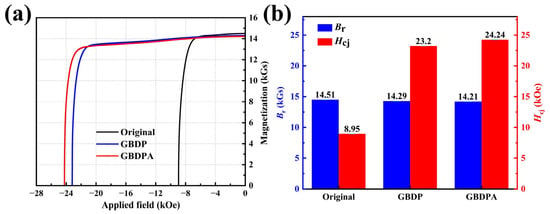
Figure 1a presents the room-temperature demagnetisation curves of the original, GBDP, and GBDPA magnets, while Figure 1b compares their remanence and intrinsic coercivity using bar charts. Table 1 summarizes the corresponding magnetic properties together with their reported error ranges. Following grain boundary diffusion with the Pr66Tb10(CoAlGa)24 alloy, Hcj increased from 8.95 to 23.20 kOe. Subsequent annealing at 500 °C for 2 h further increased Hcj to 24.24 kOe, representing an additional enhancement of 1.04 kOe, approximately 4.5%, relative to the GBDP state.
Figure 1.
(a) Demagnetization curves of the original, GBDP, and GBDPA magnets. (b) Bar charts comparing their remanence (Br, blue) and intrinsic coercivity (Hcj, red).
Table 1.
Magnetic properties of the Original, GBDP and GBDPA magnets at room temperature.
This coercivity enhancement was accompanied by a small reduction in remanence, with a total decrease of 0.30 kGs relative to the original magnet. As summarized in Table 1, the improved demagnetization-curve squareness achieved after diffusion was largely retained after annealing, while the maximum energy product exhibited only minor variations across the three conditions. These results indicate that, under the investigated processing conditions, post-diffusion annealing provides an additional coercivity enhancement with limited changes in the other magnetic properties. The associated microstructural evolution is examined below.
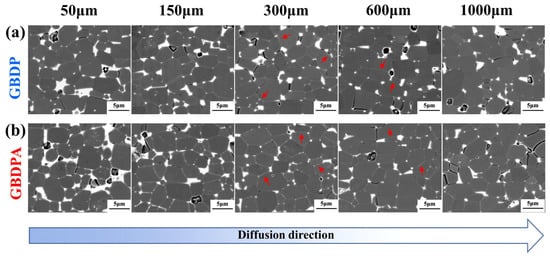
To elucidate the relationship between the magnetic properties and microstructure, Figure 2 presents SEM images of the GBDP and GBDPA magnets at depths ranging from 50 to 1000 μm below the magnet surface. The dark gray, bright white, and light gray regions correspond to the matrix phase, RE-rich phase, and Tb-rich shells, respectively. At a depth of 50 μm, well-defined Tb-rich shells are observed in both the GBDP and GBDPA magnets, together with a relatively high fraction of the RE-rich phase. At depths of 300 and 600 μm, distinct Tb-rich shells remained visible in both magnets, as indicated by the red arrows. Compared with the GBDP magnet, the GBDPA magnet exhibits a more connected distribution of intergranular constituents in the examined sections, including at a depth of 1000 μm. These morphological differences are consistent with grain boundary rearrangement during post-diffusion annealing. The improved apparent continuity of the intergranular regions may enhance magnetic isolation between adjacent grains and contribute to the additional coercivity increase.
Figure 2.
SEM-BSE images of GBDP (a) and GBDPA (b) magnets at the distance of 50, 150, 300, 600 and 1000 μm from the surface of the corresponding magnets.
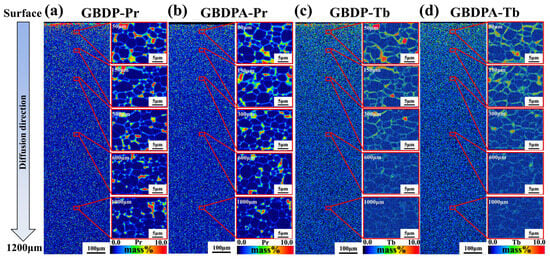
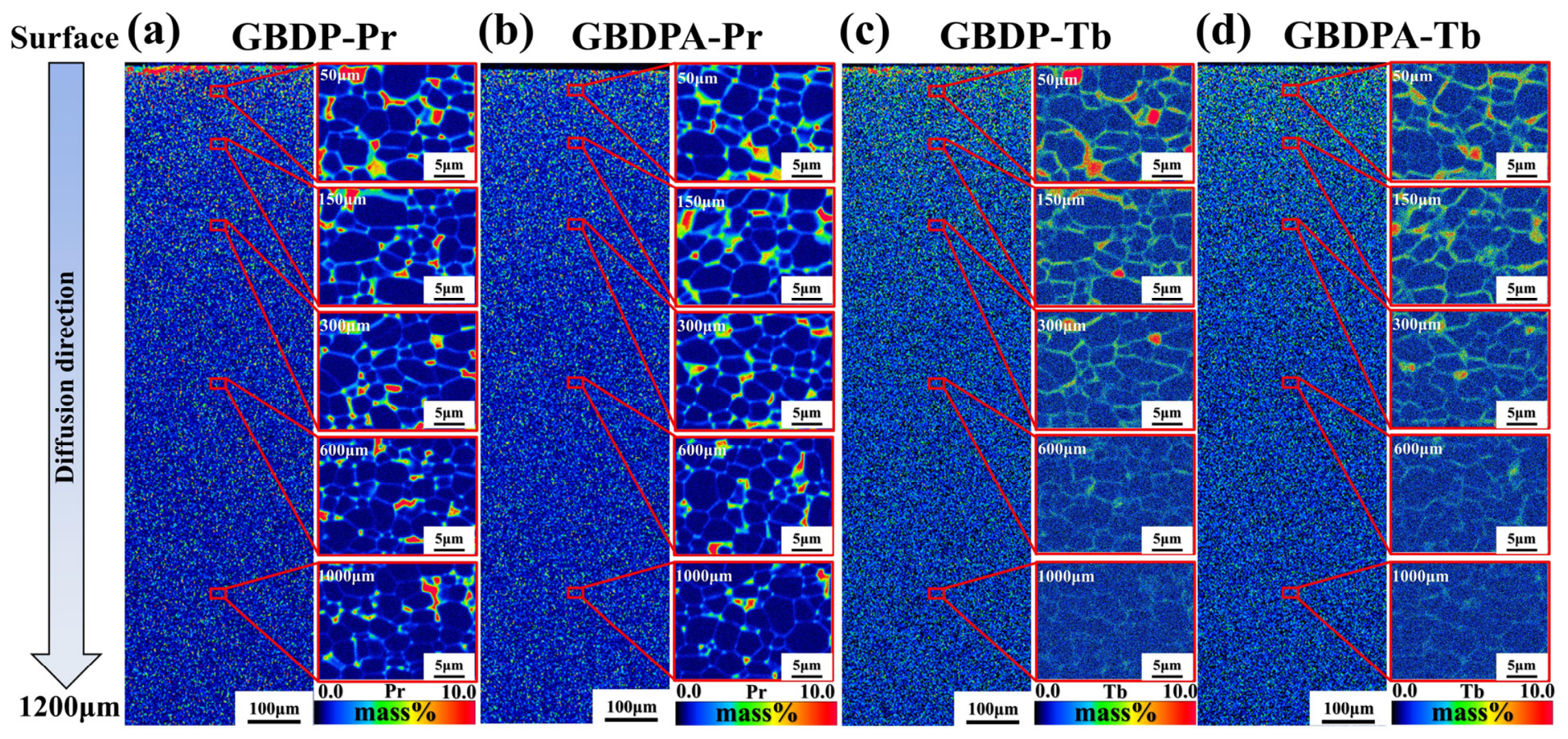
Figure 3 presents EPMA elemental maps of Pr (Figure 3a,b) and Tb (Figure 3c,d) in the GBDP and GBDPA magnets. As shown in Figure 3a,b, Pr is strongly enriched at the triple-junction phase (TJP) in the GBDP magnet. After annealing, the Pr concentration at these TJPs decreases significantly, while Pr exhibits a more continuous and homogeneous distribution along the thin grain boundaries. These results indicate that annealing promotes the redistribution of Pr within the magnet, thereby improving the continuity and compositional uniformity of the GBP. At the examined depths of 50–1000 μm, Pr enrichment appears more evenly distributed along the intergranular regions after annealing. This local redistribution, together with the changes in grain boundary morphology, may contribute to improved magnetic isolation between adjacent grains.
Figure 3.
EPMA elemental maps of Pr (a,b) and Tb (c,d) across the 0–1200 μm diffusion-depth range, together with enlarged maps acquired at depths of 50, 150, 300, 600, and 1000 μm from the diffusion surface, for the GBDP (a,c) and GBDPA (b,d) magnets.
The Tb maps also indicate changes in elemental distribution after annealing, with Tb enrichment appearing more evenly distributed around the grain peripheries. These observations are consistent with the redistribution of Tb within the microstructure established during diffusion. Together with the changes in Pr distribution and intergranular morphology, this redistribution may contribute to the additional coercivity enhancement in the GBDPA magnet.
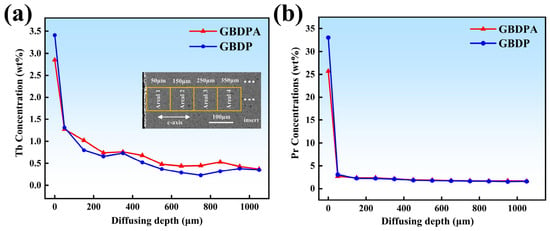
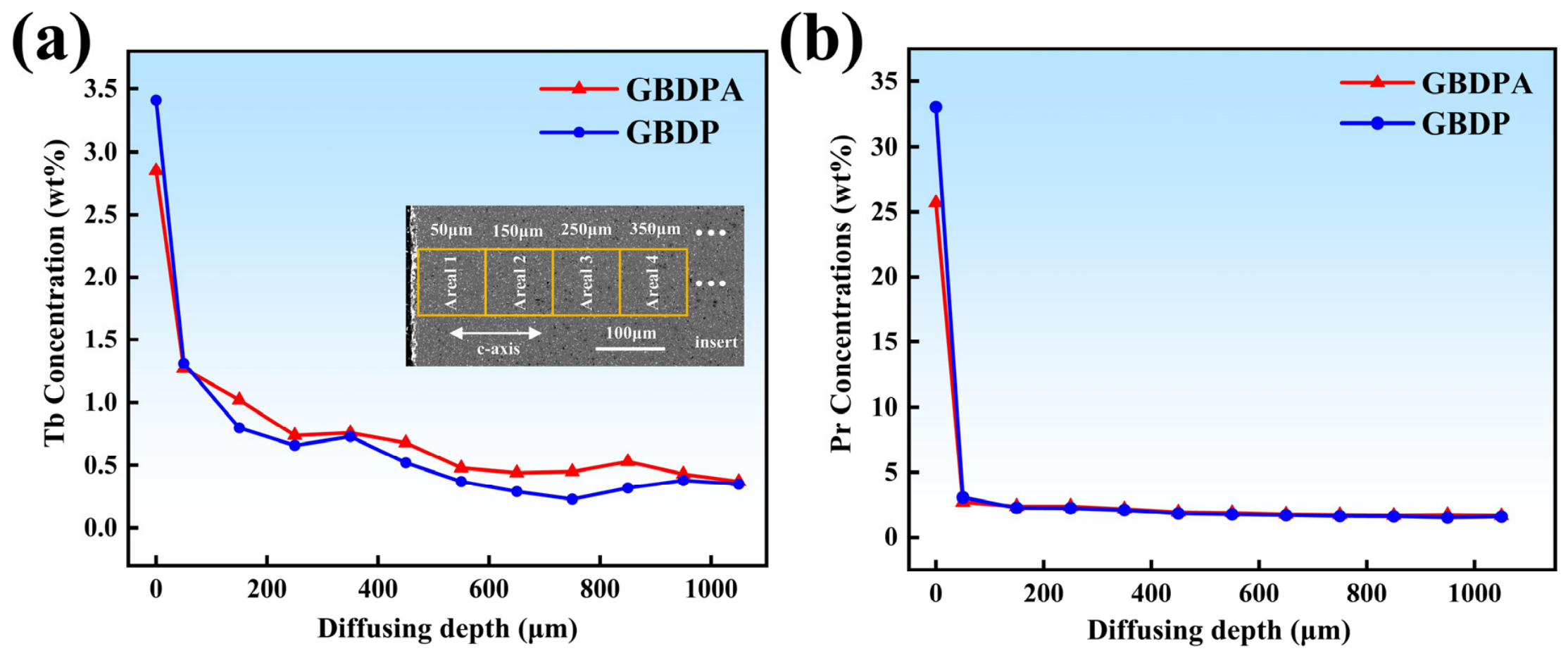
The depth profiles in Figure 4 show that both Tb and Pr concentrations decrease sharply near the surface and then decline more gradually with increasing diffusion depth. Compared with the GBDP magnet, the GBDPA magnet exhibits a lower surface Tb concentration but higher Tb concentrations at most subsurface depths. This reduced surface enrichment, accompanied by increased Tb contents in the interior, is consistent with Tb redistribution during post-diffusion annealing. Although the surface Pr concentration also decreases after annealing, the subsurface Pr profiles remain closely comparable between the two magnets. Thus, annealing produces a more pronounced change in the internal concentration profile of Tb than that of Pr.
Figure 4.
Tb and Pr concentrations against diffusion depth from the coated surface of the GBDP and GBDPA magnets (a,b).
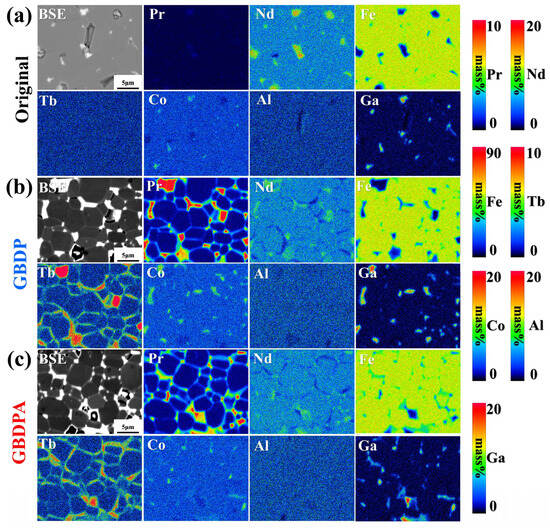
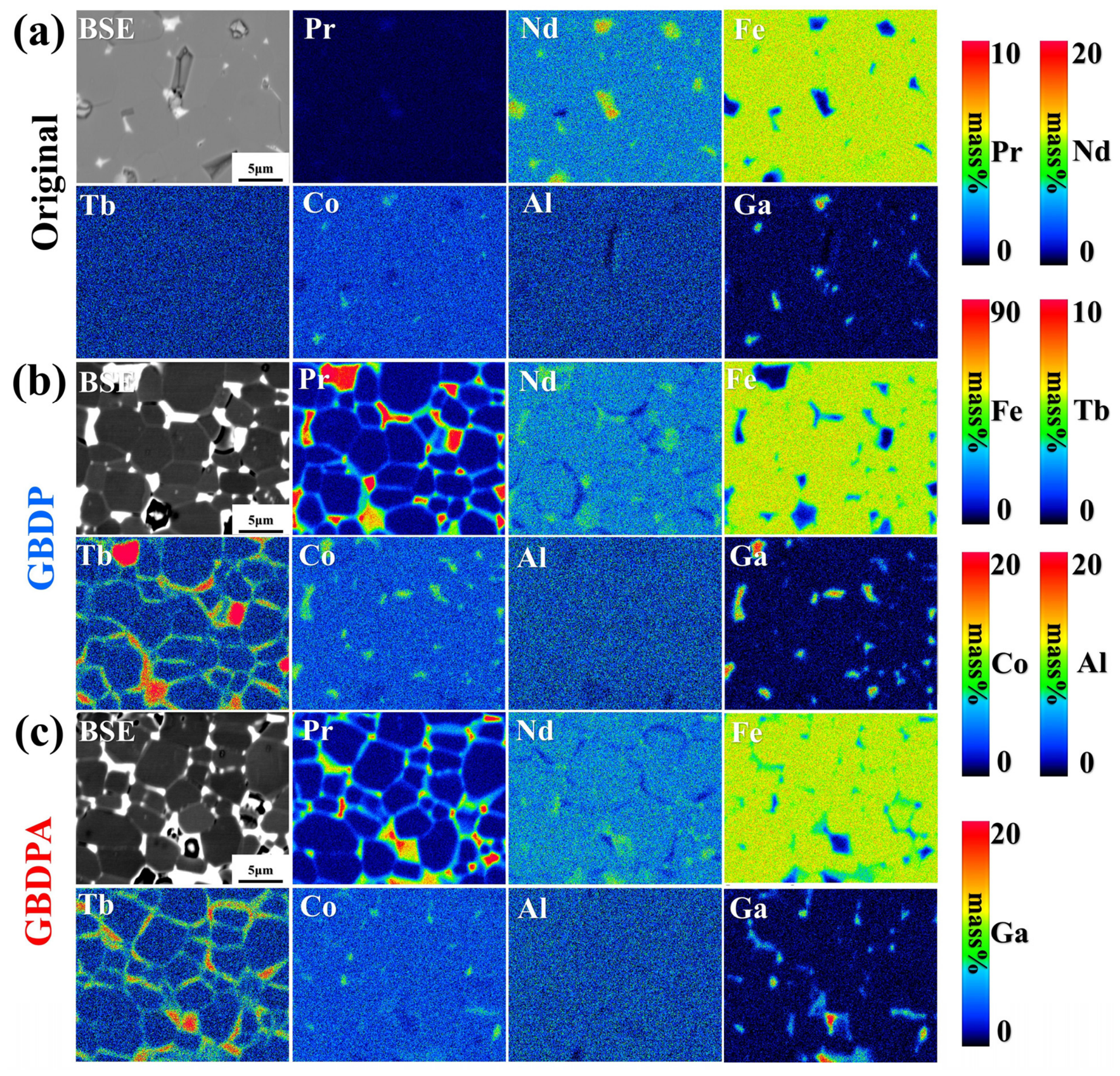
To accurately characterize the elemental distributions in the GBDP and GBDPA magnets, EPMA analyses are performed at a depth of 50 μm below the magnet surface, and the corresponding results are shown in Figure 5. The two magnets exhibit significant differences in their elemental distributions. In the GBDP magnet, Tb and Pr are strongly enriched at the TJPs, whereas both elements are distributed more uniformly in the GBDPA magnet. In addition, Co, Al, and Ga appear more evenly distributed in the grain boundary regions of the GBDPA magnet, whereas these elements are preferentially concentrated at the TJPs in the GBDP magnet. These observations suggest that post-diffusion annealing promotes elemental redistribution from the TJPs towards neighbouring grain boundaries. These observations are consistent with elemental redistribution and rearrangement of the intergranular constituents during annealing.
Figure 5.
Back-scattered images and EPMA mapping results of Pr, Tb, Co, Al, Ga, Nd, Fe at 50 μm depth for Original (a), GBDP (b) and GBDPA (c) magnets.
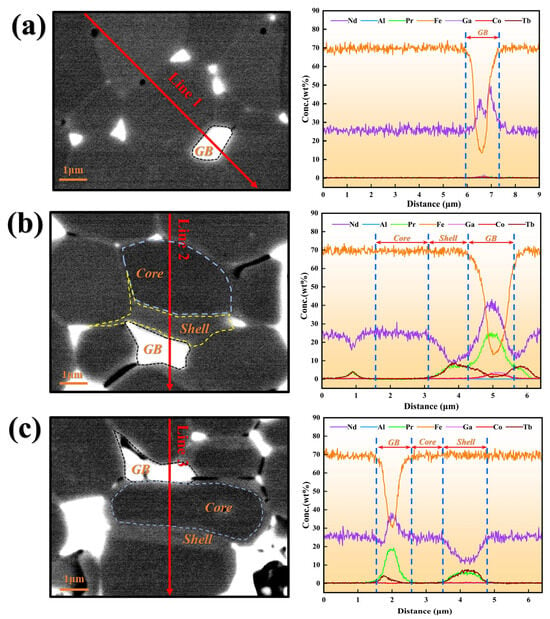
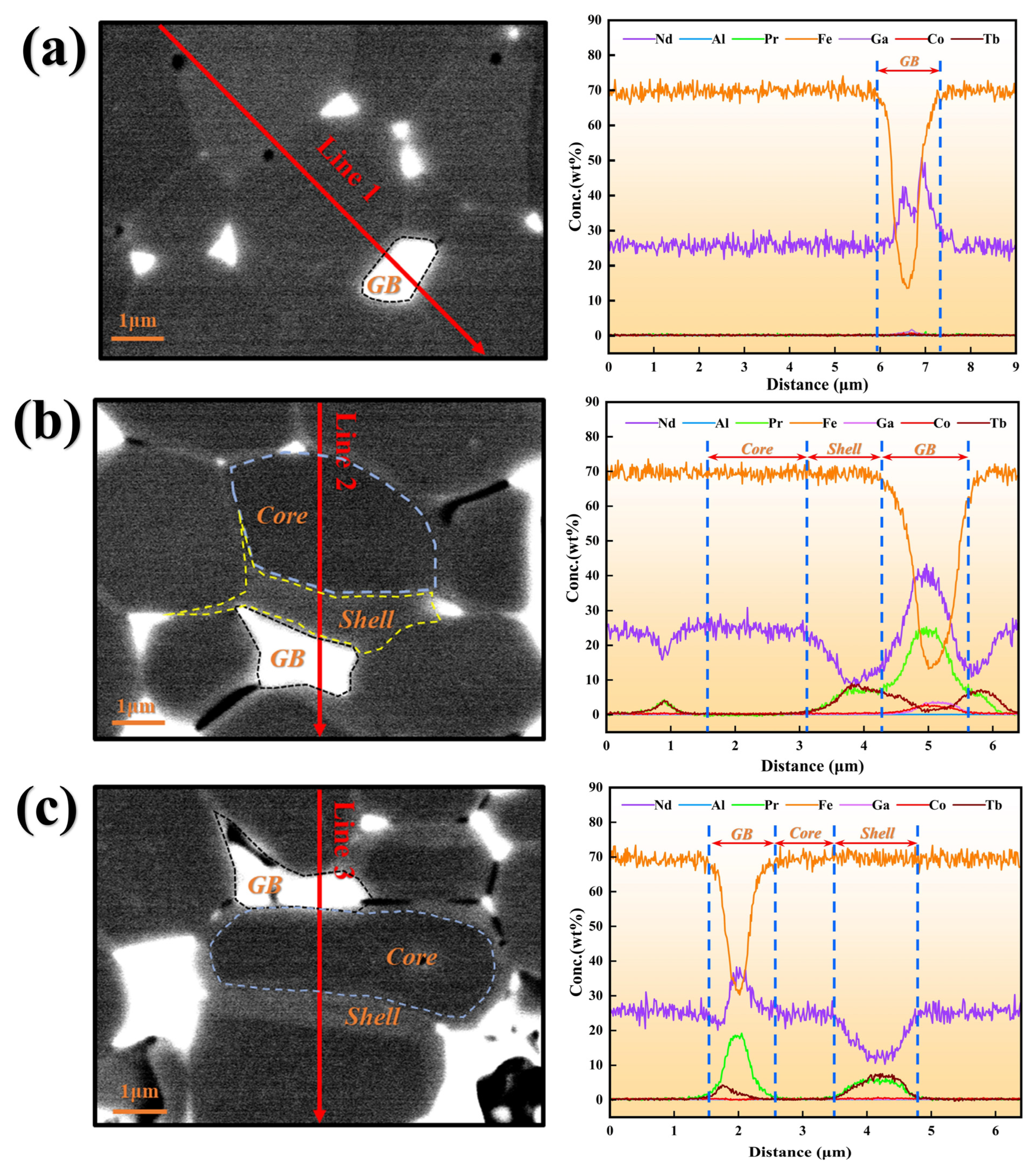
The quantitative EPMA line scans in Figure 6 reveal clear compositional differences between the grain cores, peripheral shells, and intergranular regions. In the GBDP and GBDPA magnets, Tb enrichment at the grain peripheries coincides with a decrease in Nd concentration, whereas the intergranular regions exhibit Pr enrichment and lower Fe concentrations than the matrix. After annealing, the Tb profile across the analysed shell region is relatively smooth, consistent with the more uniform local Tb distribution near grain boundaries suggested by the elemental maps. These results provide additional compositional support for annealing-associated elemental redistribution. However, the profiles characterise the resolved microstructural regions and do not directly establish the composition of nanoscale grain boundary films.
Figure 6.
EPMA line-scanning profiles at Nd, Al, Pr, Fe, Ga, Co, Tb elements for Original (a), GBDP (b) and GBDPA (c) magnets.
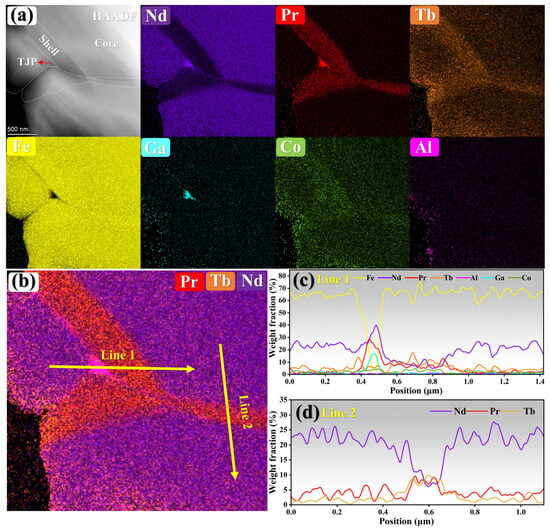
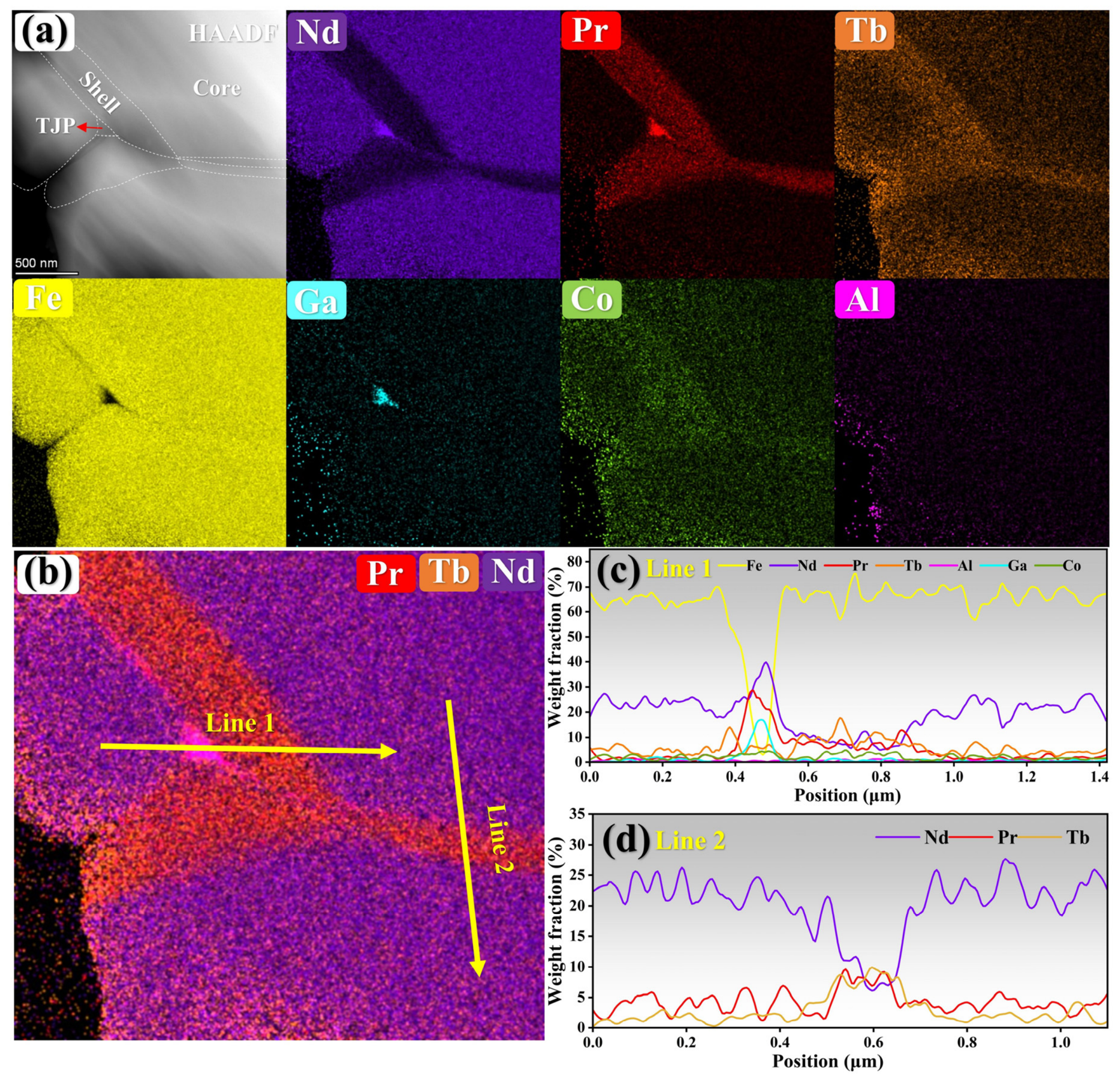
HAADF-STEM imaging and EDS analysis of the GBDPA magnet at a depth of approximately 50 μm reveal distinct elemental distributions in the grain cores, HRE-rich shells, and triple junction phase, as shown in Figure 7. The elemental maps and the superimposed Pr-Tb-Nd map show Tb enrichment along the grain peripheries. This is supported by the Line 2 profile, where increased Tb and Pr concentrations coincide with a decrease in Nd concentration, consistent with a shell enriched in Tb and Pr. The Line 1 profile additionally reveals local enrichment of Nd, Pr, and Ga, together with a pronounced reduction in Fe concentration, at the triple junction phase. These observations provide nanoscale compositional support for the shell structure and local elemental partitioning inferred from the EPMA results.
Figure 7.
(a) HAADF-STEM image and corresponding EDS elemental maps of the GBDPA magnet at approximately 50 μm below the diffusion surface. (b) Overlay of the Pr, Tb, and Nd maps showing the line-scan positions and directions. (c) EDS concentration profiles along Line 1. (d) EDS concentration profiles along Line 2.
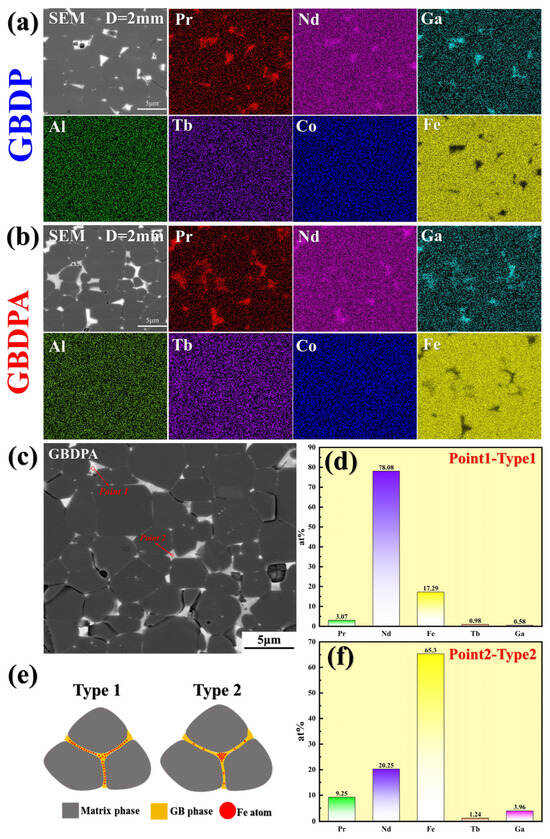
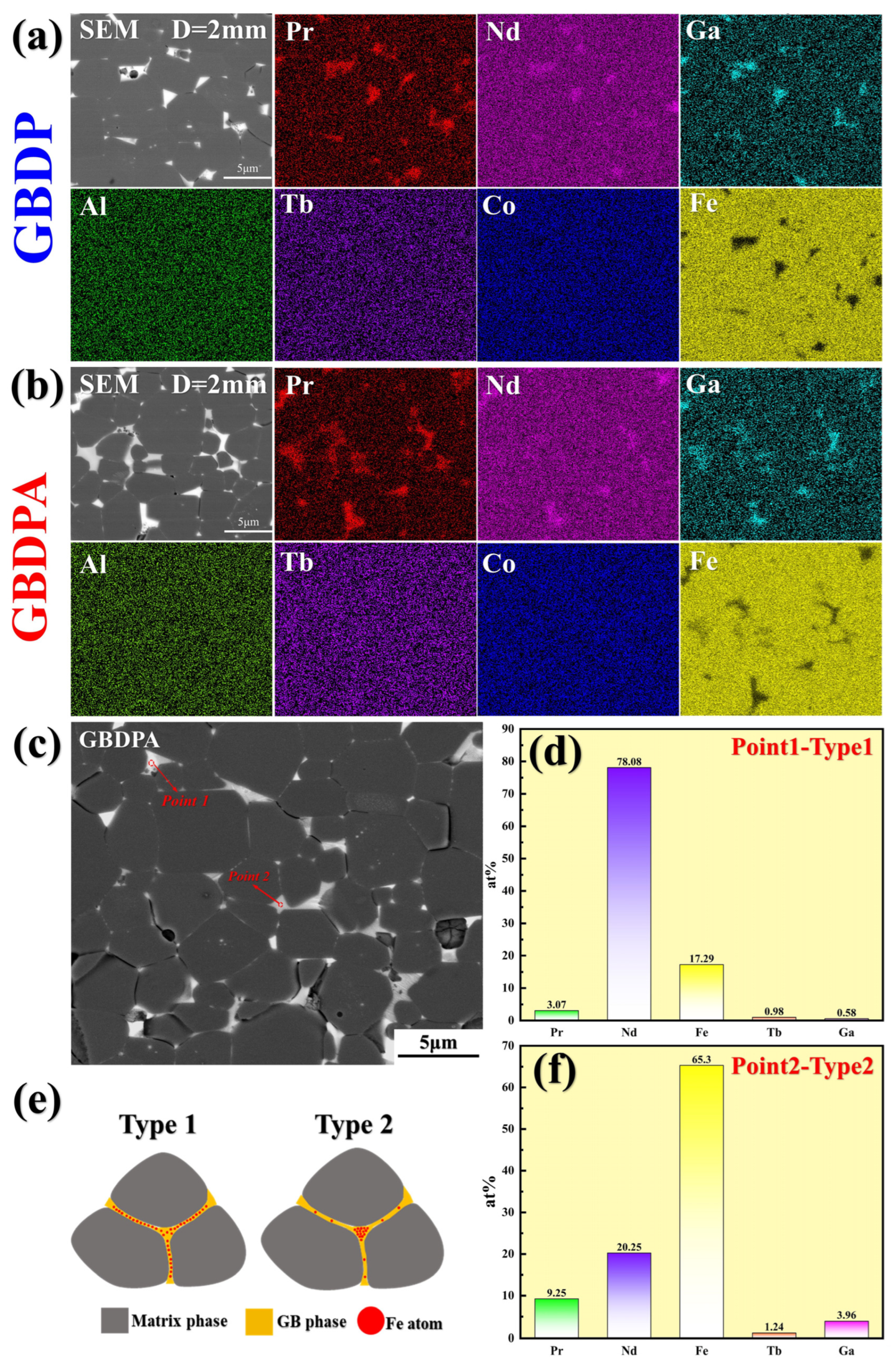
Figure 8a,b compare the SEM-EDS elemental maps of the GBDP and GBDPA magnets at a depth of 2 mm below the surface. In the GBDP magnet, most grain boundaries appear bright white in the BSE image, whereas only a few exhibit a light gray contrast. By contrast, the GBDPA magnet contains a large number of light gray grain boundary regions. EDS analysis shows that these light gray grain boundaries are enriched in Pr, Ga, and Nd, and contain a higher Fe concentration than the bright white regions. This microstructural feature is consistent with the characteristic grain boundary structure reported by Sasaki et al. and Qingfang Huang et al. for annealed Ga-doped sintered Nd-Fe-B magnets. Therefore, the light gray regions observed in the annealed magnet are described as Ga-containing RE-Fe intergranular constituents, with RE6Fe13Ga-related phases considered a possible assignment [25,26].
Figure 8.
Back-scattered images and EDS mapping results of GBDP (a) and GBDPA (b) magnets at the depth of 2 mm. (c) Locations selected for SEM-EDS point analysis. (d,f) Quantitative compositions of the Type 1 and Type 2 intergranular regions, respectively. (e) Schematic illustration of the proposed Fe redistribution mechanism.
Figure 8c shows the locations selected for EDS point analysis, with the corresponding compositions presented in Figure 8d,f. The bright Type 1 region is predominantly Nd-rich, containing 78.08 at.% Nd and 17.29 at.% Fe, together with minor amounts of Pr, Tb, and Ga. In contrast, the light gray Type 2 region contains 65.30 at.% Fe and exhibits higher Pr and Ga concentrations than the Type 1 region. These results distinguish two chemically different intergranular constituents: an Nd-rich region and a comparatively Fe-rich region containing Pr, Nd, and Ga. Such compositional heterogeneity provides a basis for considering the role of local Fe partitioning during annealing. Previous studies on Ga-containing Nd-Fe-B magnets have associated Nd6Fe13Ga-related phases and non-ferromagnetic grain boundary layers with improved magnetic isolation and enhanced coercivity [27,28]. Huang et al. also observed Fe enrichment near triple junctions accompanied by reduced Fe concentrations in the grain boundary phase [29].
Based on these observations, Figure 8e illustrates a possible redistribution mechanism in which preferential Fe partitioning into Type 2 regions is accompanied by a reduction in the Fe content of adjacent thin grain boundary layers. If such depletion occurs, it could weaken the ferromagnetic contribution of these layers and reduce intergranular exchange coupling. Although the present point analyses do not resolve the Fe balance between these regions, the proposed mechanism provides a possible link between the evolution of intergranular chemistry and the additional coercivity enhancement after annealing.
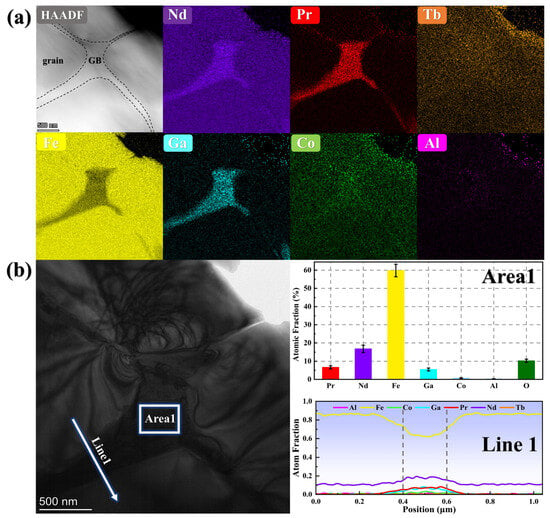
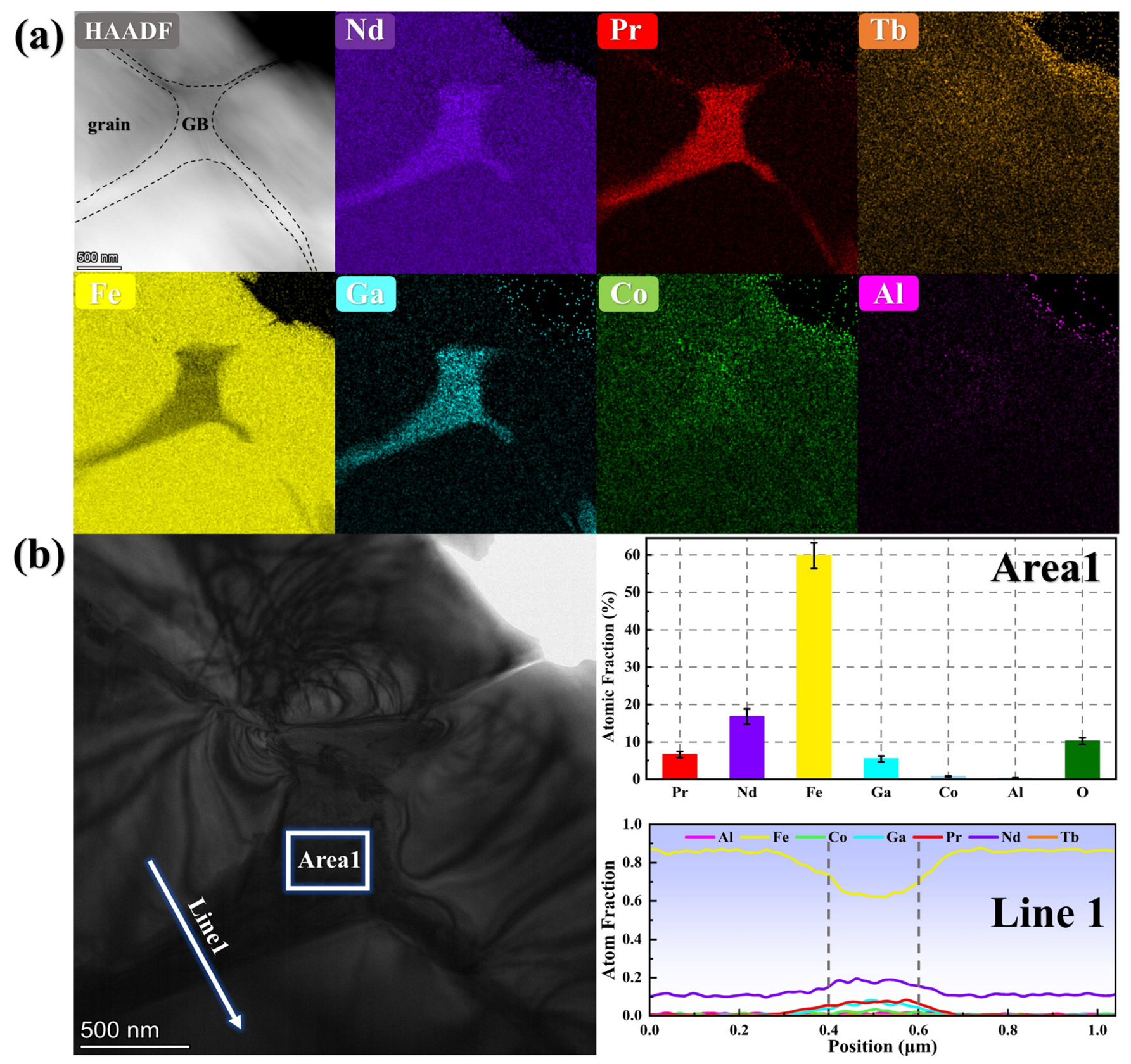
Figure 9 presents the TEM characterization of the GBDPA magnet at approximately 2 mm below the diffusion surface. Little Tb was detected in the examined region, whereas Pr and Ga were preferentially distributed within the intergranular regions. The quantitative EDS results for Area 1 (Table 2) reveal a Ga-containing RE-Fe composition. The Line 1 profile further shows increased Pr, Nd, and Ga concentrations accompanied by a decrease in Fe concentration relative to the adjacent matrix, demonstrating distinct elemental partitioning between the intergranular region and the matrix grains.
Figure 9.
Microstructural characterization of the GBDPA magnet at a depth of approximately 2 mm below the diffusion surface: (a) HAADF-STEM image and corresponding EDS elemental maps; (b) TEM image showing Area 1 and Line 1, together with the quantitative EDS results for Area 1 and the elemental concentration profiles along Line 1.
Table 2.
The quantitative EDS results for Area 1.
Together with the SEM-EDS observations in Figure 8, these results suggest that annealing-associated microstructural changes also occur in deeper regions where Tb enrichment is limited. RE6Fe13Ga-related phases are possible constituents of these Ga-containing intergranular regions, although their crystallographic identity remains unconfirmed. Previous studies have associated such phases and accompanying non-ferromagnetic grain boundary layers with improved magnetic isolation in Ga-containing Nd-Fe-B magnets [27]. The observed evolution of intergranular chemistry and morphology may therefore contribute to weaker exchange coupling between adjacent grains. This suggests that the additional coercivity enhancement after annealing may involve grain boundary modification in the magnet interior, alongside changes in the Tb-enriched regions closer to the diffusion surface. The measured coercivity represents the macroscopic reversal response of the complete specimen. Grain boundary modification in the Tb-lean interior may influence this response, but the present measurements do not resolve the local coercivity or establish whether the interior controls the onset of magnetisation reversal.
4. Conclusions
Under the investigated processing conditions, post-diffusion annealing at 500 °C for 2 h provides an additional coercivity enhancement from 23.20 to 24.24 kOe in magnets treated with Pr66Tb10(CoAlGa)24, with a remanence decrease of 0.08 kGs. This additional coercivity gain is accompanied by changes in elemental distribution and intergranular morphology. Tb-enriched shells are observed near the diffusion surface, while Ga-containing RE-Fe intergranular regions are present at approximately 2 mm depth, where Tb enrichment is limited. RE6Fe13Ga-related phases remain a possible assignment for these regions. The observations suggest that annealing modifies both the near-surface microstructure and the grain boundaries in the magnet interior. These changes may improve intergranular magnetic isolation and contribute to the additional coercivity enhancement.
Author Contributions
Conceptualization, C.Z. and Y.W.; Methodology, C.Z. and S.C.; Validation, Y.W., Z.D. and G.D.; Formal analysis, M.Z. and Y.Y.; Investigation, C.Z. and Y.W.; Resources, G.D. and S.G.; Data curation, Y.W., Z.D., M.Z. and Y.Y.; Writing—original draft, C.Z.; Writing—review & editing, C.Z., Z.D., S.C., S.G. and A.Y.; Visualization, C.Z., M.Z. and Y.Y.; Supervision, S.C., G.D., S.G. and A.Y.; Project administration, A.Y.; Funding acquisition, S.C., S.G. and A.Y. All authors have read and agreed to the published version of the manuscript.
Funding
This research was funded by [Public Project Funding from State Key Laboratory of Rare Earth Permanent Magnetic Materials] grant number [SKLREPM-PP-2025-05], [the National Natural Science Foundation of China] grant number [52401256].
Data Availability Statement
The original contributions presented in this study are included in the article. Further inquiries can be directed to the corresponding authors.
Conflicts of Interest
Authors Chen Zhang, Yaping Wu, Meng Zheng, Ye Yan were employed by the company Hefei Iron and Steel Research Institute of Rare Earth Permanent Magnetic Materials Co., Ltd. The remaining authors declare that the research was conducted in the absence of any commercial or financial relationships that could be construed as a potential conflict of interest.
References
- Gutfleisch, O.; Willard, M.A.; Brück, E.; Chen, C.H.; Sankar, S.G.; Liu, J.P. Magnetic materials and devices for the 21st century: Stronger, lighter, and more energy efficient. Adv. Mater. 2011, 23, 821–842. [Google Scholar] [CrossRef] [Scilit] [PubMed]
- Nakamura, H. The current and future status of rare earth permanent magnets. Scr. Mater. 2018, 154, 273–276. [Google Scholar] [CrossRef] [Scilit]
- Zhang, W.; Wang, Z.; Sun, X.; Cui, W.; Peng, H.; Yan, W.; Luo, Y.; Yu, D. Novel mechanism of the grain boundary diffusion process with Tb based on the discovery of TbFe2 phase. J. Mater. Sci. Technol. 2025, 214, 120–129. [Google Scholar] [CrossRef] [Scilit]
- Wang, Z.; Sasaki, T.; Une, Y.; Ohkubo, T.; Hono, K. Substantial coercivity enhancement in Dy-free Nd-Fe-B sintered magnet by Dy grain boundary diffusion. Acta Mater. 2023, 248, 118774. [Google Scholar] [CrossRef] [Scilit]
- Ming, X.; Han, X.; Wang, J.; Wang, L.; Xiong, J.; Liu, D.; Yan, G.; Shen, B. Shen, Comprehensively improved magnetic performance of Nd-Fe-B magnets with high-efficiency grain boundary diffusion of heavy rare earth. Vacuum 2024, 222, 113003. [Google Scholar] [CrossRef] [Scilit]
- Soderžnik, M.; Korent, M.; Soderžnik, K.Ž.; Katter, M.; Üstüner, K.; Kobe, S. High-coercivity Nd-Fe-B magnets obtained with the electrophoretic deposition of submicron TbF3 followed by the grain-boundary diffusion process. Acta Mater. 2016, 115, 278–284. [Google Scholar] [CrossRef] [Scilit]
- Jia, Z.; Li, Y.; Yang, X.; Cao, S.; Ding, G.; Guo, S.; Fan, X.; Xie, Y.; Xiong, Z.; Chen, R.; et al. Strategy of magnetic hardening region regulation enables a record enhanced energy product and high coercivity in Nd-Fe-B magnets. Rare Met. 2025, 44, 1267–1283. [Google Scholar] [CrossRef] [Scilit]
- Liu, R.; Qu, P.; Zhou, T.; Pan, W.; Li, M.; Huang, Q.; Zhong, Z. The diffusion behavior and striking coercivity enhancement by Dip-coating TbH3 powders in sintered NdFeB magnets. J. Magn. Magn. Mater. 2021, 536, 168091. [Google Scholar] [CrossRef] [Scilit]
- Zhou, T.; Guo, Y.; Xie, G.; Rehman, S.U.; Liu, R.; Liu, J.; Qu, P.; Li, M. Coercivity and thermal stability enhancement of NdFeB magnet by grain boundary diffusion Tb80Al20 alloys. Intermetallics 2021, 138, 107335. [Google Scholar] [CrossRef] [Scilit]
- Helbig, T.; Loewe, K.; Sawatzki, S.; Yi, M.; Xu, B.-X.; Gutfleisch, O. Experimental and computational analysis of magnetization reversal in (Nd,Dy)-Fe-B core shell sintered magnets. Acta Mater. 2017, 127, 498–504. [Google Scholar] [CrossRef] [Scilit]
- Zhang, Z.; Chen, H.; Jin, J.; Lim, B.; Liu, X.; Li, W.; Yan, M.; Ringer, S.P. On dysprosium utilisation in multi-main-phase Nd-Dy-Fe-B magnets with core-shell microstructures. Acta Mater. 2023, 261, 119344. [Google Scholar] [CrossRef] [Scilit]
- Vial, F.; Joly, F.; Nevalainen, E.; Sagawa, M.; Hiraga, K.; Park, K. Improvement of coercivity of sintered NdFeB permanent magnets by heat treatment. J. Magn. Magn. Mater. 2002, 242–245, 1329–1334. [Google Scholar] [CrossRef] [Scilit]
- Zhu, J.H.; Jin, L.; Jin, Z.H.; Ding, G.F.; Zheng, B.; Guo, S.; Chen, R.J.; Yan, A.R. Effects of post-sinter annealing on microstructure and magnetic properties of Nd-Fe-B sintered magnets with Nd-Ga intergranular addition. Chin. Phys. B 2021, 30, 067503. [Google Scholar] [CrossRef] [Scilit]
- Li, W.; Ohkubo, T.; Hono, K. Effect of post-sinter annealing on the coercivity and microstructure of Nd-Fe-B permanent magnets. Acta Mater. 2009, 57, 1337–1346. [Google Scholar] [CrossRef] [Scilit]
- Huang, Q.; Jiang, Q.; Hu, J.; Rehman, S.U.; Fu, G.; Quan, Q.; Huang, J.; Xu, D.; Chen, D.; Zhong, Z. Extraordinary simultaneous enhancement of the coercivity and remanence of dual alloy HRE-free Nd-Fe-B sintered magnets by post-sinter annealing. J. Mater. Sci. Technol. 2022, 106, 236–242. [Google Scholar] [CrossRef] [Scilit]
- Kim, T.-H.; Sasaki, T.; Ohkubo, T.; Takada, Y.; Kato, A.; Kaneko, Y.; Hono, K. Microstructure and coercivity of grain boundary diffusion processed Dy-free and Dy-containing Nd-Fe-B sintered magnets. Acta Mater. 2019, 172, 139–149. [Google Scholar] [CrossRef] [Scilit]
- Chen, F.; Zhang, L.; Jin, Y.; Cheng, Y. Simultaneous enhancement of the coercivity and remanence at high temperatures in a sintered Nd-Fe-B magnet after grain boundary diffusion with Dy60Co40 alloy. Mater. Charact. 2018, 144, 547–553. [Google Scholar] [CrossRef] [Scilit]
- Lu, K.; Bao, X.; Tang, M.; Sun, L.; Li, J.; Gao, X. Influence of annealing on microstructural and magnetic properties of Nd-Fe-B magnets by grain boundary diffusion with Pr-Cu and Dy-Cu alloys. J. Magn. Magn. Mater. 2017, 441, 517–522. [Google Scholar] [CrossRef] [Scilit]
- Qian, R.; Ma, Y.; Chen, F.; Sun, H.; Zhao, Y.; Chen, Y. Effect of annealing temperature on magnetic properties of a sintered Nd-Fe-B magnet after grain boundary diffusion with Dy70Cu30 alloy. J. Rare Earths 2024, 42, 116–120. [Google Scholar] [CrossRef] [Scilit]
- Feng, Q.; Huang, D.; Zhao, L.; Fan, J.; Jin, L.; Pan, Y.; Hong, Y.; Liu, X.; Pan, A.; Jia, H.; et al. Overcoming refractory REFe2 phase bottleneck in high-Ce Nd-Ce-Fe-B magnets via praseodymium-induced phase transformation: Enabling liquid-phase grain boundary diffusion of dysprosium. Adv. Funct. Mater. 2025, 27, e25964. [Google Scholar] [CrossRef] [Scilit]
- Song, R.; Zhao, H.; Feng, H. Pr-Tb synergistic strengthening on coercivity of Nd-Ce-Fe-B magnets grain boundary diffused with Pr-Tb-Al-Ga alloys. J. Rare Earths 2024, 42, 1704–1709. [Google Scholar] [CrossRef] [Scilit]
- He, J.; Hu, J.; Zhou, B.; Jia, H.; Liu, X.; Zhang, Z.; Wen, L.; Zhao, L.; Yu, H.; Zhong, X.; et al. Simultaneous enhancement of coercivity and electric resistivity of Nd-Fe-B magnets by Pr-Tb-Al-Cu synergistic grain boundary diffusion toward high-temperature motor rotors. J. Mater. Sci. Technol. 2023, 154, 54–64. [Google Scholar] [CrossRef] [Scilit]
- Cao, S.; Cheng, P.; Li, C.; Zhang, C.; Ding, G.; Xie, Y.; Fan, X.; Guo, S.; Zheng, B.; Chen, R.; et al. Coercivity enhancement and microstructure evolution in Nd-Fe-B sintered magnets by grain boundary diffusing Pr-Co-Al-Ga alloys. J. Magn. Magn. Mater. 2025, 633, 173549. [Google Scholar] [CrossRef] [Scilit]
- Li, C.; Cao, S.; Wang, H.; Xie, R.; Si, Y.; Xiong, Z.; Ding, G.; Guo, S.; Chen, R.; Zheng, J.; et al. Microstructural evolution and diffusion behaviors of Dy and Tb in sintered Nd-Fe-B magnets via grain boundary diffusion of Pr55DyxTb17−xM28 (M = Fe, Al, Ga) multi-component alloys. J. Mater. Res. Technol. 2025, 39, 8443–8456. [Google Scholar] [CrossRef] [Scilit]
- Sasaki, T.; Ohkubo, T.; Takada, Y.; Sato, T.; Kato, A.; Kaneko, Y.; Hono, K. Formation of non-ferromagnetic grain boundary phase in a Ga-doped Nd-rich Nd-Fe-B sintered magnet. Scr. Mater. 2016, 113, 218–221. [Google Scholar] [CrossRef] [Scilit]
- Huang, Q.; Jiang, Q.; Shi, Y.; Rehman, S.U.; Wei, X.; Li, Z.; Shi, D.; Xu, D.; Zhong, Z. Enormous improvement of the coercivity of Ga and Cu co-doping Nd-Fe-B sintered magnet by post-sinter annealing. J. Alloys Compd. 2022, 894, 162418. [Google Scholar] [CrossRef] [Scilit]
- Billington, D.; Okazaki, H.; Toyoki, K.; Kotani, Y.; Takada, Y.; Sato, T.; Kaneko, Y.; Kato, A.; Sasaki, T.T.; Ohkubo, T.; et al. Relationship between the microstructure, local magnetism and coercivity in Ga-containing Nd-Fe-B sintered magnets. Acta Mater. 2021, 205, 116517. [Google Scholar] [CrossRef] [Scilit]
- Sasaki, T.; Takada, Y.; Okazaki, H.; Ohkubo, T.; Nakamura, T.; Sato, T.; Kato, A.; Kaneko, Y.; Hono, K. Role of Ga on the high coercivity of Nd-rich Ga-doped Nd-Fe-B sintered magnet. J. Alloys Compd. 2019, 790, 750–759. [Google Scholar] [CrossRef] [Scilit]
- Huang, Q.; Jiang, Q.; Shi, Y.; Rehman, S.U.; Shi, D.; Fu, G.; Li, Z.; Xu, D.; Chen, D.; Zhong, Z. The influence of Gallium doping on the magnetic performance and microstructure of Nd-Fe-B sintered magnets. J. Magn. Magn. Mater. 2022, 552, 169242. [Google Scholar] [CrossRef] [Scilit]

Disclaimer/Publisher’s Note: The statements, opinions and data contained in all publications are solely those of the individual author(s) and contributor(s) and not of MDPI and/or the editor(s). MDPI and/or the editor(s) disclaim responsibility for any injury to people or property resulting from any ideas, methods, instructions or products referred to in the content. |
© 2026 by the authors. Licensee MDPI, Basel, Switzerland. This article is an open access article distributed under the terms and conditions of the Creative Commons Attribution (CC BY) license.