


Abstract
This study reports the fabrication of Al 1050/WC composites (2 and 4 wt.% WC) using a novel ingot-stacked, disc-consolidated approach via indirect extrusion. The results revealed that indirect extrusion transformed the initial flat, WC-coated disc interfaces into a geometrically ordered concentric ring distribution across the composite cross-section. This architecture exhibited local variable thickness and angular discontinuities due to non-uniform material flow. X-ray diffraction confirmed interfacial stability at 485 °C and detected only the Al and WC phases. X-ray computed tomography quantified an overall porosity of 2.04 vol.%, characterized by irregularly shaped pores resulting from incomplete solid-state consolidation. Higher cross-sectional microhardness values were obtained at 47.8 ± 3.6 HV (2 wt.% WC) and 49.75 ± 5.6 HV (4 wt.% WC). Uniaxial tensile tests yielded ultimate tensile strengths of 81.05 ± 3.43 MPa (2 wt.% WC) and 89.45 ± 2.85 MPa (4 wt.% WC), which exceed the value reported for annealed Al 1050 by 62% and 79%. This flow-induced formation of a concentric reinforcement architecture through disc stacking and indirect extrusion provides a novel processing route, extending solid-state functional gradient material processing to single-step thermomechanical consolidation.
1. Introduction
Aluminum matrix composites (AMCs) reinforced with ceramic particles are widely used as structural materials because of their low density, high specific stiffness, and tunable mechanical response [1,2]. Among the various ceramic reinforcements, tungsten carbide (WC) is particularly attractive due to its high hardness (18–22 GPa) and exceptionally high Young’s modulus (~700 GPa), which is approximately twice that of most transition-metal carbides and an order of magnitude greater than pure aluminum (70 GPa) [3,4]. Additionally, WC retains its hardness at elevated temperatures, making it well suited for applications that demand simultaneous abrasion resistance and structural integrity. The mechanical behavior of particle-reinforced AMCs is governed not only by the intrinsic properties of the constituent phases but also by the spatial distribution and interfacial integrity of the reinforcement within the matrix [1]. While conventional AMCs rely on a homogeneous dispersion of fine ceramic particles to activate strengthening mechanisms such as Orowan bypass, Hall–Petch grain refinement, and load transfer [1,5], recent developments have shifted toward architecturally controlled, non-uniform reinforcement distributions.
These heterogeneous configurations tailor local mechanical performance, offering spatial control that homogeneous dispersions cannot replicate [6,7]. Specifically, concentric or radially graded reinforcement configurations enable spatially tuned stress distribution, damage tolerance, and wear resistance. Higher reinforcement content near the surface enhances hardness and abrasion resistance. Lower content in the core preserves the matrix’s ductility, making this combination of interest for components subject to differential surface–core loading in sliding contact, such as bushings, liners, pins and shafts [6,7,8]. However, engineered heterogeneity also introduces localized stress concentrations, particle clustering, and a higher susceptibility to interfacial reactions [1,2]. In Al–WC systems processed at elevated temperatures, brittle interfacial reaction products (e.g., Al12W, Al5W, and Al4C3) can exacerbate these detrimental effects. These reactions have been reported to begin around 550 °C, compromising interfacial integrity and promoting crack initiation at the reinforcement–matrix boundary [9,10]. Therefore, selecting a consolidation process that induces microstructural refinement while remaining below this critical temperature threshold is paramount. Hot extrusion is an effective consolidation route because it imposes large plastic strains that promote microstructural refinement and redistribution of reinforcement phases [11]. Although severe plastic deformation (SPD) strictly refers to processes that impose high strain without net dimensional change [12], hot extrusion can achieve comparable strain levels through area reduction. In particular, indirect extrusion eliminates friction between the billet and the container wall, yielding a more uniform deformation field and requiring lower processing forces relative to direct extrusion [13]. Despite these manufacturing advantages, the resulting three-dimensional spatial architecture of the reinforcement phase in Al–WC composites remains largely uncharacterized. A central gap in the literature is the ability to engineer these reinforcement distributions precisely through thermomechanical process design. Solid-state fabrication routes for functionally graded materials (FGMs), such as powder metallurgy, spark plasma sintering, and additive manufacturing, have been reviewed in detail [14].
On the other hand, radial reinforcement gradients in bulk metal matrix composites have been produced primarily through three routes. Centrifugal casting requires a liquid stage and relies on density-driven particle segregation to establish the gradient [8,15,16]. Multi-step powder metallurgy and additive routes build the gradient by sequentially layering compositionally distinct feedstocks, with each layer requiring separate deposition and consolidation [14,17,18]. Friction stir processing generates heterostructured reinforcement distributions, but the modified region is confined to a surface layer and multiple passes are required [19]. In all three cases, the gradient geometry is defined either by a density contrast or by the deposition sequence and is therefore established before or independently of consolidation. For the Al-WC system in particular, liquid-state routes are further constrained: the disparity in melting point (2870 vs. 660 °C) and density (15.63 vs. 2.70 g/cm3), together with the poor wettability of WC by molten aluminum, promotes segregation, clustering and weak interfacial bonding [19,20], and conventional casting temperatures exceed the reported onset of the Al-WC interfacial reaction (~550 °C) [9,10]. In this sense, the present work follows a different principle. The reinforcement is concentrated at the planar disc face of a disc-stacked billet, and the extrusion flow field generates the spatial architecture during a single solid-state consolidation step. Because the radial velocity gradient inherent to axisymmetric extrusion converts initially planar transverse surfaces into nested curved surfaces of increasing curvature [21,22], the WC-coated interfaces are reorganized into a quasi-concentric shell architecture whose position is dictated by the flow field rather than by gravity, density or deposition order. Large-strain hot deformation has been shown to generate ordered spatial architectures through plastic-flow patterning at interphase boundaries [23] and through controlled material flow [11], yet thermomechanical consolidation of this type remains absent from existing FGM classification [14,17,18,24].
Thus, this study addresses a new fabrication method for Al 1050/WC composites (2 and 4 wt.% WC) from disc-stacked billets consolidated by single-step indirect extrusion. Thus, the objectives of this study are (i) to characterize the three-dimensional WC distribution in the representative 4 wt.% composite using SEM and X-ray computed tomography (X-CT); (ii) to quantify the microhardness and tensile response of both compositions; and (iii) to correlate the flow-induced concentric reinforcement architecture with the resulting radial hardness gradients.
2. Materials and Methods
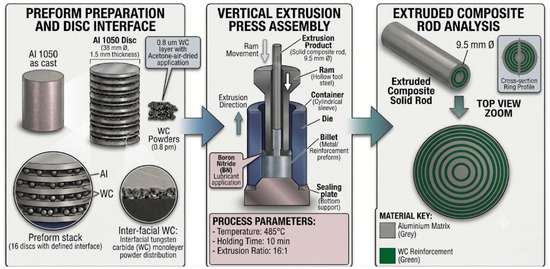
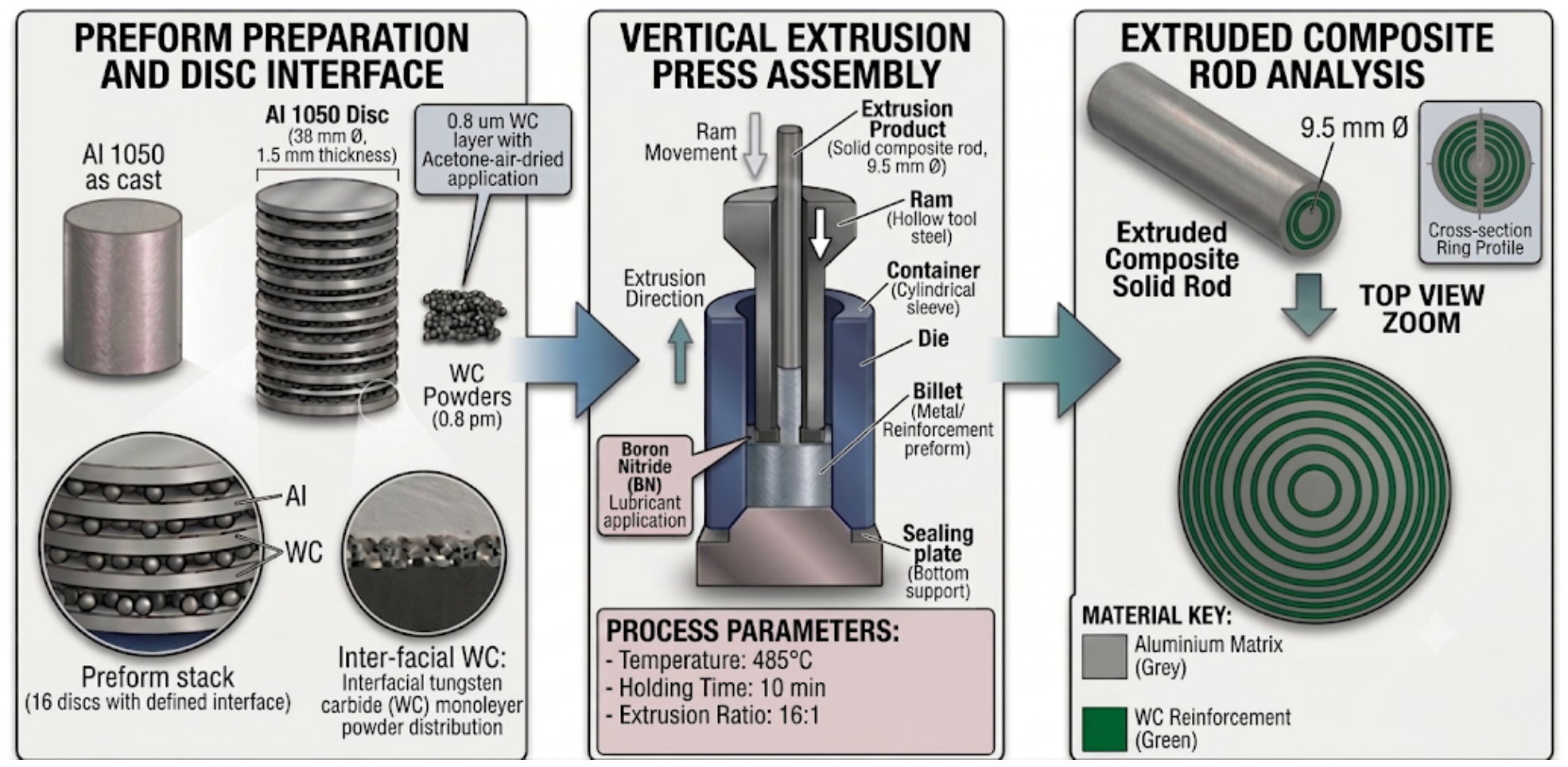
Al 1050/WC composites containing 2 and 4 wt.% WC were fabricated by disc stacking via a solid-state route, followed by indirect hot extrusion. The complete fabrication sequence is schematically illustrated in Figure 1.
Figure 1.
Schematic of the fabrication route: (left) starting materials; (center) indirect extrusion setup; (right) resulting composite rod.
2.1. Materials
Commercially pure Al 1050 (Al 1050, Viakon, Monterrey, Mexico) was selected as the matrix because it is a non-precipitation-hardenable alloy; hardness variation across the extruded section can be attributed to the reinforcement architecture and deformation structure, without a superimposed contribution from precipitates, and its low flow stress permits a 16:1 area reduction in a single indirect-extrusion step at 485 °C, below the reported onset of the Al–WC interfacial reaction. Thus, Al 1050 was selected to isolate the architectural variable, not to maximize absolute mechanical performance.
Tungsten carbide (Inframat Advanced Materials, Manchester, CT, USA) was selected as the reinforcement for its hardness (18–22 GPa), Young’s modulus (~700 GPa, about ten times that of aluminum), and its hardness retention at elevated temperatures [3,4]. The reported onset temperature of the Al–WC interfacial reaction (~550 °C) [9,10] defines the available processing window and allowed the thermal cycle to be designed. WC also provides atomic-number contrast with the matrix (Z = 74 against 13), on which both backscattered-electron imaging and X-ray computed tomography attenuation contrast depend; it therefore acts as both the strengthening phase and a marker of the extrusion flow field, which makes the flow-induced architecture directly observable. Furthermore, at the reinforcement contents used here, the choice of reinforcement has little effect on component density; at 4 wt.% the calculated composite density is 2.79 g/cm3 versus 2.69 g/cm3 with B4C, the least dense of the common ceramic reinforcements, a difference below 4%.
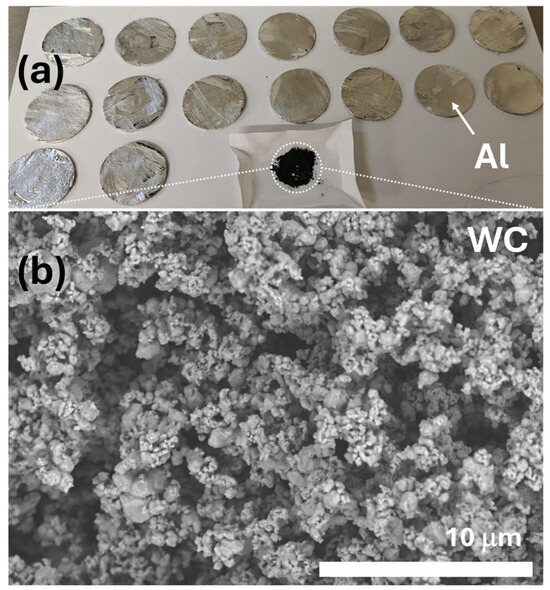
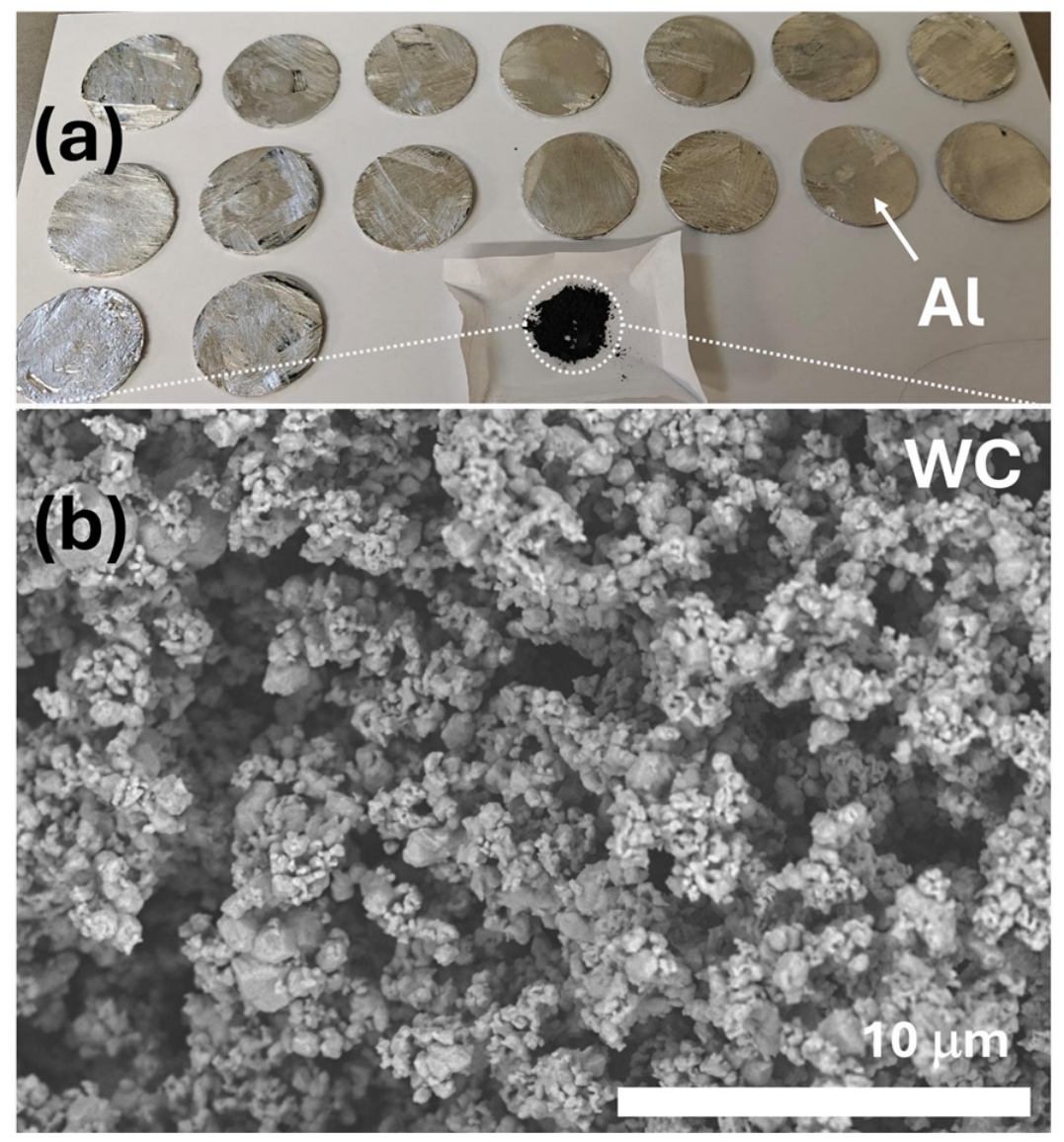
The matrix was supplied as commercially pure Al 1050 wire, which was remelted and cast into a laboratory billet. The billet was sectioned into sixteen discs and ground to final thickness; the disc faces were ground to 800 grit before coating. The WC particles had a manufacturer-specified average particle size of 0.8 µm and 99.9% purity. Figure 2 shows the as-received WC powder and the Al 1050 discs used to assemble the billets.
Figure 2.
Starting materials. (a) The 16 Al 1050 discs used to assemble one extrusion billet, shown together with the as-received WC powder; (b) SEM micrograph of the as-received WC powder.
2.2. Reinforcement Content
Two reinforcement contents differing by a factor of two, 2 and 4 wt.%, were examined to evaluate whether the concentric architecture forms and whether its effect scales with the amount of reinforcement. The WC mass was determined gravimetrically as a weight fraction of the Al 1050 matrix, and the reported values are nominal.
The as-received WC powder was sieved through a 325 mesh (45 µm) screen to remove coarse agglomerates and dispersed in acetone. The suspension was kept agitated during application; two drops were applied to each disc face, which was then air-dried at room temperature to evaporate the solvent. Unlike previous studies aimed at achieving a homogeneous reinforcement distribution, this work deliberately concentrates WC particles at the planar disc face. During subsequent extrusion, the radial velocity gradient inherent to axisymmetric flow [22,23] converts these WC-rich interfaces into a quasi-concentric architecture. This solid-state approach builds on the authors’ prior work on powder-metallurgy Al–Cu–Mg/WC composites [20].
2.3. Billet Assembly and Extrusion
The extrusion billets were assembled from sixteen coated discs, 38 mm in diameter and 1.5 mm nominal thickness (Figure 2a), stacked coaxially to create fifteen internal coated interfaces.
Before extrusion, the assembled billets were soaked in the extrusion die at 475 °C for 10 min to ensure temperature uniformity and reduce the flow stress of the Al 1050 matrix; extrusion was performed at 485 °C. This processing temperature was selected to remain below the reported onset temperature for Al–WC interfacial reactions (~550 °C) [9,10]. Indirect hot extrusion was performed at an extrusion ratio of 16:1, yielding bars with a nominal diameter of 9.5 mm. The indirect configuration was specifically chosen to eliminate billet–container friction, thereby reducing both the extrusion load and the redundant shear deformation typical of direct extrusion [13,22]. Boron nitride (BN) was applied as a lubricant to minimize friction at the die land. Extrusion was performed through a flat circular die, and the extruded bars were cooled to room temperature in still air. The billets of the two compositions were assembled, coated and extruded independently under the same conditions.
2.4. Metallographic Preparation and Microstructural Characterization
Metallographic specimens were sectioned from the extruded bar 200 mm from its leading end, hot-mounted in resin, ground with successive SiC abrasive papers down to 2000 grit and polished to a mirror finish using a 1 µm alumina suspension on a standard cloth. Phase identification was performed via X-ray diffraction (XRD) on the polished transverse sections using a PANalytical X’Pert PRO diffractometer (Malvern Panalytical, Almelo, The Netherlands) operated at 40 kV and 35 mA with Cu Kα radiation (λ = 0.15406 nm) over a 2θ range of 20–120°. Microstructural characterization was carried out by scanning electron microscopy (SEM) in backscattered electron (BSE) mode using a Hitachi SU3500 microscope (Hitachi High-Tech Corporation, Tokyo, Japan) operated at 15 kV. This mode leveraged the atomic-number contrast between the Al matrix (Z = 13) and the W-rich WC phase (W:Z = 74), and was complemented by energy-dispersive X-ray spectroscopy (EDS) mapping of Al and W to confirm the spatial distribution of the reinforcement phase. Three-dimensional reconstruction of the reinforcement architecture was performed via X-ray computed tomography (X-CT) using a Nikon XT H 225 system (Nikon Metrology, Tokyo, Japan) operated at 220 kV and a tube current of up to 1 mA, equipped with a Cu beam filter to minimize beam-hardening artifacts. A total of 5016 projections were acquired at 8 frames per projection with an exposure time of 333 ms per frame. Volume reconstruction yielded an isotropic voxel size of 81.80 µm, set by the acquisition geometry required to capture the full 170 mm bar length in a single scan. All detection limits reported here refer to this value. Volumetric analysis and porosity quantification were conducted with the porosity and inclusion analysis module of VGSTUDIO MAX 3.4.5. Following standard metrological criteria for reliable defect detection in industrial CT, only pores with an equivalent diameter of at least three voxels (≥27 voxels in volume) were considered metrologically valid [25].
2.5. Microhardness
Vickers microhardness (HV0.05, 10 s dwell time) was measured on polished transverse cross-sections using an LM300AT microindentation hardness tester (LECO Corporation, St. Joseph, MI, USA) in accordance with ASTM E384 [26]. Measurements were taken in a cruciform pattern consisting of two perpendicular diametral traverses (L1 and L2) with 14 indentations each, yielding a total of 28 indentations per specimen. The indentations were spaced 0.670 mm apart along each traverse and centered on the cross-section’s geometric center. Hardness values are reported as the point mean (L1 + L2)/2 at each radial position and are further aggregated by radial zone (peripheral, mid-radius, and core).
2.6. Tensile Testing
Uniaxial tensile tests were conducted at room temperature using an Instron universal testing machine at a constant crosshead speed of 5 mm/min. Although the test parameters—such as gripping arrangement and loading rate—followed the general provisions of ASTM B557 [27], the specimens were tested as full-section, as-extruded bars rather than being machined to a standardized reduced-gauge geometry. Machining to a reduced-gauge geometry would remove the peripheral material, in which the reinforcement shells are most closely spaced and the hardness is highest, so that a machined specimen would not sample the architecture examined here; with the bar diameters obtained (9.37–10.00 mm), a standardized reduced section would additionally have removed a substantial fraction of the radius. Consequently, the reported tensile values serve as comparative performance indicators between compositions rather than standardized material properties. Each specimen had a total length of 80 mm and a free length between grips of 25.4 mm. The cross-sectional area of each specimen was determined individually with a digital micrometer before testing to calculate the engineering stress. Three specimens were tested per composition. No extensometer was used, so crosshead displacement includes machine compliance and grip settlement and does not represent specimen elongation. Presenting the data as stress–strain would require assuming that the entire displacement corresponds to material deformation and would yield strain and modulus values that are not material properties. The measured quantity is therefore reported. The mechanical properties were compared with the value reported for annealed Al 1050 in [28].
3. Results and Discussion
3.1. Three-Dimensional Reinforcement Architecture
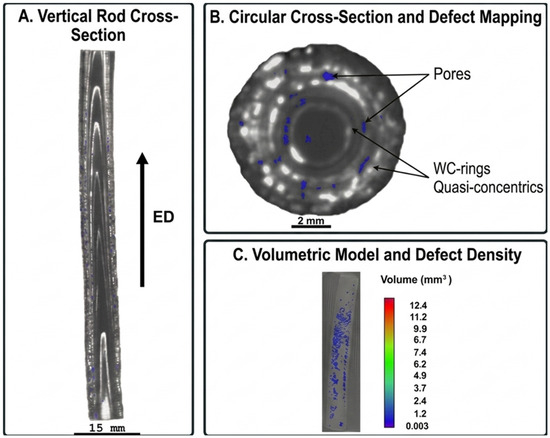
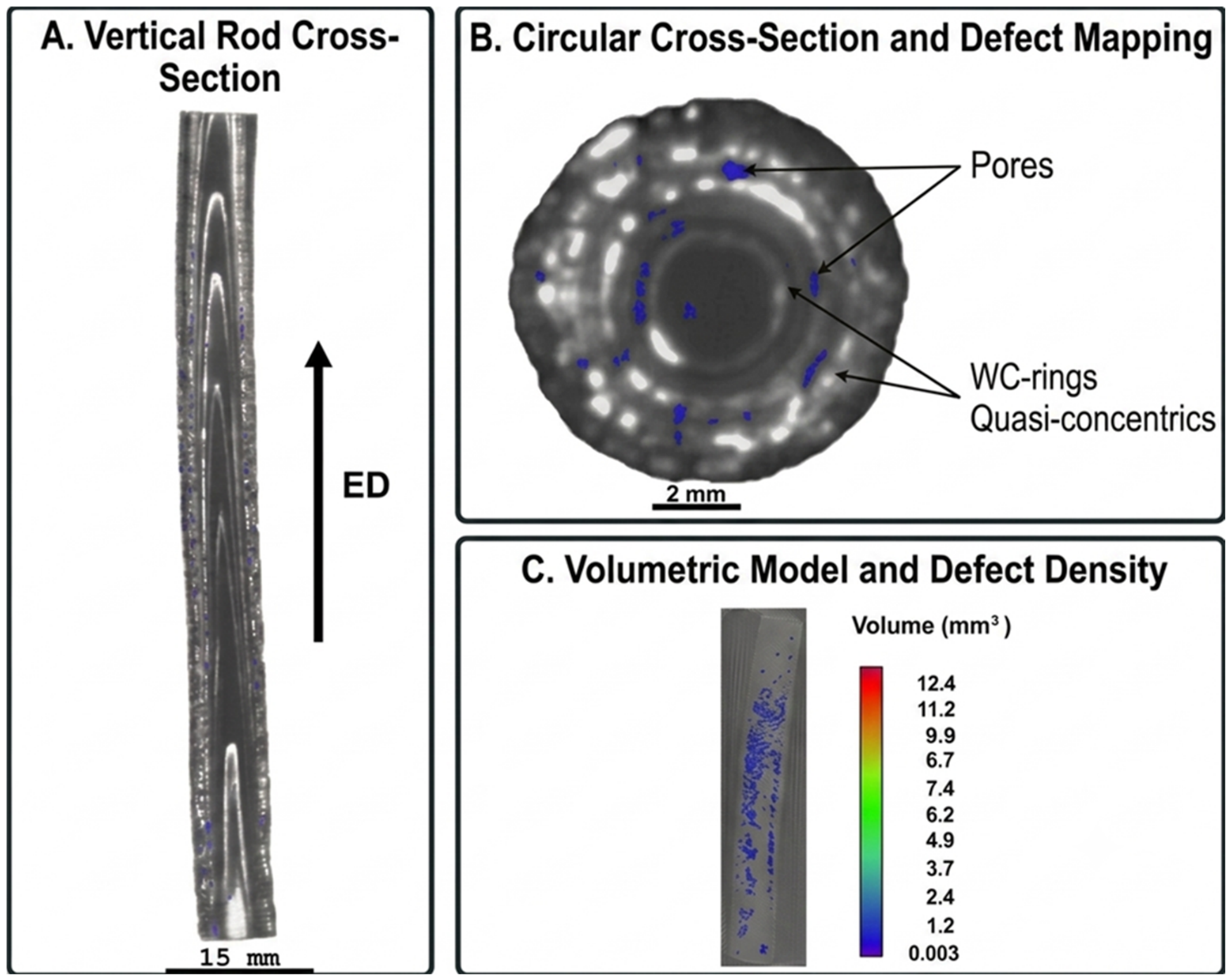
X-CT analysis was performed on the 1050/4 wt.% WC composite as a representative composition for three-dimensional architectural characterization (Figure 3), as its higher reinforcement content provides sharper contrast between the WC-rich rings and the Al matrix within the reconstructed volume. The reconstructed voxel size (81.80 µm) is approximately two orders of magnitude larger than the WC primary particle size, so individual particles are not resolved; the tomographic reconstruction detects WC-rich bands through attenuation contrast. The longitudinal reconstruction demonstrates that the WC-rich interfaces—originally planar disc boundaries in the stacked billet—were transformed by the extrusion flow into a series of nested conical domains. Each domain corresponds to a single disc interface that was simultaneously compressed and elongated along the extrusion axis. The transverse section confirms the quasi-concentric ring pattern and reveals its inherently three-dimensional nature: the rings form irregular concentric shells of variable cross-sectional thickness. Although their axis of symmetry approximately coincides with the bar axis, flow inhomogeneities locally displace it. This departure from ideal geometric concentricity is consistent with the discrete nature of the disc-stacking precursor. A count of the concentric WC-rich bands in both the X-CT transverse sections and the SEM micrographs yields approximately 14–16 resolved shells. These shells correspond to the 15 internal interfaces formed between the 16 stacked discs, with the two outermost coatings constituting the bar ends rather than internal rings. This count-level correspondence directly links each concentric shell to an original disc interface, confirming that the architecture originates from the stacked precursor rather than flow instabilities. Valberg [22] demonstrated experimentally, using AlCu2.5 indicator pins inserted into AlMgSi billets extruded at reduction ratios of 10 and 40, that planar transverse cross-sections of a billet are converted into curved surfaces whose curvature increases radially; consequently, peripheral material reaches the die mouth later than axial material from the same original cross-section.
Figure 3.
X-CT analysis of the Al 1050/4 wt.% WC composite.
In this configuration, the differential flow converts each WC-coated planar disc interface into a conical shell of increasing curvature. Finite element modeling of axisymmetric aluminum extrusion further corroborates that subsurface billet layers undergo a progressive spatial redistribution governed by the differential velocity field between the peripheral and axial zones during the extrusion stroke [21]. Non-uniform lateral material flow, coupled with local thickness variations in the initial WC slurry coatings, generates the observed ring irregularities. Quantitative porosity analysis of the reconstructed volume was conducted. Within the nominal sample volume (D = 9.5 mm, scanned length 170 mm), the overall porosity fraction was 2.04 vol.% (3672 reliable pores). This value lies between a lower bound of 1.37 vol.%, obtained when only features at least five voxels across are counted (≥125 voxels), and an upper bound of 2.23 vol.%, obtained when every detected feature is counted (≥1 voxel). The reported value uses the three-voxel criterion defined in Section 2.4, equivalent to a pore diameter of 305 µm. Equivalent pore diameters ranged from 305 µm to 2.88 mm, with a median of 374 µm. The 3672 reliable pores account for 91.5% of the total detected pore volume, while the remaining pores correspond to sub-threshold voids below the reliability limit. Conversely, a small number of larger pores (exceeding 1 mm and reaching up to 2.88 mm in equivalent diameter) account for a disproportionate fraction of the total detected pore volume, despite representing only a minor fraction of the total pore count. These pores are predominantly irregular, with a median sphericity of 0.50 that decreases progressively as pore size increases. Specifically, the median sphericity drops from 0.51 for pores in the 0.3–0.5 mm range to 0.41 for those in the 0.5–1 mm range, and to 0.25 for pores exceeding 1 mm. Notably, all pores larger than 1 mm exhibit an elongated morphology (sphericity < 0.5). This highly irregular, elongated morphology indicates incomplete solid-state bonding at the stacked-disc interfaces rather than rounded voids from trapped gas. The theoretical densities calculated by the rule of mixtures are 2.74 g/cm3 for the 2 wt.% WC composite and 2.79 g/cm3 for the 4 wt.% WC composite. Applying the tomographically determined porosity of 2.04 vol.% to the 4 wt.% composite gives an effective density of 2.73 g/cm3, corresponding to a relative density of 97.96%.
Furthermore, porosity varied between 1.2 and 2.9 vol.% across ten 17 mm segments along the scanned length, with no systematic axial trend, indicating that the scanned bar segment represents the volume sampled by the tensile specimens. Although a global porosity of 2.04 vol.% and individual pores up to 2.88 mm are non-trivial for a structural composite, they reflect an inherent trade-off of this single-step processing route, in which consolidation relies solely on extrusion without a prior densification stage. In principle, a higher consolidation temperature—maintained below the ~550 °C reaction onset threshold—could reduce residual porosity while preserving interfacial stability. Crucially, the larger pores (>1 mm) are distributed throughout the volume rather than clustered. Continuous Al-rich pathways between the WC-rich rings provide ductile ligaments that allow the material to sustain loads beyond tensile yielding, whereas isolated large pores can act as crack-initiation sites [29]. The premature fracture of one Al 1050/4 wt.% WC specimen is consistent with initiation at such a defect, although the fracture surfaces were not examined and the initiation site was not identified. Within the FGM classification framework proposed by Sayyad & Wagh [14], this composite is best described as a discontinuous, radially graded, bulk material produced via a flow-based solid-state route. The WC-rich bands become progressively closer together toward the periphery, a feature consistently observed across transverse slices throughout the X-CT volume. This structural trend qualitatively indicates that the effective reinforcement content is higher near the surface than at the core, representing an architectural fabrication approach not explicitly covered by current FGM classification schemes.
3.2. Microstructural Analysis and Phase Identification of the Reinforcement Architecture
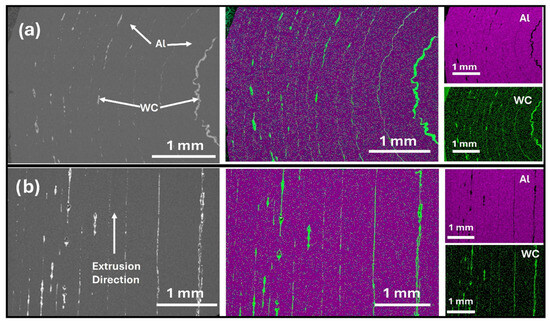
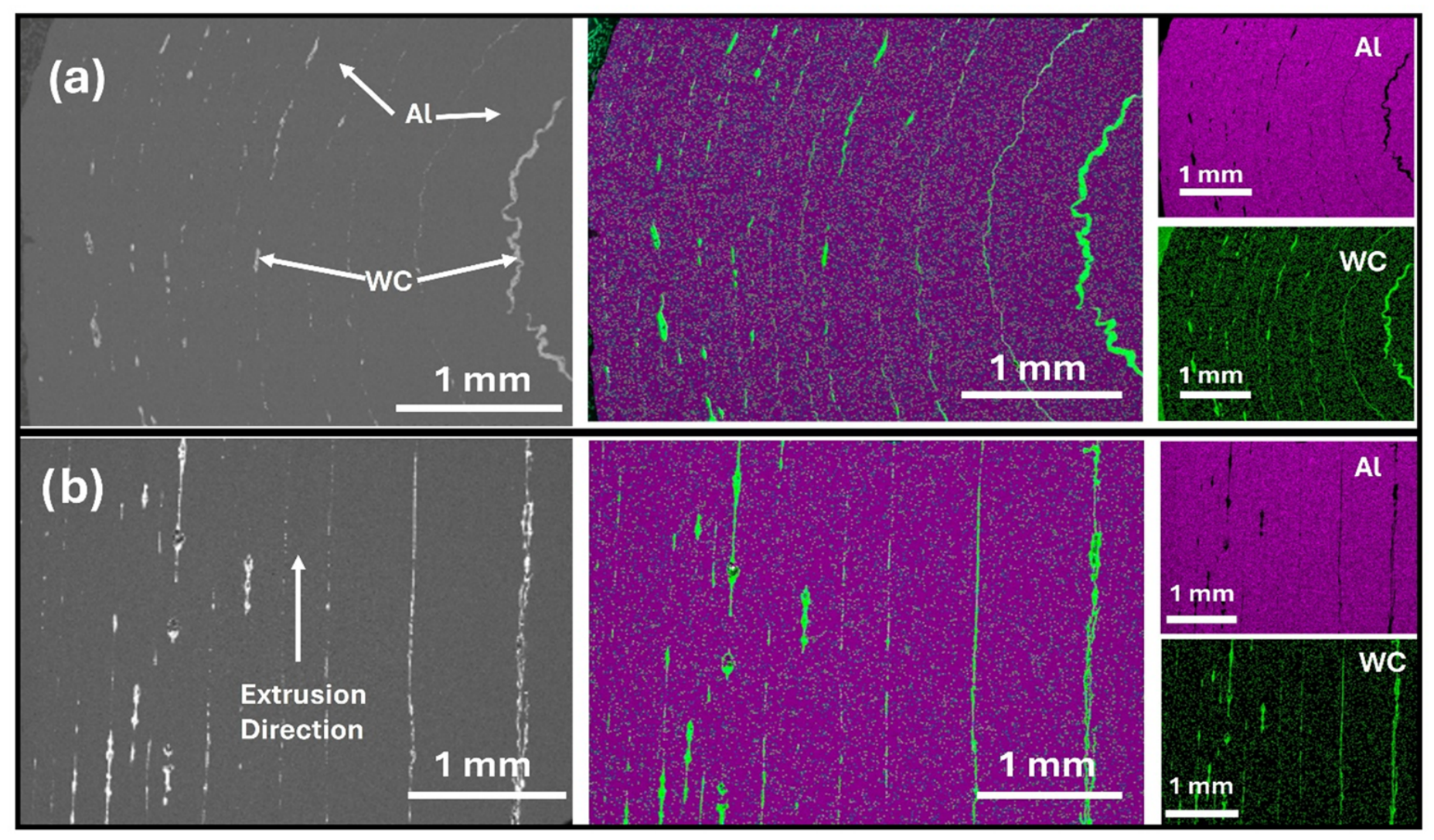
SEM-BSE imaging, EDS elemental mapping and XRD of the Al 1050/4 wt.% WC composite are presented in Figure 4. The BSE image clearly distinguishes the WC-rich regions from the Al matrix. The transverse section (Figure 4a) reveals a periodically banded WC distribution arranged in a quasi-concentric pattern around the bar axis. These rings exhibit variable local thickness and angular discontinuities; rather than geometrically perfect cylinders, the WC-rich bands form irregular concentric shells whose cross-sectional width fluctuates along the circumference. At the magnifications used, individual WC particles are not resolved; the bright bands correspond to consolidated WC-rich regions formed at the original disc interfaces. This morphology directly reflects the non-uniform compression and lateral material flow each disc interface experiences during indirect extrusion. Experimental grid-pattern studies of axisymmetric Al extrusion have demonstrated that shear strain is negligible along the billet axis and rises progressively toward the billet surface [22]. This radial velocity gradient, further documented by finite element analyses [13,30], curves the initially planar transverse interfaces into nested conical and concentric surfaces. Consequently, while the axisymmetric deformation field imposes an overall concentric geometry, local variations in flow velocity and initial WC coating uniformity cause local deviations from ideal concentricity.
Figure 4.
SEM-BSE micrographs and EDS elemental maps of the Al 1050/4 wt.% WC composite. (a) Transverse section and (b) longitudinal section, both spanning from the bar axis to the outer surface.
The longitudinal section (Figure 4b) provides complementary information on the three-dimensional reinforcement architecture. The WC-rich bands exhibit a preferential alignment parallel to the extrusion direction (ED), forming continuous though locally interrupted filaments along the bar length. No macro-porosity or interfacial decohesion was observed in BSE imaging at the investigated magnifications. The process-induced porosity quantified by X-CT is sparsely distributed throughout the bar volume and may therefore not be captured within the limited two-dimensional BSE fields examined; detecting it requires the volumetric coverage provided by X-CT. Nevertheless, the absence of interfacial decohesion at this scale is consistent with a mechanically sound Al–WC interfacial bond. The EDS elemental maps in Figure 4 show the W signal confined to the bands, with none detected in the intervening matrix: the reinforcement remained at the original disc interfaces. This result complements the diffraction result presented below. An interfacial reaction would appear either as W migration into the matrix or as the formation of a new phase; neither is observed. EDS cannot, however, exclude aluminum carbide at trace levels, since this technique does not reliably quantify carbon.
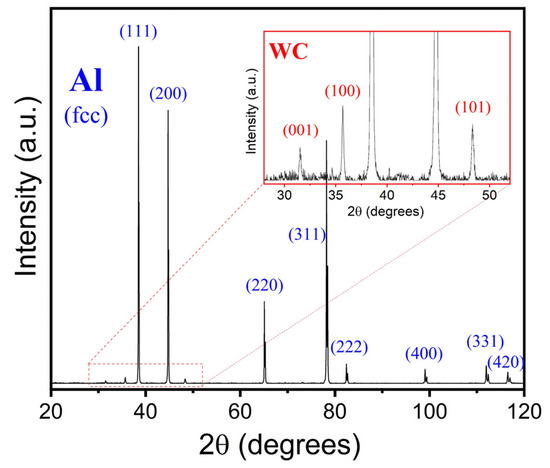
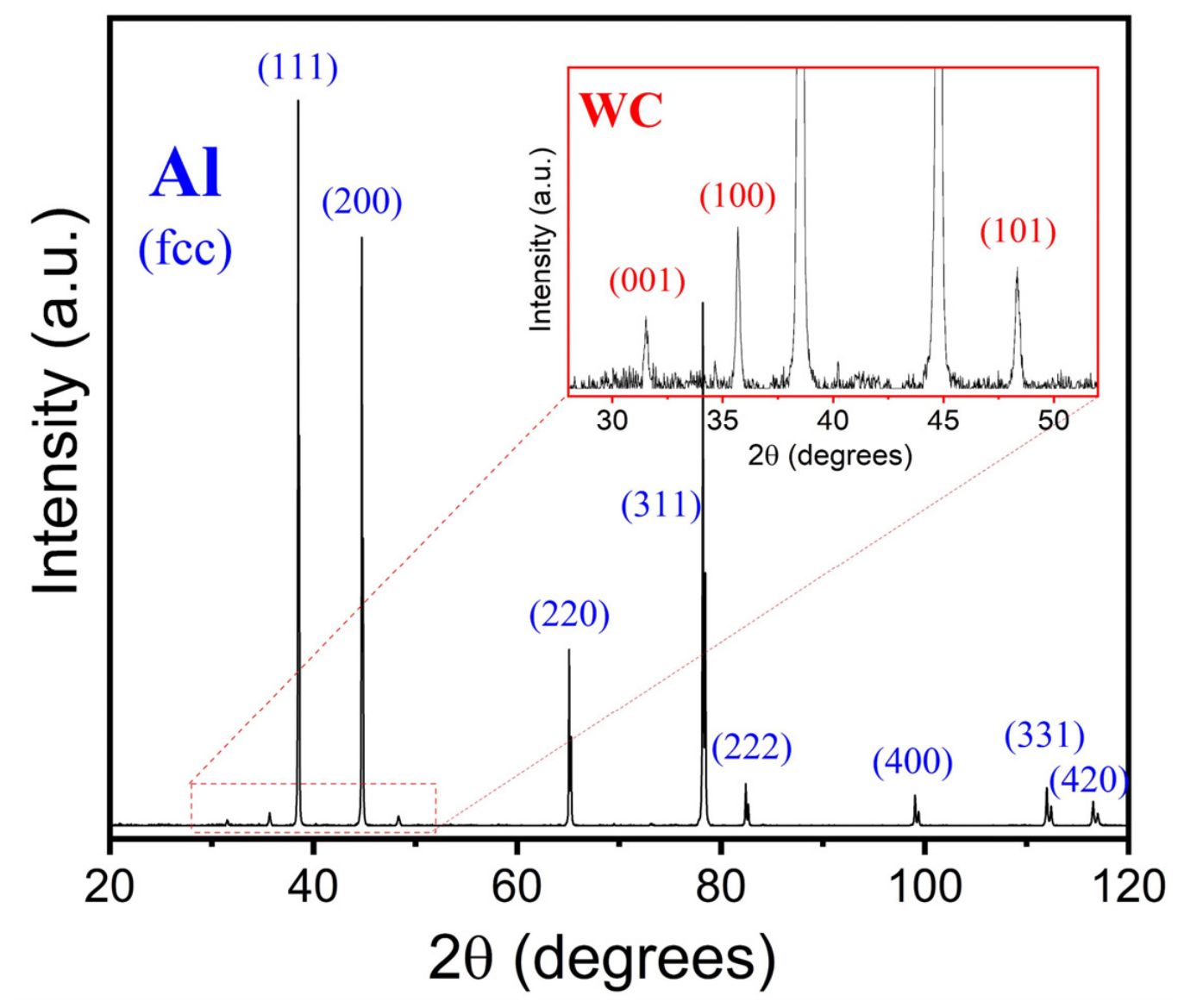
The XRD pattern of the Al 1050/4 wt.% WC composite (Figure 5) is presented as representative of both compositions, since both were processed under identical thermal conditions and the onset of Al–WC interfacial reactions occurs at approximately 550 °C, independent of WC content within this concentration range [9,10]. The diffractogram displays Bragg reflections at 2θ values consistent with FCC aluminum and hexagonal WC [4], with no additional peaks observed over the full 20–120° scan range. Notably, no reflections attributable to interfacial reaction products—specifically Al12W, Al5W, or Al4C3—were detected within the sensitivity limits of the measurement. This outcome aligns with the reported 550 °C threshold for Al–WC reactions [9]; the 485 °C processing temperature utilized here falls well below it, and the brief thermal exposure during the indirect extrusion cycle further restricts diffusion-controlled intermetallic growth. Nevertheless, reaction products such as Al4C3 may form in quantities below the detection limit of conventional XRD in WC/Al systems [9]. Therefore, while the present evidence indicates that any potential reaction products remain undetectable, the complete absence of an interfacial reaction cannot be claimed on this basis alone.
Figure 5.
X-ray diffraction pattern of the extruded Al 1050/4 wt.% WC composite. All major reflections index to FCC aluminum. The inset magnifies the (001), (100), and (101) reflections of hexagonal WC.
3.3. Mechanical Behavior of the Reinforcement Architecture
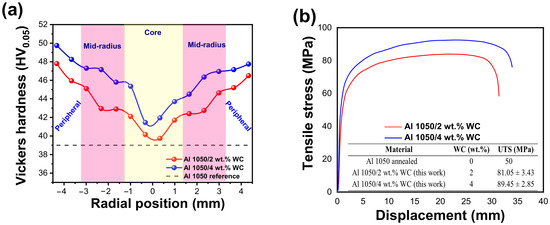
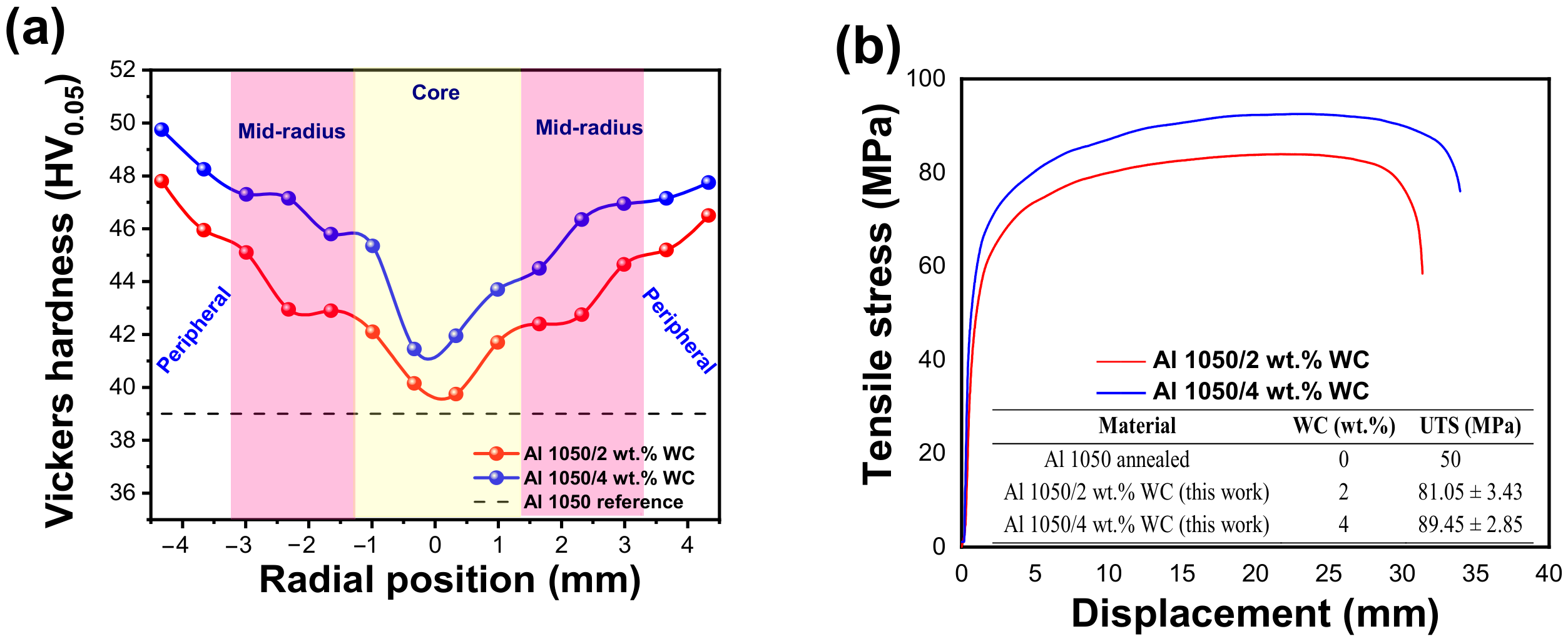
Figure 6a shows the radial microhardness profiles, and Figure 6b shows the representative engineering stress–displacement curves. Because the two diametral traverses intersect the irregular concentric shells at differing local thicknesses and angular positions, they yield distinct hardness responses at identical nominal radial coordinates. In heterostructured composites, these reinforcement geometries can induce localized hardness fluctuations [31]. The X-CT transverse section corroborates this interpretation, revealing non-uniform ring widths along their perimeters. A peripheral-to-core microhardness gradient of 8.05 HV is observed in the Al 1050/2 wt.% WC composite, with peripheral zones averaging 47.8 ± 3.6 HV and 39.75 ± 5.0 HV at the core. This gradient shows a radial trend, confirming that it stems from the reinforcement architecture. The Al 1050/4 wt.% WC composite exhibits a gradient of 8.3 HV (peripheral: 49.75 ± 5.6 HV; core: 41.45 ± 1.5 HV). The overall increase in microhardness with increasing WC content aligns with established trends for Al/WC composites, including those fabricated via friction stir processing [19]. The hardness increase likely arises from two synergistic contributions: the direct reinforcing effect of the WC-rich bands and matrix grain refinement, mainly at the sample surface, induced by hot extrusion—a common phenomenon in hot-extruded Al [32]. Within the bands, the elevated local hardness is driven by the dispersion of the hard WC phase.
Figure 6.
(a) Transverse microhardness profiles for Al 1050/2 wt.% WC and Al 1050/4 wt.% WC composites. (b) Representative engineering stress–displacement curves, with a summary of ultimate tensile strengths compared with annealed Al 1050 Adapted from Ref. [28].
Additionally, the contiguity between the hard and soft zones can generate strain gradients at the band–matrix interfaces, a feature typically associated with heterodeformation-induced (HDI) strengthening [31]. Although this study did not characterize matrix grain size—preventing quantitative decoupling of these mechanisms—the radial microhardness profile is consistent with a structural contribution of the WC bands, since hardness increases toward the periphery, where the shells appear most closely spaced in the transverse section (Figure 4a); the profile alone does not establish the relative magnitude of the two contributions. Concurrently, a radial strain gradient that peaks near the bar surface during axisymmetric extrusion [22] may enhance peripheral hardness by locally refining grains. Crucially, the presence of this gradient at the 2 wt.% WC composition indicates that the concentric architecture is preserved at lower concentrations rather than being exclusive to the Al 1050/4 wt.% WC composite; a homogeneous distribution of reinforcement would not yield such a radial trend.
Regarding tensile test results, the Al 1050/2 wt.% WC composite achieved a value of 81.05 ± 3.43 MPa, while the Al 1050/4 wt.% WC composite achieved a higher UTS of 89.45 ± 2.85 MPa. The individual values were 77.26, 81.96, and 83.94 MPa at 2 wt.% WC,% WC, and 86.93, 88.87 and 92.54 MPa at 4 wt.% WC. Fracture occurred within the free length between the grips in all specimens tested, indicating that gripping did not affect the reported values. Both composites exhibited a higher UTS than the value reported for annealed Al 1050 in [28] (50 MPa), by 62% and 79% for the 2 and 4 wt.% compositions, respectively. Because the reference was not subjected to the same thermomechanical cycle, this comparison situates the composites relative to unreinforced Al 1050 rather than attributing the difference to the reinforcement; attribution rests on the comparison between the two compositions processed under identical conditions, which differ by 10.4%. These values are compared relative to compositions and to literature data rather than as standardized material properties, owing to the full-section, as-extruded testing geometry. Similar strength improvements have been reported for Al/WC composites fabricated via friction stir processing [19]. The composites did not fail at maximum load; the stress–displacement curves show continued displacement beyond the maximum before fracture. This load-bearing capacity is consistent with the continuous Al matrix ligaments identified by X-CT between the WC-rich rings, which provide uninterrupted load paths across the composite cross-section. This behavior aligns with the design principles of heterostructured composites, where particle-free matrix regions accommodate deformation while reinforcement-rich zones bear the load [33]. Notably, unlike network or heterostructured composites produced via multi-step powder metallurgy or friction stir processing with homogeneous particle dispersion, the processing route presented here generates a geometrically ordered, concentric architecture in a single solid-state consolidation step.
4. Conclusions
Indirect extrusion of disc-stacked Al 1050/WC ingots at 485 °C with a 16:1 reduction ratio produced an architecturally ordered, concentric WC ring distribution. SEM-EDS and X-ray computed tomography (X-CT) confirmed that this structure consists of WC-rich bands elongated in the extrusion direction. This single-step, flow-based route represents a thermomechanical consolidation pathway not currently represented in solid-state functionally graded material (FGM) classifications, expanding the scope of architectural gradient composite fabrication. The absence of reaction products (such as Al12W, Al5W, or Al4C3) indicates that the processing temperature remained below the threshold for reaction initiation, thereby preserving interfacial integrity. Cross-sectional microhardness values were higher at 47.8 ± 3.6 HV (2 wt.% WC) and 49.75 ± 5.6 HV (4 wt.% WC). Tensile tests yielded ultimate tensile strengths (UTS) of 81.05 ± 3.43 MPa (2 wt.%) and 89.45 ± 2.85 MPa (4 wt.%), representing improvements of 62% and 79%, respectively, over the value reported for annealed Al 1050. The composites carried load beyond the maximum before fracture, consistent with continuous Al matrix paths between the WC-rich shells, which provide uninterrupted load paths across the cross-section. Finally, X-ray computed tomography (X-CT) quantified an overall porosity of 2.04 vol.%. The pores are highly irregular (median sphericity: 0.50), indicating incomplete solid-state consolidation. Although small voids dominate the pore number, a small number of larger pores (>1 mm) account for a disproportionate fraction of the total pore volume. Nevertheless, the continuous Al-rich pathways between the shells preserved structural cohesion in the remaining specimens, indicating the feasibility of this one-step manufacturing route.
Author Contributions
Conceptualization: G.R.-C., J.P.F.-D.l.R., F.R.-P., J.M.M.-D., I.I.L.-L., A.M.-G., R.M.-S., I.E.-G. and C.G.G.-R.; Methodology: G.R.-C., I.I.L.-L. and C.G.G.-R.; Validation: J.P.F.-D.l.R. and F.R.-P.; Formal Analysis: J.M.M.-D., I.I.L.-L., A.M.-G., R.M.-S. and I.E.-G.; Investigation: G.R.-C., I.I.L.-L. and C.G.G.-R.; Data Curation, J.M.M.-D., I.I.L.-L., A.M.-G., R.M.-S., and I.E.-G.; Writing—Original Draft Preparation: G.R.-C., J.P.F.-D.l.R. and F.R.-P.; Writing—Review and Editing: I.I.L.-L. and C.G.G.-R.; Visualization, G.R.-C. and C.G.G.-R.; Supervision: I.I.L.-L. and C.G.G.-R. All authors have read and agreed to the published version of the manuscript.
Funding
This research received no external funding.
Data Availability Statement
The data supporting the findings of this study are available from the corresponding author upon reasonable request.
Acknowledgments
Gustavo Rodríguez-Cabriales (CVU 170573) gratefully acknowledges the Secretaría de Ciencia, Humanidades, Tecnología e Innovación (SECIHTI), México, for a postdoctoral fellowship. The authors thank A.G. Franco-Díaz, A.I. González-Jacquez, K. Campos-Venegas, R. Bernal-González and G. Vázquez-Olvera for their valuable technical support throughout the study. The authors also acknowledge the use of the research facilities at the Research Center in Advanced Materials (CIMAV).
Conflicts of Interest
The authors declare no conflicts of interest.
References
- Kar, A.; Sharma, A.; Kumar, S. A Critical Review on Recent Advancements in Aluminium-Based Metal Matrix Composites. Crystals 2024, 14, 412. [Google Scholar] [CrossRef] [Scilit]
- Patel, S.K.; Shi, L. Recent Advances in Ceramic-Reinforced Aluminum Metal Matrix Composites: A Review. Alloys 2025, 4, 18. [Google Scholar] [CrossRef] [Scilit]
- Lee, M.; Gilmore, R.S. Single crystal elastic constants of tungsten monocarbide. J. Mater. Sci. 1982, 17, 2657–2660. [Google Scholar] [CrossRef] [Scilit]
- Kurlov, A.S.; Gusev, A.I. Tungsten Carbides: Structure, Properties and Application in Hardmetals. In Springer Series in Materials Science; Springer: Cham, Switzerland, 2013; Volume 184. [Google Scholar] [CrossRef] [Scilit]
- Zhang, Z.; Chen, D.L. Consideration of Orowan strengthening effect in particulate-reinforced metal matrix nanocomposites: A model for predicting their yield strength. Scr. Mater. 2006, 54, 1321–1326. [Google Scholar] [CrossRef] [Scilit]
- Fathi, R.; Chen, M.; Abdallah, M.; Saleh, B. Wear Prediction of Functionally Graded Composites Using Machine Learning. Materials 2024, 17, 4523. [Google Scholar] [CrossRef] [Scilit] [PubMed]
- Karakoç, H.; Çinici, H.; Saravana Kumar, M.; Yılmaz, T.; Ovalı, İ.; Yang, C.-H.; Arjunan, A. Influence of gradation in the reinforcement particles on the interfacial microstructure and mechanical properties of functionally graded composites. Mater. Today Commun. 2023, 38, 107601. [Google Scholar] [CrossRef] [Scilit]
- Saleh, B.; Jiang, J.; Ma, A.; Song, D.; Yang, D.; Xu, Q. Review on the Influence of Different Reinforcements on the Microstructure and Wear Behavior of Functionally Graded Aluminum Matrix Composites by Centrifugal Casting. Met. Mater. Int. 2020, 26, 933–960. [Google Scholar] [CrossRef] [Scilit]
- Mao, C.-H.; Sun, X.-D.; Liang, Q.-S.; Yang, J.; Du, J. Interfacial reaction process of the hot-pressed WC/2024Al composite. Rare Met. 2013, 32, 397–401. [Google Scholar] [CrossRef] [Scilit]
- Lv, Z.; Mao, C.; Wang, J.; Liang, Q.; Ma, S.; Yang, Z.; Yang, J.; Li, Y. Interfacial Microstructure in W/2024Al Composite and Inhibition of W-Al Direct Reaction by CeO2 Doping: Formation and Crystallization of Al-Ce-Cu-W Amorphous Layers. Materials 2019, 12, 1117. [Google Scholar] [CrossRef] [Scilit] [PubMed]
- Wąsik, A.; Leszczyńska-Madej, B.; Noga, P. Hot extrusion of SiCp/Al-Cu composites: Optimizing mechanical properties through microstructural control. Int. J. Adv. Manuf. Technol. 2024, 134, 3611–3620. [Google Scholar] [CrossRef] [Scilit]
- Estrin, Y.; Vinogradov, A. Extreme grain refinement by severe plastic deformation: A wealth of challenging science. Acta Mater. 2013, 61, 782–817. [Google Scholar] [CrossRef] [Scilit]
- Skarvelakis, D.; Stavroulakis, G.E. Aluminum Extrusion Simulation Using Finite Elements. Eng 2026, 7, 138. [Google Scholar] [CrossRef] [Scilit]
- Sayyad, A.; Wagh, H. A review of production techniques, classifications, material gradation rules, and industrial applications of functionally graded materials. J. Ceram. Compos. 2026, 2, 23–57. Available online: https://izlik.org/JA44NH42UX (accessed on 8 May 2026).
- Radhika, N.; Raghu, R. Development of functionally graded aluminium composites using centrifugal casting and influence of reinforcements on mechanical and wear properties. Trans. Nonferrous Met. Soc. China 2016, 26, 905–916. [Google Scholar] [CrossRef] [Scilit]
- Watanabe, Y.; Kim, S.I.; Fukui, Y. Microstructures of Functionally Graded Materials Fabricated by Centrifugal Solid-Particle and In-Situ Methods. Met. Mater. Int. 2005, 11, 391–399. [Google Scholar] [CrossRef] [Scilit]
- El-Galy, I.M.; Saleh, B.I.; Ahmed, M.H. Functionally graded materials classifications and development trends from industrial point of view. SN Appl. Sci. 2019, 1, 1378. [Google Scholar] [CrossRef] [Scilit]
- Parihar, R.S.; Setti, S.G.; Sahu, R.K. Recent advances in the manufacturing processes of functionally graded materials: A review. Sci. Eng. Compos. Mater. 2018, 25, 309–336. [Google Scholar] [CrossRef] [Scilit]
- Huang, G.; Hou, W.; Shen, Y. Evaluation of the microstructure and mechanical properties of WC particle reinforced aluminum matrix composites fabricated by friction stir processing. Mater. Charact. 2018, 138, 26–37. [Google Scholar] [CrossRef] [Scilit]
- Rodríguez-Cabriales, G.; Lometo-Sánchez, A.M.; Guía-Tello, J.C.; Medrano-Prieto, H.M.; Gutiérrez-Castañeda, E.J.; Estrada-Guel, I.; Garay-Reyes, C.G.; Hernández-Rivera, J.L.; Cruz-Rivera, J.J.; Maldonado-Orozco, M.C.; et al. Synthesis and characterization of Al-Cu-Mg system reinforced with tungsten carbide through powder metallurgy. Mater. Today Commun. 2020, 22, 100758. [Google Scholar] [CrossRef] [Scilit]
- Valberg, H.S.; Lefstad, M.; de Moraes Costa, A.L. On the Mechanism of Formation of Back-End Defects in the Extrusion Process. Procedia Manuf. 2020, 47, 245–252. [Google Scholar] [CrossRef] [Scilit]
- Valberg, H. Metal flow in the direct axisymmetric extrusion of aluminium. J. Mater. Process. Technol. 1992, 31, 39–55. [Google Scholar] [CrossRef] [Scilit]
- Kulagin, R.; Beygelzimer, Y.; Bachmaier, A.; Pippan, R.; Estrin, Y. Benefits of pattern formation by severe plastic deformation. Appl. Mater. Today 2019, 15, 236–241. [Google Scholar] [CrossRef] [Scilit]
- Mohammadi, M.; Rajabi, M.; Ghadiri, M. Functionally graded materials (FGMs): A review of classifications, fabrication methods and their applications. Process. Appl. Ceram. 2021, 15, 319–343. [Google Scholar] [CrossRef] [Scilit]
- Kruth, J.P.; Bartscher, M.; Carmignato, S.; Schmitt, R.; De Chiffre, L.; Weckenmann, A. Computed tomography for dimensional metrology. CIRP Ann. Manuf. Technol. 2011, 60, 821–842. [Google Scholar] [CrossRef] [Scilit]
- ASTM E384-22; Standard Test Method for Microindentation Hardness of Materials. ASTM International: West Conshohocken, PA, USA, 2022.
- ASTM B557-15; Standard Test Methods for Tension Testing Wrought and Cast Aluminum- and Magnesium-Alloy Products. ASTM International: West Conshohocken, PA, USA, 2015.
- Sattarpanah Karganroudi, S.; Hatami Nasab, B.; Rahmatabadi, D.; Ahmadi, M.; Delshad Gholami, M.; Kasaeian-Naeini, M.; Hashemi, R.; Aminzadeh, A.; Ibrahim, H. Anisotropic Behavior of Al1050 through Accumulative Roll Bonding. Materials 2021, 14, 6910. [Google Scholar] [CrossRef] [Scilit] [PubMed]
- Li, Z.; Jing, Y.; Guo, H.; Sun, X.; Yu, K.; Yu, A.; Jiang, X.; Yang, X.J. Study of 3D Pores and Its Relationship with Crack Initiation Factors of Aluminum Alloy Die Castings. Metall. Mater. Trans. B 2019, 50, 1204–1212. [Google Scholar] [CrossRef] [Scilit]
- Bajor, T.; Kawałek, A.; Berski, S.; Jurczak, H.; Borowski, J. Analysis of the Extrusion Process of Aluminium Alloy Profiles. Materials 2022, 15, 8311. [Google Scholar] [CrossRef] [Scilit] [PubMed]
- Zhao, L.; Zheng, W.; Hu, Y.; Guo, Q.; Zhang, D. Heterostructured metal matrix composites for structural applications: A review. J. Mater. Sci. 2024, 59, 9768–9801. [Google Scholar] [CrossRef] [Scilit]
- Bharath, K.; Mandal, A.; Karmakar, A.; Khanra, A.K.; Davidson, M.J. Understanding the effect of hot extrusion on the evolution of microstructure and associated mechanical properties in sintered Al-Cu-Mg alloys. Mater. Charact. 2020, 170, 110715. [Google Scholar] [CrossRef] [Scilit]
- Nie, J.; Chen, Y.; Song, L.; Fan, Y.; Cao, Y.; Xie, K.; Liu, S.; Liu, X.; Zhao, Y.; Zhu, Y. Enhancing strength and ductility of Al-matrix composite via a dual-heterostructure strategy. Int. J. Plast. 2023, 171, 103825. [Google Scholar] [CrossRef] [Scilit]
Disclaimer/Publisher’s Note: The statements, opinions and data contained in all publications are solely those of the individual author(s) and contributor(s) and not of MDPI and/or the editor(s). MDPI and/or the editor(s) disclaim responsibility for any injury to people or property resulting from any ideas, methods, instructions or products referred to in the content. |
© 2026 by the authors. Licensee MDPI, Basel, Switzerland. This article is an open access article distributed under the terms and conditions of the Creative Commons Attribution (CC BY) license.