


Abstract
Tungsten leaching kinetics were investigated for three concentrates of Spanish origin containing wolframite, scheelite and mixed mineral phases under their respective optimum processing conditions. Experimental conversion data were analysed using classical shrinking-core equations and complementary biparametric models to identify the rate-controlling mechanisms governing tungsten dissolution. Among the mechanistic models evaluated, the Ginstling–Brounshtein equation consistently provided the best description of the experimental results for all concentrates, indicating that the overall leaching rate is controlled by a coupled reaction–diffusion mechanism in which internal diffusional resistance becomes increasingly important as dissolution proceeds. For scheelite, the apparent activation energy obtained from the Arrhenius analysis (−11.66 kJ mol−1) supports this interpretation, reflecting the macroscopic response of an evolving reaction–diffusion system rather than the intrinsic activation barrier of an elementary chemical reaction. Biparametric models slightly improved the statistical fit, with the Elovich equation providing the best representation for scheelite and the activated mixed concentrate, whereas Gompertz and Avrami models performed similarly for wolframite. The combined application of mechanistic and empirical kinetic models provides a robust framework for comparing the leaching behaviour of different tungsten concentrates and for supporting the design and optimisation of hydrometallurgical processes.
1. Introduction
In 2023 and in the frame of the 2024 regulation [1], the European Commission approved a list of 47 strategic projects to boost domestic strategic raw material capacities, with the aim of strengthening the European raw material value chain and diversifying sources of supply. These new projects mark an important milestone in the implementation of the Critical Raw Materials Act, which is part of the Green Deal Industrial Plan [2] focused on reaching the targets that can contribute significantly to Europe’s green and digital transitions. The only two projects related to mining initiatives for tungsten were the “La Parrilla Mine (P6 Metals)” and “EL MOTO”, promoted by Iberian Resources Spain and Abenójar Tungsten S.L. respectively, both in Spain. Particularly, the “EL MOTO” deposit has resources certified in accordance with NI 43–101 [3] of 91 Mt with a grade of 0.42%WO3 w/w and is close to the surface. This project would contribute to the 2030 EU benchmarks for extraction set out in the CRMA, producing 20% of the average annual EU consumption of tungsten concentrate [4].
Due to the existence of several deposits in Spain containing tungsten, in previous studies Alguacil et al. [5] investigated the optimum conditions for the recovery of tungsten from various concentrates obtained from a tin deposit located in northwestern Spain. In these concentrates, tungsten is present as the mineral species wolframite ((Fe,Mn)WO4), scheelite (CaWO4), and a mixed concentrate.
In hydrometallurgy, the shrinking core model tries to describe the interaction between a solid particle and a surrounding leachant. The reaction takes place in an interface that moves inward into the solid as the fluid diffuses through the growing product layer formed. It is a classic model well explained in the literature [6] and the analytical solutions have been extensively studied from the end of the 1990s for different systems, e.g., gold in cyanide media [7]. The review of liquid diffusion-controlled rate equations [8] and the numerical solutions proposed when pseudo-steady-state approximation is not applicable [9] includes excellent descriptions of the foundations of these models.
The objective of this new study is to test existing models in order to explain the leaching mechanism of tungsten concentrates and to verify its validity obtaining fitted parameters from experimental results. In hydrometallurgical processes these parameters are crucial for the optimisation of the solubilization processes of these metals and the development of new applications and novel configurations at industrial scale.
2. Experimental
Experimental data were based on results presented in the literature [5] about the leaching in different chemical media of the three concentrates studied (wolframite, scheelite and mixed concentrate) with a tungsten content (w/w) of 50%, 29% and 29% respectively.
The overall rate of a leaching process depends on the interactions among the following three factors: (a) intrinsic chemical reaction, (b) mass and/or heat transfer, and (c) phase-contacting pattern. Identification of the rate-limiting step is essential when studying a leaching process, as it simplifies the decision-making process in the design of such processes for industrial purposes.
The most useful variable to describe the evolution of a solid–fluid reaction is the conversion factor x, which is a dimensionless number that represents the physical amount of tungsten that has reacted. Though x is theoretically denoted as x = (C0 S − CS)/C0 S, with CS and C0 S being the concentration of the solid phase at time t and the initial concentration of solid, respectively, we will use Equation (1) for practical purposes:
where x is the fraction of tungsten that has reacted, [W]t is the concentration of the metal in the solution at a given time t and [W]e is the maximum concentration of tungsten in the solution at the end of the reaction. The value of this maximum concentration depends on the tungsten content of the concentrates used and the solid/liquid ratio.
3. Results and Discussion
The kinetic analysis was undertaken to assess the suitability of different kinetic models for describing their leaching behaviour. The experimental data were analysed using classical shrinking-core equations representing different controlling mechanisms, namely liquid-film diffusion, surface chemical reaction, product-layer diffusion and mixed control. Subsequently, empirical biparametric models were evaluated in order to assess whether a better mathematical description could be achieved for systems in which the controlling mechanism evolves during the course of the reaction.
Although shrinking-core models have traditionally been employed to describe heterogeneous solid–liquid reactions, their applicability depends on the validity of several simplifying assumptions, including particle geometry, homogeneous mineral composition and the existence of a main rate-limiting step throughout the reaction [10,11,12,13]. Consequently, the interpretation of the kinetic parameters should not rely exclusively on the quality of the mathematical fit but should also be supported by physicochemical considerations regarding the dissolution mechanism.
In this work, particular attention is given to the influence of reagent concentration, particle size and pulp density on the apparent kinetic parameters, as these variables are directly relevant for process optimisation and industrial scale-up. The optimum conditions obtained [5] were:
- -
- For wolframite concentrate: alkaline leaching 370 g/L NaOH, 100 °C, particle size < 75 µm, four hours, and pulp density 50 wt%;
- -
- For scheelite concentrate: acidic leaching (400 g/L HCl), 90 °C, particle size < 20 µm, 3–4 h, and pulp density 3.2 wt%;
- -
- For mixed wolframite–scheelite concentrate: (1) alkaline roasting (excess of sodium carbonate, 800 °C, and two hours); (2) water leaching of the roasted material (90 °C, two hours, and pulp density 12.5–16.7 wt%).
3.1. Rate-Limiting Step Based on Shrinking Core Models
From an industrial perspective, identifying whether the overall reaction rate is controlled by chemical reaction, external mass transfer or diffusion through the product layer provides valuable information for defining the variables that affect reactor performance.
Four classical shrinking-core equations were therefore evaluated under the assumption of isothermal dissolution of approximately spherical particles. The models represent, respectively, control by external film diffusion, surface chemical reaction, product layer diffusion (Ginstling–Brounshtein model) and a mixed diffusion–reaction mechanism [14,15,16,17]. Apparent rate constants were estimated by nonlinear regression using the generalised reduced gradient (GRG) algorithm, and the quality of each fit was evaluated through the corresponding coefficient.
The equations representing these models are:
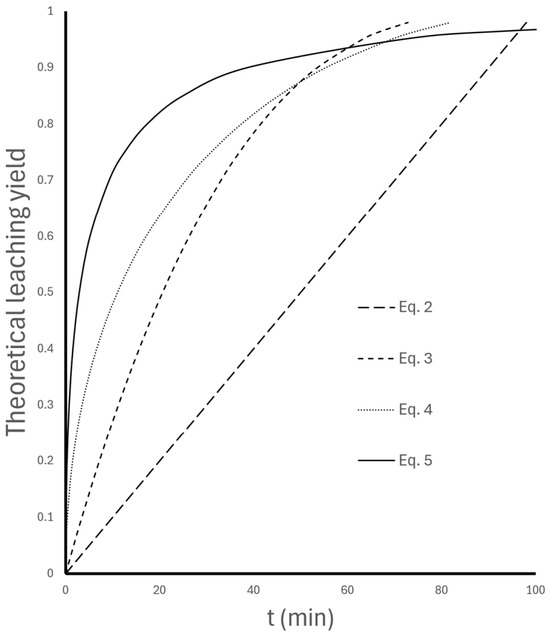
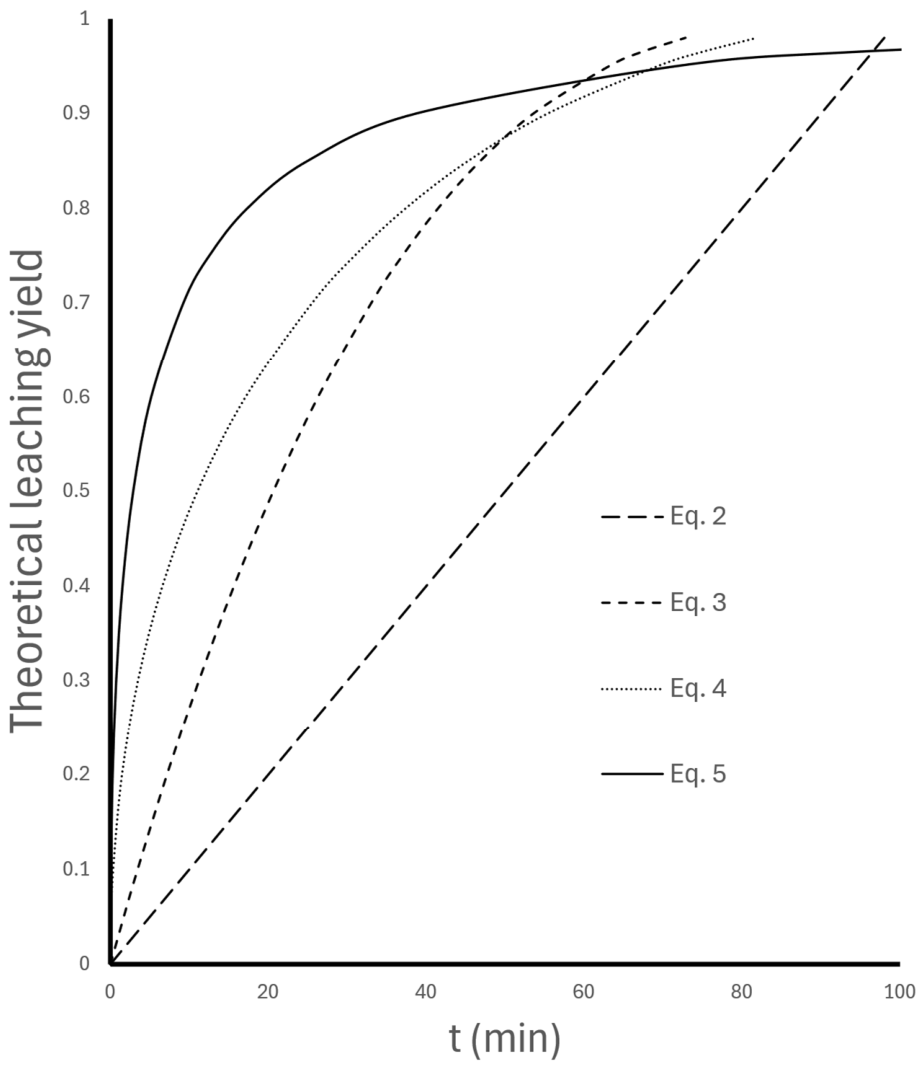
where K1, K2, K3, and K4 were the apparent rate constants (unit time−1) for the respective film-diffusion, surface chemical reaction, product-layer diffusion and mixed (film-diffusion and chemical reaction) controlled process. To exemplify the practical difference between these models, Figure 1 simulates the theoretical behaviour of the leaching yield against time using the four models tested (Equations (2)–(5)) and the same Ki value.
Figure 1.
Theoretical behaviour of leaching yield against time using the models described by Equations (2)–(5) (Ki = 0.01 min−1).
Rather than identifying the model with the highest statistical correlation alone, the analysis was focused on assessing whether the estimated kinetic parameters were physically consistent with the expected behaviour of each concentrate. This approach is particularly important because different kinetic equations may provide similar regression coefficients while representing substantially different dissolution mechanisms.
3.1.1. Wolframite Concentrate
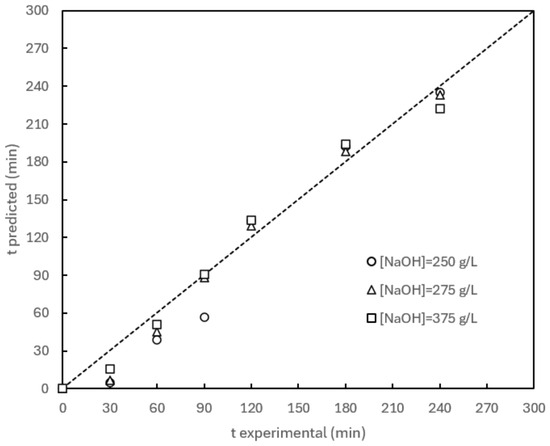
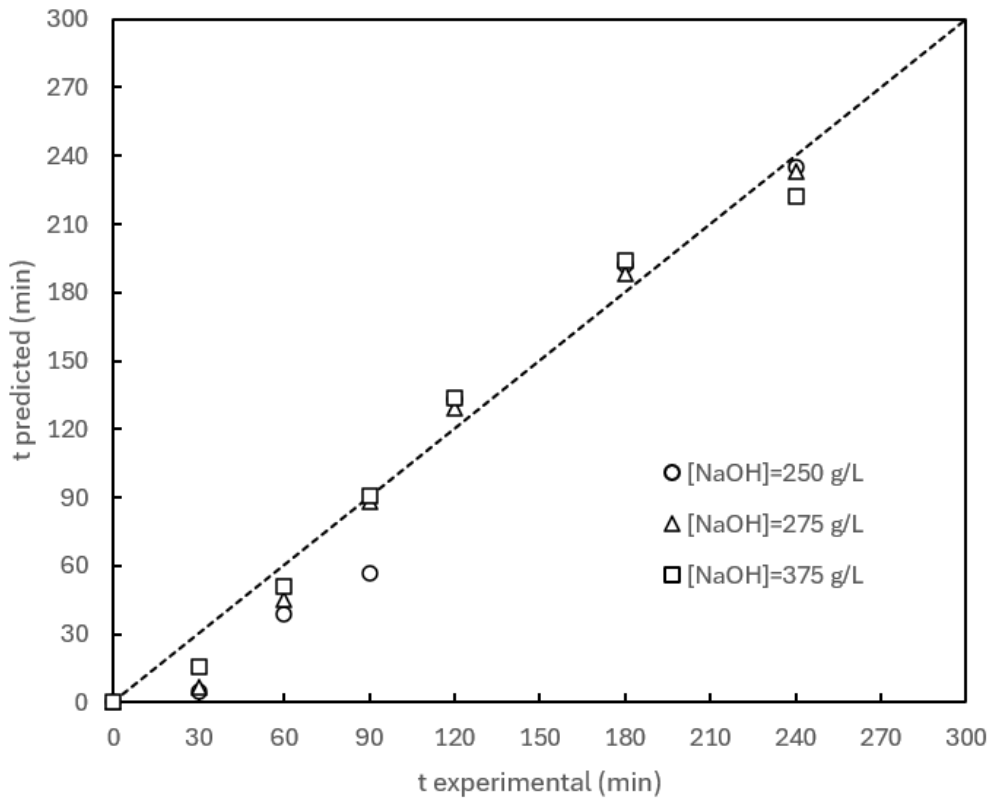
The experimental data obtained for the alkaline leaching of the wolframite concentrate were fitted to the four shrinking-core equations described above using the apparent rate constants listed in Table 1. The Ginstling–Brounshtein equation (Equation (4)) provided the highest regression coefficients for the concentrations of NaOH studied, whereas the models assuming liquid-film diffusion or mixed film diffusion–chemical reaction exhibited slightly less agreement with the experimental data. The corresponding fittings are illustrated in Figure 2.
Table 1.
Modelled conversion factors (x) and regression results for the leaching of wolframite concentrate using different [NaOH] concentrations (T = 100 °C).
Figure 2.
Results for the best fitting of the leaching data for wolframite at different [NaOH] concentrations.
The superior performance of the Ginstling–Brounshtein equation indicates that tungsten dissolution cannot be adequately described by a single elementary mechanism acting throughout the leaching process. Instead, the results suggest that the overall dissolution rate progressively becomes limited by the simultaneous contribution of surface chemical reaction and diffusional transport through the reaction products generated during leaching. Such behaviour is commonly observed during the alkaline dissolution of refractory oxide minerals, where the accumulation of poorly soluble reaction products progressively increases the resistance to mass transport without completely suppressing the contribution of the interfacial chemical reaction.
The evolution of the apparent kinetic constants also reflects the beneficial effect of increasing sodium hydroxide concentration. As expected, higher NaOH concentrations resulted in larger values of the apparent rate constant, indicating a progressive acceleration of tungsten dissolution as the chemical driving force increased.
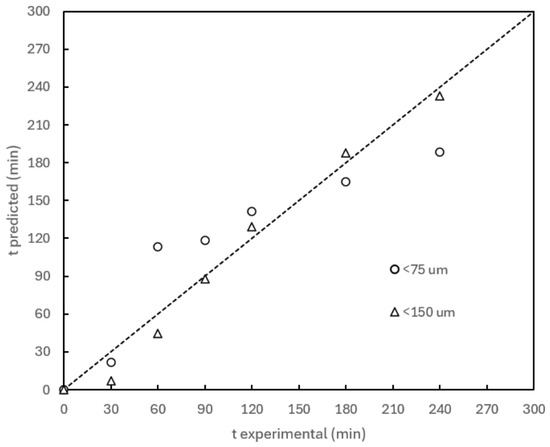
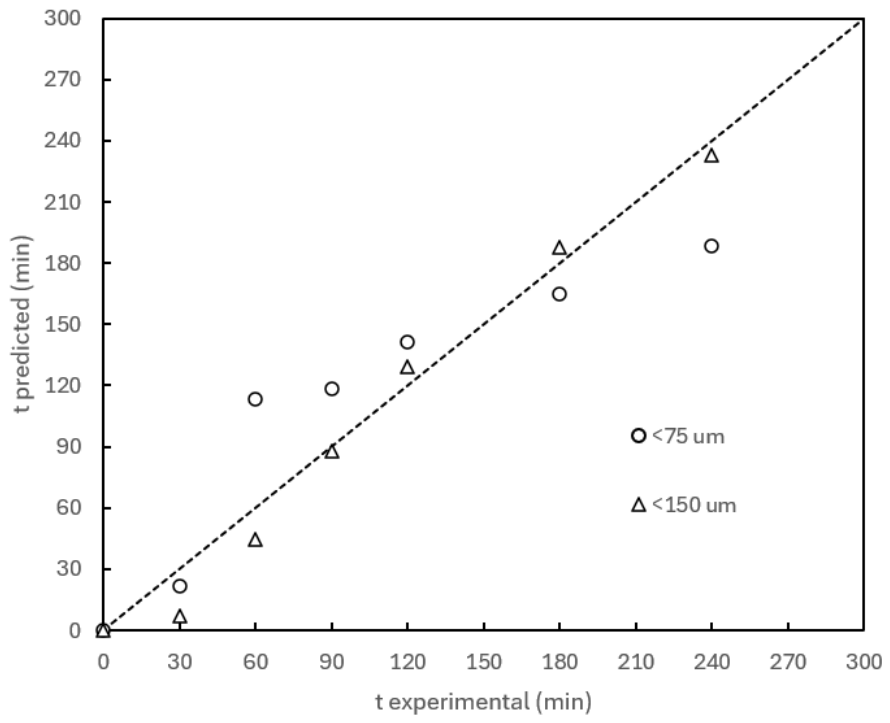
The influence of particle size further supports this interpretation (Table 2 and Figure 3). Reducing the particle size from <150 μm to <75 μm produced a systematic increase in the apparent rate constants and shortened the time required to achieve maximum tungsten extraction. It is noteworthy that the same kinetic equation remained the most suitable model for both particle-size fractions, indicating that particle size modifies the overall reaction rate without altering the dominant dissolution mechanism.
Table 2.
Modelled conversion factors (x) and regression results for the leaching of wolframite concentrate using different particle sizes (T = 100 °C).
Figure 3.
Results for the best fitting of the leaching data for wolframite at different particle sizes.
From a process engineering perspective, these observations have important implications. Since external mass-transfer resistance appears to be negligible, further increases in stirring intensity would not be expected to produce significant improvements in tungsten recovery. Conversely, variables directly affecting internal diffusion phenomena, such as particle size, porosity development or the physicochemical characteristics of the reaction layer, are likely to exert a much greater influence on the overall kinetics. Similarly, increasing reagent concentration accelerates dissolution but does not fundamentally modify the controlling mechanism, indicating that process optimisation should focus on improving internal mass transport rather than simply increasing alkali concentration beyond the range studied.
3.1.2. Scheelite Concentrate
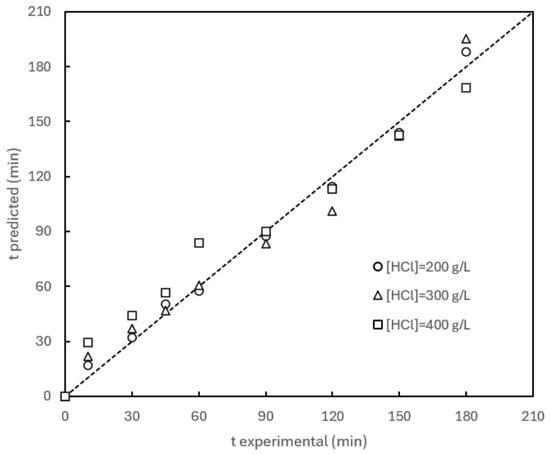
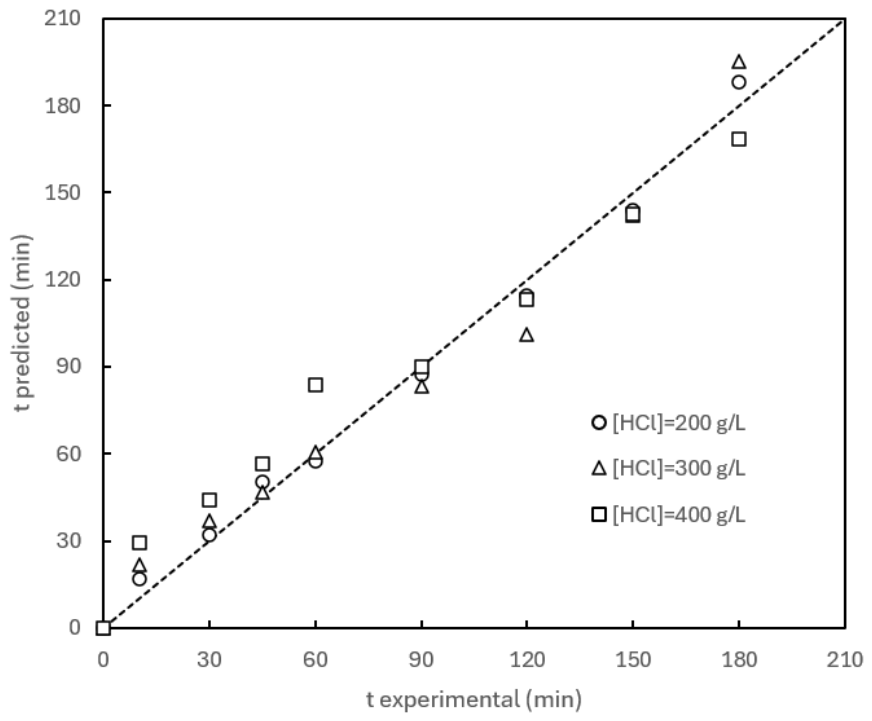
The kinetic analysis performed for the scheelite concentrate followed the same methodology adopted for wolframite. Apparent rate constants were estimated for the four shrinking-core equations using nonlinear regression, and the corresponding regression coefficients are summarised in Table 3. The experimental fittings obtained with the Ginstling–Brounshtein equation are presented in Figure 4.
Table 3.
Modelled conversion factors (x) and regression results for the leaching of scheelite concentrate using different [HCl] concentrations (T = 90 °C).
Figure 4.
Results for the best fitting of the leaching data for scheelite at different [HCl] concentrations.
The product-layer diffusion model provided an excellent description of the experimental data over the entire range of hydrochloric acid concentrations investigated, yielding regression coefficients consistently above 0.95 and reaching values close to unity under the optimum leaching conditions. The excellent agreement obtained with the Ginstling–Brounshtein equation suggests that the progressive development of diffusional resistance plays a major role throughout the dissolution process. Unlike purely reaction-controlled systems, where the dissolution rate remains proportional to the available reactive surface, the experimental conversion curves exhibit the characteristic gradual reduction in reaction rate associated with increasing transport limitations as leaching proceeds.
The increase in hydrochloric acid concentration resulted in progressively larger apparent rate constants, demonstrating that the availability of protons directly enhances the dissolution kinetics of scheelite. Higher acid concentrations accelerate the decomposition of the calcium tungstate lattice, increasing the initial dissolution rate and reducing the time required to achieve a given tungsten recovery. Nevertheless, despite this increase in reaction rate, the same kinetic equation remained valid for all acid concentrations investigated, indicating that reagent concentration affects the magnitude of the kinetic constant without modifying the dominant controlling mechanism.
This observation is particularly relevant because the dissolution chemistry of scheelite differs substantially from that of wolframite. In hydrochloric acid media, scheelite dissolution proceeds through proton attack on the CaWO4 structure, releasing calcium ions into solution while tungstic acid or hydrated tungsten oxide species may temporarily accumulate at the solid–liquid interface before complete solubilisation under the prevailing leaching conditions. Consequently, the diffusional resistance represented by the Ginstling–Brounshtein model is likely associated with the progressive modification of the reacting surface rather than with the formation of an impermeable product layer. The kinetic model should therefore be interpreted as describing an effective diffusional barrier generated during dissolution rather than a rigid geometrical shell surrounding the particles.
Particle size produced the expected influence on the overall kinetics (Table 4 and Figure 5). The finer fraction (<20 μm) exhibited systematically higher apparent rate constants than the coarser material, confirming that increasing the available specific surface area enhances tungsten dissolution. However, the similarity of the regression coefficients obtained for both particle-size fractions indicates that reducing particle size accelerates the reaction without changing the fundamental dissolution mechanism. This behaviour reinforces the interpretation that internal diffusion phenomena dominate the overall kinetics once the reaction has been initiated.
Table 4.
Modelled conversion factors (x) and regression results for the leaching of scheelite concentrate using different particle sizes (T = 90 °C).
Figure 5.
Results for the best fitting of the leaching data for scheelite at different particle sizes.
An interesting feature of the scheelite concentrate is the remarkable consistency observed among all operating conditions investigated. Compared with wolframite, the variation in the apparent kinetic parameters is smoother and the experimental conversion curves exhibit less dispersion, suggesting a more homogeneous dissolution behaviour. From an engineering perspective, optimisation of particle size, acid concentration and temperature is therefore expected to produce greater improvements in process performance than further increases in agitation, which appears to have only a minor influence once external mass-transfer limitations have been eliminated.
3.1.3. Mixed Concentrate
The mixed concentrate represents a more complex system because tungsten is distributed between two mineral phases exhibiting different dissolution behaviours. Consequently, the overall leaching kinetics cannot be interpreted as the simple superposition of the mechanisms identified for the pure concentrates, but rather as the combined response of two minerals reacting simultaneously under the same operating conditions.
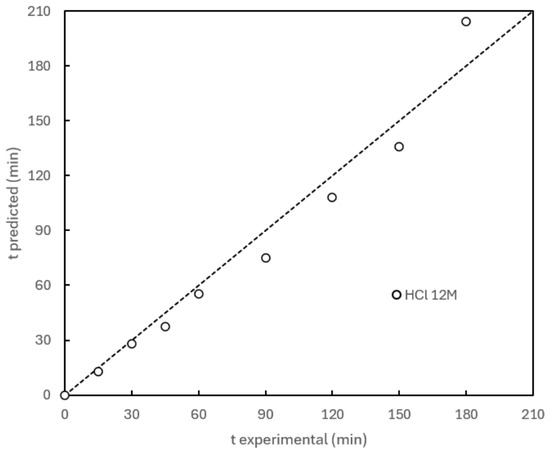
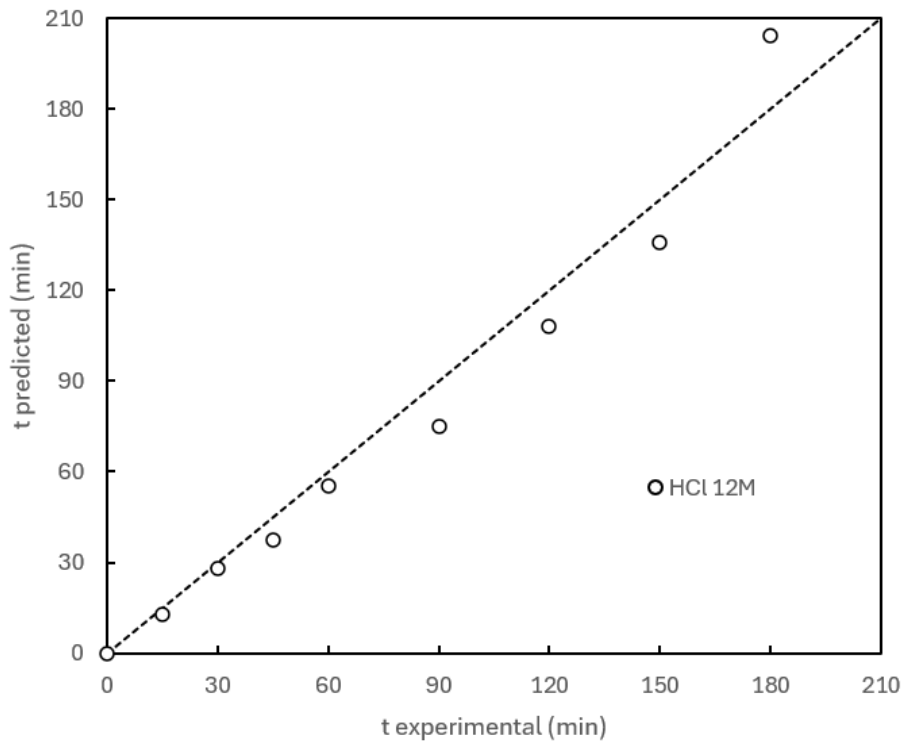
It was found that the leaching of the mixed concentrate in hydrochloric acid medium was not suitable for the recovery of tungsten contained in the starting material. Only when using extreme conditions of 80 °C and 12 M acid concentration, moderate metal recovery of 69% was reached, indicating that the presence of wolframite strongly restricts the overall extraction efficiency. This is due to the fact that residual wolframite particles progressively dominate the kinetic response as leaching proceeds, producing an apparent increase in diffusional resistance. Under these conditions, the experimental data were best represented by the product-layer diffusion equation (Table 5 and Figure 6), confirming that once scheelite dissolution has progressed, the overall reaction rate becomes increasingly controlled by diffusional transport through the altered particle structure.
Table 5.
Modelled conversion factors (x) and regression results for the leaching of mixed concentrate in HCl medium (T = 90 °C).
Figure 6.
Results for the best fitting of the leaching data for mixed concentrate in HCl medium.
The situation changes markedly after alkaline roasting of this concentrate. Thermal activation with sodium carbonate (roasting conditions: 800 °C; time: 2 h; excess Na2CO3: 30%; and particle size of the concentrate: <150 µm) converts the tungsten-bearing phases into water-soluble sodium tungstate. Under these conditions, subsequent water leaching produced tungsten recoveries exceeding 80%, and the kinetic analysis once again identified the Ginstling–Brounshtein equation as the model providing the best overall agreement with the experimental data (Table 6 and Figure 7).
Table 6.
Modelled conversion factors (x) and regression results for the leaching of mixed concentrate after roasting in alkaline medium, for different pulp densities (T = 90 °C).
Figure 7.
Results for the best fitting of the leaching data for mixed concentrate after activation by roasting in alkaline medium.
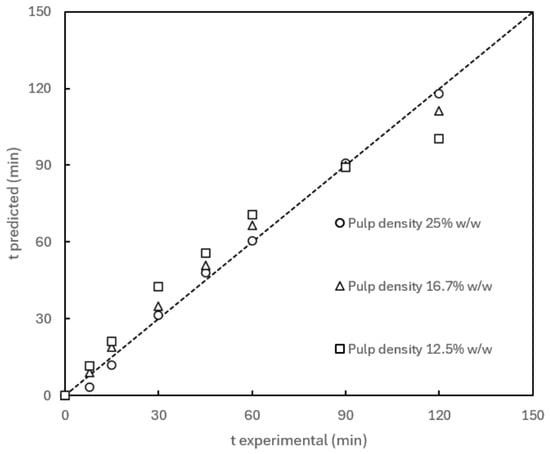
The increase in the apparent rate constants observed as pulp density decreased indicates that dilution facilitates mass transport and improves the accessibility of the leaching solution to the activated particles. Nevertheless, the persistence of the same kinetic equation over the entire range of pulp densities investigated suggests that the dominant controlling mechanism remains unchanged.
The similarity between the mechanism proposed for the activated mixed concentrate and the individual wolframite and scheelite concentrates is particularly noteworthy. Despite the very different chemical pathways involved (direct alkaline dissolution for wolframite, direct acid dissolution for scheelite, and alkaline roasting followed by water leaching for the mixed concentrate) all three systems ultimately exhibit kinetic behaviour that is best represented by diffusion through an evolving reaction layer. This suggests that the apparent diffusional resistance identified by the Ginstling–Brounshtein model is not controlled solely by the chemistry of the leaching reagent but is instead an inherent consequence of the progressive modification of the particle during tungsten dissolution.
3.2. Temperature Dependence and Apparent Activation Energy
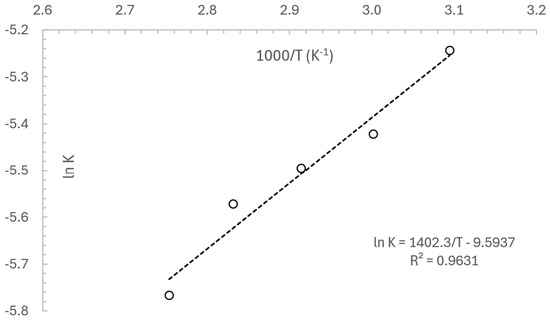
The influence of temperature on tungsten dissolution was investigated to provide an independent assessment of the kinetic interpretation derived from the shrinking-core analysis. Since the Ginstling–Brounshtein equation consistently provided the best description of the experimental data, the apparent rate constants obtained from this model were used to evaluate the temperature dependence of the leaching process of the scheelite through the Arrhenius relationship.
As expected, increasing the temperature enhanced the overall dissolution of scheelite, leading to progressively higher tungsten recoveries (Table 7). However, the apparent kinetic constants estimated from the Ginstling–Brounshtein model exhibited the opposite trend, decreasing systematically with increasing temperature. Consequently, the Arrhenius representation yielded an apparent activation energy of −11.66 kJ mol−1 (Figure 8).
Table 7.
Effect of temperature in maximum tungsten recovery for scheelite concentrate (conditions: 400 g/L HCl, 90 °C, particle size < 20 µm, 3–4 h, and pulp density 3.2 wt%).
Figure 8.
Influence of temperature on apparent kinetic constants for the leaching of scheelite concentrate.
The Ginstling–Brounshtein equation describes a heterogeneous dissolution process in which the observed reaction rate results from the simultaneous contribution of interfacial chemical reaction and diffusional transport through an evolving reaction layer. Consequently, the kinetic constant obtained from the model is not an intrinsic reaction-rate constant but an effective or apparent kinetic parameter that integrates the combined influence of several physicochemical phenomena, including chemical reaction, internal diffusion, changes in particle morphology and the progressive evolution of the reacting surface.
Under these circumstances, the activation energy obtained from the Arrhenius plot should likewise be regarded as an apparent activation energy describing the overall response of the coupled reaction–diffusion system rather than the energetic barrier associated with an elementary dissolution reaction. Its physical meaning is therefore fundamentally different from the activation energies commonly reported for heterogeneous systems governed by a single rate-controlling step. Thus, the negative value obtained in the present work confirms the competing effects of temperature on different elementary phenomena contributing to the overall kinetics.
3.3. Assessment of Biparametric Kinetic Models
Although the shrinking-core analysis provides valuable information regarding the dominant rate-controlling mechanism, its underlying assumption of a single controlling step acting throughout the dissolution process represents an important simplification for naturally occurring mineral concentrates. As demonstrated in the previous sections, tungsten leaching evolves progressively from an initial stage in which surface reaction contributes significantly to the overall rate towards a regime where diffusional resistance becomes increasingly important. Under these conditions, a single shrinking-core equation cannot be expected to reproduce perfectly the entire conversion curve.
For this reason, the experimental data obtained under the optimum leaching conditions for each concentrate were also analysed using three biparametric kinetic models, namely the Gompertz, Elovich and Avrami equations. These models do not attempt to identify a specific physicochemical mechanism but rather provide a more flexible mathematical description of processes in which the apparent reaction rate evolves continuously during dissolution.
The Gompertz model is an empirical sigmoidal equation commonly used to describe processes with an initial lag phase, a rapid growth stage, and a final deceleration. The linearized form of this equation is expressed as follows:
where α represents the undissolved proportion at time t = 1 and is described as the location or scale parameter, and KG is the leaching rate per unit time, described as the shape parameter [18].
The Elovich model is frequently applied to describe heterogeneous chemisorption processes and systems with variable activation energies of surface reactions. It is assumed that the rate of reaction decreases exponentially with increasing conversion because of surface site saturation or energetic heterogeneity. The linearized Elovich equation is expressed as:
where α represents the initial leaching rate and β is related to the desorption or activation energy and describes the rate at which the surface becomes less reactive [19].
The Avrami model is widely applied to describe nucleation and growth processes and has been adapted for leaching kinetics to represent complex, time-dependent mechanisms. It is assumed that the leaching reaction may proceed via phase boundary advancement, nucleation, or structural transformation. The model is expressed in its linearized form as Equation (8):
where k is the rate constant, and n is the Avrami exponent. Values of n close to 1 suggest linear growth, whereas values considerably different from 1 may imply nucleation, diffusion, or a combination of both processes.
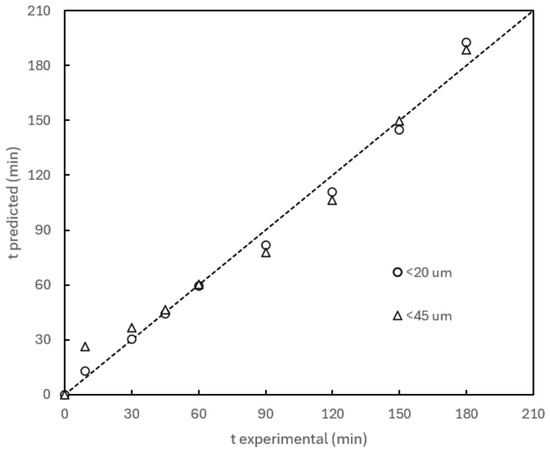
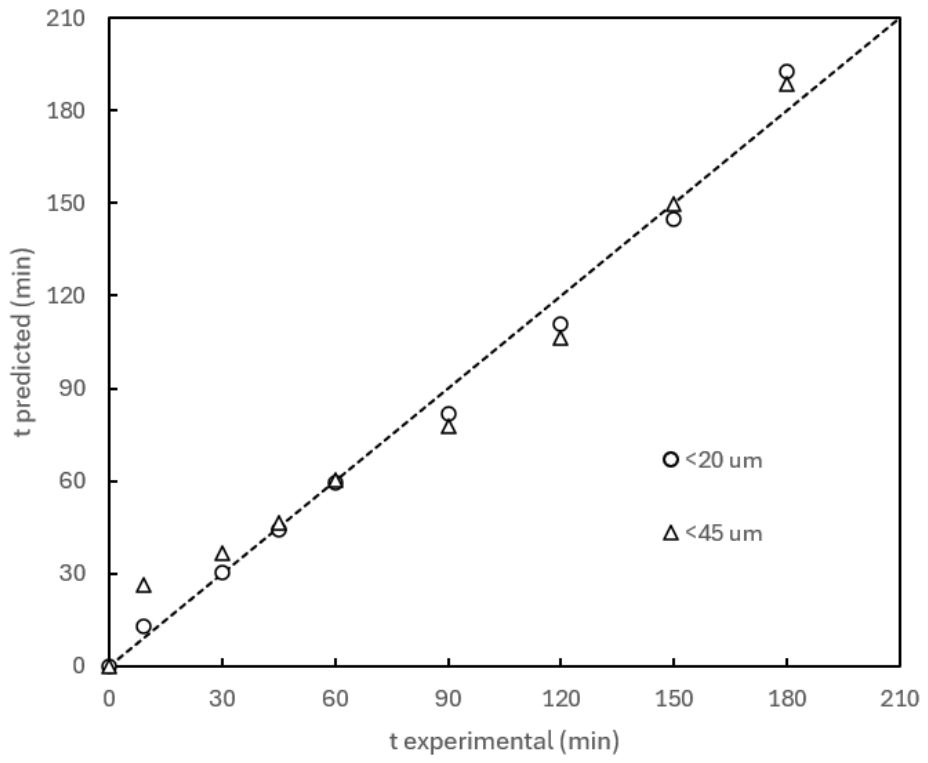
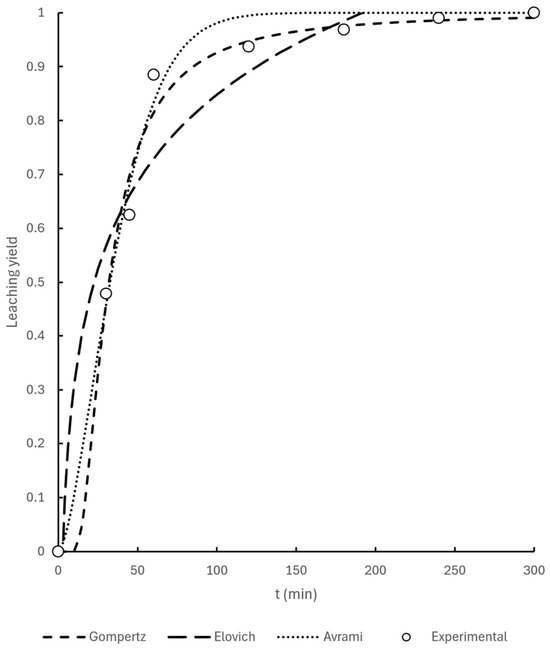
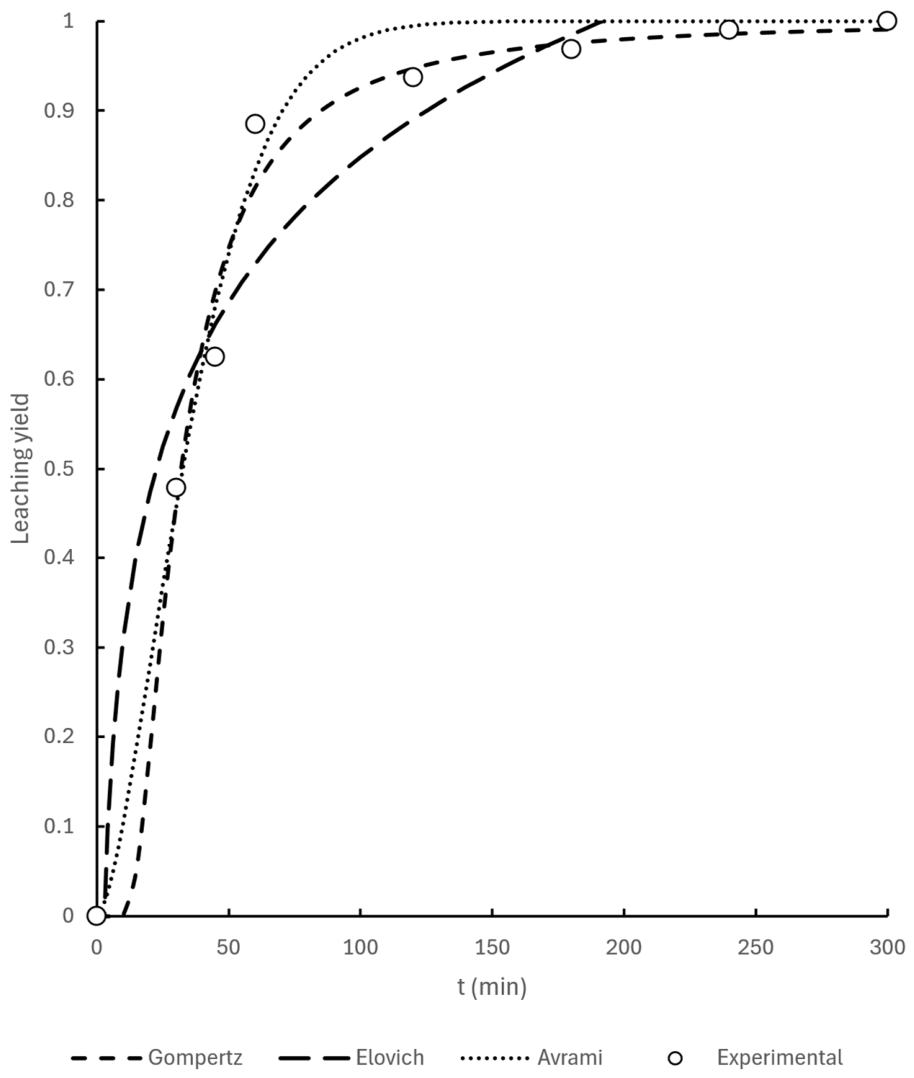
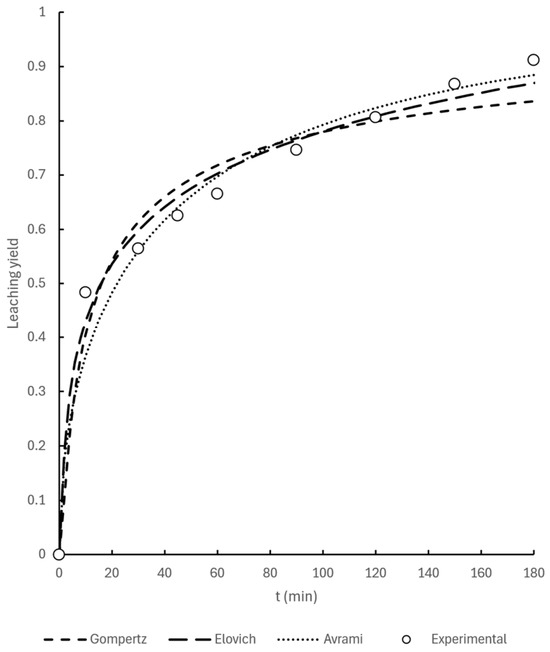
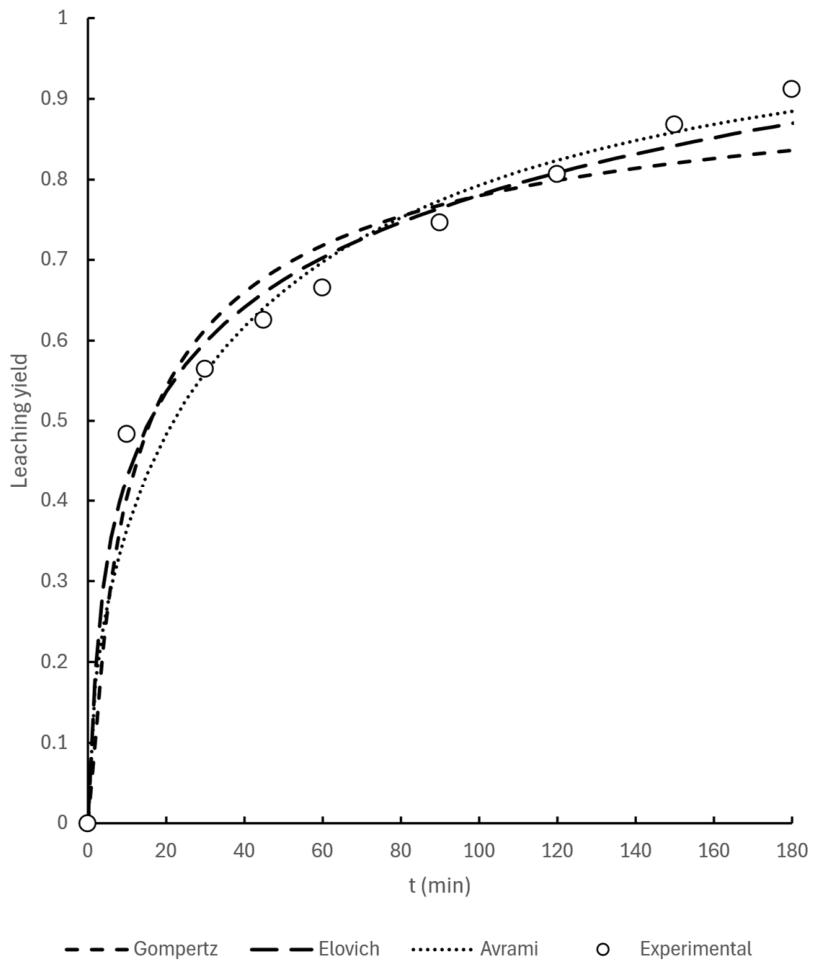
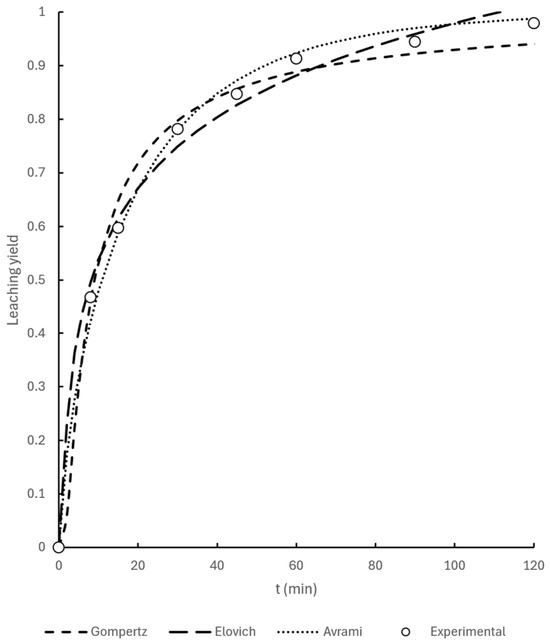
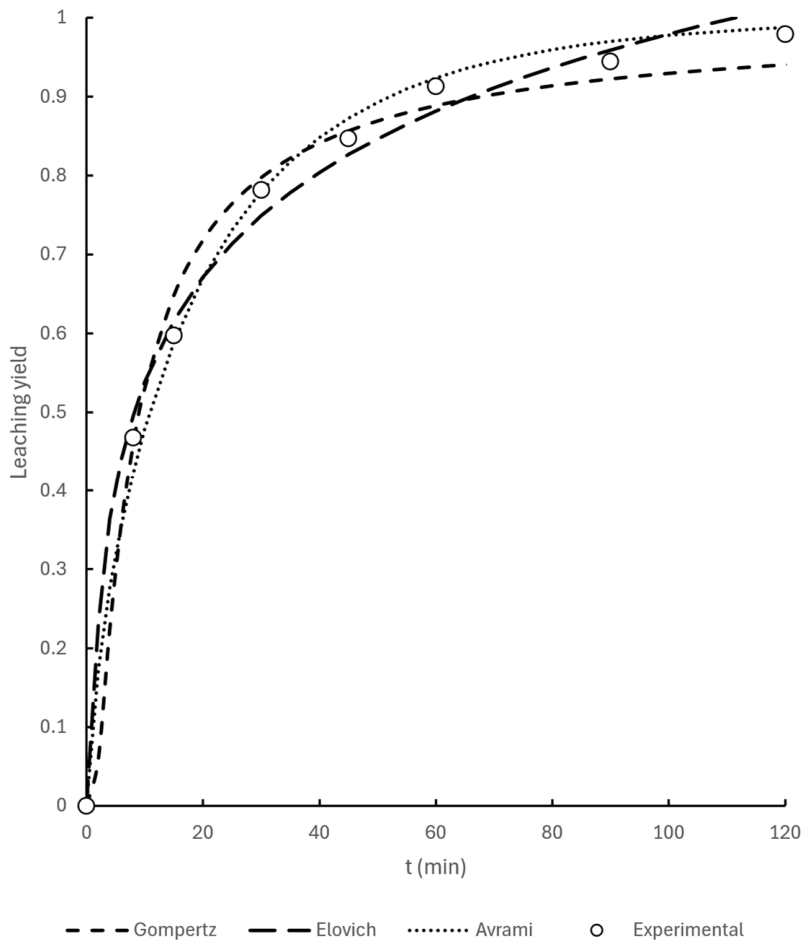
The results for each of the three concentrates studied using the best conditions are summarised in Table 8, Table 9 and Table 10. The results of the fittings are shown in Table 11 and Figure 9, Figure 10 and Figure 11 respectively.
Table 8.
Experimental results for the leaching of wolframite concentrate. Conditions: particle size < 75 µm, temperature 100 °C, pulp density 50% w/w, NaOH concentration 370 g·L−1.
Table 9.
Experimental results for the leaching of scheelite concentrate. Conditions: particle size < 45 µm, temperature 90 °C, pulp density 3.2% w/w, HCl concentration 400 g·L−1.
Table 10.
Experimental results for the leaching of mixed concentrate after roasting. Conditions: particle size before roasting < 150 µm, temperature 90 °C, pulp density 12.5% w/w, water as leachant.
Table 11.
Results of the fittings of the kinetic data to theoretical models.
Figure 9.
Results of the fitting of experimental kinetic data for wolframite concentrate using best leaching conditions.
Figure 10.
Results of the fitting of experimental kinetic data for scheelite concentrate using best leaching conditions.
Figure 11.
Results of the fitting of experimental kinetic data for mixed concentrate using best leaching conditions.
Overall, the three biparametric models produced slightly higher regression coefficients than the shrinking-core equations, confirming their greater flexibility for reproducing the complete experimental conversion curves. However, the improvement in the statistical quality of the fitting was relatively modest, indicating that the Ginstling–Brounshtein model already captures the dominant features governing tungsten dissolution. Consequently, the principal advantage of the biparametric models lies not in replacing the mechanistic interpretation provided by the shrinking-core approach but in offering a more accurate empirical representation of the overall kinetic response.
The differences observed among the three concentrates are nevertheless of particular interest. The Gompertz and Avrami equations described the leaching behaviour of wolframite with similar accuracy, whereas the Elovich model provided the best overall representation for scheelite and the activated mixed concentrate. Since the Elovich equation is commonly associated with heterogeneous reactive surfaces and progressively changing activation energies, its superior performance is consistent with the mechanistic interpretation proposed throughout this work, namely that the reactive surface evolves continuously during leaching and that the apparent kinetic behaviour cannot be represented by a unique elementary process.
From an engineering perspective, these results suggest that shrinking-core models and biparametric equations should be regarded as complementary rather than alternative approaches. The former provide physically meaningful information on the dominant rate-controlling mechanism and are therefore more appropriate for mechanistic interpretation and process understanding. The latter offer a more accurate mathematical description of the overall dissolution behaviour and may therefore be advantageous for process simulation, reactor modelling and scale-up calculations where predictive capability is often more important than the identification of an individual elementary mechanism.
4. Conclusions
The kinetic behaviour of three tungsten concentrates of Spanish origin (wolframite, scheelite and a mixed concentrate) was evaluated under their respective optimum leaching conditions using both mechanistic and empirical kinetic models.
For the three concentrates, the Ginstling–Brounshtein equation provided the best overall description of the experimental data, indicating that tungsten dissolution is governed by a coupled reaction–diffusion mechanism rather than by a single rate-controlling step. Although the chemical pathways differ substantially between alkaline leaching of wolframite, acid leaching of scheelite and alkaline roasting followed by water leaching of the mixed concentrate, all systems converge towards a similar macroscopic kinetic behaviour in which internal diffusional resistance progressively controls the overall dissolution rate.
Scheelite exhibited the most homogeneous kinetic response and the highest reproducibility, whereas wolframite showed a greater sensitivity to reagent concentration and particle size. The untreated mixed concentrate displayed the lowest leaching efficiency owing to the refractory nature of the wolframite fraction, while alkaline roasting effectively transformed its behaviour, enabling high tungsten recoveries and kinetic characteristics comparable to those of the individual concentrates.
For scheelite, the apparent activation energy of −11.66 kJ mol−1 should be interpreted as the thermal response of the overall reaction–diffusion system rather than as the activation energy of an elementary dissolution reaction. This result provides additional support for the mechanistic interpretation derived from the shrinking-core analysis.
The biparametric models produced slightly better statistical fits than the mechanistic equations, with the Elovich model providing the best representation for scheelite and the activated mixed concentrate, whereas Gompertz and Avrami models showed comparable performance for wolframite. Their main contribution, however, lies in improving the mathematical description of the complete conversion curves rather than replacing the mechanistic interpretation provided by the shrinking-core approach.
Overall, the combined use of shrinking-core and biparametric models constitutes a reliable methodology for interpreting tungsten leaching kinetics, comparing concentrates of different mineralogical composition and supporting the optimisation and scale-up of hydrometallurgical recovery processes.
Author Contributions
Conceptualization, L.J.L.-B. and F.J.A.; Methodology, L.J.L.-B.; Validation, L.J.L.-B.; Formal analysis, F.J.A.; Investigation, F.J.A.; Data curation, L.J.L.-B.; Writing—original draft, L.J.L.-B.; Writing—review & editing, L.J.L.-B. and F.J.A.; Supervision, F.J.A. All authors have read and agreed to the published version of the manuscript.
Funding
This research received no external funding.
Data Availability Statement
The original contributions presented in this study are included in the article. Further inquiries can be directed to the corresponding author.
Acknowledgments
To the CSIC (Spain) and Universidad Politécnica de Cartagena (Spain) for support.
Conflicts of Interest
The authors declare no conflicts of interest.
References
- European Union. Regulation (EU) 2024/1252 of the European Parliament and of the Council of 11 April 2024 Establishing the Framework for Ensuring a Secure and Sustainable Supply of Critical Raw Materials and Amending Regulations (EU) No 168/2013, (EU) 2018/858, (EU) 2018/1724 and (EU) 2019/1020. 2024. Available online: http://data.europa.eu/eli/reg/2024/1252/oj (accessed on 15 June 2026).
- European Union. Communication from the Commission to the European Parliament, the European Council, the Council, the European Economic and Social Committee and the Committee of the Regions. A Green Deal Industrial Plan for the Net-Zero Age. 2023. Available online: https://eur-lex.europa.eu/legal-content/EN/TXT/?uri=CELEX:52023DC0062 (accessed on 15 June 2026).
- Canadian Securities Administrators. NI 43-101 Standards of Disclosure for Mineral Projects, Form 43-101F1 Technical Report and Related Consequential Amendments. 2011. Available online: https://mrmr.cim.org/media/1017/national-instrument-43-101.pdf (accessed on 15 June 2026).
- European Union. Strategic Project Mining Project EL MOTO; Publications Office of the European Union: Luxembourg, 2025. [Google Scholar] [CrossRef]
- Alguacil, F.J.; Alonso, M.; Lozano, L.J.; Robla, J.I. Strategies for the recovery of tungsten from wolframite, scheelite, or wolframite-scheelite mixed concentrates of Spanish origin. Metals 2025, 15, 819. [Google Scholar] [CrossRef] [Scilit]
- Habashi, D. Principles of Extractive Metallurgy; Taylor & Francis: London, UK, 1986. [Google Scholar] [CrossRef] [Scilit]
- Crundwell, F.K.; Godorr, S.A. A mathematical model of the leaching of gold in cyanide solutions. Hydrometallurgy 1997, 44, 147–162. [Google Scholar] [CrossRef] [Scilit]
- Dickinson, C.F.; Healb, G.R. Solid-liquid diffusion-controlled rate equations. Thermochim. Acta 1999, 340–341, 89–103. [Google Scholar] [CrossRef] [Scilit]
- Moreno-Pulido, C.; Olwande, R.; Myers, T.; Font, F. Approximate solutions to the shrinking core model and their interpretation. Appl. Math. Model. 2026, 154, 116715. [Google Scholar] [CrossRef] [Scilit]
- Liu, J.; Chen, J.; Liu, D.; Huang, M.; Xiu, T.; Liu, Z. Release behavior of fluoride ions during the leaching of uranium and thorium from Ta–Nb slag with sulfuric acid and aluminum salts. J. Radioanal. Nucl. Chem. 2026, 335, 2855–2867. [Google Scholar] [CrossRef] [Scilit]
- Li, S.J.; Zhu, J.X. Leaching kinetics of fluorine during the aluminum removal from spent Li-ion battery cathode materials. J. Environ. Sci. China 2024, 138, 312–325. [Google Scholar] [CrossRef] [Scilit] [PubMed]
- Liu, W.; Xiao, Z.Q.; Das, S.; Zhang, W. Mechanism and kinetic study of rare earth extraction from allanite by direct acid leaching. Miner. Eng. 2024, 205, 108489. [Google Scholar] [CrossRef] [Scilit]
- Meng, L.; Hao, T.; Xu, E.; Miao, Z.; Jiang, X.; Zhao, S.; Wang, H.; Song, Z. Green and efficient separation of fluorine from spent aluminum electrolyte by aluminum sulfate solution: Leaching behavior and mechanism. Sep. Purif. Technol. 2025, 357, 130089. [Google Scholar] [CrossRef] [Scilit]
- Faraji, F.; Alizadeh, A.; Rashchi, F.; Mostoufi, N. Kinetics of leaching: A review. Rev. Chem. Eng. 2022, 38, 113–148. [Google Scholar] [CrossRef] [Scilit]
- Grénman, H.; Salmi, T.; Murzin, D.Y. Solid-liquid reaction kinetics—Experimental aspects and model development. Rev. Chem. Eng. 2011, 27, 53–77. [Google Scholar] [CrossRef] [Scilit]
- Juárez Tapia, J.C.; Patiño Cardona, F.; Roca Vallmajor, A.; Teja Ruiz, A.M.; Reyes Domínguez, I.A.; Reyes Pérez, M.; Pérez Labra, M.; Flores Guerrero, M.U. Determination of dissolution rates of Ag contained in metallurgical and mining residues in the S2O32−-O2-Cu2+ system: Kinetic analysis. Minerals 2018, 8, 309. [Google Scholar] [CrossRef] [Scilit]
- Shayakhmetova, R.; Mukhametzhanova, A.; Osipov, P.; Kali, A.; Kuandykova, A.; Rakhym, A. Mechanism, kinetics and thermodynamics of nickel, iron, and magnesium hydrochloric acid leaching from laterite ore. Sci. Rep. 2025, 15, 41342. [Google Scholar] [CrossRef] [Scilit] [PubMed]
- Apua, M.C.; Madiba, M.S. Leaching kinetics and predictive models for elements extraction from copper oxide ore in sulphuric acid. J. Taiwan Inst. Chem. Eng. 2021, 121, 313–320. [Google Scholar] [CrossRef] [Scilit]
- Aharoni, C.; Tompkins, F.C. Kinetics of adsorption and desorption and the Elovich equation. Adv. Catal. 1970, 21, 1–49. [Google Scholar] [CrossRef] [Scilit]

Disclaimer/Publisher’s Note: The statements, opinions and data contained in all publications are solely those of the individual author(s) and contributor(s) and not of MDPI and/or the editor(s). MDPI and/or the editor(s) disclaim responsibility for any injury to people or property resulting from any ideas, methods, instructions or products referred to in the content. |
© 2026 by the authors. Licensee MDPI, Basel, Switzerland. This article is an open access article distributed under the terms and conditions of the Creative Commons Attribution (CC BY) license.