


Abstract
The isothermal compression tests of as-cast Ti6Al4V alloy specimens, with coarse grains obtained from the runner, were conducted at a strain rate range of 0.001–0.1 s−1 and a temperature range of 710–920 °C. The experimental results were used for constitutive modeling. A hyperbolic sine constitutive model was developed to predict the flow behaviors of the as-cast Ti6Al4V alloy. The experimental results agreed well with the predicted results by the above constitutive model. After the establishment of the constitutive model, the closure behavior of the gas pore inside the as-cast Ti6Al4V alloy during hot isostatic pressing (HIP) was studied by experiment and simulation. Through wire cutting, turning, drilling, and argon arc welding of the raw material, the HIP samples were obtained, with these being a cylindrical specimen (Φ15 mm × 13 mm) with a sealed pore (Φ2.5 mm × 4 mm) inside. Interrupted HIP experiments at 780 °C/102 MPa/0 min and 920 °C/120 MPa/20 min were designed, and a full-standard HIP experiment (920 °C/120 MPa/150 min) was also carried out. The HIP sample was simultaneously numerically simulated using the above constitutive model under the same conditions as the experiment. The simulation and the experimental results revealed that the pore begins to close in the first stage of HIP, and the closing rate is faster than in the second stage of HIP. The gas pore cannot be completely annihilated in a standard HIP cycle. Plastic deformation is the main mechanism for pore closure during HIP.
1. Introduction
The Ti6Al4V alloy has attracted appreciable attention from the aerospace industry due to its low density, high specific strength, and excellent high-temperature mechanical properties [1,2,3]. Porosity, shrinkage cavity, and shrinkage porosity are inevitable defects in Ti6Al4V alloy castings. Hot isostatic pressing (HIP) treatment can effectively eliminate the pores in the castings without changing the shape of the castings.
HIP treatment is a process in which isostatic pressure and temperature are simultaneously applied to a workpiece [4,5], and the internal voids are therefore eliminated. The soundness and mechanical properties of materials are significantly improved after HIP treatment [5,6]. At present, there is a small amount of research focusing on the application of HIP on castings, with more studies concerned with the densification of powder [7,8,9] or additive manufacturing parts [10,11,12] by HIP. The evolution of the pores of the cast Ti6Al4V alloy during HIP is unknown, and the mechanism of pore annihilation is also unclear [13]. Visualizing the evolution of gas pores and revealing the mechanism of pore annihilation during HIP is conducive to optimizing the HIP process, and obtaining better quality products. HIP simulations can realize the visualization of the void evolution process in castings, and can significantly save on cost. Nevertheless, at present, most studies mainly use experimental methods to study the effect of HIP on the microstructure and mechanical properties of materials, which is time-consuming and costly. Therefore, it is of great engineering significance to study the HIP process through numerical simulation methods.
To our knowledge, there are only a few publications focusing on the simulation of the void closure during HIP. Xu et al. [14] investigated the effect of different HIP temperatures on void closure and found that the void can be closed when the HIP temperature is above 920 °C. Epishin et al. [13] studied the pore annihilation in a single-crystal nickel-based superalloy during HIP by experiment and simulation. Two mechanisms for pore closure were revealed: the void was closed by plastic deformation and diffusion. Prasad et al. [15] studied the characteristics of pore closure and the effect of HIP parameters, such as isostatic pressures and holding times, on pore annihilation in nickel-based superalloys by simulation; this may have helped to optimize the HIP process parameters. There has been no report on the numerical simulation of HIP on titanium alloy castings with gas pores inside. In addition, to our knowledge, the Ti6Al4V castings with pores inside would have all been processed by a standard HIP cycle (920 °C/120 MPa/150 min) in the industry, without considering the risk of grain coarsening. Therefore, it is of great importance to optimize the HIP schedule for the Ti6Al4V alloy through a combination of experiment and simulation. To simulate the HIP process of Ti6Al4V, the flow behavior of the as-cast Ti6Al4V alloy should be determined first.
Isothermal compression tests and constitutive modeling are typical methods of exploring the flow behavior during hot deformation. The constitutive relation of metals describes the relationship between flow stress and process variables, such as deformation temperature and strain rate [16,17,18,19,20]. The phenomenological constitutive equation defines flow stress as the function of strain rate and temperature in a relatively simple form. The phenomenological model does not explain the deformation mechanisms, but utilizes the empirical formula to describe the relationship between variables. One of the most popular phenomenological constitutive model, proposed by F. Garofalo [21], is an Arrhenius-type hyperbolic sine equation, which has been widely used to characterize the flow behavior of the Ti-6242S alloy [22], ferritic stainless steel [23], 5052 aluminum and AZ31 magnesium alloys [24], etc. To model the whole flow curves, the method of using the constants of the hyperbolic sine equation as functions of strain (strain compensation) has been extensively applied to model the flow behavior of materials; these include stainless steel [25,26], aluminum alloy [27,28,29], magnesium alloy [30], brass [31], and titanium alloy [32,33]. The predicted results agreed well with the experimental results. Therefore, the strain-dependent Arrhenius-type hyperbolic sine constitutive model has been established to predict flow behavior in the as-cast Ti6Al4V alloy.
In this study, the true stress-strain curves of the as-cast Ti6Al4V alloy, with initial coarse grains at temperatures of 780–920 °C with strain rates of 0.001–0.1 s−1, were obtained by isothermal compression experiments. The flow curves were modeled by the hyperbolic sine constitutive model. The obtained constitutive model was implemented for the simulation of HIP treatments. The evolution of the gas pore and the kinetics of the pore closure were first studied in the cast Ti6Al4V alloy during HIP treatments through a combination of experiments and simulations.
2. Materials and Methods
2.1. Raw Material
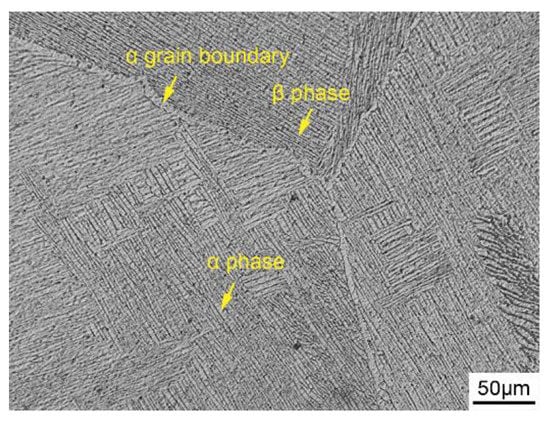
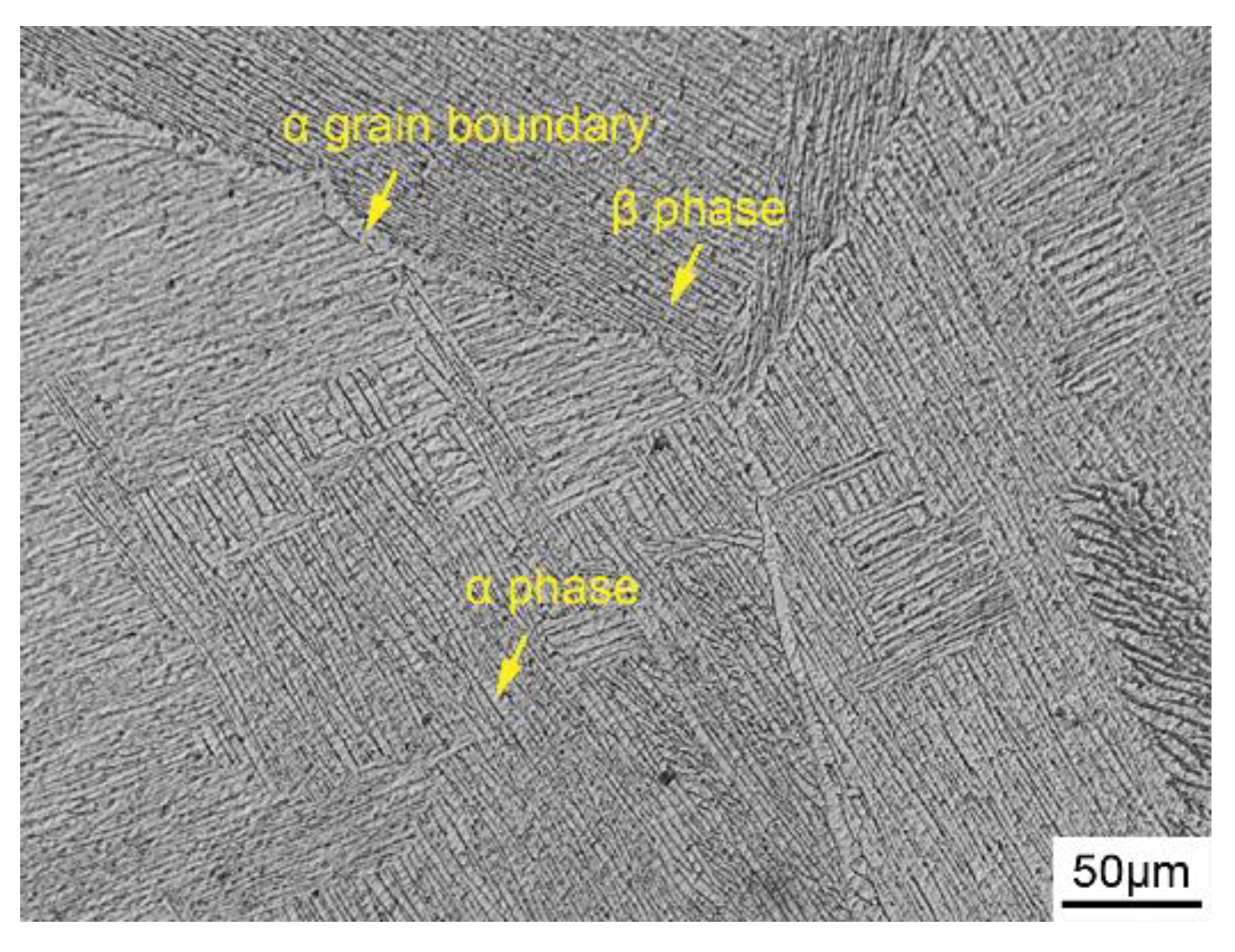
The raw materials used in this study were cut from the runners of the Ti6Al4V alloy castings. The chemical composition of the as-cast Ti6Al4V alloy is listed in Table 1. The initial microstructure of the as-cast Ti6Al4V alloy is shown in Figure 1. It can be seen that the prior β grains are coarse, the grain boundary α layer is approximately 5 μm thick, the lamellar α in the colony is approximately 3.5 μm thick, and the β layer between the α layer is approximately 1 μm thick.
Table 1.
The chemical composition of the as-cast Ti6Al4V alloy (wt%).
Figure 1.
Initial microstructure of the as-cast Ti6Al4V alloy.
2.2. Experiment Methods
Two types of experiments, the isothermal compression tests and the interrupted HIP experiments, were designed in this study. The isothermal compression tests provided the data for the establishment of the constitutive model. The interrupted HIP experiments were used to study the kinetics of the pore closure.
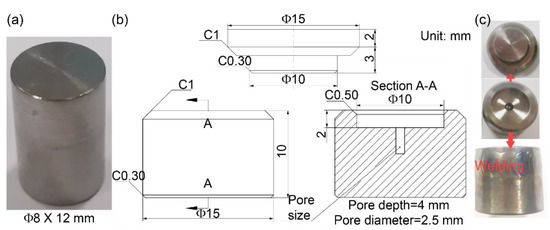
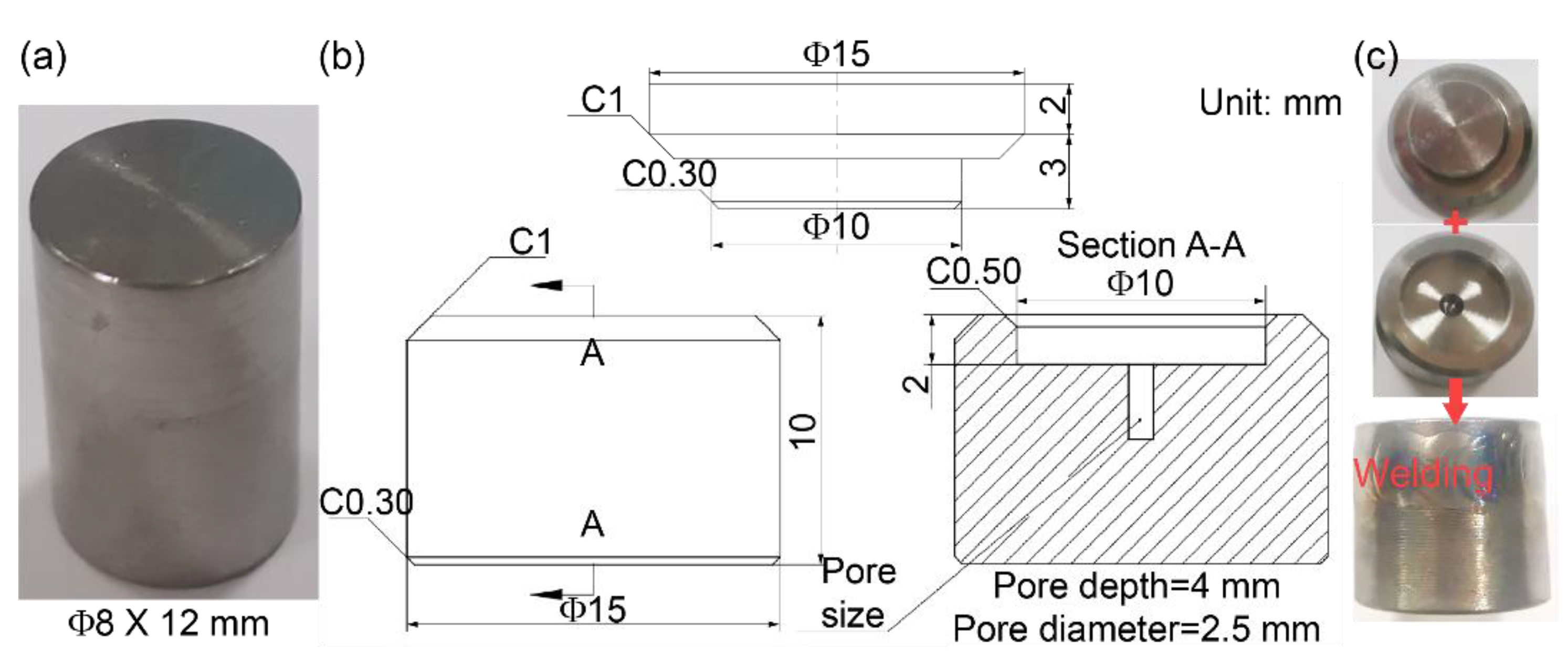
Cylindrical compression samples with a diameter of 8 mm and a height of 12 mm were machined for the compression tests (see Figure 2a). The isothermal compression tests were performed using the Gleeble 3500 thermal-mechanical simulator (Dynamic Systems Inc., Saint Paul, MN, USA) at temperatures of 710, 780, 850, and 920 °C, with strain rates of 0.001, 0.01, and 0.11 s−1. Before compression, all the samples were heated up to deformation temperatures and held for 3 min, so as to homogenize the internal temperatures of the samples. Then, the compression began and was terminated at the strain of 0.8. The true stress-strain curves were automatically obtained from the testing system. After isothermal compression, the specimens were immediately water-quenched.
Figure 2.
(a) The sample for isothermal compression tests; (b) the dimensions of the upper and lower part of the HIP sample (unit: mm); (c) the real HIP sample.
The raw materials were machined by wire cutting, turning, and drilling, and two parts were obtained (see Figure 2b,c). The dimensions of the upper and lower parts of the samples are presented in Figure 2b. These two parts were welded by argon arc welding, and the HIP sample with the sealed cylindrical gas pore inside was finally obtained (see Figure 2c). The size of the pore was Φ2.5 mm × 4 mm, and the pressure in the pore was equal to the standard atmospheric pressure. The interrupted HIP experiments were designed to explore the pore evolution during HIP treatments, as listed in Table 2. The samples were heated at a rate of 8 °C/min, and the pressure simultaneously rose to the preset temperature and pressure. The preset temperature/pressures were 780 °C/102 MPa, 920 °C/120 MPa, and 920 °C/120 MPa for HIP-1, HIP-2, and HIP-3, respectively. There was no HIP dwell time for HIP-1, and the HIP dwell times were 20 min and 150 min for HIP-2 and HIP-3, respectively. After HIP treatments, a cross-section was made at a distance of 4 mm from the bottom surface. The cross-section was ground, mechanically polished, and etched using Kroll’s reagent (3% HF, 7% HNO3, and 90% H2O) for metallographic analysis. The microstructure of the specimens was observed with the Meizs MR6000 inverted metallurgic microscope (Meizs precise instrument Co., Ltd., Shanghai, China).
Table 2.
HIP schedules.
2.3. Computation Methods
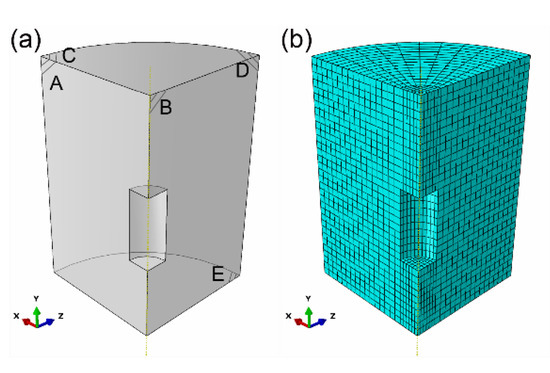
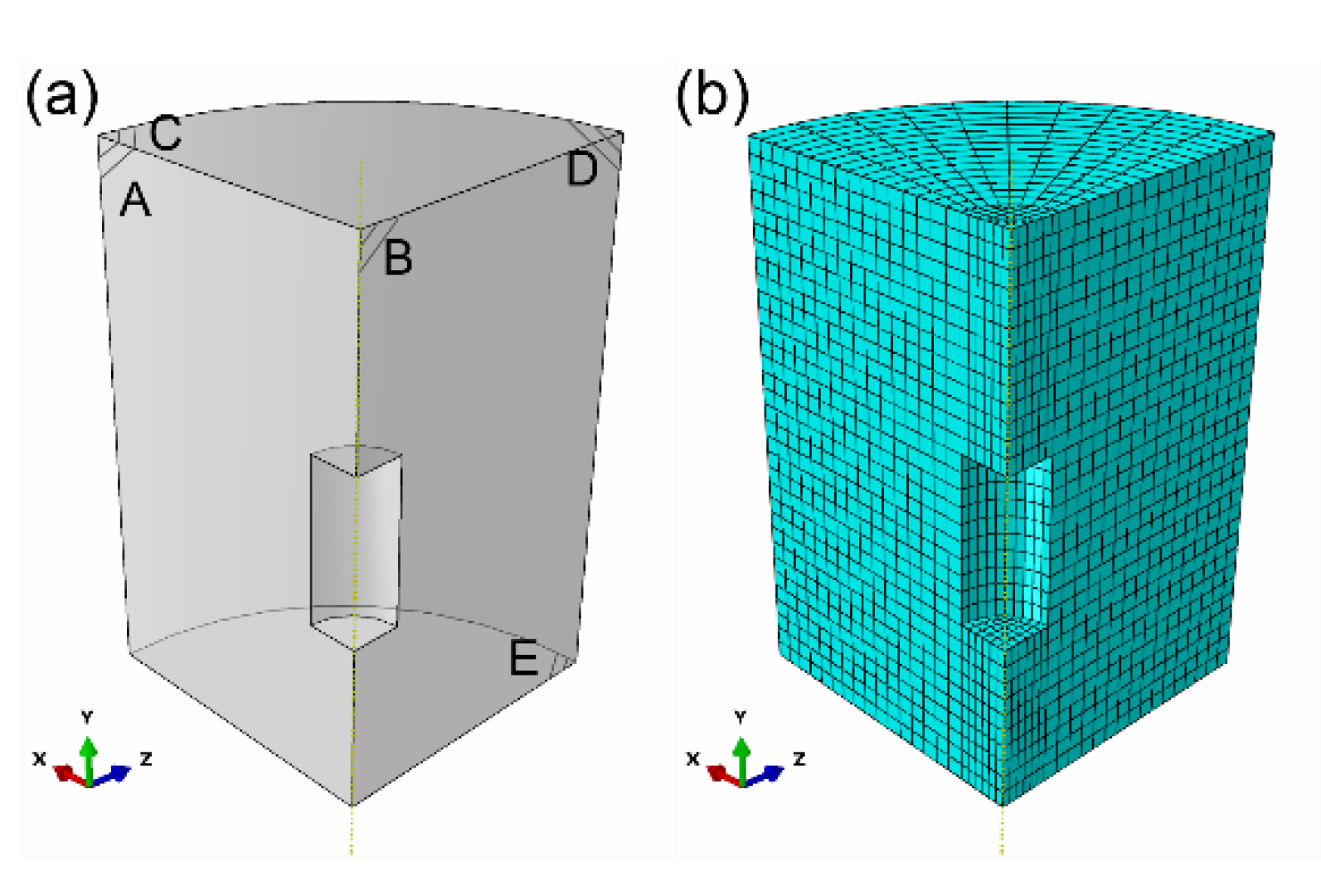
HIP simulations were carried out by the commercial FEA program, ABAQUS 6.13 (Dassault Systèmes Simulia Corp, Providence, RI, USA). The surface-based fluid cavity model, which is offered in ABAQUS [34], was adopted for the simulation of gas pore evolution during HIP. A quartered 3D model was used due to the symmetry of the samples (see Figure 3a). The symmetry constraints were imposed on faces A and B. The displacement along the Y-axis was restricted to zero. The temperature and pressure constraints were applied to faces C, D, and E. The finite element mesh is shown in Figure 3b. The geometry model was meshed with 8-node thermally coupled brick, trilinear displacement, and temperature (C3D8T) elements.
Figure 3.
(a) A quartered 3D model used in the simulation and (b) the finite element mesh.
3. Results and Discussion
3.1. Hot Deformation Behavior of As-Cast Ti6Al4V Alloy
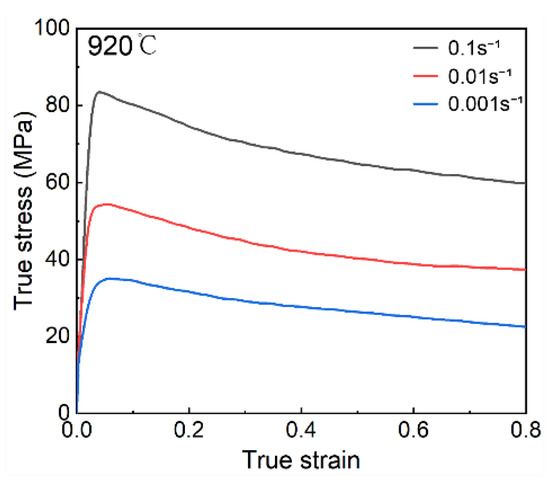
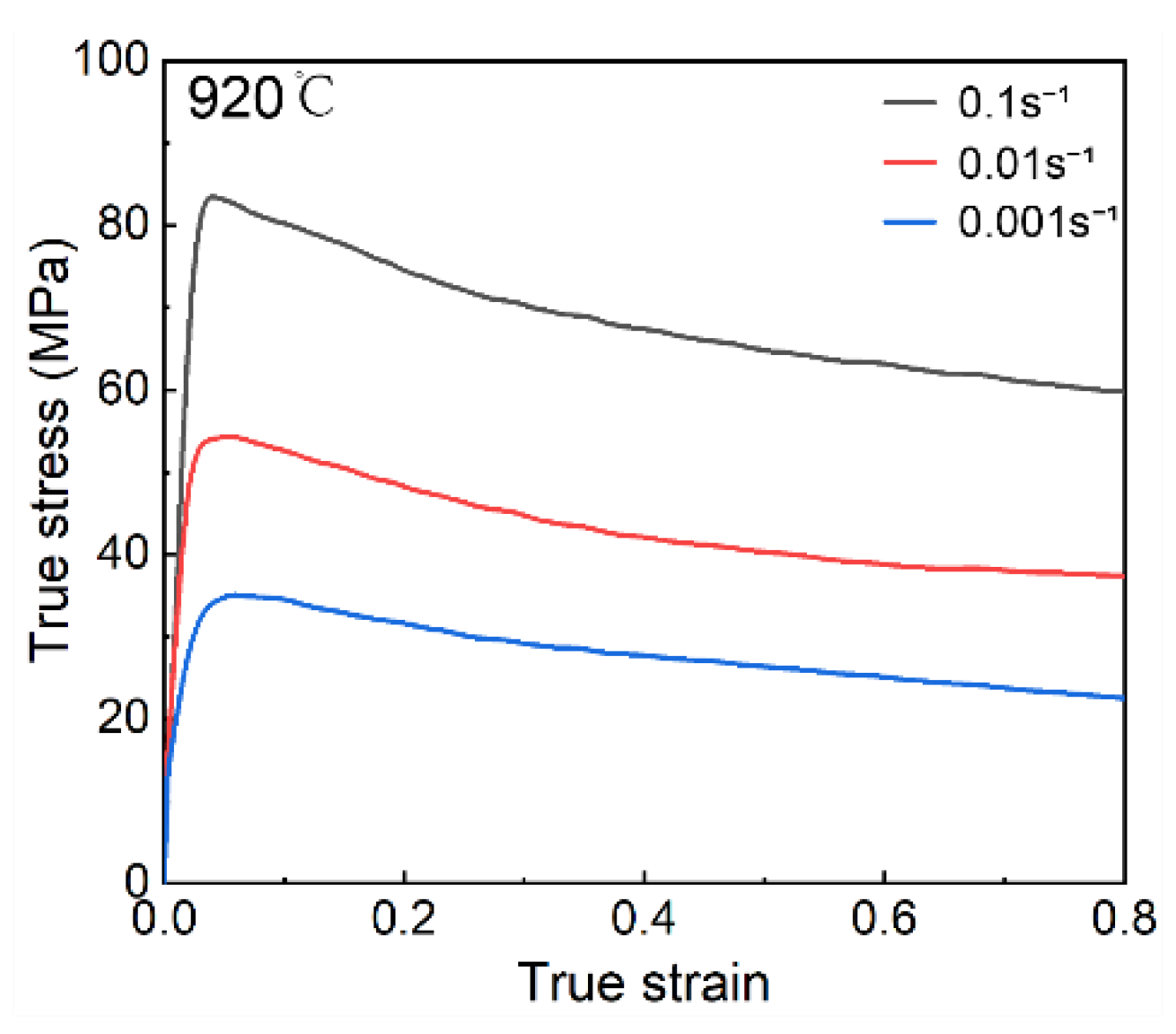
Typical, true stress-strain curves of the as-cast Ti6Al4V alloy at 920 °C are demonstrated in Figure 4. It can be seen that, when the deformation temperature is constant, flow stress decreases with the decreasing strain rates. The curves under different deformation conditions presented similar changes. Flow stress increased sharply with the increase in strain, and gradually reached peak stress. Flow stress then gradually declined due to dynamic recovery and recrystallization [35,36].
Figure 4.
Typical, true stress-strain curves of Ti6Al4V alloy at 920 °C.
3.2. Constitutive Modeling
Due to the similarity between the hot deformation process and the creep process [37], the Garofalo sine-hyperbolic equation [21] was used to describe the relationship between flow stress, deformation temperature, and strain rate, as described in Equation (1):
where is the strain rate (s−1), is the flow stress (MPa), is the activation energy of hot deformation (J/mol), is the gas constant (8.3145 J/mol/K), is the absolute temperature (K), and are the material constants.
Equation (1) can be applicable to a broad range of stress. For low stress and high stress levels , the relationship between flow stress and strain rate can be described as follows:
where and are the material parameters, and . Equation (2) was used to obtain the unknown parameter in Equation (1).
Furthermore, the well-known Zener–Hollomon parameter was introduced to describe the influence of deformation temperature and strain rate on flow behavior, as shown in Equation (3):
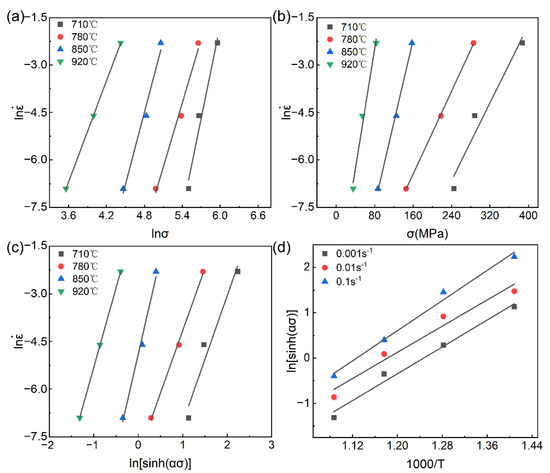
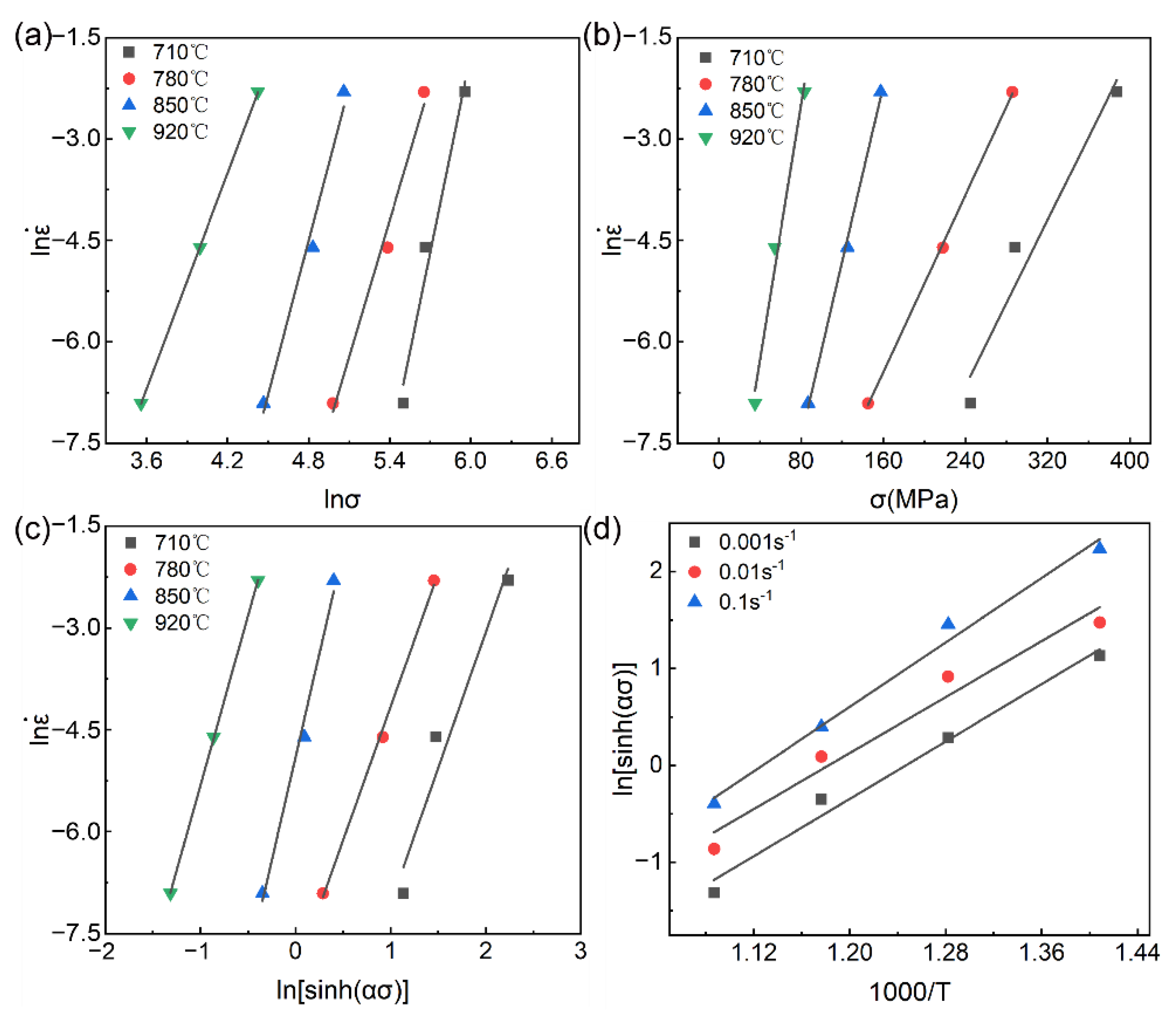
Taking the natural logarithm of both sides of Equations (1) and (2), , , and can be determined from the slope of the lines in , , and plots (see Equations (4)–(6), Figure 5a–c), respectively. can be obtained from the slope in the plot of for different strain rates (see Figure 5d). The material parameter can be derived from the intercept of plot.
Figure 5.
Plots of (a) vs. , (b) vs. , (c)
vs. , and (d) 1000/T vs. .
According to Equations (1) and (3), flow stress can be written as a function of the Z parameter as shown in Equation (8):
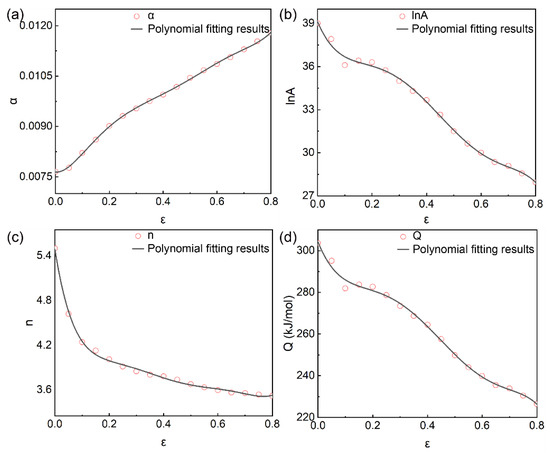
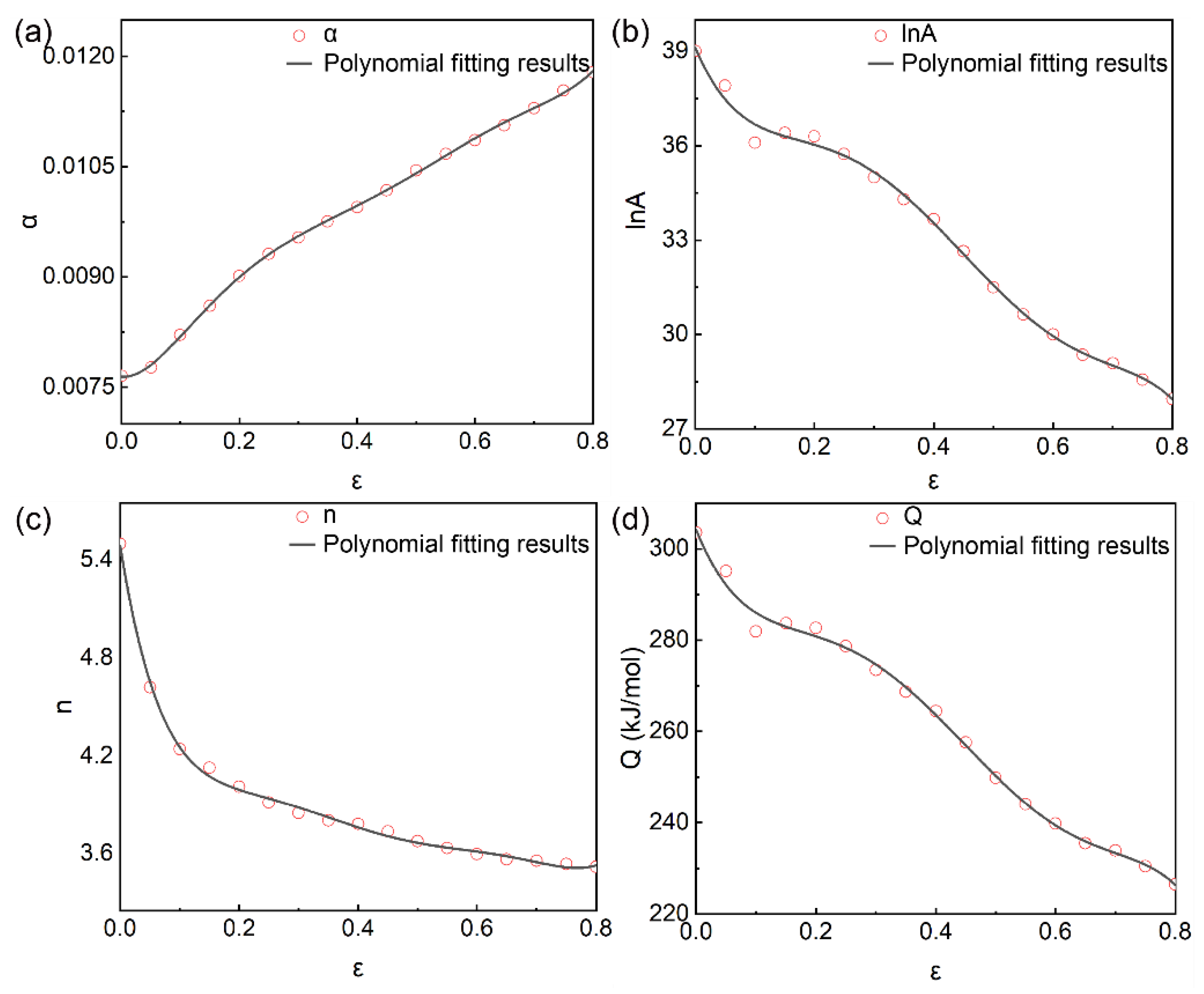
The above parameter solution process only shows the procedure under a specific strain. The effect of strain on stress during hot deformation is not considered. The material constants will change with the deformed microstructure during the hot deformation process. Therefore, in this research, the material parameters () were calculated under the strain range of 0.05–0.8 with a 0.05 interval, through the same parameter solution process. As shown in Figure 6, the results were well-fitted with sixth-order polynomial functions (listed as Equation (9)). The co-efficients of polynomial fitting are listed in Table 3.
Figure 6.
The relationship between true strain and material constants (a) , (b) , (c) and (d) and by polynomial curve fitting.
Table 3.
Co-efficient of the sixth-order polynomial for .
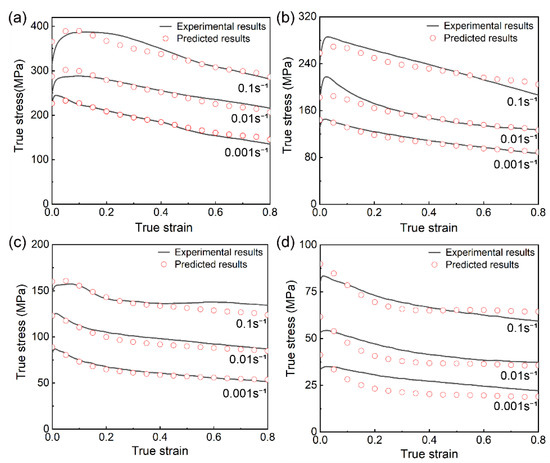
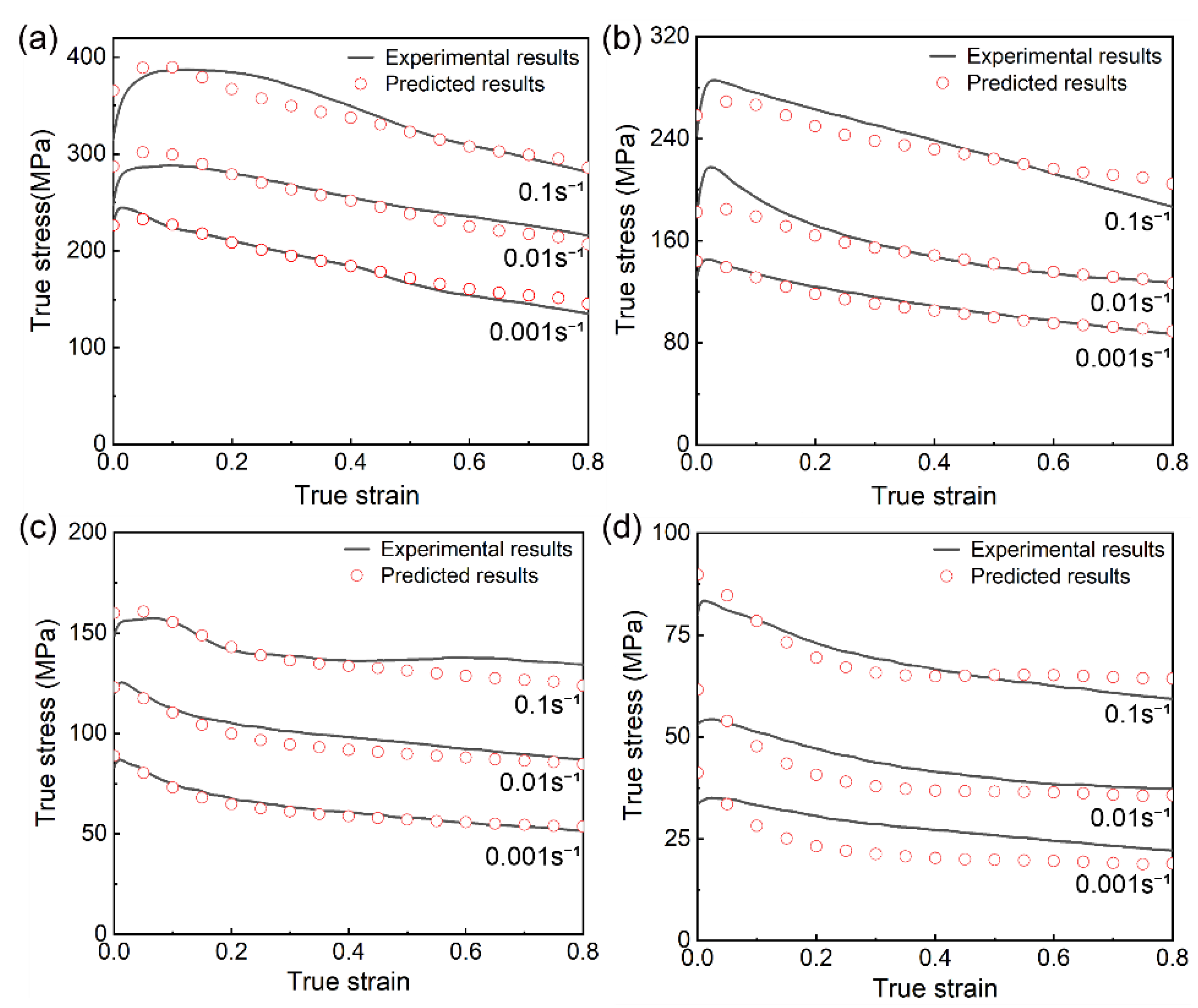
The comparison between the experimental results and the flow stress curves predicted by the strain-dependent hyperbolic sine constitutive model under all deformation conditions is illustrated in Figure 7. It can be observed that the predicted results agree well with the experimental results under most deformation conditions. Therefore, the hyperbolic sine constitutive model can be used to simulate the HIP process of the as-cast Ti6Al4V alloy.
Figure 7.
Comparison between predicted and experimental flow stresses at temperatures of (a) 710 °C, (b) 780 °C, (c) 850 °C, and (d) 920 °C.
3.3. Kinetics of Pore Closure during HIP
The void closure process during hot forging is commonly divided into two stages: mechanical closure, which leads to partial or full contact between pore surfaces, and the diffusion bonding process, in which the atoms on the pore surface intersperse themselves over time at a high temperature and pressure, so that a high-quality bonding of the surface of the pore is formed [38,39]. In view of the fact that the voids are closed through hot deformation during hot forging and HIP, we assumed that pore closure is also divided into these two stages during HIP. In this study, the mechanical closure is exclusively considered.
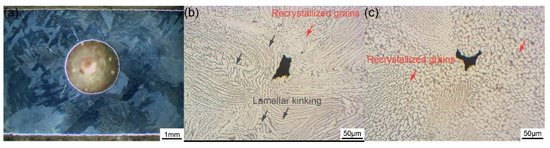
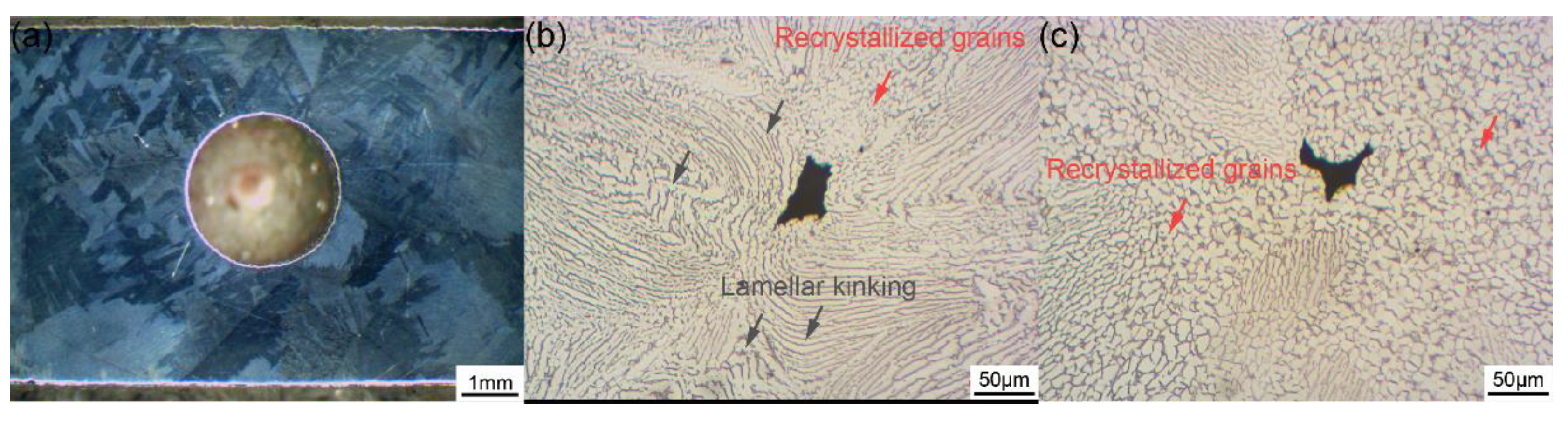
Figure 8 illustrates the OM images of the pore morphology and microstructure around the pore after HIP-1, HIP-2, and HIP-3. The area of the gas pore after HIP-1, HIP-2, and HIP-3 was 4.90625, 0.0136, and 0.0112 mm2, respectively. The change in pore volume during HIP experiment can be obtained by multiplying the area of the pore on the cross-section by the pore depth (assuming that the area of the pore is the same along the pore depth).
Figure 8.
OM images showing the morphology of pores and microstructure around the pore after (a) HIP-1, (b) HIP-2, and (c) HIP-3.
After HIP-1, there is no obvious change to the pore shape compared to the samples before HIP, and V/V0 = 1 (V is the pore volume after HIP treatment, V0 is the initial pore volume). The microstructure around the pore is the same as the initial microstructure, which is a typical Widmanstätten structure. No plastic deformation occurred after HIP-1. After HIP-2, the void volume was significantly reduced, and the V/V0 = 0.028%. The α lamellae around the pore were severely kinked (marked by black arrows), and a few recrystallized grains (marked by red arrows) were observed. After HIP-3, the V/V0 = 0.023%. Most of the α lamellae around the pore were spheroidized, and a few, short α lamellae remained. The fraction of recrystallized grains around the pore increased significantly, and the recrystallized grains obviously grew up with the increase in HIP dwell time compared with HIP-2. When compared with shrinkage cavities and shrinkage porosities [14], the gas pores cannot be completely closed after a standard HIP cycle (HIP-3).
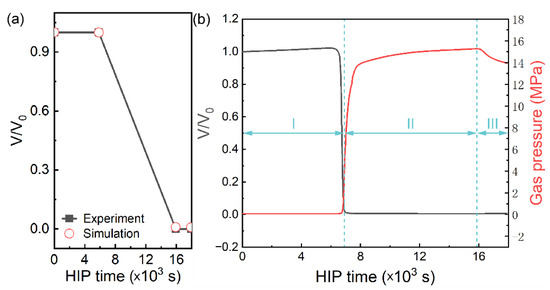
The above, strain-dependent hyperbolic sine constitutive model was implemented in a user-defined material subroutine (UMAT) to capture the viscoplastic response. Simulations of the HIP were carried out under the same three conditions as the experiments. The modelling provided a similar kinetics of pore annihilation as observed experimentally (see Figure 9a), however the annihilation rate of the simulation results was slightly lower than that of the experimental results, which could be ascribed to the assumption that diffusion was not considered in the simulations. The V/V0 after the simulation of HIP-1, HIP-2, and HIP-3 treatments were 99.95%, 0.844%, and 0.725%, respectively. Comparing the simulation results with the experimental results, it was found that the V/V0 changed a little from HIP-2 to HIP-3. However, the HIP dwelling time for HIP-3 was 130 min longer than HIP-2. The longer HIP dwelling time would cause coarse grain and the degradation of the mechanical properties. Therefore, the pore closure and microstructure should be comprehensively considered to optimize the HIP process in future studies.
Figure 9.
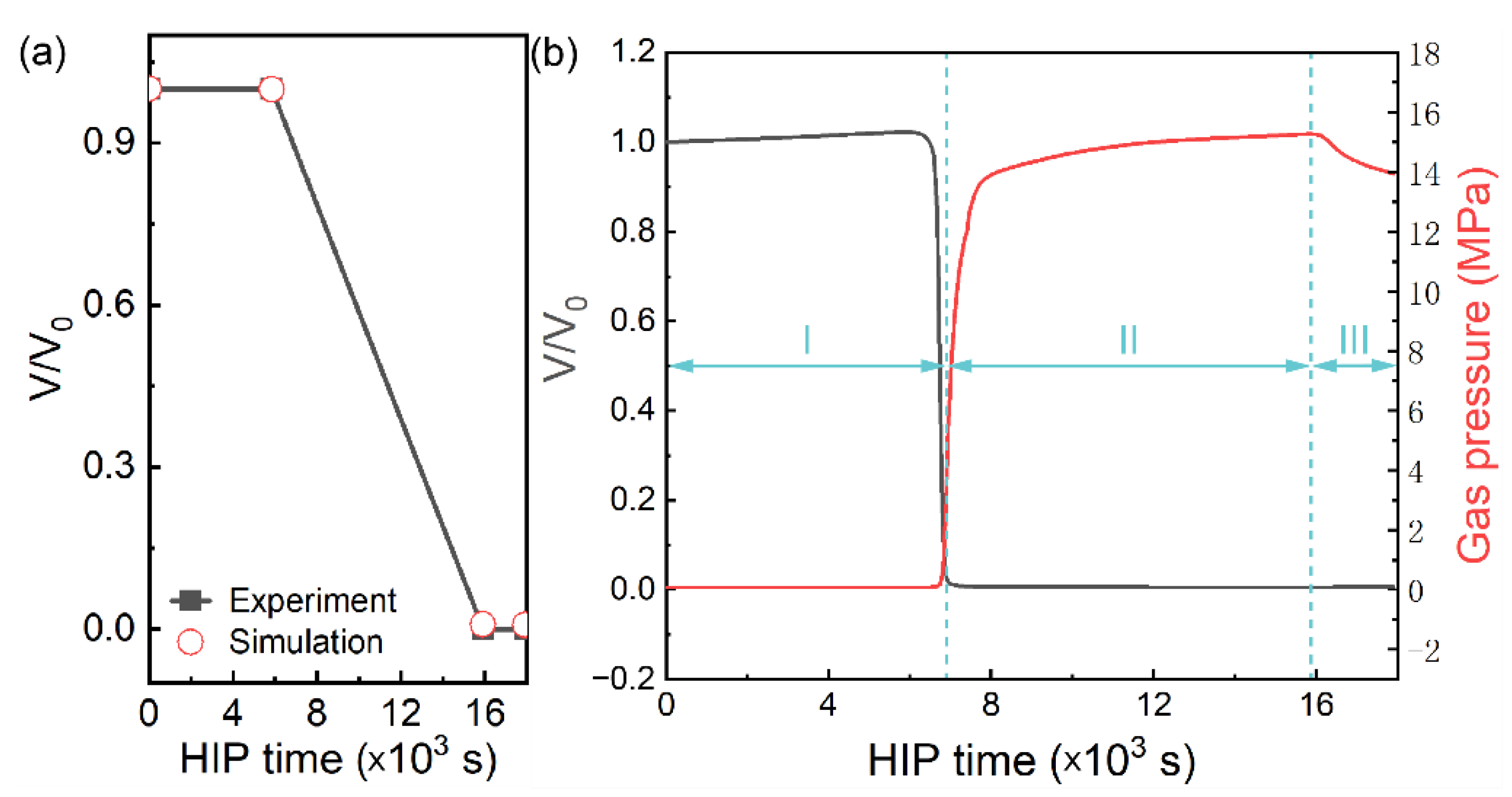
(a) The evolution of pore volume during experiment and simulation; (b) the evolution of void volume and gas pressure during a full HIP cycle (HIP-3).
Figure 9b illustrates the simulation results of the evolution of pore volume and gas pressure in the pore along with HIP time. In Stage I (the process of increasing the temperature and pressure to 920 °C/120 MPa), the pore volume initially increased due to thermal expansion, and then reduced rapidly. The pore volume reduced slowly during Stage II (the temperature and pressure holding process). It is worth noting here that the void closure already began during Stage I, and that the closure rate at Stage I was very high in comparison to Stage II. The pore volume was almost unchanged in Stage III (the process of dropping the temperature and pressure to 25 °C/0.1 MPa). The gas pressure in the pore was roughly inversely proportional to the pore volume. The initial gas pressure was the standard atmospheric pressure, and gas pressure was approximately 14 MPa after a full HIP treatment.
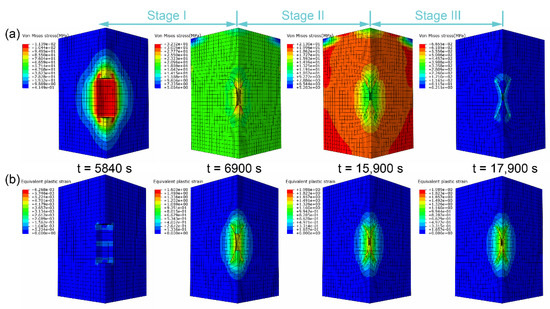
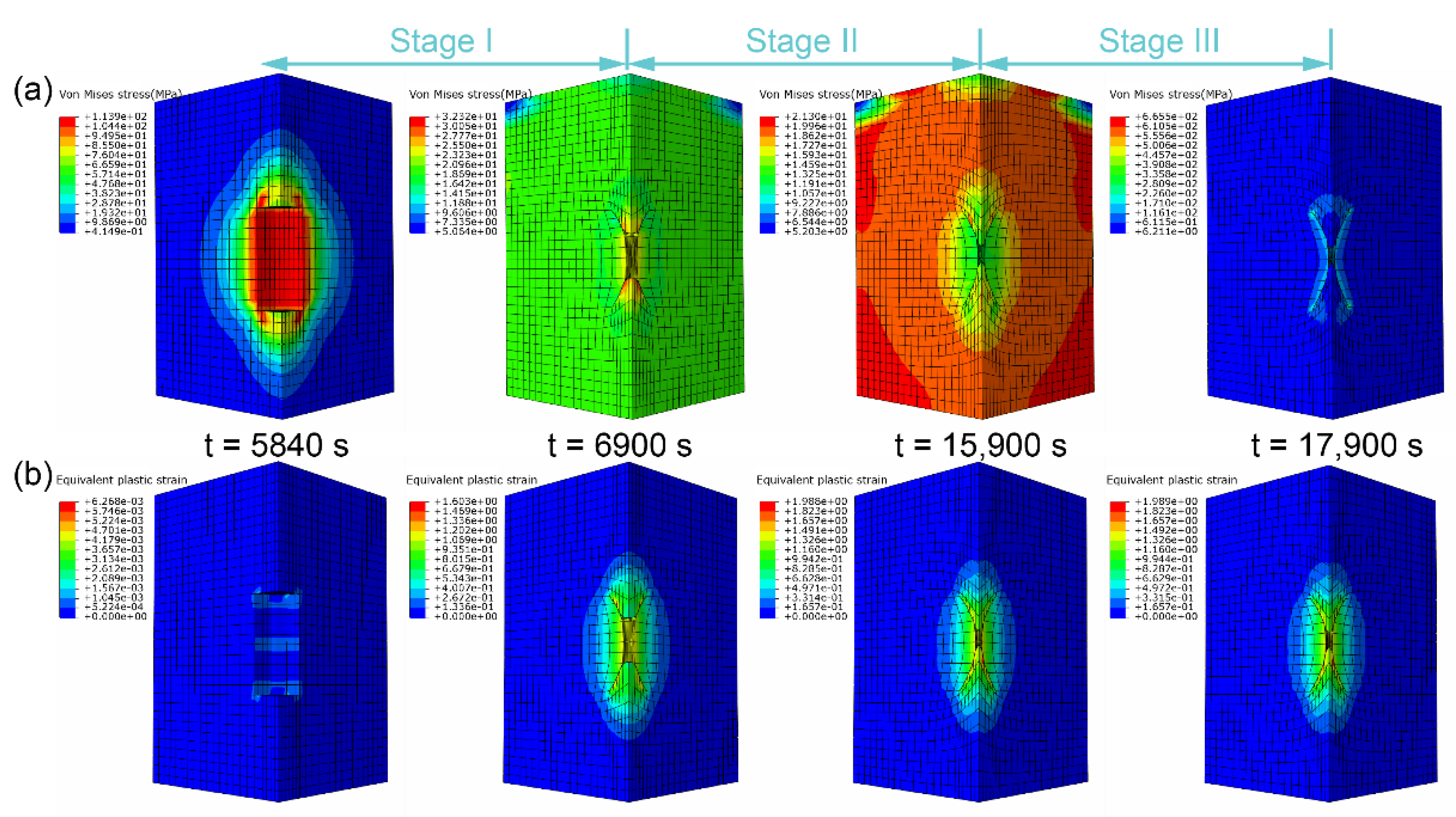
The simulation results of Mises stress (S) and equivalent plastic strain (PEEQ) during HIP-3 (a full HIP cycle) are shown in Figure 10. During Stage I, stress was mainly distributed around the pore. Plastic deformation occurred, and the stresses around the pore relaxed due to the increasing plastic strains. During Stage II, stress around the pore continued to drop, and plastic deformation proceeded to accumulate. Therefore, as the pore gradually shrunk, the stress field around the pore was gradually ‘weakened’, and the plastic strain field around the pore gradually became ‘stronger’. Plastic deformation dominated in the pore closure process. After Stage III, there was residual stress around the plastically deformed pore.
Figure 10.
The distribution of (a) Mises stress and (b) equivalent plastic strain during HIP-3.
4. Conclusions
In this study, hot compression tests in a wide range of temperatures (710, 780, 850, and 920 °C) and strain rates (0.001,0.01 and 0.1 s−1) were carried out to obtain the constitutive model of the as-cast Ti6Al4V alloy. The constitutive model was implemented to simulate the pore evolution in the cast Ti6Al4V alloy during HIP. Important conclusions are drawn below:
- (1)
- When the deformation temperature is constant, the flow stress of the as-cast Ti6Al4V alloy increases with the strain rate. When the strain rate is constant, the flow stress of the as-cast Ti6Al4V alloy decreases with increasing temperature. The flow behavior of the as-cast Ti6Al4V alloy can be well predicted by the strain-dependent Arrhenius-type hyperbolic sine constitutive model.
- (2)
- The V/V0 of the gas pore after HIP-1, HIP-2, and HIP-3 was 100%, 0.028%, and 0.023%, respectively, which means that HIP can effectively reduce the volume of the gas pore. Gas pores cannot be completely eliminated by a standard HIP cycle (HIP-3).
- (3)
- During HIP, α lamellae around the pore were gradually kinked. With the maintenance of high temperature and pressure, a large amount of recrystallized grains appeared around the pores and only a few short lamellae remained.
- (4)
- Pore closure begins in Stage I, and the closure rate is faster than in Stage II. As the pore gradually shrinks, stress around the pore gradually decreases and the plastic strain continues to accumulate. Plastic deformation is the main mechanism for pore closure during HIP.
Author Contributions
Conceptualization, methodology, software, writing—original draft preparation, and visualization, Q.X.; validation, formal analysis, investigation, data curation, and writing—review and editing, W.L.; resources and supervision, Y.Y. and J.Z.; project administration and funding acquisition, J.Z. All authors have read and agreed to the published version of the manuscript.
Funding
This work was financially supported by the National Key Research and Development Program of China (No. 2020YFB1710100), National Natural Science Foundation of China (Grant No. 51475181 and 51775205).
Data Availability Statement
The data presented in this study are available on request from the corresponding author. The data are not publicly available due to an ongoing study.
Conflicts of Interest
The authors declare no conflict of interest.
References
- Li, H.; Gao, C.; Wang, G.; Qu, N.; Zhu, D. A study of electrochemical machining of Ti-6Al-4V in NaNO 3 solution. Sci. Rep. 2016, 6, 1–11. [Google Scholar]
- Silva, D.; Guerra, C.; Muñoz, H.; Aguilar, C.; Walter, M.; Azocar, M.; Muñoz, L.; Gürbüz, E.; Ringuedé, A.; Cassir, M.; et al. The effect of staphylococcus aureus on the electrochemical behavior of porous Ti-6Al-4V alloy. Bioelectrochemistry 2020, 136, 107622. [Google Scholar] [CrossRef] [Scilit]
- Chapkin, W.A.; Simone, D.L.; Frank, G.J.; Baur, J.W. Mechanical behavior and energy dissipation of infilled, composite Ti-6Al-4V trusses. Mater. Des. 2021, 203, 109602. [Google Scholar] [CrossRef] [Scilit]
- Loh, N.L.; Sia, K.Y. An overview of hot isostatic pressing. J. Mater. Process. Technol. 1992, 30, 45–65. [Google Scholar] [CrossRef] [Scilit]
- Fryé, T.; Strauss, J.T.; Fischer-Buehner, J.; Klotz, U.E. The effects of hot isostatic pressing of platinum alloy castings on mechanical properties and microstructures. In Proceedings of the Santa Fe Symposium on Jewelry Manufacturing Technology, Albuquerque, NM, USA, 18–21 May 2014; pp. 189–210. [Google Scholar]
- Chen, C.; Xie, Y.; Yan, X.; Yin, S.; Fukanuma, H.; Huang, R.; Zhao, R.; Wang, J.; Ren, Z.; Liu, M.; et al. Effect of hot isostatic pressing (HIP) on microstructure and mechanical properties of Ti6Al4V alloy fabricated by cold spray additive manufacturing. Addit. Manuf. 2019, 27, 595–605. [Google Scholar] [CrossRef] [Scilit]
- Chang, L.; Sun, W.; Cui, Y.; Yang, R. Influences of hot-isostatic-pressing temperature on microstructure, tensile properties and tensile fracture mode of Inconel 718 powder compact. Mater. Sci. Eng. A 2014, 599, 186–195. [Google Scholar] [CrossRef] [Scilit]
- Xu, L.; Guo, R.; Bai, C.; Lei, J.; Yang, R. Effect of Hot Isostatic Pressing Conditions and Cooling Rate on Microstructure and Properties of Ti-6Al-4V Alloy from Atomized Powder. J. Mater. Sci. Technol. 2014, 30, 1289–1295. [Google Scholar] [CrossRef] [Scilit]
- Zhang, K.; Mei, J.; Wain, N.; Wu, X. Effect of hot-isostatic-pressing parameters on the microstructure and properties of powder Ti-6Al-4V hot-isostatically-pressed samples. Metall. Mater. Trans. A 2010, 41, 1033–1045. [Google Scholar] [CrossRef] [Scilit]
- Tammas-Williams, S.; Withers, P.J.; Todd, I.; Prangnell, P.B. The effectiveness of hot isostatic pressing for closing porosity in titanium parts manufactured by selective electron beam melting. Metall. Mater. Trans. A 2016, 47, 1939–1946. [Google Scholar] [CrossRef] [Scilit]
- Kumar, A.Y.; Bai, Y.; Eklund, A.; Williams, C.B. The effects of Hot Isostatic Pressing on parts fabricated by binder jetting additive manufacturing. Addit. Manuf. 2018, 24, 115–124. [Google Scholar]
- Tillmann, W.; Schaak, C.; Nellesen, J.; Schaper, M.; Aydinöz, M.E.U.; Hoyer, K.-P. Hot isostatic pressing of IN718 components manufactured by selective laser melting. Addit. Manuf. 2017, 13, 93–102. [Google Scholar] [CrossRef] [Scilit]
- Epishin, A.; Fedelich, B.; Link, T.; Feldmann, T.; Svetlov, I.L. Pore annihilation in a single-crystal nickel-base superalloy during hot isostatic pressing: Experiment and modelling. Mater. Sci. Eng. A 2013, 586, 342–349. [Google Scholar] [CrossRef] [Scilit]
- Xu, Q.; Zhou, J.; Nan, H.; Yin, Y.; Wang, M.; Shen, X.; Ji, X. Effects of hot isostatic pressing temperature on casting shrinkage densification and microstructure of Ti6Al4V alloy. China Foundry 2017, 14, 429–434. [Google Scholar] [CrossRef] [Scilit]
- Prasad, M.R.G.; Gao, S.; Vajragupta, N.; Hartmaier, A. Influence of trapped gas on pore healing under hot isostatic pressing in nickel-base superalloys. Crystals 2020, 10, 1147. [Google Scholar] [CrossRef] [Scilit]
- Längler, F.; Naumenko, K.; Altenbach, H.; Ievdokymov, M. A constitutive model for inelastic behavior of casting materials under thermo-mechanical loading. J. Strain Anal. Eng. Des. 2014, 49, 421–428. [Google Scholar] [CrossRef] [Scilit]
- Hosseini, E.; Holdsworth, S.R.; Mazza, E. Stress regime-dependent creep constitutive model considerations in finite element continuum damage mechanics. Int. J. Damage Mech. 2013, 22, 1186–1205. [Google Scholar] [CrossRef] [Scilit]
- Naumenko, K.; Gariboldi, E.; Nizinkovskyi, R. Stress-regime-dependence of inelastic anisotropy in forged age-hardening aluminium alloys at elevated temperature: Constitutive modeling, identification and validation. Mech. Mater. 2020, 141, 103262. [Google Scholar] [CrossRef] [Scilit]
- Altenbach, H.; Naumenko, K.; Gorash, Y. Creep analysis for a wide stress range based on stress relaxation experiments. In Proceedings of the Engineering Plasticity And Its Applications From Nanoscale To Macroscale: (With CD-ROM)-Proceedings of The 9th Aepa 2008, Daejeon, Korea, 20–24 October 2008; pp. 41–46. [Google Scholar]
- Ji, G.; Li, Q.; Ding, K.; Yang, L.; Li, L. A physically-based constitutive model for high temperature deformation of Cu-0.36 Cr-0.03 Zr alloy. J. Alloys Compd. 2015, 648, 397–407. [Google Scholar] [CrossRef] [Scilit]
- Garofalo, F. An empirical relation defining the stress dependence of minimum creep rate in metals. Trans. AIME 1963, 227, 351–356. [Google Scholar]
- Hajari, A.; Morakabati, M.; Abbasi, S.M.; Badri, H. Constitutive modeling for high-temperature flow behavior of Ti-6242S alloy. Mater. Sci. Eng. A 2017, 681, 103–113. [Google Scholar] [CrossRef] [Scilit]
- Zhao, J.; Jiang, Z.; Zu, G.; Du, W.; Zhang, X.; Jiang, L. Flow Behaviour and Constitutive Modelling of a Ferritic Stainless Steel at Elevated Temperatures. Met. Mater. Int. 2016, 22, 474–487. [Google Scholar] [CrossRef] [Scilit]
- Wang, Y.; Peng, J.; Zhong, L.; Pan, F. Modeling and application of constitutive model considering the compensation of strain during hot deformation. J. Alloys Compd. 2016, 681, 455–470. [Google Scholar] [CrossRef] [Scilit]
- Ren, F.; Jun, C.; Fei, C. Constitutive modeling of hot deformation behavior of X20Cr13 martensitic stainless steel with strain effect. Trans. Nonferrous Met. Soc. China 2014, 24, 1407–1413. [Google Scholar] [CrossRef] [Scilit]
- Momeni, A.; Dehghani, K. Hot working behavior of 2205 austenite--ferrite duplex stainless steel characterized by constitutive equations and processing maps. Mater. Sci. Eng. A 2011, 528, 1448–1454. [Google Scholar] [CrossRef] [Scilit]
- Lin, Y.C.; Xia, Y.-C.; Chen, X.-M.; Chen, M.-S. Constitutive descriptions for hot compressed 2124-T851 aluminum alloy over a wide range of temperature and strain rate. Comput. Mater. Sci. 2010, 50, 227–233. [Google Scholar] [CrossRef] [Scilit]
- Chen, L.; Zhao, G.; Yu, J. Hot deformation behavior and constitutive modeling of homogenized 6026 aluminum alloy. Mater. Des. 2015, 74, 25–35. [Google Scholar] [CrossRef] [Scilit]
- Zhang, B.; Baker, T.N. Effect of the heat treatment on the hot deformation behaviour of AA6082 alloy. J. Mater. Process. Technol. 2004, 153, 881–885. [Google Scholar] [CrossRef] [Scilit]
- Liao, C.; Wu, H.; Wu, C.; Zhu, F.; Lee, S. Hot deformation behavior and flow stress modeling of annealed AZ61 Mg alloys. Prog. Nat. Sci. Mater. Int. 2014, 24, 253–265. [Google Scholar] [CrossRef] [Scilit]
- Xiao, Y.-H.; Guo, C.; Guo, X.-Y. Constitutive modeling of hot deformation behavior of H62 brass. Mater. Sci. Eng. A 2011, 528, 6510–6518. [Google Scholar] [CrossRef] [Scilit]
- Peng, W.; Zeng, W.; Wang, Q.; Yu, H. Comparative study on constitutive relationship of as-cast Ti60 titanium alloy during hot deformation based on Arrhenius-type and artificial neural network models. Mater. Des. 2013, 51, 95–104. [Google Scholar] [CrossRef] [Scilit]
- Jha, J.S.; Toppo, S.P.; Singh, R.; Tewari, A.; Mishra, S.K. Flow stress constitutive relationship between lamellar and equiaxed microstructure during hot deformation of Ti-6Al-4V. J. Mater. Process. Technol. 2019, 270, 216–227. [Google Scholar] [CrossRef] [Scilit]
- Simulia, D.S. ABAQUS 6.13 User’s Manual; Dassault Syst.: Provid, RI, USA, 2013; pp. 186–190. [Google Scholar]
- Yin, F.; Hua, L.; Mao, H.; Han, X. Constitutive modeling for flow behavior of GCr15 steel under hot compression experiments. Mater. Des. 2013, 43, 393–401. [Google Scholar] [CrossRef] [Scilit]
- Jin, N.; Zhang, H.; Han, Y.; Wu, W.; Chen, J. Hot deformation behavior of 7150 aluminum alloy during compression at elevated temperature. Mater. Charact. 2009, 60, 530–536. [Google Scholar] [CrossRef] [Scilit]
- Dehghani, K.; Khamei, A.A. Hot deformation behavior of 60Nitinol (Ni60wt%–Ti40wt%) alloy: Experimental and computational studies. Mater. Sci. Eng. A 2010, 527, 684–690. [Google Scholar] [CrossRef] [Scilit]
- AlHazaa, A.; Haneklaus, N. Diffusion Bonding and Transient Liquid Phase (TLP) Bonding of Type 304 and 316 Austenitic Stainless Steel—A Review of Similar and Dissimilar Material Joints. Metals 2020, 10, 613. [Google Scholar] [CrossRef] [Scilit]
- Saby, M.; Bernacki, M.; Roux, E.; Bouchard, P.-O. Three-dimensional analysis of real void closure at the meso-scale during hot metal forming processes. Comput. Mater. Sci. 2013, 77, 194–201. [Google Scholar] [CrossRef] [Scilit]

Publisher’s Note: MDPI stays neutral with regard to jurisdictional claims in published maps and institutional affiliations. |
© 2021 by the authors. Licensee MDPI, Basel, Switzerland. This article is an open access article distributed under the terms and conditions of the Creative Commons Attribution (CC BY) license (https://creativecommons.org/licenses/by/4.0/).