


Abstract
Woody plants have increased in density and extent in rangelands worldwide since the 1800s, and land managers increasingly remove woodland plants in hopes of restoring pre-settlement conditions and/or improved forage for grazing livestock. Because such efforts can be controversial, especially on publicly owned lands, managers often attempt to frame issues in ways they believe can improve public acceptance of proposed actions. Frequently these framing efforts employ conflict metaphors drawn from military or legal lexicons. We surveyed citizens in the Rocky Mountains region, USA, about their beliefs concerning tree-removal as a management strategy. Plants targeted for removal in the region include such iconic tree species as Douglas-fir and ponderosa pine as well as other less-valued species, such as Rocky Mountain juniper, that are common targets for removal nationwide. To test the influence of issue frame on acceptance, recipients were randomly assigned surveys in which the reason for conifer removal was described using one of three terms often employed by invasive biologists and land managers: “invasion”, “expansion”, and “encroachment”. Framing in this instance had little effect on responses. We conclude the use of single-word frames by scientists and managers use to contextualize an issue may not resonate with the public.
1. Introduction
Over the past two centuries, woody plant species have increased in density and extent throughout rangelands worldwide. Of particular concern in North America is conifer encroachment, the gradual establishment and domination of coniferous trees within a non-forest habitat type due to disruption of historic ecological processes [1,2]. Species of concern vary regionally, but often are in the genus Juniperus. Typically encroachment is viewed negatively by land managers and considered a factor in ecosystem degradation [3,4]. Impacts include increased soil erosion, changes in wildfire occurrence and intensity, changes in vegetation composition, and shifts in local wildlife species [5,6]. To avoid such impacts land managers often seek to remove encroaching conifers and restore historic plant communities.
Such proposals can be controversial due to concerns about environmental impacts of practices such as prescribed burning or herbicide use, as well as doubts about the severity of the problem or the motivation behind projects billed as “restoration” [7,8,9]. Therefore land managers seek ways to predict and influence public sentiment toward removal projects, especially on federal lands where management is subject to public review as mandated by the National Environmental Policy Act (NEPA). To address existing or potential future citizen opposition, public awareness efforts often seek to emphasize the threat posed by encroaching species, thereby creating a “frame”, or rhetorical context, for the issue that may be able to influence its perception by the public [10], and thereby increase willingness to accept intervention options.
In mountain regions of the western USA conifer encroachment has reduced the extent of native shrub-steppe communities. Much of this encroachment involves larger species, primarily Douglas-fir (Pseudotsuga menziesii) and occasionally ponderosa pine (Pinus ponderosa), along with smaller conifers such as Rocky Mountain juniper (Juniperus scopulorum). Because of the iconic nature of some of these species, rangeland managers may be wary of negative public reaction to proposed removal and thus try to influence citizen acceptance of restoration practices. In this study we sought to understand how framing the conifer encroachment issue affects acceptability of two removal practices (prescribed burning and tree felling) in the northern Rocky Mountains region.
1.1. Societal Acceptance of Management Practices
For legal and practical reasons, managers of federal lands need to predict and account for levels of public support or animosity toward their activities, i.e., what has become known in U.S. land management as the “social acceptability” of management practices and the conditions resulting from those practices. The social acceptability concept has been applied in various contexts including timber harvest [11], hazardous fuels treatments [8], and wildfire management [12]. While acceptability is measured at the individual level, managers and social scientists assume that individual acceptability measurements can be aggregated to represent overall public opinion [13]. Managers may use this information to alter proposed actions are implemented to better represent what the public desires, or to increase citizen awareness of issues by altering or developing educational programs.
In this study we measured levels of acceptability of two common methods for removing encroaching conifers: prescribed burning and mechanical removal using chainsaws. Previous studies in various parts of the USA have found public support for both practices [8,14,15], but acceptance varies regionally [8].
1.2. Issue Framing in Natural Resource Management
Researchers do not agree on a definition of the term “framing”, with some arguing it should be broadly defined as any effort to influence opinion or action through the shaping of message content, and others calling for a narrower conceptualization limited to the presentation of competing arguments [16]. In this study we used a broader definition following Gamson and Modgiliani’s idea that a frame is simply the words, images, or phrases a communication source uses to reveal what is relevant to a topic at hand [17]. The context within which an issue is presented can greatly influence the opinions people hold towards it. When the same issue is framed in different ways, preferences and attitudes for that issue can shift [18,19]. Accordingly marketers, political activists and other communicators use frames to try to direct opinions along a specific path of interpretation [10]. Environmental conflicts often become intractable due to the choice of frames used by different stakeholders [20,21]. In the context of invasive species, various frames have been used to encourage changes in policy or behavior including ones that emphasize taking ownership of the problem [22] or highlight positive restoration actions [23], as well as more negative constructions focused on inequality of impacts [24] or, most often, risks to people or nature [25,26].
Battle metaphors abound in discussions of invasive species, as when Elton opened his classic work, The Ecology of Invasions by Animals and Plants, by likening what he called “ecological explosions” to the threat of nuclear war [27]. By comparison, actions to prevent or reverse invasions often are described in terms borrowed from medicine such as “prescription” or “treatment.” The use of military metaphor has its critics [28,29] but remains standard in the field. Most scientists who study biogeography are careful to use the term “invasion” only to refer to range expansions resulting from intentional or incidental introductions by humans. Range shifts that occur without direct human agency are typically described as “encroachment” if they are undesirable, “expansion” if viewed positively or neutrally.
We wondered whether such meticulous care in language might be counter-productive from a public influence standpoint. While social scientists have given considerable attention to public attitudes toward invasive species [30], few have focused on conifer encroachment. Given that encroachment is viewed as having ecological and economic consequences comparable to non-native species invasions [31], use of the milder term might tend to diminish those consequences in the public eye. Alternatively, would attitudes toward conifer removal—an action directed against “encroaching” rather than “invading” species—be different if harsher militaristic terminology were used?
Social scientists have shown that changing the label of an issue in an opinion survey changes its symbolic meaning, which in turn can dramatically affect responses and support [32]. Therefore we assessed the effect of issue frame on public opinion by means of a survey about the social acceptability of practices used to reduce conifer density and cover. To do so, we surveyed citizens using a questionnaire in which the frame differed across recipients. Framing reflected how managers and scientists typically describe the problem, distinguishing between non-native plants described using battle metaphors and native species described in more benign terms. We hypothesized that the acceptability of prescribed burning and felling would be enhanced if conifer increase were framed as invasion rather than as encroachment or expansion.
2. Methods
The study area consisted of 75 counties in the Northern Rocky Mountain region of the USA where encroachment by large conifers into sagebrush-dominated rangeland was likely to occur. County selection was made using land-cover data from a recently completed regional gap analysis [33], downloaded into the spatial analysis program ArcGIS 9.2. Study counties were those where cover classes dominated by large conifers adjoined land cover zones designated as sagebrush steppe: 33 in Montana, 21 in Idaho, 16 in Wyoming and 5 in South Dakota.
To gather data representative of beliefs among the public we obtained a list of 2,000 households within the 72 study counties from a private research firm, Survey Sampling International (SSI) of Fairfield, Connecticut, USA. SSI draws its random samples from telephone directories, which offer a comprehensive, frequently updated source for obtaining addresses but do present some drawbacks. Phone directories can contain incomplete addresses, making survey delivery difficult in small rural communities where all mail delivery is to post office boxes. Directories do not include names of households whose telephone number is unlisted, nor those of households whose members rely solely on mobile phones. This may tend to skew the sample toward older respondents as persons who choose to forgo a “land line” are more likely to be under 35 years old, unmarried, Hispanic, and students [34].
Survey administration followed a modified version of the procedures recommended by Dillman [35]. A survey was mailed in September 2008 to each of the 2,000 households along with a cover letter explaining the objectives of the research. This was followed 10 days later by a reminder and thank-you postcard. Two weeks later a second survey was sent to those households who had not responded to the initial mailing. Recipients who did not respond to either mailing were assumed to be unwilling or unable to participate, and no further efforts were made to recruit them.
An eight-page questionnaire, titled “Western Conifer Survey”, was used that included items about demographic information, assessments of the condition of and threats to natural landscapes in the region, beliefs about rangeland management, and acceptability judgments for selected practices used to change rangeland vegetation as well as conditions that may result from use of those practices. The cover letter accompanying the survey included a summary of problems associated with increased growth of unwanted vegetation: “The scenic landscapes of the West are constantly changing due to both natural processes and human activities. One change that is of growing concern in many parts of the West is an increase in the amount of land covered by conifer trees such as pines, firs, and junipers. When this change occurs in landscapes previously covered by grasses, shrubs, and other smaller plants, it’s called ‘conifer’. In some cases, conifer can negatively affect rural areas by increasing wildfire hazard, restricting forage for livestock, and reducing biological diversity.” The words used in the blank space above (encroachment, expansion, invasion) were randomly assigned to each survey. The survey and cover letter were reviewed and approved by Utah State University’s Institutional Review Board.
3. Results
3.1. Survey Response
Of the 2,000 questionnaires mailed, 510 usable surveys were returned and 185 were returned as undeliverable, for a response rate of 28.1%. Within the overall respondent group we received 169 surveys in which the frame was encroachment, 174 surveys with the expansion frame, and 167 with the invasion frame. While some recent studies have found that low response does not necessarily imply non-response bias [36,37], this response rate is less than we had hoped. Survey response rates on natural resources management topics have been steadily dropping in the USA for at least the past 30 years [38]. Moreover, response rate is strongly linked to recipient interest [39], and response to surveys about specialized topics such as ours is invariably lower. Recent advances in public opinion theory suggest that persons with high levels of interest in a topic respond quickly while subsequent efforts to boost response rate work best among persons for whom the topic is less salient [40]. Consistent with theory, when we compared responses received after the first wave of mailings to those from persons who were sent a second copy of the survey, the latter were significantly more likely to select a “Don’t Know” response. Therefore we conclude that we are likely to have captured the opinions of most respondents who have well-developed beliefs about the topic despite the low overall response rate.
3.2. Respondent Characteristics
Respondents were most likely to live in a rural area on a small non-farm property (29%) or within an urbanized area (28%), and had lived in the area for an average of 27 years. Comparing sample demographics to U.S. Census Bureau data, we found that the sample was older (average age = 58) and more likely to be male (68%), retired (42%), and well educated (77% having attended college, 48% with a Bachelor’s degree or higher). While not necessarily representative of all citizens in the region, participants in NEPA public comment processes for natural resource management activities also tend to be disproportionately male, older, and well educated [41]. Because prior research had found that acceptability of practices could vary with geographic location, urban vs. rural residence, and education [8], we tested for those influences within our sample (t-test, α = 0.05). While responses to a few items did differ, those differences occurred for less than 5% of the variables measured, therefore we conclude that the level of homogeneity within the sample is sufficient to treat the entire set of 510 responses as a single population.
3.3. Threat Perception
Because issue frames in invasive plant management are often intended to create a greater sense of awareness of threats posed by non-native or otherwise undesirable plants, we first asked respondents to rate the degree to which healthy landscapes are potentially threatened by various processes including encroachment by non-native species, Douglas-fir and Ponderosa pine. Non-natives were perceived as a greater threat to healthy natural landscapes than either of the conifer species. Encroachment by the native conifers was the potential threat least recognized by respondents. Despite the intent of the issue frames, we found no differences in threat perception for any of the items related to increase in undesirable vegetation (Table 1).

Table 1.
Perceived threat posed by an increase in undesirable vegetation, compared across issue frame (mean response to a Likert-type item ranging from 0 = no threat, to 4 = strong threat).
| Threat | Issue frame | |||
|---|---|---|---|---|
| Encroachment | Expansion | Invasion | F | |
| … of non-native species | 2.97 | 3.07 | 3.19 | 1.90 |
| … by Douglas-fir | 1.60 | 1.67 | 1.72 | 0.58 |
| … by Ponderosa Pine | 1.68 | 1.71 | 1.84 | 1.02 |
3.4. Acceptability of Management Actions and Conditions
Respondents were asked to rate the acceptability of implementing vegetation removal treatments for a variety of different purposes including the removal of encroaching, expanding, or invading tree species. Ratings were made on a scale ranging from −4 (most unacceptable) to +4 (most acceptable). Those respondents whose survey framed the issue as “expansion” were least likely to rate tree removal as acceptable (mean = 0.72), compared to “encroachment” (1.11) and “invasion” (1.54). One-way analysis of variance (Tukey’s HSD, α = 0.05) revealed that responses for the “expansion” and “invasion” groups different significantly.
Another question asked respondents to rate the acceptability of two specific removal methods: prescribed burning and mechanical removal. We used a categorical survey item, shown in Table 2, that had been employed in previous studies [8,9,42]. A large majority of respondents indicated that both practices would be acceptable under some circumstances. However, no statistically significant differences in response pattern were detected across issue frames (Table 2).
Table 2.
Levels of respondents’ acceptance for common vegetation removal methods, compared across issue frames.
| Prescribed Fire | Frame | Total | χ2 (Signif.) | ||
| Encroachment | Expansion | Invasion | |||
| Use wherever necessary | 36.1% (N = 56) | 46.7% (N = 78) | 32.7% (N = 48) | 38.8% (N = 182) | 7.48 (NS) |
| Use infrequently in selected areas | 45.2% (N =70) | 39.5% (N = 66) | 49.0% (N = 72) | 44.3% (N = 208) | |
| Do not use | 18.7% (N = 29) | 13.8% (N = 23) | 18.4% (N = 27) | 16.8% (N = 79) | |
| Mechanical removal | |||||
| Use wherever necessary | 40.1% (N = 61) | 37.7% (N = 61) | 30.8% (N = 44) | 36.3% (N = 166) | 4.18 (NS) |
| Use infrequently, in selected areas | 32.2% (N = 49) | 35.8% (N = 58) | 42.7% (N = 61) | 36.8% (N = 168) | |
| Do not use | 27.6% (N = 42) | 26.5% (N = 43) | 26.6% (N = 38) | 26.9% (N = 123) | |
Finally, because opposition to vegetation removal is often rooted in aesthetic judgments [11], the survey presented four photos of landscape scenes that were identical except for the species and density of trees (Figure 1). One photograph depicted a sagebrush and grassland scene representative of montane rangelands as they are believed to have existed prior to anthropogenic fire suppression. The next two photographs showed the same scene with low densities of Douglas-fir and Rocky Mountain juniper, respectively. The fourth photo showed a more forested scene featuring both species of conifer. Respondents were asked to rate the acceptability of each scene using a scale from −4 (most unacceptable) to +4 (most acceptable) (Table 3). The scene depicting only rangeland vegetation—i.e., the target condition after conifers are removed—received largely neutral ratings. The two photos depicting low-density conifer savannas were more acceptable, and ratings did not differ significantly based on species. The most acceptable scene was that featuring the most trees. No significant differences were found across issue frames.
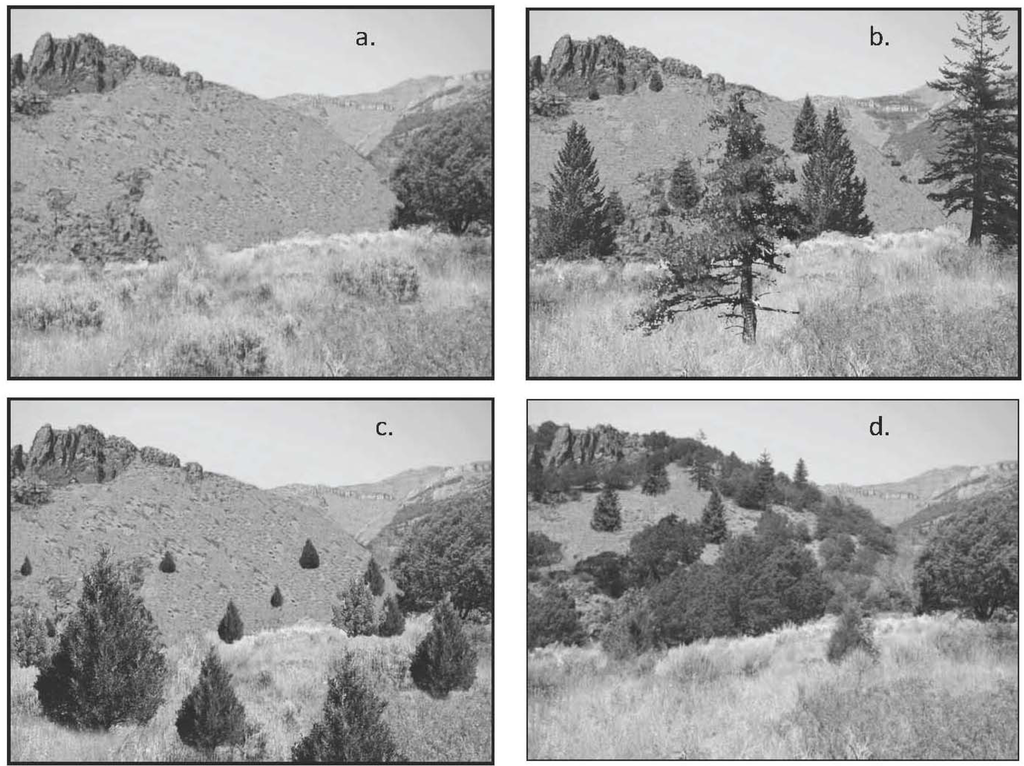
Figure 1.
Photographs of a representative mountain landscape featuring different levels of increase in conifer growth. Photos showed: (a) sagebrush and grassland scene representative of montane rangelands prior to fire suppression; same scene with low densities of (b) Douglas-fir and (c) Rocky Mountain juniper; and (d) a more forested scene featuring both species of conifer.
Figure 1.
Photographs of a representative mountain landscape featuring different levels of increase in conifer growth. Photos showed: (a) sagebrush and grassland scene representative of montane rangelands prior to fire suppression; same scene with low densities of (b) Douglas-fir and (c) Rocky Mountain juniper; and (d) a more forested scene featuring both species of conifer.
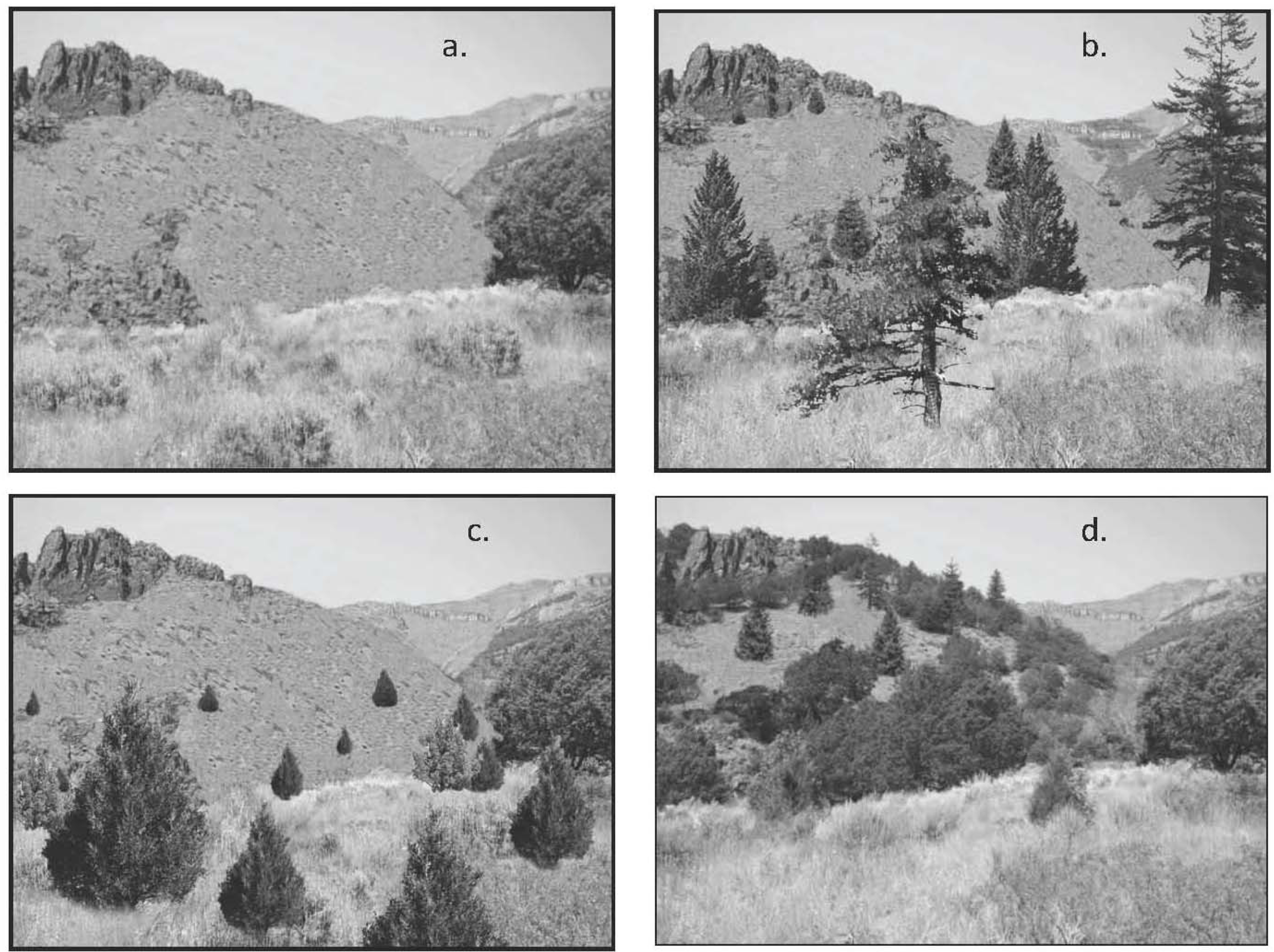
Table 3.
Respondents’ acceptability judgments for landscape scenes as views from a window in their home (see Figure 1), compared across issue frames, using a Likert-type item using a scale from −4 (most unacceptable) to +4 (most acceptable).
| Landscape Scene | Issue frame | ||||
|---|---|---|---|---|---|
| Encroachment | Expansion | Invasion | F | Signif. | |
| No trees visible (Figure 1a) | 0.08 | 0.40 | 0.53 | 1.37 | NS |
| Douglas-firs visible (Figure 1b) | 1.44 | 1.59 | 1.70 | 0.74 | NS |
| Rocky Mountain juniper visible (Figure 1c) | 1.17 | 1.47 | 1.59 | 1.92 | NS |
| Both Douglas-firs and junipers visible (Figure 1d) | 2.06 | 2.24 | 2.29 | 0.60 | NS |
4. Discussion
Ecological scientists and natural resource managers typically maintain a strict vocabulary for describing changes in plant and animal distribution that distinguishes between invading, encroaching, and expanding species. These distinctions may not be ecologically necessary, as native and non-native plants tend to respond similarly when they can exploit previously untapped biotic resources [43] but they do reflect the social desirability of outcomes for the ecosystem being colonized [44] and in the type and perceived urgency of management response that is recommended [45]. Because scientists and land managers generally perceive that the need for a response is most urgent when the spreading species is not native, the use of military metaphors has become common in the discipline of invasion biology as well as in applied fields such as weed management. As Larson notes, “Invasion biologists and conservation managers presumably (and perhaps unconsciously) rely on the rhetorical power of this language to generate action against these species, which are invisible to most people” ([29], p. 495).
In this study we found little evidence that such language leads to increased support for control actions. The vegetation change process of interest in our study is appropriately called “encroachment” [1], a word with a mildly pejorative meaning. Yet when we substituted the militaristic term “invasion” or the benign term “expansion”, there was no statistically significant difference in respondents’ estimations of the threat posed by increasing woody plant populations, nor did we see a difference in levels of acceptance for vegetation removal practices or the landscape conditions created by varying levels of woody plant cover. We did find that respondents who received the “invasion” frame held higher acceptance levels for the general idea of removing trees from rangelands than did those who received the “expansion” frame. Yet even though the acceptability score for the “invasion” group was twice as large as that for the “expansion” group (1.54 vs. 0.72), the means for all three groups were within a range describing mild acceptance for tree removal.
We chose scientific terms as our issue frame. These are not necessarily the same words that resonate most with the general public. For example, Metz and Weigel tested the terms “controlled burn”, “managed burn”, “proactive burn”, and “prescribed burn” using focus groups to determine how much each term resonated with public sentiment [46]. The term “controlled burn” resonated most strongly with the general public. Study participants preferred the term “burn” versus “fire” because burns were perceived as smaller, less “wild”, and better able to be controlled. Managers, conversely, prefer the term “prescribed fire” over “controlled burn”. It is important to understand that the terminology and language that resonate most with the public may not be the same as is used by scientists or natural resource managers.
Further, people with no previous experience with an issue are likely to answer survey questions even though they essentially have no formed opinion about the issue [47]. When asked to self-assess their knowledge “about the management and condition of natural environments in your region,” 80% rated themselves as moderately to very knowledgeable. However, when asked to rate how various landscape processes might affect healthy landscapes, conifer expansion/encroachment/invasion was the least likely to be identified as a threat, suggesting knowledge of that particular process is low. We found no relationship between education level and perceived threat. Describing an earlier public survey about rangeland management, Brunson and Steel suggested that when people are presented with new ideas concerning the scientific world they are likely to apply an already established lens or filter to judge the new item [48]. Similarly, respondents to the present survey may have judged the issue of conifer encroachment using knowledge and attitudes formed for more familiar and basic landscape health issues.
Our results not only are contrary to the expectations of ecologists and land managers concerned about invasion and encroachment effects, but they also seem to contradict those of social marketing researchers who argue that using message framing in combination with a specific target audience can enhance the success of an environmental action campaign [17,18]. Typically pro-environmental social marketing is a multi-step programmatic activity and not a one-time exposure to an issue frame in a survey instrument [10], so perhaps the effect would be enhanced by multiple exposure to the frame. Smith did measure an effect through use of a survey [32], but the issue in that study was social welfare programs, which likely are more salient to a wide array of citizens as compared to removal of undesirable trees. It is also worth noting that the terms used in the study were chosen for their scientific correctness, not the likelihood that they would resonate differently in a social marketing campaign. Therefore while we cannot assert from this study that using a militaristic scientific metaphor would enhance the social acceptability of burning and/or felling encroaching conifers in rangelands, neither can we dismiss the notion that framing could be an effective tool in a broader marketing campaign.
5. Conclusions
Social marketing is increasingly advocated as a means for generating public support for conservation action or encouraging the use of pro-environmental behaviors. Issue framing is generally part of the social marketing toolkit. Our results suggest that public land managers interested in using social marketing to generate support for vegetation management should be cautious about relying on issue frames rooted in scientific terminology. Social marketing typically entails multi-step measures with repeat exposure, whereas we tested the effects of a single exposure to a scientific term or battle metaphor. Conifer encroachment is not a well-known problem, and managers should not expect immediately to create a sense of urgency for removal of undesirable vegetation by using such terms.
Acknowledgments
Funding for this project was provided by the U.S. Department of Agriculture—Cooperative State Research, Education and Extension Service through its National Research Initiative program, and by the Utah Agricultural Experiment Station (UAES). Approved as UAES journal paper number 8346.
References and Notes
- Van Auken, O.W. Shrub invasions of North American semiarid grasslands. Annu. Rev. Ecol. Syst. 2000, 31, 197–215. [Google Scholar] [CrossRef]
- Wilcox, B.P.; Owens, M.K.; Knight, R.W.; Lyons, R.K. Do woody plants affect streamflow on semiarid karst rangelands? Ecol. Applic. 2005, 15, 127–136. [Google Scholar] [CrossRef]
- Briggs, J.M.; Knapp, A.K.; Blair, J.M.; Heisler, J.M.; Hoch, G.A.; Lett, M.S.; McCarron, J.A. An ecosystem in transition: Causes and consequences of the conversion of mesic grassland to shrubland. BioScience 2005, 55, 243–254. [Google Scholar] [CrossRef]
- Lett, M.S.; Knapp, A.K. Woody plant encroachment and removal in mesic grassland: Production and composition responses of herbaceous vegetation. Am. Midl. Nat. 2005, 153, 217–231. [Google Scholar] [CrossRef]
- Grover, H.D.; Musick, H.B. Shrubland encroachment in southern New Mexico, U.S.A.: An analysis of desertification processes in the American Southwest. Clim. Change 1990, 17, 305–330. [Google Scholar] [CrossRef]
- McCarron, J.K.; Knapp, A.K.; Blair, J.M. Soil C and N responses to woody plant expansion in a mesic grassland. Plant Soil. 2003, 257, 183–192. [Google Scholar] [CrossRef]
- Belsky, A.J. Viewpoint: Western juniper expansion: Is it a threat to arid northwestern ecosystems? J. Range Manage. 1996, 49, 53–59. [Google Scholar] [CrossRef]
- Brunson, M.W.; Shindler, B.A. Geographic variation in social acceptability of wildland fuels management in the western U.S. S. Soc. Nat. Resour. 2004, 17, 661–678. [Google Scholar] [CrossRef]
- Shindler, B.A.; Gordon, R.; Brunson, M.W.; Olsen, C. Public perceptions of sagebrush ecosystem management in the Great Basin. Rangeland Ecol. Manage. 2011, 64, 335–343. [Google Scholar] [CrossRef]
- McKenzie-Mohr, D. Promoting sustainable behavior: An introduction to community-based social marketing. J. Soc. Issues 2000, 56, 543–554. [Google Scholar]
- Bliss, J. Public perceptions of clearcutting. J. Forest. 2000, 98, 4–9. [Google Scholar]
- Kneeshaw, K.; Vaske, J.J.; Bright, A.D. Situational influences of acceptable wildland fire management actions. Soc. Nat. Resour. 2004, 17, 477–489. [Google Scholar] [CrossRef]
- Shindler, B.A.; Brunson, M.W.; Stankey, G.H. Social Acceptability of Forest Conditions and Management Practices: A Problem Analysis; USDA Forest Service, Pacific Northwest Research Station: Portland, OR, USA, 2002. [Google Scholar]
- Loomis, J.B.; Bair, L.S.; Gonzalez-Caban, A. Prescribed fire and public support: Knowledge gained, attitudes changed in Florida. J. Forest. 2001, 99, 18–22. [Google Scholar]
- Winter, G.J.; Vogt, C.; Fried, J.S. Fuel treatments at the wildland-urban interface: Common concerns in diverse regions. J. Forest. 2002, 100, 15–21. [Google Scholar]
- Schaffner, B.F.; Sellers, P.J. Introduction. In Winning with Words: The Origins and Impact of Political Framing; Schaffner, B.F., Sellers, P.J., Eds.; Routledge, Taylor and Francis: Abingdon, UK, 2010; Volume Chapter 1, p. 1. [Google Scholar]
- Gamson, W.A.; Modigliani, A. The changing culture of affirmative action. Res. Polit. Sociol. 1987, 3, 137–177. [Google Scholar]
- Chong, D.; Druckman, J.N. Framing theory. Ann. Rev. Polit. Sci. 2007, 10, 103–126. [Google Scholar] [CrossRef]
- Wilson, R.S.; Ascher, T.J.; Toman, E. The importance of framing for communicating risk and managing forest health. J. Forest. 2012, 110, 337–341. [Google Scholar] [CrossRef]
- Gray, B. Strong opposition: Frame-based resistance to collaboration. J. Commun. Appl. Soc. Psych. 2004, 14, 166–176. [Google Scholar] [CrossRef]
- Lewicki, R.; Gray, B.; Elliott, M. Making Sense of Intractable Environmental Conflicts: Concepts and Cases; Island Press: Washington, DC, USA, 2003. [Google Scholar]
- Anderson, G.L.; Delfosse, E.S.; Spencer, N.R.; Prosser, C.W.; Richard, R.D. Lessons in developing successful invasive weed control programs. J. Range Manage. 2003, 56, 2–12. [Google Scholar] [CrossRef] [Green Version]
- Gobster, P.H. Invasive species as ecological threat: Is restoration an alternative to fear-based resource management? Ecol. Restor. 2005, 23, 261–270. [Google Scholar] [CrossRef]
- Norgaard, K.M. The politics of invasive weed management: Gender, race, and risk perception in rural California. Rural Sociol. 2007, 72, 450–477. [Google Scholar] [CrossRef]
- Andersen, M.C.; Adams, H.; Hope, B.; Powell, M. Risk assessment for invasive species. Risk Anal. 2004, 24, 787–793. [Google Scholar] [CrossRef]
- Keller, R.P.; Lodge, D.M.; Lewis, M.A. Bioeconomics of Invasive Species: Integrating Ecology, Economics, Policy, and Management; Oxford University Press: Oxford, UK, 2009. [Google Scholar]
- Elton, C. The Ecology of Invasions by Animals and Plants; Methuen: London, UK, 1958. [Google Scholar]
- Davis, M.A. Invasion Biology; Oxford University Press: Oxford, UK, 2009. [Google Scholar]
- Larson, B.M.H. The war of the roses: Demilitarizing invasion biology. Front. Ecol. Environ. 2005, 3, 495–500. [Google Scholar] [CrossRef]
- Invasive and Introduced Plants and Animals: Human Perceptions, Attitudes and Approaches to Management; Rotherham, D.; Lambert, R.A. (Eds.) Earthscan: London, UK, 2011.
- Arno, S.F.; Gruel, G.E. Douglas-fir encroachment into mountain grasslands in southwestern Montana. J. Range Manage. 1986, 39, 272–276. [Google Scholar] [CrossRef]
- Smith, T.W. That which we call welfare by any other name would smell sweeter: An analysis of the impact of question wording on response patterns. Public Opin. Q. 1987, 51, 75–83. [Google Scholar] [CrossRef]
- Jennings, M.D. Gap analysis: Concepts, methods, and recent results. Landsc. Ecol. 2000, 15, 5–20. [Google Scholar] [CrossRef]
- Link, M.W.; Battaglia, M.P.; Frankel, M.R.; Osborn, L.; Mokdad, A.H. Reaching the U.S. cell phone generation: Comparison of cell phone survey results with an ongoing landline telephone survey. Public Opin. Q. 2007, 71, 814–839. [Google Scholar] [CrossRef]
- Dillman, D.A. Mail and Internet Surveys: The Tailored Design Method; Wiley: New York, NY, USA, 2000. [Google Scholar]
- Groves, R.M. Nonresponse rates and nonresponse bias in household surveys. Public Opin. Q. 2006, 70, 646–675. [Google Scholar] [CrossRef]
- Keeter, S.; Kennedy, C.; Dimock, M.; Best, J.; Craighill, P. Gauging the impact of growing nonresponse on estimates from a national RDD telephone survey. Public Opin. Q. 2006, 70, 759–779. [Google Scholar] [CrossRef]
- Connelly, N.A.; Brown, T.L.; Decker, D.J. Factors affecting response rates to natural resource-focused mail surveys: Empirical evidence of declining rates over time. Soc. Nat. Resour. 2003, 16, 541–549. [Google Scholar] [CrossRef]
- Roose, H.; Lievens, J.; Waege, H. The joint effect of topic interest and follow-up procedures on the response in a mail questionnaire: An empirical test of the leverage-salience theory in audience research. Sociol. Meth. Res. 2007, 35, 410–428. [Google Scholar] [CrossRef]
- Groves, R.M.; Singer, E.; Corning, A. Leverage-saliency theory of survey participation: Description and an illustration. Public Opin. Q. 2000, 64, 299–308. [Google Scholar] [CrossRef]
- Marshall, B.; Jones, R. Citizen participation in natural resource management: Does representativeness matter? Sociol. Spectrum 2005, 25, 715–737. [Google Scholar] [CrossRef]
- Brunson, M.W.; Evans, J. Badly burned? Effects of an escaped prescribed burn on social acceptability of wildland fuels treatments. J. Forest. 2005, 103, 134–138. [Google Scholar]
- Simberloff, D. Invasions of plant communities—more of the same, something very different, or both? Am. Midl. Nat. 2010, 163, 220–233. [Google Scholar] [CrossRef]
- Marris, E. Rambunctious Garden: Saving Nature in a Post-Wild World; Bloomsbury USA: New York, NY, USA, 2011. [Google Scholar]
- Hobbs, R.J.; Arico, S.; Aronson, J.; Baron, J.S.; Bridgewater, P.; Cramer, V.A.; Epstein, P.R.; Ewel, J.J.; Klink, C.A.; Lugo, A.E.; et al. Novel ecosystems: Theoretical and management aspects of the new ecological world order. Global Ecol. Biogeog. 2006, 15, 1–7. [Google Scholar] [CrossRef]
- Metz, D.; Weigel, L. Key public opinion research findings on the ecological role of fire and the benefits of fire management. Final report to Partners in Fire Education, 30 April 2008. Available online: http://www.myfirecommunity.net/uploads/Research_Summary.pdf (accessed on 21 March 2013).
- Tourangeau, R.; Rasinski, K.A. Cognitive processes underlying context effects on attitude measurement. Psych. Bull. 1988, 103, 209–314. [Google Scholar]
- Brunson, M.W.; Steel, B.S. Sources of variation in attitudes and beliefs about federal rangeland management. J. Range Manage. 1996, 49, 69–75. [Google Scholar] [CrossRef]
© 2013 by the authors; licensee MDPI, Basel, Switzerland. This article is an open access article distributed under the terms and conditions of the Creative Commons Attribution license (http://creativecommons.org/licenses/by/3.0/).