


Abstract
In contemporary democracies, the relationship between social protest, electoral participation, and youth citizenship is central to understanding recent transformations in political engagement. Although protest and voting are often examined as distinct repertoires of participation, in contexts of representation crisis and institutional opening they may become articulated within broader processes of democratic politicization. This article examines this relationship in post-constituent Chile by analyzing the association between the perceived political efficacy of the October 2019 social mobilizations, the reframing of electoral participation, and the subjective redefinition of youth political citizenship. Drawing on a quantitative, cross-sectional survey design, this study analyzed data from an online survey of 482 young people aged 18 to 29 living in Chile. A mediation model was estimated to assess whether the reframing of electoral participation mediates the relationship between perceived protest efficacy and the redefinition of youth political citizenship. The results show positive and statistically significant associations between all variables. Moreover, perceived protest efficacy is both directly and indirectly associated with the redefinition of youth political citizenship through the reframing of electoral participation. The article contributes to research on youth participation, political efficacy, and social movements by showing that protest may be linked to a subjective revaluation of voting and to emerging forms of active citizenship.
1. Introduction
The relationship between social protest, electoral participation, and youth citizenship constitutes a central issue for understanding recent transformations in political participation in contemporary democracies. Several studies have shown that younger generations tend to display lower levels of party identification, institutional trust, and conventional electoral participation than older cohorts [1,2]. However, this distance from traditional institutional channels does not necessarily imply depoliticization or apathy. Rather, it may express new forms of engagement with the public sphere, characterized by flexible, contentious, digital, and cause-oriented repertoires of participation [3,4,5]. In this context, it is necessary to examine how experiences of social mobilization may be associated with transformations in the meanings that young people attribute to political participation, both in its institutional and non-institutional forms.
The literature on political participation has commonly distinguished between conventional and institutional repertoires, such as voting, and non-conventional or contentious repertoires, such as social protest [5,6]. While protest is often associated with expressive, disruptive, and extra-institutional forms of collective action, voting has been understood as a central mode of integration into the representative system and of democratic legitimation [7]. Nevertheless, in contexts of political crisis, mass mobilization, and institutional opening, this distinction may become insufficient. In such scenarios, experiences of protest can generate processes of politicization that are not exhausted in street-based collective action, but may also extend toward a revaluation of electoral mechanisms when these are perceived as possible channels for articulating social demands and promoting institutional transformation.
This article argues that protest may be articulated with processes of reframing electoral participation and subjectively redefining youth political citizenship. Rather than assuming that protest and voting constitute opposing repertoires, this study proposes that they may become connected within the same trajectory of politicization. When mobilizations are perceived as politically effective, young people may develop a stronger sense that collective action can influence public decisions. In contexts of institutional opening, this experience may also reshape the meaning attributed to voting, allowing electoral participation to be understood as a channel through which demands expressed in the streets can be institutionally projected. Electoral reframing may therefore connect perceived protest efficacy with a broader redefinition of active youth citizenship [3,5,8,9,10].
Post-2019 Chile provides a particularly relevant setting for examining this argument because a major cycle of social mobilization was followed by an extended constitutional process involving successive plebiscites and elections. In this article, the term “post-constituent Chile” refers to the period following the completion of two constitutional processes that concluded with the rejection of the proposed constitutional texts in 2022 and 2023, without resulting in the adoption of a new constitution. Within this context, the study asks to what extent the perceived political efficacy of the October 2019 mobilizations is associated with youth political citizenship and whether this relationship is mediated by the reframing of electoral participation. By addressing this question, the article contributes to research on youth participation, political efficacy, and social movements by examining how contentious and institutional repertoires may become articulated within the same trajectory of democratic politicization.
2. Theoretical Framework
2.1. Social Mobilization, Institutional Impact, and Perceived Political Efficacy
Studies on social movements and contentious politics have addressed collective mobilizations as relevant forms of political participation, particularly in contexts of social conflict, representation crisis, or struggles for democratic expansion [6,7]. From this perspective, protest constitutes a repertoire of collective action aimed at challenging authorities, making social demands visible, and modifying power relations in the public sphere [11]. Through contentious mobilization, different social actors seek to influence public decisions, dispute interpretive frames, and expand spaces for democratic participation [6]. In the case of young people, participation in contexts of social mobilization has been associated with processes of politicization, identity construction, and the redefinition of both conventional and non-conventional forms of political action [12].
Recent literature also shows that mobilizations do not merely express social discontent; they may also become experiences capable of transforming perceptions, dispositions, and orientations toward politics [13,14,15,16,17]. In particular, demonstrations may be evaluated by citizens not only in terms of legitimacy, intensity, or normative support, but also according to their perceived capacity to generate political and institutional consequences [18,19,20]. This dimension is especially relevant in scenarios of political representation crisis, where traditional institutional channels may be perceived as insufficient to channel social demands and produce effective responses from authorities [21].
To conceptualize this subjective evaluation of protest, it is useful to draw on the literature on political efficacy. This concept has traditionally been understood as a citizen orientation regarding the capacity to influence the political process and obtain responses from the institutional system [22]. The literature distinguishes between internal political efficacy, referring to the subjective perception of competence to understand and intervene in politics [23], and external political efficacy, associated with the perception that authorities and institutions effectively respond to citizens’ demands [24]. Several studies have shown that higher levels of political efficacy are related to greater political involvement, participation, and civic engagement [22,23,25]. In this sense, perceptions of political influence constitute a relevant element for understanding how individuals relate to the public sphere and to mechanisms of participation.
In contexts of social mobilization, this perception of efficacy may shift from traditional institutional channels toward forms of contentious collective action. In this study, this dimension is conceptualized as perceived political efficacy of protest, understood as the belief that social mobilizations are capable of generating concrete political effects, such as attracting the attention of authorities, influencing their decisions, and promoting changes in public policies. This dimension does not necessarily refer to the objective institutional impact of protest, but rather to the subjective attribution of political capacity to collective action. When mobilizations are perceived as effective, they may strengthen feelings of political influence, recognition, and collective capacity for social transformation [16,26,27,28]. Likewise, these experiences may contribute to processes of politicization and civic empowerment, particularly among young people who interpret such cycles of mobilization as significant generational milestones [3,12,29].
In this study, perceived political efficacy does not refer to generalized internal political efficacy or to generalized external political efficacy. Instead, it refers specifically to the political efficacy attributed by respondents to the October 2019 mobilizations, understood as their perceived capacity to attract authorities’ attention, influence political decisions, and promote policy change.
2.2. Reframing Electoral Participation and Youth Political Citizenship
The literature on youth participation has challenged interpretations that reduce young people’s distance from institutions to a problem of political apathy. Rather, this distance has been understood as part of a broader transformation of civic engagement repertoires, in which young people combine institutional, contentious, digital, and cause-oriented forms of participation [3,5,8]. In this sense, youth citizenship should not be understood solely through young people’s relationship with formal institutions, but also through the ways in which they redefine the meanings, practices, and expectations associated with political participation [12].
Within this framework, electoral participation occupies an ambivalent position. On the one hand, voting has historically been considered a central mechanism of democratic citizenship, enabling the selection of authorities, the aggregation of preferences, and the legitimation of representative institutions [9]. On the other hand, in contexts of representation crisis, low institutional trust, or party disaffection, electoral participation may be perceived by young people as a limited, distant, or insufficient mechanism for channeling social demands [1,2,3]. Nevertheless, voting does not have a fixed meaning; rather, it can be reinterpreted according to the political context, generational experiences, and cycles of social mobilization [3,5]. Thus, in certain scenarios, electoral participation may be reframed as a tool for political influence or as an institutional continuation of demands previously expressed in the streets.
The notion of reframing electoral participation captures this shift in meaning. In this study, electoral reframing is conceptualized as a subjective revaluation of voting and electoral processes as meaningful mechanisms of political expression, influence, information seeking, and institutional change. Rather than referring only to the act of voting or to the frequency of electoral participation, this concept describes how young people reinterpret voting as a politically relevant mechanism capable of affecting public decisions, institutions, and processes of change. From this perspective, electoral participation may acquire renewed instrumental and symbolic value when embedded in highly politicized processes, such as social crises, protest cycles, or constitutional processes. In such contexts, voting may no longer be perceived solely as a conventional practice associated with the routine functioning of representative democracy, but instead as a channel for the institutional translation of social demands, particularly when elections are linked to expectations of political transformation.
In a complementary way, the literature on youth citizenship has questioned normative conceptions that define young people as incomplete or apathetic citizens, or as individuals merely in transition toward fully developed adult citizenship. Instead, contemporary approaches argue that young people produce their own forms of citizenship, linked to experiences of politicization, community participation, activism, protest, the use of digital technologies, and demands for social justice [3,5,12,30].
From this perspective, the subjective redefinition of youth political citizenship refers to reported changes in how young people understand active citizenship, political commitment, their motivation to participate politically, and their capacity to influence public life. This redefinition expands citizenship beyond voting and formal membership in the state by incorporating experiences of agency, deliberation, contestation, and collective demand-making.
Consequently, jointly analyzing perceived efficacy of protest, the reframing of electoral participation, and the subjective redefinition of youth political citizenship allows us to understand how young people articulate contentious and institutional repertoires in contexts of political change. This approach moves beyond a rigid opposition between protest and voting and makes it possible to observe how both may form part of the same trajectory of democratic politicization.
3. The Chilean Case
The Chilean case provides a particularly relevant setting for analyzing the relationship between social mobilization, electoral participation, and youth political citizenship. The “social uprising” that began in October 2019 expressed a cycle of accumulated discontent regarding persistent inequalities, a crisis of political representation, and challenges to the existing institutional model.
The October 2019 mobilizations began after an increase in Santiago’s public transport fares, initially contested through coordinated fare evasions led largely by secondary-school students. The protests rapidly expanded into nationwide demonstrations expressing a broader critique of the development model, social inequality, the pension system, the provision of basic services, and the lack of accountability among political and economic elites.
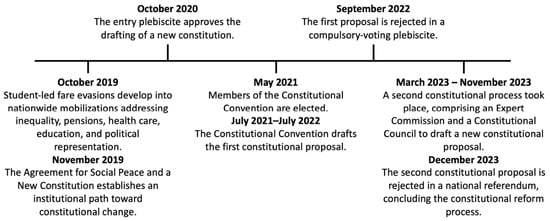
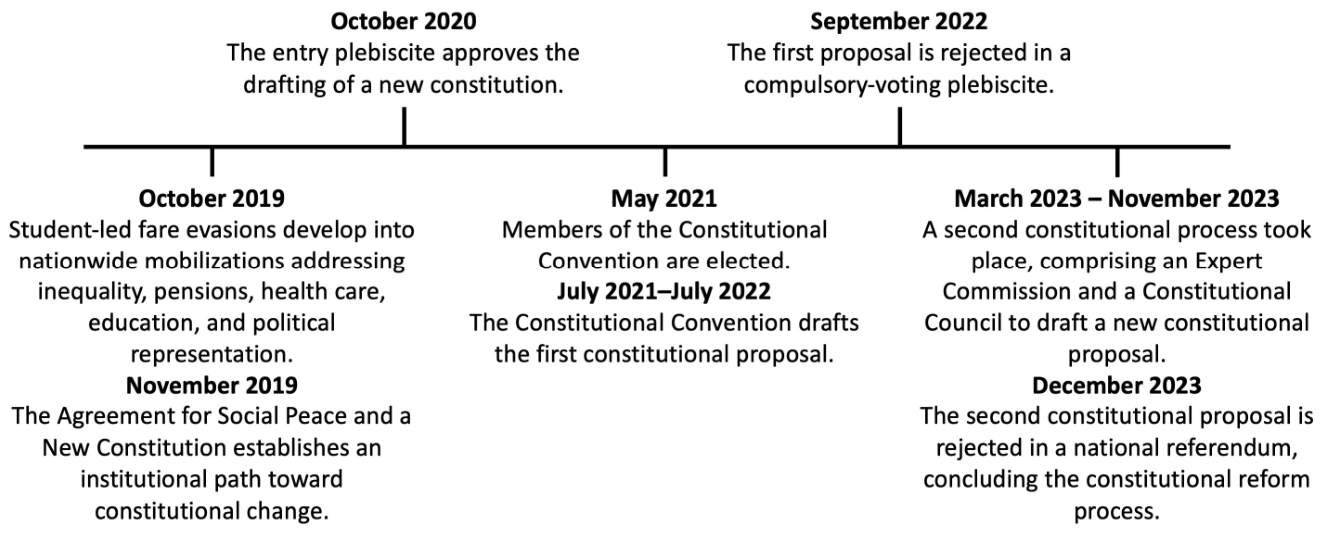
The cycle combined large peaceful demonstrations with episodes of violence, police repression, and prolonged public contestation. Its principal political consequences included the November 2019 agreement that initiated the constitutional process, thereby connecting a contentious cycle of mobilization with an unprecedented sequence of institutional and electoral decisions. Figure 1 summarizes the principal events linking the October 2019 mobilizations to the completion of the two constitutional processes in December 2023.
Figure 1.
Timeline of the Chilean Social Mobilization and Constitutional Processes, 2019–2023. Note. The timeline summarizes the main contentious, institutional, and electoral events connecting the October 2019 mobilizations with the completion of the two constitutional processes in December 2023. Source: Author’s elaboration based on [31,32,33,34,35].
Several analyses have interpreted this episode as the largest social mobilization since the return to democracy, preceded by more than a decade of contentious collective action around educational, pension-related, territorial, feminist, and socio-environmental demands, among others [10,14,32,36,37,38]. In this sense, the 2019 social uprising cannot be understood merely as a conjunctural reaction, but rather as the expression of a deeper crisis of legitimacy, representation, and political intermediation [32,37].
One of the main institutional consequences of this cycle of mobilization was the opening of the constitutional process as a mechanism for channeling the political crisis triggered by the protests. The “Agreement for Social Peace and a New Constitution,” signed in November 2019 by representatives of the country’s main political parties, established an institutional roadmap that included the 2020 entry plebiscite, the election of constitutional convention delegates in 2021, the work of the Constitutional Convention, and the 2022 exit plebiscite. Later, after the rejection of the first constitutional proposal drafted by the Convention, Chile undertook a second constitutional process that culminated in the 2023 plebiscite, in which citizens rejected a second constitutional proposal. From this perspective, the constitutional process operated as an institutional channel for processing demands that emerged from social mobilization, although it also revealed tensions between institutional politics, social movements, and citizens’ expectations for transformation [31,32,33].
This political cycle also reconfigured the place of electoral participation in Chile’s democratic experience. Following the introduction of automatic voter registration and voluntary voting in 2012, Chile recorded comparatively low and, in several electoral contests, declining turnout. For instance, turnout in municipal elections fell from 43.2% in 2012 to 34.9% in 2016, while participation in Chamber of Deputies elections dropped from 49.4% in 2013 to 46.6% in 2017. These patterns occurred within a broader context of comparatively low youth electoral participation, although turnout varied across electoral contests [39].
However, elections associated with the constitutional process acquired exceptional centrality, as they defined substantive aspects of the country’s institutional future. The 2020 entry plebiscite recorded more than 7.5 million votes and was described by the Electoral Service as the largest vote total up to that point under voluntary voting, with turnout reaching 49.2% according to the initial SERVEL report and 50.9% according to subsequent records disseminated by the Chilean Electoral Service (SERVEL). In addition, several analyses highlighted the increase in youth participation, especially compared with previous elections [34].
The reinstatement of compulsory voting in the 2022 constitutional plebiscite substantially altered the size and composition of the electorate. In that election, more than 13 million people voted, reaching turnout close to 86% of the electoral roll, the highest level recorded in the country’s recent history. According to the Electoral Service, the 2022 plebiscite incorporated more than three million new voters, and young adults aged 18 to 34 were among the groups with the highest turnout [35]. This change had not only quantitative but also analytical implications: by drastically expanding the universe of voters, the process opened new questions about the motivations, orientations, and meanings attributed to voting by groups that had previously remained more distant from regular electoral participation.
For young people, this cycle is particularly significant because it articulated experiences of street mobilization, public deliberation, and electoral participation around highly relevant institutional decisions. Recent literature on youth and the social uprising in Chile has highlighted that young people were key actors in the production of new political languages, collective identities, and forms of appropriation of public space during the 2019 mobilizations [38,40]. At the same time, the constitutional process allowed electoral participation to be reinterpreted by some youth sectors not only as a conventional mechanism for selecting authorities, but also as a possible channel for the institutional translation of demands that emerged from protest [41]. Consequently, the Chilean case makes it possible to examine how protest and voting may be articulated as complementary repertoires of political influence, especially in contexts where youth citizenship is redefining its forms of participation, expectations for change, and understanding of democratic citizenship.
4. The Present Study
This study analyzes the relationship between the perceived political efficacy of the October 2019 social mobilizations, the reframing of electoral participation, and the subjective redefinition of youth political citizenship in post-constituent Chile. Based on the literature reviewed, it argues that experiences of social mobilization may be associated with transformations not only in perceptions of protest’s capacity for political influence, but also in the meanings attributed to other mechanisms of political participation, particularly voting. In this sense, the political cycle opened in October 2019 offers a particularly relevant context for examining how young people articulate contentious and institutional repertoires in their understandings and practices of citizenship.
Accordingly, the study examines the extent to which the perceived political efficacy of the October 2019 mobilizations is associated with youth political citizenship and whether this relationship is mediated by the reframing of electoral participation. The model assumes that perceived protest efficacy may be directly associated with the subjective redefinition of youth political citizenship, insofar as the perceived political consequences of mobilization may strengthen feelings of agency, recognition, and political influence. It also proposes an indirect association through the reframing of electoral participation.
In this way, the study seeks to contribute to the understanding of youth politicization processes in contexts of institutional change, moving beyond a rigid opposition between protest and electoral participation. Instead, it argues that both repertoires may be articulated within broader trajectories of participation, in which contentious experience can reframe young people’s relationship with institutional mechanisms and with their own condition as active citizens.
Based on this argument, the following hypotheses are proposed:
H1.
The perceived political efficacy of the October 2019 social mobilizations is positively associated with higher levels of reframing electoral participation during the constitutional process.
H2.
Higher levels of reframing electoral participation during the constitutional process are positively associated with higher levels of subjective redefinition of youth political citizenship.
H3.
The perceived political efficacy of the October 2019 social mobilizations is positively associated with higher levels of subjective redefinition of youth political citizenship.
H4.
The reframing of electoral participation partially mediates the relationship between the perceived political efficacy of the October 2019 social mobilizations and the subjective redefinition of youth political citizenship.
5. Materials and Methods
5.1. Study Design and Data Collection
This study employed a quantitative, cross-sectional, and non-probabilistic design based on a self-administered survey conducted through SurveyMonkey Audience, an online panel of previously registered participants operated by SurveyMonkey (https://www.surveymonkey.com/ accessed on 7 September 2026). This design made it possible to collect standardized information on the perceptions, attitudes, and political dispositions of the target population at a specific moment in Chile’s post-constituent context. Data collection took place between 12 September 2024 and 14 September 2024.
The online modality allowed access to participants residing in different areas of the country and enabled the instrument to be administered under standardized conditions. However, given the non-probabilistic nature of the sample, the results should not be interpreted as representative estimates of the entire Chilean youth population, but rather as empirical evidence aimed at examining relationships between theoretically relevant variables.
5.2. Sample and Participants
The target population of the study consisted of young adults, men and women aged 18 to 29 residing in Chile. The final sample included 482 participants. The mean age was 23.50 years (SD = 3.46). Regarding sex distribution, 47.4% of the sample were men and 52.6% were women.
Cases were selected through non-probabilistic quota sampling, using sex and age group as quota criteria. The construction of these quotas was based on the population parameters reported in the 10th National Youth Survey 2022, with the purpose of approximating the sample distribution to the composition of the country’s youth population. Only individuals aged 18 to 29, residing in Chile, and who answered the variables included in the analytical model were included. Analyses were conducted using complete cases for the variables included in the study.
Participation was voluntary and anonymous. Before answering the survey, participants received information about the general objectives of the study, its academic purpose, the confidentiality and anonymity of their responses, and their right not to participate or to withdraw from the questionnaire at any time.
5.3. Variables and Measures
5.3.1. Perceived Political Efficacy of the October 2019 Social Mobilizations
The variable Perceived political efficacy of the October 2019 social mobilizations is defined as the belief that demonstrations and other forms of contentious collective action have the capacity to influence the political system, either by increasing authorities’ attention to citizens’ demands, influencing their decisions, or promoting changes in government policies. This variable captures the extent to which young people attribute to the cycle of mobilization that began in October 2019 a perceived capacity to alter the relationship between society and political authorities.
The variable was constructed as a composite index composed of three items. Participants evaluated their level of agreement with the following statements: (a) “I consider that the October 2019 demonstrations made political authorities pay attention to the issues that really matter to citizens”; (b) “I believe that the October 2019 demonstrations had a real impact on the decisions of political authorities”; and (c) “I feel that the October 2019 demonstrations promoted changes in government policies.”
Responses were recorded using a five-point Likert-type scale, where 1 corresponded to “strongly disagree” and 5 to “strongly agree.” The three items showed adequate internal consistency (α = 0.82) and were therefore integrated into a single index using the simple average of their scores. Higher values indicate higher levels of perceived political efficacy attributed to the October 2019 social mobilizations.
5.3.2. Reframing of Electoral Participation
The variable Reframing of electoral participation is understood as the process through which young people reinterpret voting and electoral processes as politically relevant mechanisms of expression, influence, and democratic involvement. This variable seeks to capture subjective transformations in the valuation of voting, electoral interest, informational engagement, and perceived efficacy associated with the elections held during the Chilean constitutional process.
Empirically, electoral reframing was operationalized through a six-item composite index capturing perceived changes in the importance and efficacy of voting, electoral interest, informational engagement, and the knowledge required to make informed electoral decisions during the constitutional process.
Participants evaluated their level of agreement with the following statements: (a) “Regardless of whether I was able to vote at that time, during the constitutional process, I considered the act of voting to be a more important civic responsibility than before the constitutional process”; (b) “Regardless of whether I was able to vote at that time, during the constitutional process, my interest in voting in elections increased compared with elections prior to 2020”; (c) “Regardless of whether I was able to vote at that time, during the constitutional process, I felt more committed than before to informing myself for elections (about candidates, their proposals, the draft constitution, etc.)”; (d) “Regardless of whether I was able to vote at that time, during the constitutional process, I considered that I had sufficient knowledge to make informed decisions about voting”; (e) “Regardless of whether I was able to vote at that time, during the constitutional process, I considered that participating in elections was an effective way to express political opinions”; and (f) “Regardless of whether I was able to vote at that time, during the constitutional process, I felt that voting could make a difference in election outcomes.”
Responses were recorded using a five-point Likert-type scale, where 1 corresponded to “strongly disagree” and 5 to “strongly agree.” The six items showed adequate internal consistency (α = 0.87) and were therefore integrated into a single index using the simple average of their scores. Higher values represent higher levels of reframing of electoral participation during the constitutional process.
5.3.3. Subjective Redefinition of Youth Political Citizenship
The variable Subjective redefinition of youth political citizenship is defined as the process through which young people subjectively redefine their relationship with politics, civic participation, and their own condition as active citizens after the political cycle opened by the October 2019 mobilizations and the constitutional process. This variable seeks to capture changes in the understanding of active citizenship, political engagement, and motivation toward different forms of political participation.
Empirically, this construct was operationalized through a three-item composite index measuring reported changes in participants’ understanding of active citizenship, political commitment, and motivation to participate following the constitutional process.
Participants evaluated their level of agreement with the following statements: (a) “From the constitutional process to the present, my view of what it means to be a politically active citizen has changed”; (b) “From the constitutional process to the present, I feel more committed to politics and processes of social change”; and (c) “From the constitutional process to the present, I feel more motivated to participate politically, either by voting or through other forms of participation.”
Responses were recorded using a five-point Likert-type scale, where 1 corresponded to “strongly disagree” and 5 to “strongly agree.” The three items showed adequate internal consistency (α = 0.78) and were therefore integrated into a single index using the simple average of their scores. Higher values represent higher levels of subjective redefinition of youth political citizenship after the constitutional process.
Table 1 summarizes the descriptive statistics and internal consistency estimates for the study variables.
Table 1.
Descriptive Statistics and Internal Consistency of the Study Variables.
5.4. Analytical Strategy
To evaluate the study hypotheses, a mediation model was estimated. In this model, the perceived political efficacy of the October 2019 social mobilizations was included as the independent variable, the reframing of electoral participation as the mediating variable, and the subjective redefinition of youth political citizenship as the dependent variable.
In the first stage, descriptive statistics, internal consistency analyses using Cronbach’s alpha, and bivariate correlations between the study variables were calculated. Subsequently, the mediation model was estimated, assessing both the direct effect of the perceived political efficacy of the mobilizations on the subjective redefinition of youth political citizenship and its indirect effect through the reframing of electoral participation.
The indirect effect was evaluated using bias-corrected bootstrap confidence intervals with 5000 resamples, following established recommendations for testing mediation effects [42,43]. This procedure is appropriate for mediation analysis because it does not require assuming normality in the distribution of the indirect effect. The indirect effect was considered statistically significant when the 95% confidence interval did not include zero. Standardized coefficients, standard errors, and confidence intervals are reported.
Descriptive and bivariate analyses were conducted using IBM SPSS Statistics version 27, while mediation analyses were performed using Jamovi version 2.3.28.
6. Results
6.1. Correlations Between the Study Variables
Table 2 presents the bivariate correlations between the main study variables. The results show positive and statistically significant associations between all dimensions analyzed (p < 0.001).
Table 2.
Correlation Matrix between the Study Variables.
First, the perceived political efficacy of the October 2019 social mobilizations was positively associated with the reframing of electoral participation (r = 0.42, p < 0.001). This indicates that higher levels of perceived political efficacy attributed to the mobilizations were linked to greater subjective revaluation of voting and electoral processes during the constitutional process.
Likewise, the perceived political efficacy of the mobilizations was positively associated with the subjective redefinition of youth political citizenship (r = 0.49, p < 0.001). This association suggests that those who perceived the mobilizations as politically effective also tend to report greater changes in their understanding of active citizenship, political engagement, and motivation to participate.
In turn, the reframing of electoral participation showed the strongest correlation with the subjective redefinition of youth political citizenship (r = 0.55, p < 0.001). This result suggests that the reinterpretation of voting as a relevant mechanism of political influence is closely linked to broader processes of redefining political citizenship among young people.
Taken together, the observed correlations provide preliminary evidence consistent with the proposed mediation model, as the variables are positively related and in the expected direction. However, the specific assessment of the indirect effect requires the mediation model analysis presented in the following section.
6.2. Mediation Model Analysis
To examine the mediating role of the reframing of electoral participation in the relationship between the perceived political efficacy of the October 2019 social mobilizations and the subjective redefinition of youth political citizenship, a mediation model was estimated using maximum likelihood estimation and bias-corrected bootstrap confidence intervals with 5000 resamples.
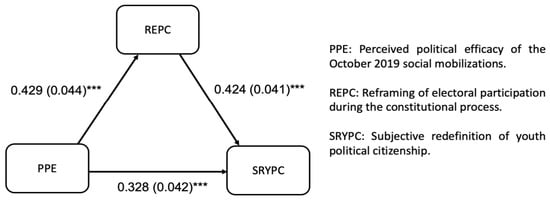
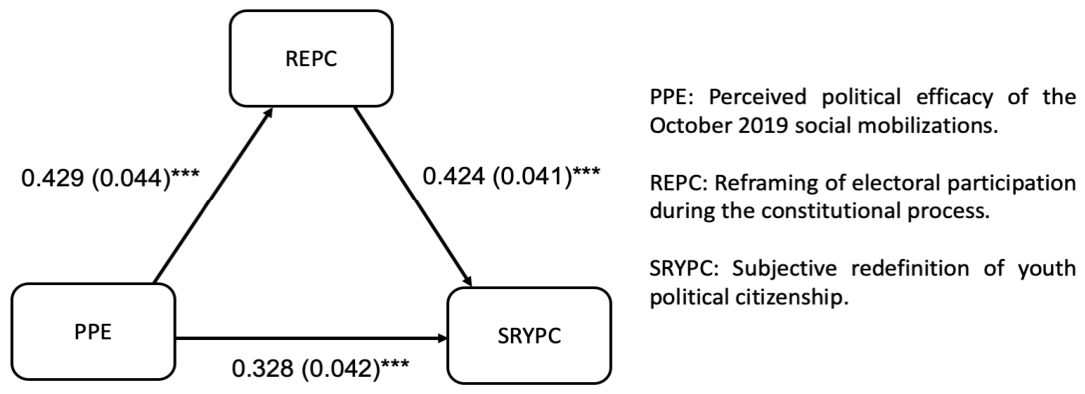
Figure 2 presents the estimated mediation model with standardized coefficients. The results show that the perceived political efficacy of the mobilizations was positively associated with the reframing of electoral participation (β = 0.429, p < 0.001). In turn, the reframing of electoral participation was positively related to the subjective redefinition of youth political citizenship (β = 0.424, p < 0.001). Likewise, the perceived political efficacy of the mobilizations maintained a positive direct association with the subjective redefinition of youth political citizenship (β = 0.328, p < 0.001), even after incorporating the mediating variable into the model.
Figure 2.
Mediation model between perceived political efficacy of the October 2019 social mobilizations, reframing of electoral participation, and subjective redefinition of youth political citizenship. Note. Standardized coefficients are reported; standard errors are shown in parentheses. The indirect effect was significant, β = 0.182, 95% CI [0.124, 0.249]. *** p < 0.001.
Table 3 presents the full estimates of the mediation model. First, the perceived political efficacy of the October 2019 social mobilizations was positively and significantly associated with the reframing of electoral participation (β = 0.429, p < 0.001), supporting Hypothesis H1. This result suggests that young people who attributed greater political efficacy to the mobilizations also tended to report higher levels of subjective revaluation of electoral participation during the constitutional process.
Table 3.
Results of the Mediation Model between Perceived Political Efficacy of the Mobilizations, Reframing of Electoral Participation, and Subjective Redefinition of Youth Political Citizenship.
Second, the reframing of electoral participation showed a positive and significant association with the subjective redefinition of youth political citizenship (β = 0.424, p < 0.001), supporting Hypothesis H2. This finding indicates that transformations in young people’s subjective relationship with voting, electoral interest, and institutional participation are linked to higher levels of political engagement, participatory motivation, and redefinition of active citizenship.
Likewise, the perceived political efficacy of the mobilizations maintained a significant direct association with the subjective redefinition of youth political citizenship (β = 0.328, p < 0.001), supporting Hypothesis H3. This result suggests that the perception of efficacy attributed to the cycle of mobilization that began in October 2019 is related to processes of citizenship redefinition not only through the electoral dimension, but also through other possible mechanisms of politicization and subjective transformation not directly included in the model.
Regarding the indirect effect, the results show that the reframing of electoral participation significantly mediated the relationship between the perceived political efficacy of the mobilizations and the subjective redefinition of youth political citizenship (β = 0.182, p < 0.001; 95% CI [0.124, 0.249]). Since the bootstrap confidence interval did not include zero, the results indicate the existence of a statistically significant indirect effect, supporting Hypothesis H4.
Finally, the total effect of the perceived political efficacy of the mobilizations on the subjective redefinition of youth political citizenship was positive and significant (β = 0.509, p < 0.001; 95% CI [0.410, 0.606]). Taken together, these results are consistent with a partial mediation model, as both the direct and indirect effects were positive and statistically significant.
The findings suggest that perceived political efficacy attributed to the October 2019 mobilizations is associated with higher reported levels of subjective redefinition of youth political citizenship. They also indicate that the reframing of electoral participation constitutes a relevant mechanism through which the perceived efficacy of protest may be articulated with broader forms of political engagement and active citizenship among young people.
7. Discussion
This study analyzed the relationship between the perceived political efficacy of the October 2019 social mobilizations, the reframing of electoral participation, and the subjective redefinition of youth political citizenship in post-constituent Chile. In particular, it assessed whether the reframing of electoral participation operates as a mediating mechanism in the relationship between perceived protest efficacy and processes of subjectively redefining political citizenship among young people. The results show positive associations between the variables analyzed and are consistent with a partial mediation model, in which electoral reframing accounts for part of the association between perceived protest efficacy and the redefinition of youth citizenship.
A first relevant finding is that the perceived political efficacy of the October 2019 mobilizations was positively associated with the subjective redefinition of youth political citizenship. This result suggests that when young people attribute to protest a capacity to capture the attention of authorities, influence public decisions, or promote institutional change, they also tend to report greater transformations in their understanding of active citizenship, political engagement, and motivation to participate. This interpretation speaks to the literature on social movements and contentious politics, which has argued that protest is not merely an expression of discontent, but a repertoire of collective action aimed at challenging authorities, making demands visible, and disputing the distribution of power in the public sphere [6,7,11].
From this perspective, the results reinforce the idea that protest can operate as an experience of subjective politicization. The perception that mobilizations had a capacity for political influence may strengthen feelings of agency, recognition, and political efficacy. This is consistent with recent studies that highlight the role of perceived efficacy in collective action and in individuals’ willingness to interpret protest as a politically relevant mechanism [16,28,29]. In this sense, perceived political efficacy of protest can be understood as a situated form of political efficacy: it does not refer to a general evaluation of the institutional system, but rather to the capacity attributed to a specific repertoire of collective action to produce political effects.
This finding also helps nuance approaches that interpret youth political participation primarily through the lens of disaffection or institutional distance. Although several studies have shown that younger generations tend to exhibit lower levels of party identification, institutional trust, or conventional electoral participation than older generations [1,2], this does not necessarily imply political apathy. On the contrary, the literature has shown that young people develop more flexible, expressive, horizontal, and cause-oriented forms of political engagement [3,8,12,30]. The findings of this study align with this perspective by showing that the experience of mobilization may be associated with processes of redefining youth citizenship, rather than simply with rejection of or distance from politics.
The central result of the study is the statistical mediating role of the reframing of electoral participation. The analyses show that the perceived political efficacy of the mobilizations is positively associated with the reframing of electoral participation and that, in turn, this reframing is linked to higher levels of subjective redefinition of youth political citizenship. This pattern suggests that the association between perceived protest efficacy and youth citizenship is not only direct but also statistically mediated through the subjective revaluation of voting and electoral processes. In other words, the perception that mobilizations were politically effective may encourage young people to interpret electoral participation as an institutionally relevant channel for articulating demands, expressing political positions, and influencing processes of change.
The interpretation of electoral reframing must also consider the reinstatement of compulsory voting for the 2022 constitutional plebiscite. Compulsory voting substantially increased turnout and altered the composition of the electorate, making observed electoral participation less directly interpretable as an expression of voluntary political engagement. However, the mediator examined in this study does not measure turnout or compliance with the legal obligation to vote. Instead, it captures subjective changes in the perceived importance, efficacy, informational demands, and political meaning of electoral participation. The findings should therefore not be interpreted as evidence that perceived protest efficacy directly increased voluntary voting. Rather, they suggest that perceived protest efficacy was associated with a subjective revaluation of voting even within a context in which electoral participation became legally compulsory. Future research should distinguish more explicitly between behavioral turnout shaped by institutional rules and subjective electoral engagement.
This finding is particularly important because it challenges a rigid opposition between contentious and institutional repertoires of participation. Traditionally, protest has been conceptualized as a non-conventional or contentious form of political action, whereas voting has been understood as the paradigmatic mechanism of conventional democratic citizenship [6]. However, the results presented here suggest that, in contexts of political crisis and institutional opening, both repertoires may be articulated within the same trajectory of politicization. Protest may expand perceptions of political agency, while voting may be reframed as an institutional mechanism for projecting demands that emerged from social mobilization.
At this point, the study contributes to the literature on youth political participation by showing that young people’s relationship with the electoral sphere may be more dynamic than approaches focused exclusively on low turnout or disaffection would suggest. The reframing of electoral participation observed in this study is not limited to the act of voting. Rather, it involves a subjective transformation in the valuation of voting, interest in elections, willingness to become informed, and the perception that electoral processes can have relevant political consequences [41]. This interpretation is aligned with approaches that understand youth citizenship as a process under construction, shaped by experiences of participation, activism, public deliberation, and demands for recognition [3,5].
The observed partial mediation also allows for a more complex interpretation of the link between protest and youth citizenship. The fact that the direct effect of the perceived political efficacy of the mobilizations on the subjective redefinition of youth political citizenship remained significant after incorporating electoral reframing indicates that voting does not exhaust the mechanisms through which protest is associated with processes of subjective transformation. Part of this relationship appears to operate through the revaluation of electoral participation, while another part may be explained by mechanisms not considered in the model, such as experiences of political socialization, generational identification, participation in activist networks, public deliberation, exposure to political information, collective recognition, or previous experiences of mobilization.
In the Chilean case, this articulation between protest, voting, and youth citizenship acquires particular relevance. The political cycle that began in October 2019 combined massive social mobilization, questioning of traditional representation, the opening of a constitutional process, and successive electoral events of high political intensity. Several analyses have interpreted the social uprising as an expression of a crisis of legitimacy, representation, and political intermediation, as well as of accumulated discontent in the face of persistent inequalities and unresolved social demands [32,33,37]. In this context, the constitutional process functioned as an institutional channel for processing part of the demands that emerged from mobilization, although it also revealed tensions between citizens’ expectations, social movements, and institutional politics [32,41].
For young people, this cycle may have constituted a significant generational experience. Recent literature on youth and social mobilization in Chile has highlighted the role of young people in producing new political languages, collective identities, and forms of appropriation of public space during recent mobilizations [40]. The results of this study suggest that this experience is expressed not only in the valuation of protest, but also in the way voting and political citizenship may be reinterpreted after a cycle of mobilization and constitutional opening. In this sense, electoral participation does not necessarily appear as a repertoire external to youth politicization, but rather as a space that may acquire new meanings when linked to expectations of institutional transformation.
From a theoretical perspective, the study makes three main contributions. First, it contributes to the literature on political efficacy by proposing a situated operationalization of perceived protest efficacy. Unlike classic measures of internal and external political efficacy, this variable captures the capacity attributed to a specific repertoire of collective action to influence authorities, decisions, and public policies [22,23]. Second, it contributes to studies on youth citizenship by showing that the subjective redefinition of political citizenship may be linked both to contentious experiences and to the revaluation of institutional mechanisms. Third, it speaks to the literature on social movements and democracy by showing that contentious collective action does not necessarily erode institutional participation, but may instead be articulated with it in contexts of high politicization and institutional change.
Nevertheless, the results should be interpreted in light of several limitations. First, the cross-sectional design of the study prevents the establishment of definitive causal or temporal relationships between the variables. Second, the non-probability sampling design limits the generalizability of the findings. Although quota criteria were used to approximate the demographic composition of the Chilean youth population, and mediation analyses were validated using 5000 bootstrapping iterations, these procedures do not eliminate potential selection bias or make the sample statistically representative; therefore, the findings should be interpreted as evidence of theoretically relevant relationships within the sample rather than as population estimates for all young people living in Chile. Third, the measures used are self-reported and retrospective, which may introduce memory biases or post hoc reinterpretations of the political events that occurred between 2019 and 2023.
Based on these limitations, future research could advance in at least three directions. First, longitudinal studies would be useful for observing how perceptions of protest efficacy, meanings attributed to voting, and forms of youth citizenship evolve over time. Second, future research could incorporate mixed-methods designs that complement quantitative measurement with interviews or focus groups, in order to gain a deeper understanding of the meanings young people attribute to protest, voting, and citizenship. Third, it would be relevant to compare different age groups or generational cohorts to assess whether the articulation between protest and electoral participation is a specific feature of young people politically socialized during the post-2019 cycle, or whether it extends to other segments of the population. Future research should also compare voluntary- and compulsory-voting contexts to distinguish the effects of institutional voting rules from changes in the subjective meaning attributed to electoral participation.
Taken together, the findings suggest that the political experience opened by the October 2019 mobilizations and the Chilean constitutional process cannot be understood solely in terms of protest, discontent, or institutional crisis. It should also be analyzed as a process of subjective transformation, in which young people reinterpret their forms of participation, expectations of political influence, and meanings associated with democratic citizenship. From this perspective, protest does not appear as a repertoire opposed to voting, but as an experience that may contribute to reframing it and projecting it toward broader forms of active citizenship.
8. Conclusions
This article analyzed how the perceived political efficacy of the October 2019 social mobilizations is associated with the reframing of electoral participation and the subjective redefinition of youth political citizenship in post-constituent Chile. The results show that perceived protest efficacy is positively related to both processes and that the reframing of electoral participation statistically mediates part of the association between perceived protest efficacy and youth political citizenship.
The main contribution of the study is to provide evidence that protest and voting should not necessarily be understood as opposing repertoires. In contexts of political crisis, social mobilization, and institutional opening, the perceived political efficacy of protest may be associated with a subjective revaluation of electoral participation, allowing voting to be reinterpreted as a channel for democratic influence and as an institutional continuation of social demands.
These findings help nuance interpretations centered exclusively on youth disaffection. Young people may maintain a critical relationship with institutions while, at the same time, reframing certain institutional mechanisms when these are linked to expectations of political change. In this sense, the Chilean case shows that youth politicization may articulate contentious and institutional repertoires within the same trajectory of active citizenship.
Nevertheless, these conclusions should be interpreted with caution given the cross-sectional, retrospective, and non-probabilistic nature of the study. Future research should advance through longitudinal designs, probabilistic samples, and qualitative or mixed-methods strategies that allow for a deeper understanding of the subjective mechanisms through which experiences of social mobilization transform the meanings attributed to voting and democratic citizenship.
Funding
This research was funded by ANID (Agencia Nacional de Investigación y Desarrollo), Chile, through FONDECYT Iniciación Project No. 11231130.
Institutional Review Board Statement
The survey analyzed in this article was conducted within the framework of FONDECYT Iniciación Project No. 11231130, which was approved by the Comité Ético Científico of Universidad Católica Silva Henríquez (Approval Code: 2023/012; approval date: 23 May 2023). The study was conducted in accordance with the Declaration of Helsinki.
Informed Consent Statement
Informed consent was obtained from all subjects involved in the study.
Data Availability Statement
The dataset supporting the findings of this study is not publicly available because participants did not provide explicit consent for public data sharing. Aggregated results from the broader research project are available in an open-access report at: https://bit.ly/3NwijLy (accessed on 7 September 2026). Further information about the data and analytical procedures may be provided by the author upon reasonable request.
Acknowledgments
During the preparation of this manuscript, the author used Microsoft 365 Copilot (GPT–5.6), a web-based generative AI service, to support the translation of the manuscript and selected survey items from Spanish into English, as well as to improve language clarity and readability. The author reviewed, verified, and approved all AI-assisted output and takes full responsibility for the content, accuracy, integrity, and final version of the manuscript.
Conflicts of Interest
The author declares no conflicts of interest.
References
- Dalton, R.J. The Good Citizen: How a Younger Generation Is Reshaping American Politics, 3rd ed.; CQ Press: Thousand Oaks, CA, USA, 2020. [Google Scholar]
- Wattenberg, M.P. Is Voting for Young People, 6th ed.; Routledge: London, UK, 2024. [Google Scholar]
- Pickard, S. Politics, Protest and Young People: Political Participation and Dissent in 21st Century Britain; Palgrave Macmillan: London, UK, 2019. [Google Scholar]
- Pontes, A.; Henn, M.; Griffiths, M.D. Towards a conceptualization of young people’s political engagement: A qualitative focus group study. Societies 2018, 8, 17. [Google Scholar] [CrossRef] [Scilit]
- Theocharis, Y.; van Deth, J.W. Political Participation in a Changing World: Conceptual and Empirical Challenges in the Study of Citizen Engagement; Routledge: London, UK, 2017. [Google Scholar]
- Tilly, C.; Tarrow, S. Contentious Politics; Oxford University Press: New York, NY, USA, 2015. [Google Scholar]
- Della Porta, D. Afterwords: Old and new repertoires of contention. In Protest, Popular Culture and Tradition in Modern and Contemporary Western Europe; Favretto, I., Itçaina, X., Eds.; Palgrave Macmillan: London, UK, 2017; pp. 249–260. [Google Scholar]
- Earl, J.; Maher, T.V.; Elliott, T. Youth, activism, and social movements. Sociol. Compass 2017, 11, e12465. [Google Scholar] [CrossRef] [Scilit]
- Eckstein, K.; Miklikowska, M.; Šerek, J.; Noack, P.; Koerner, A. Activating effects of elections: Changes in young voters’ political engagement over the course of an election year. Front. Polit. Sci. 2024, 6, 1302686. [Google Scholar] [CrossRef] [Scilit]
- Torres, R. Neoliberalism and the impact of student demonstrations in Chile: Pushing the bounds of the post-Pinochet education project? Lat. Am. Perspect. 2022, 49, 146–161. [Google Scholar] [CrossRef] [Scilit]
- Tilly, C. Contentious Performances; Cambridge University Press: Cambridge, UK, 2008. [Google Scholar]
- Chironi, D.; Della Porta, D.; Milan, C. The political participation of young people in times of crisis: A framework for analysis. In Handbook on Youth Activism; Conner, J., Ed.; Edward Elgar Publishing: Cheltenham, UK, 2024; pp. 2–15. [Google Scholar]
- Carvacho, H.; González, R.; Cheyre, M.; Rocha, C.; Cornejo, M.; Jiménez-Moya, G.; Manzi, J.; Álvarez-Dezerega, C.; Álvarez, B.; Castro, D.; et al. When social movements fail or succeed: Social psychological consequences of a collective action’s outcome. Front. Psychol. 2023, 14, 1155950. [Google Scholar] [CrossRef] [Scilit] [PubMed]
- Fernández Labbé, J. La Huella del Movimiento Estudiantil Chileno del Año 2011. Caraterísticas y Consecuencias de la Protesta Social; CIS: Madrid, Spain, 2021.
- Hatibovic, F.; Faúndez, X.; Cazorla, K.; Cruz, M.A.; Rubio, G.; Sandoval, J.; Gaete, J.M.; Sotomayor, F.; Hozven, R.; Godoy, M.P.; et al. Citizens’ perceptions of the Chilean social outburst: Environmental collective action willingness and the role of political identification, democracy, and gender. Front. Psychol. 2026, 17, 1736326. [Google Scholar] [CrossRef] [Scilit] [PubMed]
- Jiménez-Sánchez, M.; Rubio Vicedo, L.; García-Espín, P. “I can do it, we can change it”: Protest as a catalyst for political efficacy. Sociol. Forum 2026, 41, 196–213. [Google Scholar] [CrossRef] [Scilit]
- Padilla, J. Do protests change citizens’ perceptions of political parties? Evidence from the 15-M in Spain. Political Stud. 2025, 73, 1772–1796. [Google Scholar] [CrossRef] [Scilit]
- Bosi, L.; Giugni, M.; Uba, K. The consequences of social movements: Taking stock and looking forward. In The Consequences of Social Movements; Bosi, L., Giugni, M., Uba, K., Eds.; Cambridge University Press: Cambridge, UK, 2016; pp. 3–37. [Google Scholar]
- Hsiao, Y.; Lui, L. Why people perceive protest violence differently: A cross-national survey experiment in the US, Taiwan, and Hong Kong. Soc. Sci. Res. 2026, 135, 103326. [Google Scholar] [CrossRef] [Scilit]
- Lo Piccolo, A. The influence of collective action: A relational perspective on the consequences of social movements and grassroots politics. Sociol. Compass 2025, 19, e70052. [Google Scholar] [CrossRef] [Scilit]
- Dobry, M. The Sociology of Political Crisis; Bloomsbury Publishing: London, UK, 2025. [Google Scholar]
- Beaumont, E. Political agency and empowerment: Pathways for developing a sense of political efficacy in young adults. In Handbook of Research on Civic Engagement in Youth; Sherrod, L.R., Torney-Purta, J., Flanagan, C.A., Eds.; John Wiley & Sons: Hoboken, NJ, USA, 2010. [Google Scholar] [CrossRef] [Scilit]
- Alscher, P.; Jana, C. Exploring the relationship between non-institutionalized political participation and political efficacy among high school students. J. Youth Adolesc. 2025, 54, 2143–2154. [Google Scholar] [CrossRef] [Scilit] [PubMed]
- Anderson, M.R. Community psychology, political efficacy, and trust. Political Psychol. 2010, 31, 59–84. [Google Scholar] [CrossRef] [Scilit]
- Schulz, W. Political efficacy and expected political participation among lower and upper secondary students: A comparative analysis with data from the IEA civic education study. In Proceedings of the ECPR General Conference, Budapest, Hungary, 8–10 September 2005; Available online: https://files.eric.ed.gov/fulltext/ED499264.pdf (accessed on 7 September 2026).
- Bleh, J.; Masson, T.; Köhler, S.; Fritsche, I. From imagination to activism: Cognitive alternatives motivate commitment to activism through identification with social movements and collective efficacy. Br. J. Soc. Psychol. 2025, 64, e12811. [Google Scholar] [CrossRef] [Scilit] [PubMed]
- da Costa, S.; Páez, D.; Martí-González, M.; Díaz, V.; Bouchat, P. Social movements and collective behavior: An integration of meta-analysis and systematic review of social psychology studies. Front. Psychol. 2023, 14, 1096877. [Google Scholar] [CrossRef] [Scilit] [PubMed]
- Shuman, E.; Goldenberg, A.; Saguy, T.; Halperin, E.; van Zomeren, M. When are social protests effective? Trends Cogn. Sci. 2024, 28, 252–263. [Google Scholar] [CrossRef] [Scilit] [PubMed]
- Benavente, L.; Sánchez, B.; Rubio, A.; Oyanedel, J.C.; Ríos, J.; Cancino, F.; Torres, R. Ciudadanía convencional y no convencional y su relación con autoeficacia política en preadolescentes chilenos. Rev. Psicol. PUCP 2023, 41, 489–521. [Google Scholar] [CrossRef] [Scilit]
- Torres, R. Attitudes toward social media versus voting among adolescents and youth in a politicized context: Chile before and after the 2019 social uprising (2018–2022). Behav. Sci. 2025, 15, 1318. [Google Scholar] [CrossRef] [Scilit] [PubMed]
- Garcés, M. Social uprising in neoliberal Chile. J. Lat. Am. Cult. Stud. 2019, 28, 483–491. [Google Scholar] [CrossRef] [Scilit]
- Heiss, C. Revuelta social y proceso constituyente en Chile. Rev. Cienc. Soc. Ambos Mundos 2021, 2, 69–78. [Google Scholar] [CrossRef] [Scilit]
- Morales, M.; Pérez-Cosgaya, T. The impact of socio-political cleavages on constitutional referendums: The case of Chile 2022. Politics Gov. 2025, 13, 8804. [Google Scholar] [CrossRef] [Scilit]
- SERVEL (Servicio Electoral de Chile). Plebiscito Nacional 2020 fue la Mayor Votación de la Historia de Chile. 2020. Available online: https://web.archive.org/web/20210728144212/http://plebiscitonacional2020.cl/plebiscito-nacional-2020-fue-la-mayor-votacion-de-la-historia-de-chile/ (accessed on 3 June 2026).
- SERVEL (Servicio Electoral de Chile). Resultados de Participación Electoral Plebiscito Constitucional 2022. 2023. Available online: https://www.servel.cl/wp-content/uploads/2023/08/Seminario-version-COM-160823-1.pdf (accessed on 3 June 2026).
- Cabello Cádiz, P.; Torres, R. Conflictos socioambientales y acción colectiva de jóvenes de la región de Los Lagos, Chile. Rev. Colomb. Cienc. Soc. 2015, 6, 253–277. [Google Scholar] [CrossRef] [Scilit][Green Version]
- Guzmán-Concha, C. Power, legitimacy, and institutions in the October 2019 uprising in Chile. Lat. Am. Perspect. 2022, 50, 6–23. [Google Scholar] [CrossRef] [Scilit]
- Torres, R.; Joustra, C.; Figueroa, J.; Giacoman, C. Social change as a lifestyle: Identifying actions and practices of vegan activism among young adults. Front. Polit. Sci. 2025, 7, 1477573. [Google Scholar] [CrossRef] [Scilit]
- SERVEL (Servicio Electoral de Chile). Resultados Electorales Históricos. 2026. Available online: https://www.servel.cl/biblioteca-de-documentos/resultados-electorales-historicos/ (accessed on 21 July 2026).
- Giacoman, C.; Torres, R. Dance to resist: Emotions and protest in Lindy Hop dancers during October 2019 Chilean rallies. Can. J. Lat. Am. Caribb. Stud. 2021, 47, 46–66. [Google Scholar] [CrossRef] [Scilit]
- Torres, R.; Riffo Elgueta, E.; Castillo Peña, J.; De Ferari Correa, F.; Albornoz Hormazábal, G. Jóvenes, derechos y sociedad: Perspectivas constituyentes juveniles y su representación en la propuesta de nueva Constitución en Chile. Rev. Temas Sociol. 2022, 31, 45–77. [Google Scholar] [CrossRef] [Scilit]
- Preacher, K.J.; Hayes, A.F. Asymptotic and resampling strategies for assessing and comparing indirect effects in multiple mediator models. Behav. Res. Methods 2008, 40, 879–891. [Google Scholar] [CrossRef] [Scilit] [PubMed]
- Williams, J.; MacKinnon, D.P. Resampling and distribution of the product methods for testing indirect effects in complex models. Struct. Equ. Model. 2008, 15, 23–51. [Google Scholar] [CrossRef] [Scilit] [PubMed]

Disclaimer/Publisher’s Note: The statements, opinions and data contained in all publications are solely those of the individual author(s) and contributor(s) and not of MDPI and/or the editor(s). MDPI and/or the editor(s) disclaim responsibility for any injury to people or property resulting from any ideas, methods, instructions or products referred to in the content. |
© 2026 by the author. Licensee MDPI, Basel, Switzerland. This article is an open access article distributed under the terms and conditions of the Creative Commons Attribution (CC BY) license.