1. Introduction
The aging of the workforce represents a significant demographic shift, largely attributable to increased life expectancy compared to previous generations. Between 2004 and 2019, the proportion of workers aged 55 years and older increased from 12% to 20% [
1], drawing substantial attention from scholars and practitioners alike. This trend has prompted the emergence of a research agenda focused on the individual and organizational implications of an aging workforce. Despite growing scholarly interest, the literature continues to exhibit significant gaps, particularly concerning the associations between chronological age, employee performance, engagement, and organizational outcomes. These gaps are frequently compounded by the persistence of age-related stereotypes that tend to undervalue older employees, which may be implicitly or explicitly reinforced by managerial attitudes [
2]. Despite these stereotypes, recent research has reported that older workers often demonstrate higher levels of work engagement compared to their younger counterparts [
3,
4]. However, the mechanisms underlying this positive association remain underexplored in the literature. This gap is consistent with recent systematic reviews showing that, despite the rapid expansion of work engagement research, further investigation is still needed regarding its antecedents and explanatory mechanisms.
A promising, yet underexplored, mechanism that may be associated with this relationship is emotional intelligence (EI). Previous studies have suggested that emotional intelligence is positively associated with age, possibly reflecting accumulated life experience and age-related differences in emotional regulation capacities [
2,
5,
6]. These abilities are organized hierarchically, beginning with the perception and identification of emotions, followed by the capacity to harness emotions to facilitate thought processes, the understanding and labeling of emotional expressions, and, finally, the regulation of emotions to promote personal and interpersonal functioning [
7,
8]. This framework was operationalized in four related dimensions by Wong and Law [
9]: self-emotion appraisal (SEA), others’ emotion appraisal (OEA), use of emotions (UOE), and regulation of emotions (ROE), offering a comprehensive model for understanding how emotional abilities function in the workplace. Although emotional intelligence is often treated as a single construct, its four dimensions represent distinct emotional competencies that may show different patterns of association with work-related outcomes. Consequently, examining these dimensions separately may provide a more comprehensive understanding of the psychological processes linking chronological age to work engagement. Although previous studies generally suggest positive associations between age and emotional intelligence, the evidence remains inconclusive, particularly regarding the specific contribution of its different dimensions to work engagement.
Against this background, the present study examines whether the four dimensions of emotional intelligence mediate the relationship between chronological age and work engagement. By testing this proposed mechanism, the study seeks to advance understanding of the psychological correlates of work engagement in an ageing workforce and to provide insights that may inform human resource management practices. The following section reviews the relevant literature and develops the hypotheses underpinning the proposed research model.
2. Literature Review
2.1. The Aging Workforce
Improvements in overall quality of life have contributed to increased life expectancy across many countries, resulting in a growing proportion of older individuals in the workforce [
10]. Within organizational settings, however, the presence of older workers is frequently perceived through negative stereotypes. These ageist stereotypes remain prevalent and can have significant negative consequences [
11,
12,
13]. These biases not only hinder equitable recruitment and selection practices but also may contribute to reduced psychological well-being and increased disengagement among older workers [
14,
15,
16].
Ageism is, therefore, a form of discrimination based on age-related stereotypes that can lead to social rejection. Older individuals are often perceived through the lens of the deficit hypothesis, which posits a decline in productivity and reduced physical and cognitive capacity with advancing age [
2]. Such perceptions may create significant barriers to the health and well-being of older workers, while also affecting their competitiveness and continued participation in the labor market [
15,
16,
17].
The literature suggests, however, that age is positively associated with professional efficacy, with experienced workers demonstrating greater ability to employ effective emotional strategies to meet motivational and organizational goals [
2,
6]. There are several theoretical perspectives that may help explain this association. The Socioemotional Selective Theory (SST) proposed that, as individuals grow older, they tend to prioritize emotionally meaningful experiences [
18,
19,
20,
21]. According to this theory, age-related changes may be associated with higher levels of emotional competencies, which have been linked to work engagement. Accordingly, emotional intelligence may represent one potential mechanism underlying the positive association between chronological age and work engagement. This proposition, however, remains to be empirically examined.
2.2. Work Engagement: An Age-Related Construct?
The concept of work engagement first appeared in the literature in the 1990s as organizations sought to better understand the psychological states that promote employees’ involvement in their work. Within the framework of positive psychology, work engagement has been conceptualized as a positive work-related psychological state characterized by vigor, absorption, and dedication, which represent the physical, cognitive, and affective dimensions of employees’ relationship with their work [
22].
The physical dimension of work engagement is vigor, which refers to the energy employees invest in their work, reflecting their enthusiasm for the task. Dedication is the affective dimension of work engagement and relates to the extent to which individuals feel inspired and proud of their work. When vigor and dedication are present in employees’ relationship with their work, individuals are more likely to feel absorbed in the task. Absorption is the third dimension of work engagement and represents the cognitive aspect of the construct. It reflects a state of deep involvement in work activities, often resulting in losing track of time while performing work-related tasks [
23].
Recent review studies also indicate that work engagement has become one of the central constructs in organizational research because of its consistent associations with both individual well-being and organizational outcomes, while important questions remain regarding its antecedents and underlying psychological mechanisms [
24]. At the individual level, the development of the theoretical literature has demonstrated associations between work engagement and attitudinal, behavioral, social, and health-related outcomes [
24,
25,
26]. Although work engagement is conceptualized as an individual psychological state, previous research has shown that higher levels of work engagement are associated with positive outcomes, including lower turnover rates, improved performance, greater productivity, and stronger organizational commitment [
27,
28,
29].
Despite age-related stereotypes reflected in the deficit hypothesis, recent research suggests that chronological age is positively associated with work engagement [
4]. These findings have been interpreted as indicating that older workers may report higher levels of emotional regulation and resilience, characteristics that have also been associated with greater motivation and involvement at work [
2,
3].
In this regard, emotional resources associated with the lifespan may represent one possible explanation for work engagement. Nevertheless, research still falls short of explaining the mechanisms underlying these associations. Chronological age alone does not appear to fully account for individual differences in work engagement [
30,
31]. Accordingly, it is important to examine whether emotional competencies, particularly emotion regulation, are associated with work engagement and whether they mediate the association between chronological age and work engagement.
2.3. Older and More Engaged: The Role of Emotional Intelligence
The theoretical construct of emotional intelligence was first introduced by Salovey and Mayer [
32] and refers to a set of skills that enable individuals to regulate their own emotions, understand themselves, and perceive the emotions of others. According to this approach, emotions can facilitate adaptation to environmental demands, personal development, and effective functioning.
The model proposed by the authors organizes EI in four interrelated skills: (i) the ability to perceive and attribute emotions; (ii) the ability to use the perceived emotion to guide one’s thinking; (iii) the ability to understand expressions of emotions in a way that can be labeled; and (iv) the ability to regulate emotions to promote adaptive functioning [
32]. These skills follow a hierarchical order of complexity, whereby individuals first perceive emotions and subsequently use them to facilitate and regulate thoughts and actions [
7,
8,
33]. Building on this framework, Wong and Law [
9] developed a scale to assess emotional intelligence based on four dimensions: self-emotion appraisal (SEA), others’ emotion appraisal (OEA), the use of emotions (UOE), and the regulation of emotions (ROE).
Because emotional intelligence comprises a set of emotional competencies, it has been suggested that it may vary across the lifespan and with accumulated life experience [
6]. A growing body of research has reported positive associations between chronological age and emotional intelligence. Empirical findings converge to show that emotional competencies, such as self-awareness and conflict management, are positively associated with age [
2,
5].
For instance, Johnson et al. [
2] suggest that older people may be more prepared to deal with difficult situations because of their greater ability to regulate emotions in challenging contexts. In addition, evidence indicates that EI training is associated with significant improvements in emotional intelligence scores [
34]. Although these intervention studies are not directly age-related, they suggest that emotional intelligence is amenable to development, which is consistent with studies reporting positive associations between age and emotional intelligence. Similarly, self-awareness has been described as one of the emotional competencies that may continue to develop across adulthood, further supporting the possibility that emotional intelligence varies across the lifespan [
35]. Moreover, both self-report and ability-based measures have shown positive associations between chronological age and emotional intelligence [
36].
Previous research suggests that age-related improvements in emotional competencies may also be associated with work-related outcomes. For example, Ravichandran et al. [
37] argue that emotionally intelligent employees tend to report greater vigor and dedication at work, indicating a positive association between emotional intelligence and work engagement. Other studies have likewise reported positive associations between emotional intelligence and work engagement [
2,
38,
39]. Furthermore, higher emotional intelligence has been associated with greater self-awareness, self-worth, and more effective decision-making in everyday life. Among older adults, higher emotional intelligence has also been associated with greater life satisfaction and well-being [
40]. These findings suggest that emotional competencies may represent personal resources associated with work engagement. Consistent with this interpretation, previous studies have reported positive associations between emotional intelligence, job satisfaction, well-being, and work engagement [
36,
40,
41].
Therefore, based on previous findings, it may be expected that older workers report higher levels of work engagement and that emotional intelligence may partly explain this association. However, this proposition remains largely theoretical, as the psychological mechanism linking age to work engagement has not yet been conclusively established, and previous research also indicates that age is associated with both advantages and challenges in the workplace [
29,
30].
Although emotional intelligence is generally treated as a higher-order construct, its four dimensions represent distinct emotional competencies that may differentially be associated with work-related outcomes. Consequently, analyzing these dimensions separately may offer a more comprehensive understanding of the psychological processes underlying the observed association between chronological age and work engagement, rather than assuming that all emotional competencies contribute equally to this relationship.
Taken together, previous studies generally suggest that age may be associated with higher emotional intelligence and that higher emotional intelligence is positively related to work engagement. However, the evidence remains mixed, and the extent to which the four dimensions of emotional intelligence explain the association between age and work engagement has not yet been empirically established. Accordingly, the present study tests this proposed mediation model.
2.4. Hypothesis Development
The literature reviewed above suggests that workforce ageing is associated with differences in emotional competencies and work engagement. Previous research has reported positive associations between chronological age and work engagement, as well as between emotional intelligence and several work-related outcomes. However, the mechanisms through which chronological age may be associated with work engagement remain insufficiently understood. In particular, little attention has been paid to the potential mediating role of the different dimensions of emotional intelligence.
Accordingly, the present study aims to examine whether emotional intelligence mediates the relationship between chronological age and work engagement. More specifically, it investigates whether the four dimensions of emotional intelligence account for the positive association between chronological age and work engagement using a multiple mediation model. By addressing this question, the study seeks to advance current understanding of the psychological mechanisms associated with the relationship between chronological age and work engagement and to inform human resource practices in increasingly ageing workforces.
Based on the theoretical arguments presented above, the following hypotheses are proposed:
H1. Chronological age is positively associated with work engagement.
H2. Chronological age is positively associated with the four dimensions of emotional intelligence.
H3. The four dimensions of emotional intelligence are positively associated with work engagement.
H4. The four dimensions of emotional intelligence mediate the association between chronological age and work engagement.
3. Materials and Methods
3.1. Sample
The study included 377 full-time employees in Portugal from diverse organizational backgrounds and economic sectors, each with at least six months of employment. Eligible participants were between 18 and 63 years of age (M = 39.42, SD = 11.62). The sample comprised 155 men (41.1%) and 222 women (58.9%).
Regarding age distribution, 98 participants (26%) were between 18 and 30 years old, 143 (37.9%) were aged 31–45 years, and 136 (36.1%) were between 46 and 63 years old. Most participants had completed secondary education (32.9%) and were employed in the professional services sector, although a wide range of economic sectors was represented. The majority worked in the private sector (n = 307, 81.4%), whereas 70 participants (18.6%) were employed in the public sector. Regarding household income, 40.1% reported a monthly income of up to €1200, 14.5% reported an income above €2000, and 17% preferred not to disclose this information.
3.2. Measures
3.2.1. Sociodemographic Questionnaire
A sociodemographic questionnaire was used to collect information on participants’ gender, age, educational background, sector of activity, and gross income were included in a questionnaire handed to gather information about the participants.
3.2.2. Utrecht Work Engagement Scale (UWES-9)
Levels of work engagement were assessed using the 9-item version of the Utrecht Work Engagement Scale (UWES-9) [
42], which measures the frequency of work-related thoughts and feelings experienced by employees. The scale comprises three dimensions: vigor (e.g., “At my work, I feel bursting with energy”), dedication (e.g., “I am enthusiastic about my job”), and absorption (e.g., “I feel happy when I am working intensely”). Responses were provided on a 5-point Likert scale (1 = Never; 5 = Always) (
Table S1). In the present study, the UWES-9 demonstrated excellent psychometric properties, with standardized factor loadings ranging from 0.637 to 0.943, a Cronbach’s alpha of 0.93, a composite reliability (CR) of 0.961, and an average variance extracted (AVE) of 0.712.
3.2.3. Wong and Law Emotional Intelligence Scale (WLEIS)
Emotional intelligence was assessed using the Portuguese version of the Wong and Law Emotional Intelligence Scale (WLEIS) [
9,
43], validated by Rodrigues et al. [
33]. The instrument consists of 16 self-report items organized into four dimensions: (i) self-emotion appraisal (SEA; e.g., “I always know whether I am happy or not”); (ii) others’ emotion appraisal (OEA; e.g., “I always know my friends’ emotions from their behavior”); (iii) use of emotions (UOE; e.g., “I would always encourage myself to try my best”); and (iv) regulation of emotions (ROE; e.g., “I am able to control my temper so that I can handle difficulties rationally”). Responses were recorded on a 5-point Likert scale (1 = Strongly disagree; 5 = Strongly agree) (
Table S2). In the present sample, internal consistency was satisfactory for all WLEIS dimensions (SEA: α = 0.84, CR = 0.891, AVE = 0.719; OEA: α = 0.79, CR = 0.810, AVE = 0.590; UOE: α = 0.85, CR = 0.852, AVE = 0.675; ROE: α = 0.87, CR = 0.872, AVE = 0.700).
3.3. Procedures
Participants were recruited using a convenience sampling strategy based on four criteria: being at least 18 years old, working full-time, being currently employed, and having at least six months of work experience. Data were collected between October and December 2024. Participants completed an anonymous and voluntary online survey, with technical support provided if needed. To ensure that respondents were eligible for the study, the questionnaire included screening questions regarding their employment status. Only participants who reported being currently employed and having worked in their current organization for at least six months were included in the analyses. In addition, participants provided information on their employment characteristics, including contract type (permanent, fixed-term, temporary agency, or other), working schedule (full-time or part-time), and organizational tenure. No missing data were observed for the variables included in the analyses.
The study followed the ethical principles established by the Portuguese Psychologists’ Code of Ethics and the Helsinki Declaration, and no compensation was offered. Informed consent was obtained from all participants. To minimize the risk of common method bias, several procedural remedies were implemented, including anonymous and confidential data collection, the use of previously validated instruments with established psychometric properties, and clear instructions encouraging honest responses. In addition, Harman’s single-factor test was conducted using an unrotated principal component analysis including all measurement items. The first factor explained 35.9% of the total variance, which is below the recommended threshold of 50%. Accordingly, common method bias does not appear to be a significant issue in the present study.
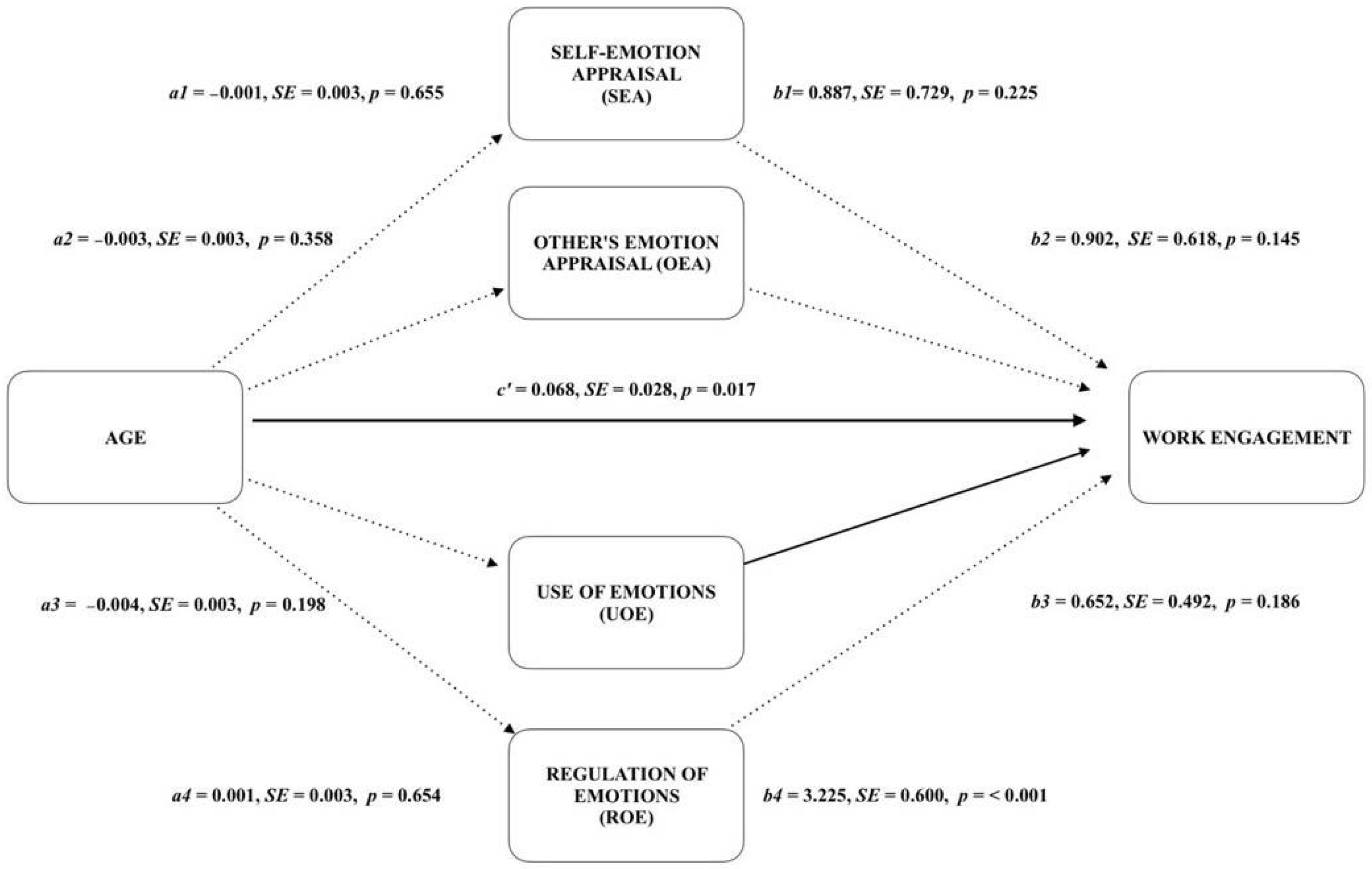
Data analyses were conducted in R version 4.3.1. First, descriptive statistics and bivariate correlations were computed for all study variables. Next, a confirmatory factor analysis (CFA) was conducted in R using the lavaan package Version 0.7.2 to examine the factorial validity of the measurement model prior to hypothesis testing. The model specified five correlated latent factors corresponding to the four dimensions of emotional intelligence and one latent factor representing work engagement. The model was estimated using the Maximum Likelihood (ML) estimator. Model fit was evaluated using multiple goodness-of-fit indices, including the Comparative Fit Index (CFI), Tucker–Lewis Index (TLI), Root Mean Square Error of Approximation (RMSEA), and Standardized Root Mean Square Residual (SRMR). Convergent validity was assessed through standardized factor loadings, composite reliability (CR), and average variance extracted (AVE), whereas discriminant validity was examined using the Fornell–Larcker criterion. Because all questionnaire items were assessed using five-point Likert scales, they were treated as ordered categorical indicators and estimated using the weighted least squares mean and variance adjusted (WLSMV) estimator. Latent factor variances were fixed to one (std.lv = TRUE), missing data were handled using pairwise deletion, and no correlated residuals or post hoc model modifications were introduced. Although the UWES-9 comprises the dimensions of vigor, dedication, and absorption, it was modelled as a single latent construct because the objective of the present study was to examine overall work engagement, consistent with previous applications of the UWES-9 as a unidimensional measure [
44]. Following the assessment of the measurement model, a parallel multiple mediation model was estimated using the lavaan package to examine whether the association between chronological age and work engagement was mediated by the four dimensions of emotional intelligence. The model was specified to reproduce the logic of Hayes’ PROCESS Model 4 [
45], with SEA, OEA, UOE, and ROE operating as parallel mediators. Unstandardized regression coefficients are reported throughout. Indirect effects were estimated using nonparametric bootstrapping with 5000 resamples and evaluated using 95% bootstrap confidence intervals. The primary mediation model did not include control variables, as the aim of the study was to examine the associations among chronological age, the four dimensions of emotional intelligence, and work engagement. As a robustness check, the mediation model was subsequently re-estimated, including gender (male/female), educational level (ranging from primary to higher education), organizational tenure (measured in years), and employment sector (public vs. private) as covariates. These variables were included to account for potential demographic and occupational influences on emotional intelligence and work engagement and to assess whether the substantive conclusions remained stable after controlling for these theoretically relevant characteristics.
5. Discussion
The growth of the older populations, particularly in Portugal, where the present study was conducted, reflects the substantial improvements in overall living conditions over recent decades and underscores the need for further research, especially in the field of work and organizational psychology. In contemporary organizations, characterized by the rapid introduction of new information technologies, employers often favor younger workers because they are perceived as more adaptable and quicker to learn [
46]. Nevertheless, recent studies have shown that older workers frequently exhibit more favorable work-related outcomes than their younger counterparts, especially regarding emotional competencies and engagement [
2,
3,
4,
29]. However, the mechanisms underlying these associations remain insufficiently understood. The present study was designed to contribute to this literature by examining whether the four dimensions of emotional intelligence mediate the association between age and work engagement.
Previous studies have suggested that several personal and occupational resources may contribute to the higher levels of engagement observed among older workers [
4,
22,
29]. Among these resources, emotional competencies, together with factors such as optimism, willingness to pursue career development, and openness to learning new skills, have been proposed as potential correlates of work engagement [
3]. However, the present findings indicate that the four dimensions of emotional intelligence did not mediate this association.
Contrary to Hypothesis 2, age was not significantly associated with any of the four dimensions of emotional intelligence in the present sample. Although previous studies have reported positive associations between age and emotional intelligence [
6,
31,
36,
47], these findings have not been entirely consistent across different populations and measurement methods. Therefore, our results suggest that chronological age alone may not be sufficient to explain individual differences in emotional intelligence, and that other personal, occupational, or contextual factors may play a more prominent role. Moreover, because the present findings did not support the mediating role of emotional intelligence, future research should examine additional individual, organizational, and contextual variables that may help explain the modest positive association observed between chronological age and work engagement [
4,
29,
40,
48,
49].
Among the dimensions of emotional intelligence, only regulation of emotions (ROE) emerged as a significant statistical predictor of work engagement, with higher levels of emotion regulation being associated with greater work engagement. This finding is consistent with previous literature suggesting that emotion regulation is associated with adaptive responses to workplace demands and more effective management of emotional experience [
38]. The finding that regulation of emotions was positively associated with work engagement after accounting for chronological age suggests that this dimension may be more closely related to work engagement than the other emotional intelligence dimensions. Unlike the appraisal or use of emotions, which may depend more on social cues or cognitive processing, the ability to regulate one’s own emotional state may be positively associated with higher levels of energy and dedication in daily work activities. Because the present study was cross-sectional, these findings should not be interpreted as evidence that improving emotion regulation necessarily increases work engagement. Rather, the observed association provides a rationale for future longitudinal and experimental studies examining whether interventions targeting emotion regulation are associated with improvements in work engagement.
5.1. Theoretical Implications
This study extends the literature on the psychological mechanisms underlying the association between chronological age and work engagement. Although the proposed multiple mediation model was not supported, the present findings refine previous theoretical assumptions by suggesting that the relationship between chronological age and work engagement was not explained by the four dimensions of emotional intelligence examined in this study. Rather than supporting emotional intelligence as an explanatory mechanism, the results indicate that Regulation of Emotions (ROE) was the only dimension independently associated with work engagement. This finding suggests that emotion regulation should not necessarily be conceptualized as an age-derived resource. Rather, it may represent a personal resource associated with work engagement independently of age.
The absence of significant indirect effects suggests that age-related differences in work engagement may not operate through dispositional emotional competencies, as suggested in previous theoretical and empirical literature [
2,
3,
4]. Instead, the association between age and engagement may be more strongly related to other factors, such as accumulated work experience, changes in work motives, or occupational expertise regulation [
24,
25,
30]. Although socioemotional selectivity theory suggests that emotional competencies may be particularly relevant across adulthood [
19,
20,
21], the present findings did not show significant associations between age and the emotional-intelligence dimensions measured here. Therefore, the results do not support the interpretation that age-related differences in emotional competencies account for the positive association between age and work engagement observed in this sample.
The finding that Regulation of Emotions was positively associated with work engagement after accounting for chronological age suggests that this emotional competency deserves greater attention in future theoretical models of work engagement. More broadly, the present finding also suggests that future models of work engagement may benefit from distinguishing between the different dimensions of emotional intelligence, rather than treating emotional intelligence as a unitary construct.
Taken together, these findings suggest that age and emotion regulation may be conceptualized as independent correlates rather than components of the same explanatory pathway to work engagement, encouraging future research to investigate alternative mechanisms linking age to engagement. Although modest in magnitude, the positive association between age and work engagement observed in the present sample is not consistent with the expectation that older workers necessarily report lower levels of work engagement than younger workers.
5.2. Practical Implications
The growing number of older people in the workplace presents challenges to organizations. The present findings have several practical implications for human resource management. First, the present findings revealed a modest positive association between age and work engagement, suggesting that older workers in the present sample were not less engaged than their younger counterparts. Although this finding should be interpreted with caution given the non-representative sample, it is consistent with previous studies reporting positive associations between age and work engagement. These findings may support consideration of age-inclusive human resource practices that value the contribution of employees across different career stages and encourage intergenerational collaboration and knowledge sharing, thereby helping to reduce ageism and support employee engagement across the workforce [
15,
16,
50,
51,
52].
Second, although emotional intelligence did not mediate the relationship between age and work engagement, Regulation of Emotions emerged as the only emotional intelligence dimension positively associated with work engagement. Accordingly, emotion regulation may represent a relevant focus for future organizational research. However, given the cross-sectional nature of the present study, these findings should not be interpreted as evidence that interventions designed to improve emotion regulation will necessarily increase work engagement. Rather, the observed association provides a rationale for evaluating emotion-regulation interventions in future longitudinal and experimental studies.
Overall, these findings indicate that organizations should not assume that improvements in engagement occur through age-related gains in emotional intelligence. Rather, age and emotion regulation showed independent associations with work engagement, highlighting both variables as relevant targets for future research and as potentially informative considerations for organizational practice.
5.3. Limitations and Future Directions
While the present study contributes to the literature on aging and work engagement, several limitations need to be addressed. First, the cross-sectional design of the study limits the ability to establish causality as it measures variables at a single point in time. Accordingly, the mediation analyses should be interpreted as evidence of indirect associations rather than causal mechanisms. In addition, unmeasured contextual or individual factors may have influenced the observed associations. Future longitudinal research is needed to determine whether the observed associations are stable over time and to evaluate potential temporal ordering among the variables.
Another limitation concerns the exclusive reliance on self-report measures for all study variables. Although procedural remedies were implemented during questionnaire design and Harman’s single-factor test suggested that common method variance is unlikely to represent a substantial threat, common-source measurement cannot be completely ruled out and may have inflated some of the observed associations. Future studies should employ multi-source or multi-method designs to further reduce the potential influence of common method bias.
The lack of significant indirect effects in the mediation model suggests that the association between chronological age and work engagement may be better understood by considering other individual, organizational, or contextual variables. Future research should explore variables such as career planning, human resource management, flexible policies, and job satisfaction to examine whether these variables help explain the association between chronological age and work engagement.
Moreover, an important limitation of this study concerns the sampling strategy. Participants were recruited through convenience sampling rather than quota sampling, and the sample was not representative of the general working population. Although the sample included participants across a broad age range (18–63 years), some age groups may be under- or overrepresented, limiting the generalizability of the findings. In addition, most participants were employed in the private sector and belonged to lower socioeconomic and educational backgrounds. Consequently, these sample characteristics may not only limit the generalizability of the findings but may also represent potential sources of confounding in the estimated associations. Although the robustness analysis, including demographic and occupational covariates, did not materially alter the pattern of results, future studies should seek more heterogeneous and representative samples to further reduce the influence of contextual and socioeconomic differences.
Lastly, the finding that regulation of emotions was positively associated with work engagement highlights the need for further research examining this association. Future studies should investigate the conditions under which emotion regulation is associated with work engagement and explore the individual and organizational factors that may strengthen or weaken this relationship. Such evidence may also help inform the development and evaluation of organizational practices aimed at supporting employees’ emotional resources and work engagement.