


Abstract
Contemporary societies are characterized by increasing role multiplicity and accelerated social change, intensifying identity-related strain and inter-role conflict. Although role theory, narrative identity research, and psychological flexibility frameworks have independently advanced the understanding of psychological adaptation, an integrative structural model explaining how life domains are hierarchically organized and reorganized over time remains underdeveloped. This manuscript introduces Casa Vital (Vital House), a dynamic structural model that conceptualizes identity as a hierarchical architecture of interdependent life domains organized around a central integrative function. The model proposes three core constructs: structural coherence, structural modes (rigidity/flexibility) and self-directed agency, and argues that psychological adaptation depends not only on emotional regulation or narrative coherence but also on the capacity to reorganize domain hierarchies in alignment with personal values and contextual demands. By positioning identity at a meso-structural level of analysis, the framework integrates sociological, narrative, and contextual behavioral traditions while offering testable hypotheses and a falsifiable research agenda. Casa Vital expands the current models of adaptation by introducing hierarchical structural reorganization as a central component of identity functioning in complex contemporary contexts.
1. Introduction
Contemporary societies are characterized by an increasing multiplicity of roles, less predictable life trajectories, and intensified demands associated with identity self-regulation. Individuals must simultaneously manage professional, relational, social, economic, and personal commitments within contexts marked by structural uncertainty and accelerated social change. This complexity increases the likelihood of inter-role conflict, chronic overload, and persistent tensions between life domains [1,2]. Although role accumulation is not inherently detrimental, hierarchical incompatibility among roles and misalignment between personal priorities and contextual demands are consistently associated with stress, emotional exhaustion, and diminished well-being [3,4,5]. In line with recent reviews, the field continues to emphasize that inter-role conflict cannot be fully understood if confined to a “dyadic” reading and requires frameworks capable of capturing the real complexity of contemporary life organization [6].
Role theory has provided a robust framework for understanding how social expectations structure behavior and generate tensions when individual resources are limited [1,7]. However, much empirical research has focused on specific conflicts (primarily work–family conflict) without developing an integrative model representing the full organization of an individual’s life-domain system. Analyses typically focus on interference between two isolated spheres rather than on the global architecture that organizes the full set of simultaneous commitments. Moreover, recent research has underscored the need to improve comparability and reliability in work–family conflict measures, precisely because heterogeneous contexts and life configurations challenge traditional operationalizations [8].
In parallel, identity has been conceptualized as a dynamic process of integration and continuity of the self [9]. Narrative identity theory expanded this perspective by proposing that individuals construct internalized stories that provide coherence to experience across time [10,11]. Narrative coherence has been associated with psychological well-being and resilience [12]. Additionally, recent longitudinal evidence suggests that certain narrative identity traits and trajectories are linked to sustained patterns of well-being and depression over time, reinforcing their relevance for understanding adaptation [13]. However, although narrative processes integrate experiences and provide meaning, they do not explicitly specify how different domains of action are hierarchically organized and redistributed in everyday practice. Narrative identity accounts for coherence across time, but it does not offer a structural model of how life domains are configured, prioritized, or adaptively reallocated in response to contextual demands.
Within the behavioral sciences, psychological flexibility has become established as a central adaptive process. Defined as the capacity to contact the present moment and persist in or modify behavior in accordance with chosen values, psychological flexibility is associated with improved functioning and reduced symptomatology [14,15]. However, research has primarily emphasized intrapsychic processes (such as acceptance, cognitive defusion, or emotion regulation) over the external structural organization of life commitments. At the same time, recent reviews have refined the analysis of mechanisms within Acceptance and Commitment Therapy (ACT) and proposed more granular decompositions of flexibility and inflexibility domains, making it especially relevant to explore observable “structural” expressions of adaptive adjustment [16]. In parallel, contemporary methodological debates regarding widely used instruments such as the AAQ-II further underscore the need for complementary measures with incremental validity [17].
In societies characterized by processes of individualization and the weakening of stable normative scripts [18,19], identity becomes a reflexive project requiring ongoing reorganization. Adaptation during life transitions (such as career changes, parenthood, or migration) involves not only emotional regulation but also the reconfiguration of priorities and commitments [20,21]. Similarly, the literature on purpose and meaning in life suggests that value orientation influences long-term behavioral organization [22,23,24], yet lacks a structural model explaining how such purpose translates into a concrete architecture of hierarchically organized domains. In this regard, recent approaches have proposed shifting the focus from “balance” toward notions of work–life integration, highlighting the need for conceptual frameworks more complex than symmetrical balance models [25].
Taken together, three theoretically relevant yet insufficiently integrated traditions can be identified: role theory, focused on structural conflict; narrative identity theory, centered on coherence and meaning; and psychological flexibility research, centered on context-sensitive value-based regulation. Although each contributes essential elements for understanding adaptation, these approaches do not by themselves provide an integrated meso-structural account of how multiple life domains are organized as an interconnected system of behavioral investment and reorganized over time in relation to personal values and contextual demands.
The present manuscript proposes the Casa Vital (Vital House) model as a structural and dynamic architecture of identity that integrates these traditions within a unified framework. The model conceptualizes identity as a hierarchical system of interdependent domains organized around a central integrative function and posits that psychological adaptation depends not only on narrative coherence or emotional regulation, but also on the capacity to reorganize the hierarchy of such domains in alignment with values and situational demands. The constructs of structural coherence, structural rigidity/flexibility and self-directed agency are introduced, delineated in relation to existing approaches, and articulated through explicit hypotheses aimed at empirical testing. By situating identity at a meso-structural level of analysis, the model seeks to advance conceptual clarity and empirical operability in the study of adaptation within complex contemporary contexts.
2. Theoretical Framework
2.1. Role Theory and the Structural Organization of Everyday Life
Role theory constitutes one of the classical frameworks for understanding how human behavior is organized within social contexts. From this perspective, roles are defined as sets of normative expectations associated with specific social positions that guide behavior and structure social identity [7]. The simultaneous performance of multiple roles is a central characteristic of adult life, particularly in complex societies, where individuals must respond concurrently to professional, family, and community demands.
Goode (1960) introduced the concept of role strain to describe the pressure that emerges when the demands associated with different roles exceed an individual’s available resources, such as time, energy, or attention [1]. Subsequently, Marks (1977) refined this perspective by proposing that role multiplicity is not inherently dysfunctional; on the contrary, it may be beneficial when roles are compatible and coherently integrated [26].
Subsequent research, particularly in the field of work–family conflict, further refined these propositions by identifying specific forms of incompatibility between roles based on time, emotional strain, and behavioral requirements [2]. Later meta-analyses confirmed that inter-role conflict is associated with higher levels of stress, emotional exhaustion, and lower psychological well-being [27,28]. Consistently, recent reviews continue to highlight the need to better integrate accumulated evidence and to broaden the focus beyond traditional dyadic configurations [6], as well as to strengthen the psychometric robustness and comparability of measures used in the field [8].
Nevertheless, this tradition presents an important conceptual limitation: analyses have predominantly centered on dyadic conflicts between specific domains without developing a model that represents the global structural organization of a person’s complete system of roles. Consequently, role theory effectively describes sources of conflict but provides fewer tools for understanding how individuals hierarchically organize, integrate, and redistribute multiple life domains over time.
2.2. Narrative Identity and Biographical Coherence
Within developmental psychology, identity has been conceptualized as an integrative process that provides continuity and coherence to the self across the life span [9]. This conception was expanded by narrative identity theory, which proposes that individuals construct internalized stories that organize past, present, and anticipated future experiences into a meaningful sequence [10,11].
Narrative coherence fulfills an integrative psychological function by allowing multiple roles and experiences to be articulated within a unified life story. Numerous studies have linked narrative coherence to greater psychological well-being, resilience, and sense of meaning [12]. In recent years, longitudinal studies have reinforced the relevance of narrative identity as a factor associated with trajectories of well-being and symptomatology, suggesting that it is not merely a static interpretative resource but a process with sustained correlates over time [13]. Likewise, longitudinal research in contexts of prolonged stress has found associations between narrative coherence and emotional well-being, underscoring its importance for understanding adaptation under high-demand conditions [29].
However, although narrative identity explains how individuals attribute meaning to their experience, it provides a limited account of the structural organization of everyday behavior. A narrative may be symbolically coherent, while the effective distribution of time, energy, and commitment across life domains remains misaligned or dysfunctional. In this sense, narrative coherence does not necessarily guarantee adaptive structural organization. This distinction is particularly relevant in life transitions, where individuals may reinterpret changes narratively without correspondingly modifying the hierarchy of commitments that sustains their daily life.
2.3. Reflexive Modernity and Biographical Individualization
Sociocultural transformations associated with late modernity have intensified the complexity of identity organization. Giddens (1991) described modern identity as a reflexive project that must be continuously updated through personal decision-making [19]. Complementarily, Beck (1992) conceptualized this process as individualization, characterized by the erosion of normatively prescribed life trajectories and increasing individual responsibility in biographical construction [18].
In this context, individuals must actively manage decisions regarding professional careers, intimate relationships, geographic mobility, and personal development, often without stable social scripts to guide such choices. This condition increases the likelihood of persistent structural tensions and demands self-regulatory capacities that go beyond emotional adaptation alone. From this perspective, identity cannot be understood solely as an internal narrative or subjective experience, but as a functional structure organizing behavior under conditions of uncertainty. Reflexive modernity thus highlights the need for models capable of explaining how individuals hierarchically reorganize their commitments in contexts of ongoing change.
2.4. Psychological Flexibility and Contextual Adaptation
Psychological flexibility has become one of the most influential constructs in contemporary adaptation research. Defined as the capacity to contact the present moment and persist in or modify behavior in accordance with chosen values, psychological flexibility is associated with lower symptomatology, greater well-being, and improved overall functioning [14,15]. ACT operationalizes this construct through interrelated processes such as acceptance, cognitive defusion, present-moment awareness, self-as-context, value clarification, and committed action [30].
However, most research on psychological flexibility has focused on intrapsychic processes and the regulation of internal events. Although these processes facilitate value-guided action, less attention has been devoted to how flexibility translates into the structural reorganization of everyday life. Recent reviews have clarified the domains of flexibility and inflexibility as mechanisms of change and have systematized available evidence, thereby opening space for evaluating additional behavioral–ecological expressions of the construct [16]. Moreover, contemporary methodological debates regarding core instruments such as the AAQ-II further reinforce the importance of assessing complementary constructs with incremental validity and observable indicators of life organization [17].
2.5. Purpose in Life, Meaning, and Behavioral Organization
Positive psychology has emphasized the role of purpose and meaning in life as long-term organizers of behavior. A sense of purpose has been associated with greater well-being, persistence in goals, and better physical and psychological health outcomes [22,23]. Similarly, meaningful work and prosocial contribution are related to higher satisfaction and engagement [24].
However, value clarity and existential meaning do not by themselves guarantee coherent behavioral organization. A strong sense of purpose may exist without being translated into an effective distribution of time and energy aligned with those values. This gap between declared values and behavioral structure suggests the need for a framework explaining how purpose is structurally implemented in everyday life, particularly in contexts where boundaries between domains become more permeable and work–life integration gains conceptual prominence over symmetrical balance models [25].
2.6. Autonomous Self-Regulation and the Motivational Foundations of Identity Organization
Contemporary psychological theories offer complementary ways of understanding how people intentionally regulate their behavior, prioritize commitments, and adjust their actions to pursue personally meaningful goals. These perspectives view identity not just as a narrative or structure, but also as a motivational and self-regulatory system that helps individuals adapt their roles as life circumstances change. Self-Determination Theory (SDT) [31] is a key framework emphasizing that behavior is most effective and fulfilling when driven by autonomous motivation (actions that feel voluntary, self-endorsed, and aligned with one’s core values). SDT highlights three basic psychological needs (autonomy, competence, and relatedness) as essential for sustained engagement in meaningful activities and effective adaptation. From this viewpoint, healthy identity functioning involves endorsing one’s commitments and adjusting them so they remain consistent with internalized values and long-term aspirations.
Complementing SDT, theories of volition and action regulation such as the Rubicon model of action phases clarify the executive mechanisms that translate autonomous intentions into effective goal pursuit, including planning, intention shielding, progress monitoring, and flexible strategy adjustment when circumstances change [32]. Life Design Theory and Career Construction Theory [33] further extend this view by highlighting how individuals actively shape their developmental trajectories through adaptability, narrative integration, and context-sensitive decision-making, supported by competencies such as concern, control, curiosity, and confidence. Finally, research on identity-based motivation shows that action becomes more effective when goals and behaviors feel identity-congruent and when contextual cues activate self-relevant interpretations of tasks and possibilities [34]. Together, these perspectives position identity not only as a representational structure but as a dynamic motivational and self-regulatory system guiding engagement and role adjustment across changing life contexts.
Although these theoretical perspectives clarify important motivational and self-regulatory mechanisms, each provides only a partial account of how individuals coordinate multiple life roles. Self-determination models explain why people pursue personally meaningful actions but do not address how competing commitments are balanced. Volitional theories describe how intentions are translated into behavior, yet they offer limited guidance on how priorities are established when demands accumulate. Similarly, approaches emphasizing adaptability and identity-congruence shed light on future-oriented functioning but provide little insight into the structural reorganization of everyday commitments. Taken together, these perspectives highlight key processes but do not fully account for how individuals integrate and continually adjust their various life domains over time.
2.7. Hierarchical Identity and Control-Based Self-Regulation Models
Hierarchical organization and dynamic reorganization have been addressed in important prior frameworks. Identity Theory proposes that individuals hold multiple role identities that are organized according to salience hierarchies, such that more salient identities are more likely to guide behavior across situations [35,36]. This tradition is particularly relevant for the Casa Vital model because it highlights that identities are not simply multiple, but differentially prioritized. However, Identity Theory focuses primarily on role identities and their salience within social interaction, whereas Casa Vital focuses on broader life domains as systems of behavioral investment that include roles but also health, emotional regulation, financial functioning, personal development, meaning, and contribution.
Control Theory and self-regulation models also provide a major precedent for understanding hierarchical organization and adaptive adjustment. Carver and Scheier’s control-theory approach conceptualizes behavior as organized through feedback loops in which discrepancies between current states and goals guide self-regulatory adjustment [37,38]. These models are directly relevant to the present proposal because they explain how goal systems can be monitored and modified when discrepancies emerge. Nevertheless, Casa Vital differs in its unit of analysis: rather than focusing primarily on goal pursuit or discrepancy reduction, it examines the structural organization of multiple life domains and the redistribution of behavioral investment across them.
Accordingly, the novelty of Casa Vital does not lie in proposing hierarchy or feedback regulation for the first time. Rather, its contribution consists of integrating role organization, domain interdependence, value–investment alignment, structural rigidity/flexibility, and self-directed agency within a single meso-structural framework of identity organization. The model therefore builds on hierarchical and control-based traditions while shifting the focus toward the architecture of everyday life domains and their reorganization across time.
2.8. Theoretical Synthesis and Conceptual Gap
The review of these traditions reveals complementary yet insufficiently integrated contributions. Role theory provides the notion of structural conflict and resource limitation; narrative identity offers symbolic coherence and biographical continuity; reflexive modernity highlights the sociocultural conditions shaping self-organization; psychological flexibility introduces value-based mechanisms of contextual adaptation; and positive psychology contributes the dimension of purpose and meaning. In addition, models of autonomous self-regulation clarify the motivational foundations of committed action and the processes through which goals are enacted, yet they do not specify how competing demands across life domains are coordinated or how higher-order priorities are recalibrated when personal or contextual conditions change. However, despite these valuable insights, the literature remains comparatively less developed in specifying how role identities, goals, values, and everyday commitments are integrated into a domain-level architecture of behavioral investment. Casa Vital addresses this gap by proposing a meso-structural model focused on how life domains are prioritized, interdependent, and reorganized over time in response to contextual demands and personally endorsed values.
This conceptual gap motivates this proposal of the Casa Vital model, which integrates these contributions under an architectural conceptualization of identity as a dynamic hierarchical system of behavioral investment.
3. The Casa Vital Model: A Dynamic Structural Architecture of Identity
3.1. Structural Assumptions of the Model
The Casa Vital model is based on the premise that identity can be conceptualized as a hierarchical architecture of interdependent domains that organize an individual’s behavioral investment across different areas of life. This formulation does not reject narrative or intrapsychic approaches; rather, it introduces an additional level of analysis: the meso-structural level, where identity is expressed as the observable distribution of time, energy, attention, and commitment across multiple functional domains.
The model rests on three fundamental assumptions. First, life domains do not operate in isolation but function as an interdependent system in which changes in one area affect others. Second, these domains are hierarchically organized, such that some acquire greater relative centrality depending on contextual demands. Third, psychological adaptation depends, in part, on the capacity to dynamically reorganize this hierarchy in response to situational demands and personal values. From this perspective, identity is not conceived as a static set of roles, but as a structural configuration that varies over time.
3.2. General Architecture of the System
The model proposes a structure composed of a central integrative function and a set of interdependent functional domains. The central function fulfills an organizing and reflective role that allows individuals to evaluate coherence, clarify values, and revise hierarchical priorities. This dimension does not constitute a specific role, but rather a metacognitive capacity for integration that enables structural reorganization.
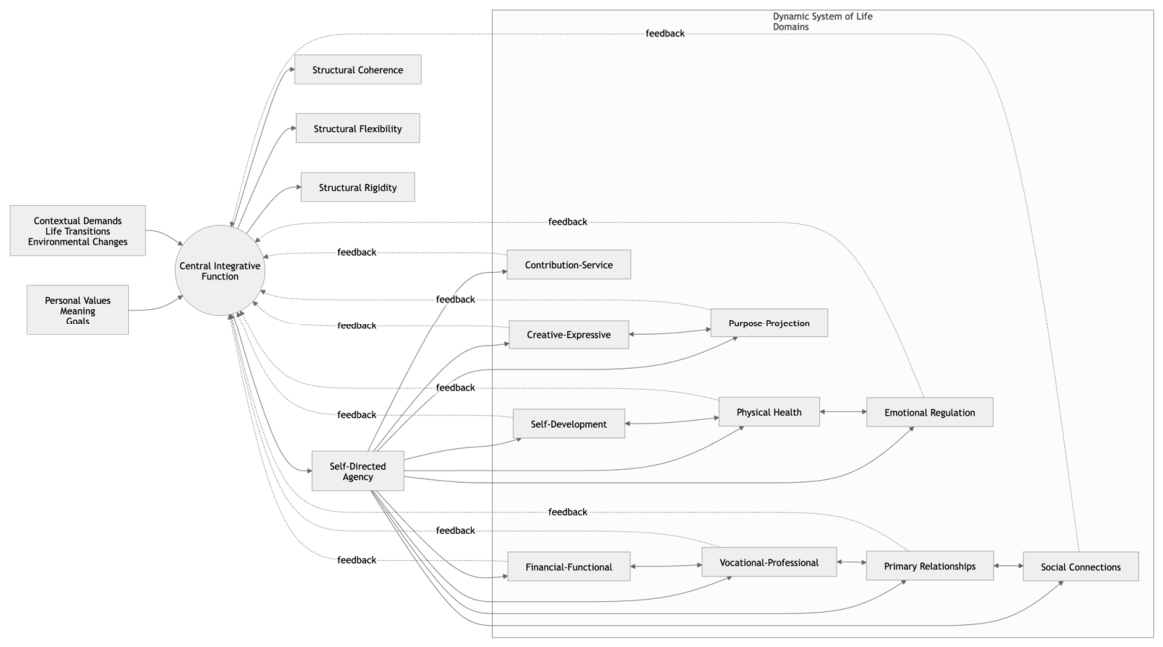
Surrounding this integrative function are functional domains representing differentiated areas of behavioral investment. These domains include, among others, the professional–vocational sphere, intimate and family relationships, the broader social network, bodily health, emotional regulation, the economic–functional domain, creative expression, prosocial contribution, meaning projection, and personal development. The ten domains represented in Figure 1 should be understood as an illustrative and preliminary taxonomy rather than as an exhaustive or universally fixed list. They were selected because they synthesize recurrent areas emphasized in role theory, work–life research, well-being models, purpose and meaning research, and applied psychoeducational contexts. Nevertheless, the model does not require these exact ten domains in all populations. Some domains may overlap, subdivide, or vary in relevance depending on developmental stage, cultural context, socioeconomic conditions, or clinical status. The central claim of the model is therefore not the universality of a specific domain list, but the existence of a hierarchically organized and dynamically adjustable system of life domains. Each domain can be characterized by its degree of centrality, its intensity of commitment, and its relative priority within the global system. The resulting architecture at any given moment constitutes the structural configuration of identity (see Figure 1).
Figure 1.
Dynamic hierarchical architecture of the Casa Vital model. Personal values and contextual demands are continuously evaluated through the Central Integrative Function. Through Self-Directed Agency, individuals reorganize the relative centrality of life domains across time. Structural coherence, structural flexibility, and structural rigidity represent emergent properties of the system. Bidirectional arrows indicate interdependence and spillover among domains, whereas feedback loops represent ongoing monitoring and adaptive reorganization.
3.3. Dynamic Hierarchy and Contextual Reorganization
A central principle of the model is the rejection of symmetrical balance as a universal normative criterion. Adaptation does not require distributing resources uniformly across domains, but rather maintaining functional alignment among personal values, contextual demands, and the effective hierarchy of commitments. At certain periods in the life cycle, some domains may legitimately acquire greater centrality without implying maladaptation. For example, transitions such as early parenthood or an intensive training process may require a temporary reorganization of priorities. What is relevant is not the magnitude of investment in a specific domain, but the capacity to adjust such investment when the context requires it. Contextual reorganization therefore constitutes a key structural mechanism of adaptation. A hierarchical conception differs from simple resource allocation models because it assumes that domains vary not only in the amount of investment they receive but also in their organizing influence over the entire system. Changes in highly central domains may therefore produce disproportionate effects on other domains, whereas changes in peripheral domains may have more limited systemic consequences.
3.4. Core Constructs of the Model
3.4.1. Structural Coherence
Structural coherence is defined as the degree of alignment among personal values, declared priorities, and the effective distribution of behavioral investment across domains. This construct extends beyond narrative coherence by specifically referring to congruence between value-based intention and the observable structure of commitments. A structural configuration may be considered coherent when the domains that occupy greater centrality reflect the individual’s core values and are appropriately adjusted to relevant situational demands. Structural coherence should also be distinguished from self-concordance. Self-concordance refers to the degree to which personal goals are consistent with an individual’s enduring interests, values, and developing self [39,40]. Structural coherence is broader in scope and operates at a different level of analysis. It does not assess whether a specific goal is self-concordant, but whether the overall configuration of life domains is aligned with personal values, declared priorities, and actual behavioral investment. Thus, self-concordance concerns value–goal alignment, whereas structural coherence concerns value–priority–investment alignment across multiple domains. This distinction makes it possible to test whether structural coherence explains incremental variance beyond existing self-concordance measures.
3.4.2. Structural Modes: Rigidity and Flexibility
Structural modes refer to the degree to which the hierarchy of life domains can reorganize in response to changing contextual conditions or evolving values. Structural rigidity denotes a stable hierarchical organization that shows low sensitivity to significant contextual signals, reflected in persistent patterns of resource allocation even when they produce misalignment. Unlike intrapsychic psychological inflexibility, rigidity manifests at the organizational level of everyday commitments, explaining cases in which individuals possess value clarity and emotional regulation yet maintain maladaptive patterns of behavior. In contrast, structural flexibility reflects the capacity to adaptively reorganize domain priorities through situational sensitivity, functional redistribution of resources, and temporal adjustments that preserve overall identity coherence. Flexibility does not imply instability; rather, it represents a form of dynamic adaptation that enables alignment between domain organization, personal values, and contextual demands.
Importantly, structural flexibility and psychological flexibility operate at different levels of analysis. Psychological flexibility refers primarily to the individual’s capacity to remain in contact with present-moment experience and to persist in or modify behavior in accordance with chosen values, especially through intrapsychic and behavioral regulatory processes. Structural flexibility, by contrast, refers to the observable reorganization of life-domain priorities and behavioral investments across contexts. Thus, a person may show psychological flexibility in relation to thoughts, emotions, and values while still maintaining a rigid organization of everyday commitments. Conversely, structural flexibility refers specifically to changes in the hierarchical configuration of domains, such as reallocating time, energy, and attention among work, family, health, social, or personal-development domains when contextual demands change. The present model therefore conceptualizes structural flexibility as a complementary meso-structural process rather than as a synonym for psychological flexibility.
3.4.3. Self-Directed Agency
Self-directed agency refers to the individual’s capacity to intentionally guide the reorganization of life-domain hierarchies in accordance with personally endorsed values and long-term aspirations. It encompasses the ability to generate autonomous intentions, evaluate the functional consequences of alternative configurations, and deliberately enact adjustments rather than relying on habitual or externally driven patterns. This process operates at the meso-structural level, linking motivational foundations with structural adaptation: individuals high in self-directed agency can integrate reflective insight, contextual information, and value-based priorities to shape domain organization proactively. Rather than reflecting mere decisional willpower, self-directed agency constitutes a sustained regulatory orientation that enables purposeful, coherent, and value-aligned identity navigation across changing circumstances.
Self-directed agency should be clearly distinguished from the central integrative function. The central integrative function refers to the metacognitive capacity to monitor the current organization of life domains, evaluate value–investment alignment, and identify potential misalignments. Self-directed agency, by contrast, refers to the intentional enactment of changes in the hierarchy of domains. In other words, the central integrative function is primarily evaluative and reflective, whereas self-directed agency is primarily executive and transformative. A person may recognize that their current organization is structurally incoherent through the central integrative function, but self-directed agency refers to whether they can deliberately implement changes in time allocation, relational boundaries, health practices, professional commitments, or other domain priorities.
Self-directed agency should also be distinguished from autonomous motivation and volitional regulation. Autonomous motivation explains why individuals pursue goals that are self-endorsed and congruent with their values, whereas self-directed agency refers to the capacity to intentionally reorganize the hierarchy of life domains when current commitments become misaligned with values or contextual demands. Similarly, volitional regulation explains how intentions are translated into action through planning, persistence, and monitoring, while self-directed agency concerns the broader reconfiguration of competing commitments across multiple domains. In this sense, self-directed agency is not limited to initiating goal-directed behavior, but involves evaluating the whole structure of life-domain organization and deliberately modifying it when necessary. Thus, self-directed agency is not defined by the origin of motivation, but by the capacity to intentionally modify the architecture of life-domain priorities when existing configurations become functionally misaligned.
3.5. System Dynamics and Interdependence
The model assumes that life domains interact bidirectionally. Changes in one domain may generate spillover effects in others, both positive and negative. For example, prolonged overinvestment in the professional domain may affect physical health or the quality of intimate relationships, whereas improvements in emotional regulation may facilitate hierarchical adjustments in other areas. This interdependence reinforces the need to analyze identity as a system rather than as a sum of independent parts.
3.6. Hypotheses Derived from the Model
Based on the foregoing principles, the model formulates the following hypotheses for future empirical testing:
H1.
Structural coherence will be positively associated with subjective well-being and life satisfaction, even after controlling for the number of roles and inter-role conflict.
H2.
Structural rigidity will mediate the relationship between inter-role conflict and psychological distress.
H3.
Structural flexibility will moderate the impact of stressful life transitions on longitudinal well-being.
H4.
Structural coherence will explain incremental variance in meaning in life and well-being beyond intrapsychic psychological flexibility and self-concordance.
H5.
Structural indices (coherence, structural modes and self-directed agency) will demonstrate incremental validity in predicting well-being and psychological distress above established measures of inter-role conflict, psychological inflexibility and self-concordance.
H6.
Self-directed agency will be positively associated with structural flexibility and negatively associated with structural rigidity, suggesting that agency supports adaptive reorganization of life-domain hierarchies.
H7.
Self-directed agency will predict incremental variance in life satisfaction and psychological well-being beyond structural coherence and structural flexibility.
H8.
Self-directed agency will moderate the relationship between stressful life events and structural coherence over time, such that individuals high in agency will be more likely to maintain or restore coherence after contextual disruption.
These hypotheses establish explicit conditions of falsifiability and allow for the evaluation of the model’s incremental validity relative to previously consolidated constructs.
3.7. Preliminary Operational Definitions and Observable Criteria
To maximize falsifiability and facilitate empirical accumulation, the model distinguishes between conceptual definitions and minimal observable criteria. Structural coherence may be operationalized as the degree of congruence among (a) the value-based importance attributed to each domain, (b) declared hierarchical priority, and (c) the effective distribution of time, energy, and commitment. In practical terms, it would be expressed as low value–investment discrepancy and high functional consistency between priorities and behavior. Structural rigidity may be operationalized as low intraindividual variability in the hierarchy of domains over time and, especially, as the absence of adjustment following relevant contextual changes (e.g., life transitions), even when indicators of interference or deterioration are present in neglected domains. Structural flexibility may be operationalized as context-sensitive hierarchical variability characterized by adaptive redistribution of resources, reversibility (the capacity to return to prior configurations when context changes), and maintenance of global coherence. Finally, self-directed agency can be operationalized as the individual’s capacity to autonomously form intentions, evaluate misalignments between values and current life-domain organization, and deliberately implement structural adjustments. It is expressed through high alignment between self-endorsed goals and enacted changes, low intention–implementation discrepancy, and a consistent ability to initiate or sustain reorganizations that maintain or restore structural coherence.
Empirically, these constructs could be examined through multidomain assessment procedures. Participants could be asked to identify relevant life domains and then rate, for each domain, perceived importance, declared priority, actual time investment, emotional energy, attentional involvement, and perceived contextual demand. Structural coherence could be estimated through discrepancy indices comparing value-based importance, declared priority, and actual behavioral investment. Structural rigidity could be examined longitudinally as low variability in domain hierarchy despite significant contextual changes or indicators of impairment in neglected domains. Structural flexibility could be measured as adaptive, context-sensitive variability in domain centrality across repeated assessments. Intensive longitudinal designs, ecological momentary assessment, or repeated multidomain questionnaires during life transitions would allow researchers to examine intraindividual changes in hierarchy, spillover among domains, and the temporal restoration of coherence following disruption.
A possible measurement strategy would involve three steps. First, participants would identify or rate a set of life domains and indicate the subjective value or importance of each domain. Second, they would rank the current priority of each domain in their life hierarchy. Third, they would report actual behavioral investment in each domain, including weekly time allocation, perceived energy expenditure, attentional involvement, and recent behavioral commitment. Structural coherence could then be operationalized through discrepancy scores between value importance, declared priority, and behavioral investment. Structural rigidity could be indexed by low change in domain hierarchy across repeated measurements despite major contextual changes or worsening indicators in neglected domains. Structural flexibility could be indexed by adaptive changes in domain centrality following contextual shifts, together with maintained or restored well-being. Self-directed agency could be measured through indicators of intentional restructuring, such as perceived capacity to modify commitments, enactment of planned changes, and reduction in intention–implementation discrepancy over time.
This preliminary operationalization allows for evaluation of the model’s incremental validity relative to adjacent constructs and facilitates longitudinal designs focused on transitions.
3.8. Applied Origins and Manualization of the Metaphor: From Theoretical Model to Intervention
At the theoretical level, Casa Vital should be understood as a conceptual model of identity organization rather than merely as a metaphorical representation. The house metaphor functions as an applied and communicative device that facilitates visualization, psychoeducation, and potential intervention, but it is analytically distinct from the theoretical constructs proposed in the model. Structural coherence, structural rigidity, structural flexibility, and self-directed agency are defined independently of the metaphor and remain conceptually meaningful without reference to rooms, basement, attic, or other house-related images. This distinction is important to preserve conceptual precision and to avoid conflating the scientific model with its applied metaphorical translation.
The Casa Vital model was developed in continuity with an applied metaphor used in training and psychological intervention contexts: representing everyday life as a “house” composed of different “rooms” symbolizing relevant roles and domains.
In the reference manual “The architecture of learning” [41], this metaphor is explicitly used to classify behaviors, thoughts, and emotions in relation to life roles and to promote awareness of functioning patterns and historical and contextual sources of influence. In this applied proposal, “habitable rooms” represent functional areas of daily life (e.g., living room/kitchen/lounge/partner’s bedroom/bathroom/children’s room/office), while two less consciously visible spaces fulfill transversal explanatory functions: the basement, defined as learning history (experiences and agents that shaped repertoires, beliefs, and emotional regulation) and the attic, associated with family expectations, generational legacy, and internalized values. In theoretical terms, these components provide a concrete way to operationalize historical determinants (basement) and normative pressures/internalizations (attic) that may contribute to rigid hierarchization patterns or to value–investment discrepancies.
Additionally, the applied proposal introduces a “Room 10,” not as a physical space but as a shift in perspective: viewing one’s life “from the outside,” promoting an introspective/observer position that allows individuals to analyze how learning history influences behavior in each room. Table 1 provides the correspondence between the rooms of the Vital House metaphor and the domains of life. Additional conceptual details regarding this correspondence are presented in Appendix A.
Table 1.
Preliminary Correspondence Between “Rooms” (Applied Metaphor) and Casa Vital Model Domains.
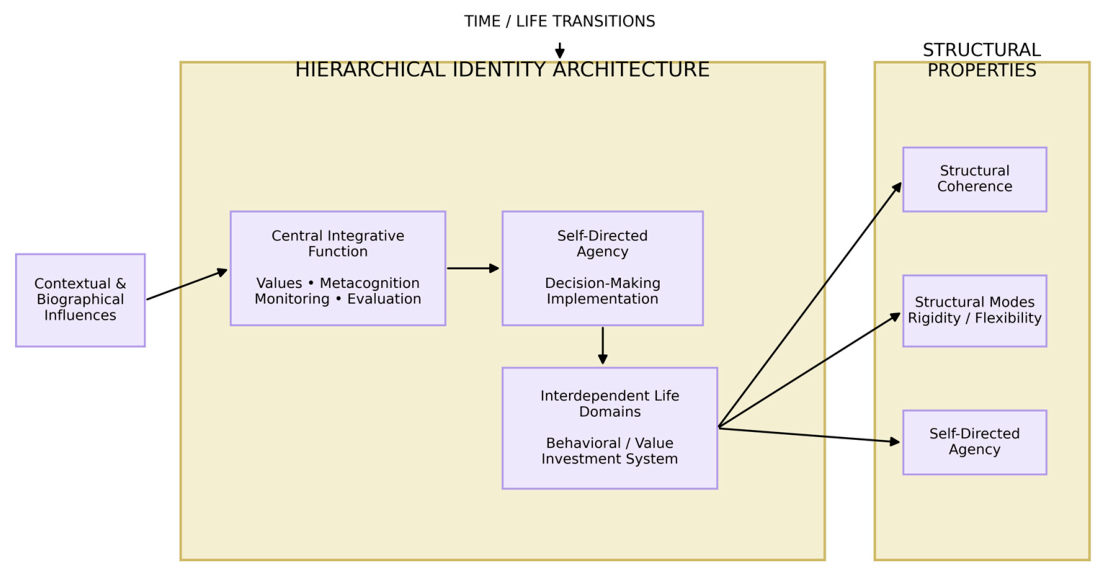
This component is conceptually convergent with the central integrative function of the Casa Vital model (the nuclear metacognitive dimension) and strengthens the articulation among values, self-awareness, and hierarchical reorganization (see Figure 2).
Figure 2.
Vital House Model: Hierarchical Architecture of Identity. Note. The arrows represent reciprocal influences among life domains and illustrate the dynamic nature of hierarchical reorganization over time. Contextual changes and life transitions may trigger adjustments in domain centrality, while the central integrative function continuously evaluates and updates the structure in relation to personal values, contextual demands, and the effective distribution of behavioral investment.
Finally, the manual explicitly incorporates the idea of interdependence among rooms (e.g., “drywall partitions,” “open-plan houses”), emphasizing how unresolved conflicts in one domain may “spill over” into behaviors and emotions in others. This notion is coherent with the systemic assumption of the model (bidirectionality and cross-domain influence) and provides a natural bridge between the theoretical framework and hypotheses regarding spillover/interference and structural rigidity. Taken together, the manualized metaphor functions as an applied translation of the model: (a) it facilitates experiential identification of domain hierarchies; (b) it enables the detection of discrepancies between values and behavior; and (c) it offers procedures to explore historical and normative determinants of identity structure.
However, to preserve scientific delimitation, the clinical-training content is presented here as applied operationalization rather than empirical evidence of the model. Future work will allow for the development of standardized protocols and the evaluation of whether interventions based on hierarchical reorganization increase structural coherence and reduce rigidity in longitudinal or experimental designs.
4. Theoretical Implications, Conceptual Delimitation, and Scope of the Model
4.1. Contribution to the Contemporary Study of Identity
The Casa Vital model introduces a conceptual expansion in the study of identity by situating it at a meso-structural level of analysis. Whereas role theory emphasizes normative expectations and conflict between social positions, and narrative identity focuses on symbolic coherence and biographical meaning, the present model proposes that identity can additionally be understood as a hierarchical architecture of behavioral investment distributed across interdependent domains.
This reformulation shifts the focus from the mere presence of multiple roles or from the subjective coherence of personal narratives toward the effective organization of commitments in everyday life. Psychological adaptation is thus conceptualized not only as emotional regulation or narrative reinterpretation, but as the capacity for dynamic structural reorganization. By introducing the constructs of structural coherence, structural modes (rigidity/flexibility) and self-directed agency, the model broadens the understanding of mechanisms linking inter-role conflict, life purpose, and psychological well-being. This integration allows phenomena such as burnout, parental exhaustion, or life crises to be analyzed within a shared architectural framework of persistent hierarchical misalignment.
The incremental contribution of the Casa Vital model lies in specifying a level of analysis that is not fully captured by role theory, narrative identity, or psychological flexibility when each is considered independently. Role theory explains how social expectations and role demands generate conflict, but it does not fully specify how the complete set of life domains is hierarchically reorganized over time. Narrative identity explains how individuals create symbolic coherence and biographical meaning, but a coherent life story may coexist with a maladaptive distribution of time, energy, and commitment. Psychological flexibility explains value-guided adaptation to internal and contextual experiences, but it does not directly model the structural configuration of everyday commitments. Casa Vital therefore contributes a meso-structural account of adaptation by focusing on how life domains are organized, prioritized, and reorganized as an interconnected architecture of behavioral investment.
4.2. Differentiation from Existing Approaches
One of the primary risks of integrative models is conceptual overlap. For this reason, it is necessary to clearly delimit the scope of the Casa Vital model in relation to prior frameworks. First, the model differs from classical work–life balance approaches in that it does not propose symmetrical or quantitatively homogeneous distribution across domains as a normative criterion. Adaptation does not depend on equality between life areas, but on functional alignment among personal values, contextual demands, and the effective hierarchy of commitments. Second, although the model maintains affinities with narrative identity, it distinguishes between symbolic coherence and structural coherence. A narrative may be internally consistent while the hierarchical organization of domains remains maladaptive. The model thus introduces a complementary, non-redundant analytical level. Third, with respect to contextual psychological flexibility, the model differentiates between intrapsychic processes and observable structural reorganization. Psychological flexibility describes the individual’s relationship to internal events and value-guided action; structural flexibility refers to the hierarchical redistribution of life domains in everyday practice. Finally, unlike popular balance models, which enumerate life domains without offering mechanisms for their interaction or reorganization, this framework specifies how domains function as an interconnected system sensitive to contextual demands. Similarly, although it remains compatible with motivational theories such as Self-Determination Theory and volitional models, it extends beyond the formation and enactment of autonomous intentions by addressing how domain hierarchies themselves are structured and recalibrated. In this way, the framework incorporates motivational processes while clarifying the structural and organizational principles that these theories typically leave unspecified. While these dimensions may correlate, they operate at distinct analytical levels. Table 2 summarizes the similarities and differences between Casa Vital and related frameworks, highlighting its distinctive meso-structural focus. This conceptual delimitation is essential to prevent the model from being interpreted as merely a terminological extension of existing frameworks.
Table 2.
Comparison of the Casa Vital model with related frameworks in identity and adaptation.
4.3. Epistemological Position and Level of Analysis
The model is situated at a meso-structural level that articulates individual and contextual dimensions without reducing itself to either. It does not seek to explain identity exclusively in intrapsychic terms, nor in macrostructural deterministic terms. Instead, it adopts a functional-contextual perspective in which identity is analyzed according to how it organizes behavior in specific contexts and how such organization influences adaptive outcomes.
This positioning allows for the integration of sociological, narrative, and behavioral contributions under a common logic of dynamic hierarchical organization. It also avoids an individualistic interpretation that would place exclusive responsibility on the subject for their life organization, recognizing that structural conditions (economic, cultural, and institutional) influence the real possibilities for hierarchical reorganization.
4.4. Scope and Conditions of Applicability
The Casa Vital model is proposed as a general conceptual framework for understanding identity organization in contexts of contemporary complexity. However, its applicability may vary depending on specific structural conditions. In contexts of high economic precariousness or severe institutional constraints, the capacity for hierarchical reorganization may be limited by external factors beyond individual control. Similarly, in the presence of severe psychopathology or significant cognitive impairment, the central integrative function may be compromised. Furthermore, hierarchies of life domains may vary culturally, particularly in societies with collectivist orientations or highly prescriptive role norms. Consequently, cross-cultural validation of the model constitutes a necessary condition for evaluating its generalizability.
4.5. Conceptual Limitations
Like any theoretical model, the present proposal presents limitations that must be critically considered. First, the delineation of specific functional domains may require empirical adjustment, as certain dimensions may partially overlap or manifest differently depending on developmental stage or sociocultural context. Second, the distinction between intrapsychic psychological flexibility and structural flexibility must be empirically demonstrated through evidence of incremental validity. If both dimensions fail to explain differential variance in well-being and adaptation, the conceptual utility of the model would be diminished. Third, the measurement of structural coherence poses methodological challenges, particularly in estimating relative hierarchies and value–behavior congruence. The development of appropriate instruments will be decisive for the scientific consolidation of the model. Fourth, the construct of self-directed agency must be empirically distinguished from related motivational variables, such as autonomous motivation or volitional competence, to demonstrate its incremental contribution to structural reorganization. The present model remains primarily conceptual and requires empirical validation before claims regarding causal mechanisms can be supported.
4.6. Falsifiability and Empirical Projection
A theoretical model acquires scientific value insofar as it establishes clear conditions for empirical testing. The Casa Vital model could be refuted if structural coherence fails to show significant associations with well-being indicators, if structural rigidity does not mediate the relationship between inter-role conflict and psychological distress, or if structural flexibility does not moderate the impact of life transitions on longitudinal outcomes. Likewise, the model would lose specificity if it failed to demonstrate incremental validity relative to consolidated constructs such as work–family conflict or psychological flexibility, or if self-directed agency did not explain variance in structural reorganization beyond established motivational variables. These conditions establish explicit evaluation criteria and delimit the scope of this proposal.
5. Discussion
The present manuscript has proposed the Casa Vital model as a dynamic structural architecture of identity that integrates three traditions that have been developed in parallel: role theory and inter-role conflict [1,2], narrative identity as a framework of biographical coherence [11], and psychological flexibility as a central process of contextual adaptation [14,15]. The central contribution lies in situating psychological adaptation at a meso-structural level: not solely as emotional regulation or narrative coherence, but as the capacity to hierarchically reorganize behavioral investment across life domains in accordance with values and situational demands [18,19].
This reformulation allows phenomena often addressed in fragmented ways (e.g., burnout, work–family tensions, or strain due to conflicting expectations) to be reinterpreted as potential manifestations of persistent hierarchical misalignment and, in some cases, structural rigidity. Accumulated evidence consistently shows that work–family conflict is associated with adverse well-being and occupational health outcomes [27,28], and recent reviews continue to emphasize its relevance and complexity [6]. From the Casa Vital perspective, these effects are not interpreted solely as dyadic interference between spheres, but as expressions of a global architecture in which domain hierarchies may become chronically fixed despite contextual change.
A relevant contribution of the model consists of differentiating between symbolic (narrative) coherence and structural (behavioral–hierarchical) coherence. Previous research has linked narrative coherence to well-being and resilience [12], and recent longitudinal studies suggest robust associations between narrative processes and mental health indicators over time [13]. However, narrative coherence may coexist with structural patterns of overinvestment or underinvestment in critical domains. For this reason, Casa Vital proposes that adaptive adjustment requires, in addition, structural coherence: alignment among values, priorities, and observable behavior.
Similarly, the model seeks to provide incremental validity relative to established frameworks in contextual psychology. Psychological flexibility has become consolidated as a transdiagnostic predictor of functioning and well-being [14,15], and recent meta-analytic reviews have refined the debate regarding mechanisms and domains of the construct in ACT [16]. At the same time, there is ongoing methodological discussion regarding widely used instruments such as the AAQ-II and their interpretation [17]. In this context, Casa Vital proposes that psychological flexibility may have an “external” and observable manifestation: the hierarchical reorganization of life domains. This does not compete with ACT; rather, it complements it by offering an explicit structural level for longitudinal research and incremental validation.
The relevance of the model is amplified in societies marked by biographical individualization and the weakening of stable normative scripts [18,19]. In these contexts, identity becomes a reflexive project requiring continuous adjustment in response to occupational, relational, and social change. The literature on transitions emphasizes that adaptation involves reconfiguring resources, meanings, and priorities [21]. Empirically, evidence also suggests that the way individuals organize narrative and emotional responses to sustained stressors is linked to subsequent well-being [29]. Casa Vital offers a framework for understanding these dynamics not only as internal processes but as reorganizations (or blocked reorganizations) within the architecture of life domains.
Moreover, the model engages with recent approaches shifting from “work–life balance” toward concepts such as work–life integration, emphasizing the interpenetration of spheres and the need for more complex frameworks than symmetrical balance models [25]. Casa Vital is compatible with this shift but adds a crucial layer: dynamic hierarchy and its structural properties (coherence, rigidity vs. flexibility, and self-directed agency).
The scientific consolidation of the model depends on empirical testing. Two priorities appear immediate: First, instruments that capture (a) relative domain hierarchies, (b) value–behavior congruence, and (c) intraindividual variation during transitions should be developed. The literature on measurement in the work–family field shows recent advances in reliability generalization and cross-cultural comparability [8], suggesting that a structural measure can be designed from the outset with robust psychometric criteria. Second, the model’s incremental validity relative to established measures of inter-role conflict and psychological flexibility/inflexibility should be evaluated [17,27,28]. Longitudinal designs in life transitions (e.g., parenthood, career changes) would allow for testing whether hierarchical reorganization predicts subsequent changes in well-being beyond narrative coherence or emotional regulation. In this regard, longitudinal evidence in narrative identity [13] provides a useful methodological precedent for integrating symbolic and structural levels. Finally, cultural generalization must be explicitly addressed, as role hierarchies and margins for reorganization depend on normative and institutional conditions. Without such validation, the model may risk overgeneralizing processes that, in certain contexts, are constrained by precariousness or normative prescription.
Limitations
Although Casa Vital offers an integrative conceptual framework, several limitations should be acknowledged. First, the model is currently theoretical and has not yet been empirically validated. Its proposed constructs (including structural coherence, hierarchical reorganization, and self-directed agency) require operational definitions and psychometrically sound measurement instruments before their predictive value can be established. Second, the model assumes that individuals possess a certain degree of autonomy to reorganize behavioral investment across life domains. However, opportunities for reorganization are often constrained by socioeconomic conditions, institutional structures, cultural expectations, and caregiving responsibilities. Consequently, the applicability of the model may vary across social contexts. Third, although Casa Vital proposes a distinction between narrative coherence and structural coherence, future research is needed to determine the extent to which these dimensions are empirically independent and whether they contribute uniquely to psychological adaptation. Finally, the present framework emphasizes intraindividual processes and may underrepresent broader contextual influences operating at organizational, community, or societal levels. Future studies should examine how structural factors facilitate or hinder adaptive reorganization across life domains. These limitations should be considered as directions for future development rather than weaknesses of the model itself. The primary objective of the present work is to provide a theoretically coherent framework capable of generating testable hypotheses and stimulating empirical research.
6. Conclusions
Casa Vital proposes that identity can be conceptualized as a hierarchical structural architecture capable of dynamic reorganization. Psychological adaptation does not depend exclusively on narrative coherence or emotional regulation, but also on the capacity to hierarchically redistribute behavioral investment across life domains in alignment with personal values and contextual demands. By introducing role theory, narrative identity, and psychological flexibility, the model offers a meso-structural perspective that connects subjective meaning with observable patterns of action. The concepts of structural coherence, structural rigidity versus flexibility, and self-directed agency provide a framework for understanding how individuals navigate life transitions, competing demands, and changing social environments. Beyond its theoretical contribution, Casa Vital generates a series of empirically testable propositions concerning the relationship between domain hierarchies, well-being, adaptation, and identity development. Its potential value lies not only in explaining difficulties associated with persistent imbalance or role conflict, but also in identifying mechanisms through which adaptive reorganization may occur over time. Although empirical validation remains necessary, the model contributes to ongoing efforts to develop more integrative approaches to psychological adaptation in contemporary societies. By focusing on the dynamic organization of life domains, Casa Vital opens new avenues for research on identity, well-being, and human development across the lifespan.
Author Contributions
C.P. and P.C. contributed equally to all aspects of this work. Together, we were responsible for the conceptualization of the review and the proposed model, the design of the methodological approach, and the development and articulation of the theoretical framework. We jointly conducted the literature review, analyzed and synthesized the evidence, and collaboratively constructed the structure and rationale of the model. Both authors contributed to drafting this manuscript, revising it critically for important intellectual content. All authors have read and agreed to the published version of the manuscript.
Funding
This research received no external funding.
Institutional Review Board Statement
Not applicable. This study did not involve human participants, animals, or the collection of any empirical data.
Informed Consent Statement
Not applicable. No data were collected from human participants.
Data Availability Statement
No data were generated or analyzed during this study.
Acknowledgments
I acknowledge Lucy Danziger and Catherine Birndorf, whose “The Nine Rooms of Happiness” [42] offered an early metaphorical cue. The present model, however, is theoretically autonomous and unrelated to the conceptual content of that book.
Conflicts of Interest
The authors declare that, following institutional guidelines for knowledge transfer, a trademark and intellectual property application for the model “Casa Vital” will be submitted by their host university, which will act as the sole legal owner. The authors declare no personal financial competing interests, commercial exploitation, or direct funding related to this application. The model is intended to remain fully open and free for academic research and clinical practice.
Appendix A
Correspondence Between the Applied “Rooms” Metaphor and the Casa Vital Model.
Appendix A.1. General Framework
The theoretical conceptualization of the Casa Vital model was developed in continuity with a psychoeducational and clinical tool based on the metaphor of the “life house,” in which different “rooms” represent functional domains of everyday life. In this manualized application, each room symbolizes a role or life domain in which behaviors, emotions, and interaction patterns manifest.
The present appendix does not constitute an intervention manual, but rather a conceptual clarification intended to explicate how the applied metaphor may be understood as a preliminary operationalization of the theoretical model.
Appendix A.2. Habitable Rooms and Functional Domains
In the applied tool, the habitable rooms (e.g., office, partner’s bedroom, children’s room, kitchen/living room, bathroom, etc.) represent differentiated areas of everyday functioning.
In terms of the Casa Vital model, these rooms correspond to hierarchically organized functional domains, such as:
- Professional–vocational domain.
- Primary relational domain (partner/nuclear family).
- Extended social domain.
- Health and self-care domain.
- Emotional-regulatory domain.
- Economic–functional domain.
- Creative/expressive domain.
- Contribution/transcendence domain.
- Personal development domain.
Each domain may be described according to:
- Degree of hierarchical centrality.
- Intensity of behavioral investment.
- Value–behavior congruence.
- Context sensitivity.
Appendix A.3. The Basement: Learning History and Historical Determinants
In the applied manualization, the basement represents the individual’s learning history, including significant experiences and influential agents (family, school, culture).
Within the theoretical model, the basement is interpreted as:
- A source of persistent hierarchical patterns.
- The origin of automatic prioritization schemas.
- A foundation of potential structural rigidities.
The conceptual inclusion of the basement allows for the integration of historical determinants without reducing the model to an exclusively intrapsychic approach.
Appendix A.4. The Attic: Internalized Expectations and Normative Legacy
The attic symbolizes inherited expectations, implicit mandates, and internalized values that may not coincide with consciously chosen values.
In structural terms, the attic is linked to:
- Discrepancies between declared values and effective behavior.
- Conflicts between internalized hierarchies and current priorities.
- Mechanisms that may sustain structural incoherence.
This component enables articulation of the model with sociological theories of normativity and individualization [18,19].
Appendix A.5. “Room 10”: The Central Integrative Function
In the applied tool, the so-called “Room 10” does not constitute a physical space, but rather a perspective-taking exercise: observing the house from the outside and analyzing how learning history influences current functioning.
In the Casa Vital model, this element corresponds to the central integrative function, which involves:
- Metacognition.
- Value clarification.
- Evaluation of structural coherence.
- Capacity for hierarchical reorganization.
This parallel strengthens the convergence between the applied and conceptual levels of the model.
Appendix A.6. Interdependence Among Rooms
The manualization incorporates the metaphor of “drywall partitions” or an “open-plan house” to describe how conflicts in one room may affect other areas.
In the theoretical model, this is formalized as:
- Bidirectional systemic interdependence.
- Interdomain spillover hypothesis.
- Possible mediation through structural rigidity.
Appendix A.7. Methodological Implications
The correspondence between metaphor and model allows for:
- Designing assessment instruments based on domain hierarchies.
- Measuring value–behavior investment discrepancies.
- Evaluating intraindividual variability during transitions.
- Developing intervention protocols focused on hierarchical reorganization.
However, empirical validation of these applications constitutes a future line of research and is not assumed as established in the present work.
References
- Goode, W.J. A theory of role strain. Am. Sociol. Rev. 1960, 25, 483–496. [Google Scholar] [CrossRef] [Scilit]
- Greenhaus, J.H.; Beutell, N.J. Sources of conflict between work and family roles. Acad. Manag. Rev. 1985, 10, 76–88. [Google Scholar] [CrossRef] [Scilit]
- Hassan Abdou, A.A.; Mohammed El-Amin, M.A.; Ali Mohammed, E.F.; Alboray, H.M.M.; Refai, A.M.S.; Almakhayitah, M.Y.M.Y.; Albohnayh, A.S.M.; Alismail, A.M.A.; Almulla, M.O.M.O.; Alsaqer, J.S.; et al. Work stress, work–family conflict, and psychological distress among resort employees: A JD-R model and spillover theory perspectives. Front. Psychol. 2024, 15, 1326181. [Google Scholar] [CrossRef] [Scilit] [PubMed]
- Ratnaningsih, I.Z.; Idris, M.A. Inter-role conflict cycle: Family distress in work–family dynamics with job and home demands. J. Fam. Econ. Issues 2025, 46, 107–121. [Google Scholar] [CrossRef] [Scilit]
- Ryu, G. Why work–family role transition matters for role strain in North America. J. Appl. Soc. Sci. 2023, 17, 58–73. [Google Scholar] [CrossRef] [Scilit] [PubMed]
- Sohal, A.; Sharma, D.; Sharma, S. Work–family conflict: A systematic literature review and research agenda. Eur. Manag. J. 2025. Advance online publication. [Google Scholar] [CrossRef] [Scilit]
- Biddle, B.J. Recent developments in role theory. Annu. Rev. Sociol. 1986, 12, 67–92. [Google Scholar] [CrossRef]
- Ugwu, L.E.; Idemudia, E.S. A meta-analytic evaluation of the reliability of work-family and family-work conflict scales. Sci. Rep. 2024, 14, 31828. [Google Scholar] [CrossRef] [Scilit] [PubMed]
- Erikson, E.H. Identity: Youth and Crisis; W. W. Norton: New York, NY, USA, 1968. [Google Scholar]
- McAdams, D.P. The psychology of life stories. Rev. Gen. Psychol. 2001, 5, 100–122. [Google Scholar] [CrossRef]
- McAdams, D.P.; McLean, K.C. Narrative identity. Curr. Dir. Psychol. Sci. 2013, 22, 233–238. [Google Scholar] [CrossRef] [Scilit]
- Adler, J.M.; Lodi-Smith, J.; Philippe, F.L.; Houle, I. The incremental validity of narrative identity in predicting well-being: A review of the field and recommendations for the future. Personal. Soc. Psychol. Rev. 2016, 20, 142–175. [Google Scholar] [CrossRef] [Scilit]
- Lind, M.; Ture, S.; McAdams, D.P.; Cowan, H.R. Narrative identity, traits, and trajectories of depression and well-being: A 9-year longitudinal study. Psychol. Sci. 2024, 35, 1325–1339. [Google Scholar] [CrossRef] [Scilit] [PubMed]
- Hayes, S.C.; Luoma, J.B.; Bond, F.W.; Masuda, A.; Lillis, J. Acceptance and commitment therapy: Model, processes and outcomes. Behav. Res. Ther. 2006, 44, 1–25. [Google Scholar] [CrossRef] [Scilit] [PubMed]
- Kashdan, T.B.; Rottenberg, J. Psychological flexibility as a fundamental aspect of health. Clin. Psychol. Rev. 2010, 30, 865–878. [Google Scholar] [CrossRef] [Scilit] [PubMed]
- Macri, J.A.; Rogge, R.D. Examining domains of psychological flexibility and inflexibility as treatment mechanisms in acceptance and commitment therapy: A comprehensive systematic and meta-analytic review. Clin. Psychol. Rev. 2024, 110, 102432. [Google Scholar] [CrossRef] [Scilit] [PubMed]
- Ruiz, F.J.; Bianchi, J.M.; Bastidas-Suárez, D.M.; Ramirez, E.S.; Pena-Hernandez, V. Is the AAQ-II that bad? J. Context. Behav. Sci. 2024, 34, 100854. [Google Scholar] [CrossRef] [Scilit]
- Beck, U. Risk Society: Towards a New Modernity; Sage: Plano, TX, USA, 1992. [Google Scholar]
- Giddens, A. Modernity and Self-Identity: Self and Society in the Late Modern Age; Stanford University Press: Redwood City, CA, USA, 1991. [Google Scholar]
- Nelson, S.K.; Kushlev, K.; English, T.; Dunn, E.W.; Lyubomirsky, S. In defense of parenthood: Children are associated with more joy than misery. Psychol. Sci. 2013, 24, 3–10. [Google Scholar] [CrossRef] [Scilit] [PubMed]
- Schlossberg, N.K. The challenge of change: The transition model and its applications. J. Employ. Couns. 2011, 48, 159–162. [Google Scholar] [CrossRef] [Scilit]
- Damon, W.; Menon, J.; Bronk, K.C. The development of purpose during adolescence. In Beyond the Self: Perspectives on Identity and Transcendence Among Youth; Furrow, J.L., Wagener, L.M., Eds.; Routledge: London, UK, 2003; pp. 119–128. [Google Scholar]
- Hill, P.L.; Turiano, N.A.; Mroczek, D.K.; Burrow, A.L. The value of a purposeful life: Sense of purpose predicts greater income and net worth. J. Res. Personal. 2016, 65, 38–42. [Google Scholar] [CrossRef] [Scilit] [PubMed]
- Steger, M.F.; Dik, B.J.; Duffy, R.D. Measuring meaningful work: The Work and Meaning Inventory (WAMI). J. Career Assess. 2012, 20, 322–337. [Google Scholar] [CrossRef] [Scilit]
- Chauhan, P.; Rai, S. Conceptualizing work-life integration: A review and research agenda. Asia Pac. Manag. Rev. 2024, 29, 415–426. [Google Scholar] [CrossRef] [Scilit]
- Marks, S.R. Multiple roles and role strain: Some notes on human energy. Am. Sociol. Rev. 1977, 42, 921–936. [Google Scholar] [CrossRef] [Scilit]
- Allen, T.D.; Herst, D.E.L.; Bruck, C.S.; Sutton, M. Consequences associated with work-to-family conflict: A review and agenda for future research. J. Occup. Health Psychol. 2000, 5, 278–308. [Google Scholar] [CrossRef] [PubMed]
- Amstad, F.T.; Meier, L.L.; Fasel, U.; Elfering, A.; Semmer, N.K. A meta-analysis of work–family conflict and various outcomes with a special emphasis on cross-domain versus matching-domain relations. J. Occup. Health Psychol. 2011, 16, 151–169. [Google Scholar] [CrossRef] [Scilit] [PubMed]
- Vanaken, L.; Hermans, D.; Bijttebier, P.; Fivush, R. Narrative coherence predicts emotional well-being during the COVID-19 pandemic: A two-year longitudinal study. Cogn. Emot. 2022, 36, 70–81. [Google Scholar] [CrossRef] [Scilit] [PubMed]
- Hayes, S.C.; Strosahl, K.D.; Wilson, K.G. Acceptance and Commitment Therapy: The Process and Practice of Mindful Change, 2nd ed.; Guilford Press: New York, NY, USA, 2012. [Google Scholar]
- Deci, E.L.; Ryan, R.M. The “what” and “why” of goal pursuits: Human needs and the self-determination of behavior. Psychol. Inq. 2000, 11, 227–268. [Google Scholar] [CrossRef] [Scilit]
- Heckhausen, H.; Gollwitzer, P.M. Thoughts about action: The theory of action phases. In Motivation and Action; Heckhausen, H., Gollwitzer, P.M., Weinert, M., Eds.; Springer: Berlin/Heidelberg, Germany, 1987; pp. 263–291. [Google Scholar]
- Savickas, M.L. Career construction theory and practice. Career Dev. Couns. Putt. Theory Res. Work. 2013, 2, 144–180. [Google Scholar]
- Oyserman, D. Identity-based motivation and consumer behavior. J. Consum. Psychol. 2009, 19, 276–279. [Google Scholar] [CrossRef] [Scilit]
- Stryker, S.; Serpe, R.T. Commitment, identity salience, and role behavior: Theory and research example. In Personality, Roles, and Social Behavior; Ickes, W., Knowles, E.S., Eds.; Springer: New York, NY, USA, 1982; pp. 199–218. [Google Scholar]
- Burke, P.J.; Stets, J.E. Identity Theory: Revised and Expanded; Oxford University Press: Oxford, UK, 2022. [Google Scholar]
- Carver, C.S.; Scheier, M.F. Attention and Self-Regulation: A Control-Theory Approach to Human Behavior; Springer-Verlag: New York, NY, USA, 2012. [Google Scholar]
- Carver, C.S.; Scheier, M.F. On the Self-Regulation of Behavior; Cambridge University Press: Cambridge, UK, 2001. [Google Scholar]
- Sheldon, K.M.; Elliot, A.J. Goal striving, need satisfaction, and longitudinal well-being: The self-concordance model. J. Pers. Soc. Psychol. 1999, 76, 482–497. [Google Scholar] [CrossRef] [PubMed]
- Sheldon, K.M.; Kasser, T. Coherence and congruence: Two aspects of personality integration. J. Pers. Soc. Psychol. 1995, 68, 531–543. [Google Scholar] [CrossRef] [PubMed]
- Peñacoba Puente, C.; Catalá Mesón, P.; Écija Gallardo, C.; Gutiérrez Hermoso, L.; Luque Reca, O.; Díaz-Portales Chaves, I. La Arquitectura del Aprendizaje: Construyendo la Casa del Conocimiento; Editorial Universitaria Ramón Areces: Madrid, Spain, 2025. [Google Scholar]
- Danziger, L.; Birndorf, C. Las nueve habitaciones de la felicidad; Urano: Barcelona, Spain, 2010. [Google Scholar]

Disclaimer/Publisher’s Note: The statements, opinions and data contained in all publications are solely those of the individual author(s) and contributor(s) and not of MDPI and/or the editor(s). MDPI and/or the editor(s) disclaim responsibility for any injury to people or property resulting from any ideas, methods, instructions or products referred to in the content. |
© 2026 by the authors. Licensee MDPI, Basel, Switzerland. This article is an open access article distributed under the terms and conditions of the Creative Commons Attribution (CC BY) license.