


Abstract
Public land and water recreation opportunities may shape how older adults perceive the places where they live. This study examined whether satisfaction with available public land and water opportunities is associated with satisfaction with living in Nebraska among White adults aged 65 years and older. We analyzed cross-sectional data from 644 respondents in the 2023 Nebraska Annual Social Indicators Survey, linked with county-level contextual measures of material community conditions, health-care infrastructure, and civic or organizational context from County Health Rankings and Roadmaps. Associations were examined using frequentist ordinal logistic regression with adjustment for demographic, socioeconomic, health, financial, and county-level characteristics. Bayesian ordered logistic regression was performed as a robustness check. More perception of public land and water opportunities was consistently associated with higher satisfaction with living in Nebraska. In the frequentist model, the odds ratio was 2.68 with strong statistical evidence. In the Bayesian model, the odds ratio was 2.61 with a 95% credible interval from 1.54 to 4.05. These findings indicate that perceived access to and quality of local recreation opportunities are relevant to place-based well-being among older adults. Incorporating such perceptions into recreation planning and age-friendly community development may improve residential satisfaction in aging populations.
1. Introduction
How older adults experience and perceive the places where they live is an important question in research on aging, health, and environment [1,2,3]. Positive subjective well-being in later life has been linked to better health outcomes, including physical, behavioral, and psychosocial health, as well as lower mortality risk [4,5,6]. As the population of older adults in the United States (U.S.) continues to grow, identifying the conditions that support well-being in later life has become an increasingly important public health and policy priority [7]. Much of the existing literature on later-life well-being has focused on individual and social determinants such as health status, financial security, and social participation [8,9,10]. Less attention has been paid to how older adults perceive place-related environmental opportunities, including the public land and water opportunities available to them.
Perceived public land and water recreation opportunities may be one such place-based factor. A growing body of research links green and blue environments with better mental and physical health and suggests that contact with natural settings is associated with improved well-being [11,12]. For older adults, these opportunities may be especially relevant because daily life is often more spatially concentrated and more dependent on local environments. In this study, “public land and water opportunities” refers broadly to publicly accessible outdoor recreation and natural-resource settings that respondents perceive as available to them. These opportunities may include land-based settings, such as parks, trails, open spaces, and recreation areas, as well as water-related settings, such as lakes, rivers, reservoirs, and other public water recreation areas. In broader literature, related concepts are often described using terms such as green space, blue space, natural environments, recreation resources, or environmental amenities. The present study focuses specifically on respondents’ satisfaction with perceived opportunities rather than objective measures of environmental exposure, geographic access, land ownership, or actual use. This distinction is important because objective indicators of environmental resources may not capture how residents perceive the public land and water recreation opportunities available to them or how those evaluations relate to satisfaction with living in Nebraska.
Prior research has increasingly examined how green and blue environments relate to well-being, including studies that emphasize perceived quality, satisfaction, accessibility, and use rather than only objective quantity or proximity [13,14,15,16,17,18]. This evidence suggests that environmental resources are not only physical amenities but also evaluated places whose perceived availability, usability, and relevance may shape well-being. Therefore, the present study does not suggest that perceived environmental quality is an unstudied concept. Rather, it builds on this literature by examining older adults’ satisfaction with public land and water recreation opportunities in Nebraska.
Perceived recreation opportunities are not examined in isolation from the broader communities in which older adults live. Research on aging, place, and later-life well-being suggests that older adults’ evaluations of where they live are shaped by the fit between personal circumstances and local conditions that support daily life, mobility, social participation, and access to resources [1,2,3,8,9,10]. Public land and water opportunities may therefore contribute to satisfaction with living in place not only because they provide environmental amenities, but also because they are experienced within wider local opportunity structures. County-level contextual indicators help adjust for this broader setting by capturing community conditions that may enable or constrain how older adults experience place. In this study, these indicators are used to situate individual perceptions of recreation opportunities within the wider county context, rather than as direct measures of public land or water recreation access.
The contribution of this study is empirical, conceptual, and methodological. Empirically, the study focuses on Nebraska, a relatively low-density U.S. state where public land and water resources, rural settlement patterns, and county-level context may shape how older adults evaluate living in place [19]. Conceptually, the study examines satisfaction with public land and water recreation opportunities as a domain-specific place appraisal, rather than treating environmental resources only as objective exposures or geographic amenities. The outcome, satisfaction with living in Nebraska, is also place-specific rather than a general measure of health, mental health, or global life satisfaction. Methodologically, the study links individual survey responses with county-level contextual indicators and compares frequentist and Bayesian ordinal models to assess whether the association is stable across inferential frameworks.
Using data from the 2023 Nebraska Annual Social Indicators Survey linked with county-level contextual indicators, this cross-sectional study examines whether satisfaction with public land and water recreation opportunities is associated with satisfaction with living in Nebraska among White adults aged 65 years and older. We examine the hypothesis that more favorable evaluations of these opportunities are associated with higher satisfaction with living in Nebraska after adjustment for demographic, socioeconomic, health, financial, and contextual characteristics. The study relies on self-reported evaluations, it thus addresses perceived opportunity rather than objective access or actual use. The findings may inform recreation planning and age-friendly community development by suggesting that older adults’ evaluations of public land and water opportunities warrant consideration as a place-related factor in later-life well-being.
2. Materials and Methods
2.1. Study Design and Data Sources
This cross-sectional study used individual-level data from the 2023 Nebraska Annual Social Indicators Survey (NASIS), merged with county-level contextual indicators from County Health Rankings and Roadmaps. NASIS is a statewide mixed-mode mail and web survey of Nebraska residents aged 19 years and older administered by the Bureau of Sociological Research at the University of Nebraska-Lincoln. The survey is designed to provide current information on Nebraska residents and to monitor changes in quality of life over time. Additionally, county-level indicators were linked to respondents by county of residence. These indicators summarize local community conditions using measures compiled from multiple national data sources, including the U.S. Department of Agriculture Food Environment Atlas, Centers for Medicare & Medicaid Service County Business Patterns, and the National Area Health Resource File/American Medical Association. Each dataset represents the most recent available release from its respective source.
2.2. Study Sample
The 2023 NASIS used an address-based sampling design derived from United States Postal Service delivery sequence data to achieve broad household coverage across Nebraska. A stratified random sample of 8000 households was drawn across eight strata, including the six Behavioral Health Regions and selected zip codes in Lincoln and Omaha. Within each sampled household, an adult aged 19 years or older whose birthday came next after 1 July 2023, was invited to participate. Data were collected from 7 July through 15 October 2023.
A total of 1725 respondents participated in the survey, including 444 web responses and 1281 mail responses, for a response rate of 22.6 percent. The present study was restricted to respondents aged 65 years and older. Because the number of respondents in racial and ethnic groups other than White was too small to support stable subgroup estimation, analyses were further restricted to respondents who identified as White. The final analytic sample included 644 respondents.
2.3. Measures
2.3.1. Outcome: Place-Based Well-Being
The primary outcome was place-based well-being, measured with the item, “Overall, how satisfied or dissatisfied are you with living in Nebraska?” Response options ranged from 1, very satisfied, to 5, very dissatisfied. The variable was reverse-coded so that higher values indicated greater satisfaction with living in Nebraska.
2.3.2. Predictor: Perceived Public Land and Water Recreation Opportunities
The main predictor was perceived public land and water recreation opportunities, measured with the item, “How satisfied are you with the public land and water opportunities available to you?” In this context, public land and water opportunities refer to publicly accessible outdoor recreation and natural-resource settings that respondents perceived as available to them, including land-based and water-related recreation opportunities. Response options ranged from 1, very satisfied, to 4, very dissatisfied.
For the primary analysis, responses were reverse-coded and collapsed into two categories: satisfied and dissatisfied. Very satisfied and somewhat satisfied responses were coded as satisfied, while somewhat dissatisfied and very dissatisfied responses were coded as dissatisfied. This coding was used because the primary hypothesis focused on whether broadly favorable perceptions of public land and water opportunities were associated with greater satisfaction with living in Nebraska. In addition, the dissatisfied group was small, with 58 respondents reporting dissatisfaction after pooling the two dissatisfied categories. Retaining all four response categories in the primary covariate-adjusted ordinal model could therefore produce unstable estimates for sparsely populated categories. Since dichotomization reduces information, this estimate should be interpreted as a contrast between broadly favorable and unfavorable evaluations, rather than as a dose–response association across the original response scale.
2.3.3. Covariates
Covariates were included based on prior research and their conceptual relevance to place-based well-being in later life [8,9,10,20,21,22,23,24,25]. These covariates represented sociodemographic characteristics, health status, health-related behavior, financial and civic circumstances, and county-level contextual conditions.
Sociodemographic characteristics included gender (male or female); educational attainment (high school diploma or GED or less, some college or associate degree, bachelor’s degree, and graduate degree); marital status (married or partnered, divorced, and widowed or never married); employment status (retired, working full time or part time, and not working); and annual household income (<$30 K, $30 K–<$50 K, $50 K–<$75 K, $75 K–<$100 K, $100 K–<$150 K, and ≥$150 K). Residential setting was included as a respondent-level measure of rurality and was categorized as town or city, farm, or open country, but not on a farm. This variable was included because residential context may be related to transportation, proximity to recreation resources, and expectations about public land and water opportunities.
Health-related behavior included self-reported general health and depressive symptoms. Self-reported general health was measured on a four-point scale ranging from poor to excellent. Depressive symptoms were assessed using the item, “During the past 12 months, did you ever feel so sad or hopeless almost every day for two weeks or more in a row that you stopped doing some usual activities?” (yes or no). Additionally, we included a covariate that captures the past-year nonmedical substance use. Respondents were classified as yes if they reported using any listed substance in ways other than prescribed during the past year, including marijuana or cannabis, Delta-8 THC, cocaine, methamphetamine, amphetamine, heroin, opioids other than heroin, or hallucinogens or psychedelics. Otherwise, we coded as no.
Additional individual-level covariates captured perceptions of broader state conditions, financial circumstances, community engagement, and household connectivity. Perceptions of statewide conditions were assessed with the item, “All in all, do you think things in Nebraska are generally headed in the right direction?” (right direction, wrong direction, or unsure). Financial satisfaction was measured with the item, “Overall, how satisfied or dissatisfied are you with your current financial situation?” (satisfied or dissatisfied). Community engagement was measured by whether respondents reported participating in community projects or volunteer activities during the past 12 months (yes or no). Household internet access was measured as whether internet service was available in the household (yes or no).
County-level contextual covariates were drawn from County Health Rankings and Roadmaps and linked by county of residence. These measures were included to situate individual perceptions of public land and water opportunities within broader county-level community conditions. The Food Environment Index, scored from 0 to 10 with higher values indicating more favorable food environments, was included as a marker of material and food-related community conditions relevant to healthy aging and satisfaction with place. This index reflects healthy food access and food insecurity and should not be interpreted as a direct measure of public land, water recreation, or objective recreation access. Primary care physician availability was included to capture local health-care infrastructure, and social associations per 10,000 population were included to capture the local civic and organizational environment. Together, these contextual indicators represent broader county-level opportunity structures that may be related to place-based well-being.
2.4. Statistical Analyses
2.4.1. Descriptive Analysis
Descriptive statistics were used to summarize sample characteristics. Categorical variables were reported as frequencies and percentages, and continuous variables were summarized using means and standard deviations to describe central tendency and variability.
2.4.2. Frequentist Ordinal Logistic Regression
A frequentist ordinal logistic regression model was employed to examine the association between perceived public land and water recreation opportunities and place-based well-being after adjustment for all covariates described above. Continuous county-level variables were standardized as z scores so that coefficients reflected a one-standard deviation increase and were more directly comparable across contextual measures [26]. The proportional odds assumption was assessed using the Brant [27] approach. The omnibus test confirmed that there was no evidence of violation (χ2 = 71.63, df = 87, p = 0.88), and none of the individual predictors significantly violated the assumption at p < 0.05, confirming that the ordinal logistic model was appropriate. Following model estimation, average marginal effects were then estimated to illustrate how perceived public land and water opportunities were associated with the predicted probability of each level of place-based well-being, holding all other variables constant.
2.4.3. Complete-Case Analytic Sample
Missing data were handled using listwise deletion. Respondents with missing values for the outcome, main predictor, or any covariate included in the regression model were excluded from model estimation. The descriptive statistics and regression models were based on the same complete-case analytic sample of 644 White adults aged 65 years and older. Therefore, the reported results should be interpreted as complete-case associations among respondents with observed information for all variables included in the analytic model. Multiple imputation was not conducted because the primary aim was to estimate covariate-adjusted associations within a restricted analytic subgroup, and imputation would have required additional assumptions about the missing-data mechanism for ordinal survey responses and county-linked contextual variables.
In addition, the available NASIS weights were developed for the statewide adult sample rather than specifically for White adults aged 65 years and older, and key sociodemographic characteristics related to differential response and sample composition, including gender, education, employment, and household income, were included directly as model covariates. Accordingly, results should be interpreted as covariate-adjusted associations within the analytic sample rather than as population-representative estimates for all older adults in Nebraska.
2.4.4. Bayesian Sensitivity Analysis
The Bayesian ordinal logistic regression model was included as an inferential sensitivity analysis rather than as a replacement for the primary frequentist ordinal logistic regression model. The purpose of this analysis was to examine whether the association between perceived public land and water recreation opportunities and satisfaction with living in Nebraska remained similar under a different estimation framework and weakly informative priors. Bayesian estimation also allowed us to examine the full posterior distribution of the association, report credible intervals for plausible effect sizes, and evaluate posterior sampling stability. This was useful because the main predictor was imbalanced, and some covariate categories were relatively small.
We performed a Bayesian ordinal logistic regression model using the ‘brms’ R package (version 2.23.0) [28,29,30]. Weakly informative normal priors were specified for all parameters, with a mean of 0 and standard deviation of 1 for slope coefficients and a mean of 0 and standard deviation of 4 for threshold parameters [31]. The Normal (0, 1) prior for slopes was chosen because continuous predictors were standardized; this prior centers the baseline on a null effect while remaining wide enough on the log-odds scale to accommodate any realistic effect size without restricting the posterior. The wider Normal (0, 4) prior for thresholds was chosen to be highly diffuse, ensuring the models’ cut points were driven entirely by the data. The posterior sampling was conducted in Stan using the No-U-Turn Sampler, an adaptive Hamiltonian Monte Carlo algorithm [32,33], with four chains and 8000 iterations per chain. The first 4000 iterations of each chain were treated as a warm-up, yielding 16,000 post-warm-up draws. Convergence was excellent: all potential scale reduction factors () equaled to 1, bulk and tail effective sample sizes (ESS) exceeded 7000 for all parameters of interest (minimum Bulk ESS = 7131, minimum Tail ESS = 9642), and visual inspection of trace plots confirmed thorough mixing with no divergent transitions.
All analyses were performed with R programming version 4.5.2 [34]. The significance level was set at alpha = 0.05.
3. Results
3.1. Sample Characteristics
Table 1 presents our sample characteristics. The outcome variable, place-based well-being, showed that the majority of respondents reported being very satisfied (54.35%), followed by somewhat satisfied (29.35%). Approximately 9.47% indicated a neutral level of satisfaction, while smaller proportions reported being somewhat dissatisfied (6.06%) or very dissatisfied (0.78%). Regarding the key predictor, satisfaction with public land and water recreation opportunities, most respondents expressed satisfaction (90.99%), whereas only 9.01% were unsatisfied.
Table 1.
Descriptive Statistics in 2023 (N = 644).
In terms of demographic characteristics, 52.64% of respondents identified as female and 47.36% as male. The majority had completed some college or held an associate degree (40.37%), followed by those with a high school diploma or less (25.16%), a bachelor’s degree (23.29%), or a graduate degree (11.18%). More than half of the sample were married or partnered (59.47%), with 12.89% divorced and 27.64% widowed or never married. Most respondents were retired (73.29%), while 24.07% were employed full- or part-time, and 2.64% were not working. Regarding the annual household income, 25% reported earning less than $30 K, 24.22% between $30 K–<$50 K, 18.48% $50 K–<$75 K, 13.51% $75 K–<$100 K, 12.11% $100 K–<$150 K, and 6.68% reported ≥$150 K. A majority of our sample resided in a town or city (73.60%), with 12.27% on farms and 14.13% in open country settings.
With respect to health status, 61.34% rated their general health as good, 19.57% as excellent, 16.93% as fair, and 2.17% as poor. Only 3.73% reported experiencing mental health issues, while 96.27% did not. Similarly, 4.81% identified as substance users, compared with 96.19% who did not. For political satisfaction with Nebraska’s government, 51.09% believed the state was headed in the right direction, 19.88% perceived it as moving in the wrong direction, and 29.04% were unsure. A majority of respondents were satisfied with their financial situation (60.40%), while 39.60% were unsatisfied. Regarding community engagement, 43.94% of respondents reported participating in community activities, while 56.06% did not. Access to the internet was high, with 87.58% reporting access and 12.42% lacking it. At the county level, the mean food environment index was 7.868 (SD = 0.627). The average number of primary care physicians per 100,000 population was 0.0007 (SD = 0.0003), and the number of social associations per 10,000 population averaged 13.586 (SD = 4.543).
3.2. Frequentist Logistic Regression Results
Table 2 presents the results of the adjusted frequentist ordinal logistic regression model for place-based well-being, measured as satisfaction with living in Nebraska. The model demonstrated good fit (LR (29) = 232.44, p < 0.001; Pseudo R2 = 0.16), indicating that the included predictors explained a meaningful portion of the variation in place-based well-being.
Table 2.
Results of Frequentist and Bayesian Ordinal Logistic Regression.
Holding all other covariates constant, satisfaction with public land and water recreation opportunities was positively associated with place-based well-being (OR = 2.68, 95% CI [1.55, 4.62], p < 0.001), suggesting that individuals who reported being satisfied with local recreation opportunities were approximately 2.7 times more likely to report higher satisfaction with living in Nebraska, compared with those who were not satisfied. Financial satisfaction was also positively associated with place-based well-being (OR = 2.49, 95% CI [1.69, 3.68], p < 0.001). In contrast, compared with respondents who believed Nebraska was headed in the “right direction,” those who perceived the state to be moving in the wrong direction (OR = 0.08, 95% CI [0.05, 0.13], p < 0.001) or being unsure (OR = 0.25, 95% CI [0.17, 0.37], p < 0.001) had lower odds of reporting a higher level of place-based well-being. Female respondents (OR = 1.52, 95% CI [1.07, 2.15], p < 0.05), those who were divorced (OR = 1.77, 95% CI [1.01, 3.11], p < 0.05), and respondents living in counties with a greater density of social associations (OR = 1.04, 95% CI [1.01, 1.08], p < 0.05), also had higher odds of greater place-based well-being. By contrast, the standardized Food Environment Index was inversely associated with place-based well-being (OR = 0.82, 95% CI [0.68, 0.97], p < 0.05).
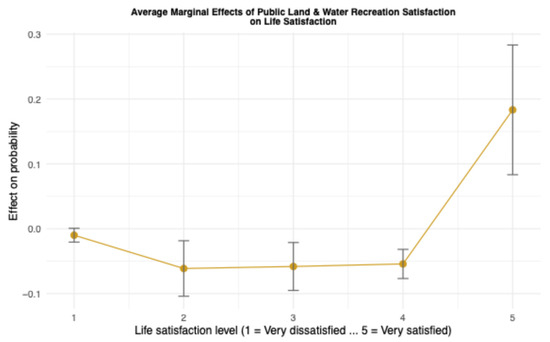
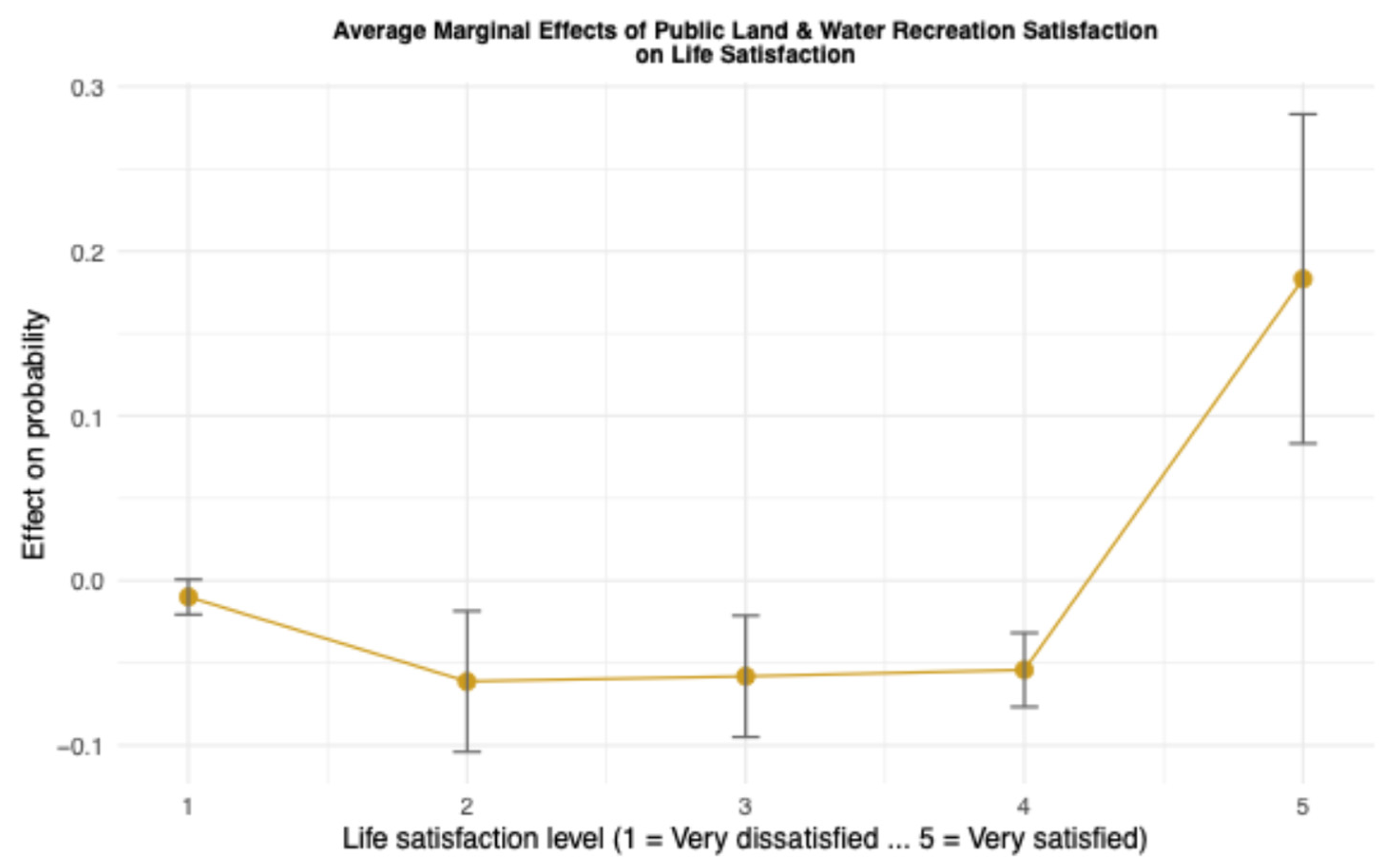
Figure 1 shows the marginal change in the probability of each outcome category associated with satisfaction with public land and water recreation opportunities. The figure shows a clear positive gradient. Being satisfied with local recreation opportunities was associated with a higher probability of reporting that one was very satisfied with living in Nebraska and lower probabilities of reporting neutral, somewhat dissatisfied, or very dissatisfied responses. The largest positive marginal effect was observed for the very satisfied category, indicating that the association between recreation opportunities and place-based well-being was driven primarily by movement toward the most favorable evaluation of living in Nebraska.
Figure 1.
Average Marginal Effects of Satisfaction with Public Land and Water Opportunities Availability on Satisfaction with Living in Nebraska.
3.3. Bayesian Ordinal Regression Results
The Bayesian ordinal logistic regression results were generally consistent with the frequentist model and supported the robustness of the positive association between perceived public land and water recreation opportunities and satisfaction with living in Nebraska across inferential frameworks. Respondents who were satisfied with public land and water recreation opportunities had higher odds of reporting greater satisfaction with living in Nebraska than respondents who were dissatisfied (posterior median OR (POR) = 2.61, 95% Credible Interval (CrI) [1.54, 4.37]) (See Table 2).
Respondents who were satisfied with their financial situation were more likely to report a more favorable place-based well-being (POR = 2.40, 95% CrI [1.66, 3.51]) compared to those who were not satisfied. Female respondents had higher odds of greater place-based well-being than male respondents (POR = 1.52, 95% CrI [1.08, 2.13]). The estimate for divorced respondents likewise suggested higher place-based well-being relative to respondents who were married or partnered (divorced, POR = 1.70, 95% CrI [1.00, 2.90]), although uncertainty around this estimate was greater.
Among county-level contextual variables, a higher Food Environment Index was associated with modestly lower place-based well-being (POR = 0.82, 95% CrI [0.68, 0.98]), whereas a greater density of social associations was associated with modestly higher place-based well-being (POR = 1.04, 95% CrI [1.01, 1.09]). In contrast, perceiving Nebraska as moving in the wrong direction was strongly associated with lower place-based well-being relative to perceiving the state as moving in the right direction (POR = 0.09, 95% CrI [0.06, 0.15]).
The Bayesian model added value by enabling direct probabilistic assessments of the key association rather than relying only on a frequentist point estimate and p-value. The posterior estimate for satisfaction with public land and water recreation opportunities was similar in magnitude to the frequentist estimate, and the 95% CrI remained above an odds ratio of 1.00. Notably, the posterior probability that the odds ratio for satisfaction with public land and water recreation opportunities exceeded 1 was 99.99%, providing intuitive and robust evidence of a positive association. This indicates that the main association was not materially changed under the Bayesian specification while offering a more comprehensive interpretation of effect certainty.
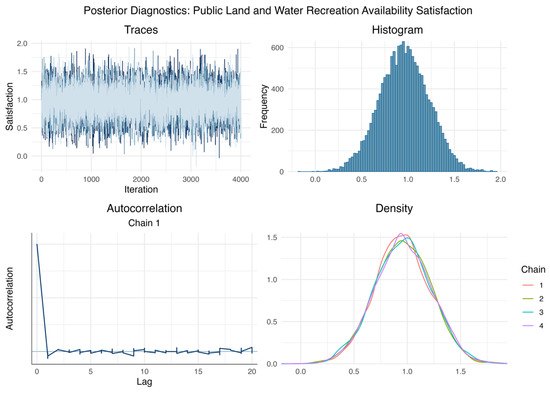
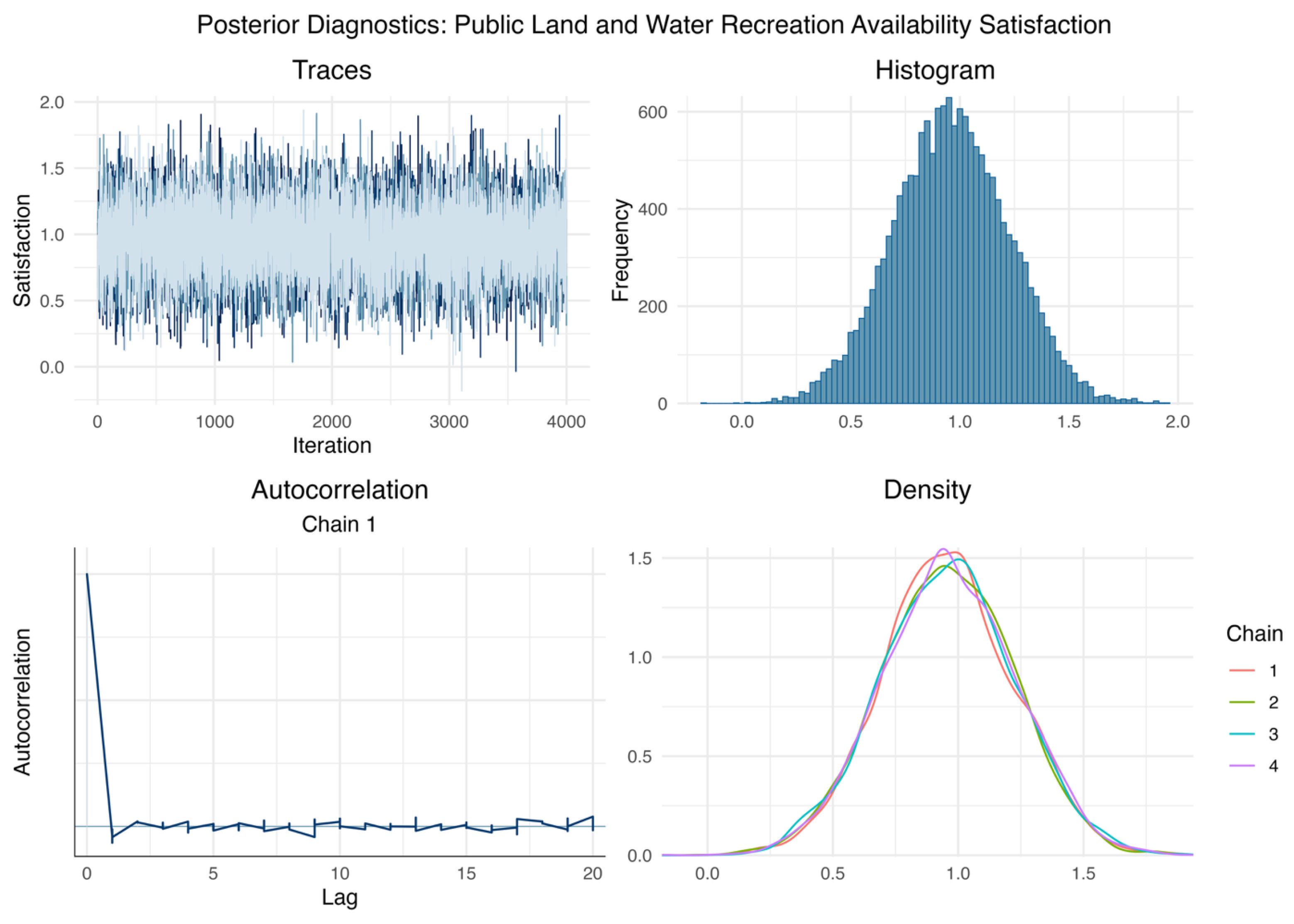
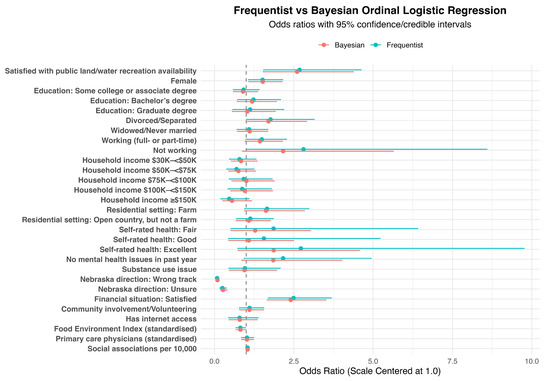
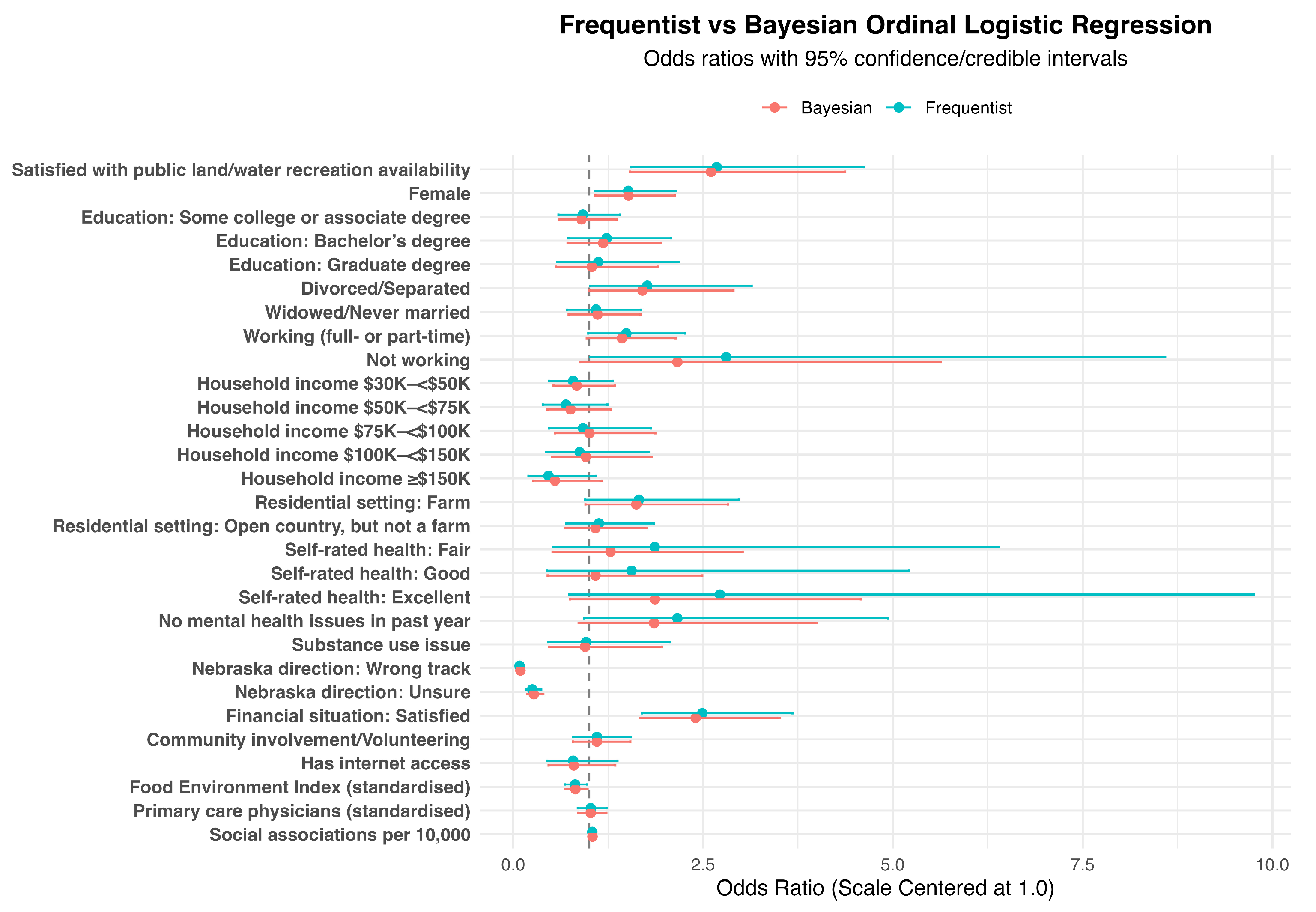
Posterior diagnostic plots for the recreation opportunities predictor are shown in Figure 2. The trace plots demonstrate stable mixing across chains, and the posterior distribution appeared smooth and unimodal, supporting a well-behaved estimate for this parameter. The autocorrelation plots showed declining dependence with increasing lag, suggesting adequate sampling efficiency. Figure 3 further shows that the Bayesian and frequentist estimates were closely aligned in direction and magnitude. Taken together, these results indicate that the positive association between perceived public land and water recreation opportunities and place-based well-being was robust across modeling approaches.
Figure 2.
Bayesian Ordinal Regression Posterior Diagnostics: Satisfaction (Satisfied) with Public Land and Water Opportunities Availability on Satisfaction with Living in Nebraska.
Figure 3.
Average Marginal Effects of Satisfaction (Satisfied) with Public Land and Water Opportunities Availability on Satisfaction with Living in Nebraska.
4. Discussion
4.1. Principal Findings
This study examined whether satisfaction with the availability of public land and water opportunities was associated with place-based well-being, measured as satisfaction with living in Nebraska, among White adults aged 65 years and older. Across both frequentist and Bayesian ordinal logistic models, respondents who were satisfied with these opportunities had about 2.7 times the odds of reporting a higher level of satisfaction with living in Nebraska than respondents who were dissatisfied, after adjustment for demographic, socioeconomic, health, financial, and contextual factors. Our findings extend the literature on green and blue environments [11,12] by linking perceived public land and water opportunities to a place-specific evaluative outcome. We also created a map (Figure S1) illustrating the geographic distribution of public land and water opportunities and satisfaction with living in Nebraska among White adults aged 65 years and older in the study population.
Several mechanisms may help explain why satisfaction with public land and water opportunities was associated with satisfaction with living in Nebraska. First, favorable evaluations of public recreation opportunities may reflect perceived opportunities for physical activity and outdoor routines, which are important for maintaining physical, mental, and social well-being in later life. Prior research on green space and older adults has emphasized physical activity, social participation, and perceived mental and physical health as key pathways through which environmental resources may support well-being [2,10,11,12].
Second, public land and water settings may provide restorative contact with nature. Stress reduction and attention restoration perspectives suggest that natural environments can support psychological recovery, reduce negative affect, and improve well-being, especially when residents perceive those spaces as usable and accessible. Third, public recreation opportunities may foster informal social contact and community participation. For older adults, parks, trails, lakes, rivers, and other public outdoor settings may serve not only as environmental amenities but also as places for routine interaction, shared leisure, and continued community engagement. Fourth, satisfaction with these opportunities may reflect a broader sense of place attachment and perceived community investment. When older adults view public land and water resources as available and relevant to their needs, these resources may contribute to feelings that the state or local community is a good place to age. In this way, the present study adds to prior literature by showing that subjective evaluation of public land and water opportunities is not only an environmental perception, but also a domain-specific place appraisal that may contribute to broader satisfaction with living in Nebraska. Because the study is cross-sectional, these mechanisms should be interpreted as conceptual explanations rather than causal pathways.
An important interpretive issue is that both the main predictor and outcome were measured as satisfaction ratings in the same survey. These measures are conceptually distinct, but they could be related evaluative judgments. Satisfaction with public land and water opportunities captures a domain-specific appraisal of perceived recreation resources available to the respondent. In contrast, satisfaction with living in Nebraska captures a broader residential evaluation of place, which may reflect health, finances, social relationships, political views, community attachment, personal history, and overall orientation toward the state. Therefore, the observed association may indicate that perceived recreation opportunities are one component of how older adults evaluate place, but it may also partly reflect a generalized positive or negative perception of Nebraska or a common response style. Although the adjusted model included financial satisfaction, perceived state direction, and other covariates, these adjustments cannot fully eliminate shared method variance. The findings should therefore be interpreted as an association between domain-specific recreation satisfaction and broader satisfaction with living in Nebraska, not as evidence that public land and water opportunities independently cause higher place-based well-being.
Beyond respondents’ evaluations of public land and water opportunities, other individual covariates were also associated with satisfaction with living in Nebraska. Financial satisfaction was positively associated with satisfaction with living in Nebraska, consistent with prior research identifying perceived financial security as an important contributor to well-being in later life [35,36,37]. Respondents who viewed Nebraska as headed in the wrong direction, or who were unsure about its direction, had substantially lower odds of reporting higher satisfaction with living in Nebraska than those who believed the state was headed in the right direction. This item reflects a broader evaluation of conditions in Nebraska and is conceptually close to the outcome, this association thus should be interpreted cautiously.
Female respondents also had higher odds of reporting greater satisfaction with living in Nebraska than male respondents, which is broadly consistent with some prior research on well-being in later life [38]. The positive association observed for divorced respondents should be interpreted more cautiously. Although the direction of the association was positive, this estimate was less central and less precise than the main findings for public land and water opportunities and financial satisfaction. In addition, the widowed or never-married group did not show a comparably clear association. For that reason, the marital-status findings are best treated as secondary rather than as a central contribution of the study.
At the contextual level, a greater density of social associations was positively associated with satisfaction with living in Nebraska. This pattern is consistent with evidence that civic and organizational opportunities are important to well-being in later life, although the county-level indicator used here reflects a broader associational environment rather than individual social connectedness [39,40].
By contrast, the inverse association with the Food Environment Index was unexpected and ran counter to findings such as those reported by Schnettler et al. [40]. This finding should be interpreted carefully. The Food Environment Index is a county-level measure of healthy food access and food insecurity, not a direct measure of food safety, public land and water recreation, environmental quality, or overall quality of life. Therefore, the odds ratio below 1 should not be interpreted as evidence that more favorable food environments reduce place-based well-being. Rather, this coefficient reflects a conditional association after adjustment for individual financial satisfaction, health status, residential setting, perceptions of Nebraska’s direction, social associations, primary care physician availability, and other covariates. Under this conditioning, the coefficient may capture residual county-level differences rather than the direct effect of food environments on satisfaction with living in Nebraska. Several explanations may account for this pattern. First, the Food Environment Index may be partly correlated with broader settlement patterns, population density, and economic structure that were not fully captured by the adjusted model. In Nebraska, some rural, farm, or open-country communities may have lower scores on food access measures because of distance to grocery stores, yet residents may still report strong satisfaction with living in the state because of long-term residence, familiarity, autonomy, community attachment, or preference for rural living. Second, the index is measured at the county level and may not reflect older adults’ actual daily activity spaces, transportation options, informal food resources, or personally experienced food access. Third, since the index is a broad composite, it may function in this model as a marker of county context rather than as a substantive determinant of place-based well-being. For these reasons, this result is best treated as a secondary contextual finding and a signal for future research, not as evidence that favorable food environments are harmful for older adults’ satisfaction with place.
4.2. Strengths and Limitations of the Study
4.2.1. Strengths
This study has several strengths that align with its place-based theoretical framing. First, the study examines satisfaction with living in Nebraska as a place-specific evaluative outcome rather than treating well-being only as a broad individual psychological construct. This approach is consistent with research on aging and place, which emphasizes how older adults evaluate the environments in which they live.
Second, the study focuses on respondents’ satisfaction with public land and water recreation opportunities as a domain-specific place appraisal. By centering perceived opportunity, the study captures a dimension of place that objective inventories, proximity measures, or environmental exposure indicators may miss. This is particularly relevant for older adults because the availability of environmental resources may matter differently depending on whether those resources are perceived as usable, accessible, and relevant to daily life.
Third, the study links individual-level survey responses with county-level contextual indicators. This design reflects the theoretical premise that satisfaction with living in place is shaped not only by individual characteristics, but also by broader local conditions. Integrating individual and county-level information, therefore, provides a more contextually grounded analysis than an individual-level model alone.
Fourth, the Bayesian ordinal logistic regression added value as an inferential sensitivity analysis. Rather than relying only on frequentist p-values and standard errors, the Bayesian model examined the posterior distribution of the association between perceived public land and water recreation opportunities and satisfaction with living in Nebraska. The close correspondence between the frequentist odds ratio and the Bayesian posterior odds ratio suggests that the main finding was stable across two estimation frameworks. The Bayesian diagnostics also supported adequate posterior sampling. This strengthens confidence in the robustness of the observed association, although it does not address the limitations of the cross-sectional design, self-reported measures, or potential residual confounding.
4.2.2. Limitation
This study also has several limitations that should be interpreted in relation to its perception-based and place-based design. First, the data were cross-sectional, which limits the ability to establish temporal ordering or infer causality. The study therefore shows that satisfaction with public land and water recreation opportunities is associated with satisfaction with living in Nebraska, not that perceived recreation opportunities cause higher place-based well-being.
Second, both the main predictor and outcome were single-item self-reported evaluative measures collected in the same survey. This design increases the possibility of shared method variance, generalized response tendency, or broader positive or negative perceptions of Nebraska. Although satisfaction with public land and water opportunities is conceptually more domain-specific than satisfaction with living in Nebraska overall, the cross-sectional survey design cannot fully distinguish a specific recreation-related association from a broader evaluative orientation toward the state.
Third, the NASIS survey response rate was 22.6%, which raises the possibility of nonresponse bias if respondents differed from nonrespondents in satisfaction with Nebraska, evaluations of public land and water opportunities, health, income, or civic engagement. In addition, the analytic sample was restricted to White adults aged 65 years and older because the number of respondents in other racial and ethnic groups was too small to support stable subgroup estimation. These features limit the external validity of the findings. Therefore, our findings should be interpreted as covariate-adjusted associations within this analytic sample rather than as population-representative estimates for all older adults in Nebraska or for racially and ethnically diverse older adult populations.
Fourth, the dissatisfied recreation group was relatively small, and the predictor was collapsed into a binary measure. This decision improved interpretability and reduced instability from sparse dissatisfaction categories, but it also reduced information from the original four-category response scale. As a result, the analysis could not distinguish very satisfied from somewhat satisfied respondents or examine gradations of dissatisfaction. The estimated association should therefore be interpreted as a broad contrast between favorable and unfavorable perceptions of public land and water opportunities, not as evidence of a graded dose–response relationship. Finally, the county-level contextual indicators may not fully capture the local environments most relevant to older adults’ daily lives. County-level measures can situate individual perceptions within broader community conditions, but they may not reflect neighborhood-level access, perceived safety, transportation barriers, activity spaces, or actual use of public land and water resources. Future studies should combine perceived measures with objective indicators of access, quality, and use at smaller geographic scales.
4.3. Further Directions
Future research should use longitudinal or quasi-experimental designs to clarify temporal ordering, include more diverse populations, preserve greater variation in perceived environmental measures, and combine perceived and objective indicators of place. Studies using smaller-area spatial measures, activity–space approaches, and measures of actual use of public land and water opportunities may provide a more precise understanding of how these environments relate to place-related satisfaction in later life.
4.4. Implications of Findings
Our findings have implications for placemaking, recreation planning, and age-friendly community development within and beyond Nebraska. The findings suggest that public land and water resources should be understood not only as physical amenities, but also as perceived opportunities that may shape how older adults evaluate whether a place supports later life. From a planning perspective, this shifts attention from the presence of resources alone to whether older adults perceive those resources as available, usable, and relevant to their needs.
This approach is important for placemaking because older adults’ satisfaction with public land and water opportunities may reflect more than access to recreation. It may also reflect perceived community investment, opportunities for social participation, continuity with familiar environments, and a sense that the local or state environment supports aging in place. Community surveys, local needs assessments, listening sessions, and participatory planning processes can therefore complement objective inventories of parks, trails, open spaces, lakes, rivers, and other public resources. These tools may help planners and public health practitioners identify gaps between the resources that exist and the opportunities that older adults perceive as meaningful or usable.
The findings also help clarify the empirical and conceptual contributions of the study. The hypothesis was supported: more favorable evaluations of public land and water recreation opportunities were associated with higher satisfaction with living in Nebraska after adjustment for demographic, socioeconomic, health, financial, and contextual characteristics. This does not imply that recreation opportunities alone determine place-based well-being. Instead, it suggests that perceived recreation opportunities may represent one domain through which older adults evaluate the broader quality of the place where they live. Future recreation planning and age-friendly initiatives may therefore benefit from integrating perception-based measures with objective indicators of access, quality, safety, transportation, and actual use.
5. Conclusions
This study contributes to research on aging, environment, and place by showing that older adults’ satisfaction with public land and water recreation opportunities was associated with broader satisfaction with living in Nebraska. Our findings support a place-based perspective in which public land and water resources are not only physical amenities, but also perceived and evaluated opportunities that may shape how older adults assess the places where they live.
Empirically, the study provides evidence from a low-density U.S. state context, where public land and water resources, rural settlement patterns, and county-level conditions may shape later-life evaluations of place. Conceptually, it positions perceived public land and water recreation opportunities as a domain-specific place appraisal linked to broader satisfaction with living in a place. Methodologically, it demonstrates the value of linking individual survey responses with county-level contextual indicators and comparing frequentist and Bayesian ordinal models to assess the robustness of the association.
For recreation planning and age-friendly community development, our findings suggest that objective inventories of public land and water resources should be complemented by assessments of how older adults perceive the availability, usability, and relevance of those opportunities.
Supplementary Materials
The following supporting information can be downloaded at: https://www.mdpi.com/article/10.3390/soc16060191/s1, Figure S1: Map of Public Land and Water Recreation Availability and Satisfaction with Living in Nebraska Among Older Adults.
Author Contributions
Conceptualization, X.L., J.Z. and J.M.P.; Methodology, J.M.; Software, J.Z.; Validation, Xiao Li, J.Z. and J.M.P.; Formal analysis, J.Z.; Investigation, X.L., J.Z. and J.M.P.; Resources, X.L., J.Z. and J.M.P.; Data curation, X.L., J.Z. and J.M.P.; Writing—original draft, X.L., J.Z., J.M.P. and J.M.; Writing—review & editing, X.L., J.Z., J.M.P. and J.M.; Supervision, J.M.; Project administration, J.Z. All authors have read and agreed to the published version of the manuscript.
Funding
This research received no external funding.
Institutional Review Board Statement
Ethical review and approval were waived for this study due to the use of fully de-identified secondary data.
Informed Consent Statement
Informed consent was obtained from all subjects involved in the study by Bureau of Sociological Research (BOSR).
Data Availability Statement
The data that support the findings of this study are available from the Bureau of Sociological Research (BOSR) and the County Health Rankings program, but restrictions apply to the availability of these data, which were used under license for the current study and so are not publicly available. Data are, however, available from the authors upon reasonable request and with permission of the aforementioned third parties.
Conflicts of Interest
The authors declare no conflicts of interest.
Abbreviations
The following abbreviations are used in this manuscript:
| NASIS | Nebraska Annual Social Indicators Survey |
References
- Davern, M.; Winterton, R.; Brasher, K.; Woolcock, G. How can the lived environment support healthy ageing? A spatial indicators framework for the assessment of age-friendly communities. Int. J. Environ. Res. Public Health 2020, 17, 7685. [Google Scholar] [CrossRef] [Scilit] [PubMed]
- Kemperman, A.; Timmermans, H. Green spaces in the direct living environment and social contacts of the aging population. Landsc. Urban Plan. 2014, 129, 44–54. [Google Scholar] [CrossRef] [Scilit]
- Korlat, S.; Kunad, A.; Nikitin, J. Nature and environmental protection in very old age. J. Gerontopsychol. Geriatr. Psychiatry 2026, 39, a000356. [Google Scholar] [CrossRef] [Scilit]
- Diener, E.; Chan, M.Y. Happy people live longer: Subjective well-being contributes to health and longevity. Appl. Psychol. Health Well-Being 2011, 3, 1–43. [Google Scholar] [CrossRef] [Scilit]
- Nemitz, J. Increasing longevity and life satisfaction: Is there a catch to living longer? J. Popul. Econ. 2022, 35, 557–589. [Google Scholar] [CrossRef] [Scilit]
- Kim, E.S.; Delaney, S.W.; Tay, L.; Chen, Y.; Diener, E.; Vanderweele, T.J. Life satisfaction and subsequent physical, behavioral, and psychosocial health in older adults. Milbank Q. 2021, 99, 209–239. [Google Scholar] [CrossRef] [Scilit] [PubMed]
- Vespa, J.E.; Armstrong, D.M.; Medina, L. Demographic Turning Points for the United States: Population Projections for 2020 to 2060; United States Cansus Bureau: Suitland, MD, USA, 2018; pp. 1–15.
- Fernández-Ballesteros, R.; Zamarrón, M.D.; Ruiz, M.Á. The contribution of socio-demographic and psychosocial factors to life satisfaction. Ageing Soc. 2001, 21, 25–43. [Google Scholar] [CrossRef] [Scilit]
- Bramhankar, M.; Kundu, S.; Pandey, M.; Mishra, N.L.; Adarsh, A. An assessment of self-rated life satisfaction and its correlates with physical, mental and social health status among older adults in India. Sci. Rep. 2023, 13, 9117. [Google Scholar] [CrossRef] [Scilit] [PubMed]
- Lv, R.; Yang, L.; Li, J.; Wei, X.; Ren, Y.; Wang, W.; Hou, J.; Fang, X. Relationship between social participation and life satisfaction in community-dwelling older adults: Multiple mediating roles of depression and cognitive function. Arch. Gerontol. Geriatr. 2024, 117, 105233. [Google Scholar] [CrossRef] [Scilit] [PubMed]
- Beyer, K.M.; Kaltenbach, A.; Szabo, A.; Bogar, S.; Nieto, F.J.; Malecki, K.M. Exposure to neighborhood green space and mental health: Evidence from the survey of the health of Wisconsin. Int. J. Environ. Res. Public Health 2014, 11, 3453–3472. [Google Scholar] [CrossRef] [Scilit] [PubMed]
- White, M.P.; Alcock, I.; Grellier, J.; Wheeler, B.W.; Hartig, T.; Warber, S.L.; Bone, A.; Depledge, M.H.; Fleming, L.E. Spending at least 120 minutes a week in nature is associated with good health and wellbeing. Sci. Rep. 2019, 9, 7730. [Google Scholar] [CrossRef] [Scilit] [PubMed]
- Ma, B.; Zhou, T.; Lei, S.; Wen, Y.; Htun, T.T. Effects of urban green spaces on residents’ well-being. Environ. Dev. Sustain. 2019, 21, 2793–2809. [Google Scholar] [CrossRef] [Scilit]
- Ekkel, E.D.; de Vries, S. Nearby green space and human health: Evaluating accessibility metrics. Landsc. Urban Plan. 2017, 157, 214–220. [Google Scholar] [CrossRef] [Scilit]
- Norha, J.; Aishwarya, A.; Gonzales-Inca, C.; Hasanzadeh, K.; Pasanen, S.; Pentti, J.; Vahtera, J.; Fagerholm, N.; Stenholm, S. Exposure to greenness and physical activity behavior: A longitudinal GPS and accelerometry study before and after retirement. Health Place 2026, 99, 103653. [Google Scholar] [CrossRef] [Scilit] [PubMed]
- Xu, T.; Nordin, N.A.; Aini, A.M. Urban green space and subjective well-being of older people: A systematic literature review. Int. J. Environ. Res. Public Health 2022, 19, 14227. [Google Scholar] [CrossRef] [Scilit] [PubMed]
- Fongar, C.; Aamodt, G.; Randrup, T.B.; Solfjeld, I. Does perceived green space quality matter? Linking Norwegian adult perspectives on perceived quality to motivation and frequency of visits. Int. J. Environ. Res. Public Health 2019, 16, 2327. [Google Scholar] [CrossRef] [Scilit] [PubMed]
- Giannico, V.; Spano, G.; Elia, M.; D’Este, M.; Sanesi, G.; Lafortezza, R. Green spaces, quality of life, and citizen perception in European cities. Environ. Res. 2021, 196, 110922. [Google Scholar] [CrossRef] [Scilit] [PubMed]
- Deichert, J.; Janousek, C.L.; Blair, R. The Character of Nebraska. In Nebraska Government and Politics; Blair, R., Janousek, C.L., Deichert, J., Eds.; Politics and Governments of the American States; University of Nebraska Press: Lincoln, NE, USA, 2025; pp. 19–28. [Google Scholar]
- Hsieh, C.R.; Liu, S.; Qin, X. The hidden costs of mental depression: Implications on social trust and life satisfaction. Manch. Sch. 2019, 87, 259–296. [Google Scholar] [CrossRef] [Scilit]
- Zullig, K.J.; Valois, R.F.; Huebner, E.S.; Oeltmann, J.E.; Drane, J.W. Relationship between perceived life satisfaction and adolescents’ substance abuse. J. Adolesc. Health 2001, 29, 279–288. [Google Scholar] [CrossRef] [Scilit] [PubMed]
- Mostafa, N.A.; Harfoush, M.S.; Atta, M.H.R.; Fouad, R.A. The impact of a student-led intergenerational support program on life satisfaction, loneliness, and psychological well-being of institutionalized older adults. Geriatr. Nurs. 2025, 62, 157–167. [Google Scholar] [CrossRef] [Scilit] [PubMed]
- Itani, A.; Hasan, I.; Younes, L.; Alzaatreh, A. Statistical analysis of the effect of socio-political factors on individual life satisfaction. Sci. Rep. 2024, 14, 19677. [Google Scholar] [CrossRef] [Scilit] [PubMed]
- Cho, H.; Choi, M.; Lee, H. Mobile internet use and life satisfaction among older adults: The moderating effect of living alone. J. Appl. Gerontol. 2024, 43, 841–849. [Google Scholar] [CrossRef] [Scilit] [PubMed]
- Seo, C.H.; Lee, K.; Miller, V.J.; Lee, H.; Rodriguez, C. Navigating perceived employment barriers: Sociodemographic influences and life satisfaction among older adults. Int. J. Aging Hum. Dev. 2024, 101, 00914150241297371. [Google Scholar] [CrossRef] [Scilit] [PubMed]
- Gelman, A. Scaling regression inputs by dividing by two standard deviations. Stat. Med. 2008, 27, 2865–2873. [Google Scholar] [CrossRef] [Scilit] [PubMed]
- Brant, R. Assessing proportionality in the proportional odds model for ordinal logistic regression. Biometrics 1990, 46, 1171–1178. [Google Scholar] [CrossRef] [Scilit]
- Bürkner, P.-C. brms: An R package for Bayesian multilevel models using Stan. J. Stat. Softw. 2017, 80, 1–28. [Google Scholar] [CrossRef] [Scilit]
- Bürkner, P.-C. Advanced Bayesian Multilevel Modeling with the R Package brms 2018. R J. 2018, 10, 395–411. [Google Scholar] [CrossRef] [Scilit]
- Bürkner, P.-C. Bayesian item response modeling in R with brms and Stan. J. Stat. Softw. 2021, 100, 1–54. [Google Scholar] [CrossRef] [Scilit]
- Gelman, A.; Jakulin, A.; Pittau, M.G.; Su, Y.-S. A weakly informative default prior distribution for logistic and other regression models. Ann. Appl. Stat. 2008, 2, 1360–1383. [Google Scholar] [CrossRef] [Scilit]
- Betancourt, M. A conceptual introduction to Hamiltonian Monte Carlo. arXiv 2017, arXiv:1701.02434. [Google Scholar] [CrossRef] [Scilit]
- Hoffman, M.D.; Gelman, A. The No-U-Turn sampler: Adaptively setting path lengths in Hamiltonian Monte Carlo. J. Mach. Learn. Res. 2014, 15, 1593–1623. [Google Scholar]
- R-Core-Team. R: A Language and Environment for Statistical Computing [Computer Software], Version 4.5.2; R Foundation for Statistical Computing: Vienna, Austria, 2025.
- Khodabakhsh, S. Factors affecting life satisfaction of older adults in Asia: A systematic review. J. Happiness Stud. 2022, 23, 1289–1304. [Google Scholar] [CrossRef] [Scilit]
- Dzando, G.; Asante, D.; Yabila, S.; Suuron, V.M.; Amenu, J.; Salifu, S.; Awiagah, S.K. Late-Life Divorce and well-being of older people: A systematic review. Arch. Gerontol. Geriatr. Plus 2024, 2, 100107. [Google Scholar] [CrossRef] [Scilit]
- Ryu, S.I.; Cho, B.; Chang, S.J.; Ko, H.; Yi, Y.M.; Noh, E.-Y.; Cho, H.R.; Park, Y.-H. Factors related to self-confidence to live alone in community-dwelling older adults: A cross-sectional study. BMC Geriatr. 2021, 21, 291. [Google Scholar] [CrossRef] [Scilit] [PubMed]
- Joshanloo, M.; Jovanović, V. The relationship between gender and life satisfaction: Analysis across demographic groups and global regions. Arch. Women’s Ment. Health 2020, 23, 331–338. [Google Scholar] [CrossRef] [Scilit]
- Cornwell, B.; Laumann, E.O.; Schumm, L.P. The social connectedness of older adults: A national profile. Am. Sociol. Rev. 2008, 73, 185–203. [Google Scholar] [CrossRef] [Scilit] [PubMed]
- Friedman, E.; Franks, M.; Teas, E.; Thomas, P.A. Social connectedness, functional capacity, and longevity: A focus on positive relations with others. Soc. Sci. Med. 2024, 340, 116419. [Google Scholar] [CrossRef] [Scilit] [PubMed]

Disclaimer/Publisher’s Note: The statements, opinions and data contained in all publications are solely those of the individual author(s) and contributor(s) and not of MDPI and/or the editor(s). MDPI and/or the editor(s) disclaim responsibility for any injury to people or property resulting from any ideas, methods, instructions or products referred to in the content. |
© 2026 by the authors. Licensee MDPI, Basel, Switzerland. This article is an open access article distributed under the terms and conditions of the Creative Commons Attribution (CC BY) license.