
Article

Determinants of Youth Green Consumption in Rural South Africa: Moral Identity, Environmental Responsibility, and Locus of Control

Department of Business Management & Economics, Walter Sisulu University, Mthatha 5099, South Africa
*
Author to whom correspondence should be addressed.
Societies 2026, 16(3), 89; https://doi.org/10.3390/soc16030089
Submission received: 6 January 2026 / Revised: 23 February 2026 / Accepted: 9 March 2026 / Published: 12 March 2026

Abstract

This study examines whether moral identity, perceived environmental responsibility, and locus of control predict green consumption behaviour among young consumers. Adopting a quantitative approach, the study follows an explanatory research design grounded in the positivist paradigm. Primary data were collected through a self-administered questionnaire delivered to respondents aged 18–35 years. Descriptive statistics were analysed using the Statistical Package for the Social Sciences (SPSS) version 30, while inferential analysis was conducted using Structural Equation Modelling (SEM) via SmartPLS 4. The findings suggest that moral identity and perceived responsibility for environmental damage are significant predictors of green consumption among youth. In contrast, locus of control shows a weak, statistically insignificant association with green consumption behaviour. After controlling for demographic variables, including gender, age, race, education, occupation, and income, the results indicate that only education level and race make significant contributions to the model. Notably, the effect of moral identity becomes insignificant once demographic factors are considered, while locus of control remains insignificant. However, perceived environmental responsibility not only retains its significance but also demonstrates a strengthened effect on green consumption behaviour. These findings highlight the persistence of the attitude–behaviour gap in sustainable consumption among young consumers, particularly in rural contexts. The study contributes to the literature by extending the Theory of Planned Behaviour through the incorporation of moral and psychological constructs within a rural African setting. Practically, the study offers insights for policymakers, educators, and marketers, emphasising the importance of environmental education, moral reinforcement, and targeted behavioural interventions to enhance youth participation in sustainable consumption practices.

1. Introduction

Global efforts to achieve the United Nations Sustainable Development Goals (SDGs) by 2030 place substantial emphasis on promoting responsible production and consumption, particularly under SDG 12 [1]. This focus has intensified as climate change continues to manifest through extreme weather events, environmental degradation, and resource depletion, which threaten the livelihoods and ecosystems of people worldwide [2,3,4]. As natural resources become increasingly scarce, societies face mounting pressure to transition towards more sustainable consumption patterns, that is, utilising products that have less or no harm to the planet [5]. Within this context, green consumption has emerged as a critical mechanism for mitigating unsustainable consumption and reducing the environmental footprint of human activities [6].
Green consumption refers to consumption behaviours that minimise negative environmental impacts and promote ecological sustainability for present and future generations [5]. Such behaviours include purchasing organic products, using renewable energy, reducing waste, and supporting firms that adopt environmentally responsible practices. Unlike conventional consumption, which primarily prioritises individual utility, green consumption generates broader societal and environmental benefits [7,8]. Consequently, consumers are increasingly recognised as co-responsible actors in addressing environmental challenges through their purchasing decisions.
In recent years, scholarly attention has increasingly shifted towards understanding the psychological determinants that underpin green consumption behaviour [9,10,11,12]. Among these determinants, moral identity has gained prominence as a critical factor influencing ethical and pro-environmental behaviour. Moral identity refers to the degree to which moral values are central to an individual’s self-concept, comprising two dimensions: internalisation, which reflects an intrinsic moral commitment, and symbolism, which reflects the outward expression of moral traits [13]. Individuals with a strong moral identity are more likely to engage in green consumption to maintain self-consistency and express ethical values [14,15].
Closely related to moral identity is perceived environmental responsibility, which reflects an individual’s belief that they are personally accountable for environmental degradation and its consequences [16]. Empirical evidence suggests that individuals who perceive a strong sense of responsibility for environmental damage are more inclined to adopt environmentally friendly behaviours, including green purchasing [17]. This sense of responsibility fosters pro-environmental attitudes and reinforces behavioural intentions to protect the environment.
Another important psychological determinant of green consumption is locus of control (LOC), which refers to individuals’ beliefs regarding their ability to influence outcomes through their actions [18]. An internal locus of control is associated with the belief that personal actions can make a meaningful difference, whereas an external locus of control attributes outcomes to external forces beyond individual control. Research consistently shows that individuals with a strong internal environmental locus of control are more likely to recycle, conserve energy, and purchase environmentally friendly products [19,20]. This highlights the role of personal agency in translating environmental concern into tangible behaviour.
Despite the growing body of literature on green consumption, significant gaps remain. Most empirical studies have been conducted in developed or urban contexts, with limited attention paid to rural settings in emerging economies [21]. Rural areas often face unique socio-economic constraints, limited access to green products, and distinct cultural dynamics that may shape consumption behaviour differently from urban contexts. In South Africa, particularly in semi-urban and rural regions such as Mthatha in the Eastern Cape, empirical evidence on the psychological drivers of youth green consumption remains scarce.
This gap is particularly noteworthy given the importance of young consumers, often referred to as Generation Z, as future leaders, policymakers, and drivers of societal change. While young people are frequently portrayed as environmentally conscious due to increased exposure to sustainability discourses and digital media [22], an enduring attitude–behaviour gap persists, whereby positive environmental attitudes do not consistently translate into green consumption behaviour [23]. Factors such as affordability, accessibility, perceived effectiveness, and personal agency may hinder the realisation of pro-environmental intentions, especially in resource-constrained rural contexts.
Motivated by these gaps, this study examines the determinants of youth green consumption in rural areas, focusing on three psychological constructs: moral identity, perceived environmental responsibility, and locus of control. The study, therefore, seeks to answer the following questions:
(a)
How does moral identity affect rural youth’s green consumption?
(b)
Does perceived responsibility influence rural youth’s green consumption?
(c)
How does locus of control affect rural youth’s green consumption?
By examining these factors among young consumers in a rural setting of an emerging economy, this research aims to provide a nuanced understanding of how internal moral and cognitive processes shape green consumption tendencies in under-researched rural areas. This study makes several contributions to the literature. First, it extends green consumption research to a rural context within an emerging economy, addressing a notable geographical and contextual gap. Second, it integrates moral identity, perceived environmental responsibility, and locus of control within a single empirical framework, offering a more holistic understanding of youth green consumption behaviour. Third, the findings provide practical insights for policymakers, educators, and marketers seeking to design targeted interventions that foster sustainable consumption among young consumers in rural areas. By advancing knowledge on the psychological foundations of green consumption, this study supports broader efforts to promote responsible consumption and environmental sustainability in line with global development goals.

2. Literature Review

2.1. Theoretical Framework

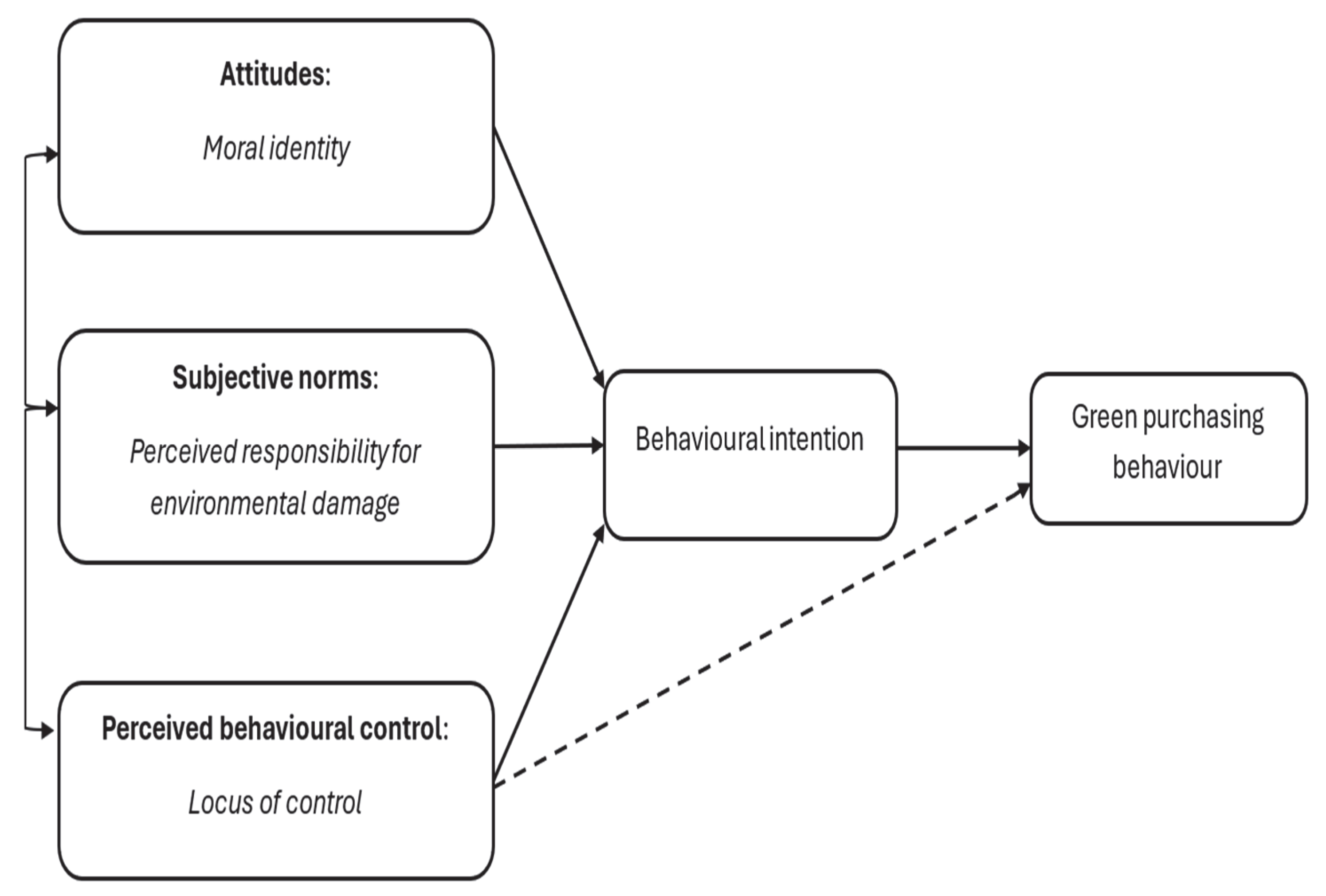
This study extends Ajzen’s [24] Theory of Planned Behaviour (TPB), which posits that individual behaviour is primarily driven by behavioural intention, which in turn is shaped by attitudes toward the behaviour, subjective norms, and perceived behavioural control. The TPB has been widely applied in explaining environmentally responsible behaviours, particularly in the context of green consumption [25,26]. In the present study, moral identity aligns with the attitudinal component of the TPB, as it reflects individuals’ ethical values and intrinsic motivations that influence favourable evaluations of green consumption practices [23] (see Figure 1). Perceived responsibility for environmental damage corresponds with subjective norms, as it captures the internalisation of social expectations and moral obligations regarding environmental stewardship [27]. Furthermore, locus of control overlaps conceptually with perceived behavioural control, given that individuals with a strong internal locus of control believe their actions can meaningfully influence environmental outcomes [18]. By incorporating these psychological dimensions into the TPB framework (Figure 1), this study provides a more comprehensive understanding of green consumption tendencies among young consumers in South Africa, particularly in rural contexts where structural and contextual constraints often hinder sustainable consumption choices [21].

2.2. Moral Identity

Moral identity is a central construct in understanding ethically driven behaviour. It reflects the extent to which moral traits, such as honesty, fairness, kindness, and justice, are integrated into an individual’s self-definition [14,28]. When morality forms a core part of one’s identity, behaviour tends to be guided by self-consistency motives, as individuals strive to act in ways that affirm who they believe they are. The construct is commonly conceptualised as comprising two dimensions: internalisation, which represents the private importance of moral traits to the self, and symbolisation, which reflects the outward expression of these traits through observable actions [13]. By linking self-concept with ethical standards, moral identity provides a psychological foundation for explaining value-driven decision-making across social and environmental domains.

2.3. Perceived Responsibility for Environmental Damage

Perceived responsibility for environmental damage refers to the extent to which individuals acknowledge their personal contribution to environmental degradation and recognise an obligation to mitigate its effects [16]. Rooted in theories of moral norm activation and personal accountability, the construct reflects an internal sense of duty arising from an awareness of the consequences of one’s actions. It captures the belief that everyday decisions, such as energy consumption, waste disposal, and product choice, carry environmental implications [17].
When individuals perceive a direct link between their behaviour and ecological outcomes, they are more likely to experience self-evaluative emotions such as guilt or moral concern in response to unsustainable practices [6]. Thus, perceived responsibility functions as a cognitive–moral mechanism that transforms environmental awareness into a felt personal obligation. As a psychological construct, it provides an important explanatory basis for understanding why some individuals move beyond passive concern to active behavioural engagement.

2.4. Locus of Control

Locus of control (LOC) refers to an individual’s belief about the extent to which they can influence life outcomes. Within environmental psychology, an internal locus of control reflects the belief that one’s personal actions can directly influence environmental outcomes, whereas an external locus of control involves attributing responsibility for such outcomes to external forces, including governments, corporations, or fate, and Cleveland et al. [19] conceptualised it as an internal environmental locus of control. Patel et al. [18] described an internal locus of control as the conviction that one’s own actions significantly shape life outcomes, including environmental consequences. Empirical evidence indicates that individuals with a strong internal locus of control are more inclined to engage in sustainable practices, such as recycling, conserving energy, and purchasing eco-friendly products [20]. In contrast, individuals with an external locus of control are less likely to adopt pro-environmental behaviours, as they tend to perceive their actions as having minimal impact on environmental change [20]. Rather than attributing outcomes to fate or external agents, those with a strong internal locus of control are more likely to assume personal responsibility and actively engage in behaviours to address environmental challenges [29].

2.5. Green Consumption

Green consumption refers to purchasing and using environmentally friendly, sustainable, and ethically produced products [5]. It reflects consumers’ efforts to minimise their ecological footprint through conscious consumption behaviours [13]. Green consumption encompasses activities such as purchasing biodegradable products, recycling, and supporting brands that adopt sustainable practices [30].

2.6. Hypothesis Development

2.6.1. The Relationship Between Moral Identity and Green Consumption

Empirical research has consistently examined moral identity as an antecedent of green consumption behaviour. Studies indicate that individuals with a strong moral identity are more inclined to purchase environmentally friendly products to align their consumption with ethical values [14,31]. For example, Rana and Solaiman [14] found that consumers high in moral identity demonstrate stronger green purchasing intentions, while Shehawy and Ali Khan [31] showed that the symbolisation dimension encourages sustainable consumption as a form of moral self-presentation.
However, the relationship is not always direct. Van der Werff et al. [32] reported that moral identity may shape pro-environmental attitudes without necessarily translating into consistent purchasing behaviour, partly due to contextual constraints such as cost and product availability. Similarly, Kang [33] observed that symbolic motivations may sometimes produce performative rather than deeply sustained green behaviours.
Despite these nuances, the overall body of evidence supports a positive association. Salciuviene et al. [23] identified internalisation as a particularly strong predictor of sustainable consumption, while Sesay and Guo [34] confirmed its relevance even in resource-constrained settings. Accordingly, this study hypothesises the following:
H1. 
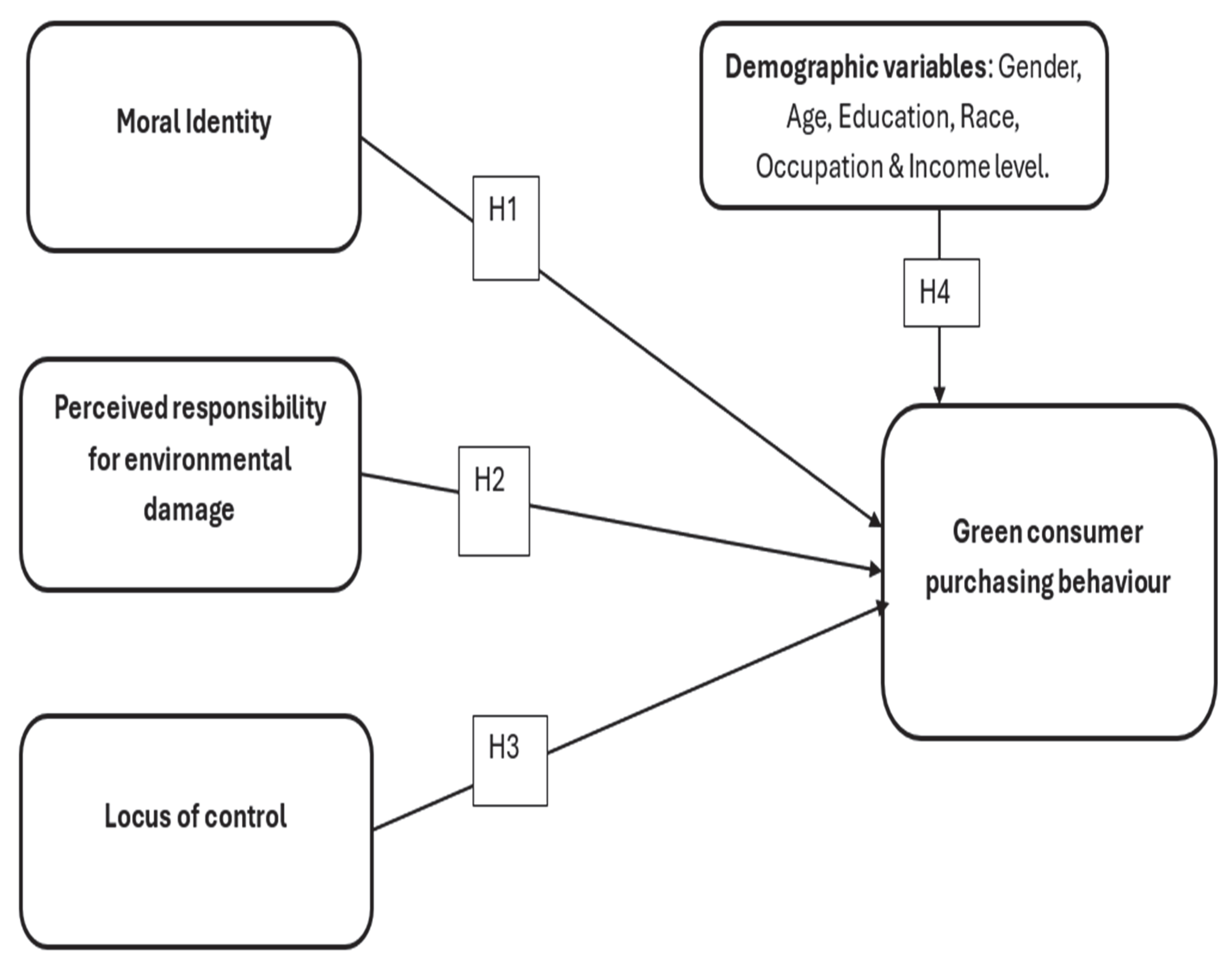
Moral identity significantly influences green consumption tendencies among young consumers in rural settings.

2.6.2. Perceived Responsibility for Environmental Damage and Green Consumption

Empirical research has increasingly examined perceived responsibility as an antecedent of green consumption behaviour. Evidence suggests that individuals who feel personally accountable for environmental harm are more inclined to translate environmental concern into purchasing decisions that favour sustainable products. For instance, Zheng et al. [12] found that environmental responsibility beliefs significantly predicted green purchasing behaviour, particularly when supported by positive environmental attitudes. Similarly, Ling et al. [22] demonstrated that, among Generation Z consumers, higher perceived responsibility was associated with stronger green buying tendencies.
Nevertheless, the relationship is not universally consistent. Cho et al. [35] reported that perceived responsibility does not always result in green purchasing when structural barriers, such as higher prices and limited product availability, intervene. Bocken and Short [36] further argued that some consumers externalise environmental accountability to governments and corporations, thereby weakening the behavioural impact of personal responsibility.
Despite these contextual limitations, the prevailing evidence supports a positive association. Studies by Saleem et al. [4] and Jahari et al. [3] underscore the role of personal accountability as a critical driver of sustainable consumption patterns. Accordingly, this study proposes the following:
H2. 
There is a significant positive relationship between perceived responsibility for environmental damage and green consumption tendencies among youth in rural settings.

2.6.3. The Relationship Between Locus of Control and Green Consumption

The relationship between locus of control and green consumption is primarily rooted in individuals’ sense of agency and perceived responsibility for environmental outcomes. Prior empirical studies consistently demonstrate that an internal locus of control is positively associated with sustainable consumption behaviours, including recycling, energy conservation, and the purchase of environmentally friendly products [18]. Individuals who believe their actions can have a meaningful impact on environmental outcomes are more likely to translate their environmental concerns into concrete, sustainable consumption choices.
Nevertheless, the relationship between locus of control and green consumption is not uniformly strong across contexts. Some studies suggest that while internal locus of control predicts specific pro-environmental actions, it does not always explain broader or more costly green purchasing patterns [20,37]. Structural barriers, such as the high cost of green products, limited availability of sustainable alternatives, and weak institutional support, can weaken the extent to which internal control beliefs translate into actual behaviour [38]. In such contexts, consumers may perceive environmental responsibility as resting with governments or corporations, thereby reducing the behavioural impact of personal agency.
Despite these constraints, evidence suggests that an internal locus of control remains a particularly salient predictor of green consumption among younger consumers. Youth tend to exhibit greater environmental awareness and stronger beliefs in their capacity to effect change, which enhances the behavioural relevance of internal control beliefs [15]. Conversely, an external locus of control may erode personal accountability, leading to disengagement from sustainable consumption practices.
Overall, while contextual barriers may moderate the strength of this relationship, the balance of empirical evidence supports the role of locus of control, particularly internal locus of control, as a meaningful psychological driver of green consumption behaviour. This reinforces its relevance for studies seeking to explain environmentally responsible consumption among young consumers. Based on the discussion, this study hypothesises the following:
H3. 
There is a positive relationship between locus of control and green consumption tendencies among youth in rural settings.
H4. 
There is a significant positive relationship between moral identity, perceived responsibility for environmental damage, locus of control, and green consumption among youth after controlling for demographic variables (gender, age, education level, race, occupation, and income level).
The hypotheses formulated in this study are graphically depicted in Figure 2.

3. Methods

The study is quantitative in nature and follows a positivist paradigm. Positivist researchers believe that reality exists independently of the researcher. The reason it is adopted in this study is that this research seeks to produce objective, measurable, and generalisable knowledge about the relationships among moral identity, perceived responsibility, locus of control, and green purchasing behaviour. To accomplish this, hypotheses were formulated in advance and tested once primary quantitative data became available. An explanatory research study was conducted to determine the causality between the independent and dependent variables. Primary data were collected only once; therefore, the study is cross-sectional. To gather primary data, a self-administered questionnaire was adopted. Rural areas within a 50 km radius of one of the main cities, that is, Mthatha, were chosen. Given limited resources, this enabled field workers to conduct most of the fieldwork during the day and report back to the city where they resided by the close of business. Primary data were collected over a four-month period from May to August 2025. Fieldwork was conducted continuously during this period, primarily on weekdays, to ensure systematic coverage of the targeted areas. Stratified random sampling was used to select respondents in the Eastern Cape province of South Africa. Rural communities within a 50 km radius of Mthatha were targeted. This geographic delimitation enabled fieldworkers to conduct daily data collection efficiently while reporting back to Mthatha at the end of each working day. The data collection period yielded 512 completed and usable questionnaires. Fieldworkers targeted youth aged 18 to 35 years and stratified respondents by gender to ensure proportional representation within the sample. The study employed stratified random sampling based on gender. Although stratification is often conducted across multiple demographic characteristics, gender was selected as the primary stratum because of its relevance to the study setting. In many rural South African communities, social roles, access to economic resources, decision-making autonomy, and consumption practices remain strongly shaped by gender norms and expectations. These socio-cultural dynamics may influence environmental attitudes and purchasing behaviour. Stratifying by gender, therefore, ensured proportional representation of both male and female participants and reduced the risk of gender bias in the sample, thereby enhancing the representativeness and analytical validity of the findings.

3.1. Measures

The study adopted measures validated by prior research. However, the wording of some scales had to be modified, and in some instances, additional items were added to ensure the scales accurately captured the true meaning and understanding of the constructs in South Africa’s rural setting. Green consumption items were adopted from Mbokane and Modley [6], the locus of control scale was adopted from Cleveland et al. [19], the perceived environmental damage scale was adopted from Jakovcevic and Steg [39], and the moral identity scale was adopted from Aquino et al. [40] and Wu et al. [41]. The scales were measured on a five-point Likert scale, ranging from 1 (strongly disagree) to 5 (strongly agree). Reliability and validity (convergent and discriminant) were assessed using Cronbach’s alpha, composite reliability, average variance extracted (AVE), Fornell-Larcker’s criteria, and the HTMT ratio.

3.2. Data Analysis

The Statistical Package for the Social Sciences (SPSS) version 30 was used to analyse descriptive statistics, while Smart-PLS 4 was used to perform structural equation modelling for inferential statistics.

4. Results

4.1. Descriptive Statistics

The demographic characteristics of the respondents were analysed to provide an overview of the sample composition. In terms of gender, the sample was relatively balanced, with males accounting for 51% and females 49% of respondents. Regarding age distribution, most respondents fell within the 18–25-year age range (43%), followed by those aged 26–29 years (35%), while the 30–35 age group was the least represented (22%).
The racial composition indicates that most respondents were Black (92%), with Whites and Coloureds each representing 3%, and Indians constituting the smallest group at 2%. Regarding educational attainment, a substantial proportion of respondents had completed post-secondary education. Degree holders constituted the largest group (36%), followed by respondents holding a matriculation certificate or currently pursuing tertiary education (33%). Postgraduate and diploma holders accounted for 23% and 8%, respectively, indicating that the sample was reasonably well-educated.
In terms of occupational status, 39% of respondents were tertiary students, 28% were self-employed, 16% were formally employed, and 17% were unemployed. Notably, the proportion of self-employed youth exceeded that of those in formal employment and those unemployed. This finding is particularly significant, as, to the best of the authors’ knowledge, no prior study has documented such a pattern among rural youth in South Africa.
Regarding monthly income, the results indicate that most respondents (42%) earned below R5000 per month (approximately USD 300), followed by 34% earning between R5000 and R10,000. Only 24% reported a monthly income exceeding R10,000 (approximately USD 600). These demographic characteristics are summarised in Table 1.

4.2. Testing for the Reliability and Validity of the Measurement Instruments

To measure the scales’ internal consistency, Cronbach’s alpha was used. Values over 0.70 are considered appropriate for social science research [42]. The Cronbach’s alpha scores for green consumption, locus of control, moral identity, and perceived responsibility for environmental damage were 0.93, 0.86, 0.88, and 0.88, respectively. Cronbach’s alpha scores in the study’s results range from 0.86 to 0.93, all of which are significantly higher than the suggested cutoff. The composite reliability scores were 0.94 for green consumption, 0.94 for locus of control, 0.896 for moral identity, and 0.89 for perceived responsibility for environmental damage. This shows that the instruments are reliable and that there is a substantial correlation between the items measuring each construct. Additionally, the constructs demonstrate good internal consistency, as evidenced by the composite reliability values (ranging from 0.89 to 0.94), which exceed the 0.70 criterion [43]. Convergent validity assesses the degree to which items measuring the same construct are highly correlated, reflecting their convergence on a common underlying latent variable [42]. In this study, convergent validity was assessed through average extracted variance. The AVE values for each scale were determined and analysed. The green consumption scale had an AVE of 0.78, while the locus of control scale had an AVE of 0.65; the moral identity scale had an AVE of 0.674, and the perceived responsibility for environmental damage had an AVE of 0.67. The AVE values range from 0.65 to 0.78 and exceed the minimum cut-off of 0.50, which Fornell and Larcker [44] contend indicates sufficient convergent validity. These findings demonstrate that the tools employed in this investigation are valid, dependable, and appropriate for investigating the proposed relationships. The results are summarised in Table 2.
Discriminant validity refers to the extent to which a construct is truly distinct from other constructs, both conceptually and empirically [45]. Two methods are usually employed to determine discriminant validity: the Heterotrait–Monotrait ratio (HTMT) and the Fornell–Larcker criterion. An HTMT ratio below 0.9 indicates good discriminant validity, indicating that the constructs are distinct. However, HTMT values above 0.9 indicate poor discriminant validity, suggesting that the constructs are not sufficiently distinct. In this study, no values exceeded the HTMT threshold: LC-GC = 0.628, MI-GC = 0.597, GC-PRED = 0.803, LC-PRED = 0.727, and MI-PRED = 0.689. This indicates that discriminant validity is achieved. The HTMT results are shown in Table 3.
When relying on the Fornell–Larcker criterion, discriminant validity did not seem to be an issue for all the study’s variables. For each construct, the criterion stipulates that its correlations with other constructs must be less than the square root of the AVE [44]. Based on the results in Table 4, the bolded numbers indicate that the correlations with other constructs are lower than the square root of the AVE. Therefore, the distinctiveness of the construct is thus confirmed through the Fornell–Larcker criterion [42].
Common method bias was further assessed to evaluate data quality. Factor analysis was conducted, and Harman’s single-factor solution accounted for approximately 39% of the total variance, below the 50% threshold. This implies that common method bias was not a concern for the study’s data [46].

4.3. Overall Model Fit Assessment

Assessing the overall model fit is essential for determining the extent to which the measurement and structural models adequately represent the observed data. In this study, model fit was evaluated using the standardised root mean square residual (SRMR), the normed fit index (NFI), and the global goodness-of-fit (GoF) index [42]. The GoF value was 0.42, exceeding the recommended threshold of 0.36 for a large effect size, thereby indicating a strong overall model fit. The SRMR value was 0.072 for both the saturated and estimated models, well below the recommended cut-off of 0.08, suggesting a good fit. In addition, the NFI was 0.924, surpassing the minimum acceptable threshold of 0.90. Taken together, these indices indicate that the structural model demonstrates an acceptable and robust fit to the data.

4.4. Inferential Statistics and Hypothesis Testing

Four hypotheses were tested using structural equation modelling (SEM) to examine the relationships between the independent variables, the dependent variable, and the control variables. The results indicate a significant positive relationship between moral identity and green consumption, with a path coefficient of β = 0.297 (t = 3.056, p = 0.002). This finding supports empirical evidence that shows pro-environmental behaviour is strongly shaped by individuals’ moral and ethical self-concepts [47,48]. Additionally, empirical evidence has shown that moral identity serves as a moderator of predictors of green consumption behaviour [14,49]. First, the strength and direction of the relationship suggest that moral identity operates not merely as a peripheral influence but as a substantive motivational driver of green consumption in rural contexts. Unlike many prior studies conducted in urban or developed settings [13,14,49], this study demonstrates that moral self-regulation remains influential even where structural constraints, such as limited product availability, lower income levels, and weaker green market penetration, are likely to exist. The finding challenges assumptions that green consumption in developing or rural settings is primarily constrained by economic factors. Instead, it suggests that identity-based motivations may partially compensate for contextual limitations.
The analysis further reveals a strong and statistically significant positive relationship between perceived responsibility for environmental damage and green consumption among youth (β = 0.671, t = 7.737, p < 0.001). Notably, the magnitude of this coefficient is substantially higher than that observed for moral identity, indicating that perceived responsibility emerges as the most influential predictor in the model. This suggests that feelings of personal accountability for environmental degradation are not merely associated with, but strongly embedded in, environmentally responsible consumption behaviour among respondents.
While this finding aligns with Luo [17], who reported that heightened responsibility perceptions increase engagement in sustainable practices, its strength within a rural context is particularly noteworthy. Conventional expectations often assume that environmentally driven consumer behaviour is more pronounced in affluent or highly urbanised settings, where exposure to environmental discourse and activism is greater. However, the present results challenge that assumption by demonstrating that rural youth also exhibit a pronounced sense of environmental accountability.
The emerging pattern, therefore, indicates that perceived responsibility may transcend contextual factors such as geographic location, suggesting that personal accountability plays a central role in shaping green consumption tendencies within this population.
In contrast, H3, which proposed a significant relationship between locus of control and green consumption, was not supported (β = −0.019, t = −0.173, p = 0.862). This result indicates that locus of control does not exert a meaningful influence on green consumption behaviour within the sampled population. The finding suggests that internal psychological control beliefs may be less influential in shaping environmentally responsible purchasing decisions, particularly in rural contexts where structural constraints such as product availability, affordability, and prevailing social norms may play a more dominant role.
To further assess the model’s robustness, demographic variables (gender, age, race, education, occupation, and income) were included as control variables. The results show that education level (β = 0.086, t = 1.950, p = 0.050) and race (β = 0.370, t = 3.658, p = 0.001) contributed significantly to the model. In contrast, income (β = −0.086, t = −0.890, p = 0.376), occupation (β = 0.100, t = 1.144, p = 0.256), age (β = −0.041, t = −0.960, p = 0.339), and gender (β = −0.012, t = −0.133, p = 0.894) did not significantly influence green consumption behaviour. These findings are consistent with those reported by Hlaba and Shava [50], who found that demographic characteristics such as gender, age, and income often have limited predictive power in explaining green consumption behaviour. However, unlike their focus on urban and semi-urban populations, the present study highlights a rural context in which race and education emerge as more salient determinants of environmentally responsible consumption. This pattern suggests that contextual factors associated with rural settings may shape the relative importance of demographic influences. Supporting this contextual perspective, Sheng et al. [51] similarly concluded that green purchasing behaviour is influenced by cultural and national environments.
Notably, after controlling for demographic variables, the effect of moral identity became insignificant (β = 0.092, t = 0.714, p = 0.477), while the already weak effect of locus of control further diminished (β = −0.139, t = −0.763, p = 0.448). In contrast, the effect of perceived responsibility for environmental damage not only remained significant but strengthened (β = 0.839, t = 4.987, p = 0.001), underscoring its robustness as a key predictor of green consumption behaviour among rural youth. The results are summarised in Table 5.

5. Discussion

5.1. Theoretical Implications

This study contributes to the theoretical literature on green consumer behaviour by integrating perspectives from moral psychology and behavioural psychology within the context of a developing economy. By empirically validating the roles of moral identity and perceived responsibility for environmental damage, the study demonstrates that ethical self-concepts and moral accountability are crucial antecedents of sustainable consumption among young people. In doing so, it reinforces and extends existing sustainability scholarship by situating global pro-environmental frameworks within a South African rural context, an area that remains underexplored in the literature.
Importantly, the findings extend Ajzen’s [24] TPB by incorporating moral and responsibility-based constructs that capture deeper ethical motivations beyond traditional attitudinal and control-based predictors. This extension aligns with recent empirical work on emerging economies [50,52] and strengthens the argument that moral considerations play a central role in shaping green consumption, particularly in contexts where structural and economic constraints are prevalent.
Conversely, the non-significant effect of locus of control challenges its assumed universality as a predictor of pro-environmental behaviour. This finding suggests that the explanatory power of internal psychological constructs may be diminished in contexts characterised by limited access to green products, financial constraints, and infrastructural barriers. As such, the study advances theory by highlighting the importance of contextual embeddedness and showing that individual agency alone may be insufficient to drive sustainable consumption in rural, resource-constrained settings.
Furthermore, the significant influence of race and education level offers a nuanced theoretical contribution by demonstrating that demographic factors interact with contextual realities to shape green consumption behaviour. This contrasts with earlier studies conducted in urban and semi-urban environments, where demographic effects were often found to be insignificant. The findings therefore reinforce the argument that place-based and socio-cultural factors are essential for explaining complex sustainability behaviours.

5.2. Managerial Implications

The findings of this study offer important implications for managers, marketing practitioners, sustainability professionals, and policymakers seeking to promote green consumption among young consumers in rural settings. First, the strong influence of moral identity and perceived responsibility for environmental damage suggests that effective green marketing strategies should move beyond purely functional or price-based appeals. The results suggest that young consumers in rural areas are driven by ethical considerations, a sense of moral responsibility, and a commitment to environmental stewardship. Accordingly, marketing communications should emphasise these values, framing green consumption as an expression of personal ethics and social accountability. Positioning eco-friendly products as aligned with moral values may enhance engagement and encourage broader adoption among rural youth.
Second, the insignificant role of locus of control implies that merely encouraging young consumers to take personal responsibility for environmental outcomes may be insufficient, particularly in contexts characterised by structural and resource constraints. This highlights the need for marketers and policymakers to address external barriers that limit green consumption in rural areas, such as limited product availability, affordability, and access to information.
Given the significant influence of education, targeted environmental education and awareness programmes can play a critical role in fostering sustainable consumption. Collaborations between marketers, educational institutions, non-governmental organisations, and local authorities may help to improve environmental literacy and strengthen pro-environmental values among young consumers. Furthermore, the observed significance of race underscores the importance of culturally sensitive and inclusive marketing strategies that resonate with diverse rural communities.
Overall, the findings suggest that promoting green consumption in rural settings requires an integrated approach that combines ethical value-based messaging, educational initiatives, and structural support mechanisms, rather than relying solely on individual psychological predispositions. Such a holistic strategy is more likely to drive meaningful and sustained adoption of green products among rural youth.

5.3. Limitations and Future Research

This study is subject to several limitations that should be acknowledged. First, the cross-sectional research design restricts the ability to draw definitive causal inferences among the study variables. Longitudinal research designs are therefore recommended for future studies to track changes over time and establish causal relationships more robustly. Second, the study focuses exclusively on rural youth in South Africa, an emerging economy where levels of rural development vary substantially. Rurality differs not only across countries but also within regions, depending on access to essential services such as electricity, water, transportation networks, and internet connectivity. These contextual differences may influence consumption patterns, thereby limiting the generalisability of the findings to other rural settings. Consequently, caution should be exercised when applying these results to contexts beyond the study.
Finally, the exclusive reliance on quantitative methods may constrain a deeper understanding of the underlying mechanisms driving green consumption behaviour. Future research could benefit from adopting mixed-methods approaches that incorporate qualitative data to provide richer insights into consumer motivations and contextual influences. Such triangulation enhances analytical depth and strengthens validity by combining the strengths of both quantitative and qualitative methodologies, an advantage not afforded when either approach is used in isolation.

6. Conclusions

This study investigated the influence of moral identity, perceived responsibility for environmental damage, and locus of control on green consumption behaviour among youth in a rural context. Guided by the Theory of Planned Behaviour as an overarching framework, rather than as a set of focal constructs, the study employed a quantitative research approach. Primary data were collected from youth aged 18 to 35, as defined by law, using a self-administered questionnaire distributed via stratified random sampling. The data were analysed using SPSS and SMART-PLS to generate descriptive and inferential insights.
The findings indicate that moral identity and perceived responsibility for environmental damage significantly predict green consumption among rural youth, whereas locus of control does not. However, when demographic variables, namely age, gender, race, education level, occupation, and income, were controlled for, only race and education level contributed meaningfully to the model. This highlights the significance of cultural context and education in shaping sustainable consumption patterns in rural areas. Notably, the effect of moral identity became insignificant after controlling for demographics, while the influence of locus of control further weakened. In contrast, perceived responsibility for environmental damage not only remained significant but strengthened, highlighting its robustness as a predictor of green consumption behaviour.
Overall, the study concludes that promoting green consumption among rural youth requires more than appealing to individual psychological traits. Instead, an integrated approach that combines ethical and value-based messaging, targeted environmental education, and supportive structural mechanisms is more likely to yield meaningful behavioural change. Sustainability practitioners, policymakers, and marketing managers are therefore encouraged to design interventions and communication strategies that foster a sense of environmental responsibility while accounting for the educational and cultural dynamics specific to rural youth markets.

Author Contributions

Conceptualisation, H.S. and N.M.; Methodology, H.S. and N.M.; Investigation, N.M.; formal analysis, N.M.; writing-original draft preparation, N.M. and H.S.; Writing-review and editing, H.S., Supervision, H.S. All authors have read and agreed to the published version of the manuscript.

Funding

This research received no external funding.

Institutional Review Board Statement

The study was conducted in accordance with the Declaration of Helsinki, and approved by the Faculty of Economic and Financial Sciences Ethics Committee of Walter Sisulu University, protocol code: 074/2025/HBM/BME-7295 on 8 July 2025.

Informed Consent Statement

Informed consent was obtained from all subjects involved in the study.

Data Availability Statement

Dataset available on request from the authors. The raw data supporting the conclusions of this article will be made available by the authors on request.

Acknowledgments

We acknowledge the fieldworkers who worked diligently to collect primary data for this research.

Conflicts of Interest

The authors declare no conflicts of interest.

References

  1. United Nations. Transforming Our World: The 2030 Agenda for Sustainable Development; United Nations: New York, NY, USA, 2015; Available online: https://sdgs.un.org/2030agenda (accessed on 13 October 2025).
  2. Van Nguyen, B.; Nguyen-Phuoc, D.Q.; Vo, N.D.Q.; Su, D.N.; Oviedo-Trespalacios, O. How value, cost, and emotions drive electric motorcycle adoption in Vietnam: A cognitive–affective–conative approach. Res. Transp. Bus. Manag. 2026, 64, 101534. [Google Scholar] [CrossRef] [Scilit]
  3. Jahari, S.A.; Hass, A.; Idris, I.B.; Joseph, M. An integrated framework examining sustainable green behaviour among young consumers. J. Consum. Mark. 2022, 39, 333–344. [Google Scholar] [CrossRef] [Scilit]
  4. Saleem, F. Antecedents of the green behavioural intentions of hotel guests: A developing country perspective. Sustainability 2021, 13, 4427. [Google Scholar] [CrossRef] [Scilit]
  5. Salhieh, S.M. Does green matter? Understanding Consumer Behaviour Toward Low-Involvement Green Products. J. Retail. Consum. Serv. 2026, 88, 104497. [Google Scholar] [CrossRef] [Scilit]
  6. Mbokane, L.; Modley, L.A. Green consumerism in young adults: Attitudes and awareness in university students in Johannesburg, South Africa. Sustainability 2024, 16, 1898. [Google Scholar] [CrossRef] [Scilit]
  7. Ribeiro, M.A.; Seyfi, S.; Elhoushy, S.; Woosnam, K.M.; Patwardhan, V. Determinants of Generation Z pro-environmental travel behaviour: The moderating role of green consumption values. J. Sustain. Tour. 2025, 33, 1079–1099. [Google Scholar] [CrossRef] [Scilit]
  8. Zhang, Y.; Cham, T.H. From slogans to actions: How does social media marketing and collectivism drive green consumption behaviour? Mark. Intell. Plan. 2025, 43, 725–754. [Google Scholar] [CrossRef] [Scilit]
  9. Sreen, N.; Purbey, S.; Sadarangani, P. Impact of culture, behaviour and gender on green purchase intention. J. Retail. Consum. Serv. 2018, 41, 177–189. [Google Scholar] [CrossRef] [Scilit]
  10. Nguyen, T.N.; Lobo, A.; Greenland, S. The influence of Vietnamese consumers’ altruistic values on their purchase of energy-efficient appliances. Asia Pac. J. Mark. Logist. 2017, 29, 759–777. [Google Scholar] [CrossRef] [Scilit]
  11. Nguyen, T.N.; Lobo, A.; Greenland, S. Energy efficient household appliances in emerging markets: The influence of consumers’ values and knowledge on their attitudes and purchase behaviour. Int. J. Consum. Stud. 2017, 41, 167–177. [Google Scholar] [CrossRef] [Scilit]
  12. Reimers, V.; Magnuson, B.; Chao, F. Happiness, altruism and the Prius effect: How do they influence consumer attitudes towards environmentally responsible clothing? J. Fash. Mark. Manag. 2017, 21, 115–132. [Google Scholar] [CrossRef] [Scilit]
  13. Li, D.; Cheng, G.; Wang, C. The influence of moral identity on green consumption. Front. Psychol. 2022, 13, 1020333. [Google Scholar] [CrossRef] [Scilit]
  14. Rana, S.S.; Solaiman, M. Moral identity, consumption values and green purchase behaviour. J. Islam. Mark. 2023, 14, 2550–2574. [Google Scholar] [CrossRef] [Scilit]
  15. Talwar, S.; Dhir, A.; Kaur, P.; Mäntymäki, M.; Islam, A.K.M.N. Why do retail consumers buy green apparel? A knowledge-attitude-behaviour-context perspective. J. Retail. Consum. Serv. 2021, 59, 102398. [Google Scholar] [CrossRef] [Scilit]
  16. Zheng, G.W.; Siddik, A.B.; Masukujjaman, M.; Alam, S.S.; Akter, A. Perceived environmental responsibilities and green buying behaviour: The mediating effect of attitude. Sustainability 2021, 13, 35. [Google Scholar] [CrossRef] [Scilit]
  17. Luo, C. Research on the impact of environmental responsibility on consumers’ green purchase intention. Front. Bus. Econ. Manag. 2024, 14, 31–35. [Google Scholar] [CrossRef] [Scilit]
  18. Patel, J.D.; Trivedi, R.H.; Yagnik, A. Self-identity and internal environmental locus of control: Comparing their influences on green purchase intentions in high-context versus low-context cultures. J. Retail. Consum. Serv. 2020, 53, 102003. [Google Scholar] [CrossRef] [Scilit]
  19. Cleveland, M.; Kalamas, M.; Laroche, M. Shades of green: Linking environmental locus of control and pro-environmental behaviours. J. Consum. Mark. 2005, 22, 198–212. [Google Scholar] [CrossRef] [Scilit]
  20. Sharma, N.; Lal, M.; Goel, P.; Sharma, A.; Rana, N.P. Being socially responsible: How green self-identity and locus of control impact green purchasing intentions. J. Clean. Prod. 2022, 357, 131895. [Google Scholar] [CrossRef] [Scilit]
  21. Traoré, L.; Belinga, B.; Lescuyer, G. A systematic review of the scope and patterns of green consumption in Sub-Saharan Africa. Sustainability 2023, 15, 6343. [Google Scholar] [CrossRef] [Scilit]
  22. Ling, P.S.; Chin, C.H.; Yi, J.; Wong, W.P.M. Green consumption behaviour among Generation Z college students in China: The moderating role of government support. Young Consum. 2024, 25, 507–527. [Google Scholar] [CrossRef] [Scilit]
  23. Salciuviene, L.; Banytė, J.; Vilkas, M.; Dovalienė, A.; Gravelines, Ž. Moral identity and engagement in sustainable consumption. J. Consum. Mark. 2022, 39, 445–459. [Google Scholar] [CrossRef] [Scilit]
  24. Ajzen, I. The theory of planned behaviour. Organ. Behav. Hum. Decis. Process. 1991, 50, 179–211. [Google Scholar] [CrossRef] [Scilit]
  25. Sukumaran, L.; Majhi, R. Not all who proclaim to be green are truly green: An analysis of the intention–behaviour gap through a systematic review of the literature. Manag. Rev. Q. 2025, 75, 1535–1574. [Google Scholar] [CrossRef] [Scilit]
  26. Liobikienė, G.; Poškus, M.S. The importance of environmental knowledge for the private and public spheres of pro-environmental behaviour: Modifying the value-belief-norm theory. Sustainability 2019, 11, 3324. [Google Scholar] [CrossRef] [Scilit]
  27. Duong, C.D.; Doan, X.H.; Vu, D.M.; Ha, N.T.; Dam, K.V. The role of perceived environmental responsibility and environmental concern on shaping green purchase intention. Vision 2026, 30, 63–77. [Google Scholar]
  28. Aquino, K.; Reed, A. The self-importance of moral identity. J. Pers. Soc. Psychol. 2002, 83, 1423–1440. [Google Scholar] [CrossRef]
  29. Sharma, R.; Jha, M. Values influencing sustainable consumption behaviour: Exploring the contextual relationship. J. Bus. Res. 2017, 76, 77–88. [Google Scholar] [CrossRef] [Scilit]
  30. Testa, F.; Pretner, G.; Iovino, R.; Bianchi, G.; Tessitore, S.; Iraldo, F. Drivers to green consumption: A systematic review. Environ. Dev. Sustain. 2021, 23, 4826–4880. [Google Scholar] [CrossRef] [Scilit]
  31. Shehawy, Y.M.; Ali Khan, S.M.F. Consumer readiness for green consumption: The role of green awareness as a moderator of the relationship between green attitudes and purchase intentions. J. Retail. Consum. Serv. 2024, 78, 103739. [Google Scholar] [CrossRef] [Scilit]
  32. Van der Werff, E.; Steg, L.; Keizer, K. It is a moral issue: The relationship between environmental self-identity, obligation-based intrinsic motivation and pro-environmental behaviour. Glob. Environ. Chang. 2013, 23, 1258–1265. [Google Scholar] [CrossRef] [Scilit]
  33. Kang, J. Moral identity and green consumption: The role of symbolic actions. J. Bus. Res. 2020, 116, 401–409. [Google Scholar] [CrossRef] [Scilit]
  34. Sesay, M.S.; Guo, X. How does consumer moral identity influence green consumption through self-enhancement/self-verification? Int. J. Sci. Bus. 2022, 16, 211–231. [Google Scholar] [CrossRef]
  35. Cho, Y.N.; Soster, R.L.; Burton, S. Enhancing environmentally conscious consumption through standardised sustainability information. J. Consum. Aff. 2018, 52, 393–414. [Google Scholar] [CrossRef] [Scilit]
  36. Bocken, N.M.P.; Short, S.W. Unsustainable business models—Recognising and resolving institutionalised social and environmental harm. J. Clean. Prod. 2021, 312, 127828. [Google Scholar] [CrossRef] [Scilit]
  37. Cleveland, M.; Kalamas, M.; Laroche, M. It’s not easy being green: Exploring green creeds, green deeds, and internal environmental locus of control. Psychol. Mark. 2012, 29, 293–305. [Google Scholar] [CrossRef] [Scilit]
  38. Eddy, S.N.G.; Burke, R. Predictors of business students’ attitudes toward sustainable business practices. J. Bus. Ethics 2010, 95, 603–615. [Google Scholar] [CrossRef] [Scilit]
  39. Jakovcevic, A.; Steg, L. Sustainable transportation in Argentina: Values, beliefs, norms and car use reduction. Transp. Res. Part F 2013, 20, 70–79. [Google Scholar] [CrossRef] [Scilit]
  40. Aquino, K.; Reed, A., II; Thau, S.; Freeman, D. A grotesque and dark beauty: How moral identity and mechanisms of moral disengagement influence cognitive and emotional reactions to war. J. Exp. Soc. Psychol. 2007, 43, 385–392. [Google Scholar] [CrossRef] [Scilit]
  41. Wu, B.; Yang, Z. The impact of moral identity on consumers’ green consumption tendency: The role of perceived responsibility for environmental damage. J. Environ. Psychol. 2018, 59, 74–84. [Google Scholar] [CrossRef] [Scilit]
  42. Hair, J.F.; Black, W.C.; Babin, B.J.; Anderson, R.E. Multivariate Data Analysis, 8th ed.; Cengage Learning: Andover, UK, 2019. [Google Scholar]
  43. Nunnally, J.C.; Bernstein, I.H. Psychometric Theory, 3rd ed.; McGraw-Hill: New York, NY, USA, 1994. [Google Scholar]
  44. Fornell, C.; Larcker, D.F. Evaluating structural equation models with unobservable variables and measurement error. J. Mark. Res. 1981, 18, 39–50. [Google Scholar] [CrossRef] [Scilit]
  45. Henseler, J.; Ringle, C.M.; Sarstedt, M. A new criterion for assessing discriminant validity in variance-based structural equation modelling. J. Acad. Mark. Sci. 2015, 43, 115–135. [Google Scholar] [CrossRef] [Scilit]
  46. Harman, H.H. Modern Factor Analysis, 3rd ed.; University of Chicago Press: Chicago, IL, USA, 1976. [Google Scholar]
  47. Wang, T.; Liu, F.; Xiong, S.; Wang, K. Getting a licence or keeping consistent? The Role of Moral Identity in Subsequent Pro-Environmental Behaviours. Asian J. Soc. Psychol. 2025, 28, e12670. [Google Scholar] [CrossRef] [Scilit]
  48. Abbas, M.; Bashir, F. Having a green identity: Does pro-environmental self-identity mediate the effects of moral identity on ethical consumption and pro-environmental behaviour? Stud. Psychol. 2020, 41, 612–643. [Google Scholar] [CrossRef] [Scilit]
  49. Li, M.; Tan, M.; Wang, S.; Li, J.; Zhang, G.; Zhong, Y. The effect of preceding self-control on green consumption behaviour: The moderating role of moral elevation. Psychol. Res. Behav. Manag. 2021, 14, 2169–2180. [Google Scholar] [CrossRef] [Scilit]
  50. Hlaba, Z.; Shava, H. Consumer attention, green attitude, and climate change awareness in green purchase behaviour: Insights from an emerging economy. Sustainability 2025, 17, 10859. [Google Scholar] [CrossRef] [Scilit]
  51. Sheng, G.; Xie, F.; Gong, S.; Pan, H. The role of cultural values in green purchasing intention: Empirical evidence from Chinese consumers. Int. J. Consum. Stud. 2019, 43, 315–326. [Google Scholar] [CrossRef] [Scilit]
  52. Mabaso, B.; Osakwe, C.N.; Jibril, A.B. Exploring the green purchase intention–behaviour gap among South African millennials using an expanded planned behaviour model. Cogent Bus. Manag. 2025, 12, 2538715. [Google Scholar] [CrossRef] [Scilit]
Figure 1. The Extended Theory of Planned Behaviour framework.
Societies 16 00089 g001
Figure 2. Research model.
Societies 16 00089 g002
Table 1. Demographic distribution of the respondents.
VariableCategoryFrequencyPercentage
GenderMale26151
female25149
Age18–2522043
26–2917935
30–3511322
RaceBlack47292
White153
Indian102
Coloured153
EducationMatric16933
Diploma418
Degree18436
Postgraduate11823
OccupationTertiary student20039
Employed8216
Self-employed14328
Unemployed8717
Income level per monthBelow R5000 (USD300)21542
R5000–R10,00017434
Above R10,000 (USD600)12324
Table 2. Reliability and validity of the scale.
VariableScale ItemOuter LoadingsCACRAVE
GCGC1—I prefer to buy environmentally friendly products.0.911 0.930.940.78
GC2—I am willing to pay more for green products.0.862
GC3—I actively seek information about eco-friendly products.0.925
GCT4—I avoid buying products that harm the environment.0.781
GC5—I discuss with others the importance of purchasing green products.0.940
LCLC1—I believe my individual efforts can help solve environmental problems.0.687 0.860.940.65
LC2—Whether I act green, it won’t make much difference to the environment. 0.893
LC3—I feel in control of the environmental impact of my choices.0.765
LC4—External forces (e.g., companies, government) are more responsible for environmental change.0.756
LC5—I can influence others around me to act more environmentally friendly.0.896
MIMI1—I consider being a moral person important to who I am0.843 0.880.8960.674
MI2—I often think about how I can become a better person0.904
MI3—I show my concern for ethical issues through my actions.0.789
MI4—People who know me would describe me as environmentally conscious.0.796
MI5—I engage in green activities because I want others to know I care about the planet.0.765
PREDPRED1—I feel personally responsible for helping to mitigate environmental damage.0.757 0.880.890.67
PRED2—My actions can have a negative effect on the environment.0.864
PRED3—I believe I have a duty to protect the environment.0.824
PRED4—I feel guilty when I waste resources (e.g., water, electricity).0.811
PRED5—I actively try to reduce my environmental footprint.0.836
GC = green consumption, LC = locus of control, MI = moral identity, PRED = perceived responsibility for environmental damage.
Table 3. Heterotrait–Monotrait ratio (HTMT).
GCLC MI PRED
GC
LC0.628
MI0.597 0.789
PRED0.803 0.727 0.689
Table 4. Fornell–Larcker criterion.
GCLCMIPRED
GC0.886
LC0.5730.804
MI0.548 0.693 0.821
PRED0.744 0.625 0.611 0.819
Table 5. Predictors of green consumption tendencies.
HypothesisBTpDecision
H1 (MI → GC)0.2973.0560.002Supported
H2 (PRED → GC)0.6717.7330.001Supported
H3 (LC → GC)−0.019−0.1730.862Not supported
Impact of demographic variables
H4a (Edu → GC)0.0861.9500.050Marginally supported
H4b (Race → GC)0.3703.6580.001Supported
H4c (Inco → GC)−0.086−0.8900.376Not supported
H4d (Occup → GC)0.1001.1440.256Not supported
H4e (Age → GC)−0.041−0.9600.339Not supported
H4f (Gender → GC)−0.012−0.1330.894Not supported
Predictors of green consumption tendencies after controlling for demographic effects
H1 (MI → GC)0.0920.7140.477Not supported
H2 (PRED → GC)0.8394.9870.001Supported
H3 (LC → GC)−0.139−0.7630.448Not supported
Disclaimer/Publisher’s Note: The statements, opinions and data contained in all publications are solely those of the individual author(s) and contributor(s) and not of MDPI and/or the editor(s). MDPI and/or the editor(s) disclaim responsibility for any injury to people or property resulting from any ideas, methods, instructions or products referred to in the content.