


Abstract
This article investigates how Arab designers based in the UAE evaluate the authenticity and professional acceptability of AI-assisted Ramadan graphic designs. Based on a workshop with nine professional graphic designers, the article analyzes group discussions about three student-produced Ramadan posters created through AI-assisted workflows and subsequently refined in conventional graphic-design software. The findings show how designers claimed and negotiated professional authority when evaluating Arabic typography, Emirati cultural references, audience appropriateness, stereotypes, and religious symbolism. Rather than establishing whether the designs were objectively authentic, the workshop reveals how authenticity was attributed, contested, and negotiated among culturally proximate but non-Emirati professionals. The study conceptualizes authenticity as negotiated professional judgment and provisionally identifies intermediary cultural authority as claims to culturally specific competence made by non-Emirati designers through professional experience and cultural knowledge, rather than national belonging.
1. Introduction
Artificial intelligence (AI) is increasingly entering the field of graphic design, and culturally specific visual design requires careful use of language, symbols, religious references, clothing, and other culturally meaningful visual elements. The aim of this article is to investigate how UAE-based Arab graphic designers evaluate culturally specific AI-assisted visual material and negotiate the boundary between cultural appropriateness, visual quality, and professional acceptability.
In a culturally diverse environment like the UAE, graphic designers are required to produce designs that resonate with Arab and Islamic audiences while also experimenting with various AI-assisted design tools. However, these design tools do not always accurately represent the cultures of the Arab world, often presenting design elements that are biased or inappropriate for these cultures [1,2]. Current literature has yet to explore how graphic designers respond to these challenges in their designs. Most existing literature discusses the capabilities of AI design tools rather than the perceptions of graphic designers and their experience in using these tools in their daily work [3]. In fact, designers face critical decisions regarding the use of AI design tools in their projects, including whether and how to use these tools [4,5].
The UAE provides a relevant setting because design has become increasingly embedded in its wider cultural and creative economy. Dubai’s creative-economy policies explicitly include design among targeted creative fields, while official reporting identifies Design and Creative Services as a major contributor within the emirate’s cultural and creative industries [6]. While the use of AI tools has led to debates on the future of graphic designers globally, with many believing that AI will eventually replace graphic designers [7], the UAE and the whole Arabian Gulf region continue to invest in design and media production [8], providing an important context for examining culturally specific AI-assisted visual production.
This article reports findings from a structured workshop with nine professional Arab designers based in the UAE. Six had participated in an earlier interview phase, while three were newly recruited for the workshop. Participants first evaluated three AI-assisted student-produced Ramadan Instagram designs individually, then discussed their assessments in three groups and collectively developed evaluation criteria. Finally, each group was required to select one design for publication on Instagram the following day without modification.
The article asks, “How do UAE-based Arab designers collectively negotiate authenticity, cultural authority, and professional acceptability when evaluating AI-assisted Ramadan visual designs?” Because none of the participants was Emirati, the study does not treat their judgments as native cultural authority, but it examines how non-Emirati Arab professionals working in the UAE claim, justify, challenge, and negotiate culturally specific expertise. The objective is to move beyond designers’ individual accounts of AI use and examine how cultural judgment is enacted, debated, and compromised in a collective professional setting. Here the objective is not to separate the technical performance of generative-AI models. Instead, the study looks at professional assessment in human–AI design workflows, where generated imagery, prompting decisions, manual editing, platform needs, and cultural judgment intersect.
The rationale for the study is that much existing debate about AI and creativity focuses on whether AI can produce original outputs, while paying less attention to how professionals judge the cultural legitimacy of those outputs. The article contributes by conceptualizing AI-assisted visual evaluation as culturally mediated professional judgment. Its value lies in showing how culturally proximal professional designers negotiate authenticity and acceptable risk, rather than assuming that either AI outputs or professional expertise are inherently culturally legitimate.
We begin with a review of the literature on creativity and cultural evaluation, then link it to the main theoretical concepts of cultural intermediaries. We then elaborate on our methodology and present the workshop analysis, followed by a general discussion.
2. AI, Creativity and Cultural Evaluation in Graphic Design
Using GenAI in graphic design has sparked debates about creativity, authorship, expertise, and value. Creativity is often understood as the production of novel outputs of a task; however, other definitions require that the outputs also be appropriate, useful, or valuable [9,10]. Within the context of graphic design, creativity is often understood to require some level of technical expertise and judgment regarding visual design and value. Thus, GenAI may assist with ideation and production, but existing research suggests that professional evaluation remains important where outputs must be judged for usefulness, appropriateness, and domain-specific quality. Runco [11] argues that AI-generated novelty should be distinguished from human creativity because intentionality and authenticity remain contested, and this distinction is relevant to culturally specific design because visual systems can recreate recognizable cultural signs without determining if those indicators are appropriate in a specific communicative situation.
Another finding in the literature on creativity is that it is also influenced by the work conditions in which creative individuals work, and not their traits alone [12]. For designers who use AI tools, these conditions include deadlines, clients, designs, and other factors external to the designers themselves. Thus, AI-assisted visual artifacts are produced within these professional conditions and remain subject to human evaluation and revision.
Scholars have approached AI creativity from different perspectives. Boden [13] examines computational creativity through combinational, exploratory, and transformative processes, whereas Runco [11] questions whether AI-generated novelty constitutes creativity in the human sense. More collaborative approaches to AI argue that AI tools should augment rather than replace human creators. Ivcevic and Grandinetti [14] propose that AI tools aid human creators in the divergent thinking stage of creation, but that humans should perform the steps of evaluating and verifying the ideas produced during the creative process. Wingström et al. [5] also found that AI tools perform different roles across creative domains; so they can be utilized in playful ways in domains like graphic design but may have different roles in other domains, and here the role of the designer may shift toward evaluating AI-created designs. Additionally, Magni et al. [15] argue that when human audiences are made aware that AI tools were used to create content, they often judge that content differently from how it would be judged if it was created without the use of AI tools; they posit that this is due to the fact that the audience associates creativity with effort and assumes that AI tools cannot exhibit creativity that lacks human effort [15].
Critical studies on creativity show that treating creativity as productivity, capital, or automation ignores the significant contributions of those who are creatively productive. For instance, Lee [16] shows how AI can both rehumanize and dehumanize creativity, while McRobbie [17] demonstrates the challenges for creative workers. Furthermore, many of the apparent efficiencies in creating AI-assisted designs may overlook the additional labor required in those design processes.
Here, the concept of cultural intermediaries helps explain why this labor is important. Though initially used to describe individuals involved in taste and classification [18], the concept of cultural intermediaries has since been applied to areas like media, branding, public relations, and the creative industries [19,20,21,22,23,24]. Graphic designers are also examples of cultural intermediaries because of their role in connecting a variety of different areas and concepts, including clients, audiences, platforms, and AI.
Here, AI-assisted graphic design is more readily understood as a co-creation of human and AI, rather than an independent machine production. Generative systems can provide imagery or compositional alternatives, and designers can influence prompts, select outputs, manipulate photos, add text, and approve the final design. This distinction is significant to the present study as the workshop stimulus itself incorporated AI-generated imagery with student prompting and post-production.
In this article, authenticity is not treated as an inherent quality of a visual artifact. Instead, drawing on research that views authenticity as socially constructed and culturally situated (e.g., [25]), we understand it as a professional judgment that is negotiated within a particular cultural context about whether a representation is meaningful, credible, and appropriate. Participants’ discussions suggest that these judgments are shaped by a range of overlapping considerations, including linguistic and symbolic accuracy, religious and cultural sensitivity, professional expectations, and anticipated audience reactions. Rather than testing whether any visual stimulus is objectively authentic, the workshop explores how authenticity is assigned, discussed, challenged, and negotiated in practice. This study examines how non-Emirati Arab graphic designers working in the UAE evaluate culturally specific visual artifacts produced through human–AI design workflows.
Within the existing literature on AI and graphic design, AI is neither a term that applies to graphic designers attempting to create designs themselves nor a term that relates to enhancing a designer’s capabilities. Instead, AI and graphic design exist in a hybrid form, in which AI creates various design elements and concepts, yet graphic designers are still required to evaluate and authorize those designs. Furthermore, while much of the existing literature in the field of AI and graphic design has been conducted by and applied to Western designers and populations, this study sheds light on Arab graphic designers based in the UAE, thereby broadening the geographical and cultural scope of AI-and-design research.
3. Analytical Framework
The study centers on cultural intermediation and authenticity; cultural intermediation explains how designers mediate among visual production, clients, audiences, and cultural meanings, while authenticity identifies the central object of negotiation. Professional vision is used to explain how designers recognize professionally salient visual and cultural features, and situated judgment explains how competing criteria are prioritized when production constraints prevent an ideal solution.
Cultural intermediation originates in Bourdieu’s [18] analysis of taste, and cultural intermediaries exist between the producers and consumers of culture. In the study of media, advertising, branding, and the creative industries, cultural intermediaries have been recognized as the individuals who exist between markets, industries, cultures, and audiences [21,22,23]. In the fields of design and the creative industries, designers both produce culture and classify its elements as tasteful or not, thereby performing both technical and symbolic labor. The article extends cultural intermediation by examining mediation between producers and audiences, as well as the authority of culturally proximate, non-native professionals to arbitrate the acceptability of AI-assisted cultural representations. We use the term “intermediary cultural authority” provisionally to describe claims to culturally specific expertise grounded in professional exposure, culturally specific knowledge, and accumulated practice, rather than native membership. Unlike cultural intermediation, which describes the mediating professional role, intermediary cultural authority concerns the basis on which non-native professionals claim legitimacy to judge particular cultural representations. The term describes a professional claim to competence rather than socially validated authority. In the workshop, cultural intermediation was visible as participants expressed judgments of symbolic and linguistic accuracy, cultural and religious appropriateness, professional quality, and anticipated audience response. This judgement is particularly relevant in the Gulf, where cultural production is substantially shaped by non-citizen professionals whose institutional and cultural proximity does not erase the distinction between expatriate and citizen positions. Research on Arabian Peninsula museums, for example, documents the longstanding role of external consultants and expatriate arts workers in producing and interpreting local cultural institutions [26]. Research on positionality in the Gulf similarly distinguishes native insiders from ‘partial insiders’ whose cultural competence may derive from language, expert knowledge, or prolonged social interaction without conferring native status [27]. Research on French expatriates in Abu Dhabi also demonstrates how understandings of local culture and cultural difference are constructed through expatriate perceptions of national and cultural identity [28]. Intermediary cultural authority then refers here to the situated professional claims through which non-citizen designers justify culturally specific judgments.
To understand how designers identify problems in AI-assisted visual artefacts, the study also draws on Goodwin’s [29] concept of professional vision. Goodwin argues that professional communities develop socially organized ways of seeing and interpreting phenomena. Professional vision is useful for explaining how designers identify visual and communicative problems in AI-assisted artifacts, without assuming whether a particular problem originated in generation, prompting, or post-production.
Furthermore, the concept of situated judgment can help us understand how creative workers make decisions within their fields, based on a variety of factors and constraints inherent to their work [17,30]. Here, situated judgment refers to how designers rank competing aesthetic, cultural, communicative, and professional criteria when production constraints make an ideal solution impossible.
The workshop makes situated judgment observable by asking participants to evaluate three Ramadan designs, developing criteria for good design through discussion, and then deciding on one design to be published on Instagram the following day with no modifications. Through this exercise, the designers could separate the essential (ideal) criteria for the best AI design from the minimally necessary (threshold) criteria for a technically acceptable, though perhaps slightly flawed, design. These concepts form a sequential analytical framework: professional vision explains how particular features become salient to designers; cultural intermediation explains how those features are interpreted in relation to cultural meanings and audiences; and situated judgment explains how competing considerations are prioritized when a publication decision must be made. Authenticity is therefore not a separate visual property but the contested judgment produced through these processes.
4. Methodology
The participants were purposefully selected based on two criteria for eligibility: expertise as a professional graphic designer and active practice in the UAE; all were accessed through the professional network of the first author. The workshop, conducted on 1 May 2026, was organized into three groups of three, so that rigorous small-group discussion could take place, while maintaining a similar group structure. Nine participants were chosen as this structure enabled three parallel sessions but was still manageable for comprehensive qualitative analysis. Gender was not a condition for eligibility, and all nine participants were women (Table 1). The all-female composition is thus considered a characteristic and restriction of the sample rather than proof of gender-specific judgment. Six participants had already taken part in the interview phase of the wider research, conducted between October and December 2025, thereby enabling workshop discussion to elaborate issues already expressed individually, while three participants were newly recruited to introduce perspectives not previously exposed during the interview phase. The six participants who returned from the interview phase influenced the group composition, as each workshop group was randomly assigned two returning participants alongside one newly recruited participant. The earlier phase of the study consisted of semi-structured interviews with 12 UAE-based professional designers and explored how they used AI within their professional workflows. Building on these findings, the workshop phase examined whether the concerns and perspectives expressed during the individual interviews were reinforced, challenged, or reshaped through discussion and interaction with peers. Prior participation may nevertheless have sensitized returning participants to the study topic and is acknowledged as a limitation. Systematic data on the frequency of AI tool use and the number of projects specifically targeting Emirati audiences were not collected, limiting comparison by level of AI expertise and locally targeted professional experience.
Table 1.
List of workshop participants-data on length of residence in the UAE were not collected.
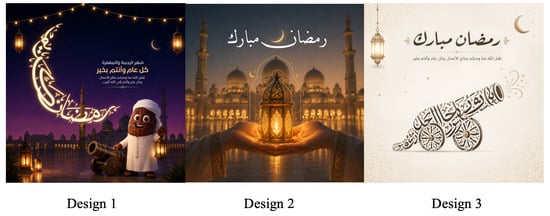
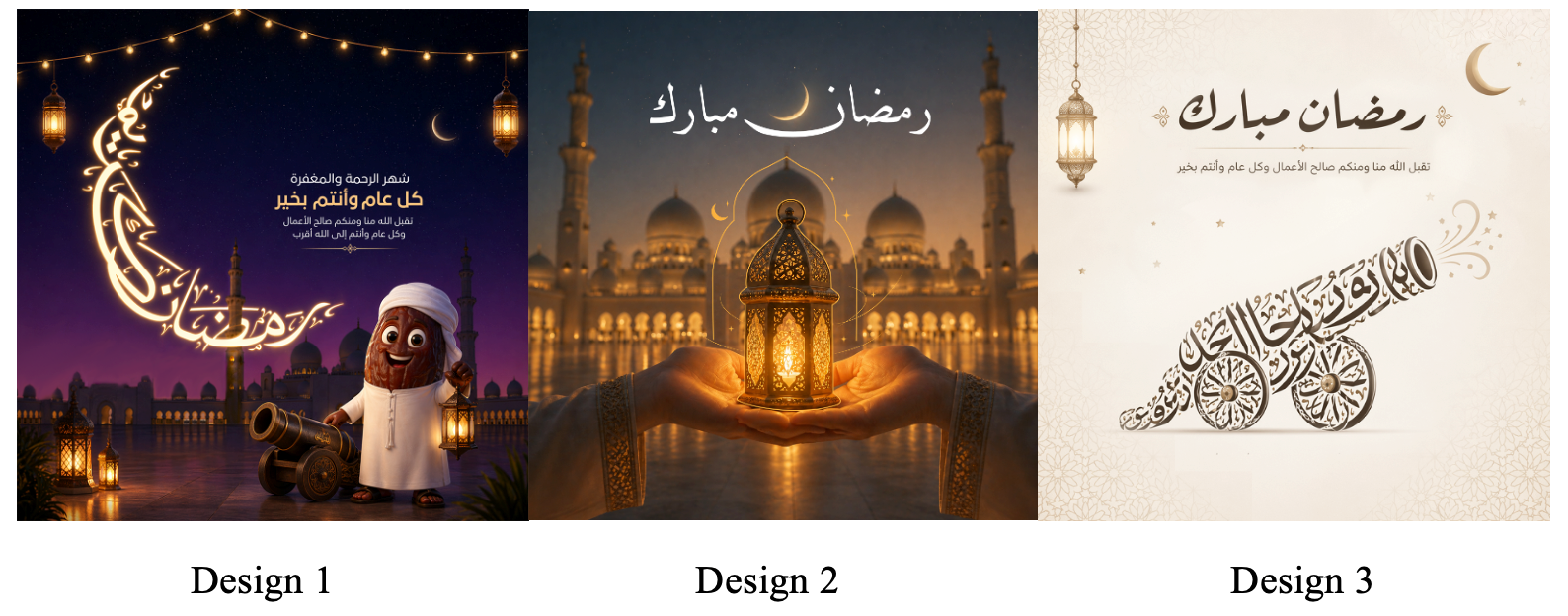
Three AI-assisted student-produced Ramadan Instagram posts (1080 × 1080 px) were used as elicitation stimuli (Figure 1). They originated in a regular undergraduate graphic-design exercise in which students generated imagery using AI tools and subsequently refined their designs in Photoshop or Illustrator, in a class taught by the first author. The student workflow reports documented the main AI platform and major post-production edits for each design. All three selected designs were generated using ChatGPT and then refined in either Photoshop (version 2026) or Illustrator (version 2026), but the reports did not specify the exact ChatGPT model or the number of iterations. The reports also show that culturally specific elements such as Emirati dress, Sheikh Zayed Grand Mosque, Arabic calligraphy, crescents, lanterns, and Ramadan greetings were requested in the prompts rather than independently introduced by the generative system.
Figure 1.
AI-assisted student-produced Ramadan stimuli: Design 1, cartoon date-character composition; Design 2, lantern held before a mosque; Design 3, Arabic-calligraphic cannon composition. The Arabic text in the designs is retained as part of the research stimuli; English translations are provided in Table 2.
Consent was obtained from the students who produced those designs, and they remained anonymous, in alignment with the university’s research ethics. From nine students’ submissions, three designs were selected using a six-criterion rating grid, prioritizing variation in the type and severity of visual/cultural issues identified in the preliminary screening. All nine eligible submissions were rated by the first author in a single-rater screening on a five-point scale (1 = not appropriate at all; 5 = completely appropriate) using six criteria: Arabic typography; appropriate use of cultural and religious symbols; avoidance of stereotyping; visual style (“for us/about us”); visual credibility; and overall cultural authenticity. These same six criteria were subsequently used in participants’ individual workshop evaluations, providing consistency between stimulus screening and participant assessment. Selection of the three stimuli combined variation in overall scores with variation in the type of issue represented: the selected designs foregrounded, respectively, culturally ambiguous symbolism, visual credibility/AI artificiality, and Arabic-typography problems. The purpose was therefore not to identify representative AI performance, but to provide contrasting elicitation materials capable of generating discussion across different dimensions of cultural and professional judgment. During the workshop, designs were shown on a projector and shared via WhatsApp so that participants could view them both collectively and on their personal mobile devices, approximating the social media context in which such designs are typically encountered. The stimuli were not intended as controlled experiments for evaluating the performance of each model; rather, they were intended as catalysts for practitioners to talk about acceptable risk, visual quality, and authenticity.
Table 2 provides translations and contextual explanations of the designs used in the workshop, and these designs are important to the analysis because, in addition to the participants’ evaluation of the readability and linguistic accuracy of Arabic text, they also evaluated how the visual presentation and cultural or religious meanings contributed to the perceived authenticity and acceptability of each design.
Table 2.
English translation of the Arabic text in the stimuli.
The workshop had four phases and lasted for approximately 2 h and 15 min. After the initial welcome, consent confirmation, and introduction, the participants evaluated each of the three designs individually. During Phase 1, participants independently rated all three designs using six predefined criteria on a five-point scale ranging from 1 (not appropriate at all) to 5 (completely appropriate). The criteria (Table 3) assessed Arabic typography, cultural and religious symbolism, avoidance of stereotyping, insider/outsider visual perspective (‘for us/about us’), visual credibility, and overall cultural authenticity.
Table 3.
Individual assessment criteria.
During Phase 2, the researcher briefly surfaced selected ratings from the Phase 1 evaluations by show of hands where divergent assessments were apparent, in order to make differences in individual judgment visible before group discussion. In Phase 3, each group developed three shared evaluation criteria and recorded them on a worksheet before collectively assessing the designs. Although participants formulated the criteria in their own terms without additional researcher guidance at this stage, their earlier exposure to the six predefined criteria may have influenced their choices. In Phase 4, each group received a constraint card requiring it to select one design for publication on Instagram the following day without modification. Participants were asked to record the reason for their selection, the criteria prioritized or compromised, whether the compromises were professionally acceptable, and whether their decision was consistent with the criteria developed in Phase 3. The exercise required a final group decision but did not necessarily produce unanimous agreement. The groups’ written worksheets and constraint-card responses were subsequently entered into a qualitative data spreadsheet and examined alongside the recorded discussions, allowing the analysis to distinguish collectively recorded decisions from individual reservations expressed during deliberation.
The three group audio recordings were transcribed verbatim in Arabic, and the qualitative material was analyzed using reflexive thematic analysis [31]. Initial coding was conducted by the first author, after which the two authors reviewed and refined the thematic interpretation. Analysis proceeded through repeated familiarization, initial semantic and interpretive coding, comparison across groups, development of candidate themes, and iterative refinement against the transcripts, worksheets, constraint cards, and field notes. The analysis combined inductive attention to participants’ own evaluative language with theoretically informed interpretation using cultural intermediation and professional vision. Because reflexive thematic analysis treats researcher interpretation as integral to analysis, inter-coder reliability coefficients were not used as a validity criterion. Because the workshop was designed as an exploratory deliberative exercise rather than as a saturation-driven interview study, thematic saturation was not used as a stopping criterion.
Workshop discussions were conducted primarily in Arabic and transcribed verbatim. Quotations presented in English were translated by the first author and checked against the Arabic transcripts by the second author to preserve design terminology, culturally specific expressions, and the evaluative meaning of participants’ statements.
The authors obtained approval to conduct the study in accordance with the approved ethical protocol. Updated consent was obtained because the workshop constituted an additional phase beyond the earlier interviews and involved audio recording and evaluation of visual stimuli. The consent forms informed participants that the designs were created by students and were not considered exemplary in the field, that participation was voluntary, and that no personally identifiable information was collected or published.
Ratings were reported separately for each criterion rather than combined into a single overall score, because the sixth criterion, overall cultural authenticity, was intended to provide a broad, holistic evaluation of each design.
5. Findings
The scores (Table 4) reinforce the qualitative finding that participants did not evaluate the stimuli along a single continuum of authenticity: the relative strengths and weaknesses of each design varied substantially across typography, symbolism, stereotyping, cultural perspective, visual credibility, and overall authenticity. Given the exploratory sample (n = 9), these ratings are descriptive and are not intended for statistical inference. Although Design 2 received the lowest mean rating for avoidance of stereotypes (M = 2.56), Group 2 subsequently selected it for publication, illustrating how collective decisions could prioritize religious appropriateness, audience suitability, and perceived risk over individual assessments of a particular criterion.
In the following analysis, group labels are used for positions recorded collectively on group worksheets or constraint cards, but specific interpretations are attributed to individual participants rather than to the whole group. Table 5 summarizes the three criteria each group generated in Phase 3 and the design ultimately selected under the publication constraint.
Table 4.
Participant ratings by evaluation criterion (n = 9; scale 1–5).
Table 5.
Phase 3 group-generated criteria and final decisions.
Theme 1: Authenticity as layered cultural judgment
Authenticity did not operate as a single evaluative standard across the workshop. Rather, participants constructed it through several overlapping dimensions: symbolic and linguistic accuracy, freedom from stereotype, affective or spiritual resonance, religious appropriateness, and sensitivity to locally specific cultural forms.
In Group 1, one participant insisted that Arabic type is not merely a technical matter but part of Arab visual culture itself:
Calligraphy is a basic thing in design, I feel that it is in the Arab culture especially in Ramadan and Eid, calligraphy is an integral part of design because of its importance in our roots and origins.(G1_P2)
Here, the designer is not simply assessing whether the letters are readable but whether typography carries cultural legitimacy. In Bourdieu’s [18] terms, the designer is classifying what counts as legitimate cultural form; in later cultural intermediation terms, she is mediating between symbolic production and audience recognition [21,22].
One finding from Group 1 is that participants distinguish between the inclusion of cultural symbols and the understanding of cultural meaning. Participants objected to designs that seemed to rely on predictable Ramadan clichés. One participant described some imagery as “basic” and “stereotyped,” linking it to how outsiders may imagine Arabs:
If you go to the UK and mention to people in the UK [this is] Ramadan, they will say to you ‘so you will eat dates, go to your tent, ride the camel’ or whatever, because that’s how they think of Arabs, right?(G1_P2)
This comment shifts the critique from visual presence to cultural comprehension, arguing that predictable clustering of Ramadan elements may reduce them to an externalized repertoire of signs. The participant’s criticism concerned the use of familiar cultural signs as substitutes for culturally meaningful representation, but because these signs were included in the students’ prompts, their presence cannot be attributed independently to the generative system. The exchange therefore shows how participants distinguished symbolic presence from culturally meaningful use.
Group 2’s critique of Design 1 (Figure 1) is important because it introduces a sharper ethical/religious dimension than Group 1. They recognize strengths in Design 1, such as readable typography, even when one phrase is shaped as a crescent, but they object to the date character. Group 2’s strongest positive evaluation is of Design 2 (Figure 1). They describe it in affective and spiritual terms: it has “warmth,” the typography is clear, the elements are basic and recognizable, and the eye falls first on the lantern before moving to the mosque, the crescent, and the greeting. Consequently, Design 2 is selected because it is clearer, more comfortable, and better suited to “Muslim audiences.”
Thus, in Group 2 discussions, the concept of authenticity was related to the designs’ ability to evoke the experience of Ramadan rather than to represent the symbols associated with it. Each participant indicated a desire for the designs to be authentic and to reflect the genuine experience of Ramadan, avoiding designs that overused symbols associated with Ramadan. Thus, the participants indicated their understanding of the role of cultural mediators to separate the symbols from the cultural meanings associated with them [18,21].
While Group 2 focused heavily on the lived experience of Ramadan, Group 3 repeatedly asked whether the design gets culturally marked details right.
The contrast among groups is therefore not evidence of uncertainty about authenticity, but evidence that authenticity itself was multidimensional: Group 1 foregrounded stereotype and symbolic meaning, Group 2 emphasized lived and affective resonance, while Group 3 placed greater weight on linguistic, religious, and locally specific representational accuracy.
Theme 2: Seeing and naming design problems
Across all three groups, participants repeatedly moved from an initial sense that something ‘felt’ wrong to a more specialized professional vocabulary of balance, hierarchy, typography, readability, focal point, visual credibility, and image–text integration. This movement from perception to articulation is consistent with Goodwin’s [29] concept of professional vision.
In Group 1, participants spent considerable time discussing balance, visual weight, contrast, layering, textual readability and relationships among elements. For example, two participants described the first design as visually heavy. They also discussed color contrast in professional terms, referring to purple and gold on the color wheel, but then qualifying that the contrast still felt uncomfortable.
A recurring concern in Group 1 was that AI was acceptable as a tool only when it did not visibly betray itself. Design 2 (Figure 1), the lantern held by the hands, most clearly triggered this issue. While the group acknowledged some strengths, they quickly focused on credibility. The problem was not only anatomical inaccuracy. It became a credibility problem:
That it has all the elements that it is Ramadan in the Emirates […] Like the lantern mosque, the crescent, and typography […] but People will lose confidence in design if it looks too AI-generated.(G1_P3)
In Group 2, participants state that AI may exaggerate certain cultural elements or reflect them in a superficial way:
I feel that [design 1] is ok […] but if it is about Ramadan, it is about something we live and experience […] there are elements like family, cultural, and religious appropriateness […] the design must reflect a genuine Ramadan experience without exaggerating the use of symbols in a superficial way.(G2_P6)
There should be a sense of color and typography that is very clear and communicates the Ramadan experience […] I mean spirituality […] it should be visually appealing with no exaggeration.(G2_P5)
Because AI generates exaggerated [symbols], our role is to reduce these, so when we prompt it to generate an image about Ramadan, it adds everything that comes to your mind about Ramadan.(G2_P6)
Participants sometimes attributed symbolic excess to generative AI itself. For example, G2_P6 suggested that AI tends to combine numerous recognizable Ramadan symbols, although the students’ workflow reports indicate that culturally specific elements had been requested in their prompts. This discrepancy reveals participants’ assumptions about AI-generated imagery rather than establishing that the technology independently introduced those symbols. Group 3 participants also identified shortcomings in human design decisions. As one participant observed, the designers appeared to have taken an AI-generated image and placed text wherever space remained, instead of integrating typography into the composition. These accounts suggest that perceived deficiencies may arise at different stages of the human–AI design workflow and that participants did not always distinguish between them:
Design 1 took all typical elements related to Ramadan like lantern and employed them in non-typical way.(G3_P8)
The hands in Design 2 are good, but I do not see them adding value, and there was no need for such closeness, because it does not show if these are the two hands of one person or of two persons […] I feel all three designs have in common that they generated an AI image and then placed the text randomly around it.(G3_P8)
But shouldn’t we judge it based on design principles, like balance, contrast, and focal point?(G3_P9)
I am not talking about standards alone, but about the design as a whole …. I see [Design 1] too crowded […] the [national dress] also has errors.(G3_P7)
G3_P7 expressed concern that the lettering beneath the cannon in Design 3 appeared to resemble the Arabic word rasūl (Messenger), although she acknowledged that this might not have been the intended word. Although G3_P9 invokes a conventional design vocabulary, other participants expand their evaluative frame to assess whether AI-generated elements add communicative value, whether Arabic/religious references create unintended meanings, whether the text is integrated or merely “placed” onto an image, and whether the national dress is culturally accurate. The discussion also illustrates cultural intermediation [18,21], as participants mediate among visual form, religious meaning, local cultural codes, and audience reception, yet their disagreement reveals competing hierarchies of judgment that encompass cultural accuracy, religious sensitivity, and professional credibility. The important point is that professional vision did not generate identical judgments, but provided a common framework for identifying and naming issues, although participants disagreed on which problems should be prioritized.
Participants treated Arabic typography as one point at which the cultural credibility of an AI-assisted artefact could break down. In Group 3, Arabic text carried not only readability but also cultural and professional legitimacy. Connected Arabic script invites reading rather than functioning only as ornament; consequently, participants evaluated letterforms, diacritics and linguistic coherence as part of professional design quality. Designers therefore mediated not only between image and culture but also between ornament and language.
Theme 3: From ideal standards to acceptable risk
Participants were redirected from rating the ideal quality of design to determining what might be published, in the constraint-card phase. All groups were required to select one design for publication on Instagram the following day, with no opportunity for modification. The collective constraint-card outputs recorded different trade-offs, so for instance, Group 1’s written decision prioritized creative distinctiveness despite compositional weaknesses; Group 2’s written decision accepted the visible hand defect because participants considered the design culturally safer; and Group 3’s written response selected Design 1 while explicitly recording that the compromise over clothing accuracy was professionally unacceptable.
Group 1 selected Design 1 (Figure 1) because, according to its written constraint card, it combined Islamic visual elements appropriately while demonstrating “creativity and thinking outside the box” in communicating a Ramadan greeting. Although participants had criticized aspects of its composition and typography, the group considered the compromise concerning the choice of fonts professionally acceptable under time pressure. Its written response further distinguished between incorrect text and an aesthetically less appealing typeface, treating the latter as a matter of taste rather than accuracy. The decision therefore illustrates how designers distinguished between errors requiring correction and imperfections they considered tolerable under production constraints.
The use of the constraint phase indicates that these criteria were not applied absolutely to the designs; while all designs were criticized, Design 1 (Figure 1) was selected despite the debate about whether it was “professionally acceptable,” indicating that the designers evaluated AI-produced designs according to a standard of compromise, acceptable within deadline pressures.
Group 2 selected Design 2, citing the “clarity of the design elements” and colors with a “clear and warm Ramadan character,” as well as the design’s suitability for Arab Muslim audiences and social media publication, according to its written constraint card. The group acknowledged the inaccurate rendering of the hands but considered this compromise professionally acceptable, reasoning that it was unlikely to provoke substantial criticism or controversy. Its decision illustrates how participants prioritized cultural appropriateness, communicative effectiveness, and perceived publication risk over a visible technical defect: Group 2 selected Design 2, the lantern and hands design, even though they had criticized its AI-generated hands, and they justified this by saying it meets their standards compared to other designs, although it still requires minor adjustments to address “everyone…all age groups,” and their preference is therefore a form of risk-managed cultural mediation:
Design 1 lost its religious relevance […] Design 2 is better […] As for Design 3, we agree that it is visually appealing, but the typography is a bit illegible.(G2_P6)
If the commissioning company produces something for children, then [the design] is suitable. The brief said the design is for Arabs and Muslims in general, regardless of age… but [Design1] seems to target children with this character and the playful fonts…We can remove the date character and just keep the cannon, then insert the script into the cannon itself to make it more suitable for the eye.(G2_P6)
Despite the visible flaws in the hands in Design 2 (Figure 1), participants selected it because they prioritized its warmth, spiritual resonance, broad audience suitability, social-media fit, and relatively low cultural or religious risk.
Group 3 selected Design 1, although its decision did not represent unanimous professional agreement. The written constraint card justified the selection through its “color contrast and clarity,” “appropriate text placement,” and an “innovative and non-traditional” concept. However, these recorded priorities contrasted with criticisms expressed during the discussion, in which participants described the composition as crowded and questioned the text integration. One participant explicitly opposed the selection, while the written card explicitly recorded that compromising the accuracy of traditional clothing was professionally unacceptable. The outcome therefore illustrates how a collective decision reached under an imposed publication constraint can coexist with unresolved disagreements over aesthetic quality and cultural accuracy.
The final reflection provided useful insight into how participants viewed AI after completing the group activity. Rather than seeing AI as unsuitable for culturally specific design, most participants viewed it as a tool whose value depends on how it is used and guided by designers. Many stressed the importance of writing effective prompts and providing culturally accurate information, especially when generating elements such as traditional clothing, crescent symbols, and Arabic calligraphy. Participants generally regarded AI as a helpful starting point for generating ideas, inspiration, and design components, rather than a tool capable of creating a fully finished design on its own. They also emphasized that AI-generated outputs often require further refinement, correction, and editing in traditional design software to achieve the desired level of accuracy and quality. Overall, the workshop did not appear to significantly change participants’ attitudes toward AI, but it reinforced existing views that AI can be a valuable support tool in culturally specific visual design, as long as designers remain responsible for verifying cultural authenticity and making the final creative decisions.
Theme 4: Claiming intermediary cultural authority
The workshop also revealed that cultural judgment involved claims about who was qualified to recognize culturally significant errors. These claims are noteworthy because none of the participants was Emirati. Rather than claiming authority through national identity, some participants grounded their judgments in professional exposure, cultural proximity, research, and accumulated experience of designing within the UAE.
In Group 3, participants disagreed about whether familiarity with Emirati cultural practices was sufficient to recognize inaccuracies in traditional clothing. G3_P7 explained: “It is not that I researched the kandura specifically; perhaps it is because we have lived with it so much.” G3_P8 replied, “You have lived with it, but this is still a cartoon. If AI had generated an actual person rather than this cartoon character, I would agree with you.” The exchange illustrates competing understandings of cultural competence. While everyday familiarity was invoked to justify professional judgment, another participant questioned whether the same standards of accuracy should apply to a stylized cartoon figure. In Group 1, participants similarly disagreed over whether dressing the character in Emirati national dress reinforced stereotypes:
There is a question that puzzles me, do you not feel that [the design] is stereotypical? Why does the character wear a dishdasha [national dress]? What does it mean? Does everyone in the UAE wear a Dishdasha?(G1_P2)
No, but what’s the design brief? We were asked to choose posters for those who are in the UAE.(G1_P3)
Isn’t this a stereotype? That’s my question, don’t you feel like it is a stereotype that everyone in the UAE wears this dishdasha?(G1_P2)
No, this is traditional attire […] I feel what stereotype is other things like the lantern, dates […] As for Emirati dress, this is part of the [local] culture.(G1_P3)
One distinctive theme in Group 3 is the discussion of traditional clothing. The group repeatedly critiques Design 1 (Figure 1) for its inaccurate representation of UAE/Gulf dress. One participant (G3_P7) criticizes the dress for not being precisely Emirati and explains that every Arab or Gulf country has its own cut, cuffs, texture, and form, and argues that “dress is the core of tradition and culture, and any mix in it can be regarded as a cultural insult or distortion.” Further, she argues that their role, as embedded in UAE culture, is to be meticulous in reflecting it, drawing on the following professional anecdote:
We once worked on a design for the National Day, one member of the team delivered a very good design using AI but I wished she was more meticulous as the [UAE] flag was reversed […] it had the [correct] colors of green, white and black but there is a protocol in raising the flag…it should flutter to the right not left…this is the country’s protocol […] I asked that designer to search for the flag protocol, and she amended the design.(G3_P7)
This moves the analysis beyond generic “Arab culture,” as Group 3 insists that local cultural signs are internally differentiated, so a kandura is not simply a “traditional Arab outfit” but has national, regional, and stylistic specificity. Thus, although the designers themselves are not Emirati, they mediate local cultural symbols through professional practice and client-facing design work, illustrating how participants claimed localized cultural expertise through professional exposure rather than national belonging.
Group 3 also debated the appearance and cultural significance of the crescent and whether such details would be noticeable to general audiences. Participants disagreed over whether particular representations were appropriate for Ramadan and whether professional designers should apply stricter standards than ordinary viewers. One participant emphasized that recognizing culturally significant details was a professional responsibility. The exchange illustrates disagreement about professional standards rather than establishing whether a particular crescent was objectively correct or incorrect.
These exchanges support the concept of intermediary cultural authority, but only in the limited sense established by this study: they show how non-native professionals claim and negotiate culturally specific expertise among themselves, but they do not establish whether Emirati designers or audiences recognize those claims as legitimate.
6. Discussion: AI and Mediated Design Judgment
The principal contribution of the workshop is not a single definition of authentic design but evidence that authenticity functions as a negotiated professional attribution. Participants drew on shared professional repertoires while assigning different weights to representational accuracy, affective resonance, religious sensitivity, visual quality, and anticipated risk. Cultural intermediation therefore does not eliminate ambiguity; it organizes and manages it.
The findings also support prior work showing that professional evaluation remains central in AI-assisted creative practice [15]. In this workshop, the more distinctive issue was not whether AI could produce novelty, but whether professionally trained designers considered that novelty culturally appropriate, meaningful and publishable.
Also, participants’ repeated appeals to what “feels” right or wrong in a design should not be treated as mere subjectivity. It is better understood as professional intuition, which is produced through coding schemes, highlighting, and shared forms of representation [29]. Designers then acquire a feel for the game of design [18], i.e., what is elegant, excessive, cheap, balanced, generic, risky, or publishable. In this sense, “good design” is not a universal category but a field-specific judgment. Professional authority is partly enacted through the ability to recognize significance before it is fully explained. Professional vision therefore supplies a shared vocabulary for seeing rather than a uniform hierarchy of judgment, and this helps explain why groups invoking similar design principles nevertheless reached different decisions under constraints. The divergent selections therefore demonstrate that situated professional judgment involves different hierarchies of tolerable risk rather than a single universal standard.
The Group 3’s exchanges suggest that claims to local visual literacy may be grounded in professional exposure and cultural proximity without becoming equivalent to native cultural authority. The UAE is not a culturally homogeneous design environment, but a multinational, Arab, Muslim, and expatriate space where many people produce visual culture for audiences whose identities do not map neatly onto nationality.
Participants also justified their cultural judgments through reported practices of research and verification. One participant recalled visiting places, taking photographs, and consulting people when working on Emirati cultural representations. She also described directing a colleague to consult the UAE flag protocol after identifying an error in a design. Although these accounts do not independently establish the accuracy of participants’ knowledge, they demonstrate how professional authority was claimed through research, cultural familiarity, and verification. At the same time, disagreements within the workshop show that such claims were not automatically accepted by other designers. The findings therefore support an interpretation of intermediary cultural authority as negotiated professional competence rather than culturally validated expertise.
The most direct practical implication is that culturally specific AI-assisted design requires human cultural and linguistic verification, but the present study cannot establish whether locally curated datasets or culturally specialized models would improve these outputs. Future research could test whether such technical interventions, culturally specific prompting strategies, or structured professional review procedures improve representational accuracy and audience reception.
7. Conclusions
In this workshop, nine non-Emirati Arab designers evaluated three AI-assisted student-produced visual artifacts through intersecting cultural and professional criteria. Participants valued aspects of AI-assisted novelty while remaining critical of linguistic, visual, symbolic, and contextual problems. Their discussions show that authenticity was not treated as an intrinsic property of the designs but was negotiated in relation to representation, audience, religion, professional standards, and anticipated risk.
Participants drew on different cultural and professional considerations when evaluating the designs, including typography, religious symbolism, visual composition, and cultural appropriateness. Particularly in Group 3, the discussion highlighted distinctions between general Arab or Gulf representations and specifically Emirati visual conventions. These findings suggest that culturally situated professional knowledge shaped participants’ evaluations, although such knowledge was neither uniform across groups nor independently validated by Emirati audiences.
This exploratory study has several limitations. First, its nine participants were all female Arab designers, and none were Emirati; the findings therefore concern the professional judgments of this particular culturally proximate group and cannot establish how Emirati audiences or designers would evaluate the same material. Also, it is not possible to determine whether gender shaped claims to cultural authority or the attention given to dress, modesty, religious sensitivity, and other culturally marked details; future studies can compare the role of gender within mixed-gender groups. Second, six participants had previously participated in the interview phase and may have been sensitized to the research themes. Third, only three visual stimuli were used, and they were created by undergraduate designers through human–AI workflows and subsequently edited in design software; therefore, flaws identified by participants cannot be attributed uniquely to generative AI. Production documentation was partial, as student workflow reports identified ChatGPT as the main platform and described some manual edits in Photoshop or Illustrator, but the exact model and iteration counts were not retained, limiting model-level inference. Fourth, participants were informed that the designs were AI-assisted, student-produced, and not presented as exemplary professional work. This framing may have oriented participants toward cultural and visual deficiencies and limited claims about how such judgments would emerge in an unprompted professional setting. Also, the study analyzes professional claims about cultural appropriateness rather than validating those judgments with Emirati audience members. Finally, the first author’s multiple roles as instructor, stimulus selector, recruiter, and workshop facilitator may also have influenced participants’ responses. Furthermore, exposure to the predefined evaluation criteria and the facilitated group discussions may have encouraged participants to emphasize professional competence or culturally appropriate judgments. These potential social-desirability and power effects should be considered when interpreting the findings. These limitations restrict generalizability but do not undermine the workshop’s purpose: to examine how culturally situated professional judgments are articulated, contested, and revised through collective deliberation. Future research should compare these claims with evaluations by Emirati designers and audiences and examine whether intermediary cultural authority is recognized, contested, or differently configured by those positioned as cultural insiders.
Author Contributions
Conceptualization, M.D.; Methodology, M.D.; formal analysis, M.D.; data curation, M.D.; writing—original draft preparation, M.D.; writing—review and editing, N.M.; supervision, N.M. All authors have read and agreed to the published version of the manuscript.
Funding
This research received no external funding.
Institutional Review Board Statement
The study was conducted in accordance with the Declaration of Helsinki and has been approved by the Research Ethics Committee at the University of Sharjah, Reference number: REC-25-09-23-05-PG, dated 10 August 2025.
Informed Consent Statement
The research participants received an information sheet and consented to participate in the workshop anonymously. They received information about the research objectives and their voluntary participation. They were not offered any financial incentives to participate in this workshop.
Data Availability Statement
The raw data are available upon reasonable request from the first author.
Conflicts of Interest
The authors declare no conflicts of interest.
References
- Ananya. AI Image Generators Often Give Racist and Sexist Results: Can They Be Fixed? Nature 2024, 627, 722–725. [Google Scholar] [CrossRef] [Scilit] [PubMed]
- Pandiyaraj, V.; Raja, N.; Deeparajeswari. Decoding Tamil Identity in Ai-Generated Imagery: Leveraging Prompts for Cultural Content Analysis. ShodhKosh J. Vis. Perform. Arts 2024, 5, 61–73. [Google Scholar] [CrossRef] [Scilit]
- Coeckelbergh, M. The Work of Art in the Age of AI Image Generation: Aesthetics and Human-Technology Relations as Process and Performance. J. Hum.-Technol. Relat. 2023, 1, 1–13. [Google Scholar] [CrossRef] [Scilit]
- Kalving, M.; Colley, A.; Häkkilä, J. Where AI and Design Meet-Designers’ Perceptions of AI Tools. In Proceedings of the Nordic Conference on Human-Computer Interaction; ACM: Uppsala, Sweden, 2024; pp. 1–8. [Google Scholar]
- Wingström, R.; Hautala, J.; Lundman, R. Redefining Creativity in the Era of AI? Perspectives of Computer Scientists and New Media Artists. Creat. Res. J. 2024, 36, 177–193. [Google Scholar] [CrossRef] [Scilit]
- Dubai Design & Fashion Council. MENA Design Education Outlook; Dubai Design & Fashion Council: Dubai, United Arab Emirates, 2016. [Google Scholar]
- World Economic Forum. Future of Jobs Report. Insight Report; World Economic Forum: Geneva, Switzerland, 2025. [Google Scholar]
- Mellor, N. Cultural Branding in the Arab Region. Media Watch 2024, 15, 313–329. [Google Scholar] [CrossRef] [Scilit]
- Amabile, T.M. The Social Psychology of Creativity; Springer International Publishing: New York, NY, USA, 1983. [Google Scholar]
- Runco, M.A.; Jaeger, G.J. The Standard Definition of Creativity. Creat. Res. J. 2012, 24, 92–96. [Google Scholar] [CrossRef] [Scilit]
- Runco, M.A. AI Can Only Produce Artificial Creativity. J. Creat. 2023, 33, 100063. [Google Scholar] [CrossRef] [Scilit]
- Amabile, T.M.; Pillemer, J. Perspectives on the Social Psychology of Creativity. J. Creat. Behav. 2012, 46, 3–15. [Google Scholar] [CrossRef] [Scilit]
- Boden, M.A. The Creative Mind: Myths and Mechanisms, 2nd ed.; Routledge: London, UK, 2004. [Google Scholar]
- Ivcevic, Z.; Grandinetti, M. Artificial Intelligence as a Tool for Creativity. J. Creat. 2024, 34, 100079. [Google Scholar] [CrossRef] [Scilit]
- Magni, F.; Park, J.; Chao, M.M. Humans as Creativity Gatekeepers: Are We Biased Against AI Creativity? J. Bus. Psychol. 2024, 39, 643–656. [Google Scholar] [CrossRef] [Scilit]
- Lee, H.-K. Rethinking Creativity: Creative Industries, AI and Everyday Creativity. Media Cult. Soc. 2022, 44, 601–612. [Google Scholar] [CrossRef] [Scilit]
- McRobbie, A. Be Creative: Making a Living in the New Culture Industries; Polity Press: Cambridge, UK, 2016. [Google Scholar]
- Bourdieu, P. Distinction: A Social Critique of the Judgement of Taste; Harvard University Press: Cambridge, MA, USA, 1984. [Google Scholar]
- Edwards, L. Exploring the Role of Public Relations as a Cultural Intermediary Occupation. Cult. Sociol. 2012, 6, 438–454. [Google Scholar] [CrossRef] [Scilit]
- Lobato, R. The Cultural Logic of Digital Intermediaries: YouTube Multichannel Networks. Converg. Int. J. Res. New Media Technol. 2016, 22, 348–360. [Google Scholar] [CrossRef] [Scilit]
- Negus, K. The Work of Cultural Intermediaries and the Enduring Distance Between Production and Consumption. Cult. Stud. 2002, 16, 501–515. [Google Scholar] [CrossRef] [Scilit]
- Nixon, S.; Gay, P.D. Who Needs Cultural Intermediaries? Cult. Stud. 2002, 16, 495–500. [Google Scholar] [CrossRef] [Scilit]
- Smith Maguire, J.; Matthews, J. Are We All Cultural Intermediaries Now? An Introduction to Cultural Intermediaries in Context. Eur. J. Cult. Stud. 2012, 15, 551–562. [Google Scholar] [CrossRef] [Scilit]
- Noonan, C.; Brock, M. Screen Agencies as Cultural Intermediaries: Delivering Gender Equality in the Film and Television Sectors? Eur. J. Cult. Stud. 2023, 26, 408–427. [Google Scholar] [CrossRef] [Scilit]
- Lindholm, C. Culture and Authenticity; Blackwell: Oxford, UK, 2008. [Google Scholar]
- Derderian, E. Consulting Culture: Creating Arabian Peninsula Museums. J. Arab. Stud. 2025, 15, 323–341. [Google Scholar] [CrossRef] [Scilit]
- Wodniak, K.; Serhan, W. Positionality in an Ethnically Diverse Qatar. Field Methods 2026, 38, 3–18. [Google Scholar] [CrossRef] [Scilit]
- Cosquer, C. Looking for the Authentic Other: Cosmopolitan Ethos and Orientalism in French Migrants’ Experiences in Abu Dhabi. Crit. Anthropol. 2021, 41, 405–420. [Google Scholar] [CrossRef] [Scilit]
- Goodwin, C. Professional Vision. Am. Anthropol. 1994, 96, 606–633. [Google Scholar] [CrossRef] [Scilit]
- Hesmondhalgh, D. The Cultural Industries; SAGE Publications, Ltd.: London, UK, 2019. [Google Scholar]
- Braun, V.; Clarke, V. Reflecting on Reflexive Thematic Analysis. Qual. Res. Sport Exerc. Health 2019, 11, 589–597. [Google Scholar] [CrossRef] [Scilit]

Disclaimer/Publisher’s Note: The statements, opinions and data contained in all publications are solely those of the individual author(s) and contributor(s) and not of MDPI and/or the editor(s). MDPI and/or the editor(s) disclaim responsibility for any injury to people or property resulting from any ideas, methods, instructions or products referred to in the content. |
© 2026 by the authors. Licensee MDPI, Basel, Switzerland. This article is an open access article distributed under the terms and conditions of the Creative Commons Attribution (CC BY) license.