


Simple Summary
Mosquito-borne diseases such as dengue and Zika continue to pose significant public health challenges in Singapore, and effective indoor mosquito control is needed during outbreaks. Indoor space spraying is commonly used to kill adult mosquitoes, but its effectiveness can be limited if sprays do not reach hidden areas or if mosquitoes become less susceptible to insecticides. This study tested a new spray formulation, Mirakn® GX, which combines a pyrethroid insecticide with carbon dioxide gas to help the spray spread more effectively indoors. The product was tested in a real residential apartment against three mosquito species commonly found in urban Singapore. The results showed that the insecticide achieved 99.79 to 100% mosquito killing, including those in hidden spaces. The product remained effective even when the exposure time was reduced to 10 min, suggesting it can be used with minimal disruption to residents. These findings highlight the potential of this insecticide to improve indoor mosquito control, benefiting both public health programmes and the community by reducing the risk of mosquito-borne diseases.
Abstract
In Singapore, indoor space spraying, such as ultra-low-volume (ULV) treatment, is used to control adult mosquitoes during vector-borne disease outbreaks. This study assessed the efficacy of Mirakn® GX, a pyrethroid-based insecticide formulation combining d,d-trans-cyphenothrin with desiccated carbon dioxide as a propellant. The implications of these findings for operational use will be discussed. Mirakn® GX was evaluated against confined field and laboratory strains of Aedes aegypti, Ae. albopictus and Culex quinquefasciatus under semi-field conditions, following World Health Organization (WHO) guidelines. This study was conducted within an occupied residential apartment unit. An additional evaluation focusing on Ae. aegypti, designed to mimic operational practice, was performed using a reduced exposure duration of 10 min. At an application rate of 1 g/m3 with 60 min exposure, 100% knockdown and 99.79–100% mortality were observed across all three mosquito species. A shortened 10 min exposure also resulted in complete knockdown and mortality in both laboratory and field strains of Ae. aegypti, supporting operational feasibility. Under semi-field conditions, the insecticide formulation showed good penetration into enclosed spaces, indicating its potential use for scenarios where timely management of indoor adult mosquitoes is required, including during outbreaks to kill infected mosquitoes.
1. Introduction
Aedes aegypti (Linnaeus, 1762) is an efficient vector for multiple arboviruses, including dengue and Zika, which have caused recurring outbreaks in Singapore in 2013, 2016, 2020, and 2022 for dengue [1,2,3,4] and in 2016 and 2023 for Zika [5,6,7]. This mosquito species is highly anthropophilic and endophilic, thriving in urban environments and breeding predominantly in artificial containers [8,9]. Its anthropophagic and anthropophilic nature makes it an efficient vector for disease transmission. As a dengue-endemic country with all four dengue serotypes circulating year-round, Singapore remains at continual risk, which presents significant challenges for public health management [10].
To combat mosquito-borne diseases, Singapore undertakes a multi-pronged dengue prevention and control strategy. This comprehensive approach includes case, mosquito and virus surveillance; elimination of breeding habitats; community outreach and education initiatives; and insecticide application during outbreaks to disrupt transmission chains [11]. In addition, Project Wolbachia–Singapore complements conventional vector control measures through the release of male Wolbachia-infected Ae. aegypti mosquitoes to suppress local Ae. aegypti populations and reduce the dengue risk [12].
Indoor space spraying (ISS) is one of the commonly applied adult mosquito control measures, particularly in a dengue outbreak. It involves dispersing fine droplets of insecticide within indoor areas to achieve rapid knockdown and mortality of adult mosquitoes, including those that may be infected [13]. However, in Singapore, Ae. aegypti populations have been shown to develop resistance to pyrethroid-based insecticides by WHO bioassay tests. This is likely driven by multiple mechanisms, such as enhanced metabolic detoxification and the presence of knockdown resistance (kdr) mutations [14,15,16].
New formulation technologies are being developed to enhance the delivery and effectiveness of insecticides against mosquitoes, such as CO2-based formulations that could improve aerosol dispersion and permeation. While CO2 has long been used in stored-product pest control [17,18,19], its use in mosquito control is a relatively new approach. It is postulated that carbon dioxide may help improve the dispersion and penetration of insecticides, enabling them to reach hidden spaces where mosquitoes often rest.
This study evaluated the adulticidal efficacy of Mirakn® GX, a Type II pyrethroid formulation containing 0.6% w/w d,d-trans-cyphenothrin, and using CO2 as the propellant, against local field strains of Ae. aegypti, Ae. albopictus (Skuse, 1894), and Culex quinquefasciatus (Say, 1823) [20,21,22,23,24,25]. Previous laboratory and field studies in Malaysia, India and the United States have shown that Gokilaht®-S 5% EC, with the same active ingredient, achieved more than 80% efficacy against laboratory-reared field strain Aedes mosquitoes [26,27]. These findings collectively underscore the promising potential of d,d-trans-cyphenothrin as an effective active ingredient for mosquito control. Hence, evaluating whether novel formulations can maintain efficacy against locally collected mosquito populations is operationally relevant.
2. Materials and Methods
2.1. Study Site
Singapore is a Southeast-Asian city-state with a tropical climate, a land area of 728.3 km2 and an estimated population of 6.11 million [28]. Locally, more than 95% of the resident population reside in high-rise residential apartment buildings (77.4% of the population reside in public housing and 17.7% reside in private apartments [29]).
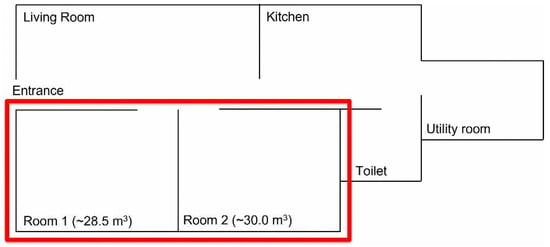
For this study, an occupied and fully furnished public housing residential apartment unit was selected as a representative of the local household demographic. The unit is located on the 12th floor and has a floor area of 66 m2 with a floor-to-ceiling height of 2.5 m. The unit has two adjacent bedrooms of similar sizes, denoted as Room 1 and Room 2 (as depicted in Figure 1).
Figure 1.
Schematic floorplan of the study site with two test bedrooms (Room 1 and Room 2, boxed red) of similar size.
2.2. Mosquito Collection and Rearing
Three common urban mosquito species, Ae. aegypti, Ae. albopictus and Cx. quinquefasciatus, were collected in immature stages (larvae and pupae) from residential and public areas across Singapore during routine inspections by enforcement officers of the National Environment Agency (NEA) [9,20,30,31]. Immature mosquitoes were identified to species based on morphological characteristics [32,33]. Only immatures collected from areas without active dengue, chikungunya and Zika transmission were kept and reared for testing.
Larvae were reared in 37.5 cm × 31.5 cm × 7.0 cm plastic trays containing 1 L of aged water and fed with a slurry made of ground Tetramin® Tropical Flakes (Tetra® Werke GmbH, Melle, Germany). Pupae were placed in 30 cm × 30 cm × 30 cm (L × W × H) cages before emergence into adults. F0 adults were allowed to mate randomly, and female mosquitoes were fed with high-health-status animal’s blood (Singapore Health Services Pte Ltd., Singapore) using a Hemotek membrane feeding system (Hemotek Limited, Blackburn, Lancashire, UK) with mouse skin as the membrane. The temperature of the feeding device was set to 37 °C. F1 eggs were collected either on WhatmanTM No-1 filter papers for Aedes mosquitoes (Cytiva, Marlborough, MA, USA) or directly on water and hatched in aged water for Culex mosquitoes. Larvae were reared and pupae were allowed to emerge as described above to collect F2 eggs. F2 adults were used in the study and tested concurrently with their laboratory susceptible strain. Eggs of the laboratory susceptible strain (F162 for Ae. aegypti (Bora-Bora), F245 for Ae. albopictus (NEA-EHI), and F370 for Cx. quinquefasciatus (NEA-EHI)) that were available in the laboratory were reared under the same rearing protocol. All rearing activities were carried out under standard insectary conditions, with an average temperature of 24.4 ± 0.2 °C, relative humidity of 86.6 ± 1.9%, and photoperiod of 12:12 h (light:dark). The rearing protocol was strictly adhered to in order to produce consistent, uniformly sized female adults for the test.
The field-collected mosquito populations used in this study were not subjected to insecticide susceptibility testing prior to evaluation. Consequently, the resistance status of the specific mosquito cohorts tested was not determined.
2.3. Insecticide Product
The product evaluated in this study is Mirakn® GX, manufactured by Sumitomo Chemical Co, Ltd., Tokyo, Japan. This formulation consists of a mixture of CO2 and d,d-trans-cyphenothrin, supplied in a compressed gas cylinder (as depicted in Figure 2). To ensure precise and consistent application of the recommended dose of 1 g/m3, prior to each treatment, the discharge rate of the compressed gas cylinder was verified by weighing it before and after a fixed 5 s calibration spray, ensuring an average discharge rate of 6.5 g/s. A CO2-only control treatment was not included because a compressed gas formulation containing CO2 without the active ingredient was not available during the study period. Consequently, the present study evaluated the efficacy of the complete commercial formulation and was not designed to determine the independent contribution of CO2 to mosquito knockdown or mortality.
Figure 2.
Compressed gas cylinder of Mirakn® GX.
2.4. Efficacy Test
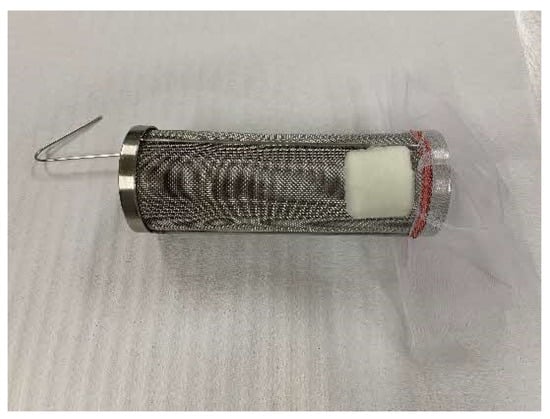
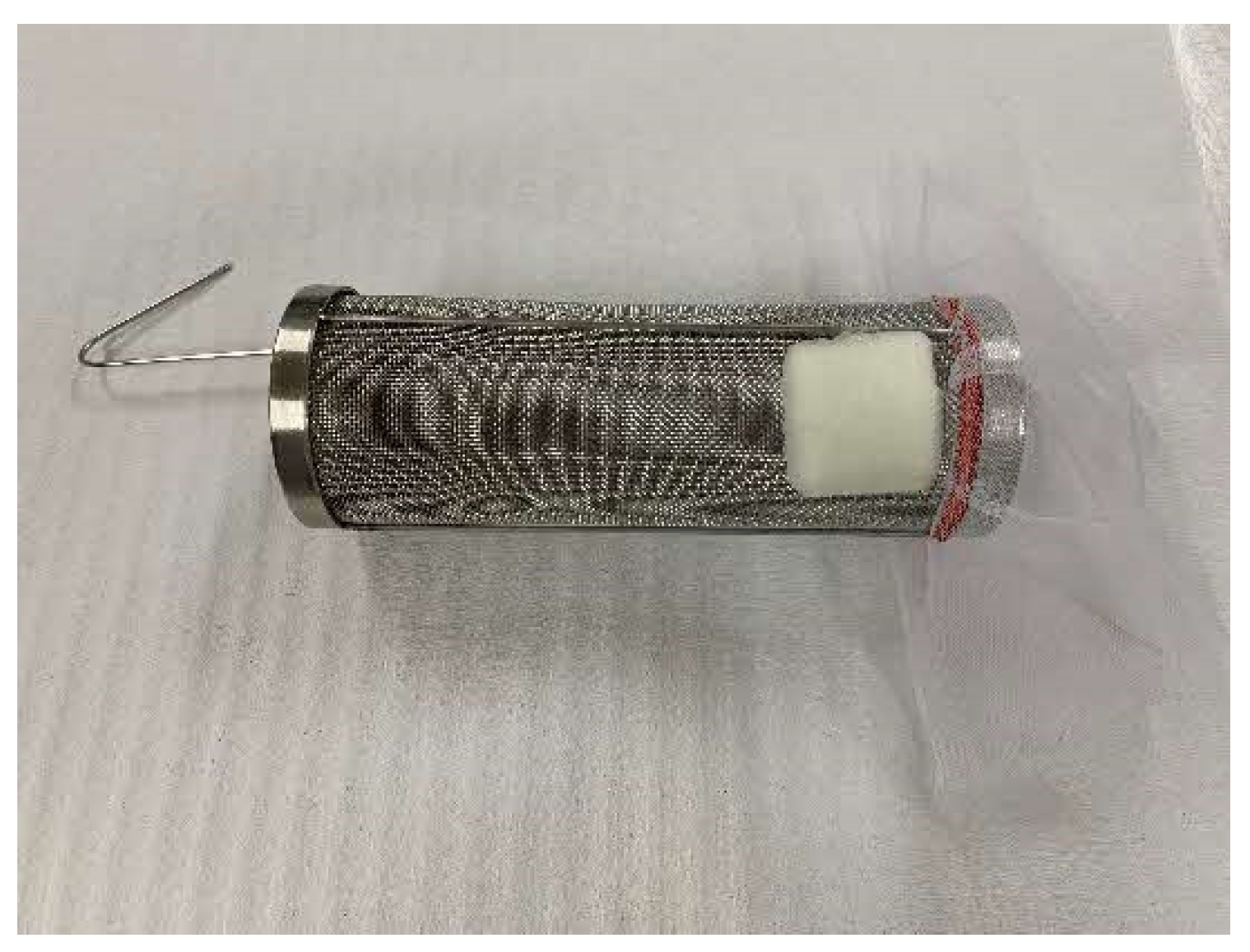
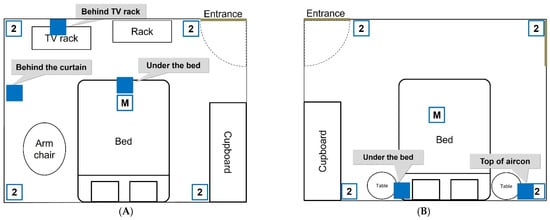
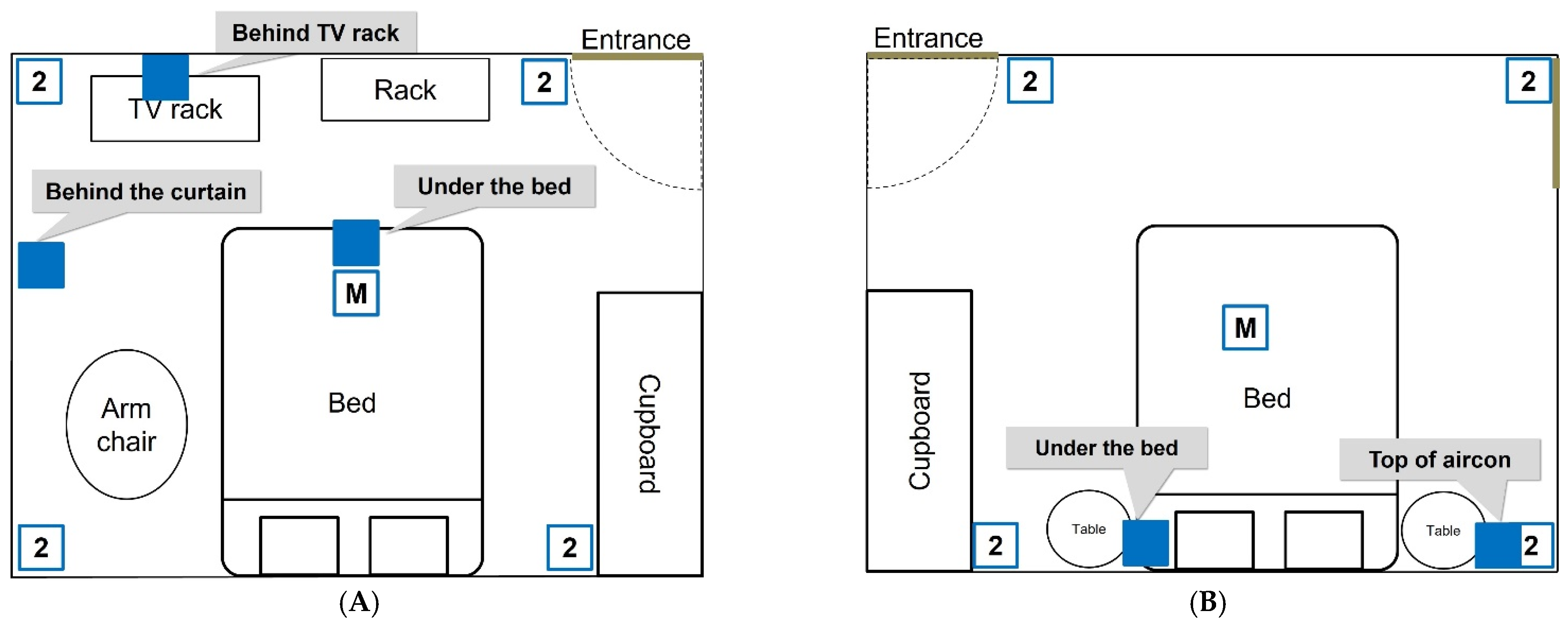
All test procedures were carried out according to the recommendations from the World Health Organization’s (WHO) Guidelines for efficacy testing of insecticides for indoor and outdoor ground-applied space spray applications [34]. Female mosquitoes were transferred into cylindrical mesh cages (5 cm diameter × 15 cm height, as depicted in Figure 3) [35]. Within each test room (volume: 28.5–30.0 m3), cages were placed at nine fixed positions: one at mid-height at the centre of the room and four at 0.25 m below the ceiling and 0.25 m above the floor. Two to three additional cages were placed at typical mosquitoes resting sites, such as under the bed [36] (as depicted in Figure 4 and Figure 5). All fans and air-conditioning units were switched off and all windows and doors in the rooms were closed during the test. Temperature and relative humidity were recorded. Cages containing mosquitoes were placed in the room (at the positions stated above) for 60 min and were checked for knockdown or mortality before spraying.
Figure 3.
A cylindrical mesh cage with female mosquitoes within.
Figure 4.
Schematic diagram of Room 1 (A) and Room 2 (B) showing the mesh cage positions for the 60 min exposure duration. In each mesh cage position, one cage of field strain and one of susceptible strain mosquitoes are placed. Non-filled and filled squares represent exposed and hidden cages, respectively. “2” indicates cages placed 0.25 m below the ceiling and 0.25 m above the floor and “M” indicates cages placed mid-height (1.5 m) at the centre of the room. The dashed arc indicates the door swing path (as depicted in Figure 5).
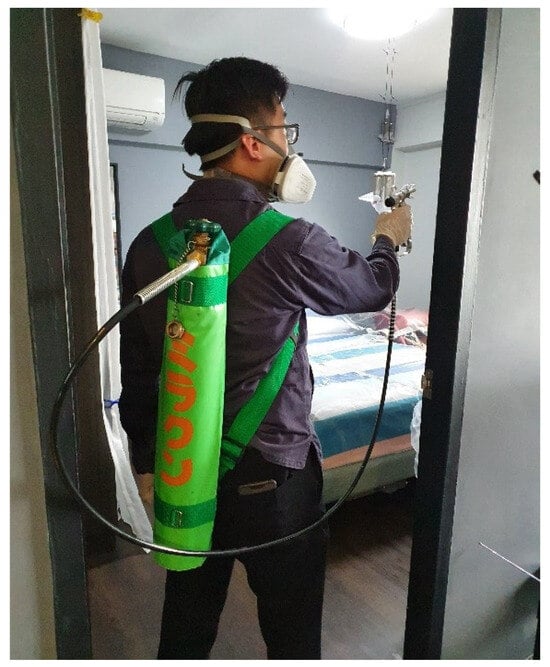
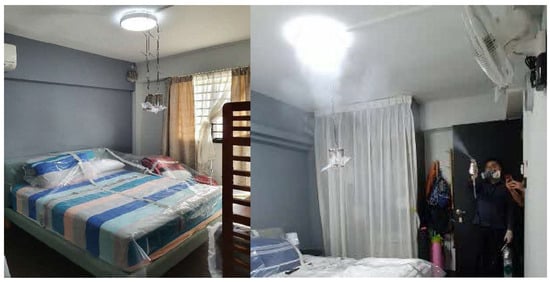
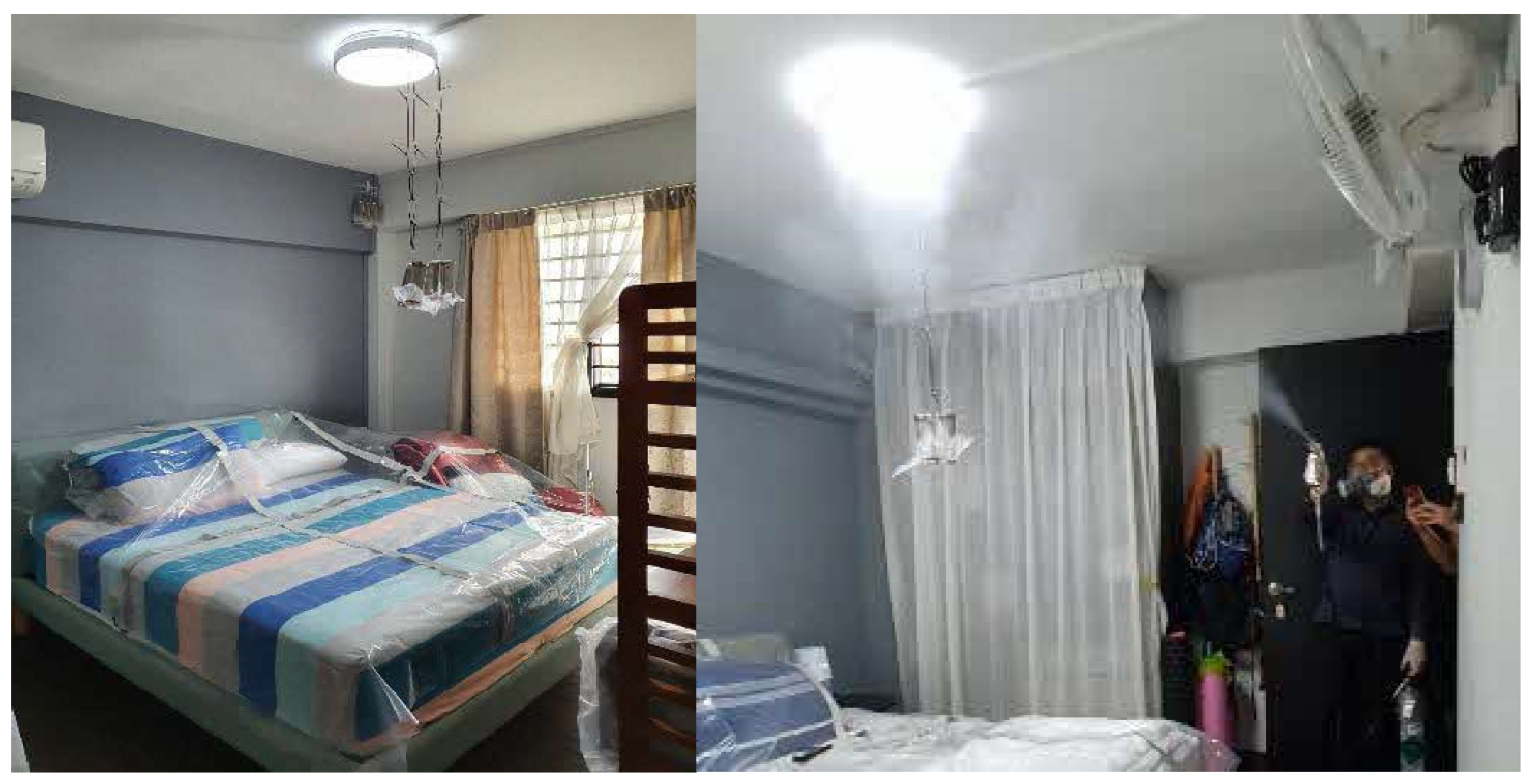
Figure 5.
Exposed cages placed 0.25 m below the ceiling and in the middle of Room 1. Actual hidden cages are located behind the curtain and under the bed (left). Spraying of Mirakn® GX from the entrance of the room (right).
Mirakn® GX was sprayed for 5 s (calculated based on volume of room and average discharge rate) from the entrance of the room (as depicted in Figure 5) from left to right at the recommended application dose of 1 g/m3. The room was then kept shut for 60 min (exposure duration) to ensure mosquito exposure to the insecticide. A pad was placed at the bottom of the door to prevent any leakage. All cages were retrieved from treated rooms immediately after the exposure duration. Mosquitoes from the individual cages were then transferred into a clean labelled paper cup and provided with 10% sucrose solution on cotton wool. Knocked-down mosquitoes were recorded immediately after transfer, and mortality was recorded at 24 h post-treatment.
Three biological replicates were conducted for Ae. aegypti and Ae. albopictus, while two biological replicates were performed for Cx. quinquefasciatus due to insufficient mosquitoes and logistical constraints. Each replicate was carried out on different occasions, with at least a fortnight between repetitions.
2.5. Statistical Analysis
All data were collated and analysed using RStudio (Version 1.3.959, RStudio: Integrated Development for R. RStudio, PBC, Boston, MA, USA). Shapiro–Wilk tests showed that the data did not conform to conditions of normality; hence, non-parametric analyses were used. The Wilcoxon Rank Sum Test was used to compare mortality outcomes between field and susceptible strains of the three mosquito species and between exposed and hidden cages. Additionally, the Kruskal–Wallis Rank Sum Test was used to assess the differences among the three mosquito species. These non-parametric statistical methods were selected to robustly capture variations between the tested groups.
3. Results
In our study, each mesh cage contained 15 to 33 female mosquitoes. Across all replicates, Mirakn® GX achieved 100% knockdown, and 99.79 to 100% mortality was observed against field and susceptible strains of Ae. aegypti, Ae. albopictus and Cx. quinquefasciatus (Table 1). Only 3 out of 1508 (0.21%) members of the field strain of Ae. aegypti survived exposure, corresponding to a mortality rate of 99.79%. Statistical analysis showed no significant differences between field and susceptible strains of Ae. aegypti (p = 0.0825), between hidden and exposed cages (p = 0.565) or among the three mosquito species (p = 0.0787).
Table 1.
High mean % knockdown ^ and mean % mortality # observed in field and susceptible strains of Ae. aegypti, Ae. albopictus and Cx. quinquefasciatus indicate the strong effectiveness of Mirakn® GX.
4. Discussion
Chemical interventions have long been the cornerstone of mosquito vector control during outbreaks aimed at breaking transmission chains [37,38]. However, mosquito vectors have gradually developed resistance mechanisms that enable them to counteract the toxic effects of insecticides [39,40]. In Singapore, field strains of Ae. aegypti have exhibited varying levels of pyrethroid resistance in WHO tube bioassays [14,16]. While such bioassays provide evidence of resistance in mosquito populations, they do not directly demonstrate a loss of efficacy under operational conditions. Field evaluations are therefore essential to validate laboratory findings and assess the practical implications of resistance for vector control [41].
Despite the presence of pyrethroid resistance in local Ae. aegypti populations, field-collected mosquitoes do not uniformly express resistance traits [14,15]. An important limitation of this study is that insecticide susceptibility testing was not performed on the field-collected mosquito populations used. Although pyrethroid resistance has been reported previously in Singapore’s populations of Ae. aegypti and Ae. albopictus, the resistance status of the specific mosquito cohorts used here remains unknown. Nonetheless, pyrethroid-formulated products remain efficacious if applied at sufficient doses or having the appropriate formulation characteristics. A laboratory study using WHO intensity bioassays on resistant Ae. aegypti has shown that higher deltamethrin concentrations up to 10× the standard dose can still achieve high mortality (98.95%), suggesting that increased concentrations may help overcome resistance and maintain efficacy [40]. However, because susceptibility testing was not performed on the field-collected mosquitoes used in this study, it remains unclear whether the observed efficacy reflects elevated application rates, formulation characteristics, or the inherent susceptibility of the tested population. In the case of Mirakn® GX, although the diagnostic concentration for d,d-trans-cyphenothrin has not been established, its concentration of 0.6% w/w is comparable to the diagnostic dose of 0.707% w/w reported for cyphenothrin [42]. However, d,d-trans-cyphenothrin is a chemically purified isomer containing about 98% of the biologically active form [43] compared to cyphenothrin’s 50%. This means that the concentration of d,d-trans-cyphenothrin represents a higher effective dose compared to cyphenothrin. According to the FAO/WHO Evaluation report [26], d,d-trans-cyphenothrin has approximately two times the insecticidal activity of cyphenothrin when tested against the common house mosquito, housefly and German cockroach.
The formulation showed strong adulticidal efficacy (100% knockdown and 99.79% mortality) against both field and susceptible strains of Ae. aegypti, Ae. albopictus and Cx. quinquefasciatus, indicating high effectiveness under the semi-field conditions evaluated. However, the relative contributions of insecticide concentration, formulation characteristics, and mosquito susceptibility could not be determined. The insecticide also exhibited strong adulticidal efficacy, with 99.12 to 100% mortality observed even within hidden areas of the experimental set-up, such as those placed under the bed or behind the curtain. This demonstrates the formulation’s high diffusion capacity and its ability to penetrate potential hidden mosquito resting sites. The observed efficacy could be attributed to the CO2 in the formulation, which is known to enhance insecticide dispersion and improve coverage. Previous studies have demonstrated that CO2 acts as a highly effective carrier, enhancing the dispersion of insecticides into “hard-to-reach” areas and increasing overall treatment efficacy against various stored-product pests [17,19]. These findings suggest that the CO2-based formulation facilitates superior insecticide penetration, increasing the likelihood of direct contact with mosquitoes even in hidden resting sites, thus maximising its adulticidal activity.
Beyond enhancing the dispersion of insecticide, CO2 can influence mosquito physiological processes. Studies have reported that CO2 can enhance insecticide toxicity by prolonging or irreversibly opening spiracles, resulting in increased uptakes of insecticides [37,38,39,40]. In cockroaches, spiracles serve as a primary penetration route for aerosolised pyrethroids, directly affecting knockdown efficacy [44]. Similar studies on stored-product pests showed that spiracles are also a major entry point for fumigants or aerosolised insecticides, demonstrating that CO2-driven spiracular responses can further enhance mortality [17,19,45,46]. Since Ae. aegypti are also reported to undergo extensive spiracular opening even in the presence of small concentrations of CO2 [47], a similar enhancement of insecticide uptake in the presence of CO2 by the study’s test mosquitoes is also likely. While these observations suggest plausible mechanisms through which CO2 may enhance insecticide delivery or mosquito exposure, the present study was not designed to evaluate the independent contribution of CO2, as a CO2-only control formulation was not available during the study period. Thus, our interpretation remains a hypothesis derived from these parallel systems. Consequently, the observed efficacy should be attributed to the complete formulation rather than to any specific contribution of CO2. Future work is necessary to isolate and quantify any direct or synergistic effects of CO2 on mosquitoes.
This study also explored operational practicality, where a single experimental trial was conducted in Room 1 and Room 2, with the exposure duration reduced to 10 min. Additional mosquito cages were strategically placed throughout the premises to simulate typical mosquito resting sites (as depicted in Supplementary Figure S1). Reducing the exposure duration from 60 to 10 min still achieved full knockdown and mortality against both field and susceptible strains of Ae. aegypti (as shown in Supplementary Table S1), suggesting that 10 min exposure duration is sufficient. A shortened exposure duration could minimise disruption to occupants and increase community acceptance of indoor space spraying operations.
As summarised in Supplementary Table S2, the insecticide product offers several practical advantages over conventional indoor ULV spraying. It is odourless, leaves no wet residues or solvent stains on surfaces, and does not require an external power source, reducing operational complexity and potential hazards associated with electrical equipment. Furthermore, the high diffusion capability of the formulation may improve the coverage of hidden or hard-to-reach resting sites, as observed by the high efficacy against Ae. aegypti, Ae. albopictus, and Cx. quinquefasciatus. This also reduces the treatment time and the time required for occupants to vacate the premises. Based on supplier-derived estimates, which incorporate differences in operational cost (per number of units and associated manpower requirements), the main drawback of Mirakn® GX is its relatively higher overall cost compared to conventional indoor ULV spraying.
Importantly, no occupants reported being unwell throughout the study period. These findings align with feedback from residents during the preliminary Mirakn® GX acceptance trial conducted by NEA at the Serangoon Gardens Estate, where 18 households across two streets participated and consented to this novel treatment approach.
While this study provides valuable insights into the use of Mirakn® GX as an alternative for indoor ULV spraying, the additional limitations need to be acknowledged. (1) These include the unavailability of a compressed gas tank without the active ingredient, which restricted the investigation of the isolated effect of CO2, a potential area for future research. (2) This study was conducted in a single occupied residential apartment unit comprising two rooms, representative of a typical public housing household in Singapore. While this provides a realistic operational setting, further evaluation across a wider range of housing layouts, room sizes, furnishing densities, ventilation characteristics, and housing types would help to strengthen the generalisability of the findings and provide additional support for the use of this insecticide in indoor space spraying. (3) Only two biological replicates were available for Cx. quinquefasciatus because of mosquito supply constraints. Although mortality was consistently 100% across both replicates, additional replication would improve confidence in the observed efficacy.
The present study followed WHO efficacy-testing guidelines using caged sentinel mosquitoes positioned at exposed and hidden locations. This methodology provides a standardised and reproducible assessment of insecticidal efficacy and facilitates comparison across studies. Although free-flying mosquito evaluations may offer additional insights into operational performance under real-world conditions, they are associated with greater variability in mosquito movement, exposure, and recapture. Future studies incorporating free-flying mosquitoes may be considered to complement the present findings and contribute additional evidence on operational effectiveness.
The growing problem of pyrethroid resistance in Ae. aegypti, Ae. albopictus and Cx. quinquefasciatus has been well documented globally [40,48,49,50,51], highlighting the need for the judicious use of insecticides, rotation between different insecticide classes, and adoption of integrated vector management (IVM) strategies to slow resistance development. Although pyrethroid resistance has previously been documented in Singapore’s Ae. aegypti populations, the susceptibility status of the field-collected mosquitoes evaluated in this study was not determined. Therefore, the present findings demonstrate efficacy against locally collected mosquito populations under the conditions tested but do not allow for conclusions regarding the efficacy against resistance-characterised populations.
Supplementary Materials
The following supporting information can be downloaded at https://www.mdpi.com/article/10.3390/insects17070716/s1, Figure S1: Schematic diagram of the residential apartment unit showing mesh cage positions for the “adjusted exposure duration” efficacy test; Table S1: Mean % knockdown ^ and total % mortality # for field and susceptible strains of Ae. aegypti show the high effectiveness of Mirakn® GX; Table S2: Advantages and disadvantages between Mirakn® GX and conventional indoor ULV spraying.
Author Contributions
C.-H.T., S.C., S.-Y.K. and S.-C.P. conceived of this study, and all authors participated in the experimental design. C.-H.T., S.C., S.-Y.K. and S.-C.P. performed the experiments. S.C. and S.-Y.K. analysed the data. S.C. and S.-Y.K. drafted the manuscript. S.-C.P., M.Z.A.R., L.-C.N. and C.-H.T. reviewed and revised the manuscript. All authors have read and agreed to the published version of the manuscript.
Funding
This study was supported by the National Environment Agency, Singapore (TS275). The funding source of this study had no role in the study design, data collection, data analysis, data interpretation, writing of the report, or in the decision to submit the paper for publication.
Institutional Review Board Statement
Not applicable.
Informed Consent Statement
Not applicable.
Data Availability Statement
The datasets generated during and/or analysed during the current study are available from the corresponding author on reasonable request.
Acknowledgments
We are grateful to the premises volunteer for providing the use of the study site. We also thank colleagues from the Environmental Health Institute (EHI) and the Eastern Regional Office (ERO) of the National Environment Agency (NEA), Singapore, for their support during this study. We acknowledge Chong Chee Seng (EHI) and Lee Chow Yang (University of California, Riverside, USA) for their critical review of the manuscript. We further thank Bentz Jaz Singapore, Sumitomo Chemical Asia, and EcoSpace Pest Management for providing the test product, licensed vector control operator and technical support throughout this study.
Conflicts of Interest
Sin-Ying Koou was affiliated with the Environmental Health Institute during the time of this study. Author Suzanna Chiang, Sook-Cheng Pang, Sin-Ying Koou, Lee-Ching Ng and Cheong-Huat Tan were employed by the Environmental Health Institute, National Environment Agency. The remaining authors declare that the research was conducted in the absence of any commercial or financial relationships that could be construed as potential conflicts of interest.
References
- Seah, A.; Aik, J.; Ng, L.-C.; Tam, C.C. The effects of maximum ambient temperature and heatwaves on dengue infections in the tropical city-state of Singapore–A time series analysis. Sci. Total Environ. 2021, 775, 145117. [Google Scholar] [CrossRef] [Scilit] [PubMed]
- Huang, L.; Xiao, G.; Chen, H.; Niu, X.; Fu, X.; Xu, H.; Xu, G.; Ma, S.; Ong, J.; Ng, L.C. Geographical clusters of dengue outbreak in Singapore during the COVID-19 nationwide lockdown of 2020. Sci. Data 2022, 9, 547. [Google Scholar] [CrossRef] [Scilit] [PubMed]
- Ho, S.H.; Lim, J.T.; Ong, J.; Hapuarachchi, H.C.; Sim, S.; Ng, L.C. Singapore’s 5 decades of dengue prevention and control—Implications for global dengue control. PLoS Negl. Trop. Dis. 2023, 17, e0011400. [Google Scholar] [CrossRef] [Scilit]
- Cheema, H.A.; Mujtaba, R.S.; Siddiqui, A.; Vohra, L.I.; Shahid, A.; Shah, J.; Nashwan, A.J.; Howard, N. Singapore’s dengue outbreak amidst the COVID-19 pandemic: Challenges, responses, and lessons. Infect. Drug Resist. 2023, 16, 1081–1085. [Google Scholar] [CrossRef] [Scilit] [PubMed]
- Leo, Y.-S.; Chow, A. Zika virus has arrived in Singapore. Lancet Infect. Dis. 2016, 16, 1317–1319. [Google Scholar] [CrossRef] [Scilit] [PubMed]
- Ho, Z.J.M.; Hapuarachchi, H.C.; Barkham, T.; Chow, A.; Ng, L.C.; Lee, J.M.V.; Leo, Y.S.; Prem, K.; Lim, Y.H.G.; de Sessions, P.F. Outbreak of Zika virus infection in Singapore: An epidemiological, entomological, virological, and clinical analysis. Lancet Infect. Dis. 2017, 17, 813–821. [Google Scholar] [CrossRef] [Scilit]
- Wong, J.C.C.; Tay, M.; Hapuarachchi, H.C.; Lee, B.; Yeo, G.; Maliki, D.; Lee, W.; Suhaimi, N.-A.M.; Chio, K.; Tan, W.C.H. Case report: Zika surveillance complemented with wastewater and mosquito testing. Ebiomedicine 2024, 101, 105020. [Google Scholar] [CrossRef] [Scilit] [PubMed]
- Scott, T.W.; Takken, W. Feeding strategies of anthropophilic mosquitoes result in increased risk of pathogen transmission. Trends Parasitol. 2012, 28, 114–121. [Google Scholar] [CrossRef] [Scilit] [PubMed]
- Rajarethinam, J.; Ong, J.; Neo, Z.-W.; Ng, L.-C.; Aik, J. Distribution and seasonal fluctuations of Ae. aegypti and Ae. albopictus larval and pupae in residential areas in an urban landscape. PLoS Negl. Trop. Dis. 2020, 14, e0008209. [Google Scholar] [CrossRef] [Scilit]
- Rajarethinam, J.; Ang, L.-W.; Ong, J.; Ycasas, J.; Hapuarachchi, H.C.; Yap, G.; Chong, C.-S.; Lai, Y.-L.; Cutter, J.; Ho, D. Dengue in Singapore from 2004 to 2016: Cyclical epidemic patterns dominated by serotypes 1 and 2. Am. J. Trop. Med. Hyg. 2018, 99, 204. [Google Scholar] [CrossRef] [Scilit] [PubMed]
- Sim, S.; Ng, L.C.; Lindsay, S.W.; Wilson, A.L. A greener vision for vector control: The example of the Singapore dengue control programme. PLoS Negl. Trop. Dis. 2020, 14, e0008428. [Google Scholar] [CrossRef] [Scilit]
- Consortium, P.W.S.; Ching, N.L. Wolbachia-mediated sterility suppresses Aedes aegypti populations in the urban tropics. medRxiv 2021. [Google Scholar] [CrossRef] [Scilit]
- Pryce, J.; Choi, L.; Richardson, M.; Malone, D. Insecticide space spraying for preventing malaria transmission. Cochrane Database Syst. Rev. 1996, 2018. [Google Scholar] [CrossRef] [Scilit] [PubMed]
- Koou, S.-Y.; Chong, C.-S.; Vythilingam, I.; Lee, C.-Y.; Ng, L.-C. Insecticide resistance and its underlying mechanisms in field populations of Aedes aegypti adults (Diptera: Culicidae) in Singapore. Parasites Vectors 2014, 7, 471. [Google Scholar] [CrossRef] [Scilit] [PubMed]
- Koou, S.-Y.; Chong, C.-S.; Vythilingam, I.; Ng, L.-C.; Lee, C.-Y. Pyrethroid resistance in Aedes aegypti larvae (Diptera: Culicidae) from Singapore. J. Med. Entomol. 2014, 51, 170–181. [Google Scholar] [CrossRef] [Scilit] [PubMed]
- Lee, R.; Choong, C.; Goh, B.; Ng, L.; Lam-Phua, S. Bioassay and biochemical studies of the status of pirimiphos-methyl and cypermethrin resistance in Aedes (Stegomyia) aegypti and Aedes (Stegomyia) albopictus (Diptera: Culicidae) in Singapore. Trop. Biomed. 2014, 31, 670–679. [Google Scholar] [PubMed]
- Valizadegan, O.; Pourmirza, A.A.; Safaralizadeh, M.H. The impact of carbon dioxide in stored-product insect treatment with phosphine. Afr. J. Biotechnol. 2012, 11, 6377–6382. [Google Scholar] [CrossRef] [Scilit]
- Golestan, M.N.; Pourmirza, A.A. Efficacy of ozone mixed with carbon dioxide on the mortality of Rhyzopertha dominica (F.) inside food packaging. Munis Entomol. Zool. 2016, 11, 169–175. [Google Scholar]
- Riudavets, J.; Castañé, C.; Alomar, O.; Pons, M.J.; Gabarra, R. The use of carbon dioxide at high pressure to control nine stored-product pests. J. Stored Prod. Res. 2010, 46, 228–233. [Google Scholar] [CrossRef] [Scilit]
- Soh, S.; Aik, J. The abundance of Culex mosquito vectors for West Nile Virus and other flaviviruses: A time-series analysis of rainfall and temperature dependence in Singapore. Sci. Total Environ. 2021, 754, 142420. [Google Scholar] [CrossRef] [Scilit] [PubMed]
- Seah, A.; Aik, J.; Ng, L.-C. Effect of meteorological factors on Culex mosquitoes in Singapore: A time series analysis. Int. J. Biometeorol. 2021, 65, 963–965. [Google Scholar] [CrossRef] [Scilit] [PubMed]
- Yap, G.; Mailepessov, D.; Lim, X.F.; Chan, S.; How, C.B.; Humaidi, M.; Yeo, G.; Chong, C.S.; Lam-Phua, S.G.; Lee, R.; et al. Detection of Japanese Encephalitis Virus in Culex Mosquitoes in Singapore. Am. J. Trop. Med. Hyg. 2020, 103, 1234–1240. [Google Scholar] [CrossRef] [Scilit] [PubMed]
- Yap, G.; Lim, X.F.; Chan, S.; How, C.B.; Humaidi, M.; Yeo, G.; Mailepessov, D.; Kong, M.; Lai, Y.L.; Okumura, C.; et al. Serological evidence of continued Japanese encephalitis virus transmission in Singapore nearly three decades after end of pig farming. Parasites Vectors 2019, 12, 244. [Google Scholar] [CrossRef] [Scilit] [PubMed]
- Rezza, G. Aedes albopictus and the reemergence of Dengue. BMC Public Health 2012, 12, 72. [Google Scholar] [CrossRef] [Scilit] [PubMed]
- Kek, R.; Hapuarachchi, H.; Chung, C.-Y.; Humaidi, M.B.; Razak, M.A.B.; Chiang, S.; Lee, C.; Tan, C.-H.; Yap, G.; Chong, C.-S. Feeding host range of Aedes albopictus (Diptera: Culicidae) demonstrates its opportunistic host-seeking behavior in rural Singapore. J. Med. Entomol. 2014, 51, 880–884. [Google Scholar] [CrossRef] [Scilit] [PubMed]
- WHO (World Health Organization). Report of the Seventh WHOPES Working Group Meeting; World Health Organization: Geneva, Switzerland, 2004. [Google Scholar]
- Mittal, P.; Sreehari, U.; Razdan, R.; Dash, A. Efficacy of Cyphenothrin (Gokilaht®-S 5% EC) as space spray against mosquitoes in sentinel cages. J. Vector Borne Dis. 2009, 46, 241–244. [Google Scholar] [PubMed]
- Singapore Department of Statistics. Population and Population Structure. Available online: https://www.singstat.gov.sg/find-data/explore-data-themes/population/population-and-population-structure/latest-news-data (accessed on 1 July 2026).
- Singapore Department of Statistics. Resident Households. Available online: https://www.singstat.gov.sg/find-data/explore-data-themes/households/resident-households/latest-news-data (accessed on 1 July 2026).
- Aik, J.; Neo, Z.W.; Rajarethinam, J.; Chio, K.; Lam, W.M.; Ng, L.-C. The effectiveness of inspections on reported mosquito larval habitats in households: A case-control study. PLoS Negl. Trop. Dis. 2019, 13, e0007492. [Google Scholar] [CrossRef] [Scilit]
- Tan, C.-H.; Wong, P.-S.J.; Li, M.-Z.I.; Yang, H.-T.; Chong, C.-S.; Lee, L.K.; Yuan, S.; Leo, Y.-S.; Ng, L.-C.; Lye, D.C. Membrane feeding of dengue patient’s blood as a substitute for direct skin feeding in studying Aedes-dengue virus interaction. Parasites Vectors 2016, 9, 211. [Google Scholar] [CrossRef] [Scilit] [PubMed]
- Rattanarithikul, R.; Harrison, B.A.; Panthusiri, P.; Coleman, R.E. Illustrated keys to the mosquitoes of Thailand I. Background; geographic distribution; lists of genera, subgenera, and species; and a key to the genera. Southeast Asian J. Trop. Med. Public Health 2005, 36, 1–80. [Google Scholar] [PubMed]
- Yeo, H.; Tan, C.-H.; Chong, C.-S.; Lam-Phua, S.-G. Identification key to the genera of adult female mosquitoes (Diptera: Culicidae) of Singapore. Zootaxa 2019, 4624, 407–423. [Google Scholar] [CrossRef] [Scilit]
- WHO (World Health Organization). Guidelines for Efficacy Testing of Insecticides for Indoor and Outdoor Ground-Applied Space Spray Applications; World Health Organization: Geneva, Switzerland, 2009. [Google Scholar]
- Pang, S.C.; Foo, S.Y.; Png, A.B.; Deng, L.; Lam-Phua, S.G.; Tang, C.S.; Ng, L.C. Evaluation of a “fogging” canister for indoor elimination of adult Aedes aegypti. Dengue Bull. 2009, 33, 203–208. [Google Scholar]
- Centers for Disease Control and Prevention. Mosquito Control at Home. Available online: https://www.cdc.gov/mosquitoes/mosquito-control/mosquito-control-at-home.html (accessed on 1 December 2025).
- van den Berg, H.; Zaim, M.; Yadav, R.S.; Soares, A.; Ameneshewa, B.; Mnzava, A.; Hii, J.; Dash, A.P.; Ejov, M. Global Trends in the Use of Insecticides to Control Vector-Borne Diseases. Environ. Health Perspect. 2012, 120, 577–582. [Google Scholar] [CrossRef] [Scilit] [PubMed]
- van den Berg, H.; Velayudhan, R.; Yadav, R.S. Management of insecticides for use in disease vector control: Lessons from six countries in Asia and the Middle East. PLoS Negl. Trop. Dis. 2021, 15, e0009358. [Google Scholar] [CrossRef] [Scilit] [PubMed]
- Kasai, S.; Komagata, O.; Itokawa, K.; Shono, T.; Ng, L.C.; Kobayashi, M.; Tomita, T. Mechanisms of Pyrethroid Resistance in the Dengue Mosquito Vector, Aedes aegypti: Target Site Insensitivity, Penetration, and Metabolism. PLoS Negl. Trop. Dis. 2014, 8, e2948. [Google Scholar] [CrossRef] [Scilit] [PubMed]
- Smith, L.B.; Kasai, S.; Scott, J.G. Pyrethroid resistance in Aedes aegypti and Aedes albopictus: Important mosquito vectors of human diseases. Pestic. Biochem. Physiol. 2016, 133, 1–12. [Google Scholar] [CrossRef] [Scilit] [PubMed]
- Namias, A.; Jobe, N.B.; Paaijmans, K.P.; Huijben, S. The need for practical insecticide-resistance guidelines to effectively inform mosquito-borne disease control programs. eLife 2021, 10, e65655. [Google Scholar] [CrossRef] [Scilit] [PubMed]
- Mongkalangoon, P.; Grieco, J.P.; Achee, N.L.; Suwonkerd, W.; Chareonviriyaphap, T. Irritability and repellency of synthetic pyrethroids on an Aedes aegypti population from Thailand. J. Vector Ecol. 2009, 34, 217–224. [Google Scholar] [CrossRef] [PubMed]
- WHO. WHO Specifications and Evaluations for Public Health Pesticides: d,d,trans-Cyphenothrin; WHO: Geneva, Switzerland, 2017. [Google Scholar]
- Sugiura, M.; Horibe, Y.; Kawada, H.; Takagi, M. Insect spiracle as the main penetration route of pyrethroids. Pestic. Biochem. Physiol. 2008, 91, 135–140. [Google Scholar] [CrossRef] [Scilit]
- Gou, Y.-P.; Quandahor, P.; Mao, L.; Li, C.-C.; Zhou, J.-J.; Liu, C.-Z. Responses of fungi maggot (Bradysia impatiens Johannsen) to allyl isothiocyanate and high CO2. Front. Physiol. 2022, 13, 879401. [Google Scholar] [CrossRef] [Scilit] [PubMed]
- Gad, H.A.; El-Deeb, S.E.; Atta, A.A.; Al-Anany, F.S.; Abdelgaleil, S.A. Integrating inert dusts with carbon dioxide as an ecofriendly approach for the control of Trogoderma granarium everts. J. Plant Dis. Prot. 2025, 132, 144. [Google Scholar] [CrossRef] [Scilit]
- Krafsur, E.S.; Graham, C.L. Spiracular responses of Aedes mosquitoes to carbon dioxide and oxygen. Ann. Entomol. Soc. Am. 1970, 63, 691–696. [Google Scholar] [CrossRef] [Scilit] [PubMed]
- Auteri, M.; La Russa, F.; Blanda, V.; Torina, A. Insecticide Resistance Associated with kdr Mutations in Aedes albopictus: An Update on Worldwide Evidences. BioMed Res. Int. 2018, 2018, 3098575. [Google Scholar] [CrossRef] [Scilit] [PubMed]
- Chamnanya, S.; Yanola, J.; Nachaiwieng, W.; Lumjuan, N.; Walton, C.; Somboon, P. Novel real-time PCR assay detects widespread distribution of knock down resistance (kdr) mutations associated with pyrethroid resistance in the mosquito, Culex quinquefasciatus, in Thailand. Pestic. Biochem. Physiol. 2022, 186, 105172. [Google Scholar] [CrossRef] [Scilit] [PubMed]
- Hafez, A.M. First comprehensive report of the resistance of Culex quinquefasciatus Say (Diptera: Culicidae) to commonly used insecticides in Riyadh, Saudi Arabia. Heliyon 2023, 9, e12709. [Google Scholar] [CrossRef] [Scilit] [PubMed]
- Omotayo, A.I.; Dogara, M.M.; Sufi, D.; Shuaibu, T.; Balogun, J.; Dawaki, S.; Muktar, B.; Adeniyi, K.; Garba, N.; Namadi, I. High pyrethroid-resistance intensity in Culex quinquefasciatus (say) (Diptera: Culicidae) populations from Jigawa, north-west, Nigeria. PLoS Negl. Trop. Dis. 2022, 16, e0010525. [Google Scholar] [CrossRef] [Scilit]

Disclaimer/Publisher’s Note: The statements, opinions and data contained in all publications are solely those of the individual author(s) and contributor(s) and not of MDPI and/or the editor(s). MDPI and/or the editor(s) disclaim responsibility for any injury to people or property resulting from any ideas, methods, instructions or products referred to in the content. |
© 2026 by the authors. Licensee MDPI, Basel, Switzerland. This article is an open access article distributed under the terms and conditions of the Creative Commons Attribution (CC BY) license.