


Simple Summary
We assessed the effects of five constant rearing temperatures on key biological parameters of Trichogramma bourarachae Pintureau & Babault and two strains (S1 and S2) of T. cacoeciae Marchal reared on Ephestia kuehniella Zeller eggs. Higher emergence rates were observed between 25 °C and 33 °C for all parasitoids. However, at 35 °C, emergence declined in T. cacoeciae, whereas T. bourarachae showed greater tolerance to elevated temperature. Parasitism rates were significantly influenced by temperature and parental thermal history. Trichogramma bourarachae showed maximum parasitism at 25 °C, while parental development at 30 °C improved performance at higher temperatures. In T. cacoeciae, optimal parasitism varied between strains depending on parental rearing temperature. Female longevity decreased with increasing temperature, but parasitoids originating from parental generation that developed at 30 °C showed improved survival at higher temperatures. Temperature increase induced a male-biased sex ratio in T. bourarachae, while T. cacoeciae maintained stable thelytokous reproduction. These results highlight the importance of considering thermal tolerance and parental thermal history for selecting Trichogramma strains for mass rearing and biological control purposes.
Abstract
The field effectiveness of Trichogramma parasitoids (Hymenoptera: Trichogrammatidae) against lepidopteran pests is strongly influenced by temperature, which affects their development, survival, parasitism and reproductive performance. Understanding thermal requirements is therefore essential for optimizing mass rearing and release strategies. The present study evaluated the effects of five constant temperatures (25, 30, 33, 35, and 40 °C) on biological parameters of Trichogramma bourarachae Pintureau & Babault and two strains (S1 and S2) of T. cacoeciae Marchal reared on Ephestia kuehniella Zeller eggs. Emergence rates were higher between 25 °C and 33 °C for all tested parasitoids, decreased markedly at 35 °C for T. cacoeciae, whereas T. bourarachae emergence showed higher tolerance at 35 °C, and no emergence was recorded for all parasitoids at 40 °C. Parasitism capacity was strongly influenced by both temperature and parental thermal history. Trichogramma bourarachae exhibited its highest parasitism rate at 25 °C; however, females originating from the parental generation that developed at 30 °C maintained relatively high parasitism rates at elevated temperatures (30 to 35 °C). For T. cacoeciae S1, parental development at 30 °C enhanced offspring parasitism over a broader temperature range. Conversely, T. cacoeciae S2 achieved maximum parasitism when the parental generation developed at 25 °C, with high parasitism maintained at 25 °C, 30 °C, and 33 °C. At the species level, parasitism was highest between 25 °C and 33 °C, declined at 35 °C, and no parasitism was recorded at 40 °C due to the absence of survival. Within each species, however, strain-specific differences were observed, particularly at 35 °C, indicating variability in thermal tolerance and reproductive performance. Female longevity decreased with increasing temperature in all species and strains. However, individuals originating from parental generation that developed at 30 °C exhibited improved survival when exposed to elevated oviposition temperatures, indicating thermal acclimation. Increasing temperature induced a male-biased sex ratio in T. bourarachae, whereas T. cacoeciae maintained stable thelytokous reproduction across all treatments. These results emphasize the importance of thermal tolerance and parental thermal history for selecting suitable Trichogramma species and strains for mass rearing and field application for biological control under warming climatic conditions.
Keywords:
egg parasitoid; thermal tolerance; emergence; parasitism; longevity; sex ratio; biological control 1. Introduction
Trichogramma spp. (Hymenoptera: Trichogrammatidae) are among the most widely used egg parasitoids in the biological control of lepidopteran pests worldwide; their success is mainly due to their broad host range and high efficacy against numerous target pests. In addition, they are easily mass-reared under laboratory conditions [1,2,3,4]. Currently, more than ten Trichogramma species are commercially or experimentally used in biological control programs against key crop pests, such as Ectomyelois ceratoniae (Zeller) (Lepidoptera: Pyralidae) [5,6,7,8], Tuta absoluta (Meyrick) (Lepidoptera: Gelechiidae) [9,10,11,12], Spodoptera frugiperda Smith (Lepidoptera: Noctuidae) [13,14,15,16], Helicoverpa armigera Hübner (Lepidoptera: Noctuidae) [4,17,18,19], and Ostrinia nubilalis Hübner (Lepidoptera: Crambidae) [2,20,21,22]. These egg parasitoids have been released in various agroecosystems, including cotton, maize, vegetables, and tree fruits, representing one of the most successful examples of augmentative biological control [23,24,25,26]. In Tunisia, the use of Trichogramma wasps is becoming increasingly prominent, as they are now officially integrated into national integrated pest management programs targeting major economic pests, such as the carob moth, E. ceratoniae [7,8], and the invasive South American tomato pinworm, T. absoluta [27,28,29]. However, despite their recognized biocontrol potential, the field performance of Trichogramma spp. often remains inconsistent due to local environmental constraints, especially temperature extremes and pronounced thermal fluctuations characterizing arid and semi-arid regions. A crucial step in developing an effective biological control program using Trichogramma involves selecting the most potent species or strain for managing the target pest and maintaining damage below an economically acceptable threshold [30,31]. Nevertheless, the efficacy of a parasitoid depends not only on its ability to parasitize hosts but also on its tolerance and adaptation to the thermal conditions of the release area [32,33,34]. A comprehensive understanding of the environmental factors, especially temperature, influencing reproductive performance of Trichogramma spp. under field conditions is essential for successful inundative releases. The ability to sustain high reproductive potential and survival under suboptimal temperatures is therefore a key factor for successful establishment and control efficiency [35,36,37,38]. Climate change has caused significant increases in global temperatures, disrupting ecosystem dynamics [39,40]. These effects are particularly severe for ectothermic organisms, as temperature governs nearly all aspects of insect biology, including development, survival, fecundity, and longevity [3,39,41,42,43,44].
Temperature affects development through two principal pathways: (i) directly modulating metabolic activity and growth rate, which generally increase within an optimal thermal range [45,46], and (ii) acting alone or in interaction with photoperiod as a key environmental cue regulating diapause induction [47]. Parasitoids, including Trichogramma, are highly sensitive to temperature throughout all life stages. High temperatures can accelerate development but often reduce longevity [37,48,49], whereas low temperatures tend to prolong development and increase mortality [32,37,38,50]. In addition to mean temperature, short-term thermal extremes and fluctuating regimes can strongly affect parasitoid performance. For example, heat or cold shocks can alter diapause incidence in Trichogramma telengai Sorokina [51], while fluctuating temperatures influence both diapause induction and developmental rates [52]. Similarly, heat stress during development may reduce emergence, longevity, and fecundity in related species such as Trichogramma bactrae Nagaraja [36,53,54].
Temperature also influences size and morphology, which may affect flight ability, host-searching behavior, and parasitism efficiency in the field [55,56]. Moreover, thermal conditions experienced during development can induce phenotypic plasticity in later generations. This transgenerational thermal effect, documented in parasitoids such as Aphidius colemani Viereck [57], shows that parental rearing temperature can influence offspring fecundity, sex ratio, and heat tolerance, which are critical for mass-rearing and field establishment of Trichogramma populations [58,59]. Such carry-over effects highlight the importance of strain selection to ensure stable performance under fluctuating field temperatures. For example, difference in thermal tolerance and parasitism capacity have been reported between strains of T. cacoeciae, with the Tunisian strain showing better adaptation and higher parasitism rates under high temperature conditions compared to the Italian strain [60]. Therefore, parental rearing temperature was explicitly incorporated into the experimental framework of the present study to evaluate its influence on key biological parameters. Understanding how temperature changes influence life-history traits of parasitoids is essential for predicting population dynamics and optimizing biological control applications [61]. Moreover, the development of efficient storage techniques is crucial for ensuring a continuous supply of parasitoids for mass production and field release. Indeed, pupal stages of different strains of Trichogramma chilonis Ishii stored at low temperatures (5 and 10 °C) exhibited marked strain-specific differences in their ability to maintain developmental arrest, emergence rate, and post-emergence survival, with some strains remaining viable for up to 50–60 days under optimal conditions [62].
The egg parasitoids Trichogramma bourarachae Pintureau & Babault and T. cacoeciae Marchal, two commercially important biocontrol candidates, have been successfully used against key lepidopteran pests across various agricultural systems worldwide. Although aspects of the life cycle of either T. bourarachae or T. cacoeciae have already been studied [33,63,64,65], different strains/ecotypes of these parasitoids from diverse geographic regions exhibit variable biological traits, which could affect their success in biological control programs [2,33,66]. Similarly, species-and strain-specific differences in emergence rate and longevity under cold storage conditions have already been reported, highlighting variability in physiological tolerance and performance among Trichogramma spp. [67].
In this context, comparative studies on thermal sensitivity among different Trichogramma species and strains are crucial for identifying candidates best suited to Mediterranean climatic conditions, where summer temperatures often exceed 40 °C.
Despite extensive research on temperature-dependent performance in Trichogramma spp., the interactive effects of parental thermal history and interspecific/strain variability under high-temperature conditions remain poorly understood. This study addresses this gap by providing a comparative analysis of two species and two strains across a wide thermal range, with a particular focus on transgenerational thermal effects relevant to biological control under climate warming.
The aim of the present study was to assess the effects of five rearing temperatures (25, 30, 33, 35, and 40 °C) on key biological parameters including pre-adult development, emergence rate, parasitism rate, survival (longevity), and sex ratio of T. bourarachae and two strains of T. cacoeciae. The present research would provide insights into how these parasitoids respond to climate change, which would optimize mass-rearing strategies and the timing of augmentative releases against target lepidopteran pests throughout Mediterranean agro-ecosystems.
2. Materials and Methods
2.1. Egg Parasitoid Rearing
Trichogramma cacoeciae is a thelytokous parasitoid that reproduces independently of Wolbachia symbiotic bacteria [68]. Trichogramma cacoeciae strain 1 (S1) was introduced as a local population in 2020 by collecting parasitoid wasps from host baits (sentinel eggs of Ephestia kuehniella Zeller (Lepidoptera: Pyralidae) in date palm orchards located in the southwest of Tunisia. However, strain 2 (S2) of T. cacoeciae was established in 2021 by collecting wasps from parasitized eggs of the carob moth E. ceratoniae in pomegranate orchards in southeastern Tunisia. The two strains of Trichogramma cacoeciae differ in their geographic origin, host species of origin, agroecosystem, and year of collection. Additionally, one arrhenotokous species, T. bourarachae, was initially collected from a date palm orchard using host baits (sentinel eggs of E. kuehniella) in the Tozeur oases, located in the southwest of Tunisia. In 2022, these two strains of T. cacoeciae and T. bourarachae were introduced in the laboratory of Date Palm Technical Center (CTD) in Kebili, Tunisia, for research and conservation purposes. The Trichogramma species studied were kept on ultraviolet-sterilized eggs of E. kuehniella in a climate-controlled chamber (25 ± 2 °C temperature, 70 ± 5% relative humidity (RH), and 16 h:8 h (L:D) photoperiod). Factitious host eggs were obtained from a culture of E. kuehniella reared on a standard diet composed of wheat flour, prepared according to the methodology described by Cerutti et al. [69].
2.2. Effect of Rearing Temperatures on Trichogramma Parasitoids
The experimental protocol design used in this study was similar to that described by Pizzol et al. [33] with slight modifications. In our study, five temperature treatments were evaluated (25, 30, 33, 35, and 40 ± 2 °C) instead of the four temperatures (15–30 °C) used in the reference protocol. In addition, multiple Trichogramma species and strains were tested rather than a single species. The oviposition period was extended to 24 h instead of 2 h to allow females to fully express their reproductive potential and to better reflect mass-rearing and biological control conditions. Furthermore, additional biological parameters, including daily mortality and sex ratio, were assessed.
2.3. Effect of Temperature on the First Generation (G1)
Females of each Trichogramma species and strains were allowed to oviposit at 25, 30, 33, 35, and 40 °C (±2 °C) in climatic chambers. For each treatment, 30 newly emerged females (<24-h-old) of each species and strain were individually isolated in glass vials (7.5 cm long × 1 cm diameter) to provide sufficient replication for statistical analysis and to account for individual variability in key biological traits. Each female parasitoid was provided with a drop of honey as food and supplied with fresh eggs of E. kuehniella as host (800 ± 50 one-day-old eggs sterilized with UV light) glued on a cardboard card (1 cm × 5 cm). This number of host eggs was provided in excess to prevent host limitation and to ensure accurate and comparable estimates of parasitism across treatments. Each isolated female represented a replicate. After 24 h, all females were removed and discarded from their vials using a thin brush, and the parasitized eggs were incubated at the respective pre-adult temperatures (25, 30, 33, 35, and 40 ± 2 °C). For each Trichogramma species and strain, this procedure provided five first-generation cohorts, hereafter referred to as G1–25, G1–30, G1–33, G1–35, and G1–40. The effect of temperature on parasitoids was assessed by recording the emergence rate, calculated as recommended by Van Driesche [70], using the following equation:
Emergence percentage = Number of eggs with emergence holes/Total number of eggs × 100
2.4. Effect of Temperature on the Second Generation (G2)
Females obtained from the above experiment were randomly selected at each of the tested pre-adult temperatures; only for the batch at 40 °C were no females selected, as no adult parasitoids emerged at this temperature in the G1 generation. Then 150 newly emerged females (<24-h-old) of each species and strain were collected from each of the four first-generation batches (G1-25, G1-30, G1-33 and G1-35); groups of 30 females were exposed during the oviposition period to each of the tested temperatures (25, 30, 33, 35, and 40 °C). Each treatment combination consisted of 30 individual females, each representing one replicate. Each female was individually isolated in glass vials (7.5 cm long × 1 cm diameter), fed with a drop of honey, and offered an egg card with 500 ± 50 one-day-old sterilized E. kuehniella eggs (6 cm × 0.9 cm). Each isolated female represented a replicate. In this way, females originating from 25 °C during G1 were tested at all five temperatures during G2, and the same procedure was followed for females that had developed at 30, 33, and 35 °C in G1. This gives 20 combinations for the second generation (G2). After exposing females to the host eggs for 7 days, they were removed. Three biological parameters were calculated: (i) parasitism rate was defined as the total number of successfully parasitized eggs by females over the 7 days; (ii) female mortality was monitored daily during the 7 days and the mortality was expressed as the cumulative number of dead females per day, and (iii) sex ratio was estimated using the following equation:
Female percentage = Number of females/Total number × 100
2.5. Data Analysis
All statistical analyses were performed using R version 4.5.0 [71]. Data were transformed before analysis to stabilize the variance [72]: emergence rate, sex ratio, and mortality by arcsin square root (arcsin √x) and fecundity by inverse (1/x). A generalized linear model (GLM binomial or Poisson) was then used to assess the effects of strain, temperature (G1), temperature (G2), and their interactions on the measured biological traits of the three studied strains. Overdispersion was assessed by comparing residual deviance to degrees of freedom to confirm the suitability of binomial and Poisson error structures. Binomial error distributions were used for proportional response variables (emergence rate, sex ratio, and mortality), whereas a Poisson error distribution was applied for count data (parasitism rate). ANOVA (Type III) on the GLM was used to evaluate the significance of each factor and interaction, based on the comparison of model deviance (likelihood ratio test).
3. Results
3.1. Emergence Rate in the First Generation (G1)
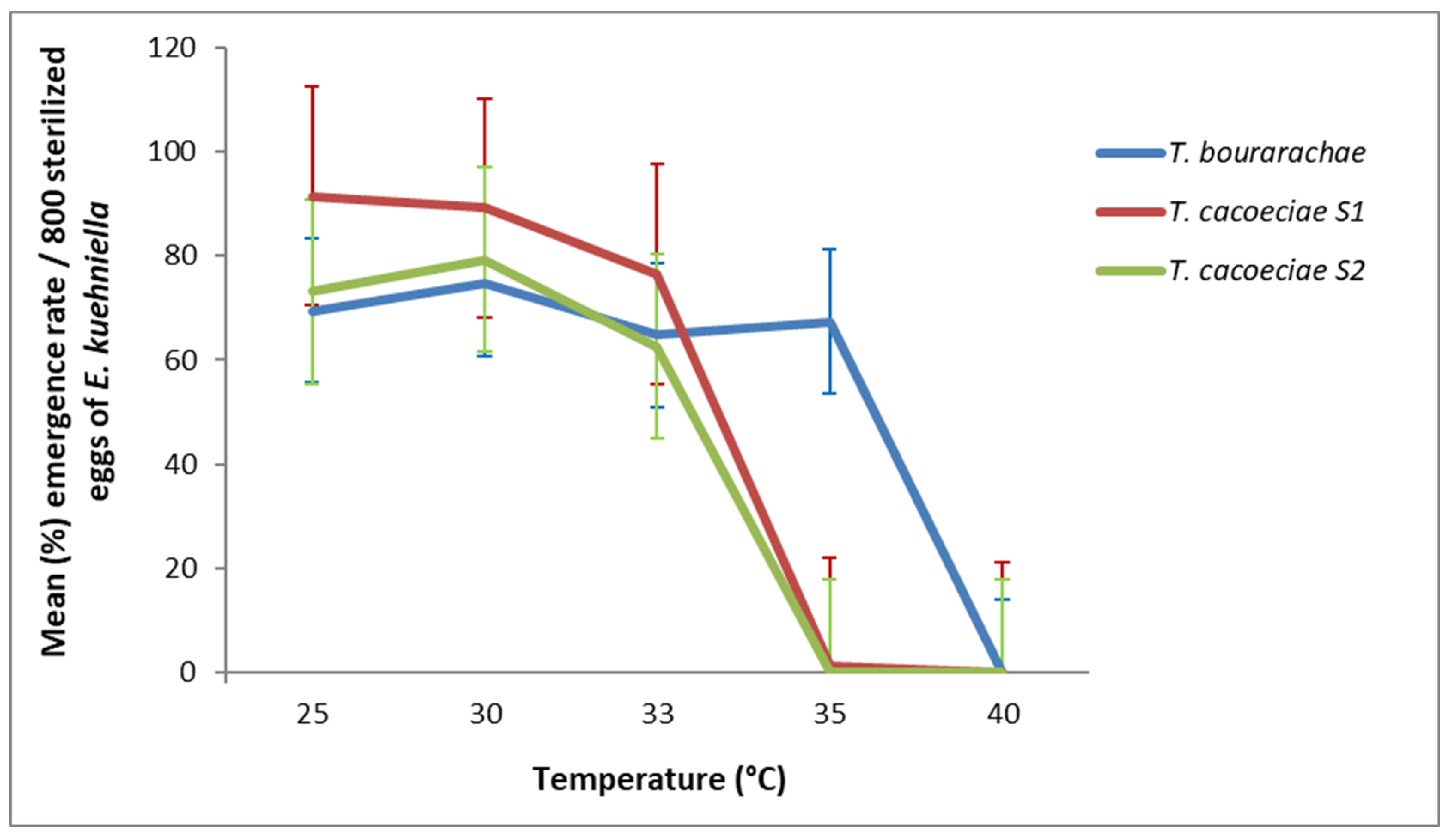
The generalized linear model (GLM) showed that both species and strains, as well as temperature, significantly affected the emergence rate of first-generation Trichogramma (strain: χ2 = 226.1, df = 2, p < 0.001; temperature: χ2 = 727.9, df = 1, p < 0.001). The interaction between strain and temperature was also significant (χ2 = 230.4, df = 2, p < 0.001). This interaction suggests that strain performance is temperature-dependent, emphasizing the need to select strains with greater tolerance to elevated temperatures for effective biological control in arid and semi-arid regions. All tested species successfully completed development and emerged as adults at 25 °C to 33 °C (Figure 1), whereas no adults emerged at 40 °C. At 25 °C, the two strains of T. cacoeciae (S1: 91.5%; S2: 73.2%) showed higher emergence rates than T. bourarachae (69.4%). At 35 °C, this trend reversed: T. bourarachae achieved the highest emergence (67.4%), while the emergence of T. cacoeciae declined sharply (S1: 1.1%; S2: 0%). This pattern clearly indicates a greater thermal tolerance of T. bourarachae, suggesting its potential suitability for biological control programs under high-temperature environments. These results indicate marked thermal sensitivity differences among strains and species, which are critical for optimizing biological control applications.
Figure 1.
Mean emergence rate (% ±SD) of T. bourarachae and T. cacoeciae strains S1 and S2 from sterilized E. kuehniella eggs at different temperatures applied during the first generation (G1). Error bars represent standard deviation. Each treatment was replicated 30 times (n = 30 females per strain per temperature).
3.2. Parasitism Rate in the Second Generation (G2)
The number of E. kuehniella eggs parasitized by the two Trichogramma species was significantly influenced by strain factor (χ2 = 0.002, df = 2, p = 0.002). Moreover, fecundity varied significantly depending on the developmental temperature of the females (G1), the temperature during oviposition and later development of their offspring (G2) (χ2 = 0.009, df = 3, p < 0.001; and χ2 = 0.015, df = 4, p < 0.001, respectively). No significant interaction was observed between strain and temperature at either generation (G1: p = 0.903; G2: p = 0.872), indicating that the effects of temperature on parasitism were consistent across strains. In other words, temperature and strain influenced parasitism rates independently, with no evidence that temperature effects differed among strains. Overall, these results indicate that the strain factor and both parental and offspring developmental temperatures are the dominant drivers of parasitism rate variation, while interactions between strain and temperature had little effect.
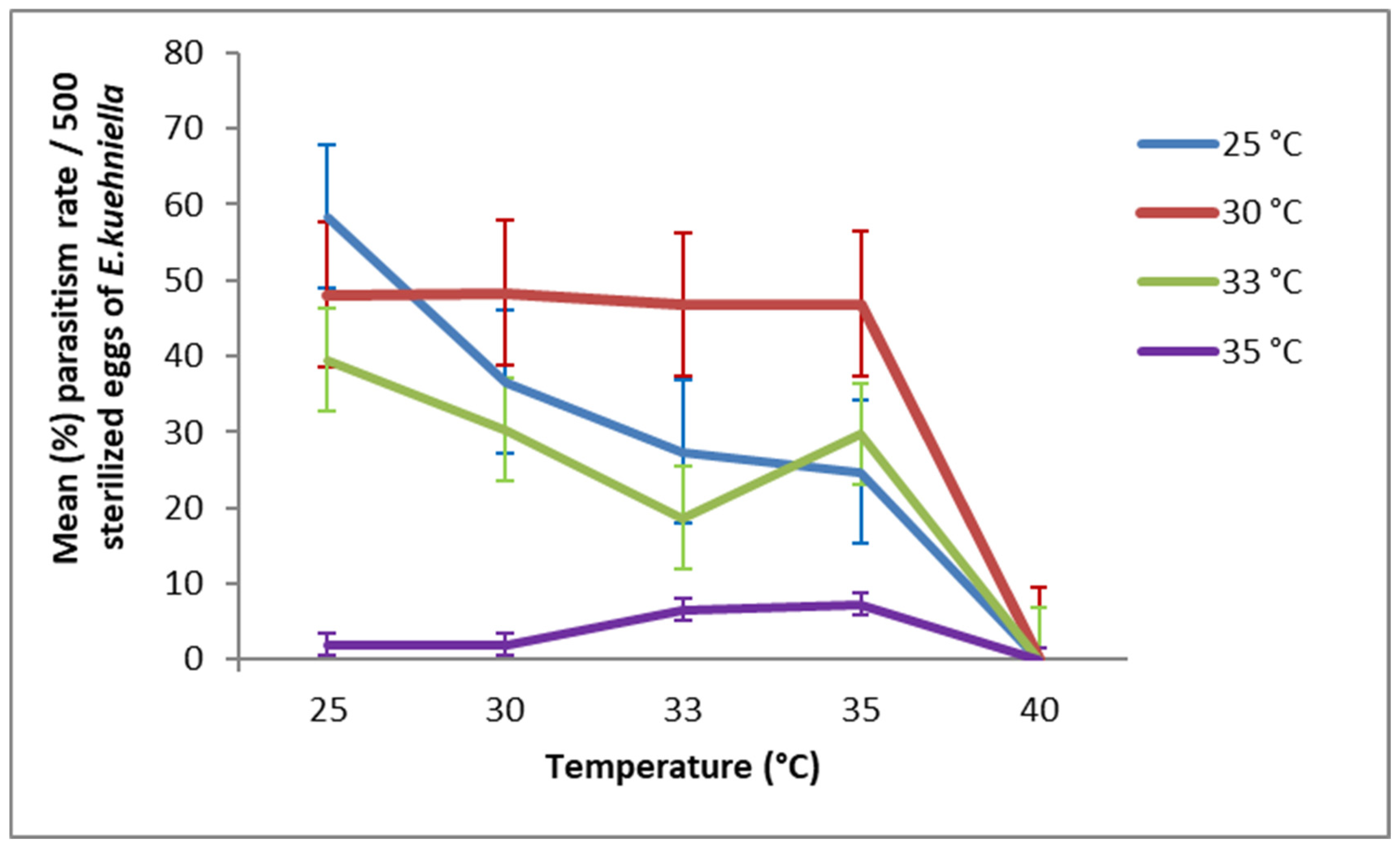
Trichogramma bourarachae exhibited optimal parasitism at 25 °C (58.3%) (Figure 2). Females that developed at 30 °C showed relatively high parasitism rates across tested temperatures, reaching 48.35%, 46.79%, and 46.87% at 30 °C, 33 °C, and 35 °C, respectively. In contrast, those developed at 35 °C during G1 showed very low parasitism rates, ranging from 1.9% to 7.3%.
Figure 2.
Effect of temperature during the second generation (G2) on the parasitism rate (mean ± SD) of T. bourarachae originating from the first generation (G1). Values represent total parasitism over 7 days.
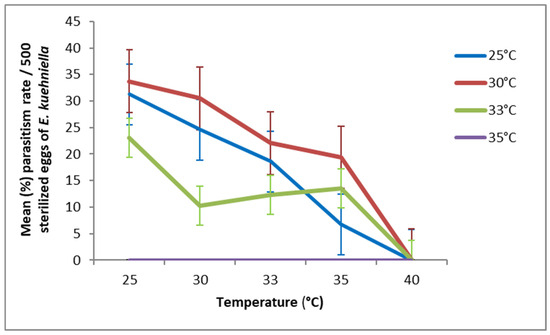
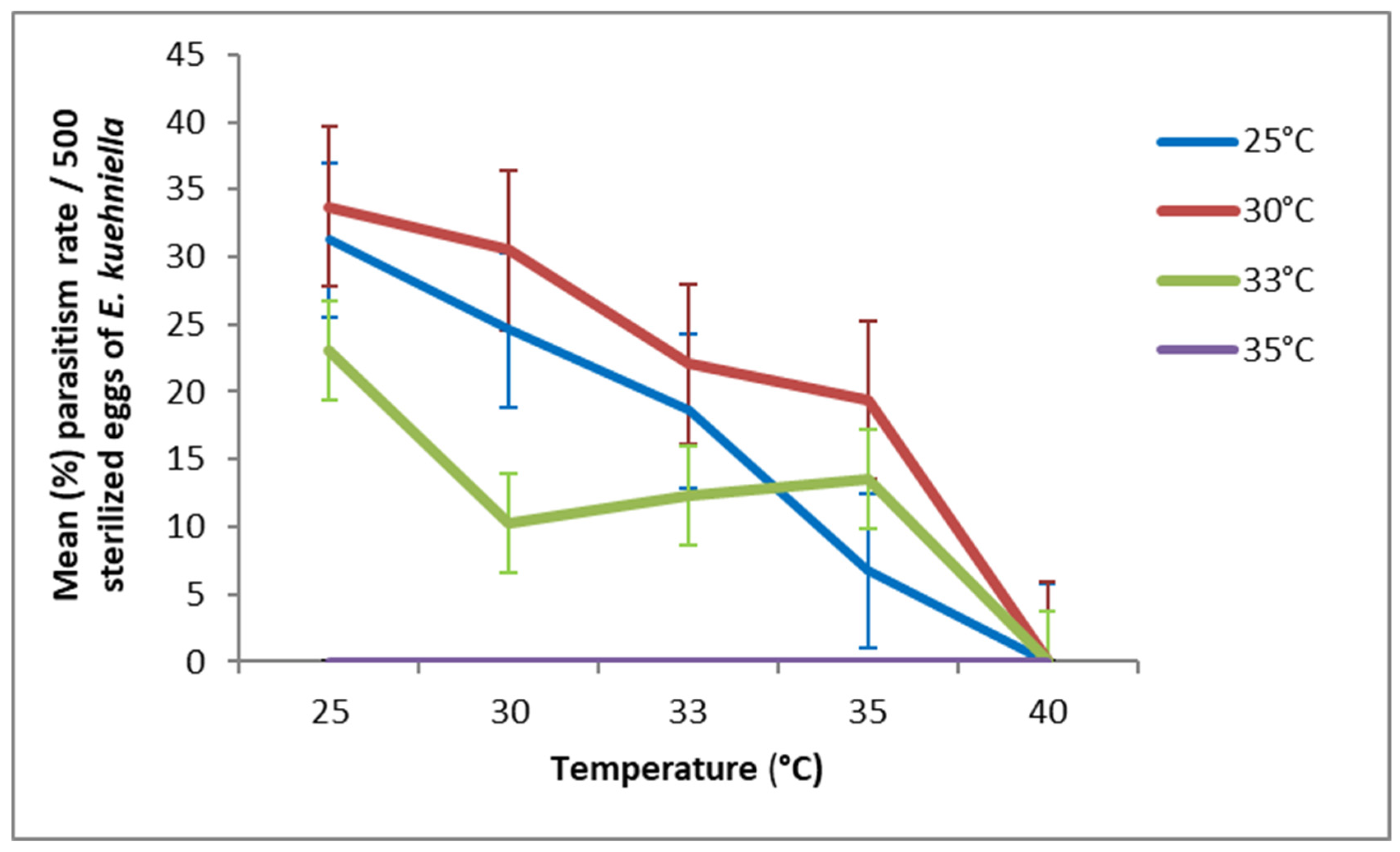
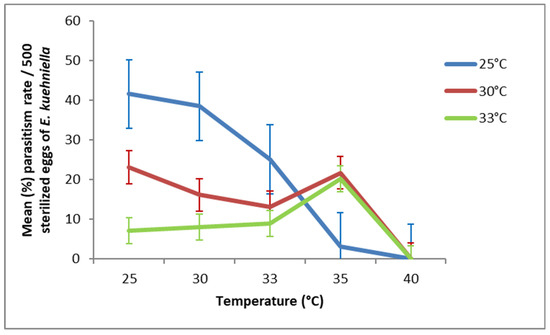
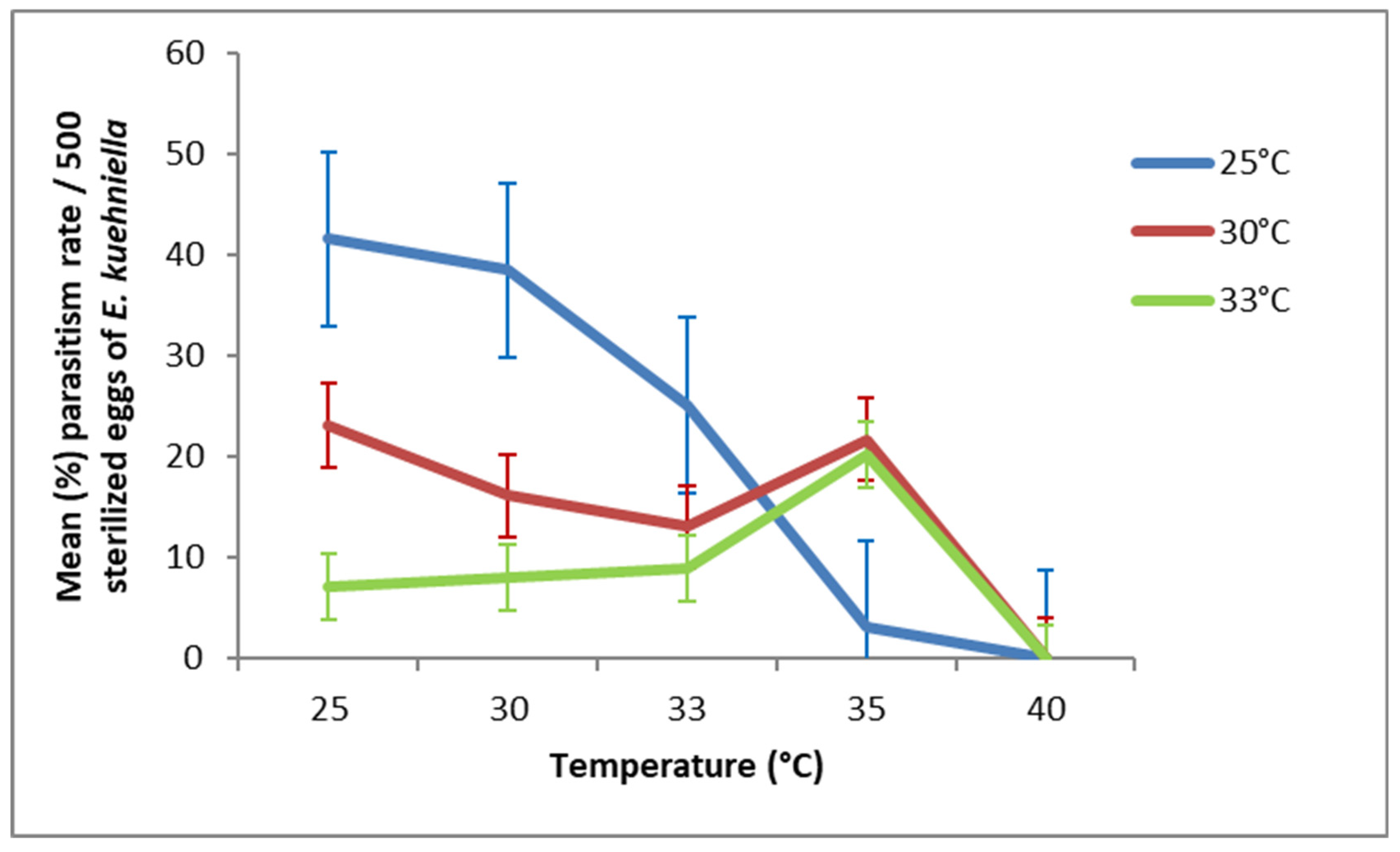
Regarding T. cacoeciae S1, females that developed at 25 °C or 30 °C in G1 exhibited a high parasitism rate when ovipositing at 25, 30, or 33 °C (Figure 3). Concerning T. cacoeciae S2, the maximum parasitism rate was observed when G1 developed at 25 °C and oviposition occurred at 25, 30, or 33 °C (Figure 4). At 35 °C, parasitism increased only when G1 development occurred at 30 °C or 33 °C, reaching 19.38% and 13.54% in S1, and 21.14% and 20.15% in S2, respectively.
Figure 3.
Effect of temperature during the second generation (G2) on the parasitism rate (mean ± SD) of T. cacoeciae strain S1 originating from the first generation (G1).
Figure 4.
Effect of temperature during the second generation (G2) on the parasitism rate (mean ± SD) of T. cacoeciae strain S2 originating from the first generation (G1).
3.3. Sex Ratio
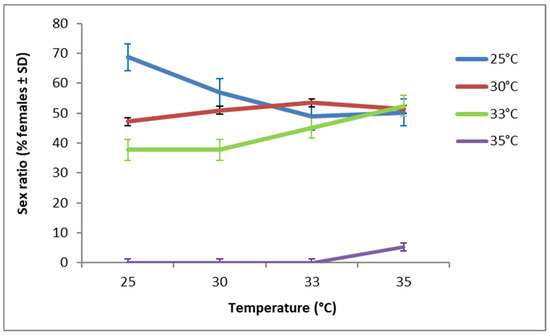
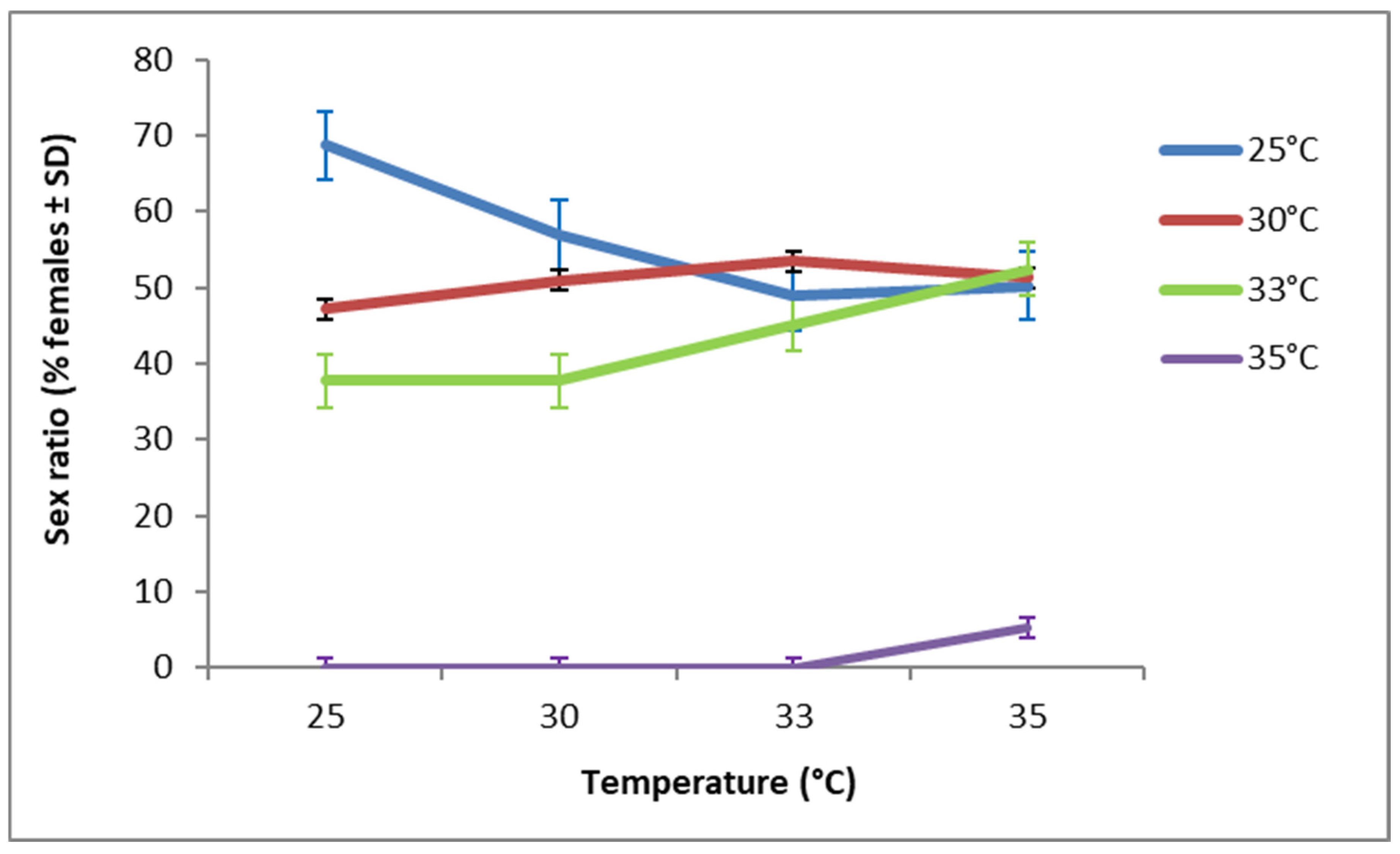
Trichogramma cacoeciae individuals (S1 and S2) did not produce any males under the tested temperature regimes, confirming that reproduction is consistently thelytokous and stable across the entire thermal range tested. However, in T. bourarachae, both the developmental temperature of females (G1) and the temperature during oviposition and offspring development (G2) had a highly significant effect on the sex ratio (χ2 = 4.104, df = 3, p < 0.001; χ2 = 4.950, df = 4, p < 0.001, respectively). When pre-adult development occurred at 33 °C, the proportion of T. bourarachae females increased from 37.74% to 52.37% as the temperature during the egg-laying period (G2) increased from 25 °C to 35 °C (Figure 5). In contrast, when G1 development occurred at 30 °C, the T. bourarachae female proportion remained relatively stable at approximately 50% across all temperatures (25, 30, 33, and 35 °C) applied during G2. No T. bourarachae females emerged when the first generation developed at 35 °C and eggs were laid at 25 °C, 30 °C, or 33 °C, resulting exclusively in males. However, when the G2 developed at 35 °C, the proportion of T. bourarachae females showed a slight increase (5.36%).
Figure 5.
Sex ratio of T. bourarachae originating from the first generation (G1) and allowed to oviposit under different temperature regimes.
3.4. Mortality
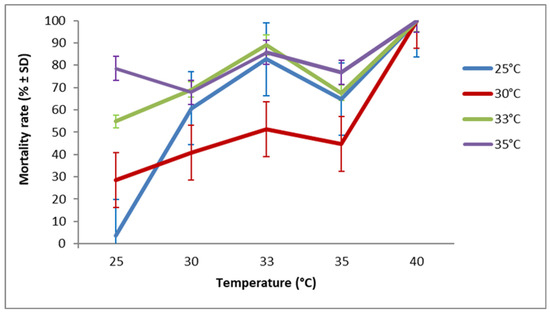
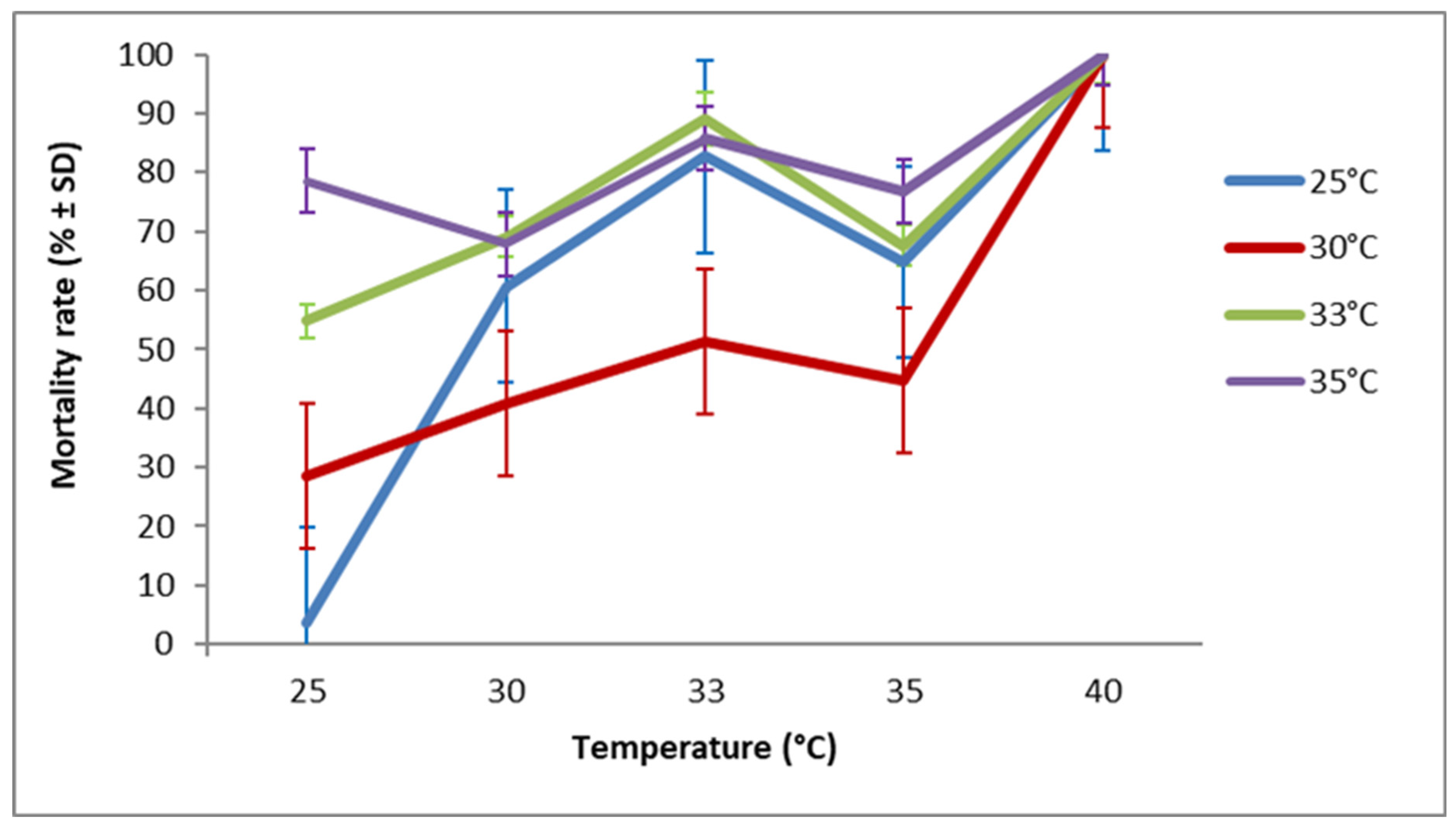
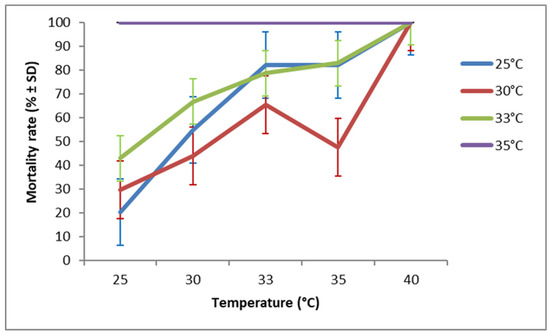
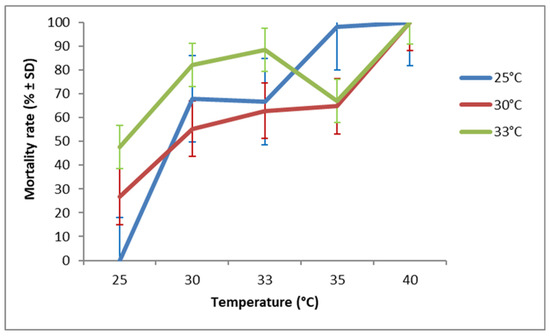
Females from different tested strains died at different rates according to their temperature of development during G1 (χ2 = 0.713, df = 1, p < 0.001), and an even stronger effect was observed for the temperature of the egg-laying period (G2) (χ2 = 4.372, df = 1, p < 0.001). However, female mortality rate during the 7 days of the egg-laying period did not differ significantly between all tested Trichogramma species (χ2 = 0.195, df = 2, p = 0.185). Furthermore, there was no significant interaction revealed between strain and either temperature factors (p > 0.3). The highest mortality was observed at 40 °C for all tested Trichogramma species. Overall, T. bourarachae (Figure 6) and T. cacoeciae S1 (Figure 7) exhibited higher mortality rates when females developed during G1 at 33 °C and 35 °C, whereas T. cacoeciae S2 (Figure 8) showed the lowest mortality rates when females developed at 30 °C.
Figure 6.
Mortality rate (after 7 days of exposure to host eggs) of T. bourarachae originating from the G1 generation and exposed to different temperature regimes.
Figure 7.
Mortality rate (after 7 days of exposure to host eggs) of T. cacoeciae S1 originating from the G1 generation and exposed to different temperature regimes.
Figure 8.
Mortality rate (after 7 days of exposure to host eggs) of T. cacoeciae S2 originating from the G1 generation and exposed to different temperature regimes.
4. Discussion
It has always been proven that field performance in Trichogramma spp. parasitoids against lepidopteran pests mainly depends on successful laboratory mass rearing, which could be influenced by factors such as artificial diet and host egg quality, storage methods, temperature, relative humidity and photoperiod [3,73]. Our results indicate that T. cacoeciae is highly sensitive to high temperatures, with emergence sharply declining above 35 °C, whereas T. bourarachae demonstrates greater thermal tolerance. These differences suggest species-specific thermal thresholds that may shape their seasonal activity and suitability for biological control under varying climatic conditions. Exposure to 40 °C resulted in complete failure of adult emergence for both species, highlighting the upper thermal limits for successful parasitism and reproduction. Such findings provide insights into the resilience of these parasitoids under extreme temperature events and can inform predictions of their performance in changing environments. Based on these findings, the upper temperature limit for adult emergence was 35 °C for T. cacoeciae (S2) and 40 °C for T. bourarachae and T. cacoeciae S1, as there was no emergence above these temperatures. These results are consistent with previous studies where the development rate of Trichogramma brassicae Bezdenko (Hymenoptera: Trichogrammatidae) declined at 32 °C and 35 °C with an upper threshold between 36 °C and 40 °C [42,61,74,75,76]. Similarly, Schöller and Hassan [77] reported that eggs parasitized by Trichogramma evanescens Westwood (Hymenoptera: Trichogrammatidae) became black, but no progeny emerged. The results from the current and previous studies indicate that upper temperature thresholds should be studied carefully before field release for effective pest management.
Females of T. bourarachae and T. cacoeciae S1 that developed during the first generation at 30 °C exhibited the highest parasitism rates across all tested temperature regimes, whereas T. cacoeciae S2 exhibited optimal parasitism when the G1 wasps developed at 25 °C and their offspring (G2) developed following oviposition at 25, 30, or 33 °C. In contrast, when the egg-laying occurred at 35 °C, the wasps that developed during G1 at 30 or 33 °C performed more efficiently than those reared at the other temperature. Across all tested Trichogramma species and strains, our experiments revealed that parasitism rate reached its peak at 25 °C, regardless of the temperature at which the first generation was reared. These results are consistent with the majority of previous studies, which reported that 25 °C represents the optimal thermal regime for achieving the highest parasitism performance [33,35,42,77,78,79]. In summary, although 25 °C was the optimal temperature for parasitism across all rearing regimes, developmental exposure to temperature between 30 and 33 °C enhanced the parasitoids’ thermal tolerance and contributed to improved performance under heat stress conditions. This suggests that temperatures experienced by the initial generations of wasps may influence the parasitism efficiency of the next generation. The relatively higher parasitism performance observed for T. bourarachae and T. cacoeciae S1 at elevated temperatures may reflect prior acclimation or adaptive responses to the challenging environmental conditions characterizing southern Tunisia. However, this interpretation should be considered as a working hypothesis that would require further investigation to confirm local adaptation. Our findings are consistent with previous studies reporting that the behavior of Trichogramma species and strains is closely linked to the ecological conditions of their native habitats [33,38,77]. However, at 40 °C, parasitization activity ceased entirely for all Trichogramma individuals, as no eggs were parasitized. This suggests that 40 °C could be the upper thermal limit for parasitism, beyond which the parasitoids are unable to maintain their reproductive activity. Similar findings have been found in other Trichogramma species, for which upper developmental thresholds ranged from 35 to 46 °C, depending on the species or strain, confirming interspecific variability in thermal tolerance [67]. These findings reinforce the idea that exposure to extreme temperatures can critically constrain the effectiveness of Trichogramma parasitoids in biological control programs, particularly under field conditions characterized by heatwaves or prolonged high-temperature periods.
Such thermal inhibition is consistent with the view that extreme heat stress compromises host seeking behavior and parasitism capacity, thereby reducing the biological control potential of Trichogramma parasitoids under excessively high temperature [49,80].
Based on our findings, rearing Trichogramma spp. at 30–33 °C can be considered optimal when releases are expected at 35 °C or above, as parasitism rates were significantly higher than at 25 °C or 35 °C during the first generation. However, potential trade-offs, such as effects on adult longevity or other fitness traits, should be considered when applying this recommendation. These results are consistent with those reported by Negahban et al. [76] and provide a basis for further field validation where the optimal temperature range for T. brassicae was between 30 °C and 33 °C. Similarly, Pizzol et al. [33] showed that a Tunisian strain of T. cacoeciae females that developed at 30 °C during the first generation (G1) exhibited high fecundity during oviposition, with their offspring (G2) completing development at 30 °C. Comparable findings were reported by Kalyebi et al. [81] who observed that parasitism rates were highest at 25 °C and 30 °C for six indigenous Kenyan Trichogramma egg parasitoid species.
Emergence and parasitism rates were found to be inversely related to temperature, a pattern also reported for T. chilonis and T. poliae Nagaraja (Hymenoptera: Trichogrammatidae) when exposed to variable temperature ranging from 20 °C to 40 °C through daily short-term heat shocks applied to both immature progeny and egg-laying females [80]. As reported by Alloui-Griza et al. [49], no progeny of T. cacoeciae emerged when developed at 40 °C due to the mortality of parasitoids. Several studies demonstrated that, within the thermal tolerance range, emergence and parasitism rates of Trichogramma spp. declined with increasing temperature [3,82,83]; consistent with these findings, our results showed that T. cacoeciae and T. bourarachae followed the same trend.
Our findings revealed an inverse relationship between temperature and adult longevity, where adult longevity decreased as the temperature increased from 25 °C to 40 °C. This result is consistent with a previous study on other Trichogramma species, T. evanescens and T. cacoeciae [77]. In the present study, female mortality after seven days of oviposition was lowest at 25 °C, intermediate at 30–35 °C, and highest at 40 °C. Overall, females from all tested Trichogramma species that developed at 30 °C (during G1) showed a relatively low mortality rate when allowed to oviposit at higher temperatures ranging from 30 °C to 35 °C. Pizzol et al. [33], working on two strains (Tunisian and French) of T. cacoeciae, reported that female mortality varied depending on the developmental temperature during G1. According to the same authors, the French strain exhibited higher mortality when females had developed at 15 or 30 °C, whereas the Tunisian strain suffered higher mortality when development occurred at 15 °C or 20 °C.
Temperature is a key factor that strongly affects the sex ratio in Trichogramma spp. [76,80]. Our experiments revealed that the sex ratio of T. cacoeciae (S1 and S2) remained unchanged across all tested temperatures as 100% females were generated. This finding aligns with earlier studies [33,84] that documented the stability of the sex ratio of T. cacoeciae because thelytoky was not induced by the endosymbiotic bacteria (Wolbachia infection). It appeared that T. cacoeciae wasps genetically determined by themselves. However, a female-biased sex ratio was observed in T. bourarachae at 25 °C, 30 °C and 33 °C, indicating that moderate temperatures favor female production. In contrast, when preadult development occurred at 35 °C, the proportion of male offspring exceeded that of females. This finding is consistent with Harrison et al. [48], who reported a male-biased sex ratio in T. pretiosum Riley (Hymenoptera: Trichogrammatidae) at 35 °C. It is crucial to understand how temperature affects the developmental biology of certain Trichogramma species or strains to establish successful mass rearing protocols for biological control programs [85]. In the Mediterranean region, such as Tunisia, the growing season (from May to late September) is characterized by extremely hot and dry conditions, with temperatures frequently exceeding 40 °C in summer. Temperature is a key limiting factor in this region, influencing the activity of Trichogramma parasitoids and, consequently, the overall effectiveness of mass releases [8]. In this context, Cherif et al. [60] demonstrated that temperature, often in interaction with relative humidity, significantly affected the life- history traits of T. cacoeciae, including parasitism and emergence rate, with elevated temperatures generally leading to a decline in overall performance. Notably, some strains of T. cacoeciae may exhibit local adaptation, as evidenced by the Tunisian strain, which has been shown to be better adapted to higher temperatures compared with the Italian strain.
The current study provides essential information on how rearing and oviposition temperatures affect the biological performance of two Trichogramma species, highlighting the importance of carefully selecting thermotolerant strains suited to local climate conditions. These findings will support the further development of optimized mass rearing strategies for ensuring more effective, climate-resilient and sustainable biological control programs throughout Mediterranean agro-ecosystems.
5. Conclusions
This study highlights the critical influence of temperature on the performance of key Trichogramma species and strains. Moderate temperatures (30 to 33 °C) were optimal for emergence and parasitism, whereas exposure to extreme heat (≥40 °C) significantly reduced survival and parasitic activity. These results provide practical guidance for the mass-rearing and field deployment of Trichogramma parasitoids, suggesting that maintaining moderate rearing conditions can enhance biological control efficacy under high-temperature environments. The differential responses among species and strains suggest that their ecological origin has shaped strong thermal specialization. The enhanced thermotolerance of T. bourarachae and T. cacoeciae (S1) reflects adaptive evolution to arid and semi-arid habitats typical of southern Tunisia.
Temperature also influenced adult longevity and sex ratio. Increasing temperature reduced female lifespan and shifted the sex ratio toward males in T. bourarachae, whereas T. cacoeciae maintained stable thelytokous reproduction (100% females), confirming its genetically determined parthenogenesis rather than Wolbachia-induced thelytoky. Collectively, these findings reinforce the importance of incorporating thermal tolerance and local adaptation criteria into Trichogramma strain selection for inundative release programs. The use of autochthonous, heat-adapted populations is expected to improve establishment, parasitism efficiency, and overall field performance under high-temperature conditions.
Future research should prioritize field validation of Trichogramma performance under naturally fluctuating temperatures to confirm laboratory findings and refine biological control strategies, considering that all results of the present study were obtained under constant-temperature conditions. Additionally, exploring physiological acclimation and the selection of locally adapted populations could provide practical approaches to enhancing thermal resilience, thereby improving the efficacy of Trichogramma releases under current and predicted climate conditions.
Author Contributions
Conceptualization: S.A.; Data curation: R.M. and S.A.; Formal analysis: S.A. and M.F.; Investigation: N.B.S., R.M. and S.A.; Performing Experiments: N.B.S., A.Z., S.Z. and S.A.; Methodology: S.A.; Validation: R.M. and S.A.; Visualization: R.M. and S.A.; Supervision: S.A.; Writing—original draft: N.B.S., R.M. and S.A.; Writing—review and editing: N.B.S., R.M., K.G.L., A.M.I., H.S.E.-B., S.M.A., S.N.A.-K., M.J.H., T.A.S., H.M. and S.A.; Funding Acquisition: A.M.I. and S.A. All authors have read and agreed to the published version of the manuscript.
Funding
This work was funded by the Deanship of Scientific Research, Vice Presidency for Graduate Studies and Scientific Research, King Faisal University, Saudi Arabia, through grant number KFU260511.
Institutional Review Board Statement
Not applicable.
Informed Consent Statement
Not applicable.
Data Availability Statement
The original contributions presented in the study are included in the article, further inquiries can be directed to the corresponding authors.
Conflicts of Interest
The authors declare no conflicts of interest.
References
- Li, L.-Y. Worldwide use of Trichogramma for biological control on different crops: A survey. In Biological Control with Egg Parasitoids; Wajnberg, E., Hassan, S.A., Eds.; CAB International: Wallingford, UK, 1994; pp. 37–53. [Google Scholar]
- Smith, S.M. Biological control with Trichogramma: Advances, successes, and potential for their use. Annu. Rev. Entomol. 1996, 41, 375–406. [Google Scholar] [CrossRef]
- Cherif, A.; Mansour, R.; Grissa-Lebdi, K. The egg parasitoids Trichogramma: From laboratory mass rearing to biological control of lepidopteran pests. Biocontrol Sci. Technol. 2021, 31, 661–693. [Google Scholar] [CrossRef] [Scilit]
- Zang, L.S.; Wang, S.; Zhang, F.; Desneux, N. Biological control with Trichogramma in China: History, present status and perspectives. Annu. Rev. Entomol. 2021, 66, 463–484. [Google Scholar] [CrossRef] [Scilit]
- Ksentini, I.; Jardak, T.; Zeghal, N. Bacillus thuringiensis, deltamethrin and spinosad side effects on three Trichogramma species. Bull. Insectol. 2010, 63, 31–37. [Google Scholar]
- Dhouibi, M.H.; Hermi, N.; Soudani, D.; Thlibi, H. Biocontrol of the carob moth Ectomyelois ceratoniae (Lepidoptera: Pyralidae) in pomegranate and citrus orchards in Tunisia. Int. J. Agric. Innov. Res. 2016, 4, 849–856. [Google Scholar]
- Zougari, S.; Attia, S.; Zouba, A.; Lebdi-Grissa, K. Effectiveness of mass trapping and Trichogramma cacoeciae (Hymenoptera: Trichogrammatidae) releases against Ectomyelois ceratoniae (Lepidoptera: Pyralidae) in Tunisian oases. Biologia 2021, 76, 1175–1188. [Google Scholar] [CrossRef] [Scilit]
- Zouba, A.; Zougari, S.; Attia, S.; Abbes, K.; Grissa-Lebdi, K.; Chermiti, B.; Ben Hmida, F. Field performance of the egg parasitoid Trichogramma cacoeciae Marchal (Hymenoptera: Trichogrammatidae) following releases against Ectomyelois ceratoniae Zeller (Lepidoptera: Pyralidae) in two types of oases in Tunisia. J. Entomol. Zool. Stud. 2022, 10, 28–35. [Google Scholar] [CrossRef] [Scilit]
- Biondi, A.; Guedes, R.N.C.; Wan, F.H.; Desneux, N. Ecology, worldwide spread and management of the invasive South American tomato pinworm, Tuta absoluta: Past, present and future. Annu. Rev. Entomol. 2018, 63, 239–258. [Google Scholar] [CrossRef] [Scilit] [PubMed]
- Mansour, R.; Brevault, T.; Chailleux, A.; Cherif, A.; Grissa-Lebdi, K.; Haddi, K.; Mohamed, S.A.; Nofemela, R.S.; Oke, A.; Sylla, S.; et al. Occurrence, biology, natural enemies and management of Tuta absoluta in Africa. Entomol. Gen. 2018, 38, 83–112. [Google Scholar] [CrossRef] [Scilit]
- Desneux, N.; Han, P.; Mansour, R.; Arnó, J.; Brévault, T.; Campos, M.R.; Chailleux, A.; Guedes, R.N.C.; Karimi, J.; Konan, K.A.J.; et al. Integrated pest management of Tuta absoluta: Practical implementations across different world regions. J. Pest Sci. 2022, 95, 17–39. [Google Scholar] [CrossRef] [Scilit]
- Han, P.; Zhang, Y.; Arno, J.; Mansour, R. Research toward enhancing integrated management of Tuta absoluta, an ongoing invasive threat in Afro-Eurasia. Entomol. Gen. 2024, 44, 263–267. [Google Scholar] [CrossRef] [Scilit]
- Jin, T.; Lin, Y.; Ma, G.; Liu, J.; Hao, Z.; Han, S.; Peng, Z. Biocontrol potential of Trichogramma species against Spodoptera frugiperda and their field efficacy in maize. Crop Prot. 2021, 150, 105–790. [Google Scholar] [CrossRef] [Scilit]
- Yang, L.; Li, F.; Lü, X.; Xing, B.; Pan, X.; Shi, X.; Li, J.; Wu, S. Performance of three Trichogramma species as biocontrol agents on Spodoptera frugiperda eggs. J. Appl. Entomol. 2022, 146, 1019–1027. [Google Scholar] [CrossRef] [Scilit]
- Navik, O.; Yele, Y.; Kedar, S.C.; Sushil, S.N. Biological control of fall armyworm Spodoptera frugiperda (JE Smith) using egg parasitoids, Trichogramma species (Hymenoptera: Trichogrammatidae): A review. Egypt. J. Biol. Pest Control 2023, 33, 118. [Google Scholar] [CrossRef] [Scilit]
- El-Gepaly, H.M.; Abdelhameed, K.M.; Shakl, S.Y.; Saleh, A.A.; Hafez, E.E. Performance of Trichogramma evanescens Westwood (Hymenoptera: Trichogrammatidae) on Spodoptera frugiperda (JE Smith) (Lepidoptera: Noctuidae) eggs at laboratory and field conditions. Sci. Rep. 2024, 14, 26831. [Google Scholar] [CrossRef] [Scilit]
- Jan, R.; Solangi, B.K.; Bizenjo, M.A.; Memon, S.A.; Pandran, Z.A.; Gola, A.S.; Jatoi, M.A.; Aminullah; Haroon, M.; Wahab, A. Effect of inundative release of Trichogramma chilonis against Helicoverpa armigera (Hubner) (Lepidoptera: Noctuidae) on yield of pea crop. Pak. J. Biotechnol. 2021, 18, 49–55. [Google Scholar] [CrossRef] [Scilit]
- Pereira, F.P.; Reigada, C.; Diniz, A.J.F.; Parra, J.R.P. Potential of Two Trichogrammatidae species for Helicoverpa armigera control. Neotrop. Entomol. 2019, 48, 966–973. [Google Scholar] [CrossRef] [Scilit]
- Khan, A.A.; Parvaiz, B. Impact of Inoculative Releases of for Trichogramma chilonis Helicoverpa armigera and Myzus persicae Hippodamia variegata for in Ecologically Engineered Tomato Ecosystem of Kashmir. Indian J. Ecol. 2024, 51, 891–894. [Google Scholar] [CrossRef] [Scilit]
- Bigler, F.; Babendreier, D.; Kuhlmann, U. Environmental Impact of Invertebrates for Biological Control of Arthropods: Methods and Risk Assessment; CAB International: Wallingford, UK, 2006; pp. 1–19. [Google Scholar]
- Wu, L.H.; Hill, M.P.; Thomson, L.J.; Hoffmann, A.A. Assessing the current and future biological control potential of Trichogramma ostriniae on its hosts Ostrinia furnacalis and Ostrinia nubilalis. Pest Manag. Sci. 2018, 74, 1513–1523. [Google Scholar] [CrossRef] [Scilit] [PubMed]
- Elite, E.; Cabrera, P.; Boisclair, J.; Trodorova, S.; Lucas, E. Field evaluation of Trichogramma ostriniae (Hymenoptera: Trichogrammatidae) and T. brassicae as biocontrol agents of the European corn borer, Ostrinia nubilalis (Lepidoptera: Crambidae), in fresh market sweet corn. Phytoprotection 2024, 104, 35–46. [Google Scholar] [CrossRef] [Scilit]
- Rohi, L.; Pintureau, B. Are Trichogramma bourarachae and the perkinsi species group really distinct from Trichogramma buesi and the pintoi group respectively? J. Appl. Entomol. 2003, 127, 265–268. [Google Scholar] [CrossRef] [Scilit]
- Dang, X.L.; Wen, S.Y.; He, X.F.; Pang, X.F. M-PCR: A powerful method for rapid molecular identification of Trichogramma wasps (Hymenoptera: Trichogrammatidae). Insect Sci. 2005, 12, 77–85. [Google Scholar] [CrossRef] [Scilit]
- Querino, R.B.; Zucchi, R.A.; Pinto, J.D. Systematics of the Trichogrammatidae (Hymenoptera: Chalcidoidea) with a focus on the genera attacking Lepidoptera. In Egg Parasitoids in Agroecosystems with Emphasis on Trichogramma. Progress in Biological Control; Cônsoli, F.L., Parra, J.R.P., Zucchi, R.A., Eds.; Springer: New York, NY, USA, 2009; pp. 191–218. [Google Scholar]
- Zougari, S.; Zouba, A.; Attia, S.; Hmida, F.B.; Grissa-Lebdi, K. Integrated pest management strategies for control of the carob moth Ectomyelois ceratoniae Zeller (Lepidoptera: Pyralidae) in two oases in the south of Tunisia. Int. J. Trop. Insect Sci. 2023, 43, 21512166. [Google Scholar] [CrossRef] [Scilit]
- Mansour, R.; Cherif, A.; Attia-Barhoumi, S.; Zappala, L.; Grissa-Lebdi, K. Tuta absoluta in Tunisia: Ten years of invasion and pest management. Phytoparasitica 2019, 47, 461–474. [Google Scholar] [CrossRef] [Scilit]
- Mansour, R.; Biondi, A. Releasing natural enemies and applying microbial and botanical pesticides for managing Tuta absoluta in the MENA region. Phytoparasitica 2021, 49, 179–194. [Google Scholar] [CrossRef] [Scilit]
- Cherif, A.; Mansour, R.; Grissa-Lebdi, K. Biological control of Tuta absoluta through releases of Trichogramma cacoeciae parasitoids and Macrolophus pygmaeus predators in northeastern Tunisian greenhouses. Biocontrol Sci. Technol. 2023, 33, 999–1010. [Google Scholar] [CrossRef] [Scilit]
- Elwakil, W.; Doherty, E.; Dale, A. Trichogramma Wasps Trichogramma spp. (Insecta: Hymenoptera: Trichogrammatidae): IN1382. UF/IFAS Extension, IN1382, 12/2022. EDIS, 2022. Featured Creatures Collection. Available online: https://journals.flvc.org/edis/article/view/130004 (accessed on 26 January 2026).
- Pintureau, B. La Lutte Biologique Et Les Trichogrammes. Application Au Contrôle De La Pyrale Du Maïs; Editions Le Manuscrit: Paris, France, 2009; pp. 1–261. [Google Scholar]
- Haile, A.T.; Hassan, S.A.; Ogol, C.K.P.O.; Baumgärtner, J.; Sithanantham, S.; Monje, J.C.; Zebitz, C.P.W. Temperature-dependent development of four egg parasitoid Trichogramma species (Hymenoptera: Trichogrammatidae). Biocontrol Sci. Technol. 2002, 12, 555–567. [Google Scholar] [CrossRef] [Scilit]
- Pizzol, J.; Pintureau, B.; Khoualdia, O.; Desneux, N. Temperature-dependent difference in biological traits between two strains of Trichogramma cacoeciae (Hymenoptera: Trichogrammatidae). J. Pest Sci. 2010, 83, 447–452. [Google Scholar] [CrossRef] [Scilit]
- Yuan, X.H.; Song, L.W.; Zhang, J.J.; Zang, L.S.; Zhu, L.; Ruan, C.C.; Sun, G.Z. Performance of four Chinese Trichogramma species as biocontrol agents of the rice striped stem borer, Chilo suppressalis, under various temperature and humidity regimes. J. Pest Sci. 2012, 85, 497–504. [Google Scholar] [CrossRef] [Scilit]
- Kalyebi, A.; Overholt, W.A.; Schulthess, F.; Mueke, J.M.; Sithanantham, S. The effect of temperature and humidity on the bionomics of six African egg parasitoids (Hymenoptera: Trichogrammatidae). Bull. Entomol. Res. 2006, 96, 305–314. [Google Scholar] [CrossRef] [Scilit] [PubMed]
- Wang, D.S.; He, Y.R.; Zhang, W.; Nian, X.G.; Lin, T.; Zhao, R. Effects of heat stress on the quality of Trichogrammatoidea bactrae Nagaraja (Hymenoptera: Trichogrammatidae). Bull. Entomol. Res. 2014, 104, 543–551. [Google Scholar] [CrossRef] [Scilit]
- Del Pino, M.; Gallego, J.R.; Hernández Suárez, E.; Cabello, T. Effect of temperature on life history and parasitization behavior of Trichogramma achaeae Nagaraja and Nagarkatti (Hymenoptera: Trichogrammatidae). Insects 2020, 11, 482. [Google Scholar] [CrossRef] [Scilit] [PubMed]
- Tabebordbar, F.; Shishehbor, P.; Ebrahimi, E.; Polaszek, A.; Ugine, T.A. Effect of different constant temperatures on life history and lifetable parameters of Trichogramma euproctidis (Hymenoptera: Trichogrammatidae). J. Econ. Entomol. 2022, 115, 474–481. [Google Scholar] [CrossRef] [Scilit]
- Deutsch, C.A.; Tewksbury, J.J.; Tigchelaar, M.; Battisti, D.S.; Merrill, S.C.; Huey, R.B.; Naylor, R.L. Increase in crop losses to insect pests in a warming climate. Science 2018, 361, 916–919. [Google Scholar] [CrossRef] [Scilit] [PubMed]
- Parmesan, C.; Morecroft, M.D.; Trisurat, Y.; Adrian, R.; Anshari, G.Z.; Arneth, A.; Gao, Q.; Gonzalez, P.; Harris, R.; Price, J.; et al. Terrestrial and Freshwater Ecosystems and Their Services. In Climate Change 2022: Impacts, Adaptation and Vulnerability. Working Group II Contribution to the Sixth Assessment Report of the Intergovernmental Panel on Climate Change; Pörtner, H.-O., Roberts, D.C., Tignor, M., Poloczanska, E.S., Mintenbeck, K., Alegría, A., Craig, M., Langsdorf, S., Löschke, S., Möller, V., et al., Eds.; Cambridge University Press: Cambridge, UK, 2022; pp. 197–378. [Google Scholar]
- Iranipour, S.; Farazmand, A.; Saber, M.; Mashhadi, J.M. Demography and life history of the egg parasitoid, Trichogramma brassicae, on two moths Anagasta kuehniella and Plodia interpunctella in the laboratory. J. Insect Sci. 2009, 9, 51. [Google Scholar] [CrossRef] [Scilit]
- Ksentini, I.; Herz, A.; Ksantini, M.; Sabelis, M.W.; Hassan, S.A. Temperature and strain effects on reproduction and survival of Trichogramma oleae and Trichogramma cacoeciae (Hymenoptera: Trichogrammatidae). Biocontrol Sci. Technol. 2011, 21, 903–916. [Google Scholar] [CrossRef] [Scilit]
- Foerster, M.R.; Marchioro, C.A.; Foerster, L.A. Temperature-dependent parasitism, survival, and longevity of five species of Trichogramma Westwood (Hymenoptera: Trichogrammatidae) associated with Anticarsia gemmatalis Hübner (Lepidoptera: Noctuidae). Neotrop. Entomol. 2014, 43, 176–182. [Google Scholar] [CrossRef] [Scilit]
- Mohammad, J.K.; Al-Jassany, R.F.; Ali, A.S.A. Influence of temperature on some biological characteristics of Trichogramma evanescens (Westwood) (Hymenoptera: Trichogrammatidae) on the egg of lesser date moth Batrachedra amydraula Meyrick. Biol. Control 2015, 29, 125–130. [Google Scholar] [CrossRef] [Scilit]
- Bergant, K.; Trdan, S. How reliable are thermal constants for insect development when estimated from laboratory experiments? Entomol. Exp. Appl. 2006, 120, 251–256. [Google Scholar] [CrossRef] [Scilit]
- Ikemoto, T.; Kiritani, K. Novel method of specifying low and high threshold temperature using thermodynamic SSI model of insect development. Environ. Entomol. 2019, 48, 479–488. [Google Scholar] [CrossRef] [Scilit]
- Goto, S.G.; Numata, H. Insect photoperiodism. In Insect Molecular Biology and Ecology, 1st ed.; Hoffman, K.H., Ed.; CRS Press: Boca Raton, FL, USA, 2015; pp. 217–244. [Google Scholar]
- Harrison, W.W.; King, E.G.; Ouzts, J.D. Development of Trichogramma exiguum and T. pretiosum at five temperature regimes. Environ. Entomol. 1985, 14, 118–121. [Google Scholar] [CrossRef] [Scilit]
- Alloui-Griza, R.; Cherif, A.; Ichaoui, O.; Grissa-Lebdi, K. Impact of high temperature on the life history traits of the egg parasitoid Trichogramma cacoeciae Marchal (Hymenoptera: Trichogrammatidae). J. Entomol. Zool. Stud. 2022, 10, 312–315. [Google Scholar] [CrossRef] [Scilit]
- Reznik, S.Y.; Voinovich, N.D.; Vaghina, N.P. Effect of temperature on the reproduction and development of Trichogramma buesi (Hymenoptera: Trichogrammatidae). Eur. J. Entomol. 2009, 106, 535–544. [Google Scholar] [CrossRef] [Scilit]
- Voinovich, N.D.; Reznik, S.Y. Heat and cold shocks decrease the incidence of diapause in Trichogramma telengai larvae. Insects 2025, 16, 54. [Google Scholar] [CrossRef] [Scilit]
- Reznik, S.Y.; Voinovich, N.D. Influence of temperature on the photoperiodic time measurement and on the maternal induction of diapause in Trichogramma telengai: The separation of the two effects. J. Insect Physiol. 2024, 155, 104654. [Google Scholar] [CrossRef] [Scilit]
- Cabello, T.; Vargas, P. Temperature as a factor influencing the form of reproduction of Trichogramma cordubensis Vargas & Cabello (Hymenoptera: Trichogrammatidae). J. Appl. Entomol. 2009, 100, 434–441. [Google Scholar] [CrossRef] [Scilit]
- Harvey, J.A.; Heinen, R.; Gols, R.; Thakur, M.P. Climate change-mediated temperature extremes and insects: From outbreaks to breakdowns. Glob. Change Biol. 2020, 26, 6685–6701. [Google Scholar] [CrossRef] [Scilit] [PubMed]
- Savescu, A. Criteria for establishing the conditions of release of the wasps of Trichogramma embryophagum Htg. In integrated control programmes. An. Inst. Prot. Plant. 1971, 9, 363–376. [Google Scholar]
- Gross, H.R. Effect of temperature, relative humidity, and free water on the number and normalcy of Trichogramma pretiosum Riley (Hymenoptera: Trichogrammatidae) emerging from eggs of Heliothis zea (Boddie) (Lepidoptera: Noctuidae). Environ. Entomol. 1988, 17, 470–475. [Google Scholar] [CrossRef] [Scilit]
- Jerbi-Elayed, M.; Foray, V.; Tougeron, K.; Grissa-Lebdi, K.; Hance, T. Developmental temperature affects life-history traits and heat tolerance in the aphid parasitoid Aphidius colemani. Insects 2021, 12, 852. [Google Scholar] [CrossRef] [Scilit]
- Huey, R.B.; Stevenson, R.D. Integrating thermal physiology and ecology of ectotherms: A discussion of approaches. Am. Zool. 1979, 19, 357–366. [Google Scholar] [CrossRef] [Scilit]
- Sgrò, C.M.; Terblanche, J.S.; Hoffmann, A.A. What can plasticity contribute to insect responses to climate change? Annu. Rev. Entomol. 2016, 61, 433–451. [Google Scholar] [CrossRef] [Scilit] [PubMed]
- Cherif, A.; Alloui-Griza, R.; Hached, W.; Grissa-Lebdi, K. Effect of Temperature and relative humidity on some biological traits of two Trichogramma cacoeciae (Marchal) (Hymenoptera: Trichogrammatidae) strains. Afr. Entomol. 2025, 33, e16201. [Google Scholar] [CrossRef] [Scilit]
- Zhang, Y.B.; Zhang, G.F.; Liu, W.X.; Wan, F.H. Variable temperature across different stages have novel effects on behavioral response and population viability in a host-feeding parasitoid. Sci. Rep. 2019, 9, 2202. [Google Scholar] [CrossRef] [Scilit]
- Ghosh, E.; Ballal, C.R. effect of host egg storage on the storage amenability of Trichogramma chilonis Ishii (Hymenoptera: Trichogrammatidae). Phytoparasitica 2019, 47, 523–529. [Google Scholar] [CrossRef] [Scilit]
- Yu, D.S.K.; Hagley, E.A.C.; Laing, J.E. Biology of Trichogramma minutum Riley collected from apples in southern Ontario. Environ. Entomol. 1984, 13, 1324–1329. [Google Scholar] [CrossRef] [Scilit]
- Moezipour, M.; Kafil, M.; Allahyari, H. Functional response of Trichogramma brassicae at different temperatures and relative humidities. Bull. Insectol. 2008, 62, 245–250. [Google Scholar]
- Ozder, N.; Kara, G. Comparative biology and life table of Trichogramma cacoeciae, T. brassicae and T. evanescens (Hymenoptera: Trichogrammatidae) with Ephestia kuehniella and Cadra cautella (Lepidoptera: Pyralidae) as hosts at three constant temperatures. Biocontrol Sci. Technol. 2010, 20, 245–255. [Google Scholar] [CrossRef] [Scilit]
- Ram, P.; Tshernyshev, W.B.; Afonina, V.M.; Greenberg, S.M. Studies on the strains of Trichogramma evanescens Weswood (Hymenoptera: Trichogrammatidae) collected from different hosts in northern Moldova. J. Appl. Entomol. 1995, 119, 79–82. [Google Scholar] [CrossRef] [Scilit]
- Ghosh, E.; Ballal, C.R. Short-term storage of the egg parasitoids, Trichogramma and Trichogrammatoidea. Egypt. J. Biol. Pest Control 2018, 28, 34. [Google Scholar] [CrossRef] [Scilit]
- Tagami, Y.; Miura, K.; Stouthamer, R. How does infection with parthenogenesis-inducing wolbachia reduce the fitness of Trichogramma? J. Invertebr. Pathol. 2001, 78, 267–271. [Google Scholar] [CrossRef] [Scilit]
- Cerutti, F.; Bigler, F.; Eden, G.; Bosshart, S. Optimal larval density and quality control aspects in mass rearing of the Mediterranean flour moth, Ephestia kuehniella Zell. (Lepidoptera: Phycitidae). J. Appl. Entomol. 1992, 114, 353–361. [Google Scholar] [CrossRef] [Scilit]
- Van Driesche, R.G. Meaning of “percent parasitism” in studies of insect parasitoids. Environ. Entomol. 1983, 12, 1611–1622. [Google Scholar] [CrossRef] [Scilit]
- R Core Team. R: A Language and Environment for Statistical Computing. R Foundation for Statistical Computing. 2025. Available online: https://cran.r-project.org/doc/manuals/r-release/fullrefman.pdf (accessed on 27 January 2026).
- Sokal, R.R.; Rohlf, F.J. Biometry: The Principles and Practices of Statistics in Biological Research, 2nd ed.; Freeman: New York, NY, USA, 1981; pp. 1–859. [Google Scholar]
- Chen, L.; Enkegaard, A.; Sorensed, J.G. Temperature affects biological control efficacy: Amicrocosm study of Trichogrmma achaeae. Insects 2021, 12, 95. [Google Scholar] [CrossRef] [Scilit] [PubMed]
- Park, Y.K.; Lee, H.P.; Lee, K.P. Effect of temperature on the biology of Trichogramma dendrolimi (Hymenoptera: Trichogrammatidae) Reared on a Factitious Host, Antheraea pernyi (Lepidoptera: Saturniidae) Egg. J. Asia-Pac. Entomol. 2000, 3, 65–70. [Google Scholar] [CrossRef] [Scilit]
- Kalyebi, A.; Overholt, W.A.; Schulthess, F.; Mueke, J.M.; Hassan, S.A.; Sithanantham, S. Functional response of six indigenous trichogrammatid egg parasitoids (Hymenoptera: Trichogrammatidae) in Kenya: Influence of temperature and relative humidity. Biol. Control. 2004, 32, 164–171. [Google Scholar] [CrossRef] [Scilit]
- Negahban, M.; Sedaratian-Jahromi, A.; Ghane-Jahromi, M.; Haghani, M.; Zalucki, M. Response of Trichogramma brassicae (Hymenoptera: Trichogrammatidae) to temperature: Utilizing thermodynamic models to describe curvilinear development. Crop Prot. 2021, 143, 105562. [Google Scholar] [CrossRef] [Scilit]
- Schöller, M.; Hassan, S.A. Comparative biology and life tables of Trichogramma evanescens and Trichogramma cacoeciae with Ephestia elutella as host at four constant temperatures. Entomol. Exp. Appl. 2001, 98, 35–40. [Google Scholar] [CrossRef] [Scilit]
- Hansen, L.S.; Jensen, K.M. Effect of temperature on parasitism and host-feeding of Trichogramma turkestanica (Hymenoptera: Trichogrammatidae) on Ephestia kuehniella (Lepidoptera: Pyralidae). J. Econ. Entomol. 2002, 95, 50–56. [Google Scholar] [CrossRef] [Scilit]
- Wang, B.; Ferro, D.N.; Wu, J.; Wang, S. Temperature-dependent development and oviposition behavior of Trichogramma ostriniae (Hymenoptera: Trichogrammatidae), a potential biological control agent for the European corn borer (Lepidoptera: Crambidae). Environ. Entomol. 2004, 33, 787–793. [Google Scholar] [CrossRef] [Scilit]
- Firake, D.M.; Khan, M.A. Alternating temperatures affect the performance of Trichogramma species. J. Insect Sci. 2014, 14, 41. [Google Scholar] [CrossRef] [Scilit] [PubMed]
- Kalyebi, S.; Sithanantham, S.; Overholt, W.A.; Hassan, S.A.; Mueke, J.M. Parasitism, longevity and progeny production of six indigenous Kenyan trichogrammatid egg parasitoids (Hymenoptera: Trichogrammatidae) at different temperature and relative humidity regimes. Biocontrol Sci. Technol. 2005, 15, 255–270. [Google Scholar] [CrossRef] [Scilit]
- Scott, M.; Berrigan, D.; Hoffmann, A.A. Costs and benefits of acclimation to elevated temperature in Trichogramma carverae. Entomol. Exp. Appl. 1997, 85, 211–219. [Google Scholar] [CrossRef] [Scilit]
- Janghel, M.; Dash, P.C.; Samal, K.C. Effect of different temperatures on growth and development of Trichogramma. Int. J. Curr. Microbiol. Appl. Sci. 2019, 8, 2119–2125. [Google Scholar] [CrossRef] [Scilit]
- Vavre, F.; de Jong, J.H.; Stouthamer, R. Cytogenic mechanism and genetic consequences of thelytoky in the wasp Trichogramma cacoeciae. Heredity 2004, 93, 592–596. [Google Scholar] [CrossRef] [Scilit]
- Greenberg, S.M.; Nordlund, D.A.; King, E.G. Mass production of Trichogramma spp.: Experience in the former Soviet Union, China, the United States and Western Europe. Biocontrol News Inf. 1996, 17, 51–60. [Google Scholar]
Disclaimer/Publisher’s Note: The statements, opinions and data contained in all publications are solely those of the individual author(s) and contributor(s) and not of MDPI and/or the editor(s). MDPI and/or the editor(s) disclaim responsibility for any injury to people or property resulting from any ideas, methods, instructions or products referred to in the content. |
© 2026 by the authors. Licensee MDPI, Basel, Switzerland. This article is an open access article distributed under the terms and conditions of the Creative Commons Attribution (CC BY) license.