


Simple Summary
A new species of the genus Prionus Geoffroy, 1762, P. zhumingyui Lin & Drumont, sp. nov., is described from Guangdong Province, China. This species belongs to the “Prionus gahani” species group. Based on collecting experiences of four species, habitat pictures and some biological information are provided. It is concluded that the species of this group are diurnal, although they have somber colors.
Abstract
This study contributes to the taxonomic research on the “Prionus gahani” species group, which includes six species. A new species, Prionus zhumingyui Lin & Drumont, sp. nov., is described from Guangdong Province, China. The new species is distinguished by having pronotum longer, antennomere III with obvious apical lobe more stretched outward and cone-shaped. Illustrations of the habitus and genitalia of the new species and other four species are provided. The habitats and collecting experiences of four species are provided: P. zhumingyui Lin & Drumont, sp. nov., P. sontinh Do, Drumont & Komiya, 2019 (with new locality information), P. antonkozlovi Drumont & Komiya, 2021, and P. gahani Lameere, 1912 (with female described for the first time). It is concluded that the species of this group are diurnal, although they have somber colors. Their small compound eyes (especially compared with other Prionus species, which have large compound eyes and are attracted to light) are well-matched to their diurnal lifestyle.
1. Introduction
Prionus Geoffroy, 1762 is a genus of the subfamily Prioninae, tribe Prionini, with Cerambyx coriarius Linnaeus, 1758 as type species [1,2]. The known members of Prionus are currently widespread in Europe, Asia, and North America [3], though species from some countries of Asia should belong to different genera or subgenera [2]. Before this study, there were 39 species and subspecies in Prionus (s. str.) in total [4], with 17 taxa (species and subspecies) distributed in China [5,6]. The “Prionus gahani” species group was first proposed by Do et al. (2019), who included four species “characterized in having distance between the upper eye lobes much longer than the width of the upper eye lobe, and the antennae usually much shorter than four-fifths of the body length” [3]. Later, Drumont & Komiya (2021) added a fifth species, P. antonkozlovi from Fujian Province, China, and mentioned P. sontinh from Yunnan Province, also from China [6]. The “Prionus gahani” species group currently comprises five valid species distributed in China and Vietnam.
During the examination of material collected in Guangdong Province, China, we identified one new species belonging to the “Prionus gahani” species group, herein described as Prionus zhumingyui sp. nov. after the collector Mr. Ming-Yu Zhu. By gathering the collected experiences of four species, the biological information of the species in this group is discussed.
2. Materials and Methods
The male genitalia were prepared by extracting them with forceps from fresh specimens without removing the abdomen. They were then cleared in 10% KOH at room temperature for 24 h, subsequently transferred to distilled water for rinsing, and examined for observation. Genitalia were photographed submerged in ethyl alcohol and subsequently preserved in polyethylene genitalia vials filled with glycerin, and pinned under the specimens.
Habitus images were taken using a Canon EOS 7D camera with a Canon Macro 100 mm macro lens, Canon, Tokyo, Japan. Images of the same object at different focal planes were combined using Helicon Focus 8 stacking software. Adobe Photoshop CS6 was used for postprocessing. The terminalia were photographed with a Keyence VHX-1000C large-depth-of-field 3D digital microscope, Keyence, Osaka, Japan [7].
The specimens studied are deposited in the following institutional museums and private collections; abbreviations as shown in the text:
ADC—Collection of Alain Drumont, Bruxelles, Belgium;
BMNH—Natural History Museum, London, United Kingdom;
CGL—Collection of Liang Guo, Sanming, Fujian, China;
CLTK—Collection of Tao-Kun Liao, Sanming, Fujian, China;
CZBC—Collection of Chengzhi Bian, Shandong, China;
IZCAS—Institute of Zoology, Chinese Academy of Sciences [=NACRC National Animal Collection Resource Center], Beijing, China;
MNHN—Muséum national d’Histoire naturelle, Paris, France;
MYNU—Invertebrate collection of Mianyang Normal University, Mianyang, Sichuan, China;
RBINS—Royal Belgian Institute of Natural Sciences, Brussels, Belgium;
ZMUM—Zoologisk Museum, University of Copenhagen, Denmark.
Abbreviations used: TL: Type locality, TD: Type depository.
This article is registered in ZooBank under the following address:
3. Results
3.1. Prionus zhumingyui Lin & Drumont, sp. nov.
Chinese common name: 朱氏锯天牛.
Figure 1.
Habitus of Prionus zhumingyui Lin & Drumont, sp. nov. (A–C) Holotype male, from Guangdong. (D–F) Paratypes males, from Guangdong. (A,D,E) Dorsal views. (B) Lateral views. (C,F) Ventral views. Scale bar: 10 mm.
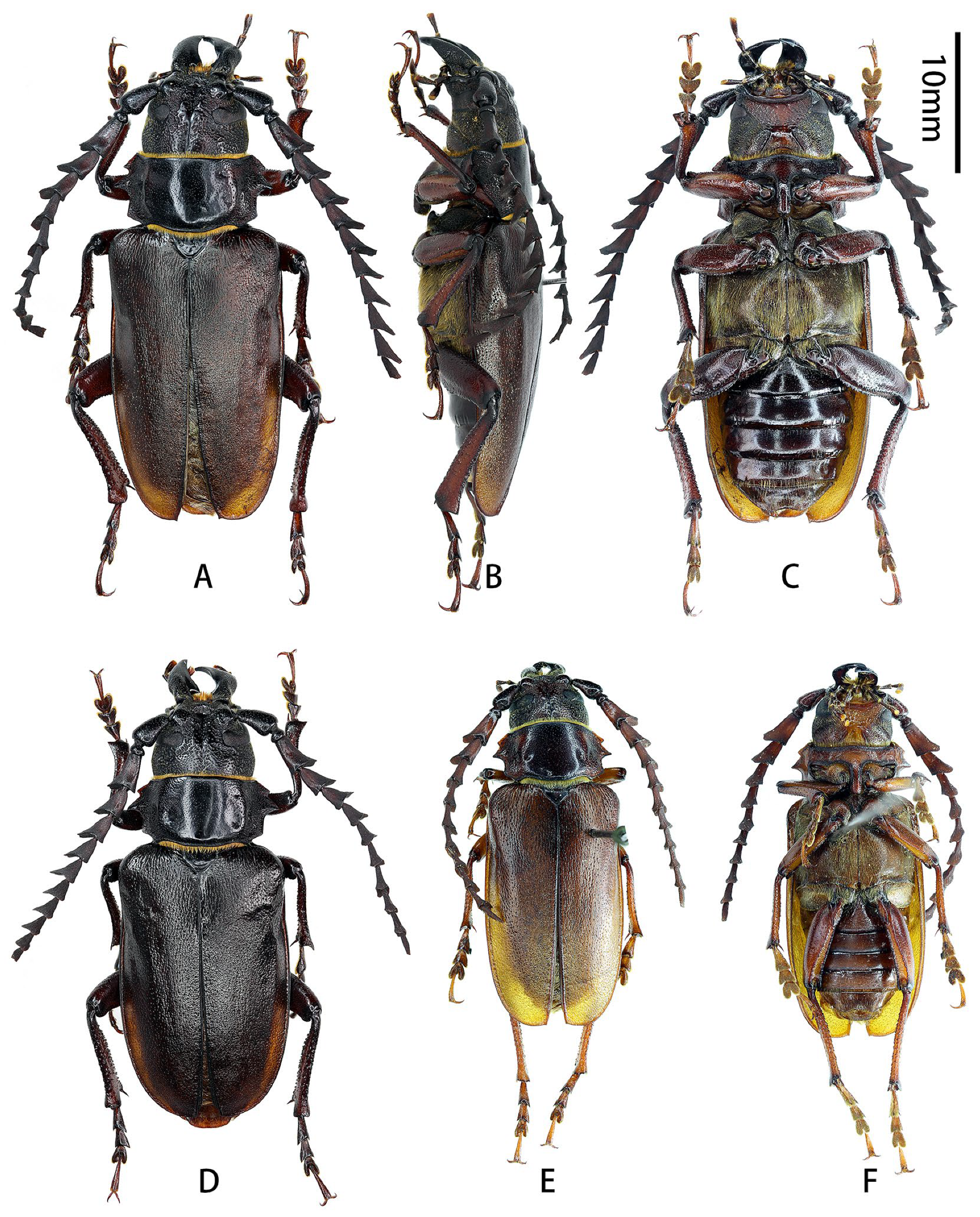
Description (male): Body length: 26.0–33.5 mm, humeral width 9.5–11.5 mm. Body moderately small, stout, reddish brown to blackish brown, dorsoventrally flattened.
Head shorter than wide, remarkably punctured all over; jugular process short, triangularly pointed apically. Eyes small, narrow, separated distantly; distance between upper eye lobes about half width of head, much longer than the width of the upper eye lobe; distance between lower eye lobes 5/8 of width of head. Labrum covered with long setae. Mandibles punctate, robust, acute at apex, slightly bent inwards, with external surface rather strongly bent (curved) at middle, furnished with distinct but not acute inner tooth near base. Antennae with 12 antennomeres, short, about two-thirds of body length. Scape short, robust, narrow basally, strongly expanded to apex, bent inward just after base. Antennomere II about one-fourth as long as scape. Antennomere III slightly shorter than antennomeres I and II combined, dorsoventrally flattened, narrow at base, and expanded apically. Antennomere IV about two-thirds as long as III, flattened, thicker than V; antennomeres V to XI similar to IV, gradually reducing in basal width while gradually longer for apical lobes; antennomere V as long as IV, slightly longer than VI; antennomeres VI–XI almost equal in length; antennomeres IV–XI nearly triangular in dorsal view, acutely pointed apically; antennomere XII irregularly truncate apically; basal area of antennomeres IV–XII strongly narrowed. Ventral side of head flattened and granulate apically.
Prothorax long when compared to allied species (Prionus gahani Lameere, 1912 [8], P. lameerei Semenov, 1927 [9], P. sifanicus Plavilstshikov, 1934 [10]), about one half of as long as wide (measured between tips of middle spines), deeply punctuate, convex on the disk, flattened laterally; each flattened area about one-fifth of pronotal width; with two spines at each side curved backward; anterior spine smaller than middle one; posterior angles almost forming a right angle; hind edge slightly roundly expanding posteriorly; anterior and posterior edges fringed with row of long golden setae.
Scutellum (Figure 1A,D,E) transverse, about twice as broad as long, glabrous.
Elytra flattened, short, about 1.7 times as long as wide; widest area at basal ninth, gradually, slightly narrowed toward base, nearly parallel-sided from basal ninth to apical fifth, and rounded apically; sutural spine short.
Legs flattened, robust. Femora smooth, thick, about as long as tibiae, ventral side with deep groove which is widened from base to apex (Figure 1C,F). Tibiae granulate, sinuous, curved outward distally, with two tibial spurs; inner side with deep groove, which is widened from base to apex. Tarsi with similar shape, combined length of tarsomeres I–V about as long as tibia; tarsomere V longest, tarsomere I subequal to (metatarsus) or slightly shorter (pro- and mesotarsi) than tarsomere V; tarsomeres II and III with similar length.
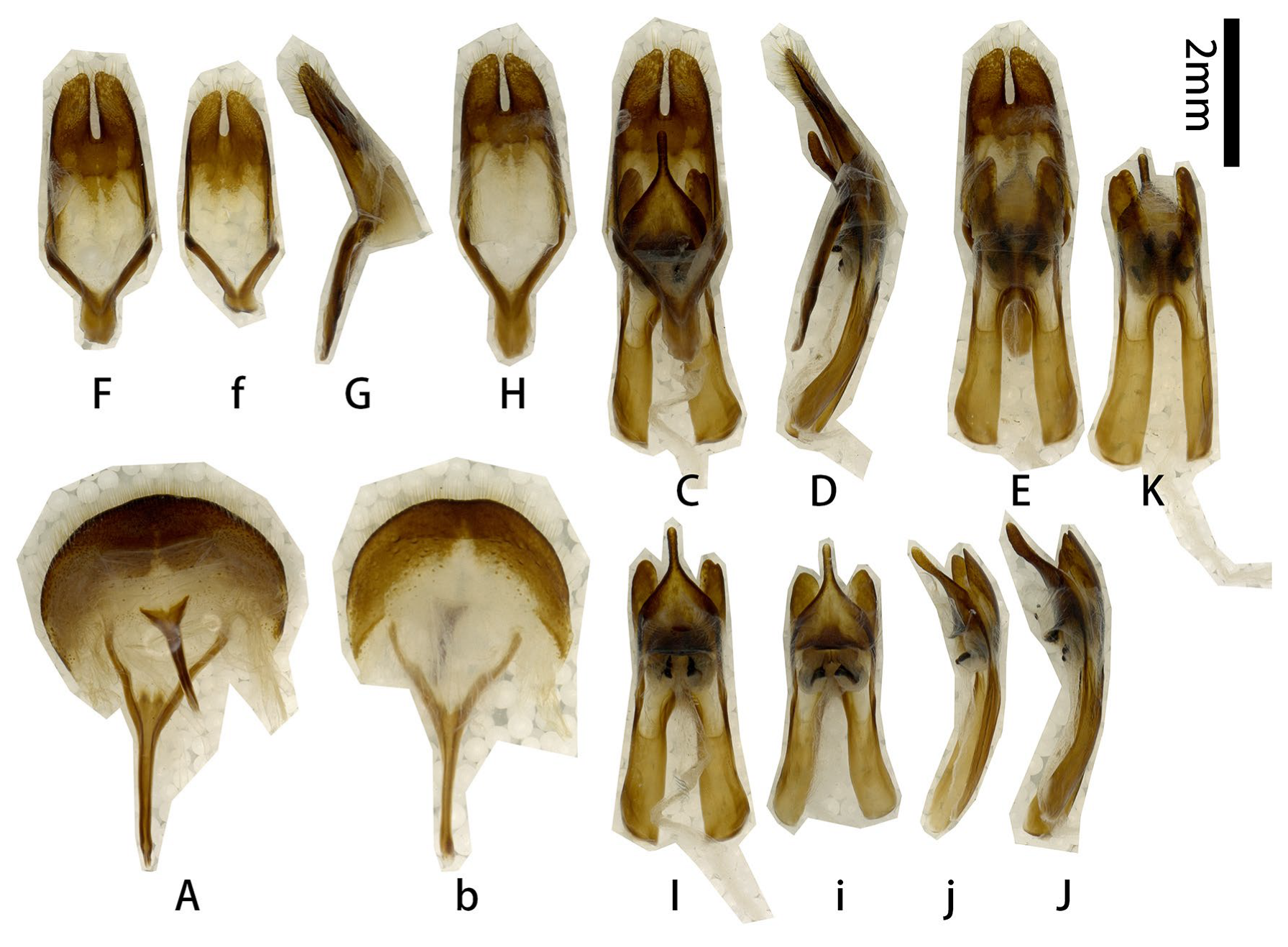
Male genitalia (Figure 2A–L): Tergite VIII (Figure 2B) transverse; apex slightly emarginated in middle; setae short and moderately dense. Tegmen rhombic in ventral view (Figure 2F,f), moderately curved in lateral view (Figure 2I); parameres (Figure 2f,G) narrower apically, moderately slender (length/width more than 2.5) with rounded apex, entirely covered with dense short setae. Median lobe very slightly curved (Figure 2L) in lateral view, median struts more than half length of median lobe. Ventral plate of median lobe strongly projected (Figure 2J,j), dorsal plate of median lobe with two wide lobes (Figure 2K,k). Internal sac with two pieces of crest-shaped basal armature (Figure 2J–L), with a bank of darker colored area at apex (Figure 2c,e,k).
Female unknown.
Figure 2.
Terminalia of Prionus zhumingyui Lin & Drumont, sp. nov. (A–L) Male, holotype. (c,e,f,j,k) Male, paratype. (A,B) Tergite VIII with sternites VIII and IX. (C–E) Male genitalia, internal sac incomplete. (c,e) Male genitalia, internal sac complete. (F–I,f) Tegmen. (J–L,j,k) Median lobe. (A,C,c,F,f,G,J,j) Ventral views. (B,E,e,H,K,k) Dorsal views. (D,I,L) Lateral views. Scale bar: 2 mm. G not to scale.
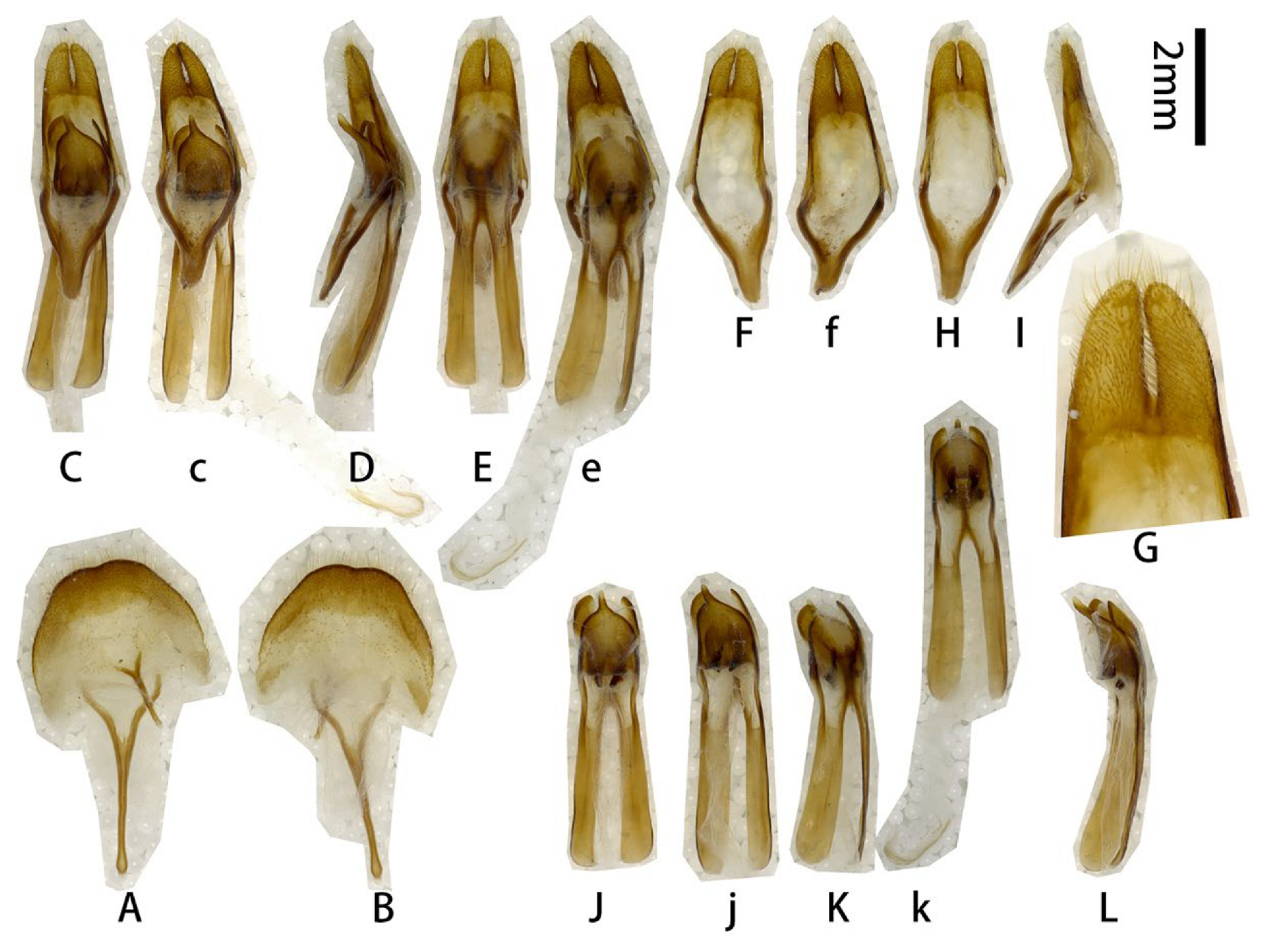
Diagnosis: Among the five species composing the “Prionus gahani” species group [3], Prionus zhumingyui sp. nov. is closest to P. sontinh (Figure 4A–C) but can be easily distinguished by having pronotum longer (ca. 1/2 vs. 1/3 as long as wide), antennomere III with obvious apical lobe more stretched outward and cone-shaped, parameres slender, and tergite VIII with apex slightly emarginated in middle.
Type material. HOLOTYPE: CHINA: ♂ (Figure 1A–C and Figure 2A–L), Guangdong, Maoming City, Xinyishi, Mt. Datianding (广东茂名市信宜市大田顶山, Figure 3A), alt. ca. 1560 m, 22.V.2025, leg. Ming-Yu Zhu (IZCAS). PARATYPES: CHINA: 1 ♂ (Figure 1D and Figure 2c,e,f,j,k), same data as holotype but deposited in MYNU (molecular number ZH11); 1♂ (Figure 1E,F), Guangdong, Xinyishi, Datianding (广东信宜大田顶), alt. 1704 m, 2.VI.1984, leg. Su-Bai Liao (IZCAS).
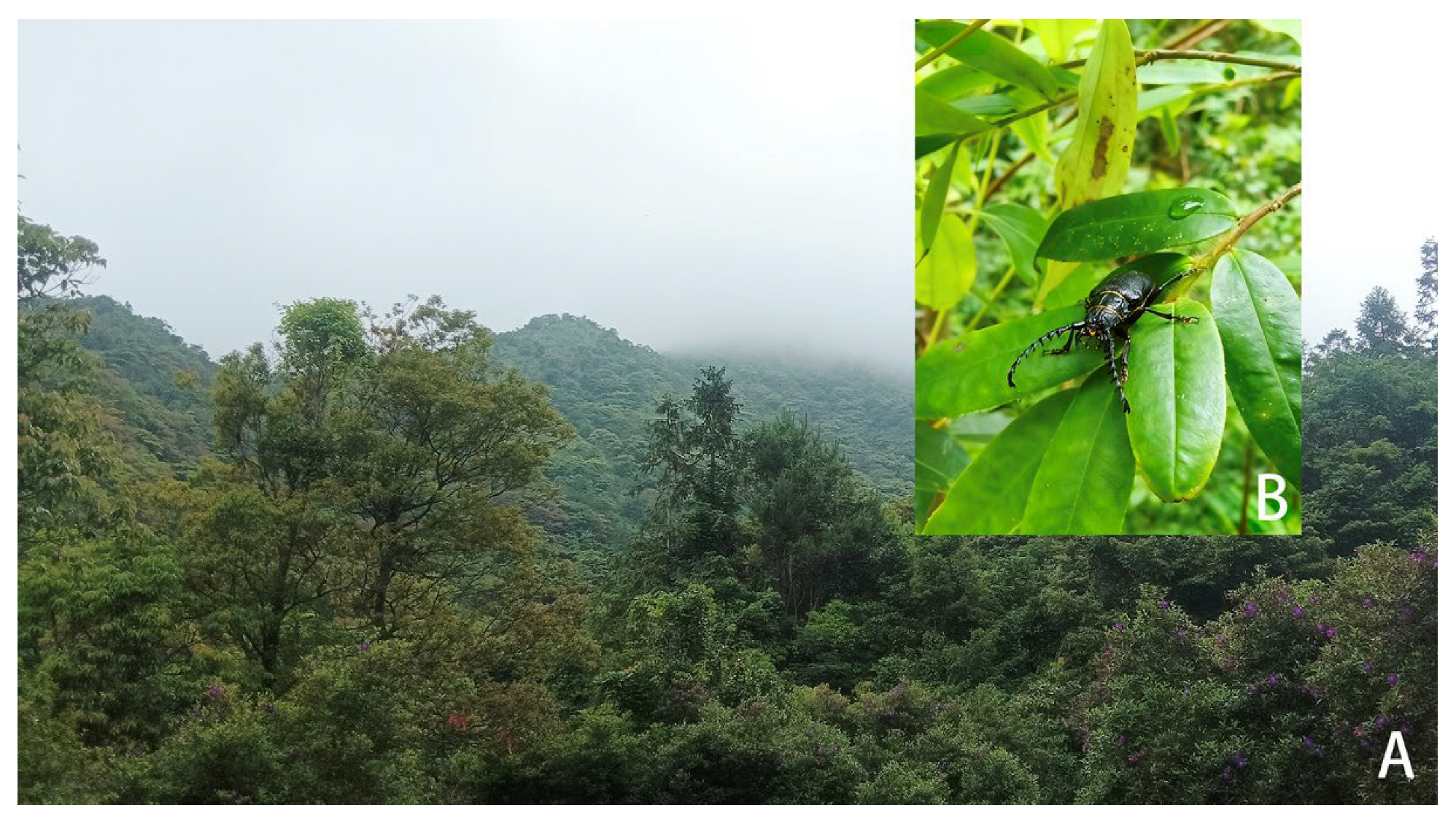
Figure 3.
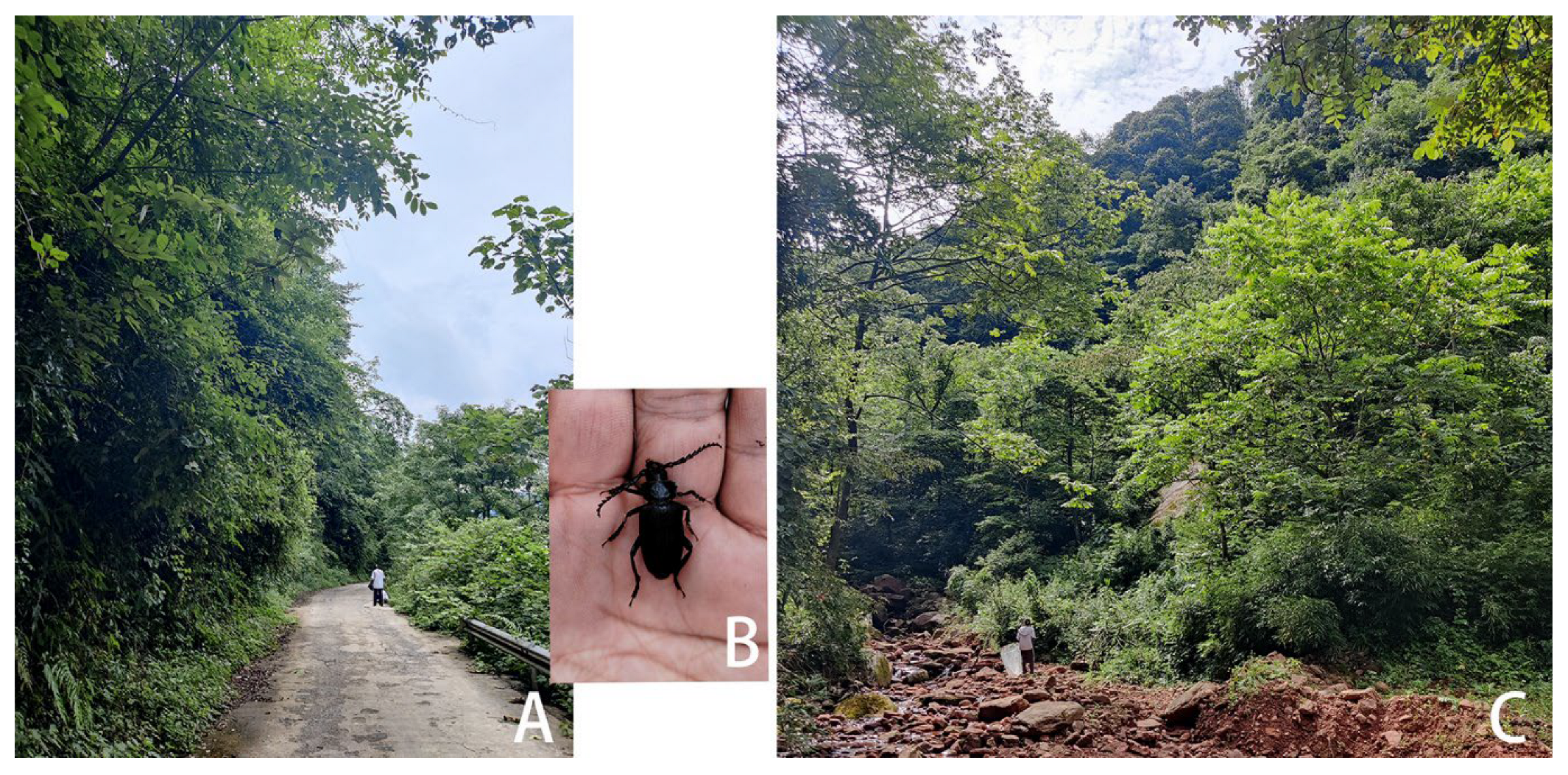
Prionus zhumingyui Lin & Drumont, sp. nov., in Guangdong, Maoming City, Xinyishi, Mt. Datianding, photographed by Bao-Zhen Xu. (A) The environment of the type locality. (B) A living specimen on leaves of Eurya sp. B located in the lower left corner of A.
Distribution: China (Guangdong). So far only known from Mt. Datianding; more investigations in this area will contribute to better define the distribution of Prionus zhumingyui Lin & Drumont, sp. nov.
Etymology: The new species is dedicated to the local collector Mr. Ming-Yu Zhu (Conghua District, Guangzhou, Guangdong), who donated two type specimens for this study and many other longhorned beetles to the first author. The name is a noun in the genitive case.
Biology and Ecology: According to Mr. Ming-Yu Zhu and Mr. Bao-Zhen Xu, the beetle was resting on leaves of Eurya sp. (Pentaphylacaceae) (Figure 3B) at 16: 30, and the weather was sunny. The habitat is located at an altitude of 1560 m in forests usually covered by fog, with very high humidity (Figure 3A). The beetle was occasionally resting on leaves of Eurya sp.; therefore, the host plant is still unknown. The specimens were collected from 22 May to 2 June, so May and June should be their active adult period. No individual came to light trap setting in the middle of this mountain, which indicated that it is active during the day, not nocturnal.
3.2. Prionus sontinh Do, Drumont & Komiya, 2019
Chinese common name: 山神锯天牛.
Prionus sontinh Do, Drumont & Komiya, 2019: 63, Figures 1–8 [3]. Type locality: Vietnam: Lai Chau, Tam Duong.
Prionus sontinh: Drumont & Komiya, 2021: 130, Figure 5 [6].
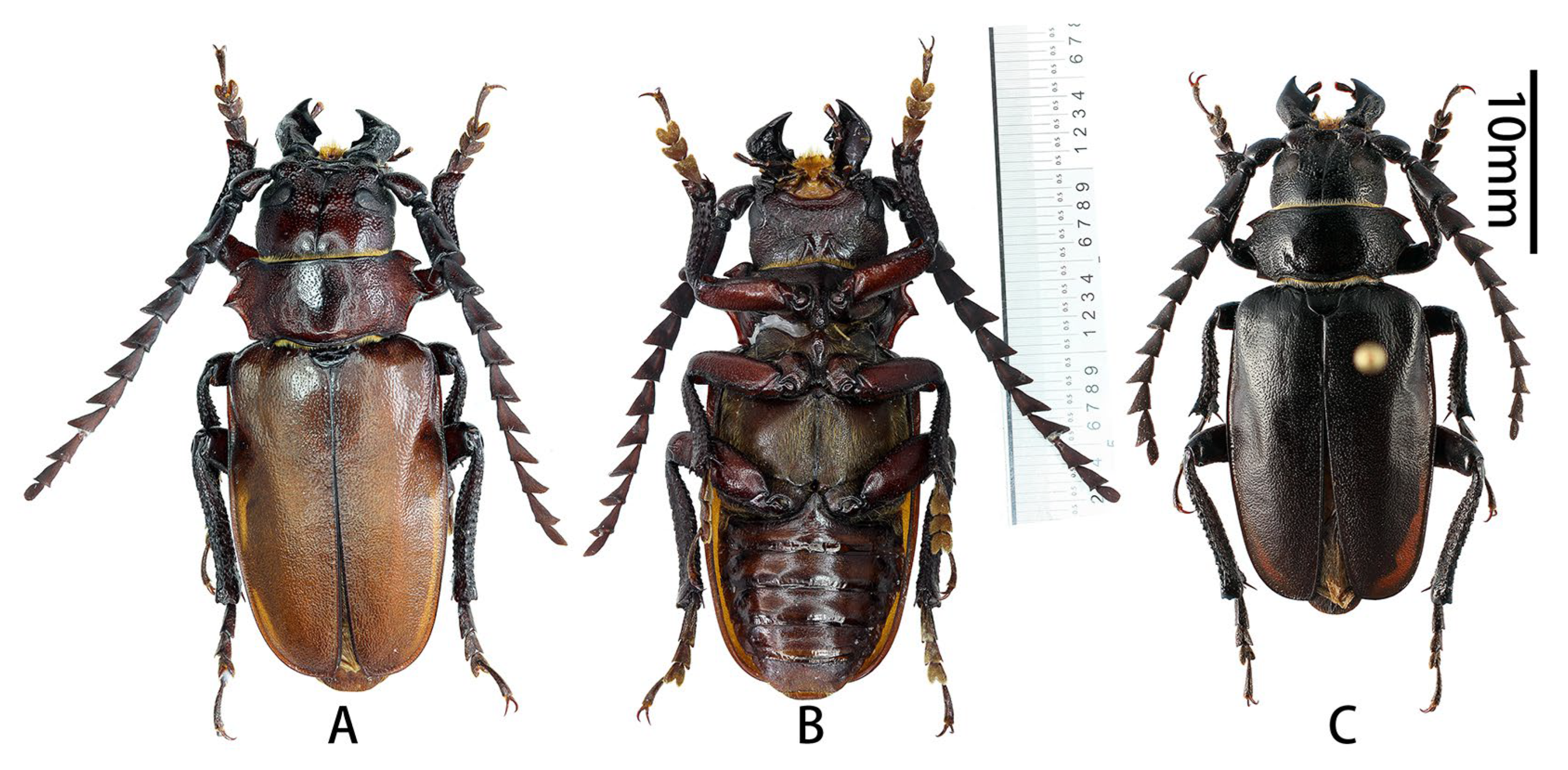
Figure 4.
Habitus of Prionus sontinh Do, Drumont & Komiya, 2019. (A,B) male, from Hà Giang, Vietnam. (C) male, from Yunnan. (A,C) Dorsal views. (B) Ventral views. Scale bar: 10 mm.
Examined material: Holotype, ♂, Vietnam, Lai Châu, Tam Duong, VI.2016, leg. Cuong Do (RBINS).
Vietnam: 1♂ (Figure 4A,B), Hà Giang, V.2025 (CZBC, molecular number SO14); 3♂♂, Hà Giang, Xin Man, VI.2022 (ADC; one male will be deposited in RBINS, I.G.: 35.082)
China: 3♂♂ (Figure 4C), Yunnan, Pingbian, Mt. Daweishan (云南屏边大围山), 2000 m, IV–V. 2020 (ADC; one male will be deposited in RBINS, I.G.: 35.082); 1♂, Yunnan, Jinping, Fenshuiling (云南金平分水岭), VII.2023 (ADC).
Complementary description. Male body length 24.0–38.5 mm, humeral width 10.0–15.0 mm; female body length 23.0–32.0 mm, humeral width 12.0–14.0 mm.
Based on the newly examined specimens during this study, the male specimens from Hà Giang, Vietnam, are reddish brown, while the male specimens from Yunnan, China, are shining black. These variations are observed and reported from the type series too [3].
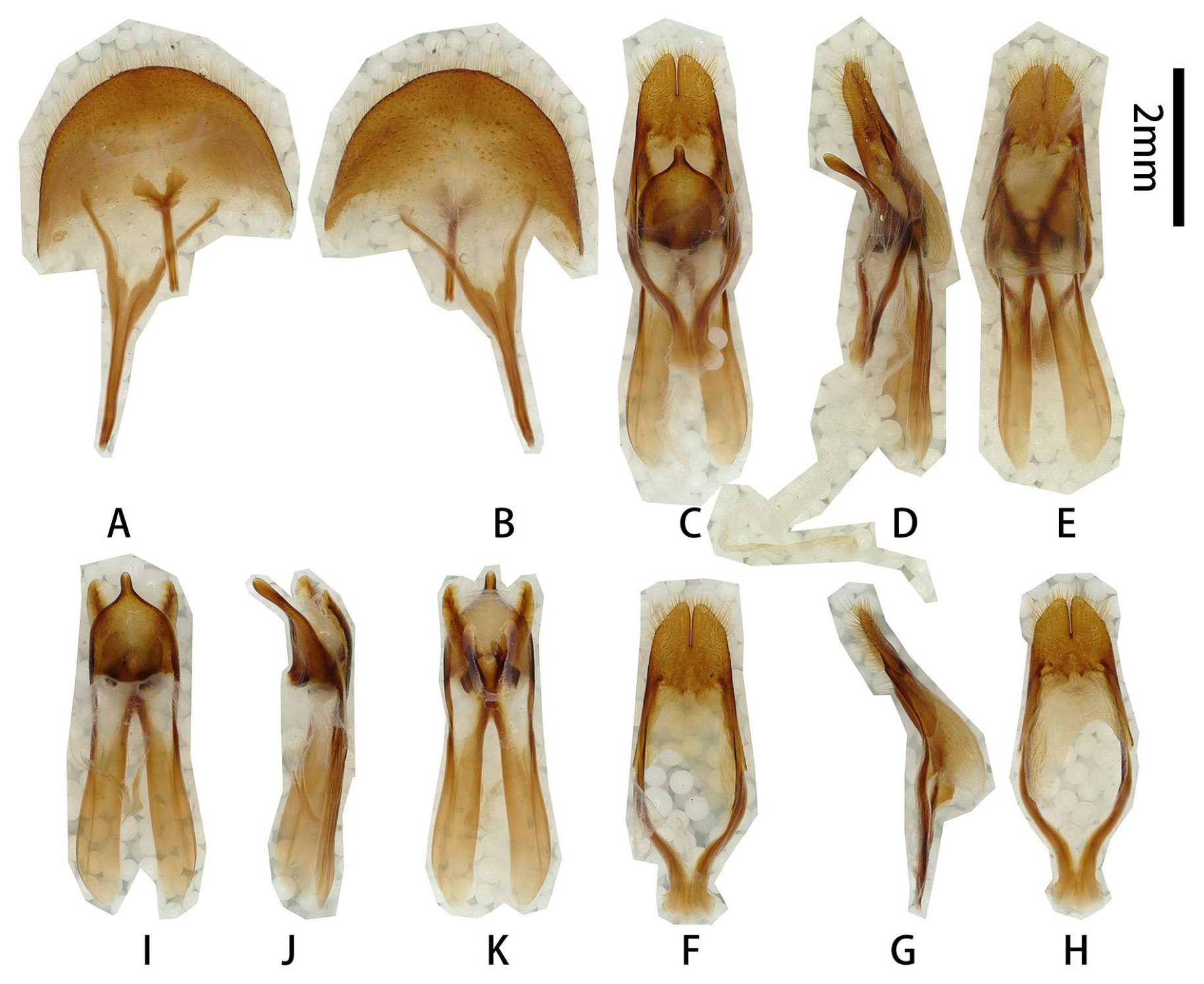
Male genitalia (Figure 5A–K): Tergite VIII (Figure 5B) transverse, apex broadly rounded, setae short and moderately dense. Tegmen rhombic in ventral view (Figure 5F), slightly curved in lateral view (Figure 5G); parameres (Figure 5F) narrower apically, quite stout (length/width ca. 1.4) with obliquely rounded apex, entirely covered with dense and moderately long setae. Median lobe very slightly curved (Figure 5J) in lateral view, with median struts about 4/7 of median lobe length. Ventral plate of median lobe strongly projected (Figure 5I), dorsal plate of median lobe with two narrow lobes (Figure 5K). Internal sac with two pieces of crest-shaped basal armature (Figure 5I–K).
Distribution: China (Yunnan) and Vietnam. This species was described from Lai Châu Province, northern Vietnam [3]. Yunnan was reported by Drumont & Komiya (2021) without detailed data [6], which are reported here for the first time. The species has also recently been found in the Vietnamese province of Hà Giang (Vi Xuyên and Xin Man), which shares more than 200 km of boundary with the province of Yunnan.
Figure 5.
Terminalia of Prionus sontinh Do, Drumont & Komiya, 2019. (A,B) Tergite VIII with sternites VIII and IX. (C–E) Male genitalia. (F–H) Tegmen. (I–K) Median lobe. (A,C,F,I) Ventral views. (B,E,H,K) Dorsal views. (D,G,J) Lateral views. Scale bar: 2 mm.
Biology and Ecology: According to Mr. Cheng-Zhi Bian, the Prionus sontinh specimens living on the Mt. Daweishan were active during the day and were most commonly found on cement roads in mountains. They have not been observed to fly, and males are not coming to light traps. Specimens live at a relatively high altitude, around 1500–2000 m, and the habitat is represented by virgin forests, with no artificial or secondary forests present. Rotting trunks were examined for individuals with no success.
3.3. Prionus antonkozlovi Drumont & Komiya, 2021
Chinese common name: 科兹洛夫锯天牛.
Prionus antonkozlovi Drumont & Komiya, 2021: 127, Figure 1 [6]. Type locality: China: Fujian, Sanming, Luobading.
Complementary description. Male body length 22.0–35.0 mm, humeral width 8.0–13.0 mm; female body length 23.0–34.0 mm, humeral width 8.5–13.5 mm.
Figure 6.
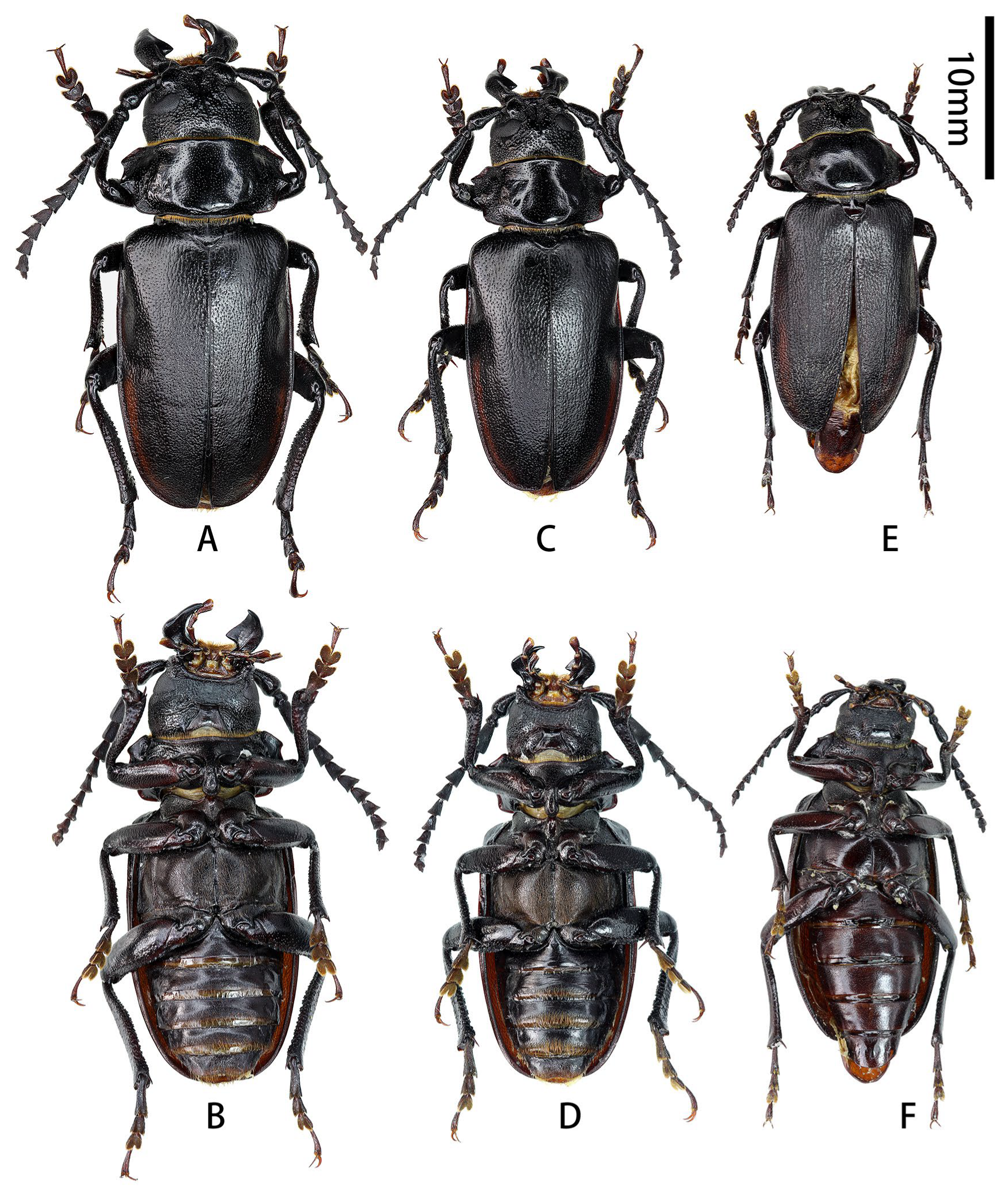
Habitus of Prionus antonkozlovi Drumont & Komiya, 2021. (A–D) Males, from Fujian. (E,F) Female, from Fujian. (A,C,E) Dorsal views. (B,D,F) Ventral views. Scale bar: 10 mm.
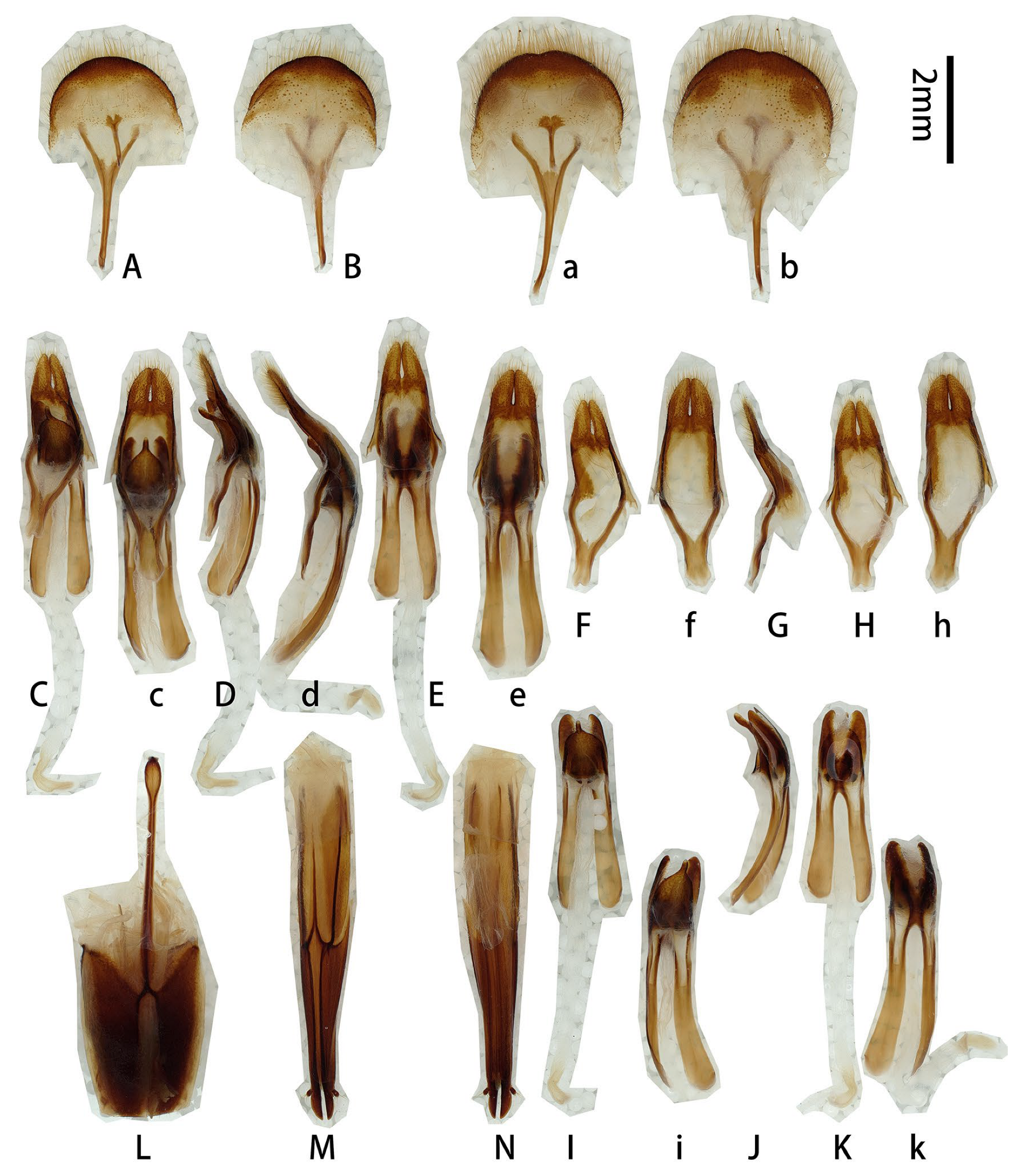
Male genitalia (Figure 7A–K,a–f,h,i,k): Tergite VIII (Figure 7B) transverse, apex broadly rounded (slightly emarginated in another larger male, Figure 7a,b), setae short and moderately dense. Tegmen rhombic in ventral view (Figure 7F,f), slightly curved in lateral view (Figure 7G); parameres (Figure 7F,f) narrower apically, moderately stout (length/width ca. 2.0) with rounded apex, entirely covered with dense short setae. Median lobe slightly curved (Figure 7D,d,J) in lateral view, median struts about 3/5 of median lobe length. Ventral plate of median lobe strongly projected (Figure 7I,i), dorsal plate of median lobe with two wide lobes (Figure 7K,k). Internal sac with two pieces of crest-shaped basal armature (Figure 7I–K). Female sternite VIII with spiculum ventral (also called tignum) and ovipositor as in Figure 7L–N.
Figure 7.
Terminalia of Prionus antonkozlovi Drumont & Komiya, 2021 from Fujian. (A–K) Male, smaller. (a–f,h,i,k) Male, larger. (L–N) Female. (A,B,a,b) Tergite VIII with sternites VIII and IX. (C–E) Male genitalia, internal sac complete. (c–e) Male genitalia, internal sac incomplete. (F–H,f,h) Tegmen. (I–K,i,k) Median lobe. (L) Female, sternite VIII with spiculum ventral (also called tignum). (M,N) Female, ovipositor. (A,a,C,c,F,f,I,i,L,M) Ventral views. (B,b,E,e,H,h,K,k,N) Dorsal views. (D,d,G,J) Lateral views. Scale bars: 2 mm.
Examined material: Holotype, ♂, Fujian, Sanming, Luobading (福建三明市锣钹顶), VI.2015 (RBINS, I.G.: 34.305); Allotype, 1♀, same data as holotype.
China, Fujian: 1♂, Fujian, Sanming City, Shaxian, Luobading (Figure 8C, 福建三明市沙县锣钹顶), elev. 1100 m, 18.VI.2019, leg. Liang Guo (CGL); 2♂♂ (Figure 6A–D), Fujian, Sanming City, Shaxian, Mt. Luobading (福建三明市沙县锣钹顶), elev. 1300 m, 30.V.2025, leg. Tao-Kun Liao (CLTK, molecular number AN9); 3♂♂1♀, Fujian, Sanming City, Shaxian, Mt. Luobading (福建三明市沙县锣钹顶), elev. 1300 m, 2.VI.2025, leg. Tao-Kun Liao (CLTK); 1♂1♀ (Figure 6E,F), Fujian, Sanming, Sanyuan Distr., Lianhuafeng (Figure 8A, 福建三明市三元区莲花峰), elev. 1100 m, 1.VI.2021, leg. Tao-Kun Liao (CLTK, the female has 219 eggs for molecular study, AN10); 2♀♀, same data but elev. 1200 m, 9.VI.2023; 1♂1♀, same data but VII.2016, leg. Liang Guo (CGL); 1♂, Fujian, Sanming, Yong’anshi, Zhushekeng (福建三明市永安市竹畲坑), elev. 1100 m, 18.VI. 2019, leg. Tao-Kun Liao (CLTK).
Distribution: China (Fujian).
Figure 8.
Prionus antonkozlovi Drumont & Komiya, 2021, in Fujian, Sanming City. (A) The environment of Sanyuan Distr., Lianhuafeng. (B) A living specimen under dry leaves of bamboo. B is located in the bamboo forest of A. (C) The environment of type locality, Shaxian, Luobading. (D) A living specimen crawling on a road of the type locality. (E) Collecting sites: the left yellow point is Lianhuafeng; the right yellow point is the type locality, Luobading. The straight-line distance between the two points is three kilometers, the three villages’ names in Chinese from left to right are Baishuicun (白水村), Dingtaicun (顶太村) and Caoyangcun (草洋村). All photographed by Tao-Kun Liao except D photographed by Liang Guo.
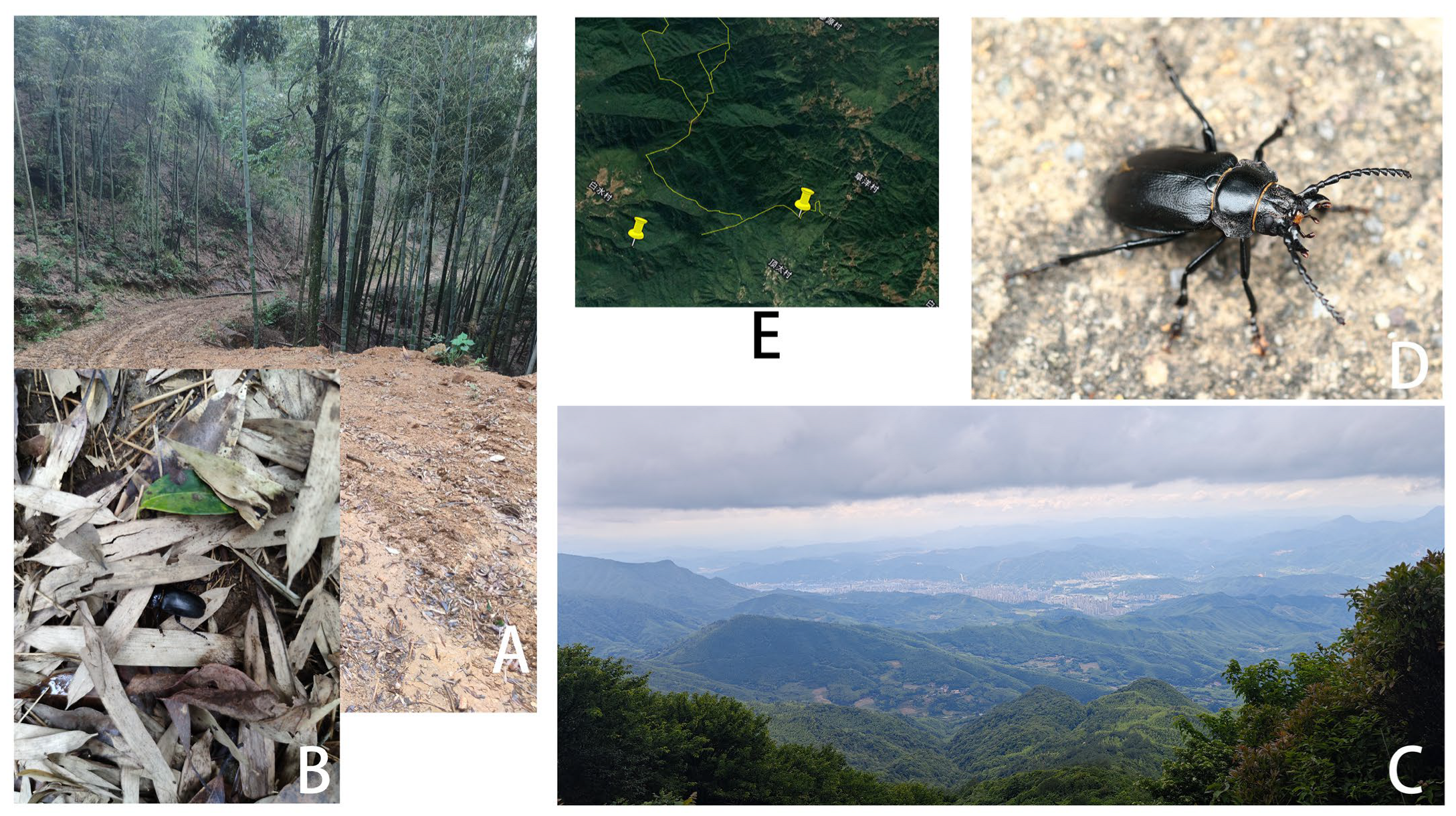
Biology and Ecology: According to Mr. Tao-Kun Liao, Mr. Liang Guo, and Mr. Peng-Yu Liu, this beetle occasionally appears in drainage ditches or crawls on the ground at the roadside, and is not attracted to light. According to field observations by Mr. Liang Guo and Mr. Tao-Kun Liao, this beetle just disappears at night, does not crawl on the ground, and cannot be attracted to light. This species has been collected in some areas of the Daimao Mountain Range (including Lotus Peak, Puchan Mountain, etc.), South of Sanming City, Fujian. It is mainly distributed at altitudes between 800 and 1400 m, with 1100 m being the primary elevation range. Its habitat includes both bamboo forests and beech forests. The peak collection period is from May to June, when the beetles are particularly active, crawling on the ground after rain.
As an additional biological information, 219 eggs were found in a female with a 23 mm length.
3.4. Prionus lameerei Semenov, 1927
Figure 9A.
Chinese common name: 云南锯天牛.
Prionus gahani: Lameere, 1916: 257 (misidentification) [11].
Prionus lameerei Semenov, 1927: 235 [9]. Type locality: China: Yunnan.
Prionus lameerei: Gressitt, 1951: 24, 26 [12]; Wang, 1986: 48 [13]; Hua, 2002: 226 (catalogue) [14]; Löbl & Smetana, 2010: 94 (catalogue) [15]; Li et al., 2014: 92 [16]; Chen et al., 2019: 23 (catalogue) [5]; Danilevsky, 2020: 116 (catalogue) [17]; Drumont & Komiya, 2021: 130, Figure 3 [6].
Prionus lameeri: Wang & Chiang, 1988: 146 (misspelling) [18].
Examined material: Holotype (Figure 9A), ♀, Yunnan (云南), leg. P. Guerry (MNHN).
Distribution: China (Yunnan, Sichuan?).
Remarks. The record from Sichuan by Wang (1986) was doubtful; it might be a misidentification of Prionus gahani.
3.5. Prionus gahani Lameere, 1912
Figure 9B–G, Figure 10A–C, Figure 11A–G, Figure 12A–N,a–k,Aa,Ii, Figure 13A,C–K,b,f,i,j and Figure 14A–C.
Chinese common name: 短角锯天牛.
Prionus gahani Lameere, 1912: 189 [8]. Type locality: China: Chongqing (Chin-Fu-San).
Prionus gahani: Lameere, 1919: 132, pl. 6, Figure 5 ([19], part); Gressitt, 1951: 24, 25 [12]; Hua, 2002: 226 (catalogue) [14]; Löbl & Smetana, 2010: 94 (catalogue) [15]; Li et al., 2014: 91 [16]; Chen et al., 2019: 22 (catalogue) ([5], part, wrong type locality); Danilevsky, 2020: 116 (catalogue) [17]; Drumont & Komiya, 2021: 130, Figure 2 [6].
Examined material: Lectotype ♂ (Figure 9C,D), Chin-Fu-San, W. China, 1908-10, W. A. Maw (BMNH, NHMUK 016605359); paralectotype ♂ (Figure 9E–G), Chin-Fu-San, W. China, 1908-10, W. A. Maw (BMNH, NHMUK 016605358).
Lectotype designation:
According to Lameere’s original description, there was more than one syntype. We therefore designate as the male lectotype (Figure 9C,D) (ICZN, Recommendation 73 F No presumption of the existence of a holotype) the specimen held at the BMNH and bearing the following labels (Figure 9D):
- (1)
- rectangular, white, printed in black with a yellow line “Chin-Fu-San, W. China, 1908–10, W. A. Maw”,
- (2)
- round, white, with a blue border, printed in black “SYNTYPE”,
- (3)
- rectangular, white, handwritten by Lameere “Prionus gahani Cotype Lmr.”,
- (4)
- yellow, printed with a black border: “Type specimen reset by A. DRUMONT in 2002”,
- (5)
- rectangular, white, with a QR code and printed in black: NHMUK 016605359.
The lectotype is in very good condition; only the last tarsomere of right pro- and mesotarsi, as well as the claws of the right metatarsus, are missing.
Figure 9.
Habitus of Prionus spp. (A) Prionus lameerei Semenov, 1927, holotype female, from Yunnan. (B–G) Prionus gahani Lameere, 1912. (B) Female, from Sichuan. (C,D) Lectotype male, from Chongqing. (E–G) Paralectotype male, from Chongqing. (A–C,E) Dorsal views. (G) Lateral views. Scale bar: 10 mm. (D,F) Labels. Not to scale.
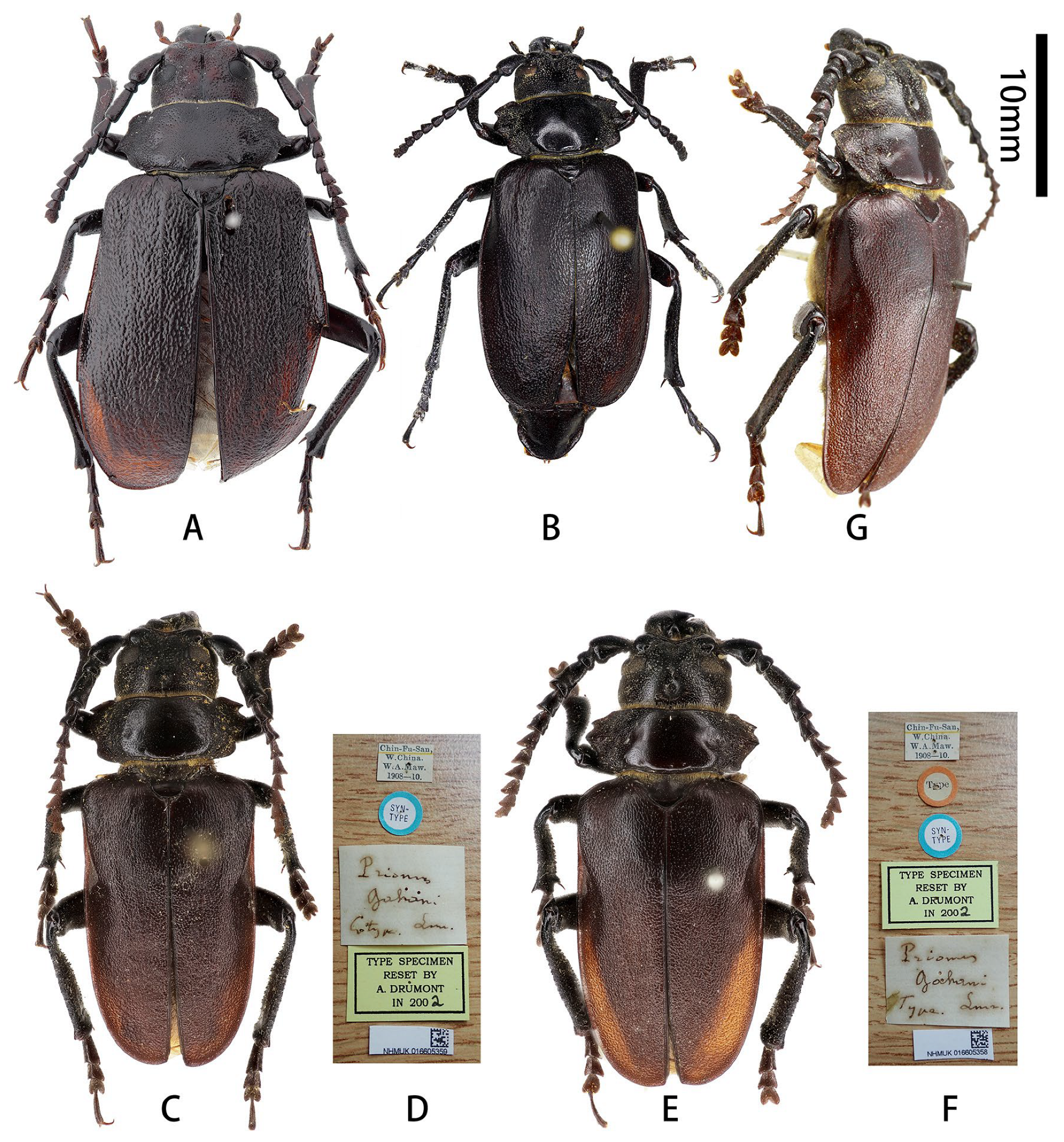
We designate as paralectotype male (Figure 9E–G) the specimen held at the BMNH and bearing the following labels (Figure 9F):
- (1)
- rectangular, white, printed in black with a yellow line “Chin-Fu-San, W. China, 1908–10, W. A. Maw”,
- (2)
- round, white, with a red border, printed in black “TYPE”,
- (3)
- round, white, with a blue border, printed in black “SYNTYPE”,
- (4)
- rectangular, white, handwritten by Lameere “Prionus gahani Type Lmr.”,
- (5)
- yellow, printed with a black border: “Type specimen reset by A. DRUMONT in 2002”,
- (6)
- rectangular, white, with a QR code and printed in black: NHMUK 016605358.
The lectotype (Figure 9C,D) was selected since its pronotum shows the normal pattern of Prionus gahani and is easily observed in males of this species, whereas the paralectotype exhibits a rather atypical pronotum.
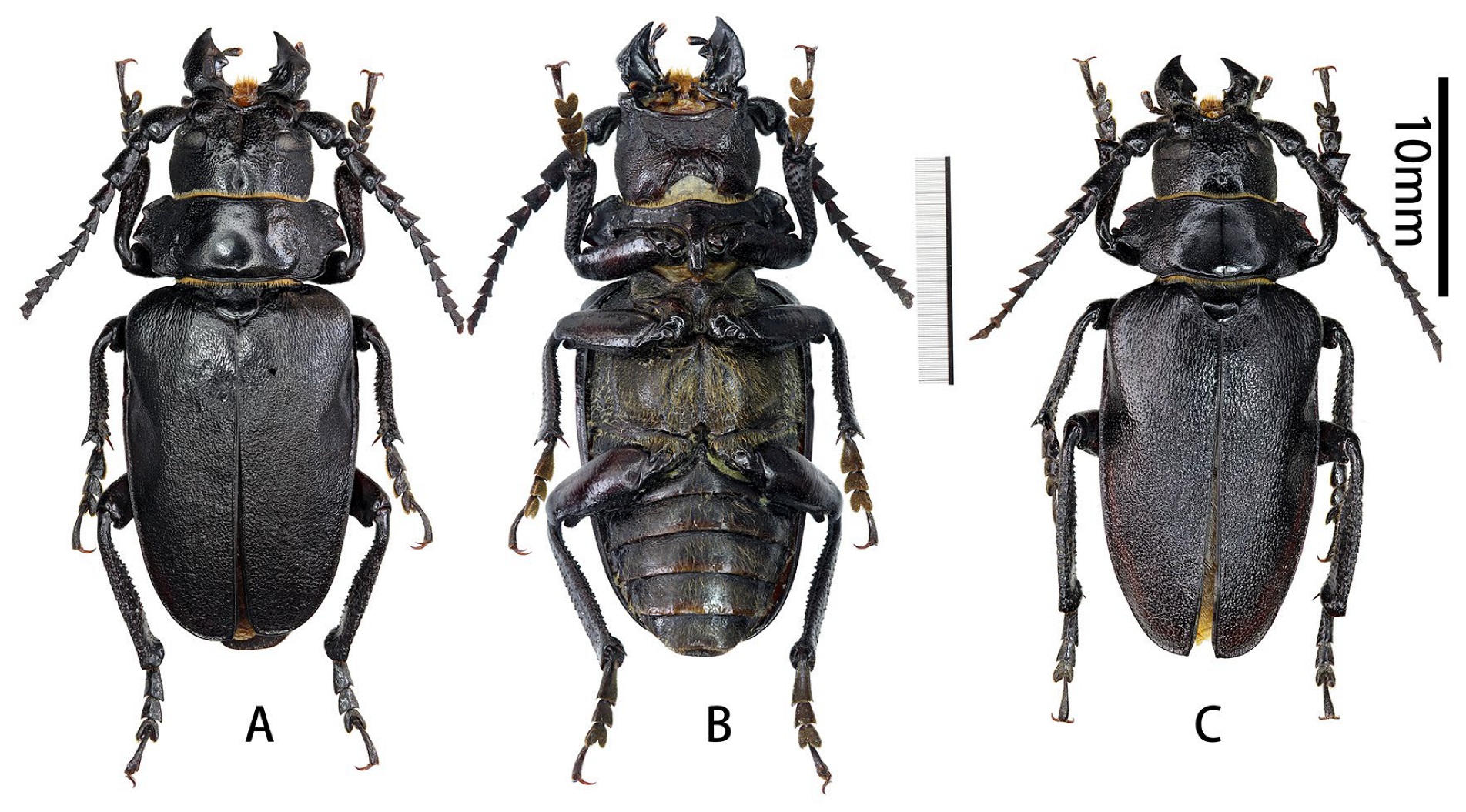
China, Chongqing: 1♂, Chongqing, Nanchuan, Jinfoshan, Huangniya (重庆南川金佛山黄泥垭, Figure 10A,B and Figure 12A–K), 1350 m, 19.VI.2025, leg. Tian-Xuan Gu, Yong Zhou (MYNU ex Tian-Xuan Gu’s private collection, molecular data GS2); 1♂ (Figure 10C and Figure 12a–k), same data but IZCAS ex Xiao-Tian Zhong’s private collection, molecular data GS1; 1♂ (Figure 12Aa,Ii), Chongqing, Wanxian, Wangerbao (重庆万县王二包), 1200 m, 12.VII.1993, leg. Jian Yao (IZCAS, 8957); 1 ♂, same data but 11.VII.1993 (IZCAS, 11023); 1 ♀ (Figure 11A,B and Figure 12L–N), Chongqing, Wanxian, Wangerbao (重庆万县王二包), 1200 m, 10.VII.1993, leg. Jian Yao by light trap (IZCAS, 10482, molecular data GS5); 2 ♂♂ 1 ♀, same data but (IZCAS, 11023 & 11029 & 11024); 1 ♂, same data but leg. Run-Zhi Huang (IZCAS, 3049); 1 ♂, same data but 10.VII.1993, leg. Run-Zhi Huang (IZCAS, 13256); 1♂, Chongqing, Wanxian, Wangerbao (重庆万县王二包), 1200 m, 9.VII.1993, leg. Wen-Zhu Li (IZCAS, 5157, molecular data GS6); 2 ♂♂, same data but (IZCAS 5159 & 5175); 1 ♂, same data but 10.VII.1993 (IZCAS 126); 1♂ (Figure 11C), Chongqing, Wulong, Baimashan (重庆武隆白马山), 1250 m, 1.VII.1989, leg. Bao-Wen Sun (IZCAS, molecular data GS7).
Figure 10.
Habitus of Prionus gahani Lameere, 1912, from type locality Chongqing, Jinfoshan. (A,C) Dorsal views. (B) Ventral view. Scale bar: 10 mm.
China, Sichuan: 1♀ (Figure 9B), Sichuan, Huaying city, Mt. Huayingshan (四川华蓥市华蓥山), elev. 1400 m, 23 & 24.VI.2007, leg. Wei-Wei Zhang (IZCAS, ex Wei-wei Zhang’s private collection); 1 ♂, Xuanhan County, Nanzhuchang (宣汉楠竹场), 20.VI.1980, leg. Xiao-Hong Chen (IZCAS); 4♂♂ (Figure 11D,E and Figure 13b,f,i,j), Luzhou City, Gulin County, Zhangde Town, Longzhuagonglu, Da’ao (泸州市古蔺县彰德镇龙爪公路大坳, Figure 14C), 1580 m, 28.1782° N, 105.7637° E, 12.VII.2024, leg. Hao Xu, Can Zhang, Yang-Ye Liao (MYNU, molecular data GS2); 3 ♂♂ (Figure 11F,G and Figure 13A–K), Luzhou City, Gulin County, Huangjing Town, Gaofeng village, Liangfeng’ao (泸州市古蔺县黄荆镇高峰村凉风坳), 1000 m, 28.1595° N, 105.6984° E, 15.VII.2024, leg. Hao Xu, Xin-Man Yang, Can Zhang (MYNU); 2 ♂♂, Luzhou City, Gulin County, Huangjing Town, Huangjing village, Changtan (泸州市古蔺县黄荆镇黄荆村长滩), 915 m, 28.2849° N, 105.7741° E, 13.VII.2024, leg. Hao Xu, Xin-Yuan Zhang, Xin-Man Yang (MYNU); 1 ♂ (Figure 14B), Luzhou City, Gulin County, Huangjing Town, Bajiedong village, Shanwangba (泸州市古蔺县黄荆镇八节洞村山王坝, Figure 14A), 1214 m, 28.2263° N, 105.7487° E, 14.VII.2024, leg. Hao Xu, Can Zhang, Yang-Ye Liao (MYNU); 1♂, Luzhou City, Gulin County, Deyao Town, Longmeiguanhuzhan (泸州市古蔺县德耀镇龙美管护站), 1500 m, 28.0901° N, 105.6902° E, 5.VIII.2024, leg. Hao Xu, Xin-Yuan Zhang, Shu-Tong Zhang (MYNU).
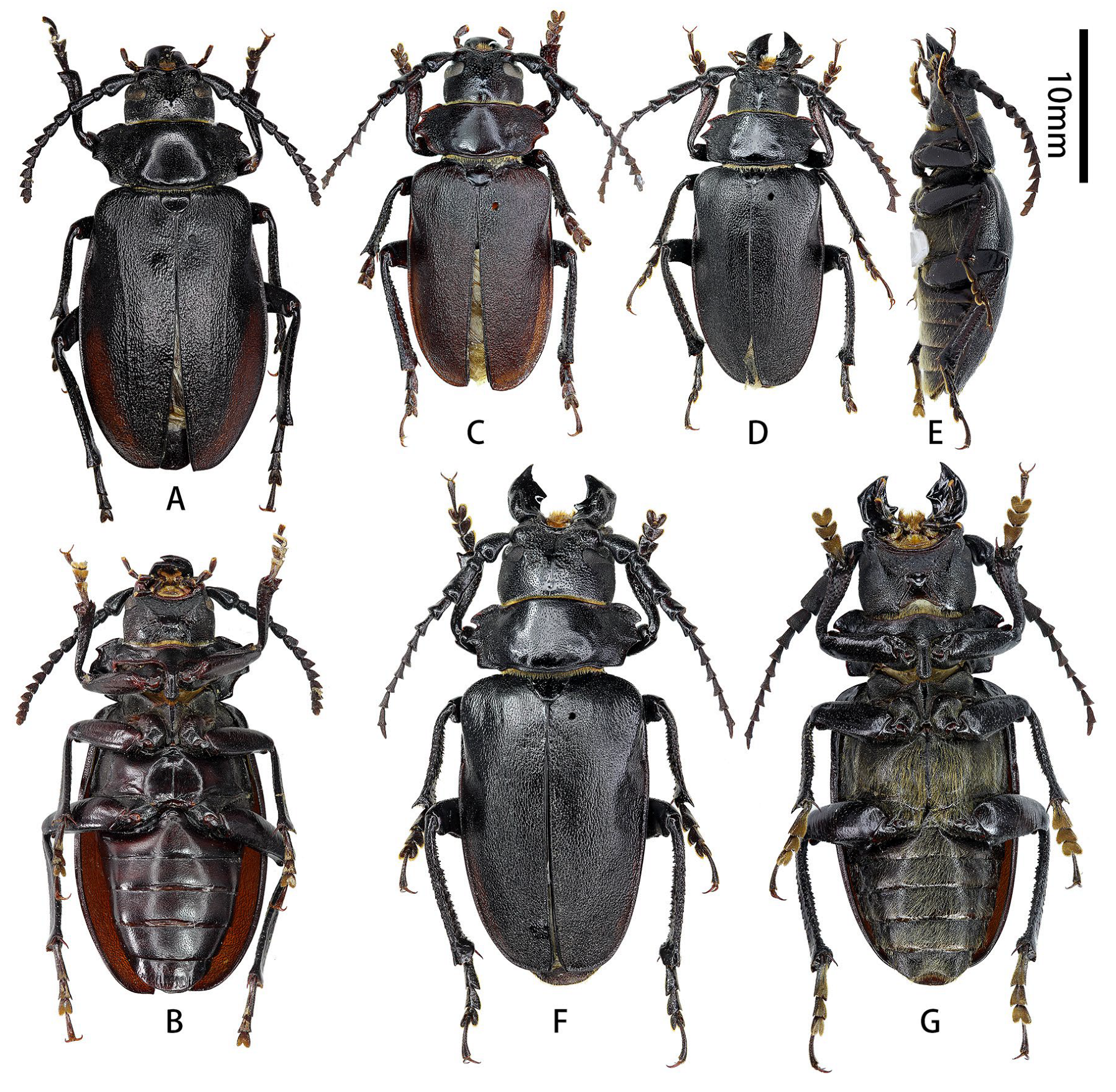
Figure 11.
Habitus of Prionus gahani Lameere, 1912. (A,B) Female from Chongqing, Wanxian. (C) Male from Chongqing, Wulong. (D–G) Males from Sichuan. (A,C,D,F) Dorsal views. (E) Lateral view. (B,G) Ventral views. Scale bar: 10 mm.
Complementary description. Male body length 18.0–34.0 mm, humeral width 8.0–14.0 mm; female body length 25.0–32.0 mm, humeral width 10.0–13.0 mm.
Female described for the first time. The coloration and punctation (Figure 9B and Figure 11A,B) closely match those of male. Antennae shorter, with last four antennomeres extending beyond basal margin of pronotum; antennomere III cylindrical, slightly shorter than scape; antennomere IV much shorter than III and subequal to V; antennomeres V to XI with short apical lobes; antennomere XII very short and almost rounded at apex. Pronotum with lateral teeth nearly identical to those of male. Elytra distinctly expanded from basal ninth, widest near middle, then gradually narrower posteriorly, with their sutural margins separated from near middle to apex. Each elytron has only one carina near middle, elytral apex identical to that of male. Ventral side (Figure 11B) lacking long pubescence present in males, with ventrite V rounded at apex.
Figure 12.
Terminalia of Prionus gahani Lameere, 1912, from Chongqing. (A–K) Male, specimen Figure 10A,B. (a–k) Male, specimen Figure 10C. (L–N) Female, specimen Figure 11A,B. (Aa, Ii) Male, from Chongqing. (A,B,a,b,Aa) Tergite VIII with sternites VIII and IX. (C–E,c–e) Male genitalia. (F–H,f–h) Tegmen. (I–K,i–k,Ii) Median lobe. (L) Female, sternite VIII with spiculum ventral (also called tignum). (M,N) Female, ovipositor. (A,a,Aa,C,c,F,f,I,i,Ii,L,M) Ventral views. (B,b,D,d,H,h,K,k,N) Dorsal views. (E,e,G,g,J,j) Lateral views. Scale bar: 2 mm.
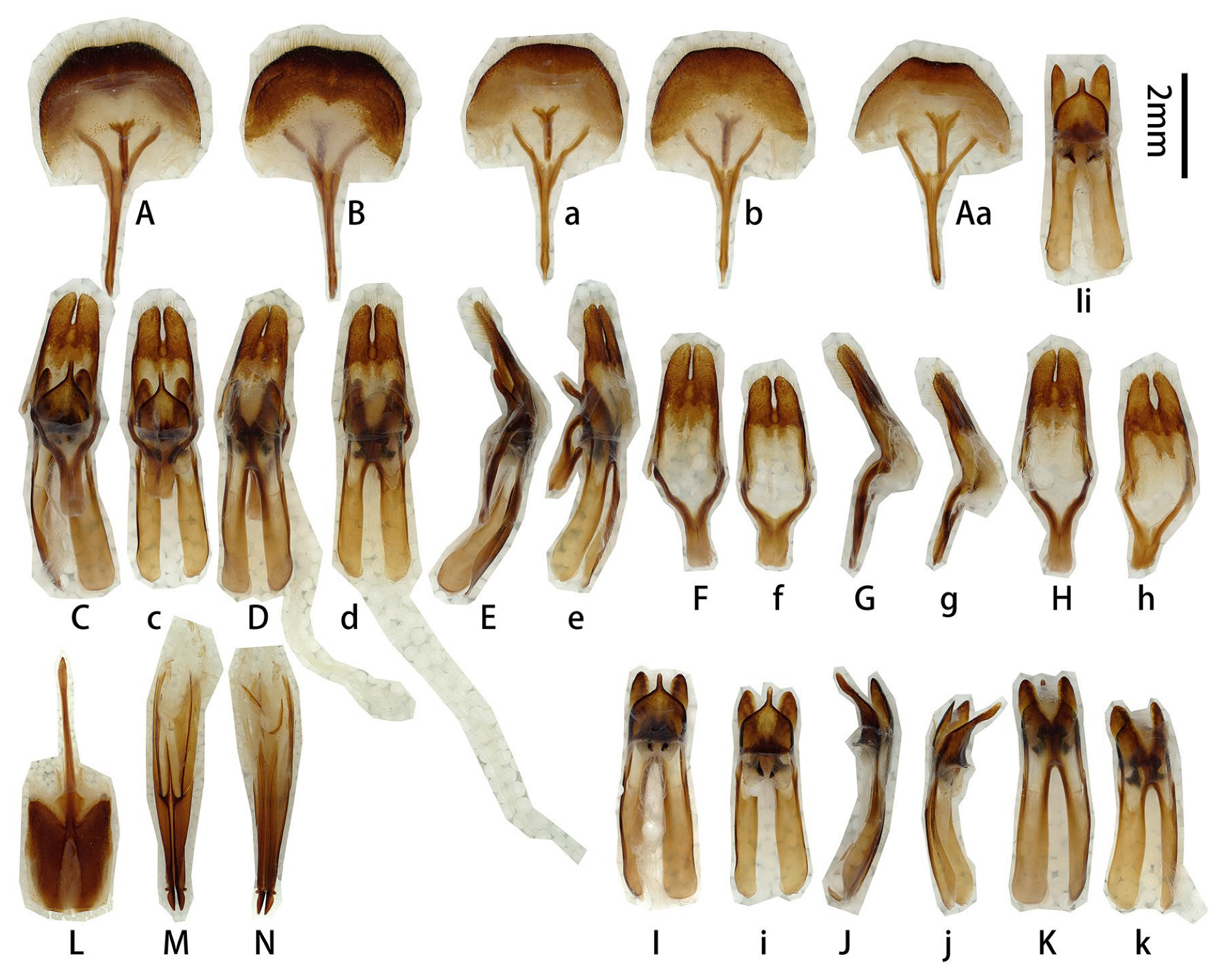
Male genitalia (Figure 12A–K,a–k,Aa,Ii and Figure 13A,C–K,b,f,i,j): Tergite VIII (Figure 12B,b and Figure 13A,b) transverse, apex broadly rounded to slightly emarginated, setae short and moderately dense. Tegmen rhombic in ventral view (Figure 12F,f and Figure 13F,f), moderately curved in lateral view (Figure 12G,g and Figure 13G); parameres (Figure 13F) narrower apically, moderately stout (length/width ca. 2.0) with projected apex, entirely covered with dense short setae. Median lobe very slightly curved (Figure 12J,j and Figure 13J,j) in lateral view, median struts subequal to half the length of median lobe. Ventral plate of median lobe strongly projected (Figure 12I,i,Ii and Figure 13I,i), dorsal plate of median lobe with two wide lobes (Figure 12K,k and Figure 13K). Internal sac with two pieces of crest-shaped basal armature (Figure 12I–K,i–k,Ii and Figure 13I–K,i,j). Female sternite VIII with spiculum ventral (also called tignum) and ovipositor as in Figure 12L–N.
Figure 13.
Terminalia of Prionus gahani Lameere, 1912, from Sichuan. (A,C–K) Male, bigger size. (b,f,i,j) Male, smaller size. (A,b) Tergite VIII with sternites VIII and IX. (C–E) Male genitalia, internal sac incomplete. (F–H,f) Tegmen. (I–K,i,j) Median lobe. (A,C,F,f,I,i) Ventral views. (b,E,H,K) Dorsal views. (D,G,J,j) Lateral views. Scale bar: 2 mm.
Distribution: China (Gansu, Chongqing, Sichuan).
Diagnosis of females. Before this study, P. lameerei (known only from the holotype female) was separated from P. gahani using male characters. Based on the females examined here, the two species can be distinguished by: (1) punctures overall much denser in P. gahani than in P. lameerei; (2) antennomeres V to IX with longer apical lobes in P. gahani than in P. lameerei; (3) lateral pronotal teeth in P. gahani with a short but backward-pointing apical tooth and almost right angled base, while in P. lameerei the apical tooth is almost absent and the base is broadly rounded; (4) each elytron with only one carina in P. gahani but two carinae in P. lameerei.
Biology and Ecology: According to Dr. Hao Xu, these beetles are particularly active at midday (11:00 to 13:30) on clear, sunny days. While collecting specimens along a forest trail, the collectors (Dr. Hao Xu and his students) observed multiple individuals emerging one after another—and at times, two or three simultaneously—from various spots in the undergrowth (Figure 14C). One male specimen (Figure 14B) was collected in the environment as Figure 14A at the time of 15: 46 on July 14th. Specimens were collected at elevations ranging from 915 to 1580 m. Nighttime light-trapping activities were conducted near the collection sites, but none of these beetles were captured. Once again, this suggests that the species may not be attracted to light.
Figure 14.
Prionus gahani Lameere, 1912 in Sichuan, Luzhou City, Gulin County. (A) Habitat in Huangjing Town, photographed by Hao Xu. (B) A living specimen collected by sweeping net on the road of Figure A, photographed by Can Zhang. (C) Habitat in Zhangde Town, photographed by Hao Xu.
Remarks: The type locality “Chin-Fu-San, W. China” (Figure 9D,F) was mistreated as a place from Yunnan [4,5]. This misunderstanding might be caused by Lameere (1919) [19], who wrote “Nord-Ouest de la Chine, Yunnan”, meaning Nord-Ouest de la Chine “and” Yunnan, but that might be misunderstood as Yunnan “belonging to Nord-Ouest de la Chine”. However, “Chin-Fu-San, W. China” is Jinfoshan, Chongqing, the same as the type locality of Echinovelleda chinensis Breuning, 1936 [20,21]. Actually, the “Yunnan” reported by Lameere (1916) [11] and then repeated by Lameere (1919) [19] was based on a misidentified specimen of Prionus lameerei [9]. Other catalogues [5,14,15,16,17] just repeated the previous mistake. Therefore, we deleted Yunnan from the distribution list of P. gahani.
3.6. Prionus sifanicus Plavilstshikov, 1934
Chinese common name: 齿跗锯天牛.
Prionus sifanicus Plavilstshikov, 1934: 220 [10]. Type locality: China: Chongqing (Giu-Fu Shan).
Prionus sifanicus: Gressitt, 1951: 24, 27 [12]; Hua, 2002: 226 (catalogue) [14]; Drumont & Komiya, 2006: 4, Figures 19, 20 [22]; Danilevsky, 2009: 690 [23]; Löbl & Smetana, 2010: 94 (catalogue) [15]; Li et al., 2014: 93 [16]; Chen et al., 2019: 23 (catalogue) ([5], part, wrong type locality); Lazarev, 2019: 1213 [24]; Danilevsky, 2020: 116 (catalogue) [17]; Drumont & Komiya, 2021: 130, Figure 4 [6].
Complementary description. Body length 18.0–28.5 mm, humeral width 8.2–12.0 mm.
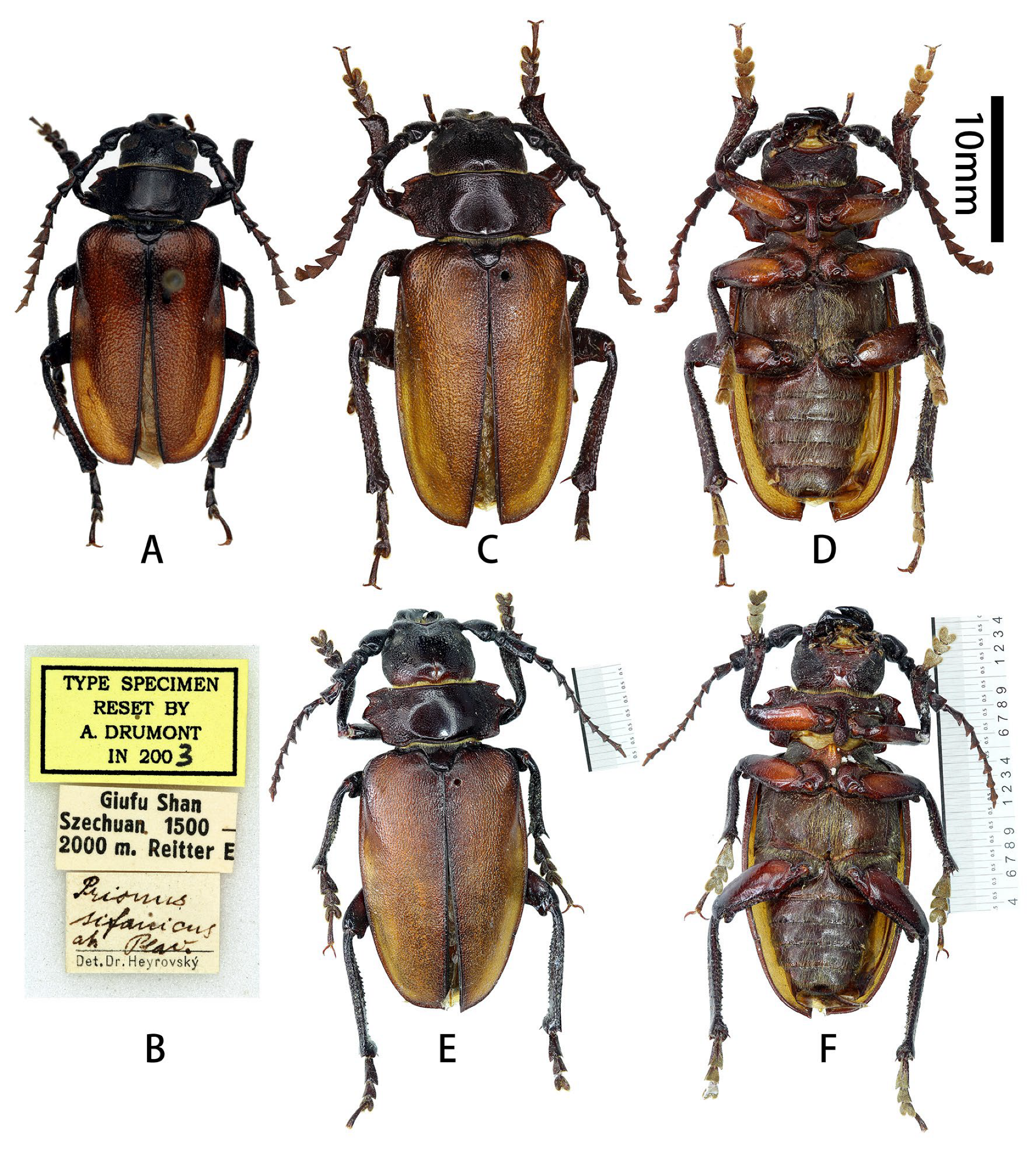
Figure 15.
Habitus of Prionus sifanicus Plavilstshikov, 1934. (A,B) Lectotype male from Chongqing, not to scale. (C–F) Males from Chongqing, Jiangjin. (A,C,E) Dorsal views. (D,F) Ventral views. Scale bar: 10 mm.
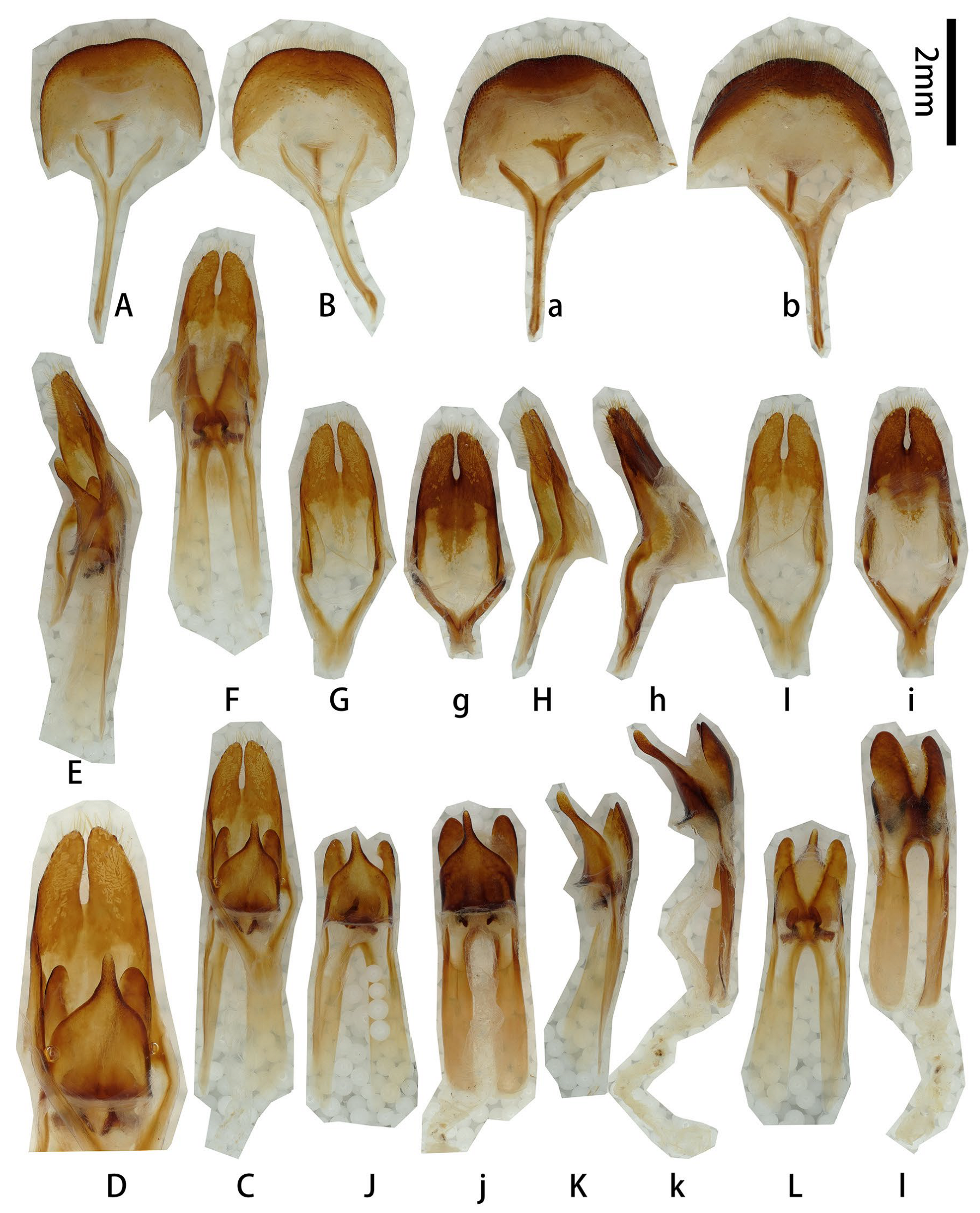
Male genitalia (Figure 16A–L,a,b,g–l): Tergite VIII (Figure 16B,b) transverse, apex broad and slightly emarginated in middle, setae very short and moderately dense. Tegmen rhombic in ventral view (Figure 16G,g), slightly curved in lateral view (Figure 16H,h); parameres (Figure 16D) narrower apically, moderately slender (length/width ca. 2.0) with rounded apex; entirely covered with dense short setae. Median lobe very slightly curved (Figure 16K,k) in lateral view, median struts subequal to 4/7 of median lobe. Ventral plate of median lobe strongly projected (Figure 16D,J,j), dorsal plate of median lobe with two wide lobes (Figure 16L,l). Internal sac with two pieces of crest-shaped basal armature (Figure 16J–L,j–l).
Female unknown.
Figure 16.
Terminalia of Prionus sifanicus Plavilstshikov, 1934. (A–L) Male, specimen Figure 15C,D. (a,b,g–l) Male, specimen Figure 15E,F. (A,B,a,b) Tergite VIII with sternites VIII and IX. (C–F) Male genitalia, internal sac incomplete. (G–I,g–i) Tegmen. (J–L,j–l) Median lobe. (A,a,C,D,G,g,J,j) Ventral views. (B,b,F,I,i,L,l) Dorsal views. (E,H,h,K,k) Lateral views. Scale bar: 2 mm.
Examined material: Lectotype ♂ (Figure 15A,B) specify, Szechuan, Giu-Fu Shan (重庆金佛山), 1500–2000 m, [E.] Reitter (ZMUM).
China, Chongqing: 2♂♂ (Figure 16C–F), Chongqing, Jiangjin (重庆江津), 10.VII.1981, leg. Qi-Zhen Wang (IZCAS).
Distribution: China (Chongqing).
Remarks: The distribution records from Sichuan were all based on the type locality Jinfoshan. Before 1997, Chongqing was a part of Sichuan Province; therefore, all the previous authors wrote Szechuan [10,23,24], Sichuan [14,22], or Chongqing, Sichuan [5,6,16,17]. The two additional males examined in this study were from Jiangjin, which belongs to Chongqing, though the labels marked “Sichuan, Jiangjin” (四川江津). Up to now, no specimens from Sichuan Province, as defined today, i.e., after the separation of Chongqing, have been reported.
4. Discussion
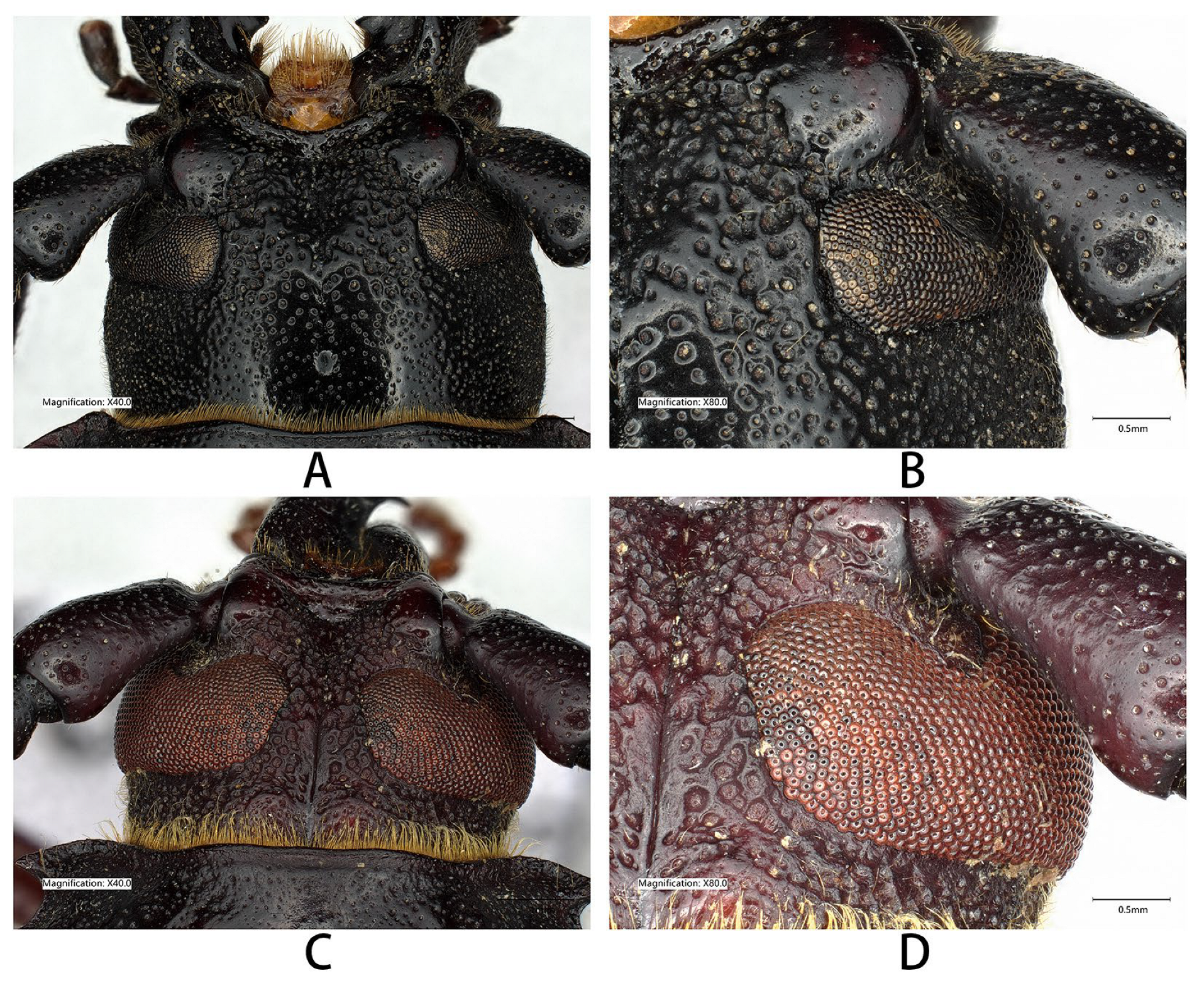
No biological information of the “Prionus gahani” species group was available before this study. Only rare type specimens were known for all the five previously known species [3,6,8,9,10]. Based on the collecting experiences from Ming-Yu Zhu, who collected two males of P. zhumingyui sp. nov, Cheng-Zhi Bian, who offered four males of P. sontinh from Yunnan, Tao-Kun Liao and Liang Guo, who collected a series of P. antonkozlovi, and Hao Xu and his students, who collected quite many males of P. gahani from Sichuan, we concluded that the species of this group are not coming to the light and are active during the day. This does not match the previous knowledge about Prioninae: “Adults are typically crepuscular or nocturnal and of somber colors; brightly colored (sometimes mimetic) or metallic diurnal species are few and mostly tropical” [25]. The species of this group are diurnal, although they have somber colors. Their small compound eyes (Figure 17A,B) (especially compared with other Prionus species, which have large compound eyes (Figure 17C,D) and are attracted to light) are well-matched to their diurnal lifestyle. As members of Prioninae, the adults appear to be relatively short-lived and do not feed, and this might be one of the reasons for their relative rarity.
Figure 17.
Compound eyes of Prionus spp. (A,B) Prionus gahani Lameere, 1912, male from Chongqing, same specimen as Figure 10C. (C,D) Prionus delavayi delavayi Fairmaire, 1887, male from Guangdong. Scale bars: 1 mm for A, C and 0.5 mm for B, D.
5. Actualized List of Species Composing the “Prionus gahani” Species Group
Prionus antonkozlovi Drumont & Komiya, 2021
Prionus gahani Lameere, 1912
Prionus lameerei Semenov, 1927
Prionus sifanicus Plavilstshikov, 1934
Prionus sontinh Do, Drumont & Komiya, 2019
Prionus zhumingyui Lin & Drumont, sp. nov.
Author Contributions
Conceptualization, M.-Y.L. and A.D.; investigation, M.-Y.L. and A.D.; writing—original draft preparation, M.-Y.L.; writing—review and editing, M.-Y.L. and A.D.; funding acquisition, M.-Y.L. All authors have read and agreed to the published version of the manuscript.
Funding
This research was supported by the Southwest and Beibu Gulf Scientific Expedition Phase I Program, Grant No. SQ2026XNKK00124), funds from Mianyang Normal University (QD2023A30 and HX2024087), a grant from the Institute of Zoology, Guangdong Academy of Sciences (GZGK23P138A0437Z), Mianyang Science and Technology Program (2023ZYDF076), and the Second Tibetan Plateau Scientific Expedition and Research Program (STEP, #2024QZKK0200).
Data Availability Statement
The original contributions presented in this study are included in the article. Further inquiries can be directed to the corresponding author.
Acknowledgments
We thank Kui-Yan Zhang (张魁艳) and Si-Qin Ge (葛斯琴) (IZCAS) for giving access to the collections, and Kui-Yan Zhang (张魁艳) (IZCAS) for assistance in taking images with a large depth of field 3D Digital Microscope (Keyence VHX-1000C and Keyence VHX-X1). We thank Ming-Yu Zhu (朱铭宇) (Guangzhou, Guangdong, China) for donating the type specimens of Prionus zhumingyui sp. nov. to IZCAS and MYNU, Bao-Zhen Xu (许宝桢) (Guangzhou, Guangdong, China) for providing the habitat and alive beetle pictures and two short videos of Prionus zhumingyui sp. nov.; Hao Xu (许浩) (MYNU) for providing the habitat pictures and biology information of Prionus gahani; Tian-Xuan Gu (顾天玄) (Chongqing, China) and Xiao-Tian Zhong (钟晓天) (Sichuan, China) for providing specimens of P. gahani from type locality; Wei-Wei Zhang (张巍巍) (Chongqing, China) for providing a female specimen of P. gahani; Tao-Kun Liao (廖焘堃) (CLTK), Liang Guo (郭亮) (CGL) and Peng-Yu Liu (刘鹏宇) (Chonglinyequ, Fuzhou, Fujian) for providing the habitat pictures, biological information and specimens of Prionus antonkozlovi. We also thank Cheng-Zhi Bian (卞承智) (CZBC) for providing habitat and biology information of Prionus sontinh in Mt. Daweishan and one male from Vietnam for molecular study (SO14), Dmitry Telnov (BMNH) for the pictures of the two syntypes of Prionus gahani preserved in his institution and Jérôme Constant (O. D. Taxonomy and Phylogeny–RBINS) for the picture of the male of P. sontinh from Yunnan illustrating this paper, Jian Sun (孙剑) (Beijing, China) for checking some detail mistakes during the review process. We would like to highlight the website “The Prioninae of the World “ (http://www.prioninae.eu/), managed by Jiri Pirkl (Czech Republic), who kindly provided us with photos of the types of Prionus antonkozlovi and P. lameerei used in this study.
Conflicts of Interest
The authors declare no conflicts of interest.
References
- Geoffroy, E.L. Histoire Abrégée des Insectes Qui se Trouvent aux Environs de Paris dans Laquelle ces Animaux Sont Rangés Suivant un Ordre Méthodique; Durand: Paris, France, 1762; Volume 1, pp. 1–523. [Google Scholar]
- Santos-Silva, A.; Nearns, E.H.; Swift, I.P. Revision of the American Species of the Genus Prionus Geoffroy, 1762 (Coleoptera, Cerambycidae, Prioninae, Prionini). Zootaxa 2016, 4134, 1–103. [Google Scholar] [CrossRef] [Scilit] [PubMed]
- Do, C.; Drumont, A.; Komiya, Z. Description of a new species of the genus Prionus Geoffroy, 1762 from northern Vietnam (Coleoptera: Cerambycidae: Prioninae). J. Asia-Pac. Entomol. 2019, 22, 63–66. [Google Scholar] [CrossRef] [Scilit]
- Tavakilian, G. (Author) & Chevillotte, H. (Software). Titan: Base de Données Internationales sur les Cerambycidae ou Longicornes, Version 30 Novembre 2024. Available online: http://titan.gbif.fr/ (accessed on 17 October 2025).
- Chen, L.; Liu, Z.-P.; Li, Z. Subfamily Prioninae Latreille, 1802. In Catalogue of Chinese Coleoptera. Chrysomeloidea. Vesperidae, Disteniidae, Cerambycidae; Lin, M.Y., Yang, X.K., Eds.; Science Press: Beijing, China, 2019; Volume 9, pp. 10–25. [Google Scholar]
- Drumont, A.; Komiya, Z. Prionus antonkozlovi n. sp. de Chine (Coleoptera, Cerambycidae, Prioninae). Lambillionea 2021, 121, 127–132. [Google Scholar]
- Lin, M.-Y.; You, R.-J.; Wang, L.-Y. A Remarkable New Species of the Genus Paraglenea Bates from China, with Notes on the Genus Malloderma Lacordaire (Coleoptera: Cerambycidae: Lamiinae: Saperdini). Insects 2025, 16, 867. [Google Scholar] [CrossRef] [Scilit] [PubMed]
- Lameere, A.A.L. Révision des Prionides. Vingtième mémoire.—Prionines (VII). Ann. Société Entomol. Belg. 1912, 56, 185–260. [Google Scholar]
- Semenov, A.P. Analecta coleopterologica XX. Rev. Russe Entomologie 1927, 21, 230–239. [Google Scholar]
- Plavilstshikov, N.N. Description de longicornes nouveaux de la Chine (Coleoptera, Cerambycidae). Sborník Entomol. Oddĕlení Národního Mus. Praze 1934, 12, 220–227. [Google Scholar]
- Lameere, A.A.L. Séance du 25 octobre 1916. Notes sur quelques Prioninae du Yunnan [Col. Cerambycidae]. Bull. Société Entomol. Fr. 1916, 1916, 257–259. [Google Scholar] [CrossRef] [Scilit]
- Gressitt, J.L. Longicorn beetles of China. In Longicornia, Études et Notes sur les Longicornes; Lepesme, P., Ed.; Paul Lechevalier: Paris, France, 1951; Volume 2, pp. 1–667. [Google Scholar]
- Wang, Q. A checklist of the Longicorn beetles first recorded from Sichuan Province (Col., Cerambycidae). J. Southwest Agric. Univ. 1986, (No. 3), 47–50. [Google Scholar]
- Hua, L.Z. List of Chinese Insects; Zhongshan (Sun Yat-sen) University Press: Guangzhou, China, 2002; Volume II, pp. 1–612. [Google Scholar]
- Löbl, I.; Smetana, A. Catalogue of Palaearctic Coleoptera, Chrysomeloidea; Apollo Books: Stenstrup, Denmark, 2010; Volume 6, pp. 84–333. [Google Scholar]
- Li, J.-K.; Drumont, A.; Mal, N.; Lin, L.; Zhang, X.-P.; Gao, M.-X. Checklist of the Prioninae of China with illustrations of genera and subgenera (Coleoptera, Cerambycidae). Cah. Magellanes (NS) 2014, 16, 73–109. [Google Scholar]
- Danilevsky, M.L. Catalogue of Palaearctic Coleoptera, Volume 6, Chrysomeloidea I (Vesperidae, Disteniidae, Cerambycidae), revised and updated ed.; Brill: Leiden, The Netherlands; Boston, MA, USA, 2020; pp. 1–712. [Google Scholar]
- Wang, Q.; Chiang, S.-N. Studies on the cerambycid fauna of Wolong Nature Reserve, Sichuan, and its origin and evolution. Entomotaxonomia 1988, 10, 131–146. [Google Scholar]
- Lameere, A.A.L. Famille Cerambycidae: Subfam. Prioninae. Coleoptera. In Genera Insectorum; Wytsman, P., Ed.; Legare Street Press: Bruxelles, Belgium, 1919; pp. 1–189, pls. 1–8. [Google Scholar]
- Breuning, S. Novae species Cerambycidarum V. In Festschrift zum 60. Geburtstag von Prof. Dr. Embrik Strand; Izdevniecība: Riga, Latvia, 1936; Volume 1, pp. 274–325. [Google Scholar]
- Bi, W.-X. Studies on the Flightless Lamiinae (Coleoptera: Cerambycidae) from China: II. Echinovelleda Breuning, 1936, Paroriaethus Breuning, 1936 and Lonyarbon gen. nov. Jpn. J. Syst. Entomol. 2018, 24, 267–276. [Google Scholar]
- Drumont, A.; Komiya, Z. Première contribution à l’étude des Prionus Fabricius, 1775 de Chine: Description de nouvelles espèces et notes systématiques (Coleoptera, Cerambycidae, Prioninae). Cah. Magellanes 2006, 56, 1–34. [Google Scholar]
- Danilevsky, M.L. Species Group Taxa of Longhorned Beetles (Coleoptera, Cerambycidae) Described by N. N. Plavilstshikov and Their Types Preserved in the Zoological Museum of the Moscow State University and in the Zoological Institute of the Russian Academy of Sciences, St. Petersburg. Entomol. Rev. 2009, 89, 689–720. [Google Scholar]
- Lazarev, M.A. Holotypes and lectotypes of longhorned beetles (Coleoptera, Cerambycidae) stored at the Zoological Museum Moscow State University. Humanit. Space-Int. Alm. 2019, 8, 1210–1359. [Google Scholar]
- Švácha, P.; Lawrence, J.F. 2.1 Vesperidae Mulsant, 1839; 2.2 Oxypeltidae Lacordaire, 1868; 2.3 Disteniidae J. Thomson, 1861; 2.4 Cerambycidae Latreille, 1802. In Handbook of Zoology, Arthropoda: Insecta; Coleoptera, Beetles, Volume 3: Morphology and Systematics (Phytophaga); Leschen, R.A.B., Beutel, R.G., Eds.; Walter de Gruyter: Berlin, Germany; Boston, MA, USA, 2014; pp. 16–177. [Google Scholar]
Disclaimer/Publisher’s Note: The statements, opinions and data contained in all publications are solely those of the individual author(s) and contributor(s) and not of MDPI and/or the editor(s). MDPI and/or the editor(s) disclaim responsibility for any injury to people or property resulting from any ideas, methods, instructions or products referred to in the content. |
© 2026 by the authors. Licensee MDPI, Basel, Switzerland. This article is an open access article distributed under the terms and conditions of the Creative Commons Attribution (CC BY) license.