


Simple Summary
Edible insects can supply protein, lipids and micronutrients, but they cannot become reliable food ingredients without suitable processing. This targeted narrative review explains how heating, drying, milling, fat removal, protein extraction, enzymatic hydrolysis, fermentation and emerging technologies change nutritional quality, digestibility, food safety, allergenicity, functionality and consumer acceptability. Blanching or boiling can reduce microorganisms, whereas excessive heat may reduce protein solubility or digestibility. Drying and storage conditions can accelerate lipid oxidation, and heating alone does not remove allergenic risk. Fermentation and hydrolysis may improve selected properties, but their conditions and products require thorough characterisation. The review proposes, as a conceptual framework, that insect ingredients be developed through species-specific processing chains that integrate safety validation, nutritional and functional testing, sensory quality, industrial cost, energy use and regulatory compliance. This approach is particularly important for transforming African indigenous edible insects into safe and commercially viable ingredients.
Abstract
Edible insects can be converted into flours, defatted powders, protein concentrates, isolates, hydrolysates, lipid fractions and chitin-rich ingredients. This targeted narrative review of 45 cited sources, including 18 original studies in the core processing-outcome synthesis, examines how processing affects the safety, nutrient retention, digestibility, techno-functionality, sensory quality, cost and sustainability of these ingredients; it is not an exhaustive or systematic review. Nutritional contribution, techno-functional performance and substantiated physiological or health-related functionality are distinguished and potential bioactivity is not treated as proof of a human health benefit. Blanching, boiling, roasting, convective drying, milling, pressing, defatting, extraction, hydrolysis and fermentation are classified as established operations; freeze-drying as an established low-temperature process; and microwave and infrared heating, ultrasound, pulsed electric fields, high-pressure processing and cold plasma as emerging or intensification technologies. Moderate heating may improve microbial control and protease accessibility, whereas excessive heat may reduce amino-acid availability, solubility, foaming and emulsification. Reductions in total counts are distinguished from validated pathogen lethality, and food safety includes biological, chemical, physical and allergenic hazards. In the European Union, market access depends on novel food authorisations that are specific to species, life stage, process and product. The review proposes a conceptual species–process–product framework that links process selection to product application, safety validation, sensory acceptance, industrial feasibility and regulatory compliance; this framework is informed by, but has not been validated against, the reviewed evidence.
1. Introduction
Population growth, urbanisation, climate pressure, constrained land and water resources and persistent nutrient gaps have intensified demand for alternative protein sources and functional food ingredients. Conventional livestock will remain important, but its resource requirements and environmental burdens have stimulated interest in complementary proteins that can be produced in diversified food systems. Edible insects are relevant because many species contain substantial amounts of protein, lipids, minerals and vitamins and because insect consumption is embedded in food traditions and livelihoods in parts of Africa, Asia and Latin America [1,2,3,4]. However, sustainability is not intrinsic to every insect product: outcomes depend on feed substrate, production efficiency, energy source, processing intensity, functional unit and use of co-products.
The transition from eating whole insects to using insect-derived functional ingredients changes both the technical opportunities and the evidence required. Whole insects and minimally processed powders retain the complete matrix, whereas defatted flours, concentrates, isolates, hydrolysates, lipid fractions and chitin-rich co-products are designed for specific food applications. Here, nutritional content refers to the amount of nutrients present; digestibility to the fraction broken down by digestion; bioaccessibility to the fraction released from the food matrix and available for intestinal uptake; bioavailability to the fraction absorbed and used physiologically; techno-functionality to properties such as solubility, emulsification, foaming, water binding and gelation; and bioactivity to a measured biological response in an experimental system. These terms are not interchangeable, and in vitro bioactivity or digestibility cannot by itself substantiate a human health claim [5,6,7,8].
Recent reviews describe edible-insect processing technologies, nutritional composition and industrialisation [5,6,7,8,9]. This targeted narrative review critically examines how processing conditions alter the nutritional quality, digestibility, techno-functional properties, bioactivity, safety and sensory performance of insect-derived food ingredients, with emphasis on species-specific trade-offs and suitability for defined food applications. Regulation, sustainability and African-specific development are treated as factors supporting this objective rather than as separate review threads. Because the review draws on a defined set of 45 cited sources (Section 2), it does not aim to provide an exhaustive or systematic appraisal of the entire evidence base. It integrates four questions that are often treated separately: which species-specific processing conditions alter nutritional and functional quality; how safety gains trade off against nutrient retention, oxidation and allergen stability; whether the resulting ingredient is suitable and sensorially acceptable in a defined food product; and whether the process is scalable and lawful in its target market. Its principal contribution is the species–process–product framework presented in Section 9, which is an author-proposed conceptual decision structure informed by the reviewed evidence rather than an experimentally validated model. The review therefore evaluates evidence by outcome level, from composition and in vitro responses to product, human and regulatory evidence, and identifies where claims exceed the available evidence.
2. Literature Search and Review Scope
This targeted narrative review examined the processing of edible insects into food ingredients. Searches were conducted in Scopus, Web of Science Core Collection, PubMed and Google Scholar for English-language literature published from January 2000 to 15 September 2026. Search combinations included “edible insect*” or individual scientific/common species names with “processing”, “thermal treatment”, “drying”, “milling”, “pressing”, “protein extraction”, “nitrogen conversion factor”, “digestibility”, “DIAAS”, “bioaccessibility”, “bioavailability”, “fermentation”, “hydrolysis”, “functional properties”, “lipid oxidation”, “microbial safety”, “chemical contaminant”, “allergenicity”, “consumer acceptance”, “scale-up”, “life-cycle assessment” and “regulation”. Reference lists of eligible papers and recent reviews were searched manually, and official European Food Safety Authority (EFSA) and EUR-Lex documents were consulted for European regulatory requirements.
Peer-reviewed original studies were prioritised when they reported a defined insect species or ingredient, processing conditions and at least one measured outcome. Within this, the core processing-outcome synthesis (Supplementary Table S1) is restricted to studies reporting a nutritional, functional, bioactivity, safety or sensory outcome, or a defined analytical outcome such as a species-specific conversion factor (e.g., [10]); original engineering or environmental-performance studies (e.g., [11,12]) are eligible as contextual evidence informing the feasibility and sustainability discussion, but are not counted in the core synthesis because they do not report one of these food-ingredient outcome types. Reviews were used to contextualise broad themes and official documents were used for legislation and regulatory assessments. The following exclusion criteria applied to the core processing-outcome synthesis; relevant engineering and environmental studies could be retained separately as contextual evidence. Studies were excluded from the core synthesis when the insect species or process was not identifiable, the material was used only as animal feed, processing conditions were insufficiently described for interpretation, or no outcome relevant to food ingredients was reported. Because this was an iterative narrative review rather than a prospectively registered systematic review, database-specific identification, deduplication and screening counts were not retained, and no formal risk-of-bias tool was applied. The search and screening process is therefore summarised narratively: records were identified in Scopus, Web of Science Core Collection, PubMed and Google Scholar using the term combinations listed above; titles and abstracts were screened against the inclusion criteria; full texts of potentially eligible records were retrieved and assessed; and records failing eligibility were excluded for one of the four documented reasons. This process yielded the 45 unique sources retained in the final synthesis, after removal of one duplicate reference. Of these 45 sources, 18 form the review’s core processing-outcome synthesis and are detailed individually in Supplementary Table S1; 20 are cited as contextual evidence, comprising 17 review articles, one technical report and two original engineering/environmental studies [11,12] that informs the sustainability discussion in Section 6 without reporting a species-specific food-processing outcome; and seven are regulatory sources, comprising five legislative texts and two EFSA scientific opinions. A reference’s publication type (original research article, review article, technical report or regulatory/legislative text) is therefore reported separately from its role in this review, because the two are not interchangeable; both are listed in full, reference by reference, in Supplementary Table S2. Historical database retrieval and screening counts were not retained; consequently, the 45 cited sources should not be interpreted as the number of records initially retrieved. Evidence was organised by unit operation and outcome because heterogeneity in species, life stage, matrix, analytical method and processing intensity precluded quantitative pooling. These methodological constraints limit reproducibility and completeness. The synthesis is therefore intended to illustrate the principal processing outcome relationships rather than to cover the entire evidence base, and its conclusions are limited to the sources examined.
3. Edible Insects as Sources of Functional Food Ingredients
In this review, a functional food ingredient is an insect-derived material whose functionality is specified at one of three distinct levels. Nutritional contribution refers to the supply of protein, indispensable amino acids, lipids, minerals or vitamins in a specified food product. Techno-functional performance refers to a reproducible technological property, such as solubility, emulsification, foaming, water binding or gelation, measured in a defined food matrix. Physiological or health-related functionality refers to a beneficial effect on a body function or on disease risk that has been substantiated by bioavailability data and adequately controlled human studies. A nutritional contribution or a technological function alone is not sufficient to describe an ingredient as functional in the physiological or health-related sense. The term is therefore used throughout this review together with the level of functionality that the evidence supports, and it does not imply a health benefit unless the third level has been demonstrated. Evidence for a health-related claim should progress from composition and in vitro activity, through digestion and bioaccessibility, to bioavailability, animal evidence where appropriate and ultimately adequately controlled human studies. Most insect-derived ingredients currently have composition, in vitro or product-level evidence rather than clinical evidence [2,3,5,7].
Drying and milling produce whole-insect powders, while pressing or solvent defatting and protein separation generate flours, concentrates and isolates with different compositions and uses [7,8,13,14]. Whole powders can enrich breads, biscuits, pasta, porridges and snacks; defatted flours may improve protein density and oxidative stability; isolates may be more suitable for beverages, emulsified sauces or meat analogues and hydrolysates may support high-solubility formulations, although bitterness and cost can limit inclusion. No ingredient category is universally superior because performance depends on species, developmental stage, substrate, process history, particle size, residual lipid and the target food matrix.
Ingredient specifications should report, at minimum, species and life stage, thermal history, drying method, particle-size distribution, residual fat, nitrogen-to-protein conversion factor and microbial/chemical contaminant status, because these determine how processing outcomes reported later in this review should be interpreted [15,16,17,18]. The safety-quality trade-off this creates for product development is set out in Section 4.
4. Processing Effects, Product Selection and Trade-Offs
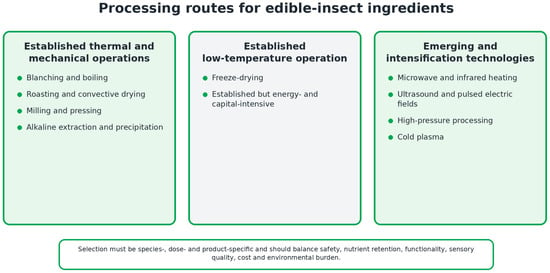
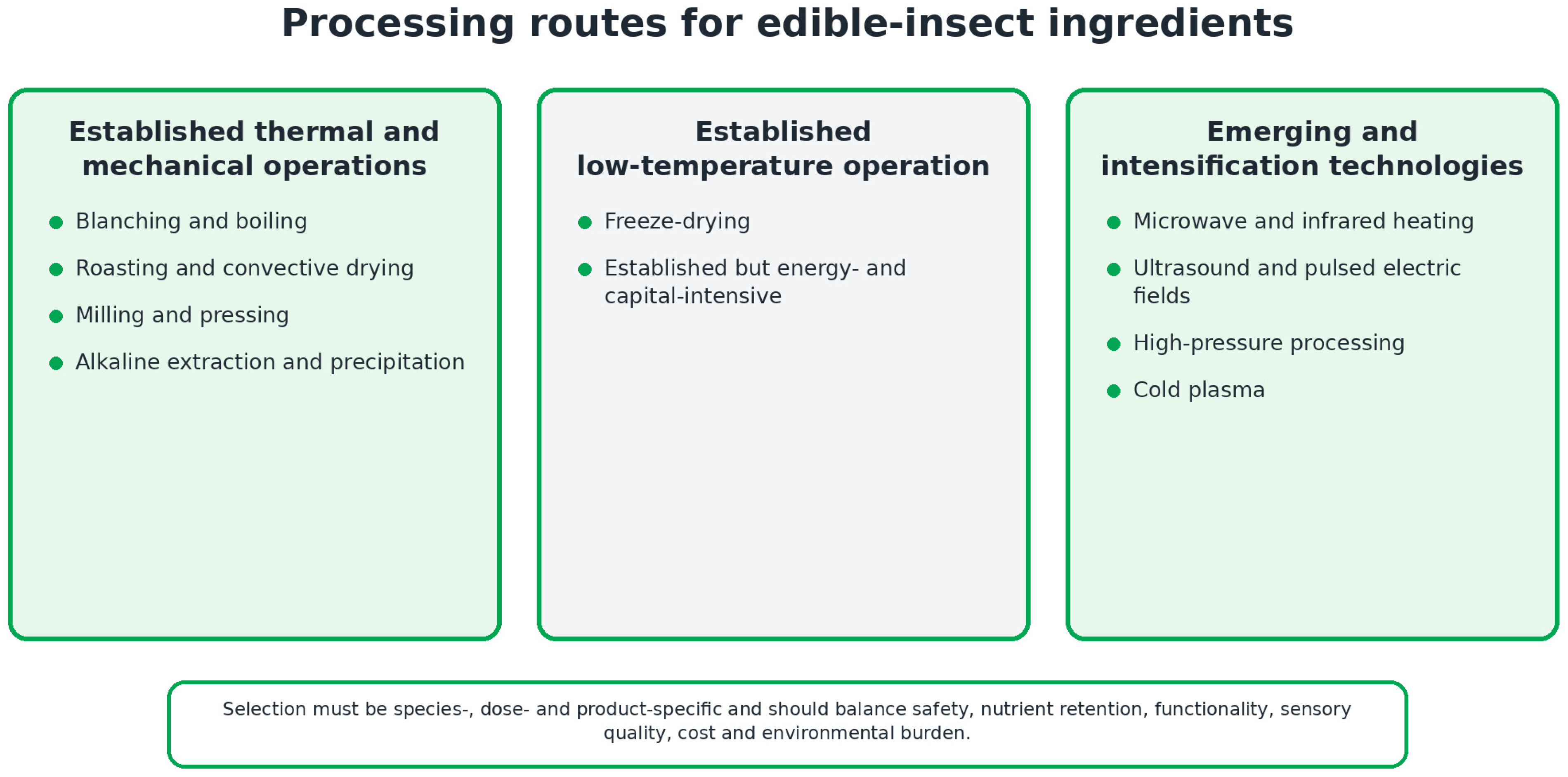
Processing operations should be classified by mechanism and maturity rather than described collectively as “novel”. Established thermal and mechanical operations include blanching, boiling, roasting, convective drying, milling and pressing. Freeze-drying is an established low-temperature dehydration technology, although it remains costly and energy-intensive. Microwave and infrared heating are established in general food processing but, because insect-specific validation remains limited, they are classified here, together with ultrasound, pulsed electric fields, high-pressure processing and cold plasma, as emerging or intensification technologies for insect ingredients. This three-group classification (established thermal and mechanical operations, an established low-temperature operation and emerging or intensification technologies) is shown in Figure 1 and is applied consistently in Table 1. Under European Union law, the authorised manufacturing process is part of the identity and conditions of use of each novel food; manufacturers cannot assume that any preparation or fraction is permitted [19,20,21].
Figure 1.
Classification and selection considerations for edible-insect processing technologies. Technologies are grouped as established thermal and mechanical operations, an established low-temperature operation (freeze-drying) and emerging or intensification technologies, consistent with Section 4 and Table 1; microwave and infrared heating are placed in the last group because insect-specific validation remains limited. The classification reflects technological maturity for insect ingredients; application to a particular insect ingredient still requires species-, dose- and product-specific validation. Authors’ synthesis based on [5,6,8,13].
Table 1.
Comparison of established and emerging or intensification processing technologies for edible-insect ingredients, classified as in Figure 1.
Figure 1 provides the classification used throughout the review, while Table 2 links selected products and species to quantitative conditions and outcomes. The table is not a list of universal prescriptions: it shows that equivalent process labels can produce different nutritional, microbial and functional results. For example, brief wet heating can reduce vegetative counts in mealworm products, but subsequent drying and handling determine recontamination; heating can improve digestibility under some conditions yet reduce solubility and emulsification under others. Product selection must therefore be based on a defined target function and a validated process window.
Table 2.
Representative quantitative processing conditions and reported outcomes for selected edible insects (selected examples; all 18 studies in the core processing-outcome synthesis are listed in Supplementary Table S1).
Table 2 also illustrates the nutrition–safety–sensory trade-off. Increasing heat intensity may improve vegetative cell reduction and develop desirable roasted flavours, but it can also promote aggregation, lysine loss, Maillard browning and lipid oxidation. Low-temperature drying may preserve selected heat-sensitive attributes but may be slower, more expensive and insufficient as a kill step. No technology should be selected on nutrient retention alone: minimum safety performance is a non-negotiable constraint, after which the process should be optimised for digestibility, functionality, sensory quality, cost and environmental burden.
4.1. Thermal Processing and Species-Specific Responses
Thermal processing changes microbial load, enzyme activity, protein conformation, lipid oxidation and sensory quality simultaneously. Moist heating transfers energy efficiently and can leach soluble nutrients; dry heating promotes browning and roasted aromas but may intensify protein aggregation and oxidation. Reported outcomes depend on species, size, developmental stage, fat and moisture content, heating medium, core temperature and duration. Accordingly, the conditions in Table 2 should not be generalised beyond the tested products [22,23,24,25,26].
For Tenebrio molitor, blanching in boiling water for 10–40 s and boiling at 100 °C for 5 min reduced selected vegetative microbial groups [22,23]. These findings do not determine universal pathogen lethality. Culinary treatments applied to T. molitor and Gryllus assimilis produced treatment-dependent changes in in vitro digestibility [24], while oven drying reduced digestibility under some conditions for T. molitor and Acheta domesticus [25]. Moderate heating means only the lowest validated time–temperature combination that achieves the required safety endpoint without unacceptable quality loss; it is not a universal numerical range and must be defined for each species, batch size and process.
To translate this principle into practice, indicative time–temperature windows reported in the cited literature for each major thermal and drying technology are given here, though each remains a validation starting point rather than a prescriptive target. Short wet-heat blanching has been validated at approximately 90–100 °C for 10–40 s in T. molitor [22] and a full boiling step at 100 °C for 5 min reduced lactic-acid bacteria by 4.9–5.0 log CFU/g and total aerobic counts by 2.8–3.1 log CFU/g [23]; the same study, which evaluated boiling within a hazard analysis and critical control point (HACCP) framework, identified boiling as an effective critical control point, reducing vegetative cells by 2.8–5.1 log CFU/g while leaving bacterial endospores comparatively unaffected (0.3–1.8 log CFU/g reduction) [23]. According to Lampová et al. [24], drying at 80 °C for 15 h increased total in vitro digestibility more than boiling, roasting or microwave heating in both T. molitor and G. assimilis; by contrast, other work reviewed therein reported that intense oven cooking (150 °C for 10 min) can reduce digestibility relative to milder heating (70 °C for 30 min). Convective and vacuum drying of mealworm larvae have been reported across 50–105 °C, with higher temperatures shortening drying time but increasing darkening and protein aggregation risk [29]. For African wild-harvested and farmed species, boiling for 20 min and drying at 40 °C (optimum within a studied range of 0–20 min boiling and 40–60 °C drying) reduced coliform counts to <1.5 log CFU/g in mopane worm (Gonimbrasia belina) while retaining protein content [30], and combined boiling or toasting with solar- or oven-drying achieved comparable microbial reductions in four East African species [31]. These study-specific findings should not be merged into a single numerical range for “moderate heating”. Wet-heat kill steps targeting microbial reduction (seconds to minutes, at the higher end of the temperatures reported here) and drying steps targeting moisture removal (sustained over hours, at the lower end of the temperatures reported here) serve different functions. The validated minimum for each must still be confirmed experimentally for the specific species, matrix and safety target rather than assumed from another species, process or study.
Functional properties can move in opposite directions after heating. In protein-enriched mealworm material, greater heating intensity decreased solubility, emulsification and foaming but increased water absorption and gel strength [26]. Such changes are not intrinsically favourable or unfavourable: reduced solubility is undesirable in beverages, whereas stronger gelation may be useful in meat analogues or structured snacks. Process optimisation must therefore use the intended food matrix as the response criterion.
4.2. Drying, Milling, Storage and Lipid Oxidation
Drying lowers water activity and enables milling, but energy input, drying rate and oxygen exposure influence colour, aroma, nutrient retention and lipid stability. Whole-insect flours and protein-rich ingredients have been produced using oven, freeze, sun, solar-cabinet, microwave, spray, vacuum, pulsed-electric-field-assisted and fluidised-bed drying [5,13,14]. Milling reduces particle size and may improve enzyme access, while also increasing surface area and exposing lipids to oxygen. The drying method is particularly important for insects containing substantial proportions of unsaturated fatty acids because these lipids are susceptible to oxidative degradation during processing and storage [5,29].
Lipid-rich insects require attention because unsaturated fatty acids can oxidise during euthanasia, drying, milling and storage, whereas species with more saturated lipid profiles may respond differently. Freeze-drying does not guarantee a stable lipid fraction: although low processing temperature limits thermal oxidation, porous structure, residual oxygen, long processing time and subsequent milling can increase oxygen exposure. In Tenebrio molitor, drying method affected peroxide formation and volatile oxidation products [29]. The optimum method is product-specific: convective, microwave or solar-assisted drying may be preferable for affordable powders when uniform heating, final water activity and oxidation are controlled, whereas freeze-drying may be justified for high-value ingredients when its quality premium offsets cost and energy use.
Studies should report water activity rather than moisture content alone and monitor primary and secondary oxidation using at least two complementary indicators, such as peroxide value and thiobarbituric acid reactive substances or volatile aldehydes. Shelf-life claims require repeated measurements under defined temperature, relative humidity, oxygen and light conditions. Defatting can improve powder stability but transfers the oxidation problem to a valuable lipid co-product that also requires stabilisation. Therefore, optimal drying treatment should be applied to achieve sufficiently low moisture and water activity while minimising lipid oxidation.
4.3. Protein Content, Digestibility, Amino-Acid Quality and Bioaccessibility
Insect proteins often show high in vitro digestibility, but estimates vary with species, process and analytical method [3,25]. Crude protein calculated as nitrogen × 6.25 can be overestimated because chitin and other compounds contribute nonprotein nitrogen. Janssen et al. proposed a species-based conversion factor of 4.76 ± 0.09 for larvae of Tenebrio molitor, Alphitobius diaperinus and Hermetia illucens and 5.60 ± 0.39 for purified larval proteins [10].
Moderate heating can unfold proteins and expose peptide bonds to digestive enzymes. By contrast, more intensive heating can promote aggregation, disulphide-bond formation and protein–protein or protein–lipid interactions that restrict enzyme access [24,25,26]. The effect of heating on digestibility is therefore conditional rather than uniformly beneficial.
The standardised INFOGEST model can improve inter-study comparability, but total in vitro digestibility and in vitro amino-acid release are not equivalent to a validated Digestible Indispensable Amino Acid Score (DIAAS). DIAAS requires ileal indispensable amino-acid digestibility determined using an accepted in vivo approach and an appropriate reference pattern. In vitro digestible indispensable amino acid scores are useful screening measures only and should be labelled clearly. Hammer et al. reported total in vitro digestibility of 91–99% for mealworm and 79–93% for cricket products, with species- and treatment-specific amino-acid responses [25].
Bioaccessibility describes release from the food matrix during digestion, whereas bioavailability additionally requires absorption and physiological utilisation. Wet processing may leach soluble minerals; fermentation or hydrolysis may alter matrix binding and lipid oxidation or protein aggregation may reduce the availability of susceptible nutrients. Therefore, composition, digestibility, bioaccessibility, bioavailability and bioactivity should be measured and reported separately. Human health claims require human evidence and cannot be assumed from composition or in vitro antioxidant and enzyme-inhibition assays.
4.4. Protein Solubility and Techno-Functional Performance
Solubility supports beverage dispersion, extraction and interfacial functions and is commonly lowest near the isoelectric region. Heating, oxidation, residual chitin and fat, pH and ionic strength can shift solubility. Table 3 connects each measured property with example product applications and the minimum information needed for interpretation. The table should be read together with the product matrix: reduced solubility is undesirable in beverages and emulsions but may coexist with stronger water binding or gel formation in structured foods [7,14,26,28,32].
Table 3.
Techno-functional properties, applications, process determinants and minimum reporting requirements.
Water-holding capacity supports juiciness and yield in bakery, meat-analogue and comminuted products; oil-holding capacity contributes flavour retention; emulsifying capacity and stability are essential for sauces and sausages; foaming supports aerated products; and gelation provides structure. These outcomes cannot be represented by protein percentage alone. They should be measured at relevant pH, salt concentration and temperature, with a commercial comparator such as whey, soy or pea protein. Mealworm protein has shown strong interfacial activity in model emulsions [28], whereas heating can trade emulsification and foaming for greater water absorption and gel strength [26].
4.5. Defatting, Protein Extraction and Recovery Yield
Defatting can improve protein accessibility, extraction and oxidative stability. Mechanical pressing is widely used in practical insect production systems because it avoids solvent residues and can be integrated with oil recovery, although residual lipid is usually higher than solvent extraction [7,8,32]. Hexane and ethanol are commonly studied solvents; supercritical carbon dioxide offers low solvent residue but requires specialised equipment. Method selection should consider lipid yield and quality, residual solvent, protein denaturation, safety, capital cost and the intended food use.
A common protein-isolation sequence uses alkaline solubilisation, separation of insoluble chitin-rich material and isoelectric precipitation near pH 4–5. Extraction pH and temperature affect recovery but can also promote deamidation, oxidation, colour formation or loss of native functionality. Reported aqueous, salt-assisted and alkaline extraction yields are not directly interchangeable because studies use different definitions of yield, recovery and purity [5,32]. Extraction studies should distinguish extraction yield (dry extract mass relative to starting material), protein recovery (protein in the extract relative to protein in the starting material) and purity (protein relative to dry extract). Optimisation should consider solubility, functionality, nutritional quality, solvent use and processing sustainability in addition to yield.
It should also report pH, temperature, time, solid-to-liquid ratio, number of extraction cycles, centrifugal force, precipitation pH, washing and drying. High recovery alone is insufficient if the isolate has poor solubility, excessive ash, undesirable colour or high water and energy requirements.
4.6. Enzymatic Hydrolysis, Peptide Evidence and Product Readiness
Enzymatic hydrolysis can improve dispersibility and generate peptide fractions with antioxidant, angiotensin-converting enzyme inhibitory, antimicrobial or anti-inflammatory activity. Outcomes depend on species, enzyme specificity, enzyme-to-substrate ratio, pH, temperature, time, degree of hydrolysis and downstream fractionation [33,34]. Most evidence concerns laboratory hydrolysates rather than marketed foods. A recent review of EU-authorised insects confirms technological and biological potential but also identifies limited scale-up, sensory, safety and human efficacy evidence [35]. Commercial readiness therefore requires reproducible manufacture, control of bitterness, contaminant and allergen assessment, shelf stability, regulatory authorisation and demonstration of benefit in the finished product.
Zielińska et al. demonstrated that hydrolysates from selected edible insects retained antioxidant and anti-inflammatory activity, and that preceding heat treatment altered the response [33]. Such findings indicate biochemical potential, not clinical efficacy. Characterisation should report degree of hydrolysis, protein recovery, peptide-size distribution, free amino groups, peptide sequence where possible and activity before and after simulated gastrointestinal digestion. Activity should be compared at equal peptide or protein concentration, and cytotoxicity, sensory bitterness and sodium introduced during pH control should be considered. A recent systematic review of Orthoptera proteins identified enzyme selection, enzyme-to-substrate ratio, pH, temperature and treatment time as important determinants of hydrolysis and reported frequent use of Alcalase for generating bioactive peptide-rich hydrolysates [34].
Peptide discovery uses ultrafiltration, liquid chromatography, tandem mass spectrometry and in silico screening. However, identification of a sequence with predicted activity does not establish absorption, circulating concentration or physiological effect. Cell, animal and human evidence should therefore be separated explicitly from chemical assays.
4.7. Fermentation, Microorganisms and Derived Products
Fermentation can be used to produce acidified insect pastes, fermented seasonings, protein-enriched doughs or powders and ingredients for familiar foods. Microbial proteases may alter digestibility and flavour, while acidification can contribute to preservation. However, fermented insects are not automatically safe or sensorially acceptable. Starter identity, inoculum, substrate composition, salt, pH, temperature, oxygen conditions and endpoint must be specified and derived products should be evaluated in their intended food matrix [27,36].
In T. molitor paste, six commercial meat starter cultures reduced pH from 6.68 to 4.60–4.95 within 72 h [27]. The cultures contained combinations of lactic acid bacteria and coagulase-negative cocci and produced different microbial trajectories. This demonstrates that reporting ‘fermented mealworm’ without culture composition, inoculum, salt, temperature, oxygen exposure and duration is insufficient. Controlled studies of blanched and fermented mealworm powders further show that fermentation and defatting can change water and oil binding, solubility and other functions [36].
For food applications, fermentation studies should quantify acidification kinetics, pathogen behaviour, biogenic amines, spore survival, mycotoxins where relevant, sensory changes and shelf stability. The starter that performs best for safety may not produce the best flavour or protein functionality, so multi-response optimisation is required. Standardised conditions cannot be assumed across species: inoculum, temperature, salt, oxygen exposure and endpoint must be validated for each insect substrate and intended product.
5. Food Safety Beyond Total Microbial Counts
Food safety encompasses biological, chemical, physical and allergenic hazards. Biological hazards may originate from the insect gastrointestinal tract, substrate, equipment, handlers or post-process contamination. For farmed insects, approved substrate and hygienic rearing are central controls because the substrate can introduce microorganisms, mycotoxins, pesticides, veterinary drug residues, heavy metals and persistent environmental contaminants. Wild-captured insects have different and less controllable exposures, including agricultural pesticides and environmental contamination. Chemical assessment should be species, origin and substrate specific and include relevant heavy metals, pesticide residues, mycotoxins, veterinary residues, process contaminants and, where exposure is plausible, per- and polyfluoroalkyl substances. Physical hazards and foreign matter also require control [17,19].
A reduction in total aerobic, Enterobacteriaceae or lactic-acid bacterial counts is not equivalent to validated inactivation of Salmonella, Listeria monocytogenes, pathogenic Bacillus or another target pathogen. Validation must specify the target organism or justified surrogate, initial load, core time–temperature or delivered dose, detection limit and achieved log reduction. The reported reductions after boiling or blanching Tenebrio molitor demonstrate control of selected indicator groups under the tested conditions but cannot be transferred automatically to other species, fat contents, batch sizes or pathogens [22,23].
A HACCP plan should combine approved substrates and suppliers, a validated kill or decontamination step, controlled drying, segregation of raw and treated zones, hygienic milling, environmental monitoring, contaminant and foreign-body control, water-activity release criteria, protective packaging and traceable storage. In the European Union, substrate and animal-by-product controls are also shaped by Regulations (EC) No 1069/2009, (EC) No 999/2001 and (EC) No 767/2009 [37,38,39]. Recontamination after an effective kill step remains a major industrial risk.
Allergen Stability and the Limits of Processing
Allergenicity remains one of the major food-safety challenges associated with edible insects because processing does not necessarily eliminate allergenic proteins. Insect proteins can cross-react with crustacean and house dust mite allergens. Tropomyosin, arginine kinase and other pan-allergens are important, but allergen profiles differ by species and developmental stage [18]. Processing may alter extractability or immunoglobulin E (IgE) binding without eliminating clinical risk.
Studies of mealworm species show that heating and in vitro digestion change band patterns and immunoreactivity, yet cross-reactive proteins can persist [40]. In migratory locust (Locusta migratoria) extracts, both enzymatic hydrolysis and thermal treatment eliminated IgE-immunoblot binding and skin-prick reactivity in crustacean and house-dust-mite-allergic patients relative to untreated extracts, with no evidence that either method outperformed the other [41]. Thermostable allergens have also been reported in other insects. Therefore, a decrease in an immunoblot signal must not be described as removal of allergenicity without clinical justification.
Human challenge data remain insufficient for many insect species and products. Nevertheless, cross-reactivity with crustacean and house-dust-mite allergens indicates a biologically plausible risk, and people with known arthropod allergies should avoid edible-insect products unless appropriately assessed and advised. Risk management should retain precautionary allergen communication where required. Processing may reduce extractability or IgE binding, but it must not be described as eliminating allergenicity without clinical evidence [18,40,41].
6. Technology Selection, Scalability, Sustainability and Regulatory Requirements
Table 1 compares established technologies with emerging or intensification technologies rather than ranking a universally best option. Blanching, boiling, roasting, convective drying and freeze-drying have established food-processing applications, although insect-specific process validation remains necessary. Microwave and infrared heating, classified here as intensification technologies (Section 4), can shorten heating or drying times but require assessment of field uniformity. Ultrasound, pulsed electric fields, high-pressure processing and cold plasma can intensify extraction, modify protein structure or support microbial control, but industrial evidence remains limited and delivered dose, penetration and scale-up must be reported [6,8].
Table 1 shows why technology choice must be matched to the intended product. Blanching or boiling may suit a primary euthanasia step but creates wet material that requires hygienic drying. Convective or microwave drying may support scalable powders but can cause oxidation or non-uniform heating. For cricket protein, ultrasound achieved a yield comparable to that of alkaline extraction (~64%), increased solubility by 51% after 14 min and produced the lightest-coloured concentrate. Pulsed electric fields and high-pressure processing gave lower yields (~50–54%) but still increased solubility by 14–17%, and high-pressure processing caused the most browning [42]. Outcomes of emerging technologies are therefore specific to the technology and the extraction metric rather than uniformly superior. Laboratory gains do not guarantee continuous throughput, pathogen lethality, cleanability, acceptable sensory quality or economic benefit. The same principles apply outside Europe. The solar-assisted drying and combined boiling or toasting and drying pathways used for wild-harvested and farmed African species (Section 8) fall within the blanching/boiling and roasting/convective-drying rows of Table 1 rather than forming a separate technology track; the same evidence requirements for scale-up therefore apply [30,31].
Industrial feasibility depends on raw-material continuity, seasonal supply, batch variability, plant utilisation and market value. Each increase in product purity also carries a cost. Whole-insect flour has the shortest process chain and the lowest capital burden; defatted flour adds pressing or solvent recovery; and isolates, hydrolysates and peptide fractions add separation, enzyme use and reaction control, which must be justified by a functional or commercial premium. Drying is frequently an energy hotspot. Hybrid solar-electric drying of black soldier fly larvae has been assessed as one option for reducing purchased energy while maintaining product quality under the conditions studied [11]. However, that study characterised drying performance rather than food-grade product quality, and it is therefore cited as engineering and environmental context rather than as evidence of food-ingredient suitability.
Freeze-drying is difficult to justify for low-value bulk protein unless a quality premium offsets its capital and energy demands. Convective, microwave or solar-assisted drying is more scalable when hygiene and process control are maintained. Life-cycle assessment also shows that different insect-protein processing chains can have markedly different energy, water and environmental burdens [12]. Sustainability claims must therefore specify the functional unit, because one kilogram of crude powder is not equivalent to one kilogram of purified protein, and a lower processing energy demand does not guarantee a lower whole-system footprint. These cost and environmental trade-offs also determine whether a given regulatory pathway (discussed below) or an African value chain (Section 8) is viable.
The regulatory discussion in this review is limited to two contrasting contexts: the European Union, which has a dedicated novel food authorisation system that applies to insects, and South Africa, the authors’ national context, where no dedicated insect-specific framework has been identified. It is not a comprehensive global comparison; other jurisdictions, including those in Asia, North America and elsewhere in Africa, apply different approaches that are not assessed here [43]. In both contexts, regulatory status is specific to jurisdiction, species, life stage, process and product, and traditional consumption of a whole insect does not authorise a powder, extract, isolate or hydrolysate in another market. In the European Union, insects not consumed to a significant degree before 15 May 1997 are novel foods under Regulation (EU) 2015/2283, and only the species, life stages, product forms and uses authorised in the Union list under Implementing Regulation (EU) 2017/2470 may be marketed [19,20,21]. EFSA opinions cannot be generalised beyond the authorised entry, and controls on feed and rearing substrates interact with the rules on animal by-products, transmissible spongiform encephalopathies and the marketing of feed [37,38,39]. South Africa applies general food-safety, hygiene, labelling and agricultural legislation, and published comparisons have not identified a single dedicated national edible-insect framework [43]. Developers in South Africa should therefore engage the competent authorities early, document the safety of the exact species and process, and confirm nutrition, health-claim, allergen-labelling and export requirements rather than assume that the EU model applies. Because only these two contexts are examined, the regulatory observations in this review should not be extrapolated to other jurisdictions without separate assessment.
7. Consumer Acceptance and Product Development
Consumer acceptance is a product and market outcome rather than an automatic consequence of nutritional value. Processing shapes visibility, colour, aroma, flavour, texture and price, which in turn determine willingness to try and repurchase insect-based foods [9,15,16,44]. Milling can reduce visual recognition but may produce a dark colour or gritty mouthfeel; roasting can generate familiar aromas but may intensify bitterness or oxidation; defatting can improve stability but may remove desirable flavour; and hydrolysis can improve solubility but may create bitter peptides. The intended food matrix should therefore guide ingredient selection, and claims must comply with the rules of the target market. Acceptance also varies across cultural settings. In regions with established entomophagy, barriers often relate more to convenience, hygiene, price and the transition from traditional to packaged foods, whereas in many Western markets neophobia and unfamiliarity remain prominent and less visible formats are often better accepted [9,44]. Product development should therefore include instrumental colour, volatile profile, particle size, texture and descriptive sensory analysis before consumer testing. Studies should also report the country, target population, prior insect-consumption experience and product format rather than generalising about ‘consumer acceptance’, because sustainability or nutrition claims cannot compensate for poor sensory quality.
8. African Indigenous Insects and Functional-Food Development
Africa has extensive entomophagy traditions, but production systems range from seasonal wild harvesting to small-scale farming and emerging commercial rearing. Wild-harvested mopane worms, termites and stink bugs differ from farmed species in substrate exposure, gut content, traceability and contaminant risk, so processing design must begin with species authentication and documentation of harvest or rearing conditions. African processing chains are not treated as a separate case in this review. The wet-heat kill steps and drying windows for mopane worm [30] and four East African species [31] are reported in Section 4.1, and the technology classification in Section 4 (Figure 1) and Table 1 applies to them directly. Farming could improve supply continuity for selected species, but it requires reliable breeding, biosecurity and realistic markets and is subject to the same trade-offs. Opportunities include flours for porridges and baked products, fermented pastes or seasonings and, where justified, pressed oils and protein-enriched fractions [9,45]. An applied example is the instant maize porridge fortified with Moringa oleifera leaf and Macrotermes falciger termite powder reported by Netshiheni et al., which showed nutritional enhancement and formulation-dependent sensory acceptance [45]; this result cannot be attributed to termite powder independently of the complete formulation. The broader lesson is that nutritional value, processing stability and consumer acceptance must be evaluated together.
9. Integrated Species–Process–Product Framework
The species–process–product framework is a conceptual decision structure proposed by the authors. It is informed by the reviewed evidence but has not been validated experimentally as a complete model. Evidence directly supports the context dependence of microbial reduction, digestibility, oxidation, allergen stability and techno-functionality [5,6,7,8,11,12,14,22,23,24,25,26,27,28,29,32,33,34,36,40,41,42]. The eight-stage integration of these endpoints is a conceptual synthesis intended to guide research and development: (1) authenticate species and life stage; (2) characterise substrate or harvest origin, composition, microbiology, contaminants and allergens; (3) define the target ingredient and food application; (4) establish validated killing, decontamination and drying conditions; (5) apply optional pressing, extraction, hydrolysis or fermentation with mass balance; (6) measure digestibility, amino-acid quality, oxidation and techno-functionality; (7) validate safety, sensory acceptance, shelf life, cost and environmental performance; and (8) confirm regulatory status, specifications and labelling.
The framework is deliberately multi-objective and does not predict a single best process, because of the safety, quality and cost trade-offs set out in Section 4. Evidence is strongest for selected laboratory-scale operations and a limited set of species, particularly Tenebrio molitor. The resulting gaps in product-scale, human and African evidence are described in Section 10.
10. Critical Knowledge Gaps and Research Priorities
Research should move from isolated proof-of-concept treatments to complete, reproducible processing chains. Priority studies should compare species using harmonised process variables and analytical methods; report species-specific protein conversion factors and indispensable amino-acid digestibility; define extraction yield and recovery consistently; integrate oxidation with shelf-life and sensory testing; characterise hydrolysate peptides beyond in vitro activity and validate starter cultures, pathogen challenge, allergen and chemical-contaminant outcomes on final products, each tied to an intended food application.
Within the literature examined in this review, evidence is concentrated in mealworms, crickets and a small number of European or Asian product systems. African, Latin American and many Asian indigenous species remain underrepresented in controlled processing research [9,44,45]. Future work should include realistic food matrices, pilot-scale mass and energy balances, techno-economic analysis, life-cycle assessment with explicit system boundaries and consumer studies in named cultural settings. Human digestion, bioavailability and clinical studies are required before in vitro bioactivity is translated into health claims. Negative and null results should be reported to prevent repeated optimisation of unsuitable species–process combinations.
11. Conclusions
Within the scope of this targeted narrative review, three evidence-supported conclusions can be drawn: (1) Processing determines whether the nutritional potential of edible insects becomes a safe, stable and useful food ingredient, and its effects depend on species, matrix, process intensity and analytical method. (2) Safety is the central design constraint: reductions in indicator counts do not demonstrate pathogen lethality, and heating, hydrolysis or fermentation may reduce but do not reliably eliminate allergenic risk. (3) Heating, drying, extraction, hydrolysis and fermentation involve trade-offs among digestibility, techno-functionality, oxidative stability and sensory quality; nutrient content, digestibility, bioaccessibility, bioavailability, techno-functionality and bioactivity must therefore be reported separately and not generalised from one species or assay to all insects or to a human health effect.
These conclusions are limited by the available literature, which is concentrated on a few farmed species, particularly Tenebrio molitor; relies mainly on laboratory-scale and in vitro studies; uses heterogeneous methods that preclude quantitative pooling; and provides few human, pilot-scale or African data. The species–process–product framework proposed in Section 9 is a conceptual synthesis that has not been validated experimentally. It is intended to guide the selection of a species–process–product combination, rather than a universally “best” technology, and should be tested in future product-scale studies. In Africa, its application will require indigenous knowledge to be combined with traceable harvesting, locally validated processing and clear regulatory pathways, in line with the research priorities set out in Section 10.
Supplementary Materials
The following supporting information can be downloaded at: https://www.mdpi.com/article/10.3390/insects17111092/s1, Table S1: Summary of Studies on Edible Insect Processing, Nutritional Quality, Technofunctional Properties, Microbial Safety, Bioactive Potential, Allergenicity, and Food Applications; Table S2: Classification of References by Publication Type and Their Role in the Review Synthesis.
Author Contributions
Conceptualisation, K.R.M.; methodology, K.R.M. and M.M.M.; literature verification, K.R.M. and M.M.M.; writing—original draft preparation, K.R.M.; writing—review and editing, K.R.M. and M.M.M. All authors have read and agreed to the published version of the manuscript.
Funding
This research received no external funding.
Informed Consent Statement
Not applicable.
Data Availability Statement
No new data were created or analysed in this study. Data sharing is not applicable to this article.
Conflicts of Interest
The authors declare no conflicts of interest.
References
- van Huis, A.; Van Itterbeeck, J.; Klunder, H.; Mertens, E.; Halloran, A.; Muir, G.; Vantomme, P. Edible Insects: Future Prospects for Food and Feed Security; FAO Forestry Paper 171; Food and Agriculture Organization of the United Nations: Rome, Italy, 2013. [Google Scholar]
- van Huis, A. Potential of insects as food and feed in assuring food security. Annu. Rev. Entomol. 2013, 58, 563–583. [Google Scholar] [CrossRef] [Scilit] [PubMed]
- Rumpold, B.A.; Schlüter, O.K. Nutritional composition and safety aspects of edible insects. Mol. Nutr. Food Res. 2013, 57, 802–823. [Google Scholar] [CrossRef] [Scilit] [PubMed]
- Payne, C.L.R.; Van Itterbeeck, J. Ecosystem services from edible insects in agricultural systems: A review. Insects 2017, 8, 24. [Google Scholar] [CrossRef] [Scilit] [PubMed]
- Liang, Z.; Zhu, Y.; Leonard, W.; Fang, Z. Recent advances in edible insect processing technologies. Food Res. Int. 2024, 182, 114137. [Google Scholar] [CrossRef] [Scilit] [PubMed]
- Ojha, S.; Bußler, S.; Psarianos, M.; Rossi, G.; Schlüter, O.K. Edible insect processing pathways and implementation of emerging technologies. J. Insects Food Feed 2021, 7, 877–900. [Google Scholar] [CrossRef] [Scilit]
- Meshulam-Pascoviche, D.; David-Birman, T.; Refael, G.; Lesmes, U. Big opportunities for tiny bugs: Processing effects on the techno-functionality and digestibility of edible insects. Trends Food Sci. Technol. 2022, 122, 265–274. [Google Scholar] [CrossRef] [Scilit]
- El Hajj, R.; Mhemdi, H.; Besombes, C.; Allaf, K.; Lefrançois, V.; Vorobiev, E. Edible insects’ transformation for feed and food uses: An overview of current insights and future developments in the field. Processes 2022, 10, 970. [Google Scholar] [CrossRef] [Scilit]
- Choi, Y.; Lee, D.Y.; Mariano, E.J.; Park, J.; Han, D.; Kim, J.S.; Park, J.W.; Namkung, S.; Hur, S.J. A review on the current research and industrialization status of edible insect protein. Food Sci. Anim. Resour. 2025, 45, 981–997. [Google Scholar] [CrossRef] [Scilit] [PubMed]
- Janssen, R.H.; Vincken, J.P.; van den Broek, L.A.M.; Fogliano, V.; Lakemond, C.M.M. Nitrogen-to-protein conversion factors for three edible insects: Tenebrio molitor, Alphitobius diaperinus, and Hermetia illucens. J. Agric. Food Chem. 2017, 65, 2275–2278. [Google Scholar] [CrossRef] [Scilit] [PubMed]
- Lehmad, M.; Hidra, N.; Lhomme, P.; Mghazli, S.; El Hachimi, Y.; Abdenouri, N. Environmental, economic and quality assessment of hybrid solar-electric drying of black soldier fly (Hermetia illucens) larvae. Renew. Energy 2024, 226, 120401. [Google Scholar] [CrossRef] [Scilit]
- Cámara-Ruiz, M.; Sánchez-Venegas, A.; Blasco-Lavilla, N.; Hernández, M.D.; Sánchez-Liarte, F.; Fernández-Gutiérrez, D.; Lara-Guillén, A.J. Comparative assessment of insect processing technologies for sustainable insect protein production. Sustainability 2023, 15, 13735. [Google Scholar] [CrossRef] [Scilit]
- Kozlu, A.; Ngasakul, N.; Klojdová, I.; Baigts-Allende, D.K. Edible insect-processing techniques: A strategy to develop nutritional food products and novelty food analogs. Eur. Food Res. Technol. 2024, 250, 1253–1267. [Google Scholar] [CrossRef] [Scilit]
- Yisa Njowe, K.B.; Duodu, K.G.; Emmambux, M.N. Techno-functional properties of protein-rich flours from different species of edible insects as affected by drying methods. Food Res. Int. 2025, 221, 117224. [Google Scholar] [CrossRef] [Scilit] [PubMed]
- Acosta-Estrada, B.A.; Reyes, A.; Rosell, C.M.; Rodrigo, D.; Ibarra-Herrera, C.C. Benefits and challenges in the incorporation of insects in food products. Front. Nutr. 2021, 8, 687712. [Google Scholar] [CrossRef] [Scilit] [PubMed]
- Mishyna, M.; Chen, J.; Benjamin, O. Sensory attributes of edible insects and insect-based foods—Future outlooks for enhancing consumer appeal. Trends Food Sci. Technol. 2020, 95, 141–148. [Google Scholar] [CrossRef] [Scilit]
- EFSA Scientific Committee. Risk profile related to production and consumption of insects as food and feed. EFSA J. 2015, 13, 4257. [Google Scholar] [CrossRef] [Scilit]
- De Marchi, L.; Wangorsch, A.; Zoccatelli, G. Allergens from edible insects: Cross-reactivity and effects of processing. Curr. Allergy Asthma Rep. 2021, 21, 35. [Google Scholar] [CrossRef] [Scilit] [PubMed]
- EFSA Panel on Nutrition, Novel Foods and Food Allergens; Turck, D.; Castenmiller, J.; De Henauw, S.; Hirsch-Ernst, K.I.; Kearney, J.; Maciuk, A.; Mangelsdorf, I.; McArdle, H.J.; Naska, A.; et al. Safety of dried yellow mealworm (Tenebrio molitor larva) as a novel food pursuant to Regulation (EU) 2015/2283. EFSA J. 2021, 19, 6343. [Google Scholar] [CrossRef] [Scilit] [PubMed]
- European Parliament and Council. Regulation (EU) 2015/2283 of 25 November 2015 on novel foods. Off. J. Eur. Union 2015, L327, 1–22. [Google Scholar]
- European Commission. Commission Implementing Regulation (EU) 2017/2470 of 20 December 2017 establishing the Union list of novel foods. Off. J. Eur. Union 2017, L351, 72–201. [Google Scholar]
- Vandeweyer, D.; Lenaerts, S.; Callens, A.; Van Campenhout, L. Effect of blanching followed by refrigerated storage or industrial microwave drying on the microbial load of yellow mealworm larvae (Tenebrio molitor). Food Control 2017, 71, 311–314. [Google Scholar] [CrossRef] [Scilit]
- Yan, X.; Laurent, S.; Hue, I.; Cabon, S.; Grua-Priol, J.; Jury, V.; Federighi, M.; Boué, G. Quality of Tenebrio molitor powders: Effects of four processes on microbiological quality and physicochemical factors. Foods 2023, 12, 572. [Google Scholar] [CrossRef] [Scilit] [PubMed]
- Lampová, B.; Doskočil, I.; Kulma, M.; Kurečka, M.; Kouřimská, L. Culinary treatments impact the digestibility and protein quality of edible insects: A case study with Tenebrio molitor and Gryllus assimilis. Front. Nutr. 2024, 11, 1399827. [Google Scholar] [CrossRef] [Scilit] [PubMed]
- Hammer, L.; Moretti, D.; Abbühl-Eng, L.; Kandiah, P.; Hilaj, N.; Portmann, R.; Egger, L. Mealworm larvae (Tenebrio molitor) and crickets (Acheta domesticus) show high total protein in vitro digestibility and can provide good-to-excellent protein quality as determined by in vitro DIAAS. Front. Nutr. 2023, 10, 1150581. [Google Scholar] [CrossRef] [Scilit] [PubMed]
- Lee, H.-J.; Kim, J.-H.; Ji, D.-S.; Lee, C.-H. Effects of heating time and temperature on functional properties of proteins of yellow mealworm larvae (Tenebrio molitor L.). Food Sci. Anim. Resour. 2019, 39, 296–308. [Google Scholar] [CrossRef] [Scilit] [PubMed]
- An, B.; Sam, C.; Dries, V.; Ruben, S.; Christel, V.; Mik, V.D.B.; Bart, L.; Leen, V.C. Comparison of six commercial meat starter cultures for the fermentation of yellow mealworm (Tenebrio molitor) paste. Microorganisms 2019, 7, 540. [Google Scholar] [CrossRef] [Scilit] [PubMed]
- Gould, J.; Wolf, B. Interfacial and emulsifying properties of mealworm protein at the oil/water interface. Food Hydrocoll. 2018, 77, 57–65. [Google Scholar] [CrossRef] [Scilit]
- Kröncke, N.; Böschen, V.; Woyzichovski, J.; Demtröder, S.; Benning, R. Comparison of suitable drying processes for mealworms (Tenebrio molitor). Innov. Food Sci. Emerg. Technol. 2018, 50, 20–25. [Google Scholar] [CrossRef] [Scilit]
- Matiza Ruzengwe, F.; Manditsera, F.A.; Madimutsa, O.N.; Macheka, L.; Kembo, G.; Fiore, A.; Ledbetter, M.; Mubaiwa, J. Optimising mopane worm (Gonimbrasia belina) processing for improved nutritional and microbial quality. J. Insects Food Feed 2023, 9, 1187–1197. [Google Scholar] [CrossRef] [Scilit] [PubMed]
- Nyangena, D.N.; Mutungi, C.; Imathiu, S.; Kinyuru, J.; Affognon, H.; Ekesi, S.; Nakimbugwe, D.; Fiaboe, K.K. Effects of traditional processing techniques on the nutritional and microbiological quality of four edible insect species used for food and feed in East Africa. Foods 2020, 9, 574. [Google Scholar] [CrossRef] [Scilit] [PubMed]
- Queiroz, L.S.; Silva, N.F.N.; Jessen, F.; Mohammadifar, M.A.; Stephani, R.; Fernandes de Carvalho, A.; Perrone, Í.T.; Casanova, F. Edible insect as an alternative protein source: A review on the chemistry and functionalities of proteins under different processing methods. Heliyon 2023, 9, e14831. [Google Scholar] [CrossRef] [Scilit] [PubMed]
- Zielińska, E.; Baraniak, B.; Karaś, M. Antioxidant and anti-inflammatory activities of hydrolysates and peptide fractions obtained by enzymatic hydrolysis of selected heat-treated edible insects. Nutrients 2017, 9, 970. [Google Scholar] [CrossRef] [Scilit] [PubMed]
- Kusumah, S.H.; Palupi, N.S.; Sitanggang, A.B.; Dewi, F.N.A.; Saraswati. Enzymatic hydrolysis methods of insect Orthoptera protein: A systematic review. Int. J. Food Sci. 2026, 2026, 9091997. [Google Scholar] [CrossRef] [Scilit] [PubMed]
- Foligni, R.; Mannozzi, C.; Glicerina, V.T.; Melchior, S.; Flamminii, F.; Orkusz, A.; Kolanowski, W.; Mozzon, M. Unlocking the potential of EU-approved edible insects: A review of protein hydrolysates and their technological and biological properties. Appl. Food Res. 2026, 6, 101883. [Google Scholar] [CrossRef] [Scilit]
- Borremans, A.; Bußler, S.; Sagu, S.T.; Rawel, H.M.; Schlüter, O.K.; Van Campenhout, L. Effect of blanching plus fermentation on selected functional properties of mealworm (Tenebrio molitor) powders. Foods 2020, 9, 917. [Google Scholar] [CrossRef] [Scilit] [PubMed]
- European Parliament and Council. Regulation (EC) No 1069/2009 of 21 October 2009 laying down health rules as regards animal by-products and derived products not intended for human consumption. Off. J. Eur. Union 2009, L300, 1–33. [Google Scholar]
- European Parliament and Council. Regulation (EC) No 999/2001 of 22 May 2001 laying down rules for the prevention, control and eradication of certain transmissible spongiform encephalopathies. Off. J. Eur. Communities 2001, L147, 1–40. [Google Scholar]
- European Parliament and Council. Regulation (EC) No 767/2009 of 13 July 2009 on the placing on the market and use of feed. Off. J. Eur. Union 2009, L229, 1–28. [Google Scholar]
- van Broekhoven, S.; Bastiaan-Net, S.; de Jong, N.W.; Wichers, H.J. Influence of processing and in vitro digestion on the allergic cross-reactivity of three mealworm species. Food Chem. 2016, 196, 1075–1083. [Google Scholar] [CrossRef] [Scilit] [PubMed]
- Pali-Schöll, I.; Meinlschmidt, P.; Larenas-Linnemann, D.; Purschke, B.; Hofstetter, G.; Rodríguez-Monroy, F.A.; Einhorn, L.; Mothes-Luksch, N.; Jensen-Jarolim, E.; Jäger, H. Edible insects: Cross-recognition of IgE from crustacean- and house dust mite-allergic patients, and reduction of allergenicity by food processing. World Allergy Organ. J. 2019, 12, 100006. [Google Scholar] [CrossRef] [Scilit] [PubMed]
- Bisconsin-Junior, A.R.; Psarianos, M.; Sevenich, R.; Ojha, S.; Mariutti, L.R.B.; Schlüter, O.K. Comparison of ultrasound, pulsed electric fields, and high pressure on cricket protein extraction and concentrate characteristics. LWT 2025, 223, 117725. [Google Scholar] [CrossRef] [Scilit]
- Lähteenmäki-Uutela, A.; Marimuthu, S.B.; Meijer, N. Regulations on insects as food and feed: A global comparison. J. Insects Food Feed 2021, 7, 849–856. [Google Scholar] [CrossRef] [Scilit]
- Abro, Z.; Sibhatu, K.T.; Fetene, G.M.; Alemu, M.H.; Tanga, C.M.; Sevgan, S.; Kassie, M. Global review of consumer preferences and willingness to pay for edible insects and derived products. Glob. Food Secur. 2025, 44, 100834. [Google Scholar] [CrossRef] [Scilit] [PubMed]
- Netshiheni, K.R.; Mashau, M.E.; Jideani, A.I.O. Nutritional and sensory properties of instant maize porridge fortified with Moringa oleifera leaves and termite (Macrotermes falciger) powders. Nutr. Food Sci. 2019, 49, 654–667. [Google Scholar] [CrossRef] [Scilit]

Disclaimer/Publisher’s Note: The statements, opinions and data contained in all publications are solely those of the individual author(s) and contributor(s) and not of MDPI and/or the editor(s). MDPI and/or the editor(s) disclaim responsibility for any injury to people or property resulting from any ideas, methods, instructions or products referred to in the content. |
© 2026 by the authors. Licensee MDPI, Basel, Switzerland. This article is an open access article distributed under the terms and conditions of the Creative Commons Attribution (CC BY) license.