


Simple Summary
To find a mate, in bush-crickets (=katydids) acoustic communication is essential. In the genus Conocephalus—and in many other bush-cricket species—the male sings, and the female localizes him by his species-specific song. These sounds can be used to identify species morphologically difficult to discriminate, but also to map their ranges. In this review, we present data on all Conocephalus species of the Eastern hemisphere with known song, based on recordings on published compact discs, on the internet and in conventional papers. Our results allow the acoustic identification of many species and confirm the findings that some species occur in more than one continent. However, one widespread and morphologically quite uniform form thought to live in Africa and Asia differs in song clearly between the continents and should now be called C. maculatus in Asia and C. continuus in Africa and Arabia. In some other species, unexpectedly large song differences have been observed, calling for more detailed studies.
Abstract
Conocephalus is a speciose, worldwide distributed genus of small bush-crickets (=katydids; Orthoptera, Tettigonioidea). While some of its species have huge ranges covering several continents, forms occurring in both hemispheres are not known. Partly due to their large ranges and because of morphological similarity, the correct identification of species is often not easy. Here, we present a review of the acoustic communication of all species with known songs in the eastern hemisphere. The species-specific amplitude pattern of the calling songs offers a helpful tool to find out which species are involved. Our results—using data from published sound files on compact discs, internet resources and conventional papers—show that species have the same species-specific songs all over their range. In addition to some misidentifications and situations which require further studies, however, we recover the widespread Conocephalus maculatus as a species complex with an Asiatic taxon (C. maculatus s.str.) and an African taxon (could be called Conocephalus continuus), both differing in song. The Indian Conocephalus hilli is considered a synonym (form) of C. maculatus.
1. Introduction
In the communication of many groups of Orthoptera, acoustic signals play a central role. This is especially true for bush-crickets (also called katydids; Tettigonioidea). Nearly all species of this group rely on sound signals for long-distance mate localization and attraction. Depending on the behavior and the ecology of the species involved, their signals—called calling songs—differ in many parameters. It is always the male who produces the calling song, but in Phaneropteridae, for example, the males often sing at a relatively low rate, and the females respond acoustically to the male song [1], whereas in Hetrodinae, the males produce long-lasting songs [2], which are used by the females to approach them phonotactically. This second type of communication system—singing males and phonotactically approaching females—is taxonomically much more widespread. Here, we review and describe the calling songs of the type genus of Conocephalidae, another group with mute females (often considered as subfamily Conocephalinae). Animals of this genus, Conocephalus Thunberg, 1815, are relatively small, slender tettigonioids (e.g., body length about 12–19 mm; [3]) and are grouped together with some similar forms into the tribe Conocephalini, which is currently considered monophyletic (but possibly not the genus Conocephalus itself; [4]).
The genus Conocephalus is found all around the world and includes more than 150 species [5]. According to present knowledge, it may have split off from the other Conocephalidae around 40 million years ago [6]. In our study, we present a review of the available acoustic data of all species of the genus; however, it is limited to the eastern hemisphere. All continents of this area are connected by common occurrences, whereas, according to our knowledge, at present, no species have been found native to both western and eastern hemispheres. In the eastern hemisphere, many species have large to very large ranges—e.g., C. fuscus from Europe to Japan, C. maculatus from Guinea to Japan, C. laetus from Mali to Australia and Vanuatu. These species often have long wings or at least forms with long wings (examples in [3]), so they may spread/be distributed relatively easily. On the other hand, many distribution maps look very patchy (see e.g., [5] for the three species listed above). For this, there are probably several reasons. The species may be rare and/or difficult to find, and there may be misidentifications in both directions—widespread species may not be recognized or may be identified as local species. In addition, identification from morphology is far from easy. In a worldwide study, out of 10 Conocephalus species studied genetically, only two could be identified morphologically to species level by the authors of the study [4]. Due to their large ranges, only very rarely large-scale studies were undertaken checking type specimens or at least material from distant localities (but see [7] for an outstanding positive exception). Since, within a single country, often, only a limited number of species is found, the interest in molecular studies seems also to be limited.
Studies of the species-specific calling songs may be a first step to get better data on which species occur where. This idea is supported by the observations that, within Europe, the song patterns of C. fuscus (as C. discolor) and C. dorsalis have been shown to be stable across the whole continent (e.g., [8,9]). In the present study, we will try to combine all available information about the amplitude modulation (=song pattern) of calling songs of Conocephalus in the eastern hemisphere. However, these data had to be collected from sources differing very widely in their intention. For example, they are presented as additions to more general studies like faunistic papers or on compact discs with the aim of giving an acoustic impression of the species involved. These limitations must be taken into account. For similar reasons, we will also not include data about the spectral composition of the song. It is well known that the songs of the small, delicate Conocephalus species contain strong ultrasonic components (e.g., [8,10]). The documentation of these frequencies requires special microphones not available in most studies, and even a high sampling rate is no proof of capturing the complete ultrasonic song spectrum. The presence of ultrasonic frequencies may affect the ratio of the amplitudes between opening and closing syllables, but this parameter does not seem to be diagnostic in Conocephalus.
2. Materials and Methods
For this review, all published song descriptions or digitally published songs of Conocephalus species of the eastern hemisphere that we had knowledge of were evaluated. Every source was considered as if the data were coming from one individual because of the mostly very limited information concerning the actual number of singing males studied. In addition, a few unpublished recordings were also included (Table 1; sound samples available in OSF under the respective species names).
Table 1.
Locality data of the previously unpublished sound data and specimens (# specimen number in collection Heller).
The unpublished songs were recorded using a Racal store 4D tape recorder (London, UK) using Brüel and Kjær microphones 4133 and 4135 and amplifier 2606 ((Nærum, Denmark); frequency response flat up to 40 and 70 kHz respectively) or a Pettersson ultrasound detector D1000X (Uppsala, Sweden) distance microphone—animal 5–10 cm) or a Tascam Linear PCM Recorder (DR-05X MK II, TEAC Professional, Santa Fe Springs, CA, USA). Later, all recordings were digitized. The stridulatory movements were registered by an opto-electronic device ([11], modified as in [8]).
Song measurements were obtained using AUDACITY (http://audacity.sourceforge.net/), AMADEUS II and AMADEUS Pro (Martin Hairer; http://www.hairersoft.com) by analyzing the sound in the time-amplitude domain. In species with song descriptions, the same parameters (see below) were measured in the figures. Due to the above-mentioned limitations, no statistical evaluations were performed. For the figures, oscillograms of the songs were prepared using TURBOLAB (Bressner Technology, Puchheim, Germany).
Bioacoustic Terminology (See Figure 1)
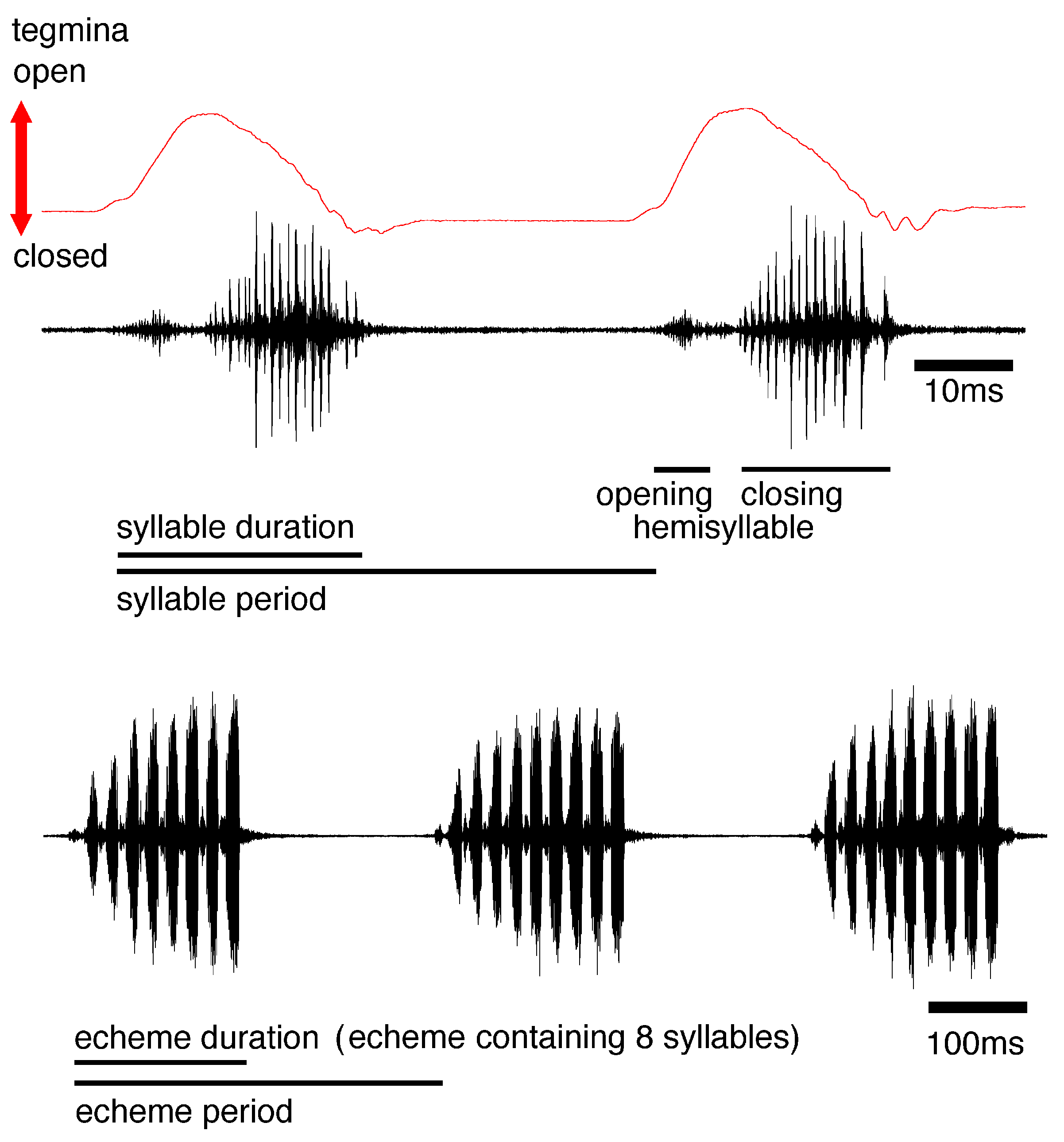
Syllable is the sound produced during one cycle of movements, generated by opening and closing of the tegmina, with each uni-directional movement generating a hemisyllable; syllable duration is the time period measured from the first impulse to the last; syllable period is the time period measured from the first impulse to the first impulse of the next syllable (reciprocal value: syllable repetition rate [SRR]); impulse is a simple, undivided transient train of sound waves (here the damped sound impulse arising as the effect of one tooth of the stridulatory file being struck by the scraper). A first-order assemblage of uniform syllables is called an echeme (=chirp; short series of syllables without stops of the wing movement in between), its length typically given in number of syllables; echeme duration is the time period measured from the first to the last syllable; echeme period is the time period measured from the first to the beginning of the next echeme (reciprocal value: echeme repetition rate [ERR]); a trill is a long series of uniform syllables without stops of the wing movement in between, its length typically given in seconds. However, there is no clear border between echemes and trills (broken trill, trill segments).
Figure 1.
Schematic representation of the terms syllable ((above); stridulatory movement in red) and echeme (below) used for the song description (see Section 2; amplitude scale linear, in arbitrary units).
3. Results
For this review, we found data for 35 (sub-)species under the genus name Conocephalus. One of them was later transferred to Euconocephalus; for another (C. adustus), the data could not be obtained, and in a third recording from an unidentified species, no regular species-specific pattern could be recognized.
Among the remaining 32 forms, 21 produced echemes, six trills (in both cases half of the forms had simple, the other half complex songs), and another five produced a complicated mixture of trills and echemes. Below, the species are presented in alphabetical order according to the specific epithet. Subgenus names are provided only for information.
All species produced relatively long-lasting, continuous songs with a moderate to high duty cycle (syllable/echeme duration divided by syllable/echeme period). In most species, opening and closing movements of the forewings resulted in sound production, but always, the sounds from the closing movements had distinctly higher amplitudes. Only in C. hastatus and C. kisi could no opening hemisyllables be recognized.
Conocephalus (Chloroxiphidion) albescens (Walker, 1869)
Terra typica: South Australia. Distribution: Australia, New Zealand.
References to song: [12] (CD), this paper (Table 1).
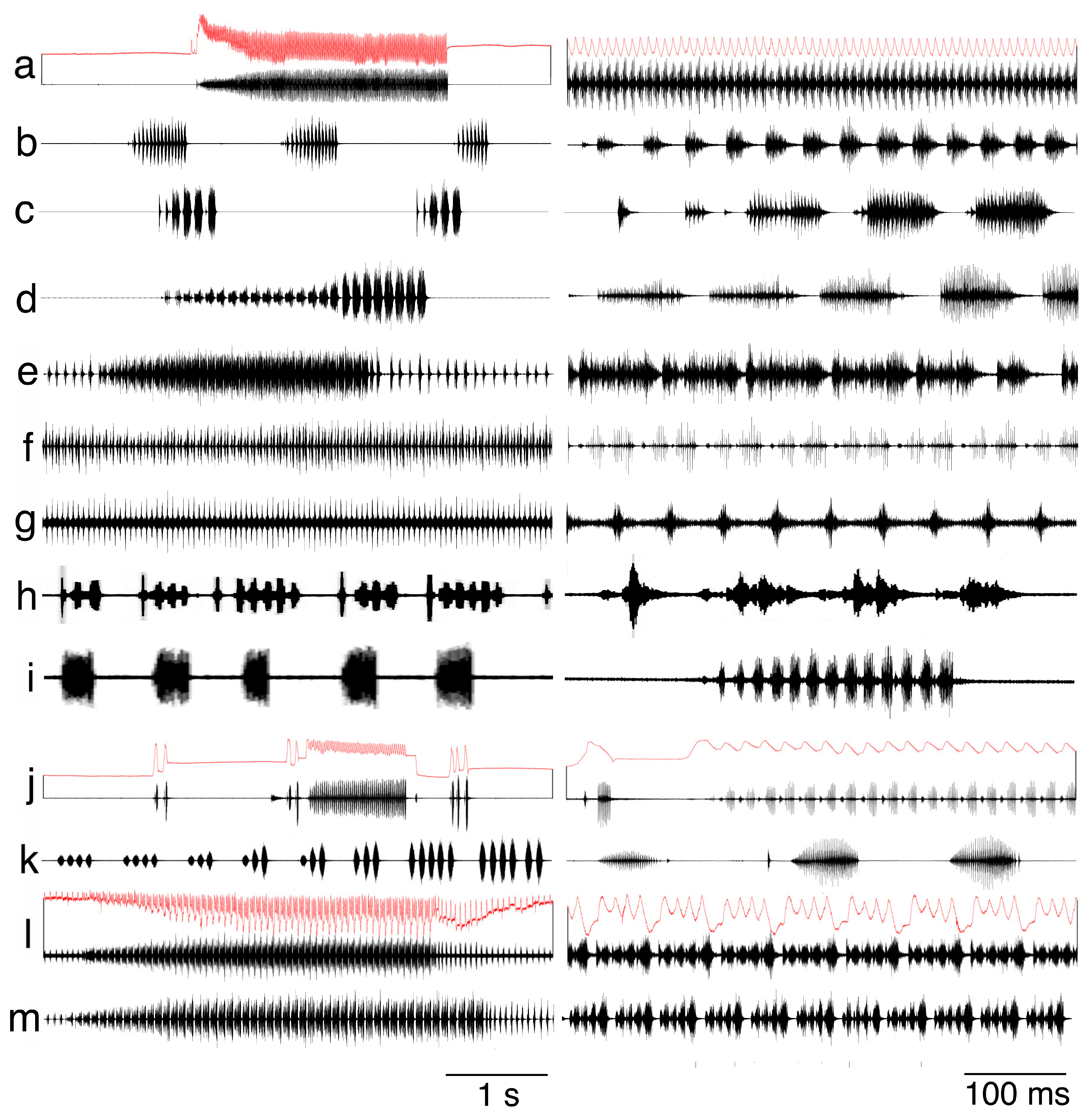
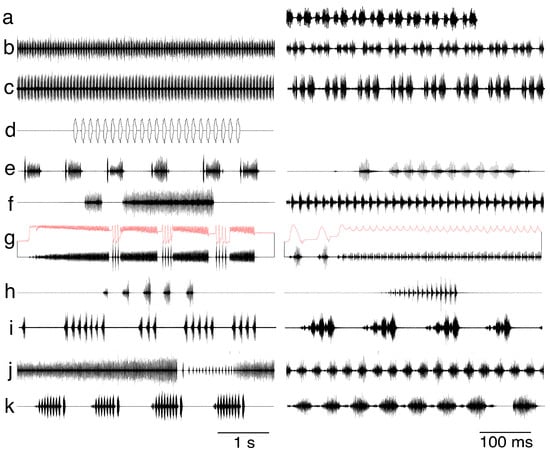
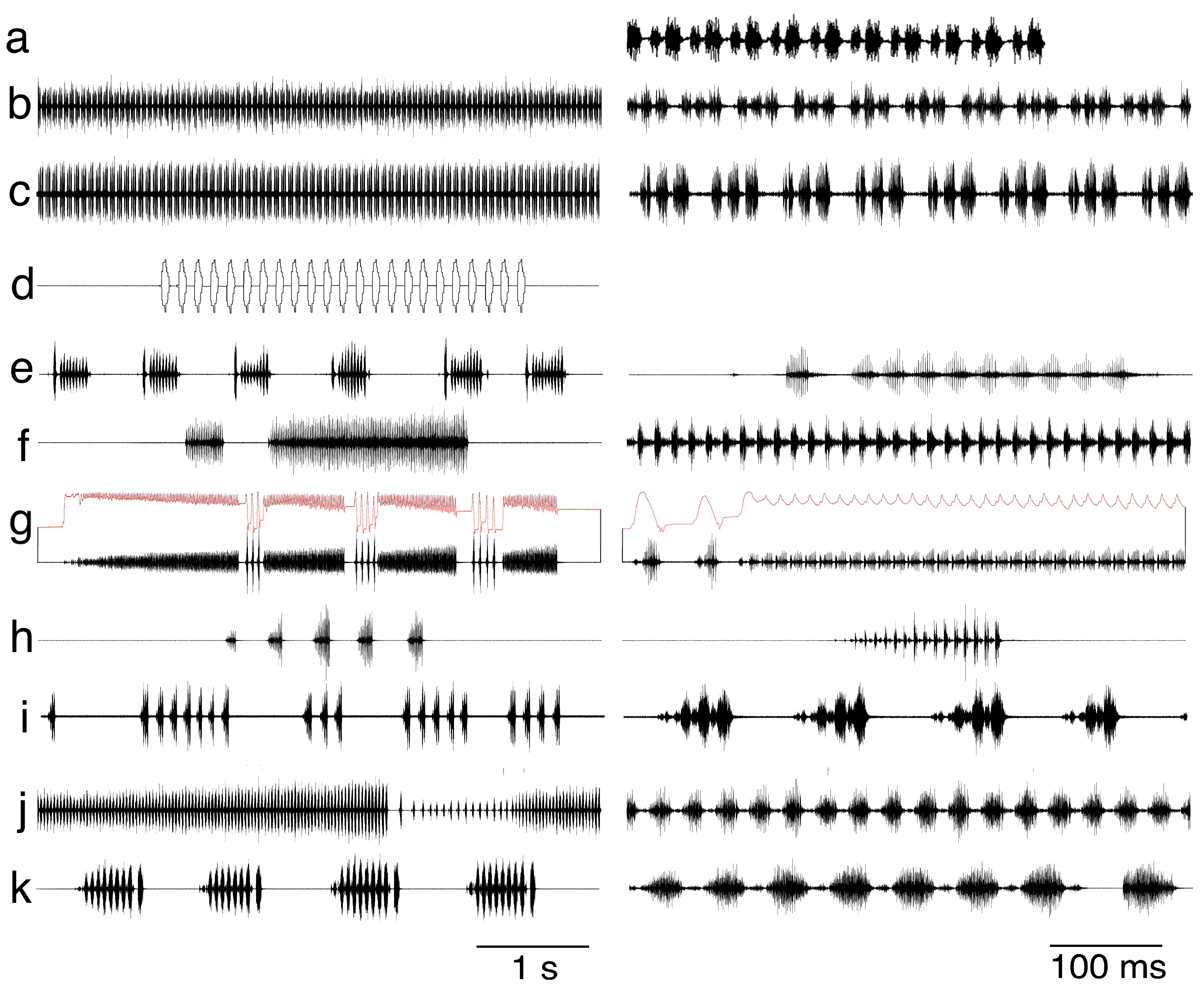
The song consists of short (duration of a few seconds) trills with a relatively high SRR (67–111 Hz; Figure 2a; Table 2). The intervals between the trills have about the same length as the trills or are longer. The impulses produced during the opening movement of the tegmina are about 10 dB softer than those during the closing movements.
Table 2.
Acoustical characteristics of the studied Conocephalus species (* source for figure or for locality data, respectively).
Figure 2.
Oscillogram of calling song and tegmen movement (red; only in (a,j,l)) of Conocephalus species (left column 5-s-section, right column 500 ms section). (a)—albescens, (b)—bambusanus (Thailand; sound file [13] used under a Creative Commons Attribtion-ShareAlike 4.0 International License), (c)—bambusanus (Korea; sound file [15] in public domain fide Taewoo Kim), (d)—bambusanus (Japan; sound file [16] used with permission of Hideo Ueda), (e)—beybienkoi (sound file [16] used with permission of Hideo Ueda), (f)—bilineatus (sound file [12] used with permission of D. Rentz), (g)—chinensis (sound file [14] used with permission of Takashi Murai, Hokkaido University Press), (h)—cognatus (from [19], modified, with permission from the Journal of Orthoptera Research), (i)—concolor (peneri) (modified from Avci & Taylan (2023) [20], with permission from the Journal of the Entomological Research Society), (j)—concolor hispanicus, (k)—conocephalus, (l)—dorsalis, (m)—ebneri (sound file [28] used under a Creative Commons Attribtion-ShareAlike 4.0 International License) (see Table 2 for source of recordings).
Conocephalus (Anisoptera) adustus (Redtenbacher, 1891)
Terra typica: Indonesia, Ambon Island. Distribution: Indonesia, Maluku Islands, Ambon and Buru Islands.
References to song: [45]—New Record for Java Island.
Paper inaccessible (can only be read in the libraries of the Universitas Gadjah Mada at Yogyakarta or Jakarta; email 25 March 2026).
Conocephalus (Conocephalus) bambusanus Ingrisch, 1990
Terra typica: Thailand. Distribution: Southeast and Eastern Asia.
References to song: [13,14,15,16,46] (CD).
In Thailand, the song consists of echemes with up to 15 syllables (Figure 2b; Table 2). SRR varied relatively widely, between 17.8 and 37.0 Hz, with a mean of 26.8 Hz (syllable period: 37.3 ± 7.5 ms). The song of the animals from Korea (with quite low syllable numbers per echeme) and Japan, however, had a distinctly lower SRR of 6–9 Hz (Figure 2c). Sometimes (Figure 2d; see [16]), a male adds a series of additional syllables with a distinctly higher amplitude at the end of an echeme (see also C. conocephalus).
The difference in SRR is certainly too large to be explained by intraspecific variability, although the recording from Thailand was made at an unusually high temperature, and the temperatures of the other recordings are not given. Recordings at different temperatures have to confirm the assumption that two species are involved.
C. bispinatus Pitkin, 1980, and the later-described C. bambusanus share some important morphological characteristics that are rare or even unique in Conocephalus. Based on the high variability, Pitkin [7] excluded specimens from outside the Pacific region from the type series of bispinatus. Possibly, there are some more species in this group, besides bambusanus, not recognized because of the similarity in the key characters (see Section 4).
Conocephalus (Anisoptera) beybienkoi Storozhenko, 1981
Terra typica: Russian Far East. Distribution: Eastern Asia.
References to song: [16] (CD).
In the calling song, two different parts regularly alternate, with each lasting several to many seconds (Figure 2e; Table 2). One part consists of (tri- to ?) tetra-syllabic echemes (ERR 12.5 Hz, SRR 61 Hz). The other part consists of isolated syllables (SRR ca. 11 Hz). The song is thus quite similar to that of C. dorsalis (see below), supporting the close relationship of both forms. C. beybienkoi was originally described as a subspecies of C. dorsalis [47].
Conocephalus (Anisoptera) bilineatus (Erichson, 1842)
Terra typica: Australia. Distribution: Australia.
References to song: [12] (CD).
The song consists of a long sequence of di-syllabic echemes (SRR 32 Hz, ERR 15.6 Hz; Figure 2f; Table 2).
Conocephalus (Amurocephalus) chinensis (Redtenbacher, 1891)
Terra typica: Amur region. Distribution: Eastern Asia.
References to song: [14,15,16,17,18,46] (CD).
The song looks like it consists of trills (durations of at least between 4 and 60 s) with SRR of 18–25 Hz (Figure 2g; Table 2). However, the syllables are unusually short (7–8 ms; see [17]); thus, the tegmina may not move during the inter-syllable intervals and the song has to be classified as a very fast sequence of single syllables. In the recording of Kim [15], but not in the otherwise similar recording of Kim [46], the intervals between the syllables are filled with impulse-like sounds, which could suggest a more complicated movement pattern. The recording of Ueda [16] comes undoubtedly from a misidentified C. melaenus (see there).
Conocephalus (Anisoptera) cognatus (Redtenbacher, 1891)
Terra typica: Borneo & Ambon Island. Distribution: Southeast Asia.
References to song: [19].
The song of C. cognatus is unusually complicated (Figure 2h; Table 2). Each song unit starts with a loud isolated syllable which is followed—after about 100 ms—by a series of 2–5 di-syllabic echemes (SRR 40 Hz, ERR 8 Hz). In the isolated syllable opening and closing, hemisyllables are clearly recognizable, whereas in the echemes, it is more difficult. Possibly, the tegmina are not completely closed during this part. The song units are repeated in a rhythm of about 1 Hz.
Conocephalus (Anisoptera) concolor (Burmeister, 1838)
Terra typica: Egypt. Distribution: Mediterranean region and western Asia (several subspecies).
References to song: [20] (the song was described under the name C. fuscus but later corrected to concolor; email Taylan 30 August 2023). The recorded specimens may belong to the subspecies Conocephalus concolor peneri Harz, 1970 (see [48]).
The song consists of relatively long echemes (syllable number around 14, SRR 55 Hz), repeated about once per second (Figure 2i; Table 2).
Conocephalus (Anisoptera) concolor hispanicus Heller, 1988
Terra typica: Spain. Distribution: Spain.
References to song: [8].
The calling song is quite variable. It contains isolated syllables, often two closely together, and short trills (duration 0.1–1 s; SRR 50 Hz; Figure 2j; Table 2). At night, in the field, isolated syllables were more common; in the laboratory, both parts were heard at nearly the same frequency. During the trill, the amplitude of the stridulatory movement is typically clearly smaller than in the isolated syllables.
Conocephalus (Conocephalus) conocephalus (Linnaeus, 1767)
Terra typica: Africa. Distribution: Africa and southern Europe.
References to song: [8,9,21,22,23,24,25,26,27] (CD).
The song is very variable, from series of isolated syllables to echemes and even trills, and there are also differences between singing during daytime and at night (see [26,27]). Most typically, the song consists of long sequences of echemes with two to five syllables. As a characteristic feature, at the end of a sequence, the amplitude increases more or less abruptly (Figure 2k; Table 2) by around 10 dB. Compared to other Conocephalus species, the syllables are quite long, and SRR is low (often less than 10 Hz).
In the figure of Sales & Pye ([21]; pl. 10 a), an SRR of about 47 Hz can be recognized (see [8]). Most likely, here, an error in the identification of the species is involved, but there are no other recordings from these regions of Africa (Uganda, Nigeria) to clarify the situation.
Conocephalus (Anisoptera) dorsalis (Latreille, 1804)
Terra typica: France. Distribution: Palaearctic (introduced to North America).
References to song: [8,9,27] and many others from Europe (further references see in three listed studies).
In the calling song, two different parts alternate regularly, with each lasting several to many seconds. In both parts, the syllables contain distinct opening and closing hemisyllables. One part consists of tetrasyllabic echemes (ERR 11–17 Hz). In the first three syllables, the tegmina are not completely closed; only in the last do they come close to the resting position, resulting in a longer closing hemisyllable (SRR 70–80 Hz at 22 °C). Correspondingly, the next opening hemisyllable is longer and sometimes even louder than the following three (Figure 2l; Table 2). The other part consists of isolated syllables (SRR 15–30 Hz) with a decreasing amplitude of wing movement and sound.
Conocephalus (Anisoptera) ebneri Harz, 1966
Terra typica: Albania. Distribution: Montenegro, Albania, Greece.
References to song: [24,28].
The song is nearly identical to that of Conocephalus dorsalis—only rarely have a few echemes with five syllables been observed (Figure 2m; Table 2). In morphology, it looks like a very large C. dorsalis [3].
Conocephalus (Anisoptera) exemptus (Walker, 1869) (syn. C. gladiatus (Redtenbacher, 1891))
Terra typica: Korea. Distribution: Eastern Asia.
References to song: [14,15,16,17,19,29] (CD; as gladiatus).
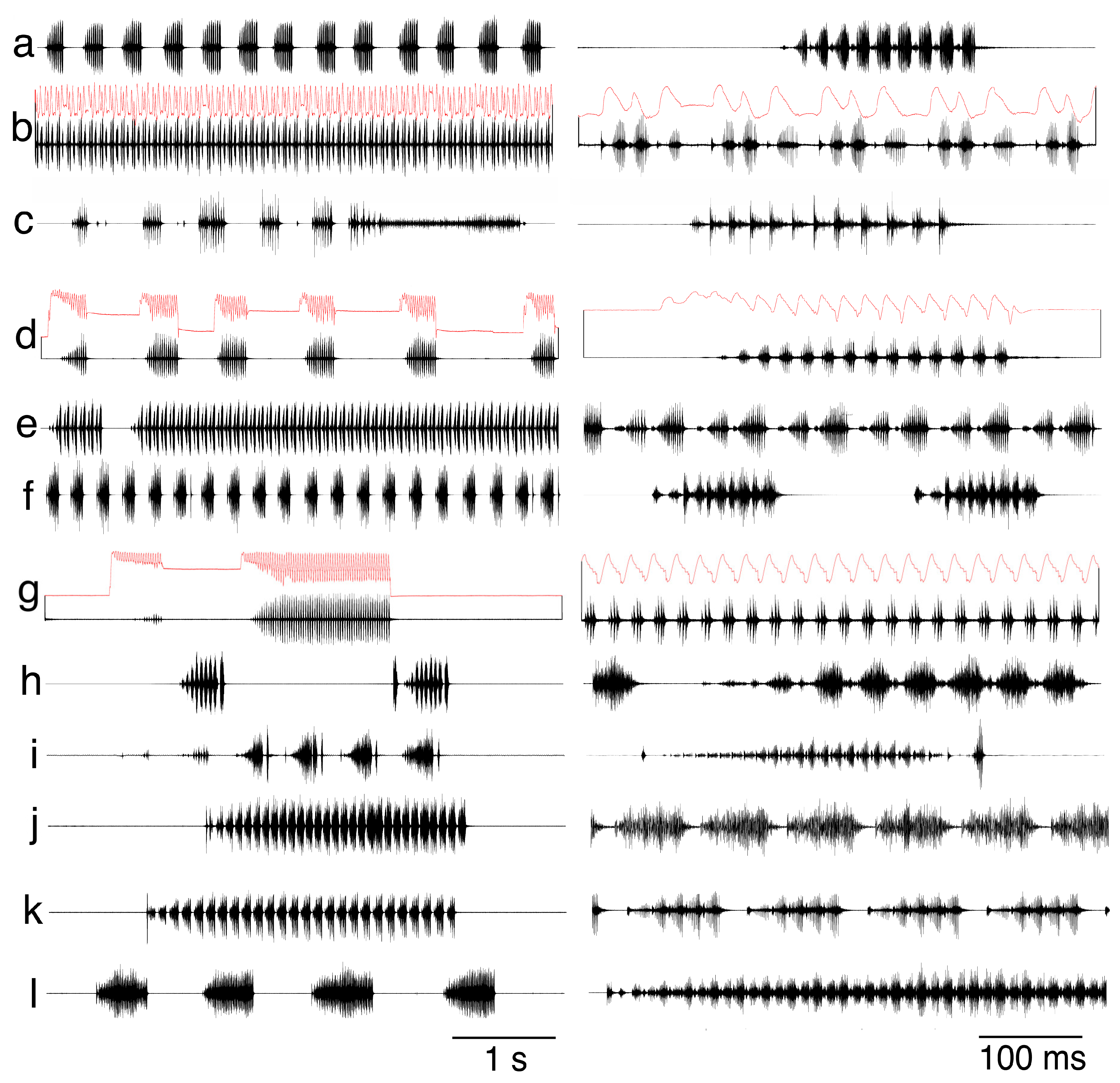
The song consists of echemes (ERR 3–4.5 Hz) containing five to nine syllables each (Figure 3a; Table 2). In the first half of an echeme, the syllables increase in amplitude, with the closing hemisyllables always being much louder than the opening (SRR 40–60 Hz). Tan et al. [19] report a trill-like sequence at the beginning of an echeme series, and this is also the only part of this recording where the SRR can be estimated to be around 50 Hz.
Figure 3.
Oscillogram of calling song and tegmen movement (red; only in (b,d,g)) of Conocephalus species (left column 5-s-section, right column 500 ms section). (a)—exemptus (sound file [14] used with permission of Takashi Murai, Hokkaido University Press), (b)—fuscus, (c)—halophilus (sound file [16] used with permission of Hideo Ueda), (d)—hastatus hastatus, (e)—iris, (f)—japonicus (sound file [16] in public domain fide Taewoo Kim), (g)—kisi, (h)—laetus (sound file [12] used with permission of D. Rentz), (i)—longipennis (sound file [33] used under Common Creative CC zero license), (j)—maculatus, (k) maculatus (“hilli”), (l)—continuus (sound file [31] used with permission of E.Schweizerbart’sche Verlagsbuchhandlung: www.schweizerbart.de/9783510614189 (accessed on 5 April 2026)) (see Table 2 for source of recordings).
Conocephalus (Anisoptera) fuscus (Fabricius, 1793) (syn. C. discolor Thunberg, 1815)
Terra typica: Europe. Distribution: Palaearctis.
References to song: [8,9,27] (CD), this paper (Table 1) and many others from Europe (further references see in studies listed above), ref. [16] (CD).
The basic unit of the unique song pattern consists of the combination of a di-syllabic echeme (SRR ca. 50 Hz) and an isolated syllable. This element is repeated in a rhythm of about 10–16 Hz (Figure 3b; Table 2) for quite a long time (up to several minutes). Closing hemisyllables are distinctly louder and longer than opening hemisyllables. Many animals, but not all, insert short (0.3–2 s) series of isolated syllables into the long sequences, a behavior similar to C. dorsalis, but usually with shorter inserted syllable series.
Conocephalus halophilus Ishikawa, 2004
Terra typica: Japan. Distribution: Japan.
References to song: [16] (CD).
The basic unit of the song consists of a complex, amplitude-modulated combination of several echemes followed by a soft trill (Figure 3c; Table 2). In the first part, several (ca. 5) quite variable echemes are observed, separated by intervals of 300–500 ms. They contain 8–12 syllables with SRRs between 38–55 Hz. Then another echeme follows, during which the amplitude becomes softer and which ends in a long (1–1.5 s), soft trill, about 8–15 dB softer than the echeme. This combination is repeated after about 10 s. Sometimes, the echeme series and the trills are also presented separately.
Conocephalus (Anisoptera) hastatus hastatus (Charpentier, 1825)
Terra typica: Balkans. Distribution: Balkans, Asia Minor.
References to song: [8,24,30].
The song consists of short (0.3–1 s) trills (SRR ca. 50 Hz). Often, several of these syllable groups follow each other with intervals of less than 1 s, then a larger interval is observed. Sound is produced only during the closing movements, and the resting position of the tegmina between the trills can be variable (Figure 3d; Table 2).
Conocephalus (Anisoptera) iris (Serville, 1838)
Terra typica: Madagascar. Distribution: Sub-Saharan Africa, Madagascar.
References to song: [25,31,32].
“In the calling song of C. iris … two different song types can be observed. One consists of short echemes with 2–3 long syllables, which are presented in a slow syllable repetition rate (11–15 Hz…). The other type, which is much more common, consists of sequences of pairs of short syllables” (Figure 3e; Table 2). “The duration of these sequences is quite variable, from 0.1 to 4.2 s. The SRR within the pairs (38 Hz) is much higher than in the slow type, therefore it is called fast type; the repetition rate of the pairs in the fast type is comparable of that of the syllables in the slow type. The echemes of the slow type are either presented isolated with large intervals between or before series of syllable sequences of the fast type. These series can last many seconds, containing short and long sequences” [25]. This description is based on songs from Tanzania and West Africa [25,31], in Mozambique, the SRR seems to be much higher as calculated from the figure presented in Naskrecki & Guta [32].
Conocephalus (Anisoptera) japonicus (Redtenbacher, 1891)
Terra typica: Japan. Distribution: Eastern Asia.
References to song: [14,15,16,46] (CD).
The basic unit of the song is represented by an echeme containing five to six syllables (SRR 48 Hz). These echemes are repeated in small groups (three to six echemes; Japan: [14]) or in long uninterrupted series (Korea: [15]; Figure 3f; Table 2), always with an ERR of 4–4.5 Hz. Occasionally, single isolated syllables are interspersed. The first syllable of an echeme is often louder than the following, which increase in amplitude towards the end of the echeme. As can be seen from the structure of the syllables in the figures, during the opening and closing of the tegmina, impulses are produced.
Conocephalus (Anisoptera) kisi Harz, 1967
Terra typica: Balkans. Distribution: Balkans, Asia Minor.
References to song: [8,24] (same recording as 8).
The song consists of short (0.5–1 s) trills (SRR ca. 50 Hz), typically slightly longer than in C. hastatus. The sound is produced only during the closing movements, and the resting position of the tegmina between the trills can be variable (Figure 3g; Table 2). Sometimes, short and soft trills can be heard, resulting from wing movements with low amplitude. During acoustical rivalry between males, single syllables and short irregular syllable groups have been observed [8].
Conocephalus (Chloroxiphidion) laetus (Redtenbacher, 1891)
Terra typica: Australia. Distribution: West Africa to New Hebrides.
References to song: [12] (CD).
The song consists of echemes repeated at intervals of one to a few seconds. The echemes contain about 10 syllables (SRR ca. 23 Hz), but the first and last ones are a little bit separated and differ in structure (Figure 3h; Table 2). Pitkin [7] found the species morphologically very close to C. exemptus (listed by her under its synonym C. gladiatus), but the songs are quite different.
Conocephalus (Anisoptera) longipennis (de Haan, 1843)
Terra typica: Indonesia, Sumatra. Distribution: From Pakistan to Southeast Asia and Micronesia.
References to song: [33].
The basic unit of the song is a short trill, first increasing and then decreasing in amplitude, which is preceded by an isolated syllable and followed by a loud isolated syllable. SRR in the trill is ca. 70 Hz (n syllables ca. 25) and the isolated syllables are separated by intervals of ca. 15–20 ms (Figure 3i; Table 2). This basic unit is produced isolated or in short groups (up to six in a rhythm of about 1.5 Hz).
Conocephalus (Anisoptera) maculatus (Le Guillou, 1841)—complex
C. maculatus is a widespread species which can easily be recognized from coloration, and quite a number of recordings exist from different areas of its huge range. Surprisingly, however, two different song patterns are found, one in Asia and the other in Africa (compare Figure 3j–l). The differences are so large that obviously two sibling taxa are involved. The difference in the neuronal networks responsible for the production of the dissimilar songs can only be explained by the existence of separate gene pools, and the females will certainly not be attracted by the “wrong” song pattern. Therefore, two names should be used, C. maculatus for the Eastern forms and Conocephalus continuus (Walker, 1869) for the western forms, mainly from Africa. In her study on Pacific Conocephalus, Pitkin [7] had only two specimens of the C. maculatus-group from Africa, both with fastigia narrower than in all Asian specimens she measured, but she nevertheless synonymized the African Conocephalus continuus with the Asian C. maculatus.
Conocephalus (Anisoptera) maculatus (Le Guillou, 1841) [s.str.; see also below, Conocephalus continuus (Walker, 1869)]
- Conocephalus (Anisoptera) hilli Farooqi & Usmani, 2019 syn. nov.
Terra typica: West Malaysia (see [7]). Distribution: From Pakistan to Japan and Southeast Asia.
The song consists of sequences of echemes (ERR 5–11 Hz), with each containing four to 10 syllables (SRR 49–77 Hz; Figure 3j,k; Table 2). The first syllable of a sequence is often louder than the following. The length of the sequences varies between 2 and 5 s.
Conocephalus hilli was described by Farooqi & Usmani [49] on three females, differing from C. maculatus mainly in length of the wings and length and shape of the ovipositor. However, wing length is a character that is well known for intraspecific variability in Conocephalus (see e.g., [3] for para-, macro- and hyperpterous specimens of C. fuscus and micro- and macropterous specimens in C. dorsalis). For ovipositor shape and length, no data are given, either by measurements or by figures, but according to the photos in Farooqi et al. [50], the differences from maculatus are quite small. Also, the differences in the number of stridulatory teeth, given in the description of the male ([50]: 40–42 in hilli to 50 in maculatus), are quite small. Since the songs of both forms are nearly identical (Figure 3j,k), and C. hilli is known only from one small area within the range of maculatus (see map in [50]), we consider hilli a local variety.
Conocephalus (Anisoptera) continuus (Walker, 1869) [see also above, Conocephalus maculatus (Le Guillou, 1841)]
Terra typica: Sierra Leone. Distribution: Africa to the United Arab Emirates.
References to song: [31,32,36,37] (all as maculatus), this paper (Table 1; see [51], Fontana per email 26 February 2026).
The song has a trill-like structure, but every second syllable is slightly softer and shorter than the preceding (in small figures sometimes not recognizable). Thus, it has to be classified as a sequence of di-syllabic echemes (ERR 22–44 Hz, SRR 44–100 Hz; when considered as a trill of 43–90 Hz; Figure 3l; Table 2). At present, the surprisingly large differences between some recordings have to be considered temperature effects (see Section 4). The length of the sequences varies between 0.5 and 2 s.
Conocephalus (Anisoptera) melaenoides Sänger & Helfert, 1995
Terra typica: Indonesia, Sulawesi. Distribution: Indonesia, Sulawesi.
References to song: [38].
The song consists of a sequence of di-syllabic echemes (ERR 28 Hz, SRR 73 Hz; Figure 4a; Table 2). In more detailed figures, the opening hemisyllables are visible, but they are much softer than the closing hemisyllables.
Figure 4.
Oscillogram of calling song and tegmen movement (red; only in (g)) of Conocephalus species (left column 5-s-section, right column 500 ms section). (a)—melaenoides (from [38], modified, with permission from Zeitschrift der Arbeitsgemeinschaft österreichischer Entomologen and Brigitte Helfert), (b)—melaenus, (c)—melaenus (sound file [16] used with permission of Hideo Ueda), (d)—peringueyi (schematic oscillogramm based on data from [36]), (e)—phasma (sound file [31] used with permission of E.Schweizerbart’sche Verlagsbuchhandlung: www.schweizerbart.de/9783510614189, accessed on 5 April 2026), (f)—redtenbacheri (sound file [12] used with permission of D. Rentz), (g) semivittatus semivittatus, (h)—signatus/trifasciatus (sound file [43] used under Common Creative CC zero license), (i)—signatus/trifasciatus (this paper), (j)—upoluensis, (k)—willemsei (sound file [12] used with permission of D. Rentz) (see Table 2 for source of recordings).
Conocephalus (Anisoptera) melaenus (Haan, 1843)
Terra typica: Indonesia, Java. Distribution: From India to China and Southeast Asia.
References to song: [14,16,17,18,38,39,40] (CD) this paper.
The song consists of long-lasting sequences (at least up to one minute) of strictly tri-syllabic echemes (ERR 15–20 Hz, SRR 65–80(–100?) Hz; Figure 4b,c; Table 2).
Conocephalus (Anisoptera) peringueyi Uvarov, 1928
Terra typica: South Africa. Distribution: South Africa.
References to song: [36,52].
As far as it can be concluded from the limited data, the song consists of echemes with variable duration and an unusually low SRR of about 7 Hz (Figure 4d; Table 2).
Conocephalus (Megalotheca) phasma Gorochov & Llorente del Moral, 2004
Terra typica: Tanzania. Distribution: Eastern Africa.
References to song: [31].
The basic unit of the song consists of a combination of an isolated syllable, followed after a very short interval (ca. 35 ms) by an echeme with ca. 10 syllables (SRR 36 Hz; Figure 4e; Table 2). The complete unit is often repeated in a rhythm of 1.5 Hz.
Conocephalus (Anisoptera) redtenbacheri (Bolívar, 1905)
Terra typica: New Guinea. Distribution: New Guinea to Australia, Micronesia and the Philippines.
References to song: [7,12] (CD).
The males produce short (up to 2–3 s) trills, sometimes irregular in length (Figure 4f; Table 2). SRR is quite high and can reach 118 Hz (at 30 °C, neotype recorded; only 67 Hz at 26 °C in Australia).
Conocephalus (Anisoptera) semivittatus (Walker, 1869)
Terra typica: New Zealand. Distribution: New Zealand to Australia, New Guinea, Micronesia and the Philippines.
References to song: semivittatus semivittatus: [12] (CD), this paper (Table 1); s. semivittatus?: [53]; semivittatus vittatus: [7,41,42].
The song consists of sequences (duration of about 5–20 s) during which trills and series of isolated syllables alternate (Figure 4g; Table 2). Typically, a sequence starts with a trill (duration often ca. 1 s; syllables slowly increasing in amplitude; SRR 50 Hz), which is followed by a short series of ca. three isolated syllables (SRR 20 Hz). These syllables have a much higher amplitude (by 6–8 dB) than the syllables in the trill. The combinations of trills and isolated syllables are repeated several times, with the number of isolated syllables often slightly increasing (e.g., from 3 to 6) and their SRR decreasing (e.g., to 12 Hz at the end). The impulses produced during the closing hemisyllables have a distinctly higher amplitude than those during the opening hemisyllables. This is true in the trill and in the isolated syllables. The high amplitude of the isolated syllables results from the fact that, here, the tegmina are closed to a larger degree than during the trill.
Bioacoustically, obvious differences between the subspecies C. semivittatus semivittatus and C. semivittatus vittatus (Redtenbacher, 1891) do not seem to exist.
Conocephalus (Anisoptera) signatus Redtenbacher 1891/trifasciatus Redtenbacher 1891
Terra typica: Sri Lanka. Distribution: Sri Lanka.
After recording, in both studies, the singing males were tentatively identified as belonging to the micropterous C. trifasciatus, probably from coloration. However, after studying long series, already, Henry [54] had concluded that it “seems more than probable that X [iphidion] trifasciatus will eventually fall as a synonym to X. signatus”. Henry [54] also lists the macropterous C. maculatus and C. longipennis from the island, but after this paper, obviously, no specimens of the genus Conocephalus have been examined in Sri Lanka.
In both recordings (both in the laboratory at 28 °C), the song consisted of echemes but with widely differing SRRs: Reynold’s male sang quite regular with 110 Hz (syllable number ca. 15, ERR 2.6 Hz; Figure 4h; Table 2) for more than 7 min, whereas, despite an observation period of several hours, our male rarely produced long series but mostly only isolated echemes with 60 Hz (syllable number 3–6, ERR up to 8 Hz, Figure 4i; Table 2; at 20 °C SRR 45 Hz, ERR typically of about 1 Hz or less). The differences between both recordings are certainly far outside intraspecific variability, and more detailed studies have to reveal the identity of the species described here.
Conocephalus (Chloroxiphidion) upoluensis (Karny, 1907)
Terra typica: Samoa. Distribution: Australia, Pacific Islands.
Reference to song: [12,42,55] (CD) (spectral data only).
Hugel [42] describes the song as follows: “The echeme-sequence of C. upoluensis call has two repeating distinct parts: a series of individual short syllables, alternated with a train of continuous buzz (this seems not to be always the case, see [12])”. Thus, in the song, two types of trills with different SRRs seem to alternate, both with durations of a few seconds. The faster (“buzz”) has an SRR of 81 Hz, the slower of 30.5 Hz (at 21.5 °C; [42]; Figure 4j, Table 2).
Conocephalus (Anisoptera) willemsei Pitkin, 1980
Terra typica: Australia, Northern Territory. Distribution: Australia.
Reference to song: [12] (CD).
The song consists of echemes (ERR 0.8 Hz) each containing about 10 syllables (SRR ca. 17 Hz). As a unique character, the last closing hemisyllable is separated from the others by a 30 ms long silent interval (Figure 4k, Table 2). This hemisyllable is also longer than the previous ones—probably, the amplitude of the tegmen movement is larger than before, and the wings return only then to their resting position.
Conocephalus sp.
Collecting locality: East Malaysia, Sabah.
Reference to song: [44].
In an 80 s recording, the male started with echemes (ERR 0.5 Hz; syllable number 5–7), which had at first an SRR of 26 Hz and which dropped quite fast to 12–13 Hz SRR. After about 40 s, the pattern changed to some trills (SRR 11–12; duration up to 3 s), until it ended in echemes again. Unfortunately, for the understanding of such a possibly complicated pattern, the sample size is too small.
Conocephalus X
Collecting locality: India: Assam, Hollangapar Gibbon Wildlife Sanctuary, Jorhat.
Reference to song: [40].
In the meantime, this species was described as Euconocephalus brevicornis Tiwari & Diwakar 2024. Its song, with a SRR of 174 Hz, also fits much better into Euconocephalus than into Conocephalus.
4. Discussion
Of the 140 species and subspecies of Conocephalus occurring in the eastern hemisphere [5], 32 could be studied here. They display a large variety of song patterns, but, as to be expected, in different recordings of the same species, an identical pattern is found—at least mostly. One of the most striking examples is C. melaenus, where, from India and Malaysia over to Thailand and China to Korea and Japan, everywhere, sequences of tri-syllabic echemes are found. For C. exemptus, the same seems to be true with a different pattern (4–9-syllabic echemes) in a perhaps somewhat smaller and more northern geographic range. In species with complex songs, the situation is similar; in C. fuscus (Europe to Japan), C. dorsalis (Europe to Franz Josef Land [5], Mongolia [56]) and C. semivittatus (New Zealand to Australia and New Guinea), all over their ranges, the same song can be heard. In the latter two, morphologically distinct subspecies are involved, whereas around C. dorsalis, even two closely related, allopatric species (C. beybienkoi and C. ebneri) share the same pattern. These two forms probably have to be considered subspecies of dorsalis under the “biological species concept” [57].
However, there are a few examples where species with the same name have different songs. The most surprising case concerns C. maculatus. From this extremely widespread species, quite a large number of recordings exist. They fall into two acoustically distinct and geographically separated groups. In Asia (India to Japan), all males produced sequences of four-to-10-syllabic echemes, whereas in Africa (and the United Arab Emirates) they make short trill-like sequences of di-syllabic echemes with their two syllables being so similar that they sometimes cannot be differentiated and look like a trill (see Figure 3j–l). On the basis of these structurally so different songs, we suggest that here, two species are involved. For the African “C. maculatus”, the name C. continuus (Walker 1869) could be used as the oldest available name. Both taxa represent a typical pair of ethospecies, known from many groups of animals and also from acoustically communicating Tettigonioidea [58].
There are two other cases with the same name for differently singing males. From Sri Lanka, two series of recordings exist, both ascribed as possibly or probably coming from C. trilineatus but differing very clearly in song structure (Figure 4h,i). This species differs only in coloration from the otherwise similar C. signatus. In addition, two similar species occur in the mainland of India just opposite Sri Lanka (C. bivittatus and C. honorei [59]; see [5]), making the situation even more complicated.
The last problematic example concerns C. bambusanus. This species is closely related to the New Guinean C. bispinatus Pitkin, 1980. Pitkin [7] herself had already material from Indochina and Borneo and considered the animals from both localities as possibly different from C. bispinatus but all “always having ventral spines on the mid femora” [7]. Ingrisch [60] described the animals from Thailand as new species and recorded also its song [13]. In 1992, Xia & Liu [61] described C. abispinatus from China, which was synonymized with bambusanus by Zhou et al. [62] and which also has the mid-femoral spines. Later, however, Kim & Kim [63] found specimens with some characteristics of bambusanus in Korea but mentioned that these animals did not have mid-femoral spines, the key character of bambusanus and bispinatus, but only an unarmed prosternum, as is typical for the whole subgenus Conocephalus. Nevertheless, they applied the name bambusanus to these animals. Storozhenko et al. [64], however, explain that all Korean specimens do have one or several mesofemoral spines. They even list these spines as typical for the subgenus, which is certainly not correct (see [7], own observations in Conocephalus conocephalus). From the Korean interpretation, the name may have come to Japan. Now, the songs of bambusanus in Thailand and in Korea and Japan are similar in structure but differ in rhythm (see Figure 2b,c). The East Asian recordings are much slower than those from Thailand. Such “speed” differences, however, can be caused by temperature differences at the time of recording (see [65]). Unfortunately, the temperatures during recording are not known for any of the East Asian recordings, whereas that from Thailand was unusually high. Judging from the size of the differences, it seems likely that different species are involved, but more detailed studies are necessary.
Songs of Conocephalus species are especially susceptible to temperature effects. Many Conocephalus species are active and singing during daytime when they are exposed to direct sunlight. In this situation, the animals may warm up and become hotter than the surrounding air. The increase in temperature depends on the duration of the exposure and the intensity of the sunlight, but it cannot easily be quantified or calculated by measuring the temperature of the ambient air. Thermal radiation thermometers may reduce the problem, but they have not been available in former times. However, also, the opposite effect may occur. Conocephalus species often occur in relatively moist environments. While sitting in moist vegetation, their body temperature will go down by evaporative cooling. This effect was observed by Bauer (pers. communication) during her experiments working with thermocouples in acridid grasshoppers [66]. Therefore, even songs, recorded at the same ambient temperature, may show considerable differences. These effects, for example, may possibly be responsible for the observed song differences in C. iris and C. upoluensis.
The species-specific patterns of male calling songs, from relatively simple to complicated, have to be received, perceived and evaluated by the females—and possibly by rival males. At present, it is unknown which characters of the song exactly are used by the animals for the recognition of conspecifics. In close-range acoustical tests, Conocephalus females always preferred the species-specific SRRs [67]. They do not seem to be able to resolve faster song structures like impulse intervals [68]. For one species (C. nigropleurum (Bruner, 1891)), a null-reaction to the pattern of a congeneric species is described, even when the song contained generally attractive frequencies [69]. On the other hand, Conocephalus has never been tested whether, for species recognition, the animals may concatenate, e.g., pairs of syllables, as is known for the bush-cricket Tettigonia viridissima (Linnaeus, 1758) [70]. For the complicated songs, we are very far from an understanding of the function of single elements.
Similarly, we do not yet have much information about taxonomic relationships and song patterns. Pairs (or groups) of related, allopatric species may share the same pattern, as seen in dorsalis, beybienkoi and ebneri. Interestingly, the two studied members of the subgenus Conocephalus, conocephalus and bambusanus, both have low SRRs and regular changes in amplitude, which could indicate a common origin. However, regular changes in loudness are possibly found only in the East Asian populations of bambusanus, and low SRRs are also observed in other species, such as C. peringueyi. Generally, information about the phylogeny of Conocephalus is completely missing except for the data in Mugleston et al. [4], which indicate mainly intracontinental relationships (Africa, America, Asia/Australia; eight of 10 species unidentified at the species level). Thus, in many fields of research (e.g., behavioral studies, physiology, molecular genetics, systematics), much has to be done to get a better understanding of the details of the function and the evolution of the calling songs in Conocephalus.
Author Contributions
Conceptualization, K.-G.H. and R.J.; methodology, K.-G.H.; validation, K.-G.H.; formal analysis, K.-G.H.; investigation, K.-G.H., A.A. and R.J.; data curation, K.-G.H.; writing—original draft preparation, K.-G.H.; writing—review and editing, K.-G.H.; visualization, K.-G.H.; supervision, K.-G.H.; project administration, K.-G.H. All authors have read and agreed to the published version of the manuscript.
Funding
This research received no external funding.
Data Availability Statement
The unpublished original data presented in the study are openly available in OrthopteraSpeciesFile (OSF) at http://orthoptera.speciesfile.org/.
Acknowledgments
We are very grateful to F. Geiser for collecting and donating specimens, to Martina Heller and Marianne Volleth for help during collecting and recording, and to Paolo Fontana and Fernando Montealegre-Z for making their sound records accessible to us. We thank the Department of Science and Technology (DST), Government of India, for supporting RJ through the provision of funds for the purchase of the recorder.
Conflicts of Interest
The authors declare no conflicts of interest.
Abbreviations
The following abbreviations are used in this manuscript:
| ERR | Echeme repetition rate |
| SRR | Syllable repetition rate |
| CD | Compact disc |
References
- Heller, K.-G.; Hemp, C.; Ingrisch, S.; Liu, C.X. Acoustic communication in Phaneropterinae (Tettigonioidea)—A global review with some new data. J. Orthoptera Res. 2015, 24, 7–18. [Google Scholar] [CrossRef] [Scilit]
- Heller, K.-G.; Chobanov, D.; Warchałowska-Śliwa, E.; Hemp, C. Review of song patterns and sound production in armoured ground crickets (Orthoptera: Tettigoniidae: Hetrodini) with karyological data and taxonomic notes. Zootaxa 2022, 5120, 451–481. [Google Scholar] [CrossRef] [Scilit] [PubMed]
- Harz, K. Die Orthopteren Europas/The Orthoptera of Europe: Volume I (Series Entomologica, 5, Band 5); Springer: Dordrecht, The Netherlands, 1969. [Google Scholar] [CrossRef] [Scilit]
- Mugleston, J.D.; Waegle, M.; Song, H.; Whiting, M.F. A comprehensive phylogeny of Tettigoniidae (Orthoptera: Ensifera) reveals extensive ecomorph convergence and widespread taxonomic incongruence. Insect Syst. Divers. 2018, 2, 5. [Google Scholar] [CrossRef] [Scilit]
- Cigliano, M.M.; Braun, H.; Eades, D.C.; Otte, D. Orthoptera Species File. Available online: http://orthoptera.speciesfile.org/ (accessed on 30 March 2026).
- Zhao, T.; Lin, Z.; Yang, H.; Song, F.; Xia, Z.; Huang, W. Evolutionary history and divergence times of Tettigoniidae (Orthoptera) inferred from mitochondrial phylogenomics. Front. Genet. 2025, 16, 1495754. [Google Scholar] [CrossRef] [Scilit] [PubMed]
- Pitkin, L.M. A revision of the Pacific species of Conocephalus Thunberg (Orthoptera: Tettigoniidae). Bull. Br. Mus. (Nat. Hist.) Entomol. 1980, 41, 315–355. [Google Scholar]
- Heller, K.-G. Bioakustik der europäischen Laubheuschrecken; Verlag J. Margraf: Weikersheim, Germany, 1988. [Google Scholar]
- Ragge, D.; Reynolds, W.J. The Songs of the Grasshoppers and Crickets of Western Europe; Harley Books: Essex, UK, 1998; (+ CD). [Google Scholar]
- Morris, G.K.; Braun, H.; Wirkner, C.S. Stridulation of the clear-wing meadow katydid Xiphelimum amplipennis, adaptive bandwidth. Bioacoustics 2016, 25, 225–251. [Google Scholar] [CrossRef] [Scilit]
- von Helversen, O.; Elsner, N. The stridulatory movements of acridid grasshoppers recorded with an opto-electronic device. J. Comp. Physiol. 1977, 122, 53–64. [Google Scholar] [CrossRef] [Scilit]
- Rentz, D.C.F. Grasshopper country. In The Abundant Orthopteroid Insects of Australia; University of New South Wales Press: Sydney, Australia, 1996; (+ CD). [Google Scholar]
- Ingrisch, S. OSF-Conocephalus Bambusanus (Recorded 1989). Available online: http://orthoptera.archive.speciesfile.org/Common/basic/PlaySound.aspx?TaxonNameID=1133490&SoundID=1978 and XC873048 (accessed on 5 April 2026).
- Ichikawa, A.; Kano, Y.; Kawai, M.; Tominago, O.; Murai, T. (Eds.) Orthoptera of the Japanese Archipelago in Color; Hokkaido University Press: Sapporo, Japan, 2006. (+ CD) (In Japanese) [Google Scholar]
- Kim, T.-W. Taxonomy and Acoustic Signals of Korean Tettigonioidea (Orthoptera: Ensifera) II; National Institute of Biological Reserves: Incheon, Republic of Korea, 2009. (+ CD) (In Korean) [Google Scholar]
- Ueda, H. Katydid Chirping of Japan Archives Vol.2 (Insects Grasshopper Nature Sounds); Rest in Records: Tokyo, Japan, 2024; (+ CD). [Google Scholar]
- Chang, Y.L.; Yang, P.L.; Mao, S.L.; Shi, F.M. The song structure of four species of the genus Conocephalus from China. Acta Zootaxon. Sin. 2007, 32, 637–642. [Google Scholar]
- Murai, T.; Ito, F. Batta Koorogi Kirigirisu Seitai Zukan = A Field Guide to the Orthoptera of Japan; HokkaidoÌ Daigakushuppankai: Hokkaido, Japan, 2011. (+ CD) (In Japanese) [Google Scholar]
- Tan, M.K.; Duncan, J.; Wahab, R.H.A.; Lee, C.-Y.; Japir, R.; Chung, A.Y.C.; Baroga-Barbecho, J.B.; Yap, S.A.; Montealegre-Z, F. The calling songs of some katydids (Orthoptera, Tettigonioidea) from the tropical forests of Southeast Asia. J. Orthoptera Res. 2023, 32, 1–24. [Google Scholar] [CrossRef] [Scilit]
- Avci, C.; Taylan, M.S. Bioacoustics of Tettigoniidae (Insecta, Orthoptera) distributed in Hakkari (Eastern Anatolia) province. J. Entomol. Res. Soc. 2023, 25, 371–386. [Google Scholar] [CrossRef] [Scilit]
- Sales, G.; Pye, D. Ultrasonic Communication in Animals; Chapman & Hall: London, UK, 1974. [Google Scholar]
- Schmidt, G.H. Biotopmäßige Verteilung und Vergesellschaftung der Saltatoria (Orthoptera) im Parco Nazionale del Circeo, Lazio, Italien. Dtsch. Entomol. Z. 1996, 43, 9–75. [Google Scholar] [CrossRef]
- Massa, B.; Fontana, P.; Buzzetti, F.M.; Kleukers, R.; Odé, B. Orthoptera. Fauna d’Italia 48; Edagricole-New Business Media: Milano, Italy, 2012; (+ CD). [Google Scholar]
- Willemse, L.; Kleukers, R.; Odé, B. The Grasshoppers of Greece; EIS Kenniscentrum Insecten en Andere Ongewervelden: Leiden, The Netherlands, 2018. [Google Scholar]
- Heller, K.-G. Provisional checklist of the Tettigonioidea (Insecta: Orthoptera) from São Tomé & Príncipe with taxonomic remarks, bioacoustical data and the description of new taxa. Zootaxa 2019, 4563, 41–46. [Google Scholar] [CrossRef] [Scilit] [PubMed]
- Korsunovskaya, O.S. New for Russia Bush Crickets (Orthoptera: Tettigoniidae) from Crimea and Caucasus. Far East. Entomol. 2024, 495, 17–21. [Google Scholar] [CrossRef] [Scilit]
- Barataud, J. Acoustique des Sauterelles, Grillons et Courtilières de France, Belgique, Luxembourg et Suisse; Editions Biotope: Mèze, France, 2025. [Google Scholar]
- Horvat, L. OSF-Conocephalus Ebneri. (Recorded 2021). Available online: http://orthoptera.archive.speciesfile.org/Common/basic/PlaySound.aspx?TaxonNameID=1133532&SoundID=2795, 3090 (accessed on 5 April 2026).
- Ingrisch, S. OSF-Conocephalus Exemptus (Recorded 1988). Available online: http://orthoptera.archive.speciesfile.org/Common/basic/PlaySound.aspx?TaxonNameID=1133454&SoundID=1975 (accessed on 5 April 2026).
- Horvat, L. OSF-Conocephalus Hastatus (Recorded 2016–2021). Available online: http://orthoptera.archive.speciesfile.org/Common/basic/PlaySound.aspx?TaxonNameID=1133555&SoundID=2762, 2862, 3091 (accessed on 5 April 2026).
- Hemp, C. A Field Guide to the Bushcrickets, Wetas and Raspy Crickets of Tanzania and Kenya; Senckenberg Gesellschaft für Naturforschung: Frankfurt, Germany, 2021; (+ CD). [Google Scholar]
- Naskrecki, P.; Guta, R. Katydids (Orthoptera: Tettigoniidae) of Gorongosa national Park and Central Mozambique. Zootaxa 2019, 4682, 1–119. [Google Scholar] [CrossRef] [Scilit] [PubMed]
- Reynolds, W.J. Bioacoustica-Conocephalus longipennis. Available online: https://bio.acousti.ca/node/9109 (accessed on 5 April 2026).
- Ingrisch, S. OSF-Conocephalus Maculatus (Recorded 1993). Available online: http://orthoptera.archive.speciesfile.org/Common/basic/PlaySound.aspx?TaxonNameID=1133389&SoundID=1969, 1970 (accessed on 5 April 2026).
- Tiwari, C.; Diwakar, S. The katydid country: Bioacoustics and ecology of tettigoniid communities from the Indian subcontinent. Bioacoustics 2023, 32, 48–72. [Google Scholar] [CrossRef] [Scilit]
- Grant, P.B.C. Acoustic Profiling of the Landscape. Doctoral Dissertation, University of Stellenbosch, Stellenbosch, South Africa, 2014. Available online: http://hdl.handle.net/10019.1/86463 (accessed on 5 April 2026).
- Kashakuro, R.S. Distribution, Abundance, Population Ratios And Acoustic Behaviour of Conocephalus maculatus (Orthoptera: Tettigoniidae) in Kagera Region North-Western Tanzania. Master’s Thesis, Kenyatta University, Nairobi, Kenya, 2017. [Google Scholar]
- Sänger, K.; Helfert, B. Notes on tettigoniids (Orthoptera, Ensifera) from Sulawesi. Z. Arb.gem. österr. Entomol. 1995, 47, 89–96. [Google Scholar]
- Ingrisch, S. OSF-Conocephalus Melaenus (Recorded 1993). Available online: http://orthoptera.archive.speciesfile.org/Common/basic/PlaySound.aspx?TaxonNameID=1133443&SoundID=1973, 1974 (accessed on 5 April 2026).
- Tiwari, C.; Diwakar, S. Singers in the grass: Call description of conehead katydids (family: Tettigoniidae) and observations on avoidance of acoustic overlap. Bioacoustics 2019, 28, 522–538. [Google Scholar] [CrossRef] [Scilit]
- Reynolds, W.J.; Pitkin, L.M. Bioacoustica-Conocephalus semivittatus (Recorded 1973). Available online: https://bio.acousti.ca/node/8970 (accessed on 5 April 2026).
- Hugel, S. Gryllacrididae and Tettigoniidae (Insecta, Orthoptera, Ensifera) from Espiritu Santo, Vanuatu. Zoosystema 2009, 31, 525–576. [Google Scholar] [CrossRef] [Scilit]
- Reynolds, W.J. Bioacoustica-Conocephalus cf trifasciatus (Recorded 1981). 1981. Available online: https://commons.wikimedia.org/wiki/File:BioAcoustica_398-2_Conocephalus_sp._possibly_trifasciatus_399_.flac?uselang=war (accessed on 5 April 2026).
- Holmes, L.B.; Tan, M.K.; Razy, J.; Chung, A.Y.C.; Salvador, J.A.G.; Nuñeza, O.M.; Muhammad, A.A.; Abdullah, N.A.; Vu, T.T.; Pham, T.H.; et al. Revisiting the calling songs of katydids (Orthoptera: Tettigonioidea) from the tropical forests of Southeast Asia. Raffles Bull. Zool. 2025, 73, 385–418. [Google Scholar] [CrossRef]
- Hariati, R.B. Morphological and Bioacoustic Characters of Tettigoniidae Members (Ordo: Orthoptera) in National Park of Merapi Mountain, Yogyakarta. Doctoral Dissertation, Universitas Gadjah Mada, Yumya Kata, Indonesia, 2015. [Google Scholar]
- Kim, T.-W. Sound Guide to Korean Katydids; National Institute of Biological Reserves: Incheon, Republic of Korea, 2010. (In Korean) [Google Scholar]
- Storozhenko, S.Y. New data on bush crickets (Orthoptera, Tettigoniidae) of the Soviet Far East. Zool. Zhurn. 1981, 60, 1722–1724. [Google Scholar]
- Sevgili, H. Conocephalus (Xiphidion) concolor peneri Harz, 1970 (Orthoptera: Tettigoniidae), a new record for Turkey. Turk. J. Entomol. 2000, 24, 249–253. Available online: https://izlik.org/JA86YN43CX (accessed on 5 April 2026).
- Farooqi, M.K.; Usmani, M.K. Description of two new species of genus Conocephalus Thunberg, 1815 (Orthoptera: Tettigoniidae: Conocephalinae) with a new record from India. Trans. Am. Entomol. Soc. 2019, 145, 107–119. [Google Scholar] [CrossRef] [Scilit]
- Farooqi, M.K.; Ali, M.; Amir, M.; Usmani, M.K. First description of the male Conocephalus (Anisoptera) hilli Farooqi & Usmani, 2019 in rice fields from India. Trans. Am. Entomol. Soc. 2022, 148, 187–195. [Google Scholar] [CrossRef] [Scilit]
- Felix, R.; Bouwman, J.; Odé, B.; Ketelaar, R.; Pham, D.M.; Bailey, J. The grasshoppers and crickets (Orthoptera) of the Socotra Archipelago (Yemen): A comprehensive overview and a description of a new Oecanthus Tree Cricket (Oecanthidae). Contrib. Entomol. 2025, 75, 21–166. [Google Scholar] [CrossRef] [Scilit]
- Grant, P.B.C.; Samways, M.J. Acoustic prey and a listening predator: Interaction between calling katydids and the bat-eared fox. Bioacoustics 2015, 24, 49–61. [Google Scholar] [CrossRef] [Scilit]
- Morris, G.K.; Ingrisch, S.; Willemse, F.; Willemse, L.; Luca, P.A.D.; Klimas, D. Stridulation songs of some Tettigoniidae (Ensifera, Orthoptera) from Papua New Guinea. Zootaxa 2025, 5600, 1–81. [Google Scholar] [CrossRef] [Scilit] [PubMed]
- Henry, G.M.R. Notes on Ceylon Tettigoniidae, with descriptions of new species. Part 1. Ceylon J. Sci. (Biol. Sci.) 1932, 16, 229–256. [Google Scholar]
- Bailey, W.J. Acoustic cues for female choice in bushcrickets (Tettigoniidae). In Acoustic and Vibrational Communication in Insects; Kalmring, K., Elsner, N., Eds.; Paul Parey: Berlin, Germany, 1985; pp. 101–110. [Google Scholar]
- Myagmar, G.; Gantigmaa, C. Review of the genus Conocephalus (Orthoptera: Tettigoniidae) in Mongolia. Far East. Entomol. 2023, 479, 7–12. Available online: http://www.biosoil.ru/FEE/Publication/2576 (accessed on 5 April 2026). [CrossRef] [Scilit]
- Mayr, E. Systematics and the Origin of Species; Columbia University Press: New York, NY, USA, 1942. [Google Scholar]
- Heller, K.-G.; Ingrisch, S.; Liu, C.-X.; Shi, F.-M.; Hemp, C.; Warchalowska-Sliwa, E.; Rentz, D.C.F. Complex songs and cryptic ethospecies: The case of the Ducetia japonica group (Orthoptera: Tettigonioidea: Phaneropteridae: Phaneropterinae). Zool. J. Linn. Soc. 2017, 181, 286–307. [Google Scholar] [CrossRef] [Scilit]
- Bolívar, I. Les Orthoptères de St-Joseph’s College à Trichinopoly (Sud de l’Inde). Ann. Soc. Entomol. Fr. 1900, 68, 761–812. Available online: http://www.biodiversitylibrary.org/item/34583 (accessed on 5 April 2026). [CrossRef] [Scilit]
- Ingrisch, S. Zur Laubheuschrecken-Fauna von Thailand (Insecta: Saltatoria: Tettigoniidae). Senck. Biol. 1990, 70, 89–138. [Google Scholar]
- Xia, K.-L.; Liu, X.-W. Descriptions of three new species of Conocephalini (Orthoptera, Tettigoniidae). Contr. Shanghai Inst. Entomol. 1992, 9, 162–166. [Google Scholar]
- Zhou, M.; Bi, W.-X.; Liu, X.-W. The genus Conocephalus (Orthoptera, Tettigonioidea) in China. Zootaxa 2010, 2527, 49–60. [Google Scholar] [CrossRef] [Scilit]
- Kim, T.-W.; Kim, J.-I. Taxonomic study of the genus Conocephalus Thunberg in Korea (Orthoptera: Tettigoniidae: Conocephalinae). Korean J. Entomol. 2002, 32, 13–19. [Google Scholar] [CrossRef] [Scilit]
- Storozhenko, S.Y.; Kim, T.-W.; Jeon, M.-J. Monograph of Korean Orthoptera; National Institute of Biological Resources: Incheon, Republic of Korea, 2015. [Google Scholar]
- Walker, T.J. Effects of temperature on rates in poikilotherm nervous systems: Evidence from the calling songs of meadow katydids (Orthoptera: Tettigoniidae: Orchelimum) and reanalysis of published data. J. Comp. Physiol. 1975, 101, 57–69. [Google Scholar] [CrossRef] [Scilit]
- Bauer, M.; von Helversen, O. Separate localization of sound recognizing and sound producing neural mechanisms in a grasshopper. J. Comp. Physiol. 1987, 161, 95–101. [Google Scholar] [CrossRef] [Scilit]
- Guerra, P.A.; Morris, G.K. Calling communication in meadow katydids (Orthoptera, Tettigoniidae): Female preferences for species-specific wingstroke rates. Behaviour 2002, 139, 23–43. [Google Scholar] [CrossRef] [Scilit]
- Fullard, J.H.; Morris, G.K.; Mason, A.C. Auditory processing in the black-sided meadow katydid Conocephalus nigropleurum (Orthoptera: Tettigoniidae). J. Comp. Physiol. 1989, 164, 501–512. [Google Scholar] [CrossRef] [Scilit]
- Morris, G.K.; Fullard, J.H. Random noise and congeneric discrimination in Conocephalus (Orthoptera: Tettigoniidae). In Orthopteran Mating Systems; Gwynne, D.T., Morris, G.K., Eds.; Westview Press: Boulder, CO, USA, 1983; pp. 73–96. [Google Scholar]
- Schul, J. Song recognition by temporal cues in a group of closely related bushcricket species (genus Tettigonia). J. Comp. Physiol. A 1998, 183, 401–410. [Google Scholar] [CrossRef] [Scilit]

Disclaimer/Publisher’s Note: The statements, opinions and data contained in all publications are solely those of the individual author(s) and contributor(s) and not of MDPI and/or the editor(s). MDPI and/or the editor(s) disclaim responsibility for any injury to people or property resulting from any ideas, methods, instructions or products referred to in the content. |
© 2026 by the authors. Licensee MDPI, Basel, Switzerland. This article is an open access article distributed under the terms and conditions of the Creative Commons Attribution (CC BY) license.