Antennal Sensitivity of Spotted Lanternflies, Lycorma delicatula: Differential Electrophysiological Responses of Males and Females to Compounds Derived from Host Plants and Conspecifics


1
Forest Pest Methods Laboratory, USDA–APHIS–PPQ, 1398 W. Truck Rd., Buzzards Bay, MA 02542, USA
2
Tropical Research and Education Center, University of Florida, 18905 SW 280 St., Homestead, FL 33031, USA
*
Authors to whom correspondence should be addressed.
Insects 2024, 15(3), 162; https://doi.org/10.3390/insects15030162
Submission received: 9 February 2024
/
Revised: 21 February 2024
/
Accepted: 26 February 2024
/
Published: 28 February 2024
(This article belongs to the Special Issue Research in Chemical Ecology of Insects of Significance to Forestry and Agriculture)
Simple Summary
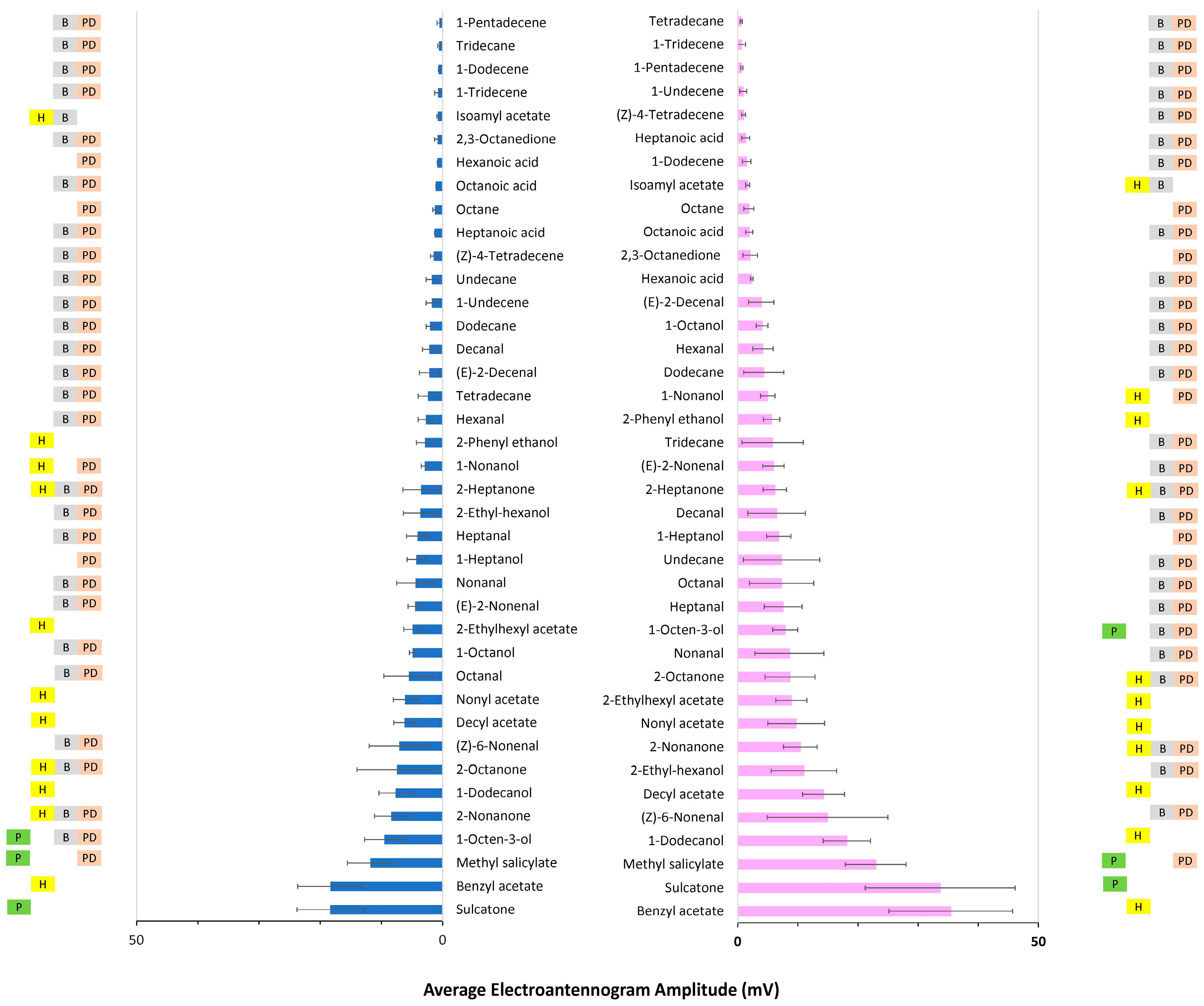
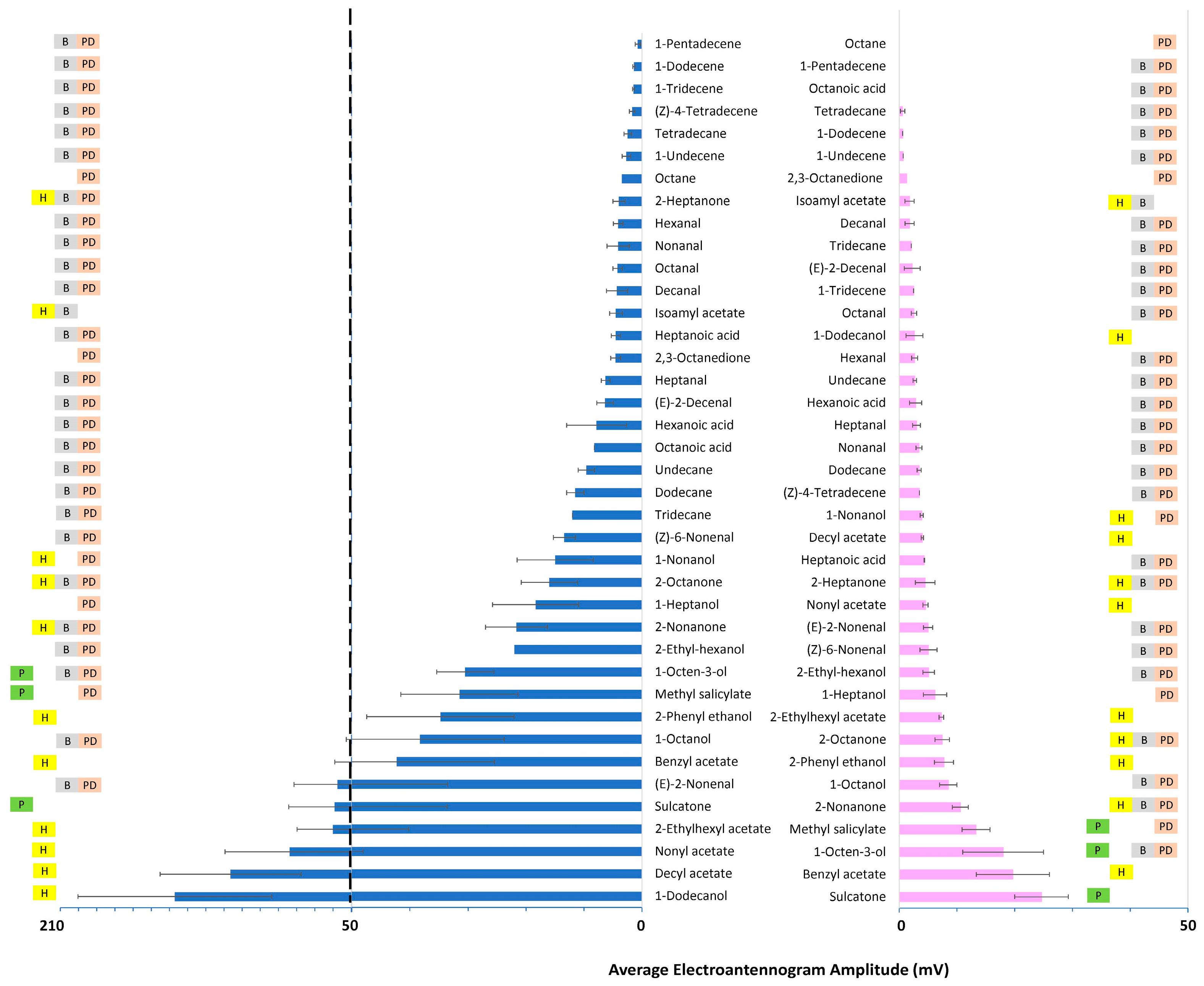
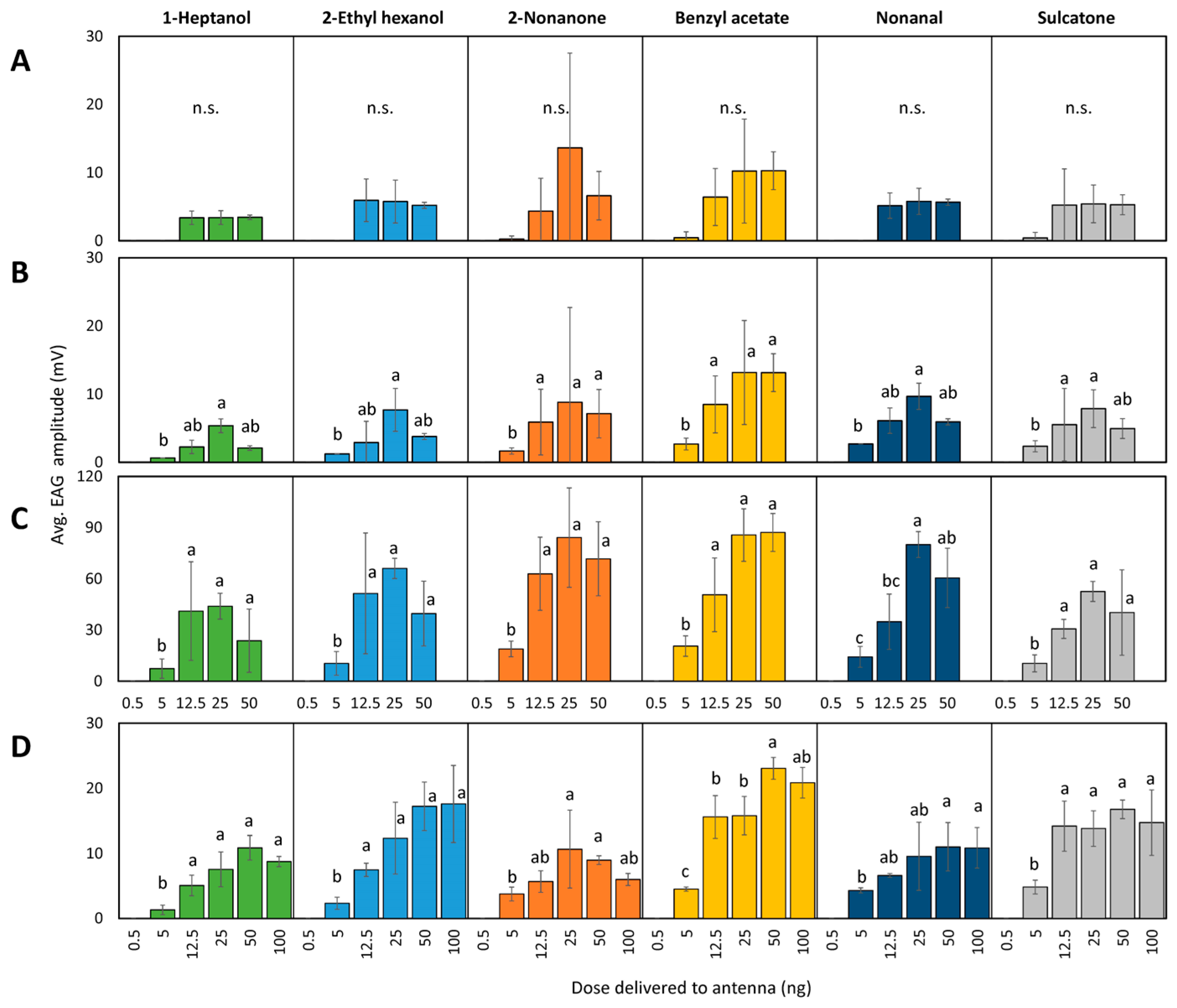
Electroantennography (EAG) was employed to screen the antennal sensitivity of male and female spotted lanternfly (SLF) fourth instars and adults to a range of 39 semiochemicals originating from their host plants and conspecifics, and semiochemicals were ranked in order of antennal response. An EAG study to a fixed dose of 50 ng indicated that the amplitude of antennal responses varied among stages and sexes. However, adult male antennae generated the largest EAG responses to identical chemicals. An EAG dose–response study of SLF antennae to a subset of compounds indicated that adult female antennae reach their saturation point at a higher dose than male antennae. Although EAG does not provide information on insect behavior, the current study reveals a spectrum of antennal sensitivity in response to different compounds and highlights the importance of chemical cues in SLF.
Abstract
In herbivorous insects, antennae play a crucial role in chemical communication and orientation when locating host plants and mates. To evaluate antennal sensitivity in response to odor stimuli, electroantennography (EAG) has been a practical technique. In the current study of the invasive spotted lanternfly (SLF), Lycorma delicatula (Hemiptera: Fulgoridae), we evaluated and compared their antennal sensitivity to a series of volatile chemicals collected from their bodies, honeydew, and host plants. To do this, we exposed the antennae of SLF fourth-instar and adult males and females to individual chemicals at a fixed dose of 50 ng. Further, a series of dose–response tests were carried out within a range of 0.5 to 100 ng. Although the amplitude of antennal responses varied among stages and sexes, adult males generated the strongest antennal responses in both experiments. In dose–response experiments, increased doses of chemicals up to 50 ng revealed the saturation points except in adult females which required a higher dose (100 ng) to reveal the saturation point. Although EAG does not provide any information on behavioral responses, our results are consistent with the olfactory bioassays in previous publications in which adult males, not females, were attracted to natural volatiles of their conspecifics. EAG indicated a higher sensitivity of adult male antennae to odor stimuli, particularly conspecific volatiles, than female antennae and highlighted sexual differences in the perception of chemical cues in SLF.
Keywords:
Lycorma delicatula; electroantennogram; semiochemicals