

Skip to Content
You are currently on the new version of our website. Access the old version .

Lubricants, Volume 6, Issue 2

2018 June - 27 articles

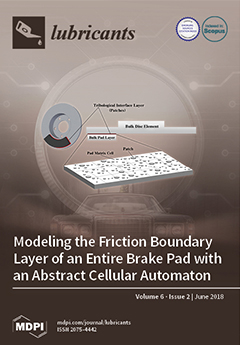
Cover Story: The high-load tribological contacts present in automotive braking systems give rise to the formation of hard, elevated contact structures known as patches. These patches carry a substantial portion of the normal force between the brake pad and the disc; therefore, their dynamics are largely responsible for the system’s macroscopic tribological behavior. The Abstract Cellular Automaton efficiently simulates the tribological interface between an entire pad and the disc by focusing on the effects of the patches, while limiting the computational resources allocated to the surrounding material. Global phenomena can thus be simulated without loss of detailed mesoscopic information. View the paper here.
  • Issues are regarded as officially published after their release is announced to the table of contents alert mailing list .
  • You may sign up for email alerts to receive table of contents of newly released issues.
  • PDF is the official format for papers published in both, html and pdf forms. To view the papers in pdf format, click on the "PDF Full-text" link, and use the free Adobe Reader to open them.

Articles (27)

  • Article
  • Open Access
16 Citations
6,227 Views
14 Pages

Synergistic Effect of Nanodiamond and Phosphate Ester Anti-Wear Additive Blends

  • Biplav Acharya,
  • Keshav S. Avva,
  • Binita Thapa,
  • Tyler N. Pardue and
  • Jacqueline Krim

Nanodiamonds are known to improve tribological performance when added to lubricants, but their impact on additives that may already be present in the lubricant is poorly documented. Here, we report on a study of their effects on thermal reaction film...

  • Article
  • Open Access
9 Citations
4,969 Views
12 Pages

Vegetable oil-in-water (VO/W) emulsions are bio-based metal working lubricants. The emulsions’ lubrication performance depends on the stability of oil droplets. In this paper, the oil droplets’ dispersion stability and lubrication of emul...

  • Article
  • Open Access
12 Citations
5,809 Views
9 Pages

The running-in of lubricated metal–metal contacts leading to ultra-low wear is inseparably connected with the formation of the third body and vice versa. Adequate tribological stressing provides the system with a power density that leads to com...

  • Article
  • Open Access
7 Citations
5,506 Views
24 Pages

Drag reduction technologies mainly include the mechanical method and the chemical method. Mechanical drag reduction technologies are widespread in the drilling field due to their environmental friendliness and ease of use. Vibration technologies are...

  • Article
  • Open Access
13 Citations
5,131 Views
10 Pages

Low Friction, Lubricity, and Durability of Polymer Brush Coatings, Characterized Using the Relaxation Tribometer Technique

  • Michel Belin,
  • Hiroyuki Arafune,
  • Toshio Kamijo,
  • Joël Perret-Liaudet,
  • Takashi Morinaga,
  • Saika Honma and
  • Takaya Sato

Among the possible solutions for achieving low friction, polymer brushes that are grafted onto surfaces are good candidates. The tribological characterization of such layers becomes more difficult when the friction is lower: the signal-to-noise ratio...

  • Article
  • Open Access
2 Citations
3,569 Views
18 Pages

The Fundamental Regularities of the Evolution of Elastic Vortices Generated in the Surface Layers of Solids under Tangential Contact Loading

  • Evgeny V. Shilko,
  • Sergey V. Astafurov,
  • Alexandr S. Grigoriev,
  • Alexey Yu. Smolin and
  • Sergey G. Psakhie

Conventionally discussed dynamic mechanisms of elastic strain energy redistribution in near-contact surface regions include P and S elastic wave pulses radiating from the contact surface. At the same time, the elastic strain energy can be transferred...

  • Article
  • Open Access
10 Citations
6,609 Views
18 Pages

Thermal–Hydrodynamic Behaviour of Coated Pivoted Pad Thrust Bearings: Comparison between Babbitt, PTFE and DLC

  • Konstantinos Katsaros,
  • Dimitrios A. Bompos,
  • Pantelis G. Nikolakopoulos and
  • Stephanos Theodossiades

The hydrodynamic lubrication and thermal analysis of tilting pad thrust bearings has been a major subject for many studies in the field of tribology. There is only a limited number of studies regarding thrust bearings with coated surfaces. The purpos...

  • Article
  • Open Access
16 Citations
6,036 Views
21 Pages

In this article, a geometrical model of different microtextures is established for an axial piston pump valve plate. A finite differential method was used to solve the Reynolds equation for the oil film thickness and pressure, which were simulated un...

  • Article
  • Open Access
8 Citations
4,861 Views
12 Pages

A Comparison Study on Wear Behaviors of Mo and Al2O3-Mo Coatings from RT to 300 °C

  • Jianhui Yan,
  • Yuanjun Guo,
  • Yi Wang,
  • Peng Zhou and
  • Jingwen Qiu

Mo and Al2O3-Mo coatings are fabricated on a low-carbon steel substrate using atmospheric plasma spraying. The microstructure and mechanical properties of two as-sprayed coatings, with a particular focus on the tribological behaviors from room temper...

  • Article
  • Open Access
76 Citations
17,457 Views
14 Pages

Three main concerns are in the focus of the development of geared transmissions nowadays: load carrying capacity, noise–vibration–harshness (NVH) behavior, and efficiency. Increasing the efficiency of modern gearboxes contributes significantly to the...

  • Article
  • Open Access
5 Citations
10,109 Views
20 Pages

This paper deals with an efficient 3D modelling of a radial ball bearing to predict the operating lubrication regime under mechanical loading and mounting conditions by using the Discrete Element Method (DEM). Due to the relevance of such an approach...

  • Article
  • Open Access
20 Citations
4,949 Views
11 Pages

Against the background of raw material shortage and the ever-expanding environmental consciousness, the use of biodegradable greases becomes more and more important. The aim of this experimental work is to investigate the tribological response of com...

  • Article
  • Open Access
14 Citations
5,327 Views
19 Pages

The principle energy exchange of a brake system occurs in the tribological boundary layer between the pad and the disc. The associated phenomena are primarily responsible for the dynamics of brake systems. The wear debris forms flat contact structure...

  • Article
  • Open Access
13 Citations
4,967 Views
11 Pages

The sliding behavior of an amorphous silica sample between two rigid surfaces is in the focus of the present paper. Molecular Dynamics using a classical Tersoff’s potential and a recently developed ReaxFF potential was applied for simulating sl...

  • Article
  • Open Access
12 Citations
5,259 Views
12 Pages

Development of a Constitutive Model for Friction in Bulk Metal Forming

  • Marco Lüchinger,
  • Igor Velkavrh,
  • Kerstin Kern,
  • Michael Baumgartner,
  • Stefan Klien,
  • Alexander Diem,
  • Michael Schreiner and
  • Wolfgang Tillmann

This paper presents a systematic procedure for the development of a constitutive model of friction with focus on the application in bulk metal forming simulations. The empirically based friction model describes friction as a function of sliding dista...

  • Article
  • Open Access
16 Citations
7,098 Views
13 Pages

The precise knowledge of frictional behavior is highly relevant for accurate modelling in sheet metal forming simulations. This allows e.g., the precise prediction of restraining forces which, in turn, determines an optimal draw bead strategy and bla...

  • Article
  • Open Access
12 Citations
7,349 Views
29 Pages

Dynamical Simulations of a Flexible Rotor in Cylindrical Uncavitated and Cavitated Lubricated Journal Bearings

  • Alessandro Ruggiero,
  • Roberto D’Amato,
  • Emanuele Magliano and
  • Drazan Kozak

Due to requirements of their operating conditions, such as high speed, high flexibility and high efficiency, rotating machines are designed to obtain larger operating ranges. These operating conditions can increase the risk of fluid-induced instabili...

  • Article
  • Open Access
23 Citations
8,572 Views
30 Pages

Material Characterization and Influence of Sliding Speed and Pressure on Friction and Wear Behavior of Self-Lubricating Bearing Materials for Hydropower Applications

  • Maria Rodiouchkina,
  • Kim Berglund,
  • Johanne Mouzon,
  • Fredrik Forsberg,
  • Faiz Ullah Shah,
  • Ilia Rodushkin and
  • Roland Larsson

Nowadays, hydropower plants are forced to have more frequent power control and the self-lubricated bearings used in the applications are one of the most critical components affected by the continuously changing operating conditions. In this study, mi...

  • Article
  • Open Access
6 Citations
4,093 Views
9 Pages

Tribocorrosion of Fe-Based Amorphous Coating in Simulated Body Fluids

  • Chanyuan Luo,
  • Xiulin Ji,
  • Cuicui Ji,
  • Yingtao Zhang and
  • Hui Wang

An arc-sprayed Fe-based amorphous coating with high hardness and low porosity was prepared. A tribo-electrochemical approach was used to study the tribocorrosion behaviour of the amorphous coating. The volume wear losses of the amorphous coating with...

  • Article
  • Open Access
6 Citations
5,693 Views
10 Pages

In the design and development of rubber products, it is important to evaluate the contact load dependency of the friction coefficient. In particular, since the pressure distribution varies depending on the dimensions of sliding bodies and the pattern...

  • Article
  • Open Access
23 Citations
5,072 Views
13 Pages

Laser surface texturing is an efficient way to control the friction and wear properties of materials. Although described in many papers, most previous work relates to a pure topographic view of laser-textured surfaces. As lasers are heat sources, the...

  • Article
  • Open Access
15 Citations
7,063 Views
14 Pages

Using Fourier transform infrared (FT-IR) spectroscopy we investigated the water content of SAE 15W–40 diesel engine lubricating oil at various levels of contamination to establish instrument calibration standards for measuring water contamination in...

  • Article
  • Open Access
14 Citations
5,406 Views
23 Pages

The challenges of technical systems subjected to friction and wear become more demanding with steadily increasing stresses. Besides safety matters, failure of tribologically loaded systems can cause tremendous maintenance costs. Because of the lack o...

  • Article
  • Open Access
10 Citations
5,261 Views
18 Pages

A stretching behavior of knitted and woven textiles is modeled. In our work, the yarns are modeled as one-dimensional hyperelastic strings with frictional contact. Capstan law known for Coulomb’s friction of yarns is extended to an additional adhesio...

  • Article
  • Open Access
25 Citations
10,046 Views
13 Pages

Effect of Base Oil Type in Grease Composition on the Lubricating Film Formation in EHD Contacts

  • Dennis Fischer,
  • Georg Jacobs,
  • Andreas Stratmann and
  • Gero Burghardt

The service life of rolling bearings is significantly affected by the film formation in elastohydrodynamic (EHD) contacts, which depends on the operating conditions, like rotational speed or temperature. In grease lubricated EHD contacts, the film fo...

  • Article
  • Open Access
33 Citations
8,003 Views
9 Pages

We performed, for the first time to our knowledge, fully ab initio molecular dynamics simulations of additive tribochemistry in boundary lubrication conditions. We consider an organophosphourus additive that has been experimentally shown to reduce fr...

  • Review
  • Open Access
33 Citations
16,496 Views
26 Pages

Articular cartilage surrounds the ends of diarthrodial joints (most common movable joints) and during motion, it experiences a wide range of loading conditions while remaining under exceedingly low-friction and wear-free conditions. This remarkable t...

Get Alerted

Add your email address to receive forthcoming issues of this journal.

XFacebookLinkedIn
Lubricants - ISSN 2075-4442