


Abstract
In pursuit of a composite coating for tunnel boring machine (TBM) disc cutters that offers both high wear resistance and self-lubricating functionality, we fabricated Fe-based composite coatings reinforced with WC and MoS2 through laser cladding. Seven coating compositions with systematically tailored MoS2 contents were prepared to investigate the concentration-dependent effects of MoS2 on microstructural evolution and tribological properties, and to evaluate their performance under various rock-contact conditions. XPS results reveal that MoS2 decomposed during laser cladding, leading to the in situ formation of metal sulfides in the Fe-based matrix. These sulfides, characterized by low shear strength, readily form a continuous and stable lubricating tribofilm at the hob–rock interface. The tribofilm effectively lowers the coefficient of friction (COF), curtails friction-induced energy dissipation and surface degradation, and ultimately enhances the wear resistance of the disc cutter. Simultaneously, the rapid non-equilibrium solidification inherent in laser cladding stabilizes metastable phases, which refine the microstructure, improve densification, and bolster phase stability. Among the tested compositions, the coating containing 4 wt.% MoS2 exhibited the most favorable dry-sliding tribological performance, as evidenced by an average coefficient of friction of 0.409, a hardness of 749.5 HV1, and consistently low wear mass losses below 2.1 × 10⁻³ g under different rock-contact conditions. Mechanistically, XRD and SEM analyses further attributed the superior performance of the 4 wt.% MoS2 coating to concurrent strengthening mechanisms: grain refinement, dispersion strengthening from uniformly distributed second-phase particles, and increased dislocation density. Collectively, these effects substantially improve the wear resistance of the disc cutter, thereby extending its durability and service life under complex operating conditions.
1. Introduction
Tunnel boring machines (TBMs) have become the dominant technology in modern tunnel construction. Statistics indicate that approximately 60–80% of current tunneling projects utilize TBM-based excavation methods to excavate tunnels [1]. However, the operational efficiency and economic viability of TBMs critically depend on the performance of disc cutters. Under geological conditions characterized by extremely hard and abrasive rocks, disc cutters experience accelerated wear, necessitating frequent replacement [2]. Consequently, downtime is prolonged, maintenance costs increase, and overall tunneling efficiency is markedly reduced. Furthermore, repeated shutdowns for cutter replacement may destabilize the excavation face, increasing the risk of geotechnical hazards, such as rock collapse, and posing serious threats to construction safety [3].
Mechanistically, disc cutters in service exhibit two primary wear modes: normal (uniform) and abnormal (non-uniform) wear modes. Normal wear is the most prevalent and unavoidable degradation mechanism during extended operations, typically manifesting as uniform surface abrasion. Although predictable, the rate of normal wear can become excessively high under harsh abrasive conditions. Such accelerated wear significantly shortens the service life of the cutter and increases the frequency of cutter replacement, ultimately escalating project costs and compromising overall construction efficiency. To mitigate cutter wear, extensive efforts in material design and surface engineering have been devoted to this problem in recent years. Representative approaches include strengthening the cutter material matrix through microstructural control (e.g., inducing a martensitic transformation), introducing hard reinforcing phases such as carbides or ceramic particles, and optimizing the alloy composition and microstructure to improve the wear resistance and frictional behavior of the tool [4]. For example, carbide-rich martensitic tool steels (e.g., Cr-Mo-V systems) exhibit enhanced hardness and wear resistance while maintaining acceptable toughness. Previous studies have demonstrated that the tribological performance of such materials can be effectively tailored by adjusting factors such as martensite morphology, grain size, and operative strengthening mechanisms [5]. These findings underscore the decisive role of microstructural design in achieving superior wear resistance in materials.
Despite these advances, strategies based solely on matrix strengthening, hard-phase incorporation, or microstructural refinement often lead to elevated friction coefficients under high loads and severe abrasion conditions. This intrinsic trade-off between achieving high wear resistance and low friction presents a major challenge in ensuring long-term service reliability [6]. Consequently, the development of metal matrix composite coatings that simultaneously offer high hardness and low friction (often referred to as friction-reducing and wear-resistant coatings) has emerged as a critical research frontier [7]. To achieve this objective, solid lubricating phases are generally incorporated into alloy powder systems to fabricate self-lubricating alloy coatings by laser cladding. Among the various solid lubricants, sulfide-based phases have attracted extensive attention owing to their excellent friction-reducing and lubricating capabilities. Previous studies have shown that sulfide phases, such as TiS and CrS, can provide stable self-lubricating effects during sliding by promoting the formation of lubricating films, thereby effectively reducing interfacial friction and improving the tribological performance of coatings [8]. By co-introducing hard reinforcing phases and solid lubricants into a metallic matrix, these coatings can suppress abrasive micro-cutting while reducing the shear stress at the frictional interface, resulting in simultaneously enhanced wear resistance and reduced coefficients of friction. This design strategy allows the wear behavior of coatings to be regulated by the combined effects of mechanical strengthening and interfacial lubrication rather than by a single mechanism, thereby enabling multidimensional control over the wear process.
Based on the above considerations, this study proposes an Fe-based composite coating design strategy that integrates wear resistance, self-lubricating capability, and potential corrosion resistance. Fe55 alloy was selected as the matrix material for the laser-cladded coating [9], while WC was introduced as a hard reinforcing phase to enhance the load-bearing capacity and resistance to abrasive wear. Previous studies have demonstrated that WC particles can effectively improve the microhardness and wear resistance of coatings through dispersion strengthening, solid-solution strengthening, and microstructural refinement. However, under the complex frictional contact conditions between TBM disc cutters and rock, improving hardness alone is insufficient to reduce interfacial shear resistance and friction-induced energy dissipation. Therefore, MoS2 was further incorporated as a solid lubricant phase to improve the self-lubricating and friction-reducing properties of the coating. In addition, MoS2 may improve the surface morphology and enhance the surface hydrophobicity of the coating [10], thereby contributing to improved corrosion resistance in complex service environments [11]. Accordingly, the simultaneous incorporation of WC and MoS2 into an Fe-based coating system provides a feasible route to constructing a “hard reinforcing phase-solid lubricant phase” functional system [12,13]. This design is expected to retain the high hardness and excellent wear resistance provided by WC while imparting superior self-lubricating and friction-reducing capabilities through MoS2, thereby improving the overall tribological and corrosion performance of Fe-based laser-cladded coatings for TBM disc cutter applications [14].
Accordingly, a series of MoS2/WC/Fe-based self-lubricating laser-cladded coatings were designed and fabricated in this study. The intrinsic relationships among composition regulation, microstructural evolution, and tribological/corrosion properties were systematically investigated. Rock-contact friction and wear tests were performed to simulate the service conditions of TBM disc cutters, and the corresponding wear behavior and wear mechanisms were clarified by microstructural characterization. On this basis, the optimal addition threshold of MoS2/WC was determined through comparative analysis. This study is expected to provide a theoretical basis for the design of high-performance self-lubricating wear-resistant coatings and offer engineering insights into improving the service life of TBM disc cutters and the operational safety of tunneling construction.
2. Experimental Materials and Methods
2.1. Experimental Materials
In this study, AISI H13 tool steel with dimensions of 100 mm × 100 mm × 10 mm was used as the substrate, whose chemical composition is shown in Table 1. The additives used in this study included Fe-based alloy powder (Fe55), purchased from Chengdu Ketailong Alloy Co., Ltd., Chengdu, China, and anhydrous ethanol (purity > 99.9%), molybdenum disulfide (MoS2, particle size < 2 μm), and nano-tungsten carbide (nano-WC, average particle size of approximately 350 nm), purchased from Shanghai Aladdin Biochemical Technology Co., Ltd, Shanghai, China.
Table 1.
Chemical Composition of the Materials.
2.2. Characterization Methods
To analyze the microstructure of the laser-cladded coating, the samples were sectioned into blocks with dimensions of 10 mm × 10 mm × 10 mm along the laser scanning direction by wire electrical discharge machining for subsequent characterization. The microstructure and morphology were observed using a scanning electron microscope (SEM, SU3800, JEOL, Tokyo, Japan), and the elemental distribution was analyzed using the attached energy-dispersive spectroscopy (EDS) system. The phase composition was examined using an X-ray powder diffractometer (XRD, X’Pert Powder, PANalytical, Almelo, The Netherlands) over a 2θ range of 20–80°. The surface elemental composition and chemical states of the samples were analyzed using X-ray photoelectron spectroscopy (XPS, Escalab 250Xi, Thermo Fisher, Waltham, MA, USA) using Al Kα radiation (hν = 1486.6 eV). To evaluate the mechanical properties of the coating, microhardness tests were performed on the cross-section of the cladded layer using an HV1102 microhardness (Wilson HV1102, Wilson, Norwood, MA, USA) tester. Tribological performance was evaluated using a ball-on-disk friction and wear testing method (MS-M9000). The reciprocating sliding wear tests were conducted at room temperature under a load of 20 N at a frequency of 4 Hz for 30 min, using a silicon nitride ceramic ball (Si3N4) with a diameter of 5 mm as the counterbody. Each test was repeated three times, and the friction coefficient was recorded in real time.
2.3. Experimental Methods
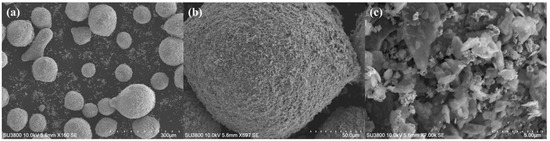
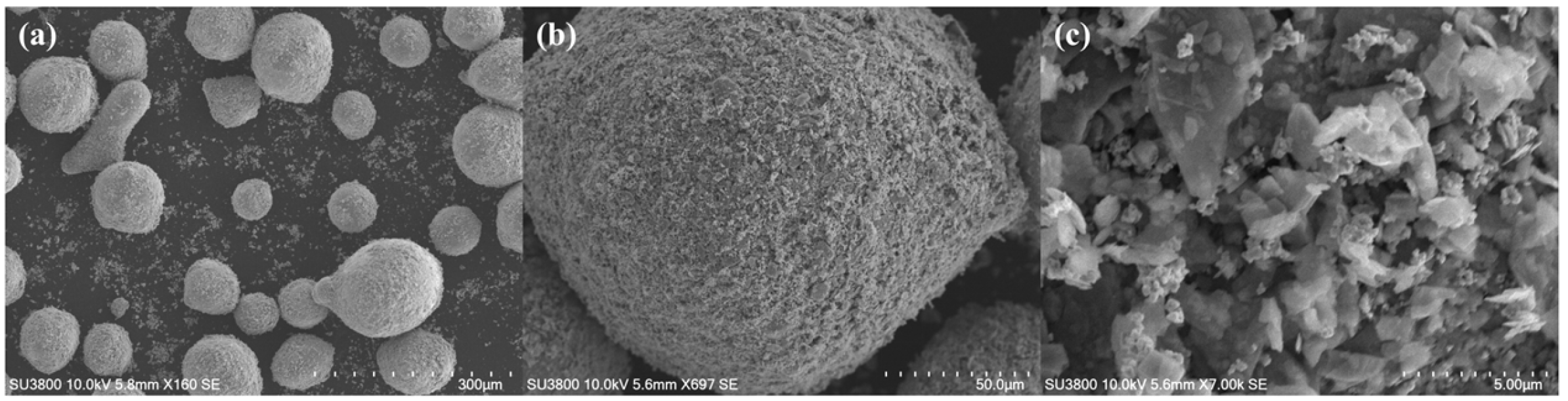
Laser cladding experiments were performed using a YLS-6000 fiber laser processing (YLS-6000, IPG Photonics Corporation, Oxford, MA, USA) system with coaxial powder feeding. Argon gas was used as a shielding atmosphere to prevent oxidation during the high-temperature cladding process. Prior to cladding, the H13 steel substrate was mechanically polished to remove the native oxide layer and then ultrasonically cleaned in anhydrous ethanol. This surface preparation ensured a clean, chemically stable interface, facilitating strong metallurgical bonding between the coating and substrate. To achieve precise control of the molten pool dynamics, minimize the thermal decomposition of WC particles, and regulate the morphology and spatial distribution of in situ-formed sulfide phases, optimized laser processing parameters were determined through systematic parametric studies and a comprehensive analysis of existing literature. The selected parameters were a laser power of 1600 W, scanning speed of 12 mm/s, spot diameter of 3 mm, overlap ratio of 50%, and powder feed rate of 12 g/min. The quality of the resulting cladding layer was evaluated based on its coating thickness uniformity, crack density, and interfacial bonding strength. For powder preparation, the composite powders were first mixed with anhydrous ethanol and homogenized via planetary ball milling at 400 rpm for 1 h to ensure a uniform dispersion of all constituent phases (Figure 1). The resulting slurry was subsequently dried in a forced-convection oven at 60 °C for 8 h to completely remove any residual solvent. X-ray diffraction (XRD) analysis of the dried powder confirmed that MoS2, Fe, and WC remained the dominant crystalline phases, with no detectable new compounds or phase transformations. This result verifies that the powder mixing process was purely physical, involving no chemical reactions between the components of the mixture.
Figure 1.
SEM images of the Fe/WC/MoS2 mixed powders at different magnifications: (a) 300 μm; (b) 50 μm; (c) 5 μm.
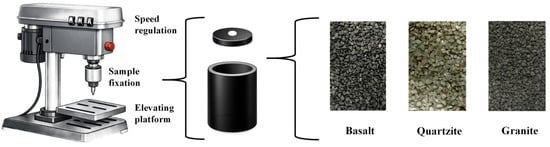
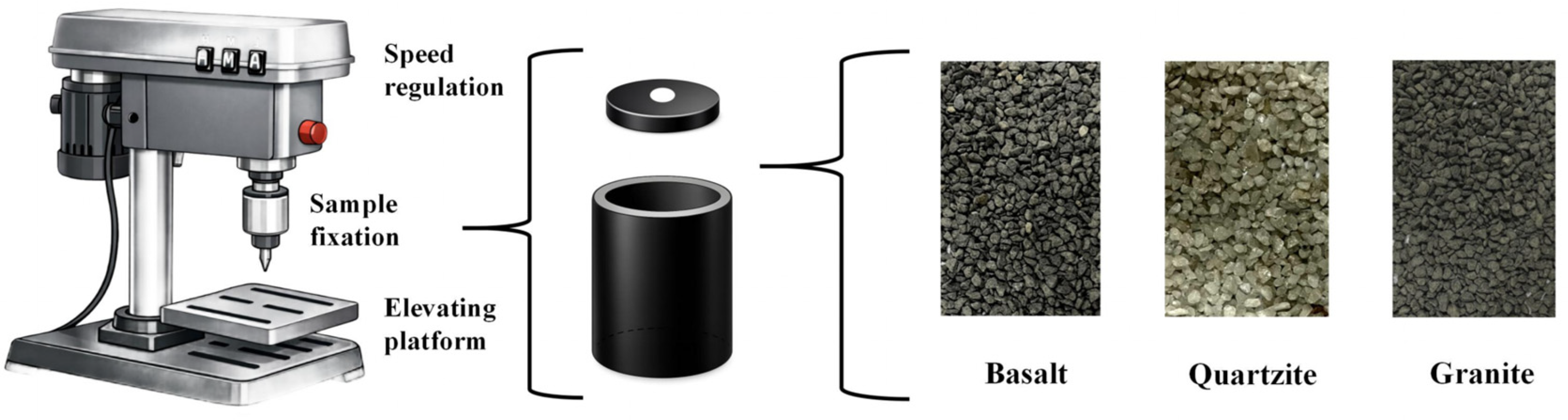
To further evaluate the wear resistance of the cladded coatings under practical geological conditions, rock abrasion tests were conducted using three typical hard and abrasive rocks, namely granite, basalt, and quartzite, as abrasive media. The test apparatus mainly consisted of a 750 W motor, a specimen holder, an electric lifting platform, and a variable-frequency drive system for controlling the rotational speed, as shown in Figure 2. During the test, the cladded specimen mounted at the front end of a steel shaft was driven to rotate by the motor. The specimen was positioned at the center of a cylindrical container and remained fixed in this position throughout the rotation process. The cylindrical container had a diameter of 100 mm and a height of 150 mm, and was filled with 500 g of rock aggregates with particle sizes ranging from 4 to 6.3 mm. To investigate the wear behavior of the cladded coatings under different impact and abrasive conditions, three rotational speeds of 1400, 2800, and 5600 rpm were applied. Each specimen was continuously rotated for 30 min. During the test, the rotating cladded specimen underwent continuous contact, impact, and friction with the hard rock particles, thereby simulating the typical wear behavior of TBM disc cutters operating in hard-rock particle environments. After the test, the mass change of each specimen before and after abrasion was measured. Meanwhile, the rock debris generated during the test was collected and weighed. For each rotational speed, every group of specimens was tested three times, and the average value was used to evaluate the wear resistance of the cladded coatings.
Figure 2.
Schematic of the wear test apparatus and specimens. The apparatus comprises a rotational speed control system, a specimen-holding fixture, and a lifting platform. The right panel presents the cylindrical specimen and the three rock abrasives used in the wear tests: basalt, quartzite, and granite.
3. Results and Discussion
3.1. Phase Composition of the Coating
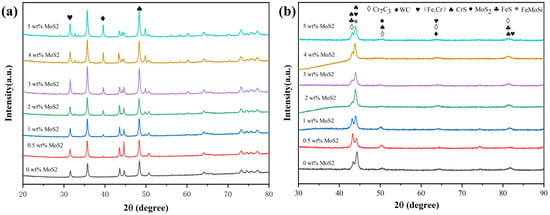
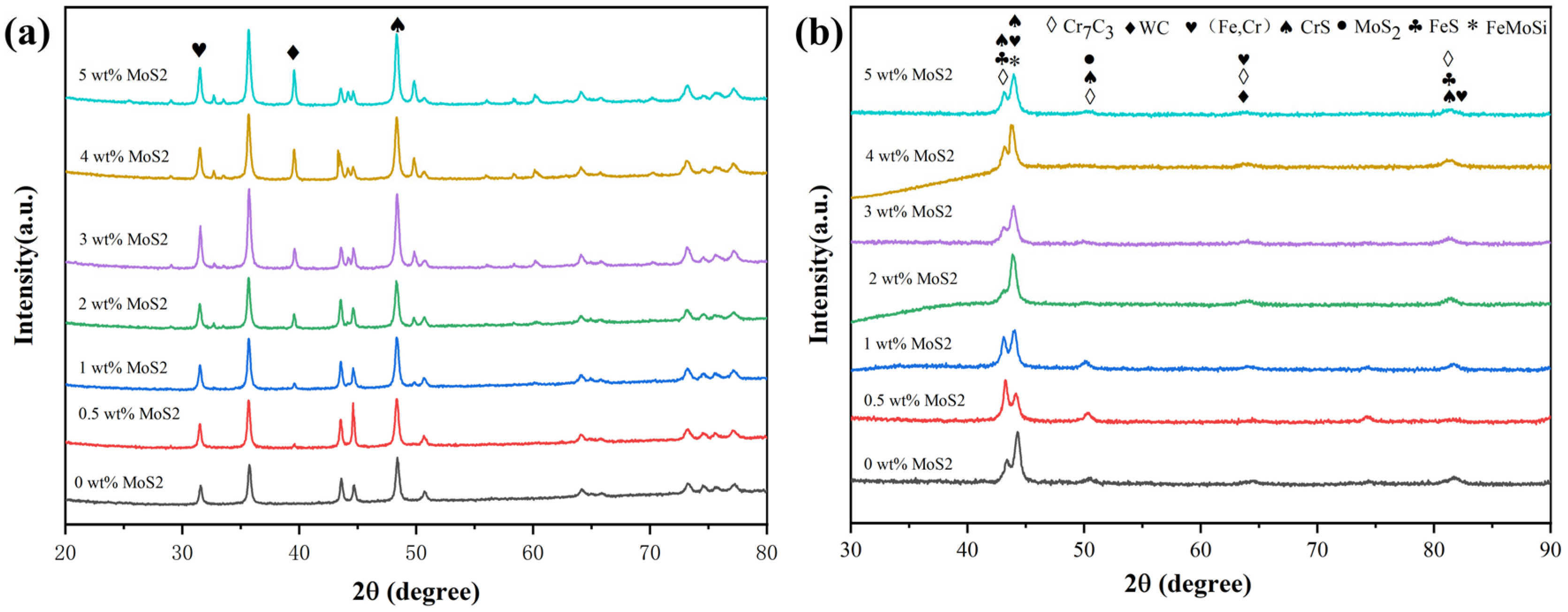
The compositional design of the cladding powder system and its reaction behavior within the molten pool are critical for determining the final phase constitution, microstructural evolution, and tribological performance of the coating. In this study, X-ray diffraction (XRD) was performed on both the as-blended powders (Figure 3a) and as-clad coatings (Figure 3b). As shown in Figure 3a, all the powder mixtures exhibited the characteristic diffraction peaks of WC over the entire MoS2 addition range (0–5 wt.%). With increasing MoS2 content, the diffraction peaks attributable to MoS2 gradually appeared and intensified, notably at approximately 2θ = 36° and 49°. Importantly, no additional diffraction peaks were observed across the compositional variants, and the main WC peak positions remained unchanged, with no discernible systematic peak shifts or broadening [15]. These results indicate that no pronounced chemical interactions occurred during powder blending and that the mixing process was predominantly physical. This interpretation is further corroborated by the SEM observations of the powder morphology and dispersion uniformity, which show no evidence of interfacial reaction products or chemically driven agglomeration. In contrast, the XRD results of the laser-cladded coating (Figure 3b) revealed the pronounced characteristics of in situ reactions occurring during the cladding process. The dominant peaks at approximately 2θ = 43°, 44°, 65°, and 82° correspond well to the α-Fe/(Fe, Cr) body-centered cubic (BCC) solid solution phase. In addition to the matrix phases, pronounced diffraction peaks associated with carbide phases, particularly Cr7C3, are detected in the XRD pattern shown in Figure 3b. This suggests that elemental segregation and local supersaturation caused by rapid solidification during laser cladding facilitate the precipitation of hard phases. Cr7C3, as a typical Cr-rich carbide, is characterized by high hardness and excellent thermal stability, enabling it to act as an effective hard reinforcement and load-bearing phase in the coating. Accordingly, the formation of Cr7C3 contributes to the enhancement of microhardness, load-bearing capacity, and wear resistance [16]. The formation of these carbides is in good agreement with the strengthening mechanism widely reported for WC-reinforced laser-cladded coatings. Under the high-temperature conditions of the molten pool, WC particles may partially decompose, following possible reactions such as WC→W + C or WC→W2 + C. The carbon released from WC decomposition can subsequently participate in carbide-forming reactions with Cr in the molten pool, thereby promoting the in situ precipitation of Cr-rich carbides. This process increases both the fraction and distribution density of hard phases, strengthens the mechanical support framework of the coating, and ultimately leads to improved wear resistance.
Figure 3.
X-ray diffraction patterns of samples with varying MoS2 contents: (a) after powder mixing; (b) after laser cladding.
Notably, diffraction peaks corresponding to metal sulfides, including FeS and CrS, were detected in the coated sample, providing direct evidence that MoS2 undergoes thermal decomposition under cladding conditions (MoS2 → Mo + 2S). The liberated sulfur subsequently reacts with dissolved Fe and Cr in the molten alloy to form thermodynamically stable sulfides (Fe + S → FeS) [9]. These sulfides, characterized by intrinsically low shear strength, can accumulate near the surface during sliding contact and contribute to the development of a lubricious sulfide/oxide composite transfer film, thereby lowering the interfacial shear stress and improving friction stability [17]. Furthermore, the detection of FeMoS implies the presence of multicomponent interactions among Fe, Mo, and S, suggesting the possible formation of complex sulfide phases with enhanced structural stability [12].
Therefore, from a phase-design perspective, the addition of MoS2 does not introduce detrimental brittle phases; instead, it promotes the complementary coexistence of lubricating sulfide phases and reinforcing carbide phases [8]. This dual-phase functionality provides a robust microstructural basis for achieving self-lubricating behavior and sustained anti-friction performance in the engineered coating.
3.2. XPS Analysis of the Laser-Cladded Coating
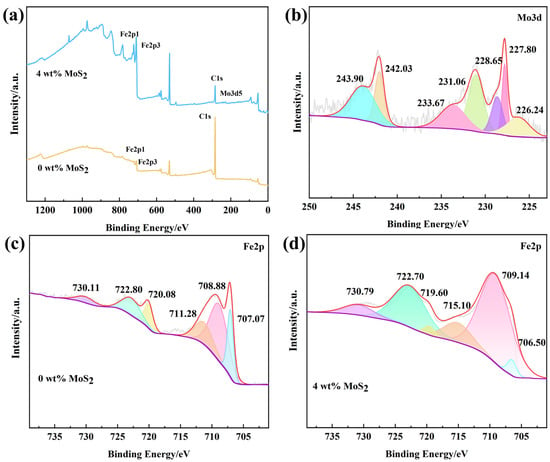
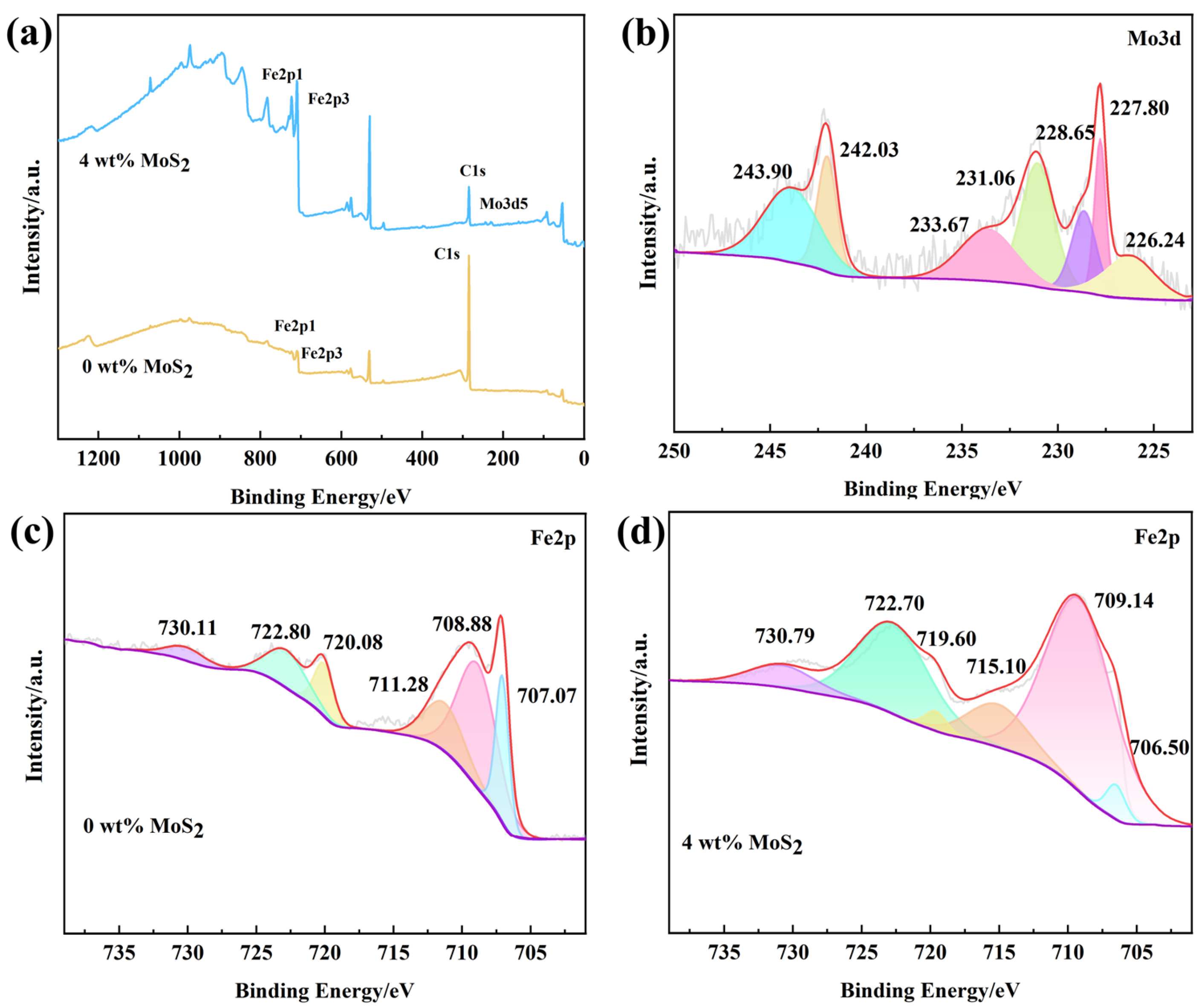
Due to the overlap of multiple diffraction peaks in the XRD patterns, XPS analysis was conducted after etching the coating surface to a depth of approximately 2 mm to further clarify the material evolution during laser cladding (Figure 4). The related mechanism was primarily elucidated based on the chemical-state evolution of Fe and Mo. The survey spectrum shows that Mo was successfully incorporated into the coating, indicating that significant chemical reactions occurred during laser cladding [18]. According to the high-resolution Mo 3d spectrum, the surface of the 4 wt.% MoS2 laser-cladded coating contained distinct multivalent Mo species: the peak at 228.65 eV corresponds to Mo4+ in MoO2, the peak at 231.06 eV can be assigned to Mo-S-related species, and the peak at 233.67 eV is more consistent with high-valence Mo-O species (Mo6+) [19]. The coexistence of low-valence sulfide Mo species and high-valence oxide Mo species suggests that MoS2 underwent decomposition and oxidative reconstruction under high-temperature laser irradiation.
Figure 4.
(a) Survey XPS spectra of the laser-cladded coatings with 0 and 4 wt.% MoS2; (b) high-resolution Mo 3d XPS spectrum of the 4 wt.% MoS2 laser-cladded coating; and (c,d) high-resolution Fe 2p XPS spectra of the laser-cladded coatings with 0 and 4 wt.% MoS2.
The high-resolution Fe 2p spectrum also reveals significant changes in the chemical state of Fe at the coating surface. Compared with the 4 wt.% MoS2 sample, the 0 wt.% MoS2 sample exhibited a larger Fe0 peak area at around 707 eV; in contrast, after the addition of 4 wt.% MoS2, the Fe2+ component at approximately 709.5 eV and the Fe3+ component at approximately 722.70 eV in the high-binding-energy region became more pronounced [20]. Combined with the Mo 3d results, it can be inferred that, with increasing MoS2 content, the active sulfur species generated by decomposition participated more extensively in the chemical reactions of Fe, thereby promoting the formation of iron sulfides and facilitating the development of an FeS-type lubricating film during friction. This process enhances the self-lubricating capability and tribological stability of the cladded coating, thereby ultimately improving its friction-reducing and wear-resistant performance.
3.3. Microhardness and Microstructural Evolution
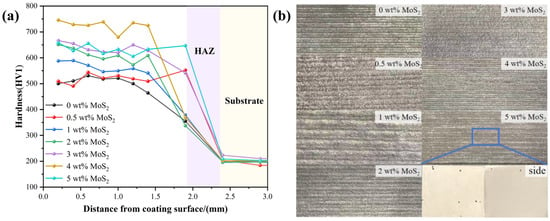
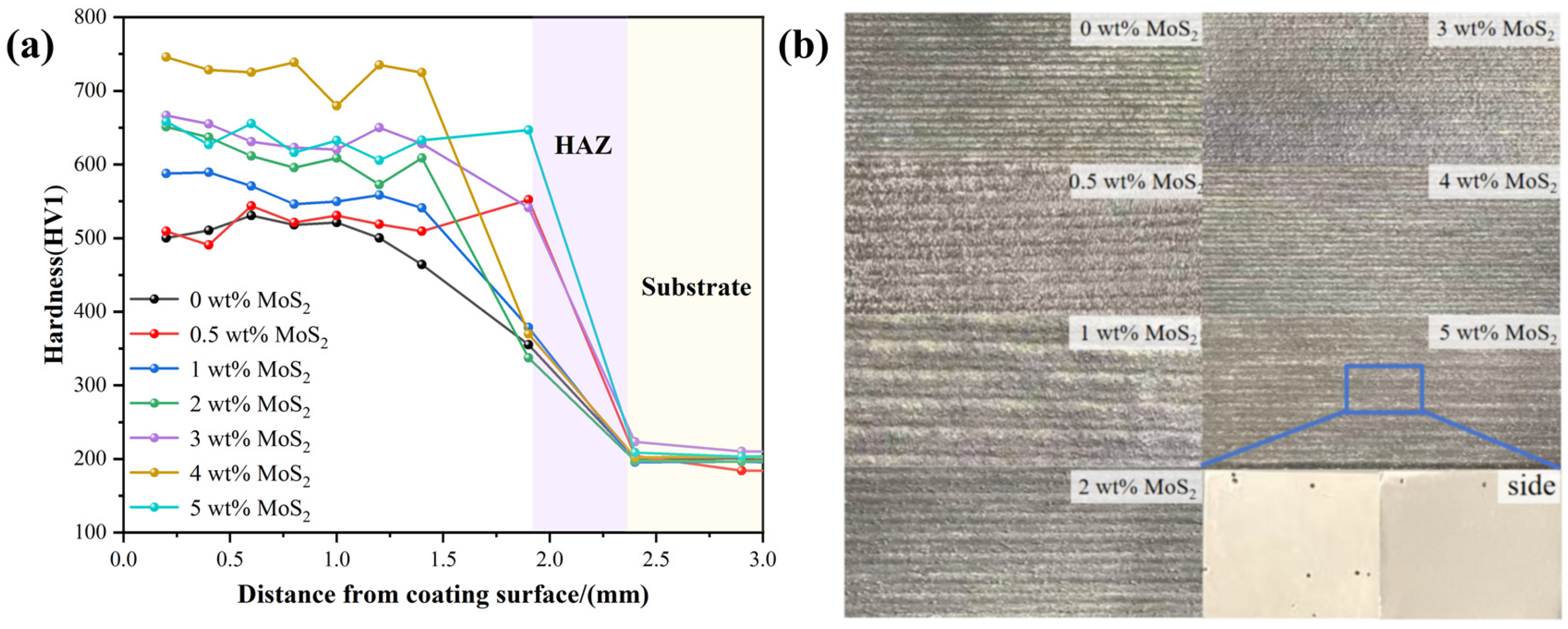
To elucidate the microstructural evolution and associated strengthening mechanisms in the MoS2/WC composite system during laser cladding, this study combined micro-Vickers hardness (HV1) measurements with cross-sectional microstructural observations (Figure 5). With the WC content fixed at 5 wt.%, the addition of MoS2 significantly influenced the hardness of the H13 steel cladding coatings. In the absence of MoS2, the coating achieved a maximum hardness of ~521 HV1, which markedly exceeded the hardness of the H13 substrate (~183.4 HV1). This outcome confirms the effectiveness of surface hardening induced by the rapid thermal cycling inherent in laser cladding. The hardness enhancement was primarily attributed to phase transformations within the H13 alloy under extreme thermal gradients during the process. Specifically, the surface layer underwent complete austenitization, followed by a rapid martensitic transformation upon cooling, accompanied by fine-scale carbide precipitations. These microstructural features acted in concert to significantly increase hardness [21]. The incorporation of nano-sized WC particles (with high intrinsic hardness and excellent thermal stability) provided additional reinforcement to the composite [22]. These particles enhanced the coating’s resistance to plastic deformation via dispersion strengthening and the formation of a load-bearing network throughout the matrix.
Figure 5.
(a) Cross-sectional microhardness distribution curves of laser-clad coatings with 0–5 wt.% MoS2, plotted against the distance from the coating surface; (b) Representative surface morphologies of the corresponding coatings.
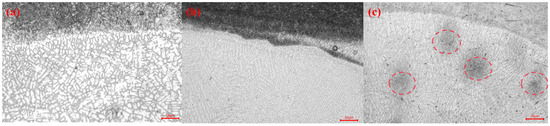
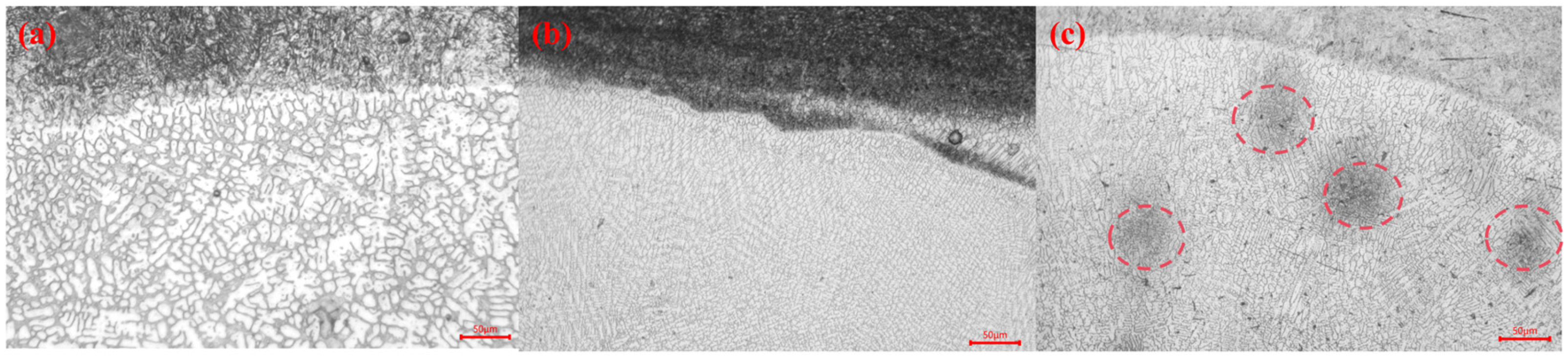
With increasing MoS2 content, the average coating hardness rose steadily and became more spatially uniform, reaching ~749.5 HV1 at 4 wt.% MoS2. This improvement in hardness was directly associated with the progressive microstructural refinement. In the MoS2-free coating (Figure 6a), the solidification structure was dominated by coarse columnar or cellular dendrites with pronounced directional growth, indicative of minimal nucleation barriers and strong thermal gradients. Upon adding MoS2, its thermal decomposition in the high-temperature molten pool released solute species (notably S and Mo) into the melt, thereby causing local solute enrichment and promoting heterogeneous nucleation [23]. This, in turn, alters the solidification kinetics, suppresses columnar dendritic growth, and facilitates grain refinement. The resulting microstructure displayed reduced dendrite arm spacing, improved homogeneity, and a localized transition from columnar to equiaxed grains (Figure 6b), which are all hallmarks of a refined solidification morphology. Although the decomposition of MoS2 can introduce slight porosity owing to gas evolution, within an optimal compositional window (≤4 wt.%), the net effect of adding MoS2 was a substantial reduction in grain size, which led to increased hardness. This increase in hardness is predominantly governed by grain boundary strengthening (Hall-Petch relationship) [24]. Moreover, the sulfur liberated from MoS2 decomposition reacts in situ with Fe and Cr in the molten matrix to form finely dispersed sulfide phases (i.e., FeS, CrS, and Cr2S3). These secondary precipitates segregate preferentially at the grain boundaries and interdendritic regions, where they act as pinning sites that restrict grain growth during solidification [25]. Their presence further reinforces grain refinement, enabling synergistic strengthening through the combined effects of fine-grain strengthening and dispersion hardening.
Figure 6.
Cross-sectional crystalline microstructural features of laser-clad coatings with different MoS2 contents: (a) 0 wt.%, (b) 4 wt.%, and (c) 5 wt.%.
In contrast, increasing the MoS2 content to 5 wt.% caused a distinct decrease in hardness, accompanied by a marked increase in the porosity of the coating (Figure 6c). The cross-sectional microstructure at 5 wt.% MoS2 showed multiple circular or elliptical dark features characteristic of entrapped gas pores. These pores were associated with disrupted microstructural continuity, localized texture distortions, and reduced homogeneity. This degradation in coating quality is attributed to excessive MoS2 decomposition, which generates an abundance of volatiles (primarily sulfur vapor and other gaseous byproducts) and disturbs the molten pool dynamics (e.g., fluid flow, wetting behavior, and interfacial stability). Under these conditions, the evolved bubbles had insufficient time to coalesce and escape from the molten pool because of the shortened liquid residence time and increased melt viscosity. Consequently, many bubbles became trapped and solidified as pores during the rapid cooling process. These voids reduce the effective load-bearing area and act as stress concentrators, thereby initiating premature microcracking and undermining both the hardness and overall structural integrity of the coating. Under the present processing parameters, an MoS2 content of approximately 4 wt.% represents the optimal balance among microstructural refinement, defect suppression, and strengthening efficiency. In contrast, 5 wt.% MoS2 produced excessive porosity, which diminished the hardness and compromised the coating quality [26].
3.4. The Influence of the Friction Coefficient
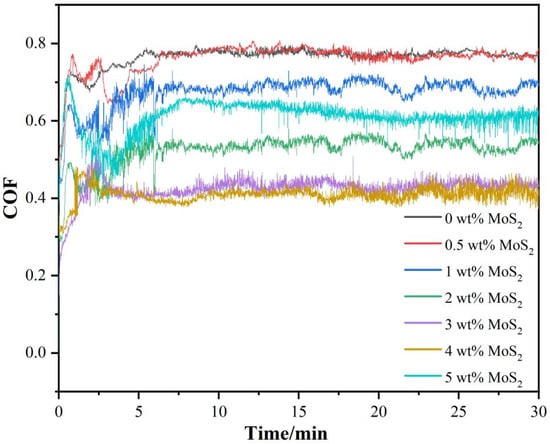
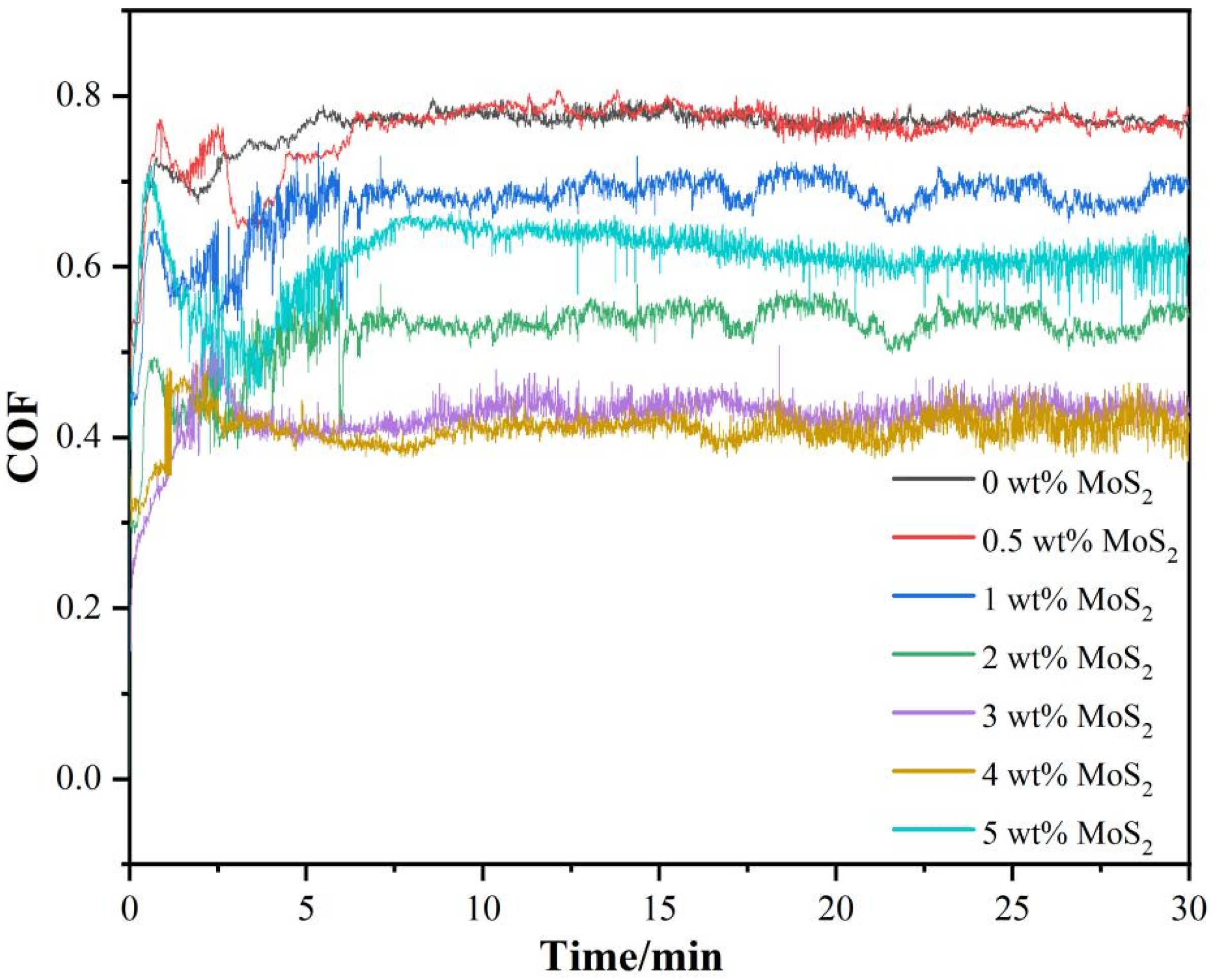
Figure 7 presents the time-dependent evolution of the coefficient of friction (COF) for laser-clad coatings with varying MoS2 contents under dry sliding conditions (20 N load). The friction behavior of all the coatings followed a characteristic two-stage profile comprising an initial running-in stage followed by a steady-state wear regime. During the first 0–5 min of sliding, the contact interface was in a transient state owing to the high initial surface roughness and incomplete asperity accommodation. This led to a rapid increase in the COF, culminating in a distinct peak in the friction curve. For the MoS2-free coating, the COF reached a maximum of approximately 0.8 within the first 2–3 min, after which it stabilized as the surface became smoother and the real area of contact increased through progressive wear-in. Once the steady-state regime was established, significant differences in the tribological performance of the coatings became evident. In general, the average COF decreased with increasing MoS2 content. However, coatings with low MoS2 concentrations still exhibited pronounced fluctuations in the COF, which can be attributed to an insufficient supply of lubricant that impedes the formation of a continuous, coherent solid lubricating film at the sliding interface. In contrast, the coating with 4 wt.% MoS2 exhibits the lowest steady-state COF (approximately 0.4) with minimal variation, indicating exceptionally stable frictional behavior. The MoS2-free coating maintained a relatively high steady-state COF of approximately 0.8, underscoring the effectiveness of MoS2 in reducing frictional resistance.
Figure 7.
Evolution of the coefficient of friction (COF) with sliding time for laser-clad coatings containing different MoS2 contents during friction tests.
The superior frictional performance of MoS2-containing coatings is primarily attributed to the in situ formation of a protective tribofilm composed of low-shear-strength sulfide phases (e.g., FeS and CrS) during sliding. This tribofilm effectively mitigates interfacial shear stress and suppresses adhesive interactions, thereby substantially reducing the COF. In addition, the presence of MoS2 reduces the accumulation of wear debris at the interface, diminishes third-body wear, helps keep the contact surfaces clean, and thereby maintains a stable, low-friction state [27]. However, at a MoS2 content of 5 wt.%, the average friction coefficient—while still lower than that of the MoS2-free coating—rebounds slightly relative to the 4 wt.% coating and is accompanied by more pronounced fluctuations in the COF curve. This behavior can be attributed to several factors, including the following. Excessive MoS2 tends to be distributed unevenly and forms agglomerates in the cladding layer, disrupting the continuity of the lubricating film during sliding and leading to inconsistent lubrication [8]. The presence of fine pores in the coating further exacerbates this issue by interrupting the lubricating film formed on the surface. Moreover, an overabundance of MoS2 may compromise the compactness and bonding strength of the coating matrix, creating localized weak regions where microcracks or material spalling can occur under shear stress [6]. These combined effects ultimately resulted in a slight degradation of the overall tribological performance at the highest MoS2 content.
3.5. Wear Resistance and Wear Morphology
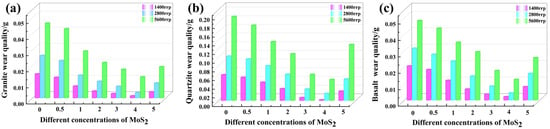
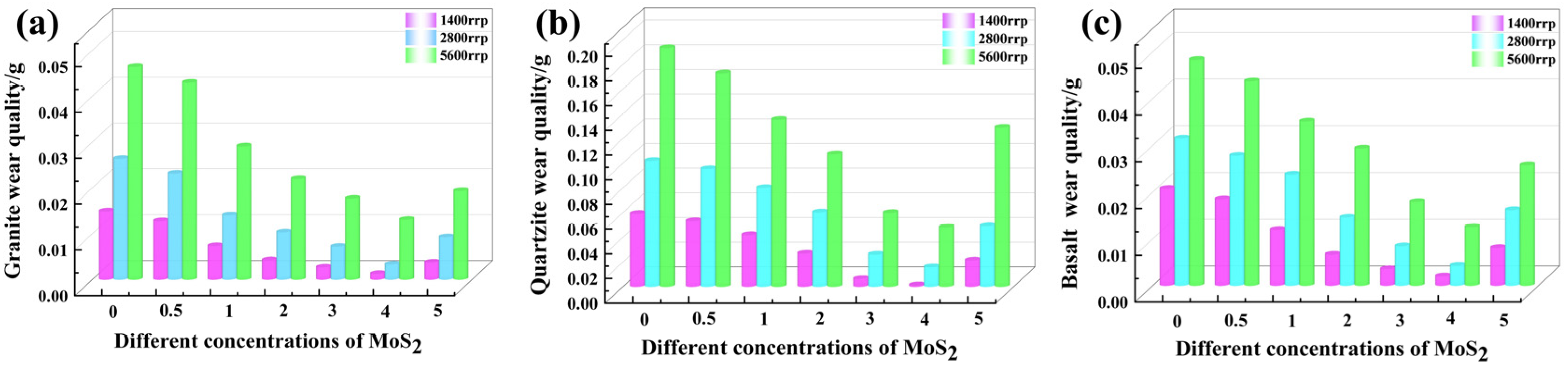
To further assess the service performance of the coatings, the wear behavior of the Fe-based/WC/MoS2 self-lubricating composite coatings was systematically evaluated under simulated hard-rock excavation conditions representative of TBM disc cutter operation. Wear tests were performed using a self-developed LCPC-like friction tester, which can reproduce the cutter-rock frictional contact encountered during field hard-rock cutting. Natural quartzite, basalt, and granite were selected as counter-abrasive materials to simulate different lithological environments at the cutter-rock interface. Three rotational speeds, namely 1400, 2800, and 5600 rpm, were applied to regulate the intensity of frictional contact, impact, and abrasive interaction between the coating and rock particles, thereby simulating cutter-rock wear conditions with different degrees of severity. The wear results indicate that the incorporation of MoS2 significantly improved the wear resistance of the coatings, with the optimum performance obtained at approximately 4 wt.% MoS2 [28]. The mass loss results further show that the 4 wt.% MoS2 coating exhibited the lowest wear rate under all rock types and rotational speeds, confirming the beneficial effect of an appropriate MoS2 addition. However, further increasing the MoS2 content led to a deterioration in wear resistance, indicating that the tribological performance is governed by a balance between the lubricating effect of MoS2 and the structural integrity of the coating. The wear severity induced by different rocks followed the order of quartzite, basalt, and granite (Figure 8), which is closely associated with the content of abrasive minerals in the rocks. Quartzite, consisting predominantly of high-hardness quartz particles, exhibited the strongest abrasiveness. During sliding, the quartzite counterface generated numerous fine and angular fragments, which were trapped at the friction interface and acted as additional cutting particles, thereby intensifying three-body abrasive wear. As a result, the coating suffered the most severe abrasive erosion under quartzite conditions. By contrast, basalt and granite contain lower quartz contents and produce relatively coarser or less abrasive debris during wear, leading to less severe coating damage.
Figure 8.
Wear behaviors of laser-clad coatings with varying MoS2 contents against granite, quartzite, and basalt under different rotational speeds (1400, 2800, and 5600 rpm): (a) Wear volume of granite; (b) Wear volume of quartzite; (c) Wear volume of basalt.
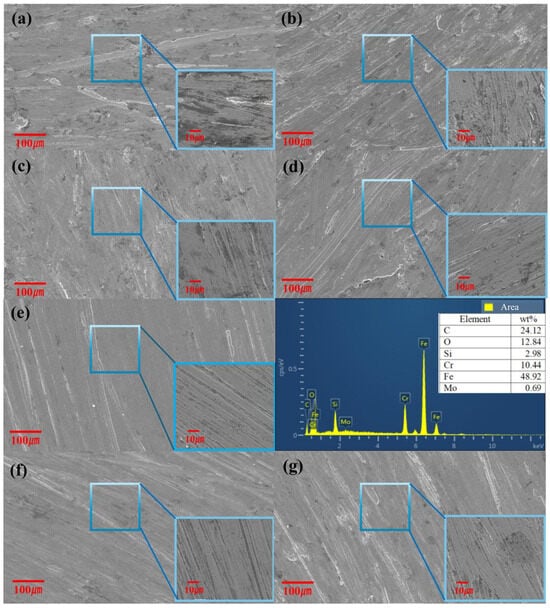
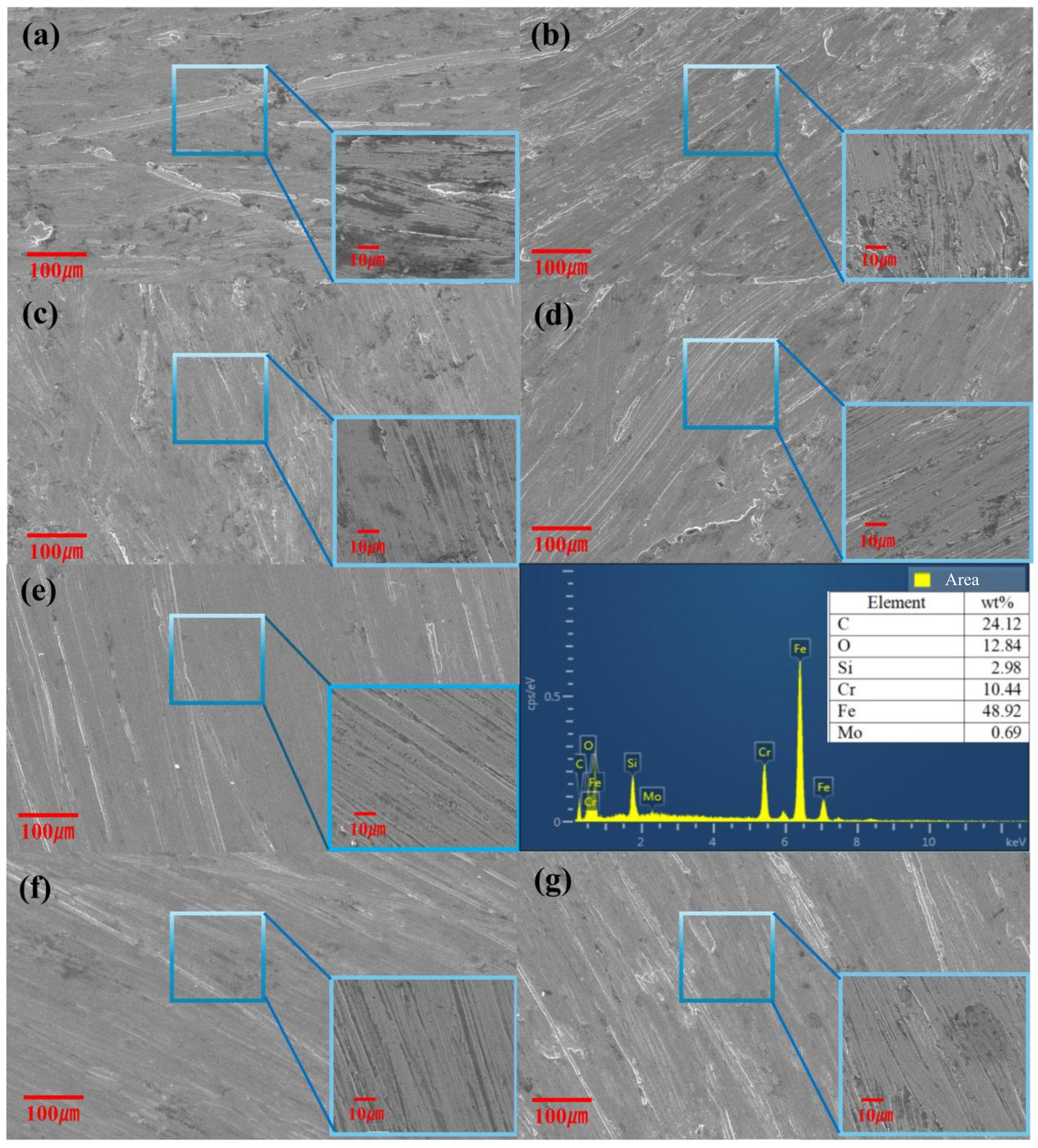
To clarify the underlying wear mechanisms, the worn coating surfaces were examined by SEM after the wear tests. As shown in Figure 9, the MoS2-free coating exhibited severe surface damage, including deep and wide furrows, extensive tearing, cracks propagating along the sliding direction, and localized spalling. Elongated continuous debris was observed along the groove edges, while embedded rock fragments and wear debris were present inside the grooves. These features indicate that, without the MoS2 lubricating phase, direct contact between the coating and the rock dominated the friction process [29]. The hard abrasive particles produced strong cutting and ploughing effects on the coating surface; thus, the dominant wear mechanism was severe two-body abrasive wear, accompanied by localized three-body abrasive wear.
Figure 9.
SEM morphologies of wear scar surfaces of laser-clad coatings with different MoS2 contents: (a) 0 wt.%; (b) 0.5 wt.%; (c) 1 wt.%; (d) 2 wt.%; (e) 4 wt.% and corresponding EDS mappings of the regions; (f) 3 wt.%; (g) 5 wt.%.
With increasing MoS2 content, the surface damage was markedly alleviated. The number and depth of furrows decreased significantly, and the continuous plastic deformation zones were greatly reduced. Compared with the deep and continuous grooves on the MoS2-free coating, the MoS2-containing coatings mainly displayed shallow and discontinuous micro-ploughing scratches. This suggests that MoS2 formed a protective solid-lubricating film during friction, which effectively separated the metallic matrix from rock abrasives and weakened the cutting and ploughing actions of interfacial asperities [30]. At approximately 4 wt.% MoS2, the coating exhibited the smoothest worn surface and the lowest degree of damage. Only a few isolated fine grooves and shallow scratches were observed, while most severe ploughing damage was effectively suppressed. The wear morphology changed from deep-cut grooves to broad and shallow band-like wear tracks, accompanied by a clear reduction in surface roughness. Moreover, the originally long and continuous wear debris was either compacted into the surface or removed from the interface as fine fragments, indicating that severe plastic shearing and material delamination were substantially inhibited. These observations demonstrate that the 4 wt.% MoS2 coating achieved an effective friction-reducing and lubricating effect, resulting in a transition of the dominant wear mechanism from severe abrasive wear to mild abrasive wear. In this case, microscale abrasive action was largely buffered by the lubricating film rather than directly inducing tearing and spalling of the coating surface. Accordingly, the friction interface changed from direct metal-rock contact to a contact state dominated by relative sliding between protective lubricating films. This interpretation is also consistent with the elemental analysis of the region shown in Figure 9e, suggesting that MoS2 and its tribochemical reaction products formed a low-shear-strength lubricating film at the interface, thereby accommodating sliding and reducing wear [31].
Nevertheless, excessive MoS2 addition adversely affected the coating performance. When the MoS2 content increased to 5 wt.%, the worn surface deteriorated again, showing localized delamination and rougher wear tracks. Although a higher amount of solid lubricant may reduce friction, excessive MoS2 can weaken the compactness and mechanical integrity of the coating. During laser cladding and frictional heating, high MoS2 contents may cause thermal decomposition and release sulfur-containing gases. These gases can be trapped within the rapidly solidified coating, leading to pore formation [32]. Such pores reduce the effective load-bearing area and act as stress concentration sites, thereby accelerating wear and crack propagation. In addition, excessive MoS2 may impair the microstructural uniformity of the coating. MoS2 particles or their reaction products may agglomerate in the matrix or form continuous lubricant-rich regions weakly bonded to the metallic matrix. Under cyclic frictional loading, these weak interfaces become preferential sites for crack initiation and propagation, eventually causing brittle fracture, localized delamination, and premature coating failure [33]. Therefore, although the amount of lubricating phase increases at high MoS2 contents, the reduced load-bearing capacity and structural stability ultimately lead to inferior wear resistance.
Overall, the tribological performance of the Fe-based/WC/MoS2 composite coatings is controlled by the synergistic balance between lubrication and structural strength. An appropriate MoS2 content promotes the formation of a stable low-shear-strength lubricating film, reduces direct metal-rock contact and abrasive cutting, and thereby significantly mitigates wear. In contrast, excessive MoS2 introduces pores, microstructural inhomogeneity, and weakly bonded interfaces, which degrade the coating load-bearing capacity and promote crack propagation. Under the present experimental conditions, approximately 4 wt.% MoS2 represents the optimal content for achieving the best balance between mechanical integrity and self-lubricating performance, resulting in the lowest friction-induced damage and the highest overall wear resistance [34].
3.6. Wear Mechanism
Based on the above analysis, the use of the Fe-based/WC/MoS2 system is well justified in terms of design rationality. First, compared with the more commonly used Ni-based systems, Fe-based materials exhibit better compatibility with steel substrates and lower cost, making them more suitable for practical application [35]. Second, when the WC content is fixed at 5 wt.%, WC mainly serves as a hard load-bearing skeleton, improving the microhardness of the coating and suppressing abrasive cutting. Meanwhile, during laser cladding, intense melt-pool convection and rapid solidification may cause part of the WC to dissolve, decompose, and re-precipitate as fine, dispersed carbide particles. These fine particles are uniformly distributed in the matrix, further producing dispersion strengthening and grain-boundary strengthening effects, thereby significantly enhancing the hardness and wear resistance of the coating matrix [36]. This also explains why no large amount of coarse WC precipitates was observed in the coating, whereas its hardness was still markedly higher than that of the substrate material.
In addition, after sufficient decomposition under the high temperature of laser cladding, MoS2 releases active sulfur species that react in situ with Fe and other matrix elements to form metastable metal sulfide films with good lubricating properties, mainly including FeS. Owing to the weak interlayer bonding in these sulfides, they possess low shear strength. During friction, they gradually migrate from the coating surface, spread, and cover the contact surface of the counterbody, forming a stable transfer lubricating film. As a result, the original metal-to-metal contact is transformed into sliding contact between sulfide films, thereby significantly reducing the friction coefficient and effectively suppressing severe wear [37,38]. On the other hand, the small pits and scratches formed during friction and wear are not entirely detrimental: they can trap wear debris, reduce the repeated circulation of abrasive particles at the interface, and suppress three-body abrasion; moreover, they can act as reservoirs for solid lubricants, continuously releasing MoS2 and its derived lubricating species as the lubricating film is gradually consumed, thereby enabling self-replenishment of the friction interface [39]. Overall, the WC reinforcing phase, MoS2 solid lubricant, and Fe-based alloy matrix play distinct but complementary roles in the laser-cladded coating. WC particles enhance the hardness and resistance to abrasive cutting, while the sulfide phases generated from the reaction of MoS2 contribute to the formation of a low-shear-strength lubricating film at the contact interface. Meanwhile, the Fe-based alloy matrix provides a continuous load-bearing framework for both the reinforcing and lubricating phases. These multiple mechanisms collectively improve the friction and wear behavior of the coating, thereby endowing the Fe-based/WC/MoS2 self-lubricating composite coating with excellent friction-reducing and wear-resistant properties [40].
4. Conclusions
In this study, Fe55/WC/MoS2 self-lubricating composite coatings were fabricated on an H13 steel substrate via laser cladding, and their friction and wear performances were systematically evaluated at room temperature. Through an in-depth analysis of the interaction between the lubricating phase and surface texture, we elucidated the coupling mechanisms that contribute to friction and wear reduction.
- The Fe55/WC/MoS2 cladding layer exhibited a fine-grained and dense microstructure free of cracks or porosity, indicating excellent metallurgical quality and structural integrity. Among all the tested compositions, the coating with 4 wt.% MoS2 achieved the lowest coefficient of friction and the smallest wear volume loss while maintaining a high hardness, identifying it as the optimal formulation.
- XPS and XRD analyses indicate that the coating is mainly composed of various sulfides (MoS2, FeS, and CrS), carbides (WC), and FeMoSi intermetallic compounds. The sulfur released from decomposed MoS2 reacts in situ with matrix elements such as Fe and Cr to form metal sulfides with low shear strength, including FeS and CrS. These tribochemical products facilitate the formation of a lubricating tribofilm, thereby effectively reducing the friction coefficient and improving the overall tribological performance.
- The 4 wt.% MoS2 coating also exhibited an average microhardness of 749.5 HV1, approximately four times higher than that of the H13 steel substrate. For most specimens, the dominant wear mechanism was a combination of fatigue wear and abrasive wear, attributable to the entrapment and cyclic action of hard debris at the contact interface. In contrast, the worn surface of the Fe55/WC/4 wt.% MoS2 textured coating was significantly smoother, with only sparse and shallow micro-grooves visible. This morphological evidence indicates a transition to a milder wear regime predominantly governed by mild abrasive wear.
Author Contributions
Conceptualization, L.H.; Methodology, L.H., Q.M. and Y.T.; Validation, Z.C.; Formal analysis, X.W.; Investigation, Z.C., K.Z. and Y.T.; Resources, L.H., Q.M. and Y.T.; Data curation, X.W.; Writing—original draft, X.W.; Writing—review & editing, X.W.; Visualization, M.Y.; Project administration, M.Y.; Funding acquisition, L.H. All authors have read and agreed to the published version of the manuscript.
Funding
This research was funded by the National Natural Science Foundation of China (No. 42402282), the Shaoxing Science and Technology Plan Project (2024A11003), the Central Government Funding Program for Guiding Local Science and Technology Development (2025ZY01028), and the Zhejiang Province International Science and Technology Cooperation Base Open Fund Project (IBGDP-2023-04).
Data Availability Statement
The data presented in this study are available on request from the corresponding author.
Conflicts of Interest
The authors declare no conflict of interest.
References
- Yang, D.; Fu, H.; Liu, W.; Wu, Z.; Gou, Y.; Zheng, J.; Zhang, Z.; Zhou, Z. A modification strategy for tilt-installed TBM cutters to reduce cutter wear: A numerical study. Tribol. Int. 2026, 214, 111232. [Google Scholar] [CrossRef] [Scilit]
- Mohammadi, M.; Palassi, M.; Karami, M. Influence of Two Gage Disc Cutters on TBM Performance and Optimization of Disc Cutter Installation Angle. Rock. Mech. Rock. Eng. 2025, 58, 9479–9498. [Google Scholar] [CrossRef] [Scilit]
- Wang, S.; Zhang, M.; Mo, J. Contact-Vibration characteristics of TBM cutters with abnormal wear under multiple cutter and composite formation conditions. Tunn. Undergr. Space Technol. 2026, 167, 107051. [Google Scholar] [CrossRef] [Scilit]
- Siddiqui, A.A.; Dubey, A.K. Recent trends in laser cladding and surface alloying. Opt. Laser Technol. 2021, 134, 106619. [Google Scholar] [CrossRef] [Scilit]
- Kobryn, P.A.; Semiatin, S.L. Microstructure and texture evolution during solidification processing of Ti–6Al–4V. J. Mater. Process. Technol. 2003, 135, 330–339. [Google Scholar] [CrossRef] [Scilit]
- Torres, H.; Caykara, T.; Rojacz, H.; Prakash, B.; Rodríguez Ripoll, M. The tribology of Ag/MoS2-based self-lubricating laser claddings for high temperature forming of aluminium alloys. Wear 2020, 442–443, 203110. [Google Scholar] [CrossRef] [Scilit]
- Olakanmi, E.O.; Cochrane, R.F.; Dalgarno, K.W. A review on selective laser sintering/melting (SLS/SLM) of aluminium alloy powders: Processing, microstructure, and properties. Prog. Mater. Sci. 2015, 74, 401–477. [Google Scholar] [CrossRef] [Scilit]
- Fleischauer, P.D.; Lince, J.R. A comparison of oxidation and oxygen substitution in MoS2 solid film lubricants. Tribol. Int. 1999, 32, 627–636. [Google Scholar] [CrossRef] [Scilit]
- Ren, A.; Kang, M.; Fu, X. Tribological behaviour of Ni/WC–MoS2 composite coatings prepared by jet electrodeposition with different nano-MoS2 doping concentrations. Eng. Fail. Anal. 2023, 143, 106934. [Google Scholar] [CrossRef] [Scilit]
- Lou, D.; Hellman, J.; Luhulima, D.; Liimatainen, J.; Lindroos, V.K. Interactions between tungsten carbide (WC) particulates and metal matrix in WC-reinforced composites. Mater. Sci. Eng. A 2003, 340, 155–162. [Google Scholar] [CrossRef] [Scilit]
- Ren, M.; Li, R.; Zhang, X.; Gu, J.; Jiao, C. Effect of WC particles preparation method on microstructure and properties of laser cladded Ni60-WC coatings. J. Mater. Res. Technol. 2023, 22, 605–616. [Google Scholar] [CrossRef] [Scilit]
- Teer, D.G.; Hampshire, J.; Fox, V.; Bellido-Gonzalez, V. The tribological properties of MoS2/metal composite coatings deposited by closed field magnetron sputtering. Surf. Coat. Technol. 1997, 94–95, 572–577. [Google Scholar] [CrossRef] [Scilit]
- Wang, X.; Zhou, S.; Dai, X.; Lei, J.; Guo, J.; Gu, Z.; Wang, T. Evaluation and mechanisms on heat damage of WC particles in Ni60/WC composite coatings by laser induction hybrid cladding. Int. J. Refract. Met. Hard Mater. 2017, 64, 234–241. [Google Scholar] [CrossRef] [Scilit]
- Minwei, L.; Bolong, L.; Haowen, R.; Hao, C.; Yubo, G.; Song, W.; Yu, Z.; Fawen, S.; Qin, L.; Kaiyuan, C. Comparative study on fragmentation mechanism of the rock under the spherical tooth cutters and constant cross section cutters assisted by vibration with different frequencies. Eng. Fract. Mech. 2025, 327, 111471. [Google Scholar] [CrossRef] [Scilit]
- Chen, C.; Feng, A.; Wei, Y.; Wang, Y.; Pan, X.; Song, X. Effects of WC particles on microstructure and wear behavior of laser cladding Ni60 composite coatings. Opt. Laser Technol. 2023, 163, 109425. [Google Scholar] [CrossRef] [Scilit]
- Gong, T.; Yao, P.; Zuo, X.; Zhang, Z.; Xiao, Y.; Zhao, L.; Zhou, H.; Deng, M.; Wang, Q.; Zhong, A. Influence of WC carbide particle size on the microstructure and abrasive wear behavior of WC–10Co–4Cr coatings for aircraft landing gear. Wear 2016, 362–363, 135–145. [Google Scholar] [CrossRef] [Scilit]
- Wang, P.; Pang, M.; Gao, L.-H. Research on the performance of nickel-based WC/MoS2 self-lubricating composite coatings laser cladding on 300 M ultra-high-strength steel surface. Mater. Today Commun. 2024, 39, 109334. [Google Scholar] [CrossRef] [Scilit]
- Sdobnyakov, N.Y.; Myasnichenko, V.S.; San, C.-H.; Chiu, Y.-T.; Ershov, P.M.; Ivanov, V.A.; Komarov, P.V. Simulation of phase transformations in titanium nanoalloy at different cooling rates. Mater. Chem. Phys. 2019, 238, 121895. [Google Scholar] [CrossRef] [Scilit]
- Zhang, F.-Z.; Liu, X.-B.; Yang, C.-M.; Chen, G.-D.; Meng, Y.; Zhou, H.-B.; Zhang, S.-H. Insights into robust carbon nanotubes in tribology: From nano to macro. Mater. Today 2024, 74, 203–234. [Google Scholar] [CrossRef] [Scilit]
- DebRoy, T.; Wei, H.L.; Zuback, J.S.; Mukherjee, T.; Elmer, J.W.; Milewski, J.O.; Beese, A.M.; Wilson-Heid, A.; De, A.; Zhang, W. Additive manufacturing of metallic components—Process, structure and properties. Prog. Mater. Sci. 2018, 92, 112–224. [Google Scholar] [CrossRef] [Scilit]
- Chen, J.L.; Li, J.; Song, R.; Bai, L.L.; Shao, J.Z.; Qu, C.C. Effect of the scanning speed on microstructural evolution and wear behaviors of laser cladding NiCrBSi composite coatings. Opt. Laser Technol. 2015, 72, 86–99. [Google Scholar] [CrossRef] [Scilit]
- Ziejewska, C.; Marczyk, J.; Szewczyk-Nykiel, A.; Nykiel, M.; Hebda, M. Influence of size and volume share of WC particles on the properties of sintered metal matrix composites. Adv. Powder Technol. 2019, 30, 835–842. [Google Scholar] [CrossRef] [Scilit]
- Feng, L.; Jin, G.; Cui, X.; Lu, B.; Guan, Y.; Chu, X.; Li, X.; Dong, Z.; Chen, D.; Wang, J. In-situ synthesis and wear mechanism of Ni- based self-lubricating composite coating with a dense continuous metal sulfide layer prepared by laser cladding. Surf. Coat. Technol. 2024, 478, 130443. [Google Scholar] [CrossRef] [Scilit]
- Gervasi, C.A.; Méndez, C.M.; Bilmes, P.D.; Llorente, C.L. Analysis of the impact of alloy microstructural properties on passive films formed on low-C 13CrNiMo martensitic stainless steels. Mater. Chem. Phys. 2011, 126, 178–182. [Google Scholar] [CrossRef] [Scilit]
- Yang, D.P.; Du, P.J.; Wu, D.; Yi, H.L. The microstructure evolution and tensile properties of medium-Mn steel heat-treated by a two-step annealing process. J. Mater. Sci. Technol. 2021, 75, 205–215. [Google Scholar] [CrossRef] [Scilit]
- Jianpeng, Y.; Yueguang, Y.; Jie, S. Cermet composite coating with a ductile Ni3Al binder phase and an in-situ Cr7C3 augmented phase. Intermetallics 2021, 138, 107300. [Google Scholar] [CrossRef] [Scilit]
- Zhu, Z.-X.; Liu, X.-B.; Liu, Y.-F.; Zhang, S.-Y.; Meng, Y.; Zhou, H.-B.; Zhang, S.-H. Effects of Cu/Si on the microstructure and tribological properties of FeCoCrNi high entropy alloy coating by laser cladding. Wear 2023, 512–513, 204533. [Google Scholar] [CrossRef] [Scilit]
- Poloczek, T.; Lont, A.; Górka, J. The Structure and Properties of Laser-Cladded Inconel 625/TiC Composite Coatings. Materials 2023, 16, 1265. [Google Scholar] [CrossRef] [Scilit]
- Zhao, J.; Luo, D.; Sun, W. Effect of TiN content on the microstructure and properties of laser-cladded nickel-based WC coatings. Ceram. Int. 2026, 52, 24422–24434. [Google Scholar] [CrossRef] [Scilit]
- Yang, Z.-Z.; Hao, H.; Gao, Q.; Cao, Y.-B.; Han, R.-H.; Qi, H.-B. Strengthening mechanism and high-temperature properties of H13 + WC/Y2O3 laser-cladding coatings. Surf. Coat. Technol. 2021, 405, 126544. [Google Scholar] [CrossRef] [Scilit]
- Zhang, M.; Wang, D.; He, L.; Ye, X.; Ouyang, W.; Xu, Z.; Zhang, W.; Zhou, X. Microstructure and elevated temperature wear behavior of laser-cladded AlCrFeMnNi high-entropy alloy coating. Opt. Laser Technol. 2022, 149, 107845. [Google Scholar] [CrossRef] [Scilit]
- Hui, X.; Dejun, K. Microstructure and High-Temperature Tribological Properties of Laser-Cladded WC10Co4Cr–xTi2AlC Coatings. Metall. Mater. Trans. A 2024, 55, 1976–1987. [Google Scholar] [CrossRef] [Scilit]
- Anghel, I.-M.; Pascu, A.; Hulka, I.; Woelk, D.H.; Uțu, I.-D.; Mărginean, G. Characterization of Cobalt-Based Composite Multilayer Laser-Cladded Coatings. Crystals 2025, 15, 970. [Google Scholar] [CrossRef] [Scilit]
- Lei, Y.; Sun, R.; Tang, Y.; Niu, W. Microstructure and phase transformations in laser clad CrxSy/Ni coating on H13 steel. Opt. Lasers Eng. 2015, 66, 181–186. [Google Scholar] [CrossRef] [Scilit]
- Lu, X.-L.; Liu, X.-B.; Yu, P.-C.; Fu, G.-Y.; Zhu, G.-X.; Wang, Y.-G.; Chen, Y. Effects of annealing on laser clad Ti2SC/CrS self-lubricating anti-wear composite coatings on Ti6Al4V alloy: Microstructure and tribology. Tribol. Int. 2016, 101, 356–363. [Google Scholar] [CrossRef] [Scilit]
- Duan, Y.; Liu, J.; Wang, J.; Xia, X.; Zhang, J. Influence of Micro-Texture on the Tribological Behavior of WC/MoS2/Fe-Based Alloy Coating by Laser Cladding. J. Therm. Spray. Technol. 2024, 33, 2748–2759. [Google Scholar] [CrossRef] [Scilit]
- Maliutina, I.N.; Si-Mohand, H.; Sijobert, J.; Bertrand, P.; Lazurenko, D.V.; Bataev, I.A. Structure and oxidation behavior of γ-TiAl coating produced by laser cladding on titanium alloy. Surf. Coat. Technol. 2017, 319, 136–144. [Google Scholar] [CrossRef] [Scilit]
- Bian, Y.; Li, S.; Tian, C.; Dong, B.; Liu, H.; He, X.; Yu, G. Comparative study on laser-cladded WC- and TiC- reinforced composite coatings on TBM disc cutters: Process optimization, microstructure evolution, and wear resistance. Int. J. Refract. Met. Hard Mater. 2026, 136, 107602. [Google Scholar] [CrossRef] [Scilit]
- Jin, G.; Cai, Z.; Guan, Y.; Cui, X.; Liu, Z.; Li, Y.; Dong, M.; Zhang, D. High temperature wear performance of laser-cladded FeNiCoAlCu high-entropy alloy coating. Appl. Surf. Sci. 2018, 445, 113–122. [Google Scholar] [CrossRef] [Scilit]
- Zhu, Y.; Shen, S.; Yang, X.; Song, F.; Dong, W.; Wang, Z.; Wu, M. Study on the friction and wear performance of laser cladding WC-TiC/Ni60 coating on the working face of shield bobbing cutter. Opt. Mater. 2024, 148, 114875. [Google Scholar] [CrossRef] [Scilit]
Disclaimer/Publisher’s Note: The statements, opinions and data contained in all publications are solely those of the individual author(s) and contributor(s) and not of MDPI and/or the editor(s). MDPI and/or the editor(s) disclaim responsibility for any injury to people or property resulting from any ideas, methods, instructions or products referred to in the content. |
© 2026 by the authors. Licensee MDPI, Basel, Switzerland. This article is an open access article distributed under the terms and conditions of the Creative Commons Attribution (CC BY) license.