


Prognostic and Predictive Significance of Claudin-6 Expression in Advanced-Stage High-Grade Serous Ovarian Carcinoma

 ,
,
Abstract
1. Introduction
2. Materials and Methods
2.1. Study Population
2.2. Data Collection and Clinical Variables
2.3. Treatment Strategy
2.4. Immunohistochemistry and Evaluation of Claudin-6 Expression
2.5. Statistical Analysis
3. Results
4. Discussion
5. Conclusions
Author Contributions
Funding
Institutional Review Board Statement
Informed Consent Statement
Data Availability Statement
Acknowledgments
Conflicts of Interest
References
- Xia, C.; Dong, X.; Li, H.; Cao, M.; Sun, D.; He, S.; Yang, F.; Yan, X.; Zhang, S.; Li, N.; et al. Cancer statistics in China and United States, 2022: Profiles, trends, and determinants. Chin. Med. J. 2022, 135, 584–590. [Google Scholar]
- Mazidimoradi, A.; Momenimovahed, Z.; Allahqoli, L.; Tiznobaik, A.; Hajinasab, N.; Salehiniya, H.; Alkatout, I. The global, regional and national epidemiology, incidence, mortality, and burden of ovarian cancer. Health Sci. Rep. 2022, 5, e936. [Google Scholar] [CrossRef] [Scilit]
- Stewart, C.; Ralyea, C.; Lockwood, S. Ovarian cancer: An integrated review. In Seminars in Oncology Nursing; Elsevier: Amsterdam, The Netherlands, 2019. [Google Scholar]
- Kim, J.; Park, E.Y.; Kim, O.; Schilder, J.M.; Coffey, D.M.; Cho, C.-H.; Bast, R.C., Jr. Cell origins of high-grade serous ovarian cancer. Cancers 2018, 10, 433. [Google Scholar] [CrossRef] [Scilit] [PubMed]
- Henderson, J.T.; Webber, E.M.; Sawaya, G.F. Screening for ovarian cancer: Updated evidence report and systematic review for the US preventive services task force. Jama 2018, 319, 595–606. [Google Scholar]
- Karam, A.; Ledermann, J.A.; Kim, J.-W.; Sehouli, J.; Lu, K.; Gourley, C.; Katsumata, N.; Burger, R.A.; Nam, B.-H.; Bacon, M.; et al. Fifth ovarian cancer consensus conference of the gynecologic cancer intergroup: First-line interventions. Ann. Oncol. 2017, 28, 711–717. [Google Scholar] [CrossRef] [Scilit]
- Perez-Fidalgo, J.A.; Gálvez-Montosa, F.; Guerra, E.M.; Madariaga, A.; Manzano, A.; Martin-Lorente, C.; Rubio-Pérez, M.J.; Alarcón, J.; Barretina-Ginesta, M.P.; Gaba, L. SEOM–GEICO clinical guideline on epithelial ovarian cancer (2023). Clin. Transl. Oncol. 2024, 26, 2758–2770. [Google Scholar] [CrossRef] [Scilit] [PubMed]
- Davis, A.; Tinker, A.V.; Friedlander, M. “Platinum resistant” ovarian cancer: What is it, who to treat and how to measure benefit? Gynecol. Oncol. 2014, 133, 624–631. [Google Scholar] [CrossRef] [Scilit] [PubMed]
- Rottenberg, S.; Disler, C.; Perego, P. The rediscovery of platinum-based cancer therapy. Nat. Rev. Cancer 2020, 21, 37–50. [Google Scholar] [CrossRef] [Scilit]
- Lorusso, D.; Ceni, V.; Muratore, M.; Salutari, V.; Nero, C.; Pietragalla, A.; Ciccarone, F.; Carbone, V.; Daniele, G.; Scambia, G. Emerging role of immune checkpoint inhibitors in the treatment of ovarian cancer. Expert Opin. Emerg. Drugs 2020, 25, 445–453. [Google Scholar] [CrossRef] [Scilit]
- Holder, A.M.; Dedeilia, A.; Sierra-Davidson, K.; Cohen, S.; Liu, D.; Parikh, A.; Boland, G.M. Defining clinically useful biomarkers of immune checkpoint inhibitors in solid tumours. Nat. Rev. Cancer 2024, 24, 498–512. [Google Scholar] [CrossRef] [Scilit]
- Lu, J.; Zhen, S.; Li, X. Characteristics of Oxidative Phosphorylation-Related Subtypes and Construction of a Prognostic Signature in Ovarian Cancer. Curr. Gene Ther. 2025, 25, 327–344. [Google Scholar] [CrossRef] [Scilit] [PubMed]
- Itoh, M.; Bissell, M.J. The organization of tight junctions in epithelia: Implications for mammary gland biology and breast tumorigenesis. J. Mammary Gland. Biol. Neoplasia 2003, 8, 449–462. [Google Scholar] [CrossRef] [Scilit]
- Otani, T.; Furuse, M. Tight junction structure and function revisited. Trends Cell Biol. 2020, 30, 805–817. [Google Scholar] [CrossRef] [Scilit]
- Adil, M.S.; Narayanan, S.P.; Somanath, P.R. Cell-cell junctions: Structure and regulation in physiology and pathology. Tissue Barriers 2020, 9, 1848212. [Google Scholar] [CrossRef] [Scilit]
- Du, H.; Yang, X.; Fan, J.; Du, X. Claudin 6: Therapeutic prospects for tumours, and mechanisms of expression and regulation. Mol. Med. Rep. 2021, 24, 677. [Google Scholar] [CrossRef] [Scilit]
- Ji, W.; Zhuang, X.; Jiang, W.G.; Martin, T.A. Tight junctional protein family, Claudins in cancer and cancer metastasis. Front. Oncol. 2025, 15, 1596460. [Google Scholar] [CrossRef] [Scilit] [PubMed]
- Lal-Nag, Á.; Battis, Á.; Santin, A.D.; Morin, P.J. Claudin-6: A novel receptor for CPE-mediated cytotoxicity in ovarian cancer. Oncogenesis 2012, 1, e33. [Google Scholar] [CrossRef] [Scilit] [PubMed]
- Zhang, C.; Guo, C.; Li, Y.; Liu, K.; Zhao, Q.; Ouyang, L. Identification of claudin-6 as a molecular biomarker in pan-cancer through multiple omics integrative analysis. Front. Cell Dev. Biol. 2021, 9, 726656. [Google Scholar] [CrossRef] [Scilit]
- Reinhard, K.; Rengstl, B.; Oehm, P.; Michel, K.; Billmeier, A.; Hayduk, N.; Klein, O.; Kuna, K.; Ouchan, Y.; Wöll, S.; et al. An RNA vaccine drives expansion and efficacy of claudin-CAR-T cells against solid tumors. Science 2020, 367, 446–453. [Google Scholar] [CrossRef] [Scilit]
- Saviano, A.; Toso, A.; Klempner, S.J.; Baumert, T.F. Claudin proteins as emerging therapeutic targets for solid tumours. Nat. Rev. Cancer 2026, 1–20. [Google Scholar] [CrossRef] [Scilit]
- Qu, H.; Jin, Q.; Quan, C. CLDN6: From traditional barrier function to emerging roles in cancers. Int. J. Mol. Sci. 2021, 22, 13416. [Google Scholar] [CrossRef] [Scilit] [PubMed]
- Wang, D.-W.; Zhang, W.-H.; Danil, G.; Yang, K.; Hu, J.-K. The role and mechanism of claudins in cancer. Front. Oncol. 2022, 12, 1051497. [Google Scholar] [CrossRef] [Scilit]
- Stadler, C.R.; Bähr-Mahmud, H.; Plum, L.M.; Schmoldt, K.; Kölsch, A.C.; Türeci, Ö.; Sahin, U. Characterization of the first-in-class T-cell-engaging bispecific single-chain antibody for targeted immunotherapy of solid tumors expressing the oncofetal protein claudin 6. OncoImmunology 2015, 5, e1091555. [Google Scholar] [CrossRef] [Scilit] [PubMed]
- Kong, F.-E.; Li, G.-M.; Tang, Y.-Q.; Xi, S.-Y.; Loong, J.H.C.; Li, M.-M.; Li, H.-L.; Cheng, W.; Zhu, W.-J.; Mo, J.-Q.; et al. Targeting tumor lineage plasticity in hepatocellular carcinoma using an anti-CLDN6 antibody-drug conjugate. Sci. Transl. Med. 2021, 13, eabb6282. [Google Scholar] [CrossRef] [Scilit]
- McDermott, M.S.; O’Brien, N.A.; Hoffstrom, B.; Gong, K.; Lu, M.; Zhang, J.; Luo, T.; Liang, M.; Jia, W.; Hong, J.J.; et al. Preclinical efficacy of the antibody–drug conjugate CLDN6–23-ADC for the treatment of CLDN6-positive solid tumors. Clin. Cancer Res. 2023, 29, 2131–2143. [Google Scholar] [CrossRef] [Scilit]
- Meinhold-Heerlein, I.; Fotopoulou, C.; Harter, P.; Kurzeder, C.; Mustea, A.; Wimberger, P.; Hauptmann, S.; Sehouli, J. The new WHO classification of ovarian, fallopian tube, and primary peritoneal cancer and its clinical implications. Arch. Gynecol. Obstet. 2016, 293, 695–700. [Google Scholar] [CrossRef] [Scilit]
- Mutch, D.G.; Prat, J. 2014 FIGO staging for ovarian, fallopian tube and peritoneal cancer. Gynecol. Oncol. 2014, 133, 401–404. [Google Scholar] [CrossRef] [Scilit]
- Schwartz, L.H.; Litière, S.; de Vries, E.; Ford, R.; Gwyther, S.; Mandrekar, S.; Shankar, L.; Bogaerts, J.; Chen, A.; Dancey, J.; et al. RECIST 1.1—Update and clarification: From the RECIST committee. Eur. J. Cancer 2016, 62, 132–137. [Google Scholar] [CrossRef] [Scilit]
- Mackensen, A.; Haanen, J.B.; Koenecke, C.; Alsdorf, W.; Wagner-Drouet, E.; Borchmann, P.; Heudobler, D.; Ferstl, B.; Klobuch, S.; Bokemeyer, C.; et al. CLDN6-specific CAR-T cells plus amplifying RNA vaccine in relapsed or refractory solid tumors: The phase 1 BNT211-01 trial. Nat. Med. 2023, 29, 2844–2853. [Google Scholar] [CrossRef] [Scilit]
- Wang, L.; Jin, X.; Lin, D.; Liu, Z.; Zhang, X.; Lu, Y.; Liu, Y.; Wang, M.; Yang, M.; Li, J.; et al. Clinicopathologic significance of claudin-6, occludin, and matrix metalloproteinases− 2 expression in ovarian carcinoma. Diagn. Pathol. 2013, 8, 190. [Google Scholar] [CrossRef] [Scilit] [PubMed]
- Kojima, M.; Sugimoto, K.; Tanaka, M.; Endo, Y.; Kato, H.; Honda, T.; Furukawa, S.; Nishiyama, H.; Watanabe, T.; Soeda, S.; et al. Prognostic significance of aberrant claudin-6 expression in endometrial cancer. Cancers 2020, 12, 2748. [Google Scholar] [CrossRef] [Scilit]
- Yuceer, R.O.; Aydin, S.; Ozer, H.; Aydin, A.A.; Yilmaz, M.; Kaya, S.; Koc, T. The prognostic and therapeutic potential of Claudin-6 and Trop-2 expression as targeted biomarkers in serous ovarian cancer: An observational study. Medicine 2025, 104, e43110. [Google Scholar] [CrossRef] [Scilit] [PubMed]
- Gao, P.; Peng, T.; Cao, C.; Lin, S.; Wu, P.; Huang, X.; Wei, J.; Xi, L.; Yang, Q.; Wu, P. Association of CLDN6 and CLDN10 with immune microenvironment in ovarian cancer: A study of the claudin family. Front. Genet. 2021, 12, 595436. [Google Scholar] [CrossRef] [Scilit] [PubMed]
- Ito, Y.; Takasawa, A.; Takasawa, K.; Murakami, T.; Akimoto, T.; Kyuno, D.; Kawata, Y.; Shano, K.; Kirisawa, K.; Ota, M.; et al. Aberrant expression of claudin-6 contributes to malignant potentials and drug resistance of cervical adenocarcinoma. Cancer Sci. 2022, 113, 1519–1530. [Google Scholar] [CrossRef] [Scilit]
- Simon, A.G.; Lyu, S.I.; Laible, M.; Wöll, S.; Türeci, Ö.; Şahin, U.; Alakus, H.; Fahrig, L.; Zander, T.; Buettner, R.; et al. The tight junction protein claudin 6 is a potential target for patient-individualized treatment in esophageal and gastric adenocarcinoma and is associated with poor prognosis. J. Transl. Med. 2023, 21, 552. [Google Scholar] [CrossRef] [Scilit]
- Katoh, M.; Katoh, M. Claudin 1, 4, 6 and 18 isoform 2 as targets for the treatment of cancer. Int. J. Mol. Med. 2024, 54, 100. [Google Scholar] [CrossRef] [Scilit] [PubMed]
- Katoh, M.; Loriot, Y.; Nakayama, I.; Hamada, A.; Shitara, K.; Katoh, M. Antibody-drug conjugates targeting the cadherin, claudin and nectin families of adhesion molecules. Front. Mol. Med. 2025, 5, 1661016. [Google Scholar] [CrossRef] [Scilit] [PubMed]

| Variable | CLDN6 Low (n = 88) | CLDN6 High (n = 31) | p-Value |
|---|---|---|---|
| Age | 0.643 | ||
| ≤62 years | 44 (50.0%) | 17 (54.8%) | |
| >62 years | 44 (50.0%) | 14 (45.2%) | |
| CA-125 level | 0.159 | ||
| <714.5 U/mL | 41 (46.6%) | 19 (61.3%) | |
| ≥714.5 U/mL | 47 (53.4%) | 12 (38.7%) | |
| Lymph node metastasis | 0.991 | ||
| Absent | 51 (58.0%) | 18 (58.1%) | |
| Present | 37 (42.0%) | 13 (41.9%) | |
| Distant metastasis | 0.492 | ||
| Absent | 78 (88.6%) | 26 (83.9%) | |
| Present | 10 (11.4%) | 5 (16.1%) | |
| Neoadjuvant chemotherapy | 0.763 | ||
| No | 37 (42.0%) | 14 (45.2%) | |
| Yes | 51 (58.0%) | 17 (54.8%) | |
| Surgical approach | 0.311 | ||
| No surgery | 9 (10.2%) | 6 (19.4%) | |
| Primary debulking surgery | 37 (42.0%) | 14 (45.2%) | |
| Interval debulking surgery | 42 (47.8%) | 11 (35.4%) | |
| Residual disease * | 0.856 | ||
| No residual tumor | 30 (38.0%) | 10 (40.0%) | |
| Residual tumor present | 49 (62.0%) | 15 (60.0%) | |
| PFI | 0.001 | ||
| Platinum-resistant | 25 (28.4%) | 19 (61.3%) | |
| Platinum-sensitive | 63 (71.6%) | 12 (38.7%) |
| Variable | Odds Ratio (OR) | 95% CI | p-Value |
|---|---|---|---|
| High CLDN6 expression | 4.52 | 1.49–13.68 | 0.008 |
| Lymph node metastasis | 0.81 | 0.31–2.12 | 0.672 |
| Distant metastasis | 3.58 | 0.79–16.14 | 0.097 |
| Residual disease | 10.12 | 2.87–35.74 | <0.001 |
| CA-125 level | 0.64 | 0.42–0.98 | 0.041 |
| Age | 1.04 | 0.99–1.08 | 0.135 |
| Variable | Median OS (Months) | 95% CI | p-Value |
|---|---|---|---|
| Overall | 43.80 | 38.05–49.54 | — |
| Age | 0.326 | ||
| <62 years | 44.06 | 39.78–48.35 | |
| ≥62 years | 43.06 | 29.74–56.38 | |
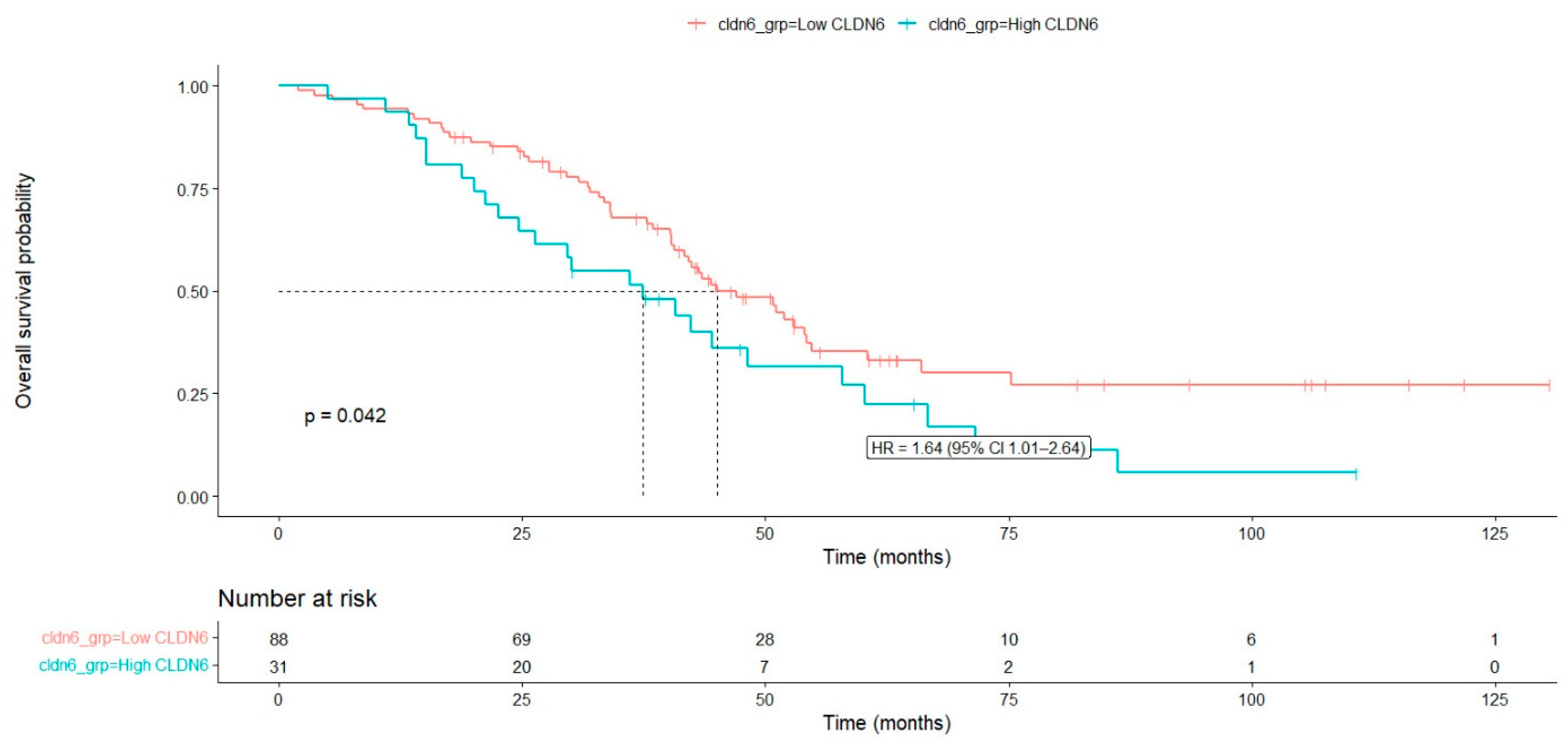
| CLDN6 expression | 0.042 | ||
| Low | 45.73 | 36.75–54.71 | |
| High | 38.00 | 23.90–52.09 | |
| CA-125 level | 0.028 | ||
| <714.5 U/mL | 51.83 | 35.31–68.35 | |
| ≥714.5 U/mL | 42.26 | 37.11–47.42 | |
| Lymph node metastasis | 0.999 | ||
| Absent | 45.73 | 38.12–53.34 | |
| Present | 42.73 | 39.01–46.45 | |
| Distant metastasis | 0.016 | ||
| Absent | 45.73 | 37.80–53.66 | |
| Present | 26.03 | 4.38–47.67 | |
| Neoadjuvant chemotherapy | 0.318 | ||
| No | 45.16 | 31.98–58.35 | |
| Yes | 42.96 | 37.36–48.56 | |
| Surgical approach | <0.001 | ||
| No surgery | 20.36 | 6.84–33.88 | |
| Primary debulking surgery | 45.16 | 31.98–58.35 | |
| Interval debulking surgery | 48.93 | 40.37–57.39 | |
| Residual disease | 0.004 | ||
| No residual tumor | 67.63 | 43.92–91.34 | |
| Residual tumor present | 42.73 | 36.36–49.10 |
| Variable | Hazard Ratio (HR) | 95% CI | p-Value |
|---|---|---|---|
| CLDN6 expression | 0.026 | ||
| CLDN6 low | Reference | ||
| CLDN6 high | 1.90 | 1.08–3.36 | |
| CA-125 level | 0.027 | ||
| <714.50 | Reference | ||
| ≥714.50 | 1.87 | 1.07–3.25 | |
| Distant metastasis | 0.144 | ||
| Absent | Reference | ||
| Present | 1.82 | 0.8–4.08 | |
| Surgical approach | 0.377 | ||
| No surgery after neoadjuvant therapy | Reference | ||
| Primary cytoreductive surgery | 1.16 | 0.98–2.35 | 0.300 |
| Interval debulking surgery | 1.93 | 0.37–2.41 | 0.365 |
| Residual disease | 0.005 | ||
| No residual tumor | Reference | ||
| Residual tumor present | 2.24 | 1.26–3.96 |
| Variable | 2-Year PFS (%) | 5-Year PFS (%) | Median PFS (Months) (95% CI) | p-Value |
|---|---|---|---|---|
| Overall | 28.3 | 12.6 | 15.73 (14.63–16.82) | |
| Age | 0.724 | |||
| <62 | 25.7 | 13.0 | 15.33 (13.86–17.28) | |
| ≥62 | 32.1 | 12.5 | 16.13 (12.93–19.33) | |
| CLDN6 expression | 0.096 | |||
| CLDN6 low | 31.6 | 16.6 | 15.90 (14.15–17.64) | |
| CLDN6 high | 19.4 | 3.2 | 15.60 (11.94–19.25) | |
| CA-125 level | 0.093 | |||
| <714.50 | 28.8 | 20.7 | 16.16 (14.06–18.26) | |
| ≥714.50 | 27.9 | 5.2 | 15.33 (12.97–17.69) | |
| Lymph node metastasis | 0.770 | |||
| Absent | 29.0 | 13.7 | 15.90 (14.73–17.06) | |
| Present | 27.4 | 11.6 | 15.60 (14.09–17.10) | |
| Distant metastasis | 0.021 | |||
| Absent | 30.5 | 13.4 | 16.13 (14.66–17.60) | |
| Present | 13.3 | 6.7 | 10.73 (8.71–12.75) | |
| Neoadjuvant chemotherapy | 0.243 | |||
| No | 32.8 | 17.3 | 15.90 (11.96–19.84) | |
| Yes | 25.0 | 9.6 | 15.73 (14.65–16.81) | |
| Surgical approach | 0.009 | |||
| No surgery after neoadjuvant therapy | 13.3 | – | 9.06 (5.82–12.30) | |
| Primary cytoreductive surgery | 32.8 | 17.3 | 15.90 (11.96–19.84) | |
| Interval debulking surgery | 28.3 | 12.3 | 16.06 (14.71–17.42) | |
| Residual disease | 0.001 | |||
| No residual tumor | 45.0 | 26.7 | 19.36 (15.02–23.70) | |
| Residual tumor present | 21.4 | 7.2 | 14.00 (12.10–15.89) |
Disclaimer/Publisher’s Note: The statements, opinions and data contained in all publications are solely those of the individual author(s) and contributor(s) and not of MDPI and/or the editor(s). MDPI and/or the editor(s) disclaim responsibility for any injury to people or property resulting from any ideas, methods, instructions or products referred to in the content. |
© 2026 by the authors. Licensee MDPI, Basel, Switzerland. This article is an open access article distributed under the terms and conditions of the Creative Commons Attribution (CC BY) license.
Share and Cite
Demir, T.; Kefeli, M.; Aydoğan Demir, A.R.; Uygun, F.N.; Akpunar, M.; Tekce Yıldız, E.; Demirağ, G. Prognostic and Predictive Significance of Claudin-6 Expression in Advanced-Stage High-Grade Serous Ovarian Carcinoma. Diagnostics 2026, 16, 1175. https://doi.org/10.3390/diagnostics16081175
Demir T, Kefeli M, Aydoğan Demir AR, Uygun FN, Akpunar M, Tekce Yıldız E, Demirağ G. Prognostic and Predictive Significance of Claudin-6 Expression in Advanced-Stage High-Grade Serous Ovarian Carcinoma. Diagnostics. 2026; 16(8):1175. https://doi.org/10.3390/diagnostics16081175
Chicago/Turabian StyleDemir, Teyfik, Mehmet Kefeli, Ayşe Rumeysa Aydoğan Demir, Fatma Nur Uygun, Melih Akpunar, Elif Tekce Yıldız, and Güzin Demirağ. 2026. "Prognostic and Predictive Significance of Claudin-6 Expression in Advanced-Stage High-Grade Serous Ovarian Carcinoma" Diagnostics 16, no. 8: 1175. https://doi.org/10.3390/diagnostics16081175
APA StyleDemir, T., Kefeli, M., Aydoğan Demir, A. R., Uygun, F. N., Akpunar, M., Tekce Yıldız, E., & Demirağ, G. (2026). Prognostic and Predictive Significance of Claudin-6 Expression in Advanced-Stage High-Grade Serous Ovarian Carcinoma. Diagnostics, 16(8), 1175. https://doi.org/10.3390/diagnostics16081175

