


Abstract
Background/Objectives: Sepsis caused by hospital-acquired infections (HAIs) remains a major challenge in intensive care units (ICUs), where antimicrobial resistance is widespread. This study examined the clinical characteristics, microbiological patterns, antimicrobial resistance, and outcomes of ICU patients with HAI-associated sepsis in western Romania. Methods: We retrospectively analysed 276 ICU HAI episodes recorded between 2020 and 2025. Cases were classified as septic shock (n = 148), sepsis without shock (n = 68), or no documented sepsis (n = 60). Mortality predictors were assessed using multivariable logistic regression and survival analyses. Results: Sepsis occurred in 78.3% of HAI episodes. Patients with septic shock were generally older and more likely to have diabetes, require mechanical ventilation (82.4%), or develop acute kidney injury (64.9%). Among sepsis-associated episodes, 78.7% were polymicrobic. Respiratory (63.9%) and bloodstream (41.7%) infections predominated, with Klebsiella pneumoniae, Acinetobacter baumannii, and Candida species frequently identified. Carbapenem resistance was particularly high in K. pneumoniae (87.5%) and A. baumannii (90.0%). Mortality increased substantially with disease severity, reaching 43.1% without sepsis, 72.3% with sepsis without shock, and 82.6% with septic shock. Sepsis severity, advanced age, and mechanical ventilation independently predicted death. Carbapenem resistance was associated with mortality, potentially reflecting early deaths and incomplete microbiological documentation. Conclusions: HAI-associated sepsis in this ICU population was characterised by frequent polymicrobic infections, extensive antimicrobial resistance, and exceptionally high mortality. These findings highlight the importance of infection prevention, early recognition of clinical deterioration, and improved microbiological surveillance to support timely treatment decisions and better patient outcomes.
1. Introduction
Sepsis, defined as life-threatening organ dysfunction caused by a dysregulated host response to infection, remains one of the leading causes of death worldwide, with an estimated 48.9 million incident cases and 11 million sepsis-related deaths in 2017 [1,2]. Although most of this burden arises in the community, sepsis acquired in hospital has emerged as a distinct and particularly lethal entity. Hospital-acquired sepsis affects 9.3 of every 1000 hospitalised patients and 56.5 of every 1000 ICU patients and has a mortality in ICU patients of about 52% [3]. Approximately one quarter of all ICU sepsis cases are acquired during the ICU stay itself [3], and ICU-treated sepsis carries a pooled hospital mortality of 41.9%, against 26.7% for hospital-treated sepsis overall [4]. In the EPIC III point-prevalence study, 54% of 15,202 ICU patients had a suspected or proven infection on the study day, with an in-hospital mortality of 30% among infected patients [5].
In 2019, 1.27 million deaths were directly attributable to bacterial antimicrobial resistance (AMR), which was also associated with 4.95 million deaths [6]. In the European Union and European Economic Area (EU/EEA) infections with antibiotic-resistant bacteria caused an estimated 33,000 attributable deaths in 2015, with carbapenem-resistant and third-generation cephalosporin-resistant Gram-negative bacteria contributing the fastest-growing share [7]. In the EUROBACT-2 cohort of 2600 ICU patients with hospital-acquired bloodstream infection, Gram-negative bacteria accounted for 59.0% of isolates, carbapenem resistance was present in 37.8% of Klebsiella spp. and 84.6% of Acinetobacter spp., and 28-day mortality was 37.1%; resistance prolonged the time to adequate therapy [8]. Romania occupies the upper end of the European resistance gradient. In 2024, the proportion of invasive K. pneumoniae isolates resistant to carbapenems in Romania was 50.3%, the third highest value in the EU/EEA after Bulgaria and Greece, and the estimated incidence of carbapenem-resistant K. pneumoniae bloodstream infections (20.31 per 100,000 population) was the highest in the Union [9,10]. Recent single-centre reports from Romanian ICUs describe carbapenem resistance in more than 80% of K. pneumoniae and A. baumannii isolates, a progressive shift from multidrug-resistant to extensively drug-resistant phenotypes and the dominance of K. pneumoniae co-producing NDM and OXA-48-like carbapenemases, which removes ceftazidime-avibactam and frequently colistin from the therapeutic armamentarium [11,12,13,14,15]. Mortality in Romanian critical care cohorts with carbapenem-resistant Acinetobacter infections have reached 66–73%, and in these cohorts age, mechanical ventilation and sepsis, rather than the resistance phenotype, predicted death [16,17].
Most Romanian ICU studies to date are microbiological surveys of isolates, and few link the resistance profile of hospital-acquired infections to the clinical syndrome of sepsis, to organ dysfunction and to patient outcome [11,12,13]. Sepsis complicating a hospital-acquired infection (HAI) in a patient who is already critically ill differs from community-onset sepsis in its pathogens, its therapeutic options and its prognosis.
The main objectives of the present study were (i) to describe the clinical characteristics, organ dysfunction and laboratory profile of ICU HAI episodes according to sepsis grade (no documented sepsis, sepsis, septic shock); (ii) to characterise the infection sites, pathogens and resistance phenotypes of sepsis-associated ICU HAI, including a comparison with sepsis-associated HAI in non-ICU wards; and (iii) to quantify in-hospital mortality and its predictors, with attention to the role of carbapenem-resistant Gram-negative bacteria and to the biases that surveillance data impose on such analyses.
2. Materials and Methods
2.1. Study Design
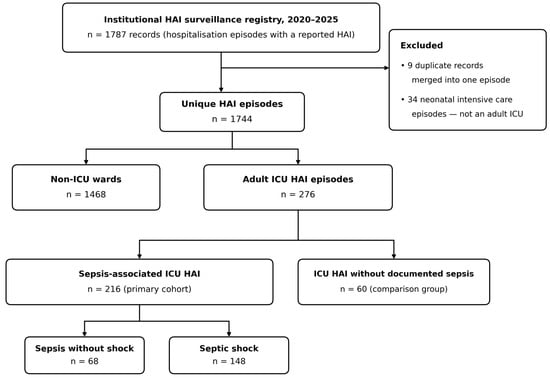
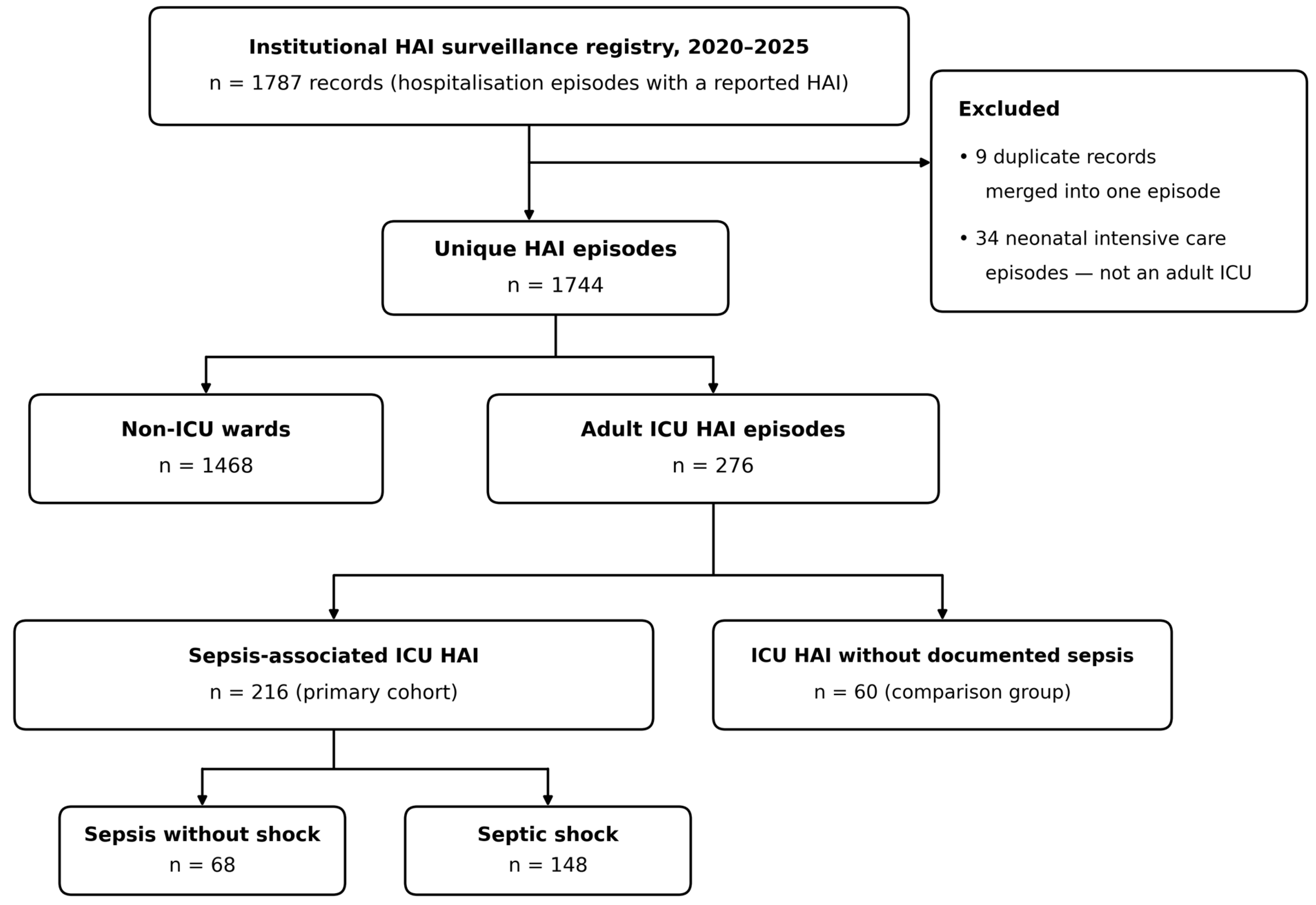
A retrospective, observational cohort study was undertaken using the institutional HAI surveillance registry of the Clinical Municipal Hospital in Timișoara, Romania. The study covered the period 1 January 2020–31 December 2025 and included hospitalisation episodes in which an HAI was diagnosed in an adult ICU. The participating units comprised the general ICU, the surgical–oncology ICU, the dedicated COVID-19 ICU and smaller ICU sub-units serving the obstetrics–gynaecology and otorhinolaryngology departments. At the registry level, five episodes involving admission in late 2019 and HAI diagnosis in 2020 were assigned to 2020. The study was reported according to the Strengthening the Reporting of Observational Studies in Epidemiology (STROBE) recommendations for cohort studies. The study flowchart is presented in Figure 1.
Figure 1.
Study flowchart.
2.2. Data Collection
Data were obtained from the institutional HAI surveillance registry maintained by the infection prevention and control department. HAI episodes were reported by the treating department. Each record corresponded to a hospitalisation episode with a reported HAI. The collected database included demographic characteristics, admission and discharge dates, the department at HAI diagnosis, dates of the first positive specimen and HAI diagnosis, ICD-10 discharge diagnoses, free-text discharge summaries, clinical flags, laboratory values, microbiological findings, antimicrobial susceptibility results and in-hospital outcome. Clinical flags included sepsis status, COVID-19, admission through the emergency department, invasive mechanical ventilation, device-associated infection, urinary catheter-associated infection, surgery-associated infection, positive blood cultures and screening swabs.
The Charlson comorbidity index was derived from ICD-10 discharge diagnoses.
SARS-CoV-2 records were excluded from the microbiological analysis. Screening swab isolates were classified as colonisation and analysed separately. Repeated records of the same organism group within an episode were reduced to the first recorded isolate. Susceptibility results were consolidated across repeated records: an organism was considered susceptible to an agent when any corresponding isolate within the episode was recorded as susceptible, and a resistance phenotype flag was retained when present in any corresponding isolate. Polymicrobic episodes were defined by the presence of at least two distinct organism groups.
Analyses were restricted to organism-specific standard testing panels, with intrinsic resistance rules applied. For selectively tested agents, including tigecycline, colistin, ceftazidime–avibactam, ceftolozane–tazobactam, cefiderocol, fosfomycin and nitrofurantoin, results were attributed to an organism only when no other organism within the episode included that agent in its testing panel.
Carbapenem resistance was defined as non-susceptibility to meropenem, imipenem or ertapenem for Enterobacterales, and to meropenem or imipenem for non-fermenting Gram-negative bacteria. Extended-spectrum β-lactamase production was identified from the corresponding registry flag.
Multidrug resistance was defined according to the Magiorakos [18] criteria as non-susceptibility to at least one agent in three or more antimicrobial categories among isolates tested in at least three categories. Difficult-to-treat resistance was defined as non-susceptibility to all tested carbapenems, other β-lactams and fluoroquinolones, with testing available in each category [19]. The composite multidrug-resistant organism (MDRO) variable included carbapenem-resistant Gram-negative organisms, extended-spectrum β-lactamase-producing Enterobacterales, methicillin-resistant Staphylococcus aureus, vancomycin-resistant enterococci and isolates flagged as resistant to all tested agents.
Organism identification and antimicrobial susceptibility testing were performed using the VITEK 2 system (bioMérieux, Marcy-l’Étoile, France), supplemented by broth microdilution using Sensititre (Thermo Fisher Scientific, Waltham, MA, USA) for selected agents. Results were interpreted according to the EUCAST breakpoints applicable in the corresponding year [20].
2.3. Inclusion and Exclusion Criteria
The main cohort included adult (aged ≥18 years) hospitalisation episodes recorded in the institutional HAI surveillance registry for the study period in which the HAI was diagnosed in an adult ICU. Both sepsis-associated episodes and episodes without documented sepsis were eligible. Neonatal intensive care episodes were excluded from the adult ICU analysis, and non-ICU episodes were analysed separately as a reference population.
Episodes with an undetermined in-hospital outcome were excluded from outcome analyses but retained for other applicable analyses. Non-adult ICU patients were also excluded.
2.4. Statistical Workflow
Data analysis was performed using Python 3.11 (Python Software Foundation, Beaverton, OR, USA), with pandas 2.3, SciPy 1.15, statsmodels 0.15 and lifelines 0.30. Categorical variables were described using absolute frequencies and percentages, while continuous variables were summarised using medians and interquartile ranges. Comparisons of categorical variables were performed using the chi-square test, Fisher’s exact test or Monte Carlo permutation testing. Continuous variables were compared using the Mann–Whitney U test or the Kruskal–Wallis test, as appropriate. Proportions were reported with Wilson 95% confidence intervals.
Associations with mortality were explored through univariable comparisons and multivariable logistic regression. In the whole ICU cohort, clinically prespecified covariates included sepsis grade, age, sex, invasive mechanical ventilation, Charlson comorbidity index ≥3, COVID-19, Gram-negative/carbapenem-resistance status, Candida isolation and study period. The model restricted to sepsis-associated episodes included septic shock versus sepsis without shock, age, invasive mechanical ventilation, Gram-negative/carbapenem-resistance status, Candida isolation and study period. Age was modelled per 10-year increase. Results were expressed as adjusted odds ratios with 95% confidence intervals, and model discrimination was assessed using the area under the receiver operating characteristic curve. Model fit was examined with the Hosmer–Lemeshow test and collinearity with variance inflation factors; overfitting was quantified by bootstrap internal validation (2000 resamples), which provided optimism-corrected estimates of the area under the curve and of the calibration slope. Because fewer than 10 outcome events per estimated parameter were available in the smaller outcome category, the logistic models were additionally re-estimated with Firth’s penalised likelihood as a sensitivity analysis.
Time to event was measured from HAI diagnosis, or from the first positive specimen when the diagnosis date was unavailable, to discharge or death. Same-day events were assigned a duration of 0.5 day. The cumulative incidence of in-hospital death was estimated using the Aalen–Johansen estimator, with discharge alive treated as a competing event. Cause-specific Cox proportional hazards models were fitted to examine the hazard of death, with discharge alive censored, and results were expressed as hazard ratios with 95% confidence intervals. The proportional hazards assumption was verified with the Grambsch–Therneau test based on scaled Schoenfeld residuals, and the concordance index was corrected for optimism by bootstrap resampling.
Missing data were not imputed, and the available denominators were reported for each analysis. All probability values were two-tailed, and p-values below 0.05 were considered statistically significant.
2.5. Ethics
The study was approved by the Ethics Committee of the Clinical Municipal Hospital from Timisoara (approval No. E-281/approval date 22 January 2026) and conducted in accordance with the Declaration of Helsinki. The database was de-identified before conducting the statistical analysis. Considering the retrospective study design and the use of anonymised surveillance data, the requirement for individual informed consent was waived.
3. Results
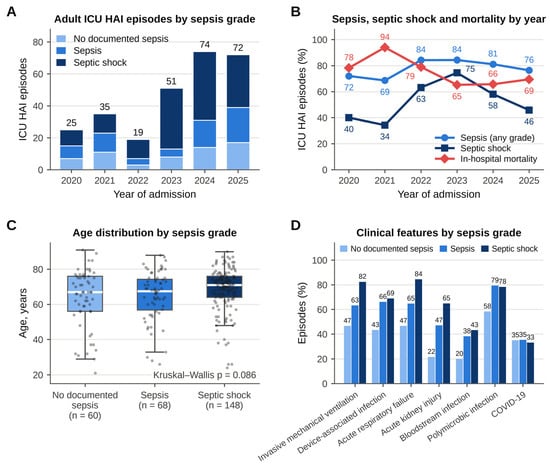
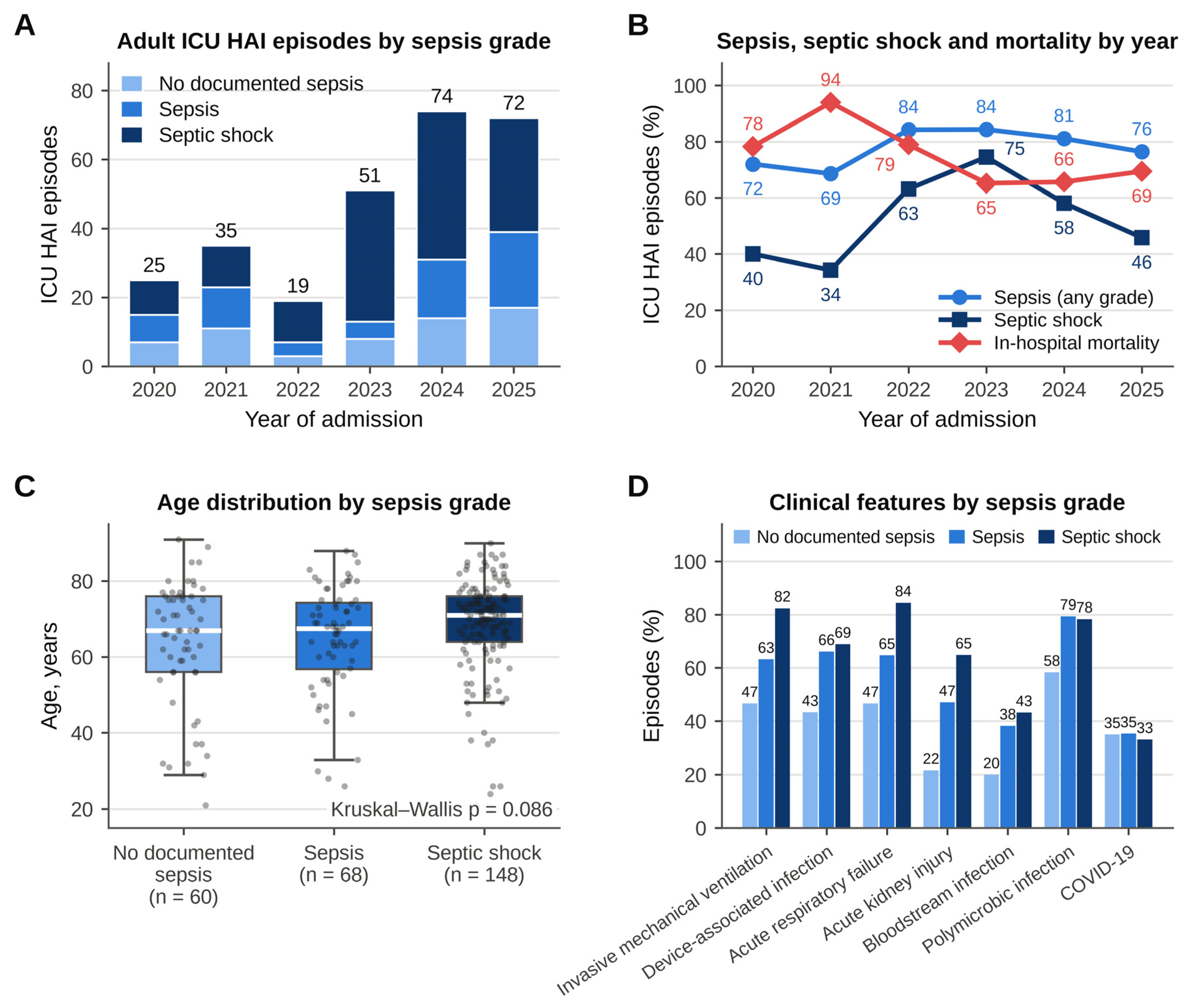
The registry contained 1787 records, corresponding to 1744 unique HAI episodes after merging nine duplicate records. The number of ICU HAI episodes recorded per year rose from 25 in 2020 and 19 in 2022 to 74 in 2024 and 72 in 2025, so that 197 episodes (71.4%) belonged to the 2023–2025 period (Figure 2).
Figure 2.
Temporal and clinical profile of adult ICU HAI episodes, 2020–2025. (A) Number of episodes per year of admission by sepsis grade; (B) proportion of episodes with any sepsis, with septic shock and in-hospital mortality among episodes with known outcome, by year; (C) age distribution by sepsis grade (boxes, median and interquartile range; dots, individual episodes); (D) frequency of key clinical features by sepsis grade. ICU, intensive care unit; HAI, healthcare-associated infection.
Sepsis was documented in 216 ICU episodes (78.3%): 148 (53.6% of all ICU episodes, 68.5% of sepsis-associated episodes) as septic shock and 68 (24.6%) as sepsis without shock; 60 episodes (21.7%) had no documented sepsis. The proportion of ICU episodes with sepsis did not change significantly over the study period (72.0% in 2020, 84.3% in 2023, 76.4% in 2025; p for trend = 0.385), whereas the share of septic shock peaked at 74.5% in 2023 and declined to 45.8% in 2025 (p for trend = 0.300) (Figure 2). ICU episodes represented 29.7% of the 728 sepsis-associated HAI episodes of the whole registry; the remaining 512 non-ICU sepsis-associated episodes, predominantly from medical (n = 191), haematology–oncology (n = 158) and surgical wards (n = 114), served as a reference group.
The median age of ICU patients was 69 years (interquartile range [IQR] 61–75; range 21–91) and 45.3% were women (Table 1). Patients with septic shock were older (median 71 versus 67–68 years; 43.9% aged 65–74 years) and more often men (64.2% versus 41.7–45.6%; p = 0.003) and were more frequently treated in the surgical–oncology ICU (37.2%; p = 0.021). The Charlson comorbidity index increased with sepsis grade (median 1, 2 and 3; p = 0.030), driven largely by diabetes mellitus (21.7%, 19.1% and 36.5%; p = 0.012), with non-significant gradients for heart failure, atrial fibrillation and cerebrovascular disease. About one third of episodes in each group occurred in patients with COVID-19 during the admission (34.1% overall), and one fifth in patients admitted for trauma. Invasive mechanical ventilation was recorded in 69.9% of ICU episodes overall and in 46.7%, 63.2% and 82.4% of episodes without documented sepsis, with sepsis and with septic shock, respectively (p < 0.001); the corresponding proportions for device-associated infection were 43.3%, 66.2% and 68.9% (p = 0.002). All infections were of hospital onset (97.5% diagnosed more than 48 h after admission), with a median of 9 days (IQR 5–14) from admission to HAI diagnosis that did not differ by grade. Sepsis-associated episodes generated more microbiological sampling (median six versus four cultures per episode; p < 0.001). Hospital stay was longest in patients with sepsis without shock (median 24 days) and shortest in the other two groups (17 days; p = 0.012), and the median interval between HAI diagnosis and discharge or death was 8, 11 and 7 days, respectively.
Table 1.
Characteristics of ICU HAI episodes by sepsis grade. Values are n (%) or median (interquartile range); p-values from the chi-square or Fisher exact test (categorical) and the Kruskal–Wallis test (continuous). ICU, intensive care unit; HAI, healthcare-associated infection.
Organ dysfunction and clinical foci by-group comparisons are shown in Table 2. Acute respiratory failure was present in 46.7%, 64.7% and 84.5% of episodes without documented sepsis, with sepsis and with septic shock (p < 0.001), acute kidney injury in 21.7%, 47.1% and 64.9% (p < 0.001) and coagulopathy or disseminated intravascular coagulation in 13.3%, 25.0% and 30.4% (p = 0.037). Pneumonia was the leading clinical focus in the sepsis groups (64.7% and 68.2% versus 38.3%; p < 0.001), whereas skin and soft tissue infections, mostly deep cervico-facial infections managed in the ICU, clustered in the sepsis without shock group (32.4%; p = 0.017). Laboratory values recorded in the registry mirrored these findings: serum creatinine (median 0.96, 1.18 and 1.54 mg/dL; p < 0.001) and urea (40, 50 and 61 mg/dL; p < 0.001) rose across grades, a creatinine ≥ 2.0 mg/dL was present in 10.7%, 16.7% and 33.8% of episodes (p < 0.001). The INR (1.10, 1.14 and 1.16; p = 0.015), potassium (3.9, 3.9 and 4.3 mmol/L; p < 0.001) and procalcitonin (0.19, 0.50 and 0.51 ng/mL; p = 0.031) were also higher in sepsis and septic shock. C-reactive protein (median 65–72 mg/L), white blood cell counts and platelet counts did not differ significantly between groups, and thrombocytopenia below 100 × 109/L was uncommon (5–13%).
Table 2.
Organ dysfunction, clinical foci and laboratory profile of adult ICU HAI episodes by sepsis grade. Values are n (%) or median (interquartile range). ARDS, acute respiratory distress syndrome; INR, international normalised ratio; AST, aspartate aminotransferase; ALT, alanine aminotransferase.
A specific pathogen was documented in 270 of the 276 ICU episodes (97.8%) and in 212 of the 216 sepsis-associated episodes (98.1%). The sepsis-associated episodes generated 761 organism records, which were consolidated into 571 first clinical isolates per organism group and episode. Infection was polymicrobic in 78.7% of sepsis-associated episodes (median two organism groups, IQR 2–4; four or more organisms in 25.5%), compared with 58.3% of episodes without documented sepsis (p = 0.006), and isolates were recovered from two or more anatomical sites in 45.4% of sepsis-associated episodes (Table 3).
Table 3.
Infection sites, pathogens and documented resistance phenotypes at the episode level in adult ICU HAI episodes by sepsis grade. Values are n (%) of episodes with at least one first clinical isolate with the characteristic; screening swab isolates are excluded except in the last row. MDRO, multidrug-resistant organism (carbapenem-resistant Gram-negative, ESBL-producing Enterobacterales, MRSA, vancomycin-resistant enterococci or isolate resistant to all tested agents). Carbapenem resistance of E. coli was evaluated only in episodes in which E. coli was the sole Gram-negative organism.
The lower respiratory tract was the dominant site: respiratory specimens accounted for 47.1% of sepsis-associated isolates, and 63.9% of sepsis-associated episodes had at least one respiratory isolate, against 41.7% of episodes without documented sepsis (p = 0.008). A positive blood culture or a registry-recorded bacteraemia was present in 41.7% of sepsis-associated episodes versus 20.0% (p = 0.007), but coagulase-negative staphylococci represented 43 of the 78 blood culture isolates (55.1%), so that bloodstream infection with an organism other than coagulase-negative staphylococci was documented in only 15.3% of sepsis-associated episodes. Among the other blood culture isolates, K. pneumoniae (n = 9), Enterococcus faecalis (n = 5), A. baumannii (n = 4) and Candida spp. (n = 4) were the most frequent; 13 of the 15 Gram-negative bloodstream isolates with an evaluable phenotype were carbapenem-resistant. Urinary (17.6%), wound or soft tissue (21.3%), catheter-related (8.8%) and intra-abdominal (2.8%) isolates were less frequent, and Clostridioides difficile infection was documented in 9.3% of sepsis-associated episodes, less often than in episodes without documented sepsis (20.0%; p = 0.033).
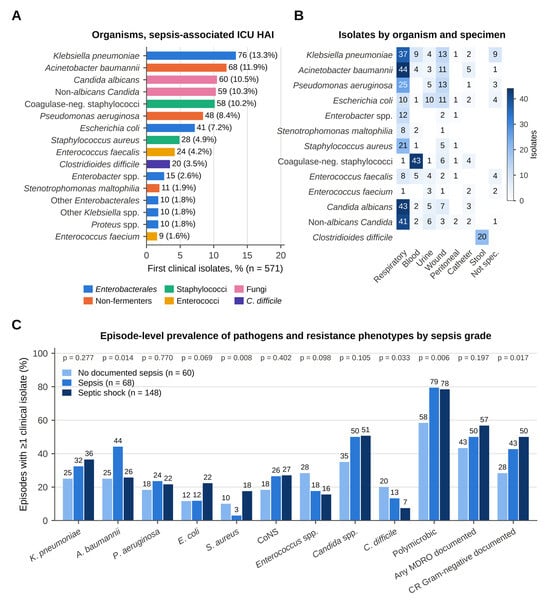
Gram-negative bacteria represented 51.3% of the 571 sepsis-associated isolates, Gram-positive bacteria 22.9% and fungi 21.2% (Figure 3). K. pneumoniae (n = 76, 13.3%) and A. baumannii (n = 68, 11.9%) were the leading organisms, followed by Candida albicans (n = 60, 10.5%), non-albicans Candida spp. (n = 59, 10.3%; C. glabrata n = 20, C. parapsilosis n = 6, C. kefyr n = 6, C. tropicalis n = 4, C. krusei n = 4), coagulase-negative staphylococci (n = 58, 10.2%), P. aeruginosa (n = 48, 8.4%), Escherichia coli (n = 41, 7.2%), Staphylococcus aureus (n = 28, 4.9%), E. faecalis (n = 24, 4.2%) and C. difficile (n = 20, 3.5%). Together, K. pneumoniae, A. baumannii and P. aeruginosa accounted for one third (33.6%) of all isolates and were present in 64.8% of sepsis-associated episodes. The organism–specimen matrix (Figure 3) shows the concentration of A. baumannii (44 of 68 isolates), Candida spp. (84 of 119), K. pneumoniae (37 of 76) and S. aureus (21 of 28) in respiratory specimens, of coagulase-negative staphylococci in blood cultures (43 of 58) and the broad distribution of K. pneumoniae, P. aeruginosa and E. coli across respiratory, wound and urinary specimens.
Figure 3.
Microbiology of sepsis-associated ICU HAI (n = 216 episodes, 571 first clinical isolates). (A) Distribution of organism groups among first clinical isolates, coloured by taxonomic family; (B) number of isolates by organism and specimen type; (C) episode-level prevalence of pathogens, polymicrobic infection and documented resistance phenotypes by sepsis grade, with p-values from the chi-square or Fisher exact test across the three grades. CoNS, coagulase-negative staphylococci; MDRO, multidrug-resistant organism; CR, carbapenem-resistant.
A Gram-negative pathogen was isolated in 77.9% and 78.4% of sepsis and septic shock episodes versus 58.3% of episodes without documented sepsis (p = 0.008). A. baumannii was most frequent in sepsis without shock (44.1% versus 25.0% and 25.7%; p = 0.014), whereas S. aureus (17.6%; p = 0.008), E. coli (22.3%; p = 0.069) and K. pneumoniae (36.5%) were most frequent in septic shock. Candida spp. was isolated in half of the sepsis-associated episodes (50.5%), with bacterial–fungal co-isolation in 45.8%. The organism distribution of sepsis-associated and non-septic ICU episodes was otherwise similar, C. difficile being the only organism significantly more frequent among the no documented sepsis group.
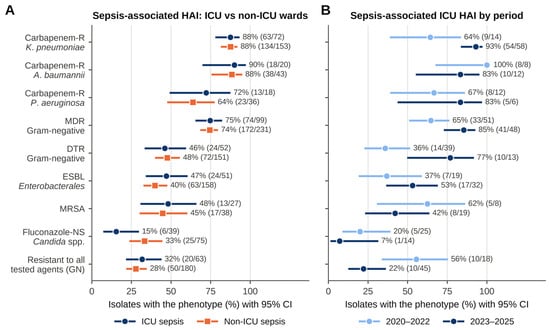
Antibiotic-level susceptibility results were available for 94.2% of sepsis-associated isolates from admissions. Carbapenem resistance was documented in 87.5% (63/72) of K. pneumoniae, 90.0% (18/20) of A. baumannii and 72.2% (13/18) of P. aeruginosa isolates with an evaluable phenotype, and in 84.6% (11/13) of Enterobacter spp. (Table 4). Estimates restricted to antibiotic-level results (78% for K. pneumoniae, 90% for A. baumannii, 72% for P. aeruginosa) or to isolates that were the only Gram-negative organism of their episode, in which attribution of results is unambiguous (22/23, 7/8 and 3/5, respectively), were concordant, and in the whole registry the carbapenem-resistance flag agreed with the antibiotic-level result in 91.8% of the 158 K. pneumoniae isolates with both (κ = 0.56). For E. coli, in contrast, the naive estimate (29/39) collapsed to five of nine isolates when the analysis was restricted to unambiguous cases, and carbapenem resistance in this species could not be estimated reliably. According to the Magiorakos criteria, 74.7% (74/99) of evaluable Gram-negative isolates were multidrug-resistant (K. pneumoniae 82.4%, A. baumannii 92.9%, P. aeruginosa 77.8%), and 46.2% (24/52) met the definition of difficult-to-treat resistance, including 66.7% (14/21) of K. pneumoniae. The registry flag “resistant to all tested agents” was carried by 31.7% (20/63) of Gram-negative isolates with the flag recorded. Among Gram-positive organisms, methicillin resistance was documented in 48.1% (13/27) of S. aureus and 73.9% (17/23) of coagulase-negative staphylococci, and vancomycin resistance in four of seven evaluable E. faecium isolates. Fluconazole non-susceptibility affected 15.4% (6/39) of Candida isolates and 36.4% (4/11) of non-albicans Candida.
Table 4.
First clinical isolates from sepsis-associated ICU HAI episodes: distribution by specimen type and documented resistance phenotypes. CR, carbapenem-resistant; MDR, multidrug-resistant (Magiorakos criteria, non-susceptibility to ≥1 agent in ≥3 antimicrobial categories among isolates with ≥3 categories tested); DTR, difficult-to-treat resistance (non-susceptibility to all tested carbapenems, other β-lactams and fluoroquinolones); ESBL, extended-spectrum β-lactamase; MRSA, methicillin-resistant S. aureus; VRE, vancomycin-resistant enterococci.
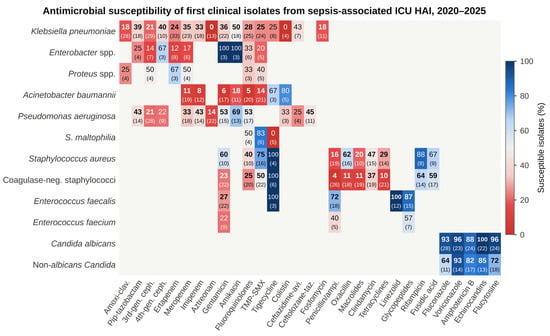
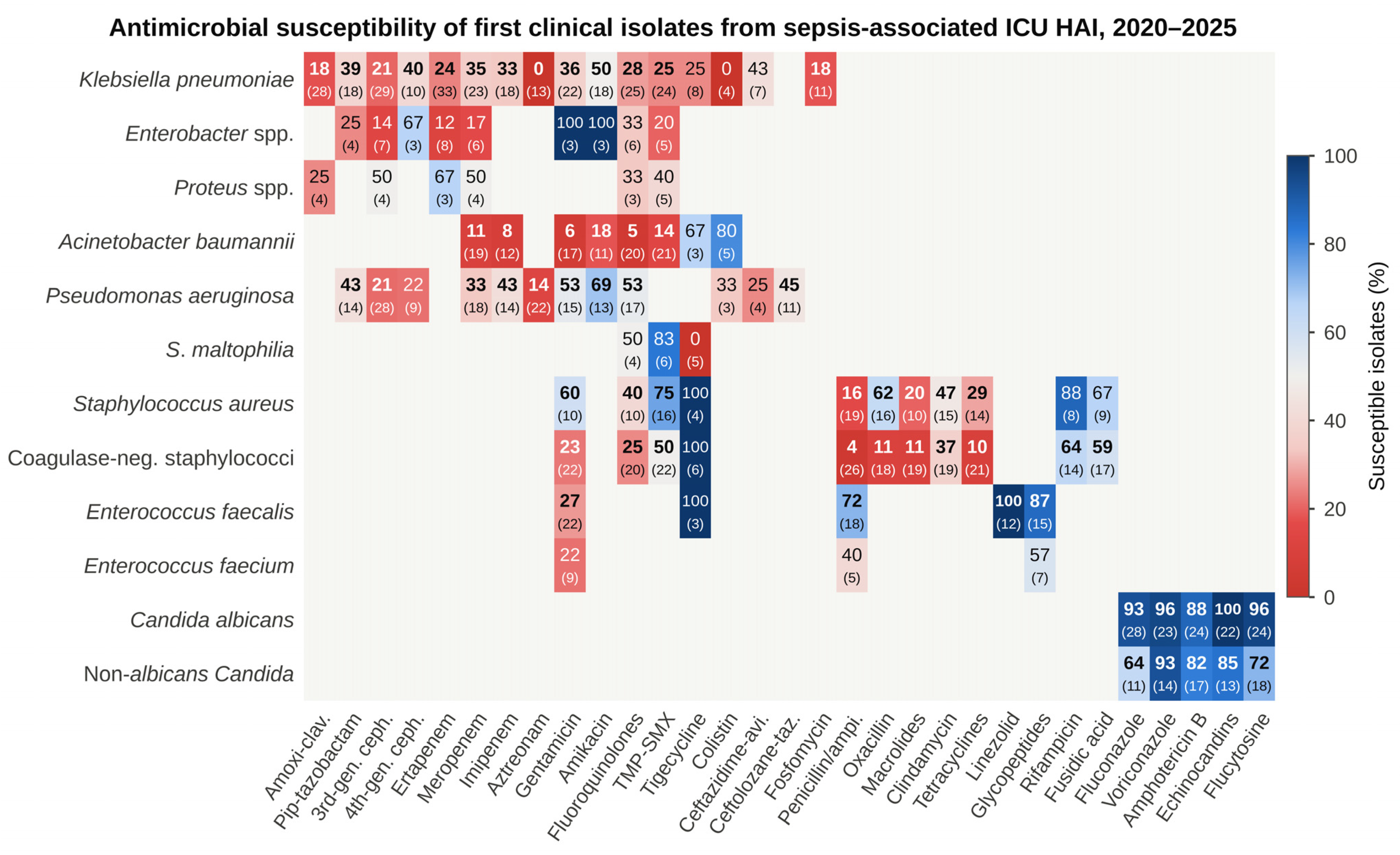
The full susceptibility profiles are shown in Figure 4. K. pneumoniae was susceptible to meropenem in 35% (8/23), to imipenem in 33%, to ertapenem in 24%, to piperacillin–tazobactam in 39%, to third-generation cephalosporins in 21%, to fluoroquinolones in 28%, to trimethoprim–sulfamethoxazole in 25%, to gentamicin in 36% and to amikacin in 50% (9/18) of tested isolates; among isolates tested for last-line agents, three of seven were susceptible to ceftazidime–avibactam, two of eight to tigecycline, two of 11 to fosfomycin and none of four to colistin. A. baumannii was susceptible to meropenem in 11% (2/19), to imipenem in 8%, to aminoglycosides in 6–18%, to fluoroquinolones in 5% and to trimethoprim–sulfamethoxazole in 14%, with colistin (4/5) and tigecycline (2/3) as the only agents retaining activity in the few isolates tested. P. aeruginosa retained susceptibility to amikacin in 69% (9/13), to gentamicin and fluoroquinolones in 53%, to ceftolozane–tazobactam in 45% (5/11), to imipenem in 43%, to piperacillin–tazobactam in 43% and to meropenem in 33% (6/18), but to ceftazidime in only 21%. Among S. aureus isolates, 62% (10/16) were susceptible to oxacillin, 75% to trimethoprim–sulfamethoxazole, 88% to rifampicin and 47% to clindamycin, and all four isolates tested were susceptible to tigecycline; coagulase-negative staphylococci were susceptible to oxacillin in 11%. E. faecalis was susceptible to ampicillin in 72%, to glycopeptides in 87% and to linezolid in 100%, whereas E. faecium was susceptible to ampicillin in two of five and to glycopeptides in four of seven isolates. C. albicans was almost uniformly susceptible to fluconazole (93%), voriconazole (96%), amphotericin B (88%) and echinocandins (100%), whereas non-albicans Candida spp. were susceptible to fluconazole in 64% (7/11), to echinocandins in 85% (11/13) and to amphotericin B in 82% (14/17).
Figure 4.
Antimicrobial susceptibility of first clinical isolates from sepsis-associated ICU HAI episodes, 2020–2025. Cells show the percentage of susceptible isolates (bold when ≥10 isolates were tested) and, in parentheses, the number of isolates tested; only combinations with at least three tested isolates are shown. TMP-SMX, trimethoprim–sulfamethoxazole.
Resistance phenotypes in sepsis-associated ICU episodes were compared with those of sepsis-associated HAI in non-ICU wards and between periods (Figure 5). Carbapenem resistance in K. pneumoniae (87.5% versus 87.6%), A. baumannii (90.0% versus 88.4%) and P. aeruginosa (72.2% versus 63.9%), multidrug resistance (74.7% versus 74.5%), difficult-to-treat resistance (46.2% versus 47.7%) and methicillin resistance in S. aureus (48.1% versus 44.7%) did not differ between settings; methicillin resistance in coagulase-negative staphylococci was higher in the ICU (73.9% versus 42.5%; p = 0.016), whereas fluconazole non-susceptibility of Candida spp. was lower (15.4% versus 33.3%; p = 0.041). Within the ICU, carbapenem resistance in K. pneumoniae rose from 64.3% (9/14) in 2020–2022 to 93.1% (54/58) in 2023–2025 (p = 0.011), with parallel increases in carbapenem-resistant Enterobacterales overall (57.7% to 87.2%; p = 0.002), multidrug-resistant Gram-negatives (64.7% to 85.4%; p = 0.018) and difficult-to-treat Gram-negatives (35.9% to 76.9%; p = 0.010), while carbapenem resistance in A. baumannii (100% and 83.3%) and P. aeruginosa (66.7% and 83.3%) remained at high levels. In the whole ICU population, the annual proportion of episodes involving K. pneumoniae (p for trend = 0.006) and A. baumannii (p = 0.022) increased over the study period, and between 2020 and 2022 and 2023–2025 the episode-level prevalence of K. pneumoniae (24.1% to 39.2%; p = 0.039) and A. baumannii (15.5% to 37.3%; p = 0.002) in sepsis-associated episodes rose as COVID-19 receded (86.2% to 14.6%; p < 0.001).
Figure 5.
Resistance phenotypes of first clinical isolates (percentage with 95% Wilson confidence interval; numbers are phenotype-positive/evaluable isolates). (A) Sepsis-associated HAI in the ICU versus non-ICU wards; (B) sepsis-associated ICU HAI in 2020–2022 versus 2023–2025. R, resistant; MDR, multidrug-resistant; DTR, difficult-to-treat resistance; ESBL, extended-spectrum β-lactamase; MRSA, methicillin-resistant S. aureus; NS, non-susceptible; GN, Gram-negative.
Thirty six isolates from screening swabs were recovered in 33 ICU episodes (S. aureus n = 15, of which 14 methicillin-resistant; E. coli n = 5; Candida spp. n = 7; K. pneumoniae, P. aeruginosa and A. baumannii n = 8 together, of which eight carbapenem-resistant). A positive screening swab was documented more often in episodes without sepsis or with sepsis without shock (18.3% and 16.2%) than in septic shock (7.4%; p = 0.042).
The in-hospital outcome was recorded in the registry for 227 ICU episodes (82.2%) and could be established from the discharge summary for a further 33 (death documented in 11, survival in 22), leaving 16 episodes (5.8%) with an undetermined outcome. Among the 260 episodes with a known outcome, 188 patients died (72.3%; 95% confidence interval [CI] 66.6–77.4). Mortality increased steeply with sepsis grade: 43.1% (22/51) without documented sepsis, 72.3% (47/65) with sepsis and 82.6% (119/144) with septic shock (p < 0.001), i.e., 79.4% (166/209) for sepsis-associated episodes overall (Table 5). Estimates based on the registry field alone (78.0% overall; 47.6%, 76.4% and 88.5% by grade) and under the extreme assumptions that all undetermined outcomes were deaths (73.9%) or survivals (68.1%) were similar.
Table 5.
Predictors of in-hospital death in adult ICU HAI episodes: multivariable logistic regression (adjusted odds ratios) in the whole ICU cohort and in sepsis-associated episodes, and cause-specific Cox regression for the hazard of death after HAI diagnosis (discharge alive censored) in the whole ICU cohort. GN, Gram-negative; CR, carbapenem-resistant; AUC, area under the receiver operating characteristic curve.
Death occurred a median of 6 days (IQR 2–16) after the HAI diagnosis and discharge alive after 11 days (IQR 7–20). Accounting for discharge alive as a competing event, the cumulative incidence of in-hospital death at 7, 14 and 28 days after HAI diagnosis was 20.8%, 29.2% and 41.7% in episodes without documented sepsis, 37.7%, 42.6% and 60.7% in sepsis and 45.0%, 58.0% and 74.0% in septic shock, reaching 82.4% at 60 days in the latter group (Figure S1; log-rank p = 0.015 across grades, p = 0.033 for septic shock versus sepsis). Among sepsis-associated episodes, 44.3% (85/192) of patients had died within 7 days and 70.3% (135/192) within 28 days of the HAI diagnosis.
Within the sepsis-associated cohort, mortality was associated in univariable analysis with age (65.0%, 69.6%, 86.7% and 81.7% in patients aged 18–49, 50–64, 65–74 and ≥75 years; p = 0.042), invasive mechanical ventilation (88.3% versus 47.8%; p < 0.001), acute kidney injury (88.0% versus 66.7%; p < 0.001), COVID-19 (87.3% versus 75.4%; p = 0.043) and the 2020–2022 period (92.9% versus 74.5%; p = 0.004), and inversely with surgery during the admission (68.5% versus 83.2%; p = 0.021). Bloodstream infection (85.9% versus 75.0%; p = 0.056) showed a borderline association, and mortality was 100% in the four patients with candidaemia and 89.5% (17/19) in patients with Gram-negative bacteraemia. Neither sex, ICU unit, Charlson index, individual pathogens, thrombocytopenia, renal or inflammatory laboratory thresholds nor lymphopenia was significantly associated with death, although non-survivors were older (median 70 versus 66 years; p = 0.030), had a shorter stay (18 versus 25 days; p = 0.004), fewer cultures (six versus nine; p = 0.012) and lower white blood cell counts (11.1 versus 15.9 × 10⁹/L; p = 0.054) than survivors.
Mortality was 72.4% when a carbapenem-resistant Gram-negative organism was documented, 81.8% when Gram-negative organisms were isolated without documented carbapenem resistance and 91.1% when no Gram-negative organism was isolated (p = 0.032); it was 73.5% versus 86.5% with and without any documented multidrug-resistant organism (p = 0.020) and 76.4% versus 90.9% in polymicrobic versus monomicrobic episodes (p = 0.034). This pattern was linked to the timing of death: among non-survivors, the median interval from HAI diagnosis to death was 4 days (IQR 1–7) when no Gram-negative organism had been isolated, 7 days (IQR 3–16) when Gram-negative organisms without documented resistance were isolated and 11 days (IQR 2–26) when carbapenem resistance had been documented (Figure S2), and the 54 patients who died within 3 days of the HAI diagnosis (32.5% of all deaths) had fewer cultures (median four versus seven) and fewer distinct organisms (median two versus three) than the other patients.
The adjusted odds ratios of the two logistic models are displayed as forest plots in Figures S3 and S4, and the checks of model quality are summarised in Table S1. The Hosmer–Lemeshow test did not indicate lack of fit for the logistic model of the whole ICU cohort (p = 0.437) or for the model restricted to sepsis-associated episodes (p = 0.211), and the largest variance inflation factor was 2.2. With 6.5 and 6.1 outcome events per estimated parameter (72 and 43 survivors for 11 and seven parameters, respectively), a moderate degree of overfitting was present: after bootstrap correction for optimism, the AUC decreased from 0.87 to 0.84 and from 0.86 to 0.84, and the calibration slopes were 0.83 and 0.85. Re-estimation with Firth’s penalised likelihood gave slightly attenuated estimates without changing the direction or the statistical significance of any association (Table S2); for example, the adjusted odds ratio of invasive mechanical ventilation in the whole ICU cohort was 9.34 (95% CI 4.56–20.01) and that of a documented carbapenem-resistant Gram-negative organism 0.36 (95% CI 0.15–0.82). For the Cox model (15.5 deaths per estimated parameter), the proportional hazards assumption was not rejected (global test, p = 0.502) and the optimism-corrected concordance index was 0.66.
Compared with the 512 sepsis-associated HAI episodes in non-ICU wards, ICU episodes involved patients of similar age and sex but with a lower comorbidity burden (median Charlson index 2 versus 3; p = 0.003; malignancy 22.7% versus 40.8%; p < 0.001), more often presented as septic shock (68.5% versus 46.5%; p < 0.001), were far more often ventilated (83.3% versus 47.7%) and device-associated (68.1% versus 48.2%; both p < 0.001), and were diagnosed later after admission (median 8 versus 6 days; p < 0.001). ICU episodes were more frequently polymicrobic (78.7% versus 62.5%; p < 0.001) and respiratory (63.9% versus 27.0%; p < 0.001), and more often involved A. baumannii (31.5% versus 19.3%), P. aeruginosa (22.2% versus 11.7%), S. aureus (13.0% versus 7.4%), coagulase-negative staphylococci (26.9% versus 17.4%) and Candida spp. (50.5% versus 30.5%), whereas C. difficile dominated in the wards (29.7% versus 9.3%; all p ≤ 0.017); the prevalence of K. pneumoniae (35.2% versus 31.2%), of any documented multidrug-resistant organism (54.6% versus 52.3%) and of carbapenem-resistant Gram-negatives (47.7% versus 44.5%) was similar. In-hospital mortality of sepsis-associated HAI was 79.4% in the ICU versus 56.0% in non-ICU wards (p < 0.001).
4. Discussion
In this six-year cohort from the adult ICUs of a Romanian tertiary emergency hospital, sepsis was documented in nearly four of five hospital-acquired infections and septic shock in more than half. Sepsis-associated HAI was a late event (median 8 days after admission) in ventilated, elderly and comorbid patients, was polymicrobic in 79% of episodes and was dominated by carbapenem-resistant K. pneumoniae and A. baumannii, P. aeruginosa and Candida spp. in the lower respiratory tract, with bloodstream involvement in two fifths of episodes. In-hospital mortality was 72% for sepsis, 83% for septic shock and 79% overall, and three quarters of patients with septic shock had died within 28 days of the HAI diagnosis. Age, sepsis grade and invasive ventilation, of the infecting organisms, independently predicted death, whereas documented carbapenem resistance was not associated with higher mortality. To our knowledge, this is the first Romanian cohort to link the microbiology and resistance of ICU-acquired infections to the clinical syndrome of sepsis, to organ dysfunction and to time-resolved outcomes.
4.1. Sepsis-Associated HAI as a Clinical Syndrome
The clinical profile of our patients is consistent with the international literature on ICU-acquired sepsis. In the meta-analysis by Markwart et al., hospital-acquired sepsis with organ dysfunction affected 56.5 of every 1000 ICU patients and killed 52.3% of them [3], and EUROBACT-2 reported a 28-day mortality of 37.1% for ICU hospital-acquired bloodstream infection, with only 16.1% of patients discharged alive by day 28 [8]. Our mortality figures are considerably higher, lie far above the pooled 30-day mortality of 34.7% for septic shock and 24.4% for sepsis reported for Europe, North America and Australia [21], and approach those reported for critically ill patients with carbapenem-resistant Acinetobacter infections in other Romanian centres, where 30-day mortality reached 73.1% in Târgu Mureș and in-hospital mortality 66% in Iași [16,17]. Several features of our cohort explain this excess. First, the study population is not all ICU patients with sepsis but the subset in whom sepsis complicated an HAI reported to infection control, i.e., patients who had already survived a median of 9 days of critical illness and in whom invasive ventilation (70%), acute respiratory failure (71%) and acute kidney injury (51%) were the rule; the 60 episodes without documented sepsis, whose mortality of 43% is itself very high, illustrate the frailty of this population. Second, the organ-dysfunction gradient across sepsis grades was steep and coherent: creatinine, urea, INR and procalcitonin rose with grade, and a creatinine of 2 mg/dL or more was three times more frequent in septic shock than in episodes without sepsis, indicating that the registry classification captured genuinely different degrees of severity.
Third, HAI surveillance in Romania is regulated by Ministerial Order 1101/2016, which mandates the investigation and reporting of HAI-related deaths [22]; this creates an ascertainment pressure toward fatal cases that was probably strongest in the early pandemic years, when only 19–35 ICU episodes per year were recorded and mortality reached 93%. The near tripling of reported ICU episodes after 2022 with a fall in mortality to 65–69% and in the share of “resistant to all tested agents” isolates suggests that the registry progressively captured less severe cases, an interpretation supported by the independent association of the 2023–2025 period with lower mortality in our models. This temporal pattern should therefore be read as a change in surveillance sensitivity superimposed at the end of the COVID-19 wave, which accounted for 86% of sepsis-associated ICU episodes in 2020–2022 but only 15% thereafter, rather than as a genuine improvement in the prognosis of ICU sepsis.
Invasive mechanical ventilation was the strongest predictor of death (aOR 11), an association that recurs in Romanian and international cohorts of resistant Gram-negative infections [17] and that reflects both the severity of the underlying illness and the ventilator-associated pneumonia that dominated our microbiology. Age increased the odds of death by about 55% per decade, in line with the 36% per decade reported for Acinetobacter infections in Târgu Mureș [16] and with the general sepsis literature [1,4]. Septic shock, in contrast, did not add prognostic information beyond sepsis once ventilation and age were accounted for, and the Charlson index and COVID-19 were not independent predictors. The latter finding does not deny the role of comorbidity but reflects the compression of risk in a population in which four of five patients die: in such a population, factors that separate survivors from non-survivors are mainly those that mark the acute trajectory (ventilation, renal failure, early death) rather than the baseline state. Bloodstream infection nearly tripled the adjusted odds of death in a secondary model and candidaemia was uniformly fatal, consistent with the excess mortality of ICU bloodstream infections of invasive [8,23] candidiasis in critically ill patients [24].
4.2. Pathogens and Resistance
The microbiology of sepsis-associated ICU HAI in our hospital reproduces, in concentrated form, the pattern described in other Romanian critical care units. In the Sibiu ICU, K. pneumoniae (36.8% of isolates) and A. baumannii (24.5%) dominated in 2024, with carbapenem resistance above 80% and 70%, respectively [11], and over four years K. pneumoniae and A. baumannii accounted for 42.8% and 36.0% of ESKAPE isolates, with a significant temporal increase in extensively drug-resistant strains [12,13]. Our carbapenem-resistance rates of 87.5% for K. pneumoniae, 90% for A. baumannii and 72% for P. aeruginosa match these figures and those of the Târgu Mureș Acinetobacter cohort (89.3% carbapenem non-susceptibility) [16], and they lie far above the national EARS-Net estimate of 50.3% for invasive K. pneumoniae [9], as expected for ICU-acquired infections. At the level of national surveillance of invasive isolates, a comparable pressure is documented in neighbouring Bulgaria, where the estimated incidence of carbapenem-resistant K. pneumoniae bloodstream infections reached 10.62 per 100,000 population in 2024 (20.31 in Romania), in contrast to Hungary (0.97 per 100,000), and carbapenem resistance in Acinetobacter spp. was 50% or higher in almost half of the reporting European countries, mostly in southern and eastern Europe [9,10]. Whether these pathogens dominate sepsis-associated ICU HAI in neighbouring countries to the same extent cannot be established from surveillance data on invasive isolates and deserves dedicated multicentre studies. Two aspects deserve emphasis. First, the rise of carbapenem resistance in K. pneumoniae from 64% in 2020–2022 to 93% in 2023–2025, together with the parallel increase of difficult-to-treat Gram-negatives from 36% to 77%, reproduces in the ICU the post-pandemic trajectory that we described for the whole hospital and that others have reported nationally [13,14,15]. Second, the resistance phenotypes of ICU and non-ICU sepsis-associated HAI were indistinguishable: carbapenem resistance in K. pneumoniae was 87.5% in both settings and multidrug and difficult-to-treat resistance did not differ, showing that the ICU is not an isolated reservoir but the most severe expression of a hospital-wide endemic of carbapenemase-producing Enterobacterales and carbapenem-resistant non-fermenters.
The therapeutic implications are stark. Among K. pneumoniae isolates from sepsis-associated ICU episodes, no conventional β-lactam retained susceptibility above 40%, amikacin was the only agent active in half of the isolates, and the few isolates tested against last-line agents were susceptible to ceftazidime–avibactam in three of seven, to tigecycline in two of eight and to colistin in none of four. These figures are consistent with the Romanian molecular epidemiology, in which more than half of carbapenem-resistant K. pneumoniae co-produce NDM and OXA-48-like carbapenemases and colistin and ceftazidime–avibactam resistance reach 70% and 76%, respectively, in Bucharest [14,15]. In such a setting, empirical therapy of ICU-acquired sepsis cannot rely on carbapenems or on ceftazidime–avibactam monotherapy, and international guidance favours cefiderocol or aztreonam–avibactam-based regimens for metallo-β-lactamase producers and reserves colistin for situations without alternatives [25,26]; the availability of rapid carbapenemase detection therefore becomes a precondition for rational treatment. A. baumannii retained susceptibility only to colistin and, partially, tigecycline, and P. aeruginosa to amikacin and, in fewer than half of the isolates, to ceftolozane–tazobactam, leaving sulbactam–durlobactam and cefiderocol as the main therapeutic hopes for these organisms [25,26]. The large contribution of Candida spp. (one fifth of isolates, half of the sepsis-associated episodes) is a further characteristic of this population, in which prolonged ventilation, broad-spectrum antibiotics and abdominal surgery converge; C. glabrata was the leading non-albicans species and fluconazole non-susceptibility in non-albicans isolates reached 36%, supporting echinocandin-based empirical therapy when invasive candidiasis is suspected [24]. Most respiratory Candida isolates in ventilated patients represent colonisation rather than infection, and their clinical weight should not be over-interpreted; however, the four candidaemias were all fatal.
4.3. Resistance, Ascertainment and the Interpretation of Mortality Models
The inverse association between documented carbapenem resistance and death is the most counterintuitive result of this study and warrants careful interpretation. We do not believe that it reflects a protective effect of resistance. Patients in whom no Gram-negative organism was isolated had the highest mortality and died a median of 4 days after the HAI diagnosis, patients with Gram-negative isolates without documented resistance died after a median of 7 days and patients with documented carbapenem resistance after 11 days, and the third of all deaths that occurred within 3 days of the diagnosis had fewer cultures and fewer isolates than later deaths. In a surveillance registry, the resistance phenotype can only be documented in patients who survive long enough for cultures to be obtained, organisms to be identified and susceptibility testing to be completed and transcribed, so that documented resistance is partly a marker of survival rather than a cause of death: a form of immortal-time and differential ascertainment bias to which any retrospective analysis of resistance and mortality based on surveillance data is exposed. Three further features reinforce this interpretation. First, the same inverse pattern was seen for every documentation-dependent variable (any multidrug-resistant organism, polymicrobic infection, K. pneumoniae and A. baumannii isolation) and for the number of cultures, which was higher in survivors. Second, the reference category of “Gram-negative infection without documented resistance” is heterogeneous, combining a small number of truly susceptible organisms (mortality 13/16) with a larger number of untested ones, so that the contrast is not a clean comparison of resistant versus susceptible infection. Third, in a setting in which nine of ten K. pneumoniae and A. baumannii isolates are carbapenem-resistant, empirical regimens are already built around the expectation of resistance, and the counterfactual of a susceptible infection treated with a carbapenem is nearly absent, which dilutes any resistance-attributable mortality. The landmark analyses, which removed early deaths, attenuated but did not abolish the association, as expected if the documentation gap extends beyond the first days. Our findings agree with the Romanian Acinetobacter cohorts, in which mortality did not differ between carbapenem-resistant and susceptible infections and initially active therapy was not associated with survival after adjustment for severity [16,17], and with the broader observation that in high-endemicity ICUs the excess mortality of resistance is mediated through delayed adequate therapy and severity rather than through the phenotype itself [8,23]. They also carry a methodological message: resistance–mortality analyses require isolate-level data with time stamps and treatment information, and surveillance registries that record only the “final” phenotype of an episode will systematically underestimate the harm of resistance in the sickest patients.
4.4. Implications for Practice and Surveillance
Three implications follow. First, because sepsis-associated HAI in this ICU is a late, ventilator-associated and largely untreatable syndrome, its prevention deserves priority over its treatment: adherence to ventilator and central line bundles, early weaning and extubation strategies, daily reassessment of devices, chlorhexidine and hand hygiene programmes and active screening for carriage of carbapenemase-producing organisms, which was documented in only 12% of our episodes, are the interventions with the largest expected effect [26,27]. Second, the antibiogram of the unit argues for institutional empirical protocols for ICU-acquired sepsis that anticipate carbapenemase production, for rapid molecular detection of carbapenemases and for stewardship of the last-line agents, whose consumption is rising nationally [15,25]. Third, the surveillance system itself needs strengthening: electronic linkage of the HAI registry with the laboratory information system would provide complete antibiograms, minimum inhibitory concentrations and sampling dates, allow standard first-isolate-per-patient reporting and enable incidence density estimates per 1000 ventilator- or patient-days, which were not available for this study [28,29].
4.5. Strengths and Limitations
The strengths of this study are its six-year span across the pandemic and post-pandemic periods, the inclusion of all adult ICUs of a large tertiary hospital, the systematic validation of the registry sepsis classification against coded and free-text clinical documentation, the linkage of microbiological data with organ dysfunction, laboratory values and outcomes at episode level, the use of competing-risk methods for time to death, and the explicit analysis of ascertainment bias, which we regard as a contribution in itself.
The registry is compiled by the infection prevention and control team from paper laboratory reports rather than exported from the laboratory information system. The registry codes susceptibility as the list of organisms susceptible to each agent, which conflates intermediate with resistant results and, in polymicrobic episodes, cannot distinguish an untested organism from a resistant one; we mitigated this by organism-specific panels, by consolidating repeated isolates of the same species, by an unambiguous attribution rule for selectively tested agents and by excluding phenotypes that failed plausibility checks (carbapenem resistance in E. coli in mixed episodes, glycopeptide and linezolid results in staphylococci), but residual misclassification is likely and MICs, breakpoint versions and test methods could not be verified. The sepsis classification was that of the registry, validated against documentation but not against prospectively recorded SOFA scores; sepsis without documented sepsis is therefore “sepsis not documented” rather than confirmed absence of sepsis, although the absence of any sepsis code or diagnosis in all 60 such episodes and their much lower mortality argue for genuine differences. Laboratory values were recorded at a single, non-standardised time point and vital signs were largely missing, precluding severity scoring. The outcome was established from the registry in 82% of episodes and from the discharge summary in a further 12% using rules whose specificity for death was 100% but whose sensitivity was 82%; sensitivity analyses under extreme assumptions did not alter the conclusions. The registry lacks a patient identifier, so readmissions could not be linked and deduplication was performed per episode; episodes with more than six organisms were truncated at six; antimicrobial treatment, its timing and adequacy were not recorded, so that the pathway from resistance to death could not be examined; and patient-day denominators were unavailable, so that incidence could not be estimated. Finally, the increase in reported ICU episodes after 2022 implies that early-period estimates are based on a more selected, sicker population, and temporal comparisons must be interpreted with this in mind.
5. Conclusions
Hospital-acquired infection-associated sepsis in critically ill patients represents a complex clinical challenge in which the progression of organ dysfunction intersects with an increasingly restrictive antimicrobial resistance landscape. Importantly, the inverse association between carbapenem resistance and mortality should not be interpreted as a protective effect or as evidence of limited clinical relevance, but rather highlights the difficulties of assessing its prognostic impact when microbiological documentation is incomplete and influenced by early mortality. These observations underscore the need for an integrated approach that prioritises infection prevention, early recognition of clinical deterioration, and antimicrobial strategies informed by local resistance patterns.
Supplementary Materials
The following supporting information can be downloaded at https://www.mdpi.com/article/10.3390/diagnostics16223892/s1, Table S1: Quality checks of the multivariable models presented in Table 5: logistic regression for in-hospital death in all adult ICU HAI episodes and in sepsis-associated episodes, and cause-specific Cox regression for the hazard of death after HAI diagnosis. Table S2: Sensitivity analysis of the logistic regression models for in-hospital death: maximum-likelihood estimates (as reported in Table 5) and estimates obtained with Firth’s penalised likelihood. Figure S1: Cumulative incidence of in-hospital death after HAI diagnosis by sepsis grade in adult ICU HAI episodes with known outcome and dates (n = 240), with discharge alive as a competing event (Aalen–Johansen estimator). Shaded areas, 95% confidence intervals. The numbers at risk are the patients still hospitalised at the start of the corresponding day; p-value from the log-rank test across the three grades. HAI, hospital-acquired infection; ICU, intensive care unit. Figure S2: Time from HAI diagnosis to death among non-survivors with sepsis-associated ICU HAI (n = 151), by Gram-negative/carbapenem-resistance documentation status. Boxes, median and interquartile range (IQR); whiskers, most extreme values within 1.5 × IQR of the box; dots, individual patients. CR, carbapenem-resistant; HAI, hospital-acquired infection; ICU, intensive care unit. Figure S3: Adjusted odds ratios (log scale) with 95% confidence intervals for in-hospital death in all adult ICU HAI episodes with known outcome (multivariable logistic regression; n = 260, 188 deaths); the estimates are those reported in Table 5. Red, significantly increased odds; blue, significantly decreased odds; grey, not significant. aOR, adjusted odds ratio; AUC, area under the receiver-operating characteristic curve; CI, confidence interval; CR, carbapenem-resistant; GN, Gram-negative; HAI, hospital-acquired infection; ICU, intensive care unit. Figure S4: Adjusted odds ratios (log scale) with 95% confidence intervals for in-hospital death in sepsis-associated ICU HAI episodes with known outcome (multivariable logistic regression; n = 209, 166 deaths); the estimates are those reported in Table 5. Red, significantly increased odds; blue, significantly decreased odds; grey, not significant. aOR, adjusted odds ratio; AUC, area under the receiver-operating characteristic curve; CI, confidence interval; CR, carbapenem-resistant; GN, Gram-negative; HAI, hospital-acquired infection; ICU, intensive care unit.
Author Contributions
Conceptualisation, A.C.C. and O.A.M.; methodology, A.C.C. and M.-M.M.; software, A.C.C. and M.-M.M.; validation, F.Z. and O.A.M.; formal analysis, A.C.C. and M.-M.M.; investigation, A.C.C. and P.-C.B.; resources, A.C.C., P.-C.B. and R.M.; data curation, A.C.C., M.-M.M. and P.-C.B.; writing—original draft preparation, A.C.C., M.-M.M., A.M.M., C.V.T. and A.M.B.; writing—review and editing, A.C.C., M.-M.M., A.M.M., A.P., C.V.T., A.M.B., R.M. and F.Z.; visualisation, A.C.C.; supervision, O.A.M. All authors have read and agreed to the published version of the manuscript.
Funding
We would like to acknowledge “Victor Babes” University of Medicine and Pharmacy for their support in covering the costs of publication for this research paper.
Institutional Review Board Statement
The study was approved by the Ethics Committee of the Clinical Municipal Hospital from Timisoara (approval No. E-281/approval date 22 January 2026) and conducted in accordance with the Declaration of Helsinki. The database was de-identified before conducting the statistical analysis. Considering the retrospective study design and the use of anonymised surveillance data, the requirement for individual informed consent was waived.
Informed Consent Statement
Patient consent was waived due to the retrospective design and the use of anonymised surveillance data.
Data Availability Statement
The data presented in this study are available on reasonable request from the corresponding authors; the data are not publicly available because they contain information that could compromise the privacy of patients.
Acknowledgments
During the preparation of this manuscript, the authors used Claude Opus 5.5 for literature organisation and language suggestions. The authors have reviewed and edited the output and take full responsibility for the content of this publication. Financial support from the Doctoral School (DOCTOMED, SMIS CODE 350965) of the “Victor Babes” University of Medicine and Pharmacy Timisoara is also acknowledged.
Conflicts of Interest
The authors declare no conflicts of interest.
Abbreviations
The following abbreviations are used in this manuscript:
| AMR | Antimicrobial resistance |
| aOR | Adjusted odds ratio |
| AUC | Area under the receiver operating characteristic curve |
| CI | Confidence interval |
| CoNS | Coagulase-negative staphylococci |
| COVID-19 | Coronavirus disease 2019 |
| CR | Carbapenem-resistant |
| DIC | Disseminated intravascular coagulation |
| DTR | Difficult-to-treat resistance |
| EARS-Net | European Antimicrobial Resistance Surveillance Network |
| ESBL | Extended-spectrum β-lactamase |
| ESKAPE | Enterococcus faecium, Staphylococcus aureus, Klebsiella pneumoniae, Acinetobacter baumannii, Pseudomonas aeruginosa and Enterobacter spp. |
| EU/EEA | European Union/European Economic Area |
| EUCAST | European Committee on Antimicrobial Susceptibility Testing |
| FEU | Fibrinogen-equivalent units |
| GN | Gram-negative |
| HAI | Hospital-acquired infection |
| HR | Hazard ratio |
| ICD-10 | International Statistical Classification of Diseases and Related Health Problems, 10th Revision |
| ICU | Intensive care unit |
| INR | International normalised ratio |
| IQR | Interquartile range |
| MDR | Multidrug-resistant |
| MDRO | Multidrug-resistant organism |
| MIC | Minimum inhibitory concentration |
| MRSA | Methicillin-resistant Staphylococcus aureus |
| NDM | New Delhi metallo-β-lactamase |
| NS | Non-susceptible |
| OXA-48 | Oxacillinase-48 (carbapenemase) |
| SARS-CoV-2 | Severe acute respiratory syndrome coronavirus 2 |
| SOFA | Sequential Organ Failure Assessment |
| STROBE | Strengthening the Reporting of Observational Studies in Epidemiology |
| TMP-SMX | Trimethoprim–sulfamethoxazole |
| VRE | Vancomycin-resistant enterococci |
| WHO | World Health Organisation |
References
- Singer, M.; Deutschman, C.S.; Seymour, C.W.; Shankar-Hari, M.; Annane, D.; Bauer, M.; Bellomo, R.; Bernard, G.R.; Chiche, J.-D.; Coopersmith, C.M.; et al. The Third International Consensus Definitions for Sepsis and Septic Shock (Sepsis-3). JAMA 2016, 315, 801. [Google Scholar] [CrossRef] [Scilit]
- Rudd, K.E.; Johnson, S.C.; Agesa, K.M.; Shackelford, K.A.; Tsoi, D.; Kievlan, D.R.; Colombara, D.V.; Ikuta, K.S.; Kissoon, N.; Finfer, S.; et al. Global, Regional, and National Sepsis Incidence and Mortality, 1990–2017: Analysis for the Global Burden of Disease Study. Lancet 2020, 395, 200–211. [Google Scholar] [CrossRef] [Scilit]
- Markwart, R.; Saito, H.; Harder, T.; Tomczyk, S.; Cassini, A.; Fleischmann-Struzek, C.; Reichert, F.; Eckmanns, T.; Allegranzi, B. Epidemiology and Burden of Sepsis Acquired in Hospitals and Intensive Care Units: A Systematic Review and Meta-Analysis. Intensive Care Med. 2020, 46, 1536–1551. [Google Scholar] [CrossRef] [Scilit]
- Fleischmann-Struzek, C.; Mellhammar, L.; Rose, N.; Cassini, A.; Rudd, K.E.; Schlattmann, P.; Allegranzi, B.; Reinhart, K. Incidence and Mortality of Hospital- and ICU-Treated Sepsis: Results from an Updated and Expanded Systematic Review and Meta-Analysis. Intensive Care Med. 2020, 46, 1552–1562. [Google Scholar] [CrossRef] [Scilit]
- Vincent, J.-L.; Sakr, Y.; Singer, M.; Martin-Loeches, I.; Machado, F.R.; Marshall, J.C.; Finfer, S.; Pelosi, P.; Brazzi, L.; Aditianingsih, D.; et al. Prevalence and Outcomes of Infection Among Patients in Intensive Care Units in 2017. JAMA 2020, 323, 1478. [Google Scholar] [CrossRef] [Scilit]
- Murray, C.J.L.; Ikuta, K.S.; Sharara, F.; Swetschinski, L.; Robles Aguilar, G.; Gray, A.; Han, C.; Bisignano, C.; Rao, P.; Wool, E.; et al. Global Burden of Bacterial Antimicrobial Resistance in 2019: A Systematic Analysis. Lancet 2022, 399, 629–655. [Google Scholar] [CrossRef] [Scilit]
- Cassini, A.; Högberg, L.D.; Plachouras, D.; Quattrocchi, A.; Hoxha, A.; Simonsen, G.S.; Colomb-Cotinat, M.; Kretzschmar, M.E.; Devleesschauwer, B.; Cecchini, M.; et al. Attributable Deaths and Disability-Adjusted Life-Years Caused by Infections with Antibiotic-Resistant Bacteria in the EU and the European Economic Area in 2015: A Population-Level Modelling Analysis. Lancet Infect. Dis. 2019, 19, 56–66. [Google Scholar] [CrossRef] [Scilit]
- Tabah, A.; Buetti, N.; Staiquly, Q.; Ruckly, S.; Akova, M.; Aslan, A.T.; Leone, M.; Conway Morris, A.; Bassetti, M.; Arvaniti, K.; et al. Epidemiology and Outcomes of Hospital-Acquired Bloodstream Infections in Intensive Care Unit Patients: The EUROBACT-2 International Cohort Study. Intensive Care Med. 2023, 49, 178–190. [Google Scholar] [CrossRef] [Scilit]
- European Centre for Disease Prevention and Control. Antimicrobial Resistance in the EU/EEA (EARS-Net)—Annual Epidemiological Report for 2024; ECDC: Stockholm, Sweden, 2025. [Google Scholar]
- European Centre for Disease Prevention and Control; World Health Organization Regional Office for Europe. Surveillance of Antimicrobial Resistance in Europe, 2024 Data; ECDC: Stockholm, Sweden; WHO Regional Office for Europe: Copenhagen, Denmark, 2025. [Google Scholar]
- Bereanu, A.S.; Vintilă, B.I.; Oprinca-Muja, L.-A.; Bereanu, R.; Codru, I.R.; Bădilă, R.M.; Neamțu, S.I.; Mohor, C.I.; Prodan, L.C.; Sava, M. Prevalence and Multidrug Resistance of WHO-Priority Bacterial Pathogens in a Romanian Intensive Care Unit. J. Clin. Med. 2026, 15, 2799. [Google Scholar] [CrossRef] [Scilit]
- Sava, M.; Codru, I.R.; Bereanu, A.S.; Stoia, O.; Vintila, B.I. Resistance Dynamics in a Romanian Critical Care Unit: Four Years of ESKAPE Pathogen Surveillance. Medicina 2025, 61, 2114. [Google Scholar] [CrossRef] [Scilit]
- Sava, M.; Vintila, B.I.; Bereanu, A.S.; Fratila, A.M.; Codru, I.R. Lessons from Four Years (2021–2024) of Klebsiella pneumoniae Resistance Surveillance Epidemiological Trends in a Romanian Intensive Care Unit. Antibiotics 2025, 14, 825. [Google Scholar] [CrossRef] [Scilit]
- Melinte, V.; Radu, M.A.; Văcăroiu, M.C.; Mîrzan, L.; Holban, T.S.; Ileanu, B.V.; Cismaru, I.M.; Gheorghiță, V. Epidemiology of Carbapenem-Resistant Klebsiella pneumoniae Co-Producing MBL and OXA-48-Like in a Romanian Tertiary Hospital: A Call to Action. Antibiotics 2025, 14, 783. [Google Scholar] [CrossRef] [Scilit]
- Tălăpan, D.; Dan, M.-O.; Cireşă, A.; Rafila, A. Insights into Klebsiella pneumoniae Carbapenem Resistance—A Two-Year Retrospective Study from a Romanian Tertiary Care Hospital. Front. Microbiol. 2026, 16, 1728843. [Google Scholar] [CrossRef] [Scilit]
- Stoian, M.; Azamfirei, L.; Stângaciu, A.C.; Manea, S.; Onisor, D.; Manea, A.; Cora, A.; Danilesco, A.; Man, A.; Stoian, A. Six Years of Acinetobacter Species in Critical Care: Carbapenem Resistance and Non-Susceptibility, Clinical Outcomes, and Lessons for Stewardship. Antibiotics 2026, 15, 267. [Google Scholar] [CrossRef] [Scilit]
- Stoian, I.A.; Balas Maftei, B.; Costin, C.A.; Crișan-Dabija, R.; Damian, C.; Paval, R.; Manciuc, C. Clinical Severity and Organ Dysfunction as Drivers of Mortality in Antimicrobial-Resistant Acinetobacter baumannii Pneumonia: A Retrospective Cohort Study. Antibiotics 2026, 15, 578. [Google Scholar] [CrossRef] [Scilit]
- Magiorakos, A.-P.; Srinivasan, A.; Carey, R.B.; Carmeli, Y.; Falagas, M.E.; Giske, C.G.; Harbarth, S.; Hindler, J.F.; Kahlmeter, G.; Olsson-Liljequist, B.; et al. Multidrug-Resistant, Extensively Drug-Resistant and Pandrug-Resistant Bacteria: An International Expert Proposal for Interim Standard Definitions for Acquired Resistance. Clin. Microbiol. Infect. 2012, 18, 268–281. [Google Scholar] [CrossRef] [Scilit]
- Kadri, S.S.; Adjemian, J.; Lai, Y.L.; Spaulding, A.B.; Ricotta, E.; Prevots, D.R.; Palmore, T.N.; Rhee, C.; Klompas, M.; Dekker, J.P.; et al. Difficult-to-Treat Resistance in Gram-Negative Bacteremia at 173 US Hospitals: Retrospective Cohort Analysis of Prevalence, Predictors, and Outcome of Resistance to All First-Line Agents. Clin. Infect. Dis. 2018, 67, 1803–1814. [Google Scholar] [CrossRef] [Scilit]
- The European Committee on Antimicrobial Susceptibility Testing. Breakpoint Tables for Interpretation of MICs and Zone Diameters, Versions 10.0–15.0, 2020–2025. Available online: https://www.eucast.org/bacteria/clinical-breakpoints-and-interpretation/clinical-breakpoint-tables/ (accessed on 10 November 2026).
- Bauer, M.; Gerlach, H.; Vogelmann, T.; Preissing, F.; Stiefel, J.; Adam, D. Mortality in Sepsis and Septic Shock in Europe, North America and Australia between 2009 and 2019—Results from a Systematic Review and Meta-Analysis. Crit. Care 2020, 24, 239. [Google Scholar] [CrossRef] [Scilit]
- Ministerul Sănătății. Ordinul Nr. 1101/2016 Privind Aprobarea Normelor de Supraveghere, Prevenire Și Limitare a Infecțiilor Asociate Asistenței Medicale În Unitățile Sanitare; Monitorul Oficial: Bucharest, Romania, 2016.
- Timsit, J.-F.; Ruppé, E.; Barbier, F.; Tabah, A.; Bassetti, M. Bloodstream Infections in Critically Ill Patients: An Expert Statement. Intensive Care Med. 2020, 46, 266–284. [Google Scholar] [CrossRef] [Scilit]
- Pappas, P.G.; Lionakis, M.S.; Arendrup, M.C.; Ostrosky-Zeichner, L.; Kullberg, B.J. Invasive Candidiasis. Nat. Rev. Dis. Primers 2018, 4, 18026. [Google Scholar] [CrossRef] [Scilit]
- Tamma, P.D.; Heil, E.L.; Justo, J.A.; Mathers, A.J.; Satlin, M.J.; Bonomo, R.A. Infectious Diseases Society of America 2024 Guidance on the Treatment of Antimicrobial-Resistant Gram-Negative Infections. Clin. Infect. Dis. 2024, ciae403. [Google Scholar] [CrossRef] [Scilit]
- Paul, M.; Carrara, E.; Retamar, P.; Tängdén, T.; Bitterman, R.; Bonomo, R.A.; de Waele, J.; Daikos, G.L.; Akova, M.; Harbarth, S.; et al. European Society of Clinical Microbiology and Infectious Diseases (ESCMID) Guidelines for the Treatment of Infections Caused by Multidrug-Resistant Gram-Negative Bacilli (Endorsed by European Society of Intensive Care Medicine). Clin. Microbiol. Infect. 2022, 28, 521–547. [Google Scholar] [CrossRef] [Scilit]
- Evans, L.; Rhodes, A.; Alhazzani, W.; Antonelli, M.; Coopersmith, C.M.; French, C.; Machado, F.R.; Mcintyre, L.; Ostermann, M.; Prescott, H.C.; et al. Surviving Sepsis Campaign: International Guidelines for Management of Sepsis and Septic Shock 2021. Intensive Care Med. 2021, 47, 1181–1247. [Google Scholar] [CrossRef] [Scilit]
- Suetens, C.; Latour, K.; Kärki, T.; Ricchizzi, E.; Kinross, P.; Moro, M.L.; Jans, B.; Hopkins, S.; Hansen, S.; Lyytikäinen, O.; et al. Prevalence of Healthcare-Associated Infections, Estimated Incidence and Composite Antimicrobial Resistance Index in Acute Care Hospitals and Long-Term Care Facilities: Results from Two European Point Prevalence Surveys, 2016 to 2017. Eurosurveillance 2018, 23, 1800516. [Google Scholar] [CrossRef] [Scilit]
- Clinical and Laboratory Standards Institute. Analysis and Presentation of Cumulative Antimicrobial Susceptibility Test Data; Clinical and Laboratory Standards Institute (CLSI): Wayne, PA, USA, 2022. [Google Scholar]

Disclaimer/Publisher’s Note: The statements, opinions and data contained in all publications are solely those of the individual author(s) and contributor(s) and not of MDPI and/or the editor(s). MDPI and/or the editor(s) disclaim responsibility for any injury to people or property resulting from any ideas, methods, instructions or products referred to in the content. |
© 2026 by the authors. Licensee MDPI, Basel, Switzerland. This article is an open access article distributed under the terms and conditions of the Creative Commons Attribution (CC BY) license.