


Abstract
Background/Objectives: This study aimed to compared the associations and apparent discrimination of admission serum albumin-to-creatinine ratio (sAlb/Cr), blood urea nitrogen-to-albumin ratio (BAR), and the previously published Renal–Inflammatory–Nutritional–Metabolic Index (RIN-IM) Score for incident in-hospital acute kidney injury (AKI) and to explore their incremental value beyond clinical characteristics and renal function. Methods: This single-center retrospective cohort included 400 adults hospitalized in an internal medicine department between January 2022 and March 2026. Patients with admission AKI were excluded. An acceptable stable preadmission creatinine and post-index creatinine follow-up were required. Incident AKI was ascertained using KDIGO serum creatinine criteria. Each index was evaluated in a separate logistic regression model adjusted for age, sex, and pre-existing comorbidities. Standalone receiver operating characteristic AUCs were compared using paired DeLong tests with Holm adjustment. Incremental performance was evaluated against a renal reference model incorporating clinical covariates, admission creatinine, and stable preadmission creatinine, with bootstrap internal validation. Results: Incident AKI occurred in 92 patients (23.0%). Adjusted odds ratios per one-unit increase were 0.70 (95% CI, 0.58–0.84) for sAlb/Cr and 1.18 (95% CI, 1.11–1.26) for BAR; the corresponding estimate per one-point increase in RIN-IM was 1.68 (95% CI, 1.45–1.95). Apparent standalone AUCs were 0.788 (95% CI, 0.739–0.837) for sAlb/Cr, 0.826 (95% CI, 0.779–0.873) for BAR, and 0.889 (95% CI, 0.854–0.925) for RIN-IM. RIN-IM had the highest apparent standalone AUC among the three indices. Conclusions: RIN-IM showed a modest incremental improvement in discrimination beyond a model incorporating clinical characteristics and renal function. This improvement does not establish clinically actionable benefit. Independent external validation and prospective assessment of score-guided management are required before routine implementation.
1. Introduction
Acute kidney injury (AKI) is a common and serious clinical syndrome characterized by an abrupt decline in kidney function [1]. Its incidence varies according to the population studied and the diagnostic criteria applied, but AKI has been reported in approximately 10–25% of hospitalized medical patients, with higher rates among older adults and patients with multiple comorbidities [2,3]. AKI is associated with prolonged hospitalization, increased healthcare costs, subsequent chronic kidney disease, and higher short- and long-term mortality [4,5,6].
The Kidney Disease: Improving Global Outcomes (KDIGO) criteria define AKI according to changes in serum creatinine and/or urine output [7]. Although serum creatinine is widely available, it is a functional rather than a direct structural injury marker and may increase only after kidney function has already deteriorated. Its concentration is also influenced by age, sex, muscle mass, nutritional status, fluid balance, and baseline kidney function [8,9,10]. These limitations have encouraged investigation of routinely available admission variables that may support AKI risk stratification. Such variables should, however, be interpreted as risk markers rather than biomarkers that directly detect subclinical structural kidney injury.
The pathophysiology of AKI is multifactorial and may involve hemodynamic instability, endothelial and microcirculatory dysfunction, systemic inflammation, oxidative stress, metabolic alterations, and reduced physiological reserve [8,9,10]. Composite laboratory indices may summarize several of these domains and potentially provide more information than an isolated laboratory measurement. Their prognostic performance nevertheless requires evaluation in clearly defined populations using temporally appropriate baseline measurements and subsequent clinical outcomes.
The serum albumin-to-creatinine ratio (sAlb/Cr) is calculated from serum albumin and serum creatinine concentrations and must be distinguished from the urinary albumin-to-creatinine ratio used to assess albuminuria. The serum ratio is not a direct measure of urinary albumin excretion or glomerular albumin leakage. A lower sAlb/Cr value may result from lower serum albumin, higher serum creatinine, or both, and may therefore reflect the combined effects of systemic illness, inflammation, reduced nutritional or physiological reserve, and impaired kidney function. In critically ill patients with sepsis, lower serum albumin-to-creatinine ratios have been associated with higher in-hospital, intensive care unit, and 30-day mortality [11]. However, evidence regarding its ability to discriminate subsequent in-hospital AKI remains limited.
The blood urea nitrogen-to-albumin ratio (BAR) is another routinely derived composite index. Blood urea nitrogen may be influenced by renal perfusion, kidney function, protein catabolism, gastrointestinal bleeding, and hydration status, whereas serum albumin is affected by inflammation, hepatic synthesis, capillary leakage, fluid balance, and physiological reserve. Higher BAR values have been associated with AKI and in-hospital mortality in retrospective cohorts and with adverse outcomes in several critically ill and medical populations [12,13,14,15,16,17]. Nevertheless, BAR is a nonspecific risk marker and should not be interpreted as a direct measure of renal injury.
The Renal–Inflammatory–Nutritional–Metabolic Index (RIN-IM) was recently developed by integrating serum creatinine, serum albumin, the systemic immune-inflammation index, the pan-immune-inflammation value, and the triglyceride-glucose index. The original model and its simplified point-based score were developed and internally validated for predicting 28-day mortality in critically ill adults [18]. Thus, RIN-IM was not originally developed as an AKI prediction model, and its performance for subsequent creatinine-defined AKI in a general internal medicine population has not been established.
Direct head-to-head comparisons of sAlb/Cr, BAR, and the RIN-IM Score for in-hospital AKI are limited. Therefore, the primary objective of the present study was to compare the associations and apparent discriminatory performance of admission sAlb/Cr, BAR, and RIN-IM for subsequent creatinine-defined AKI among hospitalized internal medicine patients. Secondary exploratory objectives were to compare their receiver operating characteristic curves, assess the apparent net benefit of models incorporating each index, and examine clinical outcome gradients across the previously defined RIN-IM Score categories.
2. Materials and Methods
2.1. Study Design and Participants
This retrospective observational cohort study was conducted at the Department of Internal Medicine of Gaziantep Medical Point Hospital. The sampling frame comprised patients registered for departmental internal medicine follow-up before hospitalization. The departmental register was linked to inpatient electronic records to identify admissions between January 2022 and March 2026. For patients with multiple admissions, only the first admission during the study period was retained before eligibility assessment, yielding 512 candidate patients. This screening population therefore represented a selected cohort rather than all consecutive internal medicine admissions during the study period. Selection was based on prior departmental registration and was independent of subsequent AKI status and RIN-IM values. The availability of a stable preadmission serum creatinine measurement within the preceding 90 days that met the study’s baseline-creatinine criteria was subsequently assessed as a separate eligibility requirement. The study protocol was reviewed and approved by the Clinical Research Ethics Committee of SANKO University (Approval No: 2026/05, Date: 12 May 2026).
Age ≥18 years was an eligibility criterion for inclusion in the analytical cohort. Patients were included if they had available laboratory measurements, including serum creatinine, blood urea nitrogen (BUN), albumin, complete blood count, and inflammatory markers obtained within the first 24 h of admission, and if they were followed for at least 48 h during hospitalization. Patients with end-stage kidney disease requiring maintenance dialysis, a history of kidney transplantation, pregnancy, incomplete or unreliable laboratory records, or missing follow-up data regarding renal outcomes were excluded. In addition, patients presenting with acute kidney injury at the time of hospital admission were not included, as the primary objective of the study was to evaluate the predictive value of admission biomarkers for the subsequent development of in-hospital acute kidney injury. Eligible patients were subsequently categorized into two groups according to the occurrence of AKI during hospitalization based on the kidney disease: Improving Global Outcomes (KDIGO) criteria: the AKI group and the non-AKI group.
2.2. Definition and Ascertainment of Incident Acute Kidney Injury
Incident acute kidney injury was defined using the serum creatinine criteria of the 2012 Kidney Disease: Improving Global Outcomes (KDIGO) Clinical Practice Guideline [7]. AKI was considered present when, after the index admission laboratory measurement, serum creatinine increased by ≥0.3 mg/dL within 48 h or increased to ≥1.5 times the reference value within 7 days. Because complete and reliable hourly urine-output data were not available for the entire retrospective cohort, the KDIGO urine-output criterion was not applied. Accordingly, the primary endpoint should be interpreted as creatinine-defined incident AKI.
Hospital admission was defined as time zero, and the first serum creatinine measurement obtained after admission was designated as the index creatinine. For each post-index creatinine measurement, the ≥1.5-fold criterion was assessed against the lowest available preceding serum creatinine value within the previous seven days. The ≥0.3 mg/dL criterion was assessed against preceding measurements within 48 h. The stable preadmission creatinine obtained within 90 days was used to characterize baseline kidney function and assess possible AKI already present at admission; its availability alone did not establish that an acute increase had occurred within seven days. Only AKI episodes first fulfilling the KDIGO criteria after the index measurement were counted as incident outcomes. Serum creatinine measurements obtained after the index time point were used exclusively for outcome ascertainment and were not incorporated into the calculation of the admission biomarkers or the RIN-IM Score.
The preadmission reference creatinine was the most recent available value obtained during a clinically stable period within 90 days before admission. Values recorded during documented acute illness or suspected AKI were not accepted as stable reference measurements. Availability of a measurement within 90 days did not, by itself, establish that a rise in creatinine had occurred within the KDIGO 7-day interval. AKI present at admission was identified using the required acute time window and available clinical information. Patients with possible pre-existing AKI or an uncertain time course of kidney dysfunction were distinguished from confirmed incident cases. Patients without an acceptable reference measurement or without any post-index creatinine measurement could not be reliably classified and were excluded from the primary incident-AKI analysis. Reference creatinine was not back-calculated from an assumed normal eGFR.
Patients were required to have at least one serum creatinine measurement after the index measurement to permit outcome assessment. Patients without an eligible preadmission reference creatinine could not be reliably evaluated for AKI already present at admission and were therefore excluded from the primary analysis. Changes in eGFR alone were not used to diagnose AKI. Patients who newly initiated renal replacement therapy because of acute kidney dysfunction were classified as having KDIGO stage 3 AKI.
Participants were classified as belonging to the AKI group if they first fulfilled the creatinine-based KDIGO criteria after the index measurement. Patients who remained free of these criteria throughout the available in-hospital follow-up were classified as belonging to the non-AKI group.
2.3. Data Collection and Outcome Definitions
Demographic, clinical, and laboratory data were retrospectively extracted from the hospital electronic medical record system using a standardized data-collection protocol. Demographic variables included age and sex. Pre-existing comorbidities included hypertension, diabetes mellitus, coronary artery disease, chronic heart failure, chronic obstructive pulmonary disease, malignancy, chronic liver disease, and chronic kidney disease. Comorbidities were considered present when documented in the medical history or electronic problem list before or at the index hospitalization. Chronic kidney disease was based on a previously documented diagnosis and was not inferred solely from a single admission creatinine or eGFR measurement.
Hospital admission was defined as time zero. Laboratory variables were obtained from the first available blood samples collected after hospital admission and within the first 24 h. When more than one measurement was available during this period, the earliest value was used. Collected variables included serum creatinine, blood urea nitrogen (BUN), serum albumin, estimated glomerular filtration rate (eGFR), C-reactive protein (CRP), white blood cell count, neutrophil count, lymphocyte count, monocyte count, platelet count, hemoglobin, admission glucose, and triglyceride concentrations. Fasting conditions were not standardized at admission. Glucose and triglyceride concentrations were therefore described as admission measurements and were not assumed to represent uniformly fasting values. Neutrophil, lymphocyte, monocyte, and platelet counts were required for calculation of the SII and PIV components of the RIN-IM Score. Subsequent creatinine measurements used to ascertain incident AKI were not used in the calculation of admission biomarkers or the RIN-IM Score, thereby preserving the temporal sequence between predictor measurement and outcome assessment.
The serum albumin-to-creatinine ratio was calculated as serum albumin (g/dL)/serum creatinine (mg/dL) and is hereafter denoted as sAlb/Cr. The BUN-to-albumin ratio (BAR) was calculated as BUN (mg/dL)/serum albumin (g/dL). Both indices were calculated using the same first available admission laboratory measurements. The sAlb/Cr is a serum-derived index and should not be confused with the urinary albumin-to-creatinine ratio; urinary albumin measurements were not used in the present study.
The primary outcome was incident AKI occurring after the index admission laboratory measurement and during hospitalization, as defined in Section 2.2. Secondary outcomes were considered exploratory and included hospital length of stay, subsequent transfer to the intensive care unit, initiation of acute renal replacement therapy, and in-hospital all-cause mortality. Hospital length of stay was calculated from hospital admission to discharge or in-hospital death. Intensive care unit admission was defined as transfer from the internal medicine ward to an ICU after the index admission. Renal replacement therapy was defined as the new initiation of acute kidney replacement therapy during hospitalization; patients receiving maintenance dialysis before admission were excluded. In-hospital mortality was defined as death from any cause before hospital discharge.
2.4. Calculation of the RIN-IM Score
The previously published simplified RIN-IM Score was calculated according to the method described by Kayan et al. [18], using the first available laboratory measurements obtained after hospital admission and within the first 24 h. The score comprises five prespecified components representing four biological domains: serum creatinine for the renal domain; the systemic immune-inflammation index (SII) and pan-immune-inflammation value (PIV) for the inflammatory domain; serum albumin for the nutritional/protein-status domain; and the triglyceride-glucose (TyG) index for the insulin-metabolic domain.
The SII was calculated as platelet count × neutrophil count/lymphocyte count. The PIV was calculated as neutrophil count × platelet count × monocyte count/lymphocyte count. All blood-cell counts were expressed as ×109/L. The TyG index was calculated as ln[triglycerides, mg/dL × admission glucose, mg/dL/2], where ln denotes the natural logarithm.
Each component was assigned 0, 1, or 2 points according to the prespecified thresholds reported in the original publication (Table 1). Component points were summed without additional weighting according to the following equation: RIN-IM Score = creatinine points + SII points + PIV points + albumin points + TyG points. The resulting total score ranged from 0 to 10. No component threshold, point assignment, or weighting was re-estimated using the present cohort. The admission RIN-IM Score distribution was summarized for each integer value from 0 to 10. Total patient counts, incident in-hospital AKI events, non-events, and observed AKI percentages were reported at each score, together with two-sided 95% Wilson confidence intervals for the event proportions. These score-specific frequencies were interpreted descriptively rather than as calibrated individual risk estimates. A monotonic increase in AKI frequency across individual scores was not assumed.
Table 1.
Prespecified component thresholds and point allocation for the simplified RIN-IM Score, adapted from Kayan et al. [18].
The originally published score strata were 0–3 points, 4–6 points, and 7–10 points. Because these strata were originally developed for the prediction of 28-day mortality in critically ill adults, their use in the present internal medicine cohort was considered a secondary, exploratory evaluation for incident AKI. The total RIN-IM Score was therefore evaluated as a continuous predictor in the primary analyses. C-reactive protein, eGFR, NLR, BUN, BAR, and the serum albumin-to-creatinine ratio were not components of the RIN-IM Score and were evaluated separately. Admission glucose and triglyceride concentrations contributed to the score only through calculation of the TyG index (Table 1) [18].
2.5. Sample Size Considerations
The analytical cohort comprised 400 patients, including 92 incident AKI events. The initial calculation for testing a single AUC against 0.50 was not considered sufficient justification for correlated AUC comparisons or multivariable model development. Under the stated model specifications, the models contained 9–13 slope parameters, corresponding to approximately 7.1–10.2 events per parameter, excluding the intercept. These ratios are descriptive and do not establish adequate sample size. Interpretation therefore emphasizes confidence intervals and the limitations imposed by the event count; adequate power to detect small differences between correlated AUCs cannot be assumed. More complex models and incremental-value analyses were considered exploratory.
2.6. Statistical Analysis
All statistical analyses were performed using IBM SPSS Statistics version 27.0 (IBM Corp., Armonk, NY, USA) and R software (version 4.3.0; R Foundation for Statistical Computing, Vienna, Austria). Continuous variables were summarized using means and standard deviations or medians and interquartile ranges, and categorical variables using counts and percentages. Between-group comparisons used appropriate parametric or rank-based tests and chi-square or Fisher exact tests. Missingness was reported for each variable before defining the analytical sample. Primary head-to-head analyses used the same patients for each predictor. Exclusion because of absent baseline or follow-up creatinine was reported separately from missing predictor data; neither missing outcome status nor reference creatinine was replaced by an assumed normal value. Association analyses used three separate logistic regression models, each containing one index and the same clinical adjustment set: age, sex, hypertension, diabetes mellitus, coronary artery disease, chronic heart failure, malignancy, and previously documented chronic kidney disease. All covariate coefficients, the intercept, analytical sample size, and event count were reported for each model. The three indices were not entered simultaneously. Continuous-variable effects were reported per original unit and per one study-sample IQR; the same scaling constant was retained during resampling. Linearity and collinearity were assessed within each model, with the relevant diagnostics and any changes to functional form reported. The renal reference model (R0) included the clinical adjustment variables together with log-transformed admission creatinine and log-transformed stable preadmission creatinine. The routine-laboratory reference model (L0) additionally included serum albumin and log-transformed BUN. The deliberate inclusion of creatinine in this analysis addressed the added-value question and was distinct from the component-avoiding association models. Nested models fitted to identical observations were compared using likelihood-ratio tests. Comparisons also reported changes in AUC and Brier score. Expanded models containing albumin or the individual score components were exploratory; nonnested models were not compared using a nested-model likelihood-ratio test. Standalone ROC curves used the observed sAlb/Cr, BAR, and integer RIN-IM values. Lower sAlb/Cr and higher BAR and RIN-IM indicated greater risk. Empirical ROC curves were not smoothed and tied values were retained. AUC confidence intervals and pairwise comparisons of the correlated standalone curves used the DeLong method, with Holm adjustment for the three pairwise comparisons. Exploratory cut-offs maximized the Youden statistic in this same cohort, with the tie-breaking rule documented. Cohort-derived cut-offs were considered exploratory. Bootstrap correction of fitted-model performance was not interpreted as validation of these cut-offs. For the integer score, any software midpoint was translated into the equivalent integer decision rule. Sensitivity, specificity, predictive values, and accuracy were calculated from explicit 2-by-2 counts with Wilson 95% confidence intervals. PPV and NPV were interpreted at the observed outcome prevalence. Internal validation was performed using 1000 patient-level bootstrap resamples, repeating the complete model-fitting procedure within each resample. Apparent and optimism-corrected performance was assessed using the area under the receiver operating characteristic curve (AUC) and the Brier score. Calibration was summarized numerically using calibration-in-the-large and calibration slope, with ideal values of 0 and 1, respectively. All assessments used fitted AKI probabilities. The same resamples were used for the renal reference model and the models incorporating sAlb/Cr, BAR, or RIN-IM. A fixed integer score alone was not treated as a calibrated AKI probability; calibration and decision curves used an explicitly fitted probability model. Bootstrap validation of that mapping was distinguished from external validation of the original score. Decision curve analysis compared the renal reference model (R0) with models separately adding sAlb/Cr, BAR, or RIN-IM, using identical analytical samples. Net benefit was calculated across threshold probabilities from 5% to 30% in increments of 0.1 percentage points and compared with the treat-all and treat-none strategies. Optimism was estimated using 1000 patient-level bootstrap resamples, with all four models refitted in each resample. At each threshold, the mean difference between bootstrap-sample and original-sample net benefit for the bootstrap-fitted models was subtracted from the apparent net benefit. Apparent and optimism-corrected curves were presented separately. The evaluated thresholds represented exploratory scenarios for enhanced renal surveillance rather than validated intervention thresholds. Reclassification was a secondary exploratory analysis: a binary 20% threshold was used only as an illustrative decision boundary, with event and nonevent components reported separately and uncertainty estimated by paired patient-level resampling that refitted both models. Category-free NRI was not interpreted as proof of clinical usefulness. Early discharges and deaths were reported explicitly; the 7-day endpoint did not imply post-discharge surveillance. C Creatinine-monitoring intensity, observed follow-up duration, AKI detection timing, and maximum KDIGO stage were summarized descriptively. All statistical tests were two-sided. Multiplicity adjustment was applied to the three pairwise ROC comparisons; other secondary analyses were interpreted as exploratory. The R code provided for standalone ROC verification and reproduction of Figure 2 and the associated classification and score-frequency tables is available in Supplementary File S1.
3. Results
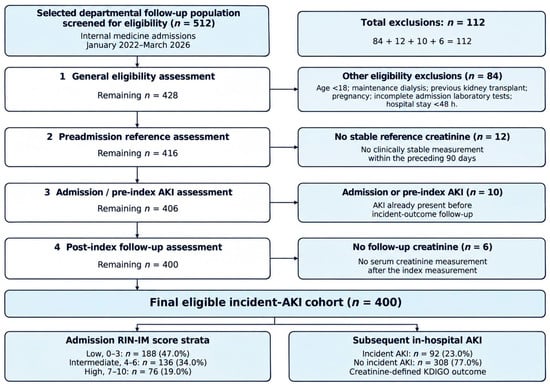
A total of 512 patients hospitalized in the Internal Medicine Department between January 2022 and March 2026 were screened for eligibility. After sequential application of the eligibility criteria, 112 patients were excluded, leaving 400 patients in the final analytical cohort. Exclusion reasons comprised age < 18 years, maintenance dialysis, previous kidney transplantation, pregnancy, incomplete admission laboratory data, hospital stay <48 h, absence of an acceptable stable reference creatinine measurement within 90 days before admission, admission or pre-index AKI, and absence of post-index creatinine follow-up. Each excluded patient was counted once under a mutually exclusive primary exclusion reason, according to the sequence shown in Figure 1. Within the eligible cohort, 188 patients (47.0%) had low admission RIN-IM scores (0–3 points), 136 (34.0%) had intermediate scores (4–6 points), and 76 (19.0%) had high scores (7–10 points). During the observed hospitalization, 92 patients (23.0%) developed incident AKI, while 308 (77.0%) remained free of creatinine-defined AKI.
Figure 1.
Selection of the incident-AKI cohort. The flow diagram summarizes patient screening, sequential exclusions, and inclusion in the final analytical cohort. Each excluded patient is assigned to a single primary exclusion category according to the sequence shown. AKI present at admission or before the prediction index, absence of an acceptable stable preadmission reference creatinine value, and unavailable post-index creatinine follow-up are presented separately. Admission RIN-IM score strata and subsequent in-hospital AKI status are shown only for the final eligible cohort. AKI, acute kidney injury; RIN-IM, Renal–Inflammatory–Nutritional–Metabolic Index. Exclusion counts represent mutually exclusive primary reasons assigned sequentially. Consequently, the number excluded because of unavailable stable preadmission creatinine refers only to patients reaching that assessment step and does not represent the overall frequency of unavailable preadmission creatinine among all hospital admissions.
Principal admission diagnoses, documented clinical conditions and exposures, and the completeness of these records according to subsequent AKI status are presented in Supplementary Table S1.
Creatinine monitoring intensity, observed follow-up duration, time to AKI detection, and maximum KDIGO stage distribution are summarized in Supplementary Table S2.
Patients who subsequently developed in-hospital AKI were older than patients who did not develop AKI (75.1 ± 11.8 vs. 63.8 ± 14.2 years; p < 0.001). Hypertension, diabetes mellitus, coronary artery disease, chronic heart failure, malignancy, and pre-existing chronic kidney disease were significantly more prevalent among patients who developed AKI (all p ≤ 0.015). In contrast, male sex, chronic obstructive pulmonary disease, and chronic liver disease did not differ significantly between the groups (all p ≥ 0.157) (Table 2).
Table 2.
Baseline demographic and clinical characteristics according to subsequent in-hospital AKI status.
Patients who subsequently developed incident in-hospital AKI had higher admission creatinine, blood urea nitrogen, CRP, white blood cell, neutrophil, monocyte, glucose, TyG values and lower albumin, eGFR, lymphocyte, hemoglobin, and platelet values than those who did not develop AKI. TyG, NLR, SII, PIV, and BAR were also higher, whereas sAlb/Cr was lower in the AKI group. The median RIN-IM Score was 7 (IQR, 6–9) in the AKI group and 2 (IQR, 1–4) in the non-AKI group. All between-group comparisons yielded p < 0.001, except for monocyte count (p = 0.011) (Table 3).
Table 3.
Admission laboratory parameters and biomarker indices according to incident in-hospital AKI status.
Admission sAlb/Cr, BAR, and RIN-IM score were significantly correlated with renal function, inflammatory markers, and adverse clinical outcomes. sAlb/Cr was inversely correlated with peak serum creatinine, peak BUN, admission CRP, admission NLR, length of hospital stay, incident AKI, ICU admission, renal replacement therapy, and in-hospital mortality, whereas it was positively correlated with the lowest eGFR recorded during hospitalization. BAR and RIN-IM demonstrated correlations in the opposite direction. Among the evaluated indices, RIN-IM showed the strongest correlations with peak serum creatinine (ρ = 0.681), peak BUN (ρ = 0.655), length of hospital stay (ρ = 0.624), and incident AKI (ρ = 0.573). RIN-IM also demonstrated stronger correlations with ICU admission (ρ = 0.431), renal replacement therapy (ρ = 0.259), and in-hospital mortality (ρ = 0.305) than either BAR or sAlb/Cr (all p < 0.001) (Table 4).
Table 4.
Spearman correlations of admission sAlb/Cr, BAR, and RIN-IM score with renal, inflammatory, and clinical variables.
In three separate logistic regression models adjusted for age, sex, hypertension, diabetes mellitus, coronary artery disease, chronic heart failure, malignancy, and pre-existing chronic kidney disease, the reported adjusted odds ratios were 0.70 per one-unit increase in sAlb/Cr (95% CI, 0.58–0.84), 1.18 per one-unit increase in BAR (95% CI, 1.11–1.26), and 1.68 per one-point increase in the RIN-IM Score (95% CI, 1.45–1.95; all p < 0.001) (Table 5). Full covariate coefficients, intercepts, model-specific performance measures, and IQR-scaled index associations are presented in Supplementary Table S3.
Table 5.
Univariable associations and separate adjusted associations of admission laboratory indices with subsequent in-hospital acute kidney injury.
Patient counts and AKI events at each integer RIN-IM score, together with score-specific event percentages and 95% Wilson confidence intervals, are presented in Supplementary Table S4.
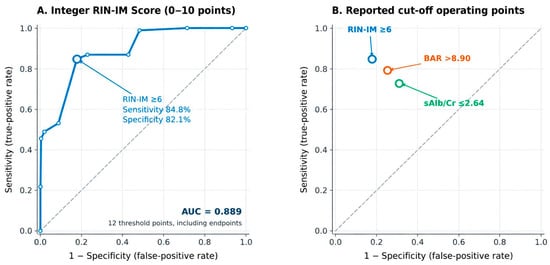
The AUCs were 0.788 (95% CI, 0.739–0.837) for sAlb/Cr, 0.826 (95% CI, 0.779–0.873) for BAR, and 0.889 (95% CI, 0.854–0.925) for RIN-IM. At the evaluated cut-offs of ≤2.64, >8.90, and ≥6, respectively, sensitivities were 72.8%, 79.3%, and 84.8%, and specificities were 69.2%, 74.7%, and 82.1%. Corresponding PPVs were 41.4%, 48.3%, and 58.6%; NPVs were 89.5%, 92.4%, and 94.8%; and accuracies were 70.0%, 75.8%, and 82.8%. Youden J values were 0.420, 0.540, and 0.669, respectively (Table 6).
Table 6.
Discrimination and classification performance at the manuscript’s reported cut-offs.
In the comparison using the reported AUC estimates and assumed standard errors, RIN-IM had a higher apparent standalone AUC than sAlb/Cr (ΔAUC, 0.101; 95% CI, 0.040–0.162; Holm-adjusted p = 0.0034) and BAR (ΔAUC, 0.063; 95% CI, 0.012–0.114; Holm-adjusted p = 0.0308). Although BAR had a numerically higher AUC than sAlb/Cr, this difference was not statistically significant under the assumptions (ΔAUC, 0.038; 95% CI, −0.027–0.103; Holm-adjusted p = 0.2495) (Table 7, Figure 2).
Table 7.
Pairwise comparison of ROC AUCs for sAlb/Cr, BAR, and RIN-IM using DeLong’s test.
Figure 2.
Standalone ROC curves of admission sAlb/Cr, BAR, and the integer RIN-IM Score for incident in-hospital AKI. Curves were calculated from the same analytical sample using the original continuous ratios and the integer RIN-IM Score (0–10 points). Tied score values were retained as groups without smoothing or jittering. Filled markers identify the integer-score ROC coordinates; open circles indicate cohort-derived Youden cut-offs. AUC estimates and threshold-specific statistics refer to these same standalone predictors. Adjusted-model probabilities are not shown.
For the renal reference model and the models additionally incorporating sAlb/Cr, BAR, and RIN-IM, respectively, apparent AUCs were 0.898, 0.904, 0.910, and 0.923, while optimism-corrected AUCs were 0.874, 0.878, 0.882, and 0.892. Corresponding optimism-corrected Brier scores were 0.132, 0.131, 0.128, and 0.123. Optimism-corrected calibration-in-the-large values were −0.020, −0.025, −0.030, and −0.040, and calibration slopes were 0.910, 0.900, 0.890, and 0.880. Although the RIN-IM-expanded model had the highest corrected discrimination and lowest corrected prediction error, its calibration slope remained below 1. Adding RIN-IM yielded an optimism-corrected AUC increase of 0.018 and a Brier-score reduction of 0.009 relative to the renal reference model.
Standalone comparisons with admission creatinine and eGFR, the exploratory analysis of RIN-IM without its creatinine points, and incremental comparisons against the renal and routine-laboratory reference models are presented in Supplementary Table S5.
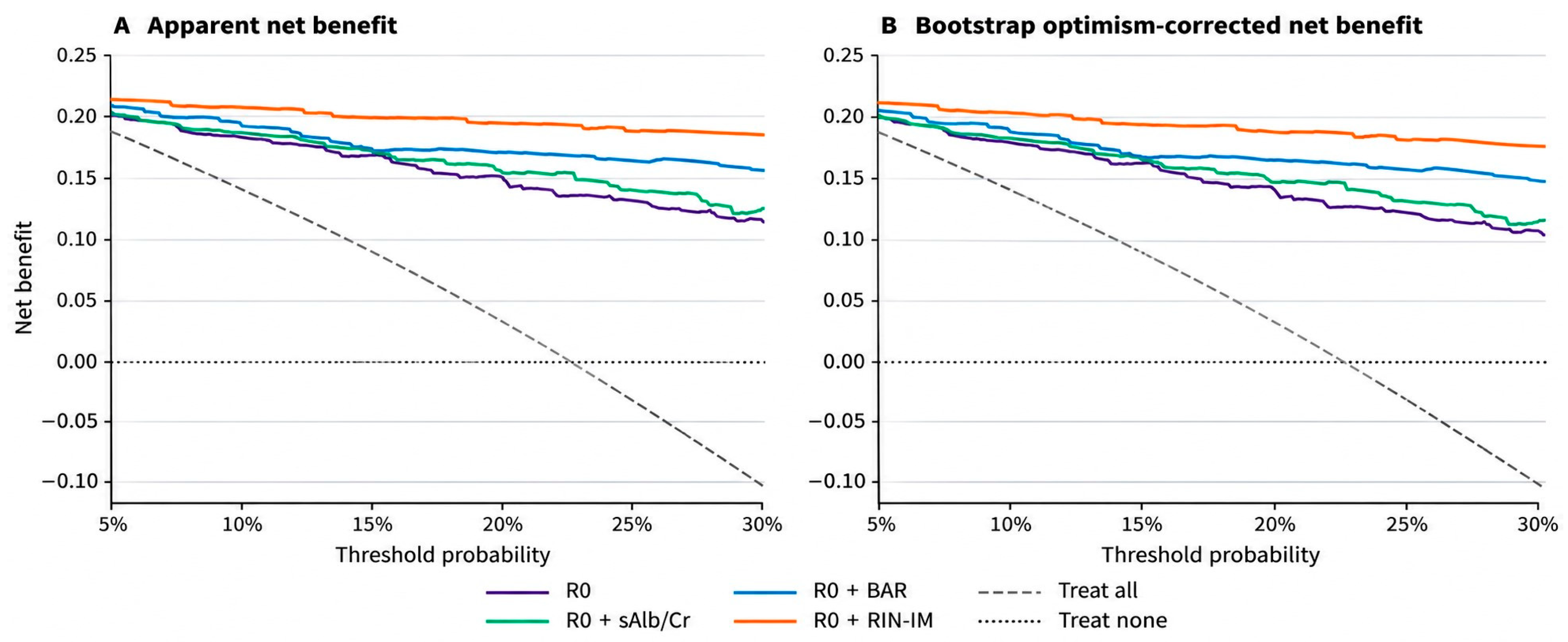
Decision curve analysis was performed across threshold probabilities of 5–30% using patient-level data (Figure 3). At thresholds of 10%, 20%, and 30%, apparent net benefits were 0.208, 0.196, and 0.186 for R0 plus RIN-IM, compared with 0.185, 0.153, and 0.116 for the renal reference model (R0) alone. After optimism correction using 1000 bootstrap resamples, corresponding net benefits were 0.204, 0.189, and 0.178 for R0 plus RIN-IM; 0.191, 0.166, and 0.149 for R0 plus BAR; 0.184, 0.149, and 0.117 for R0 plus sAlb/Cr; and 0.180, 0.144, and 0.105 for R0 alone. Net benefits for the treat-all strategy were 0.144, 0.038, and −0.100, respectively, whereas the treat-none strategy had a net benefit of zero at all thresholds. Based on unrounded estimates, the optimism-corrected net-benefit gains from adding RIN-IM to R0 corresponded to approximately 2.3, 4.5, and 7.3 additional net true-positive equivalents per 100 patients at the respective thresholds, with false-positive classifications weighted according to the threshold probability (Figure 3).
Figure 3.
Apparent and bootstrap optimism-corrected decision curves for the renal reference model and models incorporating sAlb/Cr, BAR, or RIN-IM. Panel (A) shows apparent net benefit; Panel (B) shows optimism-corrected net benefit across threshold probabilities of 5–30%. The treat-all and treat-none strategies are included for comparison.
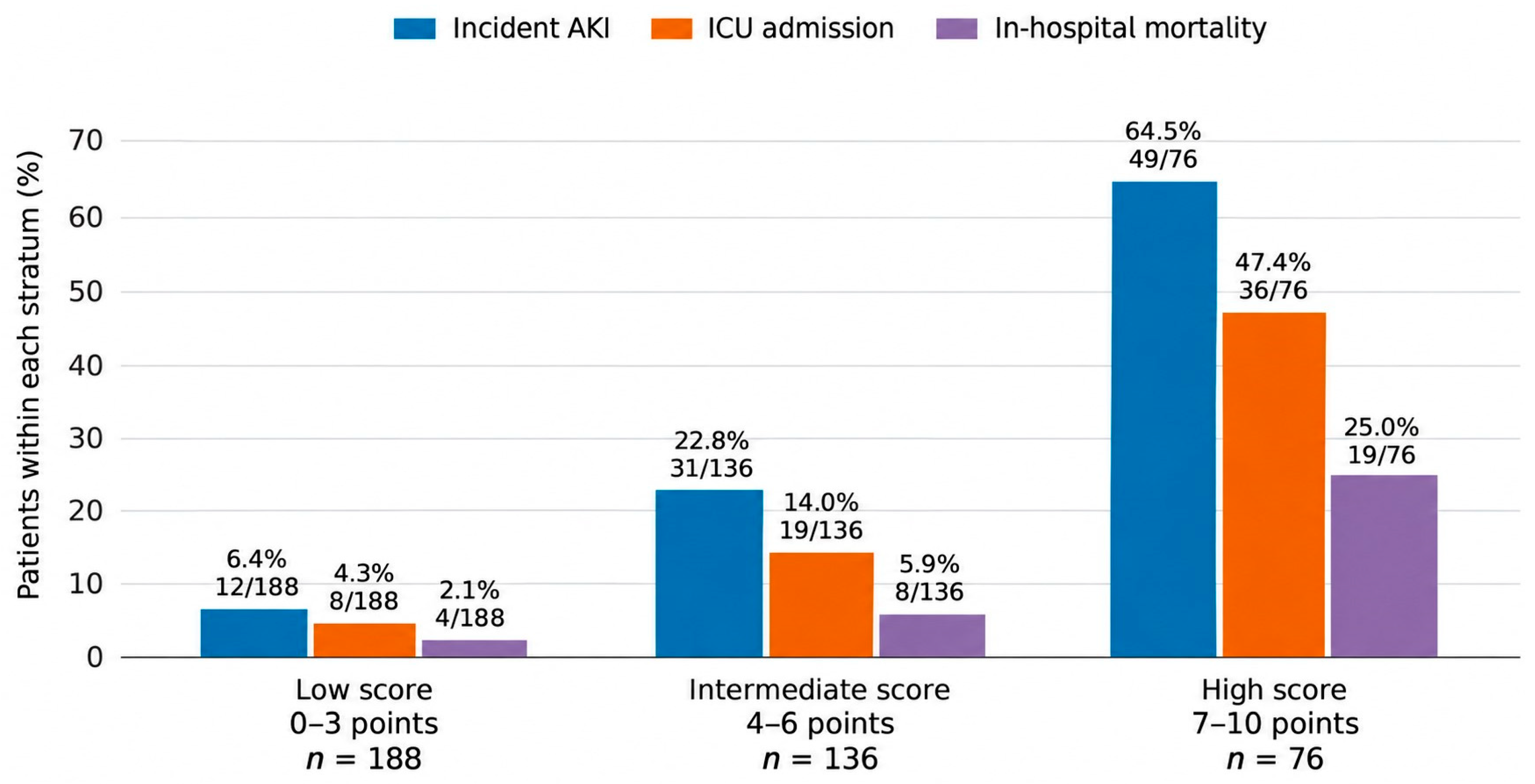
Observed clinical outcome frequencies increased across the predefined admission RIN-IM score strata (Figure 4). Incident AKI occurred in 6.4%, 22.8%, and 64.5% of patients in the low-, intermediate-, and high-score strata, respectively. Corresponding frequencies were 4.3%, 14.0%, and 47.4% for subsequent ICU admission and 2.1%, 5.9%, and 25.0% for in-hospital mortality. Detailed outcome counts, hospital length of stay, and acute renal replacement therapy are presented in Supplementary Table S6.
Figure 4.
Clinical outcomes across predefined admission RIN-IM score strata. Grouped bars show the observed percentages of incident in-hospital AKI, subsequent ICU admission, and in-hospital mortality in the low-score (0–3 points; n = 188), intermediate-score (4–6 points; n = 136), and high-score (7–10 points; n = 76) strata. Labels indicate percentages and event counts/stratum totals. Outcomes may overlap within each stratum. AKI, acute kidney injury; ICU, intensive care unit.
4. Discussion
In this retrospective cohort of hospitalized internal medicine patients, we evaluated the associations and apparent discrimination of admission sAlb/Cr, BAR, and the previously published RIN-IM Score for incident in-hospital AKI. Patients who subsequently developed AKI were older, had a greater comorbidity burden, and showed admission laboratory abnormalities consistent with impaired kidney function and systemic illness. Lower sAlb/Cr and higher BAR and RIN-IM scores were associated with incident AKI after adjustment for demographic characteristics and comorbidities. RIN-IM had the highest apparent standalone AUC among the three indices, followed by BAR and sAlb/Cr. These within-cohort findings support further evaluation of the indices but do not, by themselves, establish incremental predictive value beyond conventional renal assessment or demonstrate benefit from score-guided management.
The incidence of AKI in the present cohort was 23.0%, which is consistent with previously reported rates among hospitalized medical patients. Hoste et al. reported that AKI is a frequent complication in hospitalized and critically ill populations and is strongly associated with mortality, prolonged hospitalization, and progression to CKD [2]. Susantitaphong et al. similarly demonstrated in a meta-analysis that the global incidence of AKI varies substantially according to setting, diagnostic criteria, and patient characteristics, with higher rates observed in older and comorbid populations [19]. In line with these reports, our AKI group was significantly older and had a higher prevalence of CKD, diabetes mellitus, hypertension, coronary artery disease, chronic heart failure, and malignancy. These findings support the concept that AKI in internal medicine wards often develops on a background of pre-existing renal vulnerability, systemic disease burden, and impaired physiological reserve.
Chawla et al. emphasized that AKI and CKD should be viewed as interconnected syndromes rather than isolated entities [3]. Our findings are consistent with this concept, as Pre-existing CKD was more frequent among patients who developed AKI. Patients with CKD have reduced renal functional reserve and are more susceptible to renal hypoperfusion, inflammatory injury, nephrotoxic exposure, and metabolic stress. The strong association between CKD and AKI in our study therefore reflects both biological plausibility and clinical experience.
Serum creatinine remains the cornerstone of AKI diagnosis in KDIGO criteria, but its limitations are well recognized. Kellum et al. noted that creatinine is a delayed and indirect marker of kidney injury and may be influenced by non-renal factors such as muscle mass, age, hydration, and nutritional status [8]. Ostermann et al. also highlighted that early AKI risk assessment may be improved by integrating biomarkers that reflect multiple biological pathways rather than relying solely on conventional renal function tests [10]. In this context, the present study focused on simple laboratory-derived indices that combine renal, inflammatory, nutritional, and metabolic information. This approach may be relevant in internal medicine wards, where access to specialized AKI biomarkers can be limited and routine biochemical and hematological tests are commonly performed at admission.
In the present study, lower sAlb/Cr was significantly associated with AKI development in both univariable and multivariable analyses. Hu et al. reported that higher serum albumin-to-creatinine ratio was associated with better clinical outcomes in critically ill patients with sepsis, suggesting that this ratio may reflect the combined effects of preserved nutritional status and lower renal dysfunction burden [11]. Our findings are compatible with this observation, as patients who developed AKI had substantially lower sAlb/Cr values than those without AKI. Unlike the urinary albumin-to-creatinine ratio, sAlb/Cr is not a direct measure of albuminuria or glomerular albumin leakage. Rather, it reflects the balance between serum albumin, a marker of nutritional and inflammatory status, and serum creatinine, a marker of renal function. Therefore, the lower sAlb/Cr in our cohort likely indicates the coexistence of hypoalbuminemia and impaired renal reserve, both of which may predispose hospitalized patients to AKI.
The prognostic value of albumin-based indices is biologically plausible. Hypoalbuminemia may reflect malnutrition, systemic inflammation, capillary leakage, hepatic dysfunction, or acute-phase response. Albumin also contributes to oncotic pressure, endothelial stability, antioxidant defense, and drug binding. Therefore, reduced albumin levels may contribute to renal hypoperfusion and vulnerability to nephrotoxic or inflammatory insults. Admission albumin was lower in patients who developed AKI (Table 3). sAlb/Cr was inversely correlated with peak creatinine, peak BUN, incident AKI, ICU admission, acute renal replacement therapy, and in-hospital mortality (Table 4). These secondary-outcome correlations were exploratory and unadjusted and do not establish independent prognostic effects. However, the discriminatory performance of sAlb/Cr was lower than that of BAR and RIN-IM, suggesting that although sAlb/Cr captures important renal-nutritional information, it may be insufficient as a standalone marker for AKI risk stratification.
BAR demonstrated stronger predictive performance than sAlb/Cr in the present study. Chen et al. investigated BAR in patients with immunological and surgical diseases and found that higher BAR was associated with increased AKI risk and in-hospital mortality [15]. Bayrakçı et al. also reported that BAR was a significant prognostic marker in elderly critically ill patients with AKI [13]. Yang et al. showed that BAR was associated with AKI and in-hospital mortality in critically ill patients with intracerebral hemorrhage [20]. Our findings extend these observations to a broader hospitalized internal medicine population. BAR remained independently associated with AKI after adjustment for clinical variables and demonstrated good discriminatory ability with an apparent AUC of 0.826 (95% CI, 0.779–0.873). This supports the value of BAR as a practical, inexpensive, and readily available risk marker for AKI.
BAR may be particularly informative because it integrates several pathophysiological domains relevant to AKI. Elevated BUN may reflect reduced renal clearance, renal hypoperfusion, neurohormonal activation, catabolic state, gastrointestinal bleeding, or dehydration. Low albumin may reflect inflammation, altered hepatic synthesis, capillary leakage, fluid balance, and nutritional status. The combination of high BUN and low albumin therefore identifies patients with simultaneous renal stress, catabolism, and impaired nutritional-inflammatory reserve. Nevertheless, BAR was still inferior to RIN-IM, suggesting that a broader multidimensional index may better capture the complex pathophysiology of AKI.
The rationale for RIN-IM is pragmatic integration of existing laboratory measurements rather than molecular novelty. Creatinine contributes directly to the score and is also used to define the outcome, while albumin and blood-cell indices may reflect illness severity and physiological reserve. Thus, a high standalone AUC may partly reflect renal impairment or systemic illness already present when the score is measured. Comparisons against creatinine, eGFR, albumin, and the individual components, together with renal-reference-model analyses, are required before attributing additional information to the composite structure. Mechanistic plausibility is not a substitute for these comparisons. Abdelwahed et al. evaluated a combined model of inflammatory and endothelial biomarkers and ultrasound indices in an experimental lipopolysaccharide-induced AKI model involving 60 rats [21]. Their findings provide mechanistic support for multidomain assessment but cannot be considered direct clinical validation of the present indices [21]. Xie et al. reported that combined assessment of prognostic nutritional index and NLR had clinical value for predicting sepsis-induced AKI [22]. Li et al. also showed that inflammatory and nutritional indices may be useful predictors of AKI in patients with IgA nephropathy [23]. Although these studies used different populations and biomarker combinations, they support the same principle observed in our study: multidimensional models that combine inflammation, nutrition, and renal function may improve AKI risk stratification.
The admission RIN-IM categories should be interpreted as descriptive score strata rather than clinically validated risk groups. Different combinations of renal, inflammatory, nutritional, and metabolic components can yield the same total score. Consequently, a higher total score does not necessarily indicate a greater creatinine contribution, and differences across broad strata do not establish a monotonic increase in AKI frequency at every integer score. Whether the creatinine component accounts for the reported abrupt score-specific differences remains unresolved. Neither the categories nor the cohort-derived cut-off should be used as validated clinical intervention thresholds.
The NPV of 94.8% reported for the cohort-derived RIN-IM cut-off of ≥6 points should be interpreted in the context of the observed 23.0% AKI frequency. Predictive values depend on the population’s underlying event frequency as well as sensitivity and specificity. If sensitivity and specificity remained unchanged, a higher AKI frequency would reduce NPV, whereas a lower frequency would increase it. The observed NPV therefore does not establish a universally applicable rule-out threshold, particularly because the cut-off was selected and evaluated within the same cohort.
The exploratory decision curve analysis assessed the potential net benefit of adding RIN-IM to the renal reference model (R0), which included the clinical adjustment variables together with log-transformed admission creatinine and log-transformed stable preadmission creatinine. The 10%, 20%, and 30% thresholds should be interpreted as illustrative risk scenarios rather than established clinical intervention thresholds. Higher predicted risk could prompt consideration of closer kidney-function monitoring and review of potentially nephrotoxic medications, according to the clinical context. These actions were not evaluated in this study. Because the decision curves were estimated within the development cohort without external validation, net-benefit estimates may be optimistic. These findings therefore do not establish that score-guided management improves patient outcomes. Clinical implementation would require external validation, reliable calibration, and prospective evaluation of clearly defined actions at clinically justified risk thresholds. The score uses established laboratory measurements, but their complete availability at admission cannot be assumed. Triglycerides and a complete differential blood count, including monocytes, may not be routinely requested in every medical ward. Additional testing, reporting delays, nonfasting sampling, and automated calculation requirements may reduce practical applicability. The added complexity would be justified only if reproducible improvement beyond simpler renal and albumin-based measures is demonstrated and is large enough to affect a specified clinical decision.
The present study has several strengths. First, it evaluated a clinically relevant population of hospitalized internal medicine patients, who represent a high-risk but heterogeneous group frequently encountered in daily practice. Second, all investigated biomarkers were derived from routine laboratory parameters obtained within the first 24 h of admission, increasing the practical applicability of the findings. Third, the study compared three different biomarker strategies using multiple statistical approaches, including ROC analysis, DeLong testing, multivariable logistic regression, and decision curve analysis. Fourth, the RIN-IM score was evaluated not only as a continuous predictor but also as a categorical risk stratification tool, which may facilitate clinical interpretation.
Several limitations should be acknowledged. The retrospective, single-center design limits generalizability and introduces potential selection bias. Restricting the sampling frame to patients previously registered for departmental follow-up may preferentially select individuals with chronic diseases, previous healthcare contact, and more frequent laboratory monitoring. This selection could contribute to greater availability of preadmission creatinine measurements and limit generalizability to newly presenting or previously unmonitored patients. The small number excluded specifically for unavailable reference creatinine should therefore not be interpreted as evidence of similarly complete baseline testing across all internal medicine admissions. Requiring a clinically stable creatinine measurement within the preceding 90 days may preferentially select patients with chronic diseases, previous healthcare contact, or regular laboratory monitoring, while excluding patients with limited prior healthcare access or no recent testing. Consequently, the analytical cohort may differ from the broader population of internal medicine admissions in baseline kidney function, comorbidity burden, and AKI risk. This selection may affect the observed AKI prevalence, predictive values, and transportability of the findings; its direction and magnitude cannot be determined from the included cohort alone. AKI was ascertained using creatinine criteria without complete urine-output data. Differences in creatinine-testing frequency and observation duration may have produced differential AKI ascertainment, potentially favouring indices associated with illness severity. More frequent testing may also follow suspected or established AKI rather than precede it. Restricting ascertainment to a 7-day in-hospital window limits the observation horizon but does not standardize testing frequency or eliminate differential detection. Because creatinine contributes to both sAlb/Cr and RIN-IM and also defines the endpoint, their discrimination may partly reflect renal dysfunction already present at index assessment. A 48 h landmark analysis excluding early AKI events was not performed. Therefore, the study cannot determine whether the observed associations and discrimination persist among patients who remain AKI-free during the first 48 h. Restricting outcome ascertainment to seven days does not address this question. Incremental comparisons remain dependent on the reference model and its specified functional forms.
Direct comparison with structural kidney-injury biomarkers such as NGAL or KIM-1 was unavailable [10]. Consequently, the study cannot establish whether these indices identify tubular injury, distinguish functional changes from structural damage, or detect injury before creatinine rises. They represent combinations of established laboratory measurements rather than direct measures of structural kidney injury. Nonstandardized fasting conditions may affect the TyG component, while the requirement for triglyceride and complete differential blood-count measurements may limit reproducibility and applicability in other settings.
The relatively small number of AKI events limits model complexity, stability, and precision. ROC cut-offs were selected and evaluated within the same cohort and are susceptible to overfitting. Internal validation cannot eliminate all optimism or establish transportability, and independent external validation remains necessary. Decision-curve thresholds were exploratory, and no clinical-impact study evaluated whether score-guided management improves outcomes. Residual confounding by admission illness severity, hemodynamics, treatment, fluid status, and nephrotoxic exposures remains possible. Secondary outcomes, particularly mortality analyses based on 31 deaths, should be interpreted as exploratory.
5. Conclusions
In this retrospective cohort of hospitalized internal medicine patients, lower admission sAlb/Cr and higher BAR and RIN-IM scores were associated with incident in-hospital AKI after adjustment for demographic characteristics and comorbidities. RIN-IM showed a modest incremental improvement in discrimination beyond a model incorporating clinical characteristics and renal function. This improvement does not establish clinically actionable benefit. Independent external validation and prospective assessment of score-guided management are required before routine implementation.
Supplementary Materials
The following supporting information can be downloaded at: https://www.mdpi.com/article/10.3390/diagnostics16223891/s1, Table S1: Principal admission diagnoses and documented clinical conditions and exposures according to incident in-hospital AKI status; Table S2: Creatinine monitoring, follow-up, AKI severity, and a seven-day in-hospital sensitivity analysis; Table S3: Complete results and performance measures of three separate multivariable logistic regression models for incident in-hospital acute kidney injury; Table S4: Distribution of the integer admission RIN-IM Score and incident in-hospital AKI frequency; Table S5: Exploratory comparisons with renal function measures, incremental model performance, and risk reclassification; Table S6. Clinical outcomes across predefined admission RIN-IM score strata: an exploratory analysis; File S1: R code for standalone ROC verification and reproduction of Figure 2 and associated tables.
Author Contributions
Conceptualization, H.T., R.D. and O.O.; methodology, H.T., R.D. and O.O.; software, H.T. and R.D.; validation, H.T., R.D. and O.O.; formal analysis, H.T., R.D. and O.O.; investigation, H.T. and R.D.; resources, H.T. and R.D.; data curation, H.T. and R.D.; writing—original draft preparation, H.T., R.D. and O.O.; writing—review & editing, H.T., R.D. and O.O.; visualization, H.T. and R.D.; supervision, R.D.; project administration, H.T. and R.D.; funding acquisition, not applicable. All authors have read and agreed to the published version of the manuscript.
Funding
This research received no external funding.
Institutional Review Board Statement
The study protocol was reviewed and approved by the Clinical Research Ethics Committee of SANKO University (Approval No: 2026/05, Date: 12 May 2026). All procedures were performed in accordance with the ethical standards of the institutional research committee and with the 1964 Helsinki Declaration and its later amendments. Written informed consent was obtained from all individual participants included in the study.
Informed Consent Statement
Informed consent was obtained from all subjects involved in the study.
Data Availability Statement
The original contributions presented in this study are included in the article. Further inquiries can be directed to the corresponding author. The code for reproducing the standalone ROC analyses, threshold-specific classification counts, and score-frequency tables is provided as Supplementary File S1.
Acknowledgments
ChatGPT (GPT-5.6, OpenAI) was used for English-language editing, manuscript organization, drafting support, and preparation of illustrative table and figure drafts, including the graphical abstract. Illustrative numerical content was replaced with results derived from the original patient data. All references, statistical results, and analytical figures were independently checked by the authors against the source data and analysis outputs. The authors reviewed and revised all AI-assisted material and take full responsibility for the accuracy and integrity of the final manuscript.
Conflicts of Interest
The authors declare no conflicts of interest.
Abbreviations
The following abbreviations are used in this manuscript:
| sAlb/Cr | Serum albumin-to-creatinine ratio |
| AKI | Acute Kidney Injury |
| AUC | Area Under the Curve |
| BAR | Blood Urea Nitrogen-to-Albumin Ratio |
| BUN | Blood Urea Nitrogen |
| CI | Confidence Interval |
| CKD | Chronic Kidney Disease |
| CRP | C-Reactive Protein |
| DCA | Decision Curve Analysis |
| eGFR | Estimated Glomerular Filtration Rate |
| IQR | Interquartile Range |
| NLR | Neutrophil-to-Lymphocyte Ratio |
| NPV | Negative Predictive Value |
| OR | Odds Ratio |
| PPV | Positive Predictive Value |
| RIN-IM | Renal–Inflammatory–Nutritional–Metabolic Index |
| ROC | Receiver Operating Characteristic |
| SD | Standard Deviation |
| TyG | Triglyceride-Glucose Index |
| VIF | Variance Inflation Factor |
| ICU | Intensive Care Unit |
| KDIGO | Kidney Disease: Improving Global Outcomes |
References
- Cerda, J.; Kashani, K.; Ostermann, M.; Basu, R.K.; Bell, S.; Cantaluppi, V.; Chakaravarthi, R.; Costa, J.M.; Claure-Del Granado, R.; Macedo, E.; et al. The global epidemiology of acute kidney injury: Challenges and opportunities. Nat. Rev. Nephrol. 2025, 22, 179–198. [Google Scholar] [CrossRef] [Scilit] [PubMed]
- Hoste, E.A.J.; Kellum, J.A.; Selby, N.M.; Zarbock, A.; Palevsky, P.M.; Bagshaw, S.M.; Goldstein, S.L.; Cerdá, J.; Chawla, L.S. Global epidemiology and outcomes of acute kidney injury. Nat. Rev. Nephrol. 2018, 14, 607–625. [Google Scholar] [CrossRef] [Scilit] [PubMed]
- Chawla, L.S.; Eggers, P.W.; Star, R.A.; Kimmel, P.L. Acute Kidney Injury and Chronic Kidney Disease as Interconnected Syndromes. N. Engl. J. Med. 2014, 371, 58–66. [Google Scholar] [CrossRef] [Scilit] [PubMed]
- Gameiro, J.; Agapito Fonseca, J.; Jorge, S.; Lopes, J.A. Acute Kidney Injury Definition and Diagnosis: A Narrative Review. J. Clin. Med. 2018, 7, 307. [Google Scholar] [CrossRef] [Scilit] [PubMed]
- Silver, S.A.; Long, J.; Zheng, Y.; Chertow, G.M. Cost of Acute Kidney Injury in Hospitalized Patients. J. Hosp. Med. 2017, 12, 70–76. [Google Scholar] [CrossRef] [Scilit] [PubMed]
- Levey, A.S.; James, M.T. Acute Kidney Injury. Ann. Intern. Med. 2017, 167, ITC66–ITC80, Correction in Ann. Intern. Med. 2018, 168, 84. [Google Scholar] [CrossRef] [Scilit] [PubMed]
- Lameire, N.; Kellum, J.A. Contrast-induced acute kidney injury and renal support for acute kidney injury: A KDIGO summary (Part 2). Crit. Care 2013, 17, 205. [Google Scholar] [CrossRef] [Scilit] [PubMed]
- Kellum, J.A.; Romagnani, P.; Ashuntantang, G.; Ronco, C.; Zarbock, A.; Anders, H.-J. Acute kidney injury. Nat. Rev. Dis. Primers 2021, 7, 1–9. [Google Scholar] [CrossRef] [Scilit] [PubMed]
- Makris, K. The role of the clinical laboratory in the detection and monitoring of acute kidney injury. J. Lab. Precis. Med. 2018, 3, 69. [Google Scholar] [CrossRef] [Scilit]
- Ostermann, M.; Zarbock, A.; Goldstein, S.; Kashani, K.; Macedo, E.; Murugan, R.; Bell, M.; Forni, L.; Guzzi, L.; Joannidis, M.; et al. Recommendations on Acute Kidney Injury Biomarkers From the Acute Disease Quality Initiative Consensus Conference. JAMA Netw. Open 2020, 3, 2019209, Correction in JAMA Netw. Open 2020, 3, e2029182. [Google Scholar] [CrossRef] [Scilit] [PubMed]
- Hu, Z.; Song, C.; Zhang, J. Elevated serum albumin-to-creatinine ratio as a protective factor on clinical outcomes among critically ill patients with sepsis: A retrospective study. Front. Med. 2024, 11, 1436533. [Google Scholar] [CrossRef] [Scilit] [PubMed]
- Abofrekha, B.; Shadi, M.; Jdaidani, J.; Agarwal, A.; Sanayeh, E.B.; Zayed, A.; Itani, H.; Lee, U.J.; El-Sayegh, S.; Rojas-Marte, G.R. BUN-albumin ratio as a prognostic marker in decompensated heart failure with reduced ejection fraction. Am. Heart J. Plus Cardiol. Res. Pract. 2026, 61, 100683. [Google Scholar] [CrossRef] [Scilit] [PubMed]
- Bayrakçı, S.; Eygi, E. Prognostic Value of Blood Urea Nitrogen to Albumin Ratio in Elderly Critically Ill Patients with Acute Kidney Injury: A Retrospective Study. Medicina 2025, 61, 1233. [Google Scholar] [CrossRef] [Scilit] [PubMed]
- Chen, C.-H.; Chen, C.-L.; Li, Y.-A.; Lo, Y.-C. Prognostic Role of BUN-to-Albumin Ratio, Albumin-to-ALP Ratio, and Mortality in Critically Ill Patients with Hip Fracture: Analysis of the MIMIC-IV Database, 2008 to 2019. J. Am. Acad. Orthop. Surg. 2026, 34, 1594–1602. [Google Scholar] [CrossRef] [Scilit] [PubMed]
- Chen, X.; Zhou, J.; Wang, R.; Wang, Y.; Luo, S.; Yang, J.; Wang, S.; Yang, L.; Qiu, L. Blood urea nitrogen to albumin ratio predicts risk of acute kidney injury and in-hospital mortality associated with immunological and surgical diseases: A retrospective analysis of 1994 patients. Int. Immunopharmacol. 2024, 143, 113600. [Google Scholar] [CrossRef] [Scilit] [PubMed]
- Gong, P.; Yin, X.; Hou, X.; Zhou, Z.; Tang, Z.; Zhao, H. Systemic immune-inflammation index combined with blood urea nitrogen to albumin ratio predicts 28-day mortality in sepsis: A retrospective cohort study. Front. Physiol. 2026, 17, 1814729. [Google Scholar] [CrossRef] [Scilit] [PubMed]
- Zhu, H.; Xie, W.; Wang, P.; Jiang, S.; Hua, Y.; Shao, G.; Li, Z. The relationship between blood urea nitrogen to serum albumin ratio and cardiovascular diseases, cardiovascular mortality, and all-cause mortality in patients with diabetes mellitus. Front. Endocrinol. 2025, 16, 1456731. [Google Scholar] [CrossRef] [Scilit] [PubMed]
- Kayan, T.; Segmen, F.; Doğu, C.; Aktekin, E.Y.; Biçer, F.T.B.; Bektaş, Ş.; Dokuyucu, R.; Aydemir, S. Development and Validation of the Composite Renal–Inflammatory–Nutritional–Metabolic Index for Predicting 28-Day Mortality in Critically Ill Patients. Diagnostics 2026, 16, 2443. [Google Scholar] [CrossRef] [Scilit] [PubMed]
- Susantitaphong, P.; Cruz, D.N.; Cerda, J.; Abulfaraj, M.; Alqahtani, F.; Koulouridis, I.; Jaber, B.L. World Incidence of AKI. Clin. J. Am. Soc. Nephrol. 2013, 8, 1482–1493. [Google Scholar] [CrossRef] [Scilit] [PubMed]
- Yang, F.; Wang, R.; Lu, W.; Hu, H.; Li, Z.; Shui, H. Prognostic value of blood urea nitrogen to serum albumin ratio for acute kidney injury and in-hospital mortality in intensive care unit patients with intracerebral haemorrhage: A retrospective cohort study using the MIMIC-IV database. BMJ Open 2023, 13, 69503. [Google Scholar] [CrossRef] [Scilit] [PubMed]
- Abdelwahed, O.M.; Aboulhoda, B.E.; Awadallah, M.Y.; Gouda, S.A.A.; Abdallah, H.; Rashed, L.; Khaled, M.; Ghobrial, E.E.; Alghabban, H.M.; Sharawy, N. Prediction of acute kidney injury using a combined model of inflammatory vascular endothelium biomarkers and ultrasound indices. Clin. Hemorheol. Microcirc. 2023, 84, 283–301. [Google Scholar] [CrossRef] [Scilit] [PubMed]
- Xie, T.; Xin, Q.; Chen, R.; Zhang, X.; Zhang, F.; Ren, H.; Liu, C.; Zhang, J.; Chen, Q. Clinical Value of Prognostic Nutritional Index and Neutrophil-to-Lymphocyte Ratio in Prediction of the Development of Sepsis-Induced Kidney Injury. Dis. Markers 2022, 2022, 1449758. [Google Scholar] [CrossRef] [Scilit] [PubMed]
- Li, H.; Qian, C.; Huang, J.; Sun, M. Inflammatory and nutritional indexes as predictors of acute kidney injury in patients with Immunoglobulin A nephropathy: A retrospective study. PeerJ 2025, 13, 19917. [Google Scholar] [CrossRef] [Scilit] [PubMed]

Disclaimer/Publisher’s Note: The statements, opinions and data contained in all publications are solely those of the individual author(s) and contributor(s) and not of MDPI and/or the editor(s). MDPI and/or the editor(s) disclaim responsibility for any injury to people or property resulting from any ideas, methods, instructions or products referred to in the content. |
© 2026 by the authors. Licensee MDPI, Basel, Switzerland. This article is an open access article distributed under the terms and conditions of the Creative Commons Attribution (CC BY) license.