


Abstract
Background/Objectives: This study evaluated neoadjuvant disitamab vedotin plus programmed cell death protein 1 (PD-1) blockade and associations of post-treatment neutrophil-to-lymphocyte ratio (NLR) and systemic immune-inflammation index (SII) with response and progression-free survival (PFS) in muscle-invasive bladder cancer. Methods: This single-center retrospective cohort included 71 patients with cT2–T3N0M0, human epidermal growth factor receptor 2 (HER2)-expressing disease treated between September 2021 and October 2025. Logistic regression and receiver operating characteristic analyses evaluated response endpoints; Kaplan–Meier and Cox methods evaluated PFS. Benjamini–Hochberg correction was applied separately to response analyses. Results: Complete response (CR), objective response, and disease control rates were 66.2%, 84.5%, and 88.7%. Of 47 CRs, 5 were cystectomy-confirmed pathological CR (pCR) and 42 were clinical CR (cCR). Response associations did not remain significant after correction (minimum q = 0.082). AUCs were 0.659–0.708. In a two-variable Cox model based on 14 PFS events, treatment cycles (HR 0.615, 95% CI 0.419–0.903; p = 0.013) and SII per 100 units (HR 1.205, 95% CI 1.073–1.355; p = 0.002) were associated with PFS, but these estimates require cautious interpretation. Two deaths occurred. Conclusions: Neoadjuvant disitamab vedotin plus PD-1 blockade showed promising antitumor activity. The pooled CR endpoint may overestimate pathological response and is not directly comparable with cystectomy-confirmed pCR. Without standardized pretreatment NLR and SII measurements, reverse causality cannot be excluded. Response associations and PFS findings based on 14 events require cautious interpretation and prospective validation.
1. Introduction
Bladder cancer is a major global health burden, and muscle-invasive bladder cancer (MIBC) carries a substantial risk of metastatic recurrence and death [1,2]. Cisplatin-based neoadjuvant chemotherapy followed by radical cystectomy remains a standard approach for eligible patients. However, renal dysfunction, comorbidity, treatment intolerance, and heterogeneous tumor response restrict its use, creating a need for effective, better-tolerated perioperative strategies [3,4,5].
Disitamab vedotin is a human epidermal growth factor receptor 2 (HER2)-directed antibody–drug conjugate that delivers monomethyl auristatin E to HER2-expressing tumor cells [6,7]. Clinical and real-world studies have reported encouraging activity of disitamab vedotin alone or with programmed cell death protein 1 (PD-1) blockade in urothelial carcinoma, including the neoadjuvant setting [8,9,10,11,12,13,14,15]. Nevertheless, accessible markers that characterize response after treatment remain limited.
Peripheral blood inflammatory and nutritional indices are inexpensive and routinely available. The neutrophil-to-lymphocyte ratio (NLR), systemic immune-inflammation index (SII), and prognostic nutritional index (PNI) have been associated with treatment response or prognosis in bladder and urothelial cancers [16,17,18,19,20]. Because values measured after neoadjuvant therapy may be downstream correlates of response, toxicity, treatment duration, or intercurrent inflammation, they should be considered post-treatment association measures rather than pretreatment predictive biomarkers.
Therefore, this study evaluated the activity of neoadjuvant disitamab vedotin plus PD-1 blockade in a single-center, real-world cohort of patients with cT2–T3N0M0, HER2-expressing MIBC. This study also explored associations of clinicopathological characteristics and post-treatment inflammatory indices with complete response (CR), objective response rate (ORR), and progression-free survival (PFS). Disease control rate (DCR) and overall survival (OS) were summarized descriptively because of sparse non-DCR outcomes and deaths.
2. Materials and Methods
2.1. Study Design and Population
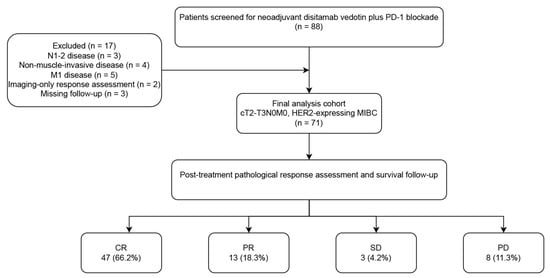
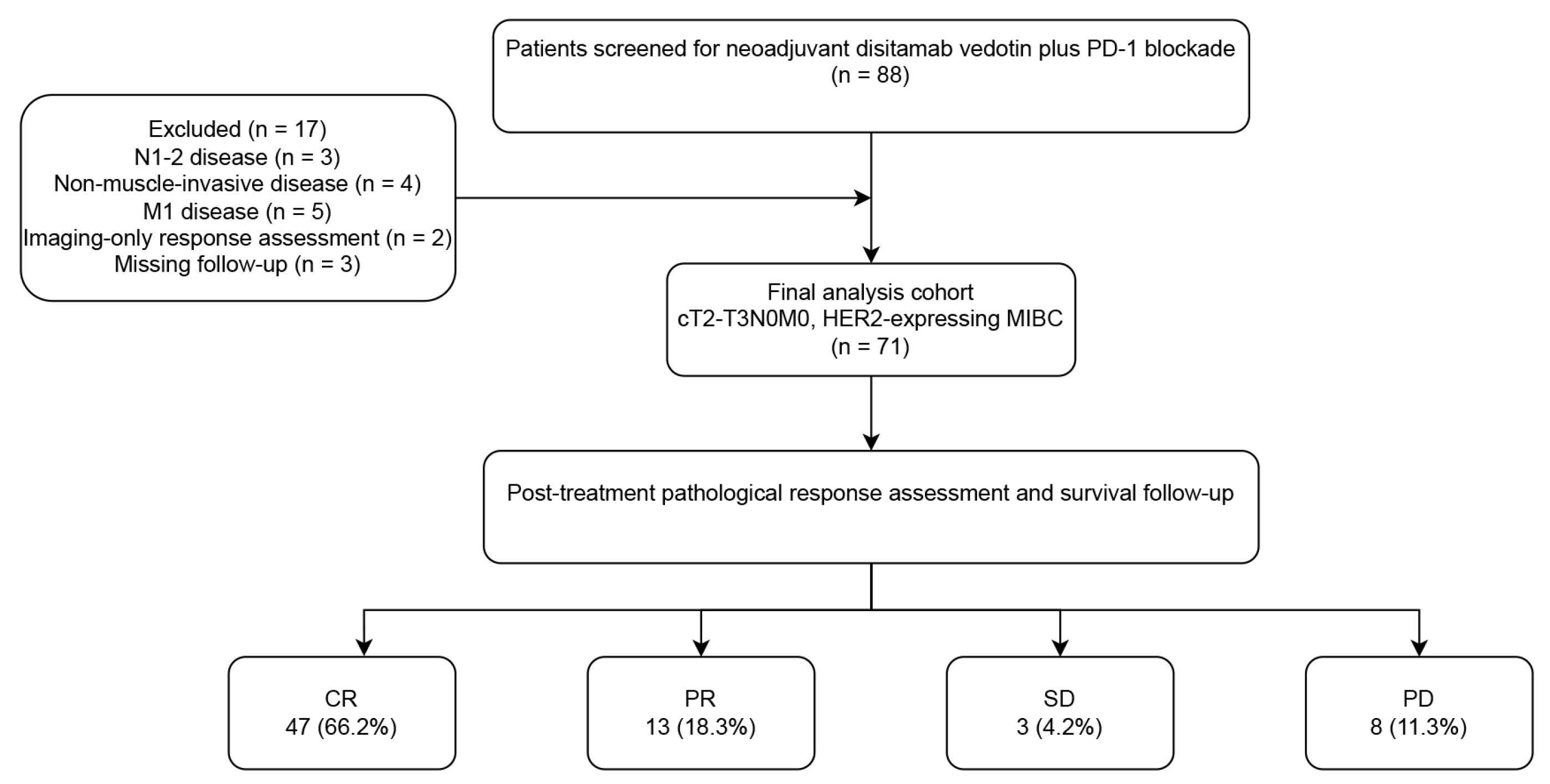
This retrospective cohort study included patients treated in the Department of Urology at Peking University Cancer Hospital between September 2021 and October 2025. Follow-up data were updated through 17 May 2026. The study flow is summarized in Figure 1.
Figure 1.
Study cohort selection and response classification. CR, complete response; PR, partial response; SD, stable disease; PD, progressive disease; HER2, human epidermal growth factor receptor 2; MIBC, muscle-invasive bladder cancer; PD-1, programmed cell death protein 1.
Eligible patients had pathologically confirmed MIBC staged cT2–T3N0M0 before neoadjuvant therapy; HER2 expression of IHC 1+, 2+, or 3+ in pretreatment tumor tissue; no previous neoadjuvant systemic chemotherapy, targeted therapy, or immune checkpoint inhibition; maximal transurethral resection of bladder tumor before treatment; neoadjuvant disitamab vedotin combined with PD-1 blockade; and an available post-treatment pathological assessment. Treatment cycles were individualized according to response, toxicity, patient preference, surgical scheduling, bladder-preservation goals, and multidisciplinary assessment. Patients with nodal or distant metastases, non–muscle-invasive disease, another active malignancy, incomplete essential data, or an acute infection or inflammatory condition affecting the blood count were excluded.
2.2. Data Collection and Laboratory Indices
Demographic, clinical, pathological, treatment, and outcome data were obtained from electronic medical records. Recorded variables included age, sex, comorbidities, smoking and alcohol history, body mass index, body surface area, disease presentation (newly diagnosed vs. recurrent), unifocal or multifocal disease, clinical T stage, treatment cycles, concurrent radiotherapy, HER2 IHC intensity, combined positive score (CPS), Ki-67 index, and post-treatment hematologic and biochemical measurements. Individual PD-1 inhibitors were not compared because treatment assignment was nonrandomized.
Laboratory values were collected after completion of the analyzed neoadjuvant treatment period and before response assessment. NLR was calculated as absolute neutrophil count divided by absolute lymphocyte count. SII was calculated as platelet count multiplied by absolute neutrophil count and divided by absolute lymphocyte count. PNI was calculated as serum albumin plus five times the absolute lymphocyte count. Because the indices were measured after treatment, temporal precedence over response could not be assumed.
2.3. Response and Survival Endpoints
The primary endpoint was a pragmatic real-world composite CR endpoint after neoadjuvant therapy, comprising pathological complete response (pCR) and clinical complete response (cCR) according to the assessment pathway. For patients undergoing radical cystectomy, pCR was defined as no viable residual tumor in the cystectomy specimen (ypT0N0). For patients who did not undergo radical cystectomy, cCR required negative pathological findings on repeat transurethral resection of bladder tumor, negative urine cytology, and no residual or metastatic disease on imaging. The pCR and cCR components were pooled for analysis but were not considered clinically or biologically equivalent.
Patients not meeting CR criteria were classified as having partial response (PR), stable disease (SD), or progressive disease (PD) based on integrated pathological, cystoscopic, and radiographic assessment. ORR was defined as CR plus PR; DCR was defined as CR plus PR plus SD.
Progression-free survival (PFS) was measured from the first dose of neoadjuvant therapy to local progression, recurrence, distant metastasis, or death from any cause. Patients without an event were censored at their last assessment. Overall survival (OS) was measured from the first dose to death from any cause. Because only two deaths occurred, OS was summarized descriptively and no inferential OS model or group comparison was performed.
2.4. Statistical Analysis
Statistical analyses and figure generation were performed using IBM SPSS Statistics 27 and R version 4.4.1. Continuous variables are presented as mean ± standard deviation (SD) and were compared using the Mann–Whitney U test. Categorical variables are presented as numbers and percentages and were compared using Fisher’s exact test. Analyses were based on available cases without imputation. Univariable logistic regression was used to analyze factors associated with CR and ORR. Because of the limited number of outcome events, no multivariable response model was constructed, and DCR was summarized descriptively. ROC curves were used to evaluate the discriminatory ability of relevant indicators for CR and ORR. AUC 95% confidence intervals were calculated using DeLong’s method. Benjamini–Hochberg correction was applied separately to multiple comparisons in the univariable logistic regression analyses for CR and ORR, with both p values and q values reported. Univariable and multivariable Cox regression analyses were used to evaluate factors associated with PFS, and Kaplan–Meier methods were used to estimate PFS and OS. Treatment cycles and SII were included in the multivariable Cox model. The proportional-hazards assumption was assessed using Schoenfeld residuals. SII was scaled per 100-unit increase in both logistic and Cox regression analyses. Because NLR and SII may be collinear, they were not simultaneously included in the same multivariable model. Because few deaths occurred, OS was analyzed descriptively. All statistical tests were two-sided, with p < 0.05 considered statistically significant; for analyses with Benjamini–Hochberg correction, q < 0.05 was considered statistically significant after adjustment. All inferential analyses were interpreted as exploratory and hypothesis-generating.
3. Results
3.1. Cohort and Treatment Response
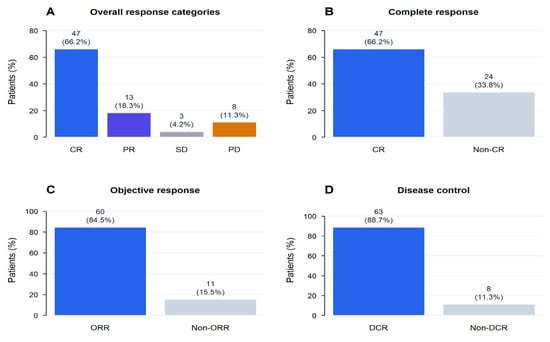
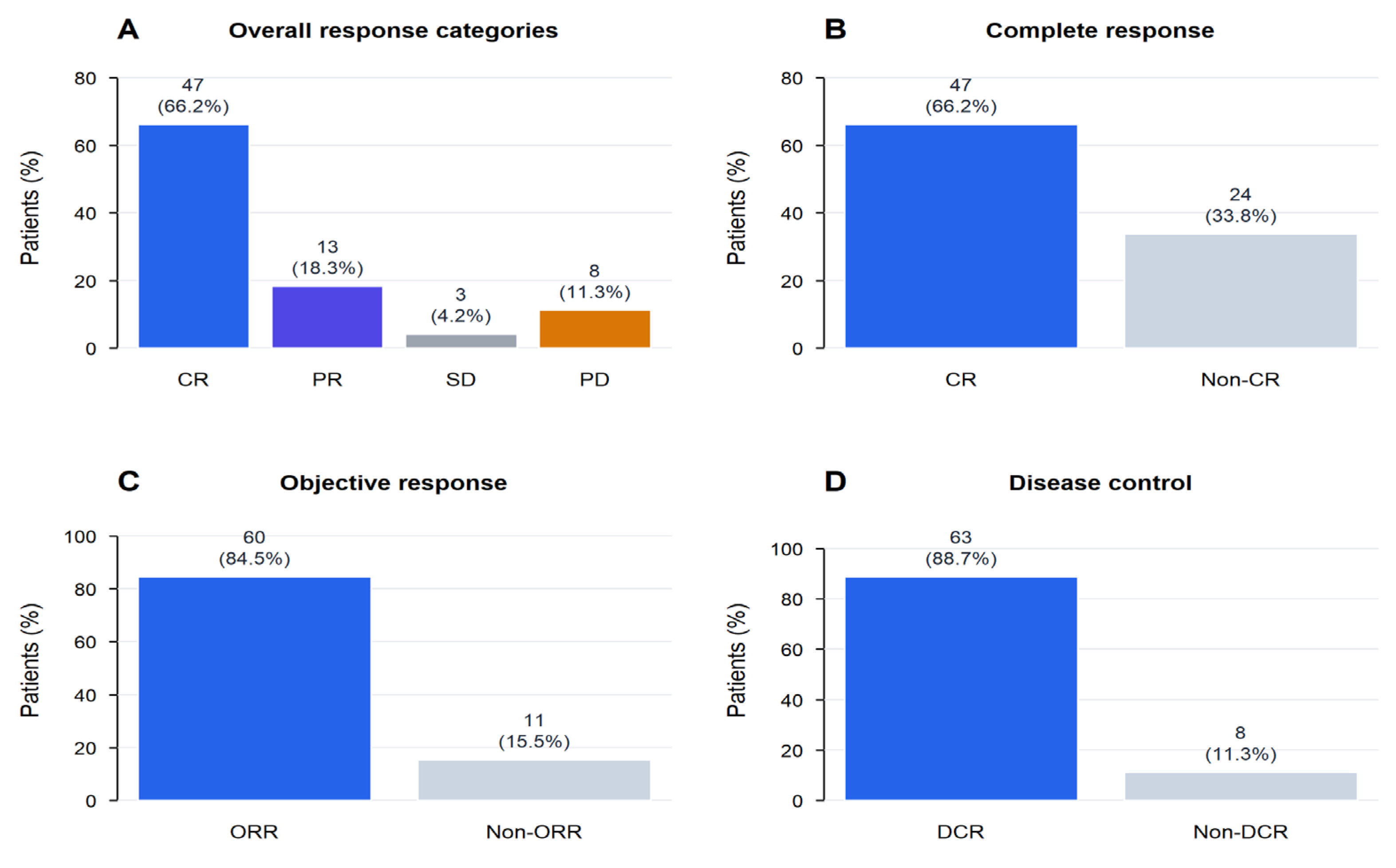
Among 88 screened patients, 17 were excluded: three had N1–2 disease, four had non–muscle-invasive disease, five had M1 disease, two had imaging-only response assessment without pathological confirmation, and three lacked follow-up data. The final cohort comprised 71 patients. Forty-seven patients achieved CR (66.2%), 13 had PR (18.3%), three had SD (4.2%), and eight had PD (11.3%). ORR was 84.5% (60/71), and DCR was 88.7% (63/71) (Figure 2). Among the 47 patients who achieved CR, 5 had cystectomy-confirmed pCR and 42 met the cCR criteria.
Figure 2.
Distribution of treatment responses after neoadjuvant therapy. (A) Complete, partial, stable, and progressive disease categories. (B) Complete response versus non-complete response. (C) Objective response versus nonresponse. (D) Disease control versus no disease control. CR, complete response; PR, partial response; SD, stable disease; PD, progressive disease; ORR, objective response rate; DCR, disease control rate.
The mean age was 62.92 ± 10.03 years; 55 patients (77.5%) were male. Baseline demographic and clinical characteristics were generally similar between the CR and non-CR groups (Table 1). The CR group received more treatment cycles (5.47 ± 1.23 vs. 4.75 ± 1.80; p = 0.047) and had higher CPS (16.16 ± 23.73 vs. 8.00 ± 15.17; p = 0.014). Post-treatment creatinine, NLR, and SII were lower in the CR group. These comparisons were unadjusted.
Table 1.
Patient characteristics and post-treatment laboratory indices stratified by complete response status.
Supplementary Table S1 summarizes characteristics by ORR status. Compared with nonresponders, patients achieving ORR received more treatment cycles (5.43 ± 1.31 vs. 4.09 ± 1.87; p = 0.018) and had lower post-treatment NLR (2.64 ± 1.05 vs. 3.64 ± 1.61; p = 0.030). These comparisons were unadjusted. Supplementary Table S2 summarizes characteristics by DCR status. Patients achieving DCR had lower post-treatment NLR than those who did not (2.69 ± 1.20 vs. 3.58 ± 0.79); however, because only eight patients did not achieve disease control, this finding was considered descriptive.
3.2. HER2 Expression and Response
CR rates were 75.0% (6/8), 63.0% (29/46), and 70.6% (12/17) in the HER2 IHC 1+, 2+, and 3+ groups, respectively (p = 0.803). Corresponding ORRs were 75.0%, 82.6%, and 94.1% (p = 0.320), and DCRs were 87.5%, 87.0%, and 94.1%, respectively; DCR was summarized descriptively (Table 2). No statistically significant CR or ORR differences were detected, but the small IHC 1+ and 3+ subgroups precluded interpreting these findings as equivalent efficacy across HER2 levels.
Table 2.
Association between HER2 immunohistochemical expression and treatment response.
3.3. Factors Associated with CR and ORR
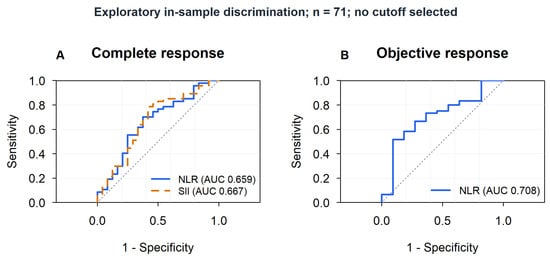
Univariable logistic regression results for candidate variables are shown in Table 3. Higher post-treatment NLR (OR 0.585; 95% CI 0.368–0.930; p = 0.023) and SII (per 100 units: OR 0.834; 95% CI 0.710–0.980; p = 0.028) were associated with lower odds of CR; however, neither met the BH-adjusted q < 0.05 threshold (both q = 0.125). Their discrimination for CR was limited (NLR AUC, 0.659; 95% CI, 0.520–0.797; SII AUC, 0.667; 95% CI, 0.526–0.807) (Figure 3A).
Table 3.
Exploratory univariable logistic regression analyses of complete and objective response.
Figure 3.
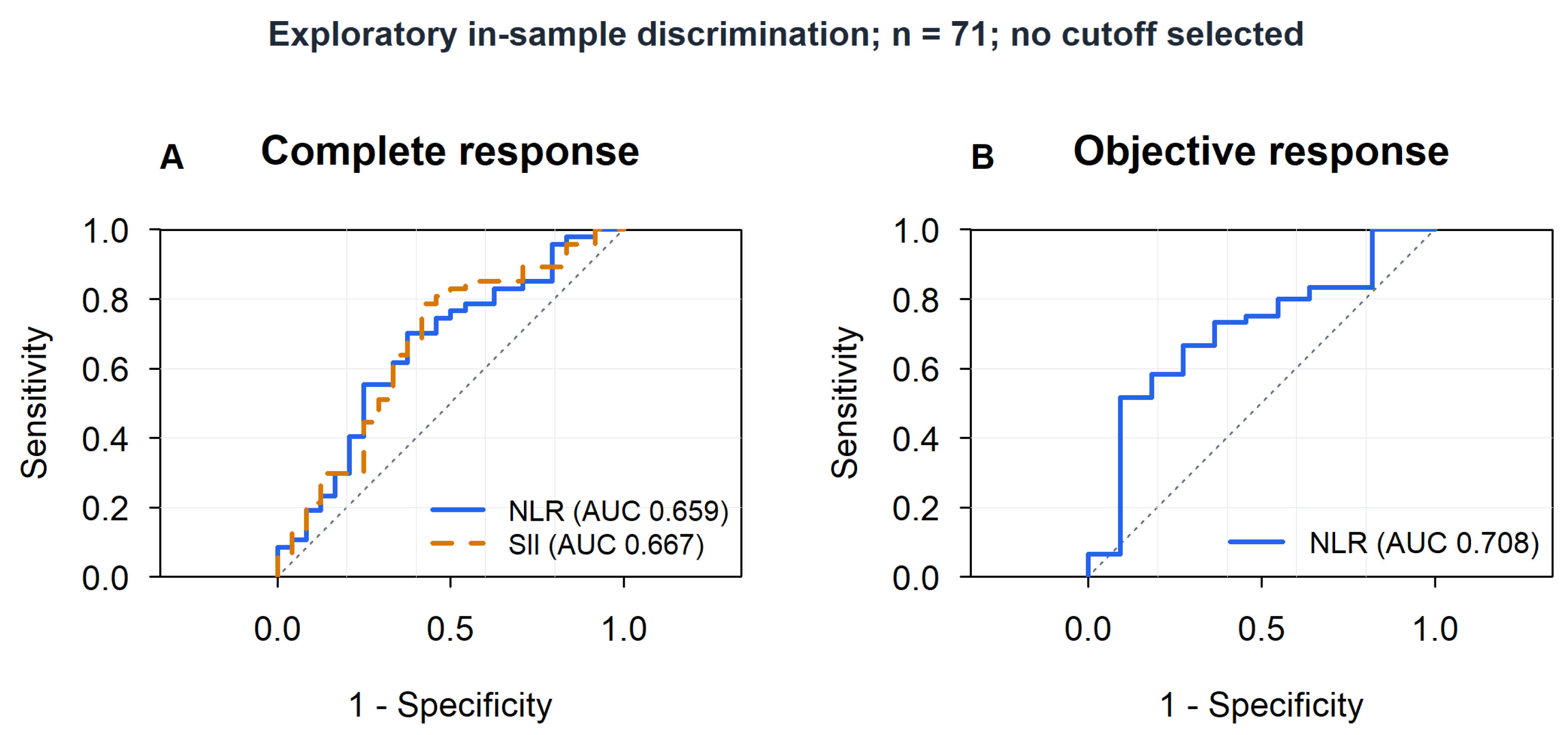
Exploratory receiver operating characteristic curves for in-sample response discrimination. (A) Post-treatment NLR and SII for complete response. (B) Post-treatment NLR for objective response. No cutoff was selected, and the curves were not internally or externally validated. NLR, neutrophil-to-lymphocyte ratio; SII, systemic immune-inflammation index; AUC, area under the curve.
For ORR, more treatment cycles (OR 1.848; 95% CI 1.164–2.933; p = 0.009), lower post-treatment NLR (OR 0.523; 95% CI 0.301–0.911; p = 0.022), and lower post-treatment SII per 100 units (OR 0.829; 95% CI 0.702–0.979; p = 0.027) met the nominal p < 0.05 threshold; each had BH-adjusted q = 0.082. No multivariable ORR model was retained because only 11 patients were nonresponders. NLR yielded an AUC of 0.708 (DeLong 95% CI 0.538–0.877) for ORR (Figure 3B). DCR regression and ROC analyses were not performed because only eight patients lacked disease control.
3.4. Follow-Up and Survival Outcomes
The median observed follow-up was 24.90 months (IQR, 12.01–37.21). Fourteen PFS events occurred: eight patients experienced PD during or immediately after neoadjuvant therapy, five subsequently developed recurrence, progression, or metastasis, and one died without a previously recorded progression event. Estimated PFS rates at 12, 24, and 36 months were 88.7%, 76.2%, and 76.2%, respectively. Two deaths occurred; estimated OS rates at 12, 24, and 36 months were 98.3%, 96.4%, and 96.4%, respectively. Because only two deaths occurred, OS was summarized descriptively and no reliable inferential conclusions were drawn.
In univariable Cox regression analyses, treatment cycles and SII were associated with PFS (Table 4). In the two-variable Cox model, each additional treatment cycle was associated with a lower hazard of a PFS event (HR 0.615; 95% CI 0.419–0.903; p = 0.013), whereas each 100-unit increase in SII was associated with a higher hazard (HR 1.205; 95% CI 1.073–1.355; p = 0.002). The proportional-hazards assumption was not violated (global p = 0.198). These associations should not be interpreted causally because treatment exposure was individualized and SII was measured after treatment.
Table 4.
Cox regression analyses of progression-free survival.
4. Discussion
In this single-center real-world cohort, neoadjuvant disitamab vedotin plus PD-1 blockade was associated with a CR rate of 66.2%, ORR of 84.5%, and DCR of 88.7% in patients with cT2–T3N0M0, HER2-expressing MIBC. Post-treatment NLR and SII showed nominal associations with response, but neither met the BH-adjusted q < 0.05 threshold. In a two-variable Cox model based on only 14 PFS events, treatment cycles and post-treatment SII were associated with PFS; these estimates are hypothesis-generating and require prospective external validation.
The observed activity is consistent with emerging reports of disitamab vedotin combined with immune checkpoint inhibition [8,9,10,11,12,13,14,15,21,22], although cross-study comparisons are constrained by different eligibility criteria, response definitions, surgical rates, schedules, and follow-up. No response difference was detected across HER2 IHC levels, but the IHC 1+ and 3+ subgroups were very small; nonsignificance therefore does not establish equivalent efficacy [23,24].
The treatment-cycle associations cannot show that additional cycles improve response or PFS. Treatment duration was individualized, and patients with early progression cannot complete more cycles, producing confounding by indication and guarantee-time bias [25,26].
NLR and SII are inexpensive and routinely available, but in this study they were measured after treatment and before response assessment [27,28,29,30,31,32]. They may reflect response, toxicity, treatment duration, or intercurrent inflammation, creating reverse causality; inconsistent baseline measurements precluded paired pre- and post-treatment analysis. Moreover, none of the nominal response associations met q < 0.05 after BH correction, and AUCs of 0.659–0.708 indicated only modest, unvalidated in-sample discrimination. These results do not support pretreatment prediction, cutoffs, or stand-alone clinical decisions.
The CR endpoint was a pragmatic composite of cystectomy-confirmed pCR and cCR based on negative repeat local assessment and imaging. Only 5 of 47 CRs were cystectomy-confirmed pCR, whereas 42 were cCR. Because these components are not equivalent and cCR may miss occult residual disease because of sampling and restaging limitations, pooling them may overestimate true pathological response; therefore, the 66.2% CR rate should not be compared directly with studies using uniform cystectomy pathology [33,34].
The main limitations are the retrospective single-center design, small sample and event counts, heterogeneous response pathways, nonrandom treatment exposure, multiple analyses, unvalidated ROC estimates, and only two deaths. Because standardized baseline NLR and SII were unavailable, the study cannot distinguish whether post-treatment values are independent biological correlates or downstream consequences of response, toxicity, or treatment duration. DCR and OS were therefore descriptive, and no multivariable ORR model was retained. Prospective multicenter studies should standardize pCR and cCR assessment, collect pretreatment and serial biomarkers, prespecify models and cutoffs, and evaluate bladder-intact, PFS, OS, and patient-reported outcomes.
5. Conclusions
Neoadjuvant disitamab vedotin plus PD-1 blockade showed promising activity in this selected real-world cohort of HER2-expressing MIBC. Post-treatment NLR and SII showed nominal associations with response, but none met the BH-adjusted q < 0.05 threshold and their in-sample ROC discrimination was modest. In a parsimonious Cox model with only 14 PFS events, treatment cycles and post-treatment SII were associated with PFS; the cycles’ association is susceptible to indication and guarantee-time bias and should not be interpreted causally. These post-treatment indices are not pretreatment predictive biomarkers. Prospective multicenter validation with standardized response assessment and serial biomarker measurement is required before clinical implementation.
Supplementary Materials
The following supporting information can be downloaded at: https://www.mdpi.com/article/10.3390/diagnostics16172802/s1, Table S1: Patient characteristics and post-treatment laboratory indices by objective response status; Table S2: Patient characteristics and post-treatment laboratory indices by disease control status.
Author Contributions
Conceptualization, Y.H., P.D. and S.W.; methodology, Y.H., Y.J., X.Y., P.D. and S.W.; software, Y.H. and Y.J.; validation, Y.H., Y.J., X.Y. and Q.Z.; formal analysis, Y.H., Y.J. and X.Y.; investigation, Y.H., Y.J., X.Y., Q.Z., Y.C., J.M., R.Y., Y.L. and Y.Y.; resources, P.D. and S.W.; data curation, Y.H., Y.J., X.Y., Q.Z., Y.C., J.M., R.Y., Y.L. and Y.Y.; writing—original draft preparation, Y.H., Y.J. and X.Y.; writing—review and editing, all authors; visualization, Y.H. and Y.J.; supervision, P.D. and S.W.; project administration, P.D. and S.W.; funding acquisition, P.D. and S.W. All authors have read and agreed to the published version of the manuscript.
Funding
This research was funded by the Clinical Research Fund for Distinguished Young Scholars of Peking University Cancer Hospital, grant number QNJJ202204; the Beijing Hospitals Authority Youth Programme, grant number QMIL20231114; the Beijing Hospitals Authority’s Ascent Plan, grant number DFL20241101; and the Beijing Natural Science Foundation, grant number L2608069.
Institutional Review Board Statement
The study was conducted in accordance with the Declaration of Helsinki and approved by the Medical Ethics Committee of Beijing Cancer Hospital (protocol code 2025YJZ111; date of approval: 25 August 2025).
Informed Consent Statement
Informed consent was obtained from all subjects involved in the study.
Data Availability Statement
The data supporting the findings of this study are available from the corresponding author upon reasonable request. The data are not publicly available due to patient privacy and ethical restrictions.
Acknowledgments
During the preparation of this manuscript, the authors used ChatGPT (OpenAI, accessed on 22 August 2026) solely for English grammar checking. The authors reviewed and edited the output and take full responsibility for the content of this publication.
Conflicts of Interest
The authors declare no conflicts of interest.
References
- Bray, F.; Laversanne, M.; Sung, H.; Ferlay, J.; Siegel, R.L.; Soerjomataram, I.; Jemal, A. Global cancer statistics 2022: GLOBOCAN estimates of incidence and mortality worldwide for 36 cancers in 185 countries. CA Cancer J. Clin. 2024, 74, 229–263. [Google Scholar] [CrossRef] [Scilit]
- Dobruch, J.; Oszczudłowski, M. Bladder cancer: Current challenges and future directions. Medicina 2021, 57, 749. [Google Scholar] [CrossRef] [Scilit]
- Rose, T.L.; Harrison, M.R.; Deal, A.M.; Ramalingam, S.; Whang, Y.E.; Brower, B.; Dunn, M.; Osterman, C.K.; Heiling, H.M.; Bjurlin, M.A.; et al. Phase II study of gemcitabine and split-dose cisplatin plus pembrolizumab as neoadjuvant therapy before radical cystectomy in patients with muscle-invasive bladder cancer. J. Clin. Oncol. 2021, 39, 3140–3148. [Google Scholar] [CrossRef] [Scilit]
- van der Heijden, A.G.; Bruins, H.M.; Carrion, A.; Cathomas, R.; Compérat, E.; Dimitropoulos, K.; Efstathiou, J.A.; Fietkau, R.; Kailavasan, M.; Lorch, A.; et al. European Association of Urology guidelines on muscle-invasive and metastatic bladder cancer: Summary of the 2025 guidelines. Eur. Urol. 2025, 87, 582–600. [Google Scholar] [CrossRef] [Scilit]
- Holzbeierlein, J.; Bixler, B.R.; Buckley, D.I.; Chang, S.S.; Holmes, R.S.; James, A.C.; Kirkby, E.; McKiernan, J.M.; Schuckman, A. Treatment of non-metastatic muscle-invasive bladder cancer: AUA/ASCO/SUO guideline (2017; amended 2020, 2024). J. Urol. 2024, 212, 3–10. [Google Scholar] [CrossRef] [Scilit]
- Shi, F.; Liu, Y.; Zhou, X.; Shen, P.; Xue, R.; Zhang, M. Disitamab vedotin: A novel antibody-drug conjugate for cancer therapy. Drug Deliv. 2022, 29, 1335–1344. [Google Scholar] [CrossRef] [Scilit]
- Sheng, X.; Wang, L.; He, Z.; Shi, Y.; Luo, H.; Han, W.; Yao, X.; Shi, B.; Liu, J.; Hu, C.; et al. Efficacy and safety of disitamab vedotin in patients with human epidermal growth factor receptor 2-positive locally advanced or metastatic urothelial carcinoma: A combined analysis of two phase II clinical trials. J. Clin. Oncol. 2024, 42, 1391–1402. [Google Scholar] [CrossRef] [Scilit]
- Wang, A.; Chen, M.; Li, D.; Shi, J.; Tang, W.; Zhang, Z.; Ren, S. Disitamab vedotin alone or in combination with immune checkpoint inhibitors in bladder-sparing treatment of muscle-invasive bladder cancer: A real-world study. Clin. Genitourin. Cancer 2024, 22, 102085. [Google Scholar] [CrossRef] [Scilit]
- Wei, Y.; Zhang, R.; Yu, C.; Hong, Z.; Lin, L.; Li, T.; Chen, J. Disitamab vedotin in combination with immune checkpoint inhibitors for locally and locally advanced bladder urothelial carcinoma: A two-center real-world study. Front. Pharmacol. 2023, 14, 1230395. [Google Scholar] [CrossRef] [Scilit]
- Guo, X.; Wang, S.; Ma, Y.; Du, Y.; Chen, Y.; Wang, Q.; Yang, K.; Tang, Q.; Fan, Y.; Hao, H.; et al. Disitamab vedotin combined with immunotherapy as neoadjuvant therapy for localized muscle-invasive bladder cancer: A multicenter real-world study. npj Precis Oncol. 2026, 10, 11. [Google Scholar] [CrossRef] [Scilit]
- Hu, J.; Yan, L.; Liu, J.; Chen, M.; Liu, P.; Deng, D.; Zhang, C.; He, Y.; Fan, B.; Li, H.; et al. Efficacy and biomarker analysis of neoadjuvant disitamab vedotin (RC48-ADC) combined immunotherapy in patients with muscle-invasive bladder cancer: A multicenter real-world study. iMeta 2025, 4, e70033. [Google Scholar] [CrossRef] [Scilit]
- Zhang, C.; Yu, Y.; Zhou, Q.; Ouyang, J.; Zhang, Z. Disitamab vedotin versus gemcitabine-cisplatin regimen with immunotherapy: A comparative analysis of efficacy and safety in muscle-invasive bladder cancer. Front. Immunol. 2025, 16, 1549647. [Google Scholar] [CrossRef] [Scilit]
- Sheng, X.; Zhang, C.; Ji, Y.; Zhou, L.; Zou, B.; Huang, H.; Wang, Y.; Yang, K.; Bai, X.; Feng, D.; et al. Neoadjuvant treatment with disitamab vedotin plus perioperative toripalimab in patients with muscle-invasive bladder cancer with HER2 expression: Updated efficacy and safety results from the phase II RC48-C017 trial. J. Clin. Oncol. 2025, 43, 665. [Google Scholar] [CrossRef] [Scilit]
- Hu, J.; Yan, L.; Liu, J.; Chen, M.; He, Y.; Fan, B.; Peng, B.; Wang, L.; Hou, W.; Li, C.; et al. Neoadjuvant immunotherapy driven bladder preservation for muscle invasive bladder cancer. iMeta 2025, 4, e70063. [Google Scholar] [CrossRef] [Scilit]
- Hu, J.; Yan, L.; Liu, J.; Chen, J.; Ou, Z.; Chen, M.; Zu, X. Efficacy and biomarker analysis of neoadjuvant disitamab vedotin combined with immunotherapy in patients with muscle-invasive bladder cancer: A multicenter real-world study. J. Clin. Oncol. 2024, 42, 113. [Google Scholar] [CrossRef] [Scilit]
- Chen, Z.; Zhang, Y.; Chen, T. Prognostic value of neutrophil-to-lymphocyte ratio for patients with bladder cancer undergoing radical cystectomy: A systematic review and meta-analysis. Front. Oncol. 2024, 14, 1463173. [Google Scholar] [CrossRef] [Scilit]
- Kaczmarek, K.; Małkiewicz, B.; Gurwin, A.; Krawczyk, W.M.; Skonieczna-Żydecka, K.; Lemiński, A. Prognostic value of postneoadjuvant chemotherapy neutrophil-to-lymphocyte ratio in patients undergoing radical cystectomy. J. Clin. Med. 2024, 13, 1953. [Google Scholar] [CrossRef] [Scilit]
- von Deimling, M.; Schuettfort, V.M.; D’Andrea, D.; Pradere, B.; Grossmann, N.C.; Kawada, T.; Yanagisawa, T.; Majdoub, M.; Laukhtina, E.; Rajwa, P.; et al. Predictive and prognostic role of the neutrophil-to-lymphocyte ratio in muscle invasive bladder cancer treated with neoadjuvant chemotherapy and radical cystectomy. Clin. Genitourin. Cancer 2023, 21, 430–441. [Google Scholar] [CrossRef] [Scilit]
- Bai, J.; Huang, Y.; Chen, B.; Ran, B.; Jian, S.; Li, J.; Chen, J.; Wei, Q.; Cao, D.; Liu, L. Prognostic value of the systemic immune-inflammation index in bladder cancer: An updated evidence-based analysis. Front. Oncol. 2025, 15, 1707657. [Google Scholar] [CrossRef] [Scilit]
- Sun, J.; Li, Z.; Zhu, X. Prognostic role of prognostic nutritional index in patients with bladder cancer: A systematic review and meta-analysis. Front. Oncol. 2024, 14, 1486389. [Google Scholar] [CrossRef] [Scilit]
- Sheng, X.; Zeng, G.; Zhang, C.; Zhang, Q.; Bian, J.; Niu, H.; Li, J.; Shi, Y.; Yao, K.; Hu, B.; et al. Disitamab vedotin plus toripalimab in HER2-expressing advanced urothelial cancer. N. Engl. J. Med. 2025, 393, 2324–2337. [Google Scholar] [CrossRef] [Scilit]
- Zhou, L.; Yang, K.W.; Zhang, S.; Yan, X.; Li, S.; Xu, H.; Li, J.; Liu, Y.; Tang, B.; Chi, Z.; et al. Disitamab vedotin plus toripalimab in patients with locally advanced or metastatic urothelial carcinoma (RC48-C014): A phase Ib/II dose-escalation and dose-expansion study. Ann. Oncol. 2025, 36, 331–339. [Google Scholar] [CrossRef] [Scilit]
- Zhao, J.; Xu, W.; Zhang, Z.; Song, R.; Zeng, S.; Sun, Y.; Xu, C. Prognostic role of HER2 expression in bladder cancer: A systematic review and meta-analysis. Int. Urol. Nephrol. 2015, 47, 87–94. [Google Scholar] [CrossRef] [Scilit]
- Wang, D.; Cao, M.; Zhang, Y.; Bi, L.; Chen, M.; Ni, M.; Zheng, Q.; Yao, K.; Liu, Z.; Yang, X.; et al. RC48-ADC monotherapy or in combination with immunotherapy for locally advanced or metastatic urothelial carcinoma with HER2 low and null expression: A multicenter, real-world, retrospective study. BMC Cancer 2025, 25, 812. [Google Scholar] [CrossRef] [Scilit]
- Pfister, C.; Gravis, G.; Fléchon, A.; Soulié, M.; Guy, L.; Laguerre, B.; Mottet, N.; Joly, F.; Allory, Y.; Harter, V.; et al. Randomized phase III trial of dose-dense methotrexate, vinblastine, doxorubicin, and cisplatin, or gemcitabine and cisplatin as perioperative chemotherapy for patients with muscle-invasive bladder cancer: Analysis of GETUG/AFU V05 VESPER secondary endpoints. Eur. Urol. 2021, 79, 214–221. [Google Scholar] [CrossRef] [Scilit]
- Wang, Y.; Song, Y.; Qin, C.; Zhang, C.; Du, Y.; Xu, T. Three versus four cycles of neoadjuvant chemotherapy for muscle-invasive bladder cancer: A systematic review and meta-analysis. Ann. Med. 2023, 55, 2281654. [Google Scholar] [CrossRef] [Scilit]
- Yu, H.; Liu, Q.; Wu, K.; Tang, S. Biomarkers to predict efficacy of immune checkpoint inhibitors in colorectal cancer patients: A systematic review and meta-analysis. Clin. Exp. Med. 2024, 24, 143. [Google Scholar] [CrossRef] [Scilit]
- Zhou, Y.; Shen, G.; Zhou, X.; Li, J. Therapeutic potential of tumor-associated neutrophils: Dual role and phenotypic plasticity. Signal Transduct. Target Ther. 2025, 10, 178. [Google Scholar] [CrossRef] [Scilit]
- Yu, Z.; Xiong, Z.; Ma, J.; Du, P.; Wang, S.; Liu, J.; Cao, Y.; Yang, Y. Prognostic and clinicopathological significance of systemic immune-inflammation index in upper tract urothelial carcinoma: A meta-analysis of 3911 patients. Front. Oncol. 2024, 14, 1342996. [Google Scholar] [CrossRef] [Scilit]
- Raskov, H.; Orhan, A.; Agerbaek, M.O.; Gögenur, I. The impact of platelets on the metastatic potential of tumour cells. Heliyon 2024, 10, e34361. [Google Scholar] [CrossRef] [Scilit]
- Conroy, M.R.; O’Sullivan, H.; Collins, D.C.; Bambury, R.M.; Power, D.; Grossman, S.; O’rEilly, S. Exploring the prognostic impact of absolute lymphocyte count in patients treated with immune-checkpoint inhibitors. BJC Rep. 2024, 2, 31. [Google Scholar] [CrossRef] [Scilit]
- Cheng, L.Y.; Su, P.J.; Kuo, M.C.; Lin, C.-T.; Luo, H.-L.; Chou, C.-C.; Huang, S.-Y.; Wu, C.-C.; Chen, C.-H.; Huang, C.-C.; et al. Combining serum inflammatory markers and clinical factors to predict survival in metastatic urothelial carcinoma patients treated with immune checkpoint inhibitors. Ther. Adv. Med. Oncol. 2024, 16, 17588359241305091. [Google Scholar] [CrossRef] [Scilit]
- Lee, H.W.; Kwon, W.A.; Nguyen, N.T.; Phan, D.T.T.; Seo, H.K. Approaches to clinical complete response after neoadjuvant chemotherapy in muscle-invasive bladder cancer: Possibilities and limitations. Cancers 2023, 15, 1323. [Google Scholar] [CrossRef] [Scilit]
- Wu, J.; Xie, R.Y.; Cao, C.Z.; Shang, B.Q.; Shi, H.Z.; Shou, J.Z. Disease management of clinical complete responders to neoadjuvant chemotherapy of muscle-invasive bladder cancer: A review of literature. Front. Oncol. 2022, 12, 816444. [Google Scholar] [CrossRef] [Scilit]

Disclaimer/Publisher’s Note: The statements, opinions and data contained in all publications are solely those of the individual author(s) and contributor(s) and not of MDPI and/or the editor(s). MDPI and/or the editor(s) disclaim responsibility for any injury to people or property resulting from any ideas, methods, instructions or products referred to in the content. |
© 2026 by the authors. Licensee MDPI, Basel, Switzerland. This article is an open access article distributed under the terms and conditions of the Creative Commons Attribution (CC BY) license.