


Abstract
Ultrasound-guided hydrodissection and dextrose prolotherapy have evolved into anatomically explicit but mechanistically distinct strategies for musculoskeletal pain. This State-of-the-Art narrative review aimed to synthesize major recent clinical and technical developments and to interpret them within a target-based framework. PubMed and Embase via Ovid were searched for English-language publications from 1 January 2021 through 29 July 2026, supplemented by selected pre-2021 landmark studies identified through backward citation tracking. After initial deduplication, 1662 records entered Title/Abstract screening. The final narrative synthesis cited 67 publications, including selected landmark and methodological sources. One author performed screening, and a second author reviewed the final publication selection; study selection was purposive and designed for a narrative synthesis rather than exhaustive systematic inclusion. Four questions guided the review: recent refinements in hydrodissection technique and indications; increasing condition specificity of prolotherapy evidence; areas of overlap and distinction between the two procedures; and the evidentiary status of emerging applications. Hydrodissection research remains concentrated in carpal tunnel syndrome and increasingly addresses injectate, volume, tissue-plane spread, and procedural configuration, whereas evidence beyond the carpal tunnel remains incompletely replicated. Prolotherapy research has shifted from broad claims toward condition-specific studies in tendinopathy, plantar fasciopathy, knee osteoarthritis, periarticular disorders, and temporomandibular joint pathology. Across both fields, variations in concentration, volume, anatomical site, session number, comparator, rehabilitation, and procedural expertise limit generalization. Hydrodissection is defined by observable, fluid-mediated separation of a tissue interface, whereas prolotherapy involves dextrose delivery to a symptomatic connective-tissue target without requiring immediate tissue-plane separation. The proposed framework is intended to standardize terminology, organize evidence maturity, and guide future comparative research rather than prescribe a validated treatment algorithm.
1. Introduction
Musculoskeletal conditions are major contributors to disability and rehabilitation needs worldwide [1]. In clinical practice, regional pain may arise from neural, fascial, tendinous, ligamentous, capsular, or enthesis-related structures rather than from a single tissue diagnosis. Real-time ultrasonography enables dynamic visualization of these structures, needle guidance along a planned trajectory, and direct observation of injectate distribution [2].
Ultrasound-guided hydrodissection and dextrose prolotherapy are increasingly used in nonoperative musculoskeletal practice, but their terminology remains inconsistent. Hydrodissection has been described using the injectate, the regional diagnosis, or the target nerve, even though its defining procedural feature is fluid-mediated separation of a tissue interface [3,4,5,6]. Prolotherapy is likewise frequently reduced to the label “dextrose injection” despite substantial differences in dextrose concentration, anatomical target, injection pattern, and rehabilitation context [7,8,9,10].
The distinction is clinically important because 5% dextrose may be used during perineural hydrodissection, where visible separation or circumferential spread is the intended procedural endpoint, whereas hypertonic dextrose is commonly used in prolotherapy directed at tendons, ligaments, entheses, capsules, or periarticular tissues [3,5,8,10,11]. In this review, hydrodissection is defined by fluid-mediated separation of a specified tissue interface, whereas dextrose prolotherapy is defined by target-directed dextrose delivery to a connective-tissue or periarticular structure without requiring tissue-plane separation. For terminology within this review, dextrose concentrations above 5% are described as hypertonic; concentration alone does not define the intervention. These procedures may share an injectate but do not necessarily share the same therapeutic logic.
During the past five years, the literature has changed in two important ways. First, hydrodissection research—particularly in carpal tunnel syndrome—has moved beyond feasibility toward comparative questions involving injectate, volume, comparator, and durability [12,13,14,15,16,17,18,19,20,21]. Second, prolotherapy research has become increasingly condition-specific, with systematic reviews and controlled trials examining discrete tendinopathies, plantar fasciopathy, knee osteoarthritis, and temporomandibular joint disorders [22,23,24,25,26,27,28,29,30,31].
This review had two overarching objectives: (1) to synthesize recent clinical and technical advances in ultrasound-guided hydrodissection and dextrose prolotherapy; and (2) to organize those advances within a target-based framework that separates evidence-supported practice from anatomical feasibility and hypothesis-generating applications. These objectives were operationalized through four questions concerning hydrodissection technique and indications, the increasing condition-specific prolotherapy literature, the shared and distinct features of the procedures, and the evidentiary status of emerging applications. The framework is intended to improve terminology, reporting, and study design rather than prescribe a validated sequence of treatment.
2. Review Methodology and Conceptual Framework
2.1. Review Design and Questions
This article was designed as a State-of-the-Art narrative review with a focused update of the recent literature and a conceptual synthesis. The manuscript was structured using the principles underlying the SANRA framework, including a clear statement of purpose, transparent description of the literature identification, appropriate referencing, scientific reasoning, and presentation of clinically relevant data [32].
Consistent with the two objectives stated above, the review addressed four review questions: (1) What recent evidence has refined the technique and indications of ultrasound-guided hydrodissection? (2) How has the evidence for dextrose prolotherapy become more condition- and site-specific? (3) Which concepts are shared by the two procedures, and which should remain distinct? (4) Which emerging applications have only anatomical, technical, or case-based support?
2.2. The Focused Literature Identification
PubMed and Embase via Ovid (accessed on 29 July 2026) were searched for English-language publications from 1 January 2021 through 29 July 2026. Three search domains were used in each database: hydrodissection, dextrose prolotherapy, and perineural dextrose/mechanistic overlap. The searches retrieved 635 PubMed and 1411 Embase records. After within-database duplicate handling and application of the English-language limit, 590 PubMed and 1194 Embase records remained; initial cross-database deduplication yielded 1662 records for Title/Abstract screening. One author (Y.Y.) performed Title/Abstract screening, and a second author reviewed the final publication selection. Full database-specific search strategies and limits are provided in Supplementary Table S1.
The search was designed to identify representative and methodologically informative publications rather than to achieve exhaustive inclusion of every potentially eligible report. Conference abstracts/records, study protocols without completed outcome data, non-musculoskeletal hydrodissection, systemic glucose studies without a relevant local injection intervention, and clearly out-of-scope publications were excluded during screening. Priority was given to systematic reviews, meta-analyses, randomized or comparative clinical studies, prospective cohorts, and studies that materially advanced understanding of injectate selection, volume, concentration, anatomical target, procedural endpoint, patient selection, or safety. Backward citation tracking identified selected pre-2021 landmark publications required for terminology, mechanisms, and historical context. Because this was a State-of-the-Art narrative review, final publication selection was purposive and guided by relevance to the review questions and methodological informativeness rather than by a PRISMA-style exhaustive inclusion process. The final manuscript cites 67 publications, including recent database-identified studies, methodological and contextual references, and selected pre-2021 landmark publications.
2.3. Evidence Prioritization and Interpretation
Evidence was organized by intervention, anatomical target, study design, and independent replication. Systematic reviews and randomized or comparative studies were prioritized when discussing clinical effectiveness. Observational studies were included when they addressed populations or procedural questions not represented in controlled trials. Cadaveric and technical studies were included only when they introduced a clinically relevant target or validated an injection pathway. Case reports were used selectively to illustrate emerging applications and were not interpreted as evidence of efficacy. Study-level characteristics of the principal comparative clinical studies informing the synthesis are summarized in Supplementary Table S2.
No formal risk-of-bias instrument, certainty-of-evidence grading, or quantitative pooling was performed because the review was not designed as a systematic review or meta-analysis. For descriptive purposes, evidence maturity was categorized according to study design and independent replication as replicated comparative evidence (comparative findings independently replicated or synthesized across studies), limited comparative evidence (comparative data without consistent independent replication), observational/feasibility evidence (noncomparative clinical or feasibility studies), or anatomical/technical/case-based evidence (cadaveric, technical, or case-level reports without comparative clinical validation). These categories were used solely to organize the literature and do not represent a formal certainty-of-evidence assessment.
2.4. Operational Definitions
The following operational definitions were used to reduce conceptual ambiguity. Hydrodissection refers to an ultrasound-guided procedure in which fluid is used to visibly separate a target structure from an adjacent tissue plane. Perineural injection refers more broadly to injectate placement around a nerve and should not automatically be labeled hydrodissection unless separation is demonstrated. Interface restriction denotes a clinically suspected reduction in relative mobility between adjacent tissues; no validated universal sonographic threshold currently exists. Tissue gliding refers to dynamic relative movement observed during a standardized maneuver. Dextrose prolotherapy refers to dextrose delivery to a selected connective-tissue or periarticular target with an intended biologic and/or neuromodulatory effect. For terminology in this review, dextrose concentrations above 5% are described as hypertonic; concentration alone does not define prolotherapy. A suspected symptomatic structure or interface denotes the anatomical target considered most relevant after integration of history, examination, imaging, dynamic assessment, and, when appropriate, electrodiagnostic or diagnostic procedural information; this inference does not establish causality.
2.5. Ultrasound Guidance, Operator Expertise, and Procedural Reproducibility
Ultrasound guidance is part of the intervention rather than a localization step alone. Transducer selection should match target depth and field of view: high-frequency linear transducers are generally suited to superficial nerves, tendons, entheses, and fascial interfaces, whereas deeper or curved regions may require a lower-frequency linear or curvilinear transducer. A bulky probe footprint can restrict the needle-entry window in anatomically confined regions [2].
Procedural reproducibility is operator-dependent. Probe orientation, beam–needle angle, needle-tip visualization, recognition of anisotropy and adjacent neurovascular structures, and interpretation of injectate spread may influence procedural fidelity. Probe and palpation pressure are additional sources of variability because excessive compression may alter tissue geometry, nerve caliber, vascular appearance, and apparent tissue mobility, whereas inconsistently applied pressure may affect symptom reproduction and dynamic assessment. Sonoguided digital palpation (SDP) is an emerging dynamic sono-clinical assessment in which controlled digital pressure is applied while the target structure is visualized in real time. In a recent report involving the long thoracic nerve, SDP reproduced concordant pain by targeted palpation of the visualized nerve before ultrasound-guided hydrodissection [33]. However, the diagnostic validity, pressure standardization, interobserver reliability, and clinically meaningful thresholds of SDP remain unestablished; it should therefore be regarded as a hypothesis-generating adjunct rather than a validated diagnostic test. For hydrodissection, technical success should document the intended tissue-plane opening, circumferential spread, or comparable real-time evidence of separation rather than perineural fluid placement alone. The hydraulic force generated during injection may also vary with needle position, tissue compliance, injection rate, and volume, but no validated injection-pressure threshold currently defines adequate or excessive tissue-plane separation [2,3,6].
Local expertise is consequently relevant when translating procedural evidence into practice. Future studies should report on the number of operators, relevant ultrasound-intervention training or experience, and any protocol used to standardize technique across operators or centers. Where pressure-based dynamic assessment or hydrodissection is used, reporting should also describe the palpation or transducer-pressure maneuver, injection rate or perceived resistance where feasible, and the sonographic endpoint used to confirm tissue-plane separation. Such reporting may improve procedural reproducibility and interpretation across operators and centers.
3. Conceptual and Terminological Foundations
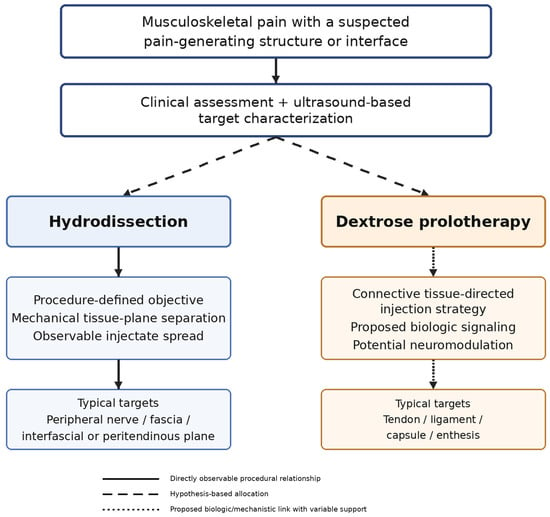
The same injectate can be used for different procedural objectives, and the same regional diagnosis can arise from different target tissues. A target-based framework therefore starts with the structure or interface being treated, the expected procedural endpoint, and the maturity of supporting evidence rather than with the injectate alone (Table 1 and Figure 1).
Table 1.
Operational distinction between hydrodissection and dextrose prolotherapy.
Figure 1.
Target-based conceptual framework. Solid arrows indicate directly observable procedural relationships; long-dashed arrows indicate hypothesis-based allocation from clinical assessment to an intervention; dotted arrows indicate proposed biologic or mechanistic links with variable support. The model is intended for reasoning and research design and is not a validated treatment algorithm.
4. Recent Advances in Ultrasound-Guided Hydrodissection
4.1. Consolidation of Evidence in Carpal Tunnel Syndrome
Carpal tunnel syndrome (CTS) remains the best-developed clinical model for nerve hydrodissection. Earlier reviews established technical feasibility and an acceptable safety profile but also identified uncertainty regarding the active component of treatment, the preferred injectate, volume, approach, and frequency [4,12]. More recent systematic reviews have confirmed that most controlled hydrodissection evidence remains concentrated in CTS [13,14].
A 2025 network meta-analysis of nine studies involving 458 patients ranked 5% dextrose highly for several short- and intermediate-term symptom and function outcomes. However, indirect comparisons, limited trial numbers, and variation in technique prevent the rankings from being treated as definitive protocol recommendations [15]. The central development is therefore not proof that one universal injectate has been established, but recognition that injectate and technique are likely treatment-effect modifiers.
4.2. Injectate, Volume, and Separation Endpoint
Randomized trials have compared 5% dextrose in water (D5W) with saline or corticosteroid and have separately examined volume-dependent effects [16,17,18,19,20]. In a four-arm double-blind trial, 10 mL D5W produced greater short-term improvement in pain and median nerve cross-sectional area than the saline groups, whereas a separate saline-based volume study compared 5- and 10-mL hydrodissection without establishing a universally optimal volume [16,17]. These findings support the plausibility of both volume-dependent mechanical separation and injectate-specific effects, but they do not isolate the relative contribution of either mechanism. In the saline-volume trial, the 10-mL group showed greater improvement than the 5-mL group at 24 weeks in BCTQ symptom severity (median change, −0.8 vs. −0.5; p = 0.024) and functional status (mean change, −0.8 vs. −0.5; p = 0.011) [17].
Comparisons with corticosteroids further illustrate the classification problem. A perineural injection may be accurately placed without producing a substantial hydrodissection endpoint, whereas a larger-volume injection may visibly separate the median nerve from the flexor retinaculum and subsynovial connective tissue. Trials comparing D5W and corticosteroid, and hydrodissection with or without corticosteroid, suggest that both injectate and procedural configuration influence outcomes [18,19,20]. Accordingly, future reports should document the plane approached, volume, spread pattern, and whether separation was achieved.
4.3. Dynamic Ultrasound and Procedural Phenotyping
Potential ultrasound-observable procedural endpoints include circumferential perineural spread, opening of a restricted fascial plane, change in nerve excursion, and alteration in cross-sectional area [2,3,6]. These observations link the intervention to an immediate anatomical event, but none has been validated as a surrogate endpoint for clinical benefit.
A single-entry dual-target technique with cadaveric validation illustrates the trend toward anatomically explicit procedural design [34]. Its value lies in demonstrating a reproducible pathway and distribution pattern; clinical superiority over conventional approaches remains unproven. This distinction—technical reproducibility versus therapeutic effectiveness—should be maintained throughout the literature.
4.4. Expansion Beyond Primary Carpal Tunnel Syndrome
Recent studies have extended dextrose-based perineural treatment beyond primary CTS. Randomized evidence has been reported for meralgia paresthetica and ulnar neuropathy at the elbow [35,36], while an observational series has described persistent or recurrent CTS after surgery [21]. The meralgia paresthetica study reported ultrasound-guided hydrodissection, whereas the ulnar neuropathy study is more appropriately described as ultrasound-guided perineural dextrose injection because tissue-plane separation was not established as the defining procedural endpoint [35,36]. Because only two non-carpal entrapment sites and one postsurgical phenotype have been evaluated in comparative or observational studies, extension to all entrapment neuropathies would be premature.
Interfascial and myofascial hydrodissection has also been evaluated in randomized trials involving shoulder-neck dysfunction and upper trapezius myofascial pain [37,38]. This work broadens the procedural focus from perineural decompression to mobility between fascial layers. Replication should use prespecified dynamic ultrasound measures because diagnostic thresholds for fascial restriction remain undefined.
A randomized comparison of hydrodissection and open surgery in severe CTS is notable because it places a minimally invasive procedure against a definitive decompressive treatment [39]. The result should be interpreted cautiously: surgical candidacy, electrodiagnostic severity, symptom duration, and follow-up length are critical modifiers, and a single trial cannot establish equivalence to surgery.
4.5. Anatomical and Case-Based Innovation
Cadaveric and anatomical investigations can validate needle pathways, target access, and dye distribution. A deep-gluteal fascial-plane study demonstrated access to the external-rotator enthesis region and the vicinity of the sciatic nerve, providing an anatomical basis for a mixed interface–enthesis hypothesis [40]. Such work is useful for procedural development but cannot reproduce in vivo pressure, fascial compliance, neural excursion, or clinical response.
Representative case reports have described dextrose hydrodissection for Wartenberg syndrome, sural nerve entrapment in postoperative scar, and subclavius-region pathology in neurogenic thoracic outlet syndrome [41,42,43]. Beyond illustrating anatomical localization and procedural reasoning, these reports provide no reliable estimate of response rate, durability, comparative effectiveness, or generalizability. All three originated from overlapping author networks represented in this review; independent prospective validation is therefore essential. Recent hydrodissection developments and unresolved questions are summarized in Table 2.
Table 2.
Major recent developments in ultrasound-guided hydrodissection.
5. Recent Advances in Dextrose Prolotherapy
5.1. From Broad Indications to Condition-Specific Evidence
Foundational reviews described dextrose prolotherapy as a broad connective-tissue injection strategy and emphasized non-uniform protocols and uncertain mechanisms [7,8,9,10]. The recent literature is more informative when organized by anatomical site and clinical condition rather than by the generic label “prolotherapy”.
A 2024 systematic review of randomized trials in sports-related tendinopathies found generally favorable signals but substantial variation in tendon, concentration, comparator, injection schedule, and rehabilitation [22]. This pattern is consistent with condition-specific reviews in lateral elbow tendinosis and rotator cuff tendinopathy [23,24]. The evidence supports continued condition-specific investigation but does not support a uniform protocol or generalized recommendation across all tendon disorders.
5.2. Rotator Cuff, Lateral Elbow, and Plantar Fasciopathy
Rotator cuff and supraspinatus studies illustrate the importance of anatomical specification. A systematic review and randomized trials have reported potential improvement after hypertonic dextrose injections, with injection sites ranging from intratendinous and enthesis-directed placement to bursal and periarticular approaches [24,25,44]. The term “rotator cuff prolotherapy” therefore conceals clinically relevant variation in technique. In the 2022 randomized trial, the dextrose group showed short-term within-group improvement at 2 weeks in VAS (mean difference, −2.1; 95% CI, −2.7 to −1.4) and SPADI (mean difference, −11.6; 95% CI, −16.5 to −6.7), although these effects were not sustained to 6 weeks [25].
Plantar fasciopathy has one of the larger condition-specific prolotherapy literature. Recent meta-analyses of randomized trials report potential improvements in pain and function, while comparisons with corticosteroid and extracorporeal shock-wave therapy show that relative benefit depends on follow-up interval and outcome selection [26,27,45,46,47]. The early sonographically guided pilot literature remains historically important because it established anatomically guided injection, although it should not carry the same evidentiary weight as later comparative trials [48].
For lateral epicondylitis, systematic review evidence and randomized trials indicate potential benefit [23,49,50]. In the direct comparison of low- and high-dose dextrose, the higher concentration did not demonstrate a clear clinical advantage [49]. A recent multiarm trial with two-year follow-up compared physiotherapy, shock-wave therapy, prolotherapy, and platelet-rich plasma, highlighting the need to interpret prolotherapy within a broader rehabilitation and orthobiologic landscape rather than as an isolated intervention [51].
5.3. Knee Osteoarthritis and Periarticular Phenotyping
In knee osteoarthritis, meta-analyses of hypertonic dextrose prolotherapy report favorable pooled estimates for some pain and functional outcomes, although protocol variation and imprecision reduce certainty [28,29].
Recent trials have examined dextrose concentration, combined intra-articular and periarticular/perineural treatment, and comparison with intra-articular saline [52,53,54]. By varying concentration, injection compartment, and the addition of periarticular perineural treatment, these trials test clinically relevant protocol components rather than a generic treatment effect. The available designs do not determine whether improvements arise predominantly from intra-articular, periarticular, perineural, or multimodal mechanisms.
Site-specific studies in pes anserine bursitis and subacromial bursitis further demonstrate that localized periarticular disorders should not be merged automatically with intra-articular osteoarthritis or tendinopathy [55,56]. The diagnosis, target tissue, injectate concentration, and co-intervention should be explicit.
5.4. Capsular, Enthesis-Related, and Temporomandibular Targets
Capsular and enthesis-related applications remain heterogeneous. A randomized frozen-shoulder study incorporated molecular markers related to matrix remodeling, while a prospective study of acromial enthesopathy and acromioclavicular arthropathy used ultrasound-guided target localization [57,58]. Molecular and ultrasound-based characterization adds biological and anatomical context. A reproducible capsuloligamentous protocol has nevertheless not emerged because site definitions, dextrose concentration, injection pattern, and outcome assessment remain non-uniform.
Temporomandibular joint (TMJ) prolotherapy has accumulated systematic reviews, randomized comparisons, and pilot studies [30,31,59,60,61,62]. The literature has progressed from proof-of-concept toward comparisons of ultrasound guidance, dry needling, autologous conditioned serum, and defined internal-derangement phenotypes. Diagnostic classification, injection compartment, concentration, and treatment frequency nevertheless remain non-uniform.
5.5. Anatomical Target Development and Representative Cases
Recent cadaveric and technical studies have proposed ultrasound-guided access to the anterior labral–ligamentous complex and popliteal fascial-retinacular structures [63,64]. Their scientific contribution is anatomical validation and procedural reproducibility; they do not demonstrate that dextrose improves clinical outcomes at these targets.
Representative case reports have described piriformis enthesopathy, sacrospinous-ligament calcification, and A1-pulley calcification treated with dextrose prolotherapy [65,66,67]. Their appropriate role is to define candidate structural phenotypes and research questions, not to establish efficacy. These publications also arise from overlapping collaborative networks; replication by independent groups is required before clinical expansion. Table 3 summarizes the principal prolotherapy evidence domains and their limitations.
Table 3.
Recent evidence domains in dextrose prolotherapy.
6. Convergence and Divergence of the Two Approaches
Hydrodissection and dextrose prolotherapy converge in three areas. First, both benefit from precise ultrasound-based target characterization. Second, dextrose may contribute neuromodulatory effects in perineural treatment and may also be used at connective-tissue targets [5,8,10,11]. Third, complex regional pain may involve simultaneous neural-interface and connective-tissue pathology.
The practical consequence is that identical injectates do not create identical interventions. A hydrodissection procedure is verified during injection by opening or filling the intended tissue plane. In prolotherapy, technical success concerns accurate deposition at a predefined tendon, ligament, capsule, enthesis, or periarticular site; no immediate separation endpoint is required. This difference determines what should be reported and prevents the label “dextrose injection” from conflating distinct procedures.
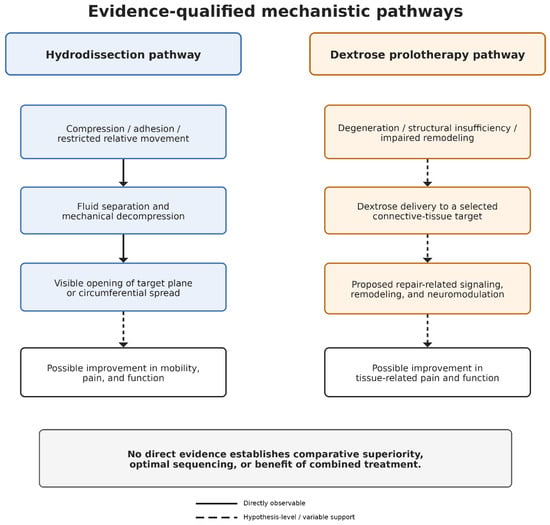
Direct comparative evidence between a hydrodissection-first strategy and a prolotherapy-first strategy is absent. Likewise, there is insufficient evidence that combining or sequencing the two procedures improves outcomes. In selected mixed presentations, staged treatment represents an individualized hypothesis followed by reassessment rather than an evidence-based algorithm. Figure 2 distinguishes directly observable procedural events from downstream links that remain mechanistic hypotheses.
Figure 2.
Evidence-qualified mechanistic pathways. Solid arrows indicate directly observable procedural events; dashed arrows indicate proposed or variably supported mechanistic links. No direct evidence establishes comparative superiority, optimal sequencing, or benefit of combined treatment.
7. Proposed Target-Based Interpretive Framework
7.1. Establish a Testable Structural Hypothesis
The framework begins with a testable hypothesis about the symptomatic structure or interface rather than an assumption that a regional diagnosis identifies a single pain generator. History, physical examination, focal symptom reproduction, ultrasound morphology, dynamic movement, and relevant electrodiagnostic or cross-sectional imaging should be integrated. A sonographic abnormality alone does not establish causality.
Hydrodissection is most coherent when the hypothesis involves nerve compression, perineural adhesion, scar tethering, or a restricted fascial plane and when the intended endpoint can be observed. Dextrose prolotherapy is most coherent when symptoms localize to a tendon, ligament, enthesis, capsule, or periarticular connective tissue and the target can be described anatomically. These statements are intended as classification principles for research and reporting, not as validated diagnostic thresholds or treatment recommendations.
7.2. Match the Procedure to the Endpoint
For hydrodissection, the report should specify the structure separated, needle approach, injectate, concentration, volume, distribution pattern, and dynamic or morphological endpoint. For prolotherapy, the report should specify the exact target, concentration, volume, number of injection points, session interval, local anesthetic use, and rehabilitation protocol.
Mixed or uncertain presentations should prompt staged reassessment rather than automatic multi-target injection. Improvement after a procedure supports—but does not prove—the original pain-generator hypothesis because natural history, contextual effects, rehabilitation, and nonspecific needle or injectate effects may contribute.
8. Research Agenda and Reporting Priorities
The recent literature supports a shift from broad intervention labels toward reproducible phenotyping and procedural reporting. Priority questions are summarized in Table 4. Safety reporting also requires greater standardization. Reported adverse events are commonly transient, including procedural pain or soreness, localized bruising or swelling, and short-lived sensory symptoms; uncommon complications may include inadvertent intraneural or intravascular injection, bleeding, infection, or injury to adjacent structures. The absence of serious events in small studies should not be interpreted as evidence that rare complications do not occur; target, needle approach, injectate, concentration, volume, monitoring period, and adverse-event definitions should be reported explicitly.
Table 4.
Priority questions and minimum reporting elements.
9. Discussion
The four review questions yielded four principal conclusions. First, hydrodissection research has progressed from feasibility toward protocol optimization, although carpal tunnel syndrome remains the only indication with a substantial comparative evidence base. Second, prolotherapy studies are increasingly condition-specific and anatomically explicit, but no uniform concentration, injection pattern, or rehabilitation strategy has emerged. Third, the procedures share ultrasound-guided anatomical precision and may both employ dextrose, yet their technical endpoints and evidentiary claims should remain distinct. Fourth, emerging applications are supported mainly by anatomical, technical, or case-based reports and therefore require independent validation before clinical expansion. Collectively, both fields have moved from broad efficacy claims toward questions of dose, distribution, procedural endpoint, and patient phenotype.
The target-based framework offers two scientific advantages. First, it separates a directly observable procedure—fluid-mediated tissue-plane separation—from proposed downstream mechanisms. Second, it prevents the term “dextrose injection” from collapsing perineural hydrodissection and connective-tissue prolotherapy into a single intervention. This distinction should improve comparability among future studies.
The framework also imposes limits. A suspected symptomatic structure or interface is usually inferred rather than proven. Dynamic ultrasound findings are operator-dependent and lack validated thresholds for many interfaces. Operator training, procedural experience, equipment, and local technical capability may influence target identification, needle visualization, injectate distribution, and reproducibility. Clinical responses cannot uniquely identify the mechanism. For these reasons, the framework should be used to formulate and test hypotheses, not to justify unvalidated multi-target treatment.
Recent anatomical and case-based innovation is valuable but particularly vulnerable to confirmation bias, selective reporting, and premature clinical expansion. The appropriate translational sequence is anatomical validation, technical reproducibility, early safety assessment, prospective clinical evaluation, and independent comparative replication.
10. Limitations
This is a focused narrative review rather than a systematic review or meta-analysis. The literature search was structured and is reported in Supplementary Table S1, but publication selection was purposive rather than exhaustive; no protocol was prospectively registered, and no formal risk-of-bias or certainty-of-evidence instrument was applied. Restriction to English-language publications and two bibliographic databases may have omitted relevant studies. Title/Abstract screening was performed by one author with final publication selection reviewed by a second author; the absence of duplicate independent screening and the use of backward citation tracking and purposive inclusion may introduce selection or citation bias.
The evidence varies substantially in diagnosis, anatomical definition, injectate composition, concentration, volume, injection technique, comparator, rehabilitation, follow-up, and outcome selection. Several trials are small or single-center, and many non-carpal or anatomically novel applications remain supported by technical reports, cadaveric studies, or case reports.
Some emerging publications were authored by overlapping collaborative networks that include authors of this review. To reduce overinterpretation, these reports were used only to illustrate anatomical feasibility or generate hypotheses, and the need for independent validation has been emphasized. Non-financial professional involvement in teaching ultrasound-guided procedures is disclosed below.
11. Conclusions
Over the past five years, both fields have moved toward anatomically explicit protocols and more cautious, condition-specific interpretation. For hydrodissection, the most mature evidence remains carpal tunnel syndrome, while volume, injectate, and procedural endpoints require further study. For dextrose prolotherapy, evidence is broader across connective-tissue disorders but remains limited by non-uniform protocols and rehabilitation. The proposed framework separates an observable mechanical intervention from a connective-tissue injection strategy and categorizes emerging applications according to evidence type and replication. Its translational value lies in improving patient phenotyping, procedural reporting, and trial design, not in prescribing a fixed sequence of care. Independent comparative studies should test whether this classification improves selection, safety, and durable outcomes.
Supplementary Materials
The following supporting information can be downloaded at https://www.mdpi.com/article/10.3390/life16091438/s1. Table S1: Database-Specific Search Strategies. Table S2: Characteristics of Principal Comparative Clinical Studies Informing the Narrative Synthesis.
Author Contributions
Conceptualization, Y.Y. and K.H.S.L.; methodology, Y.Y. and R.P.; literature interpretation, Y.Y., R.P., J.S., S.K., J.L., L.M.-S., K.H.S.L., T.S. and A.S.; visualization, Y.Y. and R.P.; writing—original draft preparation, Y.Y.; writing—review and editing, all authors; supervision, Y.Y. and K.H.S.L.; project administration, Y.Y. All authors have read and agreed to the published version of the manuscript.
Funding
This research received no external funding.
Institutional Review Board Statement
Not applicable. This article is a narrative review of the previously published literature.
Informed Consent Statement
Not applicable.
Data Availability Statement
No new data were created or analyzed in this study. Data sharing is not applicable to this article.
Acknowledgments
During manuscript preparation, the authors used ChatGPT (GPT-5.6 Thinking; OpenAI, San Francisco, CA, USA) for organizational assistance and English-language refinement. The tool was not used to select evidence, assess study quality, generate data, or determine conclusions. All scientific content, interpretations, citations, and final wording were independently reviewed and approved by the authors.
Conflicts of Interest
Some authors participate in academic teaching and professional training activities related to musculoskeletal ultrasonography, hydrodissection, and regenerative injection techniques. The authors declare no conflicts of interest.
Abbreviations
CTS, carpal tunnel syndrome; D5W, 5% dextrose in water; TMJ, temporomandibular joint.
References
- Cieza, A.; Causey, K.; Kamenov, K.; Hanson, S.W.; Chatterji, S.; Vos, T. Global estimates of the need for rehabilitation based on the Global Burden of Disease study 2019: A systematic analysis for the Global Burden of Disease Study 2019. Lancet 2021, 396, 2006–2017. [Google Scholar] [CrossRef] [Scilit]
- Walter, W.R.; Burke, C.J.; Adler, R.S. Tips and tricks in ultrasound-guided musculoskeletal interventional procedures. J. Ultrason. 2023, 23, e347–e357. [Google Scholar] [CrossRef] [Scilit]
- Lam, K.H.S.; Hung, C.Y.; Chiang, Y.P.; Onishi, K.; Su, D.C.J.; Clark, T.B.; Reeves, K.D. Ultrasound-guided nerve hydrodissection for pain management: Rationale, methods, current literature, and theoretical mechanisms. J. Pain Res. 2020, 13, 1957–1968. [Google Scholar] [CrossRef] [Scilit]
- Buntragulpoontawee, M.; Chang, K.V.; Vitoonpong, T.; Pornjaksawan, S.; Kitisak, K.; Saokaew, S.; Kanchanasurakit, S. The Effectiveness and Safety of Commonly Used Injectates for Ultrasound-Guided Hydrodissection Treatment of Peripheral Nerve Entrapment Syndromes: A Systematic Review. Front. Pharmacol. 2020, 11, 621150. [Google Scholar] [CrossRef] [Scilit]
- Wu, Y.T.; Wu, C.H.; Lin, J.A.; Su, D.C.; Hung, C.Y.; Lam, S.K.H. Efficacy of 5% Dextrose Water Injection for Peripheral Entrapment Neuropathy: A Narrative Review. Int. J. Mol. Sci. 2021, 22, 12358. [Google Scholar] [CrossRef] [Scilit]
- Colorado, B.; McNeill, D.; Norbury, J. Ultrasound-Guided Nerve Hydrodissection for Peripheral Entrapment Neuropathies. Muscle Nerve 2025, 72, 1052–1059. [Google Scholar] [CrossRef] [Scilit]
- Hauser, R.A.; Lackner, J.B.; Steilen-Matias, D.; Harris, D.K. A systematic review of dextrose prolotherapy for chronic musculoskeletal pain. Clin. Med. Insights Arthritis Musculoskelet. Disord. 2016, 9, 139–159. [Google Scholar] [CrossRef] [Scilit]
- Reeves, K.D.; Sit, R.W.; Rabago, D.P. Dextrose Prolotherapy: A Narrative Review of Basic Science, Clinical Research, and Best Treatment Recommendations. Phys. Med. Rehabil. Clin. N. Am. 2016, 27, 783–823. [Google Scholar] [CrossRef] [Scilit]
- Bae, G.; Kim, S.; Lee, S.; Lee, W.Y.; Lim, Y. Prolotherapy for the patients with chronic musculoskeletal pain: Systematic review and meta-analysis. Anesth. Pain Med. 2021, 16, 81–95. [Google Scholar] [CrossRef] [Scilit]
- Hsu, C.; Vu, K.; Borg-Stein, J. Prolotherapy: A Narrative Review of Mechanisms, Techniques, and Protocols, and Evidence for Common Musculoskeletal Conditions. Phys. Med. Rehabil. Clin. N. Am. 2023, 34, 165–180. [Google Scholar] [CrossRef] [Scilit]
- Wu, Y.T.; Chen, Y.P.; Lam, K.H.S.; Reeves, K.D.; Lin, J.A.; Kuo, C.Y. Mechanism of Glucose Water as a Neural Injection: A Perspective on Neuroinflammation. Life 2022, 12, 832. [Google Scholar] [CrossRef] [Scilit]
- Neo, E.J.R.; Shan, N.T.; Tay, S.S. Hydrodissection for Carpal Tunnel Syndrome: A Systematic Review. Am. J. Phys. Med. Rehabil. 2022, 101, 530–539. [Google Scholar] [CrossRef] [Scilit]
- Sveva, V.; Farì, G.; Fai, A.; Savina, A.; Viva, M.G.; Agostini, F.; Ranieri, M.; Megna, M.; Mangone, M.; Paoloni, M.; et al. Safety and Efficacy of Ultrasound-Guided Perineural Hydrodissection as a Minimally Invasive Treatment in Carpal Tunnel Syndrome: A Systematic Review. J. Pers. Med. 2024, 14, 154. [Google Scholar] [CrossRef] [Scilit]
- Lam, K.H.S.; Wu, Y.T.; Reeves, K.D.; Galluccio, F.; Allam, A.E.S.; Peng, P.W.H. Ultrasound-Guided Interventions for Carpal Tunnel Syndrome: A Systematic Review and Meta-Analyses. Diagnostics 2023, 13, 1138. [Google Scholar] [CrossRef] [Scilit]
- Lee, K.; Park, J.M.; Yoon, S.Y.; Kim, M.S.; Kim, Y.W.; Shin, J.I.; Lee, S.C. Ultrasound-Guided Nerve Hydrodissection for the Management of Carpal Tunnel Syndrome: A Systematic Review and Network Meta-Analysis. Yonsei Med. J. 2025, 66, 111–120. [Google Scholar] [CrossRef] [Scilit]
- Eyvaz, N.; Adar, S.; Akçin, A.İ.; Dündar, Ü.; Toktaş, H.; Eroğlu, S. Comparison of Ultrasound-Guided Hydrodissection With Various Volumes of 5% Dextrose for Carpal Tunnel Syndrome: A Prospective Randomized Controlled Double-Blind Trial. Am. J. Phys. Med. Rehabil. 2025, 104, 596–604. [Google Scholar] [CrossRef] [Scilit]
- Huang, C.Y.; Lai, C.Y.; Reeves, K.D.; Lam, K.H.S.; Li, T.Y.; Cheng, C.I.; Wu, Y.T. Volume Effect of Nerve Hydrodissection for Carpal Tunnel Syndrome: A Prospective, Randomized, and Single-Blind Study. J. Ultrasound Med. 2024, 43, 161–169. [Google Scholar] [CrossRef] [Scilit]
- Nasiri, A.; Rezaei Motlagh, F.; Vafaei, M.A. Efficacy comparison between ultrasound-guided injections of 5% dextrose with corticosteroids in carpal tunnel syndrome patients. Neurol. Res. 2023, 45, 554–563. [Google Scholar] [CrossRef] [Scilit]
- Ocek, O.; Guner, D. Perineural 5% dextrose versus corticosteroid injection in non-surgical carpal tunnel syndrom treatment. Ideggyógy. Szle. 2024, 77, 121–129. [Google Scholar] [CrossRef] [Scilit]
- Ghorbanpour, S.; Abdi, M.; Naeemi, N.; Rahimibarghani, S.; Hosseini, M.; Emami Razavi, S.Z.; Azadvari, M. Hydrodissection With or Without Corticosteroid Versus Corticosteroid-Only Injection for Carpal Tunnel Syndrome: Double-Blind Randomized Controlled Trial. Muscle Nerve 2025, 71, 986–994. [Google Scholar] [CrossRef] [Scilit]
- Chao, T.C.; Reeves, K.D.; Lam, K.H.S.; Li, T.Y.; Wu, Y.T. The Effectiveness of Hydrodissection with 5% Dextrose for Persistent and Recurrent Carpal Tunnel Syndrome: A Retrospective Study. J. Clin. Med. 2022, 11, 3705. [Google Scholar] [CrossRef] [Scilit]
- Capotosto, S.; Nazemi, A.K.; Komatsu, D.E.; Penna, J. Prolotherapy in the Treatment of Sports-Related Tendinopathies: A Systematic Review of Randomized Controlled Trials. Orthop. J. Sports Med. 2024, 12. [Google Scholar] [CrossRef] [Scilit]
- Zhu, M.; Rabago, D.; Chung, V.C.H.; Reeves, K.D.; Wong, S.Y.S.; Sit, R.W.S. Effects of Hypertonic Dextrose Injection (Prolotherapy) in Lateral Elbow Tendinosis: A Systematic Review and Meta-analysis. Arch. Phys. Med. Rehabil. 2022, 103, 2209–2218. [Google Scholar] [CrossRef] [Scilit]
- Catapano, M.; Zhang, K.; Mittal, N.; Sangha, H.; Onishi, K.; de Sa, D. Effectiveness of Dextrose Prolotherapy for Rotator Cuff Tendinopathy: A Systematic Review. PMR 2020, 12, 288–300. [Google Scholar] [CrossRef] [Scilit]
- Lin, C.L.; Chen, Y.W.; Wu, C.W.; Liou, T.H.; Huang, S.W. Effect of Hypertonic Dextrose Injection on Pain and Shoulder Disability in Patients with Chronic Supraspinatus Tendinosis: A Randomized Double-Blind Controlled Study. Arch. Phys. Med. Rehabil. 2022, 103, 237–244. [Google Scholar] [CrossRef] [Scilit]
- Chutumstid, T.; Susantitaphong, P.; Koonalinthip, N. Effectiveness of dextrose prolotherapy for the treatment of chronic plantar fasciitis: A systematic review and meta-analysis of randomized controlled trials. PMR 2023, 15, 380–391. [Google Scholar] [CrossRef] [Scilit]
- Fong, H.P.Y.; Zhu, M.T.; Rabago, D.P.; Reeves, K.D.; Chung, V.C.H.; Sit, R.W.S. Effectiveness of Hypertonic Dextrose Injection (Prolotherapy) in Plantar Fasciopathy: A Systematic Review and Meta-analysis of Randomized Controlled Trials. Arch. Phys. Med. Rehabil. 2023, 104, 1941–1953.e9. [Google Scholar] [CrossRef] [Scilit]
- Wang, J.; Liang, J.; Yao, J.; Song, H.X.; Yang, X.T.; Wu, F.C.; Ye, Y.; Li, J.H.; Wu, T. Meta-analysis of clinical trials focusing on hypertonic dextrose prolotherapy (HDP) for knee osteoarthritis. Aging Clin. Exp. Res. 2022, 34, 715–724. [Google Scholar] [CrossRef] [Scilit]
- Khateri, S.; Nejad, F.B.; Kazemi, F.; Alaei, B.; Azami, M.; Moradkhani, A.; Majidi, L.; Moradi, Y. The effect of dextrose prolotherapy on patients diagnosed with knee osteoarthritis: A comprehensive systematic review and meta-analysis of interventional studies. Health Sci. Rep. 2024, 7, e2145. [Google Scholar] [CrossRef] [Scilit]
- Sit, R.W.S.; Reeves, K.D.; Zhong, C.C.; Wong, C.H.L.; Wang, B.; Chung, V.C.H.; Wong, S.Y.S.; Rabago, D. Efficacy of hypertonic dextrose injection (prolotherapy) in temporomandibular joint dysfunction: A systematic review and meta-analysis. Sci. Rep. 2021, 11, 14638. [Google Scholar] [CrossRef] [Scilit]
- Saramantos, A.; Kyrgidis, A.; Venetis, G.; Hatziantoniou, G.; Chrysostomidis, A.; Sardeli, C.; Tilaveridis, I. Clinical Efficacy of Prolotherapy for Temporomandibular Joint Disorders: A Systematic Review and Meta-Analysis. Clin. Pract. 2025, 15, 51. [Google Scholar] [CrossRef] [Scilit]
- Baethge, C.; Goldbeck-Wood, S.; Mertens, S. SANRA—A scale for the quality assessment of narrative review articles. Res. Integr. Peer Rev. 2019, 4, 5. [Google Scholar] [CrossRef] [Scilit]
- Nugroho, N.; Lam, K.H.S.; Tandiono, T.; Suryadi, T.; Suhaimi, A.; Ratnawati, W.; Su, D.C.-J.; Yoon, Y.; Reeves, K.D. Novel Sonoguided Digital Palpation and Ultrasound-Guided Hydrodissection of the Long Thoracic Nerve for Managing Serratus Anterior Muscle Pain Syndrome: A Case Report with Technical Details. Diagnostics 2025, 15, 1891. [Google Scholar] [CrossRef] [Scilit]
- Suhaimi, A.; Yoon, Y.; Suryadi, T.; Lee, J.; Lim, J.; Kim, J.; Hwang, J.; Kim, S.-H.; Lee, U.-Y.; Lam, K.H.S. Ultrasound-Guided, Single-Entry, Dual-Target Hydrodissection for Carpal Tunnel Syndrome: A Technical Note with Cadaveric Validation. Cureus 2026, 18, e107717. [Google Scholar] [CrossRef] [Scilit]
- Shi, X.; Xu, H.; Zhu, J.; Li, G.; Bai, L. A Randomized Double-blind Trial of 5% Dextrose Versus Corticosteroid Hydrodissection for Meralgia Paresthetica. Pain Physician 2024, 27, E835–E842. [Google Scholar] [CrossRef] [Scilit]
- Mansiz-Kaplan, B.; Nacir, B.; Pervane-Vural, S.; Tosun-Meric, O.; Duyur-Cakit, B.; Genc, H. Effect of Perineural Dextrose Injection on Ulnar Neuropathy at the Elbow: A Randomized, Controlled, Double-Blind Study. Arch. Phys. Med. Rehabil. 2022, 103, 2085–2091. [Google Scholar] [CrossRef] [Scilit]
- Hsu, C.Y.; Hsu, T.H.; Lin, Y.N.; Cheng, Y.H. Additional Effect of Interfascial Hydrodissection With Dextrose on Shoulder and Neck Function in Patients With Myofascial Pain Syndrome: A Randomized Control Trial. Am. J. Phys. Med. Rehabil. 2024, 103, 827–834. [Google Scholar] [CrossRef] [Scilit]
- Chen, Y.; Liu, S.; Sun, Y.; Wang, Q. Efficacy of ultrasound-guided myofascial hydrodissection technique in myofascial pain syndrome of upper trapezius: A randomized controlled trial. Sci. Rep. 2025, 15, 33444. [Google Scholar] [CrossRef] [Scilit]
- Fouda, B.H.; Abdelwahed, W.M.; Negm, E.E. Ultrasound guided hydrodissection versus open surgery in patients with severe carpel tunnel syndrome: A randomized controlled study. Egypt. J. Neurol. Psychiatry Neurosurg. 2025, 61, 23. [Google Scholar] [CrossRef] [Scilit]
- Kim, S.-H.; Lee, U.-Y.; Yoon, Y.; Hwang, J.; Lee, J.; Kim, S.; Lam, K.H.S.; Suryadi, T.; Suhaimi, A. An Anatomical Cadaveric Demonstration of an Ultrasound-Guided Fascial Plane Injection Pathway in the Deep Gluteal Space. Bioengineering 2026, 13, 412. [Google Scholar] [CrossRef] [Scilit]
- Yoon, Y.; Lam, K.H.S.; de Castro, J.C.; Hwang, J.; Lee, J.; Suryadi, T.; Suhaimi, A.; Kang, C.-W.; Choi, J.; Kim, S. Ultrasound-Guided Dextrose Hydrodissection for Mixed Sensory–Motor Wartenberg’s Syndrome Following a Healed Scaphoid Fracture: A Case Report. Diagnostics 2026, 16, 156. [Google Scholar] [CrossRef] [Scilit]
- Yoon, Y.; Lam, K.H.S.; Hwang, J.H.; Sung, D.; Lee, J.; Suryadi, T.; Su, D.C. Sural Nerve Entrapment in Postoperative Scar Tissue: A Case of Successful Management with Hydrodissection After Calcaneal Fracture Repair. Cureus 2025, 17, e96069. [Google Scholar] [CrossRef] [Scilit]
- Yoon, Y.; Lam, K.H.S.; Lee, J.; Lim, J.; Hwang, J.; Shin, R.; Suryadi, T.; Suhaimi, A.; Choi, J.; Ko, G. Ultrasound-guided hydrodissection of the subclavius muscle region in neurogenic thoracic outlet syndrome: A case report. Front. Med. 2026, 13, 1804081. [Google Scholar] [CrossRef] [Scilit]
- Lin, C.L.; Huang, C.C.; Huang, S.W. Effects of hypertonic dextrose injection in chronic supraspinatus tendinopathy of the shoulder: A randomized placebo-controlled trial. Eur. J. Phys. Rehabil. Med. 2019, 55, 480–487. [Google Scholar] [CrossRef] [Scilit]
- Raissi, G.; Arbabi, A.; Rafiei, M.; Forogh, B.; Babaei-Ghazani, A.; Khalifeh Soltani, S.; Ahadi, T. Ultrasound-Guided Injection of Dextrose Versus Corticosteroid in Chronic Plantar Fasciitis Management: A Randomized, Double-Blind Clinical Trial. Foot Ankle Spec. 2023, 16, 9–19. [Google Scholar] [CrossRef] [Scilit]
- Kesikburun, S.; Uran San, A.; Kesikburun, B.; Aras, B.; Yasar, E.; Tan, A.K. Comparison of Ultrasound-Guided Prolotherapy Versus Extracorporeal Shock Wave Therapy in the Treatment of Chronic Plantar Fasciitis: A Randomized Clinical Trial. J. Foot Ankle Surg. 2022, 61, 48–52. [Google Scholar] [CrossRef] [Scilit]
- Baykut, A.U.; Bayraktar, H.E.N.; Arslan, H.B.; Yalçın, E.; Poyraz, İ. Chronic plantar fasciitis: Which is more effective? Prolotherapy/extracorporeal shock wave therapy? A randomized controlled trial. Arch. Orthop. Trauma Surg. 2025, 145, 242. [Google Scholar] [CrossRef] [Scilit]
- Ryan, M.B.; Wong, A.D.; Gillies, J.H.; Wong, J.; Taunton, J.E. Sonographically guided intratendinous injections of hyperosmolar dextrose/lidocaine: A pilot study for the treatment of chronic plantar fasciitis. Br. J. Sports Med. 2009, 43, 303–306. [Google Scholar] [CrossRef] [Scilit]
- Ciftci, Y.G.D.; Tuncay, F.; Kocak, F.A.; Okcu, M. Is Low-Dose Dextrose Prolotherapy as Effective as High-Dose Dextrose Prolotherapy in the Treatment of Lateral Epicondylitis? A Double-Blind, Ultrasound Guided, Randomized Controlled Study. Arch. Phys. Med. Rehabil. 2023, 104, 179–187. [Google Scholar] [CrossRef] [Scilit]
- Bayat, M.; Raeissadat, S.A.; Mortazavian Babaki, M.; Rahimi-Dehgolan, S. Is Dextrose Prolotherapy Superior To Corticosteroid Injection In Patients With Chronic Lateral Epicondylitis? A Randomized Clinical Trial. Orthop. Res. Rev. 2019, 11, 167–175. [Google Scholar] [CrossRef] [Scilit]
- Lhee, S.H.; Ryeol Lee, K.; Young Lee, D. Comparing the Use of Physiotherapy, Shockwave Therapy, Prolotherapy, and Platelet-Rich Plasma for Chronic Lateral Epicondylosis: A Prospective, Randomized Controlled Trial With 2-Year Follow-up. Am. J. Sports Med. 2025, 53, 2707–2714. [Google Scholar] [CrossRef] [Scilit]
- Öztürk, M.U.; Baygutalp, F. A comparative analysis of prolotherapy efficacy in patients with knee osteoarthritis across varied dextrose concentrations. Clin. Rheumatol. 2023, 42, 3321–3331. [Google Scholar] [CrossRef] [Scilit]
- Fu, Y.; Du, Y.; Li, J.; Xi, Y.; Ji, W.; Li, T. Demonstrating the effectiveness of intra-articular prolotherapy combined with peri-articular perineural injection in knee osteoarthritis: A randomized controlled trial. J. Orthop. Surg. Res. 2024, 19, 279. [Google Scholar] [CrossRef] [Scilit]
- Teymouri, A.; Birang, N.; Fakheri, M.; Nasiri, A. Comparison of the efficacy of ultrasound-guided dextrose 25% hypertonic prolotherapy and intra-articular normal saline injection on pain, functional limitation, and range of motion in patients with knee osteoarthritis; a randomized controlled trial. BMC Musculoskelet. Disord. 2025, 26, 313. [Google Scholar] [CrossRef] [Scilit]
- Babaei-Ghazani, A.; Eftekharsadat, B.; Soleymanzadeh, H.; ZoghAli, M. Ultrasound-Guided Pes Anserine Bursitis Injection Choices: Prolotherapy or Oxygen-Ozone or Corticosteroid: A Randomized Multicenter Clinical Trial. Am. J. Phys. Med. Rehabil. 2024, 103, 310–317. [Google Scholar] [CrossRef] [Scilit]
- Lin, L.C.; Lee, Y.H.; Chen, Y.W.; Hsu, T.H.; Vitoonpong, T.; Liou, T.H.; Huang, S.W. Comparison Clinical Effects of Hypertonic Dextrose and Steroid Injections on Chronic Subacromial Bursitis: A Double-Blind Randomized Controlled Trial. Am. J. Phys. Med. Rehabil. 2023, 102, 867–872. [Google Scholar] [CrossRef] [Scilit]
- Sam, N.M.; Yusuf, I.; Idris, I.; Adnan, E.; Haryadi, R.D.M.; Hamid, F.; Usman, A.; Johan, M.P.; Zainuddin, A.A.; Bukhari, A. The level of ratio between matrix metalloproteinase-1 (MMP-1) and tissue inhibitor matrix metalloproteinase-1 (TIMP-1) after prolotherapy intervention and the functional outcome in patient with frozen shoulder: A randomized controlled trial. Medicine 2023, 102, e34356. [Google Scholar] [CrossRef] [Scilit]
- Hsieh, P.C.; Chiou, H.J.; Wang, H.K.; Lai, Y.C.; Lin, Y.H. Ultrasound-Guided Prolotherapy for Acromial Enthesopathy and Acromioclavicular Joint Arthropathy: A Single-Arm Prospective Study. J. Ultrasound Med. 2019, 38, 605–612. [Google Scholar] [CrossRef] [Scilit]
- Alhaj Kheder, M.B.; Kandil, N.M.; El-Ghareeb, T.; Abdel Aziz, O.M.; Zeitoun, R. Ultrasound-Guided Vs Non-Guided Prolotherapy for Internal Derangement of Temporomandibular Joint. A Randomized Clinical Trial. J. Ultrasound Med. 2024, 43, 1401–1412. [Google Scholar] [CrossRef] [Scilit]
- Gibaly, A.; Abdelmoiz, M.; Alghandour, A.N. Evaluation of the effect of dextrose prolotherapy versus deep dry needling therapy for the treatment of temporomandibular joint anterior disc displacement with reduction: (a randomized controlled trial). Clin. Oral Investig. 2024, 28, 475. [Google Scholar] [CrossRef] [Scilit]
- Ravikumar, C.; Sasikala, B.; Krishnakumar Raja, V.B.; Elavenil, P. Evaluation of the efficacy of autologous conditioned serum versus dextrose prolotherapy in internal derangement of the TMJ—A pilot study. J. Craniomaxillofac. Surg. 2024, 52, 477–483. [Google Scholar] [CrossRef] [Scilit]
- Taleb, Y.S.; Zenati, M.; Alsayed Tolibah, Y. Dextrose prolotherapy effect in improving the temporomandibular joint disc displacement symptoms without reduction refractory to conservative treatment: A pilot study. Sci. Rep. 2025, 15, 18269. [Google Scholar] [CrossRef] [Scilit]
- Kim, S.-H.; Lee, U.-Y.; Yoon, Y.; Hwang, J.; Kim, J.; Na, Y.; Kim, S.; Lam, K.H.S.; de Castro, J.C.; Suryadi, T.; et al. Ultrasound-Guided Targeted Injection to the Anterior Labral-Ligamentous Complex of the Shoulder: A Cadaveric Feasibility Study for Regenerative Therapy. Bioengineering 2026, 13, 418. [Google Scholar] [CrossRef] [Scilit]
- Kim, S.H.; Lee, U.Y.; Yoon, Y.; Suryadi, T.; Su, D.C.J.; Wang, W.C.; Lam, K.H.S. Novel Ultrasound-Guided Popliteal Fascial Retinaculum Injection for Symptomatic Knee Osteoarthritis: A Technical Report with Cadaveric Dye-Distribution Study and Step-by-Step Procedural Description. Cureus 2026, 18, e107760. [Google Scholar] [CrossRef] [Scilit]
- Yoon, Y.; Sung, D.; Lee, J.; Lam, K.H.S. A Case Report of Deep Gluteal Syndrome Secondary to Piriformis Enthesopathy Successfully Treated with Ultrasound-Guided Dextrose Prolotherapy. Cureus 2026, 18, e102370. [Google Scholar] [CrossRef] [Scilit]
- Yoon, Y.; Lam, K.H.S.; Lee, J.; Park, R.; Shim, J.; Lee, J.; Su, D.C.-J.; Reeves, K.D.; Cavallino, S. Ultrasound-Guided Prolotherapy for Sciatica Secondary to Sacrospinous Ligament Calcification: A Potential and Previously Overlooked Etiological Factor in Deep Gluteal Syndrome-A Case Report and Literature Review. Life 2025, 15, 1486. [Google Scholar] [CrossRef] [Scilit]
- Yoon, Y.; Hwang, J.H.; Shim, J.; Park, R.; Lee, J.; Lam, K.H.S. A Novel Case of Trigger Finger Caused by A1 Pulley Calcification Successfully Treated with Ultrasound-Guided Prolotherapy: A Case Report and Literature Review. Cureus 2025, 17, e98189. [Google Scholar] [CrossRef] [Scilit]

Disclaimer/Publisher’s Note: The statements, opinions and data contained in all publications are solely those of the individual author(s) and contributor(s) and not of MDPI and/or the editor(s). MDPI and/or the editor(s) disclaim responsibility for any injury to people or property resulting from any ideas, methods, instructions or products referred to in the content. |
© 2026 by the authors. Licensee MDPI, Basel, Switzerland. This article is an open access article distributed under the terms and conditions of the Creative Commons Attribution (CC BY) license.