


Abstract
Cognitive disorders, from mild cognitive impairment to more serious dementia, are becoming more common and are directly related to the increased longevity and quality of life throughout the world. This demographic dynamic places a tremendous pressure on health care systems and fosters vigorous research in the international medical community, with the aim of identifying disease-modifying treatments able to stop or slow the progression of these neurodegenerative diseases. In total, 28 molecules are presently under development in this therapeutic portfolio at various phases of clinical studies. The main purpose of this research is to conduct a detailed analysis of therapeutic agents in Phase III clinical trials, a key phase for evaluating efficacy and safety. Another section describes monoclonal antibodies, a class of drugs that has already demonstrated impressive results as DMTs by specifically targeting pathogenic processes. Besides DMTs, there are several innovative approaches under research for treating acute exacerbations and symptom relief in neurodegenerative diseases. This review aims to critically synthesize the therapeutic landscape in dementia, pointing to promising directions for future clinical research. Of the 28 candidates evaluated, 7.1% met the primary efficacy endpoints in Phase III, 50.0% showed minimal or no efficacy, and 42.9% await definitive results. While monoclonal antibodies demonstrate a modest slowing of clinical progression in early-stage disease, many candidate compounds have failed, underscoring the ongoing difficulties of late-stage pharmaceutical development.
1. Introduction
Dementia is a clinical syndrome of progressive loss of cognitive functions that interferes with independent daily activities [1]. Therefore, dementia has become a huge social and economic burden on global health care systems [1,2]. Alzheimer’s disease is a distinct neurodegenerative disease and the most common cause of dementia, accounting for 60–70% of all cases [1,2]. The 2022 world report reveals that there are around 55 million people worldwide living with dementia, a concerning statistic considering the limited number of disease-modifying treatments available. Projections show that by 2030 the number of impacted individuals will be 82 million, and by 2050 the number is expected to reach 138 million. This alarming statistic of individuals affected across the Alzheimer’s disease spectrum and related dementias has motivated the international community to search for therapies that could substantially slow the progression of the underlying neurodegenerative disease and delay functional decline [1,2].
The histopathological and pathophysiological structure in the onset and development of Alzheimer’s disease is outlined by the microscopic presence of two classes of abnormal structures, extracellular β-amyloid plaques and intraneuronal neurofibrillary tangles. Both structures, intracellular and extracellular, contain dense, extremely insoluble filaments, namely neurofibrillary plaques and tangles, and soluble elements, amyloid-β peptides and tau for tangles [3].
Regarding the prevalence of dementia in the US population, the highest prevalence was among patients over 90 years old, with a rate of 37.4% compared to 5.0% in the population between 71 and 79 years [4].
Kramarow (2024) reports that data from the 2022 US National Health Interview Survey found that among adults 65 and older, 1.7% of civilian, non-institutionalized adults aged 65 to 74 were diagnosed with dementia, and the rate increased to 13.1% for those 85 and older, illustrating the link between age and dementia risk [5]. In this specific cross-sectional survey of community-living adults in the US, the prevalence was reported as 3.8% in males and 4.2% in females; however, large epidemiological and mechanistic studies have shown significant differences related to both biological sex (genetic, hormonal, and neuropathological susceptibilities) and sociocultural gender effects (lifestyle and educational opportunities) on the risk and progression of Alzheimer’s disease and dementia [2,3,4,5]. For the same age cohort (>65 years) and the same level of education, 7.9% of individuals with high school education or less developed a form of dementia over time, whereas only 2.2% of those with a higher education were affected [5]. The clinical syndrome of dementia is etiologically heterogeneous, including major forms such as Alzheimer’s disease (the predominant cause), vascular dementia, dementia with Lewy bodies, frontotemporal dementia, and mixed pathologies. This heterogeneity has made it extremely difficult to develop universal treatments that can stop biological progression. The efficacy of traditional symptomatic medications is very low at present, which has led to in-depth research to discover disease-modifying treatments. In recent years, pharmaceutical companies have developed a range of Phase III molecules principally focused on the pathophysiological progression of Alzheimer’s disease, alongside late-stage symptomatic therapies for acute neuropsychiatric symptoms (such as agitation, psychosis, depression, and delirium) that manifest across both Alzheimer’s disease and other forms of dementia [2].
The FDA approval of monoclonal antibodies targeting amyloid plaques, Lecanemab and Donanemab, raised hopes for effective modification of disease trajectory in early-stage Alzheimer’s disease. These two therapies have been shown to slow cognitive decline in the early stages of the disease [6].
2. Materials and Methods
Since this is a narrative review, the percentages presented are solely descriptive of the 28 therapies analyzed and do not represent a systematic quantitative calculation. A total of 28 drugs in Phase III clinical trials were analyzed. The main inclusion criteria for the bibliographic materials focused on research and clinical studies published within the last five years. However, several earlier seminal contributions were also included to guarantee full thematic coverage and stringent methodological validation. Data from these previous studies support recent findings and maintain persistent conceptual relevance, making them indispensable to the present analysis. All studies examined herein address a range of therapies aimed at ameliorating symptoms, preventing acute neuropsychiatric symptoms, and changing the natural history of the disease.
The inclusion and exclusion criteria of the bibliographic materials were defined with methodological rigor in an effort to restrict the analysis to the most pertinent data. Inclusion of a therapeutic agent formally entered into a Phase III or a combined Phase II/III clinical trial for Alzheimer’s disease, other dementias, or related acute neuropsychiatric symptoms established eligibility. The 28 therapeutic candidates were identified by cross-referencing key scientific databases with official clinical trial registries (e.g., ClinicalTrials.gov) to capture the complete late-stage pipeline. Data on primary endpoints, mechanisms of action, and safety from clinical trials were extracted and verified by the authors. For subsequent categorization, treatments were classified as “Positive Efficacy”, “Negligible/Failed Efficacy”, or “Data Pending” based only on whether the trials achieved statistical significance for their pre-defined primary clinical endpoints, failed to show robust clinical benefit despite potential biomarker engagement, or are still awaiting final readouts. In contrast, we excluded conventional symptomatic treatments that are already available in current care protocols and molecules for which development was definitively halted before Phase III.
The literature search was conducted for publications until August 2026. Articles were indexed in PubMed, Scopus, WoS, Elsevier, and Google Scholar. The detailed search strings included the main keywords: “disease-modifying therapies” OR “new antidementia drugs” OR “Phase III clinical trials” AND “Alzheimer’s disease” OR “dementia neuropsychiatric symptoms” OR “agitation”. For the type of sources, primary peer-reviewed publications and official trial registries were strictly prioritized for extraction of Phase III efficacy and safety data. However, highly specialized medical news sites and scientific bulletins (e.g., NeurologyLive or Psychiatric Times) were included selectively to provide important, up-to-date context on immediate trial statuses, FDA regulatory updates, or early terminations for which primary peer-reviewed manuscripts had not yet been published at the time of writing. Due to the narrative format, a quantitative PRISMA flow diagram is not provided; however, the exclusion process was robust, excluding therapeutic candidates without verifiable Phase III trial data or targeting unrelated pathologies.
3. The Purpose of This Article
This review aims to provide a rigorous, up-to-date, and critical overview of emerging pharmacological approaches that are currently under investigation in Phase III clinical trials for Alzheimer’s disease and related neurodegenerative disorders. Much of the literature describes the mechanisms and clinical course of progressive cognitive decline [1,2,6]. Therefore, the objective of this manuscript is to systematically connect two different therapeutic pillars: (1) disease-modifying therapies (DMTs) aimed at modifying biological cascades (e.g., amyloid-β plaque deposition and tau pathology) to slow down neuronal degeneration; and (2) late-stage symptomatic interventions specifically designed to prevent or manage acute neuropsychiatric decompensations (agitation, psychosis, depression, delirium), which are major drivers of caregiver distress and institutionalization. This review classifies the 28 heterogeneous molecules according to their main objectives, clinical trial outcomes, and safety profiles, and aims to provide clinicians and researchers with a clear and practical reference to navigate the changing landscape of late-stage neurodegenerative drug development.
4. Results
In Phase III of the clinical trial, the hypotheses are tested, and the data from Phase II are reanalyzed. After analyzing these data and discovering certain results regarding the impact of the drug, it is sent to a higher authority for data analysis and marketing approval, such as the FDA in the case of the US [7].
ACP-204 (Remlifanserin) is a selective 5-HT2A inverse agonist that has been evaluated in Phase II and III clinical trials in the setting of Alzheimer’s disease, especially when the disease advances to psychosis. However, while preliminary phases have suggested safety and possible efficacy signals, conclusive Phase III efficacy is still awaited, as this study is ongoing and projected to conclude in February 2028 [8].
AR1001 is a competitive antagonist of phosphodiesterase-5, leading to a reduction in cyclic guanosine monophosphate degradation. The last stage of testing on Alzheimer’s patients is now underway. While full Phase III results are not expected until 2027, this new compound was shown in early trials to have the potential to restore cognitive abilities [9,10,11].
AVP-786 is a form of dextromethorphan/quinidine, which is already used in pseudobulbar disorders and is therefore already in Phase III testing for Alzheimer’s disease. Studies on 550 participants with AD had mixed results, showing no real statistical improvement in agitation compared to placebo treatment [12,13,14].
AXS-05 (dextromethorphan–bupropion) is an oral multimodal agent that works mainly as an uncompetitive antagonist of the N-methyl-D-aspartate receptor and as an agonist of the sigma-1 receptor, with the addition of bupropion to enhance the bioavailability of dextromethorphan. AXS-05 was evaluated in the Phase II/III ADVANCE-1 trial (n = 366) and the Phase III randomized, double-blind, placebo-controlled ACCORD relapse-prevention trial (n = 178 open-label; n = 108 randomized double-blind), for agitation in Alzheimer’s disease, and successfully achieved its primary endpoints by significantly reducing Cohen–Mansfield Agitation Inventory scores and prolonging the time to agitation relapse compared to placebo (HR = 0.276, p = 0.014; relapse rate 7.5% vs. 25.9%, p = 0.018), providing rapid symptomatic relief without directly impacting the underlying neurodegeneration [15].
Blarcamesine (ANAVEX2-73), an oral sigma-1 receptor (SIGMAR1) agonist intended to restore cellular equilibrium and autophagy for neuroprotection, was evaluated in the randomized, double-blind, 48-week Phase IIb/III ANAVEX2-73-AD-004 study in 508 patients with early-stage Alzheimer’s disease. The study had two co-primary objectives: cognitive deterioration (measured by ADAS-Cog13) and functional impairment (measured by ADCS-ADL). The study reached statistical significance on the cognitive co-primary endpoint (ADAS-Cog13), but not on the co-primary functional endpoint (ADCS-ADL). The trial was negative and did not achieve the overall primary objective for regulatory approval, with both co-primary endpoints needing to achieve statistical significance. As a consequence, the Committee for Medicinal Products for Human Use of the European Medicines Agency issued a negative opinion against the granting of marketing authorization in December 2025, and the European application was withdrawn in March 2026 [16,17,18,19].
Buntanetap is a translational inhibitor of neurotoxic proteins that reduces inflammation, protects against nerve cell death, and restores axonal transport. The drug shows signs of effectiveness in these two Phase III double-blind trials with 450 patients, but more information is needed [20,21].
A currently available selective serotonin reuptake inhibitor (SSRI) antidepressant, escitalopram, was studied in a Phase III study of 173 individuals with Alzheimer’s disease. This randomized, double-blind study showed that escitalopram was not effective in managing and treating agitation in Alzheimer’s disease [22].
Fosgonimeton is a signaling modulator of human growth factor that was in Phase II/III of a double-blind study involving 312 patients with early to moderate Alzheimer’s disease. Unfortunately, this study showed that the drug failed to meet its study target [23].
Gantenerumab is a fully human IgG1 monoclonal antibody that binds to aggregated fibrillar β-amyloid plaques and is currently being evaluated for its disease-modifying potential in early symptomatic Alzheimer’s disease. The key Phase III clinical trials—GRADUATE I (n = 985) and GRADUATE II (n = 980)—were randomized, double-blind, placebo-controlled studies of 116 weeks. Gantenerumab was able to achieve partial reductions in the load of cerebral β-amyloid plaques and phosphorylated tau biomarkers. However, plaque clearance was less than anticipated, and both trials failed to meet their primary clinical endpoint of significantly slowing cognitive and functional decline on the CDR-SB scale. Based on these negative Phase III results, the sponsor has now discontinued the clinical development program for gantenerumab [24,25,26,27].
Xanomeline–trospium (KarXT) is a combination of a central M1/M4-preferring muscarinic receptor agonist (xanomeline) and a peripherally restricted muscarinic antagonist (trospium) to minimize peripheral cholinergic side effects. KarXT has been approved by the FDA for the treatment of schizophrenia and has demonstrated promising cognitive and antipsychotic signals in Phase II analyses, but is being evaluated in psychosis associated with Alzheimer’s disease as part of the Phase III ADEPT clinical trial program (ADEPT-1, ADEPT-2 and ADEPT-3). No Phase III results in Alzheimer’s disease have been published, and efficacy data from the definitive Phase III are still pending [28,29,30].
Levetiracetam, particularly the low-dose extended-release AGB101, is a novel antiepileptic drug with high permeability to the blood–brain barrier, which acts by modulating synaptic vesicle glycoprotein 2A, reducing hippocampal neuronal hyperactivity. In the randomized, double-blind Phase IIb/III HOPE4MCI study of 164 patients with Alzheimer’s disease-related MCI over 78 weeks, the primary endpoint failed to reach statistical significance in the overall cohort. However, exploratory subgroup analyses in APOE ε4 non-carriers indicated that hippocampal hyperactivity was decreased and that the entorhinal cortex volume may have been maintained. Clinical efficacy needs to be established in a larger confirmatory Phase III trial, estimated to enroll 830 participants; definitive Phase III validation is still pending [31,32].
Masitinib is a small-molecule tyrosine kinase inhibitor currently in Phase III clinical trials. It is being analyzed in a randomized, double-blind study conducted on groups of patients with mild to moderate Alzheimer’s disease who had a Mini-Mental State Examination (MMSE) score of 12–25. The number of patients is 718, and this study took a long time, precisely to reinforce the fact that it could be beneficial for patients suffering from mild to moderate Alzheimer’s disease. Currently, insufficient data support the intention to bring it to market [33,34].
Masupirdine is a serotonin-6 receptor antagonist currently in Phase III clinical trials in patients with agitation and AD. This Phase III, double-blind, randomized study on 375 patients with AD and agitation is currently under analysis, and a positive response is expected. Earlier phases demonstrated apparent benefit and tolerability, but definitive Phase III efficacy data are pending [35,36,37].
Nabilone is a synthetic cannabinoid that is being investigated for treatment of clinically significant agitation in moderate-to-severe AD. It is a partial CB1/CB2 receptor agonist with anxiolytic and antiemetic properties. The confirmatory randomized, double-blind Phase III trial is ongoing, and definitive Phase III efficacy results are still pending, although preliminary Phase II crossover trials suggested improvements in agitation scores and a need to closely monitor sedation and cognitive performance [38,39].
Nilotinib is a tyrosine kinase inhibitor that has been shown to be safe and well tolerated in Phase II trials on patients with MCI and AD, but Phase III trials are currently pending. There are currently insufficient data on this Phase III trial [40,41,42].
Piromelatine, a melatonin and serotonin receptor agonist, is in Phase III trials to see if it can improve memory and neuronal and cognitive deficiencies in patients with Alzheimer’s disease. The results of this randomized, double-blind study showed no clear difference between patients with early-stage AD and those receiving a placebo [43].
PM012 is a small molecule that acts by upregulating BDNF and is currently in Phase III trials to assess its efficacy in treating dementia. In Phase II trials, this therapy demonstrated safety, but little data are currently available on Phase III trials [44,45].
Remternetug is an IgG1 monoclonal antibody that works by destroying amyloid plaques deposited in the brain. This Phase III, double-blind clinical trial is currently underway with 974 participants with early-stage Alzheimer’s disease who will undergo Remternetug therapy. In previous phases, visible elimination of amyloid plaques was observed, and it has demonstrated a favorable safety and tolerability profile [46].
Semaglutide is a glucagon-like peptide-1 receptor agonist that is currently used to treat type 2 diabetes and obesity. The original hypotheses were premised on the drug’s capability to achieve neuroprotection and modify the progression of Alzheimer’s disease. Additional cohorts (PIONEER, SUSTAINSTEP) and the Phase III randomized, double-blind EVOKE and EVOKE+ trials (n = 1840) were evaluated [47,48]. Unfortunately, preliminary results from analyses available before our literature-search deadline indicated that the EVOKE trials did not meet their primary clinical endpoints, failing to demonstrate a statistically significant benefit over placebo in slowing cognitive or functional decline in patients with early symptomatic Alzheimer’s disease [47,48].
Simufilam is a small molecule that works by restoring the normal shape of filamin A, which is usually altered in Alzheimer’s disease. It has been studied in Phase III in several studies, including the RETHINK-ALZ and REFOCUS-ALZ double-blind randomized studies conducted on over 2000 patients with Alzheimer’s disease. Unfortunately, this new treatment has not proven to be disease-modifying, with one study showing serious adverse effects in approximately 13.0% of patients [49,50].
Solanezumab is a humanized monoclonal IgG1 antibody designed to selectively bind soluble monomeric β-amyloid peptides rather than aggregated fibrillar plaques. Across EXPEDITION 1 (n = 1012) and EXPEDITION 2 (n = 1040) in mild-to-moderate Alzheimer’s disease, EXPEDITION 3 in mild Alzheimer’s disease, and the A4 trial in preclinical Alzheimer’s disease, solanezumab consistently failed to meet its primary cognitive and functional endpoints in large-scale, randomized, double-blind, placebo-controlled Phase III trials. Consequently, the clinical development of solanezumab was stopped because of limited clinical efficacy, showing that the therapy aimed at soluble monomeric Aβ alone is not sufficient to halt the progression of neurodegenerative diseases [51,52,53].
Tricaprylin is a molecule that increases the plasma ketone response. It is believed to have effects on cognitive improvement; for this reason, it is currently in Phase III clinical trials. Unfortunately, this study conducted on 400 early-stage to moderate Alzheimer’s disease patients failed because it did not reach the expected result. However, refined formulations and sub-analyses of this metabolic approach are currently awaiting validation in new clinical trials [45,54,55].
ALZ-801 (valiltramiprosate) is an oral small molecule prodrug of tramiprosate that prevents β-amyloid monomers from aggregating into neurotoxic soluble oligomers. It was assessed in the pivotal 78-week, randomized, double-blind, placebo-controlled Phase III APOLLOE4 trial of 325 APOE ε4/ε4 homozygotes with early Alzheimer’s disease. The APOLLOE4 trial did not achieve its primary clinical endpoint of statistically significant slowing of cognitive decline on the ADAS-Cog13 scale in the overall study population (mild cognitive impairment and mild AD combined). However, it showed favorable safety with no increased ARIA risk, reductions in plasma p-tau217, and nominal slowing of cognitive decline and hippocampal atrophy in the pre-specified MCI subgroup [56,57,58,59].
E2814 is an anti-tau monoclonal antibody that prevents formation of tau protein microtubules. Double-blind, randomized Phase II/III clinical trials are currently underway for the therapy, which has been shown to be safe by Ib/II assessments [60,61,62].
Suvorexant is a dual orexin receptor antagonist and has been investigated for its potential in regulating sleep and preventing delirium. In a Phase III randomized, double-blind, placebo-controlled clinical trial enrolling 203 hospitalized older adults at high risk for delirium (not a selected group of patients with dementia), 16.8% of subjects treated with suvorexant developed delirium compared with 26.5% of placebo-treated subjects. However, the difference was not statistically significant (p = 0.13), and the primary endpoint of the investigation was not met [63,64].
Phase III trials have examined BXCL501, a selective α2 adrenergic agonist, as a sublingual version of dexmedetomidine for acute agitation in dementia. Two randomized trials were conducted in 75 and 150 dementia patients, respectively. This therapy successfully passed phases 1b/2, demonstrating safety and tolerability, and in Phase III, it achieved its main assessment criterion [65,66,67,68].
Leuprolide is a hormone that belongs to the class of GnRH agonist drugs currently used in the treatment of various types of prostate cancer, uterine fibroids, endometriosis, and others. Unfortunately, this therapy failed to meet its main criterion in Phase III, and its effects were limited [65,69,70].
The randomized, double-blind, modified delayed-start Phase III LUCIDITY trial assessed hydromethylthionine mesylate, an oral tau protein aggregation inhibitor, at 82 clinical research centers in North America and Europe, and enrolled 598 amyloid-PET-positive participants with MCI or mild-to-moderate Alzheimer’s disease. The recently presented Phase III LUCIDITY study failed to demonstrate statistically significant differences between the control arm (which received low-dose methylthioninium chloride as a urinary colorant to preserve blinding, an agent that showed unexpected symptomatic activity) and HMTM (16 mg/day) on its co-primary clinical endpoints (ADAS-Cog11 and ADCS-ADL23) at 52 weeks. The trial did not achieve its primary clinical efficacy endpoints at 52 weeks. However, biomarker analyses demonstrated reduced neurodegeneration progression (plasma NfL and gray matter atrophy) and delayed-start divergence in the MCI subgroup at 78 and 104 weeks [71,72].
Table 1 stratifies the 28 Phase III therapeutic agents by outcome statuses, primary therapeutic intents (disease-modifying versus symptomatic), mechanisms of action, primary clinical endpoints, available evidence for effects on disease progression, and safety profiles to systematically evaluate clinical outcomes and avoid conflating different patient populations and endpoints.
Table 1.
Classification of the 28 Phase III therapeutic candidates by outcome statuses, primary therapeutic objectives, mechanisms of action, clinical endpoints, evidence for effects on disease progression, and safety profiles.
5. Discussion
To gain a more comprehensive understanding of the therapeutic landscape, the 28 drugs that were analyzed were grouped according to their primary mechanisms of action (Table 2). In particular, 35.7% (10/28) of the evaluated candidates work via neuroprotection, metabolic, endocrine, or synaptic modulation. The second most common group of candidates (28.6%, 8/28) are neurotransmitter receptor agonists or antagonists. The third most common group of candidates (21.4%, 6/28) are therapies that directly target β-amyloid plaques and tau proteins. Such distribution reflects the bipolar character of late-stage clinical research regarding acute neuropsychiatric symptom management and core neurodegenerative cascade modification.
Table 2.
Distribution of therapies by primary mechanisms of action.
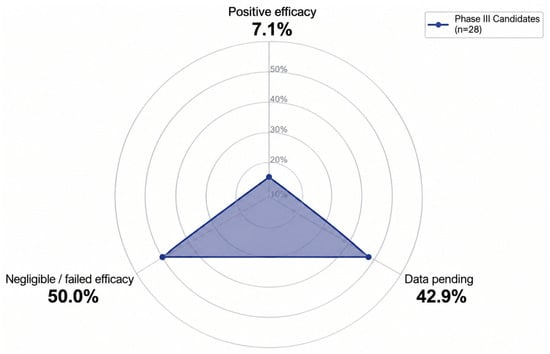
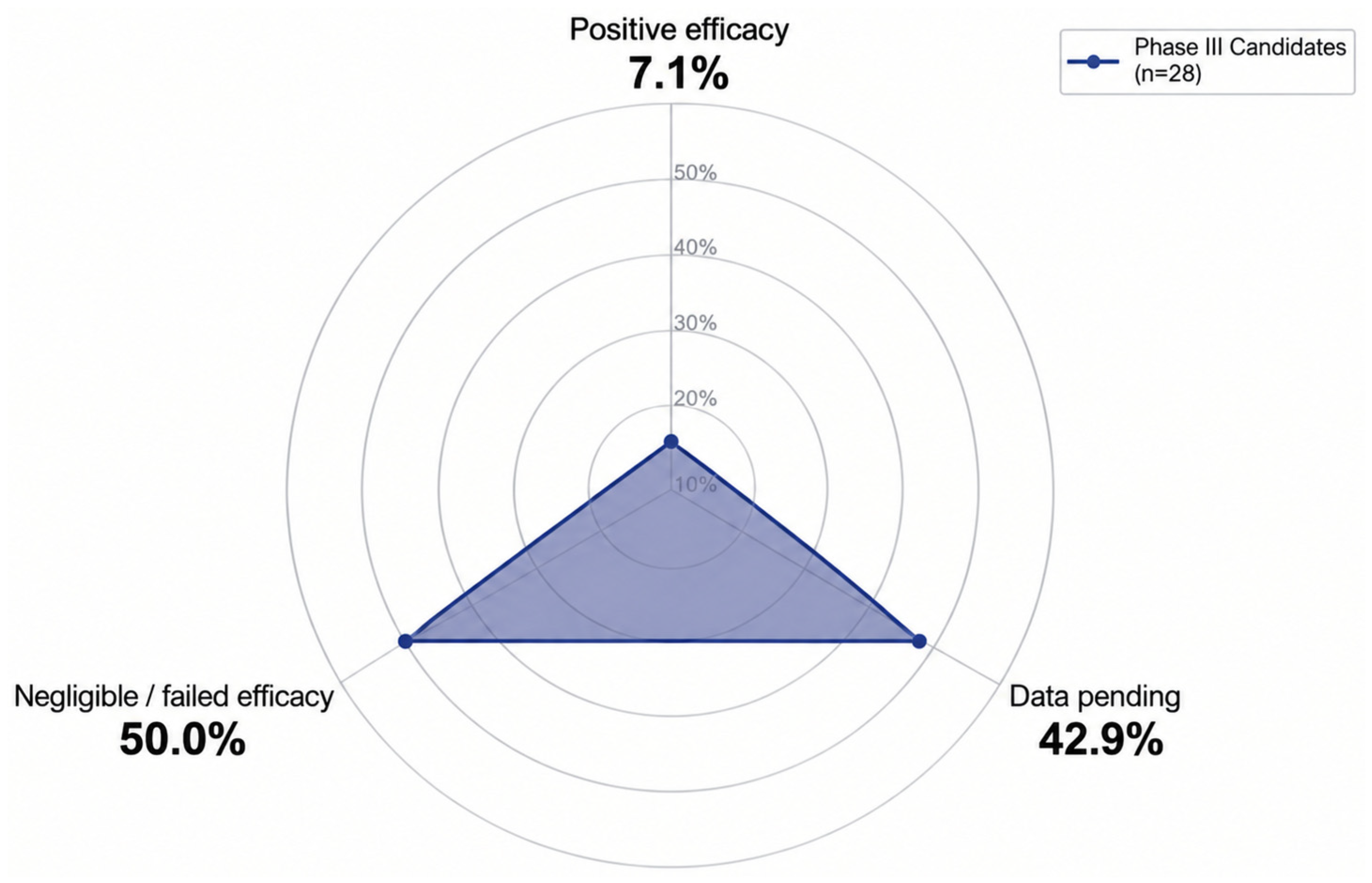
Phase I and Phase II data are only suggestive of clinical benefit, while Phase III trial results are the gold standard for clinical benefit. Strict evaluation of therapeutic efficacy for the 28 subjects must be stratified by the primary clinical endpoint because disease-modifying and symptomatic therapies cannot be combined into a single efficacy measure (Table 1, Figure 1).
Figure 1.
Distribution of reported clinical outcomes among the 28 Phase III therapeutic candidates.
Overall, 7.1% (2/28) of the 28-molecule pipeline have met their primary efficacy endpoints in Phase III, 50.0% (14/28) exhibit negligible or failed efficacy on their primary endpoints, and 42.9% (12/28) have definitive Phase III results pending. For the 16 disease-modifying therapies targeting amyloid, tau, or neuroprotection, clinical success has been elusive: none (0.0%, 0/16) achieved statistical significance across all required primary or co-primary endpoints, 56.3% (9/16) failed to meet their primary or co-primary clinical endpoints in Phase III—namely gantenerumab, solanezumab, simufilam, fosgonimeton, leuprolide, semaglutide (EVOKE/EVOKE+), ALZ-801 (APOLLOE4), hydromethylthionine mesylate (LUCIDITY), and blarcamesine (ANAVEX2-73-AD-004)—and 43.8% (7/16; AR1001, remternetug, E2814, buntanetap, masitinib, nilotinib, and PM012) await definitive Phase III results. Although blarcamesine reached statistical significance on the cognitive co-primary endpoint (ADAS-Cog13) in Phase IIb/III, it failed on its co-primary functional endpoint (ADCS-ADL), leading to an unfavorable EMA CHMP evaluation in December 2025 and its classification as a negative trial. In contrast, the 12 symptomatic candidates for neuropsychiatric or functional stabilization showed a mixed distribution: 16.7% (2/12) met their primary clinical endpoints in completed Phase III trials (AXS-05 for agitation in Alzheimer’s disease and BXCL501 for acute agitation in dementia), 41.7% (5/12) did not demonstrate statistically significant superiority over placebo on their primary endpoints (AVP-786, escitalopram, piromelatine, tricaprylin, and suvorexant, which showed a non-significant difference in delirium incidence of 16.8% versus 26.5% with placebo, p = 0.13), and 41.7% (5/12) are awaiting final Phase III results. Of the six agents targeting agitation in dementia, two (33.3%; AXS-05 and BXCL501) achieved positive Phase III results, two (33.3%; AVP-786 and escitalopram) failed to meet primary endpoints, and two (33.3%; masupirdine and nabilone) have pending Phase III outcomes.
Thus, therapeutic ‘success’ must be seen as an outcome within its clinical category, not as a single outcome. Moreover, as shown in Table 3, the choice of mechanism of action is strongly dependent on the clinical indication. Neurotransmitter receptor modulators are mainly used for acute neuropsychiatric symptoms, whereas monoclonal antibodies are only aimed at disease modification in early-stage or mild to moderate disease. None of the 28 Phase III candidates are vaccines. Most of the studies assessed were randomized, double-blind, placebo-controlled, and enrolled large cohorts of >2000 patients in pivotal programs. Disease-modifying trials primarily included biomarker-confirmed subjects from the early Alzheimer’s continuum (MCI due to AD and mild AD), whereas trials targeting neuropsychiatric symptoms included patients with clinically diagnosed mild-to-severe dementia.
Table 3.
The Therapeutic Landscape—Mechanisms of Action Across Clinical Indications.
Adverse events were highly variable among pharmacological categories regarding safety profiles. Disease-modifying monoclonal antibodies had class-specific hazards, such as ARIA and infusion-related reactions. Meanwhile, small molecules and repurposed drugs showed heterogeneous tolerability, including GI adverse effects, sedation, and cognitive decline in unsuccessful trials (e.g., negative safety signals observed in some trial arms for simufilam). Table 1 details the complete safety criteria and cessation risks for each agent. Extensive early research and discovery of new drug targets are critical to establish the foundation for complex clinical testing. This emphasizes the important step from exploratory preclinical ideas to Phase III verification [73,74].
The regulatory approval of the anti-amyloid antibodies lecanemab and donanemab in many jurisdictions highlights the important role of monoclonal antibodies targeting cerebral proteinopathies in late-stage Alzheimer’s research [75,76,77,78,79,80,81,82].
Lecanemab and donanemab have set a new standard for disease-modifying therapy by statistically slowing cognitive and functional decline in biomarker-confirmed early Alzheimer’s disease. However, their real-world implementation remains limited by stringent magnetic resonance imaging safety monitoring requirements, reimbursement barriers, and heterogeneous regulatory approvals.
Mechanistically, clinical divergence of anti-amyloid monoclonal antibodies is largely driven by kinetics of plaque clearance and epitope selectivity. We evaluated four investigational monoclonal antibodies in our cohort of 28 Phase III candidates: three targeting β-amyloid (solanezumab, gantenerumab, and remternetug) and one targeting tau pathology (E2814). Solanezumab was designed to target soluble monomeric beta-amyloid and not fibrillar plaques, and its consistent failure in the EXPEDITION and A4 trials showed that monomer sequestration alone does not affect clinical progression. Gantenerumab was engineered to target aggregated fibrillar β-amyloid plaques. However, it failed to demonstrate significant clinical benefit in the Phase III GRADUATE I and II trials due to slower and incomplete plaque clearance, resulting in permanent discontinuation of drug development.
Remternetug is a next-generation IgG1 antibody that, like donanemab, targets N-terminal pyroglutamate-modified β-amyloid (N3pG-Aβ) for rapid, deep plaque clearance. Remternetug also has potential for subcutaneous administration, which could significantly reduce the logistical burden of IV infusions. E2814 (etalanetug) is a monoclonal anti-tau antibody that binds to the microtubule-binding region of tau to inhibit trans-synaptic tau propagation. Therefore, this provides a complementary approach to these anti-amyloid strategies.
In addition to discovering novel targeted biologics and small molecules, repurposing existing pharmacological agents represents a critical strategic direction in Phase III clinical research. As noted in the methodology, our analysis includes several repurposed therapeutic candidates.
As mentioned in the methodology, we included some reused therapeutic agents in our analysis. Table 4 compares the clinical outcomes of these repurposed therapeutics, which leverage established safety profiles from other pathologies, rather than completely novel molecules designed specifically for neurodegeneration.
Table 4.
Strategic Approaches in Phase III: Novel Molecules vs. Repurposed Therapeutics.
A critical analysis of Phase III clinical trials also needs to consider why so many previous disease-modifying therapies have failed. In the past, one of the main reasons for failure was intervening too late in the disease continuum, when irreversible neuronal loss had already occurred. Moreover, early therapies frequently attacked the wrong amyloid species, such as soluble monomers rather than toxic oligomers or aggregated plaques [55]. These failures have revolutionized modern clinical trial design, making biomarker-based patient selection a must. Today, successful therapies depend on the detection of patients in the very early stages of AD or MCI, using accurate fluid biomarkers and PET imaging to confirm amyloid pathology before starting treatment [2].
Another important factor in shaping the current therapeutic landscape is the APOE genotype. The APOE ε4 allele is the most important genetic risk factor for late-onset Alzheimer’s disease and has a considerable influence on the safety and the therapeutic responsiveness of a drug. For example, the Phase III APOLLOE4 trial specifically tested the oral small-molecule oligomer inhibitor ALZ-801 in APOE ε4/ε4 homozygotes. The trial missed its primary ADAS-Cog13 endpoint in the entire early-AD population but demonstrated nominal cognitive and volumetric benefits in the MCI subset and no increased vasogenic edema, demonstrating the value of genetically stratified precision medicine [56,57]. Indeed, APOE ε4 homozygotes have a significantly increased rate of amyloid-related imaging abnormalities (ARIAs), including vasogenic edema (ARIA-E) and microhemorrhages or superficial siderosis (ARIA-H), particularly with plaque-clearing monoclonal antibodies. ARIA is the principal clinical challenge and dose-limiting toxicity of anti-amyloid immunotherapies. To manage this risk, rigorous, repeated MRI monitoring protocols are essential, which greatly increases the logistical and financial burden on health care systems and may limit real-world access to these breakthrough therapies [75,76].
In addition, when assessing the clinical outcomes of these Phase III trials, it is important to clearly distinguish between statistical significance, clinical relevance, biomarker target engagement (e.g., amyloid plaque reduction), symptomatic improvement, and true disease modification. In Alzheimer’s disease, the statistically significant slowing of cognitive decline on standardized psychometric tests does not always mean meaningful, dramatic, or easily noticeable functional benefits for patients in their everyday lives.
6. Limitations of the Study
The main limitation is the biological and diagnostic complexity of the patient groups. While most of these trials focus on a single molecular target, such as β-amyloid plaques, neurodegenerative disorders in clinical practice are typically multifactorial. Identifying a universal therapeutic effect is difficult because comorbidities and genetic variability may obscure or distort the treatment’s true effectiveness.
There is a thin line between standardized measures and the real therapeutic benefit that the patient perceives, which is reflected in the difference between statistics and practical application. Short follow-up periods, such as those of 12 to 24 months, frequently show a slowdown in cognitive decline. This does not necessarily reflect maintained functional independence or long-term cognitive improvement, given the slow progression of this disease. Thus, a clear distinction must be made between pathological target engagement—e.g., biomarker improvement or plaque clearance—and true clinical efficacy. Many of these recent Phase III trials are short, so a therapeutic agent may improve biomarkers without yet showing corresponding symptomatic benefits, which may simply require longer follow-up to become clinically apparent.
The ARIA-type phenomena that may occur are a major limitation of these new therapies. This fact requires the construction of new protocols for monitoring these patients. Due to these adverse effects, there is still a risk of therapeutic abandonment, which can also cause a study selection error and thus an overestimation of the tolerability of the drug outside a controlled setting.
The generalizability of these results may be limited by strict inclusion criteria. Patient selection for Phase III trials is often limited in ethnic, socioeconomic, and comorbidity diversity. Administration and monitoring also face challenges because many health centers lack advanced imaging equipment.
7. Novelty of the Study
This article presents a comprehensive, current, and clinically classified review of the current Phase III treatment landscape for AD and concomitant neuropsychiatric symptoms of dementia. Rather than presenting a typical synopsis of the narrative, this research systematically orders and contrasts late-stage clinical candidates, differentiating between those with proven positive efficacy and those that have failed or are still awaiting results. We also discuss possible impacts of disease progression, biomarker selection, APOE genotype, timing of treatment, and selection of endpoints on the differential clinical outcomes seen across trials. In this paper, we bring together a variety of pharmacological approaches and findings to develop a framework that can be used as a practical guide to distinguish theoretical therapeutic potential from empirical clinical validation.
8. Conclusions
The Phase III treatment landscape for Alzheimer’s disease is clinically heterogeneous and evolving. Some disease-modifying monoclonal antibodies show statistically significant slowing of clinical progression in patients at early stage rather than arresting the disease. Many candidate molecules have failed to meet their primary endpoints, and a significant proportion of the pipeline remains focused on the symptomatic and palliative treatment of neuropsychiatric symptoms.
Monoclonal antibodies are still a therapy with great potential to become established disease-modifying treatments for patients with Alzheimer’s disease. While these therapies are novel, those tested in early AD populations confirmed by biomarkers—e.g., lecanemab and donanemab—showed statistically significant but modest benefits in slowing cognitive decline. However, this potential benefit must be carefully balanced against the absolute clinical effect, the significant risks of amyloid-related imaging abnormalities (ARIAs) and microhemorrhages, the high logistical burden of strict MRI monitoring, and the long-term uncertainties about sustained real-world efficacy.
The majority of these disease-modifying therapies target the earliest stages of Alzheimer’s disease and MCI by clearing extracellular amyloid plaques or inhibiting tau pathology, while tracking neurodegeneration biomarkers—including phosphorylated tau and neurofilament light chain—to slow the rate of cognitive decline. Finally, whereas targeted symptomatic agents have demonstrated clinical utility for acute neuropsychiatric symptoms such as agitation, future success in disease modification will require rigorous patient stratification, precise biomarker profiling, and early intervention strategies.
Author Contributions
Conceptualization, M.G., A.R., S.M., A.C.P. and C.S.Ș.; methodology, S.M., A.V.S. and L.L.A.A.; software, M.G. and S.M.; validation, A.R., M.G. and S.M.; formal analysis, C.S.Ș., L.L.A.A., M.G. and A.R.; investigation, M.G. and A.C.P.; resources, M.G., A.R. and S.M.; data curation, A.V.S. and M.G.; writing—original draft preparation, S.M., C.S.Ș. and A.R.; writing—review and editing, M.G., A.C.P. and C.S.Ș.; visualization, A.R.; supervision, A.R., M.G. and C.S.Ș.; project administration, M.G.; funding acquisition, C.S.Ș. and A.R. All authors have read and agreed to the published version of the manuscript.
Funding
This research received no external funding.
Institutional Review Board Statement
Not applicable.
Informed Consent Statement
Not applicable.
Data Availability Statement
No new data were created or analyzed in this study. Data sharing is not applicable to this article.
Conflicts of Interest
The authors declare no conflicts of interest.
Abbreviations
| MCI | Mild Cognitive Impairment |
| AD | Alzheimer’s Disease |
| DMTs | Disease-Modifying Therapies |
| FDA | Food and Drug Administration |
| MMSE | Mini-Mental State Examination |
| Aβ | β-amyloid |
| I.v. | Intravenous |
| IgG1 | Immunoglobulin G Antibody Subclass 1 |
| NMDA | N-methyl-D-aspartate |
| GnRH | Gonadotropin-Releasing Hormone |
| ARIA | Amyloid-Related Imaging Abnormalities |
References
- Huang, L.K.; Kuan, Y.C.; Lin, H.W.; Hu, C.J. Clinical trials of new drugs for Alzheimer’s disease: A 2020–2023 update. J. Biomed. Sci. 2023, 30, 83. [Google Scholar] [CrossRef] [Scilit] [PubMed]
- Zhang, J.; Zhang, Y.; Wang, J.; Xia, Y.; Zhang, J.; Chen, L. Recent advances in Alzheimer’s disease: Mechanisms, clinical trials and drug development strategies. Signal Transduct. Target. Ther. 2024, 9, 211. [Google Scholar] [CrossRef] [Scilit] [PubMed]
- Bloom, G.S. The trigger and the bullet in the pathogenesis of Alzheimer’s disease. JAMA Neurol. 2014, 71, 505–508. [Google Scholar] [PubMed]
- Plassman, B.L.; Langa, K.M.; Fisher, G.G.; Heeringa, S.G.; Weir, D.R.; Ofstedal, M.B.; Burke, J.R.; Hurd, M.D.; Potter, G.G.; Rodgers, W.L.; et al. Prevalence of dementia in the United States: The aging, demographics, and memory study. Neuroepidemiology 2007, 29, 125–132. [Google Scholar] [CrossRef] [Scilit] [PubMed]
- Kramarow, E.A. Diagnosed Dementia in Adults Age 65 and Older: United States, 2022. Natl. Health Stat. Rep. 2024, 203, 1–9. [Google Scholar] [CrossRef] [Scilit]
- Wu, C.K.; Fuh, J.L. A 2025 update on treatment strategies for the Alzheimer’s disease spectrum. J. Chin. Med. Assoc. 2025, 88, 495–502. [Google Scholar] [CrossRef] [Scilit] [PubMed]
- Shen, G.; Xu, X.; Li, M.; Sun, Z.; Wei, L.; Deng, Z.; Lin, Z.; Huang, J.; Qi, W.; Xu, J. The Clinical Trials Landscape for Alzheimer’s Disease. CNS Neurosci. Ther. 2025, 31, e70492. [Google Scholar] [CrossRef] [Scilit] [PubMed]
- Friend, S.; Dirks, B.; Howell, B.; Feng, X.; Zhang, P.; Pathak, S. Design of a phase 2/3 multicenter, double-blind, placebo-controlled study investigating the efficacy and safety of ACP-204, a novel 5-HT2A inverse agonist, in Alzheimer s disease psychosis. Am. J. Geriatr. Psychiatry 2025, 33, S11–S12. [Google Scholar] [CrossRef] [Scilit]
- Xi, T.; Kim, F.; Kim, J.W.; Jung, J.S.; Jeon, E.; Jo, H.; Nam, J.S.; Song, D.K.; Choung, J.J. Target Engagement and Therapeutic Effects of AR1001, a Phosphodiesterase-5 Inhibitor, in Alzheimer’s Disease Models. Alzheimer’s Dement. 2025, 20, e095314. [Google Scholar] [CrossRef] [Scilit]
- Spichak, S. Clinical Trials Update: Latest News on Alzheimer’s Clinical Trials. Being Patient. 2025. Available online: https://beingpatient.com/trials-update-2025-q1/ (accessed on 15 June 2026).
- Kang, B.W.; Kumar, A.; Song, D.-K.; Ha, J.-Y.; Choung, J.J. Protective Effects of AR1001 in Alzheimer’s Disease Models: Polypharmacological Mechanisms. Alzheimer’s Dement. 2023, 19, e082892. [Google Scholar] [CrossRef] [Scilit]
- Meglio, M. AVP-786 Falls Short in Phase 3 Study of Agitation in Alzheimer’s Disease. NeurologyLive. 2024. Available online: https://www.neurologylive.com/view/avp-786-falls-short-phase-3-study-alzheimer-disease-agitation (accessed on 15 June 2026).
- Khoury, R.; Marx, C.; Mirgati, S.; Velury, D.; Chakkamparambil, B.; Grossberg, G.T. AVP-786 as a Promising Treatment Option for Alzheimer’s Disease Including Agitation. Expert Opin. Pharmacother. 2021, 22, 783–795. [Google Scholar] [CrossRef] [Scilit] [PubMed]
- Kuntz, L. Drug for agitation in Alzheimer’s disease, dementia fails in phase 3 clinical trial. Psychiatr. Times. 2024. Available online: https://www.psychiatrictimes.com/view/drug-for-agitation-in-alzheimer-disease-dementia-fails-in-phase-3-trial (accessed on 15 June 2026).
- Cummings, J.; Grossberg, G.; Andersson, C.; Streicher, C.; Tabuteau, H. Efficacy and Safety of AXS-05 in Agitation Associated with Alzheimer’s Disease: Results from ACCORD, a Phase 3, Double-blind, Placebo-controlled, Relapse Prevention Trial (PL5.004). Neurology 2024, 102, 5194. [Google Scholar] [CrossRef] [Scilit]
- Meglio, M. Oral Blarcamesin Reduces Cognitive Decline in Phase 2b/3 Clinical Trial for Early-Stage Alzheimer’s Disease. NeurologyLive. 2025. Available online: https://www.patientcareonline.com/view/oral-blarcamesine-shows-marked-reduction-in-cognitive-decline-in-early-alzheimer-disease-phase-2b-3-data (accessed on 15 June 2026).
- Sabbagh, M.N.; Chezem, W.R.; Jin, K.; Missling, C.U.; Anavex Life Sciences Research Group. Blarcamesin in Early-Stage Alzheimer’s Disease, Randomized Phase 2b/3 Clinical Trial. Alzheimer’s Dement. 2025, 20, e090729. [Google Scholar] [CrossRef] [Scilit]
- Macfarlane, S.; Grimmer, T.; Teo, K.; O’Brien, T.J.; Woodward, M.; Grunfeld, J.; Mander, A.; Brodtmann, A.; Brew, B.J.; Morris, P.; et al. Blarcamesine for the treatment of Early Alzheimer’s Disease: Results from the ANAVEX2-73-AD-004 Phase IIB/III trial. J. Prev. Alzheimer’s Dis. 2025, 12, 100016. [Google Scholar] [CrossRef] [Scilit] [PubMed]
- European Medicines Agency (EMA). Blarcamesine Anavex: Refusal of the Marketing Authorisation Opinion by the Committee for Medicinal Products for Human Use (CHMP) and Withdrawal of Application; EMA/CHMP: Amsterdam, The Netherlands, 2026.
- Fang, C.; Hernandez, P.; Liow, K.; Damiano, E.; Zetterberg, H.; Blennow, K.; Feng, D.; Chen, M.; Maccecchini, M. Buntanetap, a novel translational inhibitor of multiple neurotoxic proteins, proves safe and promising in both Alzheimer’s and Parkinson’s patients. J. Prev. Alzheimer’s Dis. 2023, 10, 25–33. [Google Scholar] [CrossRef] [Scilit] [PubMed]
- Fang, C.; Gaines, M.; Damiano, E.; Nagy, A.M.; Ng, D.; Maccecchini, M.L. Interim Analysis Results of Buntanetap in Phase 3 Clinical Trials in Alzheimer’s and Parkinson’s Disease. Alzheimer’s Dement. 2023, 19, e074275. [Google Scholar] [CrossRef] [Scilit]
- Rajji, T.K.; Baksh, S.N.; Shade, D.M.; Ismail, Z.; Burhan, A.M.; Okhravi, H.R.; Padala, P.R.; Rosenberg, P.B.; Schneider, L.S.; Porsteinsson, A.P.; et al. Escitalopram for Agitation in Alzheimer’s Dementia: A Phase 3 Randomized Controlled Trial. Nat. Med. 2025, 31, 1586–1591. [Google Scholar] [CrossRef] [Scilit] [PubMed]
- Meglio, M. Synaptic Agent Fosgonimetone Fails in LIFT-AD Phase 2/3 Trial for Mild to Moderate Alzheimer’s Disease. NeurologyLive. 2024. Available online: https://www.neurologylive.com/view/synaptic-agent-fosgonimeton-falls-short-phase-2-3-lift-ad-trial-mild-moderate-alzheimers (accessed on 15 June 2026).
- Bateman, R.J.; Smith, J.; Donohue, M.C.; Delmar, P.; Abbas, R.; Salloway, S.; Wojtowicz, J. Two Phase 3 Clinical Trials of Gantenerumab in Early-Stage Alzheimer’s Disease. N. Engl. J. Med. 2023, 389, 1862–1876. [Google Scholar] [CrossRef] [Scilit] [PubMed]
- Bateman, R.J.; Li, Y.; McDade, E.M.; Llibre-Guerra, J.J.; Clifford, D.B.; Atri, A.; Mills, S.L.; Santacruz, A.M.; Wang, G.; Supnet, C.; et al. Safety and efficacy of long-term gantenerumab treatment in dominantly inherited Alzheimer’s disease: An open-label extension of the phase 2/3 multicentre, randomised, double-blind, placebo-controlled platform DIAN-TU trial. Lancet Neurol. 2025, 24, 316–330. [Google Scholar] [CrossRef] [Scilit] [PubMed]
- Boess, G.; Scelsi, M.A.; Grimmer, T.; Perry, R.J.; Tonietto, M.; Klein, G.; Hofmann, C.; Salami, M.; Wojtowicz, J.; Lansdall, C.J.; et al. Home Administration of Gantenerumab by Care Partners in People with Early-Stage Alzheimer’s Disease: Feasibility, Safety, and Pharmacodynamic Impact. J. Prev. Alzheimer’s Dis. 2024, 11, 537–548. [Google Scholar] [CrossRef] [Scilit] [PubMed]
- Marvar, A. Roche Alzheimer’s Drug Fails in Clinical Trials. Being Patient. 2022. Available online: https://beingpatient.com/roche-gantenerumab-failure-alzheimers/ (accessed on 17 June 2026).
- Kang, M.; Watson, C.; Cummings, J.L.; Grossberg, G.T.; Marcus, R.; Yeung, P. Design of ADEPT-2, a Phase 3, Parallel-Group Trial to Evaluate KarXT [xanomeline-trospium] as a Treatment for Psychosis Associated with Alzheimer’s Disease. Alzheimer’s Dement. 2023, 19, e075201. [Google Scholar] [CrossRef] [Scilit]
- Kingwell, K. FDA approves first schizophrenia drug with novel mechanism of action since 1950s. Nat. Rev. Drug Discov. 2024, 23, 803. [Google Scholar] [CrossRef] [Scilit] [PubMed]
- Sauder, C.; Allen, L.A.; Baker, E.; Miller, A.C.; Paul, S.M.; Brannan, S.K. Effectiveness of KarXT (xanomeline-trospium) for cognitive impairment in schizophrenia: Post hoc analyses from a randomised, double-blind, placebo-controlled phase 2 study. Transl. Psychiatry 2022, 12, 491. [Google Scholar] [CrossRef] [Scilit] [PubMed]
- Mohs, R.; Bakker, A.; Rosenzweig-Lipson, S.; Rosenblum, M.; Barton, R.L.; Albert, M.S.; Cohen, S.; Zeger, S.; Gallagher, M. The HOPE4MCI study: A randomized double-blind assessment of AGB101 for the treatment of MCI due to AD. Alzheimer’s Dement. 2024, 10, e12446. [Google Scholar] [CrossRef] [Scilit] [PubMed]
- Mohamadi, H.; Bavafa, A. The cognitive effect of levetiracetam in patients with Alzheimer’s disease or mild cognitive impairment: A systematic review. Curr. Ther. Res. 2025, 103, 100798. [Google Scholar] [CrossRef] [Scilit] [PubMed]
- Dubois, B.; López-Arrieta, J.; Lipschitz, S.; Doskas, T.; Spiru, L.; Moroz, S.; Venger, O.; Vermersch, P.; Moussy, A.; Mansfield, C.D.; et al. Masitinib for mild-to-moderate Alzheimer’s disease: Results from a randomized, placebo-controlled, phase 3, clinical trial. Alzheimer’s Res. Ther. 2023, 15, 39. [Google Scholar] [CrossRef] [Scilit] [PubMed]
- Dubois, B. Masitinib in mild to moderate Alzheimer’s disease: Results from the AB09004 study. Alzheimer’s Dement. 2021, 17, e049866. [Google Scholar] [CrossRef] [Scilit]
- Nirogi, R.; Ravula, J.; Jetta, S.; Goyal, V.K.; Palacharla, V.R.C.; Benade, V.; Shinde, A.; Abraham, R.; Pandey, S.K.; Subramanian, R.; et al. Masupirdine (SUVN-502): An update of the phase 3 clinical development program targeting agitation in patients with dementia of the Alzheimer’s type. Neurology 2025, 104, 2315. [Google Scholar] [CrossRef] [Scilit]
- Nirogi, R.; Abraham, R.; Ravula, J.; Jetta, S.; Benade, V.; Shinde, A.; Rasheed, M.A.; Badange, R.K.; Goyal, V.K.; Palacharla, V.R.C.; et al. Masupirdine (SUVN-502): A phase 3 study for the potential treatment of agitation in patients with dementia of the Alzheimer’s type, an update. Alzheimer’s Dement. 2025, 20, e087894. [Google Scholar] [CrossRef] [Scilit]
- Nirogi, R.; Ieni, J.; Goyal, V.K.; Ravula, J.; Jetta, S.; Shinde, A.; Jayarajan, P.; Benade, V.; Palacharla, V.R.C.; Dogiparti, D.K.; et al. Effect of masupirdine (SUVN-502) on cognition in patients with moderate Alzheimer’s disease: A randomized, double-blind, phase 2, proof-of-concept study. Alzheimer’s Dement. 2022, 8, e12307. [Google Scholar] [CrossRef] [Scilit] [PubMed]
- Ruthirakuhan, M.T.; Herrmann, N.; Gallagher, D.; Andreazza, A.C.; Kiss, A.; Verhoeff, N.P.L.G.; Black, S.E.; Lanctôt, K.L. Investigating the safety and efficacy of nabilone for the treatment of agitation in patients with moderate-to-severe Alzheimer’s disease: Study protocol for a cross-over randomized controlled trial. Contemp. Clin. Trials Commun. 2019, 15, 100385. [Google Scholar] [CrossRef] [Scilit] [PubMed]
- Tullberg, S. Nabilone. In xPharm: The Complete Guide to Pharmacology; Enna, S.J., Bylund, D.B., Eds.; Elsevier: New York, NY, USA, 2007; pp. 1–4. [Google Scholar]
- Turner, R.S.; Hebron, M.L.; Lawler, A.; Mundel, E.E.; Yusuf, N.; Starr, J.N.; Anjum, M.; Pagan, F.; Torres-Yaghi, Y.; Shi, W.; et al. Nilotinib Effects on Safety, Tolerability, and Biomarkers in Alzheimer’s Disease. Ann. Neurol. 2020, 88, 183–194. [Google Scholar] [CrossRef] [Scilit] [PubMed]
- Tocci, D.; Fogel, M.; Gupta, V.; Kim, P.; Latimer, J.; Adlimoghaddam, A.; Robison, L.S.; Albensi, B.C. Beyond expectations: Investigating the potential of nilotinib in attenuating neurodegeneration in Alzheimer’s disease. Alzheimer’s Res. Ther. 2025, 17, 60. [Google Scholar] [CrossRef] [Scilit] [PubMed]
- Blay, J.Y.; von Mehren, M. Nilotinib: A novel, selective tyrosine kinase inhibitor. Semin. Oncol. 2011, 38, S3–S11. [Google Scholar] [CrossRef] [Scilit] [PubMed]
- Buccellato, F.R.; D’Anca, M.; Tartaglia, G.M.; Del Fabbro, M.; Scarpini, E.; Galimberti, D. Treatment of Alzheimer’s Disease: Beyond Symptomatic Therapies. Int. J. Mol. Sci. 2023, 24, 13900. [Google Scholar] [CrossRef] [Scilit] [PubMed]
- Lee, H.S. Mediforum verifies safety, efficacy of dementia treatment candidate. Korea Biomed. Rev. 2019. Available online: https://www.koreabiomed.com/news/articleView.html?idxno=5180 (accessed on 17 June 2026).
- Cummings, J.; Zhou, Y.; Lee, G.; Zhong, K.; Fonseca, J.; Cheng, F. Alzheimer’s disease drug development pipeline: 2024. Alzheimer’s Dement. 2024, 10, e12465. [Google Scholar] [CrossRef] [Scilit] [PubMed]
- Meglio, M. Phase 3 TRAILRUNNER-ALZ 3 to Test Effects of IgG1 Monoclonal Antibody Remternetug in Early-Stage Alzheimer’s Disease. NeurologyLive. 2024. Available online: https://www.neurologylive.com/view/phase-3-trailrunner-alz-3-test-effects-igg1-monoclonal-antibody-remternetug-early-alzheimer-disease (accessed on 17 June 2026).
- Sabbagh, M.; Boschini, C.; Cohen, S.; Fugger, M.; Jessen, F.; Dandanell, S.; Pedersen, S.D.; Tarazona, L.R.S.; Aroda, V.R. Safety considerations of semaglutide in the potential treatment of Alzheimer’s disease: A pooled analysis of semaglutide in adults aged ≥65 years. Alzheimer’s Dement. 2025, 11, e70076. [Google Scholar] [CrossRef] [Scilit] [PubMed]
- Cummings, J.L.; Atri, A.; Feldman, H.H.; Hansson, O.; Sano, M.; Knop, F.K.; Johannsen, P.; León, T.; Scheltens, P. evoke and evoke+: Design of two large-scale, double-blind, placebo-controlled, phase 3 studies evaluating efficacy, safety, and tolerability of semaglutide in early-stage symptomatic Alzheimer’s disease. Alzheimer’s Res. Ther. 2025, 17, 14. [Google Scholar] [CrossRef] [Scilit] [PubMed]
- Meglio, M. Alzheimer’s agent Simufilam fails to meet primary endpoint in phase 3 trial. NeurologyLive. 2024. Available online: https://www.neurologylive.com/view/alzheimer-agent-simufilam-fails-meet-primary-end-point-phase-3-study (accessed on 17 June 2026).
- Maia, M. Simufilam fails to meet phase 3 clinical trial goals; development halted. Alzheimer’s News Today. 2025. Available online: https://alzheimersnewstoday.com/news/simufilam-fails-meet-alzheimers-phase-3-trial-goals-discontinued/ (accessed on 17 June 2026).
- Doody, R.S.; Thomas, R.G.; Farlow, M.; Iwatsubo, T.; Vellas, B.; Joffe, S.; Kieburtz, K.; Raman, R.; Sun, X.; Aisen, P.S.; et al. Phase 3 clinical trials of solanezumab for mild to moderate Alzheimer’s disease. N. Engl. J. Med. 2014, 370, 311–321. [Google Scholar] [CrossRef] [Scilit] [PubMed]
- Honig, L.S.; Vellas, B.; Vellas, B.; Woodward, M.; Boada, M.; Bullock, R.; Borrie, M.; Hager, K.; Andreasen, N.; Scarpini, E.; et al. Clinical trial of solanezumab for mild dementia due to Alzheimer’s disease. N. Engl. J. Med. 2018, 378, 321–330. [Google Scholar] [CrossRef] [Scilit] [PubMed]
- Sperling, R.A.; Donohue, M.C.; Raman, R.; Rafii, M.S.; Johnson, K.; Masters, C.L.; van Dyck, C.H.; Iwatsubo, T.; Marshall, G.A.; Yaari, R.; et al. Trial of Solanezumab in Preclinical Alzheimer’s Disease. N. Engl. J. Med. 2023, 389, 1108–1120. [Google Scholar] [CrossRef] [Scilit] [PubMed]
- Walker, J.A.; Nelleman, L.; Henderson, S.T.; Morimoto, B. Clinical development of tricaprylin, a ketogenic drug for Alzheimer’s disease. Alzheimer’s Dement. 2020, 16, 227502818. [Google Scholar] [CrossRef] [Scilit]
- Kim, C.K.; Lee, Y.R.; Ong, L.; Gold, M.; Kalali, A.; Sarkar, J. Alzheimer’s Disease: Key Insights from Two Decades of Clinical Trial Failures. J. Alzheimer’s Dis. 2022, 87, 83–100. [Google Scholar] [CrossRef] [Scilit] [PubMed]
- Abushakra, S.; Power, A.; Watson, D.; Sabbagh, M.; Porsteinsson, A.P.; Hey, J.A.; Tolar, M.; MacSweeney, E.; Cohen, S.; Rovira, M.B.; et al. Clinical Efficacy, Safety and Imaging Effects of Oral Valiltramiprosate in APOEε4/ε4 Homozygotes with Early Alzheimer’s Disease: Results of the Phase III, Randomized, Double-Blind, Placebo-Controlled, 78-Week APOLLOE4 Trial. Drugs 2025, 85, 1455–1472. [Google Scholar] [CrossRef] [Scilit] [PubMed]
- Abushakra, S.; Porsteinsson, A.P.; Sabbagh, M.; Watson, D.; Power, A.; Liang, E.; MacSweeney, E.; Boada, M.; Flint, S.; McLaine, R.; et al. APOLLOE4 Phase 3 study of oral ALZ-801/valiltramiprosate in APOE ε4/ε4 homozygotes with early Alzheimer’s disease: Trial design and baseline characteristics. Alzheimer’s Dement. 2024, 10, e12498. [Google Scholar] [CrossRef] [Scilit] [PubMed]
- Hey, J.A.; Yu, J.Y.; Abushakra, S.; Schaefer, J.F.; Power, A.; Kesslak, P.; Paul, J.; Tolar, M. Clinical pharmacokinetics of oral ALZ-801/Valiltramiprosate in a 2-year phase 2 clinical study in APOE4 carriers with early-stage Alzheimer’s disease. Clin. Pharmacokinet. 2025, 64, 407–424. [Google Scholar] [CrossRef] [Scilit] [PubMed]
- Power, A.; Watson, D.; Abushakra, S.; MacSweeney, E.; Porsteinsson, A.P.; Sabbagh, M.N.; Liang, E.; McLaine, R.; Boada, M.; Snædal, J.; et al. Phase 3 clinical trial of oral administration of the anti-amyloid agent ALZ-801/Valiltramiprosate in APOE4/4 homozygotes with early-stage Alzheimer’s disease: Baseline characteristics and prevalence of comorbid cerebral amyloid angiopathy. Alzheimer’s Dement. 2025, 21, e095679. [Google Scholar]
- Osaka, H.; Nishida, K.; Kanazawa, T. Beyond lecanemab: Examining Phase III potential in Alzheimer’s therapeutics. PCN Rep. 2024, 3, e185. [Google Scholar] [CrossRef] [Scilit] [PubMed]
- Meglio, M. Phase 2/3 Study of Tau-Targeting Agent E2814 in Alzheimer’s Disease Enrolls First Patient. NeurologyLive. 2022. Available online: https://www.neurologylive.com/view/phase-2-3-study-tau-targeting-agent-e2814-alzheimer-enrolls-first-patient (accessed on 17 June 2026).
- Zhou, J.; Rawal, S.; Yagi, T.; Wildsmith, K.R.; Takahashi, E.; Horie, K.; Barthélemy, N.R.; Aluri, J.; Lalovic, B.; Boyd, P.; et al. E2814: An Anti-Tau Therapy Engages CNS Target and Affects MTBR-tau243 Tangle-Specific Biomarker in Dominantly Inherited Alzheimer’s Disease. Alzheimer’s Dement. 2023, 19, e082771. [Google Scholar] [CrossRef] [Scilit]
- Hatta, K.; Kishi, Y. Suvorexant for Reducing Delirium in Older Adults After Hospitalization: A Randomized Clinical Trial. JAMA Netw. Open 2024, 7, e2427691. [Google Scholar] [PubMed]
- Hatta, K.; Kishi, Y.; Wada, K.; Takeuchi, T.; Taira, T.; Uemura, K.; Ogawa, A.; Takahashi, K.; Sato, A.; Shirakawa, M.; et al. Suvorexant for Reduction of Delirium in Older Adults After Hospitalization: A Randomized Clinical Trial. JAMA Netw. Open 2024, 7, e2427653. [Google Scholar]
- Meglio, M. Addressing Alzheimer Agitation With Phase 3 TRANQUILITY Program of BXCL501. NeurologyLive. 2022. Available online: https://www.neurologylive.com/view/addressing-alzheimer-agitation-phase-3-tranquility-program-bxcl501 (accessed on 17 June 2026).
- Devanand, D.P. Management of neuropsychiatric symptoms in dementia. Curr. Opin. Neurol. 2023, 36, 347–352. [Google Scholar] [CrossRef] [Scilit] [PubMed]
- Murphy, K.S.; Golden, J.C.; Tampi, R.R. Dexmedetomidine for Agitation in Dementia: Current Data and Future Directions. J. Am. Geriatr. Soc. 2025, 73, 552–557. [Google Scholar] [CrossRef] [Scilit] [PubMed]
- Risinger, R.; Rajachandran, L.; Robinson, H. A Phase Ib/II Study of BXCL501 in Agitation Associated with Dementia. Alzheimer’s Dement. 2025, 20, e089463. [Google Scholar] [CrossRef] [Scilit]
- Jacobson, S.A.; Sabbagh, M.N. Investigational drugs for the treatment of AD: What can we learn from negative trials? Alzheimer’s Res. Ther. 2011, 3, 14. [Google Scholar] [CrossRef] [Scilit] [PubMed][Green Version]
- Swayzer, D.V.; Gerriets, V. Leuprolide. In StatPearls; StatPearls: Treasure Island, FL, USA, 2023. [Google Scholar]
- Wischik, C.M.; Bentham, P.; Gauthier, S.; Miller, S.; Kook, K.; Schelter, B.O. Oral Tau Aggregation Inhibitor for Alzheimer’s Disease: Design, Progress and Basis for Selection of the 16 mg/day Dose in a Phase 3, Randomized, Placebo-Controlled Trial of Hydromethylthionine Mesylate. J. Prev. Alzheimer’s Dis. 2022, 9, 553–561. [Google Scholar] [CrossRef] [Scilit] [PubMed]
- Wischik, C.M.; Stefanacci, R.; Bentham, P.; Gauthier, S.; Zetterberg, H.; Wilcock, G.K.; Froelich, L.; Burns, A.; MacSweeney, E.; Ballard, C.; et al. Clinical, imaging and blood biomarker outcomes in a Phase 3 clinical trial of tau aggregation inhibitor hydromethylthionine mesylate in mild cognitive impairment and mild to moderate dementia due to Alzheimer’s disease. J. Prev. Alzheimer’s Dis. 2026, 13, 100480. [Google Scholar] [CrossRef] [Scilit] [PubMed]
- Grecu, M.; Romila, A.; Moldovanu, S.; Condratovici-Plesa, A.; Anghel, L.; Oprea, V.D.; Bocancia, L.A. Early-stage research and new pharmacological targets in the management of Alzheimer’s dementia—A review of the literature. Balneo PRM Res. J. 2026, 17, 1024. [Google Scholar]
- Jin, L.W.; Lucente, J.D.; Nguyen, H.M.; Singh, V.; Singh, L.; Chavez, M.; Bushong, T.; Wulff, H.; Maezawa, I. Repurposing the KCa3.1 inhibitor senicapoc for Alzheimer’s disease. Ann. Clin. Transl. Neurol. 2019, 6, 723–738. [Google Scholar] [CrossRef] [Scilit] [PubMed]
- Terao, I.; Kodama, W. Comparative efficacy, tolerability and acceptability of donanemab, lecanemab, aducanumab and lithium on cognitive function in mild cognitive impairment and Alzheimer’s disease: A systematic review and network meta-analysis. Psychiatry Res. 2024, 332, 115682. [Google Scholar]
- Volloch, V.; Rits-Volloch, S. Effect of Lecanemab and Donanemab on early-stage Alzheimer’s disease: Mechanistic interpretation in the perspective of the Amyloid Cascade Hypothesis 2.0. J. Alzheimer’s Dis. 2023, 93, 1221–1235. [Google Scholar] [CrossRef] [Scilit] [PubMed]
- Wang, H.; Pan, J.; Tan, Z. Re-evaluation of the efficacy and safety of anti-Aβ monoclonal antibodies (lecanemab/donanemab) in the treatment of Alzheimer’s disease in early stage. Front. Pharmacol. 2025, 16, 1599048. [Google Scholar] [CrossRef] [Scilit] [PubMed]
- Sadowski, M. Differences between lecanemab and donanemab anti-amyloid therapies. NeurologyLive. 2023. Available online: https://www.neurologylive.com/view/differences-between-antiamyloid-therapies-lecanemab-donanemab-martin-sadowski (accessed on 17 June 2026).
- Ameen, T.B.; Kashif, S.N.; Abbas, S.M.I.; Babar, K.; Ali, S.M.S.; Raheem, A. Unraveling Alzheimer’s disease: The promise of aducanumab, lecanemab and donanemab. Egypt. J. Neurol. Psychiatr. Neurosurg. 2024, 60, 72. [Google Scholar] [CrossRef] [Scilit]
- Dodel, R.; Frölich, L. Donanemab for Alzheimer’s disease: From preclinical research to clinical application. Expert Rev. Neurother. 2025, 25, 1151–1163. [Google Scholar] [CrossRef] [Scilit] [PubMed]
- Jeremic, D.; Navarro-López, J.D.; Jiménez-Díaz, L. Donanemab outperformed Aducanumab and Lecanemab in cognitive outcomes but not in biomarkers and safety: Systematic review, frequentist and Bayesian network meta-analyses. medRxiv 2024. [Google Scholar] [CrossRef] [Scilit]
- Ameen, T.B.; Ali, U.; Salma, O.; Samee, M.A.; Abbas, S.M.I.; Kashif, S.N.; Arifi, M.A.; Ali, M.; Khowaja, M.; Ali, S.M.S.; et al. Amyloid solutions: Lecanemab, gantenerumab, and donanemab in the treatment of Alzheimer’s disease. Egypt. J. Neurol. Psychiatr. Neurosurg. 2025, 61, 37. [Google Scholar] [CrossRef] [Scilit]

Disclaimer/Publisher’s Note: The statements, opinions and data contained in all publications are solely those of the individual author(s) and contributor(s) and not of MDPI and/or the editor(s). MDPI and/or the editor(s) disclaim responsibility for any injury to people or property resulting from any ideas, methods, instructions or products referred to in the content. |
© 2026 by the authors. Licensee MDPI, Basel, Switzerland. This article is an open access article distributed under the terms and conditions of the Creative Commons Attribution (CC BY) license.