


Abstract
Background: The choice between mitomycin C (MMC) and oxaliplatin (OX) for hyperthermic intraperitoneal chemotherapy (HIPEC) after cytoreductive surgery for appendiceal neoplasms remains unresolved. Methods: PubMed/MEDLINE, Europe PMC, Scopus, Web of Science and ClinicalTrials.gov were searched to 1 October 2026 for studies comparing OX- and MMC-based HIPEC with outcomes in appendiceal neoplasms (PRISMA 2020; the protocol was not prospectively registered). Hazard ratios (HRs; OX vs. MMC, HR > 1 favours MMC) not reported by the studies were estimated from reconstructed individual patient data. Random-effects meta-analyses were performed; risk of bias was assessed with RoB 2 and ROBINS-I, and certainty with GRADE. Results: Ten studies (12 reports), including one randomised trial (n = 121), were included. In the randomised trial, HRs reconstructed from published Kaplan–Meier curves were 1.02 (95% CI 0.61–1.72) for disease-free survival and 1.05 (95% CI 0.59–1.85) for overall survival. In exploratory pooled analyses that also included observational cohorts, the HR for disease-free survival (4 studies, 343 patients) (OX vs. MMC) was 1.12 (95% CI 0.55–2.29; I2 = 60%), and 0.89 (95% CI 0.57–1.40) after exclusion of the only study reporting a significant difference. For overall survival (2 studies, 157 patients), the pooled HR was 0.97 (95% CI 0.56–1.69). Major morbidity did not differ (risk ratio 0.98, 95% CI 0.64–1.50). Leukopenia was more frequent with MMC, and health-related quality of life favoured OX in exploratory analyses of the randomised trial. Certainty of evidence was low to very low. Conclusions: Current evidence shows no survival difference between OX- and MMC-based HIPEC for appendiceal neoplasms, but it is sparse and imprecise. Regimen choice may reasonably be guided by toxicity, perfusion protocol and patient factors until adequately powered trials are available.
1. Introduction
Epithelial appendiceal neoplasms are rare tumours with a marked tendency to disseminate within the peritoneal cavity, ranging from low-grade mucinous neoplasms with pseudomyxoma peritonei (PMP) to high-grade and signet-ring cell adenocarcinomas [1,2]. Cytoreductive surgery (CRS) combined with hyperthermic intraperitoneal chemotherapy (HIPEC) is the accepted treatment for selected patients with peritoneal disease, and long-term survival is achieved in a substantial proportion of patients, particularly after complete cytoreduction of low-grade disease [3,4].
Mitomycin C (MMC) and oxaliplatin (OX) are the two agents most frequently used for HIPEC in appendiceal and colorectal peritoneal disease, but they are delivered with heterogeneous doses, perfusion times, temperatures and carrier solutions [5,6]. The 2022 Peritoneal Surface Oncology Group International (PSOGI) consensus endorsed several regimens for PMP rather than a single preferred agent [5], and most comparative data derive from colorectal peritoneal metastases, where results have been conflicting [7,8,9,10,11] and where the PRODIGE 7 trial questioned the added value of short-duration, high-dose OX HIPEC [12]. Because appendiceal neoplasms differ biologically from colorectal cancer, these data cannot be extrapolated directly. Because these tumours are rare, randomised trials are scarce, and most comparative studies are small retrospective cohorts that often report survival curves without hazard ratios, which must then be estimated from the published curves.
The only randomised trial comparing MMC and OX in appendiceal neoplasms reported similar toxicity and survival but was not powered for survival differences and did not report hazard ratios [13,14]. Several observational cohorts have since reported agent-specific outcomes. We therefore performed a systematic review and meta-analysis of comparative studies to estimate the effect of OX- versus MMC-based HIPEC on survival, perioperative morbidity, toxicity and quality of life in patients with appendiceal neoplasms, and to describe the certainty of the available evidence. The review question, in PICO format, was: in adults with appendiceal neoplasms with peritoneal dissemination undergoing CRS (population), does oxaliplatin-based HIPEC (intervention) compared with mitomycin C-based HIPEC (comparator) differ in overall and disease-free/progression-free survival (primary outcomes), perioperative morbidity and mortality, haematological toxicity or HRQoL (secondary outcomes)?
2. Materials and Methods
2.1. Reporting and Protocol
The review was conducted and reported in accordance with the PRISMA 2020 statement [15]. The PRISMA 2020 checklist is provided in the Supplementary Materials. The review protocol was not prospectively registered; eligibility criteria, outcomes, effect measures and the random-effects model were agreed among the authors before data extraction and are reported in full below. Because no time-stamped protocol was registered, this cannot be verified independently; therefore, every analysis that was added after data extraction, or at revision, is explicitly identified as post hoc (Section 2.8). Prespecified analyses were the random-effects analyses of all outcomes, sensitivity analyses including mixed colorectal/appendiceal cohorts, leave-one-out analyses, restriction to observational studies and the GRADE assessment; post hoc analyses were the exclusion of the study with internally inconsistent confidence intervals, the addition of the probably overlapping cohort and, at revision, the exclusion of the only PFS study, the pooling of unadjusted estimates only and the interpretation hierarchy described in Section 2.8.
2.2. Eligibility Criteria
Studies were eligible if they (i) included adults with epithelial appendiceal neoplasms with peritoneal dissemination (including PMP, low- and high-grade mucinous neoplasms and appendiceal adenocarcinoma) treated with CRS and HIPEC; (ii) compared OX-based with MMC-based HIPEC; and (iii) reported at least one outcome of interest by HIPEC agent. Randomised and non-randomised comparative studies were eligible. No language restriction was applied. Studies of mixed populations (appendiceal and colorectal) were included only in sensitivity analyses unless appendiceal-specific results were reported or could be derived. Case reports, case series of fewer than 10 patients, reviews, single-agent series without a comparator, comparisons of other regimens, preclinical studies and studies limited to neuroendocrine tumours were excluded.
The primary outcomes were overall survival (OS) and disease-free or progression-free survival (DFS/PFS). Because the aim of CRS–HIPEC is complete or near-complete cytoreduction, recurrence after CRS–HIPEC and progression of residual disease were analysed as a single time-to-event outcome, as labelled and defined in each study; reported labels and definitions are described in Section 3.4. Secondary outcomes were major postoperative morbidity (Clavien–Dindo grade ≥ III), 30- and 90-day mortality, haematological toxicity, health-related quality of life (HRQoL) and completeness of cytoreduction. Prognostic factors (histology, peritoneal cancer index [PCI], completeness of cytoreduction) and recurrence patterns were summarised descriptively.
2.3. Information Sources and Search Strategy
PubMed/MEDLINE (via the NCBI E-utilities interface) and Europe PMC (title/abstract and full-text fields) were searched on 29 September 2026 for records published from 1 January 2005. This start date was chosen because oxaliplatin-based HIPEC entered clinical use only in the early 2000s, so a comparison with mitomycin C could not have been published earlier; citation searching of the reference lists of key reports, which is not limited by date, identified no earlier comparative study, and the earliest included report was published in 2013. ClinicalTrials.gov was searched for registered trials, and the reference lists and citing articles of seven key reports were screened (citation searching). Search strategies combined controlled vocabulary (MeSH: Appendiceal Neoplasms, Pseudomyxoma Peritonei, Hyperthermic Intraperitoneal Chemotherapy, Cytoreduction Surgical Procedures, Mitomycin, Oxaliplatin) and free-text terms for the population, the intervention and each agent. Three complementary PubMed strategies were run: both agents (40 records), either agent (239 records) and HIPEC regimen terms (98 records). Scopus (TITLE-ABS-KEY) and the Web of Science Core Collection (Topic) were searched on 1 October 2026 through institutional access, with an equivalent strategy combining the population, the intervention and both agents. SpringerLink was searched as a supplementary source. Embase was not available to the authors. The search strategies were not peer reviewed with the PRESS checklist. The complete strategies with the number of records retrieved by each are provided in Supplementary Table S1.
2.4. Study Selection
After removal of duplicates, titles and abstracts were screened against the eligibility criteria, followed by full-text assessment of potentially eligible reports. Screening and full-text assessment were performed by F.I.F. and independently checked by M.C.B.; disagreements were resolved by discussion. Screening and data extraction were therefore not performed fully independently in duplicate, and corresponding authors were not contacted for unreported data (see Section 4.4). Multiple reports of the same study population were linked and counted as one study; for the randomised trial, the 10-year report was used for survival and the 2018 and 2020 reports for toxicity and HRQoL [13,14,16]. When a separate cohort probably overlapped with the population of another included study (same institution, identical protocol and possibly overlapping period), it was excluded from the primary analyses and added in a sensitivity analysis to avoid double counting.
2.5. Data Extraction
Data were extracted with a standardised form: study design, setting, period, population and histology, sample size by agent, HIPEC protocol (dose, duration, temperature, technique, carrier), PCI, completeness of cytoreduction, follow-up, effect estimates for survival outcomes, event counts for binary outcomes, and HRQoL. Data were extracted by I.A.F. and verified against the source publications by A.K. When text and tables of a report disagreed, table counts were used and the discrepancy was recorded. Where appendiceal-specific counts were not reported but could be derived (all patients minus colorectal subgroup), derived values were used and flagged. The full extraction table, with the location of every value in the source report, is provided in Supplementary Table S2.
2.6. Estimation of Hazard Ratios
Hazard ratios (HRs) were expressed as OX versus MMC (HR > 1 favours MMC). Reported HRs were used when available. When HRs were not reported, individual patient data (IPD) were reconstructed from published Kaplan–Meier curves using the algorithm of Guyot et al. [17], with curves digitised automatically from the published figures (axis calibration from tick marks, colour-based extraction of each arm) and constrained to the published numbers at risk. For one study without a numbers-at-risk table but with small groups, IPD were reconstructed exactly from the step heights (each drop corresponding to (n − 1)/n) and from the censoring marks. HRs and standard errors were then estimated by Cox proportional hazards regression (Breslow ties) on the reconstructed data. Reconstruction was validated by comparing reconstructed survival estimates, numbers at risk and log-rank p values with those reported [18], and the algorithm was additionally validated on simulated datasets. Digitisation and reconstruction were performed with custom Python (version 3.13) code, which is provided in the Supplementary Materials together with the digitised coordinates. Standard errors from Cox models fitted to reconstructed data treat the reconstructed observations as observed and do not propagate digitisation or reconstruction error, so they may understate the true uncertainty. For one study whose figure showed neither numbers at risk nor the size of the larger arm for one outcome, the oxaliplatin arm was reconstructed exactly from the step heights, the mitomycin C denominator was taken from the reported subgroup sizes (OS) or from the single-event step height (DFS), and the reconstruction was checked against the log-rank p values printed on the published figure.
2.7. Risk of Bias
Risk of bias was assessed with the Cochrane RoB 2 tool for the randomised trial [19] and ROBINS-I for non-randomised studies [20], at the level of each study and outcome; judgements and their rationale are reported in Supplementary Table S3.
2.8. Data Synthesis
Log HRs were pooled with random-effects models using restricted maximum likelihood (REML) estimation of between-study variance (τ2). Because few studies were available, the Hartung–Knapp–Sidik–Jonkman (HKSJ) adjustment was applied as a sensitivity analysis when at least three studies contributed [21], together with DerSimonian–Laird estimation [22]. Heterogeneity was quantified with Cochran’s Q, τ2 and I2 [23], and 95% prediction intervals were calculated for analyses with at least three studies. Sensitivity analyses comprised leave-one-out analysis and restriction to observational studies and, as post hoc analyses prompted by findings during data extraction, exclusion of the study whose reported confidence interval showed internal inconsistencies and addition of studies with probably overlapping populations (see Section 3); at revision, exclusion of the only study reporting PFS rather than DFS was added (post hoc). Binary outcomes were pooled as risk ratios (RRs) with a 0.5 continuity correction for single-zero cells. Results were robust to the choice of correction: corrections of 0.1–1.0 gave pooled 90-day mortality RRs of 0.77–0.95, all with confidence intervals including 1. Proportions from all appendiceal patients of the included cohorts (complete cytoreduction, major morbidity, 30-day mortality) were pooled on the logit scale as descriptive estimates irrespective of the HIPEC agent (they describe the series as a whole and are not a comparison between agents); complete cytoreduction defined as R0/R1 and as CC0–1 was not pooled because the definitions are not equivalent. Meta-regression and assessment of small-study effects were not performed because fewer than 10 studies contributed to every outcome. Analyses were performed in Python 3.13 (NumPy 2.5, SciPy 1.18) with code that reproduces published reference results of the R package metafor to four decimal places; the analysis code and an equivalent R script are provided in the Supplementary Materials.
Interpretation of pooled estimates (post hoc, introduced at revision). Because only one study was randomised and the observational studies differed in design, adjustment and HIPEC protocol, the randomised trial was regarded as the primary source of evidence on comparative efficacy. Pooled estimates that combine the trial with observational cohorts, or a multivariable-adjusted HR with unadjusted or reconstructed HRs, are presented as exploratory and hypothesis-generating, and their dependence on these choices is shown by results for the trial alone, for observational studies alone and for unadjusted or reconstructed estimates only. Survival findings were additionally summarised by structured narrative synthesis following the Synthesis Without Meta-analysis (SWiM) guideline [24], with studies grouped by design and adjustment and described by direction of effect, precision and main source of bias.
2.9. Certainty of Evidence
The certainty of evidence for each outcome was rated with the GRADE approach (risk of bias, inconsistency, indirectness, imprecision, publication bias) [25]. GRADE ratings were made by F.I.F. and agreed by consensus with V.B.
3. Results
3.1. Study Selection
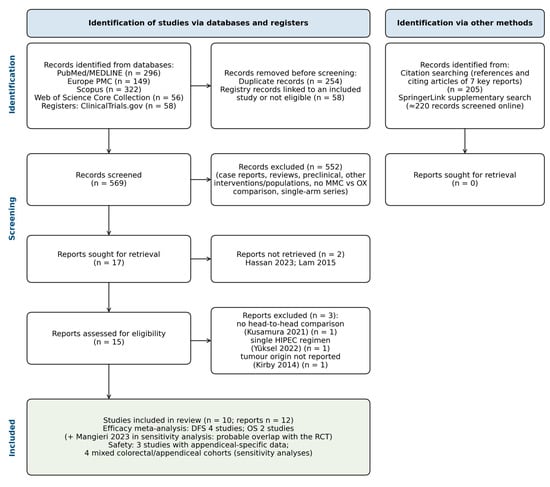
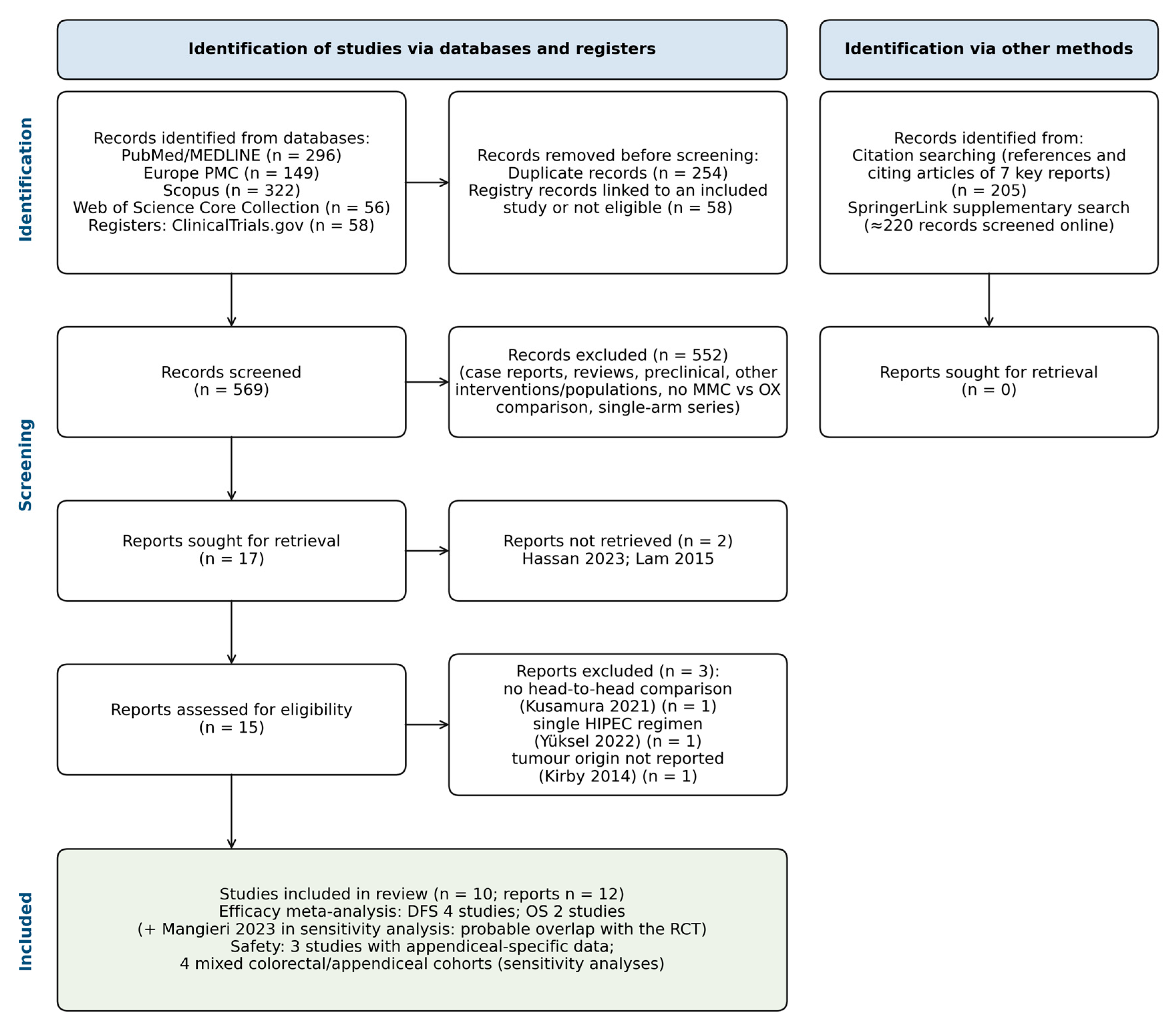
The database searches identified 823 records (PubMed 296, Europe PMC 149, Scopus 322, Web of Science 56) and 58 registry records. After removal of 254 duplicates, 569 records were screened and 552 were excluded. Of 17 reports sought for retrieval, two could not be retrieved: an open- versus closed-technique cohort that also reported morbidity by agent in mixed patients [26] and a colorectal/high-grade appendiceal cohort from the same institution and period as an included study [27,28]. Of the 15 reports assessed in full, three were excluded: one compared each regimen only with CRS alone [29], one used a single HIPEC regimen, and one did not report the tumour origins of the patients compared (Supplementary Table S5). Of the two studies added in this update, one was identified only through Web of Science [28] and the other had previously been identified but not retrieved [30]. Citation searching (205 records), the SpringerLink search and the trial registry did not identify further studies; the registry record NCT01580410 corresponded to the included randomised trial. Ten studies reported in 12 publications were included (Figure 1).
Figure 1.
PRISMA 2020 flow diagram of study selection.
3.2. Characteristics of Included Studies
The included studies comprised one multicentre randomised trial [13,14,16] and nine retrospective cohorts [28,30,31,32,33,34,35,36,37] (Table 1). Four studies reported appendiceal-specific survival by agent and contributed to the efficacy analyses (343 patients). A fifth study reported survival by agent for 159 patients with high-grade appendiceal neoplasms who had all received neoadjuvant oxaliplatin-based chemotherapy [30]; because it came from the institution that enrolled about 80% of the randomised trial’s patients, used the same perfusion protocol and did not report its study period, overlap with the trial population was probable and it was used only in a sensitivity analysis. Five studies included both colorectal and appendiceal patients: for one of them, appendiceal-specific morbidity counts could be derived [34], three did not report appendiceal outcomes separately and were used only in sensitivity analyses of safety [28,36,37], and the whole-cohort morbidity of the fifth was not pooled because of the probable overlap [30]. HIPEC protocols differed substantially between studies (Table 2): OX was given at 200 mg/m2 for 120 min in the randomised trial and in the probably overlapping cohort, at 200 mg/m2 for 30 min in one cohort; at 300–460 mg/m2 for 30 min, sometimes with intravenous 5-fluorouracil, in others; and as a 400 mg fixed dose over 60 min in one; MMC was given as a 40 mg fixed dose, 35 mg/m2 or 12–15 mg, over 60–120 min. In one cohort, MMC was followed by early postoperative intraperitoneal 5-fluorouracil (EPIC), whereas OX was given with intravenous 5-fluorouracil and without EPIC, in consecutive periods [28].
Table 1.
Characteristics of the included studies.
Table 2.
HIPEC protocols in the included studies.
3.3. Risk of Bias
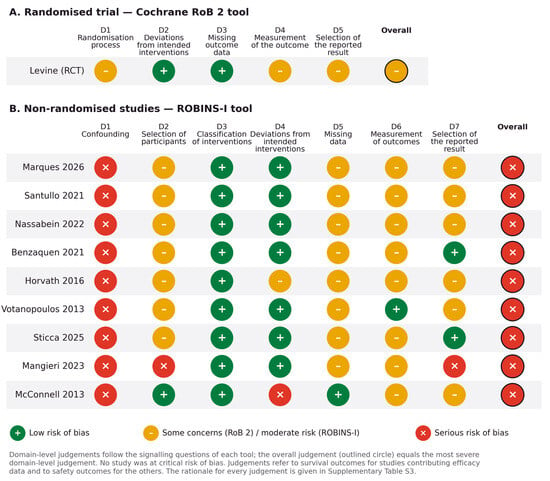
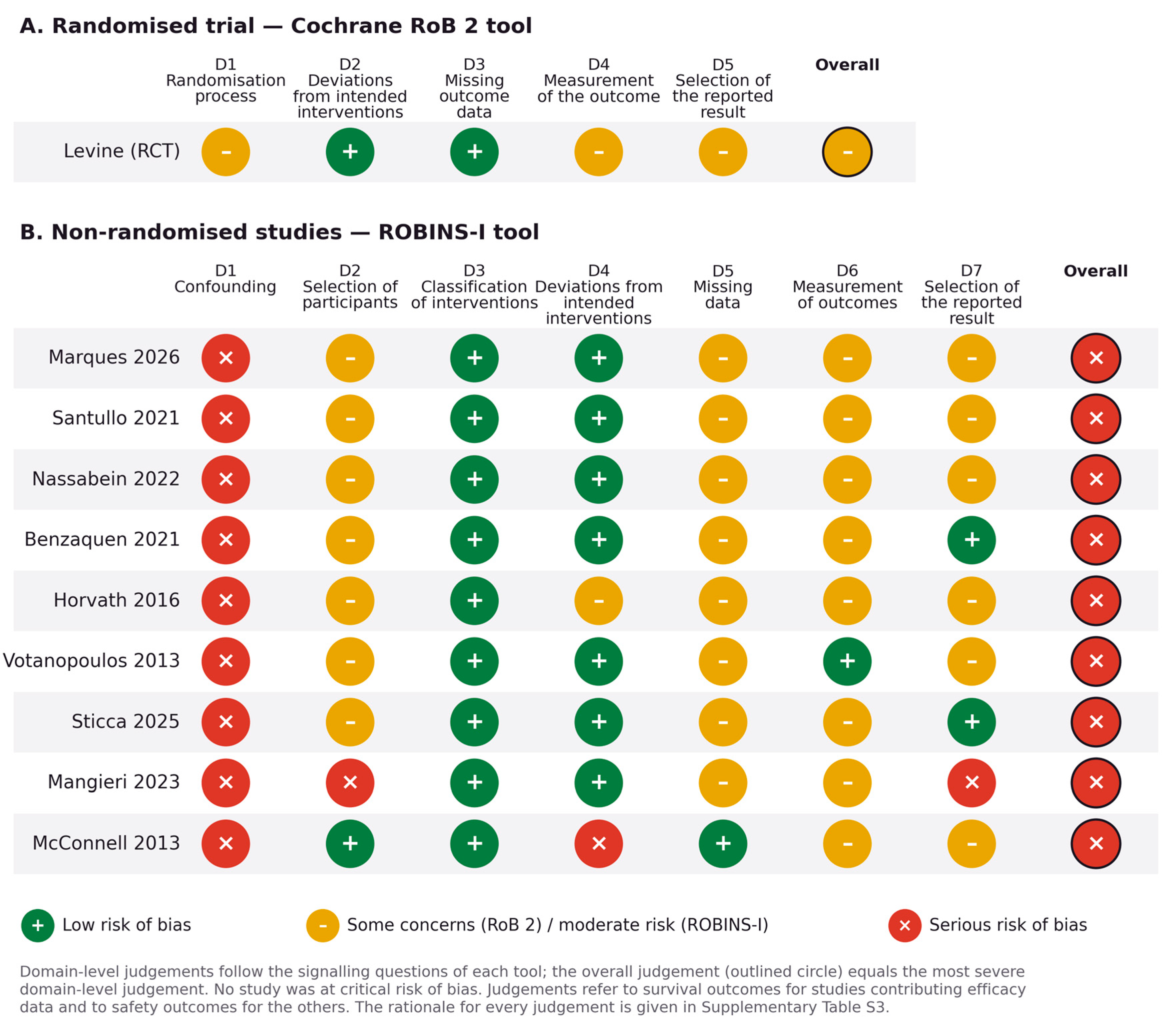
The randomised trial was judged to have some concerns overall: the method of sequence generation and allocation concealment was not reported, the reports differ on whether randomisation occurred at registration or intraoperatively, DFS was assessed without blinding, survival was a secondary endpoint, and several percentages in the text do not match the corresponding tables (for example, complete R0/R1 resection is reported as 51% in the OX arm, whereas the table counts give 37 of 60, 61.7%). All nine observational studies were at serious risk of bias, mainly from confounding by calendar era, centre, co-interventions or clinical selection of the agent (Figure 2; Supplementary Table S3).
Figure 2.
Risk-of-bias judgements by domain: (A) RoB 2 for the randomised trial; (B) ROBINS-I for non-randomised studies. Green (+), low risk; amber (–), some concerns (RoB 2) or moderate risk (ROBINS-I); red (×), serious risk. The overall judgement (outlined circle) is the most severe domain-level judgement; the rationale for each judgement is given in Supplementary Table S3. Studies: Levine RCT [13,14,16], Marques 2026 [31], Santullo 2021 [33], Nassabein 2022 [32], Benzaquen 2021 [34], Horvath 2016 [35], Votanopoulos 2013 [36], Sticca 2025 [37], Mangieri 2023 [30], McConnell 2013 [28].
3.4. Disease-Free Survival
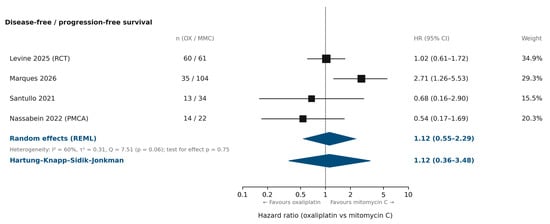
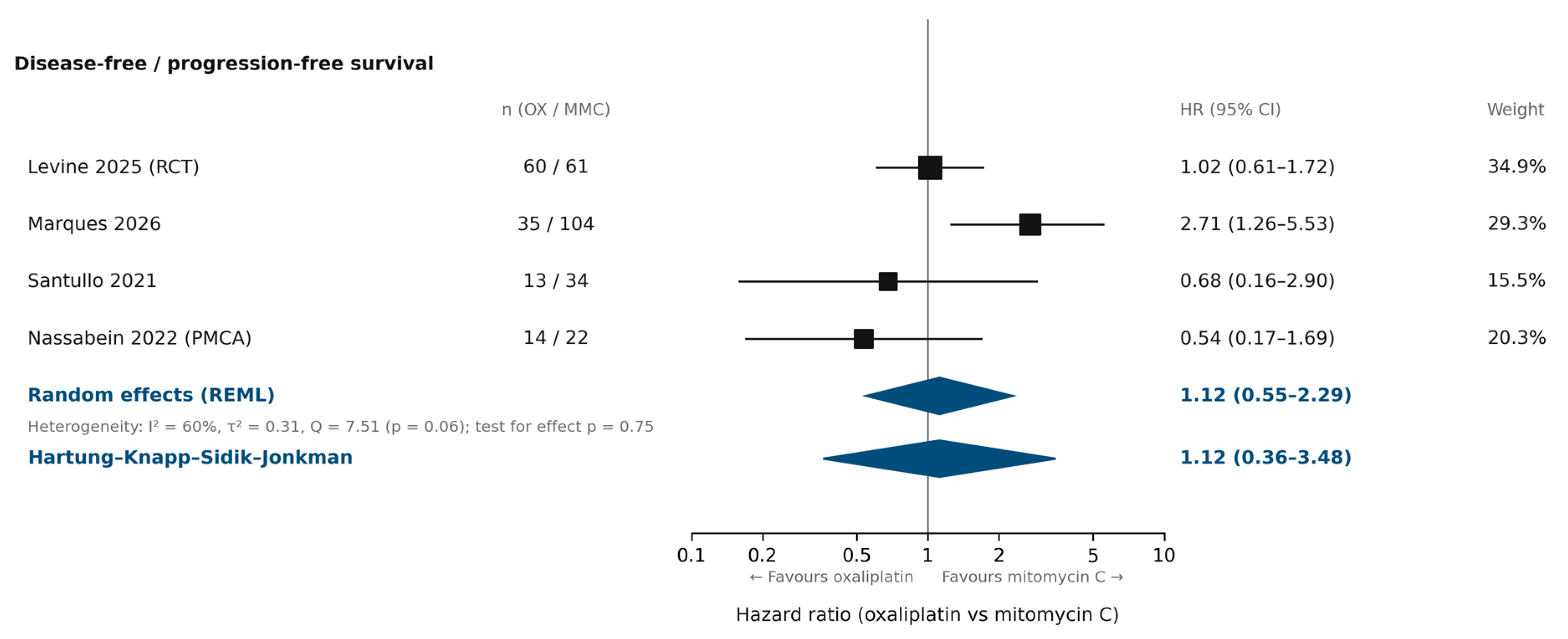
Four studies contributed to the DFS analysis (Figure 3). Outcome definitions were incompletely reported: the randomised trial labelled the same endpoint DFS in its Kaplan–Meier figure and PFS in its survival table without a formal definition [13,14], Marques et al. and Nassabein et al. reported DFS, and Santullo et al. reported PFS [31,32,33]; in all studies the event of interest was disease recurrence or progression after CRS–HIPEC. In the randomised trial, the reconstructed HR was 1.02 (95% CI 0.61–1.72); the reconstructed numbers at risk matched the published values at all time points and the reconstructed log-rank p value (0.93) was close to the reported value (0.95) (Supplementary Figure S1). Marques et al. reported a multivariable HR of 2.71 (95% CI 1.26–5.53) for recurrence with OX in a cohort in which the agent was determined by drug availability (MMC was unavailable in Brazil after 2015) [31]. Santullo et al. reported an unadjusted HR of 1.47 (0.345–6.263) for MMC versus OX, i.e., 0.68 (95% CI 0.16–2.90) for OX versus MMC [33]. In the high-grade (PMCA) subgroup of Nassabein et al., the reconstructed HR was 0.54 (95% CI 0.17–1.69) (reconstructed log-rank p = 0.28; reported p = 0.28) (Supplementary Figure S2) [32].
Figure 3.
Forest plot of disease-free/progression-free survival, oxaliplatin versus mitomycin C. Hazard ratios > 1 favour mitomycin C. Levine and Nassabein: HRs estimated from reconstructed individual patient data; Marques: multivariable HR; Santullo: unadjusted HR (inverted to oxaliplatin vs. mitomycin C). PMCA, peritoneal mucinous carcinomatosis. Squares, study estimates (size proportional to weight); horizontal lines, 95% CIs; diamonds, pooled estimates. Studies: Levine 2025 [14], Marques 2026 [31], Santullo 2021 [33], Nassabein 2022 [32].
The exploratory pooled HR was 1.12 (95% CI 0.55–2.29) (p = 0.75), with moderate heterogeneity (I2 = 60%, τ2 = 0.31, Q = 7.51, p = 0.06) and a 95% prediction interval of 0.06–19.62, which is uninformative. The HKSJ-adjusted estimate was 1.12 (95% CI 0.36–3.48) and the DerSimonian–Laird estimate 1.13 (95% CI 0.56–2.25). In the study by Marques et al., the same confidence interval (1.26–5.53) is reported in the text for three different HRs; the abstract assigns it to OX and it is consistent on the log scale with the point estimate, so it was retained, but this study was excluded in a sensitivity analysis. Without it, the pooled HR was 0.89 (95% CI 0.57–1.40) with no heterogeneity (I2 = 0%). The headline pooled DFS estimate therefore depends on this single problematic study, and the trial estimate and this estimate are the more credible readings. In leave-one-out analyses, pooled HRs ranged from 0.89 to 1.36 and all confidence intervals included 1 (Supplementary Table S4); omitting the only study reporting PFS [33] gave 1.22 (95% CI 0.52–2.86; I2 = 71%), so combining DFS and PFS did not determine the result. Restricting the analysis to observational studies, all at serious risk of bias, gave 1.11 (95% CI 0.37–3.32) (I2 = 70%), a very low-certainty, hypothesis-generating signal. Excluding the only multivariable-adjusted estimate [31], i.e., pooling unadjusted and reconstructed HRs only, gave the estimate of 0.89 (95% CI 0.57–1.40) reported above, and pooling the two unadjusted observational estimates alone gave 0.59 (95% CI 0.24–1.44).
In the high-grade appendiceal subgroup of Mangieri et al., the reconstructed DFS HR was 1.14 (95% CI 0.57–2.26) (events 9/11 vs. 84/96; reconstructed log-rank p = 0.72, figure p = 0.725) (Supplementary Figure S3) [30]. The oxaliplatin denominator was 11 for DFS and 19 for OS because DFS in that report excludes patients with incomplete cytoreduction and 90-day deaths. The HRs printed in the text of that report (0.42 for OS and 2.25 for DFS) correspond approximately to odds ratios of 5-year survival rates rather than to hazard ratios. Adding this study to the DFS analysis gave a pooled HR of 1.15 (95% CI 0.69–1.92) (I2 = 47%; HKSJ 1.15 (95% CI 0.56–2.39)) (Supplementary Figure S4).
3.5. Overall Survival
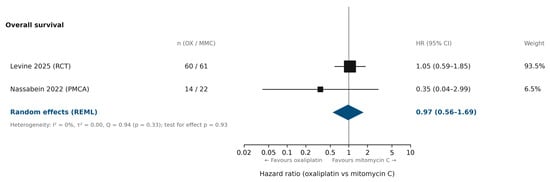
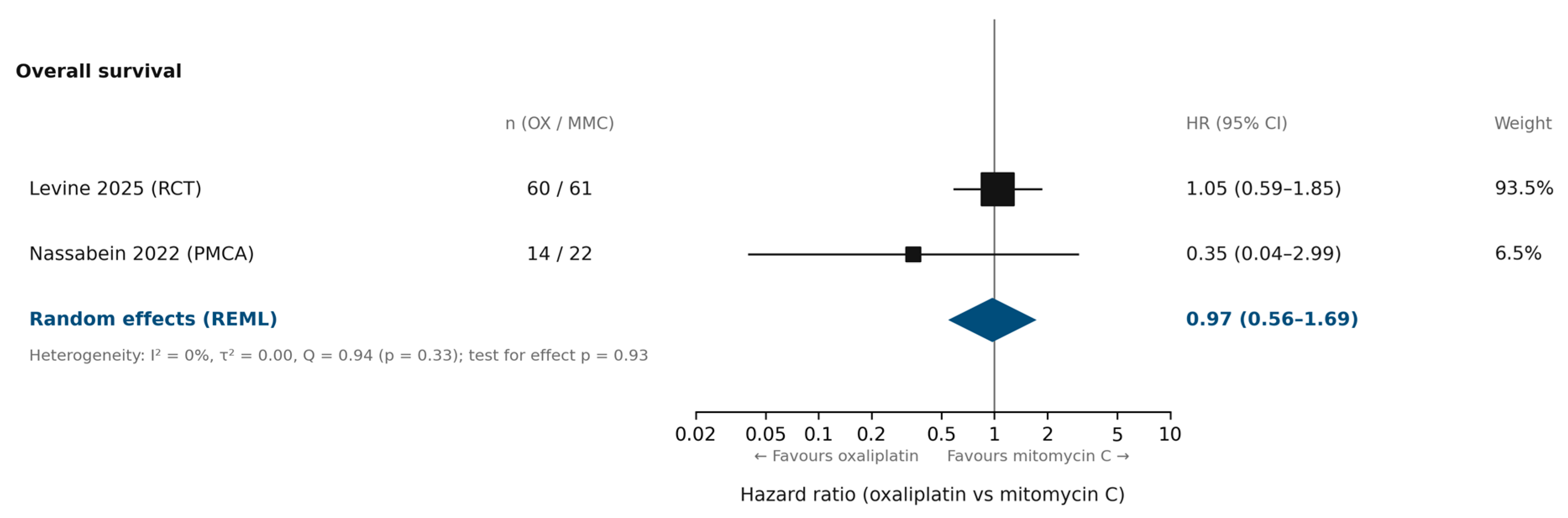
Two studies contributed to the OS analysis (Figure 4). In the randomised trial, the reconstructed HR was 1.05 (95% CI 0.59–1.85) (25 vs. 23 deaths with OX vs. MMC; reconstructed log-rank p = 0.87, reported p = 0.83); 10-year OS was 47.5% with OX and 56.2% with MMC [14]. In the PMCA subgroup of Nassabein et al., the reconstructed HR was 0.35 (95% CI 0.04–2.99) [32]. The exploratory pooled HR was 0.97 (95% CI 0.56–1.69) (I2 = 0%), with 93.5% of the weight from the randomised trial; the OS evidence is therefore essentially that of the randomised trial, with one small supportive subgroup. With only two studies, the HKSJ interval (0.03–30.99) is uninformative and a prediction interval cannot be estimated. Marques et al. reported no association between regimen and OS (log-rank p = 0.64; Cox p = 0.1) without an HR, and their Kaplan–Meier figure was of insufficient resolution and lacked numbers at risk for reliable reconstruction; this study was therefore summarised narratively [31]. In the sensitivity analysis adding the high-grade cohort of Mangieri et al. (reconstructed HR 1.23 (95% CI 0.74–2.05); events 17/19 vs. 124/140), the pooled OS HR was 1.11 (95% CI 0.76–1.61) (I2 = 0%) [30].
Figure 4.
Forest plot of overall survival, oxaliplatin versus mitomycin C. Hazard ratios estimated from reconstructed individual patient data. PMCA, peritoneal mucinous carcinomatosis. Squares, study estimates (size proportional to weight); horizontal lines, 95% CIs; diamonds, pooled estimates. Studies: Levine 2025 [14], Nassabein 2022 [32].
Within the randomised trial, 10-year OS in low-grade disease was 68.3% with MMC and 62.1% with OX (p = 0.78), and 5-year OS in high-grade disease was 43.8% (n = 16) and 10.4% (n = 12), respectively (p = 0.12) [14]. These subgroup results are based on very small numbers, and the high-grade subgroup sizes differ between the trial’s reports.
Structured narrative synthesis of survival. Grouped by design and adjustment, the survival evidence is as follows. Randomised evidence (one trial, 121 patients, some concerns): no difference in DFS (HR 1.02, 95% CI 0.61–1.72) or OS (HR 1.05, 95% CI 0.59–1.85) over 10 years, with confidence intervals compatible with effects ranging from about a 40% reduction to a 70–85% increase in hazard [14]. Adjusted observational evidence (one cohort, era-determined allocation, serious risk of bias): more recurrences with OX (HR 2.71, 95% CI 1.26–5.53), with internal inconsistencies in the reported intervals [31]. Unadjusted observational evidence (two small cohorts, serious risk of bias, 9 and 15 DFS events): non-significant effects favouring OX for DFS (HR 0.68 and 0.54) and OS (HR 0.35) [32,33]. The direction of effect therefore differs between observational studies in a way that is compatible with the confounding described in Section 3.3, whereas the only unconfounded comparison, the randomised trial, shows no difference.
3.6. Perioperative Morbidity, Mortality and Toxicity
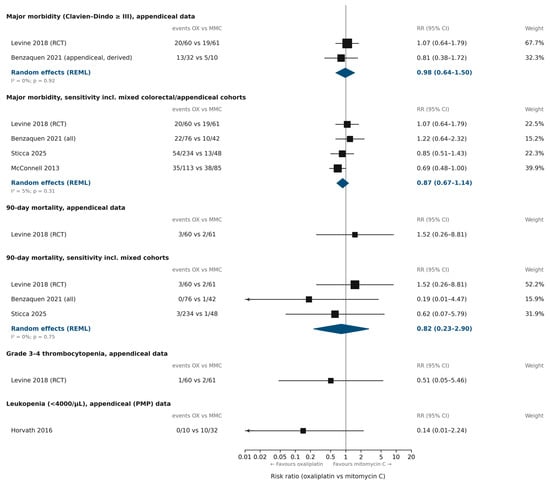
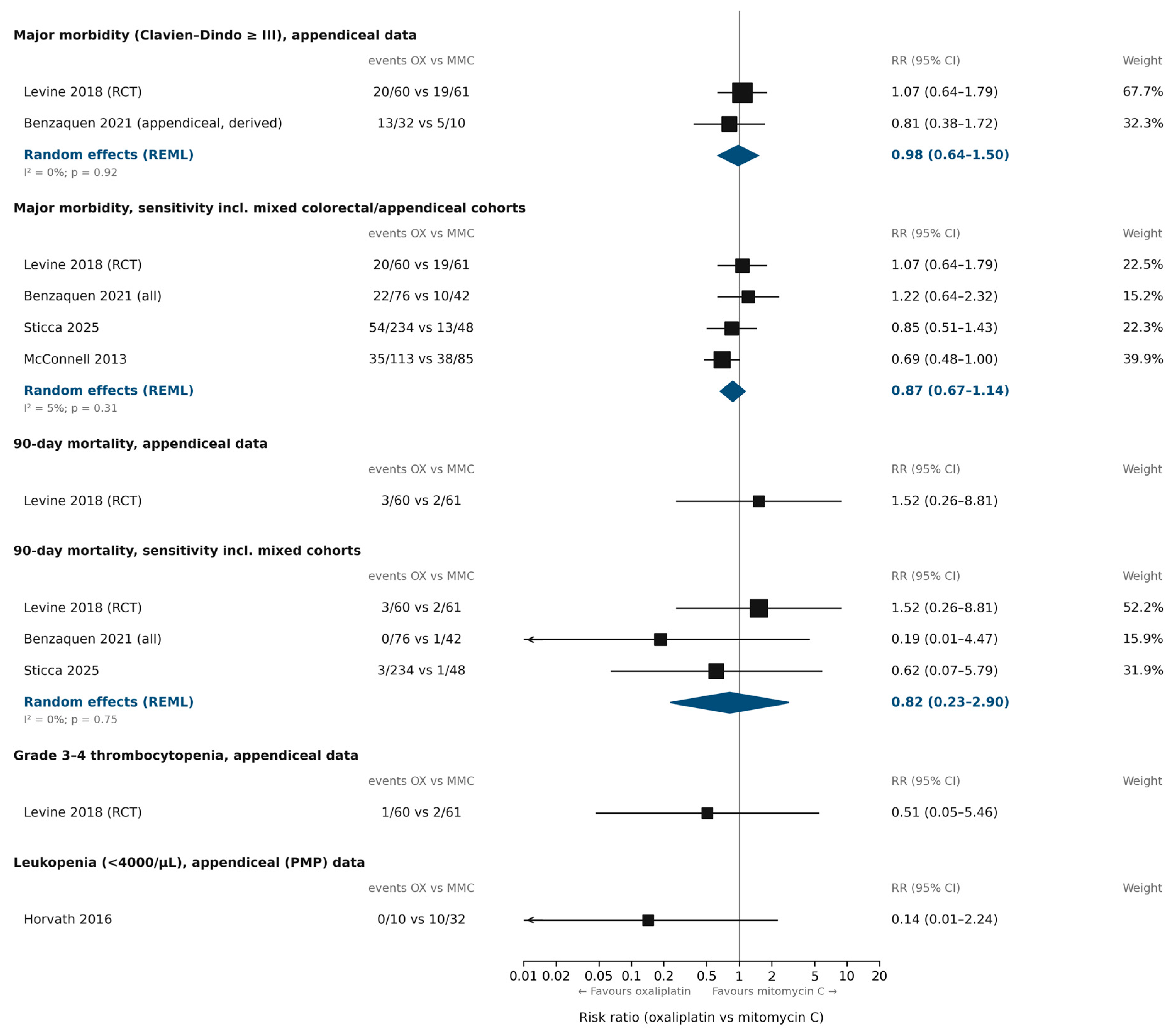
In appendiceal-specific data, major morbidity (Clavien–Dindo ≥ III) did not differ between agents (RR 0.98 (95% CI 0.64–1.50), I2 = 0%; 2 studies) (Figure 5). In the randomised trial, major morbidity occurred in 20/60 patients with OX and 19/61 with MMC (table counts; the text reports 32.7% for MMC) and 90-day mortality in 3/60 and 2/61 (RR 1.52 (95% CI 0.26–8.81)) [13]. Including mixed colorectal/appendiceal cohorts did not change these findings (major morbidity RR 0.87 (95% CI 0.67–1.14), 4 studies; 90-day mortality RR 0.82 (95% CI 0.23–2.90)). In the mixed cohort of McConnell et al., major morbidity was lower in the OX period (35/113 vs. 38/85), but MMC was combined with EPIC, which the authors identified as the independent risk factor [28]. In the whole cohort of Mangieri et al. (appendiceal and colorectal), Clavien–Dindo ≥ III complications occurred in 32.2% of OX and 20.3% of MMC patients (p = 0.06) and 90-day mortality in 9.7% and 9.6%; these data were not pooled because of the probable overlap with the randomised trial [30].
Figure 5.
Risk ratios (oxaliplatin vs. mitomycin C) for major morbidity, 90-day mortality and haematological toxicity. Appendiceal-specific data are shown with sensitivity analyses including mixed colorectal/appendiceal cohorts. Benzaquen (appendiceal, derived): all patients minus colorectal subgroup; the oxaliplatin group includes one patient of unknown primary. McConnell: mitomycin C was combined with early postoperative intraperitoneal 5-fluorouracil. Squares, study estimates (size proportional to weight); horizontal lines, 95% CIs; diamonds, pooled estimates. Studies: Levine 2018 [13], Benzaquen 2021 [34], Sticca 2025 [37], McConnell 2013 [28], Horvath 2016 [35].
Haematological toxicity profiles differed by agent. In the randomised trial, leukopenia of any grade was more frequent with MMC (p = 0.036), predominantly grade 1, with no difference in grade 3–4 leukopenia; G-CSF was given to 21% of MMC and 13% of OX patients; grade 3–4 thrombocytopenia occurred in 1/60 with OX and 2/61 with MMC [13]. In PMP patients treated by Horvath et al., leukopenia occurred in 10/32 patients after MMC and in none of 10 after OX with intravenous 5-fluorouracil [35]. In mixed cohorts, OX was associated with more grade 3–4 thrombocytopenia and neutropenia in one centre (6/55 vs. 4/134 and 8/55 vs. 6/134) [36], whereas high-dose MMC (35 mg/m2) caused more neutropenia than OX 460 mg/m2 in another (13/48 vs. 10/234) [37]. Because of the opposite directions and different definitions, neutropenia was not pooled.
3.7. Health-Related Quality of Life
In the randomised trial (FACT-G/NTX), the Trial Outcome Index was significantly lower after MMC than after OX at 12 weeks (difference 6.35, p = 0.044) and 24 weeks (difference 5.61, p = 0.049), and physical, functional and trial-outcome scores declined from baseline at 12 weeks only in the MMC group [16]. No other study reported HRQoL by agent. These findings should be considered exploratory: HRQoL was assessed with a patient-reported instrument in a single open-label trial whose primary endpoint was haematological toxicity, several subscales were compared at several time points, and the two Trial Outcome Index p values (0.044 and 0.049) were close to 0.05 and would not remain statistically significant even after a Bonferroni correction for the two time points alone (threshold 0.025). Because no minimal important difference was defined in our analysis plan, the clinical relevance of differences of 5–6 points cannot be established from these data.
3.8. Completeness of Cytoreduction and Perioperative Outcomes in All Patients
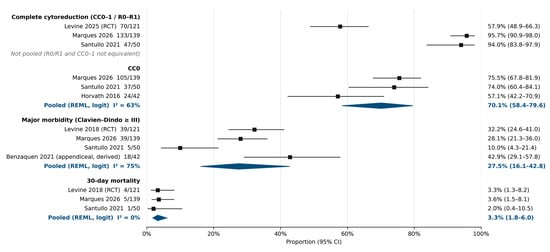
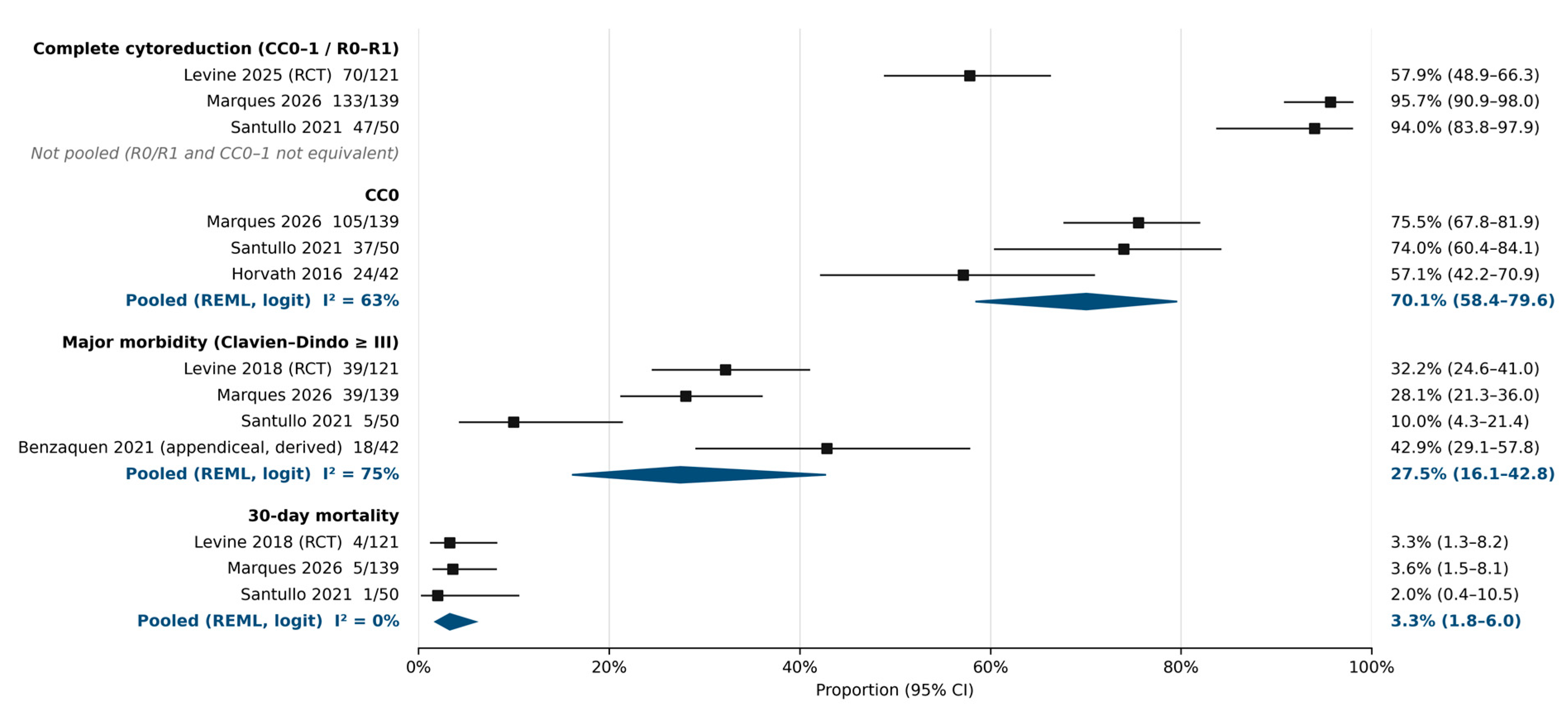
The estimates in this section are event rates pooled across all appendiceal patients of the included cohorts irrespective of the HIPEC agent; they describe the perioperative profile of CRS–HIPEC in these series and do not compare the two agents, for which the direct comparisons are reported in Section 3.6 (Figure 5). Across all appendiceal patients of the included cohorts (Figure 6), complete cytoreduction ranged from 57.9–95.7% depending on definition (R0/R1 in the randomised trial; CC0–1 in the cohorts) and was not pooled. The pooled CC0 rate was 70.1% (95% CI 58.4–79.6%) (3 studies, 231 patients; I2 = 63%); in the study by Marques et al., the count of 105 was derived from the reported 75.7% of 139 patients. Pooled major morbidity was 27.5% (95% CI 16.1–42.8%) (4 studies, 352 patients; I2 = 75%) and 30-day mortality 3.3% (95% CI 1.8–6.0%) (3 studies, 310 patients; I2 = 0%). In the randomised trial, the R0/R1 rate was 33/61 (54.1%) with MMC and 37/60 (61.7%) with OX [14].
Figure 6.
Completeness of cytoreduction, major morbidity and 30-day mortality among all appendiceal patients of the included cohorts (random-effects, logit scale). Study-level 95% CIs are Wilson intervals. These are descriptive rates pooled across both agents and do not represent a comparison between oxaliplatin and mitomycin C (see Figure 5). Squares, study proportions; horizontal lines, 95% CIs; diamonds, pooled proportions. Studies: Levine 2025 [14], Levine 2018 [13], Marques 2026 [31], Santullo 2021 [33], Horvath 2016 [35], Benzaquen 2021 [34].
3.9. Prognostic Factors and Recurrence
Prognostic factors were reported heterogeneously and could not be pooled (Table 3). Histological grade was the most consistent determinant of outcome: in the randomised trial, 5-year OS was 78.5% for low-grade and 29.5% for high-grade disease (p < 0.001) [14], and Marques et al. reported a multivariable HR for death of 2.9 (95% CI 1.14–7.26) and for recurrence of 3.54 (1.44–8.68) for poorly differentiated or signet-ring cell histology [31]. Incomplete cytoreduction (CC2–3) was independently associated with worse OS (HR 3.754, 95% CI 1.157–12.182) and PFS (HR 6.747, 1.287–35.373) in the study by Santullo et al. [33]. PCI was associated with OS in the PMCA subgroup of Nassabein et al. (median OS not reached for PCI 1–20 vs. 78.7 months for PCI 21–39, p < 0.001) [32], but not in the multivariable analysis of Marques et al. [31]. Recurrence was predominantly peritoneal: the peritoneum was the most common site of recurrence in the study by Marques et al. (30.9% of patients) [31], and seven of nine recurrences reported by Santullo et al. were intra-abdominal [33].
Table 3.
Prognostic factors reported in the included studies (not pooled).
3.10. Certainty of Evidence
Certainty of evidence was low for OS, major morbidity, 90-day mortality and HRQoL, and very low for DFS and haematological toxicity, mainly because of imprecision, risk of bias in the observational studies and inconsistency (Table 4). Ratings started at high certainty because the randomised trial contributed to each body of evidence, and the contribution of observational studies was handled by downgrading for risk of bias where they carried substantial weight; OS was not downgraded for risk of bias because 93.5% of its weight came from the randomised trial.
Table 4.
Summary of findings and certainty of evidence (GRADE): oxaliplatin versus mitomycin C HIPEC in appendiceal neoplasms.
4. Discussion
4.1. Principal Findings
This systematic review identified one randomised trial and nine observational studies comparing OX- and MMC-based HIPEC in patients with appendiceal neoplasms. The randomised trial, the only comparison free of confounding by indication or calendar era, showed similar DFS and OS over 10 years (reconstructed HRs 1.02 and 1.05). Exploratory pooled estimates that added observational cohorts were also close to 1, but their confidence intervals were wide and compatible with clinically important benefit or harm of either agent; the certainty of evidence was low to very low. Heterogeneity in DFS was driven by one cohort reporting more recurrences with OX; without this study, results were consistent and close to the null. Adding a probably overlapping high-grade cohort did not change these conclusions. These data therefore do not show a difference between agents, but they cannot establish equivalence or non-inferiority.
4.2. Interpretation of Discordant Results
The divergent result of Marques et al. should be interpreted in the light of how the agent was assigned and administered [31]. OX replaced MMC after MMC became unavailable in Brazil in 2015, so the comparison is confounded by calendar period, follow-up duration and changes in practice, and OX was given at 200 mg/m2 over only 30 min—a lower exposure than either the 200 mg/m2 over 120 min used in the randomised trial [14] or the 360–460 mg/m2 short perfusions reported in the PSOGI registry [29]; the authors subsequently increased the OX dose. In addition, the confidence interval for this HR appears elsewhere in the same report for other estimates. Conversely, in the high-grade subgroup of Nassabein et al., OX showed non-significant trends towards better DFS and OS, but the agent was selected according to disease type, prior chemotherapy and performance status [32]. In the randomised trial, a non-significant difference favouring MMC in high-grade disease was based on 28 patients [14]. Taken together, the observational signals point in opposite directions and are compatible with confounding.
Indirect evidence from the PSOGI registry suggests that the benefit of HIPEC over CRS alone in PMP may depend on the regimen: weighted HRs for OS versus CRS alone were 0.42 (95% CI 0.19–0.93) for OX with intravenous 5-fluorouracil/leucovorin, 0.57 (0.42–0.78) for cisplatin plus MMC and 0.93 (0.65–1.34) for MMC alone, and MMC was associated with higher odds of severe morbidity (OR 1.99, 1.25–3.19) [29]. These estimates are derived from separate weighted comparisons with CRS alone rather than from a head-to-head comparison, were not combined with our direct estimates, and are hypothesis-generating. A recent propensity-matched cohort also reported longer survival with cisplatin plus docetaxel than with cisplatin plus MMC in PMP [38], indicating that the relevant comparison may extend beyond MMC versus OX.
4.3. Safety and Quality of Life
The agents differ more clearly in their toxicity profiles than in efficacy. MMC was associated with more leukopenia and neutropenia, particularly at high doses [13,35,37], whereas OX was associated with grade 3–4 thrombocytopenia in one centre [36] and with more postoperative haematomas (12.0% vs. 2.1%) when given in a dextrose carrier at 460 mg/m2 [37]. Major morbidity and 90-day mortality did not differ between agents. The randomised trial is the only source of HRQoL data and showed better physical and functional recovery after OX [16], although these results are exploratory (Section 3.7). The pooled perioperative rates in Figure 6 (major morbidity 27.5%, 30-day mortality 3.3%) describe CRS–HIPEC in these series as a whole and do not inform the choice between agents. Because survival differences have not been demonstrated, these considerations, together with institutional experience, perfusion duration and drug availability, are reasonable determinants of regimen choice.
4.4. Strengths and Limitations
Strengths of this review include restriction of the primary analyses to appendiceal-specific data, separation of mixed cohorts into sensitivity analyses, estimation of HRs from reconstructed IPD with explicit validation against published statistics, conservative random-effects methods appropriate for few studies, and transparent reporting of internal inconsistencies in the source publications.
The limitations are substantial. First, only four studies contributed to DFS and two to OS, so all estimates are imprecise, and small-study effects could not be assessed. Second, only one study was randomised; the observational studies were at serious risk of confounding, and only one provided an adjusted estimate; pooling this adjusted estimate with unadjusted and reconstructed HRs, and observational with randomised data, is conceptually limited, which is why these pooled estimates are presented as exploratory and the randomised trial as the primary evidence. Third, HIPEC protocols differed in dose, duration, temperature, technique and co-administration of intravenous 5-fluorouracil, so the comparison is between protocols rather than between drugs. Fourth, three HRs were estimated from reconstructed data, which approximates but does not reproduce the original IPD. Fifth, populations were heterogeneous in histological grade, and appendiceal-specific data were unavailable for several mixed cohorts. Most cohorts were single-centre series from North America, which may limit generalisability. Sixth, Embase was not searched, although Scopus and Web of Science were, and two potentially relevant reports could not be retrieved [26,27]; one of them derives from the same institutional programme as an included cohort [28]. Seventh, overlapping populations could not be excluded with certainty: one cohort probably overlapping with the randomised trial was therefore confined to a sensitivity analysis [30]. Finally, the protocol was not prospectively registered, the search strategies were not PRESS-peer-reviewed, screening and data extraction were performed by one author and checked by a second rather than fully independently in duplicate, and corresponding authors were not contacted for unreported data.
4.5. Implications for Research
Adequately powered randomised trials with standardised perfusion protocols, stratified by histological grade and completeness of cytoreduction, are needed. Registered trials address related questions, including low- versus high-dose MMC in PMP (NCT06513065), fixed versus body-surface-area-based MMC dosing (NCT04779554) and MMC versus melphalan (NCT03073694). Future studies should report HRs with event counts, numbers at risk, toxicity by grade and HRQoL, and an individual patient data meta-analysis of existing cohorts would allow adjustment for grade, PCI and completeness of cytoreduction.
5. Conclusions
In patients undergoing CRS for appendiceal neoplasms, current evidence does not demonstrate a difference in disease-free or overall survival between oxaliplatin- and mitomycin C-based HIPEC. The evidence is limited to one randomised trial and a few confounded observational cohorts that compared heterogeneous HIPEC protocols rather than drugs alone, and its certainty is low to very low, so clinically important differences cannot be excluded. The agents differ in toxicity profile, and oxaliplatin was associated with better short-term quality of life in exploratory analyses of the only randomised trial. Until adequately powered trials with standardised regimens are available, the choice of agent can reasonably be individualised according to toxicity, perfusion protocol, patient factors and institutional experience.
Supplementary Materials
The following supporting information can be downloaded at: https://www.mdpi.com/article/10.3390/life16111835/s1, Table S1: Complete search strategies and yields; Table S2: Data extraction table with source location of each value; Table S3: Risk-of-bias judgements with rationale; Table S4: Sensitivity and leave-one-out analyses; Table S5: Reports excluded after full-text assessment or not retrieved; Figure S1: Validation of the reconstructed individual patient data for the randomised trial; Figure S2: Reconstructed Kaplan–Meier curves for the PMCA subgroup of Nassabein et al.; Figure S3: Reconstruction of the high-grade appendiceal subgroup of Mangieri et al.; Figure S4: Sensitivity analysis adding Mangieri et al.; PRISMA 2020 checklist; analysis code (Python) and equivalent R script (R ≥ 4.0, metafor package).
Author Contributions
Conceptualisation, F.I.F., I.A.F., A.D. and C.P.; methodology, F.I.F., A.K., I.A.F. and P.P.; formal analysis, F.I.F. and A.K.; investigation, F.I.F., A.K., I.A.F., A.A.N., M.C.B. and V.B.; data curation, F.I.F., A.K., I.A.F. and A.A.N.; validation, A.K., I.A.F., M.C.B., P.P., C.D., V.B., S.P., A.D. and C.P.; visualisation, F.I.F.; writing—original draft preparation, F.I.F., I.A.F. and A.K.; writing—review and editing, all authors; supervision, C.D., S.P., A.D. and C.P.; project administration, A.D. and C.P. All authors have read and agreed to the published version of the manuscript.
Funding
This research received no external funding. The APC was funded by the “Victor Babes” University of Medicine and Pharmacy Timisoara.
Institutional Review Board Statement
Not applicable (systematic review of published data).
Informed Consent Statement
Not applicable.
Data Availability Statement
All extracted data, digitised curve coordinates, reconstructed individual patient data and analysis code are provided in the Supplementary Materials.
Conflicts of Interest
The authors declare no conflicts of interest.
Abbreviations
CC, completeness of cytoreduction; CI, confidence interval; CRS, cytoreductive surgery; DFS, disease-free survival; EPIC, early postoperative intraperitoneal chemotherapy; 5-FU, 5-fluorouracil; G-CSF, granulocyte colony-stimulating factor; HIPEC, hyperthermic intraperitoneal chemotherapy; HKSJ, Hartung–Knapp–Sidik–Jonkman; HR, hazard ratio; HRQoL, health-related quality of life; IPD, individual patient data; MMC, mitomycin C; OS, overall survival; OX, oxaliplatin; PCI, peritoneal cancer index; PFS, progression-free survival; PMCA, peritoneal mucinous carcinomatosis; PMP, pseudomyxoma peritonei; PSOGI, Peritoneal Surface Oncology Group International; RCT, randomised controlled trial; REML, restricted maximum likelihood; RR, risk ratio.
References
- Hoehn, R.S.; Rieser, C.J.; Choudry, M.H.; Melnitchouk, N.; Hechtman, J.; Bahary, N. Current Management of Appendiceal Neoplasms. Am. Soc. Clin. Oncol. Educ. Book 2021, 41, 118–132. [Google Scholar] [CrossRef] [Scilit] [PubMed]
- Carr, N.; Cecil, T.D.; Mohamed, F.; Sobin, L.H.; Sugarbaker, P.H.; González-Moreno, S.; Taflampas, P.; Chapman, S.; Moran, B.J.; Peritoneal Surface Oncology Group International. A Consensus for Classification and Pathologic Reporting of Pseudomyxoma Peritonei and Associated Appendiceal Neoplasia: The Results of the Peritoneal Surface Oncology Group International (PSOGI) Modified Delphi Process. Am. J. Surg. Pathol. 2016, 40, 14–26. [Google Scholar] [CrossRef] [Scilit] [PubMed]
- Chua, T.C.; Moran, B.J.; Sugarbaker, P.H.; Levine, E.A.; Glehen, O.; Gilly, F.N.; Baratti, D.; Deraco, M.; Elias, D.; Sardi, A.; et al. Early- and long-term outcome data of patients with pseudomyxoma peritonei from appendiceal origin treated by a strategy of cytoreductive surgery and hyperthermic intraperitoneal chemotherapy. J. Clin. Oncol. 2012, 30, 2449–2456. [Google Scholar] [CrossRef] [Scilit] [PubMed]
- Govaerts, K.; Lurvink, R.; De Hingh, I.; Van der Speeten, K.; Villeneuve, L.; Kusamura, S.; Kepenekian, V.; Deraco, M.; Glehen, O.; Moran, B.; et al. Appendiceal tumours and pseudomyxoma peritonei: Literature review with PSOGI/EURACAN clinical practice guidelines for diagnosis and treatment. Eur. J. Surg. Oncol. 2021, 47, 11–35. [Google Scholar] [CrossRef] [Scilit] [PubMed]
- Kusamura, S.; Delhorme, J.-B.; Taibi, A.; Villeneuve, L.; Deraco, M.; Dico, R.L.; Glehen, O.; Moran, B. The 2022 PSOGI International Consensus on HIPEC Regimens for Peritoneal Malignancies: Pseudomyxoma Peritonei. Ann. Surg. Oncol. 2024, 31, 6262–6273. [Google Scholar] [CrossRef] [Scilit] [PubMed]
- Hübner, M.; van Der Speeten, K.; Govaerts, K.; de Hingh, I.; Villeneuve, L.; Kusamura, S.; Glehen, O. 2022 Peritoneal Surface Oncology Group International Consensus on HIPEC Regimens for Peritoneal Malignancies: Colorectal Cancer. Ann. Surg. Oncol. 2024, 31, 567–576. [Google Scholar] [CrossRef] [Scilit] [PubMed]
- Prada-Villaverde, A.; Esquivel, J.; Lowy, A.M.; Markman, M.; Chua, T.; Pelz, J.; Baratti, D.; Baumgartner, J.M.; Berri, R.; Bretcha-Boix, P.; et al. The American Society of Peritoneal Surface Malignancies evaluation of HIPEC with Mitomycin C versus Oxaliplatin in 539 patients with colon cancer undergoing a complete cytoreductive surgery. J. Surg. Oncol. 2014, 110, 779–785. [Google Scholar] [CrossRef] [Scilit] [PubMed]
- Leung, V.; Huo, Y.R.; Liauw, W.; Morris, D.L. Oxaliplatin versus Mitomycin C for HIPEC in colorectal cancer peritoneal carcinomatosis. Eur. J. Surg. Oncol. 2017, 43, 144–149. [Google Scholar] [CrossRef] [Scilit] [PubMed]
- Hompes, D.; D’HOore, A.; Wolthuis, A.; Fieuws, S.; Mirck, B.; Bruin, S.; Verwaal, V. The use of Oxaliplatin or Mitomycin C in HIPEC treatment for peritoneal carcinomatosis from colorectal cancer: A comparative study. J. Surg. Oncol. 2014, 109, 527–532. [Google Scholar] [CrossRef] [Scilit] [PubMed]
- Bakkers, C.; van Erning, F.; Rovers, K.; Nienhuijs, S.; Burger, J.; Lemmens, V.; Aalbers, A.; Kok, N.; Boerma, D.; Brandt, A.; et al. Long-term survival after hyperthermic intraperitoneal chemotherapy using mitomycin C or oxaliplatin in colorectal cancer patients with synchronous peritoneal metastases: A nationwide comparative study. Eur. J. Surg. Oncol. 2020, 46, 1902–1907. [Google Scholar] [CrossRef] [Scilit] [PubMed]
- Zhang, X.; Wu, Q.; Wei, M.; Deng, X.; Gu, C.; Wang, Z. Oxaliplatin versus mitomycin C in HIPEC for peritoneal metastasis from colorectal cancer: A systematic review and meta-analysis of comparative studies. Int. J. Colorectal Dis. 2020, 35, 1831–1839. [Google Scholar] [CrossRef] [Scilit] [PubMed]
- Quénet, F.; Elias, D.; Roca, L.; Goéré, D.; Ghouti, L.; Pocard, M.; Facy, O.; Arvieux, C.; Lorimier, G.; Pezet, D.; et al. Cytoreductive surgery plus hyperthermic intraperitoneal chemotherapy versus cytoreductive surgery alone for colorectal peritoneal metastases (PRODIGE 7): A multicentre, randomised, open-label, phase 3 trial. Lancet Oncol. 2021, 22, 256–266. [Google Scholar] [CrossRef] [Scilit] [PubMed]
- Levine, E.A.; Votanopoulos, K.I.; Shen, P.; Russell, G.; Fenstermaker, J.; Mansfield, P.; Bartlett, D.; Stewart, J.H. A Multicenter Randomized Trial to Evaluate Hematologic Toxicities after Hyperthermic Intraperitoneal Chemotherapy with Oxaliplatin or Mitomycin in Patients with Appendiceal Tumors. J. Am. Coll. Surg. 2018, 226, 434–443, Correction in J. Am. Coll. Surg. 2018, 227, 633. https://doi.org/10.1016/j.jamcollsurg.2018.09.001. [Google Scholar] [CrossRef] [Scilit] [PubMed]
- Levine, E.A.; Cos, H.; Votanopoulos, K.I.; Shen, P.; Russell, G.; Mansfield, P.; Fournier, K.; Bartlett, D.; Stewart, J.H. Ten-Year Outcome of a Randomized Trial: Cytoreduction and HIPEC with Mitomycin C Versus Oxaliplatin for Appendiceal Neoplasm with Peritoneal Dissemination. Ann. Surg. Oncol. 2025, 32, 679–686. [Google Scholar] [CrossRef] [Scilit] [PubMed]
- Page, M.J.; McKenzie, J.E.; Bossuyt, P.M.; Boutron, I.; Hoffmann, T.C.; Mulrow, C.D.; Shamseer, L.; Tetzlaff, J.M.; Akl, E.A.; Brennan, S.E.; et al. The PRISMA 2020 statement: An updated guideline for reporting systematic reviews. BMJ 2021, 372, n71. [Google Scholar] [CrossRef] [Scilit] [PubMed]
- Moaven, O.; Votanopoulos, K.I.; Shen, P.; Mansfield, P.; Bartlett, D.L.; Russell, G.; McQuellon, R.; Stewart, J.H.; Levine, E.A. Health-Related Quality of Life After Cytoreductive Surgery/HIPEC for Mucinous Appendiceal Cancer: Results of a Multicenter Randomized Trial Comparing Oxaliplatin and Mitomycin. Ann. Surg. Oncol. 2020, 27, 772–780. [Google Scholar] [CrossRef] [Scilit] [PubMed]
- Guyot, P.; Ades, A.E.; Ouwens, M.J.; Welton, N.J. Enhanced secondary analysis of survival data: Reconstructing the data from published Kaplan-Meier survival curves. BMC Med. Res. Methodol. 2012, 12, 9. [Google Scholar] [CrossRef] [Scilit] [PubMed]
- Tierney, J.F.; Stewart, L.A.; Ghersi, D.; Burdett, S.; Sydes, M.R. Practical methods for incorporating summary time-to-event data into meta-analysis. Trials 2007, 8, 16. [Google Scholar] [CrossRef] [Scilit] [PubMed]
- Sterne, J.A.C.; Savović, J.; Page, M.J.; Elbers, R.G.; Blencowe, N.S.; Boutron, I.; Cates, C.J.; Cheng, H.Y.; Corbett, M.S.; Eldridge, S.M.; et al. RoB 2: A revised tool for assessing risk of bias in randomised trials. BMJ 2019, 366, l4898. [Google Scholar] [CrossRef] [Scilit] [PubMed]
- Sterne, J.A.C.; Hernán, M.A.; Reeves, B.C.; Savović, J.; Berkman, N.D.; Viswanathan, M.; Henry, D.; Altman, D.G.; Ansari, M.T.; Boutron, I.; et al. ROBINS-I: A tool for assessing risk of bias in non-randomised studies of interventions. BMJ 2016, 355, i4919. [Google Scholar] [CrossRef] [Scilit] [PubMed]
- IntHout, J.; Ioannidis, J.P.; Borm, G.F. The Hartung-Knapp-Sidik-Jonkman method for random effects meta-analysis is straightforward and considerably outperforms the standard DerSimonian-Laird method. BMC Med. Res. Methodol. 2014, 14, 25. [Google Scholar] [CrossRef] [Scilit] [PubMed]
- DerSimonian, R.; Laird, N. Meta-analysis in clinical trials. Control Clin. Trials 1986, 7, 177–188. [Google Scholar] [CrossRef] [Scilit] [PubMed]
- Deeks, J.J.; Higgins, J.P.T.; Altman, D.G.; McKenzie, J.E.; Veroniki, A.A. Chapter 10: Analysing data and undertaking meta-analyses. In Cochrane Handbook for Systematic Reviews of Interventions, Version 6.5; Higgins, J.P.T., Thomas, J., Chandler, J., Cumpston, M., Li, T., Page, M.J., Welch, V.A., Eds.; Cochrane: London, UK, 2024; Available online: https://www.cochrane.org/handbook (accessed on 20 October 2026).
- Campbell, M.; McKenzie, J.E.; Sowden, A.; Katikireddi, S.V.; Brennan, S.E.; Ellis, S.; Hartmann-Boyce, J.; Ryan, R.; Shepperd, S.; Thomas, J.; et al. Synthesis without meta-analysis (SWiM) in systematic reviews: Reporting guideline. BMJ 2020, 368, l6890. [Google Scholar] [CrossRef] [Scilit] [PubMed]
- Guyatt, G.H.; Oxman, A.D.; Vist, G.E.; Kunz, R.; Falck-Ytter, Y.; Alonso-Coello, P.; Schünemann, H.J. GRADE: An emerging consensus on rating quality of evidence and strength of recommendations. BMJ 2008, 336, 924–926. [Google Scholar] [CrossRef] [Scilit] [PubMed]
- Hassan, S.; Dritsas, S.; O’DWyer, S.; Aziz, O.; Sutton, P.; Wang, X.; Fish, R.; Renehan, A.; Wilson, M.; Selvasekar, C.; et al. Open versus Closed technique for administration of heated intraperitoneal chemotherapy (HIPEC): Morbidity and Mortality outcomes from a high-volume centre. Eur. J. Surg. Oncol. 2023, 49, 106924. [Google Scholar] [CrossRef] [Scilit] [PubMed]
- Lam, J.Y.; McConnell, Y.J.; Rivard, J.D.; Temple, W.J.; Mack, L.A. Hyperthermic intraperitoneal chemotherapy + early postoperative intraperitoneal chemotherapy versus hyperthermic intraperitoneal chemotherapy alone: Assessment of survival outcomes for colorectal and high-grade appendiceal peritoneal carcinomatosis. Am. J. Surg. 2015, 210, 424–430. [Google Scholar] [CrossRef] [Scilit] [PubMed]
- McConnell, Y.J.; Mack, L.A.; Francis, W.P.; Ho, T.; Temple, W.J. HIPEC + EPIC versus HIPEC-alone: Differences in major complications following cytoreduction surgery for peritoneal malignancy. J. Surg. Oncol. 2013, 107, 591–596. [Google Scholar] [CrossRef] [Scilit] [PubMed]
- Kusamura, S.; Barretta, F.; Yonemura, Y.; Sugarbaker, P.H.; Moran, B.J.; Levine, E.A.; Goere, D.; Baratti, D.; Nizri, E.; Morris, D.L.; et al. The Role of Hyperthermic Intraperitoneal Chemotherapy in Pseudomyxoma Peritonei After Cytoreductive Surgery. JAMA Surg. 2021, 156, e206363. [Google Scholar] [CrossRef] [Scilit] [PubMed]
- Mangieri, C.W.; Valenzuela, C.D.; Solsky, I.B.; Erali, R.A.; Votanopoulos, K.I.; Shen, P.; Levine, E.A. Exposure to Neoadjuvant Oxaliplatin-Containing Chemotherapy, Does it Effect Intraperitoneal Hyperthermic Chemotherapy Perfusion? Ann. Surg. Oncol. 2023, 30, 2486–2493. [Google Scholar] [CrossRef] [Scilit] [PubMed]
- Marques, T.M.; Lourenco, S.R.; Kupper, B.E.; Bezerra, A.L.; Stevanato, P.R.; Bezerra, T.S.; Takahashi, R.M.; Nahime, R.H.; Souza, V.; Nakagawa, W.T.; et al. Long-term survival after cytoreductive surgery and hyperthermic intraperitoneal chemotherapy for appendiceal neoplasms: A Brazilian cancer center experience. Surgery 2026, 200, 110562. [Google Scholar] [CrossRef] [Scilit] [PubMed]
- Nassabein, R.; Younan, R.; Loungarath, R.; Mercier, F.; Dagbert, F.; Aubin, F.; Ayoub, J.P.; Tehfé, M. A Canadian single-centre experience with cytoreductive surgery and hyperthermic intraperitoneal chemotherapy for abdominal malignancies. Can. J. Surg. 2022, 65, E342–E351. [Google Scholar] [CrossRef] [Scilit] [PubMed]
- Santullo, F.; Pacelli, F.; Abatini, C.; El Halabieh, M.A.; Fortunato, G.; Lodoli, C.; Giovinazzo, F.; Rotolo, S.; Di Giorgio, A. Cytoreduction and Hyperthermic Intraperitoneal Chemotherapy for Pseudomyxoma Peritonei of Appendiceal Origin: A Single Center Experience. Front. Surg. 2021, 8, 715119. [Google Scholar] [CrossRef] [Scilit] [PubMed]
- Benzaquen, E.; Wang, Y.; Wiseman, S.; Rosenfeld, V.; Sideris, L.; Dubé, P.; Pelletier, J.-S.; Vanounou, T. Morbidity associated with the use of oxaliplatin versus mitomycin C in hyperthermic intraperitoneal chemotherapy (HIPEC) for peritoneal carcinomatosis of colorectal or appendiceal origin: A multi-institutional comparative study. Can. J. Surg. 2021, 64, E111–E118. [Google Scholar] [CrossRef] [Scilit] [PubMed]
- Horvath, P.; Beckert, S.; Struller, F.; Königsrainer, A.; Königsrainer, I. Incidence of leukopenia after intraperitoneal vs combined intravenous/intraperitoneal chemotherapy in pseudomyxoma peritonei. World J. Gastrointest. Pharmacol. Ther. 2016, 7, 434–439. [Google Scholar] [CrossRef] [Scilit] [PubMed]
- Votanopoulos, K.; Ihemelandu, C.; Shen, P.; Stewart, J.; Russell, G.; Levine, E.A. A comparison of hematologic toxicity profiles after heated intraperitoneal chemotherapy with oxaliplatin and mitomycin C. J. Surg. Res. 2013, 179, e133–e139. [Google Scholar] [CrossRef] [Scilit] [PubMed]
- Sticca, G.; Soucisse, M.; Abou-Khalil, M.; Gervais, M.-K.; Tremblay, J.-F.; Dubé, P.; Sideris, L. Safety of high-dose mitomycin C vs oxaliplatin HIPEC for peritoneal metastases. Eur. J. Surg. Oncol. 2025, 51, 110534. [Google Scholar] [CrossRef] [Scilit] [PubMed]
- Fu, Y.-B.; Yang, R.; Su, Y.-D.; Ma, R.; Wei, T.; Yu, Y.; Li, B.; Li, Y. Cisplatin + docetaxel improves survival over cisplatin + mitomycin C in hyperthermic intraperitoneal chemotherapy for pseudomyxoma peritonei: A retrospective study based on propensity score matching. Int. J. Hyperth. 2025, 42, 2467296. [Google Scholar] [CrossRef] [Scilit] [PubMed]

Disclaimer/Publisher’s Note: The statements, opinions and data contained in all publications are solely those of the individual author(s) and contributor(s) and not of MDPI and/or the editor(s). MDPI and/or the editor(s) disclaim responsibility for any injury to people or property resulting from any ideas, methods, instructions or products referred to in the content. |
© 2026 by the authors. Licensee MDPI, Basel, Switzerland. This article is an open access article distributed under the terms and conditions of the Creative Commons Attribution (CC BY) license.