


Abstract
The present study evaluates three static recovery term (SRT) formulations incorporated into the Ahmadzadeh–Varvani (A-V) kinematic hardening framework for predicting ratcheting under tensile peak hold loading at room temperature. Linear, power-law, and nonlinear SRTs were assessed using experimental data for austenitic stainless steels SUS304 and SS304. The constitutive parameters were first calibrated using monotonic, strain-controlled, hysteresis loop, and no-hold ratcheting data. The SRT coefficients were then calibrated using peak hold experiments involving hold durations of 60 s for SUS304 and 10 s for SS304. All three formulations reproduced the increased hysteresis loop translation and ratcheting strain caused by the tensile holds more accurately than the baseline model without static recovery, which underpredicted ratcheting strain by an absolute strain difference up to 1.5%. The three SRTs produced comparable overall ratcheting predictions after calibration; however, they generated different coefficient evolutions, recovery histories, and intermediate cycle responses. The nonlinear formulation provided improved agreement for portions of the SUS304 loop evolution, while the linear model offered the simplest implementation. The results demonstrate that static recovery is essential for modelling dwell-assisted ratcheting and that model selection should consider internal variable evolution in addition to final accumulated strain.
1. Introduction
Engineering components operating in power-generation, petrochemical, medical, and aerospace systems are frequently subjected to asymmetric cyclic loading containing non-zero mean stresses and intermittent dwell periods. Materials subjected to these repeated loading cycles begin to develop ratcheting strain, defined as the progressive accumulation of plastic strain under asymmetric stress-controlled loading. The introduction of dwell periods in the loading spectrum creates additional safety concerns as time-dependent plastic deformation progresses during sustained loads, increasing ratcheting strain accumulation within the material. Many researchers have subjected engineering steels to such loading conditions and have found that dwell periods, particularly when imposed at the tensile peak stress, can have catastrophic results on material performance, leading to increased ratcheting strain development and possibly premature material failure [1,2,3]. The macroscopic manifestation of a dwell period depends on the imposed control mode. Under stress-controlled loading, the hold permits continued creep or viscoplastic strain accumulation, contributing to the overall creep-ratcheting response. Under strain-controlled loading, the corresponding time-dependent deformation generally appears as stress relaxation [4]. Dwell periods imposed at the tensile peak are particularly important because the time-dependent strain produced during the hold commonly develops in the same direction as the cycle-by-cycle ratcheting strain [1,2]. These loading conditions therefore involve interactions between cyclic plasticity, loading rate sensitivity, and time-dependent internal variable evolution that cannot be represented adequately by conventional cyclic plasticity models.
Ratcheting under loading conditions containing dwell periods results from the interaction between cyclic plasticity and time-dependent material deformation. During active loading, plastic straining is accompanied by dynamic recovery, which regulates the development and stabilization of the internal backstress. When the applied stress is subsequently held, however, the dislocation structure and internal stress field may continue to evolve despite the absence of a change in the externally applied stress. This time-dependent evolution is represented constitutively through static recovery and may be accompanied by creep or viscoplastic strain accumulation during the holding period. Grain-scale crystal-plasticity simulations of 304 L stainless steel demonstrated that crystallographic slip remained active during a constant-stress hold, producing continued strain accumulation and modifying the heterogeneous distributions of internal stress, accumulated slip, and critical resolved shear stress within the polycrystalline microstructure [5]. Climb-enabled discrete-dislocation-dynamics simulations of pure Fe showed that vacancy-mediated dislocation climb promotes the annihilation of closely spaced dislocation dipoles and enables subsequent glide-driven reorganization of the dislocation network. The initially rapid reduction in dislocation density progressively slowed as nearby dipoles were exhausted and the remaining dislocations became more widely separated, providing a mechanistic explanation for the diminishing rate of static recovery with time [6]. Static recovery modifies the internal resistance to deformation and alters the translation of the yield surface before the following loading reversal, influencing the ratcheting increment accumulated during subsequent cycles. At ambient temperatures, this response is more appropriately described as time-dependent viscoplastic or creep-ratcheting deformation. Experimental investigations of 304 L, SUS304, SS304, and 316 L stainless steels have demonstrated that considerable strain can accumulate during room temperature stress holds and that the introduction of cyclic holds can substantially alter the subsequent ratcheting response [1,2,3,4,5,6,7].
Experimental investigations have demonstrated that ratcheting with a dwell period is strongly influenced by the duration and the location of the holding period, the applied loading rate, and the cyclic response of the material. In general, increasing the duration of a tensile peak hold provides additional time for viscoplastic deformation and static recovery, leading to greater accumulated strain, although the incremental influence of hold duration may diminish as the hold is extended. Kang et al. [2] found that introducing a 5 s peak stress hold substantially increased the room temperature ratcheting strain of SS304 samples, whereas extending the hold duration to 10 s produced only a comparatively small additional change, indicating a diminishing sensitivity to further increases in hold time. The position of the hold within the loading spectrum is also influential. In load-controlled creep-fatigue tests on P92 steel, Chen et al. [8] found that the interaction between cyclic and creep deformation depended strongly on whether the hold was applied at the maximum or minimum stress. Li et al. [9] observed in 0Cr18Ni10Ti stainless steel that peak stress holding promoted ratcheting due to the hold-induced creep strain developed in the same direction as the ratcheting strain. Loading rate introduces an additional time-dependent effect, since lower stress or strain rates provide more time for dislocation rearrangement and viscoplastic deformation during each cycle, while higher rates generally suppress the accumulation of ratcheting strain. Liu et al. [10] demonstrated this behaviour in FB2 9–12%Cr steel, where increasing the peak stress hold from 0.06 to 20 min or reducing the loading rate from 140 to 4.67 MPa/s accelerated creep-ratcheting and creep-damage accumulation. Yoshida [1] found that 60 s cyclic holds increased room temperature ratcheting and delayed plastic shakedown in SUS304, while Yaguchi and Takahashi [11] showed that ratcheting in modified 9Cr-1Mo steel depended on both holding duration and loading rate. Austenitic stainless steels commonly display initial cyclic hardening followed by stabilization, whereas P91, P92, and other 9–12% ferritic–martensitic steels frequently exhibit sustained cyclic softening associated with the evolution and recovery of their tempered martensitic substructure [3,11,12]. Under strain-controlled creep-fatigue loading, Wang et al. [12] further found that tensile holds ranging from 30 to 600 s intensified cyclic softening in P92 steel, although the additional influence of hold duration tended toward saturation as the hold was prolonged.
The accurate prediction of ratcheting requires a constitutive framework capable of representing both the translation and the expansion/contraction of the yield surface over repeated loading cycles. Prager’s [13] linear kinematic hardening model provided one of the earliest descriptions of yield surface translation by relating the backstress increment directly to the plastic strain increment. Its constant hardening modulus, however, produced a linear response that could not reproduce the nonlinear hysteresis loop evolution, progressive ratcheting rate decay, and eventual stabilization observed experimentally. Armstrong and Frederick [14] subsequently introduced a nonlinear dynamic recovery term into the backstress evolution equation, substantially improving the representation of the Bauschinger effect, transient cyclic response, and mean stress relaxation. Owing to the direct proportionality between the dynamic recovery term and the accumulated plastic strain increment, the Armstrong–Frederick model frequently predicted excessive backstress relaxation, leading to a substantial overestimation of ratcheting under asymmetric stress-controlled loading [11,14]. Chaboche [15,16] extended this formulation by decomposing the total backstress into multiple components that evolved at different rates, allowing rapidly developing short-range and more gradual long-range portions of the cyclic response to be represented simultaneously. Ohno and Wang [17,18] later introduced a critical state of dynamic recovery for each backstress component to regulate progressive strain accumulation. The original critical state formulation could produce premature plastic shakedown, whereas its power-law extension permitted progressively translating hysteresis loops and improved ratcheting predictions. The Ahmadzadeh–Varvani [19,20] kinematic hardening rule instead introduced an additional internal variable into the dynamic recovery term to regulate the long-range evolution and stabilization of backstress while requiring comparatively few material coefficients. Despite these developments, conventional kinematic hardening formulations primarily govern recovery through increments of plastic strain and therefore contain no independent time scale through which backstress can continue to evolve during a sustained dwell. Static recovery terms are consequently required to represent dwell-sensitive ratcheting, creep, and stress relaxation [9,12,20,21,22,23].
Static recovery has been incorporated into cyclic plasticity and unified viscoplasticity models through several mathematical formulations. In its simplest form, the static recovery rate is assumed to be linearly proportional to the current backstress, providing a direct time-dependent reduction in the internal stress while requiring relatively few additional materials. Yang and Nassar [24] introduced a linear recovery term for each backstress component in a unified viscoplastic model for 63Sn-37Pb solder alloy and used the formulation to represent the effects of strain rate, temperature, and dwell duration on cyclic deformation and fatigue response. A second formulation employs a power-law dependence on the magnitude of the current backstress, such that the recovery rate varies nonlinearly with the prevailing internal stress state. Yaguchi et al. [21] adopted this form for IN738LC, where it provided reasonable simulations of monotonic deformation, creep, stress relaxation, and several cyclic waveforms, although the formulation alone could not reproduce the anomalous mean stress evolution observed under isolated tensile holds. To represent changes in recovery behaviour as the cyclic microstructure develops, later models allowed the recovery coefficient itself to evolve with accumulated inelastic strain. Zhang and Xuan [25] replaced the constant coefficient of the conventional power-law recovery term with a strain-dependent function that evolved toward a saturated value, improving the representation of cycle-dependent stress relaxation in 9–12%Cr steel. Li et al. [9] introduced an accumulated plastic strain-dependent coefficient that evolved from an initial to a saturated value to describe long-duration peak holds in 0Cr18Ni10Ti stainless steel. Although these linear, power-law, and evolving nonlinear static recovery formulations have each been applied successfully under selected conditions, most studies have adopted a single recovery function for one material and a restricted set of hold durations or loading waveforms [9,21,22,23,24]. Chen et al. [23] showed that including a conventional static recovery term improved the predicted stress relaxation trend of 316 L stainless steel but produced an inappropriate evolution of inelastic strain rate during alternating stress and strain holds, demonstrating that agreement with one macroscopic response does not guarantee mechanically consistent internal variable behaviour. Previous A-V-based work similarly incorporated a single nonlinear static recovery function into the kinematic and isotropic hardening descriptions for SS304 but did not directly compare alternative recovery functions within the same constitutive framework [20]. It remains uncertain whether successful predictions arise primarily from the mathematical structure of the recovery function or from material-specific parameter calibration. Different formulations may reproduce similar ratcheting curves while predicting substantially different evolutions of backstress, isotropic hardening, effective recovery, and yield surface translation. A systematic comparison of the available static recovery functions is therefore required to evaluate both their macroscopic predictive capabilities and the mechanical consistency of their underlying internal variable evolution.
The present study comparatively evaluates linear, power-law, and nonlinear static recovery terms incorporated into the Ahmadzadeh–Varvani kinematic hardening rule. Although numerous kinematic hardening models incorporating static recovery have been individually developed and validated, comparatively few studies have directly evaluated multiple static recovery formulations within a single, consistent hardening framework, leaving the relative capabilities and limitations of these formulations largely unaddressed in the current literature. The formulations are assessed using experimental ratcheting data for SUS304 and SS304 steel samples subjected to tensile peak holds of 60 s and 10 s, respectively. By retaining a common kinematic hardening framework and changing only the static recovery formulation and its calibrated parameters, the investigation isolates the influence of the mathematical recovery function from that of the underlying cyclic plasticity model. The capabilities of the three formulations are examined through comparisons of measured and simulated ratcheting curves and hysteresis loops. Their influence on the evolution of effective recovery and hysteresis loop translation is also investigated. The dependence of each static recovery term on accumulated plastic strain and hold duration is further evaluated through the evolution of the recovery parameters and their corresponding three-dimensional response surfaces. The comparative analysis is intended to identify the capabilities and limitations of each formulation and to provide guidance for selecting an appropriate static recovery term according to the material response, dwell duration, and required level of constitutive model complexity.
2. Formulation and Modelling
2.1. Elastic, Plastic, and Viscoplastic Strain Components
Cyclic plasticity theories capture material behaviour by incorporating elastic, plastic, and viscoplastic strain components through the von Mises yield criterion, an incremental plastic flow rule, and a coupled isotropic–kinematic hardening rule. The yield criterion demarcates the transition from elastic to plastic domains, while the flow rule is used to define the increment of plastic strain in deviatoric stress space. The isotropic hardening rule governs the variation in the size of the yield surface, whereas the kinematic hardening rule captures the translation of the yield surface over loading cycles through the evolution of backstress. The total strain tensor can be decomposed into its components of elastic, plastic, and viscoplastic strain as:
The elastic strain component is defined through Hooke’s law as:
where is the second-order unit tensor, is the Cauchy stress tensor, and is Poisson’s ratio. The terms and denote the elastic and shear moduli, respectively. The contraction represents the trace of the stress tensor and therefore defines its hydrostatic contribution. The plastic increment of strain is determined through a flow rule originally proposed by Perzyna [26]:
where is the modulus of plasticity, is the increment of deviatoric stress, and is the backstress tensor. The difference defines the effective deviatoric stress and determines the direction of plastic flow. The notation denotes the tensor norm, while the dot denotes the corresponding tensor inner product. Macaulay’s bracket is defined such that for and for , restricting the plastic strain increment to an admissible loading direction.
The deviatoric stress tensor is obtained by removing the hydrostatic component of the applied stress:
The viscoplastic strain component was utilized to describe the rate-dependent material response as:
where constants and are material-dependent viscoplastic parameters representing the drag stress and viscous exponent, respectively. Variable denotes the viscous overstress associated with the yield function.
The initial elastic domain is described through the von Mises yield criterion:
where is the yield function and denotes the initial yield stress. The material response remains elastic for , while defines the yield surface and the onset of plastic flow. During subsequent plastic deformation, the size of the yield surface is updated through the current yield stress defined in Equation (8).
The equivalent plastic strain increment used in the hardening model is defined as:
where is the deviatoric plastic strain increment. The accumulated equivalent plastic strain is .
2.2. Isotropic Hardening Description
The isotropic hardening description governs the uniform expansion or contraction of the yield surface as plastic deformation accumulates. The current yield stress is expressed through the formulation of Lee and Zavrel [27] as:
where term is the isotropic hardening variable and is the accumulated equivalent plastic strain. For materials exhibiting cyclic hardening toward a saturated state, is defined as
where coefficient and the exponent are material-dependent variables representing the saturated value of and the rate of change of , respectively. At the onset of plastic deformation, , while the nonlinear contribution approaches as increases.
2.3. Kinematic Hardening Description
The translation of the yield surface is governed by the Ahmadzadeh–Varvani kinematic hardening rule [19,28]. The original incremental form is defined as:
The first term in Equation (10) governs the initial kinematic hardening response through the modulus and the plastic strain increment . The second term represents dynamic recovery and controls the gradual stabilization of backstress during continued plastic straining. The tensor is an additional internal variable that introduces a delayed recovery response and regulates the long-range translation of the yield surface. The coefficients and predominantly control the size and shape of the predicted hysteresis loops, whereas governs the longer-range progression and stabilization of ratcheting strain. The coefficient is a dimensionless coupling parameter that regulates the contribution of the internal variable to the dynamic recovery state.
2.3.1. Incorporation of the Static Recovery Function into the Kinematic Hardening Rule
The dynamic recovery term in Equation (10) evolves with the equivalent plastic strain increment . During a sustained stress hold, however, the applied stress remains constant while the internal stress state may continue to evolve with time. To represent this additional recovery process, the A-V rule holds the SRT function through term as:
The term corresponds to the effective static recovery increment accumulated during the current holding-time step. The corresponding instantaneous recovery rate is denoted by such that . Its direction is aligned with the effective backstress state ; therefore, its subtraction from Equation (10) reduces the existing backstress and modifies the position of the yield surface before the subsequent loading reversal. Outside a holding period, , and Equation (12) reduces to the original A-V formulation. Three alternative definitions of are evaluated in the present study.
Linear SRT Function
The linear function assumes that the recovery is directly proportional to the effective backstress state [24]:
where parameter is the linear static recovery coefficient. This formulation applies the same proportional recovery rate at a given effective backstress throughout the loading history. Its comparatively simple structure requires only one additional material coefficient but does not independently account for changes in recovery sensitivity as the cyclic response evolves.
Power-Law SRT Function
The power-law function introduces a function, originally developed by Zhang [3], dependent on the magnitude of the effective backstress:
where is the power-law recovery coefficient and is a dimensionless recovery exponent. The scalar term scales the recovery according to the prevailing internal stress magnitude. The formulation therefore permits a stronger or weaker recovery response as the effective backstress changes. When , Equation (14) reduces to the linear form given by Equation (13). For , recovery becomes increasingly sensitive to large values of effective backstress and progressively weakens as the internal stress state decreases.
Nonlinear SRT Function
The nonlinear function scales recovery using the magnitude of the backstress tensor and permits the recovery coefficient to evolve with accumulated plastic strain [9]:
where in Equation (15) denotes the scalar magnitude of the backstress tensor, , rather than the tensor itself. The exponent determines the sensitivity of recovery to the current backstress magnitude. Unlike the linear and constant coefficient power-law formulations, the coefficient varies as the cyclic plastic strain accumulates:
where and are the initial and saturated values of the static recovery coefficient, respectively. The parameter governs the rate at which transitions between these limiting values. At , the recovery coefficient is equal to , while at large accumulated plastic strain, it approaches . Consequently, the recovery coefficient decreases with cyclic deformation when and increases when . This formulation allows the static recovery response to evolve concurrently with the developing cyclic material structure.
3. Materials and Testing Conditions
3.1. Materials Testing
To evaluate the ratcheting response of materials undergoing loading cycles with holding time periods introduced at peak events of the loading spectrum, the ratcheting data of SUS304 and SS304 steel samples were taken from the literature [1,2]. SUS304 and SS304 are chromium–nickel austenitic stainless steels broadly employed in pressurized piping, chemical-processing equipment, medical devices, and aerospace structures due to their corrosion resistance, formability, and mechanical properties. Their austenitic structure also produces a noticeable rate-dependent response at room temperature, making these materials suitable for studying the interaction between cyclic plasticity, material viscosity, and dwell-assisted ratcheting. The SUS304 samples investigated were used to characterize creep-ratcheting under loading cycles with and without tensile peak holding periods. The chemical composition of this material was not reported in the source study and was therefore not assigned a nominal composition in the present work. The specimens were machined from a 22 mm diameter bar and were heated to 1050 °C for 30 min before being annealed in air. Yoshida [1] reported substantial room temperature strain accumulation in SUS304 samples under cyclic loading, with the magnitude of the response governed by material viscosity, stress ratio, cyclic hardening, and the presence of the tensile peak hold. The SS304 samples investigated were similarly austenitic chromium–nickel stainless steel; however, they underwent a different thermal treatment from the SUS304 alloy. The chemical composition of SS304 consists of 0.03%C, 9.8%Ni, 18%Cr, 1.7%Mn, 0.05%P, 0.05%S, and remainder Fe [2]. The material was initially supplied as a hot-rolled bar and was solution heat-treated at 1150 °C for 1 h, followed by water quenching. This distinction is important since material composition, prior processing, and heat treatment influence the initial yield response, cyclic hardening behaviour, and rate sensitivity of austenitic stainless steels. Kang et al. [2] reported that SS304 exhibited considerable time dependence at room temperature and that its cyclic hardening and ratcheting responses were influenced by the applied stress or strain rate, hold duration, and location of the hold within the loading waveform. Although SUS304 and SS304 belong to the same nominal 304 stainless steel family, the two materials were therefore treated independently in the present analysis rather than being considered mechanically identical.
3.2. Testing Conditions
Uniaxial monotonic, strain-controlled, and stress-controlled tests were conducted to characterize the rate-dependent and cyclic responses of the two materials. The present investigation considered only experimental data obtained at room temperature. For each material, a continuously cycled loading condition was paired with an equivalent stress-controlled waveform containing a hold at the maximum tensile stress. The selected datasets therefore isolate the additional strain accumulation associated with tensile peak holds of 60 s and 10 s in SUS304 and SS304, respectively.
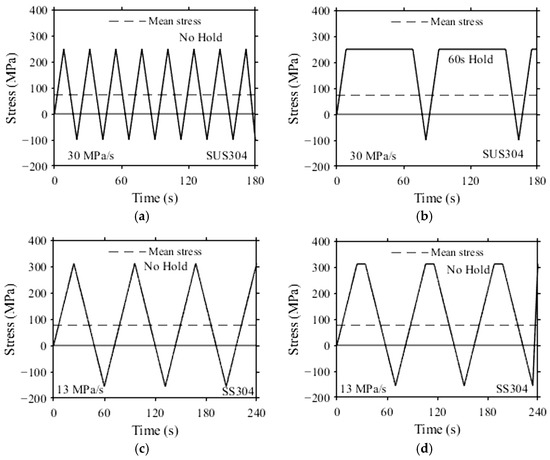
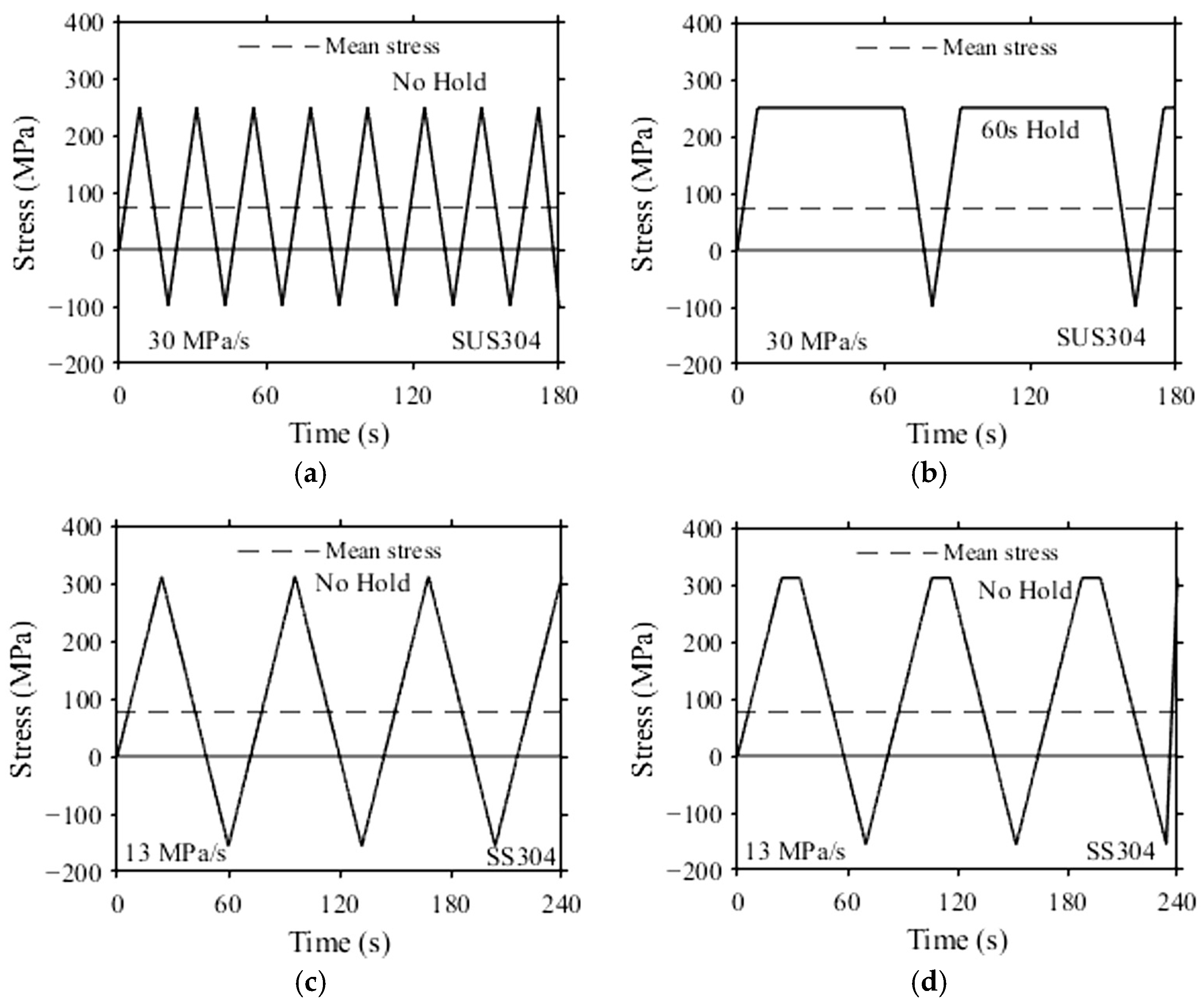
The uniaxial SUS304 specimens tested by Yoshida [1] were solid cylindrical samples with a diameter of 8 mm and a gauge length of 16 mm. The tests were conducted using a servo-controlled testing machine equipped with a microcomputer system for generating the prescribed ramp loading functions and recording the experimental response. Axial displacement was measured using a clip-on extensometer, while the instantaneous true stress was calculated and controlled through an analogue computer. Monotonic tensile tests were initially performed at stress rates of 1, 30, and 100 MPa/s to characterize the room temperature rate sensitivity of the material. The subsequent uniaxial creep-ratcheting tests included asymmetric cyclic loading at a maximum tensile stress of 250 MPa, a stress rate of 30 MPa/s, and stress ratios ranging from 0.8 to . For the present study, the response at was selected, corresponding to a mean stress of 75 MPa and a stress amplitude of 175 MPa ( MPa). Tests were conducted both without a hold and with a 60 s hold imposed at the maximum tensile stress during loading cycles.
The SS304 samples investigated by Kang et al. [2] were machined into solid cylindrical specimens with a gauge diameter of 8 mm and a gauge length of 30 mm. Testing was performed using an MTS809-250 kN servo-hydraulic testing machine, with the loading process and experimental data acquisition controlled through the accompanying Teststar system. Axial deformation was measured using a tension–torsion extensometer with an axial strain capacity of 10%. Monotonic tensile tests were conducted at strain rates of 0.002, 0.02, and 0.2%/s, while symmetric strain-controlled cyclic tests were performed at a total strain amplitude of 0.5% to characterize the cyclic hardening response. These tests demonstrated that both the monotonic and cyclic responses of SS304 remained sensitive to deformation rate at room temperature. Stress-controlled ratcheting tests on SS304 were conducted at a mean stress of 78 MPa and a stress amplitude of 234 MPa ( MPa). The experimental tests were conducted at stress rates of 2.6, 13, and 65 MPa/s and included holds applied at the tensile peak stress. The loading condition selected for the present SRT comparison was imposed at a stress rate of 13 MPa/s and consisted of either continuous cycling or a 10 s hold applied at the peak stress. Figure 1 presents the stress-controlled loading waveforms selected for the model assessments.
Figure 1.
Schematic representation of cyclic stress-controlled loading waveforms representing (a) no-hold condition and (b) incorporating a 60 s peak dwell time in SUS304 samples; (c) no-hold condition and (d) incorporating a 10 s peak dwell time in SS304 samples [1,2].
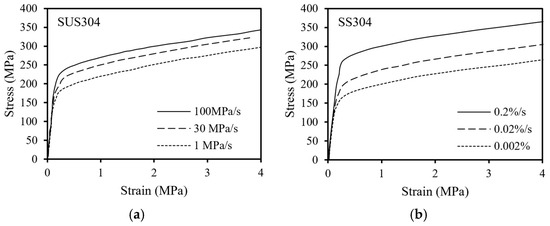
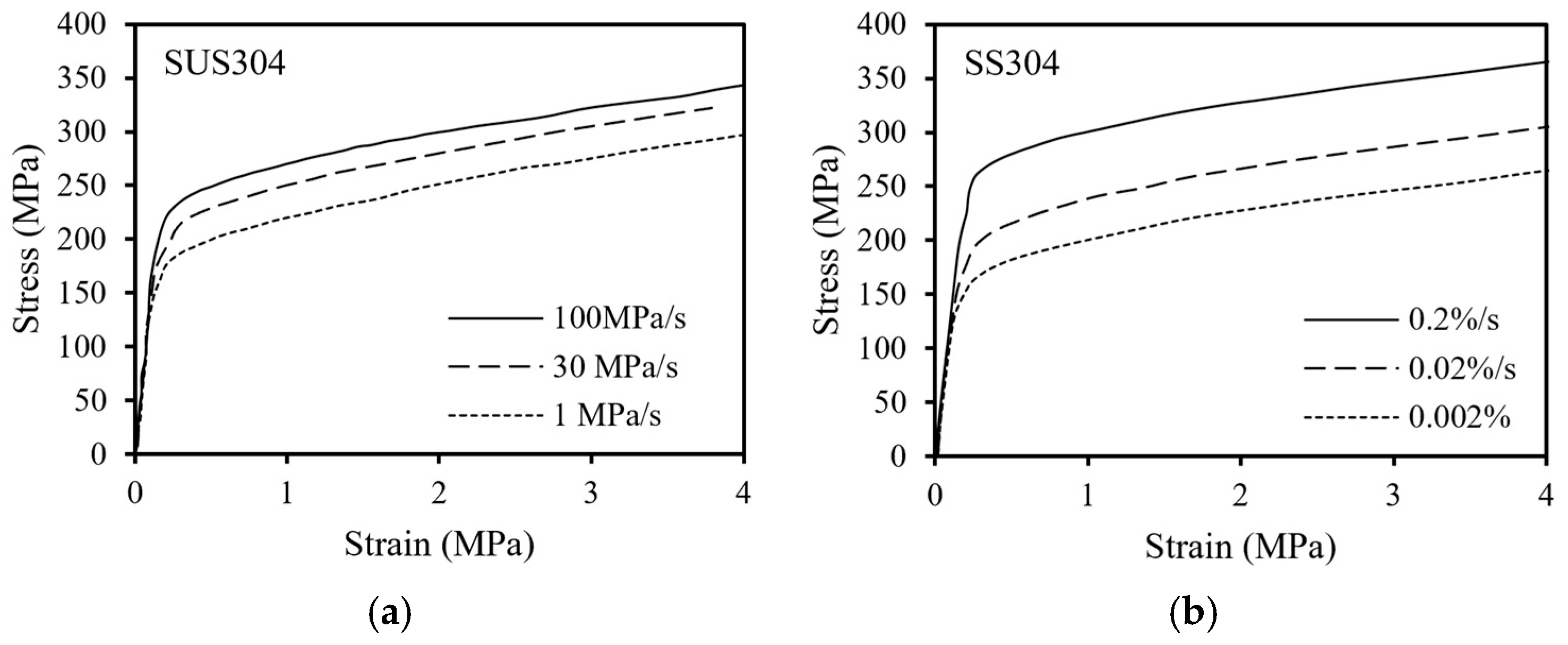
Figure 2 presents the monotonic tensile responses used to characterize the rate dependence of the two austenitic stainless steels. For SUS304 samples, the measured flow stress increased as the applied stress rate was raised from 1 to 100 MPa/s. Beyond a total strain of approximately 0.5%, the tensile curves became nearly parallel, indicating similar strain-hardening slopes within the plastic regime while retaining different flow stress levels due to the rate sensitivity of the material. A comparable trend was observed for SS304, where reducing the strain rate from 0.2 to 0.002%/s produced a noticeable reduction in flow stress. These responses verify that both austenitic materials exhibited measurable viscosity at room temperature and support the use of a rate-dependent constitutive flow rule.
Figure 2.
Tensile stress–strain curves for (a) SUS304 samples tested at various stress rates and (b) SS304 samples tested at various strain rates [1,2].
3.3. Experimental Ratcheting Data
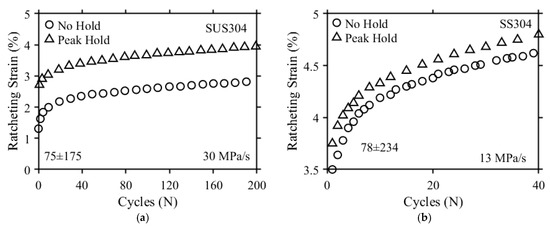
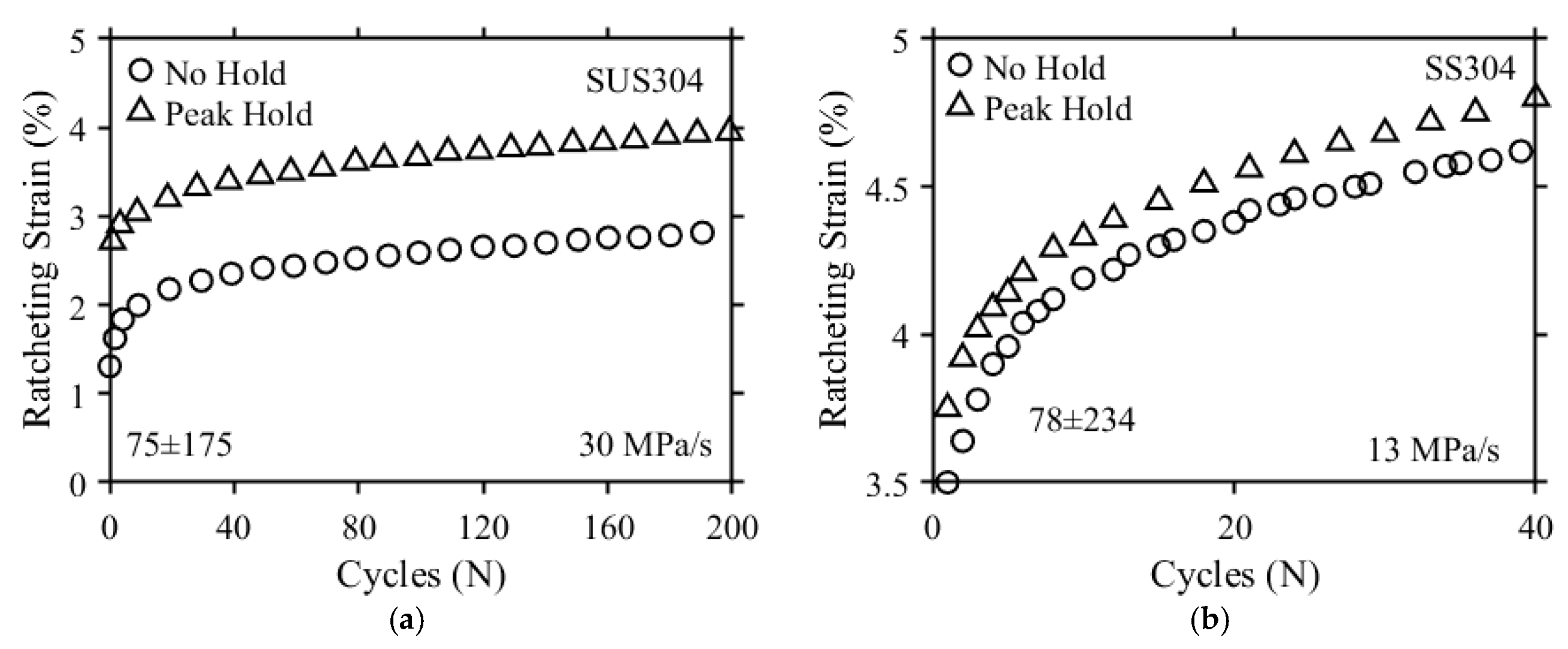
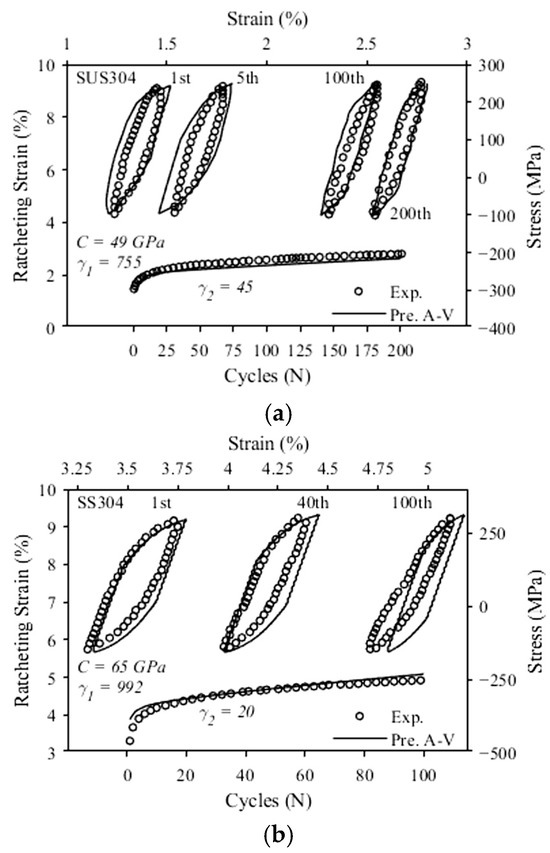
Figure 3 compares the strain accumulation measured under no-hold condition with that obtained after introducing a hold at the peak tensile stress. The two datasets cover distinctly different hold durations and material responses including a 60 s hold in SUS304 and a 10 s hold in SS304. Figure 3a presents the response of SUS304 samples tested at MPa and a stress rate of 30 MPa/s. Under no-hold cyclic loading, the accumulated strain increased rapidly during the initial cycles, followed by a progressive reduction in the strain increment per cycle. Introducing a 60 s hold at the tensile peak stress of 250 MPa produced considerably greater strain accumulation over the same number of cycles. Yoshida [1] reported that, for the selected stress ratio of , the relationship between accumulated strain and total holding time closely approached the corresponding static-creep response at 250 MPa. The majority of the additional strain developed during the tensile holding portion rather than during the subsequent unloading and reloading segments. The hold therefore allowed time-dependent deformation to continue at the maximum applied stress and modified the strain state entering the following reversal. Recent crystal-plasticity simulations further showed that cyclic tensile peak holds sustain crystallographic slip activity during the constant-stress period and delay the plastic shakedown response observed under continuous cycling, providing a microstructural interpretation for the increased strain accumulation [5]. The SS304 data presented in Figure 3b were obtained at MPa and a stress rate of 13 MPa/s. The 10 s tensile peak hold increased the ratcheting strain relative to the corresponding no-hold condition. Both curves displayed a rapid initial accumulation followed by a gradual reduction in ratcheting rate as the cycles progressed. This response is characteristic of the cyclically hardening behaviour reported for SS304 at room temperature, where increasing deformation resistance progressively restricts the plastic strain increment produced in each subsequent cycle [2,4,5,7,20].
Figure 3.
Ratcheting data for no-hold and peak hold conditions in (a) SUS304 samples and (b) SS304 samples [1,2].
To determine the material parameters in the isotropic and kinematic hardening rules, the following procedure was followed:
- Elastic modulus, , was determined from the linear portion of the tensile stress–strain curves.
- Plastic modulus, , was determined from the plastic portion of the tensile stress–strain curves.
- Viscous constants and were determined by fitting tensile stress–strain curves at a strain rate of 0.2%/s for SS304 and a stress rate of 1 MPa/s for SUS304.
- Isotropic variables and were determined by fitting the experimental data of maximum stress plotted against the accumulated plastic strain obtained from strain-controlled data in SS304 samples and from tensile stress–strain curves for SUS304 samples.
- Kinematic variables , , and were calibrated to experimental cyclic test data with no-hold condition.
- Static recovery terms , , and were calibrated utilizing cyclic test data incorporating a hold.
4. Results and Discussion
4.1. The Hardening Framework Coefficients
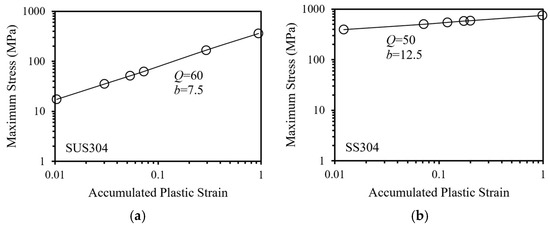
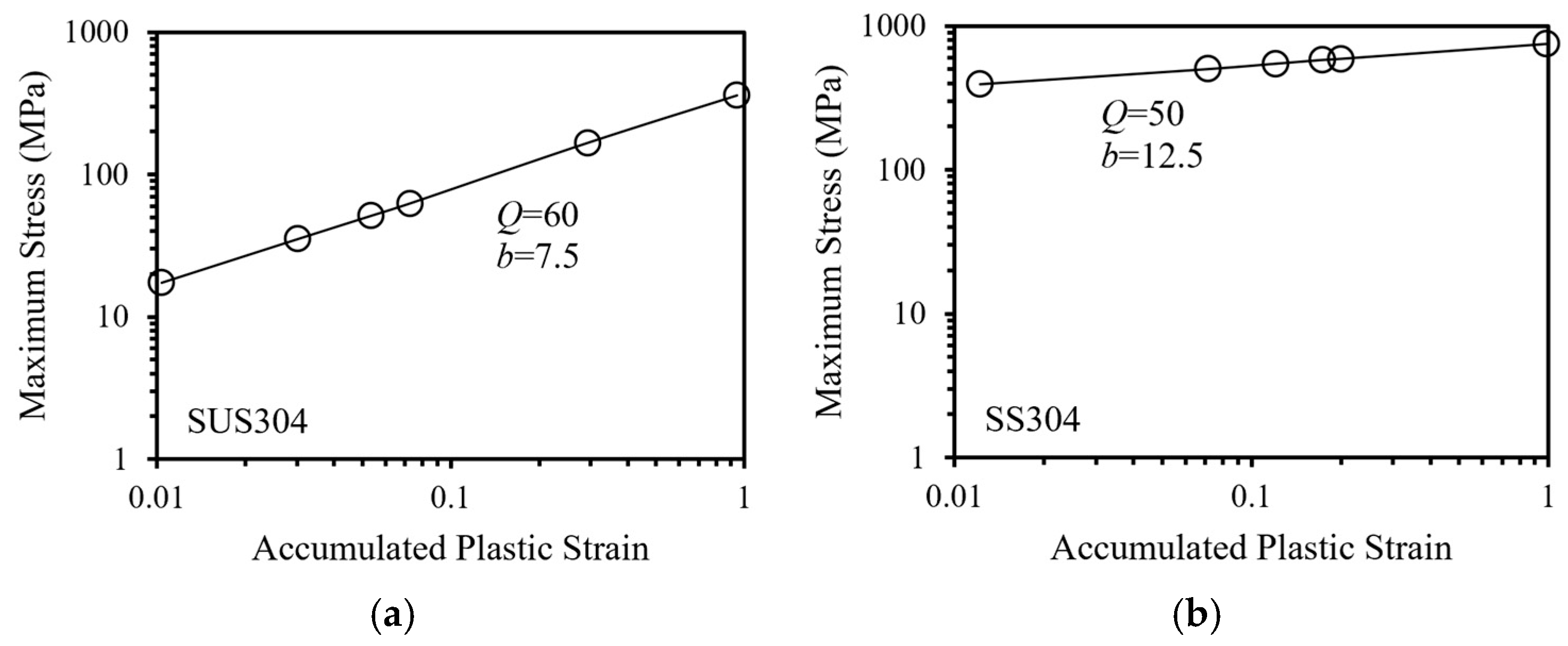
Figure 4 presents the experimental maximum cyclic stress plotted against the accumulated equivalent plastic strain in a Log-Log scale for SUS304 and SS304 steel samples. The parameters were fitted using the isotropic hardening Equations (8) and (9). The coefficient defines the saturated magnitude of the isotropic hardening variable, , while governs the rate at which this value is approached with increasing accumulated plastic strain. The close agreement between the fitted curve and the experimental data indicates that the exponential formulation adequately represents the isotropic evolution of SUS304 and SS304 samples over the investigated cyclic response.
Figure 4.
The maximum stress plotted versus the accumulated plastic strain used to calibrate isotropic coefficients in (a) SUS304 samples and (b) SS304 samples.
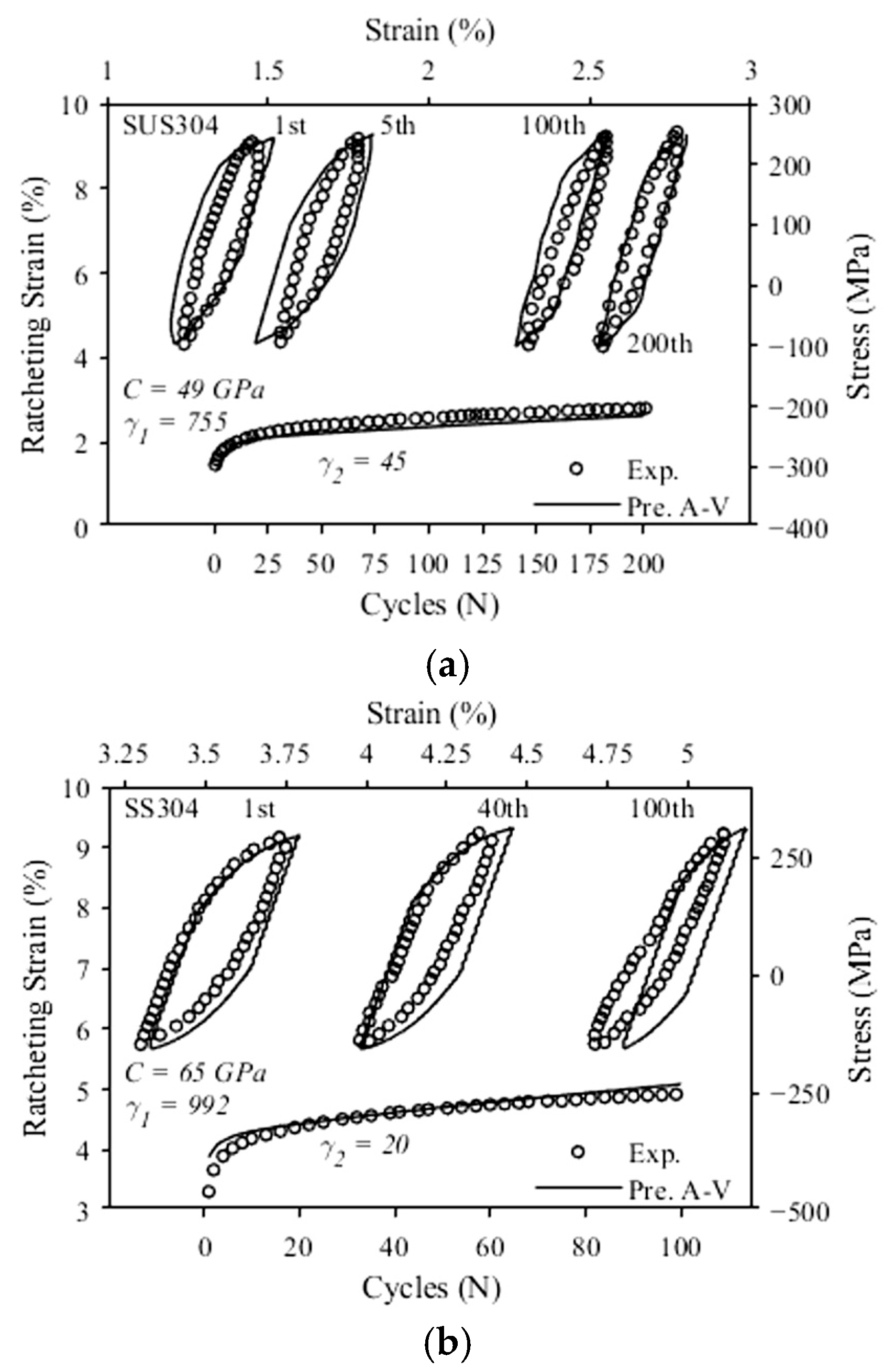
Figure 5 compares the measured responses under continuously cycled loading with those predicted using the calibrated A-V hardening rule. The coefficients and governed the size and shape of the hysteresis loops. The calibration of these coefficients through experimental data preserves the consistency condition, ensuring that any increase in stress is accompanied by the hardening rule and that the yield surface remains consistent with the current stress state over the progressive loading cycles. The coefficient was then adjusted to reproduce the long-range translation of the hysteresis loops and the progressive accumulation of ratcheting strain. Figure 5a shows that the predicted hysteresis loops closely reproduced the experimental loop shape and their progressive translation along the strain axis for SUS304 samples. The corresponding ratcheting prediction also captured the rapid accumulation of strain during the initial cycles and the subsequent reduction in ratcheting as the cycles progressed. The agreement presented in Figure 5a indicates that the kinematic coefficients provided an adequate representation of the response for the selected no-hold condition. A similarly close agreement was obtained for SS304 in Figure 5b. The predicted loops reproduced the experimentally measured shape, width, and progressive displacement with increasing cycle number. The ratcheting curve also followed the observed reduction in strain accumulation per cycle, indicating that the kinematic descriptions captured the principal characteristics of the no-hold SS304 response.
Figure 5.
Experimental and predicted hysteresis loops obtained using the calibrated A-V hardening rule coefficients , and for (a) SUS304 samples and (b) SS304 samples with no-hold condition at room temperature.
The complete coefficients used in the constitutive simulations are listed in Table 1. These include the elastic and viscoplastic parameters, the isotropic hardening coefficients, the A-V kinematic variables, and the parameters associated with the linear, power-law, and nonlinear static recovery formulations. The coefficients calibrated under continuously cycled loading were retained during the peak hold simulations so that the influence of the selected static recovery function could be assessed without altering the underlying hardening description.
Table 1.
Coefficients of the A-V kinematic and the L-Z isotropic rules and related SRT parameters used to evaluate ratcheting in steel samples with various holding periods at room temperature.
4.2. Ratcheting Prediction in the Presence of the Various Static Recovery Functions
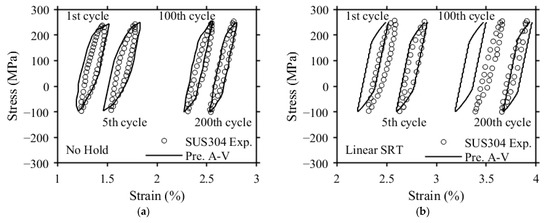
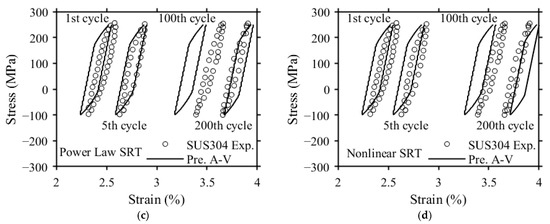
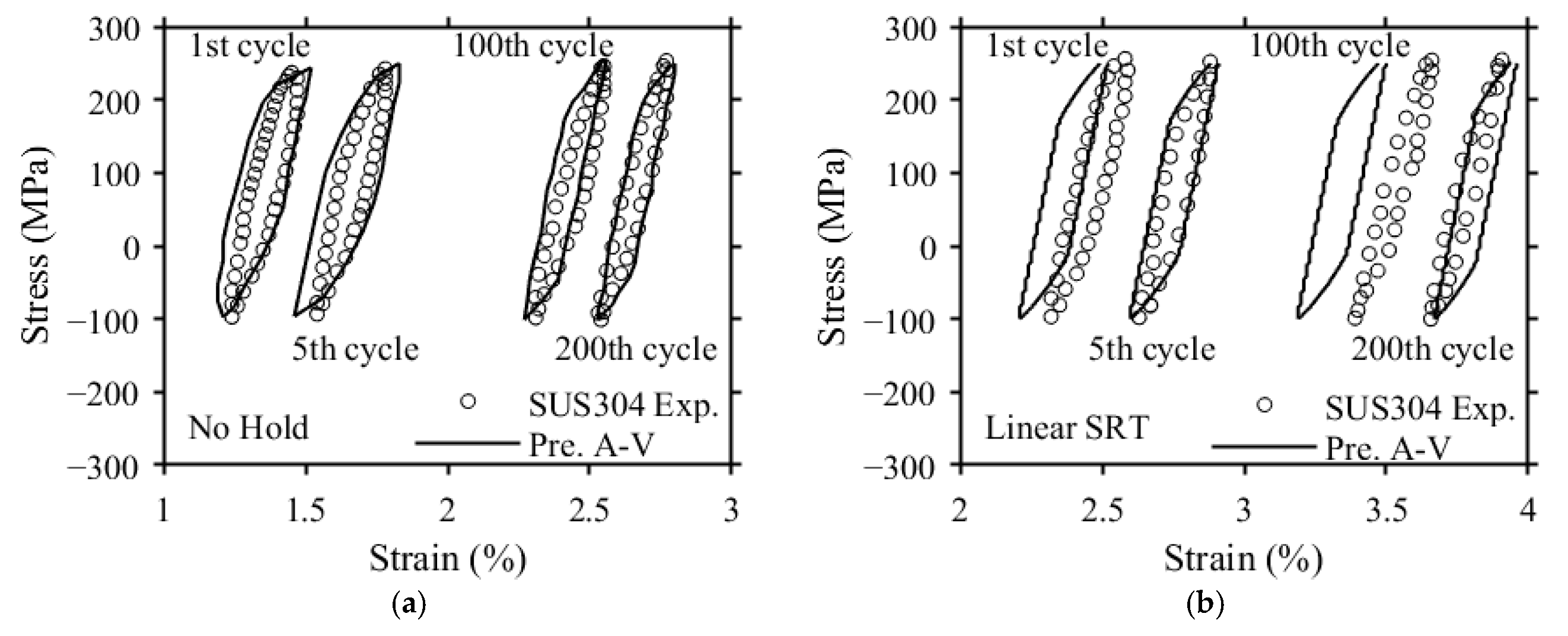
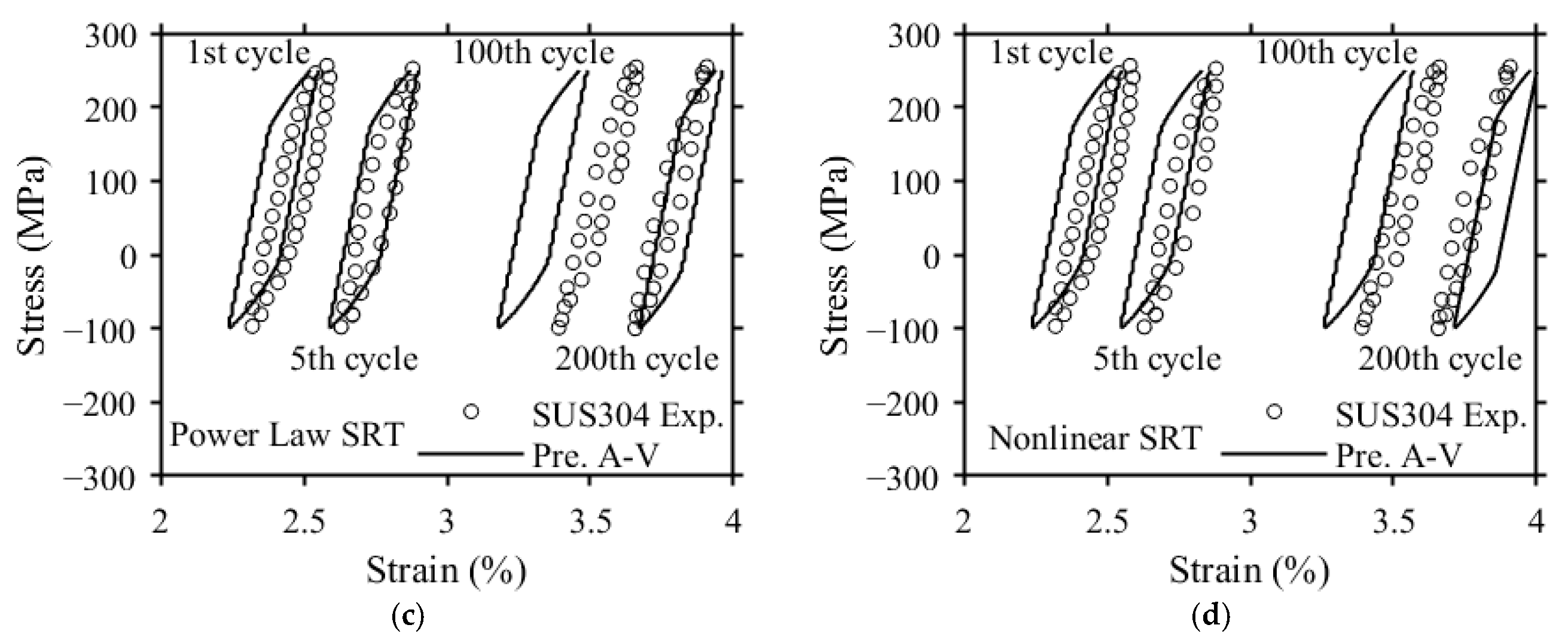
Figure 6 compares the measured and predicted hysteresis loops for SUS304 samples tested at MPa and a stress rate of 30 MPa/s. The 1st, 5th, 100th, and 200th cycles were selected to examine the initial material response, the rapid early development of ratcheting, and the long-range evolution approaching a more stabilized condition. Figure 6a presents the continuously cycled response predicted using the baseline A-V hardening framework, while Figure 6b–d present the corresponding peak hold predictions obtained using the linear, power-law, and nonlinear SRTs, respectively. Under the no-hold condition in Figure 6a, the predicted loops reproduce the experimentally observed shape and progressive translation toward increasing tensile strain. The greatest displacement occurs during the early cycles, after which the incremental translation decreases as the material cyclically hardens. The agreement under continuous cycling confirms that the baseline isotropic and kinematic parameters reproduce the principal SUS304 response before a time-dependent recovery contribution is introduced. The addition of a 60 s hold at the tensile peak causes a greater translation of the hysteresis loops along the positive strain direction. During the peak hold of each cycle, viscoplastic strain continues to accumulate while the internal backstress evolves through static recovery. The recovered backstress provides less resistance to subsequent deformation in the tensile direction, causing the following cycles to begin from a progressively shifted strain state. Figure 6b–d show that all three SRTs capture the shift in hysteresis loops as a peak hold was introduced into the loading sequence. Their predictions are especially close during the first and fifth cycles. Greater differences become evident as the cyclic history develops. Each formulation underpredicts the translation of the experimental 100th cycle loop, indicating that the predicted strain accumulation during the intermediate portion of the loading history is lower than that measured experimentally. The nonlinear SRT provides the closest representation of the 100th cycle loop, deviating from the experimental data by an absolute value of 0.13%, whereas the linear and power-law formulations produce slightly smaller loop translations, deviating by absolute strain differences of 0.21 and 0.2%, respectively. This difference reflects the manner in which the nonlinear static recovery coefficient evolves with accumulated plastic strain. Unlike the linear and power-law models, which employ constant calibrated static recovery coefficients, the nonlinear formulation allows the magnitude of to transition from its initial value toward a saturated state as the cyclic plastic strain develops. By the 200th cycle, the predicted loops from all three formulations again approach the experimental response more closely. This suggests that the calibrated models reproduce the overall accumulated strain at the end of the examined history even though they differ in their representation of the intermediate evolution.
Figure 6.
The predicted hysteresis loops by the A-V hardening rule plotted versus experimental loops for SUS304 samples tested at 75 ± 175 MPa at 30 MPa/s (a) no holds, and load cycles with a 60 s hold in the peak event incorporating (b) linear SRT, (c) power-law SRT, and (d) nonlinear SRT functions at room temperature.
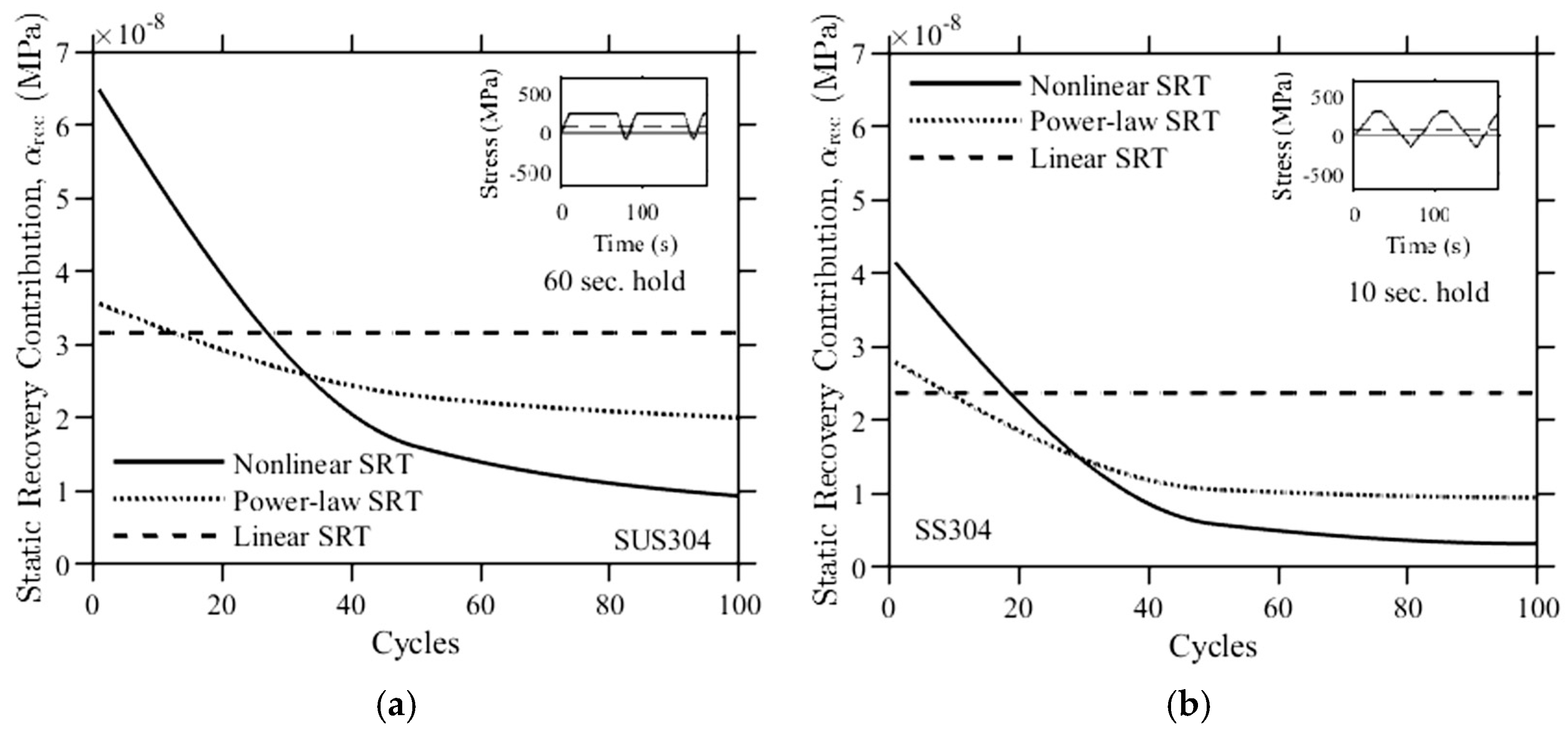
Figure 7 presents the cycle-dependent evolution of the static recovery contribution, , evaluated at the end of each loading cycle for the linear, power-law, and nonlinear SRTs of SUS304 and SS304 samples. Although all three formulations act on the effective backstress state, , their different mathematical dependencies produce distinct recovery magnitudes and evolutionary trends over the loading history. Figure 7a shows that the cycle end recovery contribution generated by all three formulations decreases progressively with increasing cycle numbers in SUS304 samples. The largest reduction occurs during the early cycles, after which the curves evolve more gradually toward their respective long-range values. The linear SRT produces the greatest recovery contribution throughout the investigated cycle range, the power-law response generally occupies an intermediate position, and the nonlinear SRT produces the lowest values. The decreasing recovery response is consistent with the evolution of ratcheting strain in SUS304 samples under asymmetric cyclic loading. The material undergoes its most rapid internal variable development during the initial cycles, while subsequent cyclic hardening and stabilization progressively reduce the change in effective backstress occurring from one hold to the next. Consequently, the incremental static recovery required during each tensile dwell also decreases. This does not indicate that static recovery ceases at later cycles; rather, its cycle-by-cycle contribution diminishes as the internal stress state approaches a more slowly evolving condition. The SUS304 predictions in Figure 6 provide further insight into the interpretation of Figure 7a. Although the nonlinear SRT produces the lowest plotted recovery contribution for SUS304, it provides the closest prediction of the experimentally measured 100th cycle hysteresis loop with variation <0.15% to the experimental data, compared to a deviation of ≥0.2% by the other two formulations. By the 200th cycle, the same formulation produces a slightly greater loop translation, 0.1% greater than the experimental data, than the linear and power-law models, 0.05% greater than the experimental data, and therefore slightly overpredicts the experimental loop position. A comparable trend is obtained for SS304 in Figure 7b. The effective recovery predicted by each SRT decreases over the loading history, with the linear formulation again producing the highest values and the nonlinear formulation the lowest. The decline is particularly noticeable during the initial portion of the response and becomes progressively less pronounced as cyclic hardening develops.
Figure 7.
Cycle end evolution of the static recovery contribution, , adapted into the A-V kinematic hardening rule for the linear SRT, power-law SRT, and the nonlinear SRT over asymmetric loading cycles in (a) SUS304 samples and (b) SS304 samples with a hold introduced at the peak stress.
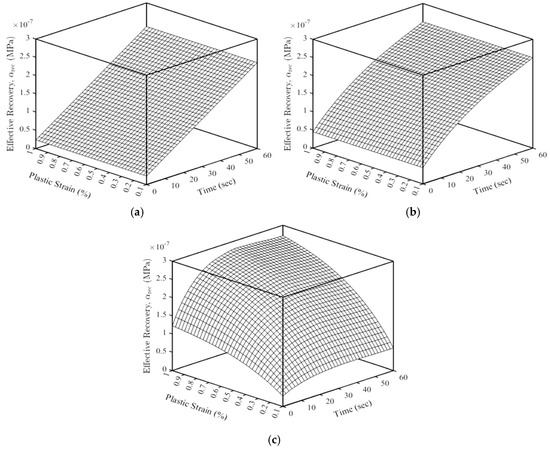
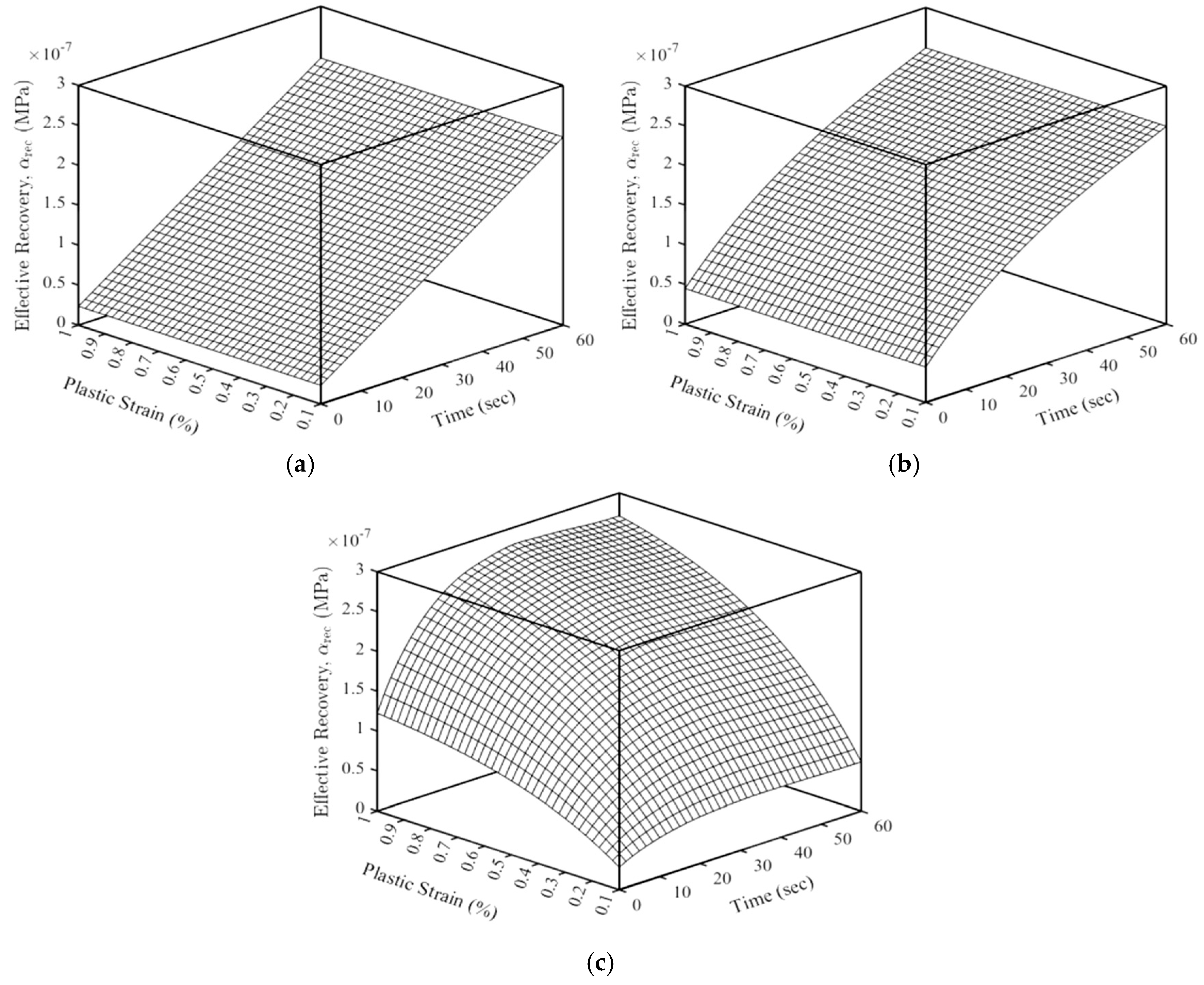
Figure 8 presents constitutive response surfaces for the accumulated static recovery, , as a function of accumulated equivalent plastic strain, , and hold duration, , for the linear, power-law, and nonlinear SRT formulations in SUS304 samples. In contrast to the cycle-history results presented in Figure 7, these surfaces are generated by evaluating the respective recovery formulations over prescribed ranges of accumulated plastic strain and hold time. They therefore illustrate the intrinsic dependence of each SRT formulation on the evolving material state and the duration of the tensile hold rather than the recovery history obtained from a particular cyclic simulation. At , no time-dependent recovery has yet accumulated. As the hold duration increases, the recovery contribution develops through the time integration of the instantaneous static recovery rate. The linear and power-law formulations employ constant recovery coefficients, and their variation with accumulated plastic strain is governed primarily by the corresponding effective backstress dependence. The nonlinear formulation additionally incorporates an accumulated plastic strain-dependent recovery coefficient, causing its response surface to evolve more strongly with . As shown in Figure 8c, the nonlinear formulation produces an increasing recovery contribution over the investigated ranges of accumulated plastic strain and hold duration, whereas the linear and power-law formulations exhibit decreasing recovery contributions with increasing accumulated plastic strain. Figure 8a shows the comparatively simple surface produced by the linear formulation, while the power-law surface in Figure 8b exhibits greater curvature because the recovery response is additionally scaled by the magnitude of the effective backstress raised to the exponent . The nonlinear surface in Figure 8c displays the strongest dependence on accumulated plastic strain because both the backstress-dependent term and the evolving recovery coefficient contribute to the calculated recovery response.
Figure 8.
Three-dimensional plot of the surfaces showing the accumulated static recovery, , for SUS304 samples with respect to plastic strain accumulation and hold duration for the (a) linear SRT, (b) power-law SRT, and (c) nonlinear SRT over a 60 s peak hold loading period.
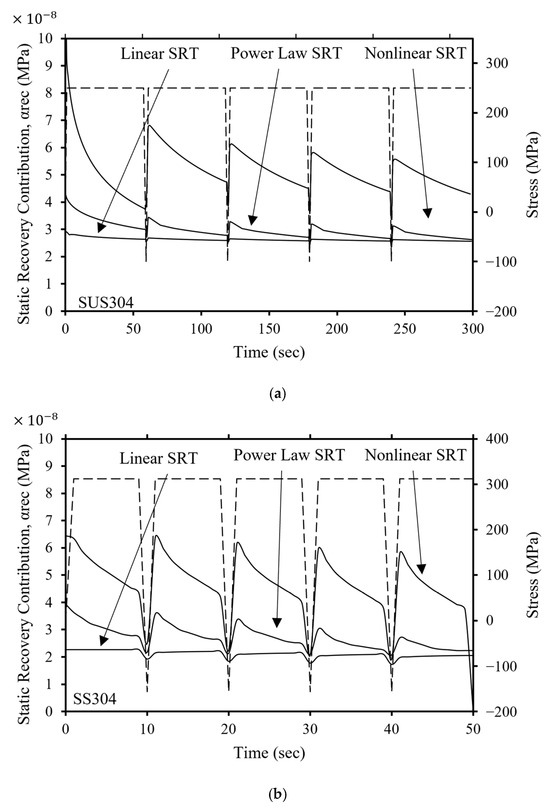
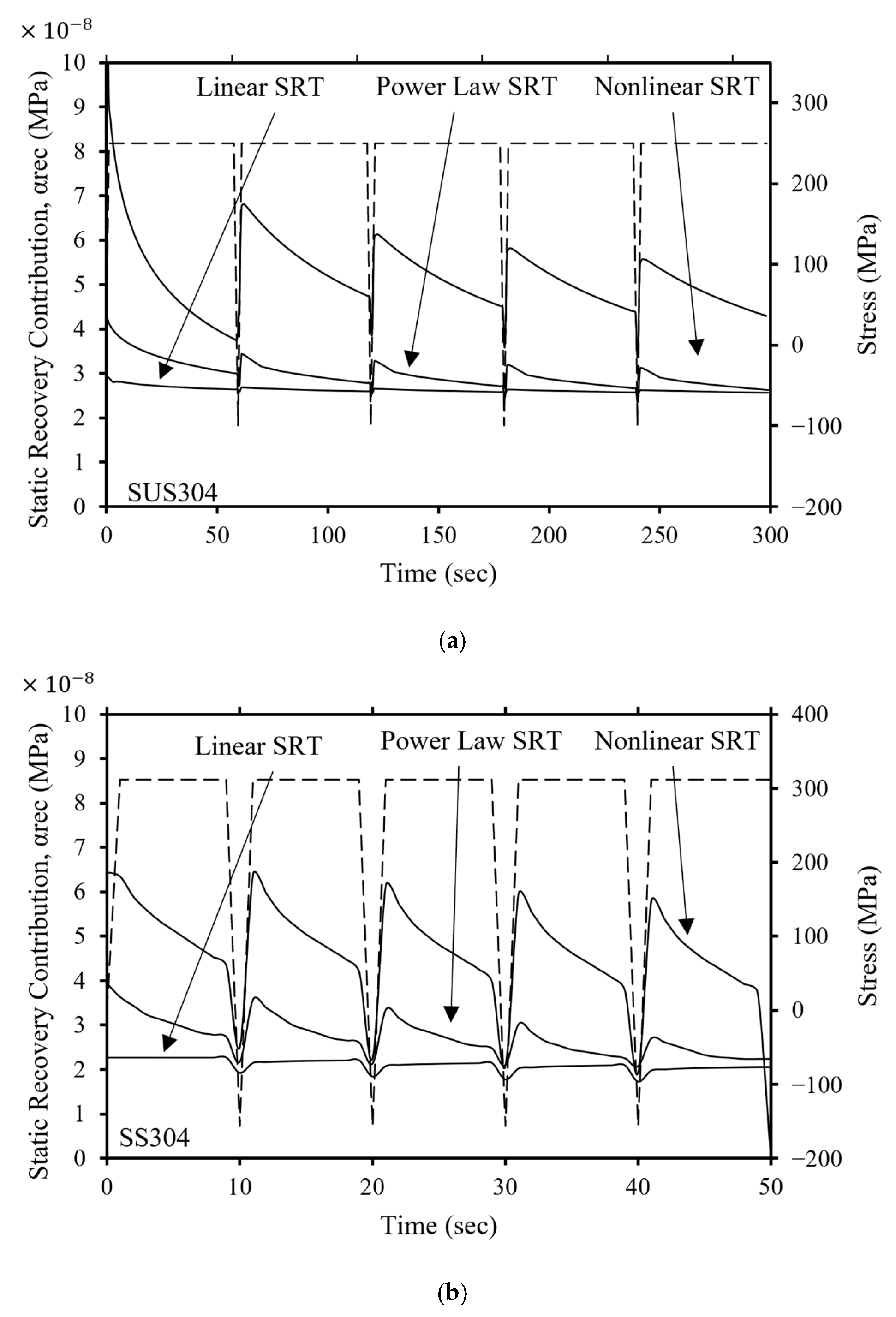
Figure 9 presents the time-resolved evolution of the static recovery contribution, , during the peak hold segments of the first five loading cycles for (a) SUS304 and (b) SS304 samples. Unlike Figure 7, which reports the recovery contribution at the end of each cycle, Figure 9 samples the same quantity throughout the loading history to show its evolution during the individual tensile peak holds. The dashed curve represents the applied stress waveform, referenced to the right-hand axis, with a 60 s tensile peak hold for SUS304 and a 10 s hold for SS304. The three solid curves represent the static recovery contributions generated by the linear, power-law, and nonlinear SRT formulations. During each tensile hold, the linear formulation exhibits an approximately linear decrease in the recovery contribution with elapsed hold time. The power-law formulation displays greater curvature because its recovery response is additionally dependent on the magnitude of the effective backstress through the exponent . The nonlinear formulation exhibits the most pronounced curvature because its response depends both on the current backstress state and on the recovery coefficient that evolves with accumulated plastic strain. For all three formulations, the maximum recovery contribution associated with each successive hold decreases as the loading cycles progress. This trend is consistent with the cycle end behaviour shown in Figure 7 and reflects the progressively smaller recovery contribution associated with the hardening material and more stabilized internal stress state. The same general behaviour is observed for both materials, although the SS304 response occurs over the shorter 10 s hold duration compared with the 60 s hold applied to SUS304.
Figure 9.
Time-resolved evolution of the static recovery contribution, , in the static recovery models over the first five loading cycles with a hold introduced at the peak stress in (a) SUS304 samples and (b) SS304 samples.
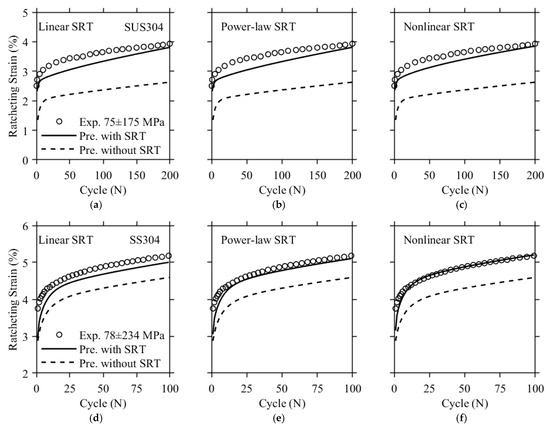
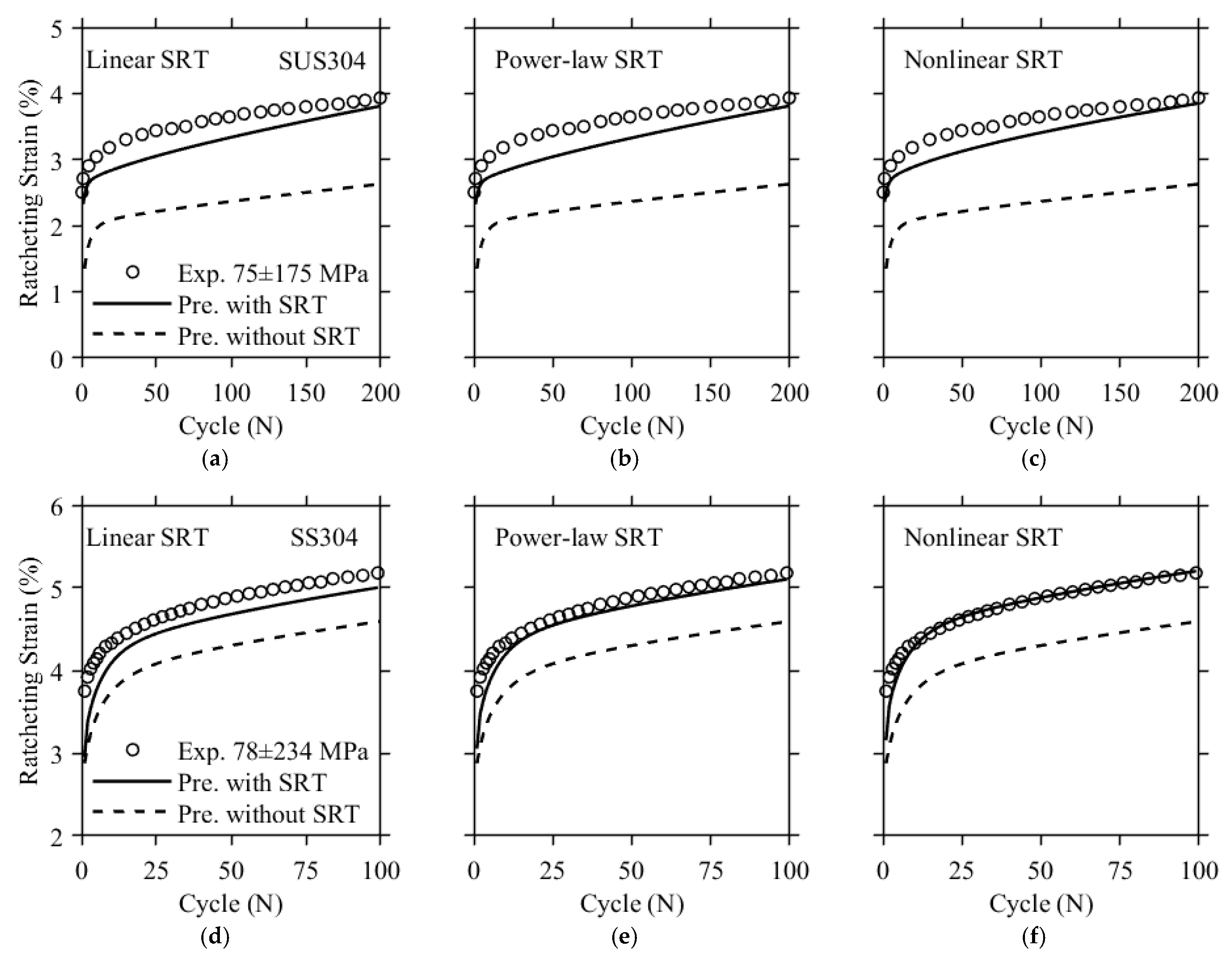
Figure 10 compares the experimentally measured ratcheting responses with calibrated predictions obtained both with and without the incorporation of a static recovery term. The linear, power-law, and nonlinear SRTs are assessed separately for SUS304 and SS304 samples. For each material, the predictions excluding static recovery were obtained while retaining the same elastic, viscoplastic, isotropic, and kinematic parameters used in the corresponding SRT simulation. The difference between the two predicted curves therefore isolates the influence of the recovery contribution introduced during the tensile hold. Figure 10a–c present the SUS304 results for the linear, power-law, and nonlinear SRTs, respectively. The baseline A-V model without static recovery consistently underpredicts the experimentally measured strain accumulation under the 60 s tensile peak hold by an absolute strain difference of approximately 1.5%. Although the no-SRT response retains the general form of the ratcheting curve, its strain increment per cycle is insufficient because the backstress can evolve only through plastic straining during the loading and unloading segments. Figure 10d–f present the corresponding SS304 results under a 10 s tensile peak hold. As observed for SUS304, omission of the SRT produces a systematic underprediction of the measured ratcheting strain by nearly 0.5%. Following calibration, all three SRT formulations substantially improve the agreement with the measured response, although small differences remain between the formulations. At the end of the investigated loading history, the nonlinear SRT overpredicts the experimental ratcheting strain by an absolute strain difference of approximately 0.02%, while the power-law and linear SRTs underpredict it by approximately 0.08% and 0.19%, respectively. The nonlinear formulation therefore provides the closest agreement for this specific calibrated SS304 loading condition, followed by the power-law and linear formulations. These differences demonstrate the relative agreement obtained after parameter calibration and should not be interpreted as independent validation of the predictive capability of the three SRT formulations.
Figure 10.
Ratcheting assessment with and without the incorporation of static recovery terms under peak dwell conditions in SUS304 steel, utilizing the (a) linear SRT, (b) power-law SRT, and (c) nonlinear SRT and SS304 samples incorporating the (d) linear SRT, (e) power-law SRT, and (f) nonlinear SRT.
The overall findings of the present investigation demonstrate that the incorporation of a time-dependent static recovery term is necessary to reproduce the additional ratcheting strain generated by tensile peak holds in SUS304 and SS304 samples. The three formulations produced distinct internal variable responses despite yielding broadly comparable macroscopic predictions after calibration. For the SUS304 and SS304 materials, the effective recovery decreased progressively with loading cycles, with the linear SRT generally producing the highest values and the nonlinear formulation the lowest. These material-dependent trends were reflected in the hysteresis loop predictions, where the nonlinear formulation most closely reproduced the intermediate 100th cycle SUS304 loop but slightly overpredicted its translation by the 200th cycle, while the linear and power-law functions produced slightly lower accumulated strains. The ratcheting comparisons in Figure 10 further showed that exclusion of static recovery consistently underpredicted the experimental peak hold response by an absolute strain difference of approximately 1.5% for SUS304 and nearly 0.5% for SS304 samples. The present results show that the linear SRT offers the simplest practical description, whereas the power-law and nonlinear formulations provide additional flexibility when recovery sensitivity changes with the evolving internal stress state or accumulated plastic strain. Although all three static recovery formulations reproduced the overall ratcheting response with comparable accuracy after calibration, the nonlinear SRT provides additional flexibility through its accumulated plastic strain-dependent recovery coefficient. Unlike the linear and power-law formulations, which rely on a fixed recovery coefficient throughout the loading history, the nonlinear formulation permits the recovery response to evolve as cyclic plastic strain accumulates, providing a phenomenological means of representing changes in recovery behaviour as cyclic deformation progresses. This is reflected in the results themselves, where the nonlinear formulation provided the closest agreement with the experimentally measured 100th cycle hysteresis loop for SUS304, where the linear and power-law models slightly underpredicted loop translation. The nonlinear SRT also showed the closest agreement with the experimental data for SS304 samples compared to the other SRT models. Among the three formulations, the nonlinear SRT provided the closest agreement at selected intermediate cycles for the calibrated loading conditions; however, independent loading conditions are required before its relative predictive performance can be generalized.
5. Conclusions
The present study compared linear, power-law, and nonlinear static recovery terms within the A-V kinematic hardening framework for SUS304 and SS304 samples subjected to tensile peak holds at room temperature. All three SRT formulations substantially improved the predicted ratcheting response relative to the baseline model without static recovery, confirming that a time-dependent evolution of backstress is required to represent the additional strain accumulated during a sustained peak stress. The linear SRT provided the simplest formulation and reproduced the overall experimental response with comparatively few parameters, while the power-law model introduced sensitivity to the prevailing effective backstress. The nonlinear formulation additionally allowed the recovery coefficient to evolve with accumulated plastic strain and provided improved agreement during portions of the intermediate cyclic response, including the 100th SUS304 hysteresis loop. The differences between the materials demonstrate that the evolution of static recovery depends on the combined effects of the recovery function, accumulated plastic strain, effective backstress, hold duration, and material-specific behaviour. Despite their different internal variable evolutions, all three SRTs could be calibrated to provide similar macroscopic ratcheting predictions under the selected loading conditions. The results therefore indicate that model selection should consider not only agreement with the final accumulated strain, but also the ability to reproduce intermediate hysteresis loop evolution and recovery behaviour over broader loading histories.
A principal limitation of the present investigation is that only room temperature datasets were considered. The applicability of the observed trends at elevated temperatures therefore remains uncertain, particularly within dynamic strain-aging regimes where temperature- and strain rate-dependent interactions between solute atoms and dislocations can increase cyclic hardening and alter resistance to ratcheting. Future work will investigate the combined influence of static recovery and dynamic strain aging so that the competing effects of dwell-assisted backstress recovery and DSA-induced cyclic strengthening can be incorporated within a unified constitutive framework.
Author Contributions
Conceptualization, P.J. and A.V.-F.; methodology, P.J. and A.V.-F.; software, P.J. and A.V.-F.; validation, P.J. and A.V.-F.; formal analysis, P.J.; investigation, P.J. and A.V.-F.; data curation, P.J. and A.V.-F.; writing—original draft preparation, P.J. and A.V.-F.; writing—review and editing, P.J. and A.V.-F.; visualization, P.J. and A.V.-F.; supervision, A.V.-F.; project administration, A.V.-F.; funding acquisition, A.V.-F. All authors have read and agreed to the published version of the manuscript.
Funding
This research was funded by the Natural Sciences and Engineering Research Council of Canada (NSERC) through A.V-F. (RGPIN-2021-03047).
Institutional Review Board Statement
Not applicable.
Informed Consent Statement
Not applicable.
Data Availability Statement
The original contributions presented in this study are included in the article. Further inquiries can be directed to the corresponding author.
Conflicts of Interest
The authors declare that they have no known competing financial interests or personal relationships that could have appeared to influence the work reported in this paper.
Abbreviations
The following abbreviations are used in this manuscript:
| The kinematic static recovery term | |
| Backstress tensor | |
| The A-V model internal variable | |
| The A-V model coefficients | |
| State of stress in deviatoric stress space | |
| Isotropic hardening internal variable | |
| Yield strength | |
| Initial yield strength | |
| Applied stress | |
| Unit tensor | |
| Elastic modulus | |
| Shear modulus | |
| Plastic modulus | |
| Poisson’s ratio | |
| Saturated value of the internal variable R | |
| Exponent defining the evolution rate of variable R | |
| Elastic strain | |
| Plastic strain | |
| Viscoplastic strain | |
| Kinematic time-dependent parameters | |
| Viscoplastic parameters |
References
- Yoshida, F. Uniaxial and biaxial creep-ratcheting behavior of SUS304 stainless steel at room temperature. Int. J. Press. Vessel. Pip. 1990, 44, 207–223. [Google Scholar] [CrossRef] [Scilit]
- Kang, G.; Kan, Q.; Zhang, J.; Sun, Y. Time-dependent ratchetting experiments of SS304 stainless steel. Int. J. Plast. 2006, 22, 858–894. [Google Scholar] [CrossRef] [Scilit]
- Zhang, K. Characterization and Modeling of the Ratcheting Behavior of the Ferritic-Martensitic Steel P91. Ph.D. Dissertation, Karlsruhe Institute of Technology (KIT), Karlsruhe, Germany, 2015. [Google Scholar]
- Taleb, L.; Cailletaud, G. Cyclic accumulation of the inelastic strain in the 304L SS under stress control at room temperature: Ratcheting or creep? Int. J. Plast. 2011, 27, 1936–1958. [Google Scholar] [CrossRef] [Scilit]
- Acar, S.; Yalcinkaya, T. Crystal plasticity modelling of time-dependent strain accumulation of stainless steel at room temperature. Philos. Mag. 2026, 106, 1–21. [Google Scholar] [CrossRef] [Scilit]
- Kohnert, A.; Capolungo, L. The kinetics of static recovery by dislocation climb. Comp. Mater. 2022, 8, 104. [Google Scholar] [CrossRef] [Scilit]
- Taleb, L.; Keller, C. Experimental contribution for better understanding of ratcheting in 304L SS. Int. J. Mech. Sci. 2018, 146–147, 527–535. [Google Scholar] [CrossRef] [Scilit]
- Chen, J.; Ji, D.; Cai, X.; Wang, D.; Dai, C.; Wang, J. Effect of holding duration at maximum and minimum stress on creep fatigue interaction of P92 steel. Mater. High Temp. 2020, 37, 51–60. [Google Scholar] [CrossRef] [Scilit]
- Li, J.; Chen, J.; Liu, Y.; Jiang, W.; Kan, Q. Constitutive modeling for the creep-ratcheting interaction of 0Cr18Ni10Ti stainless steel at high temperature. Eur. J. Mech. A/Solids 2025, 111, 105602. [Google Scholar] [CrossRef] [Scilit]
- Liu, Z.; Gong, J.; Zhao, P.; Zhang, X.; Xuan, F. Creep-fatigue interaction and damage behavior in 9-12%Cr steel under stress-controlled cycling at elevated temperature: Effects of holding time and loading rate. Int. J. Fatigue 2022, 156, 106684. [Google Scholar] [CrossRef] [Scilit]
- Yaguchi, M.; Takahashi, Y. Ratchetting of viscoplastic material with cyclic softening, part 1: Experiments on modified 9Cr-1Mo steel. Int. J. Plast. 2005, 21, 43–65. [Google Scholar] [CrossRef] [Scilit]
- Wang, X.; Zhang, T.; Zhang, W.; Wahab, M.; Gong, J. An improved unified viscoplastic model for modelling low cycle fatigue and creep fatigue interaction loadings of 9-12%Cr steel. Eur. J. Mech. A/Solids 2021, 85, 104123. [Google Scholar] [CrossRef] [Scilit]
- Prager, W. A New Method of Analyzing Stresses and Strains in Work-Hardening Plastic Solids. J. Appl. Mech. 1956, 23, 493–496. [Google Scholar] [CrossRef] [Scilit]
- Frederick, C.; Armstrong, P. A mathematical representation of the multiaxial Bauschinger effect. Mater. High Temp. 2007, 24, 1–26. [Google Scholar] [CrossRef] [Scilit]
- Chaboche, J. Time-independent constitutive theories for cyclic plasticity. Int. J. Plast. 1986, 2, 149–188. [Google Scholar] [CrossRef] [Scilit]
- Chaboche, J. Constitutive equations for cyclic plasticity and cyclic viscoplasticity. Int. J. Plast. 1989, 5, 247–302. [Google Scholar] [CrossRef] [Scilit]
- Ohno, N.; Wang, J. Kinematic hardening rules with critical state of dynamic recovery, part I: Formulation and basic features for ratchetting behavior. Int. J. Plast. 1993, 9, 375–390. [Google Scholar] [CrossRef] [Scilit]
- Ohno, N.; Wang, J. Kinematic hardening rules with critical state of dynamic recovery, part II: Application to experiments of ratchetting behavior. Int. J. Plast. 1993, 9, 391–403. [Google Scholar] [CrossRef] [Scilit]
- Ahmadzadeh, G.; Varvani-Farahani, A. A kinematic hardening rule to investigate the impact of loading path and direction on ratcheting response of steel alloys. Mech. Mater. 2016, 101, 40–49. [Google Scholar] [CrossRef] [Scilit]
- Jevtic, P.; Varvani-Farahani, A. Ratcheting evaluation of SS304 samples undergoing peak-valley loading reversals with hold time periods at room temperature through the incorporation of the static recovery term. Appl. Sci. 2026, 16, 4317. [Google Scholar] [CrossRef] [Scilit]
- Yaguchi, M.; Yamamoto, M.; Ogata, T. A viscoplastic constitutive model for nickel-base superalloy, part 1: Kinematic hardening rule of anisotropic dynamic recovery. Int. J. Plast. 2002, 18, 1083–1109. [Google Scholar] [CrossRef] [Scilit]
- Ding, J.; Kang, G.; Kan, Q.; Liu, Y. Constitutive model for uniaxial time-dependent ratcheting of 6061-T6 aluminum alloy. Comp. Mater. Sci. 2012, 57, 67–72. [Google Scholar] [CrossRef] [Scilit]
- Chen, W.; Kitamura, T.; Feng, M. Creep and fatigue behavior of 316L stainless steel at room temperature: Experiments and a revisit of a unified viscoplasticity model. Int. J. Fatigue 2018, 112, 70–77. [Google Scholar] [CrossRef] [Scilit]
- Yang, X.; Nassar, S. Constitutive modeling of time-dependent cyclic straining for solder alloy 63Sn-37Pb. Mech. Mater. 2005, 37, 801–814. [Google Scholar] [CrossRef] [Scilit]
- Zhang, X.; Xuan, F. Interaction of cyclic softening and stress relaxation of 9-12% Cr steel under strain-controlled fatigue-creep condition: Experimental and modeling. Int. J. Plast. 2017, 98, 45–64. [Google Scholar] [CrossRef] [Scilit]
- Perzyna, P. The constitutive equations for rate sensitive plastic materials. Q. Appl. Math. 1963, 20, 321–332. [Google Scholar] [CrossRef] [Scilit]
- Lee, D.; Zavrel, F. A generalized strain rate dependent constitutive equation for anisotropic metals. Acta Metall. 1978, 26, 1771–1780. [Google Scholar] [CrossRef] [Scilit]
- Varvani-Farahani, A. A comparative study in descriptions of coupled kinematic hardening rules and ratcheting assessment over asymmetric stress cycles. Fatigue Fract. Eng. Mater. Struct. 2017, 40, 882–893. [Google Scholar] [CrossRef] [Scilit]

Disclaimer/Publisher’s Note: The statements, opinions and data contained in all publications are solely those of the individual author(s) and contributor(s) and not of MDPI and/or the editor(s). MDPI and/or the editor(s) disclaim responsibility for any injury to people or property resulting from any ideas, methods, instructions or products referred to in the content. |
© 2026 by the authors. Licensee MDPI, Basel, Switzerland. This article is an open access article distributed under the terms and conditions of the Creative Commons Attribution (CC BY) license.