


Abstract
To address the problems of enhanced non-stationarity, significant feature distribution shift, and insufficient cross-condition generalization capability of traditional fault diagnosis methods under variable operating conditions such as varying speed and load, a rolling bearing fault diagnosis method integrating group sparse reconstruction and a multi-strategy improved quantum particle swarm optimization-based relevance vector machine (RVM) is proposed. First, group sparse representation learning is employed to reconstruct the original vibration signals, thereby suppressing background noise and enhancing fault-related impulsive components to improve signal separability and stability. Subsequently, a modal component selection criterion combining kurtosis and correlation coefficients is introduced to optimize and reconstruct the decomposed modal components, enabling the reconstructed signals to retain more fault-sensitive information. On this basis, multiple information entropy features are extracted from the reconstructed signals to construct high-dimensional state feature vectors for comprehensively characterizing the dynamic operating states of rolling bearings. To further enhance the parameter optimization capability, Chebyshev chaotic mapping is incorporated into the quantum particle swarm optimization (QPSO) algorithm to improve the uniformity of population initialization. Meanwhile, a Cauchy mutation strategy is introduced to strengthen the global search capability and avoid premature convergence, thereby forming a multi-strategy improved QPSO algorithm. Finally, the improved optimization algorithm is utilized to adaptively optimize the key hyperparameters of the RVM, resulting in a fault diagnosis model with high accuracy, strong generalization capability, and sparse characteristics. Experimental validation on the HUST and XJTU-SY bearing datasets demonstrates that the proposed MIQPSO-RVM framework achieves diagnostic accuracies of 96.70% and 94.83%, respectively. Compared with several representative intelligent diagnosis methods and deep learning models, the proposed method exhibits superior diagnostic performance, robustness, and generalization capability under complex operating conditions.
1. Introduction
Rolling bearings are critical components in rotating machinery and are widely used in industrial equipment such as motors, gearboxes, wind turbines, and railway systems. Wang et al. [1] investigated early rolling bearing fault diagnosis in induction motors, while Liu and Xu [2] studied the lubrication characteristics of roller bearings in high-power gearboxes. Gbashi et al. [3] reviewed the development of rolling element bearings for wind turbine applications, and Yan et al. [4] summarized fault diagnosis approaches for railway vehicle bearings. Bearing failures may cause excessive vibration, unexpected shutdowns, and severe economic losses. Therefore, accurate and reliable fault diagnosis is essential for improving equipment reliability and ensuring operational safety. With the rapid development of intelligent manufacturing and predictive maintenance technologies, vibration signal-based condition monitoring has become an important research topic in rolling bearing fault diagnosis [5]. These characteristics indicate that fault diagnosis methods designed for fixed operating conditions may experience performance degradation when applied to practical industrial scenarios, where operating conditions continuously vary.
Bearing vibration signals under variable speed and variable load conditions usually exhibit strong nonlinearity, non-stationarity, and significant distribution shifts. Keshun et al. [6] demonstrated the challenges associated with bearing fault diagnosis under complex physical and operational variations, while Zhang et al. [7] investigated the reliability of rolling bearings under variable speed and variable load conditions. In addition, the signals are often contaminated by strong background noise, which increases the difficulty of extracting weak fault-related features. Traditional time-domain and frequency-domain analysis methods have limited capability in characterizing complex dynamic behaviors under variable operating conditions [8]. Consequently, advanced signal processing and intelligent diagnosis methods have attracted increasing attention in recent years.
Signal decomposition and reconstruction methods have been widely applied in bearing fault diagnosis to suppress noise and enhance fault-related information. Wang and Ding [9] proposed an adaptive signal denoising method for rolling bearing fault diagnosis, while Guo et al. [10] investigated sparse representation based on MCKD and a periodic dictionary for bearing fault diagnosis. These studies demonstrate the potential of signal reconstruction and sparse representation for enhancing fault-related impulsive characteristics. In particular, group sparse representation can exploit structural correlations among signal components, thereby improving reconstruction quality and preserving weak fault characteristics. However, existing studies mainly focus on signal denoising or sparse representation, while the collaborative integration of structured signal reconstruction with adaptive feature extraction and intelligent classifier optimization remains insufficiently investigated.
Entropy-based feature extraction approaches have demonstrated strong capability in describing signal complexity and nonlinear dynamic characteristics. Chen et al. [11] developed an entropy-based feature extraction method for rolling bearing fault diagnosis, while Ma et al. [12] investigated permutation entropy for characterizing nonlinear vibration behavior. Zhuang et al. [13] applied sample entropy to rolling bearing fault diagnosis, and Li et al. [14] investigated fuzzy entropy-based features for bearing fault analysis. By combining multiple entropy features, richer fault-sensitive information can be extracted from reconstructed signals. Nevertheless, the discriminative capability of entropy features may still be degraded if fault-related components are not adequately enhanced during signal preprocessing. Therefore, improving the quality of reconstructed signals before entropy calculation is crucial for obtaining reliable and discriminative feature representations under complex operating conditions.
For fault classification, intelligent learning models such as support vector machines and relevance vector machines have been widely investigated. Li et al. [15] employed an improved support vector machine for rolling bearing fault diagnosis, while Guo and He [16] investigated an improved relevance vector machine for bearing state identification and prognostics. Compared with SVM, RVM possesses sparse probabilistic learning capability and can provide a compact model with relatively few relevance vectors. However, the classification performance of RVM strongly depends on the selection of kernel parameters and hyperparameters. Xu and Yao [17] applied quantum-behaved particle swarm optimization to optimize a support vector machine for fault diagnosis, demonstrating the potential of quantum-behaved swarm optimization in intelligent fault diagnosis. Wang et al. [18] further explored quantum optimization in a hybrid framework for multi-source bearing fault diagnosis. Despite these advantages, conventional QPSO may still suffer from insufficient population diversity and premature convergence when solving complex nonlinear optimization problems.
Although considerable progress has been achieved in rolling bearing fault diagnosis, several challenges remain under variable operating conditions. First, strong background noise and feature distribution shifts caused by varying speeds and loads significantly degrade the reliability of traditional signal processing methods. Second, existing sparse reconstruction approaches mainly focus on noise suppression, while the structural characteristics of fault-related impulsive components are insufficiently considered. Third, although entropy-based features can effectively describe nonlinear dynamic behaviors, their discriminative capability is highly dependent on the quality of signal reconstruction. Moreover, the diagnostic performance of RVM is strongly affected by kernel parameter selection, whereas conventional optimization algorithms still suffer from insufficient population diversity and premature convergence when solving complex nonlinear optimization problems. Although some hybrid diagnosis frameworks have combined signal processing, feature extraction, and intelligent classifiers, these modules are usually optimized independently, and the interaction between signal enhancement and classification performance is rarely considered. Therefore, an integrated diagnosis framework that coordinates signal reconstruction, feature representation, and classifier optimization is highly desirable for reliable fault diagnosis under variable operating conditions.
Motivated by these challenges, this paper proposes a rolling bearing fault diagnosis method based on group sparse reconstruction and a multi-strategy improved quantum particle swarm optimization-based relevance vector machine (MIQPSO-RVM). Different from existing hybrid approaches that simply combine independent modules, the proposed framework establishes a collaborative optimization strategy involving signal enhancement, feature extraction, and classifier parameter optimization. First, group sparse representation learning is employed to reconstruct vibration signals, thereby suppressing background noise and enhancing fault-related impulsive characteristics. Subsequently, a kurtosis-correlation criterion is introduced to select modal components containing significant fault-sensitive information for signal reconstruction. Multiple entropy features are then extracted from the reconstructed signals to construct discriminative feature vectors. Furthermore, Chebyshev chaotic mapping and a Cauchy mutation strategy are incorporated into QPSO to improve population diversity, global exploration capability, and optimization accuracy. Finally, the improved QPSO algorithm is utilized to optimize the key parameters of RVM, establishing a robust fault diagnosis model with improved generalization capability.
The main contributions of this study are summarized as follows:
- (1)
- A group sparse reconstruction framework is developed to enhance fault impulse characteristics and suppress strong background noise under variable operating conditions.
- (2)
- A kurtosis-correlation-based modal component selection strategy is proposed to improve reconstructed signal quality and preserve fault-sensitive information.
- (3)
- A multi-strategy improved QPSO integrating Chebyshev chaotic mapping and Cauchy mutation is proposed to enhance optimization accuracy and convergence performance.
- (4)
- An intelligent diagnosis framework combining signal reconstruction, entropy feature extraction, parameter optimization, and RVM-based fault classification is established for accurate bearing fault diagnosis under varying operating conditions.
2. Experimental Datasets
2.1. HUST Bearing Dataset
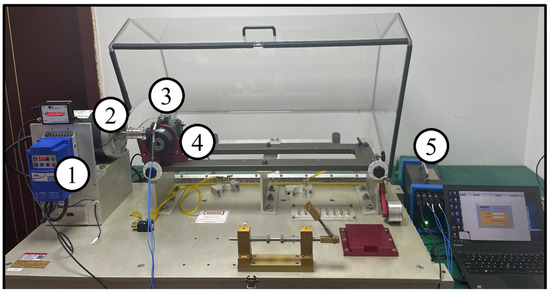
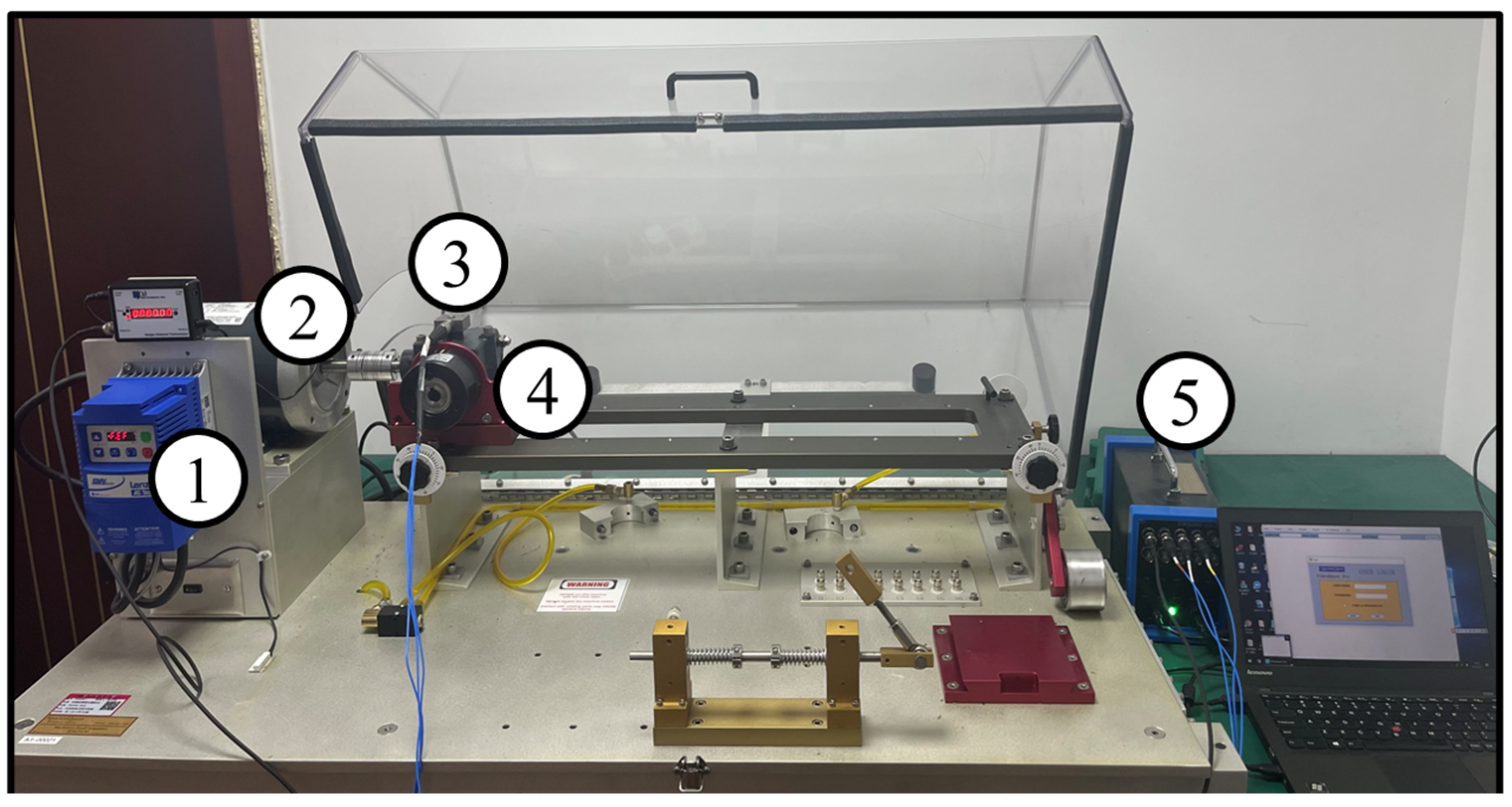
To verify the effectiveness of the proposed method, the bearing dataset collected by Huazhong University of Science and Technology (HUST), Wuhan, China, [19] was employed in this study. The experimental platform mainly consists of a driving motor, a speed controller, a transmission shaft, and a bearing test unit, as shown in Figure 1. The motor provides rotational power for the test bearing, while the speed controller regulates the operating speed to simulate different working conditions. A tri-axial accelerometer is mounted on the bearing housing to acquire vibration signals along three orthogonal directions, enabling comprehensive monitoring of bearing dynamic behavior and fault-induced vibration characteristics. The main components of the experimental platform are labeled as follows: 1—speed controller, 2—driving motor, 3—transmission shaft, 4—tri-axial accelerometer, and 5—test bearing.
Figure 1.
Experimental setup of the HUST bearing fault diagnosis platform.
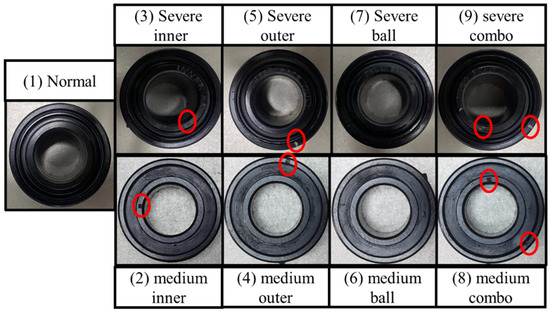
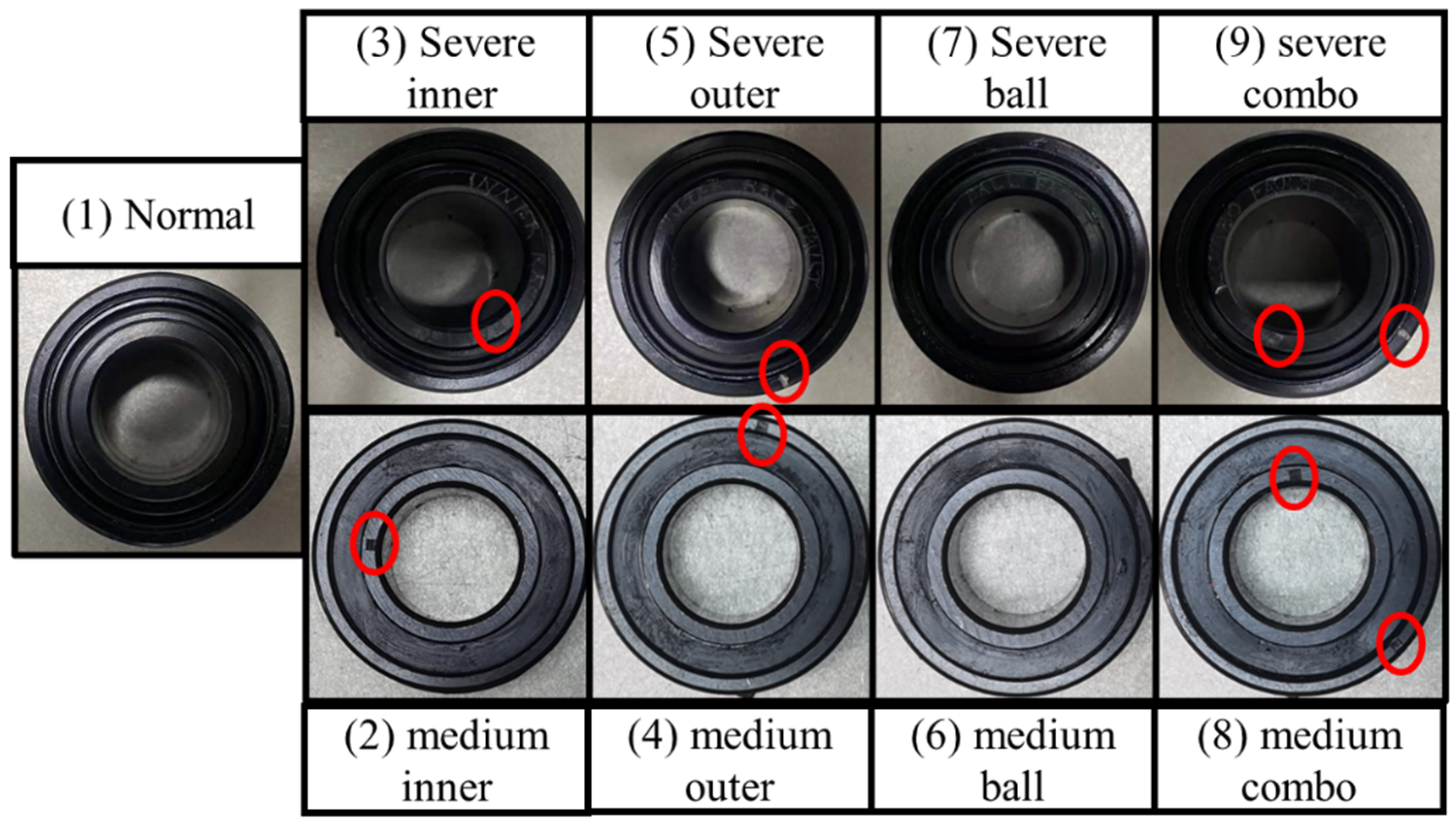
The HUST dataset contains vibration signals collected from nine bearing health conditions under different rotational speeds, including Normal Bearing (NB), Medium Inner-race Fault (MIF), Medium Outer-race Fault (MOF), Medium Rolling-element Fault (MRF), Medium Combo Fault (MCF), Severe Inner-race Fault (SIF), Severe Outer-race Fault (SOF), Severe Rolling-element Fault (SRF), and Severe Combo Fault (SCF). The combo fault refers to the coexistence of inner-race and outer-race defects. By considering different fault locations and fault severities, the dataset provides a comprehensive benchmark for evaluating the diagnostic performance and robustness of intelligent fault diagnosis methods. The bearing samples corresponding to different health conditions are illustrated in Figure 2.
Figure 2.
Bearing samples with different fault types and severities in the HUST dataset.
2.2. XJTU-SY Bearing Dataset
To further evaluate the effectiveness, robustness, and cross-dataset generalization capability of the proposed MIQPSO-RVM model, additional experiments were conducted on the Xi’an Jiaotong University-Sumyoung (XJTU-SY) bearing dataset collected in Xi’an, China [20]. Compared with the HUST dataset, the XJTU-SY dataset contains bearing degradation data collected under different operating conditions and loading levels, providing a more challenging benchmark for validating the adaptability of intelligent fault diagnosis methods.
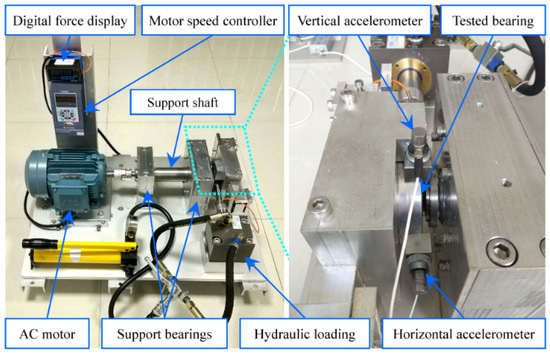
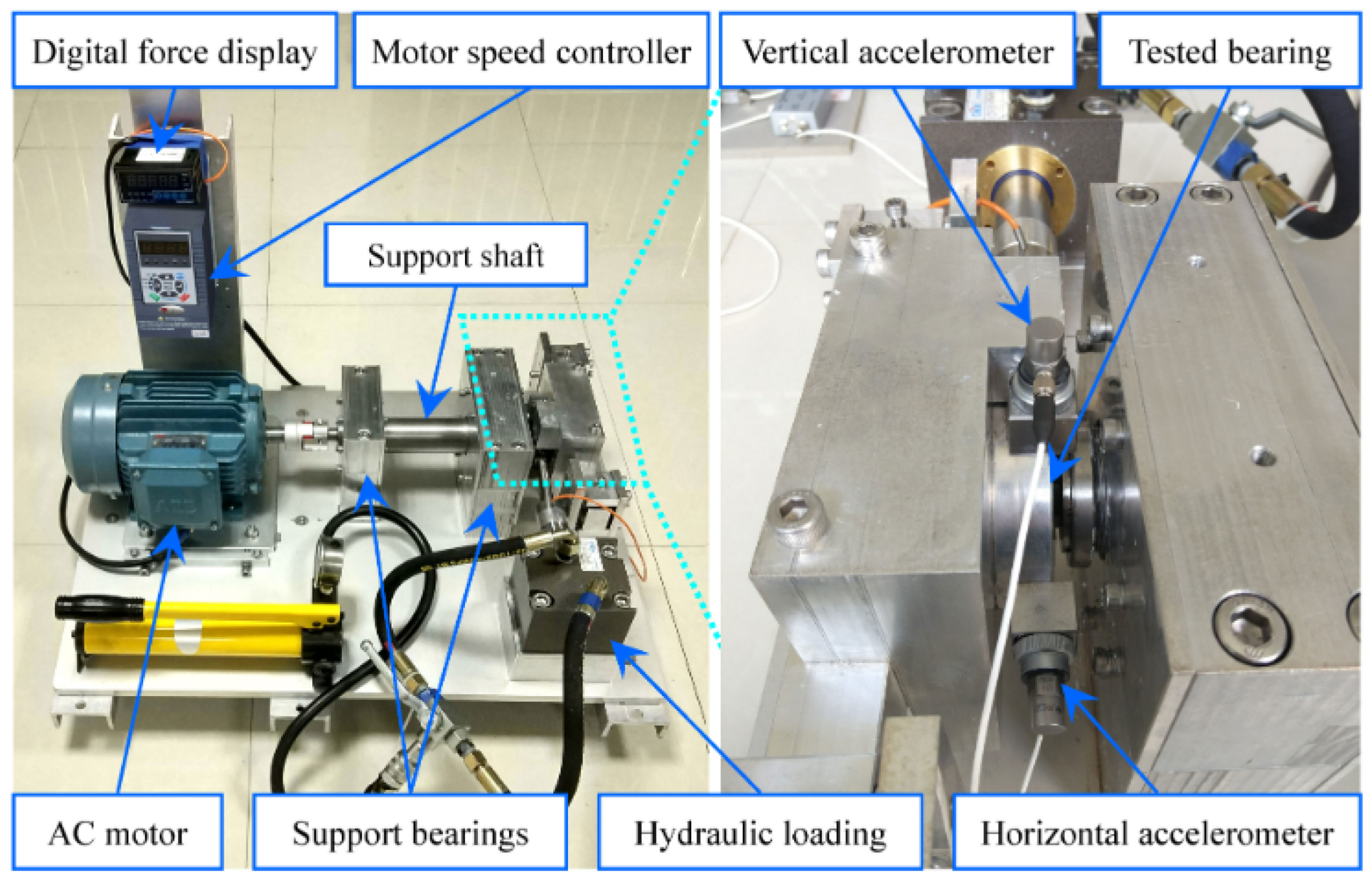
The experimental platform of the XJTU-SY dataset consists of an AC motor, a motor speed controller, a support shaft, support bearings, a hydraulic loading system, a digital force display unit, and vibration acquisition sensors, as shown in Figure 3. During operation, the AC motor drives the tested bearing through the support shaft, while the speed controller regulates the rotational speed to simulate different working conditions. The hydraulic loading system applies controllable radial loads to the tested bearing, and the applied load is monitored in real time through the digital force display. To capture bearing vibration characteristics comprehensively, horizontal and vertical accelerometers are installed near the tested bearing to acquire vibration signals from multiple directions.
Figure 3.
Data acquisition platform of the XJTU-SY bearing dataset.
The XJTU-SY dataset contains run-to-failure bearing vibration data collected under different operating conditions, including varying rotational speeds and load levels. Compared with laboratory fault simulation datasets, the XJTU-SY dataset exhibits stronger non-stationary characteristics and more complex degradation patterns, making it suitable for evaluating the practical applicability and generalization performance of intelligent fault diagnosis models. By conducting experiments on both the HUST and XJTU-SY datasets, the effectiveness and robustness of the proposed MIQPSO-RVM framework under different data distributions and operating conditions can be comprehensively validated.
2.3. Experimental Parameter Settings and Sample Construction
To ensure a fair evaluation of the proposed method, the same parameter settings were adopted for all comparative experiments. The population size of MIQPSO was set to 30, the maximum number of iterations was set to 100, and the radial basis function (RBF) was selected as the kernel function of the RVM classifier. The extracted entropy features, including permutation entropy (PE), sample entropy (SE), and fuzzy entropy (FE), were normalized before classification to eliminate the influence of different feature scales. In addition, the original vibration signals were amplitude-normalized before entropy calculation to reduce the influence of different signal energy levels among fault categories. The normalization was performed using the z-score method:
where is the original vibration signal; denotes the mean value; and represents standard deviation.
For the HUST bearing dataset, although the original dataset contains nine bearing health conditions with different fault severities, the fault severity is not the primary concern of this study. To better evaluate the fault identification capability of the proposed method with respect to fault locations, the nine original conditions were further grouped into five fault categories, namely Normal (N), Inner-race Fault (IF), Outer-race Fault (OF), Rolling-element Fault (RF), and Combo Fault (CF). Specifically, the medium and severe faults belonging to the same fault location were merged into one category. For each category, 200 samples were selected to construct the experimental dataset, resulting in a total of 1000 samples for fault diagnosis experiments.
For the XJTU-SY bearing dataset, three representative fault categories were considered, including inner-race fault, outer-race fault, and cage fault. To maintain consistency and ensure a balanced class distribution, 200 samples were selected from each fault category, yielding a total of 600 samples. To ensure a fair comparison, all methods were evaluated using the same training–testing protocol. The experiments focus on fault classification under variable operating conditions rather than strict cross-condition domain adaptation. Therefore, the training and testing samples were randomly selected from the same dataset distribution while maintaining a balanced class distribution. For the HUST dataset, different fault severities were merged into the same category because this study focuses on fault location identification rather than fault severity recognition. Accordingly, the final classification task contains five categories: normal condition, inner-race fault, outer-race fault, rolling-element fault, and compound fault.
For the XJTU-SY dataset, vibration signals collected under different rotational speeds and loading conditions were included to evaluate the robustness of the proposed method against operating condition variations. However, explicit cross-condition domain adaptation was not considered in this study, and the training and testing sets were constructed with similar operating condition distributions. This experimental design aims to verify the stability and adaptability of the proposed method under varying operating environments. For all comparison methods, the original model structures and recommended parameter settings were adopted. All methods were evaluated using the same training/testing samples and experimental protocol to ensure a fair comparison.
3. Methodology
3.1. Framework Overview
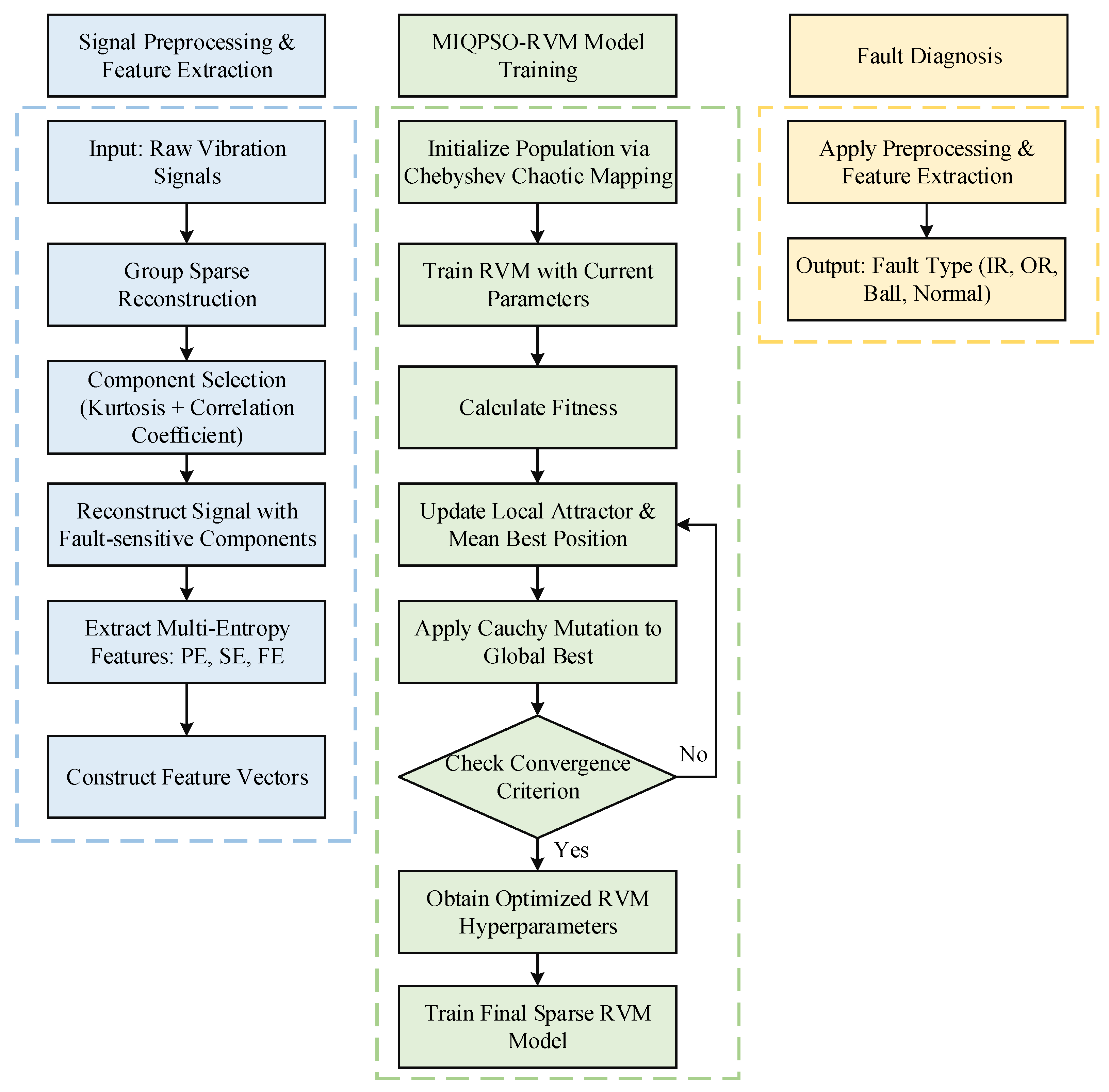
To improve the diagnostic accuracy and robustness of rolling bearings under variable operating conditions, a fault diagnosis framework integrating group sparse reconstruction, multi-entropy feature extraction, and the MIQPSO-RVM model is proposed. First, the raw vibration signals are reconstructed using group sparse representation to suppress background noise and enhance fault-related impulsive components. Subsequently, a kurtosis-correlation criterion is employed to select fault-sensitive components for signal reconstruction. Multiple entropy features, including permutation entropy (PE), sample entropy (SE), and fuzzy entropy (FE), are then extracted from the reconstructed signals to construct discriminative feature vectors representing different bearing health conditions.
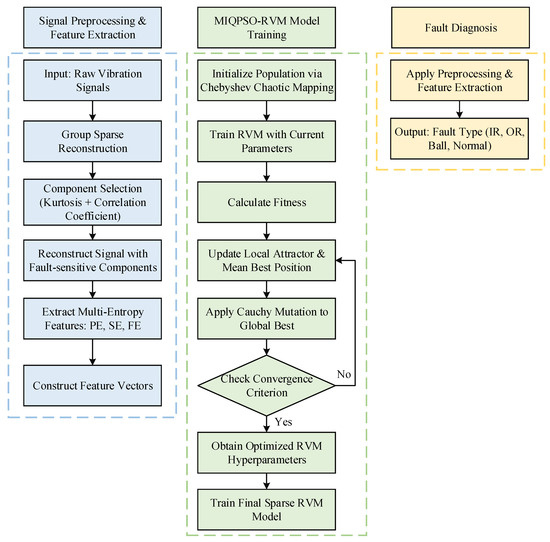
To achieve optimal classification performance, the extracted feature vectors are used to train an RVM classifier whose key parameters are optimized by the proposed MIQPSO algorithm. Specifically, Chebyshev chaotic mapping is utilized to improve the diversity of the initial population, while the Cauchy mutation strategy is introduced to enhance the global search capability and avoid premature convergence. After obtaining the optimal parameter combination, the optimized RVM model is employed to classify unknown samples and identify different bearing fault categories. The overall implementation procedure of the proposed fault diagnosis framework is illustrated in Figure 4.
Figure 4.
Flowchart of the proposed MIQPSO-RVM fault diagnosis framework.
3.2. Group Sparse Reconstruction of Vibration Signals
Rolling bearing vibration signals collected under variable speed and variable load conditions are usually contaminated by strong background noise and interference components. Moreover, the fault-related impulsive features are often weak and non-stationary, which significantly increases the difficulty of fault feature extraction. The basic idea of sparse representation is to represent the original signal using a small number of atoms from an overcomplete dictionary [21]. Since fault impulses generally exhibit sparse characteristics in the transform domain, sparse reconstruction can effectively preserve fault-sensitive information while suppressing irrelevant noise components.
Assume that the observed vibration signal is expressed as:
where denotes the observed signal, represents the overcomplete dictionary, is the sparse coefficient vector, and denotes the noise and irrelevant components contained in the measured signal.
In this study, denotes the inherent noise and interference contained in the measured vibration signals rather than artificially added noise. The overcomplete dictionary D is constructed using a discrete cosine transform (DCT) basis, with its size set to twice the signal dimension to provide sufficient redundancy. The same predefined dictionary is used for all experiments without additional supervised training. During implementation, vibration signals are segmented into samples of equal length, and sparse coefficients are optimized using an iterative shrinkage-based algorithm. The regularization parameter and group size are determined through preliminary experiments. The reconstructed signal is obtained from the optimized sparse coefficients, thereby suppressing noise components while preserving fault-related information.
The sparse representation problem can be formulated as the minimization of the reconstruction error under sparsity constraints:
where denotes the L0-norm representing the number of nonzero coefficients and K is the sparsity level.
However, solving the L0-norm optimization problem is NP-hard. Therefore, it is usually transformed into an L1-norm regularized optimization problem:
where is the regularization parameter balancing reconstruction fidelity and sparsity.
Traditional sparse representation methods mainly impose sparsity constraints on individual coefficients, which may ignore the structural correlations among neighboring coefficients. However, fault impulses in bearing vibration signals usually exhibit group distribution characteristics in the transform domain. To better preserve structured impulsive information, group sparse representation is introduced in this study.
Suppose that the sparse coefficient vector is divided into G groups:
The optimization objective of group sparse reconstruction can then be formulated as:
where represents the coefficient subset belonging to the g-th group.
The first term ensures reconstruction fidelity, while the second term imposes group sparsity constraints on the coefficient vector. Compared with conventional L1-norm sparse regularization, group sparse regularization can better preserve correlated impulsive structures and improve robustness against noise interference.
To solve the above optimization problem, iterative shrinkage-based methods are generally employed. The coefficient update process can be expressed as:
where (⋅) denotes the group soft-threshold shrinkage operator.
After solving the sparse coefficient vector, the reconstructed signal can be obtained as:
Overall, the practical implementation of the proposed group sparse reconstruction consists of the following five steps:
- (1)
- Segment the raw vibration signal into fixed-length samples.
- (2)
- Construct an overcomplete dictionary using a discrete cosine transform (DCT) basis with twice the signal dimension.
- (3)
- Solve the group sparse optimization problem using an iterative shrinkage algorithm.
- (4)
- Reconstruct the vibration signal according to the obtained sparse coefficients.
- (5)
- Perform modal selection based on kurtosis and correlation coefficient.
3.3. Modal Component Selection Based on Kurtosis and Correlation Coefficient
Although group sparse reconstruction can effectively enhance impulsive fault features, the reconstructed signal may still contain redundant or noise-dominated components. Therefore, an effective modal component selection strategy is required to further improve reconstruction quality.
Kurtosis is widely used to measure the impulsiveness of vibration signals and can effectively reflect fault shock characteristics. The kurtosis of the i-th modal component is defined as:
where denotes the i-th modal component and represents its mean value.
A larger kurtosis value generally indicates stronger impulsive characteristics and richer fault-related information. However, relying solely on kurtosis may mistakenly retain noise-dominated components with abnormal peaks. Therefore, the correlation coefficient between the modal component and the original signal is further introduced to evaluate component relevance.
The correlation coefficient is expressed as:
where and denote the mean values of the original signal and modal component, respectively.
The correlation coefficient reflects the similarity between the modal component and the original signal. Larger correlation coefficients indicate that the component preserves more useful signal information. Therefore, modal components with both high kurtosis and high correlation coefficients are selected for signal reconstruction.
In this study, a composite index combining kurtosis and correlation coefficient is introduced to evaluate the contribution of each modal component. The two indicators are first normalized and then combined as:
where and denote the normalized kurtosis and correlation coefficient of the i-th component, respectively. The components are ranked according to , and those with a cumulative contribution exceeding 90% are selected for signal reconstruction. This adaptive criterion avoids manually defined thresholds and enables effective selection of fault-sensitive components under different operating conditions.
3.4. Multi-Entropy Feature Extraction
Bearing vibration signals under variable operating conditions usually exhibit strong nonlinearity and non-stationarity. Traditional time-domain or frequency-domain features are often insufficient to fully characterize the dynamic behaviors of fault signals. Entropy-based features have demonstrated strong capability in describing signal complexity and nonlinear dynamic characteristics. Therefore, multi-entropy feature extraction is employed in this study to construct discriminative fault feature vectors.
Suppose that the reconstructed signal sequence is expressed as:
Different entropy indicators are calculated from the reconstructed signal to quantify signal complexity from multiple perspectives. The combination of PE, SE, and FE is adopted because these entropy measures characterize vibration signals from complementary perspectives. PE describes dynamic complexity, SE reflects signal irregularity, and FE improves robustness against noise interference. Therefore, their combination provides more comprehensive fault-related information rather than redundant features.
Permutation entropy is widely used for nonlinear dynamic analysis because of its computational simplicity and robustness against noise [22]. The permutation entropy can be defined as:
where denotes the probability of the i-th permutation pattern and m is the embedding dimension.
Permutation entropy reflects the randomness and dynamic complexity of vibration signals. Different fault states generally correspond to different entropy distributions.
In addition, sample entropy is adopted to measure the self-similarity and regularity of vibration signals [23]. It can be expressed as:
where and represent the number of matched vector pairs with dimensions and , respectively, and denotes the similarity tolerance.
Sample entropy exhibits good stability in describing signal irregularity and is suitable for nonlinear fault feature analysis.
Furthermore, fuzzy entropy is employed to improve feature continuity and robustness under noisy environments. Compared with sample entropy, fuzzy entropy introduces fuzzy membership functions to reduce abrupt boundary effects, thereby improving sensitivity to subtle dynamic variations.
By combining multiple entropy indicators, richer fault-sensitive information can be extracted from reconstructed signals. The extracted entropy features are then normalized to eliminate dimensional differences and improve feature consistency before classification.
Through collaborative integration of group sparse reconstruction and multi-entropy feature extraction, the proposed method effectively enhances weak fault characteristics and improves feature representation capability under complex operating conditions.
3.5. Relevance Vector Machine for Fault Classification
The relevance vector machine is a probabilistic sparse kernel model derived from the sparse Bayesian learning framework. Unlike support vector machines that produce point estimates of model parameters, RVM provides posterior probability distributions over the model weights, enabling uncertainty quantification and naturally yielding sparse solutions. Consider a training dataset , where denotes the multi-dimensional entropy feature vector extracted from the reconstructed bearing vibration signals, and represents the corresponding fault state label [24]. For binary classification, the RVM model adopts the logistic sigmoid function to map a linear combination of kernel functions to a probability space:
where K(⋅,⋅) is a kernel function and w is the weight vector.
To induce sparsity, a zero-mean Gaussian prior is imposed over each weight:
where are independent hyperparameters controlling the inverse variances. Under this hierarchical prior, the marginal likelihood is maximized to estimate . During this process, most tend to infinity, forcing the corresponding to zero, so only a few training samples (the relevance vectors) remain [25].
Because the logistic sigmoid likelihood is non-Gaussian, the posterior is intractable. The RVM learning algorithm employs the Laplace approximation. For fixed , the maximum a posteriori (MAP) estimate wMP is obtained by minimizing the negative log-posterior:
where . Using the Newton–Raphson method, wMP is iteratively updated. At convergence, the posterior is approximated as a Gaussian with covariance:
where is the design matrix defined by kernel evaluations and . The hyperparameters are then re-estimated by maximizing the Laplace-approximated evidence, leading to the update rule:
The algorithm alternates between updating the posterior moments (using current ) and re-estimating until convergence. The resulting model is sparse, and the remaining non-zero weights correspond to the relevance vectors. The kernel width (in the RBF kernel) and an additional regularization parameter C are critical for classification performance, yet the original RVM treats them as user-specified constants. This limitation motivates the adaptive optimization framework introduced in the following subsections.
3.6. Quantum Particle Swarm Optimization and Its Improvements
Particle swarm optimization (PSO) is a population-based metaheuristic inspired by social behaviors [26]. QPSO draws on concepts from quantum mechanics to overcome the limited global convergence guarantee of classical PSO [27]. In QPSO, each particle moves in a quantum potential well centered at its local attractor:
where is the personal best, is the global best, and . The position update equation derived from the delta potential well model is:
where , is a contraction–expansion coefficient that decreases linearly from to , and
is the mean best position. Despite its theoretical global convergence, standard QPSO may suffer from uneven population distribution and premature convergence when optimizing RVM hyperparameters. This issue is critical because the kernel parameters and regularization parameters of RVM are located in a nonlinear search space and directly affect classification performance. Therefore, Chebyshev chaotic mapping and Cauchy mutation are introduced to address different optimization stages rather than simply combining multiple strategies. The former improves the diversity of the initial population, while the latter enhances global exploration and helps escape local optima during iteration.
To improve population diversity, Chebyshev chaotic mapping is introduced. The Chebyshev map of order k = 4 is defined as:
Starting from a random initial value , a chaotic sequence is generated for each particle and dimension. The initial position is then mapped to the search domain via:
This procedure ensures a more uniform distribution of the initial population compared to purely random initialization, thereby reducing the risk of initial clustering in suboptimal regions.
To mitigate premature convergence, a Cauchy mutation operator is applied to the global best position G(t) with probability . The standard Cauchy distribution has the probability density function
which features heavier tails than the Gaussian distribution. The mutated position is computed as:
where is a Cauchy-distributed random variable and is an adaptively decreasing scale factor. If , the mutation is accepted. This heavy-tailed perturbation is suitable for RVM parameter optimization because it enables occasional large-scale exploration in the nonlinear parameter space while maintaining local refinement capability through adaptive scaling, and the adaptive scale factor preserves fine-tuning ability in later iterations. Combining Chebyshev initialization with Cauchy mutation yields the multi-strategy improved QPSO (MIQPSO) algorithm.
3.7. Parameter Configuration of the Proposed Framework
The performance of the proposed MIQPSO-RVM framework depends on several parameters involved in signal reconstruction, entropy feature extraction, and optimization. To improve reproducibility, the main parameters and their selection motivations are summarized in Table 1. These parameters were determined according to the characteristics of vibration signals, existing studies, and preliminary experiments.
Table 1.
Parameter configuration of the proposed MIQPSO-RVM framework.
For sparse reconstruction, the dictionary size was selected to provide sufficient redundancy for fault feature representation, while the group size was used to preserve local coefficient correlations. The entropy parameters followed commonly adopted settings in bearing fault diagnosis. The MIQPSO parameters were selected by balancing optimization performance and computational efficiency, and the same settings were used in all experiments.
4. Experimental Results and Discussion
4.1. Analysis of Group Sparse Reconstruction Performance
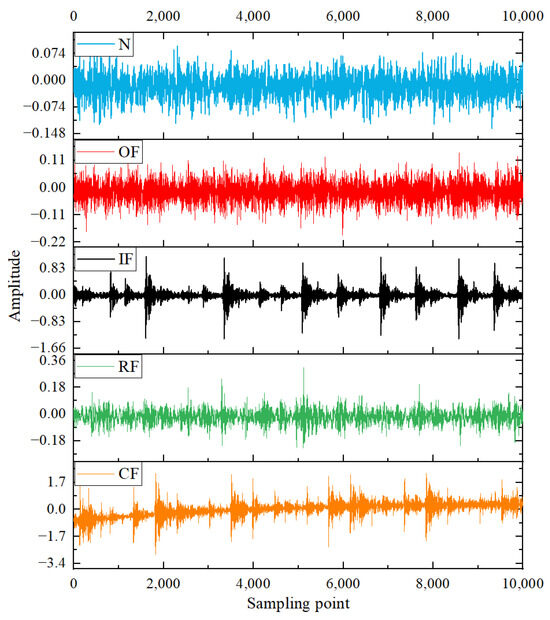
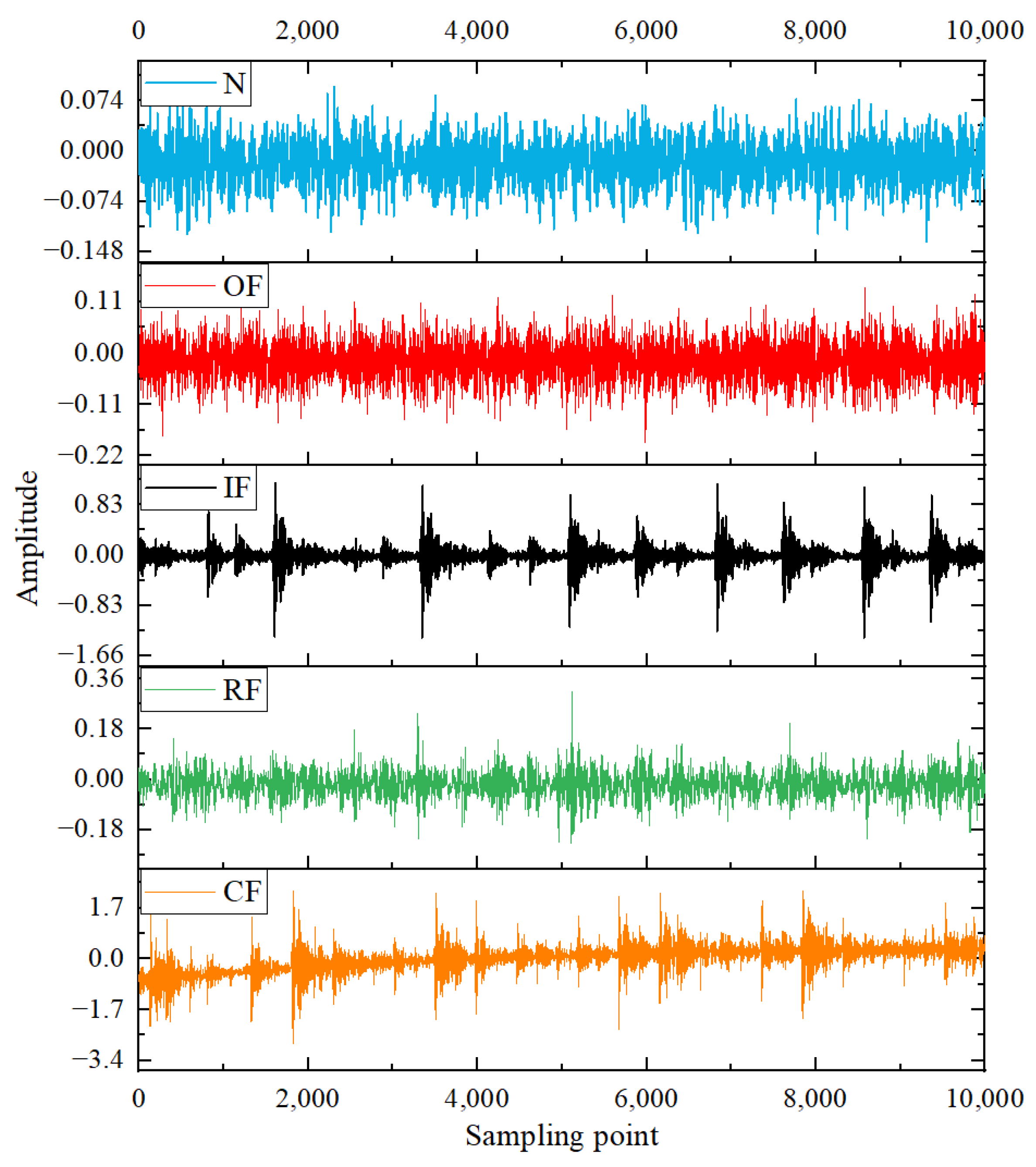
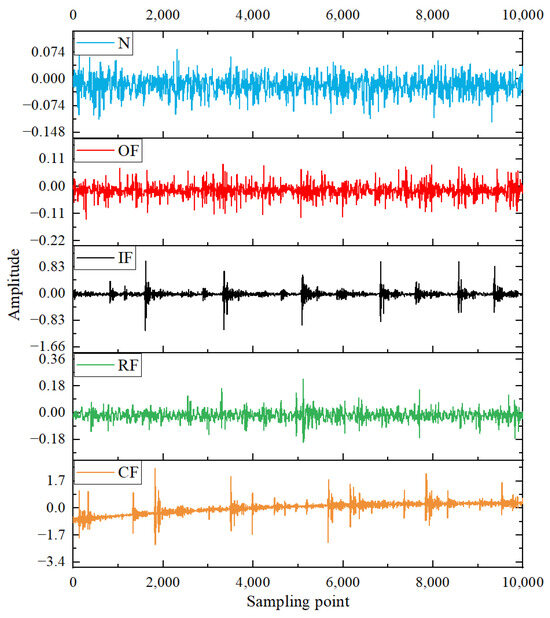
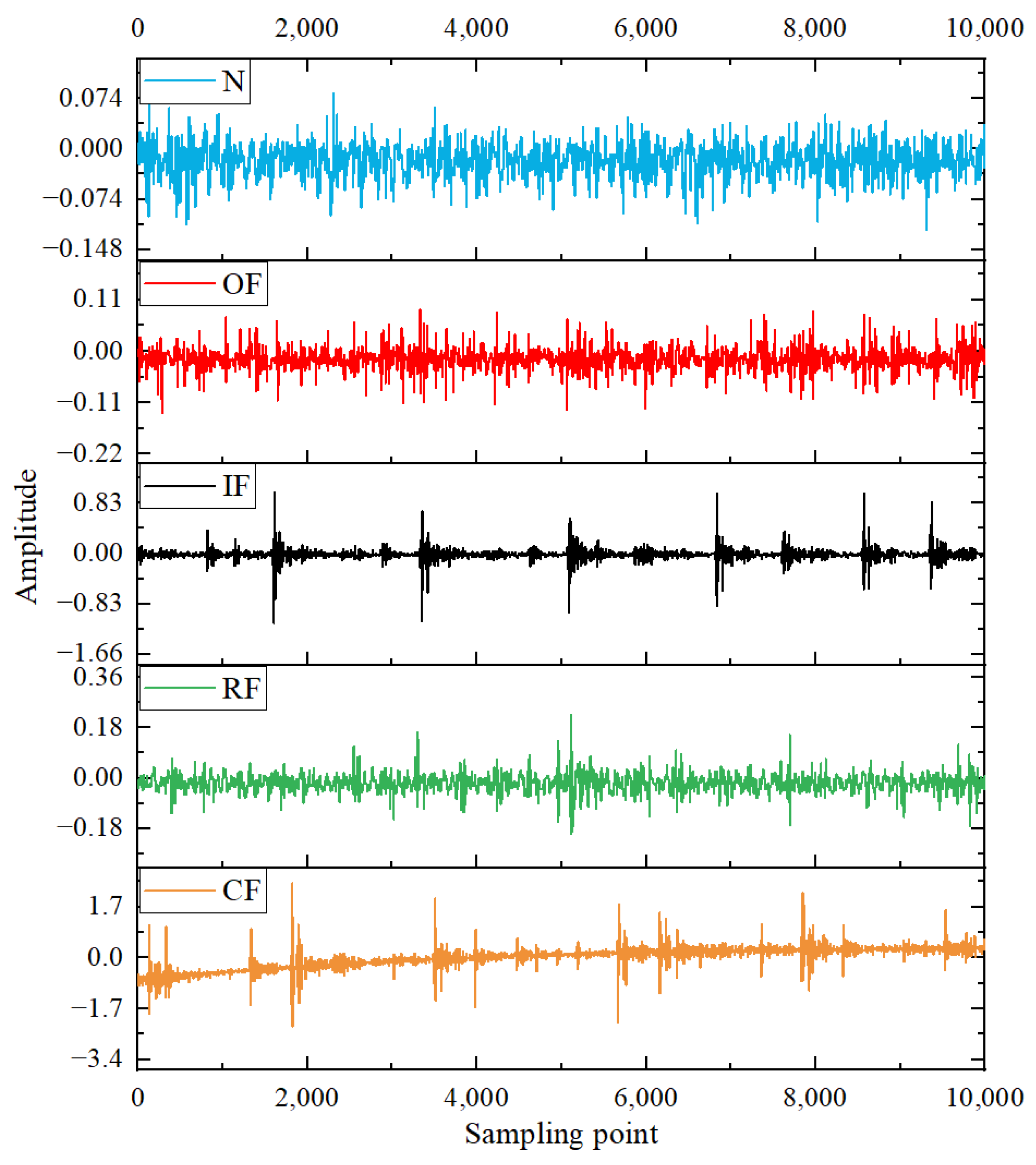
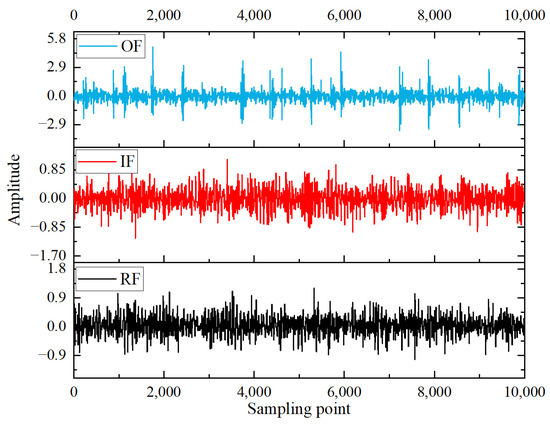
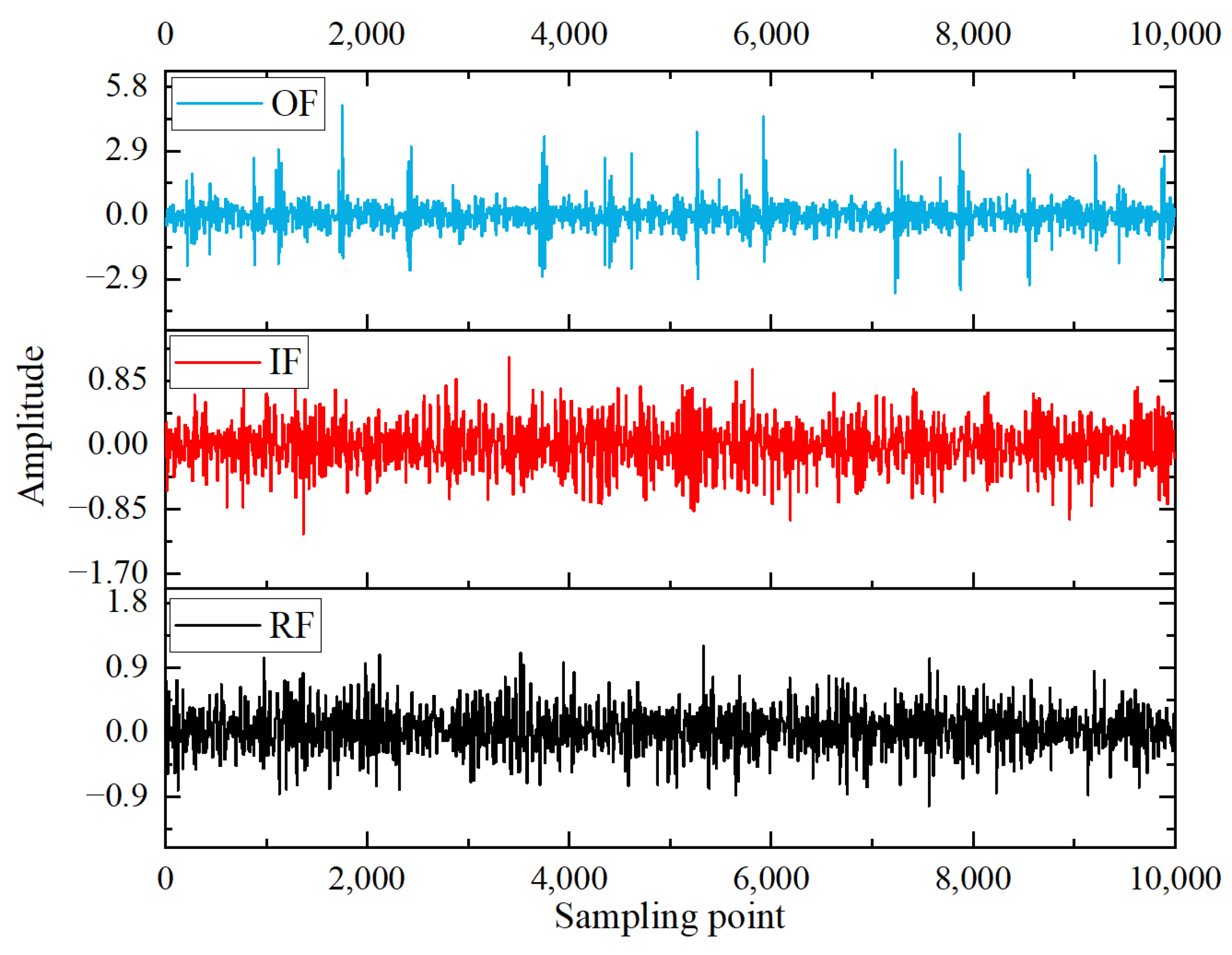
To investigate the signal characteristics under different bearing health conditions, the time-domain vibration signals of the HUST and XJTU-SY datasets are first presented in Figure 5 and Figure 6, respectively. It can be observed that the vibration signals corresponding to different fault states exhibit obvious nonlinear and non-stationary characteristics. Although certain fault conditions produce stronger impulsive responses than the normal state, the fault-related information is still heavily contaminated by background noise and interference components. It should be noted that the amplitude differences among different fault categories mainly reflect variations in vibration energy caused by different defect severities and fault locations. Before entropy calculation, all vibration signals were normalized to reduce the influence of amplitude scaling. Since PE, SE, and FE mainly characterize signal complexity, irregularity, and dynamic behavior rather than absolute amplitude, the normalization procedure ensures that the extracted entropy features mainly represent intrinsic fault characteristics. Moreover, the waveform differences among some fault categories are not sufficiently distinguishable in the time domain, especially under varying operating conditions, which increases the difficulty of subsequent fault feature extraction and classification.
Figure 5.
Time-domain vibration signals of different bearing conditions in the HUST dataset.
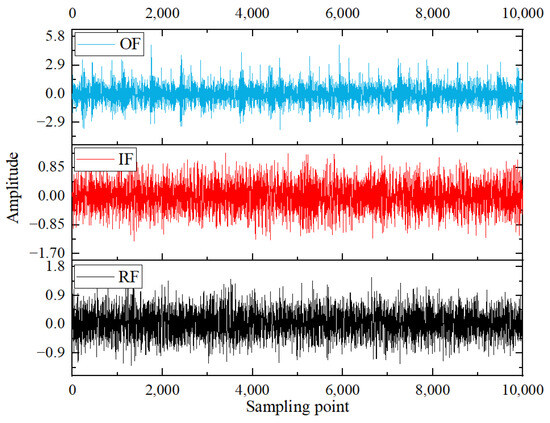
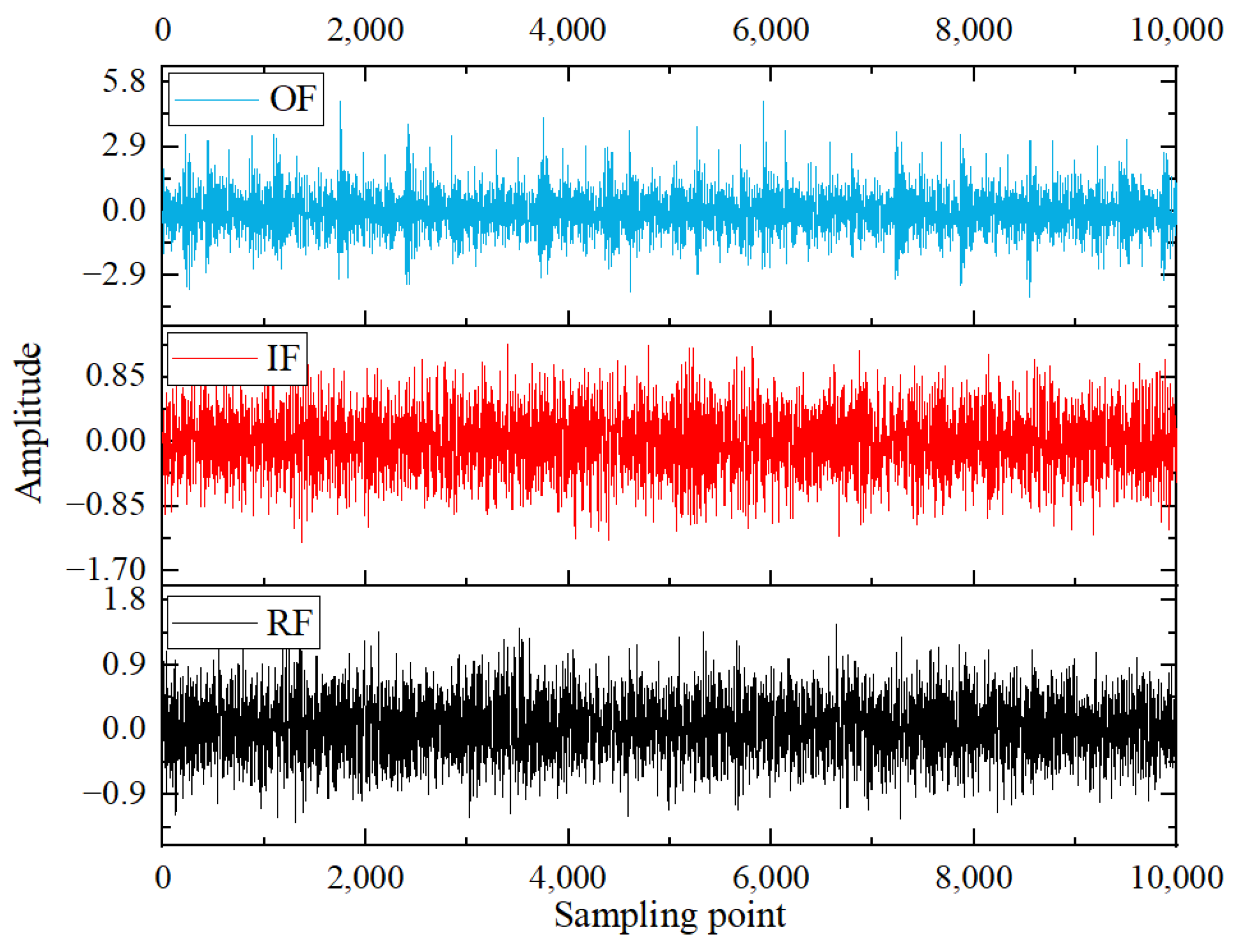
Figure 6.
Time-domain vibration signals of different bearing conditions in the XJTU-SY dataset.
To enhance fault-sensitive information and suppress background noise, the proposed group sparse reconstruction method is applied to the original vibration signals. Owing to the sparse and clustered distribution characteristics of bearing fault impulses in the transform domain, group sparse reconstruction can effectively separate fault-related transient components from noise-dominated components. After signal decomposition, a kurtosis-correlation criterion is employed to evaluate each reconstructed component. Specifically, kurtosis is utilized to characterize the impulsiveness of the component, while the correlation coefficient is used to measure its similarity to the original signal. The modal components were selected according to the proposed composite index , and the same selection criterion was applied to all experiments. Components with higher contributions were retained and subsequently reconstructed to obtain a fault-enhanced vibration signal.
The reconstructed signals corresponding to different bearing conditions are illustrated in Figure 7 and Figure 8 for the HUST and XJTU-SY datasets, respectively. Compared with the original vibration signals, the reconstructed signals exhibit more distinct transient impulsive characteristics and reduced random fluctuations. In addition, the fault-related periodic impact features become more prominent, while irrelevant noise components are effectively suppressed. These observations demonstrate that the proposed group sparse reconstruction and kurtosis-correlation selection strategy can successfully extract fault-sensitive information from complex vibration signals, thereby improving signal quality and providing a more reliable basis for subsequent entropy feature extraction and fault classification.
Figure 7.
Reconstructed vibration signals of different bearing conditions in the HUST dataset.
Figure 8.
Reconstructed vibration signals of different bearing conditions in the XJTU-SY dataset.
4.2. Multi-Entropy Feature Analysis
To evaluate the discriminative capability of the extracted features, PE, SE, and FE were calculated from the reconstructed vibration signals and combined to form multi-entropy feature vectors. Since these entropy features describe signal complexity from different perspectives, the correlation among PE, SE, and FE was further analyzed to evaluate possible redundancy. The Pearson correlation coefficients between different entropy features are listed in Table 2.
Table 2.
Correlation coefficients among multi-entropy features.
As shown in Table 2, the correlation coefficients among PE, SE, and FE are within a moderate range, indicating that these entropy features are correlated but not redundant. The relatively higher correlation between SE and FE is attributed to their similar principles in evaluating signal complexity and regularity, whereas PE shows lower correlation with the other two features due to its different permutation-based calculation mechanism. Therefore, the combination of PE, SE, and FE can provide complementary information for characterizing bearing vibration signals.
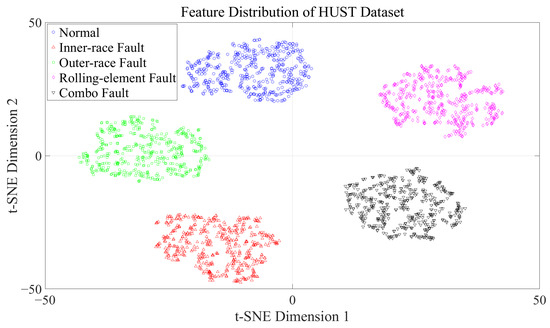
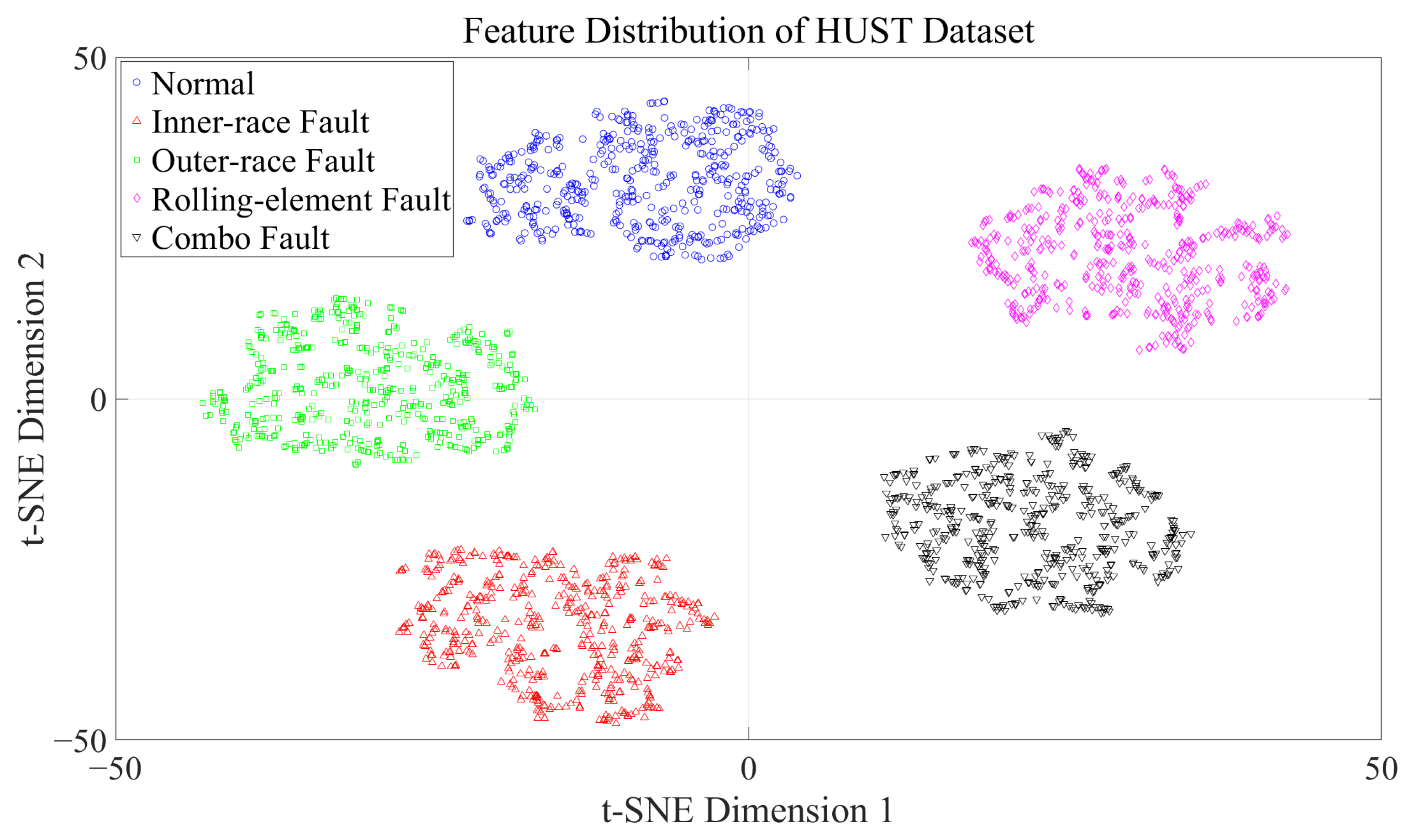
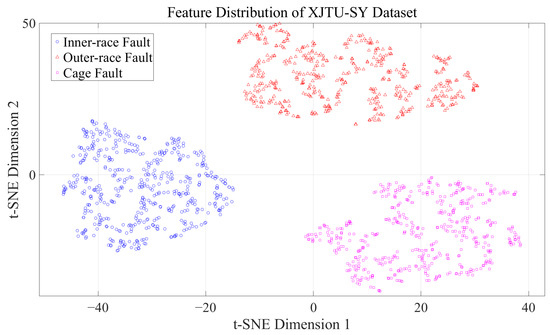
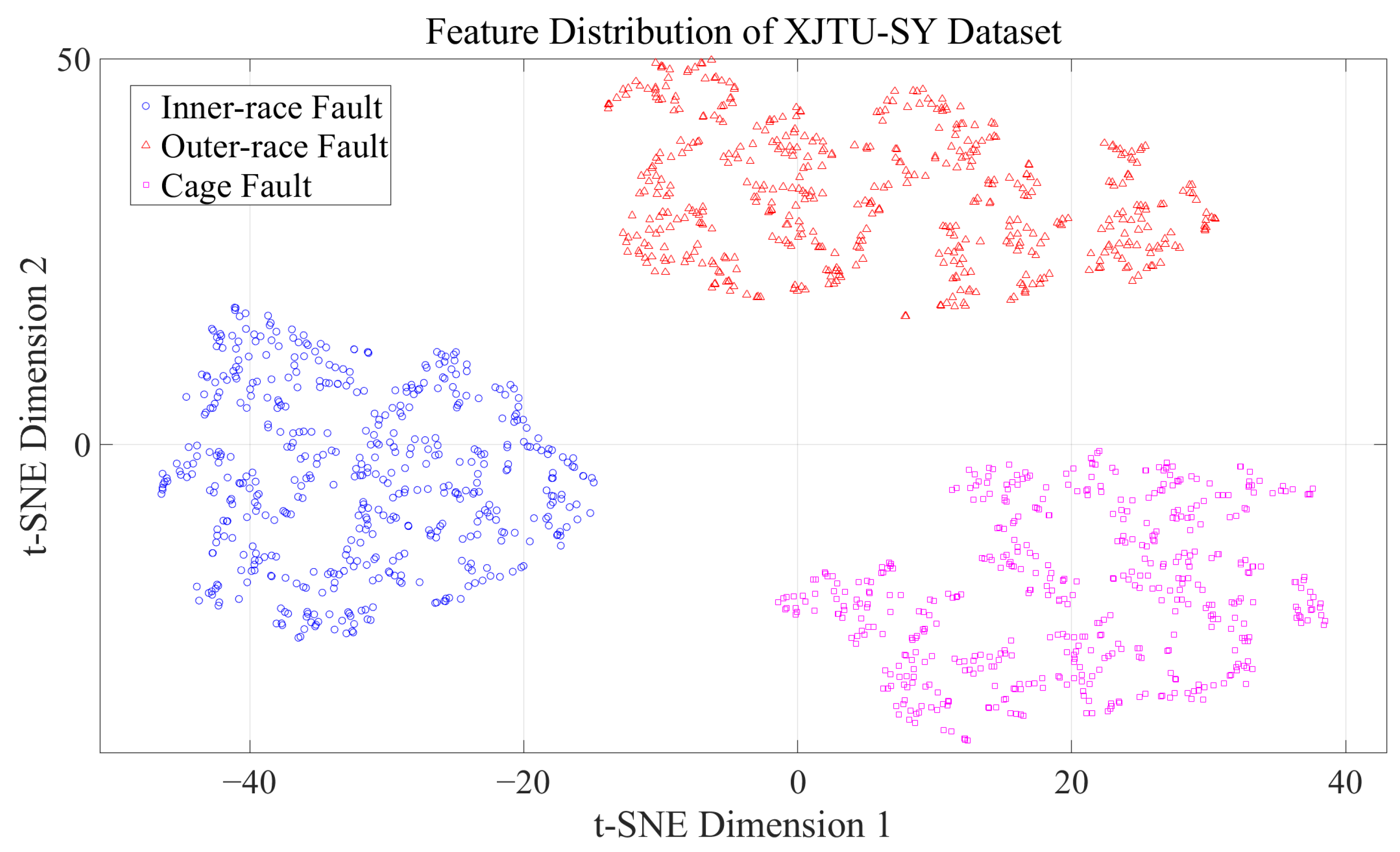
Subsequently, the visualization results for the HUST and XJTU-SY datasets are presented in Figure 9 and Figure 10, respectively.
Figure 9.
t-SNE visualization of multi-entropy features for different bearing conditions in the HUST dataset.
Figure 10.
t-SNE visualization of multi-entropy features for different fault categories in the XJTU-SY dataset.
As shown in Figure 9, the multi-entropy features extracted from the HUST dataset exhibit clear clustering characteristics. Samples belonging to the same fault category are concentrated within relatively compact regions, while different fault categories are distributed in distinct areas with limited overlap. Similarly, the t-SNE visualization results of the XJTU-SY dataset shown in Figure 10 also demonstrate good separability among different fault types. Although the XJTU-SY dataset contains more complex operating conditions and stronger non-stationary characteristics, the extracted features still maintain satisfactory clustering performance. These results indicate that the proposed group sparse reconstruction and multi-entropy feature extraction strategy can effectively capture fault-related information and provide discriminative feature representations for different bearing health conditions.
Furthermore, by integrating the complementary characteristics of PE, SE, and FE, the constructed feature vectors can comprehensively characterize the complexity, irregularity, and uncertainty of vibration signals. Consequently, the proposed multi-entropy feature extraction method enhances feature representation capability and establishes a reliable foundation for the subsequent MIQPSO-RVM-based fault classification process.
4.3. Performance Analysis of MIQPSO
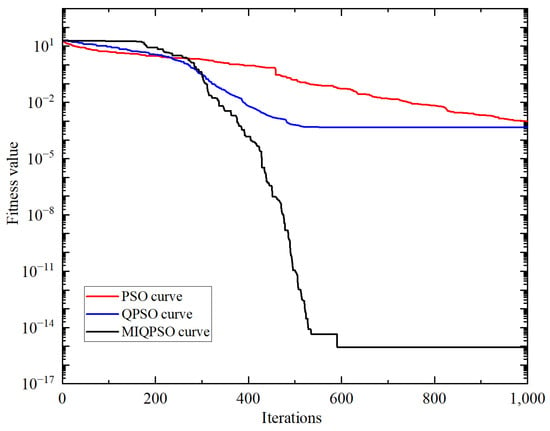
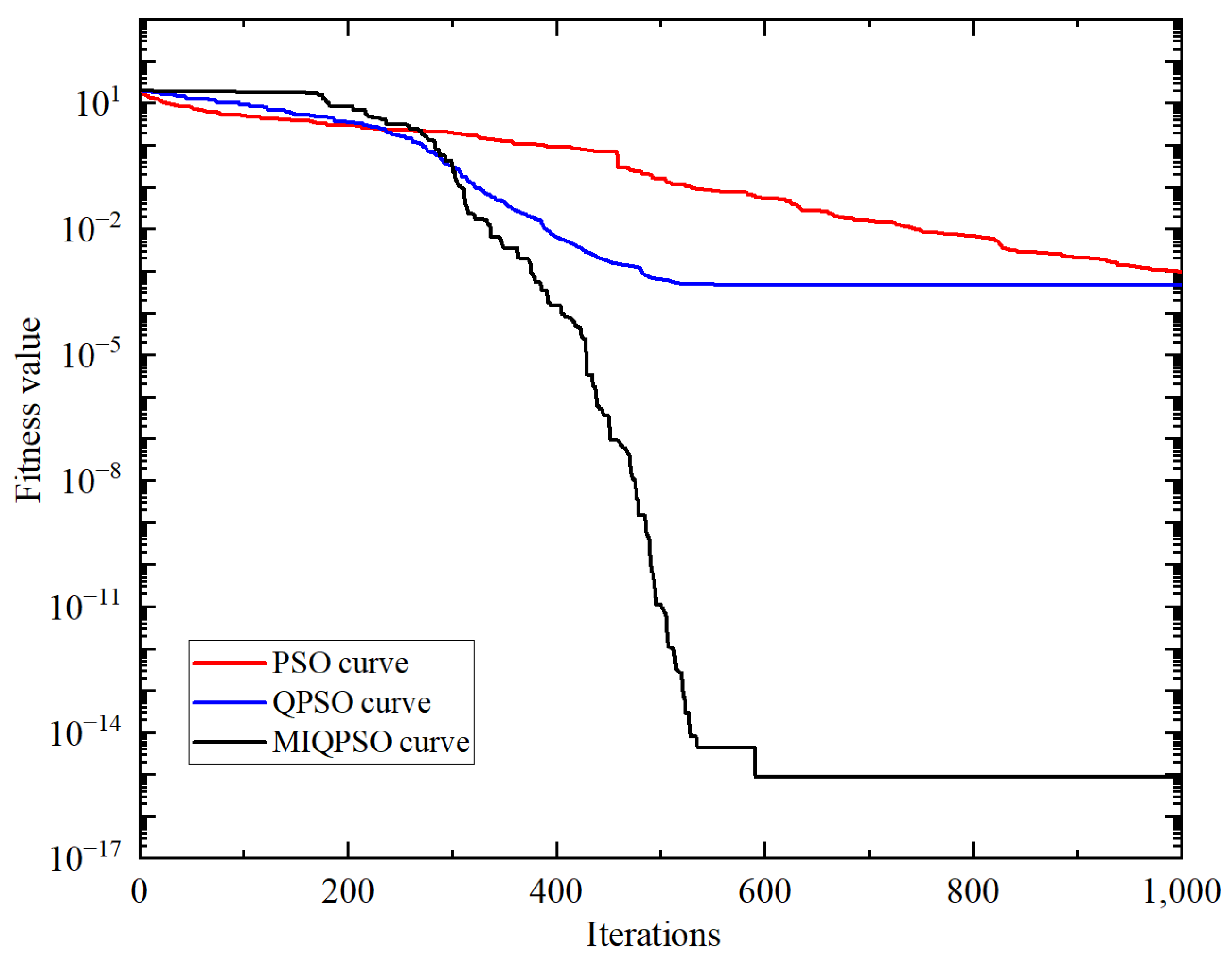
To assess the optimization capability of the proposed MIQPSO algorithm, comparative experiments were conducted on the CEC2005 benchmark function. The standard PSO, QPSO, and the proposed MIQPSO were evaluated under identical parameter settings. The convergence curves of the three algorithms are presented in Figure 11.
Figure 11.
Convergence curves of different algorithms on the CEC2005 benchmark function.
As shown in Figure 11, the convergence behaviors of the three algorithms exhibit noticeable differences. QPSO demonstrates a relatively rapid convergence rate during the early stage of the optimization process and gradually reaches a stable state after approximately 500 iterations. However, its fitness value remains at a relatively high level. In contrast, MIQPSO maintains continuous optimization during the subsequent search process and approaches convergence at approximately the 600th iteration, ultimately achieving the lowest fitness value among all compared algorithms. This result indicates that the proposed improvement strategies effectively enhance the search capability of the original QPSO and contribute to obtaining higher-quality solutions.
The standard PSO exhibits the slowest convergence rate and does not reach a stable state within the maximum number of iterations. Although its final fitness value is comparable to that of QPSO, both algorithms remain inferior to MIQPSO in terms of optimization accuracy. The improved performance of MIQPSO can be attributed to the combined effects of Chebyshev chaotic initialization and the Cauchy mutation strategy. The former improves the diversity and distribution uniformity of the initial population, while the latter enhances the search dynamics during the iterative process. As a result, MIQPSO achieves a more effective balance between exploration and exploitation, leading to improved convergence accuracy and optimization performance. To ensure reliable evaluation, the dataset samples were randomly divided into training and testing sets at a ratio of 70% and 30%, respectively. A five-fold cross-validation strategy was adopted during model training to reduce the influence of random data partitioning. The same data partition and validation strategy were applied to all comparative methods to ensure a fair comparison.
4.4. Fault Diagnosis Results, Performance Evaluation, and Comparison with Existing Methods
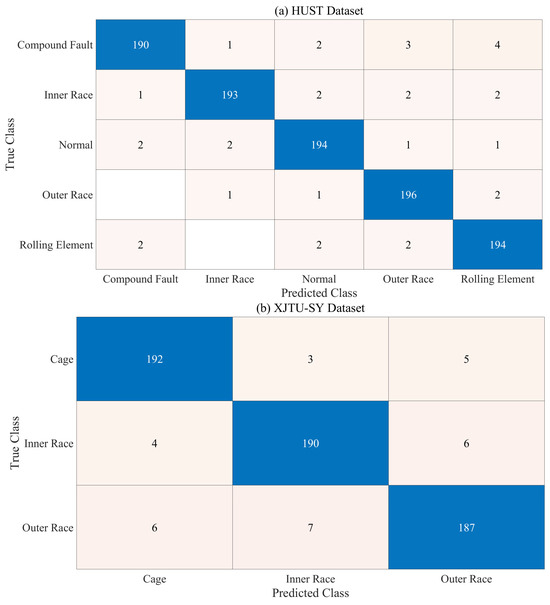
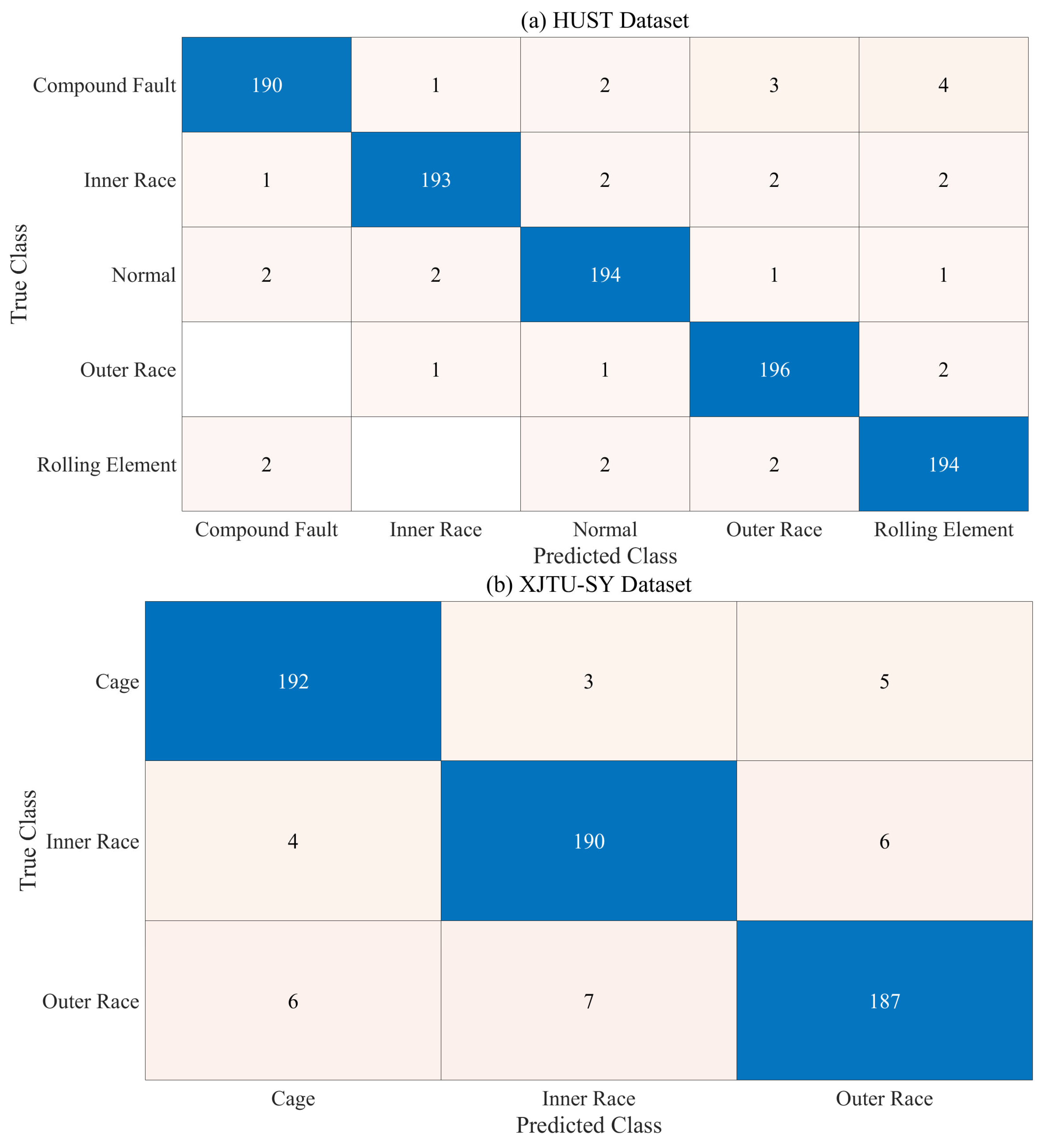
To provide a more comprehensive evaluation of the classification performance of the proposed MIQPSO-RVM framework, the confusion matrices obtained on the HUST and XJTU-SY datasets are presented in Figure 12. It can be observed that most samples are correctly classified, while only a few misclassifications occur among fault categories with similar vibration characteristics. For the HUST dataset, the main errors appear between normal, compound, and single faults, mainly because compound faults contain multiple vibration characteristics that overlap with individual fault responses. For the XJTU-SY dataset, misclassifications mainly occur between fault categories with similar degradation patterns due to more complex operating conditions and stronger non-stationary behaviors. Nevertheless, the proposed method maintains high recognition rates for all categories, demonstrating strong robustness under variable operating conditions.
Figure 12.
Confusion matrices of the proposed MIQPSO-RVM framework on the HUST and XJTU-SY dataset.
In addition to accuracy, precision, recall, and F1-score were calculated based on the confusion matrices to further evaluate the classification performance. The proposed method achieves precision, recall, and F1-score values of 96.91%, 96.70%, and 96.80% on the HUST dataset, respectively, and 94.83%, 94.83%, and 94.83% on the XJTU-SY dataset, respectively. These results indicate that the proposed framework maintains balanced classification performance without significant bias toward specific fault categories.
To further evaluate the reliability and statistical stability of the proposed method, all comparative experiments were independently repeated five times with different training–testing sample partitions. The average diagnostic accuracy and standard deviation were calculated to reduce the influence of random data partitioning and provide a more reliable performance evaluation. The comparison results are summarized in Table 3.
Table 3.
Comparison of diagnostic accuracies obtained by different methods on two bearing datasets (mean ± standard deviation, %).
As shown in Table 3, the proposed MIQPSO-RVM model achieves the highest average diagnostic accuracy on both datasets, reaching 96.70% and 94.83% on the HUST and XJTU-SY datasets, respectively. Meanwhile, the relatively small standard deviations indicate that the proposed method maintains stable performance under different data partitions. This demonstrates that the obtained results are not dependent on a specific training–testing division but reflect the robustness of the proposed framework.
Compared with optimization-based diagnosis methods, including QPSO-RVM, FEEMD-MPE-SVM, and RLMD-GWO-RVM, the proposed method consistently achieves superior performance. This improvement can be attributed to the collaborative effects of group sparse reconstruction and multi-entropy feature extraction, which enhance fault-sensitive information and improve the discriminative capability of feature representations. Furthermore, the MIQPSO algorithm provides more effective parameter optimization for the RVM classifier, contributing to improved classification accuracy and stability.
Deep learning models, including 1D-CNN, DBN, CNN-LSTM, CNN-BiLSTM, and Transformer, also achieve competitive diagnostic performance. Among them, Transformer obtains accuracies of 94.20% and 91.83% on the HUST and XJTU-SY datasets, respectively. Nevertheless, the proposed MIQPSO-RVM framework still achieves improvements of 2.50% and 3.00%, respectively. Moreover, all compared methods show slightly degraded performance on the XJTU-SY dataset due to its more complex operating conditions and stronger non-stationary characteristics. Despite these challenges, the proposed method maintains both high accuracy and low performance fluctuation, demonstrating its robustness and generalization capability for rolling bearing fault diagnosis under variable operating conditions.
4.5. Computational Efficiency Analysis
Although the proposed MIQPSO-RVM framework achieves high diagnostic accuracy, its computational efficiency is also an important consideration for practical deployment. Therefore, the average running time of different diagnosis methods was evaluated under the same experimental environment. All experiments were conducted using the same hardware platform, and the average processing time for one complete training procedure was recorded. The comparison results are presented in Table 4.
Table 4.
Computational time comparison of different methods.
As shown in Table 4, deep learning models generally require longer training time due to their complex network structures and iterative parameter updating processes, especially Transformer-based models. Compared with CNN-LSTM, CNN-BiLSTM, and Transformer, the proposed MIQPSO-RVM framework requires lower computational cost while maintaining superior diagnostic accuracy. Although the proposed method introduces additional computational steps, including sparse reconstruction and MIQPSO optimization, the RVM classifier possesses a sparse structure and requires fewer model parameters, which reduces the computational burden during classification.
It should be noted that the current framework is mainly designed for offline fault diagnosis and model development. For industrial online monitoring applications, the signal reconstruction and optimization stages can be performed offline, while the trained RVM model can achieve rapid prediction for new samples. Therefore, the proposed method provides a feasible solution for practical condition monitoring scenarios.
5. Conclusions
This study proposes a rolling bearing fault diagnosis method that integrates group sparse reconstruction, multi-entropy feature extraction, and a multi-strategy improved quantum-behaved particle swarm optimization relevance vector machine (MIQPSO-RVM). The proposed framework aims to address the challenges of noise interference, weak fault feature extraction, and parameter optimization under complex operating conditions. Group sparse reconstruction is employed to enhance fault-related impulsive components and suppress irrelevant noise, while permutation entropy, sample entropy, and fuzzy entropy are fused to construct discriminative feature representations. Furthermore, the MIQPSO algorithm is introduced to optimize the parameters of the RVM classifier, thereby improving classification accuracy and generalization performance.
Experimental results on the HUST and XJTU-SY bearing datasets demonstrate the effectiveness of the proposed method. The reconstructed signals exhibit more prominent fault characteristics, and the extracted multi-entropy features provide satisfactory separability among different fault categories. In addition, the proposed MIQPSO algorithm achieves superior optimization performance compared with conventional PSO and QPSO. Comparative studies with several representative intelligent diagnosis methods and deep learning models show that the proposed MIQPSO-RVM framework achieves the highest diagnostic accuracies of 96.70% and 94.83% on the HUST and XJTU-SY datasets, respectively. These results verify that the collaborative integration of group sparse reconstruction, multi-entropy feature fusion, and MIQPSO-based parameter optimization can effectively improve the accuracy, robustness, and generalization capability of rolling bearing fault diagnosis under complex operating conditions.
Nevertheless, several limitations remain in the current study. First, although group sparse reconstruction and MIQPSO optimization improve diagnostic performance, the integrated framework introduces additional computational costs compared with traditional single-model approaches, especially during the training stage. Second, the current validation mainly relies on laboratory datasets, and further investigation is required using large-scale industrial monitoring data with stronger noise interference and more diverse operating conditions. Future work will focus on improving computational efficiency, developing lightweight online diagnosis strategies, and validating the proposed framework in practical industrial scenarios.
Author Contributions
Conceptualization, X.W. and Y.Y.; methodology, X.W.; software, X.W.; validation, X.W. and Y.Y.; formal analysis, X.W.; investigation, X.W.; resources, Y.Y.; data curation, X.W.; writing—original draft preparation, X.W.; writing—review and editing, X.W. and Y.Y.; visualization, X.W.; supervision, Y.Y.; project administration, Y.Y.; funding acquisition, Y.Y. All authors have read and agreed to the published version of the manuscript.
Funding
This research received no external funding.
Data Availability Statement
The datasets analyzed in this study are publicly available. The HUST bearing dataset can be obtained from the Huazhong University of Science and Technology bearing data repository, and the XJTU-SY bearing dataset is publicly available from Xi’an Jiaotong University. The data supporting the findings of this study are available from the corresponding author upon reasonable request.
Acknowledgments
The authors would like to thank all individuals and institutions that provided support for this research.
Conflicts of Interest
The authors declare no conflicts of interest.
References
- Wang, Z.; Shi, D.; Xu, Y.; Zhen, D.; Gu, F.; Ball, A.D. Early rolling bearing fault diagnosis in induction motors based on on-rotor sensing vibrations. Measurement 2023, 222, 113614. [Google Scholar] [CrossRef] [Scilit]
- Liu, J.; Xu, Z. A simulation investigation of lubricating characteristics for a cylindrical roller bearing of a high-power gearbox. Tribol. Int. 2022, 167, 107373. [Google Scholar] [CrossRef] [Scilit]
- Gbashi, S.M.; Olatunji, O.O.; Adedeji, P.A.; Madushele, N. From academic to industrial research: A comparative review of advances in rolling element bearings for wind turbine main shaft. Eng. Fail. Anal. 2024, 163, 108510. [Google Scholar] [CrossRef] [Scilit]
- Yan, G.; Chen, J.; Bai, Y.; Yu, C.; Yu, C. A Survey on Fault Diagnosis Approaches for Rolling Bearings of Railway Vehicles. Processes 2022, 10, 724. [Google Scholar] [CrossRef] [Scilit]
- Kannan, V.; Zhang, T.; Li, H. A Review of the Intelligent Condition Monitoring of Rolling Element Bearings. Machines 2024, 12, 484. [Google Scholar] [CrossRef] [Scilit]
- Keshun, Y.; Chenlu, L.; Yanghui, L.; Guangqi, Q.; Yingkui, G. DTMPI-DIVR: A digital twins for multi-margin physical information via dynamic interaction of virtual and real sound-vibration signals for bearing fault diagnosis without real fault samples. Expert Syst. Appl. 2025, 292, 128592. [Google Scholar] [CrossRef] [Scilit]
- Zhang, K.; Li, B.; Huang, Q.; Gao, S. A reliability assessment method for rolling bearings under variable speed and variable load conditions. Measurement 2025, 253, 117571. [Google Scholar] [CrossRef] [Scilit]
- Cui, W.; Yang, W.; Zhang, B. A Frequency Domain Approach to Predict Power System Transients. IEEE Trans. Power Syst. 2023, 39, 465–477. [Google Scholar] [CrossRef] [Scilit]
- Wang, B.; Ding, C. An Adaptive Signal Denoising Method Based on Reweighted SVD for the Fault Diagnosis of Rolling Bearings. Sensors 2025, 25, 2470. [Google Scholar] [CrossRef] [Scilit] [PubMed]
- Guo, Z.; Fei, H.; Liu, B.; Cao, Y. Sparse Representation Based on MCKD and Periodic Dictionary for Bearing Fault Diagnosis. IEEE Trans. Instrum. Meas. 2024, 73, 3523510. [Google Scholar] [CrossRef] [Scilit]
- Chen, Z.; Yang, Y.; He, C.; Liu, Y.; Liu, X.; Cao, Z. Feature Extraction Based on Hierarchical Improved Envelope Spectrum Entropy for Rolling Bearing Fault Diagnosis. IEEE Trans. Instrum. Meas. 2023, 72, 3518912. [Google Scholar] [CrossRef] [Scilit]
- Ma, P.; Liang, W.; Zhang, H.; Wang, C.; Li, X. Multiscale permutation entropy based on natural visibility graph and its application to rolling bearing fault diagnosis. Struct. Health Monit. 2024, 24, 313–326. [Google Scholar] [CrossRef] [Scilit]
- Zhuang, D.; Liu, H.; Zheng, H.; Xu, L.; Gu, Z.; Cheng, G.; Qiu, J. The IBA-ISMO Method for Rolling Bearing Fault Diagnosis Based on VMD-Sample Entropy. Sensors 2023, 23, 991. [Google Scholar] [CrossRef] [Scilit] [PubMed]
- Li, Y.; Tang, B.; Geng, B.; Jiao, S. Fractional Order Fuzzy Dispersion Entropy and Its Application in Bearing Fault Diagnosis. Fractal Fract. 2022, 6, 544. [Google Scholar] [CrossRef] [Scilit]
- Li, L.; Meng, W.; Liu, X.; Fei, J. Research on Rolling Bearing Fault Diagnosis Based on Variational Modal Decomposition Parameter Optimization and an Improved Support Vector Machine. Electronics 2023, 12, 1290. [Google Scholar] [CrossRef] [Scilit]
- Guo, W.; He, M. An Integrated Method for Bearing State Change Identification and Prognostics Based on Improved Relevance Vector Machine and Degradation Model. IEEE Trans. Instrum. Meas. 2022, 71, 2506614. [Google Scholar] [CrossRef] [Scilit]
- Xu, M.; Yao, H. Fault diagnosis method of wheelset based on EEMD-MPE and support vector machine optimized by quantum-behaved particle swarm algorithm. Measurement 2023, 216, 112923. [Google Scholar] [CrossRef] [Scilit]
- Wang, H.; Jiang, J.; Xue, G.; Du, W. Quantum optimization–an attention hybrid framework for multi-source bearing fault diagnosis. Measurement 2026, 273, 121203. [Google Scholar] [CrossRef] [Scilit]
- Zhao, C.; Zio, E.; Shen, W. Domain generalization for cross-domain fault diagnosis: An application-oriented perspective and a benchmark study. Reliab. Eng. Syst. Saf. 2024, 245, 109964. [Google Scholar] [CrossRef] [Scilit]
- Wang, B.; Lei, Y.; Li, N.; Li, N. A Hybrid Prognostics Approach for Estimating Remaining Useful Life of Rolling Element Bearings. IEEE Trans. Reliab. 2018, 69, 401–412. [Google Scholar] [CrossRef] [Scilit]
- Pang, B.; Wang, B.; Hu, Y.; Cheng, T.; Xu, Z. Clustering Group-Sparse Mode Decomposition and Its Application in Rolling Bearing Fault Diagnosis. IEEE Trans. Instrum. Meas. 2022, 71, 3523211. [Google Scholar] [CrossRef] [Scilit]
- Rajabi, S.; Azari, M.S.; Santini, S.; Flammini, F. Fault diagnosis in industrial rotating equipment based on permutation entropy, signal processing and multi-output neuro-fuzzy classifier. Expert Syst. Appl. 2022, 206, 117754. [Google Scholar] [CrossRef] [Scilit]
- Wang, S.; Li, Y.; Si, S.; Noman, K. Enhanced hierarchical symbolic sample entropy: Efficient tool for fault diagnosis of rotating machinery. Struct. Health Monit. 2022, 22, 1927–1940. [Google Scholar] [CrossRef] [Scilit]
- Li, L.; Xu, J.; Li, J. Estimating remaining useful life of rotating machinery using relevance vector machine and deep learning network. Eng. Fail. Anal. 2023, 146, 107125. [Google Scholar] [CrossRef] [Scilit]
- Seif, M.R.; Mohammadi, S.; Behzad, M. Predicting the Deterioration Trend of Rolling Element Bearings through an Adaptive Relevance Vector Machine Utilizing Limited Historical Data. Aut. J. Mech. Eng. 2026, 10, 43–60. [Google Scholar]
- Chegini, S.N.; Amini, P.; Ahmadi, B.; Bagheri, A.; Amirmostofian, I. Intelligent bearing fault diagnosis using swarm decomposition method and new hybrid particle swarm optimization algorithm. Soft Comput. 2021, 26, 1475–1497. [Google Scholar] [CrossRef] [Scilit]
- Chen, J.; Xu, Q.; Xue, X.; Guo, Y.; Chen, R. Quantum-behaved particle swarm optimization of convolutional neural network for fault diagnosis. J. Exp. Theor. Artif. Intell. 2022, 36, 1035–1051. [Google Scholar] [CrossRef] [Scilit]

Disclaimer/Publisher’s Note: The statements, opinions and data contained in all publications are solely those of the individual author(s) and contributor(s) and not of MDPI and/or the editor(s). MDPI and/or the editor(s) disclaim responsibility for any injury to people or property resulting from any ideas, methods, instructions or products referred to in the content. |
© 2026 by the authors. Licensee MDPI, Basel, Switzerland. This article is an open access article distributed under the terms and conditions of the Creative Commons Attribution (CC BY) license.