


Abstract
Industrial equipment-maintenance knowledge is scattered across technical manuals, historical work orders, and field experience. Rapidly retrieving these heterogeneous sources and generating accurate guidance are essential to reducing downtime losses and ensuring operational safety. General-purpose large language models perform well in open-domain question answering, but their pretraining corpora lack industrial maintenance terminology and diagnostic reasoning patterns, causing severe mistakes in direct applications. Semantic-similarity-based retrieval-augmented generation can introduce domain knowledge to reduce hallucinations, yet it cannot preserve causal direction and procedural-order constraints. This limitation can logically misalign retrieved evidence and misguide maintenance decisions. Field queries also vary in wording and information completeness and often contain equipment abbreviations, colloquial transcriptions, and omitted key details, making fixed retrieval and response strategies unreliable. Our framework combines progressive fine-tuning with dual-path evidence fusion. A perplexity-driven sample-difficulty partition organizes two-stage fine-tuning so that the model learns basic domain knowledge before complex diagnostic reasoning, mitigating domain hallucinations. Parallel knowledge-graph and vector retrieval uses graph topology to preserve recorded relation directions and source procedures to supply operating-sequence information. A three-level router driven by retrieval necessity and entity-matching status selects direct answering, vector retrieval, or joint graph–vector retrieval for queries with different levels of information completeness. Independent tests, noisy-query experiments, and blinded expert evaluation show improved answer accuracy, logical consistency, and noise robustness. Relative to the base model, two-stage fine-tuning improves BLEU and ROUGE by approximately 14% and 7%, respectively. The results indicate that progressive domain learning and structured external evidence can provide reliable decision support for industrial equipment maintenance.
1. Introduction
Industrial equipment maintenance directly affects production continuity, equipment life, and on-site operational safety. Maintenance personnel must integrate technical manuals, historical work orders, fault cases, and field experience to identify equipment conditions, diagnose fault causes, and determine operating steps. These knowledge sources differ substantially in origin, structure, and expression, while field queries often contain abbreviations, nonstandard wording, and omitted information. Bhardwaj et al. found that domain vocabulary and negation in maintenance records directly affect equipment health-status identification [1]. Maintenance knowledge access must therefore go beyond lexical or semantic similarity and identify the equipment object, fault symptom, and maintenance intent behind an incomplete expression. The natural-language understanding and generation capabilities of large language models offer a new route to reducing barriers to maintenance knowledge, but open-domain language capability cannot replace industrial domain knowledge.
Applying a general-purpose large language model directly to industrial maintenance still presents reliability barriers. Open-domain pretraining corpora do not adequately cover equipment models, fault codes, component relations, and specialized operating procedures. Generated content may consequently be unsupported or inconsistent with domain facts, representing a concrete industrial risk of large-language-model hallucination [2]. Domain fine-tuning can encode specialized knowledge in model parameters, but parametric knowledge is difficult to update promptly and cannot provide verifiable external evidence during generation. Retrieval-augmented generation mitigates this limitation by accessing external text during inference. Tang et al. developed a maintenance knowledge-based RAG assistant for additive-manufacturing equipment and used a diagnostic directed acyclic graph to evaluate the fault-analysis process [3]. Similarity-based retrieval, however, mainly identifies passages that resemble the query and cannot by itself preserve fault-cause direction, component hierarchy, or operating-step order. For incomplete or ambiguous field input, a fixed retrieval path may introduce irrelevant evidence; when the equipment and fault entities are explicit, text-only retrieval may omit structured relations that could constrain reasoning.
Knowledge graphs can represent equipment, components, faults, and maintenance actions through entities and directed relations, supplementing the structural constraints absent from text retrieval. For equipment spot-inspection faults, CausalKG combines a spot-inspection knowledge graph with causal-relation knowledge to strengthen root-cause analysis [4]. This finding shows that explicit relations can preserve recorded fault direction and knowledge paths, but graph retrieval still depends on entity matching and relation coverage and cannot fully capture the parameters, conditions, and operating details contained in maintenance manuals. Vector retrieval, by contrast, is effective at recalling semantically relevant source text but cannot guarantee relation direction or procedural order through similarity alone. The two evidence types must therefore be selected, deduplicated, and logically aligned while retaining their respective strengths.
These problems lead to three interrelated technical challenges. First, maintenance corpora contain basic terminology, declarative facts, and multistep diagnostic cases. Joint training can allow frequent and easily learned expressions to dominate optimization, leaving complex reasoning samples insufficiently learned. Second, the semantic recall of vector retrieval and the relational constraints of graph retrieval must operate jointly within one generation context without misaligning fault objects, relation directions, or operating order across evidence sources. Third, the domain relevance of a query and the completeness of its entity information vary from one input to another. Applying the same retrieval process to every input increases computational cost and can amplify retrieval noise. This study therefore aims to improve domain adaptation, evidence consistency, and answer reliability under complex input conditions while respecting limited training and deployment resources.
To achieve this objective, our framework combines progressive fine-tuning with dual-path evidence fusion. During training, sample perplexity organizes two-stage LoRA fine-tuning so that the model first learns specialized terminology and basic maintenance knowledge and then learns multistep fault diagnosis and maintenance reasoning patterns. During inference, vector retrieval and knowledge-graph retrieval operate in parallel. The vector path retrieves text from maintenance documents according to semantic relevance, while the graph path matches entities and expands them within a bounded number of hops to obtain directed relations and associated knowledge paths. A fusion module then organizes both evidence types into a unified context. The need for external retrieval and the entity-matching status jointly control a three-level router, which selects direct answering, vector retrieval, or joint graph–vector retrieval for the current query.
The main contributions are as follows.
- A progressive fine-tuning and dual-path evidence fusion framework was developed that integrates domain-capability learning, external evidence acquisition, and three-level retrieval routing within a unified training and inference process for industrial equipment-maintenance question answering.
- A perplexity-guided two-stage fine-tuning method was introduced that uses sample difficulty to organize the progressive learning of domain knowledge and diagnostic reasoning patterns, improving adaptation to industrial maintenance without full-parameter updates.
- We coordinate vector retrieval and knowledge-graph retrieval through a dual-path evidence fusion mechanism and design a three-level router driven by the need for external retrieval and entity-matching status. The mechanism strengthens the factual basis and relational consistency of the evidence while adapting the retrieval path to the available query information.
The remainder of this article is organized as follows. Section 2 reviews large language model fine-tuning, knowledge graphs, and retrieval-augmented generation for industrial maintenance. Section 3 presents perplexity-guided progressive fine-tuning and adaptive dual-path evidence augmentation. Section 4 describes the experimental data, comparison methods, evaluation metrics, and implementation settings. Section 5 reports the experimental results and discusses module effects, application value, and limitations. Section 6 concludes the study and outlines future research.
2. Literature Review
2.1. Domain Adaptation of Large Language Models for Industrial Maintenance
Few-shot learning with large language models established a foundation for adaptation to specialized tasks [5]. LLaMA further demonstrated an open and efficient foundation-model design [6], while GLM unified language understanding and generation through autoregressive blank infilling [7]. In industrial maintenance, Jose et al. combined industrial technical text and domain knowledge with multimodal diagnosis of hydrogenerators [8]. Zhang et al. introduced a large language model into industrial time-series fault diagnosis and used a human-in-the-loop process to connect signal analysis, causal correction, and diagnostic decisions [9]. These studies broaden the tasks addressed by large language models in industrial settings and show that general language capability must be adapted through domain data, specialized knowledge, or task processes.
Parameter-efficient fine-tuning provides a cost-controlled route to industrial domain adaptation. LoRA freezes pretrained weights and learns low-rank update matrices, reducing the number of trainable parameters [10]. P-Tuning adjusts model behavior through continuous prompt parameters across multiple layers and has demonstrated strong parameter efficiency at different model scales and on different tasks [11]. For maintenance records without manual labels, UMEC identifies failure mechanisms through unsupervised multiclass ensemble classification [12], further illustrating that maintenance corpora differ from general open-domain text in their knowledge structure and sample conditions. A maintenance corpus, however, contains both easily learned facts and complex cases requiring multistep reasoning. Existing parameter-efficient adaptation methods do not use an intrinsic sample-difficulty signal to explicitly organize the learning order of basic knowledge and diagnostic reasoning patterns. This gap directly motivates the perplexity partition and two-stage fine-tuning adopted here.
2.2. Industrial Knowledge Retrieval and Retrieval-Augmented Generation
Retrieval-augmented generation combines the parametric memory of a large language model with external nonparametric knowledge, allowing the model to access updatable domain evidence during inference [13]. To address mismatches between retrieval corpora and target domains, Siriwardhana et al. jointly adapted the retriever and generator to improve RAG domain adaptation [14]. In industrial maintenance, Naqvi et al. used semantic retrieval for maintenance text containing technical abbreviations, abbreviated expressions, and unstructured records, showing that vector representations can improve access to complex industrial text [15]. Choi and Jeong examined knowledge-updating mechanisms based on RAG and large language models in smart manufacturing and emphasized the role of external retrieval in maintaining current information [16]. These studies show that external retrieval can compensate for limited coverage and delayed updates in parametric knowledge.
Industrial knowledge retrieval has begun to move beyond pure text similarity toward structural-semantic fusion. Naqvi et al. combined BERT-based text similarity with machine-ontology similarity and reported better maintenance-record retrieval than with a text-only method [17]. Their study addresses retrieval and ranking rather than constraints on fault-cause direction or operating order in generated answers. Semantic similarity also does not imply consistency with maintenance logic. Passages describing a fault symptom, a possible cause, and a maintenance action may be highly similar even when their applicable components, relation directions, or operating conditions differ. The studies reviewed above advance external-knowledge access and domain adaptation for RAG, semantic retrieval of maintenance text, manufacturing-knowledge updating, and diagnostic-process evaluation, but they do not directly organize directed relational evidence and source passages into a logically consistent generation context. The evidence sources must therefore remain distinguishable, with relation direction and procedural order kept explicit.
2.3. Knowledge-Graph-Enhanced Maintenance Reasoning
Knowledge graphs organize facts through entities and directed relations, giving large language models a structured knowledge interface distinct from text similarity. Yang et al. used knowledge graphs to strengthen factual awareness in language models [18], while Pan et al. categorized the integration of knowledge graphs and large language models into graph-enhanced models, model-assisted graphs, and bidirectional collaboration [19]. For equipment-maintenance knowledge organization, Lou et al. extracted entities and relations from maintenance manuals to construct an equipment-maintenance knowledge graph [20]. Other industrial studies have applied knowledge graphs or graph-enhanced models to aviation-assembly fault diagnosis [21], the fusion of procedural and experiential knowledge for nuclear-power equipment maintenance [22], bridge-maintenance knowledge organization [23], and cause analysis of aerospace-product quality problems [24]. These studies show that explicit relations can connect equipment, faults, causes, and maintenance actions and provide traceable knowledge paths for diagnostic results.
Recent studies have further integrated knowledge graphs with industrial diagnostic models. Liao et al. used a large language model to assist in the construction of a fine-grained knowledge graph for robotic fault diagnosis [25]. Ma et al. developed a knowledge-graph-enhanced process for fault diagnosis and maintenance decisions to improve the reliability of complex mechanical fault analysis [26]. The KGroot method constructs knowledge graphs from historical fault events and uses graph matching to localize recurring root causes in microservice systems [27]. The effectiveness of graph retrieval, however, depends on entity-linking quality, relation coverage, and graph updates. A graph-only system can omit long-form details from maintenance manuals and struggle with unnormalized colloquial descriptions. Simply appending graph triples to a prompt may also duplicate or conflict with textual evidence. Existing methods show that graph knowledge supports fault reasoning, but parallel retrieval, logical alignment, and unified generation using graph topology and vector-semantic evidence require further study.
2.4. Adaptive Retrieval and Research Gap
A fixed retrieval strategy performs the same operations for every query and may introduce unnecessary computation and irrelevant evidence for simple questions. Jiang et al. proposed active retrieval-augmented generation, which uses low-confidence content during generation to decide when to retrieve and what information to retrieve [28]. Self-RAG learns retrieval, generation, and critique through dedicated reflection tokens, enabling the model to assess retrieval necessity and evidence relevance [29]. Adaptive-RAG trains a classifier to estimate question complexity and selects among no retrieval, single-step retrieval, and multistep retrieval [30]. These methods show that dynamically changing retrieval behavior according to the query or generation state can provide a better balance between answer quality and computational cost.
The three adaptive methods above use generation confidence, reflection results, and question complexity, respectively, as their triggering signals and primarily address open-domain question answering or long-form generation. Industrial maintenance queries require two additional judgments: whether external knowledge is needed and whether the query can be matched to an equipment, component, or fault entity. The former determines whether external retrieval should be invoked, and the latter determines whether graph-relation expansion is feasible. Prior research has advanced domain fine-tuning, industrial RAG, structural-semantic retrieval, knowledge-graph diagnosis, and adaptive retrieval. However, the reviewed studies have not jointly implemented sample-difficulty-driven progressive learning, logic-preserving fusion of directed graph and vector evidence, and three-level routing driven by retrieval necessity and entity status within one generative maintenance question-answering framework. This gap motivates the method design.
Commercial maintenance software increasingly incorporates generative AI into maintenance workflows. Siemens Industrial Copilot supports troubleshooting and repair guidance [31], MaintainX Assist provides manual-based assistance and supports procedure creation [32], and IBM Maximo Assistant enables natural-language access to asset and work-order data [33]. These tools demonstrate the application-level integration of LLMs into maintenance workflows. In contrast, this study proposes a Progressive Fine-Tuning and Adaptive Dual-Path Evidence Augmentation Framework for industrial equipment-maintenance question answering. The framework is evaluated using maintenance of cotton-spinning drawing frames and complements existing tools by supporting industrial domain adaptation, dual-path evidence augmentation, and three-level retrieval routing.
3. Perplexity-Guided Progressive Fine-Tuning and Adaptive Dual-Path Evidence Augmentation
3.1. Problem Formulation and Overall Framework
This study addresses question answering for industrial equipment maintenance. Given a user query q, the system generates a maintenance answer . The supervised training set is , where xi denotes a maintenance question or instruction and yi denotes the verified target answer. During inference, the system can access two external-knowledge resources: a set of text passages segmented from maintenance manuals and historical records, and a maintenance knowledge graph = (,,). In the graph, contains entities such as equipment, components, fault symptoms, possible causes, and maintenance actions; contains typed, directed relations; and ⊆ × × denotes the set of knowledge triples.
The task comprises two connected stages. Training starts from the base large language model and uses sample perplexity to organize two-stage LoRA fine-tuning, yielding the domain model . During inference, the retrieval router ρ(q) uses the need for external retrieval and the entity-matching status to select direct answering, vector-augmented answering, or joint graph–vector augmentation. Let Cv(q) and Cg(q) denote vector evidence and graph evidence, respectively. The external context for each route is defined as
where ⊕ denotes the type-separated organization of graph relations and source passages. The final answer is . Route 0 does not invoke external knowledge. Route 1 uses the two-stage fine-tuned domain model with vector evidence, and Route 2 uses the same domain model with both vector and graph evidence.
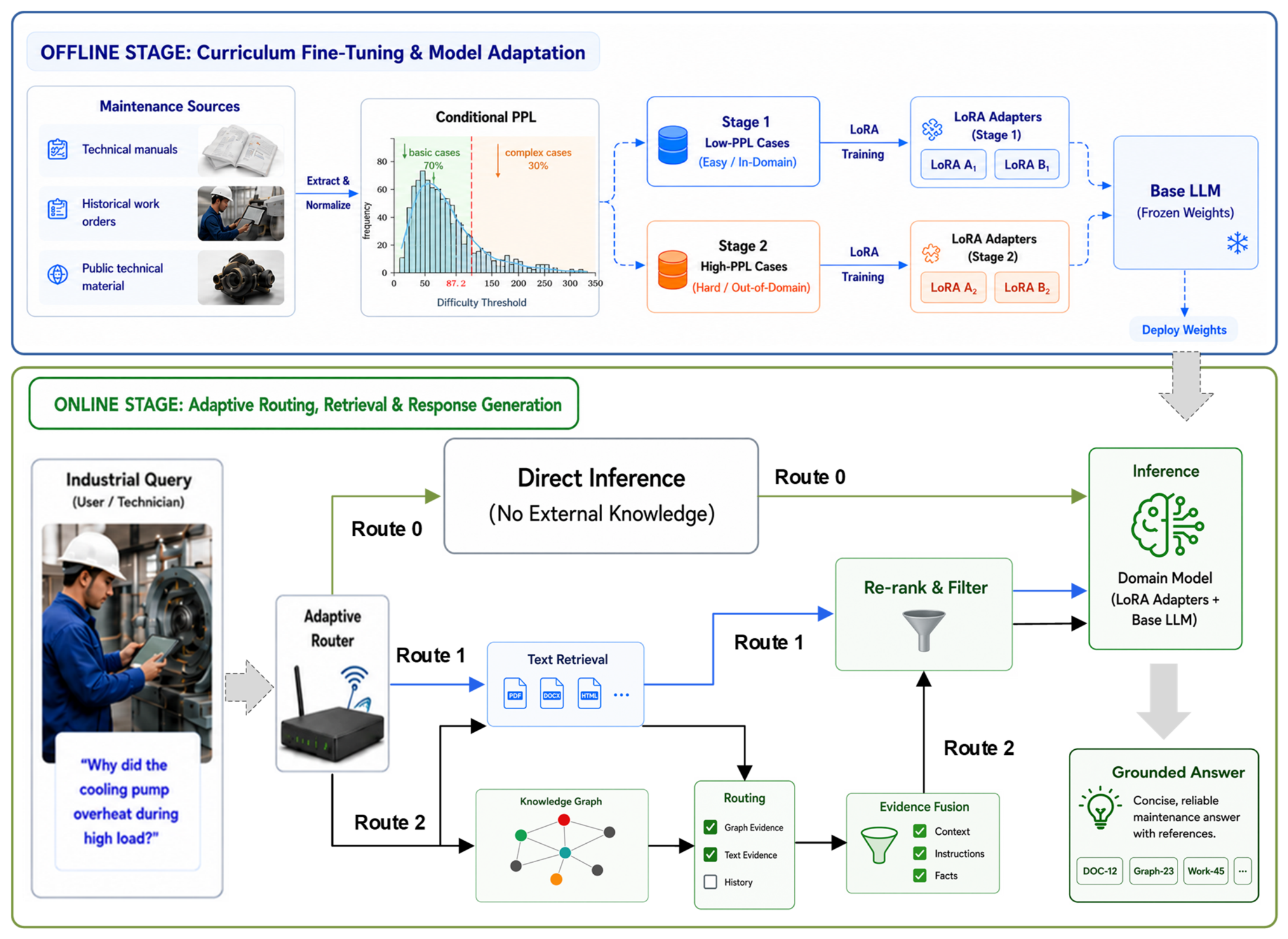
Figure 1 shows the overall workflow. The training branch first uses the frozen base model before domain fine-tuning to calculate the perplexity of normalized question–answer samples. It then partitions the samples into low- and high-perplexity subsets and runs two consecutive LoRA stages. After receiving a field query, the online branch first determines whether external maintenance knowledge is required. When retrieval is needed, the vector channel retrieves semantic context and operating details from unstructured documents. In parallel, the graph channel extracts and matches candidate entities and then retrieves directed relations and knowledge paths within a bounded number of hops. The routing result determines which evidence to activate, and the fusion module reconstructs the retrieved evidence as a unified prompt context for answer generation by the domain model.
Figure 1.
Overall architecture of perplexity-guided progressive fine-tuning and adaptive dual-path evidence augmentation. After normalization, maintenance manuals, historical work orders, and public technical materials support two branches. The frozen base model partitions the training samples by perplexity for two consecutive LoRA stages, while the corpus forms a text vector index and a directed maintenance knowledge graph. During online inference, retrieval necessity and entity availability select direct answering, text-evidence augmentation, or joint text-graph augmentation.
The text vector index and maintenance knowledge graph are built offline. Online processing performs intent determination, query encoding, entity linking, and evidence retrieval. Appendix A describes corpus normalization, graph construction, and evidence serialization, and Section 4 reports the evaluation data, implementation environment, and training parameters.
3.2. Perplexity-Guided Two-Stage Fine-Tuning
Supervised equipment-maintenance corpora contain declarative knowledge, such as terminology, component functions, and parameter descriptions, as well as cases involving multiple fault symptoms, cause determination, and troubleshooting steps. Directly mixing samples with different prediction difficulty may bias the limited parameter updates toward frequent, structurally simple expressions. This study uses perplexity measured by the frozen base model as an ordering signal. The model first establishes domain representations on the low-perplexity subset and then continues adaptation on the high-perplexity subset.
For the i-th supervised sample, the question or instruction xi and target answer yi are serialized in the training format as the normalized sample sequence . Before domain fine-tuning, the frozen base model calculates the perplexity of this sequence:
Lower perplexity means that the base model predicts the question–answer sample more easily, whereas higher perplexity indicates greater prediction difficulty. Perplexity serves only as a sample-ordering signal and is not interpreted directly as logical-reasoning difficulty. The calculation follows corpus normalization to reduce interference from anomalous characters and low-quality text.
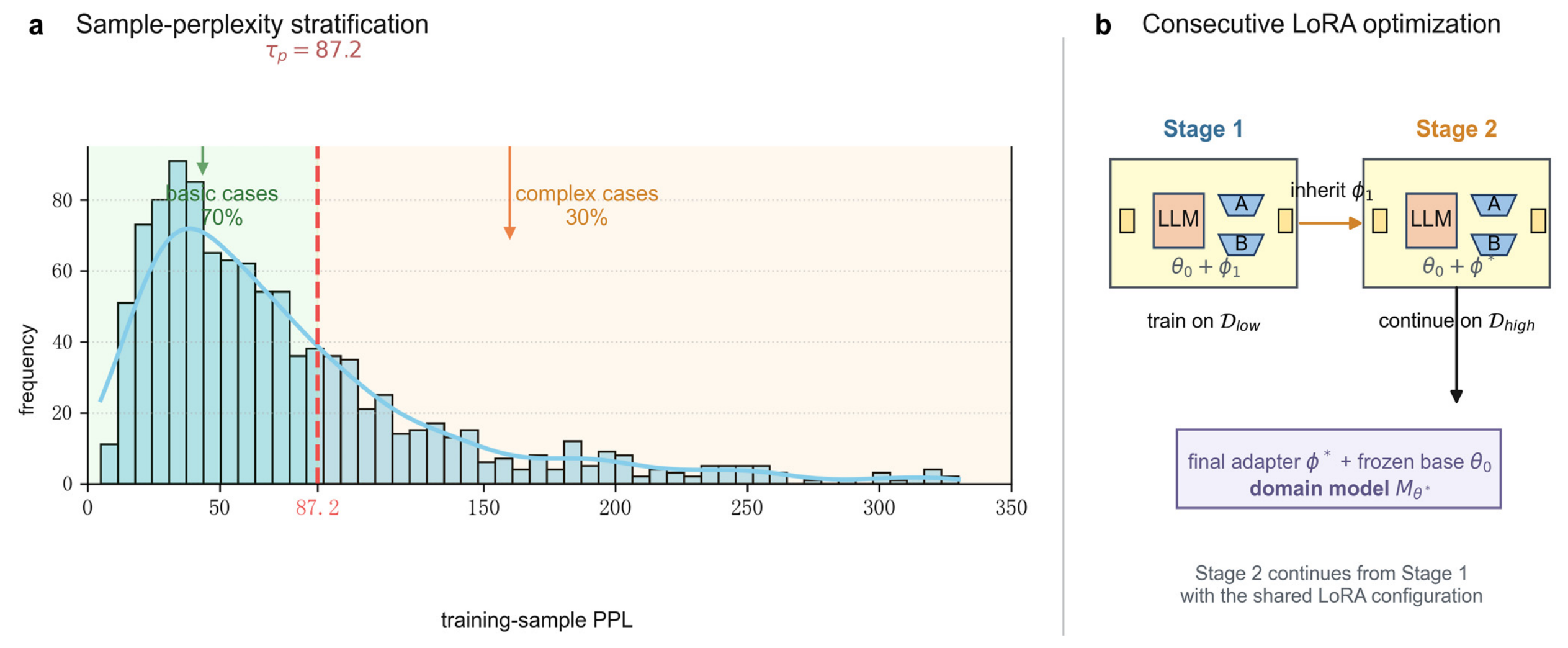
As shown in Figure 2, all samples are sorted in ascending order of perplexity and divided into low- and high-perplexity subsets at threshold τp:
low = {(xi, yi)∣PPLi ≤ τp}, high = /low
The threshold τp is a training-data partition parameter, and Section 4 reports its experimental value. The partition neither changes sample content nor generates additional data. It only determines the order in which the two sample groups enter optimization.
To reduce the parameter and GPU-memory costs of domain adaptation, LoRA modules are inserted into the query, key, and value projection matrices of the Transformer self-attention layers [10]. For a frozen weight matrix W0 ∈ ℝd×k, two low-rank matrices represent the incremental update as ΔW = BA, where A ∈ ℝr×k, B ∈ ℝd×r, and r ≪ min(d, k). The forward computation with LoRA is
During training, W0 remains frozen and only A and B are updated. Matrix A uses Gaussian initialization, and matrix B is initialized to zero so that the low-rank branch does not change the base-model output at the start of training.
Both stages use the same supervised objective. Instruction masking restricts the loss to the target-answer tokens. For dataset m used in stage m ∈ {1,2}, the objective is
where ϕ denotes all trainable low-rank parameters and Ti denotes the length of the target answer. Masking losses for the question and template tokens prevents the limited update capacity from being used to reproduce the input format and focuses optimization on the terminology, content, and organization of the maintenance answers.
The first stage optimizes the LoRA parameters on low, allowing the model to learn equipment terminology, component functions, parameter meanings, and basic maintenance rules and yielding ϕ1. The second stage inherits ϕ1 and continues training on high. This stage further adapts the domain representations to fault associations and multistep troubleshooting cases and yields the final parameters ϕ*:
The second stage directly inherits and continues updating the LoRA parameters from the first stage. Combining ϕ* with the frozen base parameters produces the domain model used during inference. Section 4 reports the rank, scaling coefficient, learning rate, and number of training epochs.
Figure 2.
Perplexity partition and consecutive LoRA optimization. (a) Distribution of training-sample perplexity calculated by the frozen base model; the blue curve is a smoothed density estimate overlaid on the histogram. The threshold τp = 87.2 divides the samples into an approximately 70% low-perplexity subset and an approximately 30% high-perplexity subset, indicated by the shaded rectangles. (b) The second stage inherits the LoRA parameters from the first stage and continues optimization; each rectangle represents one LoRA training stage.
3.3. Dual-Path Evidence Retrieval and Logic-Preserving Fusion
Two-stage fine-tuning encodes stable domain knowledge and answer patterns in the model parameters, but it cannot guarantee coverage of long-tail faults, newly issued procedures, or model-specific parameters. This study therefore equips with two complementary external evidence channels. The vector channel uses semantic proximity between the query and text passages to handle abbreviations and colloquial descriptions and to supplement procedural parameters and operating details. The graph channel uses matched entities and explicit relations to retain component hierarchies and relation directions recorded in the graph. Graph evidence supplies relational structure, and text evidence supplies executable details.
During offline processing for the vector channel, maintenance documents are segmented into text passages. The embedding model fv(⋅) encodes each passage and writes it to the vector index . During online retrieval, cosine similarity measures the relevance between the query vector vq = fv(q) and passage vector vj = fv(bj):
The approximate nearest-neighbor index returns candidate passages. The system ranks them by sv, retains the top kv results to form Cv(q), and writes the retrieved source passages to the text-evidence field.
The graph channel first extracts candidate phrases for equipment, components, fault symptoms, and related concepts from the natural-language query. Fuzzy string matching then maps these phrases to canonical entities in the graph. The matching results form the anchor set
q = EntityMatch(q,)
When a query contains only a vague symptom description or the graph lacks the corresponding node, the entity-matching result can be empty. In that case, graph expansion is not activated.
For each anchor entity, the system follows directed edges in the knowledge graph and performs neighborhood expansion for at most K hops. The candidate path set is defined as
K(q) = {(v0, r1, v1, …, rl, vl) | v0 ∈ q,1 ≤ l ≤ K,(vj−1, rj, vj) ∈ }
The linearization function L(P) converts the entities and relation labels in a bounded-hop path into a text sequence that serves as graph-relation evidence. The maximum hop count K limits the extent of local graph expansion.
Graph retrieval expands along directed relations defined in the knowledge graph, and serialization preserves the original entity–relation–entity direction. For example, “fault symptom cause” is not rewritten in the opposite direction, and equipment–component membership retains the direction defined by the graph. Source passages retrieved through the vector channel supplement prerequisites and operating details from maintenance procedures. The fusion module organizes text passages and graph-relation evidence in separate fields.
Graph paths and text passages use different representations. Function L(P) linearizes the path in the direction into short statements with relation labels. Graph-relation evidence and textual details are written to separate fields. The two evidence paths are represented as
where Dj is a retrieved text passage and L(P) is relational evidence linearized along the graph-edge direction.
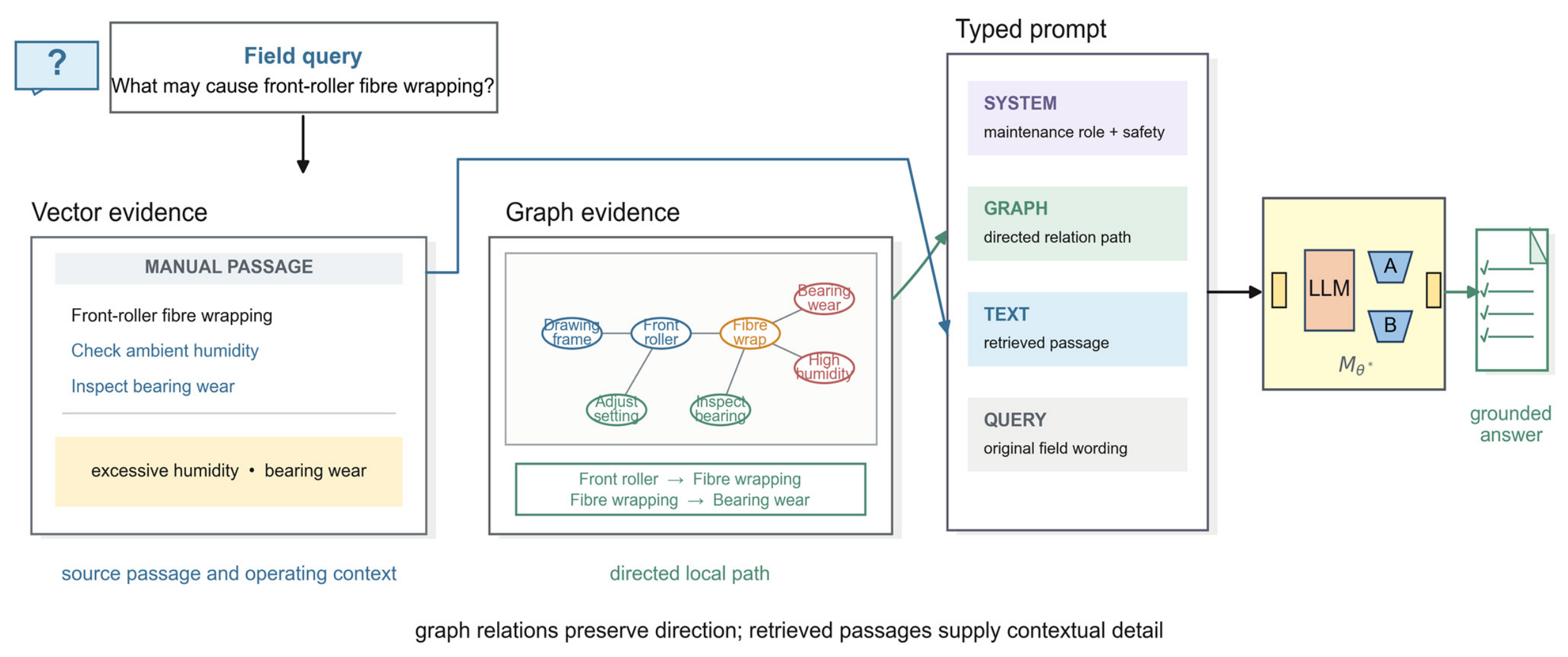
The augmented prompt contains four fields: a system instruction, graph-relation evidence, text evidence, and the user question. Graph paths retain relation types and directions, while text passages provide specific parameters and operating details. Context construction introduces no additional trainable parameters. Figure A3 in Appendix A shows an example of dual-path evidence serialization.
Online retrieval and context construction use four operators:
Operator v returns the top kv text passages from index Iv, ranked according to Equation (7). Operator e extracts candidate phrases, performs entity matching, and returns the anchor set q according to Equation (8). Operator g forms linearized graph evidence along the bounded-hop paths defined by Equation (9). Operator constructs the context in the order of system instruction, graph evidence, text evidence, and user question. When Cg = Ø, it omits the graph-evidence field.
3.4. Three-Level Retrieval Routing Based on Retrieval Necessity and Entity Status
A fixed retrieval strategy imposes unnecessary retrieval costs on simple queries and may introduce irrelevant graph paths when no entity can be matched. The system derives a binary retrieval necessity decision d(q) ∈ {0,1} from query intent. A value of 1 means that external maintenance knowledge is required, whereas 0 means that the domain model can answer directly. The entity set q indicates whether the query matches nodes in the graph. The routing function is defined as
The three-level router changes the evidence source and retrieval path according to the need for external retrieval and the entity-matching status.
Route 0 handles inputs that do not require external knowledge, including out-of-domain conversation and simple maintenance questions that the domain model can answer directly. The system skips the vector database and knowledge graph and directly invokes the two-stage fine-tuned domain model . Route 1 handles inputs that require external maintenance knowledge but do not match a graph entity. One example is the vague statement “the machine keeps making an unusual sound” without an identifiable piece of equipment or component. The system then performs vector retrieval only and uses semantic matching to retrieve potentially relevant descriptions from documents. Route 2 handles maintenance queries that require retrieval and match equipment, component, or fault entities. The system retains the vector channel, expands the local graph from the anchor entities, and fuses both evidence types as described in Section 3.3.
Algorithm 1 summarizes the complete online process. For a query requiring retrieval, the system runs vector retrieval and entity matching in parallel. After a successful match, graph expansion starts from the anchor entities. When no entity is matched, the system directly uses the vector evidence already retrieved.
| Algorithm 1. Three-Level Evidence Routing and Answer Generation Based on Retrieval Necessity and Entity Status | |
| Input: | vector index Iv; knowledge graph ; vector retrieval size kv; maximum graph hop count K |
| Output: | |
| 1. | Initialize: zr ← d(q). |
| 2. | if zr = 0 then: |
| 3. | |
| 4. | else |
| 5. | Execute in parallel |
| 6. | Cv ← v(q,Iv;kv) |
| 7. | q ← e(q,) |
| 8. | End parallel |
| 9. | if q = Ø then |
| 10. | Cg ← Ø |
| 11. | else |
| 12. | Cg ← g(,q;K) |
| 13. | end if |
| 14. | C ← (q,Cv,Cg) |
| 15. | |
| 16. | end if |
4. Experimental Design
4.1. Evaluation Data and Tasks
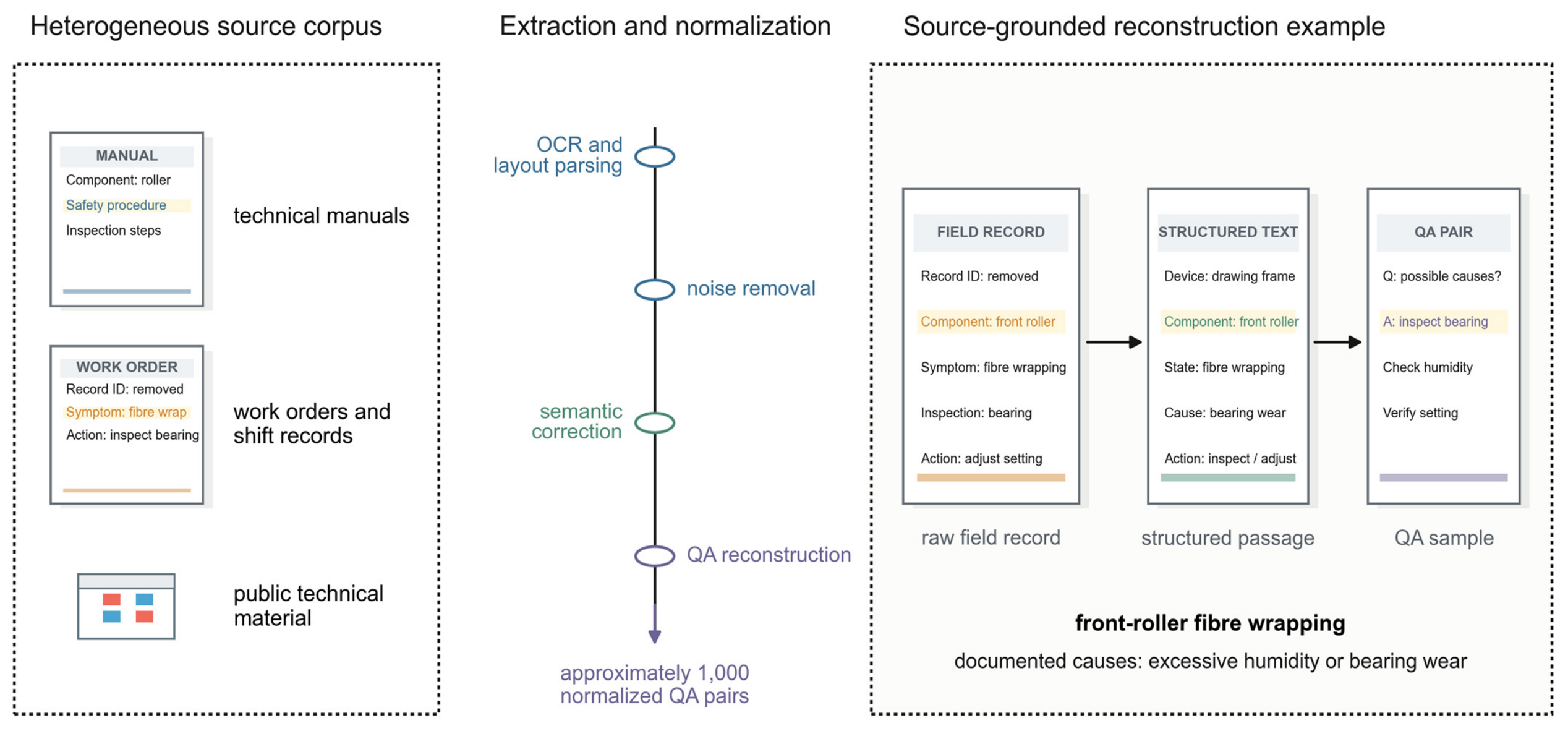
The experimental corpus focuses on maintenance of cotton-spinning drawing frames and contains three complementary source types. Manufacturer documents, including operating instructions and maintenance manuals, provide component names, process parameters, standard operations, and troubleshooting procedures. Enterprise maintenance materials, including handwritten repair records, shift-handover logs, and field troubleshooting sheets, retain actual operating conditions, nonstandard expressions, and engineering experience. Public technical materials, including textile-machinery papers, patent documents, and screened professional sources, supplement general principles and long-tail knowledge. OCR, layout parsing, web-noise removal, semantic cleaning, and question–answer reconstruction produced approximately 1000 supervised fine-tuning question–answer pairs. Appendix A.1 presents the corpus-processing procedure and a reconstruction example.
Because cotton-spinning equipment-maintenance question answering lacks a recognized open benchmark, this study independently constructs IM500-Eval to evaluate professional knowledge and fault-analysis ability in the target setting. The set contains 500 equipment-maintenance questions with expert-verified reference answers and covers equipment structure and component functions, common fault analysis, and multifactor diagnosis. IM500-Eval was separated from the training corpus before fine-tuning began, and cross-set checking excluded duplicate questions. Test samples do not participate in perplexity partitioning or parameter updates. The open-ended answer-generation task uses BLEU and ROUGE to compare reproduction of professional terms and coverage of key steps.
The noisy binary-discrimination set evaluates the ability to distinguish answers under nonstandard field input. Each sample contains a maintenance query, an expert-approved answer, and a distractor generated by the base model without domain adaptation. The evaluated model must select the candidate that better conforms to maintenance knowledge and operating procedures. The test queries contain speech-transcription errors, terminology misspellings, abbreviations, word-order changes, and nonstandard expressions, resulting in 2002 samples in total. The task reports the number of correct selections and accuracy as a robustness supplement to open-ended generation; its results are not combined with the generation metrics from IM500-Eval.
4.2. Comparison Configurations and Implementation Details
Table 1 lists six comparison configurations. All configurations use the same ChatGLM3-6B base model and evaluation data. Single-stage LoRA and two-stage LoRA use the same training samples, total sample exposures, LoRA target modules and hyperparameters, optimizer, and evaluation settings. They differ only in the order in which samples enter training and therefore form a controlled comparison of the perplexity-guided progressive training strategy. The knowledge-graph-enhanced configuration and our method use the same two-stage fine-tuned generator and evaluation protocol. The former provides graph evidence only, whereas the latter activates the three-level router described in Section 3.4 and invokes vector evidence or joint graph–vector evidence according to query status. This comparison evaluates the overall effect of the complete dual-path evidence configuration relative to no retrieval and graph-only retrieval. The internal router and vector path are not treated as independent methodological claims:
Table 1.
Comparison of configurations and their differences.
The experimental parameters were determined from the 24 GB single-GPU computing condition, preliminary screening, and training convergence and were kept constant in the corresponding comparisons. Training used FP16, a batch size of 4, AdamW, an initial learning rate of 5 × 10⁻⁵, cosine annealing, and 3 epochs. LoRA was applied to the Q, K, and V linear mappings of the attention modules with rank r = 8 and scaling coefficient α = 32; the base-model weights remained frozen during training. Each sample had the same number of training exposures under single-stage and two-stage LoRA. P-Tuning v2 used a continuous prompt length of 64.
The frozen ChatGLM3-6B base model calculated perplexity for the training samples. The samples were sorted in ascending order of perplexity and partitioned at the fixed threshold τp = 87.2. This threshold assigned 70% of the samples to the low-perplexity subset and 30% to the high-perplexity subset, applied only to the training set, and remained unchanged in all two-stage experiments. The retrieval channel used BGE [34] to generate dense vectors and an HNSW approximate-nearest-neighbor index [35] to retrieve the top-k text passages. Neo4j stored the structured relations and supported bounded-hop neighborhood expansion around matched entities. Every retrieval configuration used a fixed retrieval count and graph-expansion range.
4.3. Evaluation Metrics
Open-ended generation uses BLEU [36], ROUGE-1, ROUGE-2, and ROUGE-L [37]. BLEU measures local agreement between a generated answer and its reference through modified n-gram precision and a brevity penalty:
where pn is the modified n-gram precision, wn is the corresponding weight, the experiment uses equal weights wn = 1/N, and BP is the brevity penalty. When the length of the generated text c is less than or equal to the length of the reference text r, the BP will exponentially decay the score. ROUGE-1 and ROUGE-2 measure unigram and bigram recall, respectively, while ROUGE-L evaluates content coverage from the longest common subsequence of the generated and reference answers; the denominator of Equation (15) is the total number of occurrences of all n-grams in the reference text, while the numerator represents the number of n-grams that are matched by both the generated text of the large language model and the reference text. Industrial maintenance answers can have several semantically equivalent forms, so these lexical-overlap metrics support relative comparisons on the same test set. The blinded expert evaluation further assesses professional accuracy, safety, and logical consistency.
Accuracy for the noisy discrimination task is defined as
Expert evaluation uses a 10-point scale and calculates the mean score for professional accuracy, industrial safety, logical consistency, answer completeness, and language fluency. Section 5 compares raw test values and expert means under a common evaluation protocol and avoids inferential expressions such as “statistically significant”.
4.4. Expert Blind Evaluation and Prototype Test
The overall testing procedure comprised four stages. First, all six comparison configurations in Table 1 were evaluated on the same held-out test sets using the common environment and settings listed in Table 2. Second, open-ended responses on IM500-Eval were evaluated using BLEU and ROUGE, whereas the noisy binary-discrimination set was evaluated using answer-selection accuracy. Third, 100 question sets were randomly selected for blinded evaluation by five maintenance engineers using the five criteria defined in Section 4.3. Finally, the integrated prototype was tested in the reported single-server environment, and hybrid-retrieval response time, streaming generation throughput, knowledge-graph rendering time, and page-request response time were recorded. The human evaluation involved 5 engineers, each with more than 5 years of experience in cotton-spinning equipment maintenance. The study randomly sampled 100 question sets from the test data, and each system generated answers to the same questions. Model identifiers were then removed before the experts applied a common rating scale. The five evaluation dimensions assess the professional accuracy of the maintenance content, agreement between the recommendations and industrial safety requirements, logical consistency of the diagnostic analysis, completeness of necessary information, and language fluency. Each dimension is compared using the mean rating from the 5 experts.
Table 2.
Experimental environment, training parameters, and setting rationale.
In addition to offline evaluation, the integrated prototype was tested on the main service workflow in the single-server environment, whose features are listed in Table 2, as shown previously. The test recorded mean response time for dual-path hybrid retrieval, streaming generation speed for maintenance instructions, knowledge-graph visualization rendering time, and mean page-request response time. These engineering measures evaluate the interactive responsiveness of the prototype.
5. Results and Discussion
5.1. Effect of Perplexity-Guided Progressive Fine-Tuning
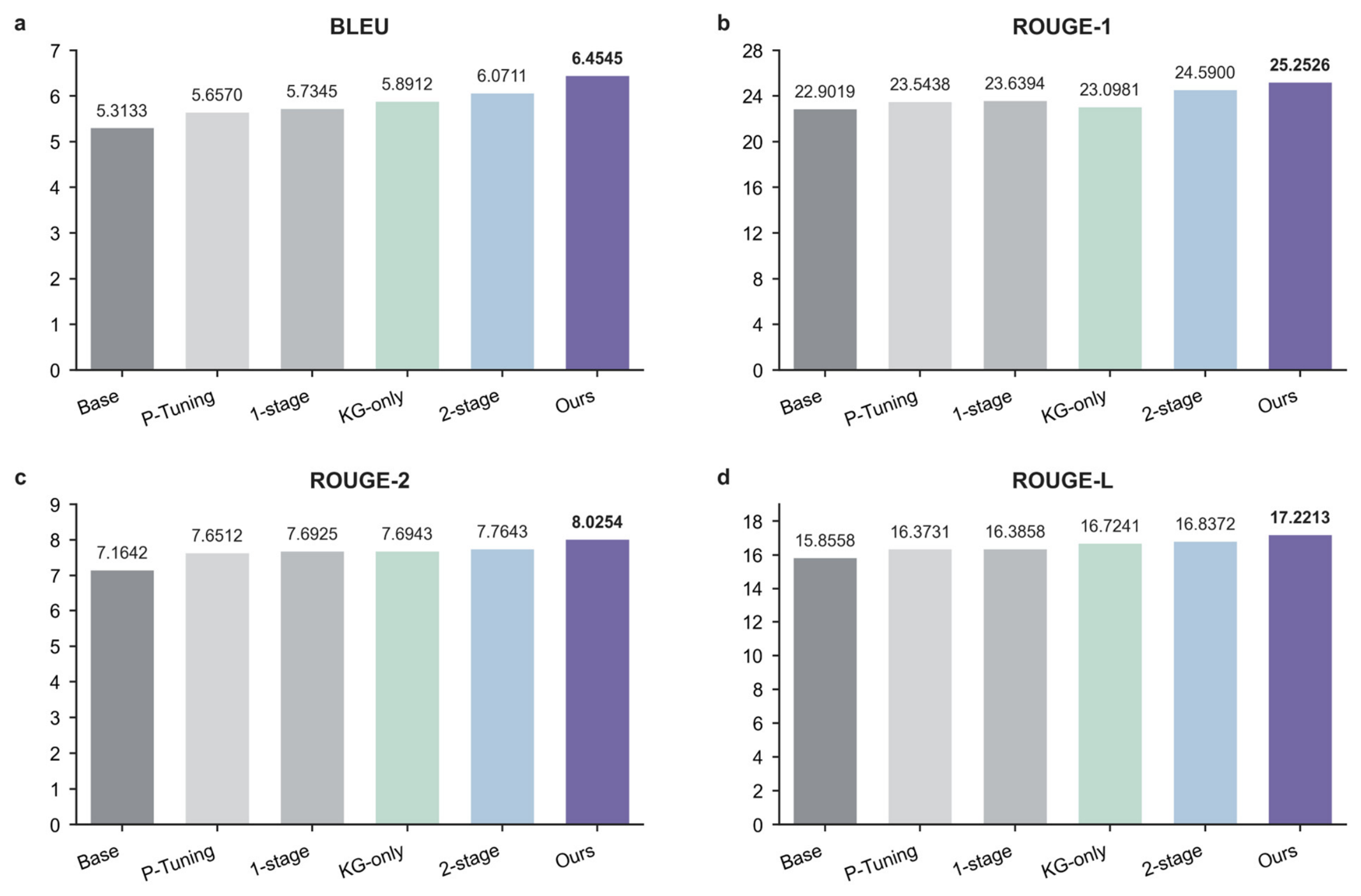
Figure 3 reports the generation results on IM500-Eval. Two-stage LoRA obtains BLEU, ROUGE-1, ROUGE-2, and ROUGE-L scores of 6.0711, 24.5900, 7.7643, and 16.8372, respectively, all higher than those of the base model. The relative increases over the base model are 14.26%, 7.37%, 8.38%, and 6.19%. Relative to single-stage LoRA, which mixes all training samples, two-stage LoRA improves the four metrics by 5.87%, 4.02%, 0.93%, and 2.75%, respectively.
Figure 3.
Answer-generation quality on IM500-Eval. (a) BLEU; (b) ROUGE-1; (c) ROUGE-2; (d) ROUGE-L. Each bar shows the reported raw test values. Our method (Ours) obtains the highest point estimate for all four generation metrics on IM500-Eval.
Single-stage LoRA and two-stage LoRA keep the training samples, sample exposures, LoRA configuration, and evaluation procedure unchanged and differ only in training order. Under this controlled condition, two-stage LoRA exceeds single-stage LoRA on all four metrics, verifying the effectiveness of the perplexity-guided progressive training strategy on the current equipment-maintenance data. P-Tuning v2 and single-stage LoRA also outperform the base model, indicating that domain adaptation provides the main gains. The two-stage schedule further improves the reproduction of professional terms and coverage of key content.
5.2. Overall Effect of Dual-Path Evidence Augmentation
Our method achieves the highest value for all four generation metrics in Figure 3. Relative to two-stage LoRA without external retrieval, it improves BLEU, ROUGE-1, ROUGE-2, and ROUGE-L by 6.32%, 2.69%, 3.36%, and 2.28%, respectively. Relative to the graph-only configuration, the four gains are 9.56%, 9.33%, 4.30%, and 2.97%. All retrieval configurations use the same two-stage generator and evaluation procedure, and their differences lie in how they organize external evidence. These results verify the overall effectiveness of the complete dual-path evidence configuration.
The knowledge-graph-enhanced configuration does not exceed two-stage LoRA on any of the four metrics; its BLEU and ROUGE-1 scores are 5.8912 and 23.0981, respectively. Graph relations supplement the structural links among components, fault symptoms, and maintenance actions, but graph evidence alone cannot cover the parameters and operating details in the manuals. Our method uses vector text to supply execution information, graph relations to organize fault associations, and the three-level router to select an evidence path according to query status. The complementary use of both paths explains the consistent gains over no retrieval and graph-only retrieval. This conclusion concerns the complete dual-path evidence configuration and does not assign the overall gain to independent internal-module effects.
5.3. Discrimination Under Noisy Input
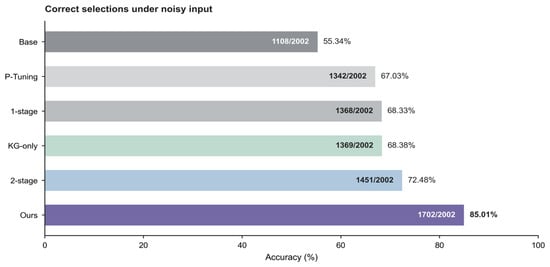
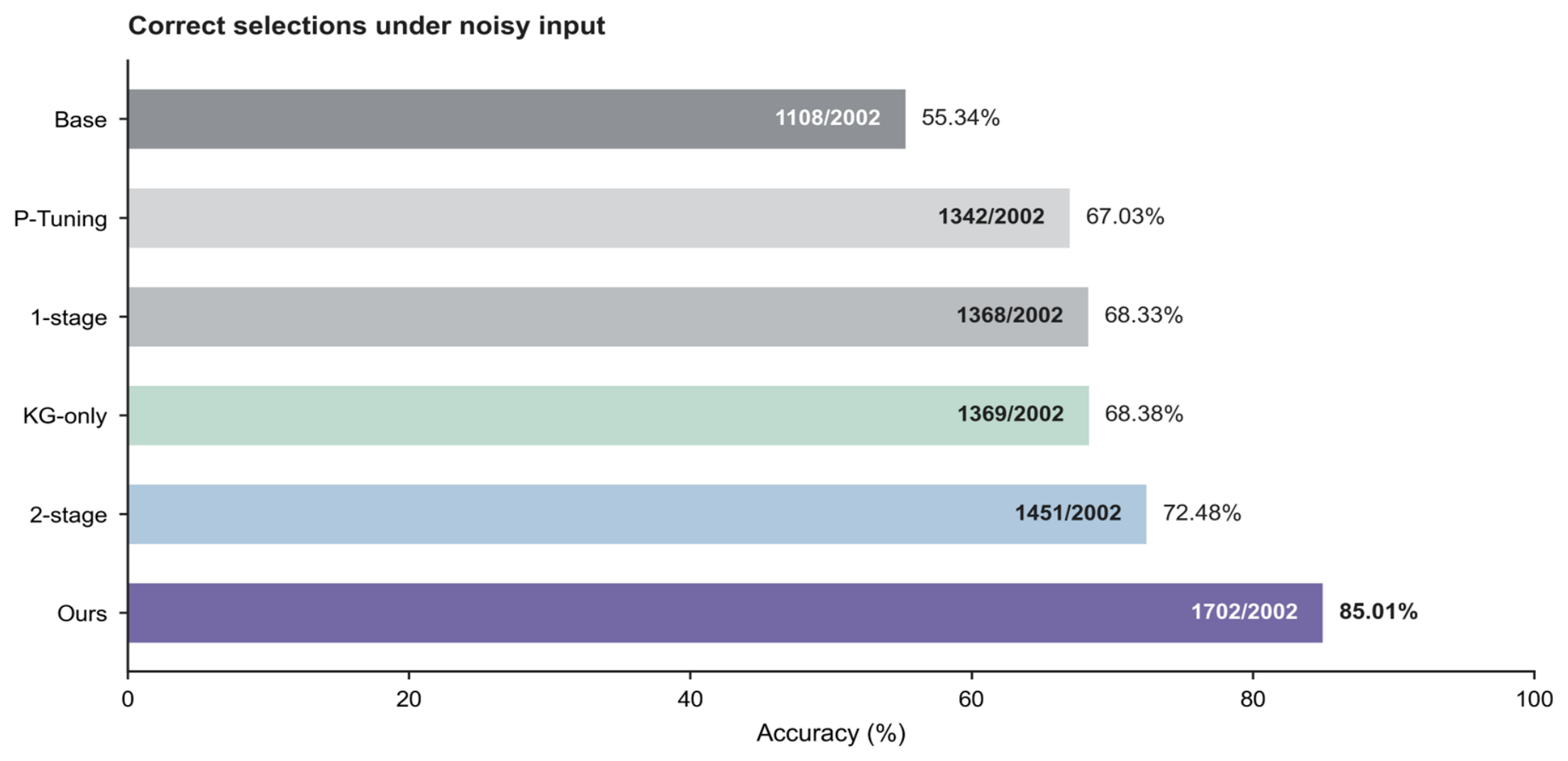
Figure 4 reports the binary-discrimination results on 2002 noisy samples. The base model makes 1108 correct selections, corresponding to 55.34% accuracy. Two-stage LoRA makes 1451 correct selections and increases accuracy to 72.48%, also exceeding single-stage LoRA. Our method makes 1702 correct selections and reaches 85.01% accuracy, exceeding both the base model and two-stage LoRA.
Figure 4.
Binary answer-discrimination results under noisy input. Our method (Ours) achieves the highest discrimination accuracy of 85.01% on 2002 noisy samples. Labels inside the bars show correct selections over the total number of samples.
The knowledge-graph-enhanced configuration reaches 68.38% accuracy, which is close to the 68.33% of single-stage LoRA and below that of two-stage LoRA. Our method outperforms both the knowledge-graph-enhanced configuration and two-stage LoRA without retrieval. This result follows the same direction as the open-ended generation metrics, indicating that perplexity-guided progressive training improves domain discrimination and that the complete dual-path evidence configuration further strengthens the ability to distinguish reliable answers from distractors under nonstandard input.
5.4. Expert Evaluation and Prototype Performance
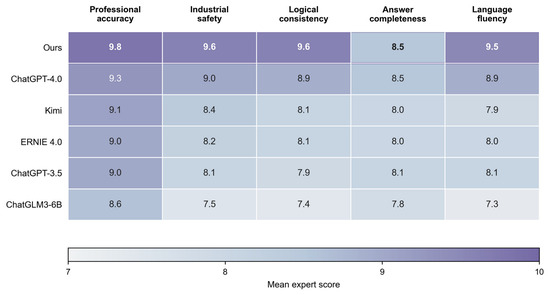
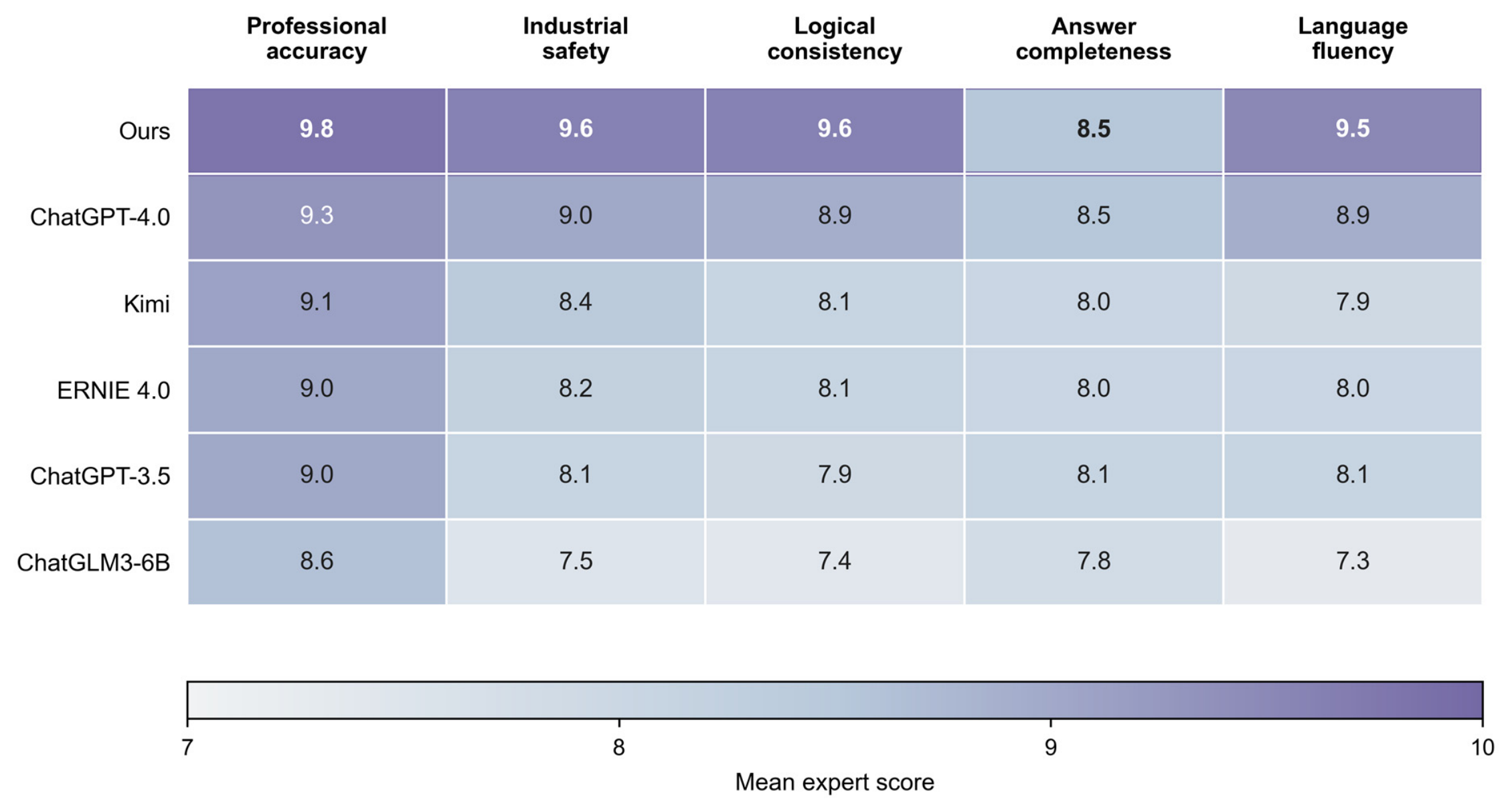
Figure 5 reports the mean scores from the blinded expert evaluation. Our method receives 9.8, 9.6, 9.6, and 9.5 for professional accuracy, industrial safety, logical consistency, and language fluency, respectively, the highest scores among the listed configurations. Its answer-completeness score is 8.5, tied with ChatGPT-4.0. Relative to ChatGPT-4.0, our method is higher by 0.5, 0.6, 0.7, and 0.6 points on the four dimensions above. The anonymous evaluation and automatic metrics show consistent results: the engineers recognized the professional content, safety-oriented wording, and diagnostic coherence of Ours.
Figure 5.
Mean scores from the blinded expert evaluation. Our method (Ours) receives the highest descriptive mean on four expert-evaluation dimensions and ties with ChatGPT-4.0 on answer completeness. The color scale is fixed from 7 to 10.
The prototype-test results are reported in Table 3. The mean response time for dual-path hybrid retrieval is 1.12 s, the streaming generation speed for maintenance instructions is 26.5 tokens/s, the knowledge-graph visualization rendering time is 1.35 s, and the mean page-request response time is 0.82 s. These throughput and response levels show that the complete method can support interactive demonstration and functional validation in the reported single-server environment.
Table 3.
Performance results for the integrated prototype.
5.5. Evidence Synthesis and Applicability
Two controlled comparisons provide the main evidence for method effectiveness. Single-stage LoRA and two-stage LoRA differ only in training order, and the four generation metrics and noisy discrimination accuracy support perplexity-guided progressive training. The no-retrieval configuration, graph-only configuration, and complete method use the same generator and evaluation protocol, and their results support the complete dual-path evidence configuration. IM500-Eval measures open-ended answer generation, 2002 noisy samples measure answer discrimination under nonstandard input, the blinded expert evaluation adds engineers’ judgments of professional quality, safety-oriented wording, and logical consistency, and the prototype test reports single-server interactive performance. The results point in the same direction across these evaluation levels.
The conclusions are based on cotton-spinning drawing-frame maintenance knowledge, the query types constructed in this study, and the reported experimental environment. Within this scope, perplexity-guided progressive fine-tuning and dual-path evidence augmentation jointly improve answer generation and noisy answer discrimination while retaining the interactive responsiveness of the prototype. This validation provides a reusable way to organize training and retrieval for related knowledge-intensive equipment-maintenance tasks.
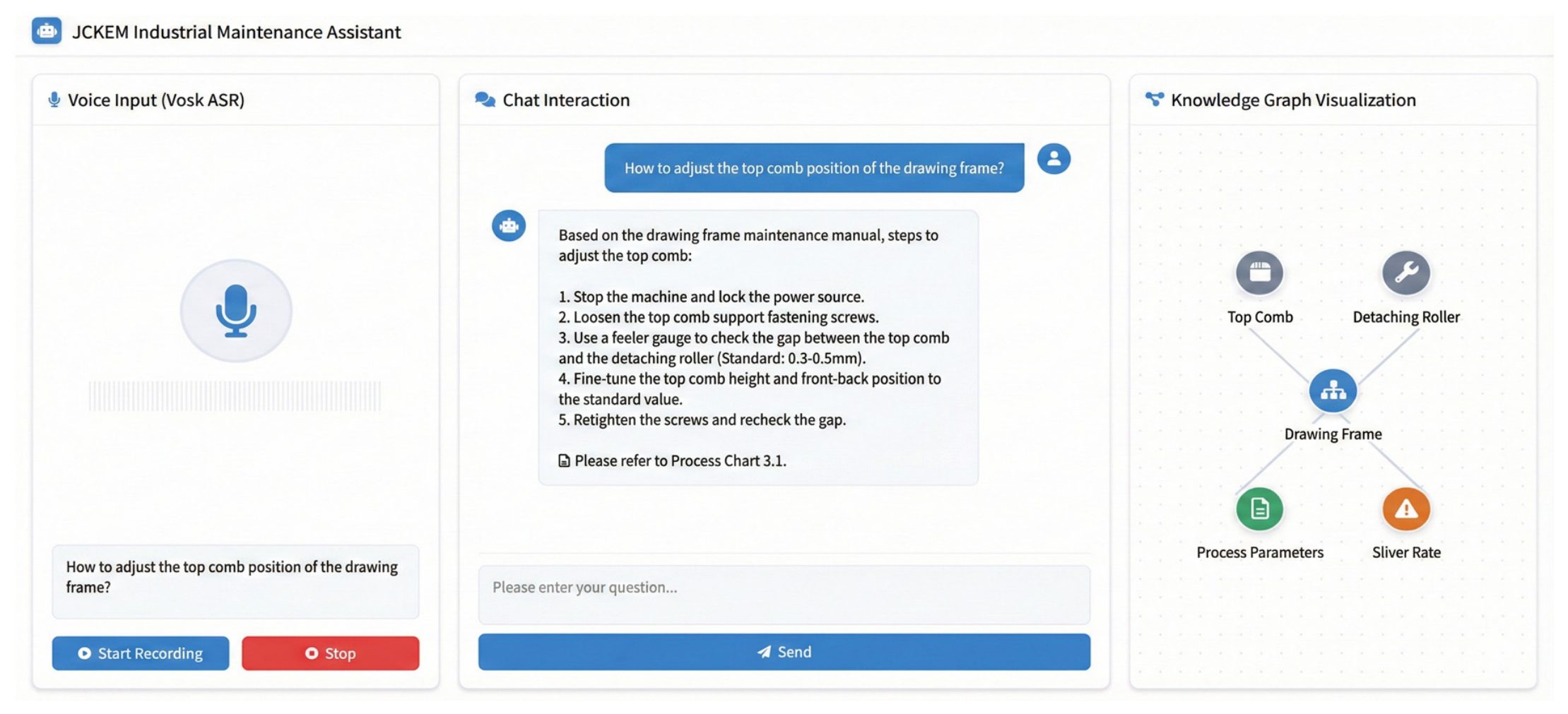
In actual industrial maintenance and repair operations, operators need to strictly follow the instructions in the operation manual. They have to consult the complex textual data and then operate according to the requirements of the operation manual. Even experienced operators usually need to spend a considerable amount of time on information lookup. To test the ability of our framework in real industrial maintenance scenarios, we developed a real-time human–machine interaction maintenance and repair assistant system, as shown in Figure 6. This system is developed based on Python and Gradio’s front-end page and is started by the back-end server, enabling maintenance and repair operators to ask questions in real time and receive responses from the joint causal knowledge-enhanced model. The system supports multi-terminal communication, allowing interaction not only through a PC but also through mobile devices such as smartphones.
Figure 6.
Architecture of the real-time interactive system with our framework.
6. Conclusions
This study addresses domain hallucination, logical misalignment of retrieved evidence, and inadequate adaptation to nonstandard queries in industrial equipment maintenance. Our method combines perplexity-guided two-stage LoRA fine-tuning, vector and knowledge-graph dual-path evidence fusion, and three-level retrieval routing based on intent and entity status. On IM500-Eval, two-stage LoRA obtains BLEU, ROUGE-1, ROUGE-2, and ROUGE-L scores of 6.0711, 24.5900, 7.7643, and 16.8372, respectively, all higher than the base model and single-stage LoRA. Our method further raises the four scores to 6.4545, 25.2526, 8.0254, and 17.2213 and makes 1702 correct selections among 2002 noisy samples, reaching 85.01% accuracy. In the anonymous evaluation by five engineers, our method achieves the highest mean scores among the listed configurations for professional accuracy, industrial safety, logical consistency, and language fluency and ties with ChatGPT-4.0 for answer completeness.
These results verify the joint effectiveness of perplexity-guided progressive domain adaptation and dual external evidence on the current equipment-maintenance task and show that the complete method can support an interactive single-server prototype. Several limitations should be acknowledged. First, the present validation is restricted to cotton-spinning drawing-frame maintenance and the evaluation sets constructed in this study; therefore, the generalizability of the framework to other equipment types and public benchmarks remains to be established. Second, the prototype was evaluated in a single-server environment, and its performance under larger-scale deployment has not yet been examined. Future work will extend the method to other equipment types, evaluate it on public or openly constructed maintenance datasets, integrate equipment images and operating signals, and improve knowledge updating, evidence provenance, and human-confirmation mechanisms.
Author Contributions
All authors contributed to the study conception and design. Material preparation and data collection were performed by P.L., R.G. and T.M., and analysis by Y.Z. and J.H. The first draft of the manuscript was written and edited by Y.Z., P.L. and all authors commented on previous versions of the manuscript. All authors have read and agreed to the published version of the manuscript.
Funding
This research was funded by the National Natural Science Foundation of China (NSFC), grant number 52075404; Hubei University of Economics Youth Fund, grant number XJZD202105; and Scientific Research Program of Hubei Provincial Department of Education, grant number Q20212205. The APC was funded by the authors.
Data Availability Statement
The source maintenance manuals, enterprise work orders, and shift records contain proprietary and operational information and cannot be made publicly available. The aggregated experimental results supporting the conclusions of this article are reported in the manuscript.
Acknowledgments
During manuscript preparation, the authors used GPT-5.6 Soul and DeepSeek-V4-PRO for language editing, translation, and figure redrawing. The authors reviewed and edited all outputs and take full responsibility for the content of this publication.
Conflicts of Interest
The authors declare no conflicts of interest.
Abbreviations
The following abbreviations are used in this manuscript:
| LLMs | Large language models |
| RAG | Retrieval-Augmented Generation |
| LoRA | Low-Rank Adaptation |
| PPL | Perplexity |
| KG | Knowledge Graph |
| BGE | BAAI General Embedding |
| HNSW | Hierarchical Navigable Small World |
| OCR | Optical Character Recognition |
| PEFT | Parameter-Efficient Fine-Tuning |
| FP16 | 16-Bit Floating-Point Precision |
| GPU | Graphics Processing Unit |
| Q/K/V | Query/Key/Value |
| BLEU | Bilingual Evaluation Understudy |
| ROUGE | Recall-Oriented Understudy for Gisting Evaluation |
| BP | Brevity Penalty |
| TF-IDF | Term Frequency–Inverse Document Frequency |
| JSON | JavaScript Object Notation |
| CUDA | Compute Unified Device Architecture |
Appendix A. Corpus and Knowledge-Resource Construction
Appendix A.1. Multisource Corpus Processing and Question-Answer Reconstruction
Figure A1 shows the corpus-construction process. Manufacturer manuals mainly provide standardized terminology, process parameters, and troubleshooting procedures. Repair work orders and shift-handover records supplement actual operating conditions and field-handling experience, while public technical materials extend general principles and long-tail knowledge. Handwritten work orders are scanned and converted to text through OCR. Layout parsing preserves headings, paragraphs, and table regions in PDF manuals, and tags, advertisements, and irrelevant content are removed from web materials before ingestion. A maintenance-oriented prompt template then performs semantic correction and structural organization, converting key descriptive passages into question–answer form. This process produces approximately 1000 supervised fine-tuning samples.
Figure A1.
Multisource maintenance corpus processing and question–answer reconstruction. Technical manuals, work-order records, and public technical materials undergo text extraction, noise removal, semantic correction, and question–answer reconstruction. The correspondence among the raw field record, structured passage, and question–answer sample on the right shows that the component, fault symptom, and possible causes are retained during format conversion.
Appendix A.2. Directed Maintenance Knowledge-Graph Construction
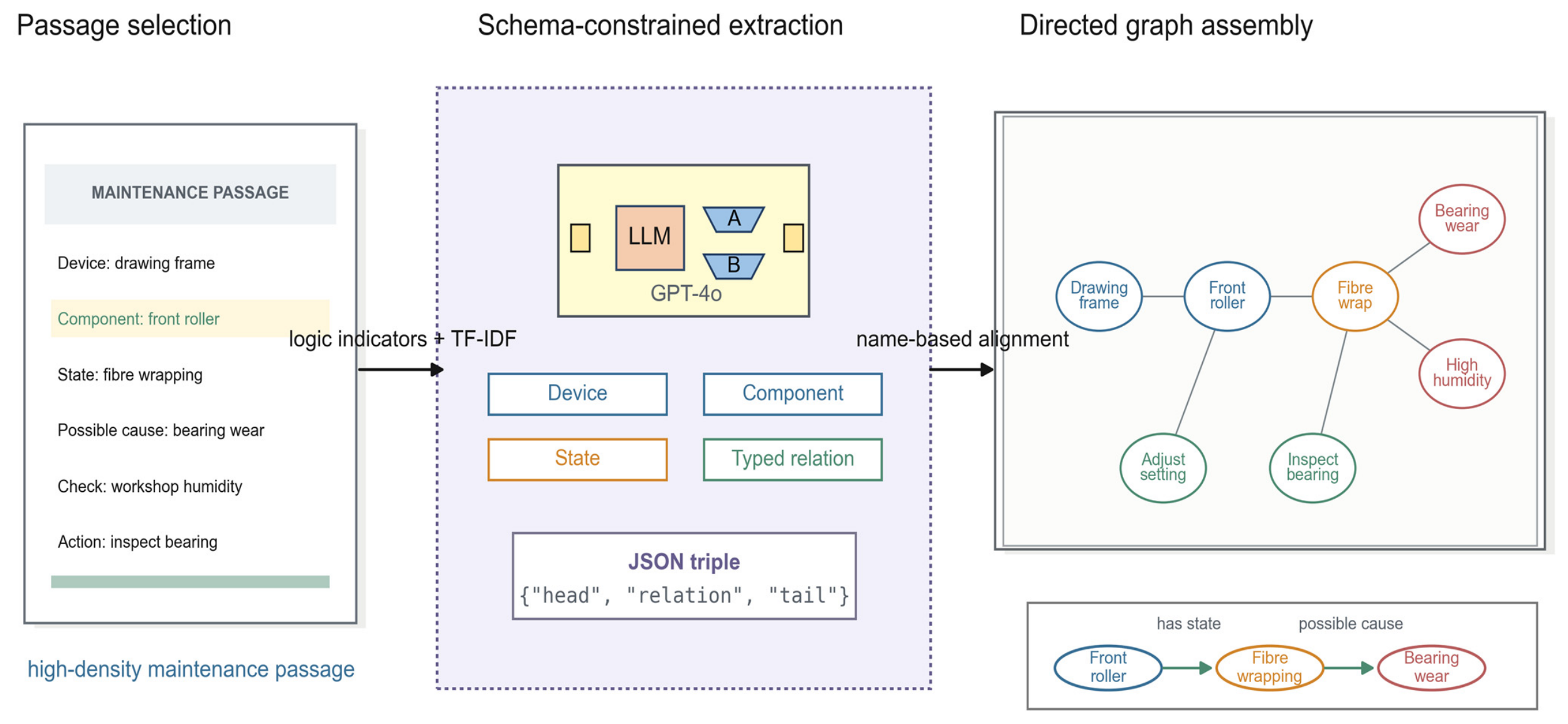
The knowledge-graph corpus comes mainly from operation and maintenance manuals, repair work orders, and field records. To emphasize fault mechanisms and handling relations, the system first calculates semantic density from TF-IDF term weights and logical indicators such as “cause,” “due to,” and “solution” and filters the candidate passages. It then performs large-language-model-assisted semantic cleaning on the retained content. Under a predefined schema, GPT-4o identifies equipment, components, states, and typed relations and outputs them as standardized JSON triples. For entities that have different names but refer to the same object, the system aligns and merges them by name similarity while retaining their original relations. The organized triples are then written to Neo4j in batches.
Figure A2.
Offline construction of the directed maintenance knowledge graph. Schema-constrained GPT-4o extraction converts high-semantic-density passages into JSON triples. Entities with similar names are aligned and merged before being written to Neo4j. The example on the right shows the direction and one-to-many structure of component–state–possible-cause relations.
Appendix A.3. Dual-Path Evidence Serialization
Vector retrieval and graph retrieval return different forms of evidence. The vector channel retains contextual information from source passages, while the graph channel linearizes local directed paths into short statements with relation labels. During fusion, the system creates separate fields for the system instruction, graph evidence, text evidence, and user question. The graph field preserves triple-relation directions, and the text field preserves source information and the narrative order within each passage. Figure A3 uses a query about front-roller fiber wrapping to show how a text passage and a directed relation path jointly enter the domain model.
Figure A3.
Dual-path evidence retrieval and typed-prompt serialization. The vector passage supplements contextual details from the source document, and the directed graph path provides an explicit relational structure. The two evidence types are organized into separate fields and then passed to the two-stage fine-tuned domain model.
References
- Bhardwaj, A.S.; Veeramani, D.; Zhou, S. Identifying Equipment Health Status from Maintenance Records Using Lexicon Based Unsupervised Sentiment Analysis Adjusted for Negation (LUSAA-N). Comput. Ind. Eng. 2023, 186, 109693. [Google Scholar] [CrossRef] [Scilit]
- Ji, Z.; Lee, N.; Frieske, R.; Yu, T.; Su, D.; Xu, Y.; Ishii, E.; Bang, Y.J.; Madotto, A.; Fung, P. Survey of Hallucination in Natural Language Generation. ACM Comput. Surv. 2023, 55, 248. [Google Scholar] [CrossRef] [Scilit]
- Tang, J.; Peng, S.; Guo, J.; Song, D.; Gao, D.; Liu, W.; Wang, F. DT and LLM Driven Intelligent Maintenance System for L-DED and DAG-Based LLM Fault Diagnosis Evaluation Framework. Appl. Soft Comput. 2025, 185, 113942. [Google Scholar] [CrossRef] [Scilit]
- Zhou, B.; Li, J.; Li, X.; Hua, B.; Bao, J. Leveraging on Causal Knowledge for Enhancing the Root Cause Analysis of Equipment Spot Inspection Failures. Adv. Eng. Inform. 2022, 54, 101799. [Google Scholar] [CrossRef] [Scilit]
- Brown, T.; Mann, B.; Ryder, N.; Subbiah, M.; Kaplan, J.D.; Dhariwal, P.; Neelakantan, A.; Shyam, P.; Sastry, G.; Askell, A.; et al. Language Models Are Few-Shot Learners. In Proceedings of the 34th International Conference on Neural Information Processing Systems, Vancouver, BC, Canada, 6–12 December 2020; Curran Associates, Inc.: Red Hook, NY, USA, 2020; Volume 33, pp. 1877–1901. [Google Scholar]
- Touvron, H.; Lavril, T.; Izacard, G.; Martinet, X.; Lachaux, M.-A.; Lacroix, T.; Rozière, B.; Goyal, N.; Hambro, E.; Azhar, F.; et al. LLaMA: Open and Efficient Foundation Language Models. arXiv 2023, arXiv:2302.13971. [Google Scholar] [CrossRef] [Scilit]
- Du, Z.; Qian, Y.; Liu, X.; Ding, M.; Qiu, J.; Yang, Z.; Tang, J. GLM: General Language Model Pretraining with Autoregressive Blank Infilling. In Proceedings of the 60th Annual Meeting of the Association for Computational Linguistics, Dublin, Ireland, 22–27 May 2022; Muresan, S., Nakov, P., Villavicencio, A., Eds.; Association for Computational Linguistics: Vienna, Austria, 2022; Volume 1, pp. 320–335. [Google Scholar]
- Jose, S.; Nguyen, K.T.P.; Medjaher, K.; Zemouri, R.; Lévesque, M.; Tahan, A. Advancing Multimodal Diagnostics: Integrating Industrial Textual Data and Domain Knowledge with Large Language Models. Expert Syst. Appl. 2024, 255, 124603. [Google Scholar] [CrossRef] [Scilit]
- Zhang, Q.; Xu, C.; Li, J.; Sun, Y.; Bao, J.; Zhang, D. LLM-TSFD: An Industrial Time Series Human-in-the-Loop Fault Diagnosis Method Based on a Large Language Model. Expert Syst. Appl. 2025, 264, 125861. [Google Scholar] [CrossRef] [Scilit]
- Hu, E.J.; Shen, Y.; Wallis, P.; Allen-Zhu, Z.; Li, Y.; Wang, S.; Wang, L.; Chen, W. LoRA: Low-Rank Adaptation of Large Language Models. In Proceedings of the 10th International Conference on Learning Representations (ICLR 2022), Virtual, 25 April 2022; Available online: https://openreview.net/forum?id=nZeVKeeFYf9 (accessed on 8 September 2026).
- Liu, X.; Ji, K.; Fu, Y.; Tam, W.; Du, Z.; Yang, Z.; Tang, J. P-Tuning: Prompt Tuning Can Be Comparable to Fine-Tuning Across Scales and Tasks. In Proceedings of the 60th Annual Meeting of the Association for Computational Linguistics, Dublin, Ireland, 22–27 May 2022; Muresan, S., Nakov, P., Villavicencio, A., Eds.; Association for Computational Linguistics: Vienna, Austria, 2022; Volume 2, pp. 61–68. [Google Scholar]
- Bhardwaj, A.S.; Veeramani, D. An Unsupervised Multi-Class Ensemble Classifier for Identifying Equipment Failure Mechanisms from Maintenance Records. Reliab. Eng. Syst. Saf. 2025, 264, 111410. [Google Scholar] [CrossRef] [Scilit]
- Lewis, P.; Perez, E.; Piktus, A.; Petroni, F.; Karpukhin, V.; Goyal, N.; Küttler, H.; Lewis, M.; Yih, W.; Rocktäschel, T.; et al. Retrieval-Augmented Generation for Knowledge-Intensive NLP Tasks. In Proceedings of the 34th International Conference on Neural Information Processing Systems, Vancouver, BC, Canada, 6–12 December 2020; Curran Associates, Inc.: Red Hook, NY, USA, 2020; Volume 33, pp. 9459–9474. [Google Scholar]
- Siriwardhana, S.; Weerasekera, R.; Wen, E.; Kaluarachchi, T.; Rana, R.; Nanayakkara, S. Improving the Domain Adaptation of Retrieval Augmented Generation (RAG) Models for Open Domain Question Answering. Trans. Assoc. Comput. Linguist. 2023, 11, 1–17. [Google Scholar] [CrossRef] [Scilit]
- Naqvi, S.M.R.; Ghufran, M.; Varnier, C.; Nicod, J.-M.; Javed, K.; Zerhouni, N. Unlocking Maintenance Insights in Industrial Text through Semantic Search. Comput. Ind. 2024, 157–158, 104083. [Google Scholar] [CrossRef] [Scilit]
- Choi, H.; Jeong, J. A Conceptual Framework for a Latest Information-Maintaining Method Using Retrieval-Augmented Generation and a Large Language Model in Smart Manufacturing: Theoretical Approach and Performance Analysis. Machines 2025, 13, 94. [Google Scholar] [CrossRef] [Scilit]
- Naqvi, S.M.R.; Ghufran, M.; Varnier, C.; Nicod, J.-M.; Zerhouni, N. Enhancing Semantic Search Using Ontologies: A Hybrid Information Retrieval Approach for Industrial Text. J. Ind. Inf. Integr. 2025, 45, 100835. [Google Scholar] [CrossRef] [Scilit]
- Yang, L.; Chen, H.; Li, Z.; Ding, X.; Wu, X. Give Us the Facts: Enhancing Large Language Models with Knowledge Graphs for Fact-Aware Language Modeling. IEEE Trans. Knowl. Data Eng. 2024, 36, 3091–3110. [Google Scholar] [CrossRef] [Scilit]
- Pan, S.; Luo, L.; Wang, Y.; Chen, C.; Wang, J.; Wu, X. Unifying Large Language Models and Knowledge Graphs: A Roadmap. IEEE Trans. Knowl. Data Eng. 2024, 36, 3580–3599. [Google Scholar] [CrossRef] [Scilit]
- Lou, P.; Yu, D.; Jiang, X.; Hu, J.; Zeng, Y.; Fan, C. Knowledge Graph Construction Based on a Joint Model for Equipment Maintenance. Mathematics 2023, 11, 3748. [Google Scholar] [CrossRef] [Scilit]
- Liu, P.; Qian, L.; Zhao, X.; Tao, B. Joint Knowledge Graph and Large Language Model for Fault Diagnosis and Its Application in Aviation Assembly. IEEE Trans. Ind. Inform. 2024, 20, 8160–8169. [Google Scholar] [CrossRef] [Scilit]
- Wang, Y.; Cheng, Y.; Qi, Q.; Tao, F. IDS-KG: An Industrial Dataspace-Based Knowledge Graph Construction Approach for Smart Maintenance. J. Ind. Inf. Integr. 2024, 38, 100566. [Google Scholar] [CrossRef] [Scilit]
- Gao, Y.; Xiong, G.; Li, H.; Richards, J. Exploring Bridge Maintenance Knowledge Graph by Leveraging GrapshSAGE and Text Encoding. Autom. Constr. 2024, 166, 105634. [Google Scholar] [CrossRef] [Scilit]
- Zhou, B.; Li, X.; Liu, T.; Xu, K.; Liu, W.; Bao, J. CausalKGPT: Industrial Structure Causal Knowledge-Enhanced Large Language Model for Cause Analysis of Quality Problems in Aerospace Product Manufacturing. Adv. Eng. Inform. 2024, 59, 102333. [Google Scholar] [CrossRef] [Scilit]
- Liao, X.; Chen, C.; Wang, Z.; Liu, Y.; Wang, T.; Cheng, L. Large Language Model Assisted Fine-Grained Knowledge Graph Construction for Robotic Fault Diagnosis. Adv. Eng. Inform. 2025, 65, 103134. [Google Scholar] [CrossRef] [Scilit]
- Ma, Y.; Zheng, S.; Yang, Z.; Pan, H.; Hong, J. A Knowledge-Graph Enhanced Large Language Model-Based Fault Diagnostic Reasoning and Maintenance Decision Support Pipeline towards Industry 5.0. Int. J. Prod. Res. 2026, 64, 5239–5260. [Google Scholar] [CrossRef] [Scilit]
- Wang, T.; Qi, G.; Wu, T. KGroot: A Knowledge Graph-Enhanced Method for Root Cause Analysis. Expert Syst. Appl. 2024, 255, 124679. [Google Scholar] [CrossRef] [Scilit]
- Jiang, Z.; Xu, F.; Gao, L.; Sun, Z.; Liu, Q.; Dwivedi-Yu, J.; Yang, Y.; Callan, J.; Neubig, G. Active Retrieval Augmented Generation. In Proceedings of the 2023 Conference on Empirical Methods in Natural Language Processing, Singapore, 6–10 December 2023; Bouamor, H., Pino, J., Bali, K., Eds.; Association for Computational Linguistics: Vienna, Austria, 2023; pp. 7969–7992. [Google Scholar]
- Asai, A.; Wu, Z.; Wang, Y.; Sil, A.; Hajishirzi, H. Self-RAG: Learning to Retrieve, Generate, and Critique through Self-Reflection. In Proceedings of the 12th International Conference on Learning Representations (ICLR 2024), Vienna, Austria, 7 May 2024; Available online: https://openreview.net/forum?id=hSyW5go0v8 (accessed on 8 September 2026).
- Jeong, S.; Baek, J.; Cho, S.; Hwang, S.J.; Park, J. Adaptive-RAG: Learning to Adapt Retrieval-Augmented Large Language Models through Question Complexity. In Proceedings of the 2024 Conference of the North American Chapter of the Association for Computational Linguistics: Human Language Technologies, Mexico City, Mexico, 16–21 June 2024; Duh, K., Gomez, H., Bethard, S., Eds.; Association for Computational Linguistics: Vienna, Austria, 2024; Volume 1, pp. 7036–7050. [Google Scholar] [CrossRef] [Scilit]
- Siemens. Siemens Expands Industrial Copilot with New Generative AI-Powered Maintenance Offering. Available online: https://press.siemens.com/global/en/pressrelease/siemens-expands-industrial-copilot-new-generative-ai-powered-maintenance-offering (accessed on 5 September 2026).
- MaintainX. Search Asset Manuals with MaintainX Assist. Available online: https://help.getmaintainx.com/search-asset-manuals-with-maintainx-assist (accessed on 5 September 2026).
- DeKeyrel, K. Enhanced Maximo Streamlines Workforce Efficiency, Investment Planning, and Facilities Management; Introduces Gen AI Assistant. Available online: https://newsroom.ibm.com/blog-enhanced-maximo-streamlines-workforce-efficiency,-investment-planning,-and-facilities-management-introduces-gen-ai-assistant (accessed on 5 September 2026).
- Xiao, S.; Liu, Z.; Zhang, P.; Muennighoff, N.; Lian, D.; Nie, J.-Y. C-Pack: Packed Resources for General Chinese Embeddings. In Proceedings of the 47th International ACM SIGIR Conference on Research and Development in Information Retrieval (SIGIR ‘24), Washington, DC, USA, 14–18 July 2024; Association for Computing Machinery: New York, NY, USA, 2024; pp. 641–649. [Google Scholar] [CrossRef] [Scilit]
- Malkov, Y.A.; Yashunin, D.A. Efficient and Robust Approximate Nearest Neighbor Search Using Hierarchical Navigable Small World Graphs. IEEE Trans. Pattern Anal. Mach. Intell. 2020, 42, 824–836. [Google Scholar] [CrossRef] [Scilit]
- Papineni, K.; Roukos, S.; Ward, T.; Zhu, W.-J. Bleu: A Method for Automatic Evaluation of Machine Translation. In Proceedings of the 40th Annual Meeting of the Association for Computational Linguistics, Philadelphia, PA, USA, 7–12 July 2002; Isabelle, P., Charniak, E., Lin, D., Eds.; Association for Computational Linguistics: Vienna, Austria, 2002; pp. 311–318. [Google Scholar]
- Lin, C.-Y. ROUGE: A Package for Automatic Evaluation of Summaries. In Proceedings of the Text Summarization Branches Out, Barcelona, Spain, 25–26 July 2004; Association for Computational Linguistics: Vienna, Austria, 2004; pp. 74–81. [Google Scholar]

Disclaimer/Publisher’s Note: The statements, opinions and data contained in all publications are solely those of the individual author(s) and contributor(s) and not of MDPI and/or the editor(s). MDPI and/or the editor(s) disclaim responsibility for any injury to people or property resulting from any ideas, methods, instructions or products referred to in the content. |
© 2026 by the authors. Licensee MDPI, Basel, Switzerland. This article is an open access article distributed under the terms and conditions of the Creative Commons Attribution (CC BY) license.