1. Introduction
With the rapid development of unmanned aerial vehicle (UAV) technologies, their applications in maritime inspection, target reconnaissance, search and rescue, and offshore logistics have expanded significantly in recent years [
1]. Compared with conventional manned shipborne operations, UAV systems offer advantages in deployment flexibility, operational efficiency, and safety. However, due to the inherent limitations in endurance and payload capacity, a single UAV often cannot independently accomplish long-duration and long-range maritime missions. In this context, unmanned surface vessels (USVs) or ship platforms can serve as mobile bases for UAV deployment, recovery, and task continuation. Therefore, autonomous landing of UAVs on dynamic shipborne platforms has become a key enabling technology for persistent maritime operations and heterogeneous air–sea cooperation [
2].
Compared with landing on static ground targets, autonomous landing on a moving ship deck is considerably more challenging. In real maritime environments, the landing platform is continuously affected by wave-induced roll, pitch, and heave motions, while the UAV is simultaneously subjected to wind disturbances, turbulent airflow, illumination variation, sea-surface reflection, spray interference, and partial target occlusion [
3]. These factors make shipboard landing not merely a terminal descent control problem, but rather a tightly coupled problem involving target perception, relative navigation, motion prediction, landing decision-making, and closed-loop control. As a result, ensuring safe and reliable landing on a dynamic deck under complex sea conditions remains a challenging topic in the field of autonomous flight systems.
Early research on autonomous UAV landing mainly focused on vision-guided landing on static or mildly dynamic platforms. Saripalli et al. developed a landmark vision-based landing method for autonomous helicopters, which established one of the earliest complete frameworks for visual target detection, relative localization, and closed-loop landing control [
4]. To improve the robustness of fiducial-based localization, Olson proposed the AprilTag visual marker system, and Wang and Olson further introduced AprilTag 2, significantly improving detection speed and robustness in practical scenarios [
5,
6]. These studies laid an important foundation for visual pose estimation and relative guidance in UAV landing tasks.
In addition to fiducial-marker-based landing, vision-based UAV landing and relative navigation have also been investigated from different perspectives. Sharp et al. developed an early vision system for UAV landing, showing the feasibility of using onboard visual information for autonomous touchdown guidance [
7]. Cho et al. studied vision-based detection and tracking in cluttered environments, which is relevant to robust target perception under complex backgrounds [
8]. Herissé et al. proposed an optical-flow-based method for landing a VTOL UAV on a moving platform, demonstrating the usefulness of visual motion cues for relative landing control [
9]. Lee et al. further investigated image-based visual servoing for autonomous landing on moving platforms, highlighting the importance of closed-loop visual feedback during the terminal approach [
10]. Saska et al. studied onboard visual relative localization for groups of micro aerial vehicles in GPS-denied environments, which provides useful support for decentralized visual navigation [
11]. Wang et al. proposed an autonomous tracking and landing method based on visual navigation, further confirming the role of vision-based state estimation in UAV landing tasks [
12]. These studies indicate that visual perception is a key component of autonomous UAV landing, but they do not explicitly evaluate whether the current visual observation is reliable enough for final descent under degraded maritime imaging conditions.
For autonomous landing on shipborne platforms, researchers have gradually expanded from target detection to integrated perception-and-control design. Lin et al. proposed a monocular vision-based real-time target recognition and tracking method for UAV autonomous landing in cluttered shipboard environments, demonstrating the feasibility of robust deck target recognition under complex backgrounds [
3]. Sanchez-Lopez et al. designed a visual autonomous shipboard landing approach for VTOL UAVs using a downward-looking monocular camera and validated it on a six-degree-of-freedom motion platform [
13]. Wang and Bai further presented an onboard monocular vision-based scheme for quadrotor autonomous approaching and landing on a vessel deck, achieving a complete process from long-range approach to close-range landing [
14]. These studies significantly advanced the practicality of UAV shipboard recovery.
As research moved toward harsher maritime conditions, deck motion prediction and real-time control gradually became central concerns. Ross et al. investigated autonomous landing of rotary-wing UAVs on underway ships in sea states and incorporated acoustic positioning, motion prediction, and path planning to improve recovery performance in severe marine environments [
15]. Greer and Sultan proposed a shrinking horizon model predictive control (SHMPC) method for helicopter–ship touchdown, showing that predictive control can effectively exploit feasible landing windows under deck motion constraints [
16]. Zhang et al. combined visual navigation and adaptive learning control to realize UAV landing on a moving autonomous surface vehicle, further demonstrating the potential of learning-enhanced control in dynamic landing scenarios [
17]. More recently, Gupta et al. proposed an MPC-based landing framework for UAV recovery in harsh winds and turbulent open waters, indicating that communication-independent landing on moving USVs is feasible even under strong disturbances [
18]. Recent studies from 2024 to 2025 have further extended UAV landing research toward learning-based visual perception, UAV–USV cooperative recovery, and real-time predictive control on moving marine platforms. Pieczyński et al. developed a lightweight deep-learning vision pipeline for autonomous UAV landing support, in which landing target detection, relative pose estimation, human-presence detection, and error estimation were implemented on onboard embedded hardware [
19]. Guo et al. proposed a visual guidance and control method for autonomous landing of a quadrotor UAV on a small USV by combining improved minimum-snap trajectory generation with event-triggered visual guidance, demonstrating the importance of robust onboard visual guidance in UAV–USV recovery [
20]. Procházka et al. further proposed an MPC-based trajectory generation method for agile landing on a moving USV deck, where predicted USV states were used to update landing trajectories in real time under changing deck inclination [
21]. These recent works show that current UAV shipboard landing research is moving from basic marker detection and landing-window selection toward integrated perception, prediction, and control under real-world marine disturbances.
Despite this progress, existing shipboard landing studies still face two prominent limitations. First, many vision-based UAV landing methods rely on target detection confidence or pose estimation outputs without explicitly modeling whether the current observation is trustworthy enough to support safe descent [
3]. Second, most predictive-control-oriented landing frameworks primarily focus on platform motion prediction and low-tilt touchdown window selection [
16], while visual degradation such as blur, low illumination, reflection, and occlusion is usually discussed separately in the image-quality assessment literature [
22,
23]. In real maritime scenarios, low illumination, strong reflection, motion blur, sea spray, partial occlusion, and background clutter may all reduce image usability and destabilize relative state estimation, phase switching, and touchdown decision-making [
24].
In recent years, vision-based autonomous landing research has gradually evolved from marker detection and pose estimation toward integrated designs involving perception, estimation, decision-making, and control. A recent comprehensive review by Semerikov et al. showed that modern UAV landing systems increasingly emphasize robustness in degraded environments, autonomous safety, and real-time deployability [
25]. At the same time, studies on multi-rotor position and attitude control have also indicated that high-performance UAV landing requires tighter coupling between perception quality and control reliability, especially when operating under disturbances and modeling uncertainties [
2].
To better characterize degraded visual observations, no-reference image quality assessment (NR-IQA) methods provide a useful technical basis. Traditional blind image quality models such as BRISQUE and NIQE quantify image degradations without requiring pristine references and have been widely used to assess blur, noise, and exposure-related artifacts [
22,
23]. More recently, transformer-based NR-IQA models, such as MUSIQ, TReS, and MANIQA, have demonstrated stronger capabilities in modeling both global and local image degradation patterns [
26,
27]. These methods suggest that image usability for landing tasks can be evaluated in a structured and learnable manner, rather than being approximated only through detector confidence scores. More recent NR-IQA studies have continued to improve the modeling of degraded visual observations through Transformer structures and contrastive learning. For example, Shi et al. proposed a supervised-contrastive-learning and Transformer-based NR-IQA model, showing that degradation features with different distortion types and levels can be learned more effectively [
28]. This supports the use of image quality assessment as a task-related visual usability indicator in UAV landing scenarios, where blur, reflection, low illumination, and partial occlusion may directly affect landing marker detection and relative pose estimation.
Meanwhile, uncertainty-aware vision has become an important research direction for safety-critical perception systems. Gal and Ghahramani showed that dropout can be interpreted as approximate Bayesian inference, making it possible to quantify model uncertainty efficiently in deep networks [
29]. Lakshminarayanan et al. proposed deep ensembles as a scalable way to estimate predictive uncertainty [
30]. Kendall and Gal further distinguished epistemic and aleatoric uncertainty in computer vision tasks, highlighting the need to jointly model both data-related and model-related uncertainty [
31]. Guo et al. demonstrated that modern neural networks are often poorly calibrated, which implies that raw confidence scores may not faithfully reflect actual prediction reliability [
32]. In object detection, Hall et al. formally defined probabilistic object detection, and Oksuz et al. later emphasized reliable uncertainty quantification and calibration for self-aware detectors in safety-critical environments [
33]. These developments strongly motivate the introduction of uncertainty-aware perception into UAV autonomous landing systems. Recent studies on object detection calibration further indicate that raw detector confidence may be unreliable in safety-critical visual perception. Oksuz et al. introduced the self-aware object detection problem, emphasizing that object detectors should provide reliable uncertainty estimates and be able to reject unreliable scenes under domain shift [
34]. Kuzucu et al. further showed that object detection calibration and evaluation remain non-trivial for reliable deployment, and that detection accuracy and calibration should be jointly considered when assessing the reliability of object detectors [
35]. These studies support the motivation of this paper to combine posterior probability, perception uncertainty, and image quality rather than relying only on single-frame detection confidence.
From the above review, it is clear that existing studies have established a solid basis for shipboard UAV landing in terms of target detection, relative pose estimation, motion prediction, and predictive control. However, for a fully decentralized landing under complex maritime conditions, the key issue is no longer limited to identifying when a feasible landing window appears. More importantly, the system must also determine whether the current visual observations are sufficiently reliable to support a safe descent. If the controller continues descending under degraded visual conditions simply because a detector reports high confidence in a single frame, inappropriate phase switching, inaccurate landing-window selection, or unstable touchdown may occur.
To address this issue, this paper proposes a fully decentralized UAV shipboard landing method based on probabilistic perception and visual quality assessment. Without relying on active communication between the UAV and the USV, the proposed framework integrates detection posterior probability, perception uncertainty, and image quality assessment into a unified observation reliability model. This reliability information is further embedded into relative state estimation, phase transition logic, and final descent decision-making, thereby enabling the landing controller to consider not only whether the deck is entering a feasible low-inclination landing state, but also whether the current observation and its causal horizon-wise reliability estimates are trustworthy enough to justify continued descent.
Compared with existing shipboard landing studies that mainly focus on deck motion prediction, landing window selection, or robust control under bounded disturbances, the novelty of this work lies in developing a perception-reliability-driven predictive landing mechanism. The proposed method does not simply combine probabilistic perception, visual quality assessment, and MPC as independent modules. Instead, it transforms visual degradation, detection uncertainty, and posterior confidence into a unified online observation reliability variable, which is further coupled with state estimation, MPC optimization, and landing phase transition.
The main contributions of this paper are summarized as follows. First, a task-oriented observation reliability model is developed for fully decentralized UAV shipboard landing. The model jointly considers detection posterior probability, perception uncertainty, and no-reference visual quality assessment, so that the trustworthiness of visual observations can be evaluated online under degraded maritime imaging conditions. Second, the observation reliability is embedded into the control pipeline rather than being used only as a monitoring index. It adaptively adjusts the observation noise covariance and introduces reliability-related penalties into the MPC objective function, enabling the controller to become more conservative when the visual observation is unreliable. Third, a reliability-constrained phase-switching mechanism is proposed for final descent decision-making. The UAV is allowed to enter the final landing phase only when deck motion prediction, horizontal alignment, visual quality, perception uncertainty, and observation reliability are simultaneously satisfied over consecutive frames. Fourth, comparative and ablation simulation studies are conducted to distinguish the proposed method from standard MPC, confidence-only MPC, and fixed robust MPC. The results demonstrate that the proposed method can reduce unsafe descent decisions under degraded visual conditions while maintaining real-time solvability.
The remainder of this paper is organized as follows.
Section 2 formulates the problem and presents the overall system architecture.
Section 3 describes the proposed fully decentralized landing method, including the motion prediction model, reliability-aware observation model, and reliability-enhanced MPC design.
Section 4 presents simulation results and analysis. Finally,
Section 5 concludes the paper and discusses future research directions.
3. Fully Decentralized Landing Method Based on Probabilistic Perception and Visual Quality Assessment
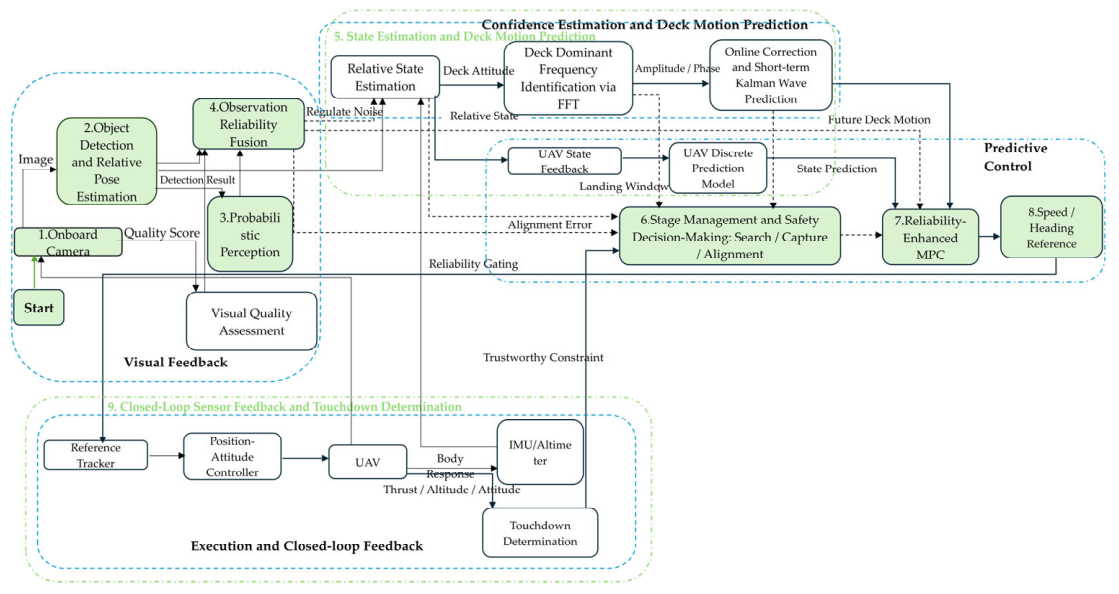
To meet the demands of autonomous landing under complex sea conditions and degraded visual environments, this paper introduces probabilistic perception, visual quality assessment, and observation reliability fusion mechanisms into the traditional control pipeline of “visual detection, wave prediction, model predictive control, and flight control execution.” On this basis, a reliability-enhanced fully decentralized landing control framework is constructed. This framework not only focuses on determining feasible landing windows, but also further considers whether the current visual observations are sufficient to support a safe final descent. The overall control process is illustrated in
Figure 1.
Figure 1 illustrates the fully decentralized UAV landing control process based on probabilistic perception and visual quality assessment proposed in this paper. The onboard camera first performs visual detection and pose estimation of the target deck, followed by online prediction of the deck’s roll and pitch motion using FFT spectral decomposition and a Kalman observer. Meanwhile, the probabilistic perception module outputs detection uncertainty, and the visual quality assessment module quantifies the task usability of the current image. Together with the detection posterior probability, these form the observation reliability metric, which is then applied to state estimation, phase transitions, and final descent decision-making. Ultimately, the reliability-enhanced MPC controller integrates the predicted deck motion, UAV predicted state, and observation reliability information to generate velocity references and heading control commands. These are processed by the reference tracker, position and attitude controllers, and flight control actuators to control the UAV, with onboard sensors and state estimators closing the feedback loop. Compared to existing research methods, this approach not only determines “when a feasible landing window exists,” but also further evaluates “whether current visual observations are sufficient to support a safe descent,” thereby improving the safety and robustness of autonomous landing under complex sea conditions and degraded visual environments.
3.1. USV Motion Prediction Model
To maintain consistency with the original MPC-NE framework, this paper still adopts a ship/unmanned surface vehicle (USV) motion prediction model based on wave period decomposition. Let the six-degree-of-freedom pose of the target platform in the world coordinate frame be denoted as
Here, , , and represent the position components of the target platform, while φ, θ, and ψ denote the roll, pitch, and yaw angles, respectively. Considering that the landing phase is most sensitive to deck attitude, this paper mainly focuses on the periodic oscillations in the roll and pitch directions. For compact notation, these six components are also expressed as , (j = 1, 2…), where = x, = y, = z, = φ, = θ, and = ψ. Considering that the landing phase is most sensitive to deck attitude, this paper mainly focuses on the periodic oscillations in the roll and pitch directions.
The motion of the
j degree of freedom can be expressed as
represent the amplitude, frequency, and initial phase of the i frequency component, respectively, and denotes the non-periodic term. This decomposition is suitable for modeling the motion of platforms that are approximately stationary and primarily affected by wave-induced periodic disturbances.
To eliminate low-amplitude noise components, a spectral filtering threshold is set.
The purpose of this threshold is to retain the primary oscillation modes and prevent noise from being misidentified as valid wave components. By employing a similar thresholding strategy, this process has a significant impact on the subsequent convergence of the Kalman observer.
After obtaining the main frequency components, a Kalman observer is used to perform online correction of the amplitude and phase for each mode. Let the state corresponding to the
i mode in the
j degree of freedom be denoted as
Its continuous-time dynamics are
After superimposing all modes, the overall observer model for the
j-th degree of freedom can be obtained
Among them
is a block diagonal matrix and
the corresponding output matrix. After discretization, it can be obtained as follows:
Furthermore, after obtaining the latest observer state at time
, the amplitude and phase can be extracted from the observer state, and the deck motion at a future time
can be further predicted.
This equation utilizes a modeling approach that first performs online identification of the platform state, followed by online correction, and then short-term prediction of the future platform state. This serves as the foundation for subsequent ship approach window determination and constrained optimization.
Selection of Spectrum Filtering Parameters
To ensure the stability of roll and pitch main oscillation mode identification for ship/unmanned surface vehicle platforms, this paper standardizes the key parameters in the motion prediction module based on the spectrum filtering mechanism provided in Equation (4), as shown in
Table 1. Among these, the spectrum filtering coefficient
is used to suppress low-amplitude noise modes, retaining only the dominant wave components for subsequent Kalman online correction and short-term state prediction.
The parameter settings in
Table 1 reflect a modeling approach that prioritizes dominant modes and focuses on short-term prediction. Since the methods in
Section 2 mainly address the periodic oscillations in the deck’s roll and pitch directions, a conservative and limited number of effective modes are selected. Additionally, an amplitude threshold is applied to mitigate the impact of noisy frequency components on the convergence of the observer. This ensures that the deck motion inputs used for subsequent ship landing-window determination and predictive control optimization remain stable. Equations (2)–(9) describe this prediction process.
3.2. Reliability-Aware Observation Model
Unlike conventional model predictive control methods based on nonlinear observers, which directly feed visual pose measurements into the prediction and control chain, this paper further considers the issue of insufficient reliability of visual observations under complex sea conditions. Let the observation output of the onboard vision at time step
k be
represents the UAV’s relative state with respect to the deck, is the visual observation function, and is the observation noise covariance matrix.
To assess whether the current visual observation is sufficient to support a safe landing, this paper first introduces a probabilistic perception module. For the
K-th image frame, after
M stochastic forward passes, the mean of the class distribution output by the object detection network is defined as
On this basis, by combining the predictive entropy and the covariance of outputs from multiple forward passes, the perception uncertainty is defined as
This uncertainty measure is used to determine whether the detection results are stable and reliable, thereby avoiding overly optimistic judgments that may arise from relying solely on single-instance confidence scores. This design draws on research approaches for uncertainty quantification and calibration in safety-critical visual detection, but in this paper, it is further tailored for the ship landing scenario and is directly used to construct estimation and decision-making weights in subsequent processes [
29].
Meanwhile, to assess the usability of the current image for the landing task, the visual quality score is defined as
denotes the output of a no-reference image quality assessment network;
,
,
represent the sharpness, exposure quality, and target visibility metrics, respectively; and
refers to the output of a lightweight no-reference image quality assessment network. Research on no-reference image quality assessment has shown that Transformers and multi-dimensional attention mechanisms can effectively model both global and local image degradations, providing a transferable technical foundation for onboard image quality scoring [
24,
26,
27]. In this work, visual quality assessment is not used as a general aesthetic image score. Instead, it is interpreted as a task-related observation usability indicator for shipboard landing. For vision-based UAV landing, the relative pose estimation of the deck or landing marker mainly depends on the detectability of target edges, corner localization accuracy, sufficient exposure, image sharpness, and target visibility. Degradations such as motion blur, sea-surface reflection, low illumination, spray interference, and partial occlusion directly reduce the accuracy and stability of target detection and pose estimation. Therefore, the visual quality score is introduced to describe whether the current image contains sufficient usable visual information for safe relative state estimation.
However, visual quality alone is not assumed to completely determine observation reliability. It is combined with the detection posterior probability and perception uncertainty. The posterior probability reflects the detector’s confidence in the target category, the uncertainty term reflects the stability of the probabilistic perception output, and the image quality score reflects the usability of the visual input itself. By fusing these three factors, the proposed reliability model avoids relying solely on detector confidence, which may be overoptimistic under blur, reflection, or occlusion.
Based on the detection posterior probability, visual quality score, and perception uncertainty, the observation reliability is further defined as
denotes the maximum a posteriori probability of the main target,
is the visual quality score,
are the weighting coefficients, and
represents the Sigmoid function, that is,
When the detection results are stable, the image quality is good, and the perception uncertainty is low, the observation reliability becomes large. Conversely, when the image is blurred, overexposed, occluded, or the detection becomes unstable, the observation reliability decreases.
Finally, the observation reliability is used to adaptively adjust the observation noise covariance online:
In this paper, the visual measurement vector contains the relative position and relative attitude estimated from the onboard visual perception module, namely
Therefore, the observation noise covariance matrix satisfies
The adaptive covariance matrix is bounded between a nominal lower bound and a degraded-observation upper bound:
Specifically,
corresponds to the covariance under clear visual observation and stable marker detection, whereas
corresponds to the maximum covariance allowed under severe visual degradation, such as low illumination, motion blur, reflection, and partial occlusion. The covariance is updated according to the observation reliability as
where
is the observation reliability,
controls the nonlinear amplification of unreliable observations, and
is a smoothing factor used to avoid abrupt covariance jumps. When
is high,
approaches
, and the filter assigns more confidence to the visual measurement. When
decreases,
approaches
, and the Kalman observer becomes more conservative.
3.2.1. Causal Prediction of Visual Reliability Quantities over the MPC Horizon
At the current sampling instant k, the onboard vision system only has access to the current image frame and historical sensor information. Therefore, the future visual reliability-related quantities used in the MPC prediction horizon are not treated as future measured values. Instead, they are generated causally from the currently available perception output before solving the MPC optimization problem.
Specifically, after the current image frame is processed, the detector posterior probability
, the visual quality score
, the perception uncertainty
, and the fused observation reliability
are obtained according to Equations (11)–(14). Since the MPC prediction horizon adopted in this paper is short, namely
N = 10 with a sampling interval of 0.1 s, the visual degradation level is assumed to vary slowly within one prediction horizon compared with the MPC update rate. Therefore, a zero-order-hold reliability prediction is adopted as the nominal causal approximation:
To avoid overly optimistic use of the current visual observation under rapidly degraded imaging conditions, a conservative degradation margin can also be introduced:
where
is the sampling interval,
and
are conservative degradation rates, and
and
are predefined lower and upper bounds. In the simulations of this paper, the zero-order-hold form is used as the nominal setting because of the short prediction horizon, while the conservative degradation form provides an optional safety margin under severe low illumination, motion blur, reflection, or occlusion. At the next sampling instant, the onboard vision system receives a new image frame, updates
,
,
,
, and solves the MPC problem again in a receding-horizon manner. Therefore, the proposed reliability-enhanced MPC does not require unavailable future visual observations and remains causal and online implementable.
Since both
and
are diagonal positive definite matrices, the time-varying covariance matrix
is uniformly positive definite and bounded. Therefore, the innovation covariance
is always positive definite, and the Kalman gain
remains bounded. Under the standard conditions that the observer model is uniformly detectable and the process noise covariance is bounded, the estimation error covariance remains bounded in the time domain. In addition, when the observation reliability becomes too low, the phase-switching mechanism prevents the UAV from entering the final descent phase and keeps the system in hover-wait, re-alignment, or go-around mode. Therefore, the adaptive covariance update does not cause estimator divergence; instead, it prevents overconfident use of degraded visual measurements.
Model predictive control methods based on nonlinear observers treat visual pose as the sole source of platform state in scenarios without communication, performing FFT decomposition and Kalman correction based on this input. In contrast, this paper explicitly models the “reliability” of visual information at the observation level, so that state estimation no longer assumes all visual observations have equal reliability.
3.2.2. Selection of Probabilistic Perception and Visual Quality Assessment Parameters
The selected components are determined by the failure modes of fully decentralized shipboard landing. First, probabilistic perception is introduced because the UAV cannot rely on external communication or active shipborne beacons, and the onboard vision system must estimate not only the target state but also the confidence and uncertainty of its own perception output. Second, visual quality assessment is introduced because detector confidence alone cannot fully reflect whether the image is usable for pose estimation. In maritime environments, blur, reflection, low illumination, and occlusion may degrade the geometric information required for landing even when a detector still produces a high confidence score. Third, MPC is adopted because shipboard landing is a constrained predictive control problem involving deck attitude, landing-window selection, control smoothness, and descent safety. Therefore, these modules are selected not for simple functional combination, but because they correspond to three coupled requirements of the landing task: perception trustworthiness, observation usability, and constrained predictive decision-making.
In the reliability-aware observation model, this paper uses probabilistic perception to estimate detection uncertainty and visual quality assessment to quantify the usability of the current image for the landing task. Based on this, the observation reliability index is constructed according to Equations (13) and (14). Since the original literature provides the variable formulation but does not disclose specific hyperparameters for each term, the weights in this paper are empirically tuned following the principle of “detection reliability as the primary factor, task-related image usability as secondary, and explicit penalization of uncertainty.” The relevant parameter settings are shown in
Table 2.
In
Table 2,
–
satisfies the normalization requirement in Equation (13) and is used to comprehensively characterize overall image quality, sharpness, exposure status, and target visibility.
,
,
is used for the Sigmoid reliability mapping in Equation (14), where the posterior probability term is dominant, the image quality term provides auxiliary correction, and the uncertainty term acts as a suppression factor in the fusion process. This configuration helps prevent the system from making overly optimistic judgments based on single-frame high-confidence observations under degraded visual conditions such as blur, overexposure, or occlusion.
To reduce the empirical nature of the parameter selection, all perception-related quantities are normalized into the interval [0, 1] before reliability fusion. The posterior probability represents the direct confidence of target detection, the visual quality score reflects the task-oriented usability of the image for pose estimation, and the uncertainty term describes the temporal and probabilistic instability of the perception output. Therefore, the posterior probability is assigned the largest positive weight, the image quality score is assigned a secondary positive weight, and the uncertainty term is assigned a negative penalty weight. This design follows the principle that a reliable landing observation should simultaneously have high detection confidence, sufficient image usability, and low perception uncertainty.
In addition, the weights can be adjusted according to the degradation level of the current maritime visual condition. A normalized degradation index is introduced as
where
denotes the normalized deck-motion intensity related to roll and pitch variation,
denotes the illumination attenuation level,
is the visual quality score, and sat(⋅) limits the value to [0, 1]. When sea-state-induced motion or illumination attenuation becomes stronger,
increases. The reliability-fusion weights can then be updated as
where
,
and
are the nominal values listed in
Table 2. This adaptive scaling reduces excessive dependence on single-frame posterior confidence and increases the influence of image quality and uncertainty under degraded observations. In the simulations of this paper, the nominal values in
Table 2 are used as the baseline setting, while the influence of different weight combinations is further evaluated through sensitivity analysis in
Section 4.6.
3.3. UAV Discrete Prediction Model
In the UAV prediction model section, a discrete linear time-invariant model is used to describe the UAV’s kinematic behavior within the prediction horizon. Let the UAV state vector be
The control input is the jerk of each channel:
Thus, the discrete prediction model of the UAV can be expressed as
The state matrix and the input matrix are given by
To facilitate subsequent closed-loop stability analysis of the reliability-enhanced model predictive controller, the reference trajectory tracking error and the control increment are further defined based on the above discrete prediction model as follows:
Here,
denotes the reference state provided during the alignment phase or the final landing phase, and
represents the control input increment. To provide a unified description of the state error and input memory terms, an augmented state is introduced.
Then, the augmented error system for the final landing phase can be written as
Here, represents the equivalent disturbance term, which is composed of the deck prediction residual, visual estimation error, and external wind and wave disturbances. The above augmented error model provides a unified framework for constructing the Lyapunov function and analyzing closed-loop stability in the subsequent sections.
This model is essentially an Euler discretization approximation based on single-particle kinematics. Therefore, the innovation of this paper does not lie in reconstructing UAV dynamics, but rather in leveraging more reliable perception results to provide more robust state inputs and decision support for predictive control.
3.4. Reliability-Enhanced MPC Objective Function
The MPC objective function generally consists of a trajectory tracking term, a control smoothing term, and a landing barrier term. The trajectory tracking term constrains the deviation of the UAV from the deck reference state, while the control smoothing term suppresses abrupt changes in the control input. The landing barrier term jointly models pitch angle, roll angle, and altitude errors, enabling the UAV to descend and make contact when a feasible landing window appears. The primary role of this barrier term is to ensure safe shaping of the final descent phase, rather than serving as a terminal cost in the conventional sense.
To further enhance decision-making robustness under complex sea conditions and degraded visual scenarios, this paper introduces a reliability enhancement term into the original objective function and additionally incorporates a standard quadratic terminal penalty in the theoretical analysis, thus forming a new time-domain optimization objective. Let the prediction horizon length be (
N); then, the optimization objective can be written as follows:
where the stage cost function is defined as
The conventional trajectory tracking and control smoothing terms are defined as
is the state error weighting matrix, and is the control increment weighting matrix. This term ensures that the UAV maintains both tracking accuracy and input smoothness during approach and descent, preventing final-phase attitude oscillations caused by rapid changes in the control channels.
The landing barrier term in the original formulation remains unchanged and is denoted as
is the piecewise Sigmoid barrier function, which represents the composite landing variable associated with the deck contact process, and are the barrier parameters jointly determined by deck roll, pitch, and descent altitude, and is the weighting coefficient for the barrier term. This term is used to construct a safety potential field from the holding area to the feasible descent region, guiding the UAV to prioritize descent when the deck attitude is near zero inclination.
On this basis, this paper introduces an additional reliability enhancement term. The reliability-related variables used in this term are not future measured visual quantities, but causal horizon-wise estimates generated at time step K according to
Section 3.2.1.
Here, , , and denote the horizon-wise observation reliability, visual quality score, and perception uncertainty estimated at the prediction step using information available at time step K. , , and are the corresponding penalty weights. Since these quantities are generated from the current and past visual observations before each MPC optimization, the reliability-enhanced MPC formulation satisfies causality and can be implemented online in a receding-horizon manner. The introduction of this term enables the optimizer to consider not only whether the platform will enter a feasible landing window in the future, but also whether the current visual observation and its causal horizon-wise reliability estimates are sufficiently reliable to support continued descent.
To facilitate the subsequent derivation of closed-loop stability results, a terminal penalty term is further introduced in the theoretical analysis.
and the terminal feasible set is defined as
Here,
is the terminal local feedback gain,
is the input constraint set, and
is the terminal set boundary parameter. Accordingly, the final optimization problem in this paper can be written as
s.t.
Here, denotes the augmented state constraint set. The above objective function retains the safety shaping effect of the landing barrier term, enhances conservativeness under degraded visual conditions through the reliability enhancement term, and provides a foundation for closed-loop stability analysis by incorporating the terminal penalty and terminal constraint.
3.4.1. Selection of MPC Weight Matrices and Penalty Coefficients
To explicitly incorporate observation reliability into the landing control optimization process, this paper uniformly tunes the key weights in the trajectory tracking term, control smoothing term, landing barrier term, reliability enhancement term, and terminal penalty term, based on the objective function given in Equations (40)–(45). The results are shown in
Table 3. Considering that the final landing phase requires both attitude safety, smooth descent, and real-time solvability, this paper prioritizes the strengthening of vertical state constraints and observation reliability constraints in the weight design.
As shown in
Table 3, this paper adopts a “vertical-priority, lateral-secondary, moderate-attitude” configuration strategy for the state error and control increment terms. Specifically, in Equation (42), the weights for position and velocity in the Z (vertical) direction are increased to enhance the stability of the final descent; in Equation (43), the landing barrier term retains its safety shaping effect for the zero-inclination window; in Equation (44), observation reliability, uncertainty, and visual quality are incorporated into the descent decision via the reliability-related penalty terms. In Equation (45), the terminal penalty is not assigned as an arbitrary fixed matrix. Instead, the terminal synthesis matrices
and
are used to compute the terminal weighting matrix
and the terminal feedback gain
K through the discrete algebraic Riccati equation. This modification provides an explicit synthesis procedure for the terminal ingredients used in the closed-loop stability analysis. The MPC weight matrices are selected according to the physical importance of different landing states and the allowable error range of each channel. Specifically, the vertical position and velocity weights are set larger than the lateral weights because the final touchdown safety is more sensitive to vertical descent error and deck inclination. The control increment matrix is selected to suppress aggressive changes in the jerk command and to maintain real-time numerical solvability. The barrier weight is used to emphasize the zero-inclination landing window, whereas the reliability-related penalty weights are used to prevent descent when the visual observation is unreliable.
A scaling-based rule is used to guide the selection of the diagonal elements:
where
is the allowable tracking error of the
i-th state,
is the allowable control increment of the
j-th input, and
,
are task-dependent scaling factors. Larger values of
are assigned to vertical states and touchdown-related attitude states, while larger values of
are used when smoother control commands are required.
To further account for different sea states and visual degradation levels, the reliability-related MPC weights can be boundedly adjusted as
where
,
, and
are the nominal values in
Table 3. This mechanism increases the penalty on unreliable observations when the sea state becomes more severe or the illumination condition deteriorates. To avoid excessive conservativeness, all adaptive weights are bounded within predefined lower and upper limits. In this paper, the nominal weights in
Table 3 are used for the main comparison, and additional sensitivity tests are conducted in
Section 4.6 to verify that the proposed controller is not overly dependent on a single parameter setting.
3.4.2. Lyapunov-Based Closed-Loop Stability Analysis
To avoid assuming the existence of the terminal controller without construction, the terminal feedback gain and terminal weighting matrix are explicitly synthesized based on the tracking-error and augmented-state definitions in Equations (35) and (36) and the augmented error system in Equations (36)–(39). Since the tracking error state is and the control increment is , the augmented error state is denoted as . The terminal control law is designed as .
Where
. The terminal gain K is obtained by solving a discrete-time LQR problem for the augmented linear error system
Let
and
be the terminal synthesis weighting matrices. The terminal weighting matrix
is computed from the discrete algebraic Riccati equation
Then, the terminal feedback gain is given by
Under the stabilizability of
and the detectability of
, the solution
is symmetric positive definite, and the closed-loop matrix
is Schur stable. Therefore, there exists a positive definite matrix
satisfying the Lyapunov decrease condition
The terminal feasible set is selected as the ellipsoidal positively invariant set
where
is chosen such that all state and input constraints are satisfied for any
. In this way, the terminal controller is not assumed a priori, but is constructed from the Riccati equation, and the terminal set is selected to ensure recursive feasibility and local closed-loop stability.
and denote the closed-loop state matrix as
Since
is Schur stable by the above DARE-based synthesis, there exists a symmetric positive definite matrix
satisfying the following discrete Lyapunov equation:
where
The candidate Lyapunov function is chosen as
Then, along the trajectory of the augmented error closed-loop system, the following relation is obtained:
Substituting into the discrete Lyapunov equation yields
Furthermore, applying Young’s inequality
Here, , are positive constants. From the above, it can be seen that when , then ; thus, the augmented error system is locally asymptotically stable at the equilibrium point . When , the closed-loop system satisfies input-to-state practical stability, meaning the system state ultimately converges to a bounded neighborhood related to the disturbance upper bound .
Under the model predictive control framework, let
denote the optimal value function of the above optimization problem. Given recursive feasibility, positive invariance of the terminal set, and feasibility of the terminal control law, the standard shifted sequence yields
By the positive definiteness of the stage cost function, this can be further written as
is a constant. The above results indicate that it can serve as an input-to-state practically stable Lyapunov function for the proposed reliability-enhanced MPC closed-loop system. Since both the landing barrier term and the reliability enhancement term are non-negative safety shaping terms, they enhance the conservativeness in selecting feasible landing windows and observation reliability during the final descent phase, without disrupting the monotonic decrease property of the optimal value function. Therefore, under the conditions of terminal constraints and recursive feasibility, the reliability-enhanced MPC controller designed in this paper ensures local stability and practical boundedness of the closed-loop system during the final landing phase.
3.5. Reliability-Constrained Landing Phase Switching Mechanism
Before initiating the landing phase, two conditions must be met: First, the FFT accuracy must reach a threshold to ensure that slow oscillation mode identification is sufficiently reliable. Second, the horizontal position error and horizontal velocity must be small enough to ensure that the UAV is already in a controllable alignment state. Only when both conditions are satisfied will the landing barrier term be activated, and the MPC will begin searching for an appropriate zero-tilt landing window.
This paper further introduces observation reliability, image quality, and uncertainty constraints on this basis, and defines the ship landing criterion with reliability constraints as follows:
and represent the horizontal position error and horizontal velocity error, respectively, is the spectral identification accuracy metric, and , , , , and are the corresponding thresholds. Only when the above conditions are continuously satisfied for frames will the system switch from the alignment wait phase to the final descent phase; otherwise, it will remain in hovering wait, re-align, or initiate a go-around. Compared with the model predictive control method based solely on a nonlinear estimator, this paper does not change the core idea of waiting for an appropriate landing window before descent, but instead adds an assessment of whether the current visual observation is trustworthy.
For phase switching, the reliability constraints are evaluated using the current smoothed values and consecutive-frame verification. For the MPC prediction horizon, the corresponding reliability-related quantities are replaced by their causal predictions
,
, and
. A conservative horizon-wise reliability condition can be written as
Thus, the UAV is not allowed to enter the final descent phase based on a single reliable-looking current frame. The descent decision requires both consecutive-frame reliability verification and horizon-wise conservative reliability satisfaction. This design prevents non-causal use of future visual observations and suppresses unsafe descent decisions caused by transient high-confidence but low-quality visual detections.
Compared with the model predictive control method based on a nonlinear estimator, this paper does not change the core idea of waiting for an appropriate landing window before descent. Instead, it adds a mechanism to determine whether the current visual observation is trustworthy. Accordingly, the system is named the Probabilistic Perception and Visual Quality Assessment-based Decentralized Predictive Control for UAVs. This approach effectively prevents unsafe descent triggered by single-frame misdetection in scenarios with low illumination, strong reflection, occlusion, or blurring.
Selection Rationale of Threshold Parameters for Phase Transition
During the phase transition in the ship landing process, relying solely on FFT accuracy and horizontal position/velocity errors is insufficient to fully reflect the trustworthiness of observations under degraded visual conditions. Therefore, based on Equations (68)–(71), this paper introduces constraints on observation reliability, image quality, and perception uncertainty to the original phase transition criteria, and sets unified thresholds for each criterion as shown in
Table 4.
The threshold values in
Table 4 are not intended to be universal constants, but are selected according to the safety requirements of the final shipboard landing phase and the numerical range of the proposed reliability-aware observation model. The selection follows three principles. First, the UAV should not enter the final descent phase until the deck motion prediction becomes sufficiently stable. Second, the horizontal alignment error and lateral velocity should be small enough to avoid side contact with the deck during touchdown. Third, the visual observation should be sufficiently reliable, which requires high observation reliability, acceptable image quality, and low perception uncertainty. Therefore, these thresholds are designed to balance landing safety and landing opportunity availability.
As shown in
Table 4, the threshold design reflects the principle of “prediction stability first, alignment verification second, and reliability confirmation third.” The FFT accuracy threshold is used to prevent the controller from entering the final descent phase before the dominant deck motion modes are sufficiently identified. The horizontal position and velocity thresholds are introduced to ensure that the UAV is already in a controllable alignment state. The reliability, image quality, and uncertainty thresholds are used to suppress descent decisions under degraded visual observations. In addition, the consecutive-frame requirement is introduced to avoid phase switching caused by isolated, reliable-looking frames. Therefore, the final descent phase is triggered only when both the geometric landing condition and the perception reliability condition are continuously satisfied. To further verify the rationality of the selected thresholds, a sensitivity analysis with loose, nominal, and strict threshold settings is conducted in
Section 4.5.
The threshold design in
Table 4 embodies the decision-making principle of “first alignment, then verification, followed by descent.” Specifically, the system only allows the transition from the alignment waiting phase to the final descent phase when FFT identification is sufficiently stable, horizontal position and velocity errors are small enough, observation reliability and image quality meet the required standards, and uncertainty is constrained within a safe range. Additionally, these conditions must be continuously satisfied for
frames to prevent false triggering of descent or unsafe landing due to single-frame abnormal observations. This logic is consistent with the design objectives of Equations (68)–(71).
3.6. Algorithmic Novelty Compared with Existing Methods
The proposed method differs from existing robust MPC and reliability-aware control methods in the way perception uncertainty is modeled and used for landing decision-making. Conventional robust MPC methods usually handle uncertainty through fixed disturbance bounds, invariant sets, or conservative observation noise assumptions. Such methods improve robustness at the control level, but they do not explicitly distinguish whether the visual observation itself is trustworthy enough for final descent. In contrast, the uncertainty considered in this work is observation-source-dependent and time-varying. It is caused not only by external disturbances or model mismatch, but also by visual degradation, including motion blur, illumination variation, reflection, sea-spray interference, and partial occlusion.
The algorithmic novelty of this work is reflected in three aspects. First, a task-oriented observation reliability variable is constructed online by fusing detection posterior probability, perception uncertainty, and visual quality assessment. This reliability variable is not manually assigned, but is updated according to the current visual perception state. Second, the reliability variable is directly coupled with estimation and control by adaptively adjusting the observation noise covariance and adding reliability-related penalties to the MPC objective function. Therefore, the conservativeness of the controller becomes perception-adaptive rather than fixed. Third, the final descent phase is triggered only when the deck motion condition, alignment condition, image quality condition, uncertainty condition, and observation reliability condition are continuously satisfied. This prevents single-frame high-confidence but low-quality observations from triggering unsafe descent.
Therefore, the contribution of this paper does not lie in replacing the basic UAV kinematic model or the standard MPC framework. Instead, it lies in introducing a perception-reliability-driven predictive landing mechanism that explicitly links visual observation usability with estimation confidence, descent decision-making, and constrained predictive control.
As shown in
Table 5, standard MPC mainly relies on state prediction and control constraints, but it does not explicitly consider whether the visual observation is reliable. Robust MPC improves safety by using fixed uncertainty bounds or conservative margins, but its conservativeness is not adjusted according to real-time image degradation. Confidence-only methods introduce perception information into the decision process, but detector confidence alone may be overoptimistic under motion blur, reflection, or partial occlusion. In contrast, the proposed method constructs an online observation reliability variable by jointly considering posterior probability, perception uncertainty, and visual quality. This reliability is further embedded into state estimation, MPC optimization, and phase-switching logic, which makes the final descent decision both perception-aware and prediction-constrained.
4. Simulation Results and Analysis
The landing cost function is defined as a combination of several sigmoid functions, that is:
where
is defined as:
Here,
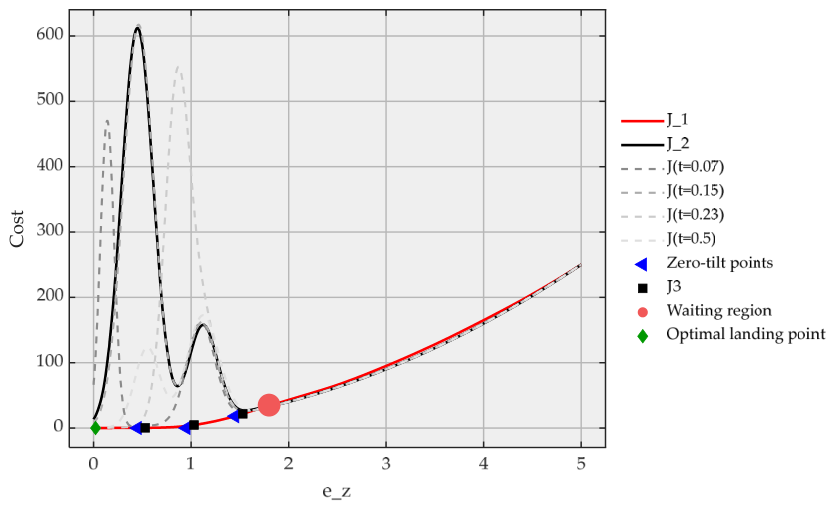
is used to control the waiting area during the landing attempt (see
Figure 2). In the simulations,
is set, together with a reasonable assumption for real-world landing scenarios: the USV’s motion along the x and y axes can be considered negligible. Since the unmanned surface vehicle’s propulsion system can effectively compensate for drift caused by water currents, this is beneficial for achieving a successful landing. Additionally, since the UAV’s descent path will never be directly below the USV, it is also safe to set
.
To activate and initiate landing, two conditions must be met. First, to facilitate the detection of slow oscillations, the FFT accuracy must exceed a given threshold. Second, the position errors in the x and y directions must be below preset thresholds, that is, , and the horizontal velocity must also be sufficiently small.
To illustrate the interaction between
and
during the landing approach, a simplified schematic of the objective function is presented in
Figure 2, where only one mode is used for each of the pitch and roll axes. When
is activated, a composite profile is obtained, determined jointly by the residual error in Equation (72) and
. In
Figure 2, the objective function exhibits a continuously evolving peak over time, which serves as a “barrier.” The higher cost associated with this peak keeps the aircraft within the waiting area (as indicated in the figure). Meanwhile, in each iteration of the MPC, the USV model generates predictions of the USV’s future motion, and at this point,
is involved to further assess whether the current observation and its causal horizon-wise reliability estimates are sufficiently reliable.
At certain moments, the USV will be sufficiently close to zero tilt, and after verifying the reliability, a feasible solution will emerge, as shown by the zero-tilt points in the figure. Subsequently, the UAV can reduce its altitude and approach the target in a way that continuously decreases the cost along the trajectory of these special feasible points, effectively “embedding” itself into these time-varying trajectories. As a result, the UAV can track these zero-tilt points and ultimately reach the optimal landing point, where the system will confirm touchdown based on thrust and other information from the onboard sensors.
4.1. Visual Quality Response Analysis Under Degraded Shipboard Landing Conditions
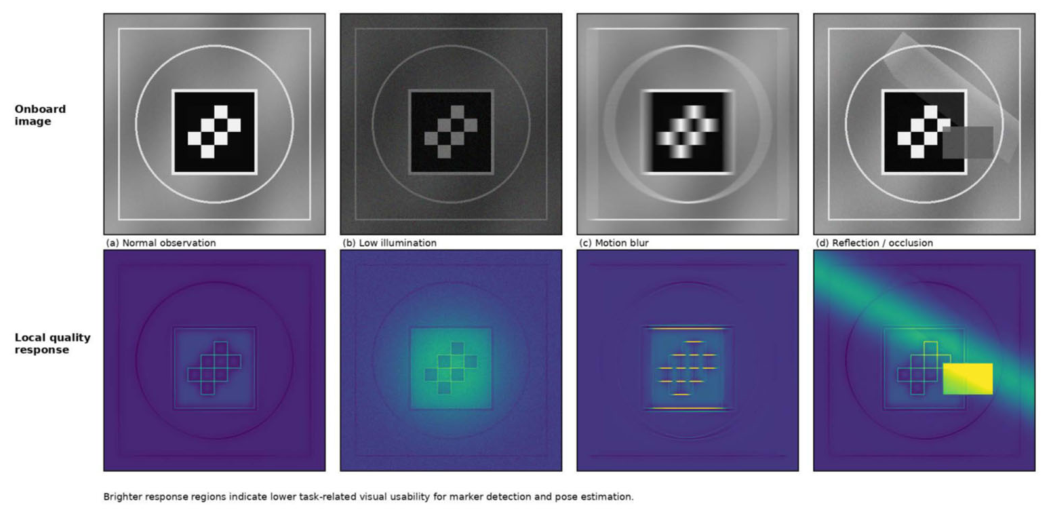
The purpose of this experiment is to evaluate whether the proposed observation reliability model can identify unreliable onboard visual observations before they are used for relative pose estimation and final descent decision-making. Unlike general image quality assessment experiments, this section focuses on degraded visual observations in UAV shipboard landing scenarios. The evaluated degradations include low illumination, motion blur, sea-surface reflection, partial marker occlusion, and background interference, because these factors directly affect AprilTag corner localization, landing-marker detection, and relative pose estimation accuracy.
In the simulation, an AprilTag-like landing marker is mounted on the moving USV deck and observed by the UAV’s onboard camera. The original visual observation is degraded by different maritime imaging disturbances. For each degraded image, the local quality response map is generated to indicate task-related visual usability. In the response map, brighter regions correspond to lower local visual usability, while darker regions correspond to relatively reliable image regions. Therefore, the response map can be used to analyze whether the geometric features required for landing, especially marker edges and corner regions, are affected by visual degradation.
Figure 3 shows the visual reliability evaluation results under different degraded shipboard landing observations. Under normal observation conditions, the landing marker remains clear, and the local quality response is relatively weak, indicating that the image contains sufficient visual information for marker detection and pose estimation. Under low illumination, the response map becomes stronger around the marker boundary and low-contrast regions, showing that the reliability of corner localization is reduced. Under motion blur, strong responses appear near the tag edges and corner neighborhoods, which indicates that the geometric features used for relative pose estimation are degraded. Under reflection and partial occlusion, the low-quality response is concentrated around the corrupted marker region and reflective background areas. These results demonstrate that the proposed visual quality assessment branch can identify degraded visual regions that are directly related to the shipboard landing task.
To further illustrate the role of visual reliability in landing decision-making,
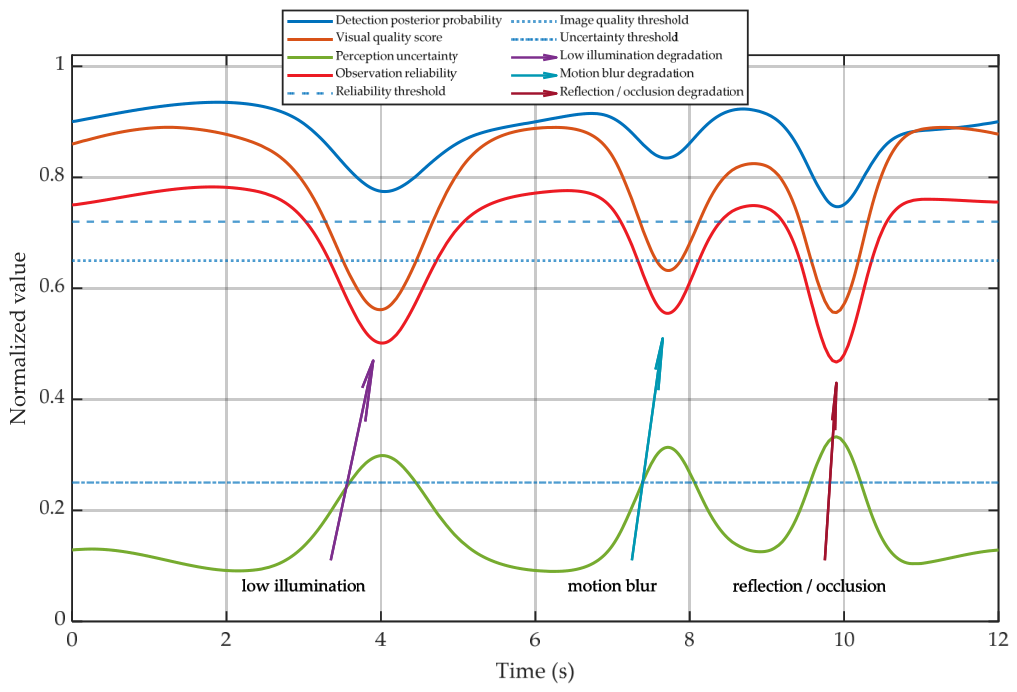
Figure 4 presents the time-varying detection posterior probability, visual quality score, perception uncertainty, and observation reliability under representative degradation events. When the image quality is high and the perception uncertainty is low, the observation reliability remains above the reliability threshold, and the visual measurement can be used by the state estimator and MPC controller. In contrast, when low illumination, motion blur, reflection, or occlusion occurs, the visual quality score decreases, and the perception uncertainty increases. As a result, the observation reliability drops below the required threshold, which prevents the controller from entering the final descent phase based on unreliable single-frame observations.
According to the reliability-aware observation model in
Section 3.2, the proposed method does not use visual quality as an isolated aesthetic score. Instead, the visual quality score is fused with detection posterior probability and perception uncertainty to form an online observation reliability variable. When the observation reliability decreases, the equivalent observation noise covariance is enlarged, and the downstream state estimation becomes more conservative. This mechanism reduces the risk of unstable pose estimation and unsafe descent triggering under degraded maritime visual conditions.
Therefore, the results in this section verify the practical function of the proposed visual reliability model in UAV shipboard landing. The model can distinguish reliable and unreliable visual observations, provide a task-oriented quality evaluation for AprilTag-based pose estimation, and support reliability-constrained phase switching before the final descent. This provides simulation evidence that the proposed method improves landing safety not only by predicting deck motion, but also by evaluating whether the current visual observation is trustworthy enough for safe autonomous landing.
4.2. Deck Motion Prediction Results and Analysis
Accurate short-term prediction of deck roll and pitch is essential for identifying feasible low-inclination landing windows. Therefore, this subsection evaluates the prediction performance of the FFT-based spectral decomposition and Kalman observer under simulated deck motion. The prediction trend, roll and pitch tracking consistency, and prediction error are used to assess whether the proposed motion prediction module can provide reliable inputs for the subsequent MPC landing decision.
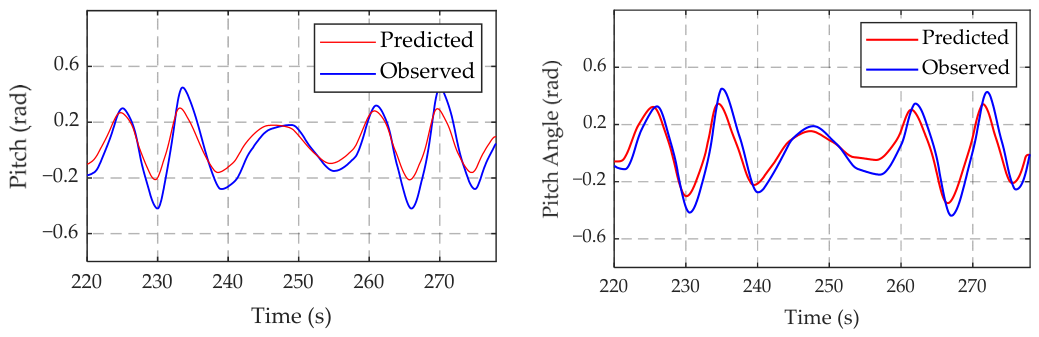
As shown in
Figure 5, the predictions made by the probabilistic perception and visual quality assessment-based decentralized predictive control for UAVs reliably match the observed wave motion. The observer can adaptively estimate the frequency, amplitude, and phase of the oscillatory modes and converge reliably. In contrast, the predictions from the model predictive control based on a nonlinear estimator with AprilTag assistance exhibit slight deviations compared to the results obtained with additional visual quality assessment. This difference in performance can be explained by two factors. First, model linearization in the time domain generates increasing errors as the sampling time increases. Therefore, the integration of visual quality assessment, together with a sampling rate three times higher than that of vision alone, allows for faster and more accurate convergence. Second, the output rate of the AprilTag recognition node fluctuates around 30 Hz, depending on the computational load of the UAV’s onboard computer. This can lead to incorrect mode identification, since the FFT algorithm requires observations to have a fixed sampling rate. Nevertheless, these results indicate that integrating the visual quality assessment module can improve the reliability of deck motion prediction.
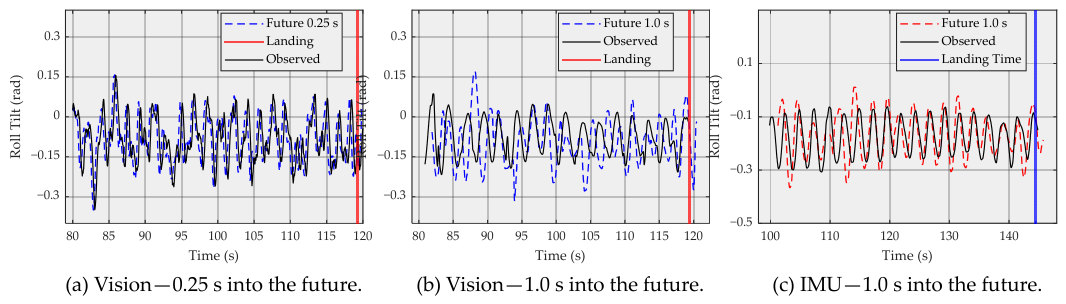
To further evaluate the short-term deck motion prediction module,
Figure 6 compares the predicted and observed roll angles under different sensing sources and prediction horizons. As shown in
Figure 6a, the vision-based prediction with a 0.25 s horizon follows the observed roll motion relatively closely. When the prediction horizon is extended to 1.0 s, as shown in
Figure 6b, the prediction deviation increases due to the longer extrapolation interval and the fluctuation of visual observation quality. In contrast, the IMU-assisted prediction result in
Figure 6c maintains a relatively stable trend under the 1.0 s horizon. These results indicate that short-term motion prediction can provide useful information for selecting low-inclination landing windows. In the proposed framework, this prediction result is further combined with observation reliability, visual quality, and perception uncertainty to determine whether the UAV should enter the final descent phase.
4.3. Ablation Analysis of the Reliability-Enhanced MPC Framework
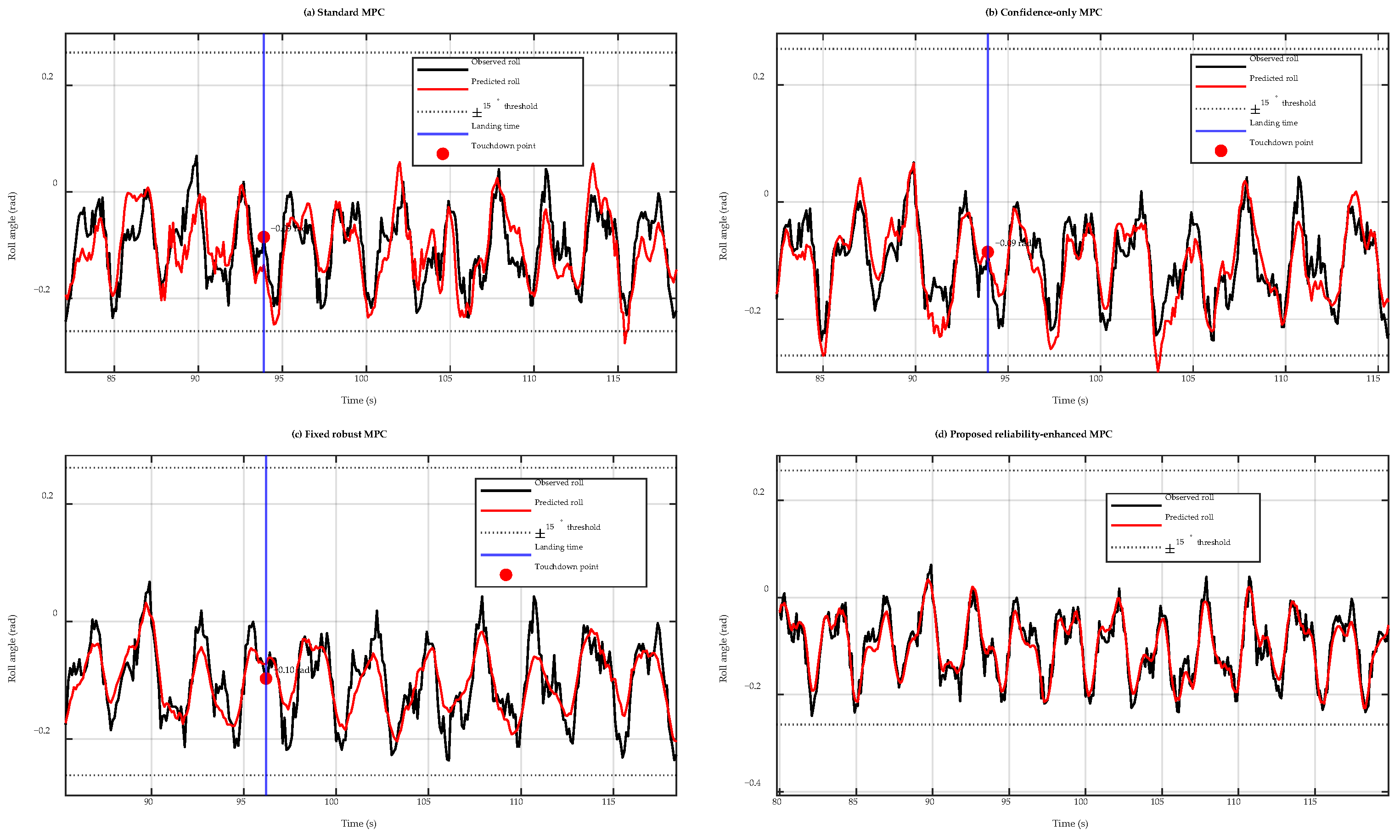
To clarify the contribution of each key component in the proposed framework, an ablation simulation study is conducted under the same simulated shipboard landing conditions. Four strategies were considered: standard MPC, confidence-only MPC, fixed robust MPC, and the proposed reliability-enhanced MPC. As shown in
Figure 7, the standard MPC mainly relies on deck motion prediction and may trigger landing when the visual observation is unreliable. The confidence-only MPC introduces detector confidence into the decision process, but it may still be affected by overconfident detections under blurred or low-quality images. The fixed robust MPC adopts a conservative landing criterion, but its conservativeness is not adaptively adjusted according to real-time visual conditions. In contrast, the proposed method jointly considers predicted deck motion, posterior probability, visual quality, perception uncertainty, and observation reliability. Therefore, it can suppress unsafe descent decisions under degraded visual conditions and select a safer low-inclination landing window.
To further verify that the performance improvement is not merely caused by the basic MPC structure, an ablation comparison was conducted under the same deck motion and degraded visual conditions. Four strategies were compared: standard MPC, confidence-only MPC, fixed robust MPC, and the proposed reliability-enhanced MPC. The standard MPC removes all perception reliability information. The confidence-only MPC uses only the detection posterior probability. The fixed robust MPC adopts a conservative but fixed uncertainty margin. The proposed method uses the complete reliability model, including posterior probability, visual quality assessment, perception uncertainty, and reliability-constrained phase switching.
As shown in
Table 6, the standard MPC exhibits a relatively high false descent rate because it does not consider the reliability of visual observations. The confidence-only MPC improves the landing performance to some extent, but it may still be affected by overconfident detections under blur, reflection, or partial occlusion. The fixed robust MPC reduces unsafe descent decisions by using conservative margins, but its conservativeness is not adaptively adjusted according to real-time visual degradation. In contrast, the proposed method achieves the highest landing success rate and the largest proportion of landings within 15°, while maintaining a comparable average solution time. These results indicate that the improvement comes from the complete reliability-aware mechanism rather than from a single module or parameter adjustment.
4.4. Landing Results Analysis
The touchdown performance under low deck inclination conditions is evaluated in this subsection.
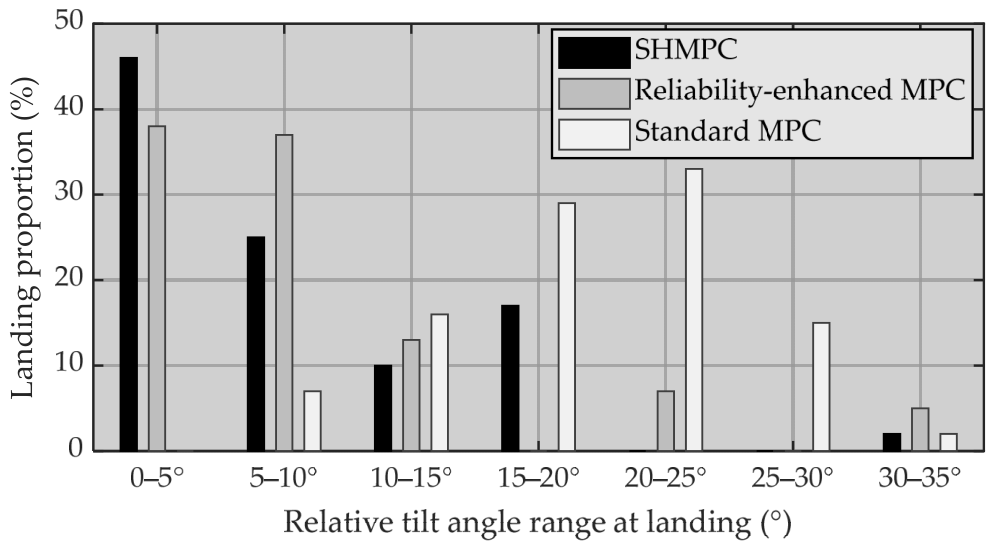
Figure 8 presents the results of the numerical comparison between the reliability-enhanced MPC proposed in this work and the advanced SHMPC method. It can be observed that about 75% of landings with the reliability-enhanced MPC occur within an inclination angle of 10°, while under the landing control of SHMPC, the percentage of landings within the same inclination range is about 71%. The average solution time of SHMPC is approximately 913 ms per iteration, whereas that of the proposed reliability-enhanced MPC is approximately 104 ms per iteration.
Moreover, in the same figure, the results of the simulations carried out with MATLAB2024b are shown. It is important to emphasize that there are some differences between the numerical simulation results and those of the realistic simulation, since the realistic simulation is subject to processing time constraints and the algorithms must be executed in real time. It can be observed that, with the standard MPC method, 24% of landings occur within a tilt angle of 15°, while with the reliability-enhanced MPC method, this percentage is 82%. Furthermore, compared to the standard method, the proposed method reduces the 80th percentile result by 9°. In this comparison, a successful landing is defined as a trial in which the platform tilt angle at touchdown is less than 20°. Under the maximum deck tilt amplitude of 0.5 rad, the proposed method achieved 45 successful landings and 5 failed landings in 50 trials, corresponding to a landing success rate of 90% and a failure rate of 10%. In contrast, the standard MPC method exhibited a failure rate of about 50%. Finally, even in less ideal and more challenging scenarios, the system designed in this work is able to achieve about 74% successful landings within one minute after reaching the FFT accuracy threshold.
4.5. Sensitivity Analysis of Phase-Switching Thresholds
To further evaluate the influence of the phase-switching thresholds, a sensitivity analysis was conducted by varying the key thresholds around their nominal values. The reliability threshold, image quality threshold, uncertainty threshold, horizontal position error threshold, horizontal velocity threshold, and consecutive-frame number were adjusted within a reasonable range. The landing success rate, false descent rate, average waiting time, and touchdown roll angle were used as evaluation metrics. The results show that overly loose thresholds may increase the risk of premature descent under degraded visual conditions, while overly strict thresholds may reduce landing opportunity availability and increase waiting time. The nominal values used in this paper provide a balanced trade-off between safety and landing efficiency.
As shown in
Table 7, the loose threshold setting provides more frequent landing opportunities and therefore results in the shortest average waiting time. However, because the reliability, image quality, uncertainty, and alignment constraints are relaxed, the UAV is more likely to enter the final descent phase under degraded visual observations, leading to a higher false descent rate and a larger mean touchdown angle. In contrast, the strict threshold setting significantly reduces the false descent rate and achieves the smallest mean touchdown angle, but it also increases the average waiting time and may cause the controller to miss some feasible landing windows. The nominal threshold setting achieves the highest overall landing success rate and maintains 82% of landings within 15°, while keeping the false descent rate at a relatively low level. Therefore, the nominal thresholds adopted in
Table 4 provide a reasonable trade-off between landing safety and landing opportunity availability.
4.6. Sensitivity Analysis of Reliability and MPC Weight Parameters
To further evaluate the influence of the empirical parameters listed in
Table 2 and
Table 3, a sensitivity analysis is conducted for both the reliability-fusion weights and the MPC penalty coefficients. The purpose of this analysis is to verify whether the proposed method remains effective under different parameter combinations, and to clarify the trade-off among landing safety, landing opportunity availability, and real-time solvability. In each setting, Monte Carlo simulations are conducted under degraded maritime visual conditions, including deck-motion variation, illumination attenuation, motion blur, and partial target occlusion. The main evaluation metrics include the landing success rate within a 15°deck inclination, false descent rate, mean touchdown inclination, average waiting time before descent, and average MPC solution time.
As shown in
Table 8, reducing the uncertainty penalty or the image-quality weight increases the probability of premature descent under degraded visual observations. Although this may shorten the waiting time, it leads to a higher false descent rate and a larger touchdown inclination. In contrast, increasing the uncertainty penalty or image-quality weight improves landing conservativeness and reduces unsafe descent decisions, but it also increases the waiting time before descent. The nominal setting provides a balanced trade-off between landing opportunity and safety. These results indicate that the proposed reliability model is not overly sensitive to a single weight value, but the uncertainty penalty and image-quality weight play important roles in suppressing unsafe descent under degraded visual conditions.
Table 9 shows that the reliability-related MPC penalties have a clear influence on the final descent behavior. When the reliability penalty is too small, the controller tends to accept landing windows even when the visual observation is not sufficiently reliable, resulting in a higher false descent rate. When the reliability penalty is too large, the controller becomes more conservative, and the false descent rate decreases, but the landing opportunity may be delayed. Similarly, a larger barrier weight improves the tendency to select low-inclination touchdown windows, but an excessively large value may reduce the flexibility of trajectory tracking. The nominal setting achieves a reasonable balance among landing safety, touchdown accuracy, and real-time computation. The average solution time remains close to 100 ms in all tested cases, indicating that the additional reliability-related penalties do not significantly increase the computational burden.
To examine the adaptability of the proposed parameter mechanism under different environmental degradation levels, additional simulations are performed under three representative conditions: mild degradation, moderate degradation, and severe degradation. Mild degradation corresponds to small deck-motion variation and sufficient illumination; moderate degradation includes stronger roll/pitch motion and partial illumination attenuation; severe degradation includes larger deck-motion fluctuation, stronger image blur, and lower target visibility. The results show that, as the degradation level increases, the adaptive reliability mechanism increases the penalty on uncertainty and low image quality, thereby reducing unsafe descent decisions. Although the waiting time before descent slightly increases under severe degradation, the controller avoids aggressive descent based on unreliable visual observations. This behavior is consistent with the safety-oriented design objective of the proposed reliability-enhanced MPC framework.
5. Conclusions
This study investigated the problem of fully decentralized UAV landing on a dynamic USV platform under degraded visual conditions. The main finding is that the final descent decision should not be determined only by deck motion prediction or detector confidence. Instead, the trustworthiness of the visual observation itself must be considered before allowing the UAV to enter the final landing phase.
To address this issue, a perception-reliability-driven predictive landing framework was developed. The proposed method constructs an online observation reliability variable by jointly considering detection posterior probability, perception uncertainty, and visual quality assessment. This reliability variable is then embedded into observation noise adaptation, MPC optimization, and reliability-constrained phase switching. In this way, the controller can adapt its conservativeness according to real-time visual degradation, rather than relying on fixed uncertainty margins or confidence-only decision rules.
The simulation results show that the proposed reliability-enhanced MPC improves the safety of landing-window selection under degraded observations. Compared with standard MPC, confidence-only MPC, and fixed robust MPC, the proposed method reduces unsafe descent decisions and achieves a better balance between landing success rate, touchdown attitude, false descent suppression, and real-time solvability. The sensitivity analysis further indicates that the selected phase-switching thresholds provide a reasonable trade-off between landing opportunity availability and descent safety: overly loose thresholds increase the risk of premature descent, whereas overly strict thresholds may cause excessive waiting or missed landing windows. In addition, the analysis of the reliability-fusion weights and MPC penalty coefficients confirms that the selected parameters provide a balanced trade-off between landing opportunity and descent safety. Under stronger sea-state disturbance and illumination attenuation, the adaptive reliability mechanism increases controller conservativeness and reduces unsafe descent decisions.
The proposed method also has several limitations. First, the current validation is mainly based on simulation and software-in-the-loop analysis, and real shipboard flight tests under complex sea conditions are still required. Second, although the threshold parameters are supported by sensitivity analysis, their optimal values may vary with UAV size, deck motion intensity, camera configuration, and maritime illumination conditions. Third, the current framework mainly considers visual degradation and deck roll/pitch prediction, while more complex disturbances such as strong wind gusts, sea spray, communication delay, and deck heave coupling require further investigation.
Future work will focus on three aspects. First, multimodal perception fusion will be introduced by combining vision, IMU, or event-based sensing to further improve observation reliability under severe degradation. Second, adaptive or learning-based threshold tuning will be investigated to reduce the dependence on manually selected parameters. Third, real-world flight experiments on moving vessel platforms will be conducted to verify the practical robustness and deployment feasibility of the proposed reliability-aware landing framework.