This is an early access version, the complete PDF, HTML, and XML versions will be available soon.
Open AccessArticle
Investigation of Grayscale Characterization and Enhanced YOLOv8n for Coal and Gangue Detection
by
Guangyu Zhou
 Guangyu Zhou
Wenqian Xu
Wenqian Xu  ,
,
Zhaosheng Meng
Zhaosheng Meng
Qingliang Zeng
Qingliang Zeng
Qi Wang
Qi Wang
1
College of Mechanical and Electronic Engineering, Shandong University of Science and Technology, Qingdao 266590, China
2
Yili No. 1 Coal Mine, Shandong Energy Group Xinjiang Energy & Chemical Co., Yining 835000, China
3
College of Energy and Mining Engineering, Shandong University of Science and Technology, Qingdao 266590, China
4
Shandong Key Laboratory of Intelligent Prevention and Control of Dynamic Disaster in Deep Mines, Shandong University of Science and Technology, Qingdao 266590, China
5
Collaborative Innovation Center for Mine Intelligent Technology and Equipment, Anhui University of Science and Technology, Huainan 232001, China
*
Authors to whom correspondence should be addressed.
Machines 2026, 14(6), 598; https://doi.org/10.3390/machines14060598 (registering DOI)
Submission received: 6 April 2026
/
Revised: 23 May 2026
/
Accepted: 25 May 2026
/
Published: 27 May 2026
Abstract
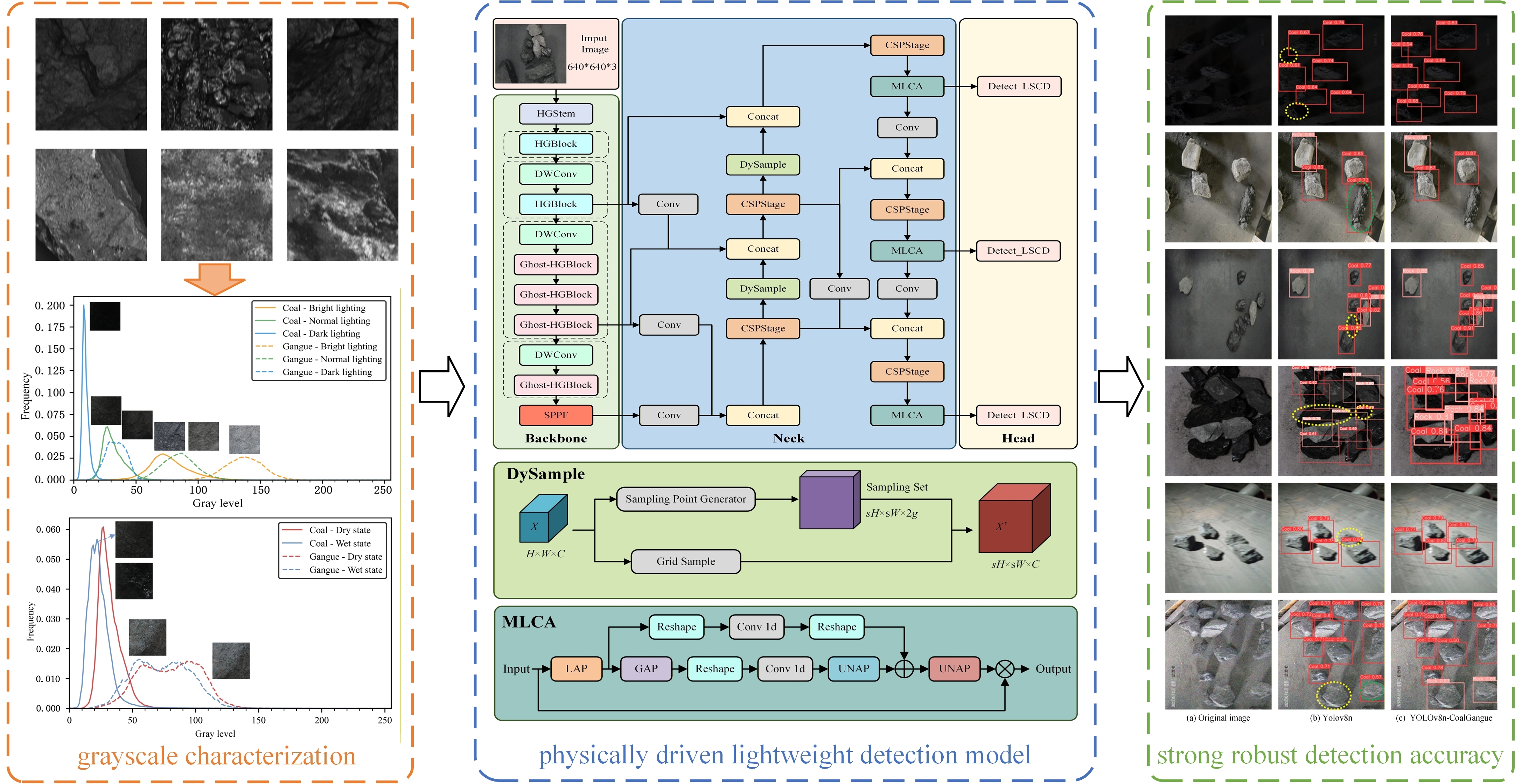
To address the decline in detection accuracy caused by the degradation of grayscale features under environmental interference, a lightweight detection model driven by grayscale characterization, YOLOv8n-CoalGangue, is proposed based on an in-depth analysis of the dynamic variations exhibited by grayscale features. First, grayscale histograms are used to quantitatively evaluate the effects of illumination changes and moisture conditions on feature distributions, revealing that global grayscale aliasing and local texture degradation are the key visual feature bottlenecks. Guided by these unique findings, targeted technological innovations are integrated into the developed architecture. HGNetV2-G, which incorporates the GhostNet principle, is used as the backbone to reduce the incurred computational cost while preserving the core feature extraction ability of the model. A mixed local channel attention (MLCA) mechanism is introduced in the neck to filter background noise and focus on local high-frequency features, which helps overcome global grayscale aliasing issues. In addition, a DGFPN-based feature fusion network is constructed by combining RepGFPN and DySample, together with lightweight shared convolution detection (LSCD), which compensates for the loss of multiscale grayscale details without increasing the imposed parameter burden. Furthermore, the PIoUv2 loss function improves the bounding-box regression process in dense overlapping scenarios. Experimental results show that the proposed model achieves an mAP@50 of 97.2% with a 32% reduction in the number of parameters required (only 2.1 M). It also demonstrates strong robustness under six extreme industrial conditions, such as low illumination and coal dust occlusion, confirming the effectiveness of the design driven by grayscale characterization for practical green mining applications.
Share and Cite
MDPI and ACS Style
Zhou, G.; Xu, W.; Meng, Z.; Zeng, Q.; Wang, Q.
Investigation of Grayscale Characterization and Enhanced YOLOv8n for Coal and Gangue Detection. Machines 2026, 14, 598.
https://doi.org/10.3390/machines14060598
AMA Style
Zhou G, Xu W, Meng Z, Zeng Q, Wang Q.
Investigation of Grayscale Characterization and Enhanced YOLOv8n for Coal and Gangue Detection. Machines. 2026; 14(6):598.
https://doi.org/10.3390/machines14060598
Chicago/Turabian Style
Zhou, Guangyu, Wenqian Xu, Zhaosheng Meng, Qingliang Zeng, and Qi Wang.
2026. "Investigation of Grayscale Characterization and Enhanced YOLOv8n for Coal and Gangue Detection" Machines 14, no. 6: 598.
https://doi.org/10.3390/machines14060598
APA Style
Zhou, G., Xu, W., Meng, Z., Zeng, Q., & Wang, Q.
(2026). Investigation of Grayscale Characterization and Enhanced YOLOv8n for Coal and Gangue Detection. Machines, 14(6), 598.
https://doi.org/10.3390/machines14060598
Note that from the first issue of 2016, this journal uses article numbers instead of page numbers. See further details
here.
Article Metrics
Article Access Statistics
For more information on the journal statistics, click
here.
Multiple requests from the same IP address are counted as one view.