Review

Additively Manufactured of Aluminum Alloy: Processes, Properties, and Applications
1
School of Mechanical Engineering, Wuhan Polytechnic University, Wuhan 420023, China
2
School of Mechanical Engineering, State Key Laboratory of Intelligent Construction and Healthy Operation and Maintenance of Deep Underground Engineering, Sichuan University, Chengdu 610065, China
*
Author to whom correspondence should be addressed.
Machines 2026, 14(6), 597; https://doi.org/10.3390/machines14060597
Submission received: 3 May 2026 / Revised: 20 May 2026 / Accepted: 22 May 2026 / Published: 27 May 2026
(This article belongs to the Topic Additive Manufacturing: From Promise to Practice)

Abstract

This paper reviews recent advances in additive manufacturing (AM) of aluminum alloys and proposes an integrated framework of materials, processes, microstructure, properties, and applications. Focusing on Laser Powder Bed Fusion (L-PBF) and Directed Energy Deposition (DED), it summarizes the major challenges of aluminum alloy AM, including hot cracking, porosity, and anisotropy, together with corresponding optimization strategies. The paper particularly highlights three additive manufacturing-specific alloy systems—Sc/Zr microalloyed, heat-resistant eutectic, and transition-metal-strengthened aluminum alloys—and clarifies their composition design and strengthening mechanisms. Finally, future trends in intelligent manufacturing, integrated alloy process design, and green development are discussed, emphasizing the importance of interdisciplinary integration for large-scale industrial applications.

1. Introduction

1.1. Research Background

Aluminum alloy, as a typical lightweight metal structural material, holds an irreplaceable position in modern industrial fields due to its excellent comprehensive performance [1]. With a density of only about 2.7 g/cm3, which is approximately one-third that of steel, it also features high specific strength, good corrosion resistance, and excellent formability. These characteristics make it a core material for achieving equipment lightweighting and energy conservation. The strategic significance of lightweight design is increasingly prominent in the global manufacturing industry’s transition towards green and efficient development, and has become a core path for enhancing product competitiveness and achieving sustainable development. In recent years, aluminum alloy additive manufacturing (AM) has attracted extensive attention in the aerospace field due to its advantages in lightweight design, fabrication of complex structures, and high material utilization efficiency [2,3,4]. Technologies such as Laser Powder Bed Fusion (L-PBF), Directed Energy Deposition (DED), and Wire Arc Additive Manufacturing (WAAM) have been widely applied in the manufacturing of aerospace structural components, satellite brackets, and thermal management parts [5]. Among them, high-strength 2xxx and 7xxx series aluminum alloys are important aerospace materials because of their excellent specific strength and fatigue resistance. However, these alloys are highly susceptible to hot cracking, porosity, and residual stress during AM processing, which limits their industrial application [6]. To address these challenges, researchers have improved the printability and mechanical properties of aluminum alloys through process optimization, nanoparticle reinforcement, and alloy composition design. Hu et al. reported that nano-treated AA2024 alloy fabricated by WAAM exhibited significantly reduced hot cracking sensitivity and improved fatigue performance [7]. In addition, machine learning-assisted alloy design has become a promising approach for developing AM-compatible high-strength aluminum alloys with enhanced thermal stability and mechanical performance [8]. WAAM technology has shown great potential for manufacturing large-scale aerospace structures because of its high deposition efficiency and low production cost [9]. Furthermore, cold metal transfer (CMT)-based WAAM can effectively reduce heat input and improve deposition stability and microstructural uniformity. In the space field, LPBF-fabricated AlSi10Mg alloys have been successfully used in lightweight CubeSat mirrors and precision aerospace components. Overall, aluminum alloy AM is rapidly developing toward high-performance and engineering applications, and future studies are expected to focus on crack suppression, intelligent process control, and the development of novel high-strength alloys for aerospace applications. In the civilian sector, with the rapid development of the global new energy vehicle industry, range anxiety has become a key factor restricting its market penetration. Empirical data indicates that for every 10% reduction in the weight of an electric vehicle, its range can increase by 5% to 8% [5]. This has driven the automotive industry’s urgent need for lightweighting technologies, and aluminum alloy, with its outstanding comprehensive performance, plays a core role in the lightweight design of key components such as battery pack casings, vehicle body frames, and chassis structures [6,7].
As one of the most important lightweight structural materials, the status of aluminum alloy stems from its excellent specific strength, good corrosion resistance, superior formability, and mature industrial chain. Compared with traditional steel, aluminum alloy components can achieve a weight reduction of up to 40% to 60% [8]. More importantly, aluminum alloy has a rich alloy system and diverse processing techniques, allowing its performance to cover a wide range through composition design and microstructure control, thereby meeting various application requirements from high strength and high toughness to high thermal conductivity [9,10]. However, traditional manufacturing methods are facing severe challenges. “Subtractive manufacturing” represented by cutting and “isomorphic manufacturing” represented by casting and forging have exposed a series of inherent limitations when dealing with integrated components with complex internal flow channels, lattice core structures, topology-optimized shapes, or functionally graded materials, such as long manufacturing cycles, low material utilization rates, multiple component assemblies, and complex assembly stresses [11,12,13]. These limitations severely restrict product innovation design and performance improvement, especially in the high-end equipment field that pursues extreme lightweighting and functional integration. The emergence of additive manufacturing technology provides a revolutionary solution. This technology uses the “discrete-pile” forming principle to directly manufacture three-dimensional solid parts by layer-by-layer material addition, and is hailed as a leading technology of the “Third Industrial Revolution”. Among them, the Laser Powder Bed Fusion (LPBF) technology, due to its extremely high forming accuracy and manufacturing flexibility, has become the main technical route for the preparation of complex aluminum alloy components [14]. LPBF technology can achieve complex geometric shapes that are impossible to manufacture by traditional methods, integrate multiple parts into a single component, reduce connection links, and significantly improve structural efficiency and reliability [15,16].
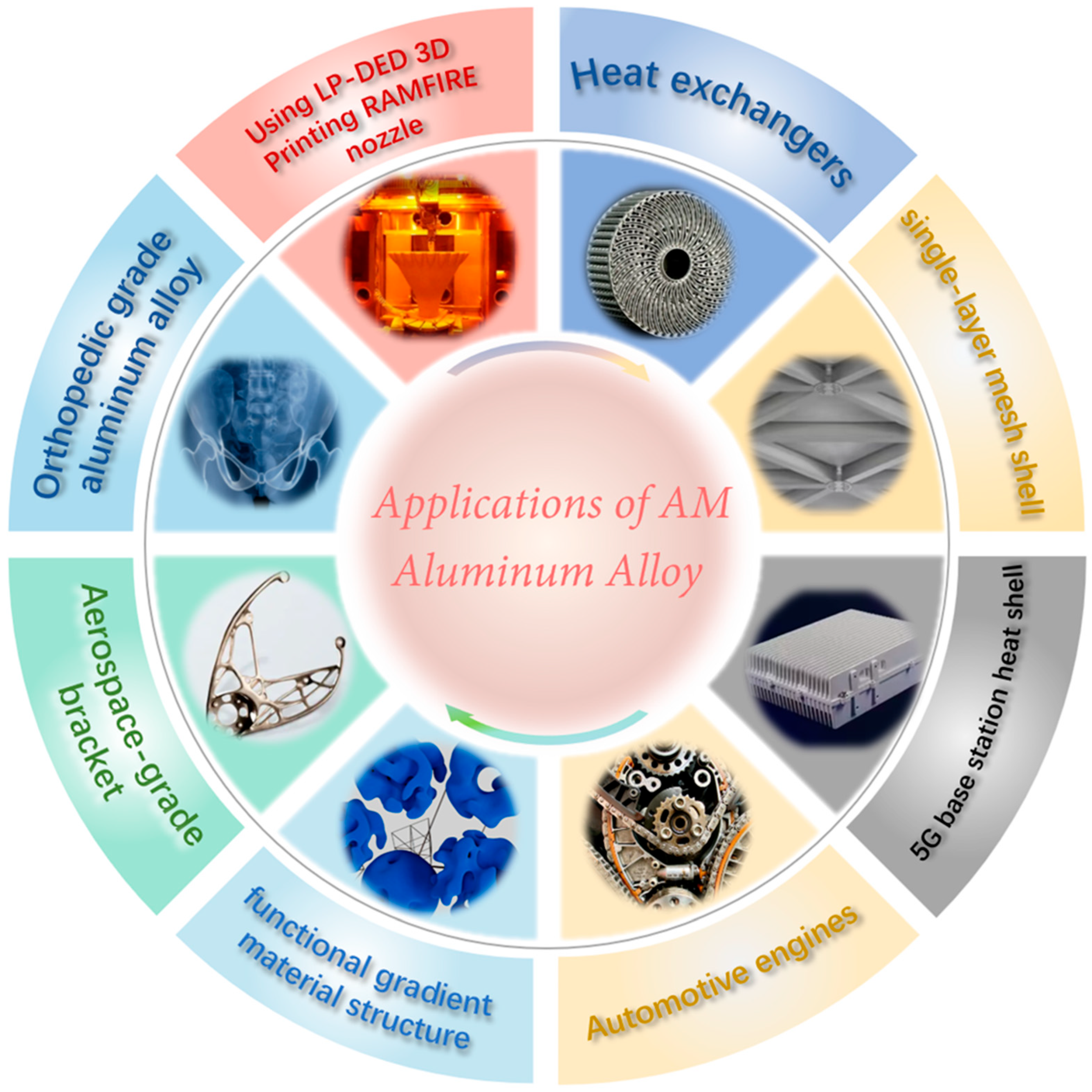
Metal additive manufacturing (AM) technology is undergoing a profound transformation from prototype manufacturing to direct end-product manufacturing. Its application scope has expanded from the initial rapid prototyping to high-end fields such as aerospace, biomedicine, automotive manufacturing, and energy power [17,18,19]. According to the statistics of the industry barometer “Wohlers Report 2023”, in the global metal additive manufacturing materials market in 2022, the consumption of aluminum alloy increased by 28.5% year-on-year, becoming the third largest metal additive manufacturing material after titanium alloy and stainless steel. Its annual usage growth rate has remained above 25% for five consecutive years [20]. At the same time, major global aerospace manufacturers (such as Boeing and GE Aviation) and automotive companies (such as BMW and Audi) have all established dedicated metal additive manufacturing research and development centers and have taken aluminum alloy as a key research material, laying out related patents and technical standards. This strong growth trend and industrial layout fully confirm the broad prospects and huge value of aluminum alloy additive manufacturing technology in industrial applications, marking that this technology is entering a critical stage of transitioning from laboratory research to large-scale industrial applications, as shown in Figure 1.

1.2. Technical Challenges

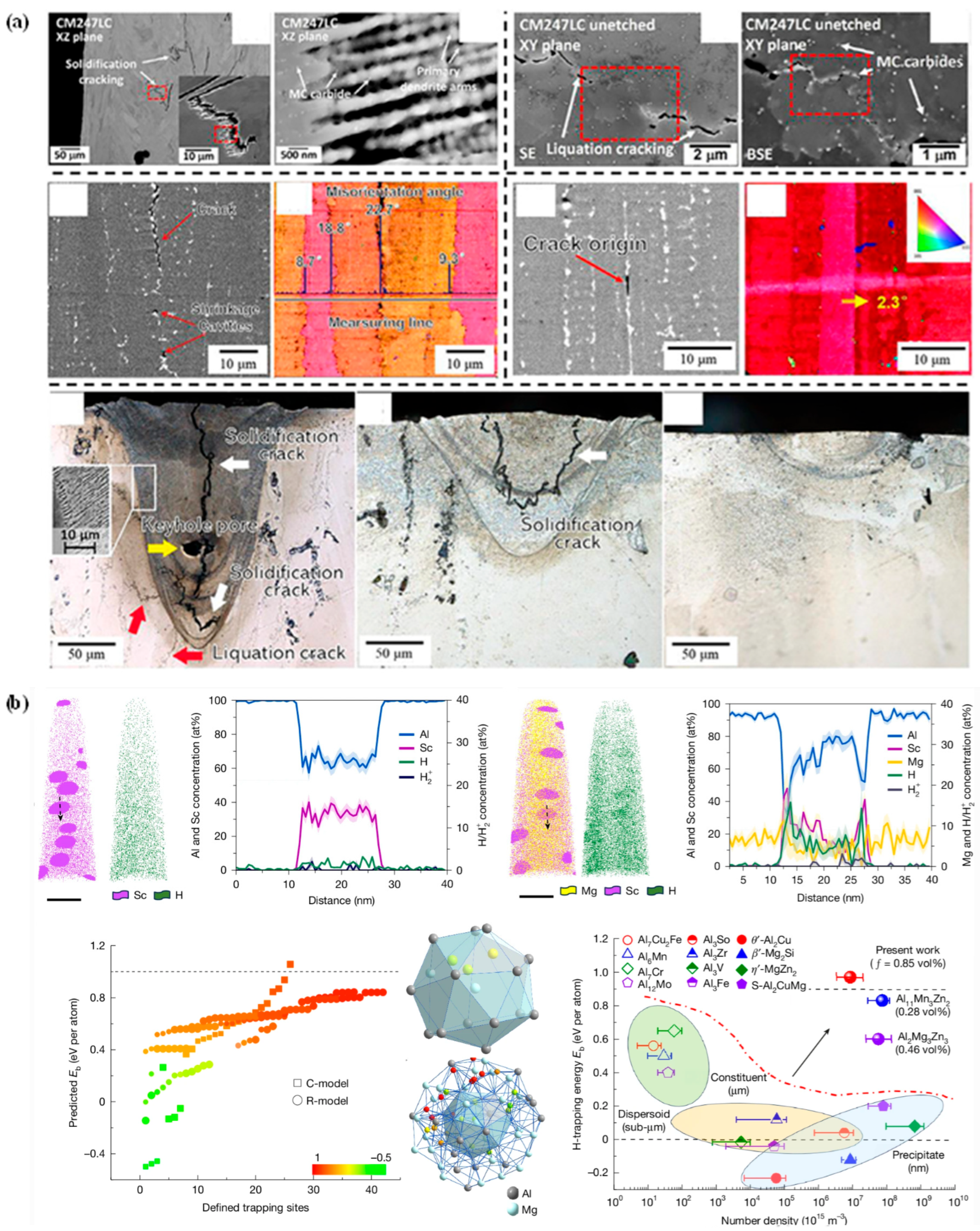
Although additive manufacturing of aluminum alloys shows great potential, its technological development still faces a series of severe challenges, mainly due to the mismatch between the inherent physical properties of aluminum alloys and the unique process characteristics of additive manufacturing [21]. The sensitivity to hot cracking is the most prominent problem in the traditional additive manufacturing of high-strength aluminum alloys. For aluminum alloys with a wide solidification temperature range (such as the 2xxx and 6xxx series), under the rapid cooling condition during the laser powder bed fusion process, they are prone to form liquid films at the solidification front, which, under the action of thermal stress, can cause crystalline cracks [22]. Studies have shown that in the typical process window of laser power 250–400 W and scanning speed 800–1500 mm/s, the hot cracking rate of Al-Cu-Mg alloy can reach 15–40%, severely restricting the application of such alloys in additive manufacturing [23]. Porosity defects are another key challenge. The high hydrogen solubility of aluminum alloys changes significantly during rapid solidification, leading to the release of hydrogen gas and the formation of pores [24]. At the same time, the splashing and unstable keyhole behavior during the interaction of the laser and the powder can also incorporate gases, forming process-related pores [25]. These porosity defects not only reduce the density (typically 97–99.5%) but also become sources of fatigue cracks, significantly shortening the service life of the parts [26]. Anisotropy is a typical feature of additive manufacturing aluminum alloys. Due to the layer-by-layer manufacturing method and the significant temperature gradient along the construction direction, the microstructure of the alloy usually presents elongated columnar crystals with exfoliation growth, resulting in significant directional differences in mechanical properties and thermal physical properties [27]. Research shows that the tensile strength in the vertical construction direction of LPBF formed AlSi10Mg alloy is 8–12% higher than that in the horizontal direction, while the elongation is 15–20% lower [28]. Moreover, the limited applicability of materials is also an important problem currently faced. The commercial aluminum alloy powders for additive manufacturing are mainly concentrated in a few limited grades such as AlSi10Mg and AlSi7Mg, and their strength levels (tensile strength 300–400 MPa) are difficult to meet the strict requirements of mechanical properties for high-end structural components [29]. Developing new high-performance additive manufacturing-specific aluminum alloy systems and establishing corresponding process specifications have become an urgent need to promote the development of this technology [30].

1.3. Scope of Review

This review focuses on the significant breakthroughs in the field of aluminum alloy additive manufacturing in the past five years. Based on the latest developments in aluminum alloy additive manufacturing technology, this review systematically constructs an integrated analytical framework of “process breakthrough–material innovation–performance regulation–engineering application”, aiming to provide researchers and engineering technicians with a comprehensive technical development context. Through the review and analysis of the important research results in the past five years, this review not only pays attention to the progress of the technology itself, but also focuses on revealing the intrinsic connections and development laws among various technical links. The feature of this review lies in breaking the traditional single technical route discussion mode and adopting a multi-dimensional and systematic analytical perspective, emphasizing the revelation of the intrinsic connections between materials, processes, performance, and applications. Through critical commentary on the latest research progress, it not only summarizes the existing achievements, but also strives to discover the unresolved scientific problems and technical bottlenecks, and points out the direction for subsequent research.

2. Main Processes of Aluminum Alloy Additive Manufacturing

In the field of aluminum alloy additive manufacturing, Laser Powder Bed Fusion (LPBF) and Directed Energy Deposition (DED) are currently the main processes. LPBF achieves supersaturation of solutes and microstructure refinement at extremely high cooling rates (106–108 K/s), providing the possibility for the design of high-performance alloys. However, the aluminum alloy’s susceptibility to oxidation and high thermal conductivity lead to porosity and incomplete fusion defects, which remain key challenges. The DED process has advantages in the manufacturing of large components, but it requires high plasticity of the printed state to accommodate subsequent processing.

2.1. Powder Bed Fusion (PBF) Technology

Powder Bed Fusion (PBF) technology is one of the most widely used processes in the field of aluminum alloy additive manufacturing. Its basic principle is to selectively melt the aluminum alloy powder spread on the powder bed using high-energy beams (laser or electron beam), and to build up a three-dimensional solid component layer by layer. Depending on the type of high-energy beam, PBF technology is mainly divided into two typical processes: Selective Laser Melting (SLM) and Electron Beam Melting (EBM) [31].

2.1.1. Selective Laser Melting (SLM)

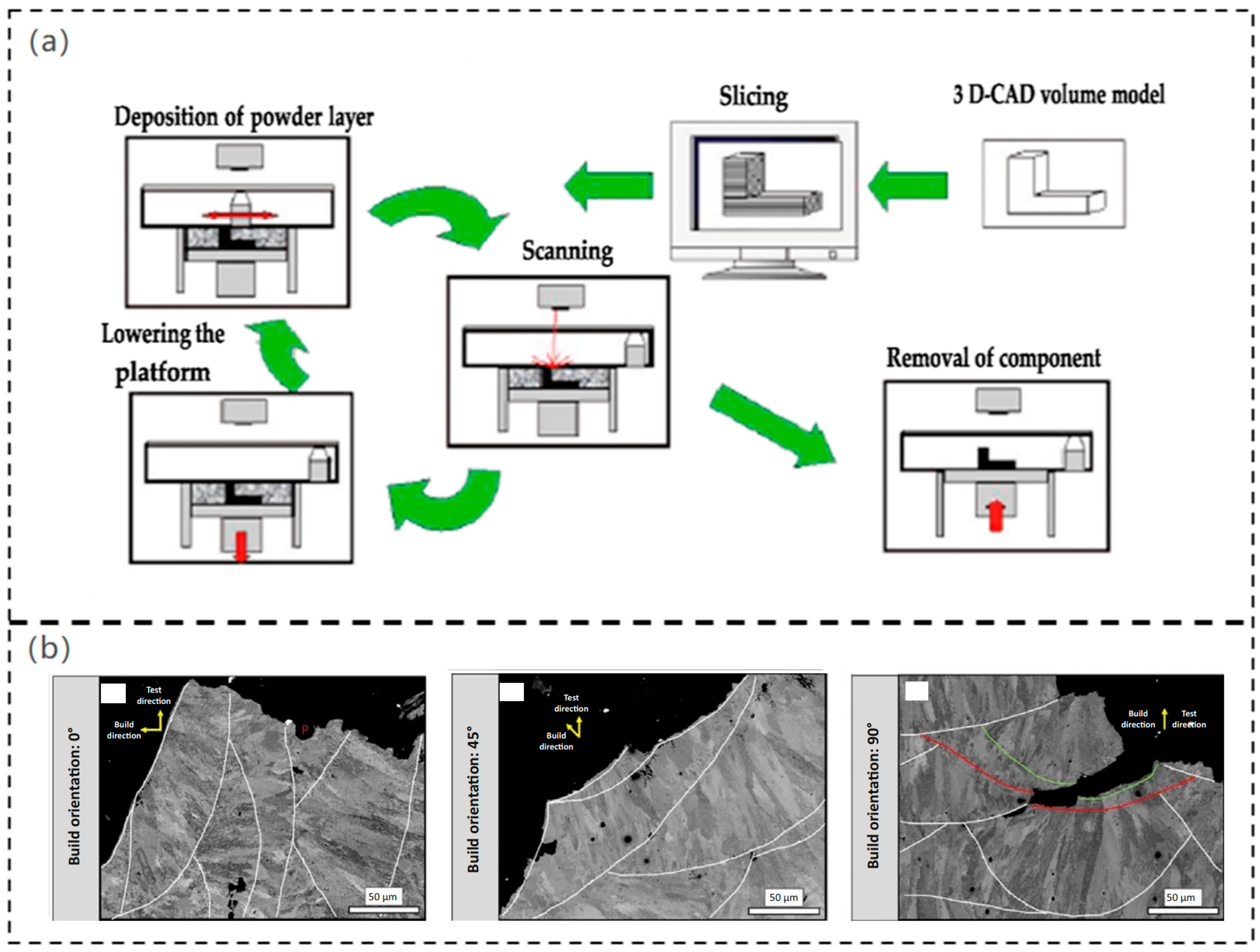
Selective Laser Melting (SLM) technology uses a high-power-density laser beam as the energy source and, based on the data model of layer-by-layer slicing, melts and solidifies aluminum alloy powder layer by layer. The specific process principle is as follows: First, a powder spreading device evenly spreads a layer of aluminum alloy powder with a thickness of 20–100 μm on the forming platform. Then, under the drive of the computer control system, the laser beam scans along the contour path of the current layer. The powder absorbs the laser energy and rapidly heats up to above the melting point, achieving the melting of the powder. After one layer of scanning is completed, the forming platform descends by a layer thickness distance, and the powder spreading device spreads a new layer of powder. This process is repeated until the entire component is formed [32]. The SLM equipment mainly consists of a laser system, a powder spreading system, a forming chamber, a control system, a cooling system, etc. The laser system usually adopts a fiber laser, with a wavelength mostly of 1064 nm and an output power generally between 100 and 500 W, featuring good beam quality and stability. The powder spreading system includes powder spreading rollers or powder spreading scrapers to ensure the uniformity and density of the powder layer. The forming chamber can be filled with inert gas (such as argon) to prevent the oxidation of aluminum alloy powder during the melting process. The control system is responsible for coordinating the movement of each component and precisely controlling the laser scanning path [33]. The pore morphology under different laser powers is shown in the figure, demonstrating the evolution behavior of process-induced pores under varying laser energy input conditions. Although these observations were originally reported for 316 L stainless steel, the relationship between laser energy density and pore evolution provides a useful reference for understanding porosity formation and process optimization in aluminum alloy LPBF. The key parameters of the SLM process have a significant impact on the forming quality, microstructure, and mechanical properties of aluminum alloy components, mainly including laser power, scanning speed, layer thickness, powder spreading density, scanning pitch, etc. Laser power directly determines the melting degree of the powder. Insufficient power can lead to incomplete melting of the powder, resulting in unfused defects. Excessive power may cause over-melting, generating spheroidization effects or thermal deformation [34]. Scanning speed and laser power jointly determine the energy input density of the laser (energy input density = laser power/(scanning speed × scanning pitch × layer thickness)). Excessively fast scanning speed can lead to insufficient energy input, while too slow of a scanning speed can increase the heat-affected zone [35]. The surface morphology of the molten pool at different scanning speeds is shown in Figure 2, comparing the surface morphology of the molten pool of high-strength aluminum alloy prepared by SLM at scanning speeds of 100 mm/s and 500 mm/s [36]. Layer thickness and powder spreading density affect the fluidity and density of the powder layer. A thinner layer thickness is beneficial for improving the forming accuracy but will reduce the forming efficiency. Insufficient powder spreading density can lead to an increase in the porosity of the powder layer, affecting the density of the component [37].

2.1.2. Electron Beam Melting (EBM)

The main differences between Electron Beam Melting (EBM) and Selective Laser Melting (SLM) lie in the energy source, processing environment, and thermal history during solidification [40,41]. EBM employs a high-energy electron beam, generated, accelerated, and precisely focused under a vacuum to selectively melt metallic powder. Compared with laser-based systems, electron beams exhibit higher energy density, rapid scanning capability, a broader interaction zone, and non-contact electromagnetic deflection, enabling highly responsive beam control [42]. EBM processing must be conducted under a high-vacuum environment (typically ≤10−3 Pa) to suppress oxidation of reactive powders such as aluminum alloys and to minimize electron scattering, thereby ensuring stable energy delivery [43]. In contrast, SLM operates under an inert gas atmosphere (e.g., argon or nitrogen) at near-atmospheric pressure with relatively low vacuum requirements, relying on gas shielding to limit oxidation [43]. In terms of thermal behavior, EBM is characterized by a preheated powder bed (approximately 600–800 °C), which, combined with its broader energy distribution, results in relatively slow cooling rates (102–103 °C/s). Conversely, SLM utilizes a highly concentrated laser spot, leading to steep thermal gradients and significantly higher cooling rates (104–106 °C/s) [44]. The process characteristics of EBM confer several advantages, including reduced oxygen contamination due to vacuum processing, which enhances mechanical performance and corrosion resistance; elevated build temperatures that effectively mitigate residual stresses, thermal distortion, and cracking susceptibility; and a larger effective scan area that improves efficiency for bulk or large-scale components [45]. Consequently, EBM is particularly well-suited for aerospace applications demanding high structural integrity and dimensional stability, such as large load-bearing aluminum alloy components [46].

2.2. Challenges and Solutions of PBF Process in Aluminum Alloy Forming

High Sensitivity to Hot Cracks

1. Solidification characteristics of gold: High-strength aluminum alloys such as 2xxx and 7xxx series have a wide solidification temperature range. During the solidification process, they tend to form coarse columnar crystals. This microstructure structure will intensify stress concentration, thereby increasing the possibility of thermal crack formation and leading to a decline in mechanical properties [47].
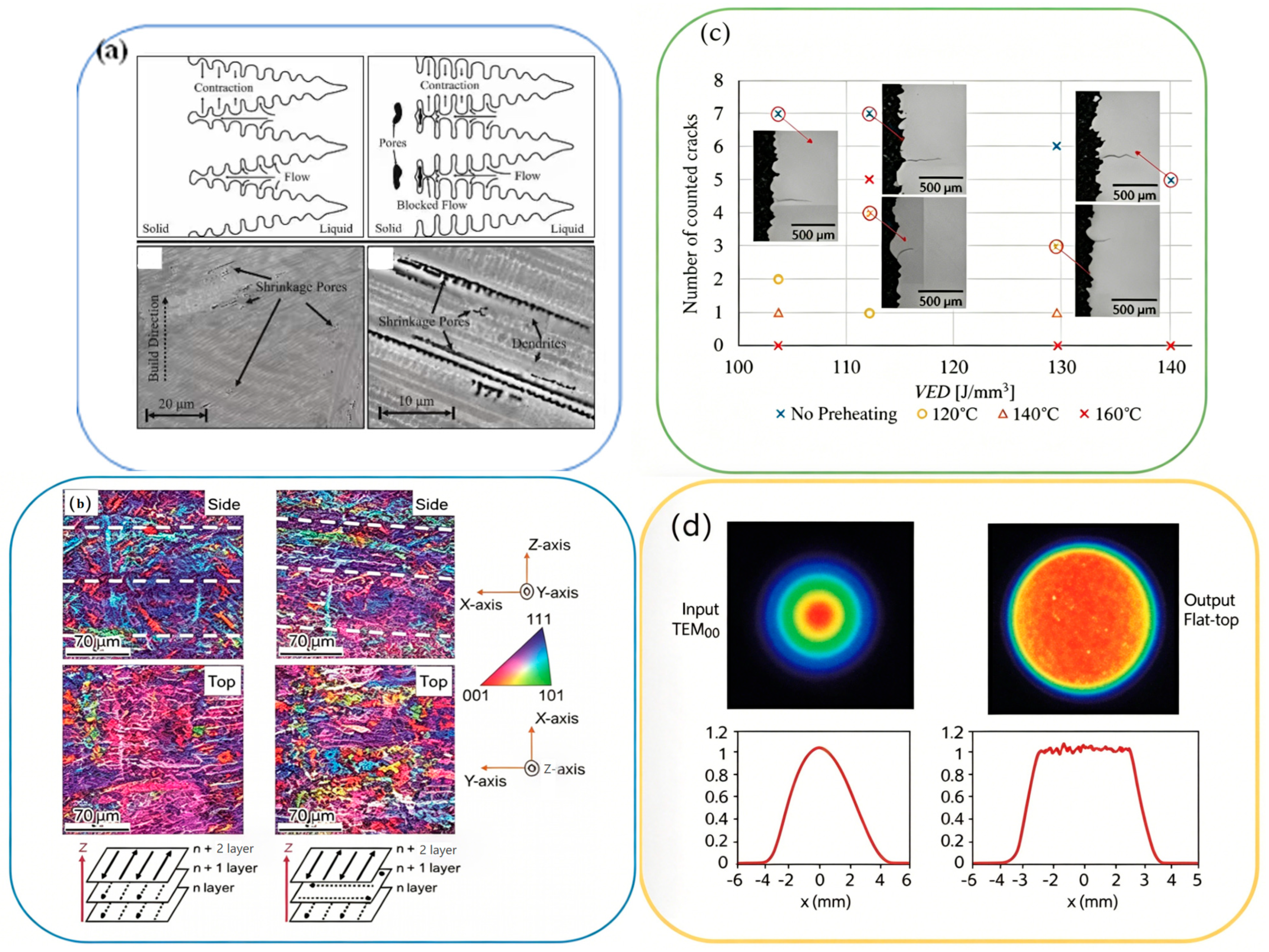
Solution: Introducing grain refiners (such as Zr, Sc, TiB2, etc.) is the most effective way to inhibit cracks, as shown in Figure 3. For example, introducing titanium boron composite additives in Al7075 powder, taking advantage of the instantaneous reaction in the high-temperature molten pool of L-PBF, in situ generating TiB2 particles and Al3Ti rod-shaped phases. TiB2 forms and stabilizes preferentially, and the Al3Ti rod-shaped structure can effectively anchor the grain boundaries and hinder crack propagation [48]. Or, for example, adding Sc to Al-Mg alloys to form Al3Sc nanoparticles, which can act as heterogeneous nucleation points, transforming columnar crystals into fine equiaxed crystals, interrupting the continuity of the liquid film, thereby significantly reducing or even eliminating thermal cracks [49,50].
2. Process thermal behavior: In the PBF process, the “point–line–plane” scanning mode of the laser causes local areas to undergo rapid heating–cooling cycles, resulting in significant temperature gradients (up to 103–104 K/mm) [52]. This non-uniform thermal field leads to differences in thermal expansion and contraction, which accumulate high residual stresses within the formed part. When the stress is released, it is prone to induce crack propagation, especially at thick-walled parts or geometrically abrupt areas of complex structures [53,54,55,56,57].
Solution: Preheat the substrate (preheating temperature 200–300 °C) to extend the solidification time, reduce the temperature difference between the molten pool and the substrate, and slow down the cooling rate to reduce the temperature gradient [58]; at the same time, optimize the laser energy distribution pattern and replace the traditional Gaussian beam with a flat-top beam, as shown in Figure 4. The flat-top beam can make the temperature field of the molten pool more uniform, stabilize the backpressure distribution, form a wide and shallow molten pool shape, and reduce local overheating and stress concentration caused by energy concentration. Simulation results show that the process window of the flat-top beam is 40% wider than that of the Gaussian beam, and the residual stress is reduced by approximately 35% [59]. Using zone-directional scanning (such as checkerboard or stripe scanning) can disperse heat accumulation and avoid continuous growth of columnar crystals with a large aspect ratio. For example, in the Al-Mg-Sc-Zr alloy, by using a scanning strategy with an interlayer rotation of 67°, the proportion of equiaxed crystals increases to 80% [60].

2.3. Directed Energy Deposition (DED) Technology

The DED process can deposit metal materials layer by layer to form any shape on uniform and uneven substrates [65]. The deposition rate and volume density of the DED process are higher than those of the PBF process, while the layer thickness, surface roughness and the minimum feature size of the manufactured parts of the PBF process are relatively smaller than those of the DED process [66,67,68]. For the DED process, the currently representative ones are laser metal deposition (LAM-DED) and arc additive manufacturing (WAAM) [69,70].

2.3.1. Laser Metal Deposition (L-DED)

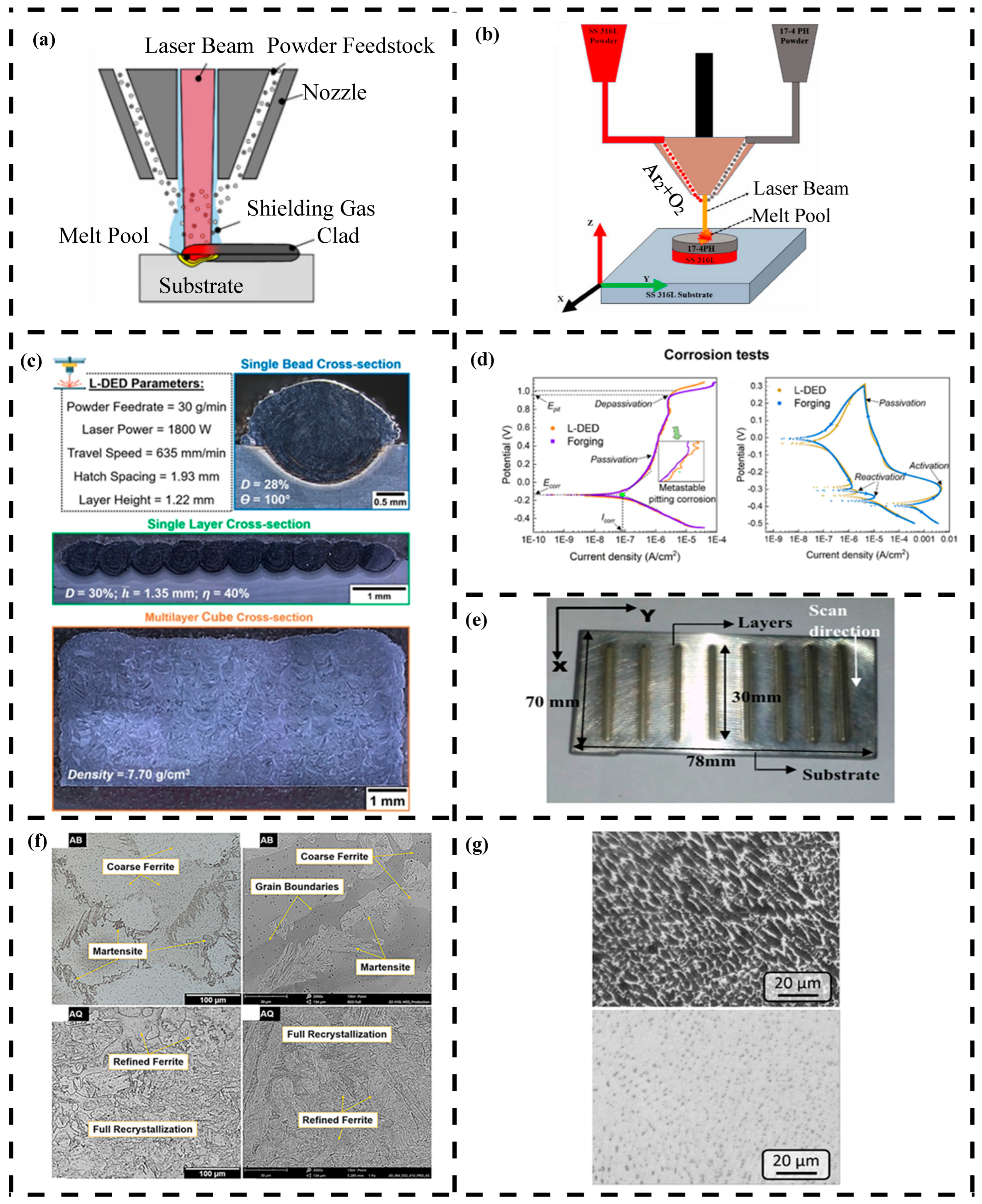
Laser Direct Energy Deposition (L-DED) is one of the core technologies in the field of metal additive manufacturing. It forms a molten pool on the substrate surface by focusing the laser beam, and simultaneously feeds in powder materials to achieve interlayer metallurgical bonding. It combines the ability to form complex structures with high deposition efficiency, demonstrating great potential in the manufacturing of aluminum alloy lightweight components [71]. As shown in the process principle (Figure 5a), the laser source, powder feeding system, and protective gas work together to enable multi-material and gradient structure deposition [71]. Dash et al. operated the L-DED metal AM system in an argon environment and maintained the oxygen level below 15 ppm, thereby effectively melting the deposited powder onto the substrate. Moreover, they were able to fabricate bimetallic schematics, as shown in Figure 5b [72].
Parameter optimization is the key to the stability of the L-DED process. It is usually optimized in stages using the design of experiments (DoE) method. Sousa et al. [73] conducted research on AISI 410L stainless steel and demonstrated that, by gradually optimizing (laser power, scanning speed, powder feeding rate, etc.) from single pass, single layer to multiple layers, a deposited part with a density of 99.48% could be obtained, along with its optimized parameters and cross-sectional features (Figure 5c). Das et al. [74] in the multi-layer deposition of 15–5 PH stainless steel, fixed the laser power at 450 W and the scanning speed at 5 mm/s, and achieved defect-free deposition by adjusting parameters such as the powder feeding rate. The macroscopic morphology of the deposited layer is shown in (Figure 5e). This optimization approach has important reference value for L-DED of aluminum alloys. Guo et al. [75], in the L-DED research of 316L stainless steel, used the orthogonal test method, which can be directly applied to the process parameter design of aluminum alloys, and the optimized deposited layer has no incomplete fusion defects. In addition, the deposition strategy also affects the forming quality. Using the alternating sawtooth path and contour-filling combination strategy can improve the dimensional accuracy of aluminum alloy components [71]. The non-equilibrium solidification characteristics of L-DED dominate the microstructure evolution of aluminum alloys. Rapid heating–cooling cycles result in the deposition pieces presenting typical columnar or equiaxed crystal structures. Yuan et al. [76] discovered in their titanium alloy research that, through the synergistic alloying of Si and B, the transformation from columnar crystals to equiaxed crystals can be achieved. This grain refinement idea can be transferred to aluminum alloys, and by regulating the content of alloying elements, the tendency of columnar crystal epitaxial growth can be disrupted. For L-DED of stainless steel, Das et al. [74] observed that, in multi-layer deposition, the grains oriented along <101>/<001> direction and the fraction of austenite phase gradually increased with the increase in the number of layers. Similar crystal orientation characteristics in aluminum alloys have been confirmed by Zhang et al. [77] in their stainless steel research, and the composition and element distribution of the microstructure are significantly affected by the cooling rate. Moreover, the repeated thermal cycles during the L-DED process will cause element segregation and the precipitation of secondary phases. Sousa et al. [73] found that, after the AISI 410L undergoes austenitization + quenching + tempering treatment, the grains were refined and the phase distribution was more uniform (Figure 5f), which provided a reference for the design of post-treatment processes for aluminum alloys. Heat treatment can be used to eliminate residual stress and optimize the morphology of the second phase.
In aluminum alloy L-DED systems, the strength, hardness, and toughness are strongly dependent on the resulting microstructure and grain morphology. Previous studies on stainless steel and titanium alloy additive manufacturing [73,74,75,76] demonstrated that grain refinement, thermal cycle regulation, and optimization of high-angle grain boundary fractions can effectively improve mechanical performance. Although these investigations were conducted on non-aluminum alloy systems, the revealed strengthening and toughening mechanisms provide valuable guidance for the microstructure design and performance optimization of aluminum alloy additive manufacturing. Fatigue performance is a core indicator of aluminum alloy structural components. Zhang et al. [78] found that, after adding a trace amount of B to Ti-6Al-4V, the high-cycle fatigue life of the material increased by an order of magnitude, and grain refinement could hinder crack initiation but also could reduce crack propagation resistance. This pattern has been verified in aluminum alloy-related research. In terms of corrosion performance, Wang et al. [79] demonstrated that the point corrosion potential (1 V) of L-DED duplex stainless steel was superior to that of forged parts (Figure 5d), and aluminum alloys could improve the stability of the passivation film by optimizing the content of elements such as Cr and Ni, and this component regulation strategy could be used to enhance corrosion resistance.
The application scope of L-DED has expanded from single-material forming to gradient structures and component repair. Ostolaza et al. [71] used L-DED to manufacture AISI 316L/H13 functional gradient materials, as shown in the microstructure details in Figure 5g. This technology can be directly applied to the local repair of aluminum alloy molds; Blakey-Milner et al. [80] reported that L-DED titanium alloy parts have been applied in military and civilian aircraft, and the lightweight advantage of aluminum alloy L-DED components provides broad application prospects in the aerospace field. However, L-DED aluminum alloys still face challenges in residual stress and defect control. Ostolaza et al. [71] observed cracks and incomplete fusion defects in the gradient material research, which could be alleviated by substrate preheating and optimizing scanning strategies. The application of numerical simulation technology provides a new approach for process optimization. Das et al. [74] used a three-dimensional multi-physics field model to simulate the temperature field of multi-layer deposition, which could accurately predict the solidification behavior of the aluminum alloy melt pool and provide theoretical support for process parameter regulation.
In the future, the L-DED process for aluminum alloys needs to further strengthen the coupling regulation of process–microstructure–performance, combined with the grain refinement effect of alloying elements such as Si and B [76], drawing on the post-treatment experience of other metal materials [73], and achieving precise defect control through the combination of numerical simulation and experiments. With the continuous maturation of the process, L-DED is expected to achieve large-scale application in aluminum alloy aerospace components, automotive lightweight parts, and mold repair.
Figure 5. (a) The working principle of multi-material deposition Laser Directed Energy Deposition (L-DED) [71]. (b) The schematics of the fabrication of the bimetallic sample by L-DED [72]. (c) Schematic diagram of optimized parameters and geometric cross-section of L-DED [73]. (d) Corrosion performance of duplex stainless steel (DSS) prepared by L-DED and forged 2507 duplex stainless steel (DSS). Polarization curves of potentiodynamic polarization (PDP) and double-ring electrochemical potentiokinetic reactivation (DL-EPR) curves [79]. (e) Macroscopic image of the deposited layer [74]. (f) Optical and scanning electron microscopic structures [73]. (g) Microstructural details of the functional gradient material (FGM) sample along the gradient direction. The eighth layer, 100% AISI H13, has a microstructure composed of martensite and austenite; the sixth layer, 40% AISI 316L and 60% AISI H13, mainly has an austenite microstructure; the first layer, 100% AISI 316L, has a microstructure composed of austenite and ferrite [71].
Machines 14 00597 g005

2.3.2. Arc Additive Manufacturing (WAAM)

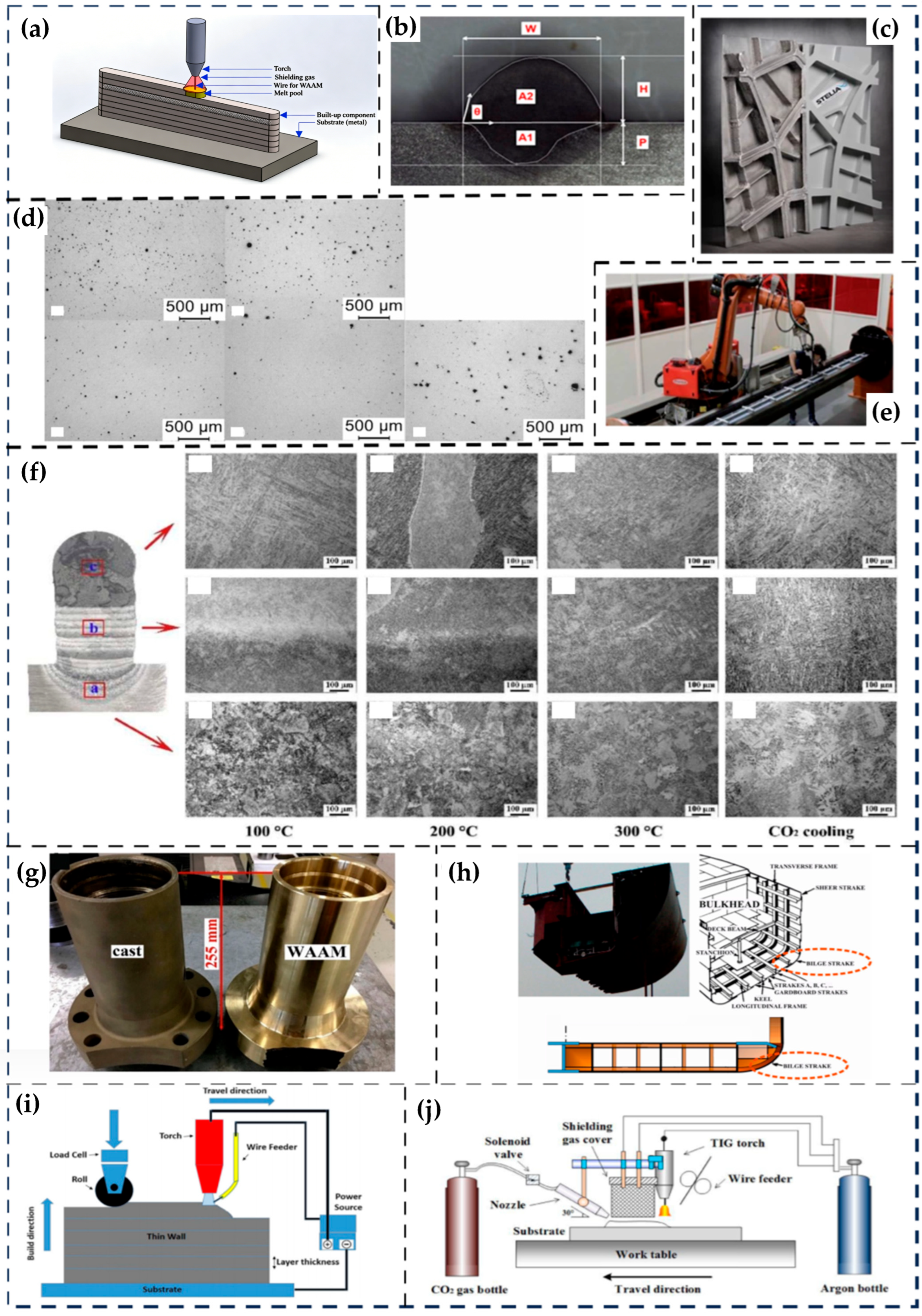
Wire Arc Additive Manufacturing (WAAM), as the core branch of Directed Energy Deposition (DED) technology, has emerged as a key process for additive manufacturing of large and complex aluminum alloy components due to its high deposition efficiency, low raw material cost, and large-scale forming capabilities [81,82]. Its essence is to melt the aluminum alloy wire through an electric arc (such as GTAW, GMAW, and PAW), deposit layer by layer along a pre-set path, and ultimately achieve near-net-shape formation. The typical WAAM process flow includes wire melting, molten pool formation, interlayer solidification, and component stacking (Figure 6a). The stability of the electric arc, the behavior of the molten pool, and the interlayer thermal management directly determine the forming quality and mechanical properties of the aluminum alloy components.
(1) WAAM Process Type and Aluminum Alloy Compatibility
The WAAM process for aluminum alloys can be classified into three main types: gas tungsten arc welding (GTAW) base, gas metal arc welding (GMAW) base, and cold metal transfer (CMT) process (including its variants) [81,83,84,85]. The GTAW-based WAAM uses a non-melting tungsten electrode and requires lateral wire feeding, with an aluminum deposition rate of approximately 1–2 kg/h, suitable for Al-Cu alloys (such as 2319) that are sensitive to heat input. Wang et al. [86] demonstrated that increasing the wire feed speed (WFS) in GTAW-based WAAM results in an increase in weld bead height and a decrease in width, with an increase in arc energy demand, which can lead to insufficient fusion (Figure 6b). This figure clearly shows the correlation between key characteristics, such as weld bead width (W), penetration depth (P), and height (H) and process parameters. GMAW-based WAAM uses a wire as the melting electrode and has a deposition rate of up to 3–4 kg/h, but traditional GMAW has issues with poor arc stability and high spatter, significantly affecting the forming accuracy of Al-Mg alloys (such as 5083) [84]. The CMT process, as an improved version of GMAW, achieves low heat input (30–50% reduction in heat input compared to traditional GMAW) and zero spatter through the coordinated control of wire reciprocation and current. Its variant CMT-PADV (pulse advanced mode) can optimize the fluidity of the molten pool through polarity alternation [83]. Their research shows that CMT-PADV can control the porosity of 2319 aluminum alloy components at 0.4–0.84%, with a maximum pore diameter of less than 100 μm (Figure 6d). This figure compares the porosity distribution under different deposition strategies, where the rectangular deposition has no interlayer residence time, resulting in random pore distribution and no interlayer aggregation. In addition, plasma arc welding (PAW)-based WAAM has a deposition rate (2–4 kg/h) higher than GTAW, but the equipment cost is high, and it is only occasionally used in the manufacturing of thick-walled components of high-purity aluminum alloys (such as Al-Si system 4047) [81]. Tandem-GMAW (double wire GMAW) is a new WAAM process that increases the aluminum deposition rate to 6–8 kg/h by simultaneous deposition of two wires. Çam et al. [84] used this process to manufacture thin-walled parts of 2325 aluminum alloy, combined with active interlayer cooling (Figure 6j), which increased the forming efficiency by 97% and avoided weld collapse caused by heat accumulation.
(2) The influence of process parameters on the forming quality of aluminum alloy by WAAM technology
The core process parameters of aluminum alloy WAAM include wire feed speed (WFS), arc voltage (U), gun movement speed (TS), interlayer temperature, type and flow rate of protective gas, etc. These parameters affect the formation of weld beads, microstructure and mechanical properties by regulating the heat input (HI = ηUI/TS, η is the efficiency) [81,83]. Yildiz et al. [87] demonstrated that the ratio of WFS to TS is a key parameter for controlling heat input. In the WAAM of ER120S-G wire, this ratio is positively correlated with the weld bead height and penetration depth, and negatively correlated with hardness (Figure 6b). The contact angle (Θ) of the weld bead increases with the increase in TS, directly affecting the interlayer fusion quality. The interlayer temperature and residence time are crucial for the grain evolution of aluminum alloys. Çam et al. [84] found in 5A06 aluminum alloy GTAW-WAAM that, when the interlayer temperature increased from 100 °C to 300 °C, the proportion of columnar crystals increased from 35% to 62%, while using CO2 cooling (Figure 6f) could refine the grains and form a uniform structure dominated by needle-like α phases. The electrode extension length (ESO) also affects the geometry of the weld bead: when ESO increased from 8 mm to 12 mm, the weld bead height of the Al-Mg alloy increased by 15%, and the penetration depth decreased by 20%, which was due to the increase in the pre-melting amount of the wire caused by enhanced resistance heating [81]. The selection of protective gas needs to match the type of aluminum alloy: for Al-Mg systems (such as 5183), 99.99% Ar is commonly used (Horgar et al. [88] showed that this gas could make the tensile strength of 5183 aluminum alloy reach 273–293 MPa), while for Al-Cu systems (such as 2319), an Ar + He mixed gas can reduce oxidation. The gas flow rate is usually controlled at 25–30 L/min. Arana et al. [83] found that, when the flow rate was lower than 20 L/min, the porosity of 2319 aluminum alloy increased from 0.67% to 1.2%, which was due to insufficient protection and the entry of H2O from the air into the molten pool (Figure 6d).
(3) Industrial Applications and Typical Cases of Aluminum Alloy WAAM
Aluminum alloy WAAM has been piloted and applied in various fields such as aerospace, shipping, and rail transportation. In the aerospace sector, STELIA Aerospace used the CMT-PADV process to manufacture the aluminum alloy panels for the Airbus fuselage (Figure 6c), with a material utilization rate of 92%. Compared to traditional milling (BTF ratio = 10), the cost was reduced by 29%. Cranfield University collaborated with Thales Alenia Space to manufacture a 6 m long aluminum alloy wing spar using WAAM (Figure 6e), with a deposition rate of 0.75 kg/h and fatigue strength meeting aviation standards. In the shipping sector, RAMLAB used WAAM to manufacture nickel–aluminum bronze–aluminum alloy composite propellers (Figure 6g), with the forming time of the aluminum alloy propeller hub being only 1/3 of that of traditional casting, and the mechanical properties being comparable to those of forgings. Additionally, Damen Shipyard used 2319 aluminum alloy WAAM to manufacture upper-structure components of ships (Figure 6h), avoiding weld seam deformation through interlayer cooling (Figure 6j) and reducing the subsequent machining volume by 30%. In the rail transportation sector, Çam et al. [84] used WAAM to manufacture Al-Mg5Mn aluminum alloy vehicle body frames, combined with interlayer rolling (Figure 6i), achieving a tensile strength of 282 MPa for the components.
It should be noted that the stainless steel and titanium alloy examples discussed in this section are included primarily to illustrate transferable process optimization principles, thermal behavior characteristics, and microstructure regulation mechanisms that are relevant to aluminum alloy additive manufacturing. Excessive material-specific discussions unrelated to aluminum alloy systems have been reduced in the revised manuscript to improve the focus of this review.
Figure 6. (a) Schematic diagram of the WAAM process [81]. (b) Feature diagram of the ER120S-G welding bead [87]. (c) Aluminum alloy fuselage panel of STELIA Aerospace [89]. (d) Porosity distribution diagram of 2319 aluminum alloy under different deposition strategies [83]. (e) WAAM aluminum alloy components in the aerospace field [89]. (f) Microstructure diagram of Ti6Al4V alloy under different cooling conditions [81]. (g) Comparison of nickel–aluminum bronze and WAAM aluminum alloy components [90]. (h) Cylindrical curved panel of ship structure [90]. (i) Schematic diagram of interlayer rolling process of aluminum alloy by WAAM [84]. (j) Schematic diagram of interlayer cooling process of aluminum alloy by WAAM [91].
Machines 14 00597 g006

3. Special Aluminum Alloy Material System for Additive Manufacturing

3.1. Sc/Zr Microalloyed Aluminum Alloy

3.1.1. Al-Mg-Sc Alloy Series

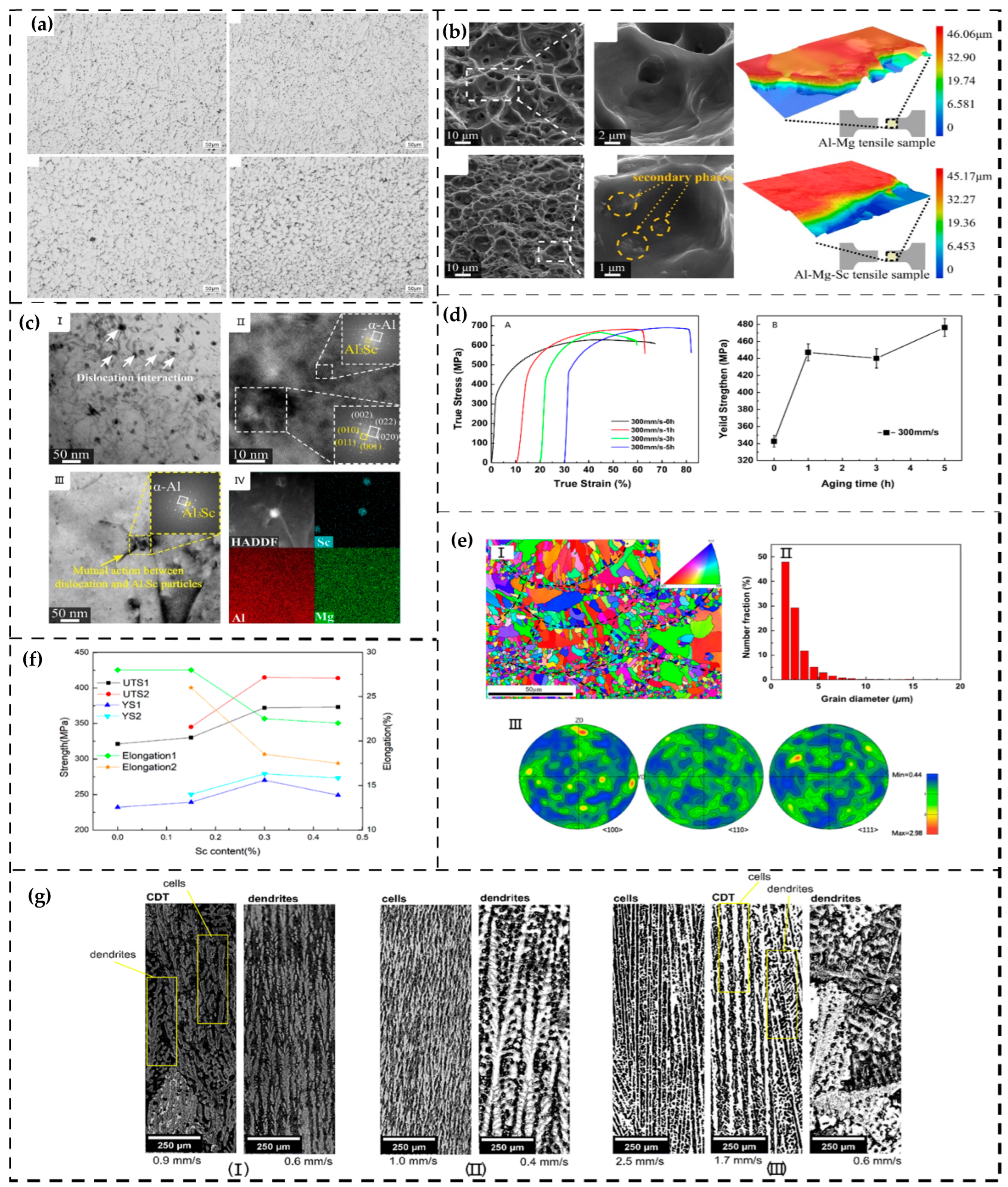
The Sc element, as a highly efficient microalloying element for aluminum alloys, plays a crucial role in controlling the microstructure and enhancing the properties during additive manufacturing. Studies have shown that the addition of Sc can significantly inhibit the hot cracking tendency of aluminum alloys, with the core mechanism including both grain refinement and melt purification effects [92]. Ren et al. [93] discovered in the Al-Mg-Sc alloy prepared by wire arc additive manufacturing (WAAM) that the Al3Sc phase formed by Sc and Al has a L12 crystal structure, with a lattice mismatch of only 0.15% with the α-Al matrix, and can serve as a heterogeneous nucleation core to significantly refine the grains. When the Sc content is 0.3%, the average grain size is reduced from approximately 80 μm to 30 μm (Figure 7a), and the columnar crystals transform into equiaxed crystals, significantly reducing the anisotropy of the microstructure. At the same time, Sc reacts with O2, H2 and impurity elements to form high-melting-point compounds, effectively purifying the melt and reducing defect formation, thereby inhibiting hot cracking [92,94]. The improvement of the mechanical properties of the Al-Mg-Sc series alloys by Sc element originates from the synergistic effect of grain refinement strengthening and precipitation strengthening. Xia et al. [92] prepared Al-Mg-Sc alloys using WAAM technology, with the yield strength, tensile strength and elongation reaching 183.03 MPa, 335.58 MPa and 22.74% respectively, which were 88%, 55% and 46% higher than those of the Al-Mg alloy without Sc, respectively. The fracture surface presented typical ductile fracture characteristics, with smaller and more uniform crater sizes (Figure 7b). TEM analysis showed that uniformly dispersed Al3Sc nanoparticles (20–50 nm) could hinder the movement of dislocations through pinning (Figure 7c), resulting in a significant precipitation strengthening effect. Grain refinement further enhanced the strength through the Hall–Petch mechanism. In the high Mg-content Al-Mg-Sc-Zr alloy prepared by selective laser melting (SLM), the Al3(Sc,Zr) phase precipitated after aging treatment increased the compressive yield strength to 476 ± 10 MPa, and the microhardness reached 175 ± 5 HV (Figure 7d), and the alloy maintained good isotropy (Figure 7e). Moreover, the optimization of Sc content is crucial for performance. Ren et al. [93] found that, in the Al-Mg-Sc alloy prepared by WAAM, 0.3% is the optimal Sc content, at which the initial Al3Sc phase precipitates significantly. After 350 °C × 1 h heat treatment, the tensile strength further increased to 415 MPa (Figure 7f), while excessive Sc content (0.45%) would cause the precipitated phase to aggregate and grain boundaries to coarsen, resulting in no further improvement in mechanical properties [93].
Nunes et al. [95] studied low-Sc-content Al-Mg-Sc alloys through transient directional solidification and found that the addition of Sc can change the morphology of the α-Al phase, inducing cellular crystal growth at higher cooling rates (Figure 7g), and the Al3Sc phase can inhibit the continuous precipitation of the Mg2Al3 brittle phase, causing it to be distributed in a fine and discontinuous manner, thereby improving the alloy’s toughness. Furthermore, in the Al-Mg-Sc-Zr alloy prepared by SLM, the synergistic effect of Sc and Zr can significantly enhance the stability of the precipitated phase. Riva et al. [96] pointed out that the rapid solidification characteristic of SLM enables more Sc and Zr to be dissolved in the Al matrix. After aging, the Al3(Sc,Zr) nanoparticles precipitated have higher anti-coarsening ability and can still maintain the blocking effect against displacement at high temperatures [97].
Figure 7. (a) Metallographic structures of as-deposited bodies of Al-Mg-Sc alloys with 0% Sc, 0.15% Sc, 0.3% Sc, and 0.45% Sc [93]. (b) The fracture of samples after the tensile test: deposited Al-Mg sample; deposited Al-Mg-Sc sample [92]. (c) Bright-field image, nanoscale EDS mapping, HRTEM, and diffraction spot of deposited Al-Mg-Sc sample after the tensile test: (I) and (III) the bright-field image; (II) HRTEM; (IV) nanoscale EDS mapping [92]. (d) True compressive stress–strain curves A and compression yield strength B of the as-fabricated samples after being aged at 350 °C for different times [97]. (e) EBSD orientation maps I, grain size distribution II and pole figures III of the sample fabricated at a scanning speed of 1000 mm/s [97]. (f) Mechanical properties of Al-Mg-Sc alloy deposits before and after heat treatment. UTS1, YS1, and Elongation1 are the tensile strength, yield strength, and elongation of the as-deposited body, respectively. UTS2, YS2, and Elongation2 are the tensile strength, yield strength, and elongation after heat treatment at 350 °C for 1 h, respectively [93]. (g) Representative longitudinal optical high-magnified microstructures/morphologies of the (I) Al-3Mg-0.1Sc, (II) Al-5Mg-0.1Sc and (III) Al-10Mg-0.1Sc alloys [95].
Machines 14 00597 g007

3.1.2. Al-Mn-Sc-Zr Alloy Series

The Al-Mn-Sc-Zr series alloys achieve excellent matching of strength and plasticity through multi-element synergistic microalloying, combined with the strengthening effect of nano-sized Al3(Sc, Zr) precipitated phases. Jia et al. [98] fabricated Al-Mn-Sc alloys with high Mg content using SLM, and after simple industrial heat treatment, the yield strength reached 560 MPa and the elongation was 18%. The strengthening mechanism included the synergistic effects of grain boundary strengthening, solid solution strengthening and precipitation strengthening. In the Al-Mg-Sc-Zr alloys fabricated by SLM, the co-addition of Sc and Zr significantly enhanced the stability of the precipitated phases [96]. The rapid solidification characteristic of SLM enabled more Sc and Zr to be dissolved in the Al matrix, and the Al3(Sc, Zr) nanoparticles precipitated after aging had higher anti-coarsening ability and could still maintain the hindering effect on dislocation at high temperatures. Tang et al. [97] demonstrated that, after aging at 350 °C for 3 h in a high Mg content (>11 wt%) Al-Mg-Sc-Zr alloy, the microhardness reached 175 ± 5 HV and the compressive yield strength was 476 ± 10 MPa. TEM observations revealed uniformly distributed L12-Al3Sc nanoparticles within the grains, with a size of approximately 20–50 nm, maintaining a good lattice relationship with the matrix. The regulatory effect of multi-element microalloying on the microstructure mainly lies in refining the grains and improving element segregation. In the Al-Cu-Sc alloy fabricated by beam oscillation wire laser directed energy deposition, the in situ microalloying of Sc combined with beam oscillation technology enabled the uniform distribution of Sc elements and avoided agglomeration. The Al3Sc particles effectively inhibited the segregation of Cu elements to the grain boundaries, reducing the precipitation of brittle Al2Cu phases at the grain boundaries, ultimately increasing the tensile strength to 433 MPa and the elongation to 11.8% [99,100]. EBSD analysis showed that the Al-Mg-Sc-Zr alloy formed a typical equiaxed–columnar bimodal grain structure after LPBF fabrication, with a high-angle grain boundary ratio exceeding 94%, effectively reducing the anisotropy of the microstructure. Moreover, the process parameters have a significant impact on the microstructure and properties of multi-element alloys. Tang et al. [97] found that the laser scanning speed had a significant effect on the microhardness of the Al-Mg-Sc-Zr alloy fabricated by SLM. When the scanning speed was 1000 mm/s, the microhardness of the deposited alloy reached 148 ± 2 HV, and the hardness differences of samples prepared at different scanning speeds after aging treatment were significantly reduced, and the mechanical properties tended to be stable.
Overall, Sc/Zr microalloying in aluminum additive manufacturing demonstrates excellent potential for strengthening and grain refinement. However, compared with conventional grain refiners such as TiB2, TiC, and rare earth elements (La/Ce), it shows significant differences in crack suppression efficiency, mechanical properties, and economic feasibility, as summarized below in Table 1. In terms of crack suppression, Sc/Zr forms L12-structured Al3(Sc,Zr) nanoscale precipitates, which provide a high density of heterogeneous nucleation sites within the molten pool. This fully transforms coarse columnar grains into uniform equiaxed grains, fundamentally blocking hot cracking initiation pathways, with suppression efficiency exceeding 90%. In contrast, TiB2/TiC ceramic particles mainly refine grains to a limited extent and alleviate crack propagation, with an inhibition rate of approximately 60–70%. Rare earth elements primarily act through melt purification and weakening of crack-driving forces, with limited effectiveness in promoting columnar-to-equiaxed grain transition, resulting in a suppression rate below 50%. Regarding mechanical properties, Sc/Zr-modified alloys fabricated via WAAM/SLM can achieve tensile strengths of 370–470 MPa while maintaining elongation above 20%, exhibiting a superior strength–ductility synergy compared with conventional systems. TiB2/TiC-refined alloys typically show strength improvements of no more than 50 MPa and often suffer from reduced ductility due to particle agglomeration. Rare earth-modified alloys exhibit limited strength enhancement (≤30 MPa), along with poor high-temperature stability and a tendency toward thermal softening. From an economic perspective, Sc is a rare and expensive metal; even a content of 0.3% significantly increases material cost, making it suitable mainly for high-value applications such as aerospace. In contrast, TiB2 and TiC are low-cost and mature in processing, making them suitable for large-scale industrial production. Rare earth elements offer moderate cost with combined grain refinement and purification effects, making them a more cost-effective industrial option. In summary, Sc/Zr systems are advantageous for high-end performance requirements, whereas TiB2-based and rare-earth refiners are more suitable for low-cost, large-scale manufacturing. These approaches can be flexibly selected according to different service conditions, providing multiple pathways for alloy design in aluminum additive manufacturing.
Explanation:
  • The element addition amount is indicated by “~” when the measured value is close to the target value. Other elements are not labeled as the matrix Al or trace impurities (Fe, Si, etc., <0.1 wt%).
  • The mechanical properties preferentially select the value corresponding to the optimal Sc/Zr content of this system, and label “as-deposited” and “after heat treatment” to distinguish the states.
  • The core strengthening mechanism is based on the microstructure characterization results in the literature (such as TEM observation of Al3Sc precipitate phase, EBSD showing grain refinement, etc.).

3.2. Heat-Resistant Aluminum Alloy System

3.2.1. Al-Ce Eutectic Alloy System

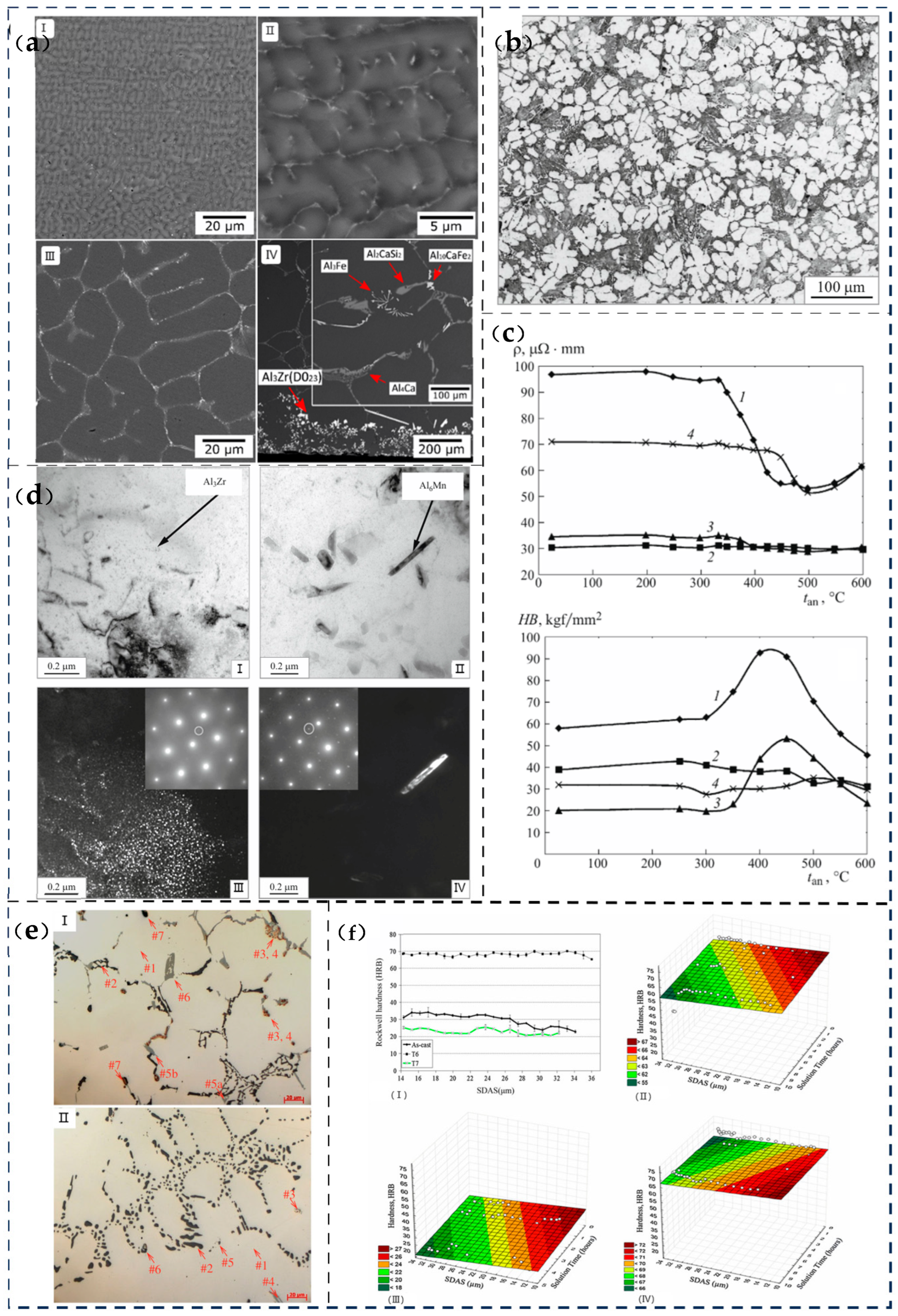
The Al-Ce alloy is a typical eutectic system, with its eutectic composition being approximately 12 wt.% Ce and the eutectic temperature being around 650 °C [101]. In this system, the solubility of Ce in the Al matrix is extremely low (<0.01 wt.%), so almost all of the Ce forms the Al14Ce intermetallic compound phase. Al14Ce has a body-centered tetragonal structure and a melting point as high as 925 °C, which provides excellent thermal stability for the alloy [14]. During the additive manufacturing process, the rapid solidification conditions (with a cooling rate of up to 104 K/s) significantly refine the Al-Ce eutectic structure. The research by Belov et al. shows that the Al-Ce alloy prepared by electromagnetic casting (EMC) technology exhibits fine dendritic structure and uniformly distributed eutectic particles [102] (Figure 8a). This refined microstructure not only enhances the room-temperature strength of the alloy, but more importantly, improves its high-temperature creep resistance. The strengthening mechanisms of the Al-Ce eutectic alloy mainly include: (1) the pinning effect of the eutectic phase Al14Ce, which hinders grain boundary migration and dislocation movement; (2) the dispersion strengthening effect of fine eutectic lamellae on the matrix; (3) the weak solid solution strengthening effect of the Ce element on the matrix lattice. Due to the high thermal stability of the Al14Ce phase, these strengthening effects remain even at high temperatures, enabling the Al-Ce alloy to have a usage temperature of 300–350 °C [102].

3.2.2. Al-Ni Eutectic Alloy System

The Al-Ni alloy system is another important type of heat-resistant eutectic alloy, with a eutectic composition of approximately 6.1 wt.% Ni and a eutectic temperature of 640 °C. The main strengthening phase in this system is Al19Ni, which has an orthorhombic crystal structure and a melting point of approximately 854 °C [103]. The AN2ZhMts alloy developed by Belov et al. is a new type of heat-resistant cast aluminum alloy based on the Al-Ni-Fe-Mn-Zr system. Its main structural components are (Al) + Al9FeNi eutectic (Figure 8b). The main feature of this alloy is that it can achieve high mechanical properties without the need for quenching treatment, which significantly reduces the heat treatment cost. Studies have shown that, after annealing at 400–450 °C, the hardness of the AN2ZhMts alloy can reach above 90 HB, the tensile strength exceeds 250 MPa, and the elongation is greater than 5% (Figure 8c) [103]. The high-temperature stability of Al-Ni eutectic alloys mainly stems from the thermal stability of the Al19Ni (or Al9FeNi) phase. During annealing, nano-sized Al3Zr (L12 structure) and Al6Mn dispersion phases are also precipitated in the alloy, which further enhances the high-temperature strength of the alloy (Figure 8d). However, when the annealing temperature exceeds 450 °C, these dispersion phases will significantly coarsen, leading to alloy softening [103].

3.2.3. Al-Fe Eutectic Alloy System

The eutectic composition of the Al-Fe alloy is approximately 1.8 wt.% Fe, and the eutectic temperature is 655 °C. The main strengthening phase in this system is Al13Fe, which has a monoclinic crystal structure. Under rapid solidification conditions, the Al-Fe alloy can form metastable Al6Fe phase, which transforms into stable Al13Fe phase during subsequent heating [101]. In recent years, the Al-Fe-V-Si alloy system has received extensive attention. Kasprzak et al. demonstrated that, by adding transition metal elements such as Zr, V, and Ti, complex intermetallic compound phases such as Al-Si-Ti-Zr and Al-Si-Ti-V-Fe can be formed. These phases nucleate at the grain boundaries and effectively inhibit grain boundary sliding at high temperatures (Figure 8e) [104]. In additive manufacturing, the selective laser melting (SLM) technique is used to prepare Al-Fe-V-Si heat-resistant aluminum alloys. The microstructure refinement caused by rapid solidification results in the alloy having a high hardness (36 HRB) in the as-cast state. After T6 heat treatment, the hardness can be further increased to 69–71 HRB (Figure 8f) [104].

3.2.4. Strengthening Mechanism of Eutectic Alloys

The high-temperature strengthening mechanisms of eutectic system alloys mainly include the following aspects: (1) Pinning strengthening of eutectic phases: Eutectic phases (such as Al14Ce, Al19Ni, Al13Fe, etc.) are distributed in a network or lamellar form within the Al matrix, forming a three-dimensional framework structure. This structure effectively pins the grain boundaries, preventing grain growth and grain boundary slip at high temperatures. Studies by Belov et al. have shown that, in Al-Ca-Zr-Fe-Si alloy systems, the eutectic phases containing calcium (Al14Ca, Al10CaFe2, and Al2CaSi2) have a strong pinning effect on grain boundaries, enabling the alloy to maintain a non-re-crystallized structure at 450 °C [102]. (2) Nanometer dispersed phase precipitation strengthening: In eutectic alloys containing Zr, Mn, etc., annealing treatment will cause the precipitation of nanoscale Al3Zr (L12 structure) and Al6Mn dispersed phases. These dispersed phases have a size of only 10–20 nm and a high number density, maintaining a coherent or semi-coherent relationship with the matrix, providing significant precipitation strengthening effects [103]. (3) Solid solution strengthening and fine grain strengthening: Under rapid solidification conditions, the solid solubility of transition metal elements (such as Zr and Mn) in the Al matrix is significantly increased, resulting in a solid solution strengthening effect. At the same time, the fine grain structure (branch arm spacing can be as small as 10 μm or less) caused by rapid solidification also contributes a part of the strengthening effect [104].
Figure 8. (a) As-cast microstructure of alloy ACZ after various cooling velocities [102]. (b) Microstructure of alloy ANZ2hMts in cast condition [103]. (c) Dependence of the resistivity (I) and hardness (II) of the experimental alloys on the temperature of the last stage of annealing [103]. (d) Secondary segregations of phases Al3Zr (I, III) and Al6Mn (II, IV) in alloy AN2ZhMts after annealing by regime T450 [103]. (e) Typical microstructures of the investigated alloy in (I) as-cast, (II) T6 (H3) heat-treated conditions having SDAS of approximately 25 μm [104]. (f) (I) The correlation between hardness and SDAS for alloy in the as-cast, T6 (H1) and T7 (H2) conditions. Note: increased as-cast hardness with reducing SDAS size (higher solidification rates) and almost constant hardness value over analyzed SDAS range for T6 and T7 conditions. (II–IV) The correlation between hardness, SDAS and solution treatment time for the alloy in the following conditions: (II) T6 (H1)—1-step solution treatment. (III) T7 (H2)—1-step solution treatment. (IV) T6 (H3)—2-step solution treatment [104].
Machines 14 00597 g008

3.3. High-Strength Aluminum Alloy System: Transition Metal Reinforced Aluminum Alloy

3.3.1. Nano-Metallic Compounds Formed by the Introduction of Co

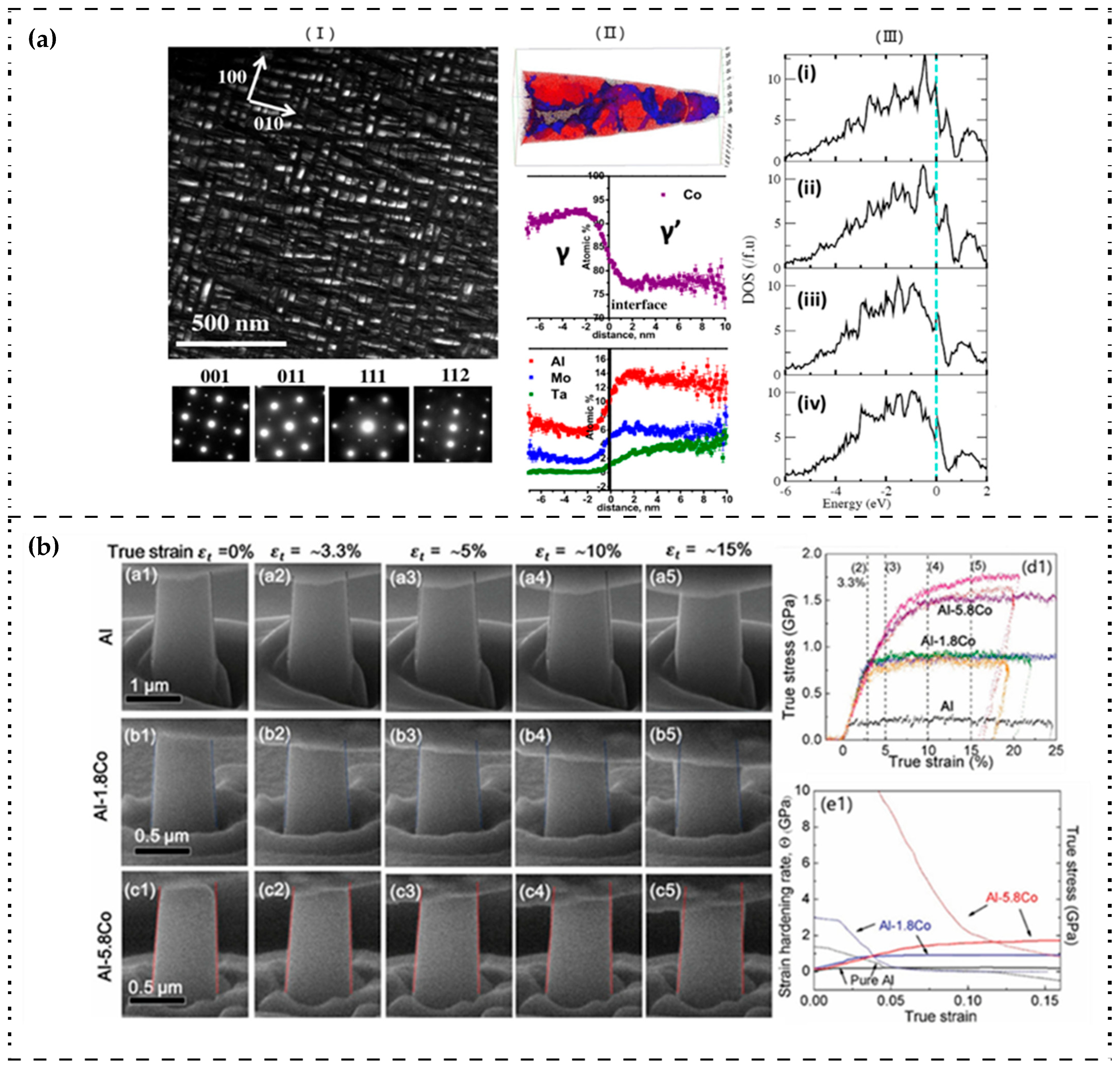
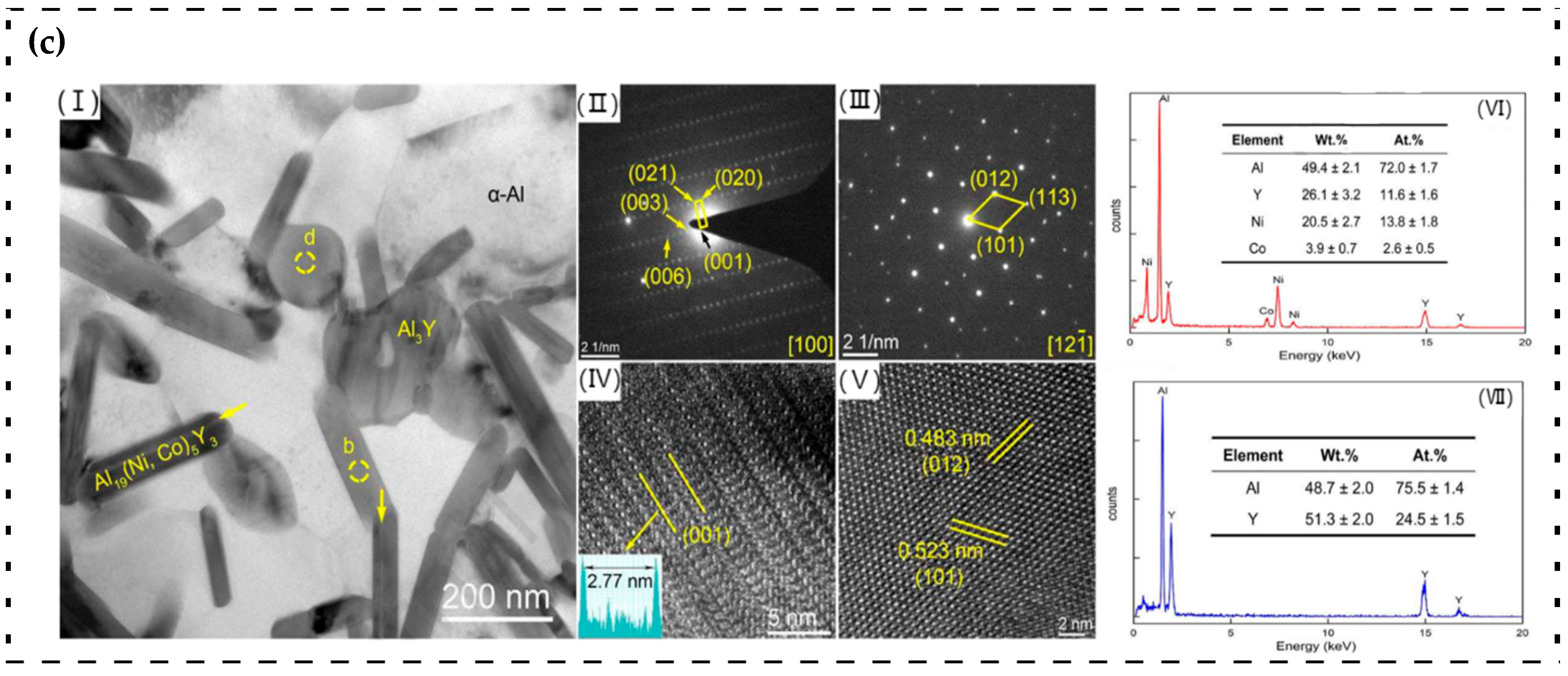
The introduction of cobalt (Co) as a transition metal element into aluminum alloys provides an important approach for developing new high-strength aluminum alloys. Studies have shown that the solubility of Co in the aluminum matrix is extremely low, and this characteristic enables it to achieve effective strengthening through the formation of nanoscale intermetallic compounds [105]. According to the research of Xue et al., the nanocrystalline Al-Co alloys prepared by high-energy ball milling and discharge plasma sintering exhibit excellent mechanical properties, mainly attributed to the uniformly distributed nanoscale Al9Co2 intermetallic compound particles in the Al matrix [105] (Figure 9a). This study successfully prepared bulk Al-Co alloys with a nanocrystalline structure by precisely controlling the Co content and processing parameters, and their yield strength and tensile strength are significantly higher than those of traditional aluminum alloys. The formation of nanotwin structures is another important feature of Co strengthening of aluminum alloys. Xue et al. successfully introduced high-density nanotwin structures into Al-Co alloys through mechanical alloying and subsequent heat treatment [105] (Figure 9b). This unique microstructure not only provides excellent strength but also maintains good plastic deformation ability. It is pointed out that the formation of nanotwins is closely related to the low solubility of Co in the aluminum matrix. Co atoms tend to accumulate at grain boundaries and twin boundaries, thereby stabilizing the nanotwin structure. This strengthening mechanism provides a new design idea for developing aluminum alloys with both high strength and good plasticity. In the high-temperature application field, the introduction of Co also shows significant advantages. The research on the Al-Y-Ni-Co alloy system indicates that the addition of Co can significantly improve the high-temperature strength and creep resistance of the alloy [106] (Figure 9c). This alloy can maintain a high strength level in the 300–400 °C temperature range, mainly due to the complex intermetallic compound phases formed by Co and Y, Ni, etc. These high-temperature stable phases can effectively anchor the grain boundaries and inhibit grain growth and creep deformation at high temperatures. Moreover, the introduction of Co can also improve the casting and welding properties of the alloy, which is of great significance for practical engineering applications. The research on Co-based γ-γ’ alloy systems provides important references for understanding the strengthening mechanism of Co in aluminum alloys. Although these alloys are mainly used in high-temperature alloys, their strengthening principles are also of significance for aluminum alloy design. It has been shown that Co can form stable γ’ phases (Co3(Al,Mo,Ta)) with Al, Mo, Ta, etc., and this ordered intermetallic compound phase has excellent high-temperature stability [107]. By analogy with this strengthening mechanism, researchers designed similar nano-precipitated phase structures in Al-Co alloys to achieve significant strengthening effects. It is worth noting that the addition amount of Co needs to be precisely controlled. Excessive Co content will lead to the formation of coarse intermetallic compounds, which instead reduces the mechanical properties of the alloy. The application of additive manufacturing technology provides new possibilities for the preparation of Co-strengthened aluminum alloys. Studies have shown that Al-Co alloys prepared by Selective Laser Melting (SLM) technology have unique microstructure characteristics, including ultrafine grains and uniformly distributed nano-precipitated phases [108]. This rapid solidification process can effectively inhibit the formation of coarse intermetallic compounds, thereby obtaining more excellent mechanical properties. Moreover, the additive manufacturing technology can also achieve near-net-shape forming of complex-shaped parts, which is of great significance for applications in aerospace and other fields.

3.3.2. Nano-Metallic Compounds Formed by the Introduction of Fe

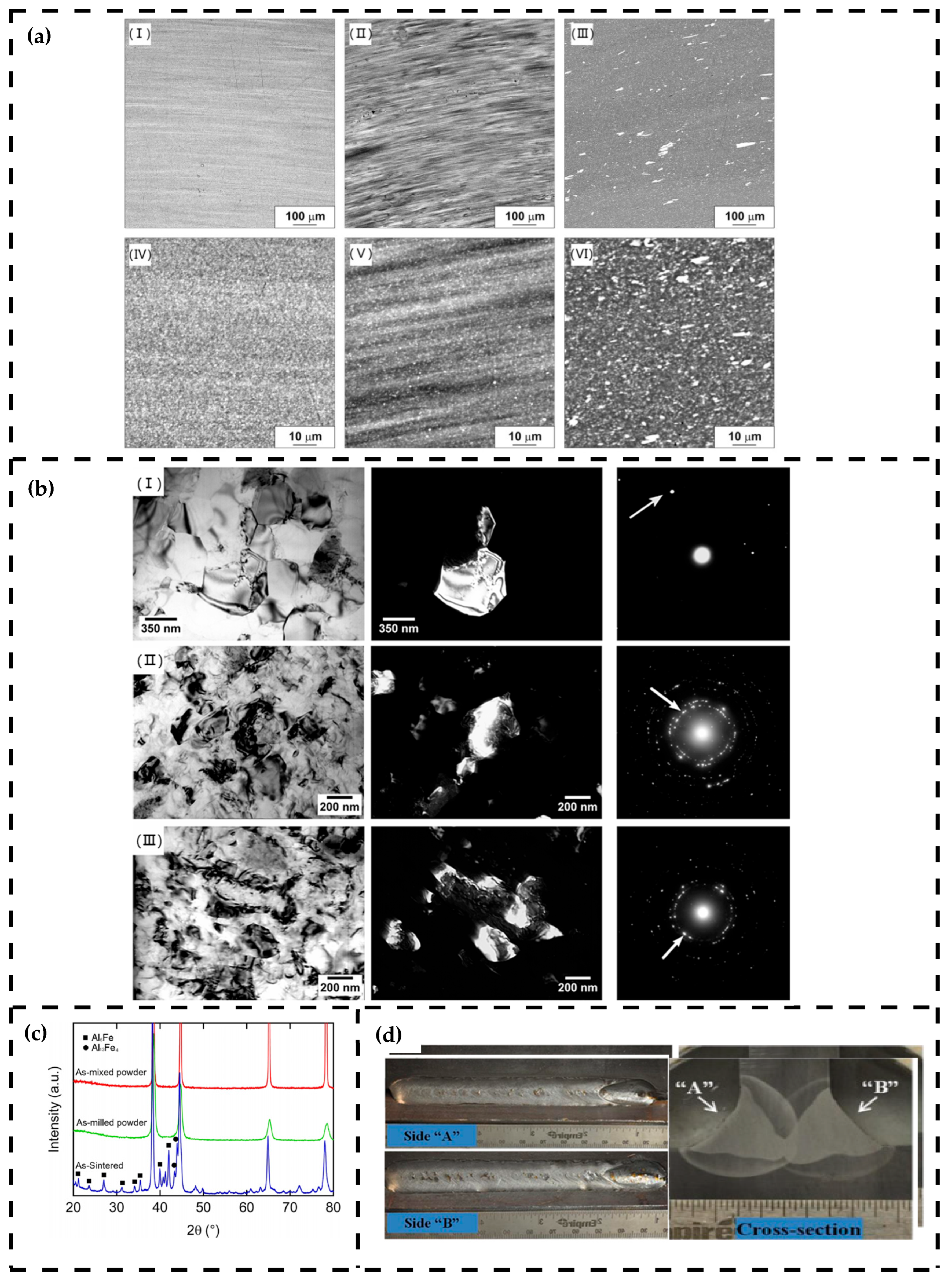
Iron (Fe), as one of the most common impurity elements in aluminum alloys, has traditionally been regarded as a harmful element because it easily forms coarse needle-like Al3Fe phases, which seriously damage the plasticity and toughness of the alloy. However, recent studies have shown that, through reasonable component design and process control, Fe can be transformed into an effective alloying element, achieving strengthening effects by forming nanoscale intermetallic compounds [109] (Figure 10a). The pioneering work of Belov et al. demonstrated that introducing an appropriate amount of Fe in the Al-Zn-Mg-Cu series high-strength aluminum alloys and adding Ni can form a (Al) + Al9FeNi eutectic structure, significantly improving the casting performance and mechanical properties of the alloy. The preparation of nano-crystalline Al-Fe alloys is an important direction in the research on Fe strengthening of aluminum alloys. Sasaki et al. [110] prepared bulk nano-crystalline Al-Fe alloys through mechanical alloying and plasma sintering techniques. It was found that, when the Fe content was controlled within an appropriate range, the nano-sized Al3Fe and Al6Fe particles formed in the alloy could effectively pin the grain boundaries and inhibit grain growth, thereby achieving excellent comprehensive mechanical properties (Figure 10b). This study also revealed the influence laws of Fe content on the microstructure and mechanical properties of the alloy, providing an important basis for the component design of Fe-strengthened aluminum alloys. The high-pressure torsion (HPT) technique provides an effective way to prepare ultrafine-grained Al-Fe alloys. Studies have shown that, through HPT treatment, the nano-sized intermetallic compound particles formed in the Al-Fe alloy can significantly refine the grain size and increase the strength and hardness of the alloy [111]. After HPT treatment of the Al-Fe alloy, the grain size can be refined to sub-micron or even nanometer levels, and the solubility of Fe is also significantly increased. These factors work together to make the alloy exhibit excellent mechanical properties. Moreover, HPT treatment can also improve the uniformity of the distribution of intermetallic compound particles, further enhancing the performance stability of the alloy (Figure 10c). The combined addition of Fe and Ni is an important strategy for developing new high-strength aluminum alloys. The research of Letyagin et al. [112] showed that adding Fe and Ni simultaneously in the Al-Zn-Mg series alloys can form (Al) + Al9FeNi eutectic structures, which have better properties than (Al) + Al3Ni eutectic structures. The formation of Al9FeNi phase can not only increase the strength of the alloy but also improve the casting performance and welding performance of the alloy. This study determined the optimal Fe/Ni ratio through thermodynamic calculations and experiments, providing a theoretical basis for the design of new “nikalin” alloys.
Introducing Fe into the 7xxx series high-strength aluminum alloys is another important research direction. Traditional 7xxx series alloys require strict control of the Fe content to ensure the plasticity and toughness of the K alloy. However, research by Akopyan and Belov [113] showed that, by optimizing the alloy composition and heat treatment process, an appropriate amount of Fe can be introduced into the 7xxx series alloys to form beneficial Al9FeNi phases, thereby improving the comprehensive properties of the alloy. The developed ATs6N0.5Zh alloy (Al-6.3%Zn-2.1%Mg-0.2%Cu-0.4%Fe-0.6%Ni) exhibits excellent mechanical properties (σr ~ 500 MPa, σ0.2 ~ 450 MPa, δ ~ 4.7%), proving the feasibility of the Fe strengthening strategy. The application of Fe-Al intermetallic compounds in heterogeneous material bonding is also worthy of attention. Studies have shown that the Fe-Al intermetallic compound layer can serve as an effective transitional layer for connecting steel and aluminum alloys, achieving high-quality connections between the two materials [114]. This connection method takes advantage of the excellent high-temperature stability of Fe-Al intermetallic compounds and their good compatibility with both base materials, providing a new solution for the connection of dissimilar materials. Although this is not a direct study on Fe strengthening of aluminum alloys, the characteristics of Fe-Al intermetallic compounds revealed by it are of reference value for understanding the mechanism of Fe’s role in aluminum alloys (Figure 10d).
Figure 10. (a) SEM images of the HPT-processed alloy surfaces (I, II) Al-1%La, (III, IV) Al-9%Ce and (V, VI) Al-7%Ni [111]. (b) TEM bright-field (left) and dark-field (center) images from disk-type samples of Al-2% Fe after HPT processing through (I) N = 1, (II) N = 20, and (III) N = 75 revolutions. Dark-field images obtained from selected beams as pointed by arrows in corresponding SAED patters (right) [115]. (c) XRD patterns of as-mixed powder, as-milled powder and as-sintered alloy [110]. (d) Top surfaces and cross-section of the AHSS-to-A516 weld beads [114].
Machines 14 00597 g010

3.3.3. Nano-Metallic Compounds Formed by the Introduction of Ni

Nickel (Ni), as an important alloying element in aluminum alloys, can achieve effective strengthening through the formation of nanoscale Al3Ni intermetallic compounds. The solubility of Ni in the aluminum matrix is extremely low, which makes it tend to form eutectic structures or precipitated phases during solidification, providing abundant possibilities for alloy design [116]. The “nikalin” series alloys developed by Belov et al. are high-strength aluminum alloys based on the (Al) + Al3Ni eutectic structure, and these alloys exhibit excellent casting properties and mechanical properties. The rapid solidification technology is an important means for preparing high-performance Al-Ni alloys. Ohtera et al. [117] prepared rapid solidification Al-Ni-X (X = Zr, Ti or Mm) alloy powders through high-pressure nitrogen atomization technology, and the obtained bulk alloys after hot extrusion showed extremely high specific strength and specific modulus. It was shown that the specific strength of the Al88.5Ni8Zr2.5 alloy could reach 266 MPa·Mg−1·m−3, and the specific modulus could reach 31.3 GPa·Mg−1·m−3, which was significantly superior to traditional high-strength aluminum alloys. This excellent performance is mainly attributed to the synergistic strengthening effect of ultrafine grains and uniformly distributed nanoscale intermetallic compound particles. The high-pressure torsion technology is also applicable for the preparation of Al-Ni alloys. After HPT treatment, the grain size of Al-4%Ni, Al-8%Ni and Al-11%Ni alloys is significantly refined, and the nanoscale Al3Ni particles are uniformly distributed in the aluminum matrix, making the alloys exhibit excellent strength and hardness [117]. It was shown that, with the increase in Ni content, the volume fraction of intermetallic compounds increases, and the strengthening effect becomes more significant. However, excessive Ni content will lead to the formation of coarse intermetallic compounds, which instead reduces the plasticity of the alloy. Additive manufacturing technology provides a new approach for the preparation of Al-Ni alloys. Studies have shown that the Al-Ni eutectic alloys prepared by selective laser melting technology have unique microstructure characteristics, including ultrafine eutectic structure and uniformly distributed nanoscale Al3Ni particles [117]. This rapid solidification process can effectively inhibit the formation of coarse intermetallic compounds, thereby obtaining more excellent mechanical properties. This study also revealed the influence laws of laser power and scanning speed on the microstructure and mechanical properties of the alloy, providing guidance for the process optimization of additive manufacturing Al-Ni alloys. The Al-Ni-Mn-Zr series alloys are another important type of high-strength aluminum alloys. Amenova et al. demonstrated that, by optimizing the contents of Ni, Mn and Zr, new aluminum alloys with high strength and good thermal resistance can be developed [118]. In this alloy system, Ni mainly forms (Al) + Al3Ni eutectic structure, while Mn and Zr form nanoscale Al6Mn and Al3Zr precipitates during subsequent heat treatment, achieving multi-scale strengthening effects. The results of mechanical calculations show that the phase composition of this alloy system is complex, and precise control of the contents of each element is required to obtain the ideal microstructure. Adding rare earth elements to Al-Ni alloys is an effective strategy for further improving alloy performance. Studies have shown that adding rare earth elements such as La or Ce to Al-Ni alloys can form more complex intermetallic compound phases, achieving more significant strengthening effects [111]. Al-Ni-La and Al-Ni-Ce alloys, after HPT treatment, exhibit more excellent mechanical properties than Al-Ni binary alloys, mainly attributed to the improvement of crystal grain refinement and precipitate distribution by rare earth elements.
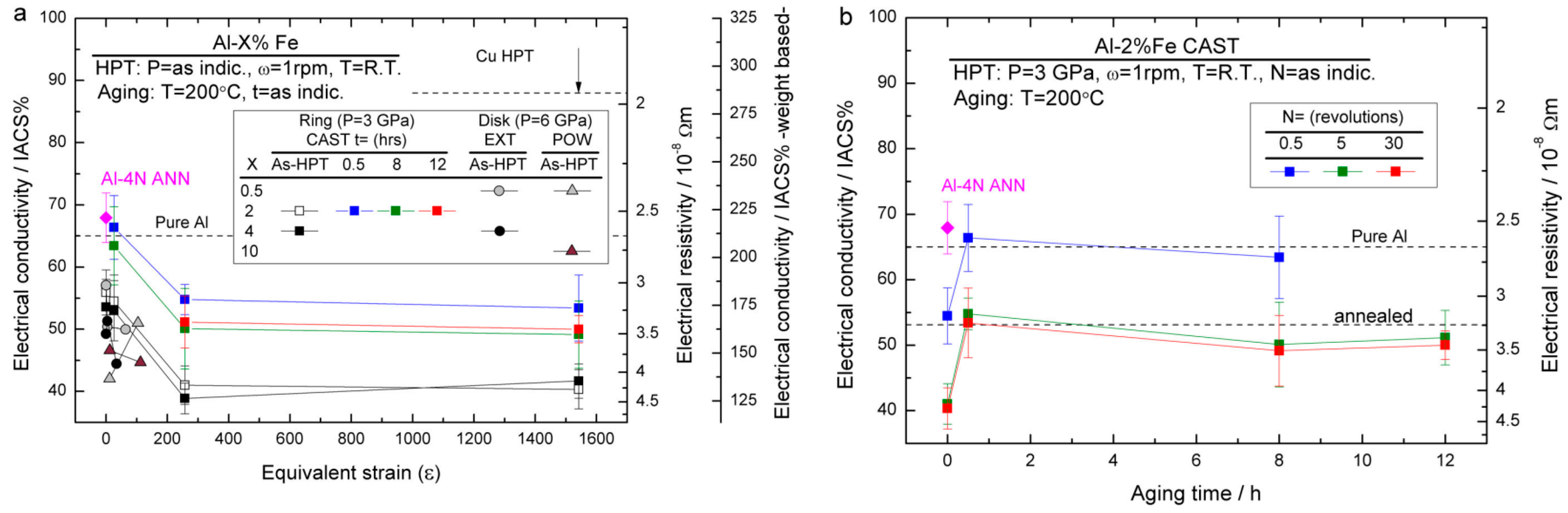
Research on the electrical conductivity of Al-Ni alloys has also made significant progress. Studies have shown that the combined effect of high-pressure torsion and aging treatment can achieve good electrical conductivity while maintaining high strength [110,119]. After HPT treatment of Al-Fe alloys, the solubility of Fe in the aluminum matrix significantly increases. Subsequently, through appropriate aging treatment, nano-sized intermetallic compound particles precipitate, which not only enhances the strength of the alloy but also maintains good electrical conductivity (Figure 11a,b). This excellent match between strength and electrical conductivity makes Al-Ni alloys have broad application prospects in fields such as power transmission.

3.4. Aluminum Materials Performance

Aluminum alloys and their matrix composites are widely used in lightweight aerospace and automotive structures. Monolithic aluminum alloys (e.g., 6061 and 7075) exhibit good ductility and machinability but limited specific strength and stiffness. In contrast, aluminum matrix composites (AMCs) reinforced with ceramic particles (SiC and Al2O3) or nanophases show significantly enhanced mechanical performance, including higher strength, modulus, hardness, and wear resistance, as shown in Table 2. For example, SiC-reinforced AMCs can achieve tensile strengths of 450–500 MPa and elastic moduli above 95 GPa, far exceeding unreinforced 6061 aluminum (230–310 MPa and ~70 GPa). Recent advances in nano-reinforced and additively manufactured (SLM) aluminum alloys have further narrowed the gap, achieving a favorable strength–ductility synergy with tensile strengths over 500 MPa while maintaining ~10% elongation. Nevertheless, conventional particle-reinforced AMCs often suffer from reduced ductility, typically below 5%. This trade-off between strength and ductility remains a key challenge, and recent research has focused on optimizing reinforcement type, size, volume fraction, and manufacturing routes to achieve balanced performance [120,121].
Explanation:
  • Mechanical properties correspond to optimal preparation and heat-treatment conditions reported in the literature; “as-deposited” and “after heat treatment” are labeled to distinguish material states.
  • For Al–SiC composite, strengthening is attributed to SiC particle reinforcement and grain refinement. For printable Al alloy, high strength derives from nano-precipitation strengthening.
  • The references correspond to the previous text, and the cited references are all from the reference list of the corresponding main literature to ensure data traceability.

4. Conclusions and Future Prospects

4.1. Conclusions

Aluminum alloy additive manufacturing technology has rapidly developed over the past decade, moving from initial process exploration to the engineering application stage. This article systematically reviews the process breakthroughs, material innovations, performance regulation, and engineering application status of aluminum alloy in additive manufacturing, and constructs an integrated analysis framework of “process–material–microstructure–performance”. Through in-depth analysis of mainstream additive manufacturing technologies (such as laser powder bed fusion, directed energy deposition, etc.), we reveal the special behavior patterns and key scientific issues of aluminum alloy in the additive manufacturing process.
In terms of process technology, Laser Powder Bed Fusion (L-PBF) has become a research hotspot due to its high precision and complex forming capabilities, while the Directed Energy Deposition (DED) technology shows unique advantages in the manufacturing of large-sized components. Studies have shown that process parameters such as laser power, scanning speed, and layer thickness have a decisive impact on the forming quality. By optimizing these parameters, defects such as porosity and hot cracks can be effectively controlled. In particular, the introduction of innovative process methods such as substrate preheating and scanning strategy optimization has significantly improved the forming quality of aluminum alloy.
In terms of material system innovation, Sc/Zr microalloyed aluminum alloys have become the research focus. The addition of Sc and Zr elements can form Al3(Sc,Zr) nano-particle precipitates, serving as heterogeneous nucleation points to refine the grains and effectively inhibit the generation of hot cracks. At the same time, the development of heat-resistant eutectic alloy systems (such as Al-Ce and Al-Ni series) and transition metal strengthening alloys (such as Fe and Co-containing alloys) has expanded the high-temperature application prospects of aluminum alloy. These new material systems achieve a synergistic improvement in strength, toughness, and heat resistance through multi-component composite alloying design.
In terms of microstructure regulation, the unique rapid solidification characteristics of additive manufacturing result in non-equilibrium microstructures, such as ultrafine grains and element segregation. Through the optimization of post-heat treatment processes, the precipitation behavior of precipitates can be regulated, thereby optimizing material performance. In addition, new methods such as inoculation treatment and electromagnetic field assistance provide new approaches for precise microstructure regulation.
However, aluminum alloy additive manufacturing still faces many challenges. Firstly, high-strength aluminum alloys (such as 7xxx series) have high sensitivity to hot cracking and are difficult to form; secondly, components have anisotropy, affecting their reliability under loading conditions; thirdly, the existing applicable material systems are limited and difficult to meet diverse application requirements. The resolution of these issues requires collaborative efforts in alloy design, process innovation, and post-processing technologies from multiple aspects.
Furthermore, recent studies from 2024–2026 have demonstrated that the integration of artificial intelligence-assisted process optimization, in situ monitoring, and data-driven alloy design significantly improves the forming stability and reproducibility of aluminum alloy AM components. Particularly, machine learning algorithms combined with thermal imaging and melt pool monitoring can predict defect formation in real time, thereby reducing porosity and improving component consistency. These advances indicate that aluminum alloy AM is gradually transitioning from laboratory-scale experimentation toward intelligent and industrialized manufacturing. From an engineering perspective, aluminum alloy AM has shown substantial practical value in lightweight aerospace structures, integrated automotive battery housings, heat dissipation components for 5G communication systems, and customized biomedical implants. Compared with conventional subtractive manufacturing, AM technology significantly reduces material waste, shortens manufacturing cycles, and enables the fabrication of highly integrated complex structures that are difficult or impossible to achieve using traditional approaches. Therefore, aluminum alloy AM is expected to become one of the core enabling technologies for next-generation high-end manufacturing industries.

4.2. Future Outlook

Over the past decade, aluminum alloy additive manufacturing (AM) technology has achieved remarkable progress, particularly in high-performance fields such as aerospace, automotive, and national defense. However, this technology still confronts numerous challenges, including microstructural defects, anisotropy, hot cracking, and porosity, which restrict its broader application. Based on current research findings, the future development of aluminum alloy AM needs to achieve breakthroughs in multiple aspects, including alloy design, process innovation, microstructure control, post-processing technology, intelligent control, and sustainability.
Firstly, the development of new alloy systems is a focus of future research. Traditional aluminum alloys (e.g., 2xxx and 7xxx series) are prone to hot cracking and element evaporation during the AM process, necessitating the design of AM-specific alloys. For instance, the addition of elements such as Sc and Zr to form Al3(Sc,Zr) precipitates can refine grains and inhibit crack formation. Wu et al. pointed out that the development of heat-resistant aluminum alloys requires balancing the volume fraction of precipitates and their thermal stability. In the future, it will be necessary to explore the combination of high-solubility elements (e.g., Ce and Ni) and low-diffusion elements (e.g., Zr) to enhance high-temperature performance. Meanwhile, biomimetic design (such as lattice structures) and functionally graded materials (FGMs) will emerge as new directions to meet the demands of lightweighting and multi-functional integration.
Secondly, process optimization and innovation are key to improving forming quality. Currently, Laser Powder Bed Fusion (L-PBF) and Wire Arc Additive Manufacturing (WAAM) are mainstream technologies, but there exists a trade-off between forming precision and efficiency. In the future, it is essential to develop hybrid manufacturing processes, such as integrating AM with rolling, friction stir processing (FSP), or cold spraying, to eliminate defects and enhance component performance. For example, it is proposed introducing interlayer cooling or ultrasonic shock treatment in WAAM to reduce residual stress and porosity. Additionally, intelligent process monitoring (e.g., online thermal imaging and machine learning) will enable real-time adjustment of process parameters, thereby improving forming stability.
Thirdly, microstructure control is crucial for ensuring excellent mechanical properties. Future studies should establish a quantitative relationship among “process parameters–thermal history–microstructure evolution–mechanical performance” through multi-scale simulation and digital twin technologies. Recent studies have shown that coupling computational fluid dynamics (CFD), phase-field simulation, and finite element analysis can effectively predict melt pool evolution, grain growth behavior, and residual stress distribution during AM processing. This integrated simulation framework will significantly reduce experimental costs and accelerate alloy/process optimization. In addition, the integration of artificial intelligence (AI) and big data technologies is expected to become a transformative direction for aluminum alloy AM. AI-assisted parameter optimization and defect prediction can improve manufacturing efficiency and process robustness. Deep learning models trained using process datasets, melt pool images, and thermal signals have already demonstrated excellent capability in identifying pores, cracks, and lack-of-fusion defects. Therefore, future intelligent AM systems will gradually realize closed-loop autonomous manufacturing. Post-processing technologies will also play an increasingly important role in industrial applications. Advanced heat treatment, hot isostatic pressing (HIP), laser shock peening, and surface nanocrystallization technologies can effectively reduce residual stress and improve fatigue resistance. Particularly for aerospace and automotive structural components subjected to cyclic loading, improving fatigue life and long-term reliability remains one of the most critical research priorities. From the viewpoint of engineering applications, aluminum alloy AM is expected to accelerate its industrial penetration in aerospace lightweight structures, integrated propulsion systems, electric vehicle battery trays, rail transportation components, and thermal management devices. Recent industrial demonstrations have confirmed that topology-optimized AM aluminum structures can achieve 20–50% weight reduction while maintaining comparable mechanical performance. This lightweight advantage contributes directly to energy conservation and carbon emission reduction, which is highly aligned with global green manufacturing strategies. Sustainability and green manufacturing should also become key future research topics. Compared with conventional subtractive manufacturing, AM technology greatly improves material utilization and reduces machining waste. Future research should further focus on low-carbon powder preparation, recyclable aluminum alloy powders, energy-efficient AM equipment, and life-cycle assessment (LCA). Establishing environmentally friendly and economically sustainable AM manufacturing systems will be essential for large-scale industrial deployment. Finally, standardization and industrial certification remain major bottlenecks restricting the commercialization of aluminum alloy AM components. Future work should strengthen the establishment of unified standards for powder quality, process qualification, defect evaluation, and mechanical performance testing. Particularly in safety-critical fields such as aerospace and nuclear energy, the development of internationally recognized qualification and certification systems is indispensable for promoting the widespread engineering application of AM aluminum alloy components. Overall, aluminum alloy additive manufacturing is evolving from “process feasibility” toward “high-performance intelligent manufacturing”. Through interdisciplinary integration involving materials science, mechanical engineering, artificial intelligence, and digital manufacturing, AM aluminum alloys are expected to become one of the most important lightweight structural materials in next-generation advanced manufacturing systems.

Author Contributions

Conceptualization, investigation, data curation, methodology, formal analysis, and writing—original draft, Y.P.; supervision, project administration, funding acquisition, and writing—review and editing, J.C.; validation, resources, L.H. All authors have read and agreed to the published version of the manuscript.

Funding

This research received no external funding.

Data Availability Statement

The original contributions presented in the study are included in the article; further inquiries can be directed to the corresponding author.

Conflicts of Interest

The authors declare no conflicts of interest.

References

  1. Rooy, E.L. Introduction to aluminum and aluminum alloys. In Properties and Selection: Nonferrous Alloys and Special-Purpose Materials; ASM International: Almere, The Netherlands, 1990; pp. 3–14. [Google Scholar]
  2. Chen, J.S.; Chen, J.B.; Shi, Q.Y.; Wang, Y.-T.; Xia, X.-Z.; Li, R.-D. Microstructure and high-temperature performance of heat-resistant Al− Fe− Mn alloy prepared by laser powder bed fusion. Trans. Nonferrous Met. Soc. China 2025, 35, 2200. [Google Scholar] [CrossRef]
  3. Chen, J.; Chen, J.; Wang, H.; He, L.; Huang, B.; Dadbakhsh, S.; Bartolo, P. Fabrication and development of mechanical metamaterials via additive manufacturing for biomedical applications: A review. Int. J. Extrem. Manuf. 2025, 7, 012001. [Google Scholar] [CrossRef]
  4. Sokoluk, M. Fundamental Study on Nanoparticle Interaction with Hot Crack Susceptible Aluminum Alloys During Arc Welding. Ph.D. Thesis, University of California, Los Angeles, CA, USA, 2020. [Google Scholar]
  5. Benedyk, J.C. Aluminum alloys for lightweight automotive structures. In Materials, Design and Manufacturing for Lightweight Vehicles; Woodhead Publishing: Sawston, UK, 2010; pp. 79–113. [Google Scholar]
  6. Chen, J.; Yu, S.; Yang, J.; Xu, R.; Li, R.; Huang, S.; Zhu, H.; Liu, X. Research on the microstructure and mechanical properties of repaired 7N01 aluminum alloy by laser-directed energy deposition with Sc modified Al-Zn-Mg. Metals 2023, 13, 829. [Google Scholar] [CrossRef]
  7. Hu, M.; Zhi, S.; Chen, J.; Li, R.; Liu, B.; He, L.; Yang, H.; Wang, H. Restraint of intermetallic compound and improvement of mechanical performance of Ti/Al dissimilar alloy by rotary friction welding based on laser powder bed fusion. J. Manuf. Process. 2024, 131, 440–454. [Google Scholar] [CrossRef]
  8. Rajan, R.; Kah, P.; Mvola, B.; Martikainen, J. Trends in aluminium alloy development and their joining methods. Rev. Adv. Mater. Sci. 2016, 44, 383–397. [Google Scholar]
  9. Jiang, L.; Wang, C.; Fu, H.; Shen, J.; Zhang, Z.; Xie, J. Discovery of aluminum alloys with ultra-strength and high-toughness via a property-oriented design strategy. J. Mater. Sci. Technol. 2022, 98, 33–43. [Google Scholar] [CrossRef]
  10. Eskin, D.G. Sc applications in aluminum alloys: Overview of Russian research in the 20th century. In TMS Annual Meeting & Exhibition; Springer International Publishing: Cham, Switzerland, 2018; pp. 1565–1572. [Google Scholar]
  11. Georgantzia, E.; Gkantou, M.; Kamaris, G.S. Aluminium alloys as structural material: A review of research. Eng. Struct. 2021, 227, 111372. [Google Scholar] [CrossRef]
  12. Gu, D.; Shi, X.; Poprawe, R.; Bourell, D.L.; Setchi, R.; Zhu, J. Material-structure-performance integrated laser-metal additive manufacturing. Science 2021, 372, eabg1487. [Google Scholar] [CrossRef]
  13. Chen, B.; Xi, X.; Tan, C.; Song, X. Recent progress in laser additive manufacturing of aluminum matrix composites. Curr. Opin. Chem. Eng. 2020, 28, 28–35. [Google Scholar] [CrossRef]
  14. Wu, C.; Wen, J.; Zhang, J.; Song, B.; Shi, Y. Additive manufacturing of heat-resistant aluminum alloys: A review. Int. J. Extrem. Manuf. 2024, 6, 062013. [Google Scholar] [CrossRef]
  15. Taheri-Mousavi, S.M.; Xu, M.; Hengsbach, F.; Houser, C.; Ge, Z.; Glaser, B.; Wei, S.; Schaper, M.; LeBeau, J.M.; Olson, G.B.; et al. Additively manufacturable high-strength aluminum alloys with thermally stable microstructures enabled by hybrid machine learning-based design. arXiv 2024, arXiv:2406.17457. [Google Scholar]
  16. Omiyale, B.O.; Olugbade, T.O.; Abioye, T.E.; Farayibi, P.K. Wire arc additive manufacturing of aluminium alloys for aerospace and automotive applications: A review. Mater. Sci. Technol. 2022, 38, 391–408. [Google Scholar] [CrossRef]
  17. Zhang, H.; Ni, D.R.; Xiao, B.L.; Liu, F.C.; Ma, Z.Y. Recent progress of aluminum alloys and aluminum matrix composites produced via laser powder bed fusion: A review. J. Mater. Sci. 2024, 59, 9857–9891. [Google Scholar] [CrossRef]
  18. Campbell, I.; Diegel, O.; Kowen, J.; Wohlers, T. Wohlers Report 2018: 3D Printing and Additive Manufacturing State of the Industry: Annual Worldwide Progress Report; Wohlers Associates: Washington, DC, USA, 2018. [Google Scholar]
  19. Tammas-Williams, S.; Todd, I. Design for additive manufacturing with site-specific properties in metals and alloys. Scr. Mater. 2017, 135, 105–110. [Google Scholar] [CrossRef]
  20. Cheng, H.; Liu, S.; Zhang, X.; Tong, X.; Deng, J.; Liu, Q.; Cao, J. Research on the Development Status, Challenges, and Trends of Electric Ferries in China under the Background of Carbon Neutrality. J. Power Energy Eng. 2025, 13, 80–102. [Google Scholar] [CrossRef]
  21. Herzog, D.; Seyda, V.; Wycisk, E.; Emmelmann, C. Additive manufacturing of metals. Acta Mater. 2016, 117, 371–392. [Google Scholar] [CrossRef]
  22. Coniglio, N.; Cross, C.E. Mechanisms for solidification crack initiation and growth in aluminum welding. Metall. Mater. Trans. A 2009, 40, 2718–2728. [Google Scholar] [CrossRef]
  23. Zhang, J.; Gao, J.; Song, B.; Zhang, L.; Han, C.; Cai, C.; Zhou, K.; Shi, Y. A novel crack-free Ti-modified Al-Cu-Mg alloy designed for selective laser melting. Addit. Manuf. 2021, 38, 101829. [Google Scholar] [CrossRef]
  24. Anyalebechi, P.N. Analysis of the effects of alloying elements on hydrogen solubility in liquid aluminum alloys. Scr. Metall. Et Mater. 1995, 33, 1209–1216. [Google Scholar] [CrossRef]
  25. Dixit, S.; Liu, S. Laser additive manufacturing of high-strength aluminum alloys: Challenges and strategies. J. Manuf. Mater. Process. 2022, 6, 156. [Google Scholar] [CrossRef]
  26. Hauser, T.; Reisch, R.T.; Breese, P.P.; Lutz, B.S.; Pantano, M.; Nalam, Y.; Bela, K.; Kamps, T.; Volpp, J.; Kaplan, A.F.H. Porosity in wire arc additive manufacturing of aluminium alloys. Addit. Manuf. 2021, 41, 101993. [Google Scholar] [CrossRef]
  27. Tawfik, M.M.; Nemat-Alla, M.M.; Dewidar, M.M. Enhancing the properties of aluminum alloys fabricated using wire+ arc additive manufacturing technique-A review. J. Mater. Res. Technol. 2021, 13, 754–768. [Google Scholar] [CrossRef]
  28. Jing, C.H.E.N.; Wei, H.O.U.; Xiuzhuan, W.A.N.G.; Songlin, C.H.U.; Zhiyi, Y.A.N.G. Microstructure, porosity and mechanical properties of selective laser melted AlSi10Mg. Chin. J. Aeronaut. 2020, 33, 2043–2054. [Google Scholar] [CrossRef]
  29. Tang, M.; Pistorius, P.C. Oxides, porosity and fatigue performance of AlSi10Mg parts produced by selective laser melting. Int. J. Fatigue 2017, 94, 192–201. [Google Scholar] [CrossRef]
  30. Derekar, K.S. A review of wire arc additive manufacturing and advances in wire arc additive manufacturing of aluminium. Mater. Sci. Technol. 2018, 34, 895–916. [Google Scholar] [CrossRef]
  31. Gibson, I.; Rosen, D.; Stucker, B.; Khorasani, M.; Rosen, D.; Stucker, B.; Khorasani, M. Additive Manufacturing Technologies; Springer: Cham, Switzerland, 2021; Volume 17, pp. 160–186. [Google Scholar]
  32. Zheng, J.; Pang, Q.; Hu, Z.; Sun, Q. Recent progress on regulating strategies for the strengthening and toughening of high-strength aluminum alloys. Materials 2022, 15, 4725. [Google Scholar] [CrossRef] [PubMed]
  33. Aboulkhair, N.T.; Everitt, N.M.; Maskery, I.; Ashcroft, I.; Tuck, C. Selective laser melting of aluminum alloys. MRS Bull. 2017, 42, 311–319. [Google Scholar] [CrossRef]
  34. Si, L.; Zhang, T.; Zhou, M.; Li, M.; Zhang, Y.; Zhou, H. Numerical simulation of the flow behavior and powder spreading mechanism in powder bed-based additive manufacturing. Powder Technol. 2021, 394, 1004–1016. [Google Scholar] [CrossRef]
  35. Górski, F.; Kuczko, W.; Wichniarek, R. Influence of process parameters on dimensional accuracy of parts manufactured using fused deposition modelling technology. Adv. Sci. Technol. Res. J. 2013, 7, 27–35. [Google Scholar] [CrossRef]
  36. Yang, J.; Han, J.; Yu, H.; Yin, J.; Gao, M.; Wang, Z.; Zeng, X. Role of molten pool mode on formability, microstructure and mechanical properties of selective laser melted Ti-6Al-4V alloy. Mater. Des. 2016, 110, 558–570. [Google Scholar] [CrossRef]
  37. Chen, D.; Wang, P.; Pan, R.; Zha, C.; Fan, J.; Liang, D.; Zhao, Y. Characteristics of metal specimens formed by selective laser melting: A state-of-the-art review. J. Mater. Eng. Perform. 2021, 30, 7073–7100. [Google Scholar] [CrossRef]
  38. Bremen, S.; Meiners, W.; Diatlov, A. Selective laser melting: A manufacturing technology for the future? Laser Tech. J. 2012, 9, 33–38. [Google Scholar] [CrossRef]
  39. Bayraktar, Ş.; Alparslan, C. Comparison of the SLM, SLS, and DLMS techniques in additive manufacture of AlSi10Mg alloys. In Innovation and Sustainable Manufacturing; Woodhead Publishing: Sawston, UK, 2023; pp. 231–253. [Google Scholar]
  40. Najmon, J.C.; Raeisi, S.; Tovar, A. Review of additive manufacturing technologies and applications in the aerospace industry. In Additive Manufacturing for the Aerospace Industry; Elsevier: Amsterdam, The Netherlands, 2019; pp. 7–31. [Google Scholar]
  41. Tang, M.; Pistorius, P.C. Fatigue life prediction for AlSi10Mg components produced by selective laser melting. Int. J. Fatigue 2019, 125, 479–490. [Google Scholar] [CrossRef]
  42. Rahman, M.S.; Schilling, P.J.; Herrington, P.D.; Chakravarty, U.K. A comparative study between selective laser melting and electron beam additive manufacturing based on thermal modeling. In ASME International Mechanical Engineering Congress and Exposition; American Society of Mechanical Engineers: New York, NY, USA, 2018; Volume 52005, p. V001T03A015. [Google Scholar]
  43. Zhang, C.; Zhu, J.; Zheng, H.; Li, H.; Liu, S.; Cheng, G.J. A review on microstructures and properties of high entropy alloys manufactured by selective laser melting. Int. J. Extrem. Manuf. 2020, 2, 032003. [Google Scholar] [CrossRef]
  44. Frazier, W.E. Metal additive manufacturing: A review. J. Mater. Eng. Perform. 2014, 23, 1917–1928. [Google Scholar] [CrossRef]
  45. Kumar, A.; Kumar, P.; Sebaey, T.A.; Gambhir, V. (Eds.) Tools, Techniques, and Advancements in Engineering Materials Science; IGI Global: Palmdale, PA, USA, 2024. [Google Scholar]
  46. DebRoy, T.; Wei, H.L.; Zuback, J.S.; Mukherjee, T.; Elmer, J.W.; Milewski, J.O.; Beese, A.M.; Wilson-Heid, A.; De, A.; Zhang, W. Additive manufacturing of metallic components–process, structure and properties. Prog. Mater. Sci. 2018, 92, 112–224. [Google Scholar] [CrossRef]
  47. Li, G.; Zhao, C.; Huang, Y.; Tan, Q.; Hou, J.; He, X.; Guo, C.; Lu, W.; Zhou, L.; Liu, S.; et al. Additively manufactured fine-grained ultrahigh-strength bulk aluminum alloys with nanostructured strengthening defects. Mater. Today 2024, 76, 40–51. [Google Scholar] [CrossRef]
  48. Liang, Y.; Han, Q.; Sui, Z.; Zhang, Z.; Zhang, H.; Gu, H.; Wu, D.; Wang, L.; Liu, H.; Setchi, R. Laser powder bed fusion of high-strength crack-free Al7075 alloy with the in-situ formation of TiB2/Al3Ti-reinforced phases and nucleation agents. Compos. Part B Eng. 2025, 289, 111940. [Google Scholar] [CrossRef]
  49. Jiang, S.; Xu, Y.; Wang, R.; Chen, X.; Guan, C.; Peng, Y.; Liu, F.; Wang, M.; Liu, X.; Zhang, S.; et al. Structurally complex phase engineering enables hydrogen-tolerant Al alloys. Nature 2025, 641, 358–364. [Google Scholar] [CrossRef]
  50. Liu, Y.; Hu, D.; Wang, M.; Wang, K.; Fu, Y.; Jin, S.; Zou, B.; Ju, Y.; Yan, W.; Wang, Y.M.; et al. Exceptional Strengthening via Nanostructure Engineering in Additively Manufactured Aluminum Alloys. Nano Lett. 2025, 25, 12081–12090. [Google Scholar] [CrossRef]
  51. Fu, J.; Li, H.; Song, X.; Fu, M.W. Multi-scale defects in powder-based additively manufactured metals and alloys. J. Mater. Sci. Technol. 2022, 122, 165–199. [Google Scholar] [CrossRef]
  52. King, W.; Anderson, A.T.; Ferencz, R.M.; Hodge, N.E.; Kamath, C.; Khairallah, S.A. Overview of modelling and simulation of metal powder bed fusion process at Lawrence Livermore National Laboratory. Mater. Sci. Technol. 2015, 31, 957–968. [Google Scholar] [CrossRef]
  53. Rees, D.T.; Leung, C.L.A.; Elambasseril, J.; Marussi, S.; Shah, S.; Marathe, S.; Brandt, M.; Easton, M.; Lee, P.D. In situ X-ray imaging of hot cracking and porosity during LPBF of Al-2139 with TiB2 additions and varied process parameters. Mater. Des. 2023, 231, 112031. [Google Scholar] [CrossRef]
  54. Pagani, L.; Grasso, M.; Scott, P.J.; Colosimo, B.M. Automated layerwise detection of geometrical distortions in laser powder bed fusion. Addit. Manuf. 2020, 36, 101435. [Google Scholar] [CrossRef]
  55. Liu, D.; Li, X.; Su, Y.; Guo, J.; Luo, L.; Fu, H. Influence of initial solid–liquid interface morphology on further microstructure evolution during directional solidification. Appl. Phys. A 2013, 110, 443–451. [Google Scholar] [CrossRef]
  56. Tang, Y.; Xiao, D.; Huang, L.; You, R.; Zhao, X.; Lin, N.; Ma, Y.; Liu, W. Effect of minor Sc addition on the microstructure evolution of Al–Cu–Li–Mg alloy during homogenization with different cooling modes. Met. Mater. Int. 2022, 28, 2422–2433. [Google Scholar] [CrossRef]
  57. Schmeiser, F.; Krohmer, E.; Wagner, C.; Schell, N.; Uhlmann, E.; Reimers, W. In situ microstructure analysis of Inconel 625 during laser powder bed fusion. J. Mater. Sci. 2022, 57, 9663–9677. [Google Scholar] [CrossRef]
  58. Cheng, J.; Xing, Y.; Dong, E.; Zhao, L.; Liu, H.; Chang, T.; Chen, M.; Wang, J.; Lu, J.; Wan, J. An overview of laser metal deposition for cladding: Defect formation mechanisms, defect suppression methods and performance improvements of laser-cladded layers. Materials 2022, 15, 5522. [Google Scholar] [CrossRef]
  59. Dai, R.; Yang, B.; Wudy, K. Impact of beam shaping on melt pool behavior in laser processing of stainless steel 316L: Thermal analysis using multispectral imaging. J. Mater. Process. Technol. 2025, 340, 118835. [Google Scholar] [CrossRef]
  60. Gholamzadeh, J.; Fatemi, S.M.; Mollaei, N.; Abedi, A. Processing of Ultrafine/nano-grained microstructures through additive manufacturing techniques: A critical review. J. Ultrafine Grained Nanostructured Mater. 2024, 57, 203–221. [Google Scholar]
  61. Wang, D.; Huang, J.; Tan, C.; Yang, Y. Review on effects of cyclic thermal input on microstructure and property of materials in laser additive manufacturing. Acta Met. Sin. 2022, 58, 1221–1235. [Google Scholar]
  62. Bhardwaj, T.; Shukla, M. Effect of laser scanning strategies on texture, physical and mechanical properties of laser sintered maraging steel. Mater. Sci. Eng. A 2018, 734, 102–109. [Google Scholar] [CrossRef]
  63. Panahi, N.; Åsberg, M.; Oikonomou, C.; Krakhmalev, P. Effect of preheating temperature on the porosity and microstructure of martensitic hot work tool steel manufactured with L-PBF. Procedia CIRP 2022, 111, 166–170. [Google Scholar] [CrossRef]
  64. Templeton, W.F.; Hinnebusch, S.; Strayer, S.T.; To, A.C.; Pistorius, P.C.; Narra, S.P. A mechanistic explanation of shrinkage porosity in laser powder bed fusion additive manufacturing. Acta Mater. 2024, 266, 119632. [Google Scholar] [CrossRef]
  65. Ahn, D.G. Directed energy deposition (DED) process: State of the art. Int. J. Precis. Eng. Manuf. Green Technol. 2021, 8, 703–742. [Google Scholar] [CrossRef]
  66. Ahn, D.G. Direct metal additive manufacturing processes and their sustainable applications for green technology: A review. Int. J. Precis. Eng. Manuf. Green Technol. 2016, 3, 381–395. [Google Scholar] [CrossRef]
  67. Negi, S.; Nambolan, A.A.; Kapil, S.; Joshi, P.S.; R, M.; Karunakaran, K.P.; Bhargava, P. Review on electron beam based additive manufacturing. Rapid Prototyp. J. 2020, 26, 485–498. [Google Scholar] [CrossRef]
  68. Ding, D.; Pan, Z.; Cuiuri, D.; Li, H. Wire-feed additive manufacturing of metal components: Technologies, developments and future interests. Int. J. Adv. Manuf. Technol. 2015, 81, 465–481. [Google Scholar] [CrossRef]
  69. Singh, A.; Kapil, S.; Das, M. A comprehensive review of the methods and mechanisms for powder feedstock handling in directed energy deposition. Addit. Manuf. 2020, 35, 101388. [Google Scholar] [CrossRef]
  70. Dass, A.; Moridi, A. State of the art in directed energy deposition: From additive manufacturing to materials design. Coatings 2019, 9, 418. [Google Scholar] [CrossRef]
  71. Ostolaza, M.; Arrizubieta, J.I.; Lamikiz, A.; Cortina, M. Functionally graded AISI 316L and AISI H13 manufactured by L-DED for die and mould applications. Appl. Sci. 2021, 11, 771. [Google Scholar] [CrossRef]
  72. Dash, A.; Bandyopadhyay, A. 17-4 PH and SS316L bimetallic structures via additive manufacturing. Virtual Phys. Prototyp. 2024, 19, e2292695. [Google Scholar] [CrossRef]
  73. Sousa, J.M.S.D.; Pereira, M.; Cruz, J.R.D.; Thiesen Júnior, A.; Ferreira, H.S.; Gutjahr, J. Influence of post-processing heat-treatment on the mechanical performance of AISI 410L stainless steel manufactured by the L-DED process. J. Laser Appl. 2023, 35, 042056. [Google Scholar] [CrossRef]
  74. Das, T.; Chandrakanth, B.; Samanta, S.K.; Lohar, A.K. Study of multi-layer deposition in L-DED process for 15–5 PH stainless steel: A numerical and experimental approach. J. Manuf. Process. 2023, 99, 469–484. [Google Scholar] [CrossRef]
  75. Guo, P.; Zou, B.; Huang, C.; Gao, H. Study on microstructure, mechanical properties and machinability of efficiently additive manufactured AISI 316L stainless steel by high-power direct laser deposition. J. Mater. Process. Technol. 2017, 240, 12–22. [Google Scholar] [CrossRef]
  76. Yuan, L.; Lin, X.; Wang, L.; Ding, H.; Yang, H.; Yu, J. Achieving advanced isotropic mechanical properties in a novel L-DED near-α titanium alloy with synergistic alloying modification of Si and B. Mater. Sci. Eng. A 2025, 928, 148076. [Google Scholar] [CrossRef]
  77. Zhang, K.; Wang, S.; Liu, W.; Shang, X. Characterization of stainless steel parts by laser metal deposition shaping. Mater. Des. 2014, 55, 104–119. [Google Scholar] [CrossRef]
  78. Zhang, K.; Liu, Y.; Tian, X.; Yang, Y.; Zhu, Y.; Bermingham, M.; Huang, A. Fatigue behaviour of L-DED processed Ti-6Al-4V with microstructures refined by trace boron addition. Int. J. Fatigue 2023, 168, 107454. [Google Scholar] [CrossRef]
  79. Wang, Y.; Xu, L.; Han, Y.; Zhao, L.; Li, H.; Hao, K.; Ren, W. Super duplex stainless steel with balance ratio produced by laser directed energy deposition (L-DED). J. Manuf. Process. 2023, 105, 213–218. [Google Scholar] [CrossRef]
  80. Blakey-Milner, B.; Gradl, P.; Snedden, G.; Brooks, M.; Pitot, J.; Lopez, E.; Leary, M.; Berto, F.; Plessis, A.D. Metal additive manufacturing in aerospace: A review. Mater. Des. 2021, 209, 110008. [Google Scholar] [CrossRef]
  81. Shah, A.; Aliyev, R.; Zeidler, H.; Krinke, S. A review of the recent developments and challenges in wire arc additive manufacturing (WAAM) process. J. Manuf. Mater. Process. 2023, 7, 97. [Google Scholar] [CrossRef]
  82. Singh, S.; kumar Sharma, S.; Rathod, D.W. A review on process planning strategies and challenges of WAAM. Mater. Today Proc. 2021, 47, 6564–6575. [Google Scholar] [CrossRef]
  83. Arana, M.; Ukar, E.; Rodriguez, I.; Aguilar, D.; Alvarez, P. Influence of deposition strategy and heat treatment on mechanical properties and microstructure of 2319 aluminium WAAM components. Mater. Des. 2022, 221, 110974. [Google Scholar] [CrossRef]
  84. Çam, G. Prospects of producing aluminum parts by wire arc additive manufacturing (WAAM). Mater. Today Proc. 2022, 62, 77–85. [Google Scholar] [CrossRef]
  85. Treutler, K.; Wesling, V. The current state of research of wire arc additive manufacturing (WAAM): A review. Appl. Sci. 2021, 11, 8619. [Google Scholar] [CrossRef]
  86. Wang, H.; Jiang, W.; Ouyang, J.; Kovacevic, R. Rapid prototyping of 4043 Al-alloy parts by VP-GTAW. J. Mater. Process. Technol. 2004, 148, 93–102. [Google Scholar] [CrossRef]
  87. Yildiz, A.S.; Davut, K.; Koc, B.; Yilmaz, O. Wire arc additive manufacturing of high-strength low alloy steels: Study of process parameters and their influence on the bead geometry and mechanical characteristics. Int. J. Adv. Manuf. Technol. 2020, 108, 3391–3404. [Google Scholar] [CrossRef]
  88. Horgar, A.; Fostervoll, H.; Nyhus, B.; Ren, X.; Eriksson, M.; Akselsen, O.M. Additive manufacturing using WAAM with AA5183 wire. J. Mater. Process. Technol. 2018, 259, 68–74. [Google Scholar] [CrossRef]
  89. Pant, H.; Arora, A.; Gopakumar, G.S.; Chadha, U.; Saeidi, A.; Patterson, A.E. Applications of wire arc additive manufacturing (WAAM) for aerospace component manufacturing. Int. J. Adv. Manuf. Technol. 2023, 127, 4995–5011. [Google Scholar] [CrossRef]
  90. Taşdemir, A.; Nohut, S. An overview of wire arc additive manufacturing (WAAM) in shipbuilding industry. Ships Offshore Struct. 2021, 16, 797–814. [Google Scholar] [CrossRef]
  91. Wu, B.; Pan, Z.; Ding, D.; Cuiuri, D.; Li, H.; Xu, J.; Norrish, J. A review of the wire arc additive manufacturing of metals: Properties, defects and quality improvement. J. Manuf. Process. 2018, 35, 127–139. [Google Scholar] [CrossRef]
  92. Xia, Y.; Cai, X.; Dong, B.; Lin, S. Wire arc additive manufacturing of Al-Mg-Sc alloy: An analysis of the effect of Sc on microstructure and mechanical properties. Mater. Charact. 2023, 203, 113116. [Google Scholar] [CrossRef]
  93. Ren, L.; Gu, H.; Wang, W.; Wang, S.; Li, C.; Wang, Z.; Zhai, Y.; Ma, P. Effect of Sc content on the microstructure and properties of Al–Mg–Sc alloys deposited by wire arc additive manufacturing. Met. Mater. Int. 2021, 27, 68–77. [Google Scholar] [CrossRef]
  94. Benarieb, I.; Dynin, N.V.; Zaitsev, D.V.; Sbitneva, S.V. The structure and properties of wrought Al–Mg–Sc aluminum alloys with different scandium content. Phys. Met. Metallogr. 2023, 124, 65–73. [Google Scholar] [CrossRef]
  95. Nunes, A.T.; de Gouveia, G.L.; Spinelli, J.E. Solidification, α-Al morphologies, and tensile properties of low-Sc modified Al-Mg alloys. Mater. Charact. 2023, 206, 113416. [Google Scholar] [CrossRef]
  96. Riva, S.; Yusenko, K.V.; Lavery, N.P.; Jarvis, D.J.; Brown, S.G. The scandium effect in multicomponent alloys. Int. Mater. Rev. 2016, 61, 203–228. [Google Scholar] [CrossRef]
  97. Tang, H.; Geng, Y.; Luo, J.; Xu, J.; Ju, H.; Yu, L. Mechanical properties of high Mg-content Al-Mg-Sc-Zr alloy fabricated by selective laser melting. Met. Mater. Int. 2021, 27, 2592–2599. [Google Scholar] [CrossRef]
  98. Jia, Q.; Rometsch, P.; Kürnsteiner, P.; Chao, Q.; Huang, A.; Weyland, M.; Bourgeois, L.; Wu, X. Selective laser melting of a high strength AlMnSc alloy: Alloy design and strengthening mechanisms. Acta Mater. 2019, 171, 108–118. [Google Scholar] [CrossRef]
  99. Dong, B.; Xia, Y.; Cai, X.; Lin, S.; Fan, C. Addition of Sc in wire-based directed energy deposition of Al–Mg–Zn–Cu alloy: Microalloying to refine grains and improve mechanical properties. Addit. Manuf. 2023, 67, 103494. [Google Scholar] [CrossRef]
  100. Song, W.; Chen, Z.; Zhang, H.; An, B.; Wu, Y. The Effect of Selective Laser Melting Parameters on Microstructure and Mechanical Properties of Al-Cu-Mg Alloys with Sc and Zr Addition. J. Mater. Eng. Perform. 2026, 35, 315–328. [Google Scholar] [CrossRef]
  101. Wang, Y.; Xia, X.; Li, R.; Wang, T.; Yuan, T. A review of additive manufacturing heat-resistant aluminum alloys: Materials, properties and strengthening strategies at high temperature. Int. Mater. Rev. 2025, 70, 648–709. [Google Scholar] [CrossRef]
  102. Belov, N.; Akopyan, T.; Korotkova, N.; Murashkin, M.; Timofeev, V.; Fortuna, A. Structure and properties of Ca and Zr containing heat resistant wire aluminum alloy manufactured by electromagnetic casting. Metals 2021, 11, 236. [Google Scholar] [CrossRef]
  103. Belov, N.A.; Alabin, A.N.; Sannikov, A.V.; Tabachkova, N.Y.; Deev, V.B. Effect of annealing on the structure and hardening of heat-resistant castable aluminum alloy AN2ZhMts. Met. Sci. Heat Treat. 2014, 56, 353–358. [Google Scholar] [CrossRef]
  104. Kasprzak, W.; Chen, D.L.; Shaha, S.K. Heat treatment development for a rapidly solidified heat resistant cast Al-Si alloy. J. Mater. Eng. Perform. 2013, 22, 1839–1847. [Google Scholar] [CrossRef]
  105. Xue, S.; Li, Q.; Xie, D.Y.; Zhang, Y.F.; Wang, H.; Wang, H.; Zhang, X. High strength, deformable nanotwinned Al–Co alloys. Mater. Res. Lett. 2019, 7, 33–39. [Google Scholar] [CrossRef]
  106. He, T.; Chen, S.; Lu, T.; Zhao, P.; Chen, W.; Scudino, S. High-strength and ductile ultrafine-grained Al–Y–Ni–Co alloy for high-temperature applications. J. Alloys Compd. 2020, 848, 156655. [Google Scholar] [CrossRef]
  107. Makineni, S.K.; Samanta, A.; Rojhirunsakool, T.; Alam, T.; Nithin, B.; Singh, A.K.; Banerjee, R.; Chattopadhyay, K.J.A.M. A new class of high strength high temperature Cobalt based γ–γ′ Co–Mo–Al alloys stabilized with Ta addition. Acta Mater. 2015, 97, 29–40. [Google Scholar] [CrossRef]
  108. Rödler, G.; Fischer, F.G.; Preußner, J.; Friedmann, V.; Fischer, C.; Weisheit, A.; Schleifenbaum, J.H. Additive manufacturing of high-strength eutectic aluminium-nickel alloys–Processing and mechanical properties. J. Mater. Process. Technol. 2021, 298, 117315. [Google Scholar] [CrossRef]
  109. Belov, N.A. Sparingly alloyed high-strength aluminum alloys: Principles of optimization of phase composition. Met. Sci. Heat Treat. 2012, 53, 420–427. [Google Scholar] [CrossRef]
  110. Sasaki, T.T.; Mukai, T.; Hono, K. A high-strength bulk nanocrystalline Al–Fe alloy processed by mechanical alloying and spark plasma sintering. Scr. Mater. 2007, 57, 189–192. [Google Scholar] [CrossRef]
  111. Rogachev, S.O.; Naumova, E.A.; Lukina, E.A.; Zavodov, A.V.; Khatkevich, V.M. High strength Al–La, Al–Ce, and Al–Ni eutectic aluminum alloys obtained by high-pressure torsion. Materials 2021, 14, 6404. [Google Scholar] [CrossRef]
  112. Letyagin, N.V.; Akopyan, T.K.; Sokorev, A.A.; Shkaley, I.V.; Cherkasov, S.O.; Doroshenko, V.V.; Sviridova, T.A.; Churyumov, A.Y. Plasma Electrolytic Oxidation of Al-Zn-Mg-Ni-Fe “Nikalin” Alloys. Metals 2024, 14, 680. [Google Scholar] [CrossRef]
  113. Akopyan, T.K.; Belov, N.A. Approaches to the design of the new high-strength casting aluminum alloys of 7xxx series with high iron content. Non-Ferr. Met. 2016, 1, 20–27. [Google Scholar]
  114. Liu, W.; Ma, J.; Atabaki, M.M.; Kovacevic, R. Joining of advanced high-strength steel to AA 6061 alloy by using Fe/Al structural transition joint. Mater. Des. 2015, 68, 146–157. [Google Scholar] [CrossRef]
  115. Cubero-Sesin, J.M.; Arita, M.; Horita, Z. High strength and electrical conductivity of Al-Fe alloys produced by synergistic combination of high-pressure torsion and aging. Adv. Eng. Mater. 2015, 17, 1792–1803. [Google Scholar] [CrossRef]
  116. Belov, N.A.; Alabin, A.N.; Mishurov, S.S. Influence of iron and silicon on the phase composition and structure of heat-resistant casting nikalines strengthened by nanoparticles. Russ. J. Non-Ferr. Met. 2011, 52, 244–253. [Google Scholar] [CrossRef]
  117. Ohtera, K.; Kita, K.; Nagahama, H.; Inoue, A.; Masumoto, T. High mechanical strength and strengthening mechanism of aluminium alloys with an ultrafine grain structure. Mater. Sci. Eng. A 1994, 179, 592–595. [Google Scholar] [CrossRef]
  118. Amenova, A.; Belov, N.; Smagulov, D.; Toleuova, A. Perspective high strength aluminium alloys of new generation based on Al–Ni–Mn–Fe–Si–Zr system. Mater. Res. Innov. 2014, 18, S1-50–S1-53. [Google Scholar] [CrossRef]
  119. Cao, B.; Shaeffer, M.; Cadel, D.; Ramesh, K.T.; Prasad, S. An analysis of strengthening mechanisms and rate-dependence in a high strength aluminum alloy. J. Dyn. Behav. Mater. 2018, 4, 6–17. [Google Scholar] [CrossRef]
  120. Yalçın, B.; Yüksel, A.; Aslantaş, K.; Der, O.; Ercetin, A. Optimization of micro-drilling of laminated aluminum composite panel (Al–PE) using Taguchi orthogonal array design. Materials 2023, 16, 4528. [Google Scholar] [CrossRef]
  121. Franz, G.; Vantomme, P.; Hassan, M.H. A review on drilling of multilayer fiber-reinforced polymer composites and aluminum stacks: Optimization of strategies for improving the drilling performance of aerospace assemblies. Fibers 2022, 10, 78. [Google Scholar] [CrossRef]
Figure 1. Applications of additive manufacturing for aluminum alloy.
Machines 14 00597 g001
Figure 2. (a) The principle of the SLM process [38]; (b) cross-sectional images of the fracture surfaces of AlSi10Mg alloy under different build directions [39].
Machines 14 00597 g002
Figure 3. (a) Typical crack morphology inside additive manufacturing metal components [51]. (b) Unprecedented hydrogen capture ability of complex metal nanophases [49].
Machines 14 00597 g003
Figure 4. (a) Schematic diagram of the molten pool temperature field [61]. (b) Common laser scanning strategies and the influence of scanning strategies on tissue texture [62]. (c) The number of counted cracks in selected samples fabricated at different preheating temperatures and the applied VED [63]. (d) Gaussian beam and parabolic beam [64].
Machines 14 00597 g004
Figure 9. (a) (I) TEM dark-field images of the Co–10Al–5Mo–2Ta (2Ta) alloy under the [001] crystal zone axis during peak aging at 800 °C, along with the low-index diffraction patterns along [001], [011], [111], and [112] crystal zone axes. (II) APT reconstruction using the equivalent surface of 10% Al, and the adjacent histogram passing through the c/c0 interface. (III) Comparison of the density of states (DOS) in the L12 ordered structure: (i) Co0.75Al0.1458Mo0.0625Ta0.0417, (ii) Co0.77Al0.125Mo0.0625Ta0.0417, (iii) Co0.3542Ni0.4167Al0.1458Mo0.0625Ta0.0208 and (iv) Co0.333Ni0.4375Al0.1458Mo0.0417Ta0.0208Ti0.0208 [107]. (b) In situ micropillar compression tests for single crystal Al and Al–Co films. (ac) The SEM snap shots of Al (111) single crystal and Al-1.8Co and Al-5.8Co pillars captured during pillar compression tests. There is no detectable shear band or crack generation during deformation. (d1) True stress–strain curves show that Al-1.8Co and Al-5.8Co have a respective flow stress of ∼0.9 and 1.6 GPa, compared with pure Al, 0.23 GPa. (e1) Comparisons of strain hardening effect among Al, Al-1.8Co, and Al-5.8Co samples [105]. (c) Microstructure and phases in the Al90.4Y4.4Ni4.3Co0.9 alloys: (I) bright-field TEM image; (II) and (IV) selected area electron diffraction (SAED) pattern and high-resolution TEM (HRTEM) image of the rod-like phase (Al19(Ni, Co)5Y3) in (I); (III) and (V) SAED pattern and HRTEM image of equiaxed phase (Al3Y) in (I); (VI) and (VII) EDX analysis of rod-like and equiaxed phases, the results are the average of 5 particles [106].
Machines 14 00597 g009aMachines 14 00597 g009b
Figure 11. Electrical conductivity (IACS%) plotted as function of (a) equivalent strain and (b) aging time [115].
Machines 14 00597 g011
Table 1. Summary Table of Key Research Data on Sc/Zr Microalloyed Alloys.
Alloy SystemFabrication ProcessElement Addition (wt)Mechanical Properties (Room Temperature)Core Strengthening MechanismsRefs.
Al-Mg-ScWire Arc Additive Manufacturing (WAAM)Mg–6.3, Sc: 0.15, 0.3, 0.45As-deposited (Sc = 0.3%): Tensile strength 372 MPa, yield strength 270 MPa, elongation 22.5%; After heat treatment (350 °C/1 h): Tensile strength 415 MPa, yield strength 279 MPa, elongation 18.5%1. Primary Al3Sc phase heterogeneous nucleation refines grains; 2. Secondary Al3Sc precipitation strengthening (pinning dislocations)[93]
Al-Mg-Sc-ZrSelective Laser Melting (SLM)Mg–11.3, Sc: 0.24, Zr: 0.23As-deposited: Microhardness 148 ± 2 HV, compressive yield strength 342 ± 7 MPa; After aging (350 °C/3 h): Microhardness 175 ± 5 HV, compressive yield strength 476 ± 10 MPa1. Grain refinement (bimodal grain structure); 2. L12-Al3Sc nanoprecipitation strengthening; 3. Mg solid solution strengthening[97]
Al-Mg-Sc (Low Sc)Rapid Solidification Directional SolidificationMg: 3, 5, 10, Sc: 0.1Al-5Mg-0.1Sc (high cooling rate): Optimal tensile strength, ductile fracture with dimples1. Refinement of cellular and dendritic structures; 2. Al3Sc suppresses brittle continuous Mg2Al3 precipitation[95]
Al-Mg-Sc-Zr (Wrought Alloy)Semi-continuous Casting + Hot Rolling + Cold RollingMg: 4.5–4.8, Sc: 0.07, 0.20, Zr: 0.12–0.14Annealed (Sc = 0.07%): Tensile strength > 400 MPa, yield strength > 300 MPa, elongation ~26.3%1. Al3(Sc,Zr) precipitation strengthening; 2. Subgrain boundary strengthening (non-recrystallized structure)[94]
Al-Mg-ScWire Arc Additive Manufacturing (WAAM)Mg–6.0, Sc: 0.3, Zr: 0.35As-deposited: Yield strength 183.03 MPa, tensile strength 335.58 MPa, elongation 22.74%; 88%, 55%, 46% higher than Sc-free alloy1. Columnar → equiaxed transition (Al3Sc promotes nucleation); 2. Al3Sc particles pin grain boundaries[92]
Al-Mn-ScSelective Laser Melting (SLM)Mn: Appropriate, Sc: AppropriateAfter heat treatment: Yield strength up to 560 MPa, elongation 18%1. Grain boundary strengthening; 2. Solid solution strengthening; 3. Al3Sc precipitation strengthening[97]
Al-Mg-Sc-ZrSelective Laser Melting (SLM)Mg–6.2, Sc: 0.36, Zr: 0.09As-deposited: Yield strength and tensile strength significantly higher than conventional Al-Mg alloys, elongation ~7%1. Al3(Sc,Zr) suppresses Mg evaporation; 2. Synergistic grain refinement and precipitation strengthening[92]
Al-Mg-Sc-Zr (Low Sc Replacement)Semi-continuous Casting + Heat TreatmentMg: 4.5, Sc: 0.07, Zr: 0.12Annealed: Tensile strength 415 MPa, yield strength 315 MPa, elongation ~17.8%1. Al3(Sc,Zr) precipitation strengthening (Zr replacement effect)[94]
Al-Mg-ScWire Arc Additive Manufacturing (WAAM)Mg–5.6, Sc: 0.135 (Target 0.15)As-deposited: Tensile strength and yield strength slightly higher than Sc-free alloy, no significant change in elongation1. Sc solid solution strengthening; No obvious grain refinement (Sc completely dissolved in α-Al matrix)[93]
Table 2. Alloy Composition, AM Process, Heat Treatment, and Mechanical Properties.
Material SystemAlloy Composition (wt%)AM ProcessHeat TreatmentTensile Strength (MPa)Yield Strength (MPa)Elongation (%)Hardness
6061 AluminumMg:1.0, Si:0.6, Cu:0.2, Cr:0.1, Al:BalSLMT6 (530 °C Solution + Artificial Aging)3102761295HB
7075 AluminumZn:5.6, Mg:2.5, Cu:1.6, Cr:0.3, Al:BalSLMT74515705008150HB
Al-20%SiC CompositeAl:Bal, SiC:20 vol%Powder MetallurgyT64503804.5120HV
6092/SiCp/17.5%Al:Bal, SiC:17.5 vol%PMT64904346107HB
7093/SiCp/15%Al:Bal, SiC:15 vol%PMT66946421.895HB
Printable Al AlloyAl + Nanoscale PrecipitatesSLMPost-Heat Treatment500+450+10130HV
(Al3BC+CNT)/UFG AlAl:Bal, Al3BC:5 vol%, CNT:1 vol%Mechanical Activation + Annealing-39435019.7110HV
Disclaimer/Publisher’s Note: The statements, opinions and data contained in all publications are solely those of the individual author(s) and contributor(s) and not of MDPI and/or the editor(s). MDPI and/or the editor(s) disclaim responsibility for any injury to people or property resulting from any ideas, methods, instructions or products referred to in the content.