Designing Human–Robot Collaborative Workstations: An ECS-Based Framework for Efficiency and Worker Empowerment

Abstract
1. Introduction
2. State of the Art and Research Questions
2.1. Design Methods to Integrate Cobots in Workers’ Environment
2.2. Human–Robot Collaboration Scenarios
2.3. Task Allocation Strategies
2.4. Empowerment
2.5. Research Hypotheses
3. Research Approach
3.1. Approach Principles
3.2. The Research Process
4. The Desired Framework
4.1. The ‘ECS Workstation’ Framework
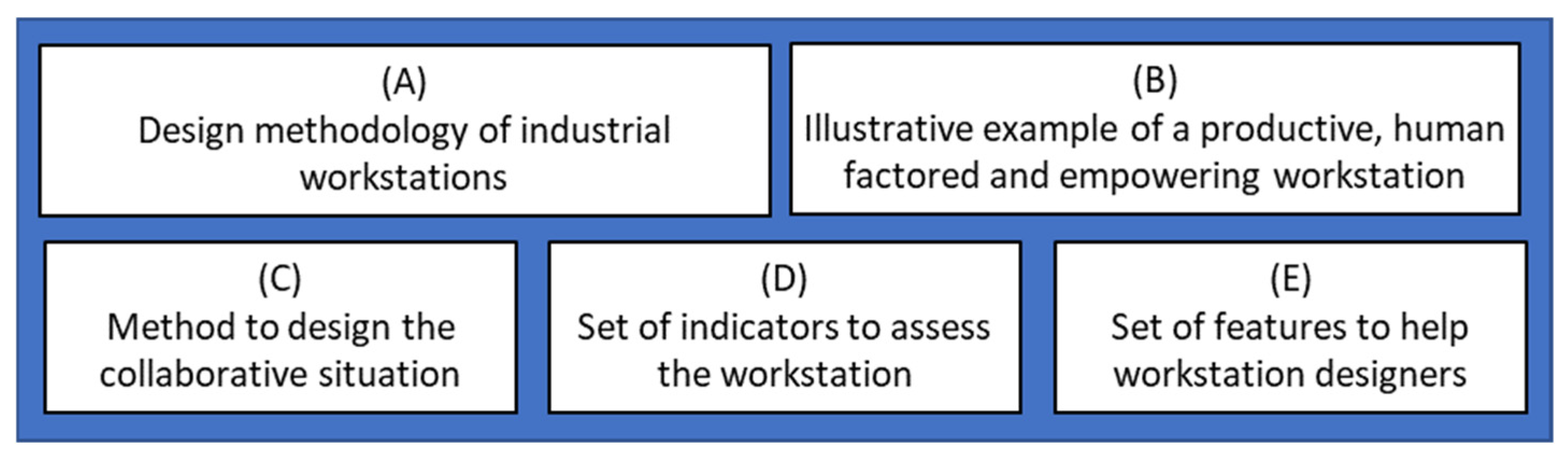
- (A)
- A methodology for designing industrial workstations. Let engineers use their own tools and methods in practice. The designer’s chosen method is the best one to use.
- (B)
- A practical example of a workstation that aligns with productivity, human factors, and empowerment standards. Displaying success motivates, proves it is possible, and engages the brain. This is demonstrated in Section 5.1.
- (C)
- A design method for worker–cobot collaboration. Collaborative activity is a key driver of the design process. Its design is not the optimal behavior resulting from the technical and production decisions. Our approach is detailed in Section 5.2.
- (D)
- A set of indicators to assess the workstation designed, prototyped or in service. It is the core of our proposal: what does ‘a productive, human-factored and empowering workstation’ mean in practice? The ‘ECS’ concept and indicators are explained in Section 4.2 and used in Section 5.3.
- (E)
- A set of features to help designers. It is practical knowledge, based on the experience of professionals using the proposed vision. As the set evolves, it will improve both in quality and quantity. The initial feature set is presented in Section 5.4.
4.2. Enabling Work Situation
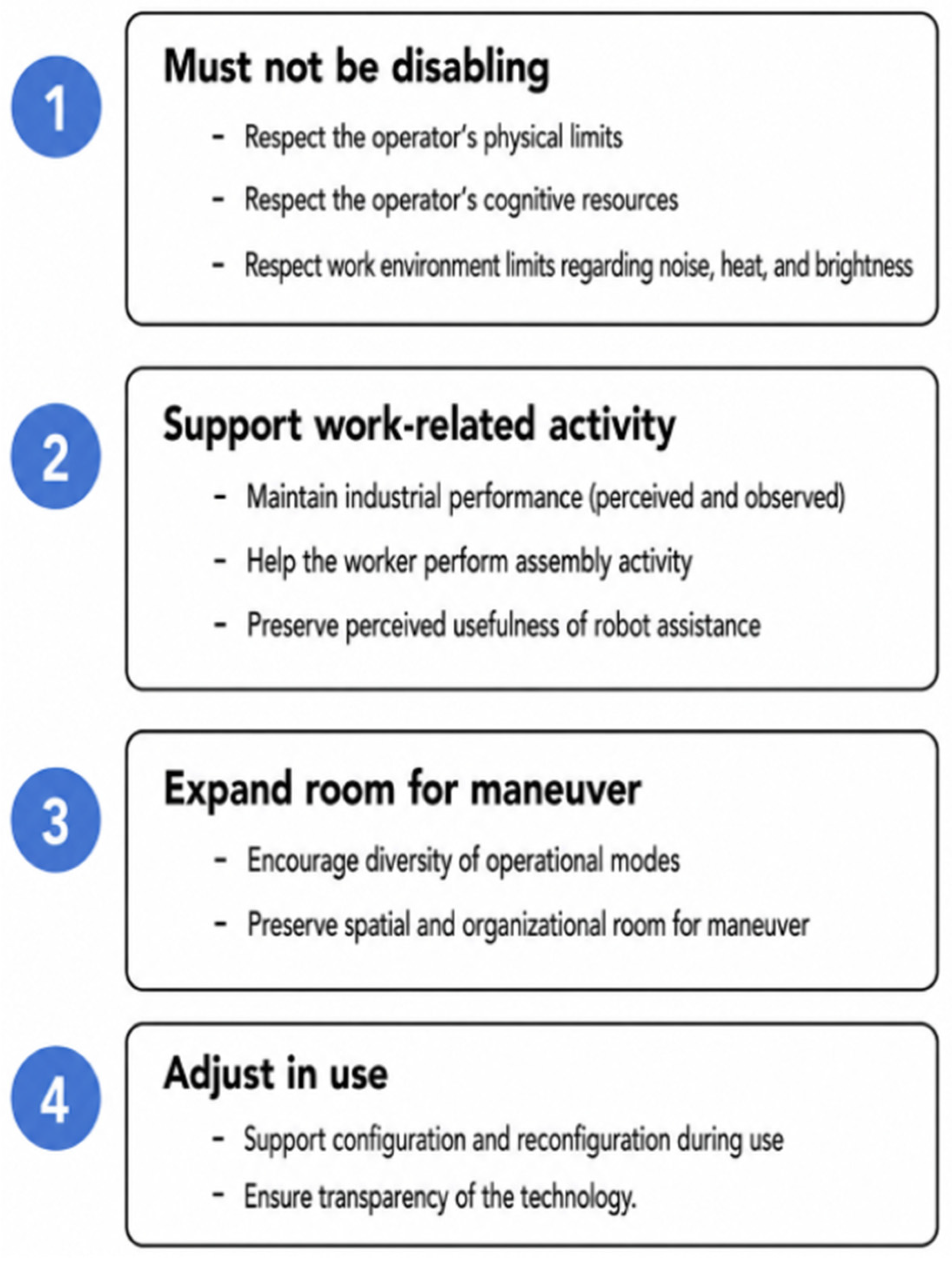
- (1)
- Must not be disabling ①. The cobot must not hinder the operator’s ability to perform tasks. This dimension emphasizes that the robot should not limit the user’s operational intentions or introduce constraints that hinder goal-directed activity. Concretely, it complies with the set of usual requirements for productivity and human factors in classical workstation design methods.
- (2)
- Support work-related activities ②. The work environment must enhance work-related activities by boosting worker engagement, comfort, and perceived meaning. This should be achieved without compromising productivity. The cobot’s positive impact is measured through affective, hedonic, and meaning-related dimensions.
- (3)
- Expand the room to maneuver ③. A flexible work environment that allows workers to choose from multiple satisfactory ways to complete tasks, considering individual preferences and situational variability, and worker initiatives, must be provided.
- (4)
- Adjust in use ④. The human–robot system must be adjusted over time based on the worker’s experience. This includes operational transparency, instrumentation and instrumentalization, configurability, management of unexpected events, and peer support. These elements enable the operator to understand, anticipate, and adapt to the robot’s behavior, resolve malfunctions, and progressively adjust the interaction.
5. Main Results
5.1. The Demonstrative Workstation
5.1.1. Design Principles for the Demonstrator
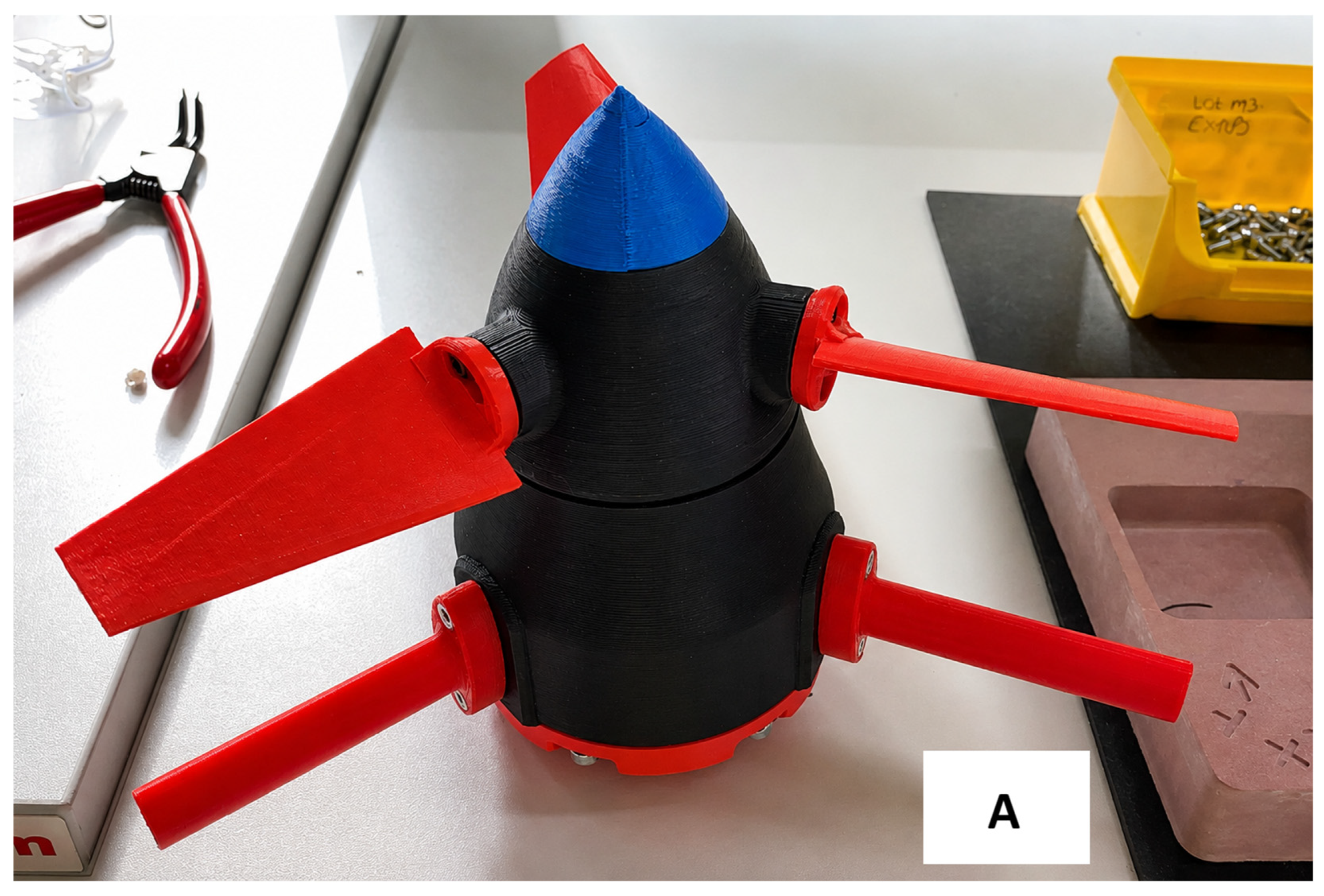
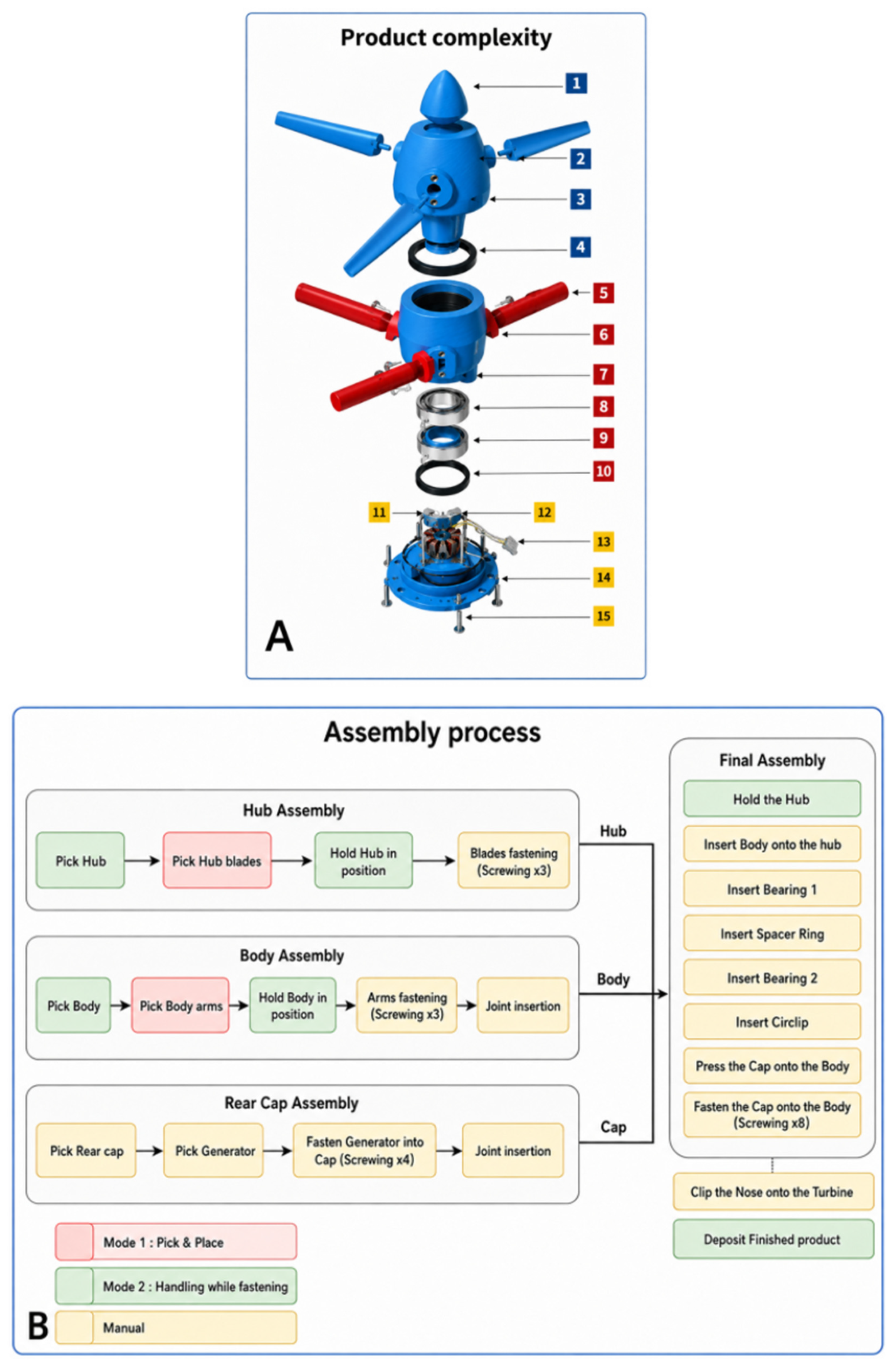
5.1.2. The Use-Case Description
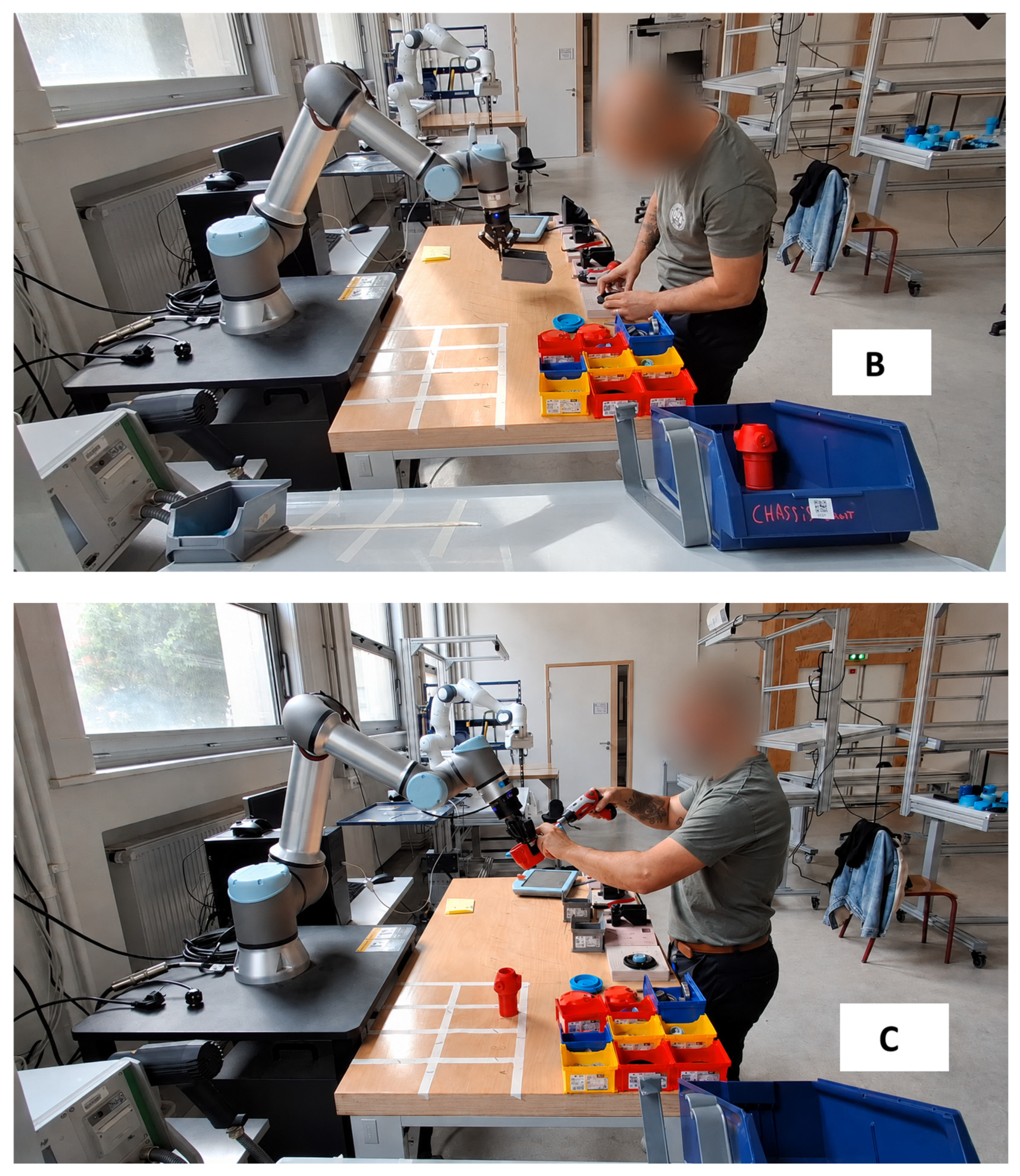
5.1.3. The Workstation Designed
5.2. Design Method of the Collaboration Strategy
5.2.1. Collaboration Scenarios
5.2.2. Four Rules to Make the Collaborative Workstation Meet the ECS Criteria
- (1)
- The cobot must not limit the worker’s ability to act. It must not monopolize critical operations, impose strict time constraints, or create situations where the worker cannot complete the task independently. This principle protects against the risks of dependence, competence decline, and loss of control identified in previous ECS analyses.
- (2)
- The cobot must assist human workers by performing tasks such as material handling or positioning, without replacing their strategies or imposing a rigid procedure. The support must enhance fluidity and reduce constraints, while allowing the human to maintain control over coordination and meaning making.
- (3)
- The allocation must maintain multiple ways of completing the task. Instead of imposing a single optimal sequence, the system allows the worker to switch between independent work, collaborative work, or supportive interactions based on the situation. Maintaining variability is crucial for making situated adjustments and accommodating workers’ preferences, pace, or strategies.
- (4)
- The workstation design must allow for dynamic changes in how robot assistance is used, the level of automation preferred by the worker, and the balance between manual and collaborative modes. This flexibility ensures that the workstation can adapt to the evolving needs of the work system and promote sustainable collaboration.
5.2.3. Lessons Learnt
5.3. Assessment Against the Proposed Operational Criteria
5.3.1. Assessment Results
5.3.2. Discussion
5.4. Design Principles for Productive, Human-Factored, and Empowering Workstations
5.4.1. Principle 1: Respect Worker Competence by Assisting Assembly While Maintaining Expected Industrial Performance
5.4.2. Principle 2: Empower Workers to Make Strategic Adjustments Based on the Situation
5.4.3. Principle 3: Ensure the Workstation Remains Adaptable over Time by Evolving It with Experience
6. Conclusions
Author Contributions
Funding
Informed Consent Statement
Data Availability Statement
Conflicts of Interest
Abbreviations
| ECS | Enabling Collaborative Situation |
| HRC | Human–Robot Collaboration |
| HRI | Human–Robot Interaction |
| HMI | Human–Machine Interface |
| UX | User Experience |
| RULA | Rapid Upper Limb Assessment |
| NASA-TLX | Task Load Index |
Appendix A
Appendix A.1. NASA-TLX Workload Scale

| Dimension | Item | Rate |
|---|---|---|
| Mental demand | How much mental and perceptual activity was required to perform the task, for example thinking, deciding, searching, etc.? Did the task seem simple and require little attention (low = 0), or complex and require a high level of attention (high = 100)? | |
| Physical demand | How much physical activity was required to perform the task, for example pushing, moving, turning, handling, etc.? Did the task seem easy, not very tiring, and calm (low = 0), or strenuous, tiring, and active (high = 100)? | |
| Temporal demand | How much time pressure did you feel during task execution? Did the task have to be performed slowly (low = 0) or quickly (high = 100)? | |
| Performance | How do you assess your performance in completing the task? What is your level of satisfaction with your performance? For this criterion, the scale is reversed: high performance = 0; low performance = 100. | |
| Effort | How much mental and physical effort did you have to exert to reach your level of performance? High = 100; Low = 0. | |
| Frustration | During task execution, did you feel satisfied, pleased, and relaxed (low = 0), or rather annoyed, irritated, and stressed (high = 100)? |
Appendix A.2. Perceived Work Quality Scale
| Item | Answer |
|---|---|
| The work carried out with the cobot is of good quality. | |
| I have no problem with the quality of the work performed in collaboration with the cobot. | |
| I was able to carry out all the tasks assigned to me with the cobot. | |
| My performance in collaboration with the cobot was excellent. |
Appendix A.3. Meaning of Work Scale
| Item | Answer |
|---|---|
| I find this task personally enriching. | |
| In this task, the objectives to be achieved are stimulating and meaningful. | |
| I clearly understood the usefulness of this task. | |
| This task has a clear and precise direction. |
References
- European Commission. Industry 5.0: Towards a Sustainable, Human-Centric and Resilient European Industry; Publications Office of the European Union: Luxembourg, 2021. [Google Scholar]
- Xu, X.; Lu, Y.; Vogel-Heuser, B.; Wang, L. Industry 4.0 and Industry 5.0: Inception, conception and perception. J. Manuf. Syst. 2021, 61, 530–535. [Google Scholar] [CrossRef] [Scilit]
- Romero, D.; Stahre, J. Towards the resilient Operator 5.0: The future of work in smart resilient manufacturing systems. Procedia CIRP 2021, 104, 1089–1094. [Google Scholar] [CrossRef] [Scilit]
- Calzavara, M.; Faccio, M.; Granata, I. Achieving productivity and operator well-being through dynamic task allocation strategies in collaborative assembly systems. Int. J. Adv. Manuf. Technol. 2024, 130, 4567–4584. [Google Scholar]
- Wang, L.; Váncza, J.; Krüger, J.; Wang, X.V.; Makris, S.; Chryssolouris, G. Human-centric assembly in smart factories. CIRP Ann. 2025, 74, 789–815. [Google Scholar] [CrossRef] [Scilit]
- Wang, L.; Liu, S.; Cooper, C.; Wang, X.V.; Gao, R.X. Function block-based human-robot collaborative assembly driven by brainwaves. CIRP Ann. 2021, 70, 5–8. [Google Scholar] [CrossRef] [Scilit]
- Dimitropoulos, N.; Togias, T.; Zacharaki, N.; Michalos, G.; Makris, S. Seamless human-robot collaborative assembly using artificial intelligence and wearable devices. Appl. Sci. 2021, 11, 5699. [Google Scholar] [CrossRef] [Scilit]
- Villani, V.; Pini, F.; Leali, F.; Secchi, C. Survey on human-robot collaboration in industrial settings: Safety, intuitive interfaces and applications. Mechatronics 2018, 55, 248–266. [Google Scholar] [CrossRef] [Scilit]
- Lorenzini, M.; Lagomarsino, M.; Fortini, L.; Gholami, S.; Ajoudani, A. Ergonomic human-robot collaboration in industry: A review. Front. Robot. AI 2023, 9, 813907. [Google Scholar] [CrossRef] [Scilit]
- Dimitropoulos, N.; Togias, T.; Michalos, G.; Makris, S. Operator support in human–robot collaborative environments using AI enhanced wearable devices. Procedia CIRP 2021, 97, 464–469. [Google Scholar] [CrossRef] [Scilit]
- Gladysz, B.; Romero, D. Current development on the Operator 4.0 and transition towards the Operator 5.0: A systematic literature review in light of Industry 5.0. J. Manuf. Syst. 2023, 70, 160–185. [Google Scholar] [CrossRef] [Scilit]
- Abicht, J.; Hellmich, A.; Ihlenfeldt, S. New automation solution for brownfield production: Cognitive robots for the emulation of operator capabilities. CIRP J. Manuf. Sci. Technol. 2024; in press. [CrossRef] [Scilit]
- Matheson, E.; Minto, R.; Zampieri, E.G.G.; Faccio, M.; Rosati, G. Human-robot collaboration in manufacturing applications: A review. Robotics 2019, 8, 100. [Google Scholar] [CrossRef] [Scilit]
- Chowdhury, H. Human-robot collaboration in manufacturing assembly tasks. Preprints 2023. [Google Scholar] [CrossRef] [Scilit]
- Ore, F.; Jiménez Sánchez, J.L.; Wiktorsson, M.; Hanson, L. Design method of human-industrial robot collaborative workstation with industrial application. Int. J. Comput. Integr. Manuf. 2020, 33, 911–924. [Google Scholar] [CrossRef] [Scilit]
- Giberti, H.; Abbattista, T.; Carnevale, M.; Giagu, L.; Cristini, F. A methodology for flexible implementation of collaborative robots in smart manufacturing systems. Robotics 2022, 11, 9. [Google Scholar] [CrossRef] [Scilit]
- Stadnicka, D.; Antonelli, D. Human-robot collaborative work cell implementation through lean thinking. Int. J. Comput. Integr. Manuf. 2019, 32, 580–595. [Google Scholar] [CrossRef] [Scilit]
- El Zaatari, S.; Marei, M.; Li, W.; Usman, Z. Cobot programming for collaborative industrial tasks: An overview. Robot. Auton. Syst. 2019, 116, 162–180. [Google Scholar] [CrossRef] [Scilit]
- Manjunath, M.; Kranz, P.; Tenbergen, B.; Daun, M. Taxonomy for early safety analysis of human-robot interaction. In Proceedings of the ER2025 Companion Industrial Track, Poitiers, France, 20–23 October 2025. [Google Scholar]
- Petzoldt, C.; Harms, M.; Freitag, M. Review of task allocation for human-robot collaboration in assembly. Int. J. Comput. Integr. Manuf. 2023, 36, 1675–1715. [Google Scholar] [CrossRef] [Scilit]
- Baratta, A.; Cimino, A.; Longo, F.; Mirabelli, G.; Nicoletti, L. Task allocation in human-robot collaboration: A simulation-based approach to optimize operator productivity and ergonomics. Procedia Comput. Sci. 2024, 232, 688–697. [Google Scholar] [CrossRef] [Scilit]
- Chanel, G.; Cegarra, J.; Buisine, S. Towards mixed-initiative human-robot interaction: Assessment of physiological and behavioural indicators for performance prediction. Sensors 2020, 20, 296. [Google Scholar] [CrossRef] [Scilit]
- Tausch, A.; Kluge, A.; Adolph, L. Psychological effects of the allocation process in human-robot interaction: A model for research on ad hoc task allocation. Front. Psychol. 2020, 11, 564672. [Google Scholar] [CrossRef] [Scilit]
- Oliveira, M.; Andrade, J.R.; Ratten, V.; Santos, E. Psychological empowerment for the future of work: Evidence from Portugal. Glob. Bus. Organ. Excell. 2023, 42, 65–78. [Google Scholar] [CrossRef] [Scilit]
- Spreitzer, G.M. Psychological empowerment in the workplace: Dimensions, measurement, and validation. Acad. Manag. J. 1995, 38, 1442–1465. [Google Scholar] [CrossRef] [Scilit]
- Kaasinen, E.; Schmalfuß, F.; Özturk, C.; Aromaa, S.; Boubekeur, M.; Heilala, J.; Heikkilä, P.; Kuula, T.; Liinasuo, M.; Mach, S.; et al. Empowering and engaging industrial workers with Operator 4.0 solutions. Comput. Ind. Eng. 2020, 139, 105678. [Google Scholar] [CrossRef] [Scilit]
- Sen, A. Development as Freedom; Oxford University Press: Oxford, UK, 1999. [Google Scholar]
- Falzon, P. Ergonomics, knowledge development and the design of enabling environments. In Proceedings of the Humanizing Work and Work Environment Conference, Guwahati, India, 10–12 December 2005. [Google Scholar]
- Compan, N.; Coutarel, F.; Brissaud, D.; Rix-Lièvre, G. Enabling collaborative situations (ECS): Interest for the taking into account of the work activity in the design and evaluation of human-technology collaborations in contemporary industry. Trav. Hum. 2022, 85, 211–240. [Google Scholar] [CrossRef] [Scilit]
- Lubrez, V.; Rix, G.; Coutarel, F. Human-Centred Design for Industry 5.0: Introducing the ESD Model and Comparing Generations of Production Machines to Characterize their Evolution. In 36th Annual Conference of the European Association of Cognitive Ergonomics (EACE) (ECCE 2025), Tallinn, Estonia, 7–10 October 2025; ACM: New York, NY, USA, 2025; pp. 1–6. [Google Scholar] [CrossRef] [Scilit]
- ISO 10218-1:2025; Robotics—Safety Requirements—Part 1: Industrial Robots. International Organization for Standardization: Geneva, Switzerland, 2025.
- Cippelletti, E.; Fournier, É.; Jeoffrion, C.; Landry, A. Assessing cobot acceptability of French workers: Proposition of a model integrating the TAM3, the ELSI and the meaning of work scales. Int. J. Hum.-Comput. Interact. 2024, 41, 2763–2775. [Google Scholar] [CrossRef] [Scilit]




| Use Mode | Type of Collaboration | Task Distribution | Temporal Coordination | Task Interdependency |
|---|---|---|---|---|
| Manual | No | No | No | No |
| Pick & place | Simultaneous | Separate | Parallelism | Weak |
| Handling | Supportive | Share | Simultaneity | High |
| Combined | Combined | Share | Simultaneity | High |
| Criterion | Indicator | Measurement Tools | Results |
|---|---|---|---|
| Must not be disabling | Respect workers’ physical limits | Rapid Upper Limb Assessment (RULA) | Score 4, investigate further to improve more |
| Respect workers’ cognitive limits | NASA Task Load Index (NASA-TLX) (see Appendix A.1) | Mental demand ≈ 33, Physical demand ≈ 45, Temporal demand ≈ 55, Frustration ≈ 35, Performance ≈ 80. Conclusion: moderate to low mental workload | |
| Ensure acceptable work environment (noise, heat, lighting) | Environmental conditions checklist | Appropriate working environment | |
| Support work-related activity | Maintain industrial performance (perceived and observed) | Assembly cycle time measure Final product conformity by questionnaire (perceived) and product control (observed) | Maximum target cycle time: 10.3 min The observed cycle time ranged from 8.3 to 10.3 min, depending on workers and mode chosen Conformity perceived: 17/20; conformity observed: all the products tested were good except for one |
| Help the worker perform assembly activity | Ergonomic expert’s observation on the actual assembly process | Four tasks of synchronization added No interruption of the assembly activity due to the cobot Workers were not involved in the initial workplace design process | |
| Preserve perceived usefulness of robot assistance | Workers’ feedback by questionnaire (see extracts of the questionnaire items in Appendix A.2 and Appendix A.3 | Score: 14 on the perceived usefulness scale [32], high perceived usefulness | |
| Expand room to maneuver | Encourage diversity of operational modes | Number of collaboration modes effectively used | Four modes actually used |
| Preserve spatial and organizational room to maneuver | Ergonomic expert’s observation of workspace use Ergonomic expert’s observation of task sequencing | The cobot operating envelope covered approximately 40% of the worktable, while the remaining area was managed by the operators Differences in tool arrangement and subassembly sequencing were observed across users | |
| Adjust in use | Support configuration and reconfiguration during use | Ergonomic expert’s observation on workers’ behavior in practice | The mode-switching interface was used by all workers, with some participants activating it repeatedly during task execution However, workers could not modify or program new tasks for the cobot and had to contact a technician for any program changes No participant attempted to alter the cobot control logic during the experiment |
| Ensure transparency of the technology | Workers’ feedback by questionnaire | Initial training done Specific training modules available but not used yet Robot motions understood and anticipated by workers |
Disclaimer/Publisher’s Note: The statements, opinions and data contained in all publications are solely those of the individual author(s) and contributor(s) and not of MDPI and/or the editor(s). MDPI and/or the editor(s) disclaim responsibility for any injury to people or property resulting from any ideas, methods, instructions or products referred to in the content. |
© 2026 by the authors. Licensee MDPI, Basel, Switzerland. This article is an open access article distributed under the terms and conditions of the Creative Commons Attribution (CC BY) license.
Share and Cite
Chakroun, M.; Rocchi, V.; Brissaud, D. Designing Human–Robot Collaborative Workstations: An ECS-Based Framework for Efficiency and Worker Empowerment. Machines 2026, 14, 586. https://doi.org/10.3390/machines14060586
Chakroun M, Rocchi V, Brissaud D. Designing Human–Robot Collaborative Workstations: An ECS-Based Framework for Efficiency and Worker Empowerment. Machines. 2026; 14(6):586. https://doi.org/10.3390/machines14060586
Chicago/Turabian StyleChakroun, Malek, Valérie Rocchi, and Daniel Brissaud. 2026. "Designing Human–Robot Collaborative Workstations: An ECS-Based Framework for Efficiency and Worker Empowerment" Machines 14, no. 6: 586. https://doi.org/10.3390/machines14060586
APA StyleChakroun, M., Rocchi, V., & Brissaud, D. (2026). Designing Human–Robot Collaborative Workstations: An ECS-Based Framework for Efficiency and Worker Empowerment. Machines, 14(6), 586. https://doi.org/10.3390/machines14060586