


Abstract
Efficient cross-district police dispatching is vital for timely emergency response, yet it faces complex constraints involving coupled inter-district routing, task sequencing, escort capacities, and mandatory transfers at makeshift police posts. This study formulates the Multi-district Police Dispatching and Path Planning Problem (MDPDPP) with makespan minimization. To address the problem’s hierarchical structure, we propose a Cooperative Iterated Greedy (CIG) algorithm. The problem is decomposed into district-level routing and capacity-constrained intra-district task scheduling, which are jointly optimized through a cooperative search mechanism. A capacity-aware decoding and local search strategy is further developed to capture the non-linear effects of escort capacity dynamics and mandatory detours. Computational experiments on a wide range of instances show that the proposed CIG algorithm consistently outperforms several state-of-the-art metaheuristics in terms of solution quality and robustness. Friedman statistical tests further confirm the statistical significance of the observed performance improvements, demonstrating the effectiveness of the proposed approach for complex multi-district police dispatching systems.
1. Introduction
The evolution of smart cities imposes strict requirements on the efficiency and reliability of police resource dispatching [1]. Police departments require rapid decision-making mechanisms to address emergency incidents that exhibit high spatial irregularity and temporal uncertainty [2]. Effective task assignment and route planning strategies play a crucial role in reducing response times and improving the utilization efficiency of police resources. However, as urban scale expands and the diversity of incident types increases, traditional dispatching approaches are facing serious challenges in terms of adaptability and scalability in complex scenarios [3].
It is important to clarify that path planning alone does not guarantee effective execution in real-world operational systems. In autonomous and connected vehicle applications, high-level path/trajectory planning must be complemented by low-level trajectory tracking and robust control mechanisms to ensure safe and reliable motion under uncertainties (e.g., disturbances, communication delays, and stability constraints). Recent studies have investigated the integration of motion planning with robust output-feedback trajectory tracking for multiple intelligent and connected vehicles at unsignalized intersections [4], and event-triggered robust path tracking strategies considering roll stability under network-induced delays [5,6]. These works highlight that execution robustness depends not only on the planned path but also on the tracking/control layer. Nevertheless, the present study focuses on the upper-layer planning and dispatching problem in police emergency response: we optimize task assignment, inter-district routing, and capacity-aware intra-district scheduling under operational constraints, while assuming that feasible routes can be executed by downstream tracking/control systems. Therefore, our contribution is positioned at the decision-making level and can be integrated with existing vehicle control frameworks when needed.
From the planning and dispatching perspective, the multi-district police task assignment and routing problem represents a tightly coupled scheduling challenge [4]. It simultaneously involves the matching between emergency tasks and police vehicles, the visiting sequence of vehicles across multiple geographic districts, and capacity- and time-related constraints arising during execution. These decision variables are strongly interdependent and difficult to decouple, endowing the problem with a typical combinatorial optimization structure and causing its complexity to grow rapidly with increasing urban scale and task density.
For police dispatching and emergency routing problems of this kind, exact optimization methods provide valuable references in small-scale instances or benchmark analyses [7]. However, in real-world policing scenarios, emergency tasks are characterized by sudden arrivals and dynamic evolution [8]. Frequent disruptions often require repeated model reconstruction and re-optimization, making it difficult for exact methods to meet real-time decision-making requirements in terms of computational cost and response speed [9]. By contrast, rule-based heuristic strategies are still widely adopted in practice due to their simplicity and fast responsiveness. Nevertheless, such methods typically rely heavily on manually designed experience-based rules, exhibit limited adaptability to diverse urban structures and incident distributions, and struggle to maintain stable performance in complex multi-district environments [10].
In recent years, metaheuristic algorithms have provided a viable approach for addressing large-scale police dispatching and routing problems, demonstrating a certain advantage in balancing computational efficiency and solution quality [11]. Nevertheless, existing methods still face several critical challenges in multi-district settings [12]. On the one hand, algorithmic performance is often highly sensitive to the quality of the initial solution, and initialization strategies that neglect spatial structural characteristics can lead to inefficient search processes [13]. On the other hand, when task assignment, route planning, and capacity management decisions are tightly coupled, conventional local search operators lack effective coordination mechanisms, making it difficult to fully exploit the solution space and thereby constraining further performance improvements in complex scenarios [14].
The Multi-Depot VRP (MDVRP) and Multi-District VRP are classic VRP variants that have been extensively studied in the literature. These problems focus on routing vehicles from multiple depots or across multiple districts, often subject to capacity constraints and varying task demands. Classic algorithms for MDVRP, such as Clarke–Wright savings heuristics and column generation methods, have shown strong performance in solving problems with fewer interdependencies among decision variables [15]. Similarly, for Multi-District VRP, methods like the sweep algorithm or ant colony optimization (ACO) are often employed to optimize vehicle routing across multiple districts [16]. However, these classic methods are not specifically designed to handle the complexities of problems with tightly coupled task assignment and district routing decisions, especially when these decisions involve hierarchical structures or time-varying conditions.
In contrast, the problem we address in this paper involves additional complexities, such as mandatory transfers at makeshift police posts and dynamic task arrivals. These characteristics make it significantly more challenging than traditional MDVRP or Multi-District VRP formulations. For example, task sequencing, vehicle routing, and capacity management decisions are strongly interdependent, which requires algorithms that can effectively coordinate these components. Therefore, we propose an improved Iterated Greedy (IG) algorithm to tackle this problem, which incorporates a cooperative, hierarchical approach to optimize district-level routing and task assignment simultaneously.
To address the above issues, this paper proposes an improved Iterated Greedy (IG) framework for the multi-district police task assignment and routing problem. The framework adopts the classical destruction–construction mechanism as the backbone of global optimization, striking a balance between search efficiency and solution quality. During the initialization stage, a K-means clustering-based strategy is introduced to explicitly exploit the spatial distribution characteristics of emergency tasks, thereby generating high-quality, structure-aware initial solutions. In the local search stage, Variable Neighborhood Descent (VND) is integrated to enhance the coordinated optimization of multiple interdependent decision components and to strengthen solution improvement. The main contributions of this study are summarized as follows.
- (1)
- This paper formulates a novel multi-district police dispatching and path planning problem that integrates district-level routing, capacity-constrained task scheduling, and mandatory transfers at makeshift police posts within a unified makespan minimization framework.
- (2)
- A cooperative iterated greedy algorithm with capacity-aware decoding and hierarchical coordination mechanisms is proposed to effectively address the strong coupling between district routing and intra-district task sequencing decisions.
- (3)
- Extensive computational experiments, together with Friedman statistical tests, demonstrate the superior performance, robustness, and statistical significance of the proposed algorithm compared with state-of-the-art metaheuristics.
The remainder of this paper is organized as follows. Section 2 reviews the related literature on police dispatching and metaheuristics. Section 3 provides the formal mathematical formulation of the MDPDPP. Section 4 details the proposed Cooperative Iterated Greedy (CIG) algorithm. Computational experiments and parameter tuning are presented in Section 5. Section 6 provides a comprehensive discussion of the algorithmic mechanisms and managerial implications, followed by open research questions. Finally, Section 7 concludes the paper.
2. Literature Review
Police dispatching and emergency response routing problems constitute a class of highly coupled routing–scheduling optimization challenges characterized by strict operational constraints, heterogeneous task requirements, and stochastic incident arrivals [17]. Unlike classical Vehicle Routing Problems (VRPs), policing operations necessitate the simultaneous coordination of reactive incident response and proactive patrol coverage, creating strong spatiotemporal interdependencies [18]. This coupling is a recognized hurdle in public safety operations research, particularly for large-scale urban systems facing imbalanced demand and limited resources [19].
Recent research suggests that evaluating policing performance solely through response-time minimization can be misleading, because real-world patrol operations must cope with stochastic incident arrivals, time-dependent travel conditions, and the consequent need for integrated, adaptive decision-making. In particular, Saint-Guillain et al. [20] formulated a time-dependent stochastic routing model for online police patrol management in Brussels, showing that uncertainty and temporal variability fundamentally change dispatching and routing decisions beyond static VRP assumptions. Moreover, spatial partitioning and patrol district design are not merely administrative choices but operational levers: Camacho-Collados et al. [21] developed a multi-criteria police districting framework that explicitly balances response-related performance with workload equity, demonstrating that district configurations can significantly affect system reliability and workload distribution. Together, these studies underscore that realistic police dispatching models should jointly consider dynamic routing, spatial coverage structures, and workload balancing rather than relying on isolated response-time objectives.
More recently, Mousapour et al. [19] investigated adaptive patrol routing strategies driven by hotspot detection, highlighting that real-time demand evolution and patrol redeployment policies introduce substantial complexity beyond static routing formulations. Complementary insights have also been reported in transportation and public safety literature [22,23], where dynamic dispatching under uncertainty is shown to require tightly integrated assignment and routing decisions. Collectively, these studies indicate that police dispatching problems cannot be adequately modeled through isolated routing or scheduling perspectives.
The Emergency Medical Services (EMS) literature provides a more mature methodological foundation for dynamic dispatching and relocation problems, sharing several structural similarities with police operations. Integrated ambulance dispatching, relocation, and coverage models have been extensively studied to balance immediate response performance and preparedness under uncertainty [24]. For example, dynamic models for real-time ambulance dispatching and relocation have been developed that explicitly incorporate stochastic demand and evolving system states, showing that consistently redeploying vehicles to cover future calls can improve overall system performance beyond purely reactive policies [2].
Despite these advances, EMS models typically assume single-patient service and do not explicitly consider capacity evolution induced by task execution, such as escorting or detention requirements common in police operations. Moreover, intermediate handling through temporary facilities or posts is rarely modeled in EMS contexts. In contrast, recent location-routing studies have investigated the use of intermediate depots and transfer facilities, but these models primarily focus on logistics efficiency and cost minimization rather than task-driven capacity evolution and dynamic resource coupling [25].
In parallel, research on Multi-Robot Task Allocation (MRTA) and Automated Guided Vehicle (AGV) scheduling has explored strong interactions between task assignment, routing, and capacity constraints. Surveys by Zhong et al. [26] systematized allocation–routing integration mechanisms in MRTA, while recent AGV studies addressed joint assignment and path planning under congestion and capacity limits. Although developed outside public safety contexts, these formulations provide valuable analogies for modeling tightly coupled decision processes in multi-district emergency dispatching systems. Despite extensive research across police dispatching, EMS, logistics, and robotic systems, the literature still lacks a unified framework capable of simultaneously addressing the following interacting elements: (1) District-level routing with no-reentry constraints, reflecting jurisdictional or operational boundaries. (2) Task-induced dynamic capacity evolution, arising from escort, custody, or on-site personnel commitments. (3) Capacity-triggered offloading or transfer mechanisms at intermediate police posts or makeshift police post.
While individual components of these features have been studied in isolation, no existing work has systematically integrated all three within a single optimization model. This omission limits the applicability of current approaches to real-world multi-district police operations, where routing, task execution, and capacity management are inherently intertwined. Consequently, there is a clear need for dedicated solution methodologies that explicitly capture the interplay among task allocation, route sequencing, and dynamic capacity control in multi-district police dispatching problems.
Due to the combinatorial nature and dynamic complexity of large-scale dispatching and routing problems, exact optimization methods often become computationally intractable when applied to real-time decision making or large-scale instances [27]. As a result, metaheuristic algorithms have gradually emerged as the dominant solution paradigm for practical routing and scheduling optimization, offering a favorable balance between solution quality and computational efficiency [28]. In integrated dispatching and relocation problems, metaheuristic frameworks have been shown to outperform pure mathematical programming approaches on large-scale benchmarks, while maintaining acceptable computation times under dynamic and uncertain environments [29].
Within the family of metaheuristic approaches, Iterated Greedy (IG) algorithms have attracted increasing attention due to their structured destruction–reconstruction mechanism, which naturally balances exploration and exploitation [30]. By partially destroying a current solution and subsequently reconstructing it, IG is capable of escaping local optima while preserving useful structural information [31]. Delgado-Antequera et al. [32] demonstrated that IG, when combined with neighborhood-based refinement strategies, can achieve competitive performance on routing problems with complex and heterogeneous constraints, indicating its robustness and scalability in realistic settings.
Nevertheless, it has been widely observed that the effectiveness of IG and related metaheuristics is highly sensitive to the quality of the initial solution, especially in large-scale routing problems with strong spatial characteristics [28]. Naive random initialization often leads to fragmented routes with excessive cross-region transitions, which significantly slows convergence and degrades search efficiency [33]. To mitigate this issue, cluster-first–route-second strategies have been extensively adopted, whereby tasks are first grouped into spatially coherent clusters before detailed routing optimization. Le et al. showed that K-means-based clustering can substantially enhance routing heuristics for large-scale VRPTW variants by generating high-quality initial solutions that respect spatial coherence [34]. More advanced decomposition frameworks further reinforce this insight. For instance, the Decompose–Route–Improve (DRI) strategy proposed by Kerscher and Minner explicitly integrates spatial, temporal, and demand information into clustering and subproblem refinement, leading to significant improvements in scalability and solution quality for large instances [13]. These studies collectively highlight the critical role of spatially informed initialization and decomposition in large-scale, multi-region dispatching problems.
While global exploration mechanisms such as IG provide broad coverage of the solution landscape, they typically require powerful local search strategies to effectively refine candidate solutions, particularly under complex feasibility and capacity constraints [35]. Variable Neighborhood Descent (VND) offers a systematic way to coordinate multiple neighborhood structures, enabling adaptive adjustment of search granularity and facilitating escape from local optima [36]. Kyriakakis et al. [37] demonstrated that integrating VND with metaheuristic frameworks yields significant performance gains for capacitated vehicle routing problems, especially in scenarios where costs and feasibility are influenced by cumulative or nonlinear effects. Similarly, Sze et al. [38] developed adaptive variable neighborhood search strategies for dynamic routing environments, showing that variable neighborhood mechanisms are essential for maintaining solution quality under evolving demand conditions.
The modular structure of the IG framework makes it particularly well suited for integration with problem-specific decoding procedures and feasibility repair mechanisms. In dispatching problems where routing decisions interact with dynamic capacity evolution and structured intermediate handling, the destruction–reconstruction cycle of IG helps maintain diversity in the search process, while local search intensification via VND enables fine-grained exploitation of structural improvements [39]. In the problem considered in this study, successive task assignments alter vehicle escort loads and may trigger intermediate transfers at district-level posts, resulting in evolving capacity dynamics that cannot be adequately captured by distance-centric heuristics alone. By embedding VND modules capable of capacity-aware move evaluation and coordinated multi-neighborhood search, the IG-based solver is well positioned to address these challenges and deliver high-quality solutions with acceptable computational effort.
In summary, although existing studies cover a wide range of dispatching and routing domains—including police patrol optimization, EMS relocation, logistics location-routing, and MRTA/AGV systems—no prior work has simultaneously incorporated district sequencing, task-induced dynamic capacity evolution, and capacity-triggered intermediate transfer mechanisms within a unified optimization framework. As shown in Table 1, most prior models address these elements in isolation, either focusing on dynamic demand, facility location, or routing under static capacity assumptions.
Table 1.
Summary of representative research streams related to dispatching and routing optimization.
Therefore, there remains a clear methodological and modeling gap in integrating these interacting decision layers within a coherent combinatorial optimization structure. Metaheuristic approaches—particularly Iterated Greedy enhanced with spatial decomposition and coordinated local search—provide a promising and well-justified foundation for tackling the multi-district police dispatching and path planning problem studied in this work.
3. Problem Formulation
In the context of urban emergency response and police resource allocation, this study considers a multi-district police dispatching system designed to efficiently handle events. The notations are listed as follows in Table 2.
Table 2.
Symbols and descriptions.
The city is partitioned into m non-overlapping geographic districts. Within each district, there are incident locations that require on-site police intervention, mandating immediate deployment of officers to the scene. Each district is equipped with a makeshift police post that serves as a relay or transfer node, facilitating temporary offloading of detainees, personnel handover, resupply, or coordination to support distributed response operations.
The police resources consist of w police cars, all dispatched from a single primary dispatch center (depot), which serves as both the origin and final return point. Each police car has a maximum escort capacity of , reflecting constraints imposed by safety regulations, vehicle space, and legal requirements (e.g., seating capacity or risk-based assessments).
Handling each incident incurs an on-site operation time , encompassing subtasks such as scene stabilization, suspect control, preliminary evidence collection, and medical assistance. Additionally, incident generates newly detained or supervised individuals requiring transport. When a police car’s remaining capacity is insufficient to accommodate the personnel generated by the next incident, the police car must first proceed to the makeshift police post within its current district to offload detainees before continuing its route. Without loss of generality, hereinafter the terms police incident task and task are used interchangeably. This problem requires the following basic assumptions to be met.
- (1)
- All police cars are homogeneous in configuration (i.e., identical in capacity, speed, and operational capabilities).
- (2)
- Each incident task is serviced exactly once by a single police car.
- (3)
- Each police car follows a single, continuous route that originates from and terminates at the primary dispatch center, traversing a sequence of districts such that no district is revisited once exited (i.e., districts are non-entrance along a police car’s route).
Equation (1) defines the objective function of the model, which minimizes the makespan—i.e., the maximum completion time among all police cars upon finishing their assigned tasks and returning to the central depot. This objective ensures optimal overall response efficiency of the entire police dispatch system, rather than merely optimizing individual vehicle routes. Constraint (2) stipulates that each police incident task must be assigned exclusively to one police car. Constraint (3) guarantees that every incident task is serviced exactly once by a single police car. Constraint (4) enforces flow conservation for each car within each district. Constraints (5) and (6) ensure that, within any given district, the route of each police car starts and ends at the district’s makeshift police post (i.e., the transfer node). Constraints (7) and (8) require that every police car departs from the primary dispatch center and ultimately returns to it after completing all assigned tasks. Constraints (9) and (10) impose that for each district visited by a police car, there is exactly one incoming arc and one outgoing arc, and subtours within a district are prohibited. Constraints (11) and (12) couple the district-level and intra-district routing decisions: if police car traverses no arcs within district , then the district-level visit indicator must be zero; conversely, if any intra-district arc is used by police car in district , then must equal one, indicating that the district is indeed visited by that police car. Constraints (13) and (14) enforce capacity feasibility, ensuring that sufficient residual capacity is available before servicing the next incident task. Constraints (15)–(17) model the capacity dynamics associated with either proceeding directly to an incident task or detouring to the makeshift police post for detainee transfer. Constraints (18) and (19) define the time-consistency relationships for arrivals within districts and determine the completion time of each police car k. Finally, constraints (20)–(22) specify the domains of the decision variables.
4. The Proposed Algorithm
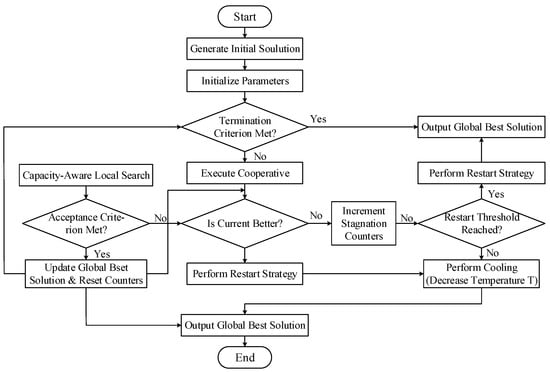
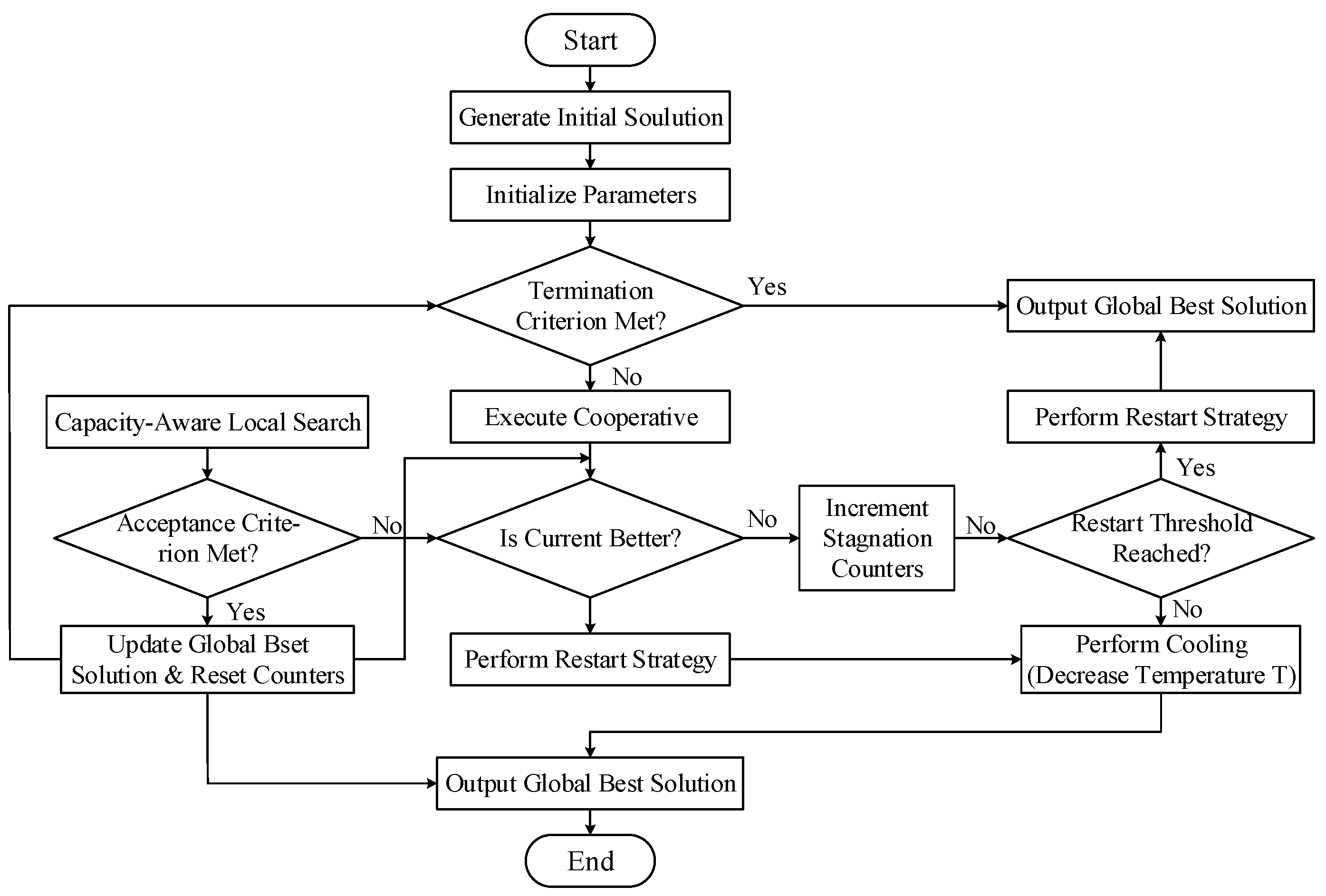
To address the multi-district police dispatching and path planning problem (MDPDPP), this paper proposes a cooperative iterated greedy algorithm (CIG). The overall architecture of the framework is illustrated in Figure 1. Considering the problem complexity, a decomposition strategy is employed to divide it into two coupled subproblems. One is the inter-district routing problem, which determines the assignment and visiting sequence of districts for each police car, treating a district as a cohesive task group. The other is the intra-district task scheduling problem, which optimizes the task execution order within each district under capacity constraints. In this section, the solution representation is first detailed. Then, critical components including the -means initialization, cooperative mechanism, and capacity-aware local search are presented. Finally, the CIG framework is outlined.
Figure 1.
Architecture of the proposed CIG algorithm.
4.1. Solution Representation
The dispatching plan is modeled as a solution set , where each vector defines the routing sequence for police car . To minimize dimensionality, the chromosome employs a permutation of unique task indices, systematically excluding the central depot and district level makeshift posts. This streamlined integer encoding ensures that every incident task is assigned to exactly one vehicle while reducing the computational burden associated with representing auxiliary nodes in the search space.
To address the multi-level routing structure, the linear sequence is logically partitioned into district segments . Here, each sub-vector represents a continuous scheduling order of tasks within a specific district , where denotes the total number of districts visited. Segment boundaries are identified implicitly by detecting district index changes between adjacent tasks, strictly enforcing the non-reentrant constraint by prohibiting multiple disjoint visits to the same district.
This hierarchical decomposition aligns the solution structure with the proposed cooperative optimization mechanism. The coarse-grained dimension governs the district visiting order , while the fine-grained dimension optimizes intra-district spatial efficiency. Furthermore, complex dual-resource constraints are handled via dynamic decoding, trips to the makeshift post are not explicitly encoded but are automatically interpolated into whenever the cumulative detainee count exceeds capacity , ensuring feasibility without expanding the chromosome length.
4.2. Initialization
The convergence velocity and final solution quality of metaheuristic algorithms are heavily dependent on the composition of the initial population. A purely random initialization often results in excessive inter-district travel, leading to inferior starting solutions for the MDPDPP. Therefore, a spatial decomposition strategy is proposed to generate the initial population. This strategy effectively reduces the global multi-depot problem into multiple localized single vehicle routing subproblems through two sequential stages, spatial clustering and heuristic path construction.
4.2.1. Spatial Task Clustering
To minimize the high-cost inter-district transitions and ensure workload locality, a spatial decomposition strategy is implemented utilizing the K-Means algorithm. The global set of incident tasks is partitioned into disjoint clusters , where denotes the fleet size. Let represent the spatial coordinate vector of the -th incident task, and denote the geometric centroid of cluster . The clustering process minimizes the within-cluster sum of squares, serving as a proxy for minimizing the total travel distance. The objective function is formulated as:
where represents the Euclidean distance. The optimization proceeds iteratively through two alternating phases until the centroids stabilize. Specifically, each incident task is assigned to the cluster with the nearest centroid to strictly enforce spatial compactness, as governed by:
Subsequently, the centroids are recalculated as the arithmetic mean of all tasks currently aggregated within the respective cluster:
Upon convergence, this procedure yields spatially concentrated task groups, effectively transforming the complex multi-depot routing problem into independent single-vehicle subproblems.
4.2.2. Hierarchical Path Construction
Unordered tasks within cluster are transformed into feasible routing sequences through a hierarchical strategy addressing intra-district and inter-district levels. The intra-district segments are established using a hybrid heuristic. A nearest neighbor method generates an initial path by selecting the closest unvisited node. This sequence is refined by a capacity aware operator to minimize local travel costs while strictly satisfying escort capacity constraints through the evaluation of dynamic makeshift post visits.
The visiting order of district segments is resolved using a greedy strategy based on district centroids. Commencing from the primary dispatch center , the nearest unvisited district segment is iteratively appended to the route vector until all assigned districts are sequenced. This initialization procedure guarantees spatial compactness and local optimality in the starting population to provide a robust foundation for the evolutionary search.
4.3. Local Search Strategy
Canonical operators optimizing solely on Euclidean distance are insufficient for the MDPDPP due to the non-linear impact of dual-resource constraints. To mitigate fluctuations caused by the dynamic insertion of makeshift post visits, the algorithm employs a simulation-based decoding function during move evaluation. This ensures that any sequence alteration that triggers a mandatory detour is immediately penalized in the cost calculation, preventing the local search from accepting deceptively short paths that are rendered suboptimal by capacity-triggered transfers. The specific procedure is outlined in Algorithm 1.
| Algorithm 1: Capacity Aware Local Search Strategy | |
| Input: | , |
| Output: | |
| 1: | ; True; |
| 2: | while improved do |
| 3: | False |
| 4: | // Phase 1: Capacity-Aware (Edge Exchange) |
| 5: | do |
| 6: | do |
| 7: | |
| 8: | |
| 9: | True |
| 10: | end if |
| 11: | end for |
| 12: | end for |
| 13: | // Phase 2: Capacity-Aware Relocate (Node Insertion) |
| 14: | if not improved then |
| 15: | do |
| 16: | do |
| 17: | ) |
| 18: | ) then |
| 19: | improved ← True |
| 20: | end if |
| 21: | end for |
| 22: | end for |
| 23: | end if |
| 24: | end while |
| 25: | |
As detailed in Algorithm 1, the strategy is implemented as a prioritized variable neighborhood descent within an iterative improvement loop. The procedure initially executes phase 1, which systematically evaluates the reversal of sub-segments to resolve topological edge crossings and reduce baseline travel distance. The transition to phase 2 is strictly conditional. This secondary phase, which involves extracting individual tasks and reinserting them into alternative positions to rectify inefficient ordering, is triggered only when the preceding phase fails to identify a superior solution. To maintain computational efficiency in large-scale instances, the search space for node insertion can be further restricted by evaluating only the -nearest neighbor positions relative to the task’s original coordinates, thereby preventing exhaustive search in dense task environments. Crucially, both phases rely on a simulation based decoding function to validate candidate moves. By reconstructing the vehicle’s operational timeline node-by-node, this function dynamically monitors the cumulative escort load and explicitly injects penalty costs, encompassing detour mileage and setup times for mandatory post visits, whenever capacity limits are breached, thereby ensuring the search trajectory adheres to true operational feasibility.
4.4. Cooperative Iterated Greedy Process
To address the hierarchical dependency between district assignment and task scheduling, a cooperative mechanism coordinates optimization across the fine grained task layer and the coarse grained group layer. This mechanism dynamically switches perturbation strategies based on search stagnation to balance local intensification with global diversification as outlined in Algorithm 2.
| Algorithm 2: Cooperative Perturbation Strategy | |
| Input: | ; |
| Output: | ; |
| 1: | ; |
| 2: | then |
| 3: | // Phase 1: Task Layer Perturbation |
| 4: | with maximum makespan |
| 5: | and random tasks from others |
| 6: | |
| 7: | do |
| 8: | Find position p* in minimizing operational cost with penalty |
| 9: | |
| 10: | |
| 11: | then |
| 12: | |
| 13: | else |
| 14: | |
| 15: | end if |
| 16: | else |
| 17: | // Phase 2: Group Layer Perturbation |
| 18: | |
| 19: | as atomic blocks |
| 20: | do |
| 21: | minimizing global makespan |
| 22: | |
| 23: | end for |
| 24: | |
| 25: | then |
| 26: | |
| 27: | else |
| 28: | |
| 29: | then |
| 30: | GenerateRandomSolution() |
| 31: | |
| 32: | end if |
| 33: | end if |
| 34: | end if |
| 35: | |
The process detailed in Algorithm 2 involves two perturbation modes governed by stagnation counters. The task layer operates during stable search intervals where the stagnation counter is below the threshold to refine local schedules. A bottleneck oriented strategy targets the vehicle route with the maximum completion time and extracts tasks from its longest district segment for greedy reinsertion into positions that minimize operational costs. The group layer is triggered when local optimization stagnates and necessitates a macro-level adjustment. This phase treats entire district segments as atomic units and executes block transfers to different routes to facilitate global workload rebalancing. By treating these segments as indivisible blocks, the algorithm preserves the micro-level local optimal sequences previously established during the task-layer optimization, thereby avoiding the destruction of high-quality local scheduling while seeking a better global workload distribution. The mechanism reverts to the task layer only upon achieving a global improvement to ensure structural bottlenecks are resolved before resuming fine grained scheduling.
The efficacy of this strategy relies on the oscillatory behavior driven by the switching logic. Persistent failure to improve in the task layer signals a local optimum trap and necessitates the macro-level adjustments of the group layer to modify the underlying district configuration. The reset mechanism upon any global improvement immediately redirects the search back to the task layer. This ensures that every structural breakthrough achieved by district rebalancing is fully exploited through precise sequence polishing to prevent premature convergence while maximizing solution quality.
4.5. Restart Strategy and Acceptance Criterion
To prevent deep stagnation, the algorithm incorporates a restart strategy monitored by a counter and a threshold . Unlike standard iteration counts, tracks consecutive switches between task and group layers where the global best solution remains unchanged. For instance, with 30 local steps per phase, an of 5 allows approximately 150 total perturbations before a restart. Once triggered, the hybrid operator in Algorithm 3 activates. It selectively retains stable micro structures to preserve local optimality while fully decomposing macro structures to break bottlenecks and force exploration.
| Algorithm 3: Restart | |
| Input: | ; |
| Output: | ; |
| 1: | then |
| 2: | ; |
| 3: | |
| 4: | do |
| 5: | then |
| 6: | then |
| 7: | |
| 8: | else |
| 9: | |
| 10: | end if |
| 11: | else |
| 12: | do |
| 13: | |
| 14: | end for |
| 15: | end if |
| 16: | end for |
| 17: | |
| 18: | do |
| 19: | |
| 20: | |
| 21: | end for |
| 22: | |
| 23: | end if |
| 24: | |
Following the perturbation or restart phase, the decision to retain a candidate solution follows the metropolis acceptance criterion. Let denote the current solution and the candidate solution with objective values and respectively. The objective degradation is defined as and . The probability of accepting is mathematically formulated as:
where represents the current temperature parameter. This stochastic mechanism ensures that improving moves are always accepted, while deteriorating moves are accepted with a probability that decreases as increases or as declines. The temperature is initialized at and decays geometrically according to the cooling schedule , where is the cooling rate (). This schedule gradually shifts the search focus from broad diversification to precise convergence. While the decreasing temperature naturally lowers the probability of accepting deteriorating moves, the algorithm avoids premature convergence through a dedicated restart strategy. By monitoring stagnation counters (), the algorithm triggers a structural reset whenever the search remains trapped for a predefined interval, effectively bypassing the limitations of low acceptance probabilities at late search stages to explore new regions of the solution space.
4.6. Summary of the Proposed Algorithm
The CIG algorithm operates within a unified optimization framework illustrated in Algorithm 4. The workflow commences with Data Loading and Preparation, followed by a two-stage initialization process: tasks are first clustered into districts using -Means, and then optimized locally to establish a feasible baseline.
| Algorithm 4: General Framework of the CIG Algorithm | |
| Input: | ; |
| Output: | ; |
| 1: | ← GenerateInitialSolution() (Section 4.2) |
| 2: | |
| 3: | |
| 4: | while Termination Criterion not met do |
| 5: | // Step 1: Cooperative Perturbation (Section 4.4) |
| 6: | ) |
| 7: | // Step 2: Capacity-Aware Local Search (Section 4.3) |
| 8: | ) |
| 9: | // Step 3: Acceptance Criterion (Section 4.5) |
| 10: | ) then |
| 11: | |
| 12: | end if |
| 13: | // Step 4: Update Global Best and Counters |
| 14: | then |
| 15: | |
| 16: | |
| 17: | else |
| 18: | ) |
| 19: | end if |
| 20: | // Step 5: Restart Strategy (Section 4.5) |
| 21: | then |
| 22: | |
| 23: | |
| 24: | end if |
| 25: | // Step 6: Cooling (Section 4.5) |
| 26: | |
| 27: | end while |
| 28: | |
This initial solution enters the main evolutionary loop, which iterates for a predefined number of cycles. In each iteration, the algorithm executes a cooperative perturbation and applies the simulated annealing acceptance criterion. Subsequently, the global best solution is updated. If the solution improves, all stagnation counters are reset; otherwise, the respective layer counters and the global restart counter are incremented. The flow then proceeds to the restart logic; if exceeds the threshold , the search is reset using the hybrid operator to escape local optima before proceeding to the next iteration.
4.7. Computational Complexity Analysis
In this subsection, we analyze the computational complexity of the proposed CIG algorithm. Let denote the total number of incident tasks, mmm the number of districts, and www the number of police cars. Without loss of generality, let ndn_dnd represent the number of tasks within a district, where . Let denote the maximum number of main iterations of the algorithm.
- (1)
- Initialization Phase
The initialization phase consists of two major components: K-means clustering and hierarchical path construction.
The classical K-means procedure partitions nnn tasks into www clusters. For each iteration of K-means, every task is assigned to its nearest centroid, requiring operations. Let denote the number of clustering iterations before convergence (typically small in practice). The overall complexity of clustering is therefore: .
Within each cluster, tasks are ordered using a nearest-neighbor heuristic followed by a capacity-aware refinement. Constructing a nearest-neighbor route over nnn tasks requires time in the worst case. The district-level greedy ordering of segments requires at most , which is dominated by since . Hence, the total time complexity of the initialization phase is: . Since in most practical scenarios, the dominant term is .
- (2)
- Capacity-Aware Local Search
The local search procedure (Algorithm 1) adopts a two-phase VND framework, including edge-exchange and relocation operators.
Edge-exchange phase: For a district segment containing tasks, all possible subsegment reversals are examined, resulting in candidate moves. Each candidate requires evaluation via the simulation-based decoding function.
Relocate phase: If no improvement is found, relocation considers inserting each task into every other position, also yielding candidates.
Decoding complexity: Unlike classical VRP delta evaluation, the proposed decoding mechanism reconstructs the operational timeline node-by-node to account for dynamic capacity evolution and possible makeshift post detours. Therefore, evaluating one candidate solution requires time. Consequently, the worst-case complexity of local search within one district segment is: . Aggregating across all districts, and noting that , the worst-case bound becomes: .
In practice, however, improvements are typically found early and the search is confined to limited neighborhoods, resulting in substantially lower average complexity.
- (3)
- Cooperative Perturbation Mechanism
The cooperative perturbation (Algorithm 2) alternates between task-layer and group-layer operations.
- Task-layer perturbation: Removing and reinserting a subset of tasks requires evaluating up to insertion positions per task, leading to evaluations in the worst case.
- Group-layer perturbation: District segments are treated as atomic blocks. Reinserting up to mmm segments across www routes results in candidate placements, which is bounded by .
Each insertion requires decoding evaluation with complexity . Therefore, the worst-case complexity per perturbation step is .
- (4)
- Restart and Acceptance Mechanism
The restart strategy decomposes and reconstructs district segments. In the worst case, reconstruction requires reinserting up to nnn tasks, each with evaluation cost, yielding: . The Metropolis acceptance criterion requires only constant time per iteration: .
- (5)
- Overall Complexity
Let denote the maximum number of main iterations. Since each iteration includes cooperative perturbation and capacity-aware local search, the dominant cost arises from the local search component. The worst-case time complexity of the CIG algorithm is therefore .
However, several observations justify the practical scalability of the algorithm: The cubic term originates from the exhaustive neighborhood exploration combined with simulation-based decoding; in practice, early improvement termination significantly reduces effective search depth. The hierarchical decomposition confines intensive local search to district segments rather than the entire task set, reducing the effective ndn_dnd per neighborhood. The cooperative switching mechanism prevents excessive exploration in stagnated regions, limiting unnecessary evaluations.
Given that the stopping criterion is defined by a maximum CPU time rather than a fixed iteration count (Section 5.1), the practical runtime is directly controllable. Empirical results demonstrate that the algorithm maintains stable computational performance even for large-scale instances.
In summary, although the theoretical worst-case complexity of CIG is cubic in the number of tasks, its structured decomposition, adaptive neighborhood control, and time-based termination mechanism ensure computational tractability for realistic multi-district police dispatching scenarios.
5. Experiments and Analysis
5.1. Experiments Setting
Since no benchmark test instances are available for the problem under investigation, a set of instances is randomly generated to reflect realistic multi-district policing scenarios. Eight district scales are considered, namely . For each district, the total number of tasks is randomly drawn from the interval [10,30]. In addition, six different fleet sizes of police cars are examined, i.e., . Consequently, a total of distinct combinations of district and vehicle scales are obtained. For each combination, five independent instances are generated, resulting in 240 test instances in total. The traveling speed of each police car is fixed at 60 km/h. To evaluate algorithmic performance, the relative percentage increase (RPI) [40] is adopted as the performance metric, which is computed according to Equation (27).
All computational experiments are conducted on a workstation running Windows 10 Professional Edition, equipped with an Intel(R) Xeon(R) Silver 4210R processor at 2.40 GHz and 128 GB of RAM. All algorithms are implemented in Java. To ensure a fair comparison, the competing algorithms share identical components, including solution representation, initialization procedures, and termination conditions. The stopping criterion is defined by a maximum CPU time limit, which is set to .
It should be noted that publicly available police dispatch datasets are extremely limited due to confidentiality and security constraints. Furthermore, to the best of our knowledge, no existing benchmark dataset simultaneously incorporates non-reentrant district routing, dynamic escort capacity evolution, and mandatory intermediate transfer operations, which are core structural features of the MDPDPP.
Therefore, synthetic instance generation is adopted to provide a controlled and reproducible evaluation framework. The instance generation procedure is carefully designed to emulate realistic urban policing scenarios. District scales, task densities, fleet sizes, escort capacities, and operation times are generated within ranges that reflect practical operational settings.
5.2. Parameters Tuning
CIG contains three tunable parameters: restart strategy parameter and thresholds and . The design of experiments (DOE) approach [41] is utilized to calibrate the above parameters. The levels of the parameters are set: , , and . There are different parameter combinations in total. The termination criterion is the maximum CPU time () milliseconds. The calibration benchmark is . Each combination includes five instances. Hence, a total of treatments are tested. Each instance is independently tested five times (replicates). Hence, there are results in this calibration experiment.
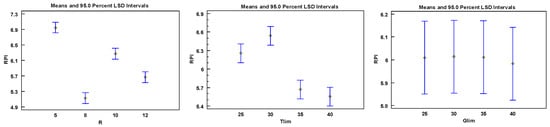
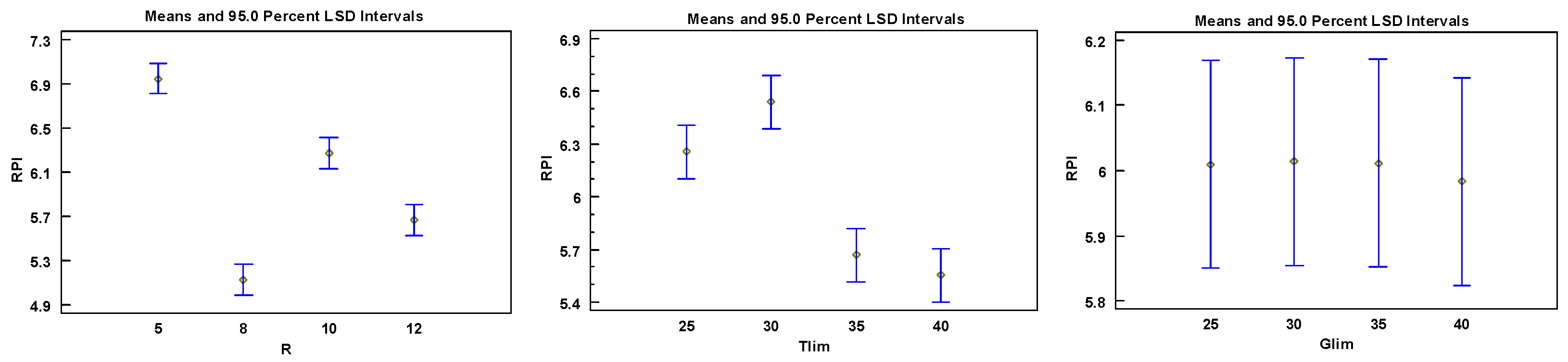
The results are evaluated by the analysis of variance (ANOVA) technique to study the statistical significance of the effects of the studied factors and their interactions. Three main hypotheses (in order of importance, independence of the residuals, homoscedasticity of the variants and levels of the different factors and normality of the model residuals) are checked and no significant deviations are found. The response variable of the ANOVA experiment is RPI. Based on the ANOVA results reported in Table 3, the restart-related parameter and the stagnation threshold exhibit statistically significant impacts on the algorithmic performance, whereas parameter plays a comparatively marginal role. This observation is consistent with the design philosophy of the CIG framework, in which macro-level diversification and micro-level exploitation are orchestrated through a restart-driven control logic. Specifically, parameter directly regulates the frequency of structural resets. When is excessively large, the algorithm tends to remain confined within locally optimal district configurations, as insufficient disruptive perturbations are triggered to alter inter-district assignments. Conversely, an overly small leads to frequent restarts, which excessively discard accumulated search information and impair convergence stability. The empirical results shown in Figure 2 reveal that a moderate value of achieves the best trade-off between intensification and diversification, enabling the algorithm to escape local optima while preserving high-quality partial structures.
Table 3.
ANOVA results of CIG.
Figure 2.
Main effects plot of all parameters.
Similarly, the threshold , which governs the switching between task-layer and group-layer perturbations, has a pronounced influence on solution quality. A larger delays macro-level district reallocation, causing the algorithm to over-invest in fine-grained task permutations even when structural workload imbalance dominates the makespan. In contrast, a smaller activates group-layer adjustments prematurely, potentially destabilizing locally efficient intra-district sequences. The selected parameter setting allows the cooperative mechanism to react adaptively to stagnation patterns, ensuring that district-level rebalancing is invoked only when necessary.
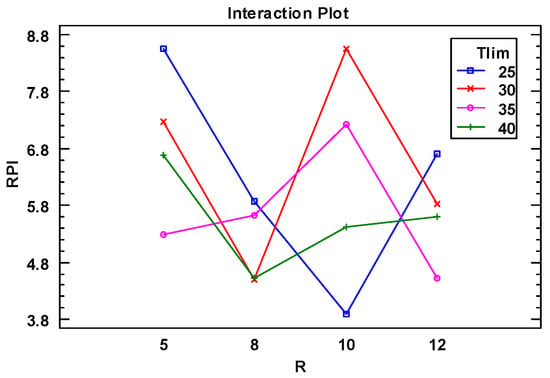
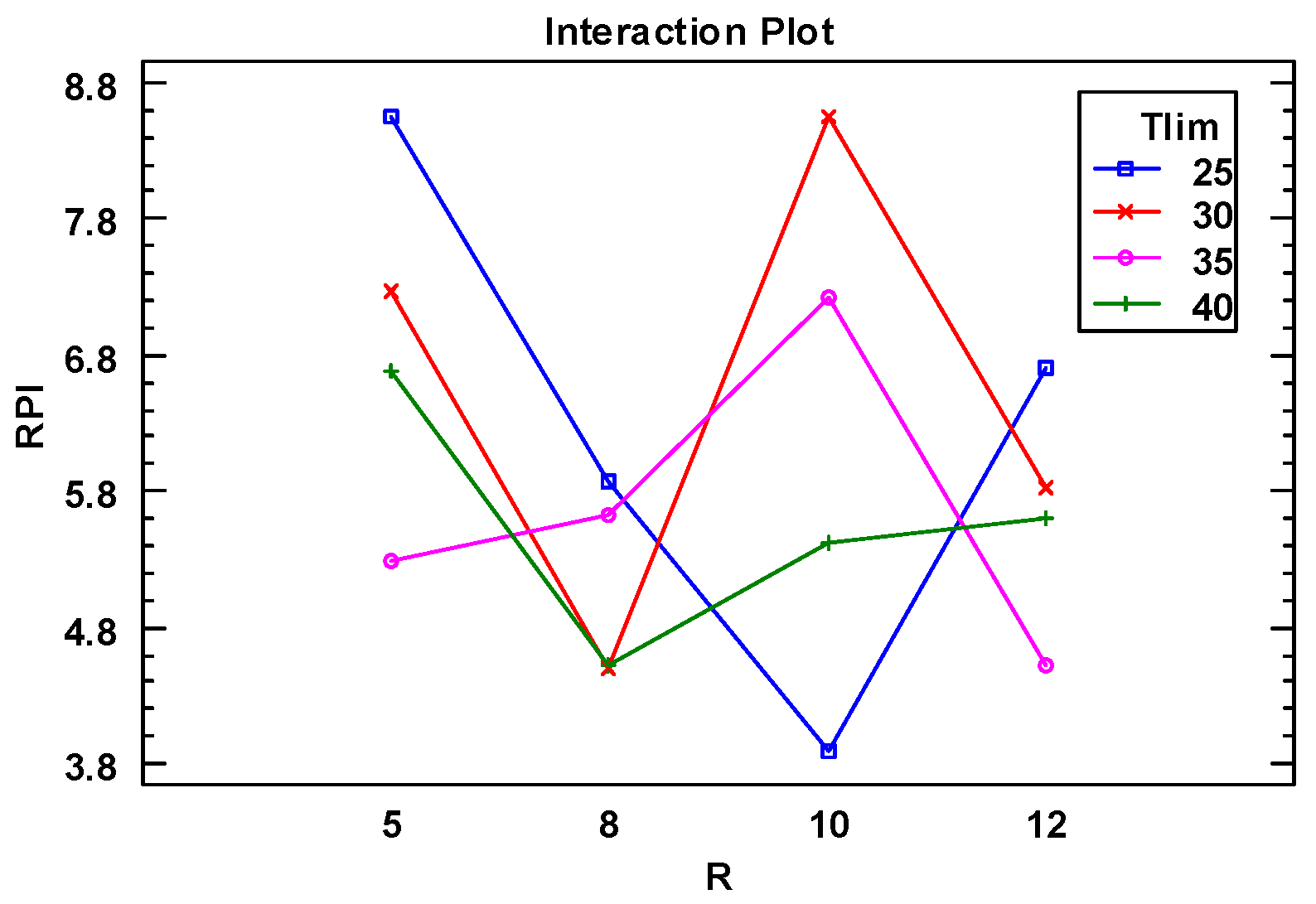
Although the interaction effects among parameters are statistically significant in Table 1, the interaction plots in Figure 3 indicate that these interactions are relatively mild and do not contradict the main-effect trends. Therefore, the final parameter configuration , , and adopted in this study represents a robust compromise across different instance scales.
Figure 3.
Interaction plots with Tukey Honest Significant Differences (HSD) 95% confidence intervals.
5.3. Comparison Experiments and Analysis
As the MDPDPP (Multi-Depot and Multi-District Pickup and Delivery Problem) has not been specifically investigated in existing literature, several representative state-of-the-art algorithms from closely related research areas are employed for comparative evaluation. Specifically, the Improved Harmony Search algorithm (IHS) [42], the Discrete Artificial Bee Colony algorithm (DABC) [43], and the Discrete Jaya algorithm (DJAYA) [44] are selected as benchmarks. These algorithms, while not specifically designed for VRP variants with “hierarchical structures” or “multi-district dispatching” features, are well-known metaheuristics that have shown strong performance in solving complex combinatorial optimization problems. We believe these algorithms can provide valuable insights into solving the MDPDPP due to their global search capabilities and adaptability.
The reason for not including classic algorithms specifically designed for Multi-Depot VRP (MDVRP) or Multi-District VRP as benchmarks lies in the unique characteristics of the MDPDPP. Our study focuses on a VRP variant that incorporates hierarchical structures and multi-region dispatching features, which differ significantly from the traditional MDVRP or Multi-District VRP formulations. Thus, we have selected the aforementioned metaheuristics to better handle these unique features. To ensure a fair comparison, these algorithms have been tailored to the specific characteristics of the MDPDPP, and their parameters have been carefully re-tuned. The corresponding calibration results are summarized in Table 4.
Table 4.
The parameter setting of all algorithms.
Each algorithm is independently run 5 times on each instance. Table 4 reports the average relative percentage increase (ARPI) values of all algorithms across various combinations of district and fleet sizes. Overall, CIG consistently outperforms DABC, DJAYA, and IHS on the majority of test instances, with a clear advantage in terms of both solution quality and robustness.
A key observation from Table 5 is that the performance gap between CIG and the benchmark algorithms becomes more pronounced as the problem scale increases, particularly for instances with a larger number of districts or tighter fleet capacities. This trend can be attributed to the hierarchical coupling structure of the MDPDPP. As the number of districts grows, the complexity of inter-district routing decisions increases combinatorically, and naive sequence-based heuristics struggle to coordinate district assignment and intra-district scheduling effectively.
Table 5.
ARPI values of all algorithms.
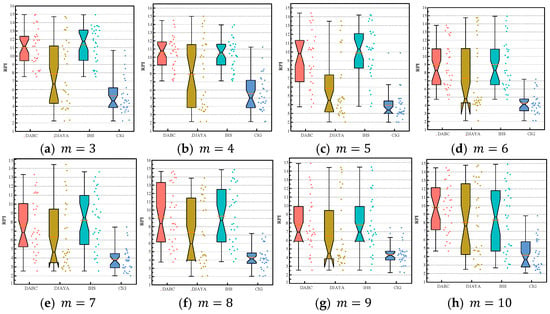
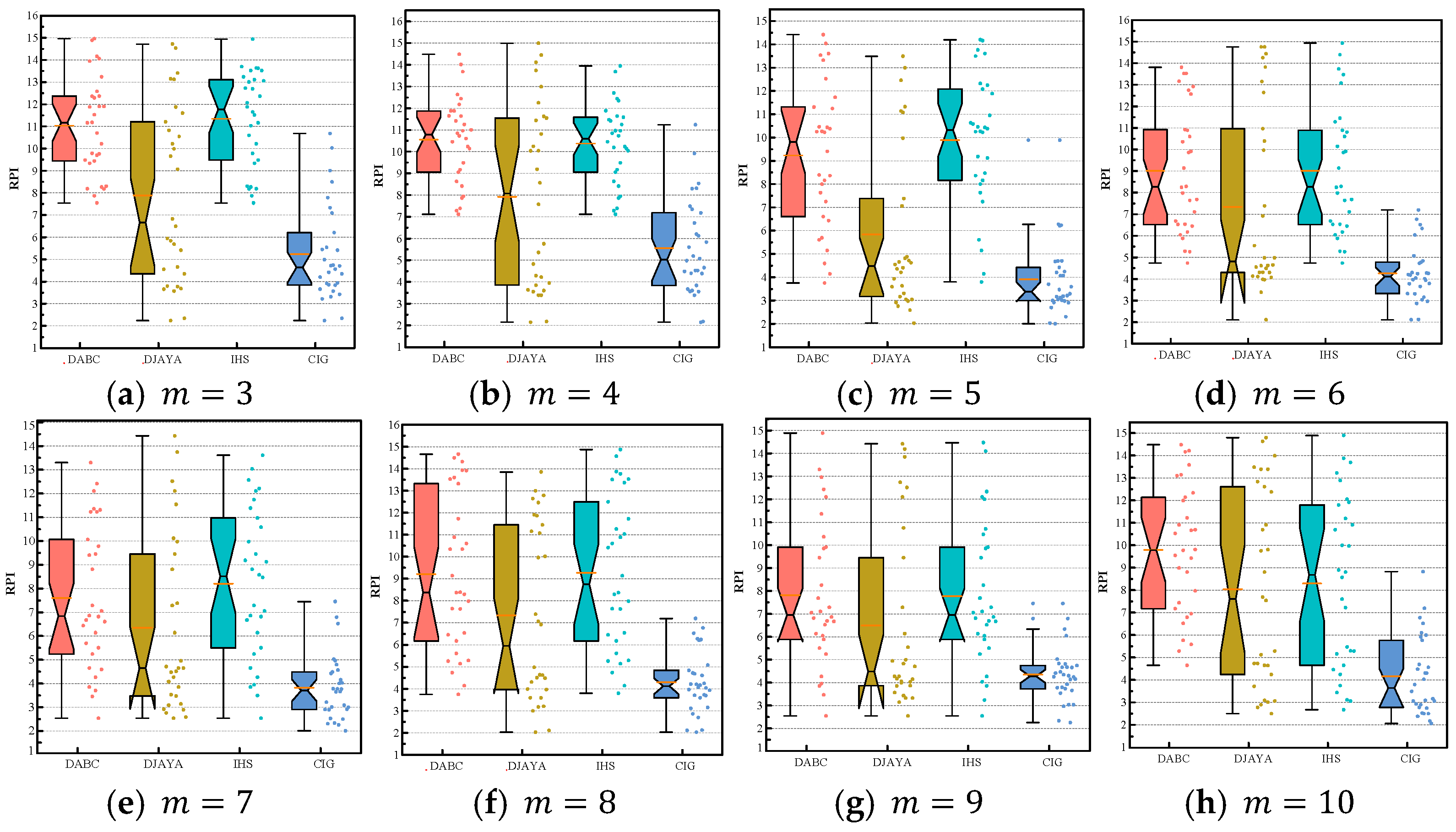
In contrast, CIG explicitly decomposes the problem into district-level and task-level components and coordinates them through a cooperative perturbation mechanism. This design enables the algorithm to identify bottleneck routes at the group level and rebalance workloads before refining local task sequences, thereby directly targeting the makespan objective. The benchmark algorithms, although competitive in classical routing or scheduling settings, lack explicit mechanisms to exploit this hierarchical dependency and therefore exhibit inferior scalability. Moreover, the superiority of CIG is not limited to average performance. The boxplots in Figure 4 demonstrate that CIG yields significantly tighter distributions of RPI values compared to the other algorithms. The reduced interquartile range indicates higher solution stability and lower sensitivity to stochastic effects, which is particularly desirable in time-critical policing applications where consistent performance is essential.
Figure 4.
Boxplots of RPI for all algorithms.
A closer examination of Table 5 reveals that district scale and fleet size exert distinct influences on algorithmic behavior. For a fixed number of police cars, increasing the number of districts generally leads to higher RPI values for all algorithms, reflecting the increased complexity of coordinating inter-district movements under non-reentrance constraints. However, the rate of performance degradation is markedly slower for CIG. This robustness stems from the group-layer perturbation strategy, which treats district segments as atomic blocks during macro-level adjustments. By preserving intra-district task structures while reallocating entire district segments across routes, CIG effectively reduces the combinatorial burden associated with re-optimizing fine-grained sequences after each global adjustment. Conversely, when the fleet size increases for a fixed district scale, all algorithms benefit from enhanced resource availability, as the workload can be distributed more evenly among police cars. Nevertheless, CIG maintains a consistent advantage, indicating that its cooperative mechanism is capable of exploiting additional vehicles without inducing excessive inter-district travel or redundant post visits.
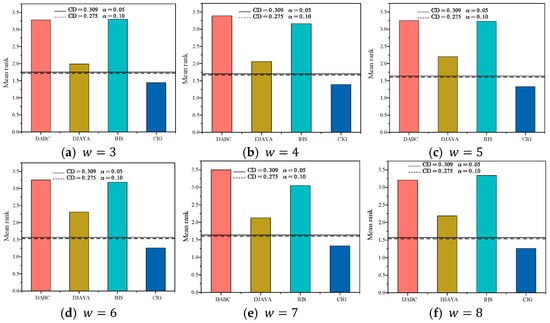
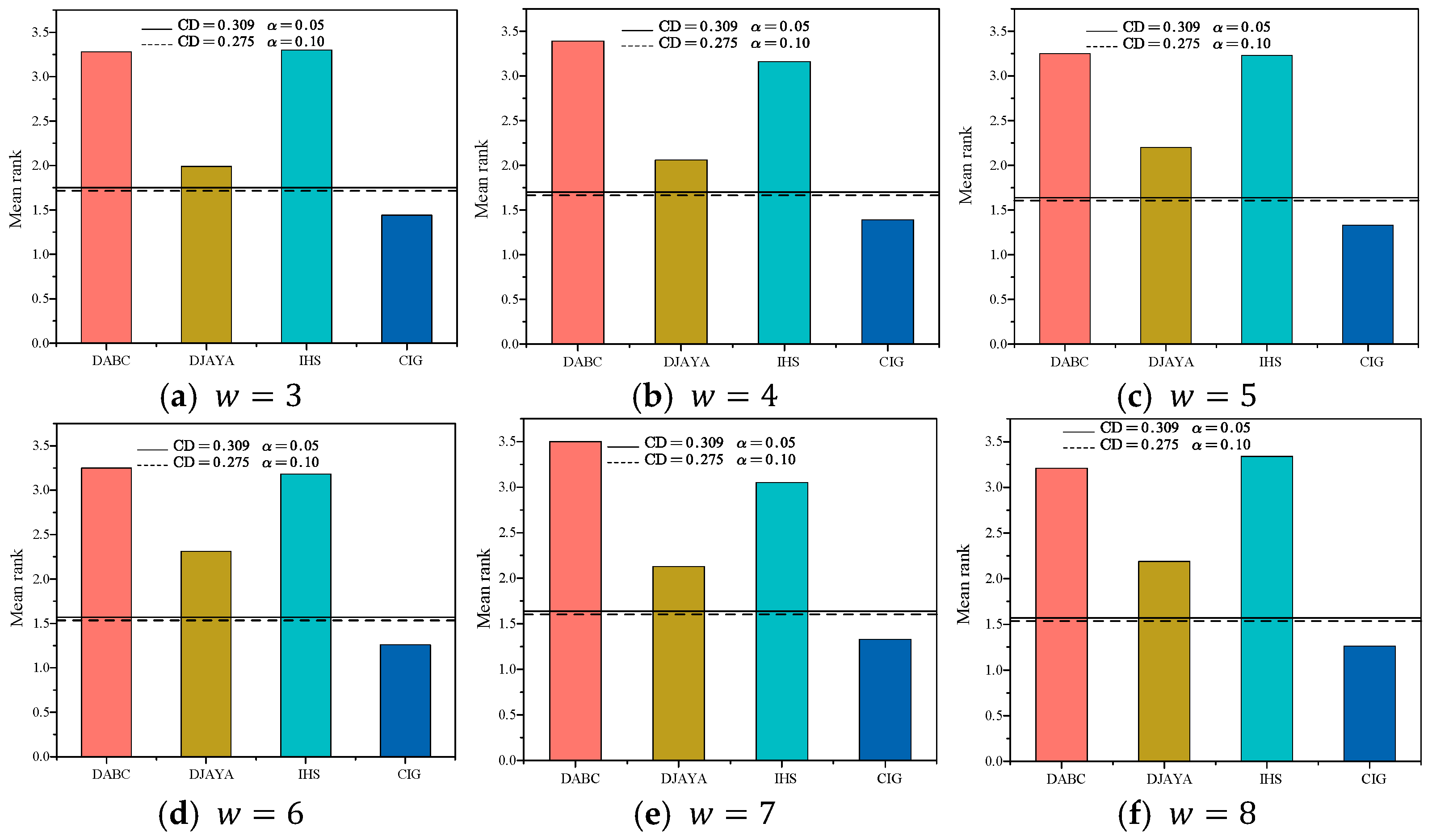
To further assess whether the observed performance differences among the compared algorithms are statistically significant, a non-parametric Friedman test is conducted. Given that the experimental results involve multiple algorithms evaluated across the same set of instances and that normality cannot be guaranteed, the Friedman test provides an appropriate and robust statistical framework for multi-algorithm comparison. Table 6 reports the average Friedman ranks of the compared algorithms under different fleet sizes, where a smaller rank indicates better performance. The Friedman test -values are all far below 0.05, rejecting the null hypothesis that all algorithms perform equivalently. To identify pairwise differences, we further apply the Nemenyi post hoc test; two algorithms are considered significantly different if their rank difference exceeds the critical difference (CD). It can be observed that CIG consistently achieves the lowest average rank across all tested numbers of police cars, whereas DABC and IHS exhibit substantially higher ranks, indicating inferior relative performance. DJAYA generally ranks second, but its performance remains clearly separated from that of CIG.
Table 6.
Results achieved by Friedman test at different number of police car.
Moreover, the associated -values are all far below the significance level of 0.05. These results confirm that the null hypothesis, which assumes no statistically significant differences among the algorithms, can be decisively rejected for all fleet-size scenarios. Hence, the performance superiority of CIG over the competing algorithms is not due to random fluctuations but is statistically significant. To provide a more intuitive interpretation, Figure 5 illustrates the critical difference (CD) diagrams corresponding to the Friedman test results. In these diagrams, algorithms whose rank intervals do not overlap within the CD threshold are considered significantly different. As shown in Figure 4, CIG is consistently positioned well apart from the other algorithms and does not overlap with any competing method across all tested fleet sizes. This clearly demonstrates that CIG significantly outperforms DABC, DJAYA, and IHS under diverse resource configurations.
Figure 5.
Graphical representation of the Friedman-test at different number of police car.
An additional observation is that the rank separation between CIG and the benchmark algorithms remains stable as the number of police cars increases. This indicates that the relative advantage of CIG is not sensitive to fleet scale, highlighting its robustness and scalability. In contrast, the rankings of the benchmark algorithms exhibit more noticeable fluctuations, suggesting higher sensitivity to instance characteristics and parameter interactions. From an algorithmic perspective, these statistically significant results further corroborate the effectiveness of the cooperative iterated greedy framework. By explicitly coordinating district-level workload allocation with capacity-aware intra-district task sequencing, CIG is able to consistently generate high-quality solutions across heterogeneous scenarios. The Friedman test thus provides strong statistical evidence supporting the reliability and general superiority of the proposed approach.
6. Discussion
6.1. Mechanisms Discussion and Practical Implications
The performance gains of CIG are directly linked to its capacity-aware decoding and cooperative search design. Unlike distance-based heuristics, the MDPDPP exhibits strong nonlinearity due to escort capacity dynamics and mandatory detours. Small changes in task order can trigger additional post visits, substantially increasing completion time. By employing simulation-based decoding, CIG evaluates candidate moves under true operational conditions.
Furthermore, the hierarchical coordination between task-layer and group-layer perturbations ensures that local improvements are aligned with global workload balance. This design allows decision-makers to evaluate realistic operational trade-offs, such as whether reallocating a district to a different vehicle can reduce system-wide response time despite increased local travel. Beyond public safety, this framework presents significant potential for application in emerging Autonomous Mobility-on-Demand (AMoD) networks, where a fleet of vehicles must be dynamically repositioned across urban districts to mitigate supply-demand imbalances.
6.2. Open Research Questions (ORQ)
While the proposed approach demonstrates robustness, several critical challenges remain for future exploration:
- (1)
- Dynamic and Stochastic Environments: Real-world police dispatching is inherently dynamic, with incidents arriving stochastically. Future work should investigate embedding the CIG algorithm into an event-driven rolling-horizon framework to handle real-time re-optimization.
- (2)
- Fleet Heterogeneity: Incorporating heterogeneous vehicle fleets with varying escort capacities and priority-based dispatch policies (e.g., weighted penalty costs) remains a vital direction to align with practical law enforcement requirements.
- (3)
- Learning-Assisted Control: Demand uncertainty, travel time variability, and imperfect information may affect dispatch quality. Hybridizing the proposed framework with reinforcement learning or other learning-assisted mechanisms could further enhance adaptive control under high uncertainty [41].
7. Conclusions
This study addressed the Multi-district Police Dispatching and Path Planning Problem (MDPDPP) by integrating inter-district routing, task scheduling, and dynamic escort capacity management within a unified makespan minimization framework. A Cooperative Iterated Greedy (CIG) algorithm was developed to coordinate hierarchical decision layers through capacity-aware decoding and adaptive perturbation mechanisms.
Extensive computational experiments conducted on 240 test instances demonstrate the clear superiority of the proposed method. On average, CIG achieved an ARPI value of 4.450, significantly outperforming DABC (9.281), DJAYA (7.151), and IHS (9.128). This corresponds to performance improvements of approximately 38% compared with DJAYA and over 50% compared with DABC and IHS. Furthermore, Friedman statistical tests confirmed that these improvements are statistically significant across all fleet-size configurations (all p-values < 0.05), providing strong evidence of the robustness and consistency of the proposed approach. These results suggest that the proposed approach provides an effective and scalable baseline for supporting planning in complex multi-district dispatching scenarios where feasibility and operational realism are driven by capacity evolution and transfer constraints.
Future work will extend the framework toward dynamic and uncertainty-aware settings (e.g., rolling-horizon replanning), incorporate richer operational constraints and heterogeneous resources, and validate performance using real operational data.
Author Contributions
Conceptualization, J.W. and X.H.; methodology, P.X. and X.H.; validation, Panpan X; formal analysis, J.W., P.X. and X.H.; writing—original draft preparation, P.X.; writing—review and editing, J.W. and X.H.; supervision, J.W. All authors have read and agreed to the published version of the manuscript.
Funding
This research received no external funding.
Data Availability Statement
Data is available upon request.
Acknowledgments
The authors used generative AI tools for limited editorial assistance (e.g., language polishing). The tools were not used to generate scientific claims, derive results, or create data and figures. All outputs were verified and curated by the authors.
Conflicts of Interest
The authors declare no conflict of interest.
References
- Jesus, T.C.; Portugal, P.; Costa, D.G. Vasques, Reliability and Detectability of Emergency Management Systems in Smart Cities under Common Cause Failures. Sensors 2024, 24, 2955. [Google Scholar] [CrossRef] [Scilit]
- Schmid, V. Solving the dynamic ambulance relocation and dispatching problem using approximate dynamic programming. Eur. J. Oper. Res. 2012, 219, 611–621. [Google Scholar] [CrossRef] [Scilit] [PubMed]
- Castillo-Salazar, J.A.; Landa-Silva, D.; Qu, R. Workforce scheduling and routing problems: Literature survey and computational study. Ann. Oper. Res. 2016, 239, 39–67. [Google Scholar] [CrossRef] [Scilit]
- Viadero-Monasterio, F.; Meléndez-Useros, M.; Zhang, N.; Zhang, H.; Boada, B.L.; Boada, M.J.L. Motion Planning and Robust Output-Feedback Trajectory Tracking Control for Multiple Intelligent and Connected Vehicles in Unsignalized Intersections. IEEE Trans. Veh. Technol. 2025, 74, 18543–18555. [Google Scholar] [CrossRef] [Scilit]
- Viadero-Monasterio, F.; Nguyen, A.-T.; Lauber, J.; Boada, M.J.L.; Boada, B.L. Event-Triggered Robust Path Tracking Control Considering Roll Stability Under Network-Induced Delays for Autonomous Vehicles. IEEE Trans. Intell. Transp. Syst. 2023, 24, 14743–14756. [Google Scholar] [CrossRef] [Scilit]
- Dunnett, S.; Leigh, J.; Jackson, L. Optimising police dispatch for incident response in real time. J. Oper. Res. Soc. 2019, 70, 269–279. [Google Scholar] [CrossRef] [Scilit]
- Almalki, M.; Aldhahri, E.; Aljojo, N. Ambulance routing optimization based on emergency medical service availability. Discov. Artif. Intell. 2025, 5, 297. [Google Scholar] [CrossRef] [Scilit]
- Yoon, S.; Albert, L.A. Dynamic dispatch policies for emergency response with multiple types of vehicles. Transp. Res. Part E Logist. Transp. Rev. 2021, 152, 102405. [Google Scholar] [CrossRef] [Scilit]
- Rautenstrauß, M.; Schiffer, M. Optimization-Augmented Machine Learning for Vehicle Operations in Emergency Medical Services. arXiv 2025, arXiv:2503.11848. [Google Scholar] [CrossRef] [Scilit]
- Hao, Z.; Wang, Y.; Yang, X. Every Second Counts: A Comprehensive Review of Route Optimization and Priority Control for Urban Emergency Vehicles. Sustainability 2024, 16, 2917. [Google Scholar] [CrossRef] [Scilit]
- Moghdani, R.; Salimifard, K.; Demir, E.; Barak, S.; Aazami, A.; Shekarabi, S.A.H. A metaheuristic approach for the multi-objective sustainable vehicle routing problem. Ann. Oper. Res. 2025, 1–50. [Google Scholar] [CrossRef] [Scilit]
- Bueno-Ferrer, Á.; De Pablo Valenciano, J.; De Burgos Jiménez, J. Unveiling the Potential of Metaheuristics in Transportation: A Path Towards Efficiency. Optimization, and Intelligent Management. Infrastructures 2025, 10, 4. [Google Scholar] [CrossRef] [Scilit]
- Kerscher, C.; Minner, S. Decompose-route-improve framework for solving large-scale vehicle routing problems with time windows. Transp. Res. Part E Logist. Transp. Rev. 2025, 204, 104409. [Google Scholar] [CrossRef] [Scilit]
- Zhao, J.; Mao, M.; Zhao, X.; Zou, J. A Hybrid of Deep Reinforcement Learning and Local Search for the Vehicle Routing Problems. IEEE Trans. Intell. Transp. Syst. 2021, 22, 7208–7218. [Google Scholar] [CrossRef] [Scilit]
- Clarke, G.; Wright, J. Scheduling of vehicles from a central depot to a number of delivery points. Oper. Res. 1964, 12, 568–581. [Google Scholar] [CrossRef] [Scilit]
- Dorigo, M.; Gambardella, L.M. Ant colonies for the traveling salesman problem. Biosystems 1997, 43, 73–81. [Google Scholar] [CrossRef] [Scilit] [PubMed]
- Larson, R.C. A hypercube queuing model for facility location and redistricting in urban emergency services. Comput. Oper. Res. 1974, 1, 67–95. [Google Scholar] [CrossRef] [Scilit]
- Dewinter, M.; Vandeviver, C.; Beken, T.V.; Witlox, F. Analysing the Police Patrol Routing Problem: A Review. ISPRS Int. J. Geo-Inf. 2020, 9, 157. [Google Scholar] [CrossRef] [Scilit]
- Mousapour, F.; Batta, R.; Walteros, J.L. On the development and analysis of a comprehensive police patrolling model. EURO J. Transp. Logist. 2025, 14, 100153. [Google Scholar] [CrossRef] [Scilit]
- Saint-Guillain, M.; Paquay, C.; Limbourg, S. Time-dependent stochastic vehicle routing problem with random requests: Application to online police patrol management in Brussels. Eur. J. Oper. Res. 2021, 292, 869–885. [Google Scholar] [CrossRef] [Scilit]
- Camacho-Collados, M.; Liberatore, F.; Angulo, J.M. A multi-criteria Police Districting Problem for the efficient and effective design of patrol sector. Eur. J. Oper. Res. 2015, 246, 674–684. [Google Scholar] [CrossRef] [Scilit]
- Schmid, V.; Doerner, K.F. Ambulance location and relocation problems with time-dependent travel times. Eur. J. Oper. Res. 2010, 207, 1293–1303. [Google Scholar] [CrossRef] [Scilit] [PubMed]
- Becker, J.; Kurland, L.; Höglund, E.; Hugelius, K. Dynamic ambulance relocation: A scoping review. BMJ Open 2023, 13, e073394. [Google Scholar] [CrossRef] [Scilit]
- Bélanger, V.; Ruiz, A.; Soriano, P. Recent optimization models and trends in location, relocation, and dispatching of emergency medical vehicles. Eur. J. Oper. Res. 2019, 272, 1–23. [Google Scholar] [CrossRef] [Scilit]
- Schiffer, M.; Schneider, M.; Walther, G.; Laporte, G. Vehicle Routing and Location Routing with Intermediate Stops: A Review. Transp. Sci. 2019, 53, 319–343. [Google Scholar] [CrossRef] [Scilit]
- Zhong, R.Y.; Dai, Q.Y.; Qu, T.; Hu, G.J.; Huang, G.Q. RFID-enabled real-time manufacturing execution system for mass-customization production. Robot. Comput.-Integr. Manuf. 2013, 29, 283–292. [Google Scholar] [CrossRef] [Scilit]
- Rios, B.H.O.; Xavier, E.C.; Miyazawa, F.K.; Amorim, P.; Curcio, E.; Santos, M.J. Recent dynamic vehicle routing problems: A survey. Comput. Ind. Eng. 2021, 160, 107604. [Google Scholar] [CrossRef] [Scilit]
- Elshaer, R.; Awad, H. A taxonomic review of metaheuristic algorithms for solving the vehicle routing problem and its variants. Comput. Ind. Eng. 2020, 140, 106242. [Google Scholar] [CrossRef] [Scilit]
- Carvalho, A.S.; Captivo, M.E.; Marques, I. Integrating the ambulance dispatching and relocation problems to maximize system’s preparedness. Eur. J. Oper. Res. 2020, 283, 1064–1080. [Google Scholar] [CrossRef] [Scilit]
- Miao, Z.; Guo, H.; Pan, Q.; Peng, C.; Xu, Z. A reinforcement learning-enhanced multi-objective iterated greedy algorithm for weeding-robot operation scheduling problems. Expert Syst. Appl. 2025, 263, 125760. [Google Scholar] [CrossRef] [Scilit]
- Zou, W.; Zou, J.; Sang, H.; Meng, L.; Pan, Q. An effective population-based iterated greedy algorithm for solving the multi-AGV scheduling problem with unloading safety detection. Inf. Sci. 2024, 657, 119949. [Google Scholar] [CrossRef] [Scilit]
- Delgado-Antequera, L.; Caballero, R.; Sánchez-Oro, J.; Colmenar, J.M.; Martí, R. Iterated greedy with variable neighborhood search for a multiobjective waste collection problem. Expert Syst. Appl. 2020, 145, 113101. [Google Scholar] [CrossRef] [Scilit]
- Vidal, T.; Laporte, G.; Matl, P. A concise guide to existing and emerging vehicle routing problem variants. Eur. J. Oper. Res. 2020, 286, 401–416. [Google Scholar] [CrossRef] [Scilit]
- Le, T.D.C.; Nguyen, D.D.; Oláh, J.; Pakurár, M. Clustering algorithm for a vehicle routing problem with time windows. Transport 2022, 37, 17–27. [Google Scholar] [CrossRef] [Scilit]
- Qiao, K.; Liang, J.; Yu, K.; Yue, C.; Lin, H.; Zhang, D.; Qu, B. Evolutionary Constrained Multiobjective Optimization: Scalable High-Dimensional Constraint Benchmarks and Algorithm. IEEE Trans. Evol. Comput. 2024, 28, 965–979. [Google Scholar] [CrossRef] [Scilit]
- Zhang, M.; Jiao, L.; Shang, R.; Zhang, X.; Li, L. Unsupervised EA-Based Fuzzy Clustering for Image Segmentation. IEEE Access 2020, 8, 8627–8647. [Google Scholar] [CrossRef] [Scilit]
- Kyriakakis, N.A.; Marinaki, M.; Marinakis, Y. A hybrid ant colony optimization-variable neighborhood descent approach for the cumulative capacitated vehicle routing problem. Comput. Oper. Res. 2021, 134, 105397. [Google Scholar] [CrossRef] [Scilit]
- Sze, J.F.; Salhi, S.; Wassan, N. An adaptive variable neighbourhood search approach for the dynamic vehicle routing problem. Comput. Oper. Res. 2024, 164, 106531. [Google Scholar] [CrossRef] [Scilit]
- Wang, J.; Mei, S.; Liu, C.; Peng, H.; Wu, Z. A decomposition-based multi-objective evolutionary algorithm using infinitesimal method. Appl. Soft Comput. 2024, 167, 112272. [Google Scholar] [CrossRef] [Scilit]
- Guo, H.W.; Miao, Z.H.; Ji, J.C.; Pan, Q.K. An effective collaboration evolutionary algorithm for multi-robot task allocation and scheduling in a smart farm. Knowl.-Based Syst. 2024, 289, 111474. [Google Scholar] [CrossRef] [Scilit]
- Guo, H.; Pan, Q.; Sang, H.; Miao, Z.; Zhang, W. AHLLNS: An automated algorithm for multi-objective heterogeneous agricultural robot operation scheduling problems. IEEE Trans. Autom. Sci. Eng. 2026, 23, 5096–5109. [Google Scholar] [CrossRef] [Scilit]
- Li, G.; Li, X.; Gao, L.; Zeng, B. Tasks assigning and sequencing of multiple AGVs based on an improved harmony search algorithm. J. Ambient Intell. Humaniz. Comput. 2019, 10, 4533–4546. [Google Scholar] [CrossRef] [Scilit]
- Zou, W.-Q.; Pan, Q.-K.; Meng, T.; Gao, L.; Wang, Y.-L. An effective discrete artificial bee colony algorithm for multi-AGVs dispatching problem in a matrix manufacturing workshop. Expert Syst. Appl. 2020, 161, 113675. [Google Scholar] [CrossRef] [Scilit]
- Gunduz, M.; Aslan, M. DJAYA: A discrete Jaya algorithm for solving traveling salesman problem. Appl. Soft Comput. 2021, 105, 107275. [Google Scholar] [CrossRef] [Scilit]

Disclaimer/Publisher’s Note: The statements, opinions and data contained in all publications are solely those of the individual author(s) and contributor(s) and not of MDPI and/or the editor(s). MDPI and/or the editor(s) disclaim responsibility for any injury to people or property resulting from any ideas, methods, instructions or products referred to in the content. |
© 2026 by the authors. Licensee MDPI, Basel, Switzerland. This article is an open access article distributed under the terms and conditions of the Creative Commons Attribution (CC BY) license.