


Abstract
The translation of knowledge and methodologies across disciplines represents a valuable source of innovation, particularly in user-centered design approaches that have become essential in medical device development. This study explores the use of the PICO (Population, Intervention, Comparison, and Outcome) framework, a cornerstone of evidence-based medicine for formulating clinical questions, as a conceptual structure to support the alignment between clinical needs and engineering design consideration in robotic rehabilitation devices, with a focus on hand exoskeletons. Through a conceptual reinterpretation and application-oriented exploration supported by illustrative case studies involving both rigid and soft robotic glove prototypes, this study shows how each PICO component can inform engineering parameters, from defining user impairments and intervention strategies to benchmarking and outcome measurements. The analysis highlights the potential of PICO in fostering a user-centered design perspective and bridging clinical and engineering domains while also identifying its structural limitations when applied to device design contexts. This study concludes that while the PICO framework offers a valuable foundational structure, it requires customization to fully address the multifactorial requirements of effective, patient-specific robotic rehabilitation device design.
1. Introduction
In recent years, the field of design has undergone a marked shift towards a user-centered approach, as evidenced by a growing emphasis on user-centered and user-oriented techniques [1,2,3,4,5,6,7,8]. This phenomenon is particularly evident in the increasing interest related to usability, which has emerged as a paramount concern in the development of goods and systems across various industries [9]. A comparable trend is firmly established in healthcare, where personalized medicine and customizable therapies have become critically important, highlighting the necessity of considering individual patient features in clinical decision-making [4,10,11]. Consequently, contemporary optimal devices can be customized to accommodate the patient’s anatomical characteristics, employing adjustable geometric parameters or three-dimensional scanning technology for enhanced flexibility [12,13,14,15,16,17,18,19]. These devices are equipped with sensors, lightweight materials, ergonomic designs, and control systems, ensuring safety and functionality [20,21,22,23]. Although a significant number of robotic hand exoskeletons reported in the literature are described as being developed according to a user-centered design approach, in most cases, such an approach tends to align more closely with a custom-tailored design paradigm, where solutions are highly individualized and adapted to specific users or small cohorts, rather than guided by a standardized and reproducible methodological framework. As a result, despite the emphasis on user involvement, the design processes often lack a shared operational structure that can translate clinical needs into engineering specifications. This absence of standardization can limit scalability, comparability across studies, and the transferability of design solutions to broader patient populations.
Several structured approaches have been proposed to support the requirement needed for medical device development. These include Quality Function Deployment (QFD) for translating user needs into engineering characteristics, systems engineering methodologies such as the V model for structured verification and validation, and formal design control processes, as required by FDA 21 CFR 820.30. Human-centered design principles, as formalized in ISO 9241-210, further emphasize iterative user involvement and contextual analysis. Despite their relevance, these approaches often operate either at a high managerial level (e.g., quality systems and regulatory compliance) or at a technical validation level, without explicitly structuring the early conceptual link between clinical reasoning and device architecture definition. In robotic rehabilitation, where clinical goals, biomechanical constraints, and technological solutions must be tightly integrated, this gap remains particularly evident.
According to the Open Innovation framework, innovation is significantly enhanced when solutions are pursued beyond traditional problem boundaries [24,25]. Moreover, it is acknowledged that tools and frameworks developed in one sector frequently offer valuable insights applicable to other domains. One such framework is the PICO (Population, Intervention, Comparison, and Outcome) model, a widely utilized approach in the field of evidence-based medicine (EBM) for the systematic organization of clinical inquiries [26,27,28]. PICO, which is not conventionally linked to the design processes of medical devices [29], presents a systematic methodology that could be beneficial in the development of medical equipment, especially in the context of robotic rehabilitation. Actually, PICO can be employed as an effective instrument in user-centered design (UCD) to methodically and conventionally organize information regarding structural and functional deficiencies [30].
In contrast with other UCD approaches, the approach proposed in this paper through the application of the PICO framework to the design of robotic hand exoskeletons for rehabilitation is grounded in the identification of a target impairment and/or population. By structuring the design process around clinically defined conditions and functional deficits, the method promotes a more standardized and replicable pathway from needs assessments to technical development. Furthermore, adopting PICO provides an effective interdisciplinary communication tool. Therapists and clinicians typically frame rehabilitation goals in medical and functional terms, whereas engineers and designers operate within technical and performance-driven domains. Without a common framework, this divergence can hinder mutual understanding and slow the translation of therapeutic requirements into device specifications. Since PICO is a model originally established and widely applied in evidence-based medicine, its integration into the design process creates a shared conceptual and operational language. This facilitates structured dialogue between clinical and engineering stakeholders, ultimately supporting the development of rehabilitation technologies that are not only user-informed but also clinically grounded, methodologically standardized, and more easily generalizable.
In the medical device domain, user-centered design is not only a methodological choice but also a regulatory requirement. International standards such as ISO 13485 (quality management systems for medical devices) and ISO 14971 (risk management for medical devices) explicitly require manufacturers to identify user needs, intended use, and potential hazards throughout the product lifecycle. In parallel, IEC 62366-1 formalizes usability engineering processes aimed at minimizing use-related risks, while regulatory bodies such as the U.S. Food and Drug Administration (FDA) have issued specific guidance on the application of human factors and usability engineering to medical devices. Similarly, the European Medical Device Regulation (EU MDR 2017/745) emphasizes safety, performance, and clinical evaluation within a structured development framework. Within this regulatory landscape, structured methodologies capable of systematically translating clinical needs into technical specifications are not only desirable but also necessary. However, while existing standards define requirements and processes, they do not provide an explicit operational bridge between clinical reasoning and early-stage engineering design decisions in robotic rehabilitation devices.
Several systematic and integrative reviews have analyzed robotic rehabilitation devices, particularly exoskeletons and wearable systems, examining different aspects, such as mechanical design features and architectures (rigid, soft, and hybrid), structural configurations, best-practice design choices, actuation technologies, control strategies, usability aspects, and clinical outcomes [11,22,31,32,33,34]. These works provide detailed taxonomies and comparative technical evaluations, highlighting trends toward lightweight, modular, and wearable solutions. More recent contributions also address human-centered design principles and regulatory integration in medical device development [5,19]. However, despite this extensive body of literature, structured methodologies explicitly supporting the translation of clinical evidence into engineering specifications during early-stage design remain underexplored. This gap motivates the investigation of structured conceptual models as a potential bridge between clinical reasoning and engineering development in robotic rehabilitation.
Achieving strategic objectives, including resource sustainability, the eradication of information redundancy, and the enhancement of competence, necessitates interdisciplinary collaboration and knowledge transfer. Consequently, we advocate for the implementation of the PICO framework as a mechanism to guide the design of robotic rehabilitation medical devices, specifically as a foundational design criterion [35]. The directed design methodology facilitates the exploration of innovative and expansive protocols for design, emphasizing actions that enhance functional design in accordance with Sustainable Development Goal 3 (SDG 3), which aims to secure healthy lives and promote well-being for all age groups [36,37]. In line with SDG 3, a preliminary application of the PICO framework was proposed to identify the key criteria for the design of a robotic hand rehabilitation device [38]. This preliminary study, which was applied to a specific case—an actuated glove for hand rehabilitation—provided insights for the design of more effective devices and for improving robotic rehabilitation outcomes, despite also highlighted that the PICO model can be further improved in the robotic rehabilitation field. Potential improvements may include explicitly specifying the main technical requirements of the device and the limitations associated with its operational context. Nonetheless, PICO is expected to demonstrate limitations that are intrinsic to its design, as it was not originally developed to fulfill this particular function [39,40]. Consequently, we emphasize the increasing necessity for a new research avenue to establish an innovative framework that is inspired by PICO yet more suitably adapted to direct the design of these medical devices. Consequently, this study facilitates skill optimization, resulting in cross-collaboration among physiotherapists, experienced users, healthcare professionals, and engineers.
A previous study reported in ref. [31] proposed the application of the PICO approach to systematically map robotic devices for hand rehabilitation already reported in the literature, while the present paper introduces the PICO model as a structured framework for the design of such devices and demonstrates its practical implementation through two representative case studies. Therefore, this research examines the possibilities of PICO in this novel setting and delineates the requisite subsequent actions to provide a more appropriate framework for robotic rehabilitation design.
2. The PICO Framework Reinterpreted: Technical Activities in Robotic Rehabilitation Devices
The PICO framework serves as a systematic approach traditionally employed for developing research questions and defining the scope of clinical investigations, meta-analytical reviews, and evidence-based medicine studies. This foundational methodology is built upon four fundamental components that outline the essential elements of a clinical inquiry: patient population/clinical problem (P), intervention strategy (I), comparison (C), and measured outcomes (O) [26].
The present study introduces a methodological adaptation of the PICO framework for application in robotic hand exoskeleton design and technology assessment. The reinterpretation of this framework and its application to guide the design of robotic hand exoskeletons tailored for the rehabilitation needs of specific patients represents both a novel approach to the design of medical devices and an innovative application of the PICO framework. In fact, the distinctive characteristics and needs of end users must fundamentally shape the functional requirements and technical specifications that devices must fulfill. From this perspective, adopting a patient-centered design philosophy is becoming an essential best practice, and the adoption of structured frameworks can help fulfill all the technical requirements of medical devices. In this study, the traditional PICO structure is systematically reinterpreted to address two primary objectives: (1) guiding engineers in the design process of robotic hand rehabilitation devices based on the patient needs and (2) developing a classification system to support clinical decision-making in device selection.
The PICO components were mapped onto technical design parameters through a structured translation process. Each element of the framework was analyzed and reinterpreted to identify relevant design constraints and specifications. Therefore, the new application of the PICO framework is as follows:
- Patient/Problem helps define the patient’s functional impairments and target user characteristics.
- Intervention helps define the functional and interactive requirements and therapeutic modalities.
- Comparison guides the design by benchmarking against existing technologies, defining, for instance, actuation and control strategies as well as the structure of the exoskeleton.
- Outcome provides information about the sensor integration and performance metrics.
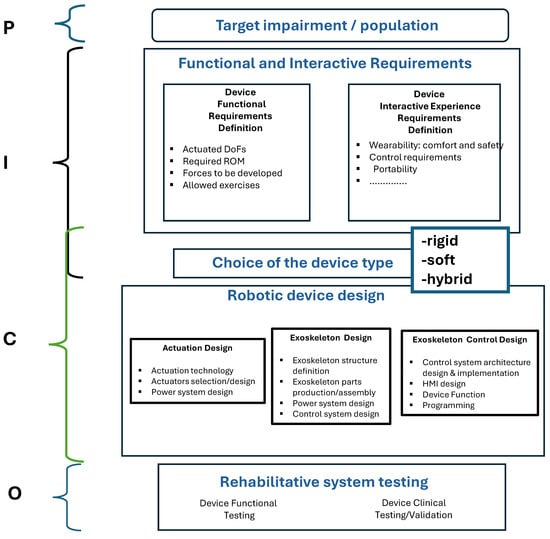
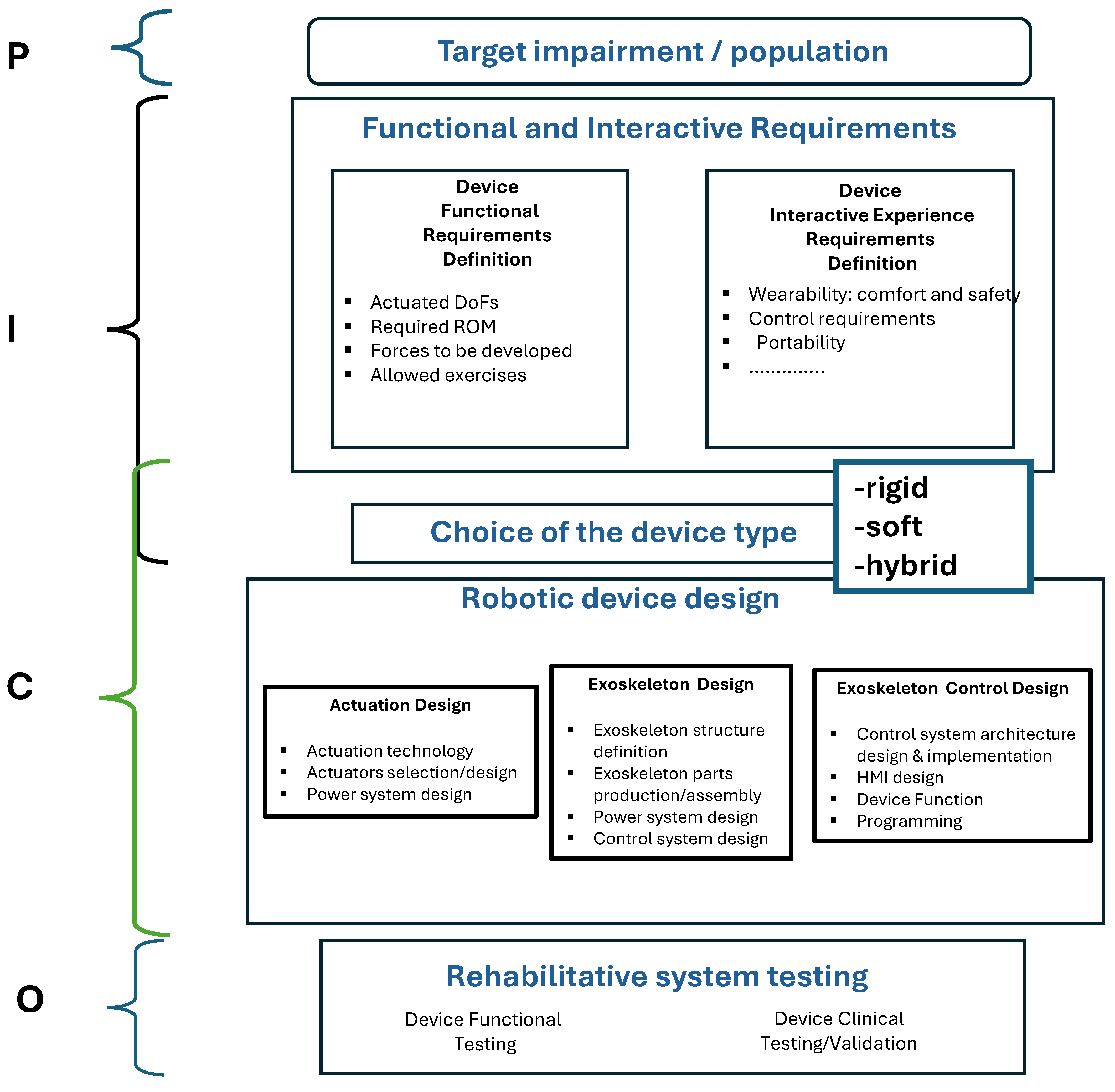
The practical utility of the reinterpreted PICO framework in bridging the gap between clinical needs and engineering solutions can be synthesized by considering the methodology presented Figure 1.
Figure 1.
Methodology of different phases synthesized in the flowchart.
2.1. P: Target Impairment/Population
In this design phase, the technician focuses on the target impairment or patient population for which the robotic hand exoskeleton is intended, either for rehabilitation or assistive purposes. The identification of the target impairments to be addressed allows the overall purpose of the device to be clearly defined and provides a solid foundation for all subsequent design decisions.
2.2. I: Functional and Interactive Requirements
This design stage includes the definition of the device’s functional requirements, as well as the interactive experience requirements. In particular, the identification of the necessary actuated degrees of freedom (DoFs), corresponding to the joint movements that require assistance or resistance during the rehabilitation, is one of the most important functional requirements to define. Subsequently, the required range of motion (ROM) can be specified for each actuated joint by defining the angular displacements necessary to ensure the safe and effective execution of therapeutic exercises. Another key aspect concerns the definition of the device’s force-generation capacity, which is determined by establishing the torque and force levels required to effectively support the rehabilitation process. Finally, the permitted exercise modalities are defined, specifying the therapeutic activities and movement patterns that the device must be able to accommodate. In parallel, during the phase dedicated to defining the interactive experience requirements, a user-centered design approach is adopted. Wearability is evaluated in terms of comfort, adaptability, and safety, ensuring that the device can be used for extended periods without causing discomfort or adverse effects. Control requirements are then defined, including control interfaces, feedback systems, and user interaction modalities. Lastly, device portability is assessed by considering mobility, weight constraints, and usability across different environments, such as clinical settings and home-based rehabilitation.
Finally, device-type selection can be addressed. In particular, the comprehensive definition of functional and interactive requirements, as the outcomes derived from both Phases P and I, guide the design choice between rigid, soft, or hybrid device architectures and the technological approach. Therefore, the choice of the device type is based on the previously established parameters, including required force output, range of motion, wearability, safety, and portability. The selected architecture must ensure adequate mechanical performance while maintaining user comfort and adaptability to the target rehabilitation scenario. This phase represents a critical transition from requirements analysis to detailed engineering design, as the chosen device type directly influences actuation strategies, structural layout, control complexity, and overall system integration. This decision point lies at the intersection of the I and C phases, since the selection must be supported not only by design requirements but also by benchmarking against existing technologies and solutions.
2.3. C: Comparative Design of the Robotic Device
This phase is dedicated to the detailed design of the robotic device, encompassing actuation, the mechanical structure, power systems, and the control architecture. The actuation design phase involves the selection and/or custom design of suitable actuators, along with the definition of the actuation technology and transmission mechanisms required to meet the force and motion specifications. In parallel, the power system is designed to ensure sufficient energy supply, efficiency, and safe operation within the intended use scenarios.
The exoskeleton design phase includes the definition of the mechanical structure, ensuring proper alignment with human joints and anatomical constraints. This step also covers the design, production, and assembly of individual exoskeleton components, along with careful consideration of materials, manufacturability, weight reduction, and structural robustness. The integration of the power system within the exoskeleton structure is addressed to maintain balance, compactness, and usability.
Finally, the control design phase focuses on the development of the control system architecture, including its design and implementation. This includes low-level and high-level control strategies, sensor integration, and real-time system management. Human–Machine Interface (HMI) design is addressed to enable intuitive and effective interaction between the user and the device, providing appropriate feedback and control modalities. The phase concludes with device function programming, ensuring that the robotic system can execute the intended rehabilitation tasks reliably, safely, and in accordance with therapeutic objectives.
2.4. O: Rehabilitative System Testing
The final phase of the methodology focuses on the testing and validation of the rehabilitative system to ensure its safety, reliability, and effectiveness. This phase includes comprehensive device functional testing aimed at verifying that all mechanical, electrical, and control components operate as intended and in accordance with the defined functional requirements. Functional testing assesses actuator performance, range-of-motion accuracy, force and torque delivery, control responsiveness, and overall system robustness under different operating conditions. This phase also provides information about sensor integration.
In addition, this phase includes device clinical testing and validation, which are conducted to evaluate the system’s therapeutic effectiveness, usability, and safety when used by end users. Clinical validation involves trials with representative users or patients under controlled conditions, often in collaboration with clinicians or therapists, to assess rehabilitation outcomes, user comfort, and interaction quality. The results of this phase provide critical feedback for design refinement and confirm the suitability of the rehabilitative system for real-world clinical or home-based applications.
To validate the proposed methodology and illustrate the practical implementation of the PICO framework in exoskeleton design, this study presents and explores some case studies. These examples demonstrate how each design phase guided by the PICO model is applied to extract design requirements and translate clinical needs into technical specifications across different clinical scenarios and patient populations.
Through these multiple case studies, the practical application of the PICO framework to the design of different robotic exoskeletons for hand rehabilitation is shown, along with how the PICO methodology guides decision-making throughout the design process for various rehabilitation contexts. The concrete examples presented clearly illustrate how the application of the PICO framework to the design of robotic hand exoskeletons is capable of addressing and mitigating the gap that frequently arises between clinical needs, engineering constraints, and the specific needs of patients.
3. Design Guided by the PICO Framework
When designing medical devices, placing the patient at the center of the design process is now widely regarded as best practice [1,5]. The specific characteristics of the end user directly determine the functional and technical specifications required of a device. Several of these aspects are also reflected in the PICO framework but from a clinical point of view. The following case study illustrates the proposed approach of deriving design constraints from the PICO framework and integrating them directly into the development process of a new prototype.
The PICO framework is traditionally used to formulate research questions and guide meta-analyses and clinical studies [26,41,42]. In rehabilitation engineering, however, it can also serve as a structured tool to organize and clarify the design of assistive and robotic devices. Built around four key elements, PICO offers a systematic method for translating clinical needs into engineering requirements.
The letter P defines the target population and their impairments, such as stroke survivors, post-surgical patients, or individuals with neurological disorders [31]. The letter I specifies the therapeutic intervention, which may involve exoskeletons, prostheses, or digital rehabilitation platforms, and helps identify relevant functional goals and technical constraints [26]. The letter C compares the proposed solution against existing treatments or devices, providing insights into performance, regulatory validation, and potential advantages [9]. Finally, O captures measurable outcomes, such as functional recovery, usability, and user satisfaction, which together guide design decisions and serve as benchmarks for effectiveness.
Through this structure, the PICO framework supports the systematic identification of clinical priorities and their translation into technical features, providing designers and researchers with a practical, evidence-based approach for developing user-centered rehabilitation devices.
Placing the patient at the core of the design process is therefore widely recognized as best practice in medical device development, as end-user characteristics directly inform both functional and technical specifications. Many of these considerations align closely with the PICO framework, though they were originally conceived for clinical contexts. In the following sections, two case studies are presented to demonstrate how design constraints derived from PICO can be systematically translated into engineering requirements and applied directly in the prototyping of new rehabilitation devices.
Besides its application in the design process, the PICO approach is useful for mapping the characteristics of existing devices and provides a structured framework for their evaluation and comparison from a user-centered, impairment-oriented perspective. From this standpoint, PICO becomes a valuable tool for key stakeholders (e.g., doctors, physiotherapists, and other clinicians) in the preliminary selection of the most suitable device for specific users and needs. In the following section, we demonstrate this latter application by analyzing two existing devices through the PICO lens.
3.1. The Rigid Hand Exoskeleton
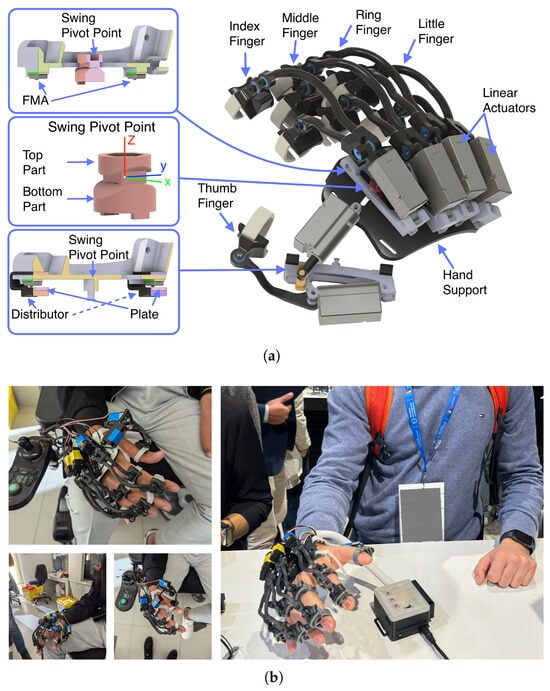
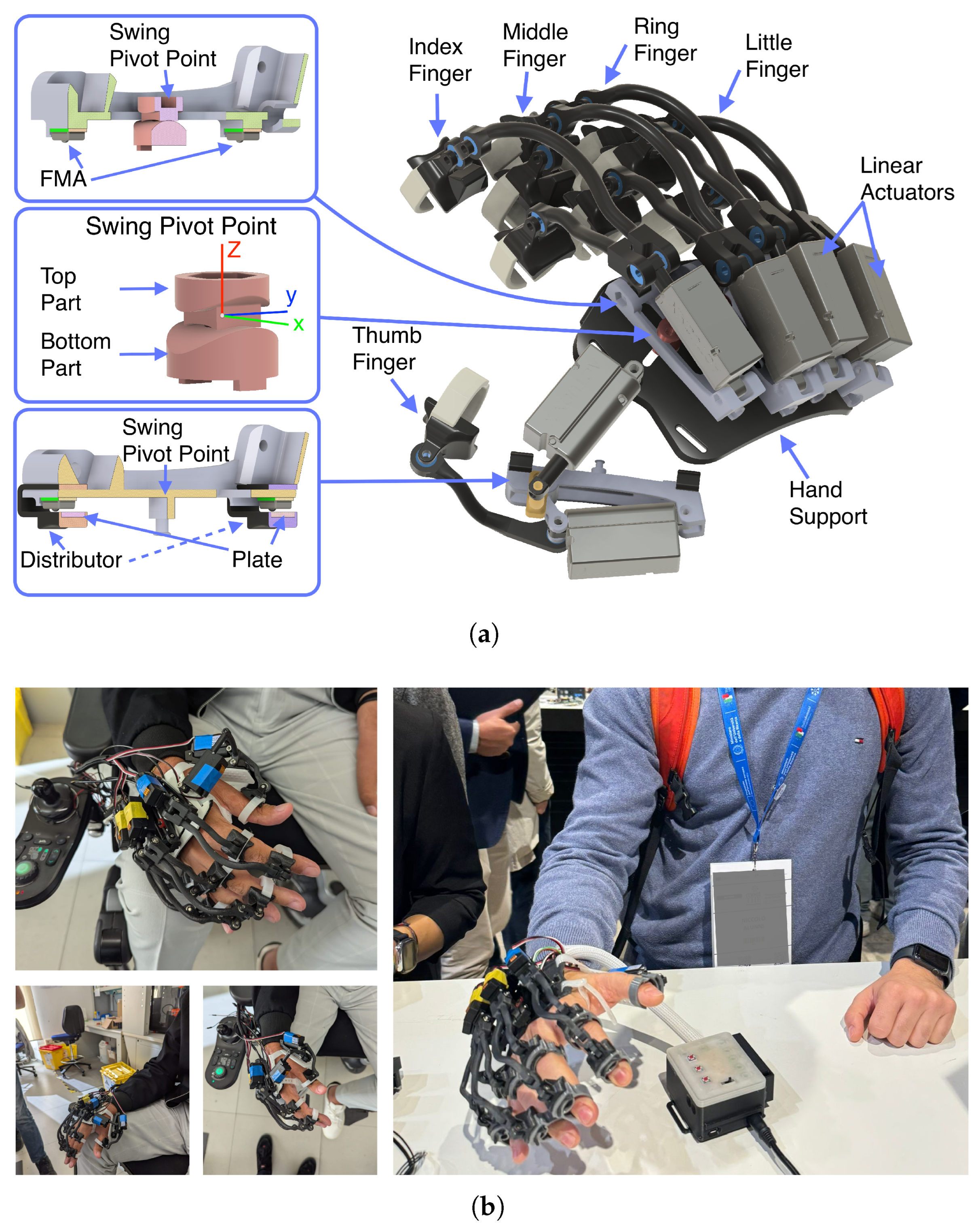
A hand exoskeleton for flexion–extension assessment and training was developed using a user-centered approach, emphasizing autonomous donning, modularity, and usability in both therapist-assisted and independent rehabilitation [43,44,45]. According to the classification proposed in ref. [31], the device is rigid. The final prototype comprises five finger modules that can be actuated jointly or independently, integrating FMA MicroForce sensors (Honeywell, North Carolina) to measure forces exerted by either the patient or therapist. The CAD model is shown in Figure 2a, while Figure 2b depicts the device being worn by an end user.
Figure 2.
Rigid exoskeleton. (a) CAD model. (b) The hand exoskeleton worn by end users.
The device includes a hand support and modular actuated fingers. The support, which was anatomically shaped to fit the hand, combines internal cushioning with an external ABS-CF10 carbon fiber shell and is secured using TPU straps. Finger modules are mounted on a horizontal slot with a swing pivot point that allows flexion–extension and lateral–longitudinal adjustments. The thumb employs a specific strap-based mechanism (Figure 2b) to accommodate its unique kinematics.
Actuation is provided by PQ12-63-6-R linear actuators (Actuonix, Saanichton, BC, Canada), with two dedicated to the thumb and one for each other finger, and they are controlled via a Teensy 4.1 microcontroller (PJRC, Sherwood, OR, USA). Force sensors are integrated within the actuator supports, while TPU distributors on the thumb ensure safety and measurement accuracy. Each phalanx support features a soft TPU half-ring for secure attachment. The mechanical design is based on postural synergies [46], with linkage dimensions and positions aligned to the first synergy of each finger. The exoskeleton enables flexion–extension movement for all fingers, while abduction–adduction motion is passively implemented for all parts except for the thumb.
The design and development process can be framed through the PICO approach:
- Population/Problem: This rigid exoskeleton is designed as a rehabilitation and training tool for patients with limited hand control, low residual strength, and mild spasticity. According to the impairment–pathology mapping in [31], such limitations often result from neurological conditions such as stroke. Unlike soft devices, the rigid structure ensures precise actuation and controlled force transmission, making it suitable for patients who require accurate, repeatable finger movements rather than high adaptability or compliance.
- Intervention: The exoskeleton supports grasping and releasing tasks while guiding rehabilitation exercises. It enables the recording and replay of predefined motion profiles via a user interface. Each finger module provides one active degree of freedom for flexion–extension movement, while the thumb also allows adduction–abduction motion. The rigid design ensures consistent trajectories and accurate force application, both critical for effective therapy, though the number of active motions per finger remains limited.
- Comparison: While no quantitative comparison with alternative therapies has yet been performed, the device has been evaluated relative to other rigid robotic hands in terms of actuation, mechanical design, number of actuated fingers, tip force, system weight, portability, motion type, and modularity [43]. This analysis highlights the advantages of rigid exoskeletons in delivering precise, controlled, and repeatable rehabilitation exercises.
- Outcome: Preliminary tests with potential users confirmed the repeatability and consistency of rehabilitative exercises. Motion tracking is achieved through integrated sensors, including IMU-based systems adapted from earlier prototypes [43], providing real-time feedback through a graphical user interface. The modular structure allows selective activation of modules (e.g., thumb and index only), while parametric components can be fabricated via standard FDM technologies, ensuring adaptability to different users and rehabilitation goals. The device can be employed to execute repetitive motions of the hand and the wrist, which can be either generated by the control interface (e.g., sinusoid profiles where the amplitude and the frequency can be set) or defined by the clinician or physiotherapist. In this case, the device is initially set to a “learning” mode, in which it records the exercise executed by the user while being supported and supervised by the clinician and then saves and re-plays it as many times as needed.
3.2. The MGlove-TS
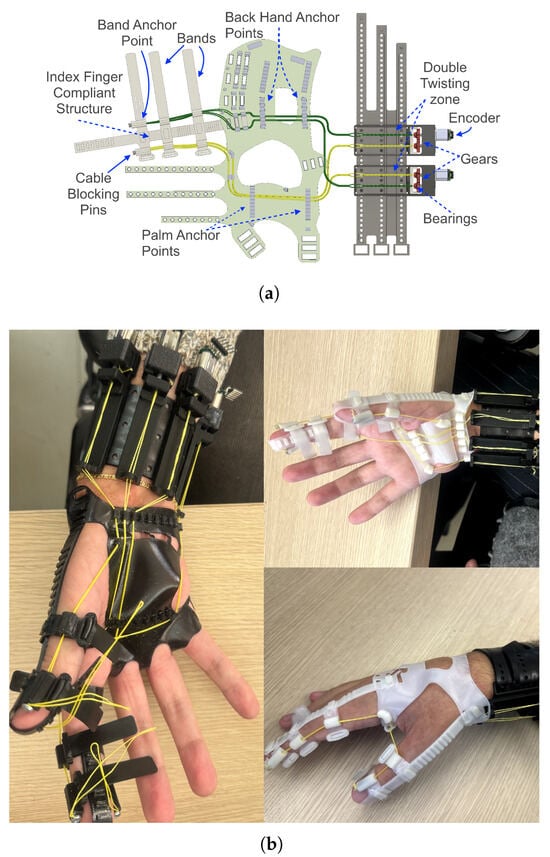
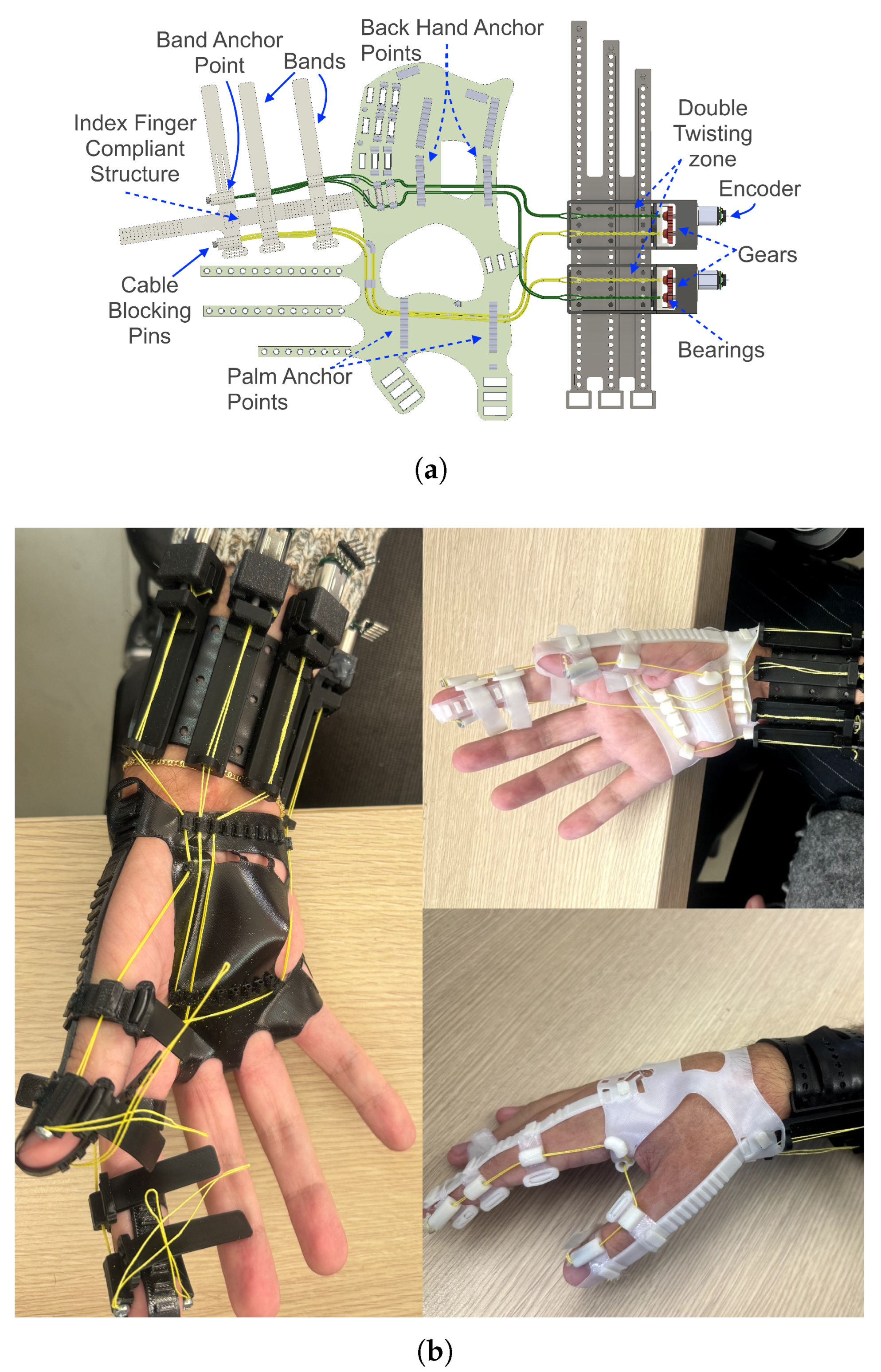
The design of an actuated glove for hand rehabilitation following an impairment-guided methodology was presented in Dragusanu et al., 2024 [47], as illustrated in Figure 3.
Figure 3.
Soft glove prototype. (a) CAD model. (b) The glove worn by an end user.
The device is a tendon-driven soft glove actuated by twisted string actuators (TSAs), which were designed with a modular and parametric approach to accommodate diverse user needs. Each finger module can function independently and may incorporate up to two tendons per finger. In the configuration shown in Figure 3b, the thumb and index modules are worn by the user, with tendons arranged to enable flexion, adduction, and abduction. Finger extension can be achieved either passively via an elastic structure on the dorsal side or actively using a dual-TSA setup, as illustrated in Figure 3a. TSAs have been exploited since 2011 as an efficient and effective motion transmission system, in particular in wearable robotic devices [48,49,50,51]. The twisting principle transforms the rotation of a motor shaft into a translation motion with a very low, and sometimes variable, transmission ratio [52,53,54]. TSAs are usually characterized by a high power-to-weight ratio, compactness, flexibility, and low costs. This choice allows us to obtain a light, compact, and versatile system.
Tendons are routed through adjustable anchor points on the glove surface in contact with the palm and connected to an actuation unit positioned on the forearm. The influence of tendon routing and anchor placement on finger motion has been analyzed in ref. [55], who compared one- and two-tendon configurations. TSAs can be embedded within a forearm-mounted bracelet, using compact motors for improved portability and comfort. As with the previous device, the design and development are framed by the PICO approach as follows:
- Population/Problem: The P addressed by this glove includes patients with limited active hand control, low residual strength, low muscle tone, and mild spasticity, conditions typically arising from neurological disorders such as Parkinson’s disease or Limb-Girdle Muscular Dystrophy [31]. For such users, soft devices are preferable to rigid or hybrid systems due to their adaptability and compliance while allowing the required actuation forces to remain moderate.
- Intervention: The glove facilitates grasping and releasing tasks while supporting rehabilitation exercises. The 2-DoF finger modules described in ref. [47] enable flexion, adduction, and abduction movements and are controlled through a graphical user interface (GUI) with LeapMotion tracking [56]. This setup allows the recording and repetition of motion profiles to guide therapy sessions.
- Comparison: Although no quantitative evaluation against alternative therapies has yet been performed, the glove has been benchmarked against robotic gloves, and data on it is available in the scientific literature. The comparison highlights the advantages of soft gloves in terms of comfort, adaptability, and intrinsic safety. Specifically, in ref. [47], the device is compared with other actuated gloves for hand rehabilitation presented in the last decade, namely [50,57,58,59,60,61,62,63,64]. The parameters that were considered in the comparison were actuation types (hydraulic, pneumatic, servomotors, and linear electromechanical actuators), motion transmission systems (tendons, pulley and gears, and linkages), mechanical structures (classified as soft, rigid, and hybrid), the number of actuated fingers, weight, portability, and actuated finger movements. The main characteristics of the soft glove considered in this work with respect to the ones included in the comparison is the possibility of actuating both extension and adduction/abduction motions and its low weight.
- Outcome: In the tests, the involved potential user presented with severe limitations in extension, reduced problems in flexion wrist motions, severe limitations in closing/opening the hand, low residual force, low active control of the hand and wrist, low spasticity, and low muscle tone. In flexion–extension exercises of the fingers, the maximum flexion angle of the index metacarphalangeal joint reached 71.49° ± 2.19°, with a repeteability of 8.31°. Preliminary tests with users demonstrated improvements in joint range of motion (ROM). For example, index finger adduction–abduction increased from 8° without assistance to 15° when using the glove. Integrated sensors, such as IMU-based systems adapted from previous wearable designs [43,56] and LeapMotion tracking [56], provide real-time feedback via the GUI, guiding exercises through visual or auditory cues. The modular structure enables selective use of finger modules (e.g., thumb and index only), while parametric components can be fabricated using standard FDM technologies for customized fits. ROM limits are constrained within physiological ranges to ensure safety, and the glove remains lightweight, flexible, and minimally intrusive to natural hand motion. A removable motor and TSA pin system ensures user safety in case of motor failure or blockage, maintaining back-drivability and preventing unintentional locking of the hand in flexion.
4. Application of the PICO Framework in Clinical Scenarios
Although the PICO framework was primarily developed to provide method and structure in the creation of clinical queries, the use of this approach for alternative purposes has also been evaluated, especially within the same medical field [40,42,65].
An interesting application is the use of the PICO framework as a tool for the analysis of clinical scenarios, with the aim of extracting potentially relevant information for the selection of medical devices already on the shelf or for the identification of requirements and desiderata in the design of new devices.
In the following section, two illustrative clinical scenarios, conceived as personas, are presented. In particular, these scenarios describe upper-limb and hand rehabilitative cases.
4.1. Persona 1: Rose, a Patient with Chronic Stroke at Home
4.1.1. Profile
Rose is 68 years old and suffered a stroke three years ago, which left her with right-sided hemiparesis with significant weakness and spasticity in her hand and arm. She lives alone in a small apartment on the third floor, which has no elevator. She is highly motivated to improve the functionality of her hand to perform daily activities such as cooking, dressing, and tending to her small balcony garden. She receives weekly visits from an occupational therapist, but most of her rehabilitation is done independently. She has a limited budget for purchasing devices.
4.1.2. Application of the PICO Model
- P (Population/Problem): A 68-year-old patient with chronic post-stroke right hemiparesis. Weakness and spasticity of the upper limb, particularly the right hand.
- I (Intervention): Design/use of a robotic device for hand and upper-limb rehabilitation.
- C (Comparison): Conventional therapy with an occupational therapist or physical therapist.
- O (Outcome): Improve grip strength and hand dexterity. Reduce hypertonia and increase hand ROM and functionality.
4.1.3. PICO Limitations in This Scenario
The PICO model could not adequately capture pivotal elements for designing an effective robotic device for Rose; the reasons are as follows:
- Operational Context: It does not consider that Rose lives alone in a small apartment without an elevator. This implies that the device must be lightweight, easy to put on and take off independently, portable, and not bulky. It must be usable without constant clinical supervision and with a standard household power supply. These aspects are not explicitly covered by the definition of P, I, C, and O.
- Overall Pathological Condition: Chronic stroke can also involve cognitive problems, fatigue, and learning difficulties. PICO focuses on hand impairment but not on the complexity of Rose’s condition.
- Economic Constraints: Rose’s limited budget is a determining factor for device selection or design, but it is not contemplated by PICO.
- Personal Goals and Quality of Life: PICO outcomes are clinical (strength, spasticity, and ROM), but Rose wishes to cook, dress, and garden. These functional and quality-of-life goals, although related to clinical outcomes, require deeper consideration in robot design.
4.2. Persona 2: Jerome, an Athlete with a Brachial Plexus Injury
4.2.1. Profile
Jerome, who is 35 years old, is a former professional tennis player. He suffered a severe brachial plexus injury after a motorbike accident. He has partially recovered arm and hand function on his left side. Still, he presents significant limitations in movement and strength, particularly in forearm pronation and supination, as well as fine grip. His motivation is very high; he wants to return to adapted sports activities and resume his work as a sports coach, which requires demonstrations and active interactions. He is technologically savvy and has access to significant financial resources. He needs a device that can be used both in a clinical setting for intensive rehabilitation and in sports or work contexts and offers a high level of personalization and real-time feedback.
4.2.2. Application of the PICO Model
- P (Population/Problem): A 35 years-old athlete with a brachial plexus injury, with limited movement, strength, and functionality (pronation/supination and fine grip) of the left hand and arm.
- I (Intervention): Design of an advanced robotic exoskeleton for arm and hand rehabilitation.
- C (Comparison): Traditional intensive physiotherapy.
- O (Outcome): Increase ROM, strength, dexterity and fine coordination of the upper limb.
4.2.3. PICO Limitations in This Scenario
The PICO model could fail to capture and highlight fundamental aspects for optimal robotic design as follows:
- Performance and Personalization Needs: Jerome, as an athlete, has high-performance needs and seeks functional recovery that goes beyond simple normalization. He requires a highly customizable device with advanced sensors for real-time feedback and the ability to simulate complex, sport-specific movements. PICO does not provide a framework to integrate these high-level needs into the design.
- Versatile Use Environment: The need to use the device in different contexts (clinic, gym, and tennis court) implies requirements for robustness, portability, wear resistance, and integration with other sports equipment that PICO does not explicitly address.
- Psychological and Motivational Aspects: Jerome’s strong motivation and desire to return to an active and sporting life could be supported by gamification elements or engaging user interfaces, aspects that PICO does not address.
- Advanced Technical Constraints: The demand for real-time feedback and complex movements implies specific technical requirements (e.g., low latency, high precision, and numerous actuated degrees of freedom) that PICO does not sufficiently provide.
5. Discussion
The PICO framework is intended to systematically gather and organize information according to a standardized manner. This framework is designed to assist clinicians in developing research questions or performing meta-analyses, although some studies investigated the potential of this approach for alternative purposes.
For instance, Rathbone et al. evaluate the use of PICO as tool for expediting citation screening in title-based scoping searches and rapid reviews [65]. The authors obtained positive results, but they also underlined some limitations in the direct approach of the method to this new application, in particular the need for a thorough workup of the potential synonyms and alternative terms.
Conversely, Schiavenato and Chu analyze the use of the PICO framework in the specific context of evidence-based practice (EBP) in nursing, highlighting how the use of this approach as is for a different purpose could be misleading for unexperienced operators like young students [41]. In fact, according to their direct experience, nursing students may be tempted to modify their question search to better adapt to the PICO structure or, even worse, mislead the concept of EBP with the PICO framework itself. Also in this scenario, the authors suggest that modifications are required to the original PICO framework to increase matching between clinical questions and information sources that will affect patient care.
On the other hand, Brandt Eriksen and Faber Frandsen investigate the impact of PICO on literature search quality in a systematic review, and although they could only extract a few papers and obtained limited results, they also stated a three-fold purpose of the use of PICO: this approach forces the questioner to focus on the important issue or outcome, allows the identification of key terms that enable and simplify the computerized search, and finally guides the questioner in the schematization of the problem, intervention and outcomes of a specific type of care [40].
In this complex scenario, we believe that the PICO framework may also aid designers in identifying the critical attributes of a device in a certain context. In fact, promoting the utilization of potentially beneficial tools across conventional disciplinary boundaries is an innovative strategy for optimizing resources, improving the efficiency of applied endeavors toward novel breakthroughs, fostering scientific creativity, and amplifying the impact of discoveries. Additionally, this logic aligns with the guidelines established by the United Nations for the advancement of the Sustainable Development Goals (SDGs) and may serve as a compelling strategy for radical innovations in SDG 3, “Ensure healthy lives and promote well-being for all at all ages” [36].
However, the information contained inside the PICO framework may not be deemed comprehensive for delineating the technical specifications required for the design of medical devices, including both the quantity and kind of data presented. The requirement for domestic applications may imply the demand for lightweight, portable solutions, alongside limitations on electronics due to reliance on batteries or the home power grid; however, such considerations are subject to the designer’s interpretation and may or may not be addressed based on their knowledge or expertise in the field. Consequently, we believe that the PICO framework could become a more efficacious design instrument if appropriately modified to fulfill this alternative function. The limitations identified in Section 4 indicate that although the PICO framework effectively structures clinical reasoning, it does not fully capture the multidimensional requirements involved in robotic rehabilitation device design. In particular, the analysis of the proposed personas highlights the need to incorporate additional engineering-relevant dimensions that go beyond the traditional Population, Intervention, Comparison, and Outcome components.
Based on the present investigation, four complementary dimensions emerge as particularly relevant when translating clinical questions into technical specifications:
- Context: Operational environment, level of supervision, portability constraints, power supply limitations, and real-world usage conditions (e.g., home versus clinical setting).
- Economic Constraints: Affordability, scalability, cost–benefit considerations, and accessibility, especially in long-term rehabilitation scenarios.
- Performance Requirements: Precision, latency, number of actuated degrees of freedom, actuation power, robustness, and task-specific functional demands (e.g., sport-related or high-performance activities).
- Usability and Experience: Autonomy in donning and doffing, cognitive load, motivational aspects, user engagement, and quality-of-life goals that extend beyond purely clinical outcome measures.
These dimensions do not replace the original PICO components; rather, they interact with them as complementary layers that enrich the translation of clinical reasoning into engineering design decisions. For instance, while the “Population” element defines the impairment profile, contextual and usability factors determine how the device must be physically configured and controlled. Similarly, performance requirements refine the technical interpretation of the “Intervention” component, and economic considerations influence the feasibility and scalability of the proposed solutions.
This structured extension can therefore be interpreted as a preliminary step toward a more comprehensive PICO-based engineering framework tailored to rehabilitation robotics. Systematic formalization and validation of this extended structure are currently under development and will be the subject of future work.
In order to critically position the proposed approach within the broader landscape of user-centered and requirement-engineering-based methodologies, Table 1 presents a conceptual comparison between PICO and established design frameworks commonly adopted in medical device development.
Table 1.
Conceptual positioning of the PICO-driven structuring approach relative to established user-centered and requirement-engineering-based methodologies in robotic rehabilitation device development. QFD: quality function deployment; HCD: human-centered design; DT: design thinking.
The objective of this comparison is not to claim methodological superiority but to clarify the complementary and front-end structuring role of PICO in clinically driven robotic rehabilitation device development.
Improvement examples encompass making explicit the key technical specifications expected from the device and the constraints associated with the intended operational context; however, further assessment in this regard should be conducted meticulously, as highlighted by the examples of personas investigated in the current paper, and preliminary analyses are presently in progress. These analyses seem to indicate the need for a model that encourages designers and physicians to consider a wider range of factors, from clinical conditions and operating environments to technical constraints and desired outcomes, thereby facilitating the creation of more relevant, effective, and patient-centered robotic rehabilitation devices.
The integration of regulatory standards (ISO 13485, ISO 14971, and IEC 62366-1) [66,67,68] and human-centered design frameworks (ISO 9241-210) [69] into the development lifecycle highlights that structured requirement elicitation is not merely a methodological preference but a regulatory necessity [70]. However, these standards primarily define procedural compliance and risk mitigation strategies, rather than providing an operational cognitive framework for translating clinical reasoning into engineering architecture decisions. The proposed PICO-driven reinterpretation does not aim to replace existing regulatory or systems engineering models; instead, it complements them by structuring the early conceptual phase, where clinical evidence, patient characteristics, and therapeutic objectives must be converted into functional and technical specifications. In this sense, PICO may serve as a front-end structuring tool within established medical device development pipelines.
From an engineering design perspective, the limitations of the PICO framework identified in other domains translate into specific challenges in robotic rehabilitation device development. While PICO effectively structures the clinical problem definition and outcome specification, it does not inherently guide detailed engineering trade-offs such as actuator selection, transmission mechanisms, control architecture design, power management, or material choice. Nevertheless, PICO demonstrates clear value during early-stage requirement elicitation, where patient characteristics and therapeutic objectives directly inform key technical parameters, including degree-of-freedom selection, range-of-motion constraints, torque requirements, and sensing strategies. As development progresses toward detailed engineering, system integration, and regulatory compliance, additional structured methodologies remain necessary. Therefore, PICO should be interpreted as a clinically grounded requirement-structuring framework that complements established engineering development models rather than a replacement.
Moreover, it is imperative to recognize that medical devices constitute a distinct category of application: these systems are anticipated to not only engage with humans, sharing work environments akin to industrial cobots, but also to operate in direct contact, exchanging forces and information with the user [71]. This interaction is expected to yield accurate, clinically pertinent outcomes. The complexity of this issue is likewise evident in the normative framework [72,73]. In ref. [74], an integrated framework linking medical device design, regulatory compliance (FDA, ISO, and EU MDR), and risk management to support safe and efficient product development across the device lifecycle is presented. In ref. [75], the regulatory convergence in medical device approval processes is analyzed, focusing on how international standards (ISO and IEC) support harmonization across regions such as the US, EU, and Japan. An optimized version of the PICO framework should incorporate these elements.
PICO represents an interesting opportunity for the design and selection of robotic rehabilitation medical devices. In this paper, we investigated how it can be applied for the evaluation and classification of existing devices, as well as how it defined the main device requirements for two specific users. The PICO approach can be further extended to the design phase; in this case, its potential can be better evaluated with quantitative metrics of design outcomes (e.g., reduced development time, optimized costs, and improved user satisfaction). Future development of this work will include the demonstration of the PICO approach’s applicability in a new design project, in which we will conduct a controlled comparative study versus traditional design methodologies, including quantitative metrics.
6. Conclusions
The PICO framework (Population, Intervention, Comparison, and Outcome) is a recognized methodology that provides essential insights for the design of innovative medical devices by structuring inquiries and clarifying key factors to consider in clinical and practical settings. Nonetheless, despite the robust foundation it offers, the presence of several limitations indicates the necessity of customization to enhance its efficacy and relevance in the domain of medical device development. The framework may necessitate adjustments to address the distinct difficulties and diverse requirements associated with the design and evaluation of medical technologies, which frequently involve several stakeholders and regulatory factors.
Preliminary assessments of the PICO framework have identified opportunities to enhance and develop the structure into a more thorough and adaptable concept. This expansion has the potential to enhance the framework’s ability to meet the specific needs of device designers, thereby increasing its practical applicability in real-world contexts. The proposed framework is twofold: first, as a guide for the development of innovative medical devices and second, as a method to delineate the essential attributes of commercially accessible off-the-shelf products. This addition has the potential to facilitate the integration of novel innovations with established solutions, offering a comprehensive and user-centric method for professionals aiming to assess or incorporate diverse medical technology into clinical practice.
Author Contributions
Conceptualization, C.A., R.B., M.D., M.G., S.L., M.M., J.P., M.T. and M.C.V.; methodology, C.A., R.B., M.D., M.G., S.L., M.M., J.P., M.T. and M.C.V.; formal analysis, C.A., R.B., M.D., M.G., S.L., M.M., J.P., M.T. and M.C.V.; writing—original draft preparation, C.A., R.B., M.D., S.L., J.P. and M.T.; writing—review and editing, R.B., M.D., M.G., S.L., M.M., J.P., M.T. and M.C.V.; supervision, C.A., M.G., M.M. and M.C.V. All authors have read and agreed to the published version of the manuscript.
Funding
This research was partially funded by the Italian Ministry of Research (MUR) under the program PRIN 2022 (project SAILOR: Soft wearable robotic glove for hand theranostics N. 20229PYMRA_001 Sector ERC PE8). This work was also supported in part by the Italian Ministry of Health—Ricerca Corrente 2026.
Institutional Review Board Statement
Not applicable.
Informed Consent Statement
Not applicable.
Data Availability Statement
Data are available upon request to the corresponding author.
Conflicts of Interest
The authors declare no conflicts of interest.
References
- Malvezzi, M.; Valigi, M.C.; Salvietti, G.; Iqbal, Z.; Hussain, I.; Prattichizzo, D. Design Criteria for Wearable Robotic Extra–Fingers with Underactuated Modular Structure. Mech. Mach. Sci. 2019, 68, 509–517. [Google Scholar] [CrossRef] [Scilit]
- Östlund, B.; Malvezzi, M.; Frennert, S.; Funk, M.; Gonzalez-Vargas, J.; Baur, K.; Alimisis, D.; Thorsteinsson, F.; Alonso-Cepeda, A.; Fau, G.; et al. Interactive robots for health in Europe: Technology readiness and adoption potential. Front. Public Health 2023, 11, 979225. [Google Scholar] [CrossRef] [Scilit] [PubMed]
- Frennert, S.; Persson, J.; Skavron, S. A critical narrative review of assistive robotics and call for a systems and user-centered approaches to enhance quality of life of individuals with disabilities. In Proceedings of the Adjunct Proceedings of the 2024 Nordic Conference on Human-Computer Interaction, Uppsala, Sweden, 13–14 October 2024; pp. 1–11. [Google Scholar] [CrossRef] [Scilit]
- Helmstetter, S.; Dörr, M.; Germann, R.; Matthiesen, S. User-centered design of power tools: A generic process for evaluation of usability aspects. Forsch. Ingenieurwesen 2022, 86, 93–104. [Google Scholar] [CrossRef] [Scilit]
- Berettoni, A.; Driessen, J.J.M.; Puliti, M.; Barresi, G.; De Benedictis, C.; Ferraresi, C.; Laffranchi, M. Human-Centered Design Trade-Offs for Semi-Powered Knee Prostheses: A Review. IEEE Trans. Med. Robot. Bionics 2025, 7, 429–442. [Google Scholar] [CrossRef] [Scilit]
- Lim, W.M.; Jasim, K.M.; Malathi, A. Service robots in healthcare: Toward a healthcare service robot acceptance model (sRAM). Technol. Soc. 2025, 82, 102932. [Google Scholar] [CrossRef] [Scilit]
- Gasson, S. Human-centered vs. user-centered approaches to information system design. J. Inf. Technol. Theory Appl. (JITTA) 2003, 5, 5. [Google Scholar]
- Garcia, P.L.; Saerens, E.; Crispel, S.; Varadharajan, A.; Lefeber, D.; Verstraten, T. Factors influencing actuator’s backdrivability in human-centered robotics. In Proceedings of the MATEC Web of Conferences, Petrosani, Romania, 27–29 October 2022; EDP Sciences: Les Ulis, France, 2022; Volume 366, p. 1002. [Google Scholar] [CrossRef] [Scilit]
- Formicola, R.; Amici, C.; Mor, M.; Bissolotti, L.; Borboni, A. Design of Medical Devices with Usability in Mind: A Theoretical Proposal and Experimental Case Study Using the LEPRE Device. Designs 2023, 7, 9. [Google Scholar] [CrossRef] [Scilit]
- Randazzo, L.; Iturrate, I.; Perdikis, S.; Millan, J.d.R. mano: A Wearable Hand Exoskeleton for Activities of Daily Living and Neurorehabilitation. IEEE Robot. Autom. Lett. 2018, 3, 500–507. [Google Scholar] [CrossRef] [Scilit]
- Cheng, C.Y.M.; Lee, C.C.Y.; Chen, C.K.; Lou, V.W. Multidisciplinary collaboration on exoskeleton development adopting user-centered design: A systematic integrative review. Disabil. Rehabil. Assist. Technol. 2024, 19, 909–937. [Google Scholar] [CrossRef] [Scilit] [PubMed]
- Rose, C.G.; O’Malley, M.K. Hybrid rigid-soft hand exoskeleton to assist functional dexterity. IEEE Robot. Autom. Lett. 2018, 4, 73–80. [Google Scholar] [CrossRef] [Scilit]
- Logozzo, S.; Valigi, M.C.; Malvezzi, M. Modelling the human touch: A basic study for haptic technology. Tribol. Int. 2022, 166, 107352. [Google Scholar] [CrossRef] [Scilit]
- Valigi, M.C.; Logozzo, S.; Affatato, S. In Vitro 3D Wear Characterization of Knee Joint Prostheses; Springer International Publishing: Cham, Switzerland, 2019; pp. 3855–3863. [Google Scholar] [CrossRef] [Scilit]
- Logozzo, S.; Malvezzi, M.; Valigi, M.C. Study of Contact Deformations in Human and Robotic Fingertips for Haptic Applications. Mech. Mach. Sci. 2025, 179, 474–483. [Google Scholar] [CrossRef] [Scilit]
- Amabile, M.; Burini, V.; Di Puccio, F.; Logozzo, S.; Marongiu, G.; Mattei, L.; Valigi, M.C. Three-Dimensional Experimental Analysis of Wear in Retrieved Hip Implants. In Proceedings of I4SDG Workshop 2025—IFToMM for Sustainable Development Goals. I4SDG 2025; Springer: Cham, Switzerland, 2025; pp. 424–433. [Google Scholar] [CrossRef] [Scilit]
- Valigi, M.C.; Logozzo, S.; Canella, G. A Robotic 3D Vision System for Automatic Cranial Prostheses Inspection. In Advances in Service and Industrial Robotics. RAAD 2017; Springer: Cham, Switzerland, 2018; pp. 328–335. [Google Scholar] [CrossRef] [Scilit]
- Affatato, S.; Ruggiero, A.; Logozzo, S.; Valigi, M.C. Roughness Digital Characterization and Influence on Wear of Retrieved Knee Components. Appl. Sci. 2021, 11, 11224. [Google Scholar] [CrossRef] [Scilit]
- Assare-Mokwah, E.; Arunkumar, S. Application of human-centered design principles to wearable exoskeletons: A systematic review. Disabil. Rehabil. Assist. Technol. 2025, 20, 767–788. [Google Scholar] [CrossRef] [Scilit]
- Achilli, G.M.; Logozzo, S.; Malvezzi, M.; Valigi, M.C. Contact mechanics analysis of a soft robotic fingerpad. Front. Mech. Eng. 2022, 8, 966335. [Google Scholar] [CrossRef] [Scilit]
- Arata, J.; Ohmoto, K.; Gassert, R.; Lambercy, O.; Fujimoto, H.; Wada, I. A new hand exoskeleton device for rehabilitation using a three-layered sliding spring mechanism. In Proceedings of the 2013 IEEE International Conference on Robotics and Automation, Karlsruhe, Germany, 6-10 May 2013; IEEE: Piscataway, NJ, USA, 2013; pp. 3902–3907. [Google Scholar] [CrossRef] [Scilit]
- Tran, P.; Jeong, S.; Herrin, K.R.; Desai, J.P. Hand exoskeleton systems, clinical rehabilitation practices, and future prospects. IEEE Trans. Med. Robot. Bionics 2021, 3, 606–622. [Google Scholar] [CrossRef] [Scilit]
- Capacho-Alfonso, V.H.; Soto-Durán, D.E.; Jiménez-Builes, J.A. Health technology adoption model for big data integration in hospitals: A systematic approach in the era of health 4.0. Health Serv. Outcomes Res. Methodol. 2025, 25, 410–437. [Google Scholar] [CrossRef] [Scilit]
- Chesbrough, H.W. The Era of Open Innovation. Manag. Innov. Change 2006, 3, 34–41. [Google Scholar]
- Serbest, K.; Eldoğan, O. Design, Development and Evaluation of a New Hand Exoskeleton for Stroke Rehabilitation at Home. Politek. Derg. 2021, 24, 305–314. [Google Scholar] [CrossRef] [Scilit]
- Richardson, W.; Wilson, M.; Nishikawa, J.; Hayward, R. The well-built clinical question: A key to evidence-based decisions. ACP J. Club 1995, 123, A12. [Google Scholar] [CrossRef] [Scilit]
- Aslam, S.; Emmanuel, P. Formulating a researchable question: A critical step for facilitating good clinical research. Indian J. Sex. Transm. Dis. AIDS 2010, 31, 47–50. [Google Scholar] [CrossRef] [Scilit]
- Hosseini, M.S.; Jahanshahlou, F.; Akbarzadeh, M.A.; Zarei, M.; Vaez-Gharamaleki, Y. Formulating research questions for evidence-based studies. J. Med. Surg. Public Health 2024, 2, 100046. [Google Scholar] [CrossRef] [Scilit]
- Formicola, R.; Ragni, F.; Borboni, A.; Amici, C. Design Process of Medical Devices for Robotic Rehabilitation: An Open Innovation-Inspired Approach; Springer: Singapore, 2022; pp. 575–584. [Google Scholar] [CrossRef] [Scilit]
- Nishikawa-Pacher, A. Research Questions with PICO: A Universal Mnemonic. Publications 2022, 10, 21. [Google Scholar] [CrossRef] [Scilit]
- Achilli, G.M.; Amici, C.; Dragusanu, M.; Gobbo, M.; Logozzo, S.; Malvezzi, M.; Tiboni, M.; Valigi, M.C. Soft, Rigid, and Hybrid Robotic Exoskeletons for Hand Rehabilitation: Roadmap with Impairment-Oriented Rationale for Devices Design and Selection. Appl. Sci. 2023, 13, 11287. [Google Scholar] [CrossRef] [Scilit]
- Tiboni, M.; Borboni, A.; Vérité, F.; Bregoli, C.; Amici, C. Sensors and Actuation Technologies in Exoskeletons: A Review. Sensors 2022, 22, 884. [Google Scholar] [CrossRef] [Scilit]
- Perrelli, M.; Lago, F.; Garofalo, S.; Bruno, L.; Mundo, D.; Carbone, G. A critical review and systematic design approach for innovative upper-limb rehabilitation devices. Robot. Auton. Syst. 2025, 183, 104835. [Google Scholar] [CrossRef] [Scilit]
- Qiu, S.; Pei, Z.; Wang, C.; Tang, Z. Systematic Review on Wearable Lower Extremity Robotic Exoskeletons for Assisted Locomotion. J. Bionic Eng. 2023, 20, 436–469. [Google Scholar] [CrossRef] [Scilit]
- Eldawlatly, A.; Alshehri, H.; Alqahtani, A.; Ahmad, A.; Al-Dammas, F.; Marzouk, A. Appearance of Population, Intervention, Comparison, and Outcome as research question in the title of articles of three different anesthesia journals: A pilot study. Saudi J. Anaesth. 2018, 12, 283. [Google Scholar] [CrossRef] [Scilit]
- United Nations—Department of Economic and Social Affairs. Transforming Our World: The 2030 Agenda for Sustainable Development; United Nations: New York, NY, USA, 2015; Available online: https://sdgs.un.org/2030agendaDevelopment (accessed on 2 March 2026).
- Johnson, M.J.; Keyvanian, S.; Mendonca, R.J. Toward inclusive rehabilitation robots. In Rehabilitation Robots for Neurorehabilitation in High-, Low-, and Middle-Income Countries; Elsevier: Amsterdam, The Netherlands, 2024; pp. 471–498. [Google Scholar] [CrossRef] [Scilit]
- Amici, C.; Buraschi, R.; Dragusanu, M.; Gobbo, M.; Logozzo, S.; Malvezzi, M.; Pollet, J.; Tiboni, M.; Valigi, M.C. Beyond Boundaries: PICO-Driven Design Criteria for Robotic Rehabilitation Medical Devices. In Proceedings of the I4SDG Workshop 2025—IFToMM for Sustainable Development Goals, Villa San Giovanni, Italy, 9–11 June 2025; Carbone, G., Quaglia, G., Eds.; Springer: Cham, Switzerland, 2025; pp. 285–292. [Google Scholar]
- Huang, X.; Lin, J.; Demner-Fushman, D. Evaluation of PICO as a knowledge representation for clinical questions. In Proceedings of the AMIA, Annual Symposium proceedings/AMIA Symposium, AMIA Symposium, Washington, DC, USA, 11–15 November 2006; pp. 359–363. [Google Scholar]
- Brandt Eriksen, M.; Faber Frandsen, T. The impact of patient, intervention, comparison, outcome (PICO) as a search strategy tool on literature search quality: A systematic review. J. Med. Libr. Assoc. 2018, 106, 420–431. [Google Scholar]
- Schiavenato, M.; Chu, F. PICO: What it is and what it is not. Nurse Educ. Pract. 2021, 56, 103194. [Google Scholar] [CrossRef] [Scilit]
- Brown, D. A Review of the PubMed PICO Tool: Using Evidence-Based Practice in Health Education. Health Promot. Pract. 2020, 21, 496–498. [Google Scholar] [CrossRef] [Scilit]
- Dragusanu, M.; Iqbal, M.Z.; Baldi, T.L.; Prattichizzo, D.; Malvezzi, M. Design, development, and control of a hand/wrist exoskeleton for rehabilitation and training. IEEE Trans. Robot. 2022, 38, 1472–1488. [Google Scholar] [CrossRef] [Scilit]
- Dragusanu, M.; Troisi, D.; Prattichizzo, D.; Malvezzi, M. Evaluating Adaptability Properties of a Compact Wearable Hand Exoskeleton. In Proceedings of the 10th IEEE RAS/EMBS International Conference for Biomedical Robotics and Biomechatronics (BioRob), Heidelberg, Germany, 1–4 September 2024; pp. 1561–1566. [Google Scholar] [CrossRef] [Scilit]
- Dragusanu, M.; Piroli, A.; Malvezzi, M. Human–Exoskeleton Interaction Force Measurement in a Wearable Device for Hand Actuation. In Proceedings of the International Workshop on Medical and Service Robots; Springer: Berlin/Heidelberg, Germany, 2025; pp. 251–260. [Google Scholar]
- Santello, M.; Flanders, M.; Soechting, J.F. Postural hand synergies for tool use. J. Neurosci. 1998, 18, 10105–10115. [Google Scholar] [CrossRef] [Scilit] [PubMed]
- Dragusanu, M.; Troisi, D.; Suthar, B.; Hussain, I.; Prattichizzo, D.; Malvezzi, M. MGlove-TS: A modular soft glove based on twisted string actuators and flexible structures. Mechatronics 2024, 98, 103141. [Google Scholar] [CrossRef] [Scilit]
- Hosseini, M.; Sengül, A.; Pane, Y.; De Schutter, J.; Bruyninck, H. Exoten-glove: A force-feedback haptic glove based on twisted string actuation system. In Proceedings of the 2018 27th IEEE International Symposium on Robot and Human Interactive Communication (RO-MAN); IEEE: New York, NY, USA, 2018; pp. 320–327. [Google Scholar] [CrossRef] [Scilit]
- Hosseini, M.; Meattini, R.; San-Millan, A.; Palli, G.; Melchiorri, C.; Paik, J. A sEMG-driven soft exosuit based on twisted string actuators for elbow assistive applications. IEEE Robot. Autom. Lett. 2020, 5, 4094–4101. [Google Scholar] [CrossRef] [Scilit]
- Tsabedze, T.; Hartman, E.; Zhang, J. A compact, compliant, and biomimetic robotic assistive glove driven by twisted string actuators. Int. J. Intell. Robot. Appl. 2021, 5, 381–394. [Google Scholar] [CrossRef] [Scilit]
- An, J.; Park, S.; Kim, J.; Lee, D.; Cho, Y.; Koo, S.H.; Shin, D. Fabric integrated wearable glove with a twisted string actuator for manual handling tasks. Sci. Rep. 2025, 15, 13185. [Google Scholar] [CrossRef] [Scilit] [PubMed]
- Gaponov, I.; Popov, D.; Ryu, J.H. Twisted string actuation systems: A study of the mathematical model and a comparison of twisted strings. IEEE/ASME Trans. Mechatronics 2013, 19, 1331–1342. [Google Scholar] [CrossRef] [Scilit]
- Singh, H.; Popov, D.; Gaponov, I.; Ryu, J.H. Twisted string-based passively variable transmission: Concept, model, and evaluation. Mech. Mach. Theory 2016, 100, 205–221. [Google Scholar] [CrossRef] [Scilit]
- Palli, G.; Natale, C.; May, C.; Melchiorri, C.; Wurtz, T. Modeling and control of the twisted string actuation system. IEEE/ASME Trans. Mechatronics 2012, 18, 664–673. [Google Scholar] [CrossRef] [Scilit]
- Dragusanu, M.; Piroli, A.; Malvezzi, M. Analysis and development of the modular elements of a tendon-actuated glove for hand rehabilitation. Robotica 2025, 43, 1–19. [Google Scholar] [CrossRef] [Scilit]
- Dragusanu, M.; Troisi, D.; Suthar, B.; Prattichizzo, D.; Malvezzi, M. Development of a Soft Actuated Glove Based on Twisted String Actuators for Hand Rehabilitation. In Proceedings of the 2024 10th IEEE RAS/EMBS International Conference for Biomedical Robotics and Biomechatronics (BioRob), Heidelberg, Germany, 1–4 September 2024; pp. 1702–1708. [Google Scholar] [CrossRef] [Scilit]
- Ryu, D.; Moon, K.W.; Nam, H.; Lee, Y.; Chun, C.; Kang, S.; Song, J.B. Micro hydraulic system using slim artificial muscles for a wearable haptic glove. In Proceedings of the 2008 IEEE/RSJ International Conference on Intelligent Robots and Systems; IEEE: New York, NY, USA, 2008; pp. 3028–3033. [Google Scholar] [CrossRef] [Scilit]
- Kang, B.B.; Lee, H.; In, H.; Jeong, U.; Chung, J.; Cho, K.J. Development of a polymer-based tendon-driven wearable robotic hand. In Proceedings of the 2016 IEEE International Conference on Robotics and Automation (ICRA); IEEE: New York, NY, USA, 2016; pp. 3750–3755. [Google Scholar] [CrossRef] [Scilit]
- Nycz, C.J.; Bützer, T.; Lambercy, O.; Arata, J.; Fischer, G.S.; Gassert, R. Design and characterization of a lightweight and fully portable remote actuation system for use with a hand exoskeleton. IEEE Robot. Autom. Lett. 2016, 1, 976–983. [Google Scholar] [CrossRef] [Scilit]
- Popov, D.; Gaponov, I.; Ryu, J.H. Portable exoskeleton glove with soft structure for hand assistance in activities of daily living. IEEE/ASME Trans. Mechatronics 2016, 22, 865–875. [Google Scholar] [CrossRef] [Scilit]
- Mohammadi, A.; Lavranos, J.; Choong, P.; Oetomo, D. Flexo-glove: A 3D printed soft exoskeleton robotic glove for impaired hand rehabilitation and assistance. In Proceedings of the 2018 40th Annual International Conference of the IEEE Engineering in Medicine and Biology Society (EMBC); IEEE: New York, NY, USA, 2018; pp. 2120–2123. [Google Scholar] [CrossRef] [Scilit]
- Yurkewich, A.; Hebert, D.; Wang, R.H.; Mihailidis, A. Hand extension robot orthosis (HERO) glove: Development and testing with stroke survivors with severe hand impairment. IEEE Trans. Neural Syst. Rehabil. Eng. 2019, 27, 916–926. [Google Scholar] [CrossRef] [Scilit] [PubMed]
- Xu, W.; Guo, Y.; Bravo, C.; Ben-Tzvi, P. Design, control, and experimental evaluation of a novel robotic glove system for patients with brachial plexus injuries. IEEE Trans. Robot. 2022, 39, 1637–1652. [Google Scholar] [CrossRef] [Scilit] [PubMed]
- Bagneschi, T.; Leonardis, D.; Chiaradia, D.; Frisoli, A. Design and characterization of modular soft components for an exoskeleton glove with improved wearability. In Proceedings of the Symposium on Robot Design, Dynamics and Control; Springer: Berlin/Heidelberg, Germany, 2022; pp. 106–114. [Google Scholar] [CrossRef] [Scilit]
- Rathbone, J.; Albarqouni, L.; Bakhit, M.; Beller, E.; Byambasuren, O.; Hoffmann, T.; Scott, A.M.; Glasziou, P. Expediting citation screening using PICo-based title-only screening for identifying studies in scoping searches and rapid reviews. Syst. Rev. 2017, 6, 1–7. [Google Scholar] [CrossRef] [Scilit]
- ISO 13485:2016; Medical Devices—Quality Management Systems—Requirements for Regulatory Purposes. International Organization for Standardization: Geneva, Switzerland, 2016.
- ISO 14971:2019; Medical Devices—Application of Risk Management to Medical Devices. International Organization for Standardization: Geneva, Switzerland, 2019.
- IEC 62366-1:2015; Medical Devices—Part 1: Application of Usability Engineering to Medical Devices. International Electrotechnical Commission: Geneva, Switzerland, 2015.
- ISO 9241-210:2019; Ergonomics of Human-System Interaction—Part 210: Human-Centred Design for Interactive Systems. International Organization for Standardization: Geneva, Switzerland, 2019.
- Chavarria, M.A.; Ortiz-Escobar, L.M.; Bacca-Cortes, B.; Romero-Cano, V.; Villota, I.; Muñoz Peña, J.K.; Londoño Sánchez, J.R.; Campo, O.; Suter, S.; Cabrera-López, J.J.; et al. Challenges and opportunities of the human-centered design approach: Case study development of an assistive device for the navigation of persons with visual impairment. JMIR Rehabil. Assist. Technol. 2025, 12, e70694. [Google Scholar] [CrossRef] [Scilit]
- Frennert, S.; Persson, J.; Díez-Rodríguez, E.; Alcobendas-Maestro, M.; Villamayor Vega, F.; Oliviero, A. Exploring Barriers and Enablers for the Intention to Use Assistive Robotics Among People With Spinal Cord Injury and Those Involved in Their Care: Qualitative Study. JMIR Rehabil. Assist. Technol. 2026, 13, e72080. [Google Scholar] [CrossRef] [Scilit]
- Teixeira, M.B. Design Controls for the Medical Device Industry; CRC Press: Boca Raton, FL, USA, 2019. [Google Scholar]
- Amaral, C.; Paiva, M.; Rodrigues, A.R.; Veiga, F.; Bell, V. Global Regulatory Challenges for Medical Devices: Impact on Innovation and Market Access. Appl. Sci. 2024, 14, 9304. [Google Scholar] [CrossRef] [Scilit]
- Singh, J.; Patel, P. Methods for medical device design, regulatory compliance and risk management. J. Eng. Res. Rep. 2024, 26, 373–389. [Google Scholar] [CrossRef] [Scilit]
- Imagawa, K.; Mizukami, Y.; Miyazaki, S. Regulatory convergence of medical devices: A case study using ISO and IEC standards. Expert Rev. Med. Devices 2018, 15, 497–504. [Google Scholar] [CrossRef] [Scilit] [PubMed]

Disclaimer/Publisher’s Note: The statements, opinions and data contained in all publications are solely those of the individual author(s) and contributor(s) and not of MDPI and/or the editor(s). MDPI and/or the editor(s) disclaim responsibility for any injury to people or property resulting from any ideas, methods, instructions or products referred to in the content. |
© 2026 by the authors. Licensee MDPI, Basel, Switzerland. This article is an open access article distributed under the terms and conditions of the Creative Commons Attribution (CC BY) license.