


Abstract
Amorphous soft magnetic materials (AMMs) have demonstrated significant advantages in electric machines due to their low core losses, high permeability, high tensile strength, and superior energy efficiency at high operating frequencies. Despite these benefits, their adoption in electric vehicle (EV) motors remains limited. This review explores the key technological, economic, and industrial barriers preventing the widespread use of AMMs in EV applications. An overview of the AMM fundamentals, including the material composition, manufacturing processes, and recent advancements, is first presented. To quantitatively assess their potential in traction applications, a numerical study is conducted on two 5.5 kW synchronous reluctance machines with identical geometries, employing AMM and conventional silicon steel stators, respectively. The machines are compared in terms of electromagnetic torque and efficiency, highlighting the impact of AMM properties on machine performance. These results are discussed alongside the findings from the existing literature to evaluate the core loss reduction, electromagnetic behavior, mechanical robustness, and thermal considerations. Special attention is given to the emerging commercial applications of AMMs in EV motors, which have only recently begun to materialize. Finally, the study highlights the gap between academic research and industrial implementation and identifies critical research areas needed to accelerate AMM adoption.
1. Introduction
Research into amorphous soft magnetic materials (AMMs) for electrical machines began in the early 1980s, with early studies—such as those by General Electric—exploring their use in both transformers and fractional-horsepower motors [1]. While AMMs were rapidly adopted in transformer cores owing to their low core losses and simple geometries, their application in electric motors (EMs) proved more challenging. EM designs involve complex core geometries, higher mechanical stresses, and manufacturing constraints, all of which have limited AMM integration. Additionally, the industry’s strong reliance on silicon steel has made the transition to AMM-based EM designs less attractive because of the fabrication challenges, cost, and design complexity.
Despite the early challenges, the initial studies highlighted the potential of AMMs in EMs. Johnson et al. [1] reported an 80% reduction in core losses at 60 Hz compared to 0.35 mm M22 silicon steel. A super-high-speed reluctance motor demonstrated a fivefold drop in core losses and a six-point efficiency gain using AMMs in 1989 [2]. By the early 1990s, AMMs were also tested in PMBLDC motors, with a 4-pole prototype achieving only 2.2 W/kg iron losses at 3600 r/min (elec.), indicating a strong potential for variable-speed applications [3].
Between 2000 and 2010, the research on AMMs in EMs expanded beyond the core loss and efficiency improvements to include additional design considerations such as torque ripple reduction, winding configuration optimization to improve the slot fill factor, and enhanced manufacturability [4]. In parallel, the advancements in AMM core structures led to new configurations optimized for specific motor topologies. AMM stators in the form of tape-wound [5] and cut [6] cores were introduced as a promising solution for segmented and conventional axial flux motors.
Between 2010 and 2020, the research on AMM-based EMs significantly expanded, covering a broad range of operating speeds, from low-speed 1200 rpm [7] to ultra-high-speed applications reaching 400,000 rpm [8]. This wide speed range enabled AMM-based EMs to be explored for a variety of applications, including electric and hybrid vehicles [9,10,11,12], ventilation systems [13], servo motors [14,15], and microturbines [8]. Researchers applied AMMs to several motor types, including Permanent Magnet Synchronous Motors (PMSM) [16,17], Switched Reluctance Motors (SRM) [10,12], Synchronous Reluctance Motors (SynRM) [18], BLDC [19], and Induction Motors (IM) [20]. Studies targeted core loss reduction, efficiency gains, and thermal performance, highlighting AMMs’ advantages. Furthermore, advances in manufacturing techniques and motor design improved AMM integration, though key fabrication challenges remained.
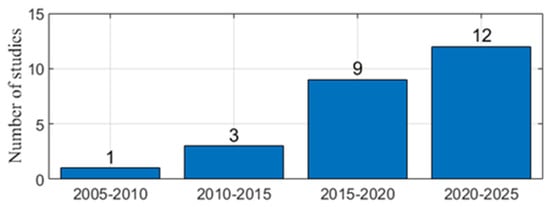
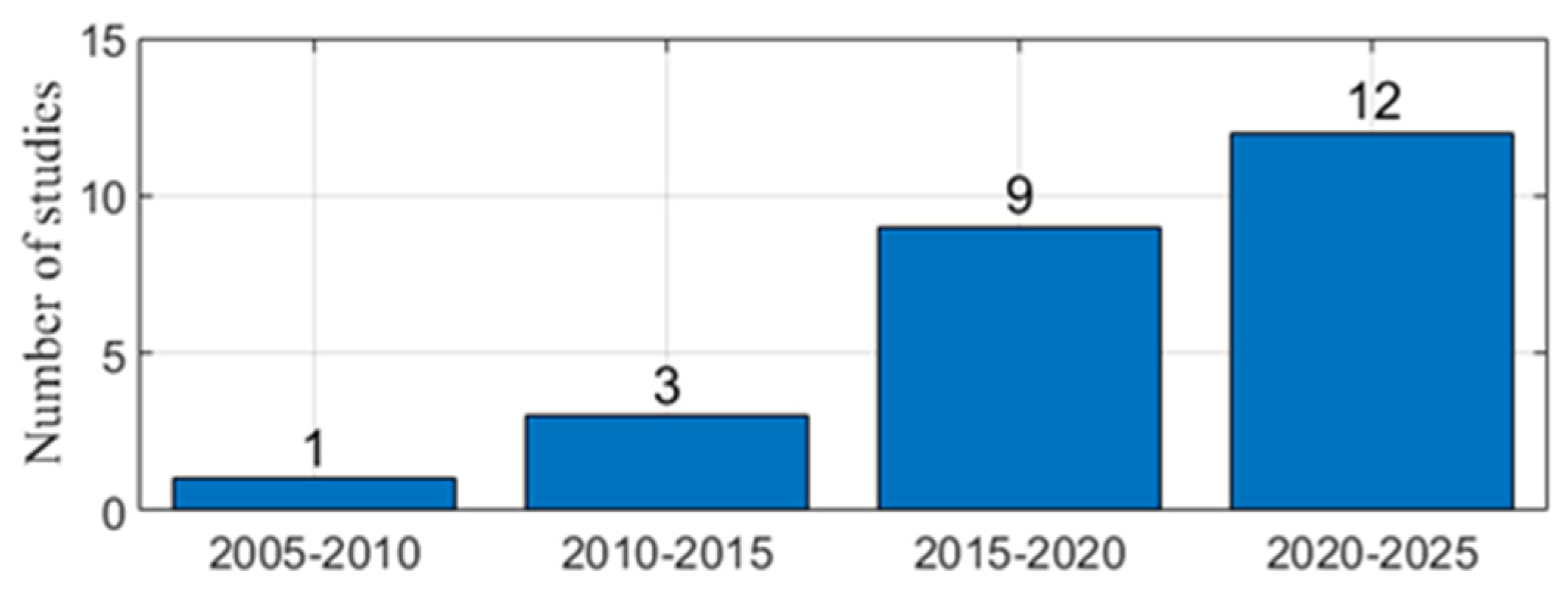
Since 2020, studies on AMMs for EV motors have surged (see Figure 1), accompanied by a rise in prototype development, with power levels reaching up to 150 kW [21,22,23], suitable for high-performance EVs. Research has also expanded into noise, vibration, and harshness (NVH) [24,25], advanced manufacturing [26,27,28], and stress analysis [29,30]. Moreover, AMMs are increasingly treated as a mainstream design option—similar to silicon steel—allowing a broader evaluation of EM performance [31,32,33,34]. Recent reviews have addressed key aspects of AMMs. For instance, Ref. [35] analyzes the challenges in amorphous sheet production, such as stacking and annealing, while Ref. [36] focuses on high-power density motors used in EVs. However, with AMMs gaining attraction in EV applications and evolving rapidly [37,38,39], a focused analysis of their role in this domain is increasingly needed.
Figure 1.
Number of studies on AMMs in EV applications between years 2005–2025, shown per five years intervals.
This paper reviews the fundamentals, recent developments, and challenges associated with AMMs in EV motors. Section 2 presents an overview of the AMM composition, fabrication methods, and recent technological innovations. Section 3 investigates the application of AMMs in EV motors, focusing on key performance metrics such as core loss, efficiency, electromagnetic torque, and thermal and mechanical behavior. Section 4 presents a numerical finite element analysis (FEA) study comparing two 5.5 kW SynRMs with identical geometries, employing AMM and conventional silicon steel stators, to highlight the benefits and limitations of AMM relative to silicon steel. Section 5 highlights the current challenges, including manufacturing, cost, and design compatibility. Overall, the paper aims to provide a comprehensive perspective on AMMs and their potential in next-generation EV motor technologies.
2. Characteristics of AMM
The development of AMMs from the raw material to the finished ribbon form involves multiple stages, which are discussed in this section.
2.1. Composition and Material Science
A general composition form for AMM alloys is defined by Chen as follows [40]:
where M, Y, and Z are defined as follows:
| M: Fe, Ni, Co, V, Cr | ||
| Y: P, B, C | ||
| Z: Al, Si, Sn, Ge, In, Sb, or Be |
2.2. Thin-Film AMM Fabrication Techniques
Various fabrication techniques have been developed to produce thin-film AMMs. One of the most prominent is chill-block melt-spinning (CBMS). CBMS involves bringing the melt into contact with a moving, chilled solid surface to rapidly quench it, resulting in a ribbon structure. AMMs produced by most of these techniques have a thickness limited up to ~100 µm, with a typical thickness of ~25 µm [35]. On the other hand, the width of the manufactured ribbon can range from a few millimeters up to 200 mm, depending on the application.
Post-fabrication processes are crucial for optimizing the magnetic performance of AMMs by minimizing the core losses and increasing the saturation magnetization. These techniques are broadly categorized into annealing and scribing techniques.
2.2.1. Annealing
Annealing involves heating the AMM ribbon under several conditions. The main types of annealing are as follows:
- Thermal annealing: The AMM ribbon is heated without any external magnetic or mechanical influence. It often embrittles iron-based AMMs [41].
- Field annealing: The ribbon is annealed in the presence of an external magnetic field to promote the directional alignment of magnetic domains [42].
- Stress annealing: The ribbon is annealed in the presence of mechanical (tensile) stress, e.g., reel-to-reel [43].
2.2.2. Scribing
Scribing techniques aim to refine the magnetic domain structure by applying grooves on the AMM ribbon. These grooves introduce artificial pinning sites, which constrain domain wall motion and reduce core losses. Methods reported in [35] include the following: mechanical scribing, laser scribing, and chemical etching.
2.3. Recent Advances and Emerging Trends
Rapid annealing has recently emerged as a method to enhance AMM magnetic properties. By using this method, a higher saturation flux density (1.87 T) is achievable [44]. The 3D printing of bulk AMM parts is another breakthrough, eliminating shape limitations and allowing thicker laminations. Although thicker layers increase eddy current losses, they reduce manufacturing steps and improve stacking factors [45]. Notably, recent advancements demonstrate laminations up to 50 µm thick [34].
3. Application of AMMs in Electric Vehicle Motors
The use of AMMs in EMs must be assessed from various angles. While they significantly reduce core losses, boosting efficiency, they typically have a lower saturation flux density than silicon steel, which can limit the peak power or could lead to larger motor volumes. This trade-off, especially the peak-to-rated power ratio (Ppeak/Prated), is critical for high-performance EVs. Meanwhile, advances in inverter technology have enabled high-frequency operation with minimal losses, making AMMs attractive due to their superior performance at elevated frequencies compared to conventional steels. Higher switching frequencies can support more compact motor designs, helping offset the power density limits from AMMs’ lower saturation flux. While lower core losses are beneficial from a thermal standpoint, the smaller physical size of the motor can make effective cooling, especially in forced-liquid-cooled systems, more difficult. These complex interdependencies highlight the need for multi-physics analysis and interdisciplinary design approaches to fully realize the benefits of AMMs.
3.1. Motor Specifications Relevant to AMMs in EV
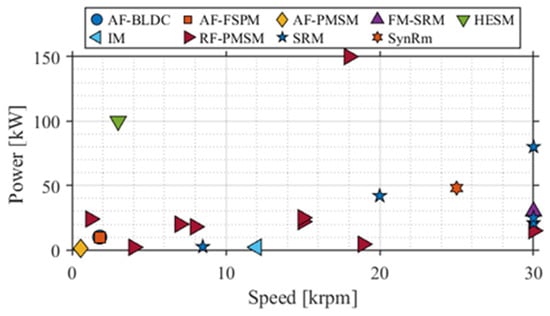
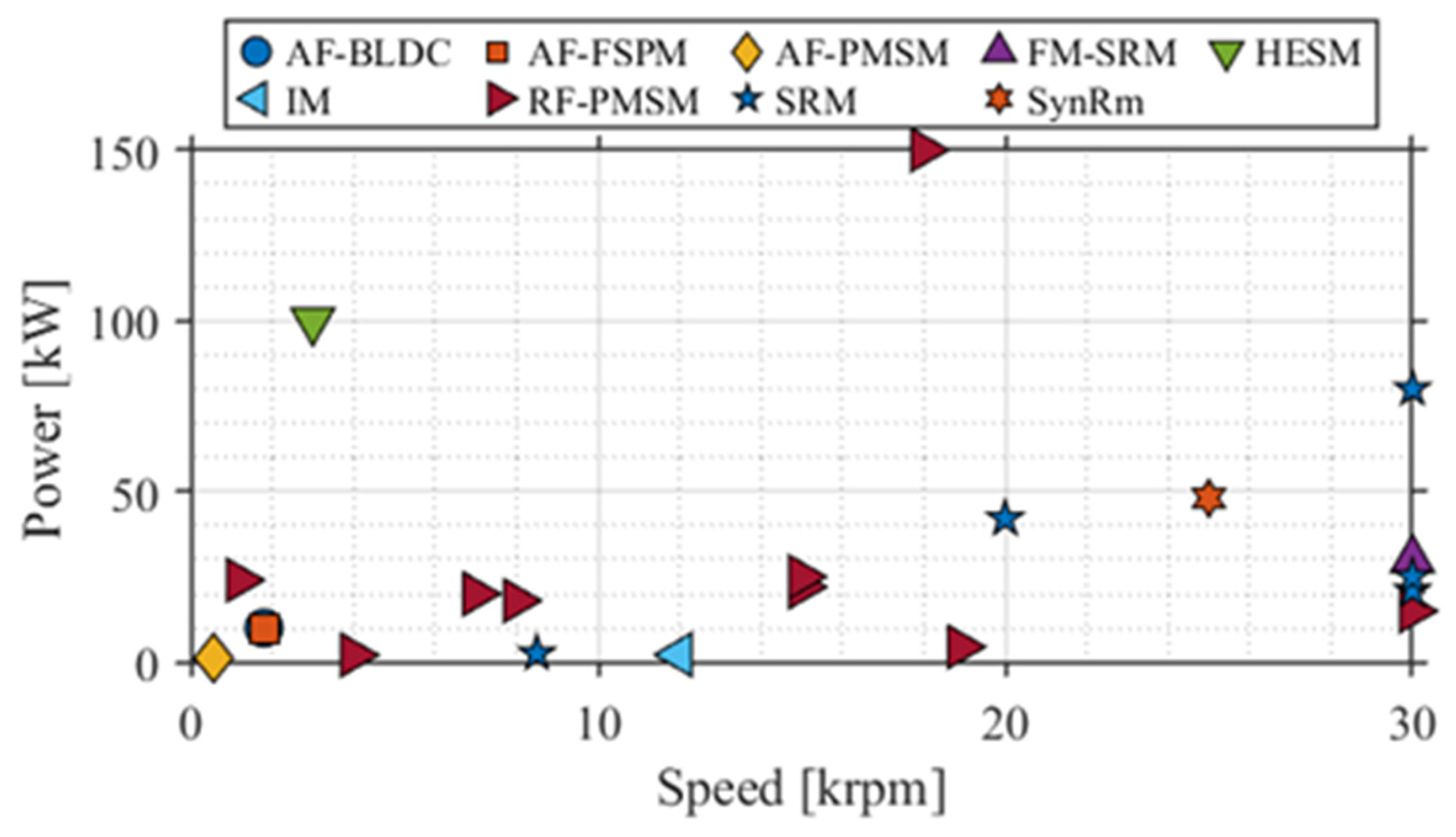
In EV application, the axial flux motors built with AMM materials often utilize tape-wound cores [5,6,46,47], while radial flux motors typically employ AMMs in the form of cut and stacked sheets. These design choices reflect different approaches to integrating AMMs based on motor architecture and manufacturing feasibility. From the power rating perspective, research studies have investigated motor designs up to 150 kW [21], although most physical prototypes are scaled-down versions, generally around 42 kW [25]. Additionally, applications span a wide range of operational speeds, from as low as 1200 rpm [7] to high-speed machines reaching up to 30,000 rpm (see Figure 2 and Table 1) [10,12,48,49].
Figure 2.
Ratings and types of EMs in literature, constructed using AMMs.
Table 1.
Comparison of AMM motors in EV application.
3.2. Core Loss and Energy Efficiency
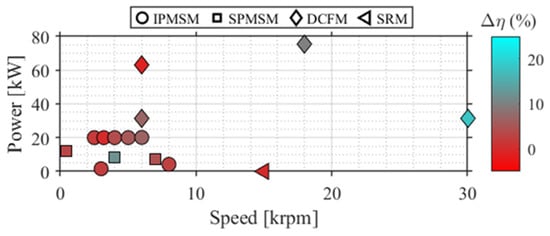
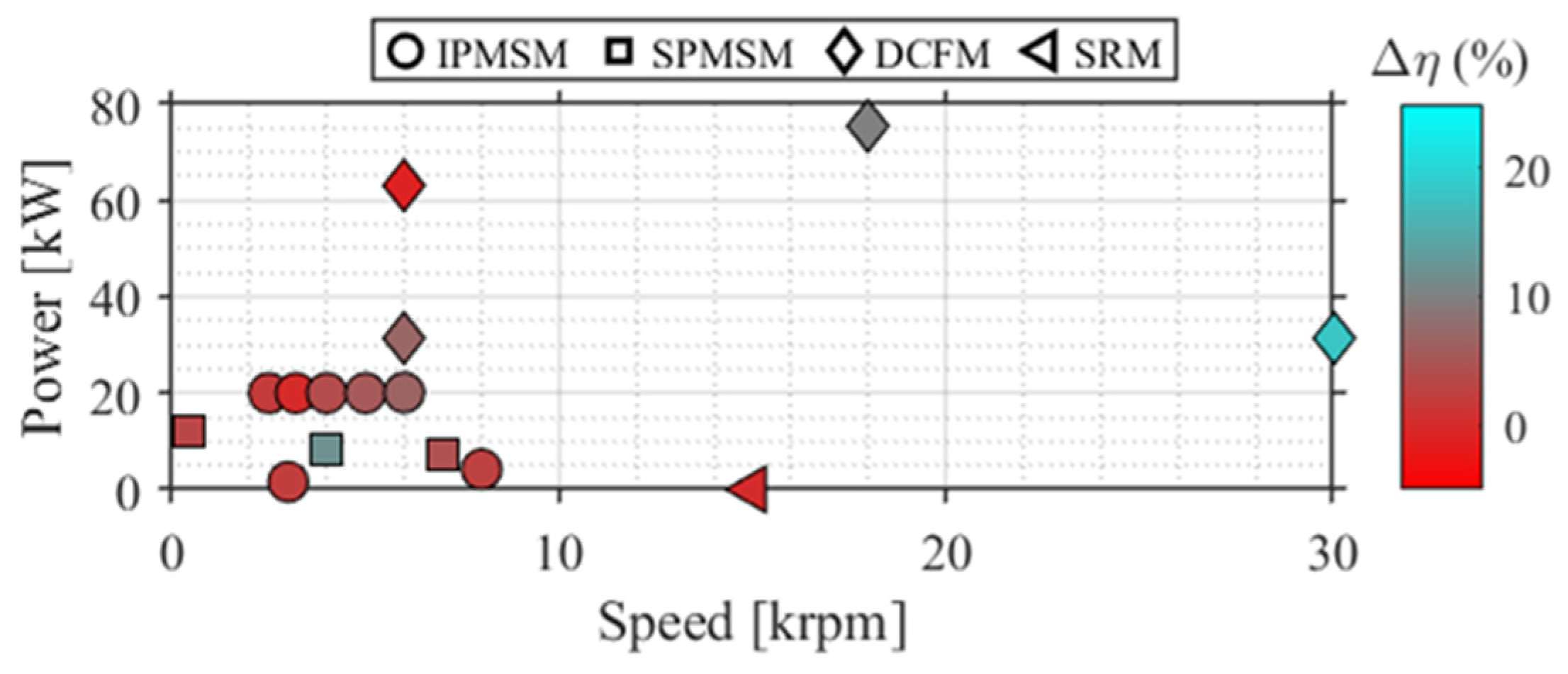
It can be seen in Figure 3 that many studies report efficiency gains. These results are especially reported when replacing conventional electrical steel with AMMs, followed by optimizing geometry. An outer-rotor PMSM with three different cores achieved the highest efficiency of 95.4% for AMMs, compared to 92.1% for silicon steel and 86.3% for the Soft Magnetic Composite [7]. Another study found that, despite a slight increase in copper losses, the reduction in core losses led to a net efficiency improvement, particularly at higher speeds [10]. The same study also showed that an AMM-based SRM had much lower iron losses (250 W to 950 W) compared to PMSMs. Discrepancies between theoretical and experimental results were attributed to increased eddy current losses from short circuits between AMM laminations [12]. Similar increases in eddy current losses were noted when the stacking factors exceeded a threshold, prompting the use of refined models, such as finite element analysis (FEA) [21].
Figure 3.
Efficiency improvements in the literature for EMs built with AMM materials for EVs. EM topologies are SPMSM [7,21], IPMSM [9,27], DCFM [10], and SRM [49].
Some studies replaced silicon steel sheets with AMMs without optimization [9]. A study on an outer-rotor SPM showed the efficiency at 4000 rpm increased from 81% to 93%, and at 7000 rpm from 71% to 75%, by switching the stator core from electrical steel to AMM, while maintaining the same design [21]. Another study found that an SRM with an AMM core achieved a 90.9% efficiency at the rated operation, compared to 85.8% with silicon steel and 89.8% with high-silicon steel [49]. In an EV traction IPMSM, using an AMM stator raised the maximum efficiency from 96.6% to 98.7% [34]. However, in a 55 kW IPM, switching from M19 silicon steel to AMM did not improve the efficiency, as the increased copper losses outweighed the reduction in iron losses [50]. A study provides guidelines for when switching to AMMs leads to higher efficiency (outside these conditions, re-optimization is necessary) [9]. These studies highlight that, without optimization, efficiency improvements are not guaranteed.
3.3. Electromagnetic Performance
EV traction motors are demanded for both the increased efficiency and compactness, but, generally, motor losses decrease with increasing volume. AMMs introduce both opportunities and challenges in terms of electromagnetic performance. For example, an AMM-based motor has been shown to be 31% smaller in volume, consequently achieving a 45% higher power density compared to a conventional EV motor [9]. The other study investigates a 150 kW outer-rotor SPM employing an AMM stator which demonstrates a power density of 10.9 kW/kg [21]. Another one that is a 12 kW outer-rotor SPM reports a 0.928 kW/kg power density, which is higher compared to its same design with electrical steel 0.896 kW/kg and SMC 0.899 kW/kg [7]. One strategy to further boost the power density involves increasing the pole pair number. AMM opens the path to higher pole numbers without compromising the EM efficiency [21] due to their high frequency operation capabilities. On the other hand, the lower saturation magnetic flux density of AMMs compared to conventional electrical steels could result in reduced torque generation capabilities at base speeds [34].
3.4. Mechanical and Acoustic Properties
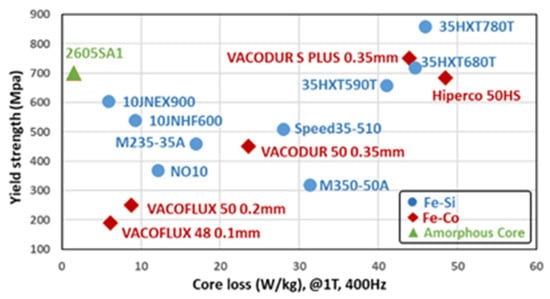
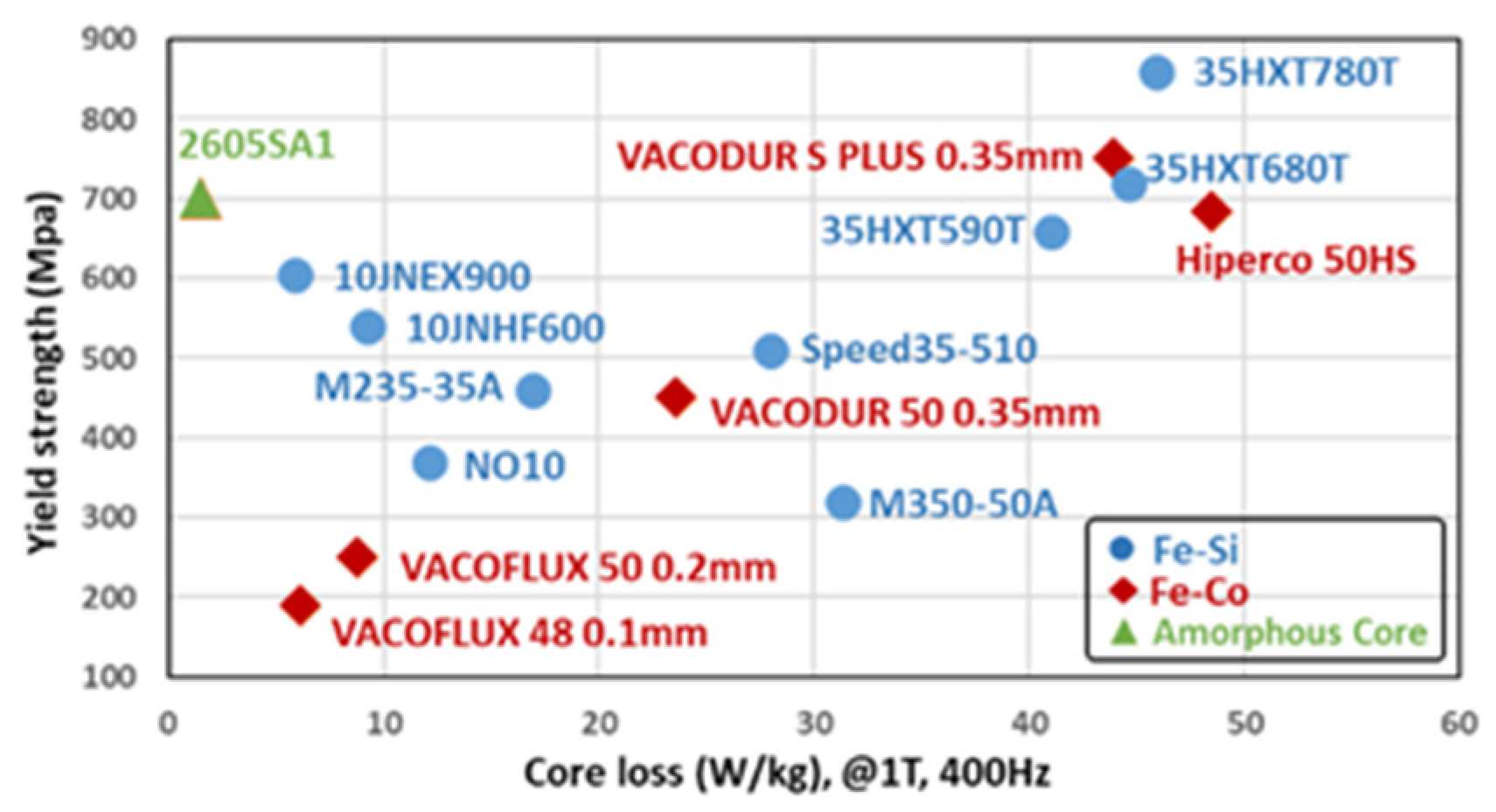
AMMs exhibit distinctive mechanical and thermal characteristics that influence the motor performance, manufacturability, and reliability. Mechanically, AMMs have a high tensile strength, often exceeding 2000 MPa, and a high yield strength, around 700 MPa (Figure 4), making them well-suited for high-speed EMs operating up to 30,000 rpm [10,12,34,48,49]. Their high corrosion and wear resistance further enhances their durability in demanding environments [34]. These traits align well with the application of AMMs in high-speed EV motors, where both mechanical robustness and low core loss are essential for sustained performance. In addition to mechanical concerns, AMMs introduce unique acoustic behaviors due to their high magnetostriction. It has been experimentally shown that AMM-based machines produce higher acoustic noise levels than those using conventional or high-silicon steels [25].
Figure 4.
Comparison of AMM (2605SA1) with other high-performance electrical steels in terms of yield strengths and core losses [51].
3.5. Corrosion Performance
Corrosion performance is a critical consideration for EMs used in EV traction motors. The EM core structure is normally exposed to harsh operating conditions, including high humidity, repeated thermal cycling, and contact with liquid cooling systems. These conditions can promote corrosion over time. Compared with silicon steels, AMMs demonstrate better corrosion resistance due to their non-crystalline, grain-boundary-free structure [52]. This corrosion resistance is particularly advantageous in high-speed EV motors, where long-term material stability has a direct impact on efficiency, reliability, and acoustic performance. However, the thin ribbon geometry of AMMs also introduces certain vulnerabilities. During manufacturing processes such as cutting, stacking, or tape winding, surface damage or insulation degradation can occur, increasing the susceptibility to localized corrosion [53]. In liquid-cooled EV motors, compromised coatings may further accelerate corrosion and raise the risk of short circuits between laminations [54].
3.6. Sustainablity and Economic Considerations
As global regulations on emissions and environmental impact tighten, sustainability has become a critical design objective in EV component development, covering all stages of the product lifecycle. AMMs, known for their energy efficiency, must also be assessed for economic feasibility and sustainability. A recyclability assessment of EM materials shows that AMMs receive neutral to slightly negative scores, indicating poorer recyclability compared with materials such as silicon and cobalt steels, highlighting the need for better recycling strategies [11]. Enomoto (2021) reports that the manufacturing cost gap between AMM and silicon steel stators is smaller than the raw material cost difference, with AMM being about 1.3 times more expensive than silicon steel, compared to 4.5 times higher 13 years ago [27,55]. From a sustainability perspective, factors like product lifetime, recyclability, and carbon footprint are increasingly important. While AMMs contribute to long-term efficiency gains that can reduce emissions, their end-of-life handling remains a concern. Some companies are addressing this issue. Hitachi, for example, has implemented a closed-loop recycling system for amorphous alloy cores in transformers since 2009, reprocessing unusable cores into ferroboron for new AMM production, thus supporting circular material use and reducing the environmental impact [56].
3.7. Recent Advances in Commercial Use Cases
Despite extensive research and the promising benefits of AMMs, their commercial use in EV motors remains limited due to challenges like manufacturing complexity, integration with existing designs, and cost. However, recent developments show increasing interest in using AMMs for EV applications. In 2018, Hitachi Metals took the first steps toward AMM application in EV motors [38], developing an 11 kW motor for lightweight HEVs that used Metglass, an amorphous metal, in the stator teeth. This design achieved 97.2% efficiency, meeting the IE5 efficiency class standard. By laminating sheared Metglass for the stator teeth, they overcame several manufacturing challenges. Although the prototype proved the feasibility of integrating AMMs for improved efficiency, there have been no reported commercial deployments in EV or HEV platforms so far.
In 2024, the Guangzhou Automobile Group (GAC) introduced the Quark Electric Drive 2.0, an electric drive unit (EDU) designed for ultra-high rotational speeds, with a motor capable of operating up to 30,000 rpm [39]. This motor utilizes a stator core made from an amorphous soft magnetic alloy with a permeability up to 100 times higher than that of conventional silicon steel. The result is a highly efficient motor with a power density of 13 kW/kg and a peak efficiency of 98.5%, reportedly extending the EV range by up to 31 miles without any additional modifications. This represents the first known commercial use of AMMs in a lightweight EV application, marking a significant milestone and opening the door for the broader utilization of these materials in the EV industry. These advancements illustrate the emerging commercial interest and application of AMMs in EV motors. While challenges remain, continued research and development efforts are crucial for realizing the full potential of AMMs in enhancing EV performance and efficiency.
4. AMM vs. Silicon Steel
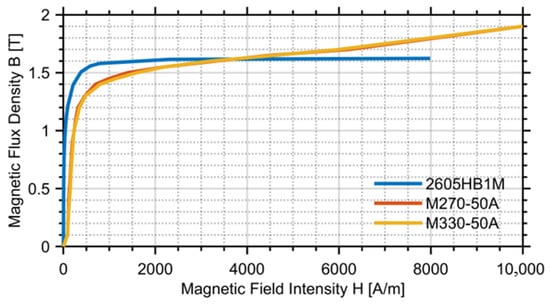
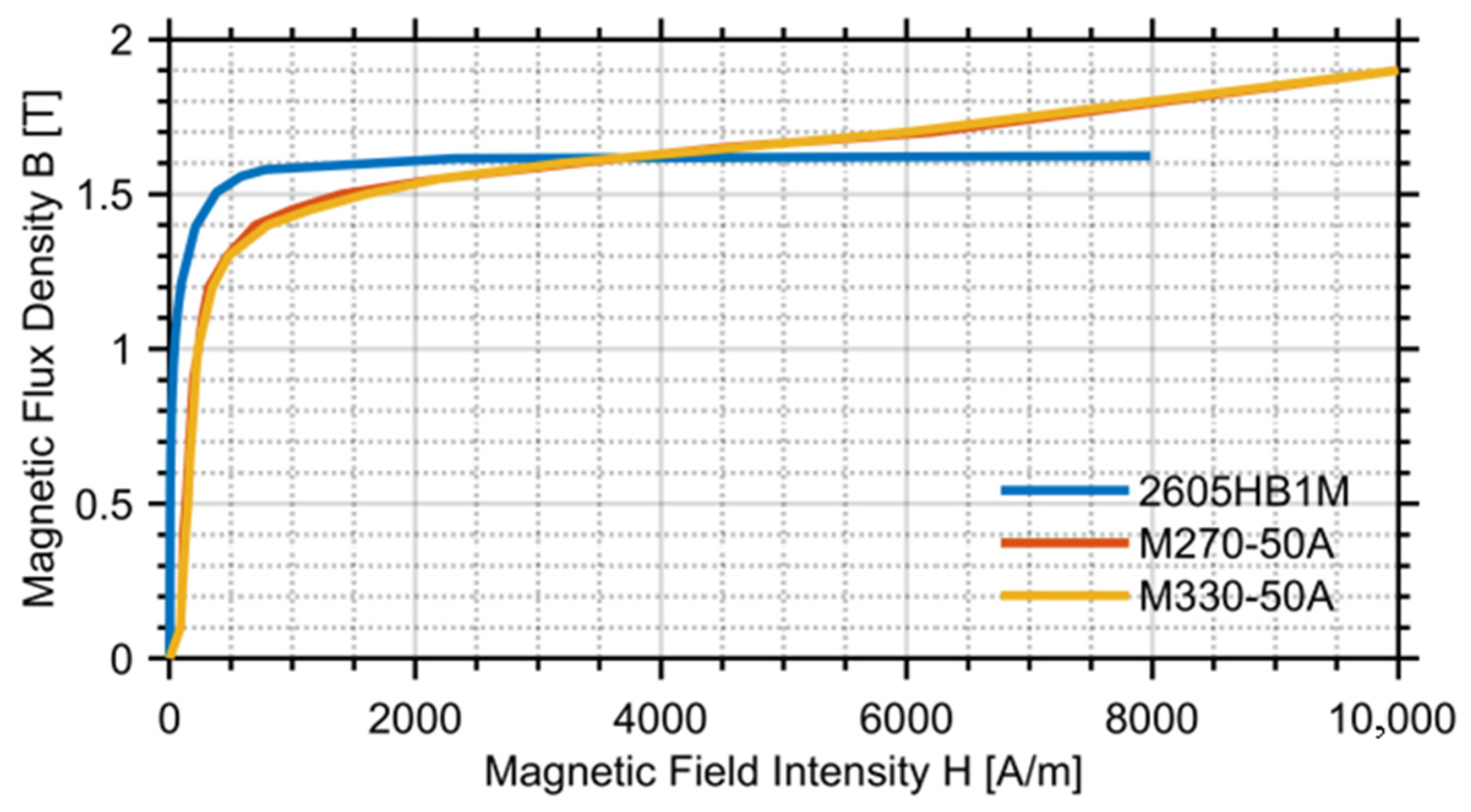
In this section, a research study is conducted to evaluate the potential advantages and limitations of employing AMM as a core material in SynRMs. The goal is to determine whether AMM offers advantages over conventional silicon steel and to outline insights for future research. The traditional M270 is used as the silicon steel material for the benchmark motor and 2605HB1M is used as the AMM material. The material BH data is given in Figure 5.
Figure 5.
BH curves for the core materials used through this study.
4.1. Methodology
Two SynRM were developed to provide a basis for comparing AMM and silicon steel as core materials. The key machine parameters were selected according to a previously studied SynRM [57,58], and these parameters are summarized in Table 2. Using these parameters, a 2D finite-element model was constructed in ANSYS Maxwell version 2024 R2. The stator of the model was parameterized to enable optimization.
Table 2.
Key EM parameters.
The AMM material has a lower stacking factor, as mentioned in [35]. This is because AMM laminations are much thinner compared to that of silicon steel, so that there are more insulation layers implemented. The stacking factors are taken as 0.89 and 0.98 for the AMM and silicon steel stators, respectively. The axial length is kept the same amongst AMM and silicon steel EMs. As a result, the volume of the core material used in the AMM stator is 9% lower than the volume of the core material used in the silicon steel EM stator. On the other hand, the AMM stator uses 4.5 times more insulation and adhesion material. Furthermore, the thicknesses of the AMM and silicon steel laminations are 0.025 mm and 0.5 mm, respectively. Therefore, to manufacture a 140 mm stator, roughly 4984 AMM or 275 silicon steel laminations are required. This suggests that the AMM stator requires a longer and more cumbersome machining process compared to the silicon steel stator.
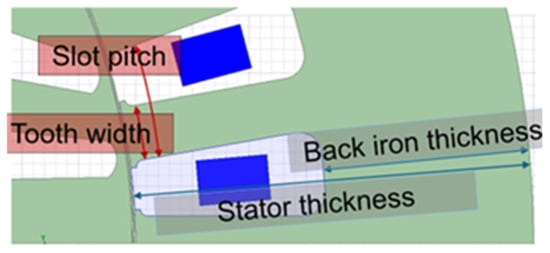
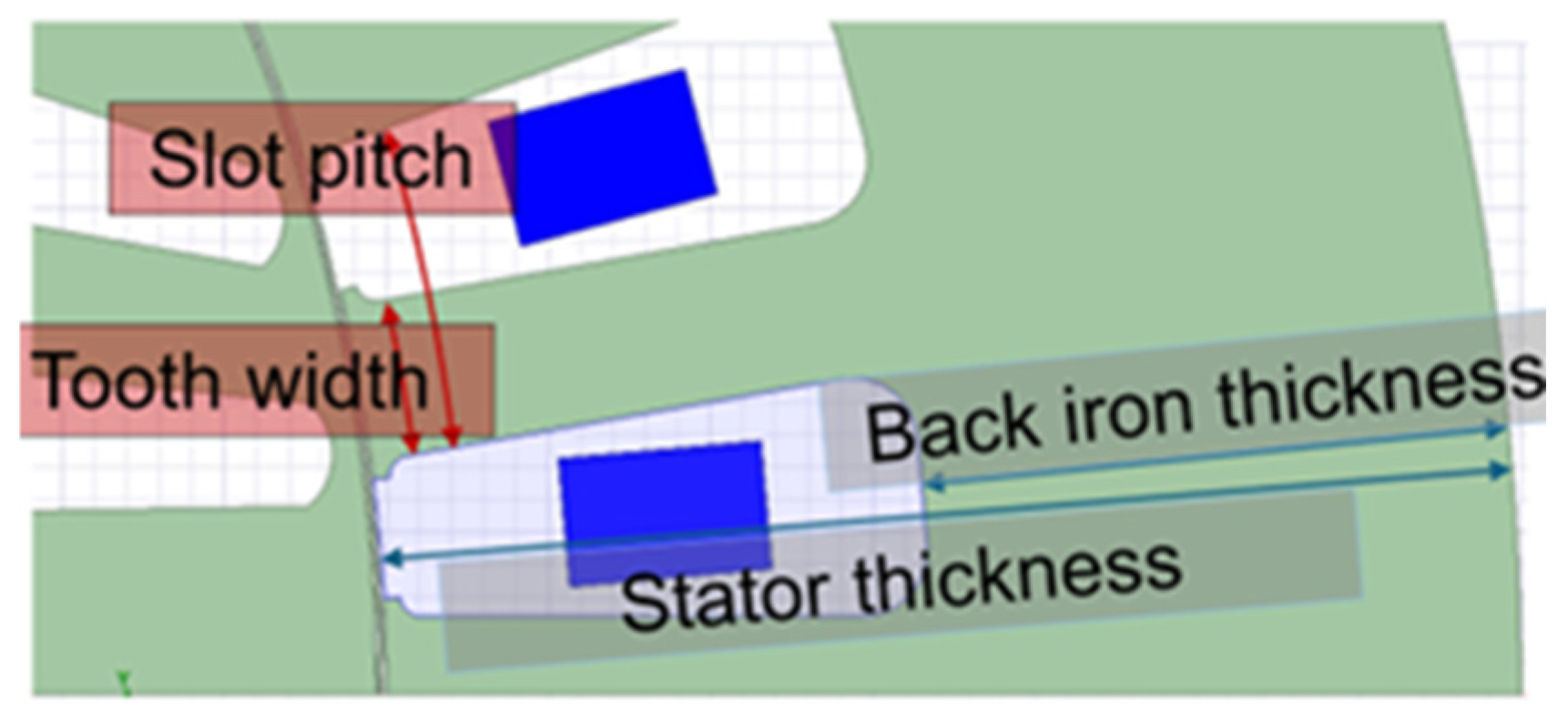
In this study, only the stator geometry was parameterized, while the rotor design was directly adopted from the reference SynRM. This approach was chosen because the primary distinction between AMM and silicon steel lies in their core-loss behavior, which is predominantly influenced by the alternating flux that is on the stator. Moreover, the number of variables is limited by taking this approach, easing up the computation cost on the optimization, and linking the results and the variables to each other more clearly. The stator parameters considered in the analysis are illustrated in Figure 6, and given as follows:
Figure 6.
Stator dimensions used for parameters and .
A grid search was initially performed across the stator design parameters to observe their influence on machine performance. Subsequently, a multi-objective optimization was conducted to maximize the torque and minimize the torque ripple under full-load operation at 3000 rpm using a Maximum Torque Per Ampere (MTPA) driving scheme [59,60]. A variant of NSGA-II, an elitist genetic algorithm implemented in MATLAB version R2024b, as a user-defined function, was employed as the multi-objective genetic algorithm. The optimization problem is formulated as follows:
subject to the following:
Here, Tavg denotes the average electromagnetic torque, and Tripple represents the torque ripple. All torque quantities are evaluated at 3000 rpm under the MTPA control strategy. The design variables and define the machine geometry, and their bounds define the feasible design space. Both the grid search and the optimization were executed separately for machines employing silicon steel and AMM stators.
Based on the optimization outcomes, a single-stator geometry that provided the optimal performance for both material variants was selected for a detailed analysis. The selected geometry has the variables and . Efficiency maps over the torque–speed and power–speed operating ranges were then computed for each machine under an MTPA control scheme. To generate these maps, operating conditions spanning speeds from 0 to 9000 rpm and load levels from no-load to full-load were evaluated using the MTPA control strategy, ensuring a broad and representative sampling of the electromagnetic operating envelope. Finally, efficiency maps over the torque–speed and power-speed operating range were computed for each machine under the MTPA control scheme. This methodology enables a comprehensive evaluation of how the substitution of AMM for silicon steel alters the overall efficiency performance characteristics.
Finally, an iteration to this study has been conducted, where the axial length of the AMM EM is increased to match the nominal torque of the AMM EM to silicon steel EM.
4.2. Results
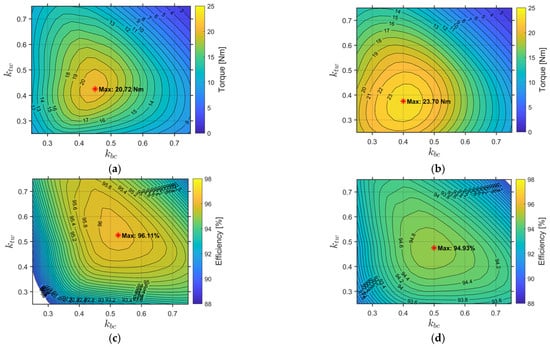
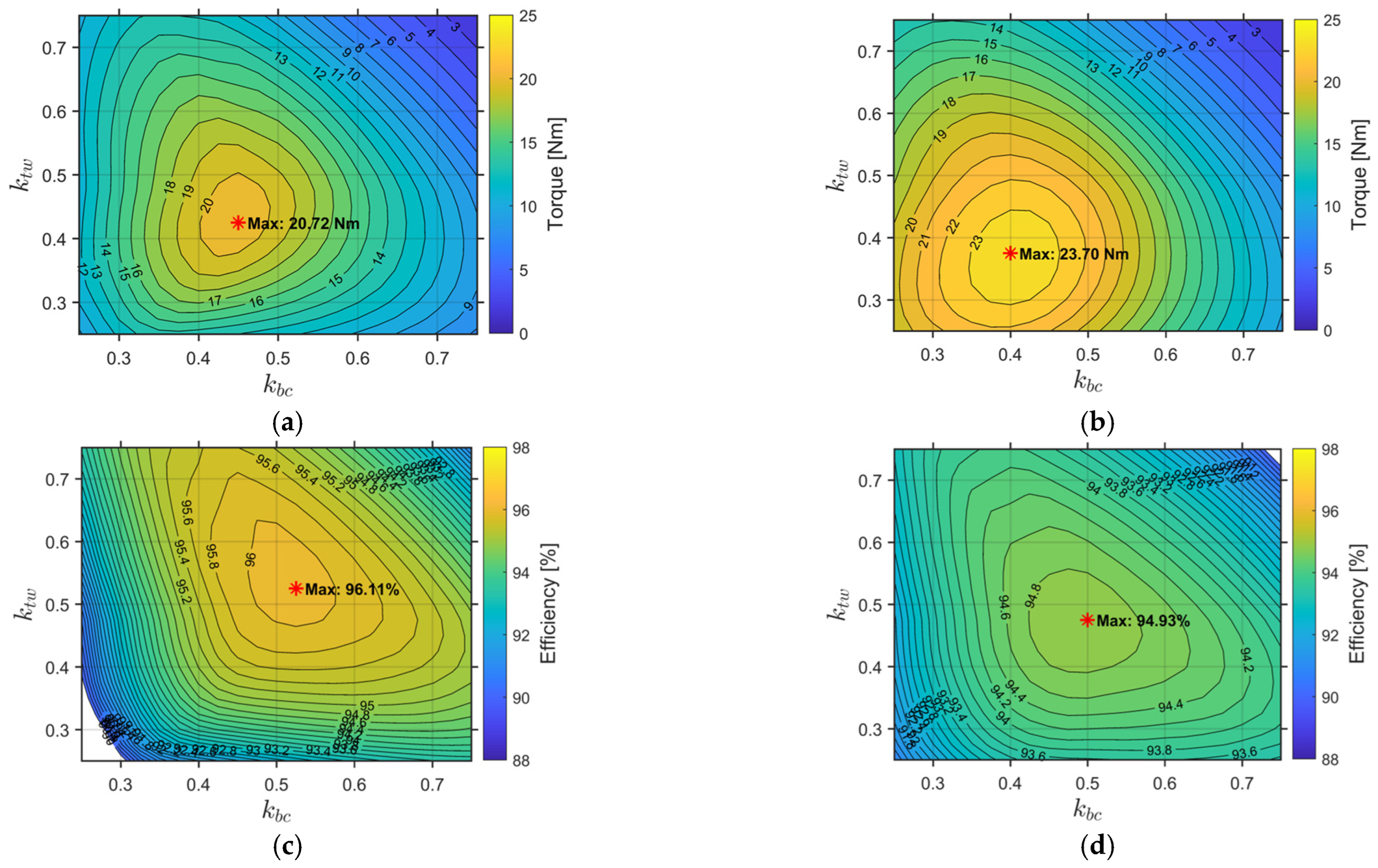
The grid-search results presented in Figure 7 indicate that replacing the stator material from silicon steel to AMM leads to a reduction in the maximum attainable torque at 3000 rpm. Specifically, the peak torque decreases by 2.98 Nm, from 23.70 Nm to 20.72 Nm, corresponding to a reduction of approximately 12.5%. A portion of this decrease, up to 9%, can be directly correlated to the AMM stator stacking factor, 0.89 against the stacking factor of silicon steel which is 0.98. If both the stator and rotor core were built with AMM laminations, the correlated reduction would be directly 9%. However, the silicon-steel rotor, with its higher saturation flux density, can accommodate a higher magnetic loading than the AMM stator. Conversely, the maximum achievable efficiency at 3000 rpm increases by 1.18%, improving from 94.93% to 96.11%. The results further show that these maxima occur at higher values of and for the AMM-based machine, indicating that both the optimal stator back-iron thickness and tooth width, i.e., the amount of core material, increase when AMM is employed in place of silicon steel.
Figure 7.
Grid search results. Torque and efficiency values are calculated at 3000 rpm full-load operation. (a) Rated torque of SynRM with AMM stator, mapped over the decision variables. (b) Rated torque of SynRM with silicon steel stator, mapped over the decision variables. (c) Rated efficiency of SynRM with AMM stator, mapped over the decision variables. (d) Rated efficiency of SynRM with silicon steel stator, mapped over the decision variables.
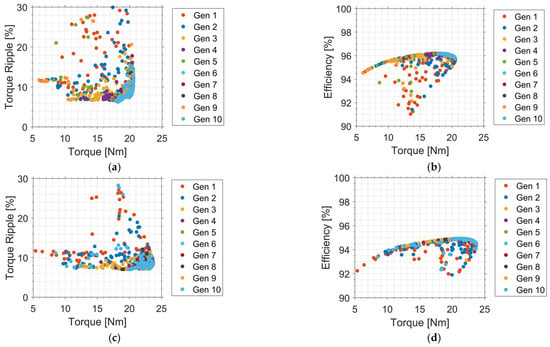
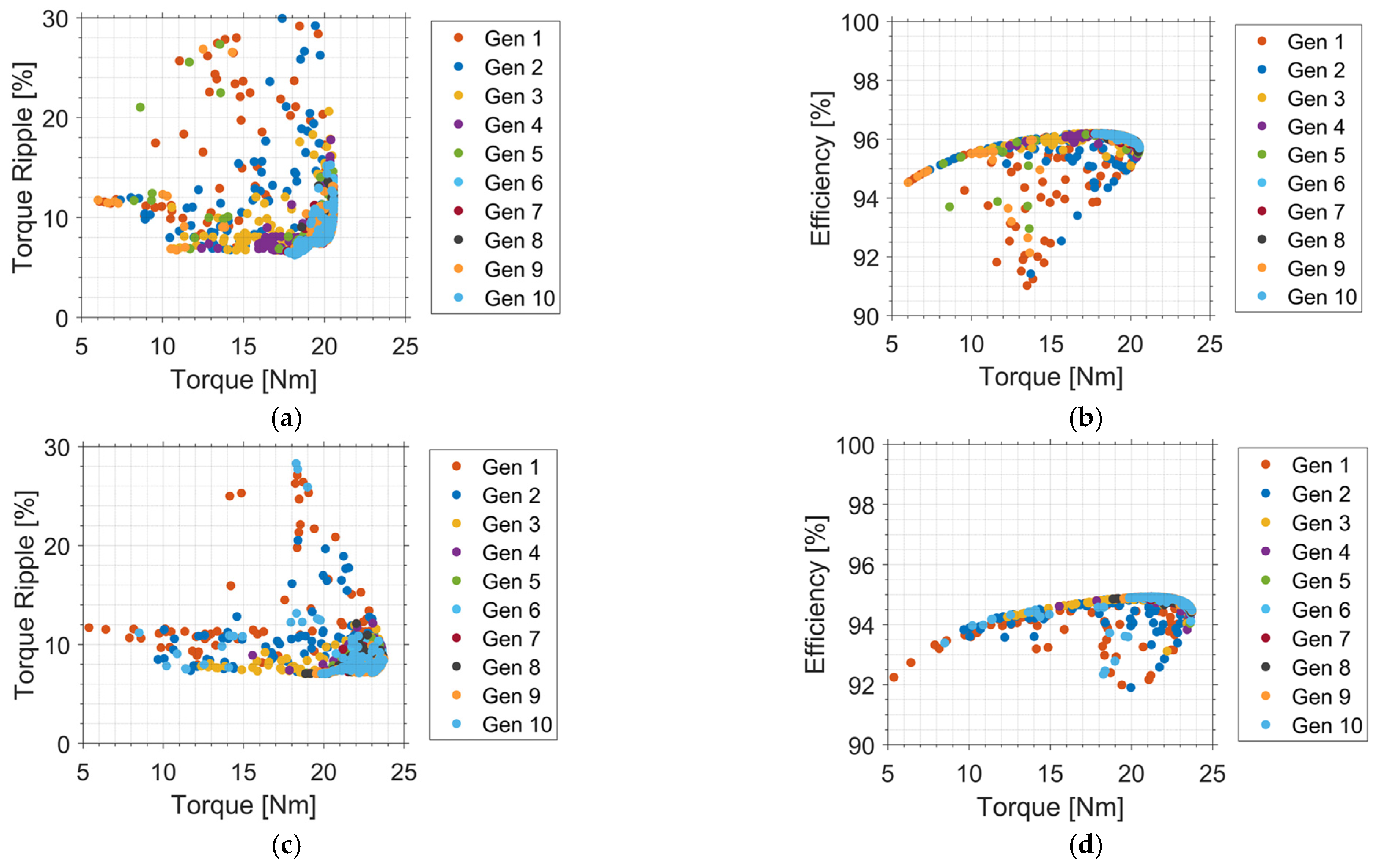
The optimization results are shown in Figure 8. The results indicate that the torque ripple can be reduced to approximately 6% for both SynRMs with AMM and silicon steel stators. They also confirm the maximum torque achievable by the SynRM under study, as observed through the grid search results. Furthermore, at 3000 rpm under full-load conditions, the maximum efficiencies reach 96.2% and 95% for the SynRMs with AMM and silicon steel stators, respectively.
Figure 8.
Optimization results. Torque, torque ripple, and efficiency results are calculated at 3000 rpm full-load conditions. (a) Torque ripple vs. torque results for SynRM with AMM stator. (b) Efficiency vs. torque results for SynRM with AMM stator. (c) Torque ripple vs. torque results for SynRM with silicon steel stator. (d) Efficiency vs. torque results for SynRM with silicon steel stator.
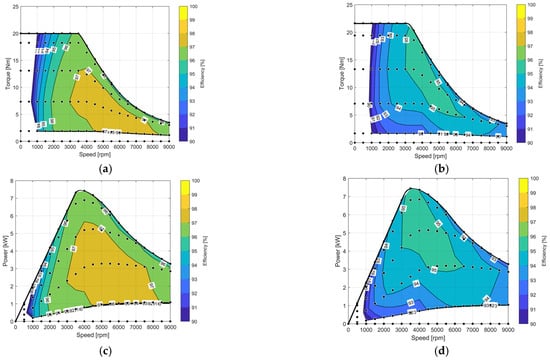
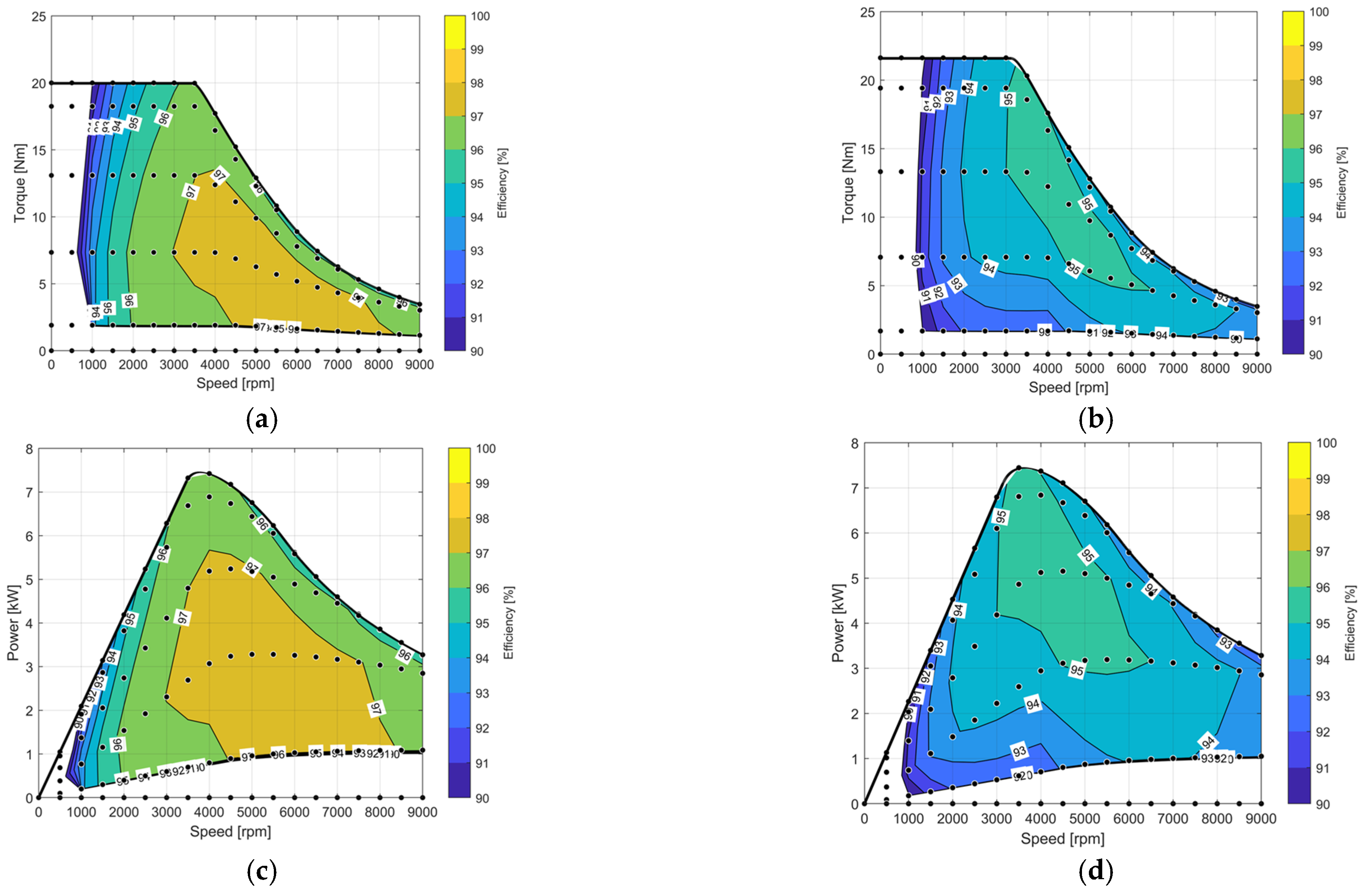
The efficiency map results in Figure 9 demonstrate that the SynRM with an AMM stator attains efficiencies exceeding 97% over a broader operating region compared to the silicon-steel counterpart, whose peak efficiency reaches only about 95%. For the AMM machine, this high-efficiency region also shifts toward higher speeds and lower torque levels relative to the silicon-steel design.
Figure 9.
SynRM performance results, showing efficiency mapped over torque-speed and power-speed curves with an MTPA control scheme. (a) Efficiency map of SynRM with AMM stator, mapped on torque-speed envelope. (b) Efficiency map of SynRM with silicon steel stator, mapped on torque-speed envelope. (c) Efficiency map of SynRM with AMM stator, mapped on power-speed envelope. (d) Efficiency map of SynRM with silicon steel stator, mapped on power-speed envelope.
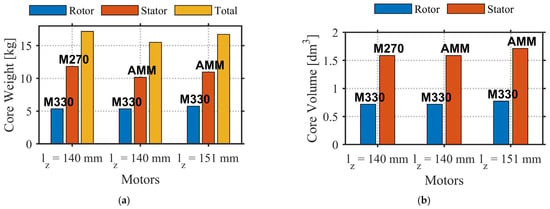
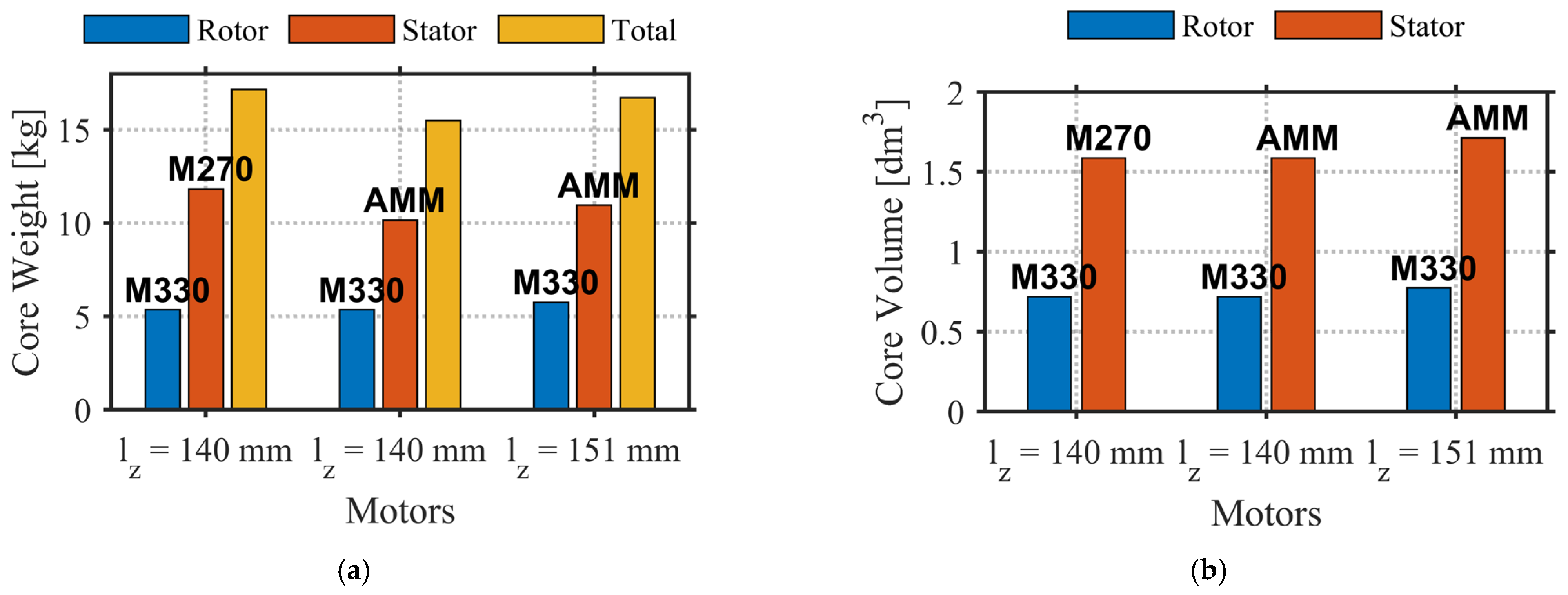
Finally, the axial length of the AMM EM is increased by 8%, from 140 mm to 151 mm, to compensate for the 12% rated torque reduction, and achieve the same rated torque output of silicon steel EM, that is, 21.63 Nm. The resulting motor core weights and volumes are shown in Figure 10. Motors 1 and 3 exhibit the same nominal torque of 21.66 Nm. The total core weight of motor 3 is lower than motor 1, 16.71 kg to 17.17 kg, respectively. This is because AMM has a lower weight density compared to silicon steel, 7.18 g/cm3 to 7.6 g/cm3, respectively. Overall, these results show that shifting the stator from silicon steel to AMM while keeping the nominal torque output the same increases the volume but reduces the total weight of the motor.
Figure 10.
Comparison of material usage in the three electric motor designs: one with M270 stator and 140 mm axial length, one with AMM stator and 140 mm axial length, and last with AMM stator and 151 mm axial length (to match the nominal torque): (a) rotor, stator, and total material weight, and (b) rotor and stator material volume.
4.3. Discussion
The observed reduction in maximum torque and the corresponding increase in efficiency at 3000 rpm when transitioning from a silicon-steel stator to an AMM stator are consistent with the intrinsic material properties of AMM. Specifically, AMM exhibits a lower saturation magnetic flux density, and an AMM stator can be manufactured with a lower stacking factor, which leads to a reduced torque capability, as well as significantly lower core losses, which accounts for the improved efficiency. The shift of the maximum-efficiency region toward higher operating speeds in the AMM-based machine is also expected, as core losses in silicon steel increase more rapidly with frequency than in AMM.
The efficiency maps in Figure 9 further indicate that the AMM-stator machine is particularly well-suited for low-torque operation. AMM EM maintains its higher efficiency across a wider speed range at lower torques, compared to silicon steel EM. In Figure 9a, AMM EM exhibits a minimum of 96% efficiency at 2 Nm, between speeds of 2000 to 9000 rpm. On the other hand, in Figure 9b, the silicon steel EM exhibits efficiencies between 92–94%, meaning that, with a 2 Nm output at any given speed higher than 2000 rpm, the AMM EM exhibits at least a 2% higher efficiency compared to the silicon steel EM. This suggests that AMM could offer meaningful advantages in SynRM applications that demand mid- to high-speed operation under relatively low torque, such as certain highway automotive drive scenarios. Nevertheless, these findings warrant further investigation, ideally through a comprehensive system-level analysis to fully assess their practical implications.
5. Challenges and Future Work
The integration of AMMs in EV motors offers significant efficiency improvements and loss reduction. However, several challenges must be overcome for broader commercial adoption, including technical, manufacturing, economic, and design compatibility issues. Addressing these obstacles is crucial for the future development of AMM-based motors in the EV industry. This section highlights the key challenges and suggests future research and industrial directions.
5.1. Manufacturing and Processing Challenges
Despite progress, practical limitations remain. The thinness of AMM foils requires processing a large number of strips, increasing production time. AMM sheets are also typically supplied in limited widths (142, 170, and 213 mm), restricting the range of stator diameters that can be manufactured [27]. The hardness of AMMs (around 900 HV) compared to conventional electrical steels (200–300 HV) creates manufacturing difficulties. AMMs’ poor machinability leads to increased tool wear and longer processing times [10]. Their brittleness and low ductility (less than 1% elongation) make them prone to cracking or warping during fabrication and handling [7,49]. The thin lamination structure, though effective in reducing eddy currents, further increases the susceptibility to mechanical deformation.
Alternative techniques like water jet cutting, wire electrical discharge machining (EDM), and laser cutting are used for processing AMMs [55]. While precise, these methods can induce thermal or mechanical stresses that may alter the amorphous structure or degrade magnetic properties [61]. For instance, laser cutting can cause partial crystallization due to localized heating [55], and wire EDM may introduce surface roughness and micro-cracks [28]. Additive manufacturing (AM) has begun to adapt for AMM core prototyping [37], but controlling cooling rates and thermal gradients to maintain the amorphous structure remains challenging. Additionally, the brittleness of AMMs complicates handling and assembly, as their limited ductility makes them prone to cracking under mechanical stress. Potential solutions may include developing composite structures or adding ductile phases to improve mechanical robustness. The lack of established industry standards and supply chains for AMM cores further complicates consistent material quality and performance, hindering their widespread adoption in commercial motors.
5.2. Cost and Economic Feasibility
The high cost of AMMs is a major barrier to their adoption in EV motors. They are significantly more expensive than traditional silicon steel (two to three times [62]) due to specialized production methods, tool wear, low yield rates, and limited manufacturing infrastructure [34,61]. This cost disparity is particularly challenging in the automotive industry, where price competitiveness is crucial for large-scale adoption. While AMMs offer efficiency benefits that can reduce energy consumption and potentially offset some initial costs over a vehicle’s lifetime, these long-term savings are often difficult to quantify and justify in short-term procurement decisions. Future efforts should focus on developing cost-effective production methods, scaling manufacturing, and establishing clear economic models that highlight the total cost of ownership benefits of AMM-based motor solutions.
5.3. Compatability with Motor Designs
Integrating AMMs into existing motor designs presents challenges, as many conventional motors are optimized for silicon steel laminations and may not fully utilize the unique properties of AMMs. For example, AMMs’ lower saturation flux density requires design adjustments, such as increasing core cross-sectional area or altering flux paths to maintain torque and power output. These changes impact motor dimensions and packaging, which can be problematic for space-constrained EV applications. To optimize performance, motor topologies may need to be re-engineered to account for AMMs’ electromagnetic [9] and thermal characteristics, requiring revisions in cooling strategies [29], mechanical fixtures, and manufacturing workflows. Interdisciplinary approaches combining electromagnetics, thermal, mechanical engineering, and materials science are crucial. Future research should focus on creating design guidelines and simulation tools specific to AMM-based motor development to streamline innovation and reduce trial and error.
6. Conclusions
AMMs offer promising opportunities for enhancing the efficiency and performance of EV motors, due to their superior magnetic properties. This study also underlines these benefits, demonstrating a 1.18% maximum efficiency improvement when AMM and silicon steel EMs are compared. Furthermore, the results show that the high-efficiency operation range shifts towards high speed–low torque operations, which implies that, for the applications with such demands, AMM is shown to be a prominent stator material over silicon steel. Over the past few decades, advances in material science, manufacturing techniques, and motor design methodologies have steadily improved the feasibility of integrating AMMs into various motor topologies across a broad speed and power spectrum. Despite these advancements, several challenges remain. The high cost of AMMs, limitations in saturation flux density, and complex manufacturing requirements—especially for non-standard geometries—continue to hinder their widespread adoption. However, emerging solutions such as additive manufacturing and optimized stacking strategies are gradually addressing these issues, paving the way for the greater integration of AMMs in high-performance and high-frequency motor applications. As EV powertrains evolve and demand more compact, efficient, and thermally manageable motor solutions, AMMs are increasingly positioned as a key enabling technology. Realizing their full potential will require interdisciplinary approaches that combine electromagnetic, thermal, mechanical, sustainability, and manufacturing perspectives. With ongoing research and industrial engagement, AMMs are poised to play a crucial role in shaping the next generation of sustainable and high-efficiency EV propulsion systems.
Author Contributions
Conceptualization, P.S. and M.I.; methodology, D.H.; software, B.K.; validation, D.H., B.K. and M.I.; formal analysis, B.K.; investigation, B.K.; resources, S.S.; writing—original draft preparation, D.H. and B.K.; writing—review and editing, supervision, P.S. and S.S.; project administration, S.S.; funding acquisition, S.S. All authors have read and agreed to the published version of the manuscript.
Funding
This research was supported by Flanders Make, the strategic research centre for the manufacturing industry in the framework of CTO actions 2025.
Data Availability Statement
The original contributions presented in this study are included in the article. Further inquiries can be directed to the corresponding author(s).
Acknowledgments
During the preparation of this study, the authors used ChatGPT (GPT-5) for a grammatical review of the text. The authors have reviewed and edited the output and take full responsibility for the content of this publication.
Conflicts of Interest
The authors declare no conflicts of interest.
Abbreviations
The following abbreviations are used in this manuscript:
| AMM | Amorphous soft magnetic material |
| AM | Additive manufacturing |
| BLDC | Brushless DC |
| CBMS | Chill-block melt-spinning |
| DCFM | DC-excited flux-modulated |
| EDM | Electrical discharge machining |
| EDU | Electric drive unit |
| EM | Electric motors |
| EV | Electric vehicle |
| FEA | Finite element analysis |
| IM | Induction machine |
| MTPA | Maximum Torque Per Ampere |
| NVH | Noise, vibration, and harshness |
| PMBLDC | Permanent magnet brushless DC |
| PMSM | Permanent magnet synchronous machine |
| SPMSM | Surface permanent magnet synchronous machine |
| SRM | Switched reluctance machine |
| SynRM | Synchronous reluctance machine |
References
- Johnson, L.A.; Cornell, E.P.; Bailey, D.J.; Hegyi, S.M. Application of low loss amorphous metals in motors and transformers. IEEE Trans. Power Appar. Syst. 1982, PAS-101, 2109–2114. [Google Scholar] [CrossRef] [Scilit]
- Fukao, T.; Chiba, A.; Matsui, M. Test results on a super-high-speed amorphous-iron reluctance motor. IEEE Trans. Ind. Appl. 1989, 25, 119–125. [Google Scholar]
- Jensen, C.C.; Profumo, F.; Lipo, T.A. A low-loss permanent-magnet brushless DC motor utilizing tape-wound amorphous iron. IEEE Trans. Ind. Appl. 2002, 28, 646–651. [Google Scholar] [CrossRef] [Scilit]
- Hayashi, H.; Nakamura, K.; Chiba, A.; Fukao, T.; Tungpimolrut, K.; Dorrell, D.G. Efficiency improvements of switched reluctance motors with high-quality iron steel and enhanced conductor slot fill. IEEE Trans. Energy Convers. 2009, 24, 819–825. [Google Scholar] [CrossRef] [Scilit]
- Wang, Z.; Enomoto, Y.; Ito, M.; Masaki, R.; Morinaga, S.; Itabashi, H.; Tanigawa, S. Development of a permanent magnet motor utilizing amorphous wound cores. IEEE Trans. Magn. 2010, 46, 570–573. [Google Scholar] [CrossRef] [Scilit]
- Liew, G.S.; Soong, W.L.; Ertugrul, N.; Gayler, J. Analysis and performance investigation of an axial-field PM motor utilising cut amorphous magnetic material. In Proceedings of the 2010 20th Australasian Universities Power Engineering Conference, Christchurch, New Zealand, 5–8 December 2010; pp. 1–6. [Google Scholar]
- Sui, Y.; Liu, Y.; Wang, P.; Wu, F.; Yu, B. Investigation of a five-phase 30-slot/32-pole in-wheel outer-rotor permanent-magnet synchronous machine for electric vehicles. In Proceedings of the 17th International Conference on Electrical Machines and Systems (ICEMS), Hangzhou, China, 22–25 October 2014; pp. 2595–2599. [Google Scholar]
- Hong, D.K.; Joo, D.; Woo, B.C.; Jeong, Y.H.; Koo, D.H. Investigations on a super high-speed motor-generator for microturbine applications using amorphous core. IEEE Trans. Magn. 2013, 49, 4072–4075. [Google Scholar] [CrossRef] [Scilit]
- Fan, T.; Li, Q.; Wen, X. Development of a high power density motor made of amorphous alloy cores. IEEE Trans. Ind. Electron. 2014, 61, 4510–4518. [Google Scholar] [CrossRef] [Scilit]
- Ou, J.; Liu, Y.; Schiefer, M.; Breining, P.; Doppelbauer, M.; Chai, F. Application of amorphous cores to DC-excited flux-modulated motors used for electric vehicles. In Proceedings of the International Conference on Electrical Systems for Aircraft, Railway, Ship Propulsion and Road Vehicles & International Transportation Electrification Conference (ESARS-ITEC), Nottingham, UK, 7–9 November 2018; pp. 1–7. [Google Scholar]
- Jha, A.K.; Li, Z.; Garcia, A.; Upadhayay, P.; Rasmussen, P.O.; Kedous-Lebouc, A.; Garbuio, L. Weighted index of recycling and energy (WIRE) cost for motors in electric vehicles. In Proceedings of the International Symposium on Power Electronics, Electrical Drives, Automation and Motion, SPEEDAM, Amalfi, Italy, 20–22 June 2018; pp. 407–412. [Google Scholar]
- Tomioka, T.; Akatsu, K. Study of high-speed SRM with amorphous steel sheet for EV. In Proceedings of the 2019 22nd International Conference on Electrical Machines and Systems (ICEMS), Harbin, China, 11–14 August 2019; pp. 1–6. [Google Scholar]
- Wang, Z.; Masaki, R.; Morinaga, S.; Enomoto, Y.; Itabashi, H.; Ito, M.; Tanigawa, S. Development of an axial gap motor with amorphous metal cores. IEEE Trans. Ind. Appl. 2011, 47, 1293–1299. [Google Scholar] [CrossRef] [Scilit]
- Wu, S.; Tang, R.; Han, X.; Tong, W. Vibration analysis of amorphous alloy permanent magnet synchronous motors. In Proceedings of the 2016 IEEE Vehicle Power and Propulsion Conference (VPPC), Hangzhou, China, 17–20 October 2016; pp. 1–6. [Google Scholar]
- Zhu, L.; Han, X.; Tang, R.; Zhu, J. Loss analysis of the permanent magnet motor with an amorphous stator core considering manufacturing processes. In Proceedings of the 2019 22nd International Conference on Electrical Machines and Systems (ICEMS), Harbin, China, 11–14 August 2019; pp. 1–6. [Google Scholar]
- Okamoto, S.; Denis, N.; Kato, Y.; Ieki, M.; Fujisaki, K. Core loss reduction of an interior permanent-magnet synchronous motor using amorphous stator core. IEEE Trans. Ind. Appl. 2016, 52, 2261–2268. [Google Scholar] [CrossRef] [Scilit]
- Zhu, G.; Liu, W.; Liu, X.; Li, L.; Tong, W.; Han, X. Analytical analysis and cooling system design of a high-speed permanent magnet motor utilizing an amorphous metal core. In Proceedings of the 2018 IEEE International Conference on Applied Superconductivity and Electromagnetic Devices (ASEMD), Tianjin, China, 15–18 April 2018; pp. 1–2. [Google Scholar]
- Li, Z.; Pei, Y.; Chai, F.; Hu, H.; Wu, Y.; Yu, Y. Accurate modeling and performance analysis of synchronous reluctance motor considering amorphous alloy properties. In Proceedings of the 2019 22nd International Conference on Electrical Machines and Systems (ICEMS), Harbin, China, 11–14 August 2019; pp. 1–6. [Google Scholar]
- Kolano, R.; Kolano-Burian, A.; Krykowski, K.; Hetmańczyk, J.; Hreczka, M.; Polak, M.; Szynowski, J. Amorphous soft magnetic core for the stator of the high-speed PMBLDC motor with half-open slots. IEEE Trans. Magn. 2016, 52, 1–5. [Google Scholar]
- Dems, M.; Komeza, K. Performance characteristics of a high-speed energy-saving induction motor with an amorphous stator core. IEEE Trans. Ind. Electron. 2013, 61, 3046–3055. [Google Scholar] [CrossRef] [Scilit]
- Walker, A.; Zou, T.; Mifsud, L.P.; Connor, P.; Huang, H.; Ren, X.; Kaloun, A. High pole-number outer-rotor SPM machine for sustainable 150 kW high-speed EV traction. In Proceedings of the 2024 IEEE Vehicle Power and Propulsion Conference (VPPC), Washington, DC, USA, 7–10 October 2024; pp. 1–6. [Google Scholar]
- Wu, S.; Hao, D.; Tong, W. Cooling system design and thermal analysis of modular stator hybrid excitation synchronous motor. CES Trans. Electr. Mach. 2022, 6, 241–251. [Google Scholar] [CrossRef] [Scilit]
- Schneider, K.P.; McHenry, M.E.; de Boer, M.P. Evaluation of rotational speed limits in an axial flux-switching motor constructed from metal amorphous nanocomposite magnetic cores. IEEE Trans. Energy Convers. 2024, 39, 2278–2287. [Google Scholar] [CrossRef] [Scilit]
- Xu, X.; Han, Q.; Qin, Z.; Chu, F. Analytical methods for the radial electromagnetic vibration of stator in permanent magnet motors with an amorphous alloy core. Mech. Syst. Signal Process. 2020, 145, 106909. [Google Scholar] [CrossRef] [Scilit]
- Sobue, H.; Chiba, A.; Cai, Y.; Kiyota, K.; Fujii, Y.; Senda, K.; Yoshizaki, S. Analysis and experimental comparison of acoustic noise of three switched reluctance motors made of conventional steel, high silicon steel, and amorphous iron. IEEE Trans. Ind. Appl. 2021, 57, 5907–5915. [Google Scholar] [CrossRef] [Scilit]
- Chai, F.; Li, Z.; Chen, L.; Wu, Y. Effect of cutting and slot opening on amorphous alloy core for high-speed switched reluctance motor. IEEE Trans. Magn. 2020, 57, 1–5. [Google Scholar] [CrossRef] [Scilit]
- Enomoto, Y.; Suzuki, K.; Okita, S.; Eto, K.; Katayama, E. Evaluation of a motor with an amorphous iron core punched by a die. IEEJ J. Ind. Appl. 2021, 10, 785–792. [Google Scholar] [CrossRef] [Scilit]
- Yang, X.; Qiu, S.; Wang, Y.; Zhao, P.; Gao, Y.; Wang, H.; Zhang, C. Research on deterioration mechanism and high-precision modelling of the core loss for amorphous alloys after wire-cut electric discharge machining. Materials 2023, 16, 2275. [Google Scholar]
- Ou, J.; Liu, Y.; Doppelbauer, M. Comparison study of a surface-mounted PM rotor and an interior PM rotor made from amorphous metal for high-speed motors. IEEE Trans. Ind. Electron. 2020, 68, 9148–9159. [Google Scholar] [CrossRef] [Scilit]
- Fan, Z.; Yi, H.; Xu, J.; Xie, K.; Qi, Y.; Ren, S.; Wang, H. Performance study and optimization design of high-speed amorphous alloy induction motor. Energies 2021, 14, 2468. [Google Scholar] [CrossRef] [Scilit]
- Li, T.; Zhang, Y.; Liang, Y.; Ai, Q.; Dou, H. Multiphysics analysis of an axial-flux in-wheel motor with an amorphous alloy stator. IEEE Access 2020, 8, 27414–27425. [Google Scholar]
- Simizu, S.; Byerly, K.; Schneider, K.; Kim, H.; Nations, M.; Narasimhan, S.; Beddingfield, R.; Bhattachayara, S.; McHenry, M.E. Flux switching permanent magnet motor with metal amorphous nanocomposite soft magnetic material and rare earth free permanent magnets. In Proceedings of the 2021 IEEE Energy Conversion Congress and Exposition (ECCE), Vancouver, BC, Canada, 10–14 October 2021; pp. 3866–3872. [Google Scholar]
- Enomoto, Y.; Kimura, M.; Marukawa, Y.; Sano, H. Distributed winding IPM motor with an amorphous metal stator core. IEEJ J. Ind. Appl. 2022, 11, 730–736. [Google Scholar] [CrossRef] [Scilit]
- Kano, Y.; Kanekiyo, H.; Suzuki, Y. Traction drive motor for small EVs using mass-producible amorphous laminated cores. Electr. Eng. Jpn. 2024, 217, e23484. [Google Scholar]
- Theisen, E.A. Recent advances and remaining challenges in manufacturing of amorphous and nanocrystalline alloys. IEEE Trans. Magn. 2022, 58, 1–7. [Google Scholar] [CrossRef] [Scilit]
- Ramesh, P.; Lenin, N.C. High power density electrical machines for electric vehicles—Comprehensive review based on material technology. IEEE Trans. Magn. 2019, 55, 1–21. [Google Scholar] [CrossRef] [Scilit]
- Thorsson, J. Scaling up Amorphous Metals for EV Parts Using Additive Manufacturing. White Paper. 2021. Available online: https://yrityssalo.fi/wp-content/uploads/2021/03/3-Scaling-up-amorphous-metals-for-EV-parts-using-AM_Thorsson.pdf (accessed on 11 December 2025).
- Proterial Ltd. Development of Amorphous Metal Materials. Technical Report. 2018. Available online: https://www.proterial.com/e/press/backnumber/2018/pdf/20181024en.pdf (accessed on 19 December 2025).
- InsideEVs GAC Reveals New Advanced Electric Motor Technology. 2024. Available online: https://insideevs.com/news/731663/gac-new-advanced-electric-motor/ (accessed on 19 December 2025).
- Chen, H.; Sherwood, R.; Gyorgy, E. The influence of composition and aging on the Curie temperature of metallic glasses. IEEE Trans. Magn. 1977, 13, 1538–1540. [Google Scholar] [CrossRef] [Scilit]
- Francoeur, B.; Couture, P. Continuous-annealing method for producing a flexible, curved, soft magnetic amorphous alloy ribbon. J. Appl. Phys. 2012, 111, 07A309. [Google Scholar] [CrossRef] [Scilit]
- Wang, A.; Zhao, C.; He, A.; Men, H.; Chang, C.; Wang, X. Composition design of high Bs Fe-based amorphous alloys with good amorphous-forming ability. J. Alloys Compd. 2016, 656, 729–734. [Google Scholar] [CrossRef] [Scilit]
- Azuma, D.; Ito, N.; Ohta, M. Recent progress in Fe-based amorphous and nanocrystalline soft magnetic materials. J. Magn. Magn. Mater. 2020, 501, 166373. [Google Scholar] [CrossRef] [Scilit]
- Han, M.; Sun, C.; Xu, H.; Meng, Y.; Luo, Q.; Qiao, B.; Xu, Y.; Zhang, T. Revealing the effect of rapid annealing on nano-crystallization behavior and soft magnetic properties of Fe–Co–B amorphous alloy. J. Mater. Res. Technol. 2023, 26, 5425–5436. [Google Scholar]
- Ozden, M.G.; Morley, N.A. Laser additive manufacturing of Fe-based magnetic amorphous alloys. Magnetochemistry 2021, 7, 20. [Google Scholar] [CrossRef] [Scilit]
- Wang, Z.; Enomoto, Y.; Masaki, R.; Souma, K.; Itabashi, H.; Tanigawa, S. Development of a high-speed motor using amorphous metal cores. In Proceedings of the 8th International Conference on Power Electronics-ECCE Asia, Jeju, Republic of Korea, 30 May 2011; pp. 1940–1945. [Google Scholar]
- Liew, G.S.; Ertugrul, N.; Soong, W.L.; Gayler, J. Investigation of axial field permanent magnet motor utilising amorphous magnetic material. Aust. J. Electr. Electron. Eng. 2007, 3, 111–120. [Google Scholar] [CrossRef] [Scilit]
- Chai, F.; Li, Z.; Chen, L.; Wu, Y. Effect of motor structure on loss and modal frequency of high-speed switched reluctance motor with amorphous alloy core. In Proceedings of the 2020 23rd International Conference on Electrical Machines and Systems (ICEMS), Hamamatsu, Japan, 24–27 November 2020; pp. 58–63. [Google Scholar]
- Zhong, X.; Chai, F.; Ou, J.; Xu, D.; Liu, Y. Improving high-speed switched reluctance motor by amorphous alloy and a new winding configuration for electric vehicles. In Proceedings of the 2024 IEEE 7th International Electrical and Energy Conference (CIEEC), Tianjin, China, 10–12 May 2024; pp. 3938–3943. [Google Scholar]
- U.S. Department of Energy. FY2008 Annual Progress Report for Power Electronics and Electrical Machines; U.S. Department of Energy: Washington, DC, USA, 2008.
- Zou, T.; Gerada, D.; Walker, A.; Vakil, G.; La Rocca, S.; La Rocca, A. Influence of airgap length on performance of high power PM-assisted synchronous reluctance machines. In Proceedings of the 2020 IEEE Energy Conversion Congress and Exposition (ECCE), Detroit, MI, USA, 11–15 October 2020; pp. 1357–1363. [Google Scholar]
- Bakare, M.S.; Voisey, K.T.; Chokethawai, K.; McCartney, D.G. Corrosion behaviour of crystalline and amorphous forms of the glass forming alloy Fe43Cr16Mo16C15B10. J. Alloys Compd. 2012, 527, 210–218. [Google Scholar] [CrossRef] [Scilit]
- Zhao, Z.; Qiu, S.; Chen, J.; Cao, D.; Pei, R.; Sun, H.; Zhang, C. Research on performance degradation mechanism and correction of core loss model of amorphous alloys based on wire cutting. IEEE Trans. Magn. 2025, 61, 2000307. [Google Scholar] [CrossRef] [Scilit]
- Zou, Z.; Liu, S.; Kang, J. Degradation mechanism and online electrical monitoring techniques of stator winding insulation in inverter-fed machines: A review. World Electr. Veh. J. 2024, 15, 444. [Google Scholar] [CrossRef] [Scilit]
- Kolano, R.; Krykowski, K.; Kolano-Burian, A.; Polak, M.; Szynowski, J.; Zackiewicz, P. Amorphous soft magnetic materials for the stator of a novel high-speed PMBLDC motor. IEEE Trans. Magn. 2012, 49, 1367–1371. [Google Scholar] [CrossRef]
- Baba, K. Hitachi’s involvement in material resource recycling. Hitachi Rev. 2010, 59, 180–187. [Google Scholar]
- Ibrahim, M.N.; Sergeant, P.; Rashad, E.E.M. Combined star–delta windings to improve synchronous reluctance motor performance. IEEE Trans. Energy Convers. 2016, 31, 1479–1487. [Google Scholar] [CrossRef] [Scilit]
- Ibrahim, M.N.F.; Abdel-Khalik, A.S.; Rashad, E.M.; Sergeant, P. An improved torque density synchronous reluctance machine with a combined star–delta winding layout. IEEE Trans. Energy Convers. 2018, 33, 1015–1024. [Google Scholar] [CrossRef] [Scilit]
- Yilmaz, Y.B.; Bostanci, E. Effects of rotor flux barrier design on torque ripple and high-speed performance of synchronous reluctance machines. In Proceedings of the 2020 International Conference on Electrical Machines (ICEM), Gothenburg, Sweden, 23–26 August 2020; pp. 448–454. [Google Scholar]
- Rezapour, P.; Yilmaz, Y.B.; Bostanci, E. Effects of maximum speed on output characteristics of IPMSMs in EV applications: A comparative study. In Proceedings of the 2023 International Aegean Conference on Electrical Machines and Power Electronics (ACEMP) & 2023 International Conference on Optimization of Electrical and Electronic Equipment (OPTIM), Istanbul, Turkiye, 1–2 September 2023; pp. 1–9. [Google Scholar]
- Celie, J.; Stie, M.; Rens, J.; Sergeant, P. Effects of cutting and annealing of amorphous materials for high-speed permanent magnet machines. In Proceedings of the 2016 XXII International Conference on Electrical Machines (ICEM), Lausanne, Switzerland, 4–7 September 2016; pp. 1630–1635. [Google Scholar]
- Lamnow Comparison of Amorphous and Silicon Steel Materials in Motor Laminations. 2021. Available online: https://lamnow.com/compared-amorphous-and-silicon-steel-materials-in-motor-lamination/ (accessed on 19 December 2025).

Disclaimer/Publisher’s Note: The statements, opinions and data contained in all publications are solely those of the individual author(s) and contributor(s) and not of MDPI and/or the editor(s). MDPI and/or the editor(s) disclaim responsibility for any injury to people or property resulting from any ideas, methods, instructions or products referred to in the content. |
© 2026 by the authors. Licensee MDPI, Basel, Switzerland. This article is an open access article distributed under the terms and conditions of the Creative Commons Attribution (CC BY) license.