


Abstract
The strong Ramsey number of two graphs F and H without isolated vertices is the minimum positive integer n such that every red-blue (edge) coloring of results in two edge-disjoint monochromatic subgraphs, one isomorphic to F and the other isomorphic to H. These numbers have been determined for all such pairs of graphs of size 3. For a set S of graphs without isolated vertices, the strong Ramsey number of S is the minimum positive integer n such that every red-blue coloring of results in k pairwise edge-disjoint monochromatic subgraphs isomorphic to the graphs in S. The number is determined for all sets of three graphs of size 3. Other results and questions on strong Ramsey numbers are also presented.
MSC:
05C15; 05C35; 05C55
1. Introduction
For two graphs F and H without isolated vertices, the Ramsey number of F and H is the minimum positive integer n such that for every red-blue (edge) coloring of the complete graph of order n, there exists a subgraph isomorphic to F all of whose edges are colored red (a red F) or a subgraph isomorphic to H all of whose edges are colored blue (a blue H). The (diagonal) Ramsey number of a graph F without isolated vertices is the minimum positive integer n such that every red-blue coloring of results in a subgraph of isomorphic to F all of whose edges are colored the same (a monochromatic F). Due to the numerous intriguing and highly nontrivial problems occurring in Ramsey theory, the study of Ramsey numbers has attracted the attention of many researchers and has been one of most popular areas of research in graph theory (see refs. [1,2,3,4,5,6], for example). Many variations of Ramsey numbers have been introduced and studied which provide different approaches to the investigation of Ramsey numbers (see [7,8,9,10,11,12], for example).
The Ramsey number of two graphs F and H without isolated vertices is the smallest positive integer n of a complete graph such that every red-blue coloring of yields a monochromatic subgraph that is either isomorphic to F or isomorphic to H (not necessarily both). This observation gave rise to a variation of Ramsey number in [13] that requires a strong property. The strong Ramsey number of two non-isomorphic graphs F and H without isolated vertices is the minimum positive integer n such that every red-blue (edge) coloring of results in two edge-disjoint monochromatic subgraphs, one isomorphic to F and the other isomorphic to H. Consequently, the strong Ramsey number requires that every red-blue coloring of results in two edge-disjoint monochromatic subgraphs either of different colors or the same color, one isomorphic to F and the other isomorphic to H. As mentioned in [13], since the Ramsey number exists for every pair of graphs by a result of Ramsey [14], the strong Ramsey number exists as well. In [13], the strong Ramsey number is determined for all pairs of graphs of size 2 or 3 without isolated vertices; while in [15], the strong Ramsey number is determined for all pairs of graphs of size 4 without isolated vertices.
The concept of the strong Ramsey number of two non-isomorphic graphs can be extended to sets of two or more non-isomorphic graphs. For a set of pairwise non-isomorphic graphs without isolated vertices, the strong Ramsey number of S is the minimum positive integer n such that every red-blue coloring of results in k pairwise edge-disjoint monochromatic subgraphs . In particular, if , then is the strong Ramsey number of and . First, we present some preliminary information.
Proposition 1.
For every set S of pairwise non-isomorphic graphs without isolated vertices, the strong Ramsey number of S exists and
Proof.
Let be a set of pairwise non-isomorphic graphs without isolated vertices. For , let and let . Let there be given a red-blue coloring of . Because , there is a monochromatic subgraph in . Since deletion of the vertices of from results in , where , there is a monochromatic subgraph in that is edge-disjoint from . Continuing in this manner, we obtain pairwise edge-disjoint monochromatic subgraphs . Thus, exists.
Next, let . Since every red-blue coloring of produces pairwise edge-disjoint monochromatic subgraphs , it follows that for and so . □
Observation 1.
If and are two sets of pairwise non-isomorphic graphs without isolated vertices such that , then .
Since strong Ramsey numbers have been determined in [13] for all pairs of graphs of size 2 or 3 without isolated vertices, it follows that strong Ramsey numbers have been determined for all sets of two graphs of size 3. The goal here is to determine the strong Ramsey numbers of all sets of three graphs of size 3. There are five graphs of size 3 without isolated vertices, namely the triangle , the star , the 4-path , the union of the 3-path and the graph , and the matching , shown in Figure 1. Here, , , and (see [4,16]).
Figure 1.
The five graphs of size 3 without isolated vertices.
We assume that all graphs in each set under consideration are pairwise non-isomorphic and have no isolated vertices. Notation and terminology not defined here may be found in the book [17] and additional information on Ramsey numbers can be found in [2,4,5].
2. Acyclic Graphs of Size 3
The first 3-element sets of graphs we consider consist of acyclic graphs. A graph is acyclic if it has no cycles. The four acyclic graphs of size 3 without isolated vertices are , , and . It is useful to determine for the set of all four of these graphs. First, we present a lemma.
Lemma 1.
Every red-blue coloring of that results in the two edge-disjoint monochromatic subgraphs and also results in the three pairwise edge-disjoint monochromatic subgraphs , and .
Proof.
Let there be given a red-blue coloring of with that results in edge-disjoint monochromatic subgraphs and , where say . Since , there are two possibilities to consider.
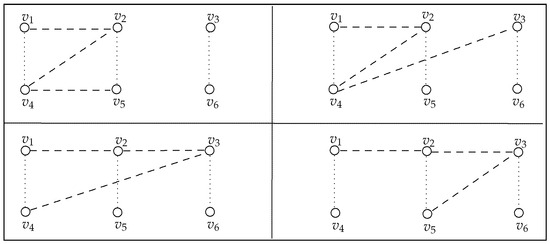
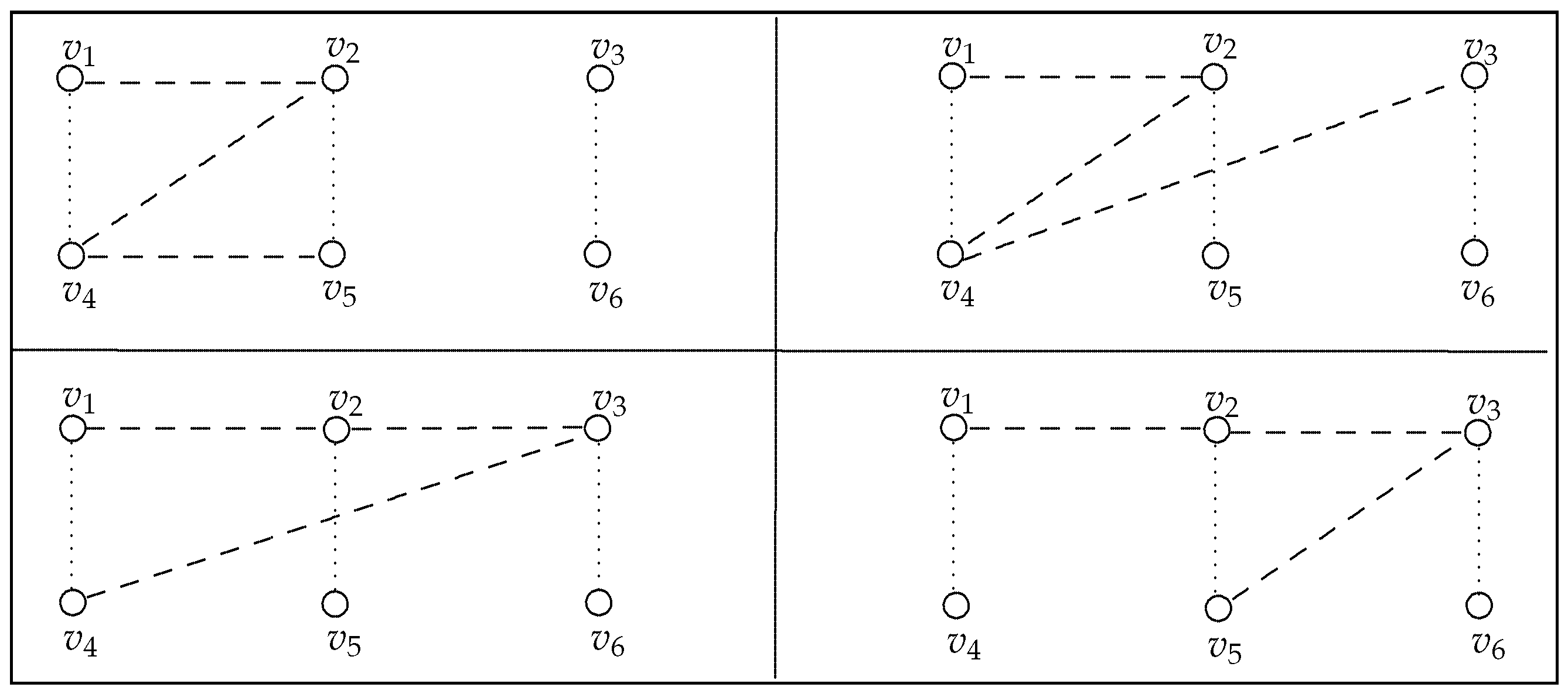
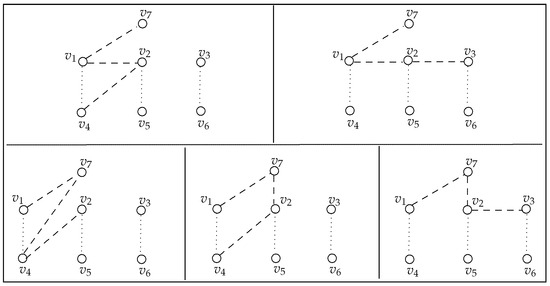
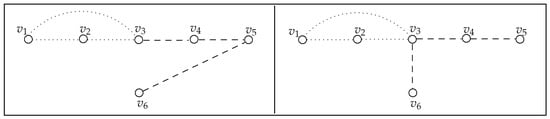
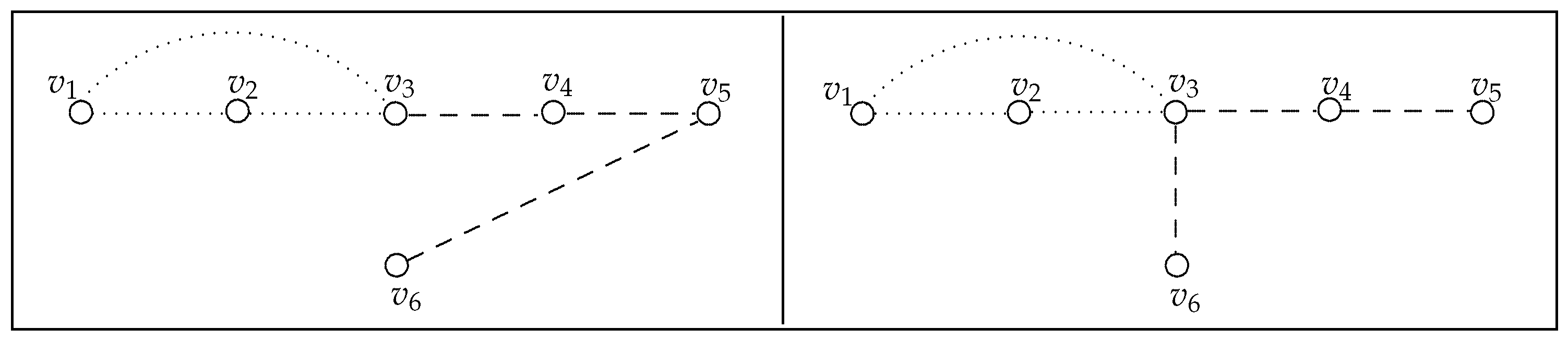
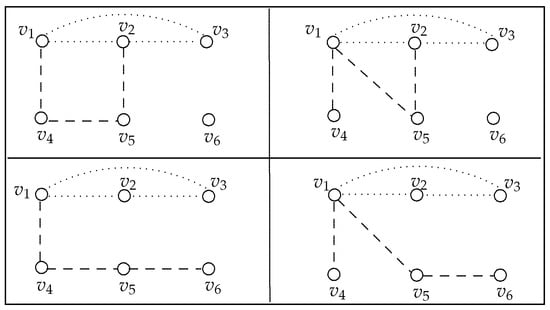
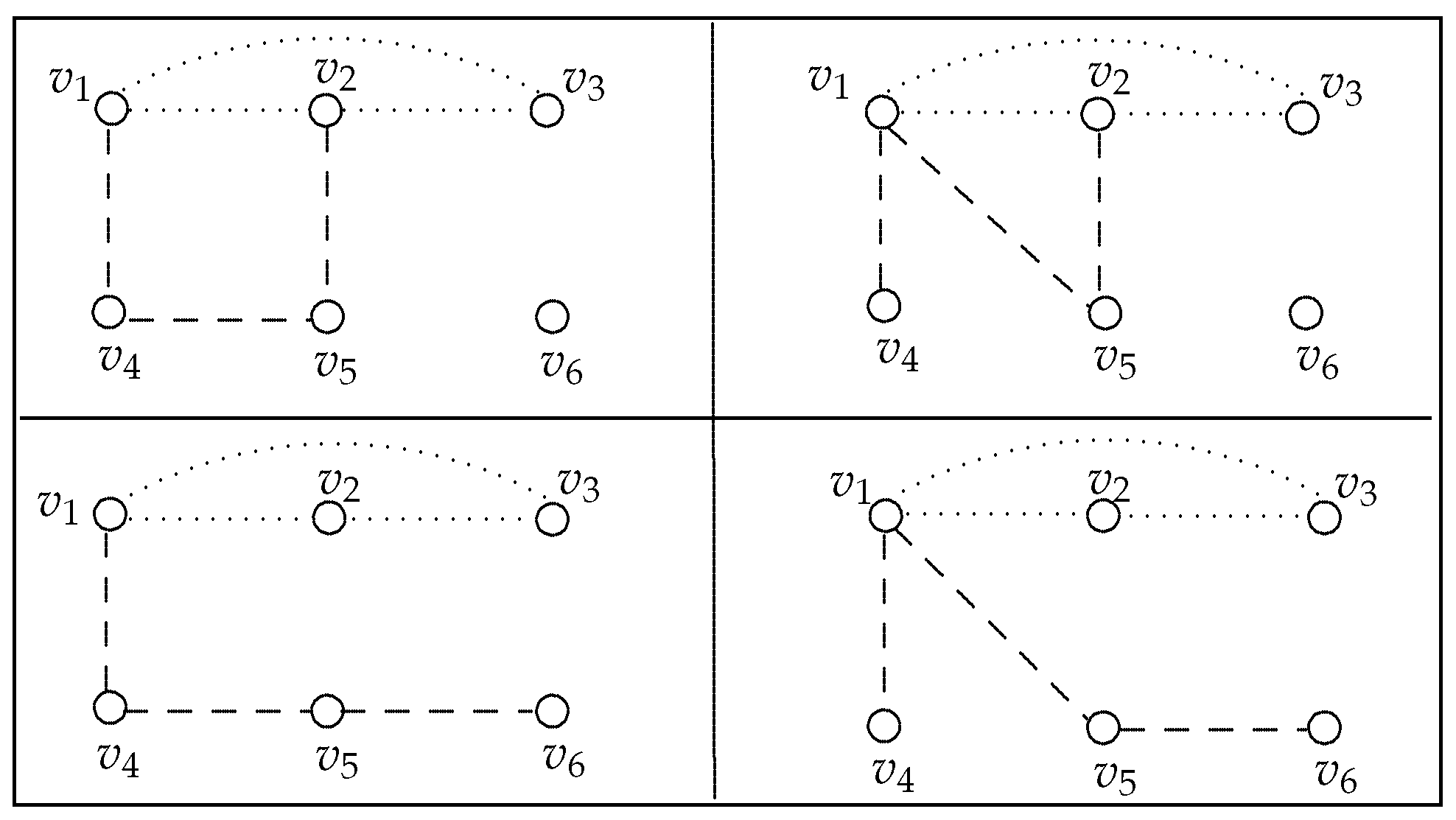
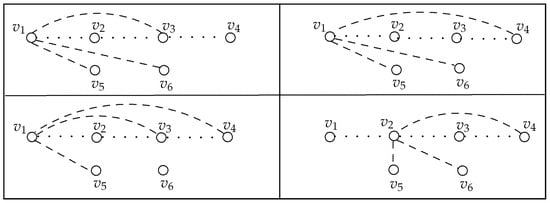
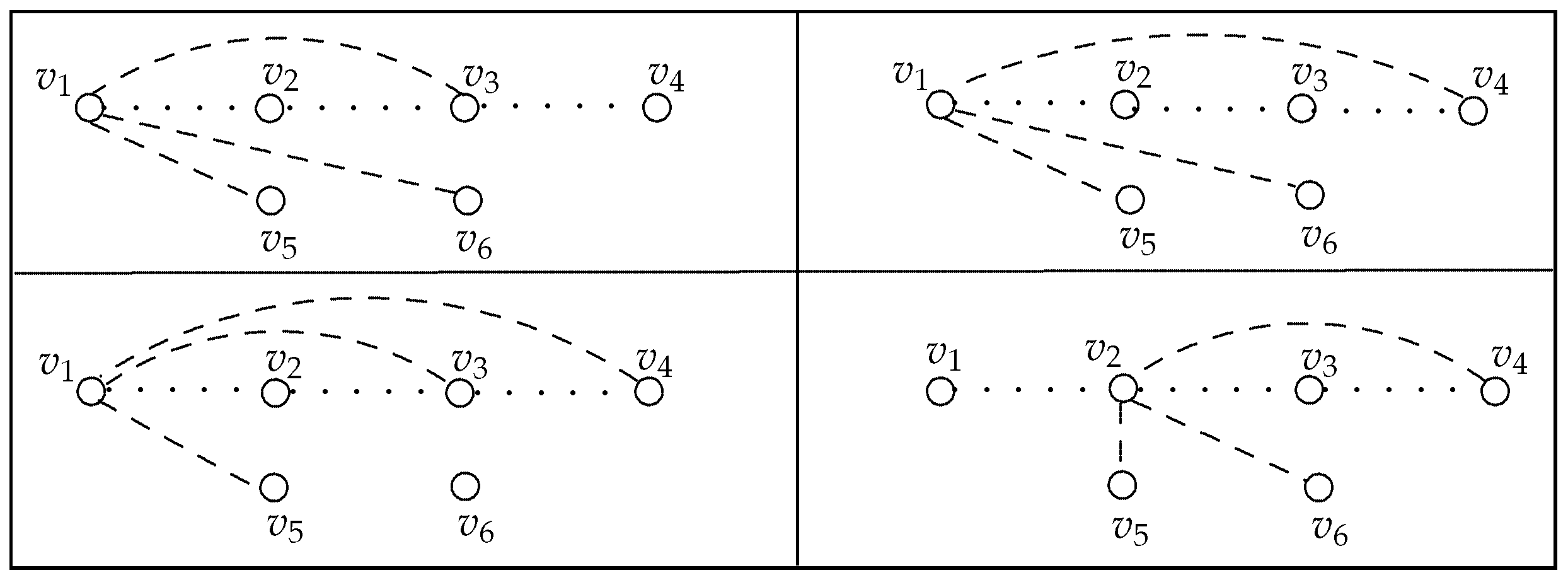
Case 1. . Then . We may assume that is one of the four 4-paths , , , . We consider each of these four possibilities shown in Figure 2, where an edge in is indicated by a dotted line and an edge in is indicated by a dashed line.
Figure 2.
The four possible subgraphs in Case 1.
- If or , then at least two of the three edges have the same color (by the Pigeonhole Principle), say and are red where .
- If or , then at least two of the three edges have the same color, say and are red where .
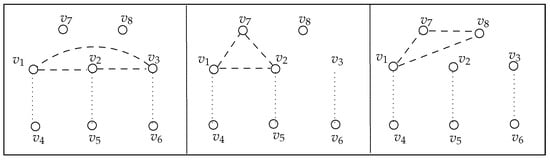
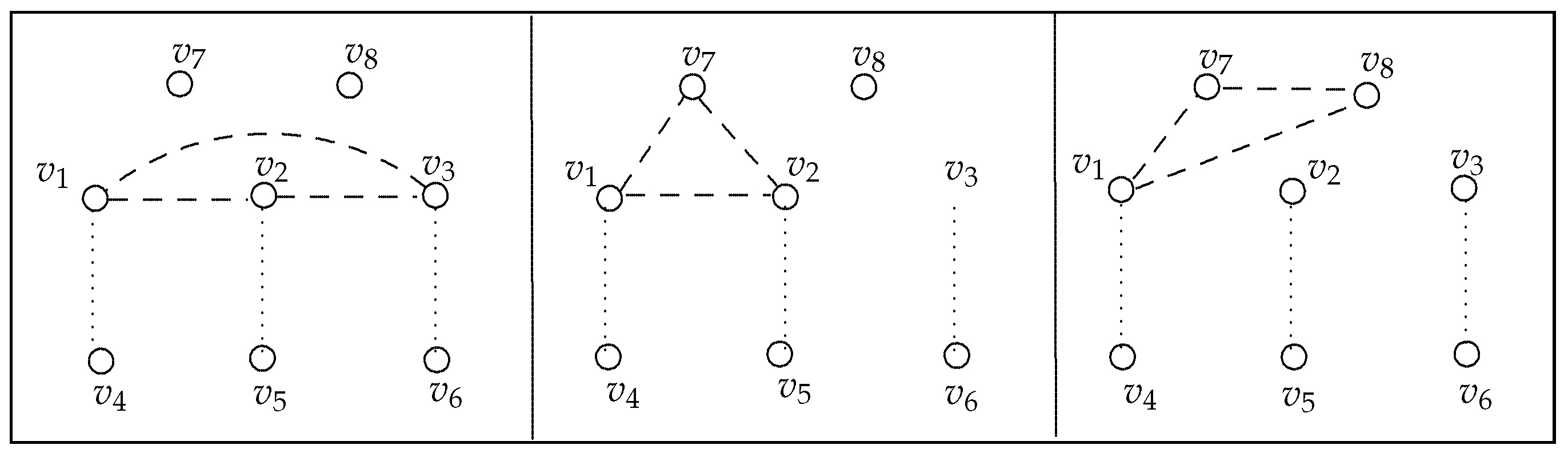
In either case, let . If contains a red edge , then there is a red that is edge-disjoint from and . Thus, we may assume that is blue. First, suppose that . In this situation, at least two of the three edges have the same color.
- ⋆
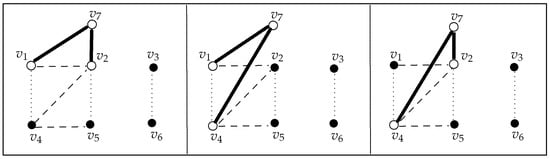
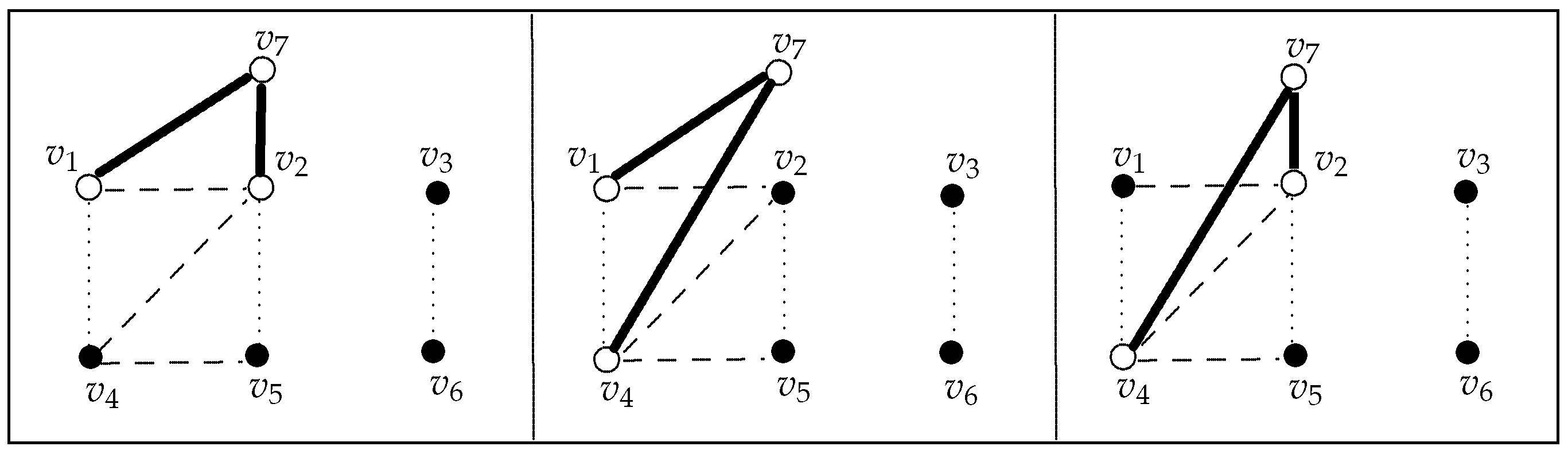
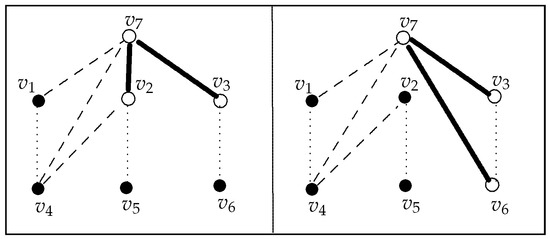
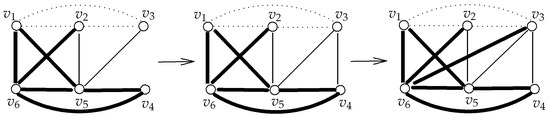
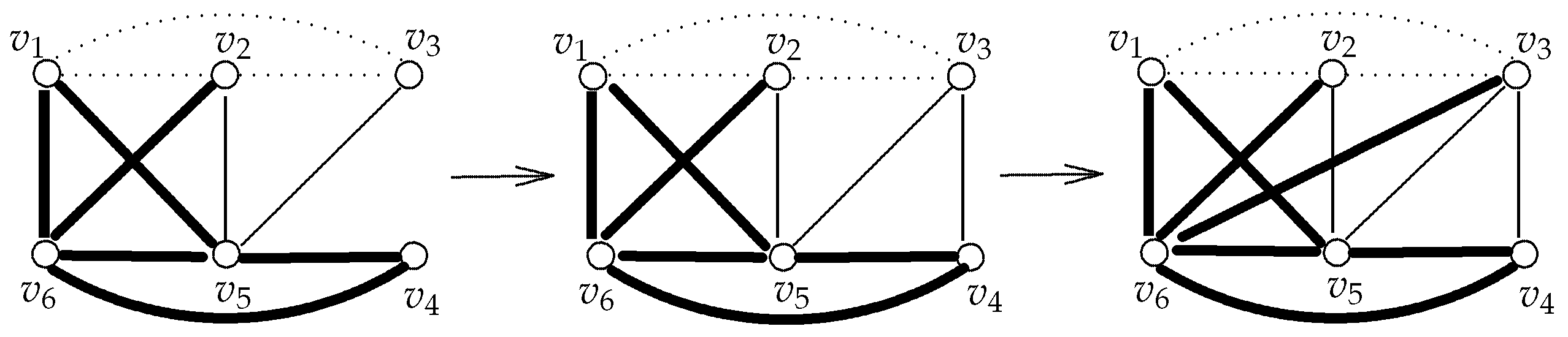
- If and are red, then is blue. Thus, is a blue in that is edge-disjoint from and . If is red, then there is a red that is edge-disjoint from and . If is blue, then there is a blue that is edge-disjoint from and . This is illustrated in the first graph in Figure 3, where the solid vertices represent the four vertices of and a solid line represents a red edge.Figure 3. Illustrating steps in the proof of Case 1 where .
- ⋆
- If and are red, then is blue. By the argument above, we may assume that is blue. Thus, is a blue in that is edge-disjoint from and . If is red, then there is a red that is edge-disjoint from and . If is blue, then there is a blue that is edge-disjoint from and . This is illustrated in the second graph in Figure 3 where the solid vertices indicate the four vertices of .
- ⋆
- If and are red, then is blue. We may assume that is blue. Then is a blue in that is edge-disjoint from and . If is red, then there is a red that is edge-disjoint from and . If is blue, then there is a blue that is edge-disjoint from and . This is illustrated in the third graph in Figure 3 where the solid vertices indicate the four vertices of .
If is one of the other three 4-paths , , and , then we apply the proof technique employed in the situation where and use a similar argument to create pairwise edge-disjoint monochromatic subgraphs and . For example, if , then at least two of the three edges have the same color, say red.
- ⋆
- First, suppose that and are red. Let . If contains a red edge , then there is a red that is edge-disjoint from and . If is blue, then is a blue in that is edge-disjoint from and . If is red, then there is a red that is edge-disjoint from and . If is blue, then there is a blue that is edge-disjoint from and .
- ⋆
- Next, suppose that and are red. Let . If contains a red edge , then there is a red that is edge-disjoint from and . If is blue, then is a blue in that is edge-disjoint from and . If is red, then there is a red that is edge-disjoint from and . If is blue, then there is a blue that is edge-disjoint from and .
- ⋆
- Finally, suppose that and are red. Let . If contains a red edge , then there is a red that is edge-disjoint from and . If is blue, then is a blue in that is edge-disjoint from and . If is red, then there is a red that is edge-disjoint from and . If is blue, then there is a blue that is edge-disjoint from and .
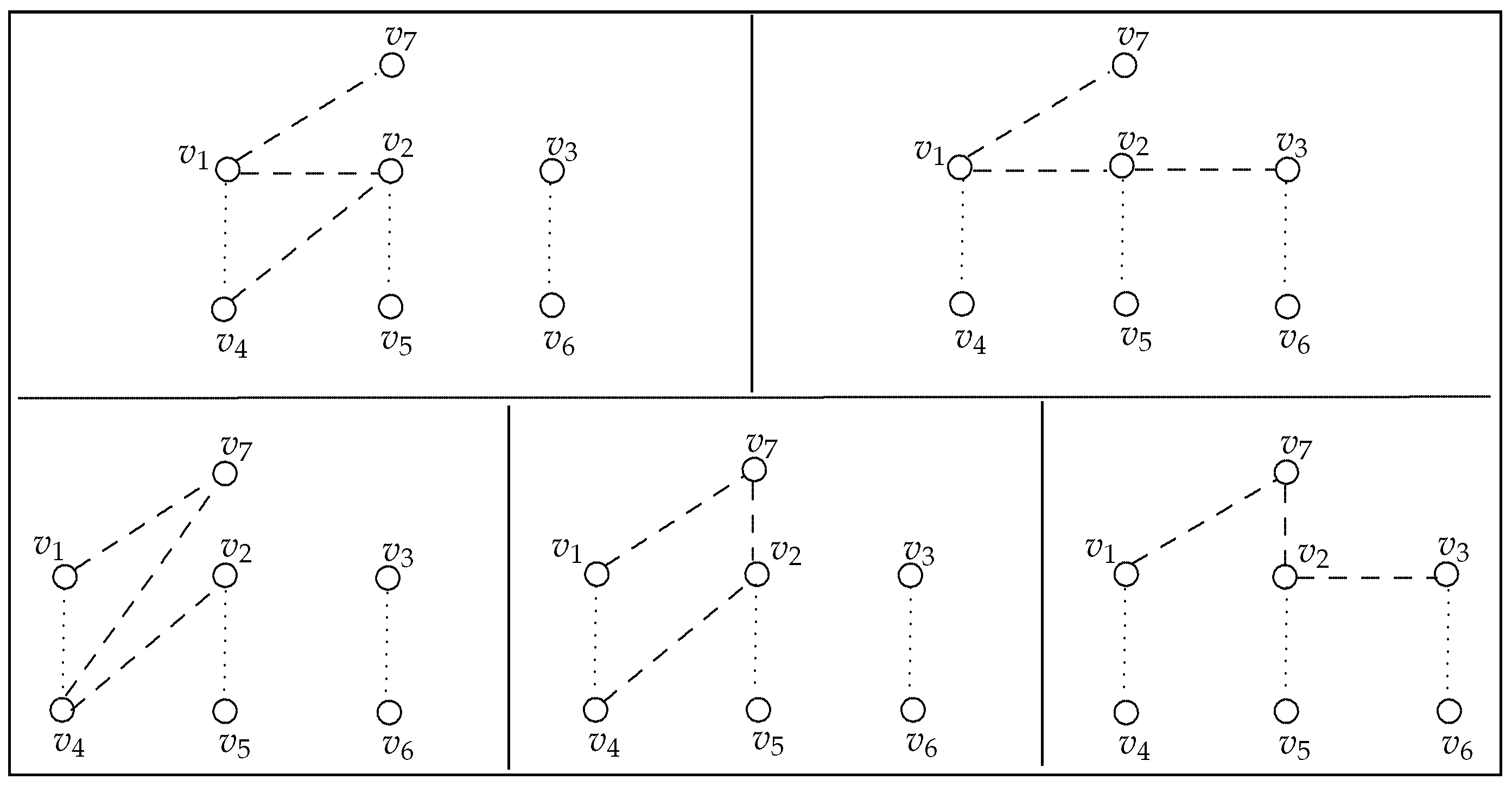
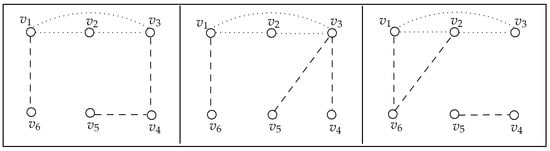
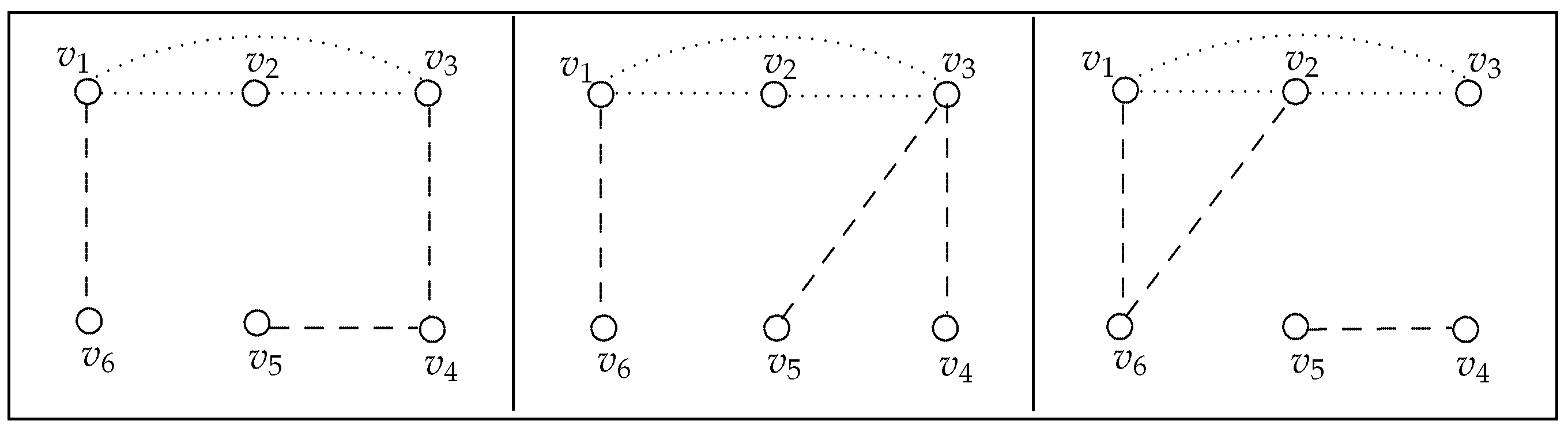
Case 2. . We may assume that is one of the five 4-paths , , , , . We consider each of these five possible 4-paths for shown in Figure 4.
Figure 4.
The five possible subgraphs in Case 2.
- If or , then at least two of the three edges have the same color, say and are red where .
- If , then at least two of the three edges have the same color, say and are red where .
- If , then at least two of the three edges have the same color, say and are red where .
- If , then at least two of the three edges have the same color, say and are red where .
In either case, let . If contains a red edge , then there is a red that is edge-disjoint from and . Thus, we may assume that is blue. As in Case 1, an argument is given only for since the proof technique and the arguments for other choices of are similar. In this situation, at least two of the three edges have the same color.
- ⋆
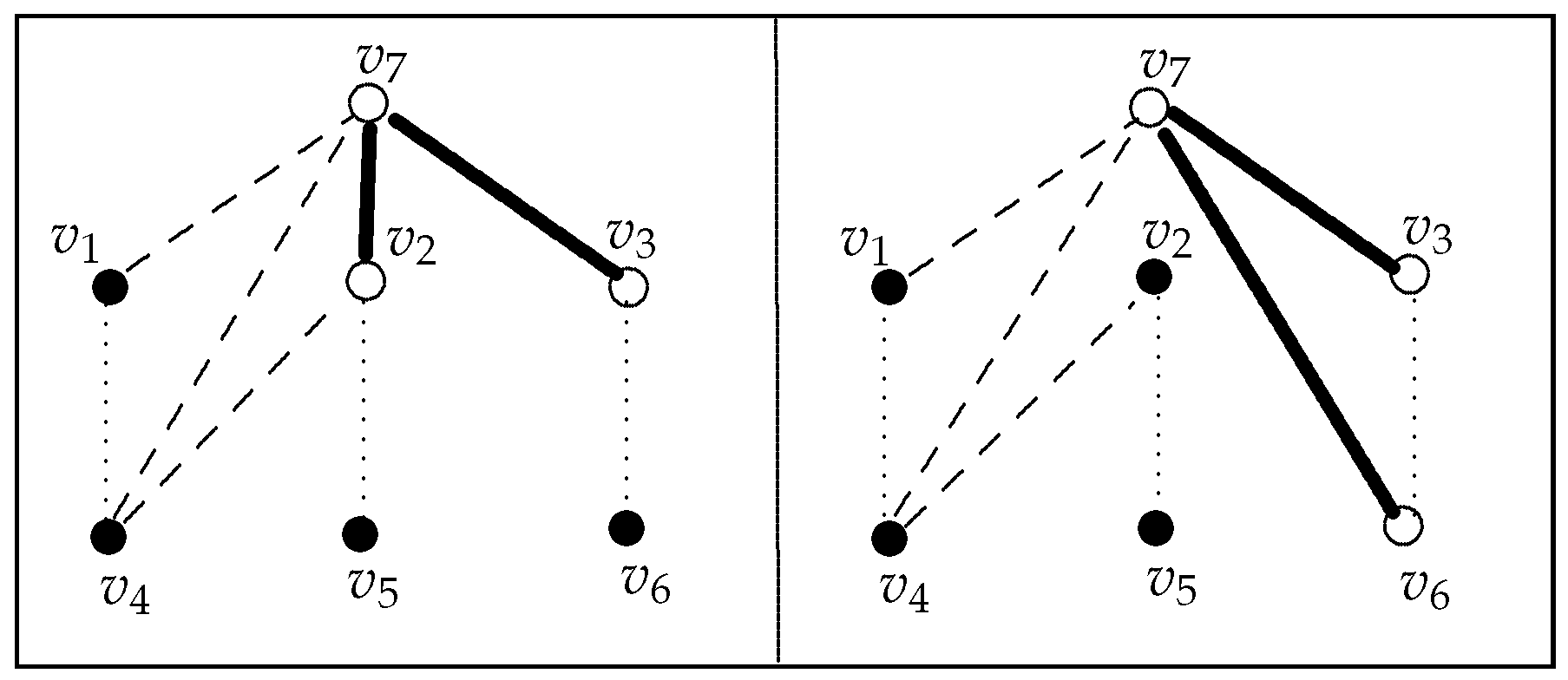
- If and are red or and are red, say the former, then is blue. Thus, is a blue in that is edge-disjoint from and . If is red, then there is a red that is edge-disjoint from and . If is blue, then there is a blue that is edge-disjoint from and . This is illustrated in the first graph in Figure 5 where the four solid vertices represent the vertices of .Figure 5. Illustrating steps in the proof of Case 2 when .
- ⋆
- If and are red, then is blue. We may assume that is blue. Thus, is a blue in that is edge-disjoint from and . If is red, then there is a red that is edge-disjoint from and . Thus, we may assume that is blue. If is red, then there are edge-disjoint monochromatic subgraphs and , where is red and is blue, that are edge-disjoint from . If is blue, then there is a blue , that is edge-disjoint from and . This is illustrated in the second graph in Figure 5 where the four solid vertices represent the vertices of .
□
We are now prepared to determine the strong Ramsey number of the set of the four acyclic graphs of size 3 without isolated vertices.
Theorem 1.
If then .
Proof.
Since , it follows by Proposition 1 that . It remains to show that . Let there be given a red-blue coloring of with . Since by Theorem 2, there are edge-disjoint monochromatic subgraphs and in G, where say . If , where say , then the red-blue coloring of with contains edge-disjoint monochromatic subgraphs and . By Lemma 1, there are pairwise edge-disjoint monochromatic subgraphs , and in G. Since at least three of the seven edges incident with in G have the same color, there is a monochromatic centered at that is edge-disjoint from , and and so . Thus, we may assume that . First, we verify the following claim.
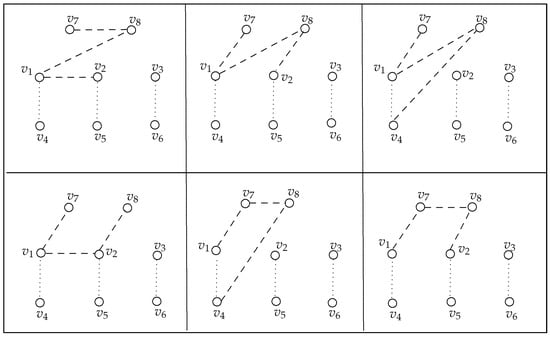
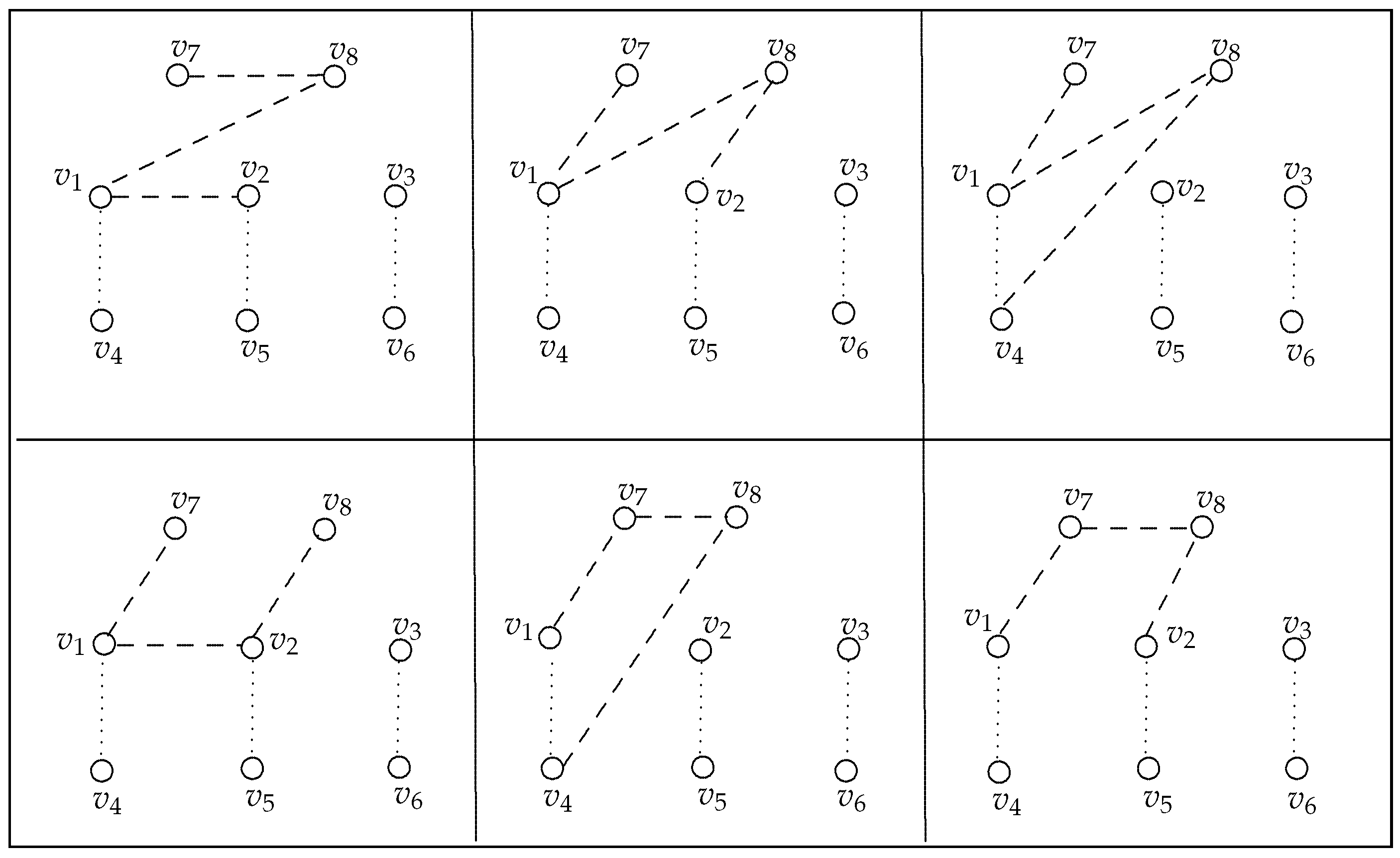
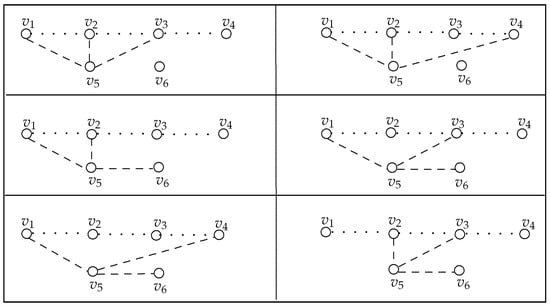
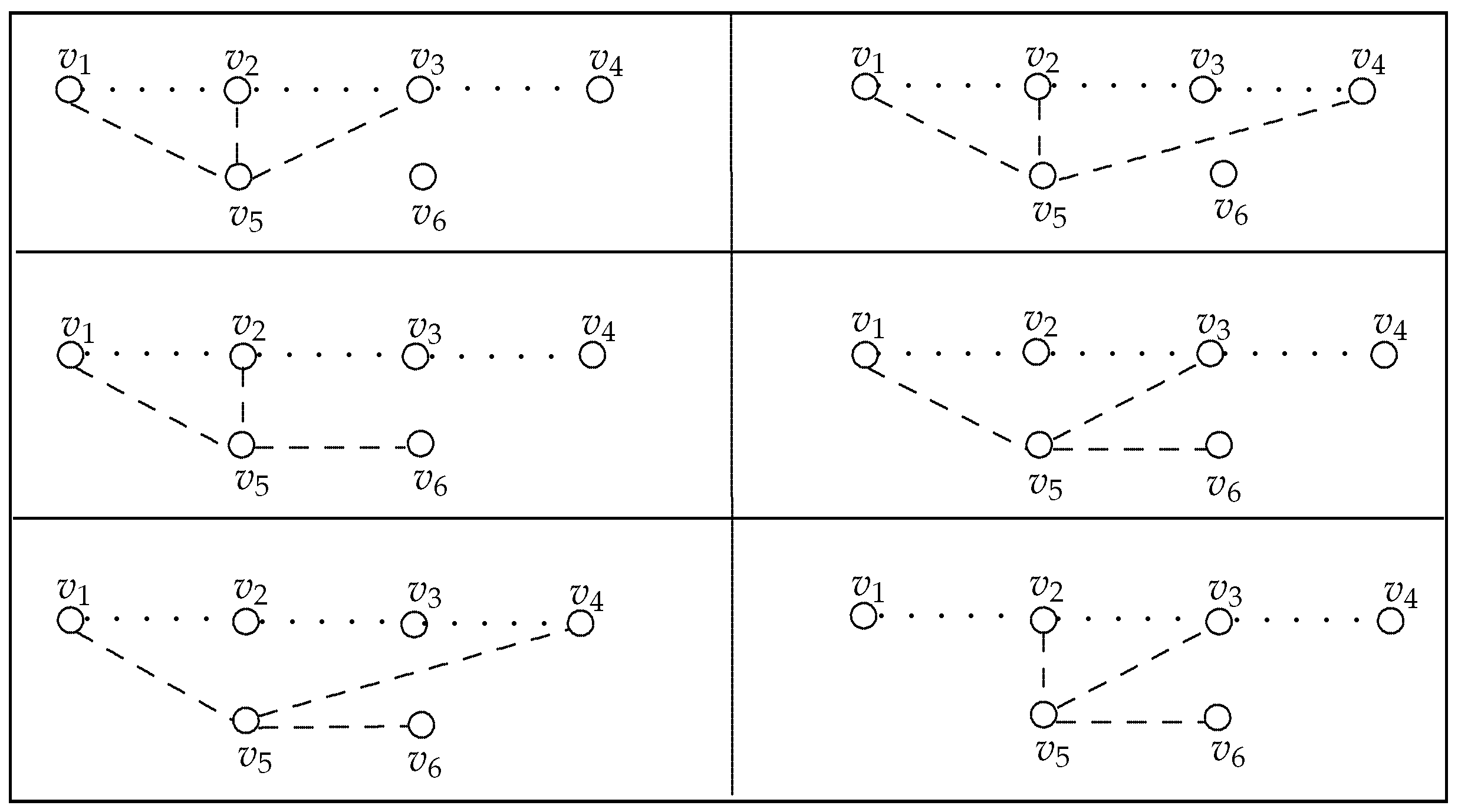
To verify this claim, we may assume that is one of the six 4-paths , , , , , shown in Figure 6.
Figure 6.
The six possible subgraphs in G.
We now consider these six possible 4-paths for . In each of these cases, at least two of the three edges , , have the same color, say and are red where . Let . If contains a red edge , then there is a red that is edge-disjoint from and and . Thus, we may assume that is blue. First, suppose that . At least two of the three edges have the same color, say red.
- ⋆
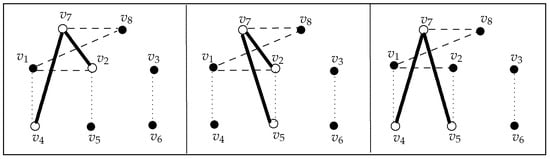
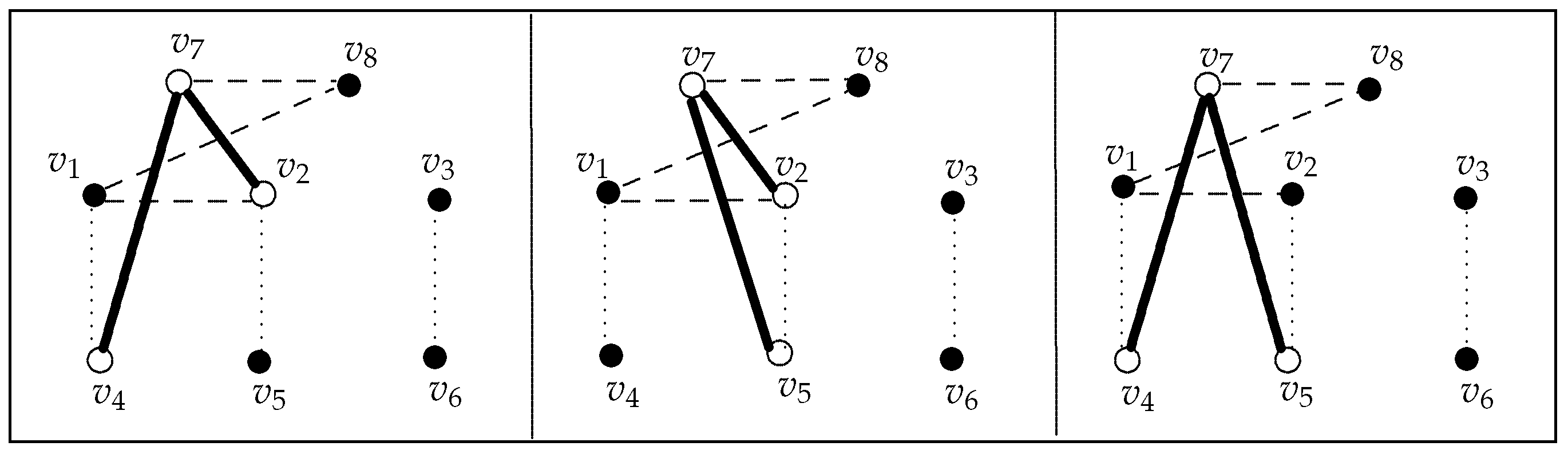
- If and are red, then is blue. If is red, then there are edge-disjoint monochromatic subgraphs and , where is blue and is red, that are edge-disjoint from . If is blue, then there are edge-disjoint blue subgraphs and , where and , that are edge-disjoint from . In either situation, let . The first graph in Figure 7 illustrates this situation where the four solid vertices represent the vertices of .Figure 7. Illustrating the steps in the proof of Theorem 1.
- ⋆
- If and are red, then is blue. If is red, then there are edge-disjoint monochromatic subgraphs and , where is blue and is red, that are edge-disjoint from . If is blue, then there are edge-disjoint blue subgraphs and , where and , that are edge-disjoint from . In either situation, let . The second graph in Figure 7 illustrates this situation where the four solid vertices represent the vertices of .
- ⋆
- If and are red, then is blue. If is red, then there are edge-disjoint monochromatic subgraphs and , where is blue and is red, that are edge-disjoint from . Let . If is blue, then there are edge-disjoint blue subgraphs and , where and , that are edge-disjoint from . Let . The third graph in Figure 7 illustrates this situation where the four solid vertices represent the vertices of .
If is one of the other five 4-paths , , , , , then we apply the proof technique employed in the situation when and use a similar argument to create pairwise edge-disjoint monochromatic subgraphs and such that some vertex v of G is incident with at most two edges in . For example, if , then at least two of the three edges have the same color, say red.
- ⋆
- If and are red, then is blue. If is red, then there are edge-disjoint monochromatic subgraphs and , where is blue and is red, that are edge-disjoint from . If is blue, then there are edge-disjoint blue subgraphs and , where and , that are edge-disjoint from . In either situation, let .
- ⋆
- If and are red, then is blue. If is red, then there are edge-disjoint monochromatic subgraphs and , where is blue and is red, that are edge-disjoint from . If is blue, then there are edge-disjoint blue subgraphs and , where and , that are edge-disjoint from . In either situation, let .
- ⋆
- If and are red, then is blue. If is red, then there are edge-disjoint monochromatic subgraphs and , where is blue and is red, that are edge-disjoint from . Let . If is blue, then there are edge-disjoint blue subgraphs and , where and , that are edge-disjoint from . Let .
This completes the verification of the claim. By the claim, there is a vertex v that is incident with at least five edges in . Since three of these five edges have the same color, there is a monochromatic that is edge-disjoint from , and . Hence, there are pairwise edge-disjoint monochromatic subgraphs , , and in G. Therefore, and so . □
3. The 3-Element Sets of Graphs of Size 3
There are five graphs of size 3 containing no isolated vertices, namely , and and so ten 3-element sets S of graphs of size 3. If , then , while if , then . We show that for every 3-element set S of graphs of size 3 without isolated vertices. It is useful to know the strong Ramsey numbers of all pairs of graphs of size 3 without isolated vertices.
Theorem 2
([13]). If then
We begin with those sets S containing .
3.1. The 3-Element Sets of Graphs of Size 3 Containing 3K2
There are six sets S of graphs of size 3 containing no isolated vertices such that , three of which consist of the acyclic graphs of size 3 and the remaining three contain the triangle . The following is a consequence of Observation 1, Proposition 1, and Theorem 1.
Corollary 1.
If where , then .
Theorem 3.
If where , then .
Proof.
Since by Proposition 1, it remains to show that . Let there be given a red-blue coloring of with . Since by Theorem 2, G contains edge-disjoint monochromatic subgraphs and . We may assume that and is one of the three triangles , , and shown in Figure 8. Since , we consider these three cases.
Figure 8.
The three possible subgraphs in G.
Case 1. . Let . Since , there is a vertex that is incident with at least five edges in and at least three of these five edges have the same color. Hence, there is a monochromatic that is edge-disjoint from and .
Case 2. . At least two of the three edges have the same color, say and are red (since the arguments are similar for other choices of two red edges). If or is red, then there is a red that is edge-disjoint from and . Thus, we may assume that and are blue. Regardless of the color of the edge , there is a monochromatic that is edge-disjoint from and .
Case 3. . First, suppose that or . At least two of the three edges have the same color, say and are red where . If one of the edges in is red, then there is a red in G that is edge-disjoint from and . Thus, we may assume that is a blue . Let . If is blue, then there is a blue that is edge-disjoint from and . Hence, we may assume that is red and so all of are red. If one of and is red, say , then is red that is edge-disjoint from and . Thus, we may assume that and are blue. Then is blue that is edge-disjoint from and .
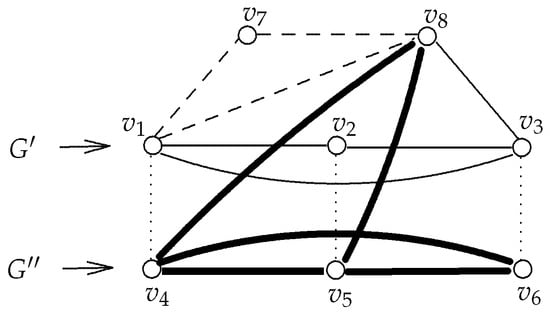
Next, suppose that . At least two of the three edges have the same color, say and are red (since the arguments are similar for other choices of two red edges). If one of the edges in is red, then there is a red in G that is edge-disjoint from and . Thus, we may assume that is a blue . If one of the edges in is blue, then there is a blue in G that is edge-disjoint from and . Thus, we may assume that is a red . If is red, then there is a red that is edge-disjoint from and . Hence, we may assume that is blue. For , this is illustrated in Figure 9, where a red edge is indicated by a solid line and a blue edge is indicated by a thin line. Regardless of the color of , there is a monochromatic that is edge-disjoint from and .
Figure 9.
A step in the proof in Case 3 of Theorem 3.
Hence, for each , there are pairwise edge-disjoint monochromatic subgraphs in G. Therefore, and so . □
In summary, we have the following.
Theorem 4.
If S is a set of three graphs of size 3 without isolated vertices containing , then .
3.2. The 3-Element Sets of Graphs of Size 3 Not Containing 3K2
We now turn to the four 3-element sets S of graphs of size 3 without isolated vertices such that . In this case, . We show that for each such set S. We begin with consisting of the three connected graphs of size 3.
Theorem 5.
If then .
Proof.
Since , it follows by Proposition 1 that . It remains to show that . Let there be given a red-blue coloring of with . Since by Theorem 2, there are edge-disjoint monochromatic subgraphs and in G. If , where say , then at least three of the five edges () have the same color and so there is a monochromatic subgraph that is edge-disjoint from and . We may therefore assume that . Further, we may assume that and is either or , as shown in Figure 10. We consider these two cases.
Figure 10.
The two possible subgraphs in G.
Case 1. . Let . If three edges in X have the same color, then there is a monochromatic in G that is edge-disjoint from and . Thus, we may assume that exactly two edges in X are red, say and are red where . Hence, there are three possibilities. An argument is given only for since the proof technique is the same and the arguments for the choices and are similar.
Suppose that and are red. If both and are red, then there is a red with in G that is edge-disjoint from and . Thus, we may assume that at least one of and is blue, which results in three possibilities.
- ⋆
- First, suppose that is blue and is red. Then is a red and is a blue . If is red, then there are edge-disjoint monochromatic subgraphs and where is blue and is red with that are edge-disjoint from . If is blue, then there are edge-disjoint monochromatic subgraphs and where is red and is blue with that are edge-disjoint from .
- ⋆
- Next, suppose that is red and is blue. Then is a red . If is red, then regardless of the color of , there are edge-disjoint monochromatic subgraphs and that are edge-disjoint from . For example, if is red, then is red and is red with . If is blue, then is blue and is red with . If is blue, then there are edge-disjoint monochromatic subgraphs and where is red and is blue with that are edge-disjoint from .
- ⋆
- Finally, suppose that both and are blue. Then is a blue . If is red, then is red with is edge-disjoint from and . If is blue, then is blue with is edge-disjoint from and .
Case 2. . Let . If three edges in Y have the same color, then there is a monochromatic in G that is edge-disjoint from and . Thus, we may assume that exactly two edges in Y are red, say and are red, where , which results in three possibilities. An argument is given only for since the proof technique is the same and the arguments for the choices and are similar.
Suppose that and are red. If both and are red, then there is a red with in G that is edge-disjoint from and , for otherwise at least one of and is blue, which results in three possibilities.
- ⋆
- First, suppose that is blue and is red. Then is a red and is a blue . Regardless of the color of , there are edge-disjoint monochromatic subgraphs and that are edge-disjoint from .
- ⋆
- Next, suppose that is red and is blue. Then is a red and is a blue . Regardless of the color of , there are edge-disjoint monochromatic subgraphs and that are edge-disjoint from .
- ⋆
- Finally, suppose that both and are blue. Then is a blue . If is red, then there are edge-disjoint monochromatic subgraphs and where is blue and is red with that are edge-disjoint from . If is blue, then there are edge-disjoint blue subgraphs and where and that are edge-disjoint from .
Hence, G contains pairwise edge-disjoint monochromatic subgraphs . Therefore, and so . □
Theorem 6.
If then .
Proof.
Since , it follows by Proposition 1 that . Thus, it remains to show that . Let there be given a red-blue coloring of with . Since by Theorem 2, there are edge-disjoint monochromatic subgraphs and in G. We may assume that and is one of the following three subgraphs , , in G shown in Figure 11. We consider these three possibilities.
Figure 11.
The three possible subgraphs in G.
In each situation, at least two of the three edges have the same color, say (1) and are red, (2) and are red, or (3) and are red. We provide an argument only for (1) since the proof technique is the same and the arguments for (2) and (3) are similar.
First, suppose that . If and are red, then and are blue; for otherwise there is a red that is edge-disjoint from and .
- ⋆
- If is red, then there is a red with . If one of and is red, say , then there is a red that is edge-disjoint from and . If and are blue, then there is a blue that is edge-disjoint from and .
- ⋆
- If is blue, then there is a blue with . If one of and is blue, say , then there is a blue that is edge-disjoint from and . If and are red, then there is a red that is edge-disjoint from and .
Next, suppose that . If and are red, then and are blue; for otherwise there is a red that is edge-disjoint from and .
- ⋆
- If is red, then there is a red with . If one of and is red, say , then there is a red that is edge-disjoint from and . If and are blue, then there are edge-disjoint monochromatic subgraphs and , where is blue with and is red, that are edge-disjoint from .
- ⋆
- If is blue, then there is a blue with . If one of and is blue, say , then there is a blue that is edge-disjoint from and . If and are red, then there is a red that is edge-disjoint from and .
Finally, suppose that . If and are red, then and are blue; for otherwise there is a red that is edge-disjoint from and .
- ⋆
- If is red, then there is a red with . Then is red, for otherwise there is a blue that is edge-disjoint from and . If is red, then there is a red that is edge-disjoint from and . Thus, we may assume that is blue. If is blue, then there are edge-disjoint monochromatic subgraphs and , where is blue with and is red, that are edge-disjoint from . If is red, then there are edge-disjoint red subgraphs with and that are edge-disjoint from . This procedure is illustrated in Figure 12.Figure 12. Illustrating the arguments when is red.
- ⋆
- If is blue, then there is a blue with . Regardless of the color of , there is monochromatic that is edge-disjoint from and .
Thus, there are pairwise edge-disjoint subgraphs in G. Therefore, and so . □
Theorem 7.
If then .
Proof.
Since , it follows by Proposition 1 that . Thus, it remains to show that . Let there be given a red-blue coloring of with . Since by Theorem 2, there are edge-disjoint monochromatic subgraphs and in G. We may assume that and is one of the following four subgraphs , , , in G shown in Figure 13. We consider these four possibilities.
Figure 13.
The four possible subgraphs in G.
In each situation, at least two of the three edges have the same color, namely either (1) and are red, (2) and are red, or (3) and are red. We provide an argument only for (1) since the proof technique is the same and the arguments for (2) and (3) are similar.
First, suppose that . If and are red, then and are blue; for otherwise, say is red, there is a red that is edge-disjoint from and .
- ⋆
- First, suppose that is red. If one of , is blue, say , then there are edge-disjoint monochromatic subgraphs and , where is blue and is red, that are edge-disjoint from . If , are all red, then there are edge-disjoint red subgraphs and that are edge-disjoint from .
- ⋆
- Next, suppose that is blue. If or is red, say , then there are edge-disjoint monochromatic subgraphs and , where is red and is blue, that are edge-disjoint from . If and are blue, there are edge-disjoint blue subgraphs and that are edge-disjoint from .
Next, suppose that . If one of is red, say , then there is a red that is edge-disjoint from and . Thus, we may assume that are blue.
- ⋆
- First, suppose that is red. If or is blue, say the former, then there are edge-disjoint monochromatic subgraphs and , where is blue and is red, that are edge-disjoint from . If and are red, then there are edge-disjoint red subgraphs and that are edge-disjoint from .
- ⋆
- Next, suppose that is blue. If is red, then there are edge-disjoint monochromatic subgraphs and , where is red and is blue that are edge-disjoint from . If is blue, then there are edge-disjoint blue subgraphs and that are edge-disjoint from .
We now assume that . If or is red, say the former, then there is a red that is edge-disjoint from and . Thus, we may assume that and are blue.
- ⋆
- First, suppose that is red. If one of , is blue, say , then there are edge-disjoint monochromatic subgraphs and , where is blue and is red, that are edge-disjoint from . If , are all red, then there are edge-disjoint red subgraphs and that are edge-disjoint from .
- ⋆
- Next, suppose that is blue. If is red, then there are edge-disjoint monochromatic subgraphs and , where is red and is blue, that are edge-disjoint from . If is blue, then there are edge-disjoint blue subgraphs and that are edge-disjoint from .
Finally, suppose that . If one of is red, say , then there is a red that is edge-disjoint from and . Thus, we may assume that are blue.
- ⋆
- First, suppose that is red. If is blue, then there are edge-disjoint monochromatic subgraphs and , where is blue and is red, that are edge-disjoint from . If is red, then there are edge-disjoint red subgraphs and that are edge-disjoint from .
- ⋆
- Next, suppose that is blue. If or is red, say the former, then there are edge-disjoint monochromatic subgraphs and , where is red and is blue, that are edge-disjoint from . If and are blue, then there are edge-disjoint blue subgraphs and that are edge-disjoint from .
Hence, there are pairwise edge-disjoint monochromatic subgraphs in G. Therefore, and so . □
Theorem 8.
If then .
Proof.
Since , it follows by Proposition 1 that . Thus, it remains to show that . Let there be given a red-blue coloring of with . Since by Theorem 2, there are edge-disjoint monochromatic subgraphs and in G. We may assume that . For the location of in G, we consider two cases, according to the location of the center of .
Case 1. The center of is either or , say the former. By symmetry, we may assume that is one of the following six sets , , , , , shown in Figure 14.
Figure 14.
The six possible subgraphs for in Case 1.
We provide an argument only for since the proof technique is the same and the arguments for other choices of are similar. At least two of () have the same color, say red. There are three possibilities.
- First, suppose that and are red. Then is blue, for otherwise there is a red that is edge-disjoint from and .
- ⋆
- If is red, then is blue, for otherwise there are edge-disjoint red subgraphs with and that are edge-disjoint from . Then is red, for otherwise there is a blue that is edge-disjoint from and . Then and are blue, for otherwise, say is red, then there are edge-disjoint red subgraphs with and that are edge-disjoint from . Then that is edge-disjoint from and .
- ⋆
- We now assume that is blue. First, suppose that is red. Then and are blue, for otherwise, say is red, then is edge-disjoint from and . Then there are edge-disjoint monochromatic subgraphs and , where is red with and is blue, that are edge-disjoint from . Next, suppose that is blue. Then and are red, for otherwise, say is blue, then there are edge-disjoint blue subgraphs with and that are edge-disjoint from . If is red, there is a red that is edge-disjoint from and . If is blue, then there are blue subgraphs with and that are edge-disjoint from .
- Next, suppose that and are red. By the argument above, we may assume that is blue. Then and are blue, for otherwise, say is red, there is a red that is edge-disjoint from and .
- ⋆
- If is red, then and are red, for otherwise, say is blue, there is a blue that is edge-disjoint from and . Then there are edge-disjoint red subgraphs with and that are edge-disjoint from .
- ⋆
- If is blue, then there are edge-disjoint blue subgraphs with and that are edge-disjoint from .
- Finally, suppose that and are red. We may assume that is blue. Then and are blue, for otherwise, say is red, there is a red that is edge-disjoint from and .
- ⋆
- First, suppose that is red. If one of is blue, say , then there are edge-disjoint monochromatic subgraphs and , where is blue with and is red, that are edge-disjoint from . If all are red, then there is a red that is edge-disjoint from and .
- ⋆
- Next, suppose that is blue. If is blue, then there are edge-disjoint blue subgraphs with and that are edge-disjoint from . If is red, then there are edge-disjoint monochromatic subgraphs and , where is red with and is blue, that are edge-disjoint from .
Case 2. The center of belongs to . By symmetry, we may assume that is one of the following four sets , , , , shown in Figure 15.
Figure 15.
The four possible subgraphs for in Case 2.
We provide an argument only for since the proof technique is the same and the arguments for other choices of are similar. At least two edges in have the same color, say red. There are three possibilities.
- First, suppose that and are red. Then and are blue, for otherwise, say is red, there is a red that is edge-disjoint from and .
- ⋆
- If is red, then there is a red with . If is red, then there is a red that are edge-disjoint from and . If is blue, then there are edge-disjoint monochromatic subgraphs and , where is blue with and is red, that are edge-disjoint from .
- ⋆
- If is blue, then there is blue that is edge-disjoint from . If or is red, say the former, then there is a red with that is edge-disjoint from and . Thus, we may assume that and are blue. If or is blue, say the former, then there is a blue with that is edge-disjoint from and . If and are red, then there is a red with that is edge-disjoint from and .
- Next, suppose that and are red. By the argument above, we may assume that is blue. Then is blue, for otherwise there is a red that is edge-disjoint from and . This implies that and are red, for otherwise, say is blue, there is a blue that is edge-disjoint from and .
- ⋆
- If is red, then there are edge-disjoint red subgraphs with and that are edge-disjoint from .
- ⋆
- We now assume that is blue. If is red, there is a red is edge-disjoint from and . If is blue, then there are edge-disjoint monochromatic subgraphs and , where is red with and is blue, that are edge-disjoint from .
- Finally, suppose that and are red. We may assume that is blue. Then is blue, for otherwise there is a red that is edge-disjoint from and . This implies that is red, for otherwise there is a blue that is edge-disjoint from and .
- ⋆
- If is red, then there are edge-disjoint red subgraphs with and that are edge-disjoint from .
- ⋆
- We now assume that is blue. If or is red, say the former, then there are edge-disjoint monochromatic subgraphs and , where is red with and is blue, that are edge-disjoint from . If and are blue, then there are edge-disjoint blue subgraphs with and that are edge-disjoint from .
Hence, there are pairwise edge-disjoint monochromatic subgraphs in G. Therefore, and so . □
In summary, we have the following.
Theorem 9.
If S is a set of three graphs of size 3 without isolated vertices not containing , then .
4. Closing Remarks
By Theorems 2, 4, and 9, we have the following result.
Theorem 10.
For every set S of two or three graphs of size 3 without isolated vertices,
By Theorem 1, if S is the set of the four acyclic graphs of size 3 without isolated vertices, then . This brings up the question as to whether this fact holds for the remaining 4-element subsets or the entire set of the five graphs of size 3 without isolated vertices. Furthermore, there is the more general question as to whether this fact can be extended to broader sets of graphs.
Author Contributions
Conceptualization, G.C. and P.Z.; methodology, G.C. and P.Z.; software, P.Z.; validation, G.C. and P.Z.; formal analysis, G.C. and P.Z.; investigation, G.C. and P.Z.; resources, G.C. and P.Z.; data curation, G.C. and P.Z.; writing—original draft preparation, G.C. and P.Z.; writing—review and editing, G.C. and P.Z. All authors have read and agreed to the published version of the manuscript.
Funding
This research received no external funding.
Data Availability Statement
The original contributions presented in this study are included in the article. Further inquiries can be directed to the corresponding author.
Acknowledgments
We thank the anonymous referees whose valuable suggestions resulted in an improved paper.
Conflicts of Interest
The authors declare no conflicts of interest.
References
- Chvátal, V. Tree-complete graph Ramsey numbers. J. Graph Theory 1977, 1, 93. [Google Scholar] [CrossRef] [Scilit]
- Graham, R.L.; Rothschild, B.L.; Spencer, J.H. Ramsey Theory, 2nd ed.; Wiley: New York, NY, USA, 2013. [Google Scholar]
- Greenwood, R.E.; Gleason, A.M. Combinatorial relations and chromatic graphs. Canad. J. Math. 1955, 7, 1–7. [Google Scholar] [CrossRef] [Scilit]
- Radzisowski, S.P. Small Ramsey numbers. Electron. J. Combin. 2026. Available online: https://www.cs.rit.edu/~spr/ElJC/sur.pdf (accessed on 24 June 2026).
- Robertson, A. Fundamentals of Ramsey Theory; Chapman and Hall/CRC: New York, NY, USA, 2021. [Google Scholar]
- Soifer, A. The New Mathematical Coloring Book, 2nd ed.; Springer: New York, NY, USA, 2024. [Google Scholar]
- Beineke, L.W.; Schwenk, A.J. On a bipartite form of the Ramsey problem. In Proceedings of the Fifth British Combinatorial Conference, Aberdeen, UK, 14–18 July 1975; pp. 17–22. [Google Scholar]
- Bialostocki, A.; Voxman, W. Generalizations of some Ramsey-type theorems for matchings. Discret. Math. 2001, 239, 101–107. [Google Scholar] [CrossRef] [Scilit]
- Conlon, D.; Nenadov, R.; Trujić, M. The size-Ramsey number of cubic graphs. Bull. Lond. Math. Soc. 2022, 54, 2135–2150. [Google Scholar] [CrossRef] [Scilit]
- Eroh, L. Rainbow Ramsey Numbers. Ph.D. Thesis, Western Michigan University, Kalamazoo, MI, USA, 2000. [Google Scholar]
- Jent, E. Multiple Monochromatic Subgraphs in Edge-Colored Graphs. Ph.D. Thesis, Western Michigan University, Kalamazoo, MI, USA, 2025. [Google Scholar]
- Olejniczak, D. Variations in Ramsey Theory. Ph.D. Thesis, Western Michigan University, Kalamazoo, MI, USA, 2018. [Google Scholar]
- Chartrand, G.; Zhang, P. Strong Ramsey numbers of graphs. Electron. J. Math. 2026, 11, 141–153. [Google Scholar] [CrossRef] [Scilit]
- Ramsey, F.P. On a problem of formal logic. Proc. Lond. Math. Soc. 1930, 30, 264–286. [Google Scholar] [CrossRef] [Scilit]
- Chartrand, G.; Zhang, P. Strong Ramsey numbers of graphs of size 4. Mathematics 2026, 14, 2158. [Google Scholar] [CrossRef] [Scilit]
- Burr, S.A. Diagonal Ramsey numbers for small graphs. J. Graph Theory 1983, 7, 57–67. [Google Scholar] [CrossRef] [Scilit]
- Chartrand, G.; Zhang, P. Chromatic Graph Theory, 2nd ed.; Chapman & Hall/CRC Press: Boca Raton, FL, USA, 2020. [Google Scholar]


Disclaimer/Publisher’s Note: The statements, opinions and data contained in all publications are solely those of the individual author(s) and contributor(s) and not of MDPI and/or the editor(s). MDPI and/or the editor(s) disclaim responsibility for any injury to people or property resulting from any ideas, methods, instructions or products referred to in the content. |
© 2026 by the authors. Licensee MDPI, Basel, Switzerland. This article is an open access article distributed under the terms and conditions of the Creative Commons Attribution (CC BY) license.