


Abstract
The robotic grasping problem is firstly cast as a linear complementarity problem and reformulated into nonsmooth equations. We propose two block Kaczmarz methods to solve the equations. The K-means clustering algorithm is utilized to partition the nonsmooth equations. Based on the resulting block information, the subgradient greedy randomized Kaczmarz method and the subgradient multi-step greedy Kaczmarz method are constructed. Asymptotic convergence of the proposed block subgradient Kaczmarz methods is given. Numerical results confirm the superior computational accuracy of the new methods.
Keywords:
robotic grasping problem; complementarity problem; Kaczmarz method; clustering algorithm; convergence MSC:
65H10; 90C33
1. Introduction
Robotic grasping lies at the heart of manipulation pipelines that integrate perception, grasp-pose generation, trajectory planning, constraint satisfaction, contact resolution, and feedback control. Recent progress has notably improved perception and grasp planning. Category-level semantically aware methods strengthen generalization through task-related semantics [1], while occlusion-aware grasping explicitly models occlusion and scene context to boost prediction and execution reliability [2]. These works stress the tight coupling between visual perception, high-level grasp planning, and physical hand–object contact. Executing a grasp further involves online numerical computation, manipulator control, and collision avoidance. Robust zeroing neural networks tackle online dynamic matrix solving and trajectory tracking under disturbances and noise [3]. For uncertain manipulators, an Udwadia-based adaptive robust constraint-following framework delivers prescribed tracking performance despite time-varying uncertainties and sensor noise [4]. At the motion-planning level, parallel model predictive path-integral control with a gradient–velocity-modulated signed-distance-field cost enables real-time motion in dynamic obstacle environments [5]. Taken together, these studies demonstrate that grasp planning, trajectory tracking, constraint enforcement, and obstacle avoidance form a tightly interwoven core of robotic manipulation.
During robotic grasping, the interplay between grasping displacement and contact force exhibits a complementary relationship. By incorporating the equilibrium equation, friction law, contact and slip condition, maximum dissipation principle, as well as material deformation principle, the grasping process can be formulated as a complementarity problem [6,7,8]. Through linearization of the friction law, the grasping problem can be further expressed as a linear complementarity problem model [9,10]. With the model, efficient numerical approaches can be used to compute grasping physical quantities, such as grasping stability [11], contact force [8], slippage damage, and so on.
The coefficient matrix of the linear complementarity problem often fails to satisfy the convergence conditions required by conventional solution methods, such as projection [12] or modulus-based matrix splitting [13] iterations. To address this problem, the linear complementarity problem is reformulated as an equivalent system of nonsmooth equations [14]. By integrating the subgradient Newton method with the Kaczmarz algorithm, we establish an effective novel numerical approach to obtain the minimum-norm solution that satisfies the complementarity condition. Here, the most crucial work is designing an appropriate Kaczmarz iterative algorithm.
Ansorge [15] pioneered the greedy residual Kaczmarz algorithm by incorporating a greedy row-selection strategy that prioritizes the equation with the maximal residual component at previous iterations. Strohmer [16] established the exponential convergence rate for a randomized row-selection strategy, which inspired numerous subsequent refinements and extensions. Nutini [17] demonstrated that employing a non-uniform probability distribution for row selection converges at least as rapidly as using a uniform distribution. Bai [18] pioneered the greedy randomized Kaczmarz algorithm by embedding a residual-guided randomized sampling mechanism via a predefined index set. Critically, these algorithms employ exactly one equation per iteration.
Concurrently, block Kaczmarz variants have emerged as a prominent research direction. Needell [19] formulated the theoretical foundation for convergence in block-iterative Kaczmarz methods by deriving orthogonal projection onto a subspace defined by multiple rows of the system matrix. Building on this, Needell [20] proposed the Randomized Block Kaczmarz algorithm. Integrating a residual-guided greedy randomized sampling mechanism into the Randomized Block Kaczmarz framework, Liu [21] presented the Greedy Randomized Block Kaczmarz algorithm for iterative linear system resolution. Jiang [22,23] incorporated the clustering algorithm into the block Kaczmarz framework. More recently, Xiao [24] extended the block greedy Kaczmarz method to systems of smooth nonlinear equations, and further applied it to nonlinear signal recovery problems [25].
The Newton Subgradient Nonsmooth Greedy Randomized Kaczmarz (NSNGRK) method [26] and the Newton Subgradient Nonsmooth Multi-Step Greedy Randomized Kaczmarz (NSNMGK) method [27] have been employed to compute grasp-related parameters such as grasping forces and relative displacement in robotic grasping problems. We aim to enhance solution accuracy by integrating a block-wise framework based on the K-means clustering algorithm into the aforementioned methods and accordingly propose the Block Newton-Subgradient Nonsmooth Greedy Randomized Kaczmarz (BNSNGRK_k) method and the Block Newton-Subgradient Nonsmooth Multi-Step Greedy Kaczmarz (BNSNMGK_k) method. In these approaches, the residuals are partitioned into several clusters based on Euclidean distance. By integrating a greedy block-selection strategy, this approach prioritizes iteration on blocks containing rows corresponding to larger residual components, thereby promoting more accurate solutions.
This paper proceeds as follows: Section 2 formalizes essential mathematical preliminaries and foundational lemmas. Section 3 details the construction of the proposed block subgradient greedy Kaczmarz methods and derives their convergence guarantees. Section 4 validates computational efficacy through numerical experiments. Section 5 concludes with a comprehensive summary of key contributions.
2. Problem Description and Preliminaries
The linear complementarity problem arising from multi-fingered robotic grasping can be expressed as
Here, is the right-hand-side vector, and and form a pair of complementary vectors. The coefficient matrix has the following block structure:
where , , and are matrix blocks of compatible dimensions, and denotes a zero matrix of the appropriate size.
A key tool for reformulating such problems is the Fisher–Burmeister function which possesses the equivalence property Using this function, the complementarity problem is recast as a root-finding problem for the nonsmooth vector equation
To solve this nonsmooth equation, a subgradient Newton approach is employed, which requires computing the generalized Jacobian matrix of . Here, is evaluated efficiently via a dual-number automatic differentiation scheme [28]. A dual number z is defined as , where are the primal and tangent components, respectively, and satisfies . For a nonsmooth vector function , the ith column of is obtained by perturbing the ith input direction: let where is the ith standard basis vector. Substituting into gives the dual expansion where is precisely the tangent part of the output. Extracting this tangent component for each and assembling the results column-wise yields the full generalized Jacobian matrix .
Let denote the cardinality of a set , and define . For a vector x, denotes the Euclidean norm. For , define and as the minimum and maximum singular values, respectively, and denote and as the spectral and Frobenius norms and as the submatrix formed by the rows indexed by the set .
Definition 1
([29]). Let ϕ be a proper convex function and point . A vector is called a subgradient of at if it satisfies
The set of all such vectors,
is called the subdifferential of ϕ at .
Definition 2
([30]). Let be a locally Lipschitz function. The generalized Jacobian of Φ at a point z, denoted , is defined by
where denotes the set of points at which Φ is differentiable, and conv represents the convex hull.
Definition 3
([31]). A matrix satisfies the row lower bound property if there exists such that
Definition 4
([31]). A function satisfies the local tangential cone condition if there exists such that for all and ,
The parameter in the local tangential cone condition is understood as a uniform upper bound within a neighborhood of a solution rather than as a global constant valid over the entire iteration trajectory. Its value may depend on the nonlinear mapping, the selected generalized Jacobian, and the local neighborhood under consideration. In the numerical experiments, the iteration-dependent quantity is used only as an empirical diagnostic of the local linearization error and should not be identified with a rigorously established global value of .
Lemma 1
([32]). The Fisher–Burmeister function is smooth everywhere except at the origin and is locally Lipschitz continuous.
Lemma 2
([33]). Let have full column rank. Then for all ,
Lemma 3
([26]). Let be a nonsmooth function satisfying the local tangential cone condition at point . If , then for , there exists a subgradient such that
3. Block Subgradient Greedy Kaczmarz Method Based on K-Means Clustering and Convergence Analysis
The condition number of the generalized Jacobian matrix directly governs both the convergence accuracy and the convergence rate of the Kaczmarz method [34]. In the block variant, the convergence behavior is related to the condition numbers of the block Jacobian matrices . An appropriate partition may produce block Jacobian matrices with better conditioning than the complete Jacobian matrix, thereby improving the efficiency of the block projection steps.
The K-means clustering algorithm provides an effective approach for partitioning the equations into coherent blocks. In this work, K-means is applied to the rows of the generalized Jacobian matrix. Rows with similar subgradient characteristics are assigned to the same block. The residual vector is not included in the clustering data, thereby avoiding the scale and dimensional inconsistency between derivative information and function values.
The following presents the core derivation and design analysis of the algorithm. First, we utilize the central difference scheme with an optimal step size to numerically replicate the key properties of the dual-number method—specifically, the function value from the real part and the derivative from the tangent part. For the current iterate , a small perturbation (the square root of machine precision) is chosen. The i-th column of the numerical generalized Jacobian is then constructed as
where is the i-th unit vector. By constructing each column sequentially, an approximate generalized Jacobian matrix is obtained. This matrix effectively captures the differential characteristics of at , forming the foundation for the subsequent block Newton iterations.
Denote the residual at the current iterate by . At each outer iteration, K-means is applied only to the rows of the current generalized Jacobian matrix . Using the sum of squared Euclidean distances as the clustering criterion, the row indices are partitioned into p disjoint blocks,
For the i-th block, its Jacobian centroid is defined by
Since the K-means centroid is generally not an actual row of , we select the row in the block that is closest to the centroid:
The representative Jacobian row and its corresponding representative residual are then defined as Thus, and are associated with the same original nonsmooth equation. The representative quantities of all blocks are assembled as
These representative quantities are used for greedy block filtering and randomized block selection. Inspired by the greedy randomized Kaczmarz method, the threshold is defined as
The candidate block set is given by
A block is selected with probability
Since the residual vector does not participate in the K-means distance, the convergence of toward zero does not cause scale degeneration in the clustering metric. Nevertheless, residual information is retained in the greedy filtering and randomized block-selection rules.
Finally, after the block index has been selected using the representative quantities, the actual iteration is performed using the complete Jacobian submatrix and the complete residual subvector . The block Newton–Kaczmarz update is
The Moore–Penrose pseudoinverse ensures that the update remains well defined when the selected Jacobian block is rank-deficient. Therefore, the representative Jacobian rows and residuals are used only for block selection, whereas all equations in the selected block are used in the solution update.
After each iteration, the residual is updated as . The generalized Jacobian is recomputed and its rows are re-clustered at each outer iteration. The procedure terminates when , at which point an approximate solution of the nonsmooth system is obtained. We refer to the resulting method as the BNSNGRK_k algorithm. Its complete computational procedure is presented in Algorithm 1.
To fully utilize the greedy condition, we extend the BNSNGRK_k method by modifying its block-selection strategy within each iteration. Instead of choosing only one block per iteration, the proposed variant sequentially utilizes all matrix blocks that satisfy the greedy criterion as working row blocks. This multi-step update scheme gives rise to the BNSNMGK_k method. The complete computational steps of BNSNMGK_k are summarized in Algorithm 2.
We now establish the convergence of the proposed methods. First, we present some key lemmas.
Lemma 4.
Let be a nonsmooth vector-valued function satisfying the local tangential cone condition, and let denote its Clarke generalized Jacobian. For any and with ,
and
Proof.
Applying Lemma 3 component-wise to each yields
thus proving the first inequality.
For the second inequality, we begin with the derived bound and apply the reverse triangle inequality:
Rearranging terms gives
□
| Algorithm 1 Block Newton-Subgradient Nonsmooth Greedy Randomized Kaczmarz with K-means (BNSNGRK_k) |
| Require: Coefficient matrix , vector , tolerance , initial iterate |
| Ensure: Approximate solution |
|
| Algorithm 2 Block Newton-Subgradient Nonsmooth Multi-Step Kaczmarz with K-means (BNSNMGK_k) |
| Require: Coefficient matrix , vector , number of clusters p, tolerance , initial iterate |
| Ensure: Approximate solution |
|
Lemma 5.
Let be a nonsmooth vector-valued function satisfying the local tangential cone condition, with
Assume that there exists such that
At the k-th iteration, let denote the selected block. Suppose that there exist a representative subgradient and a consistency parameter such that
where
Consider the iteration
If
then
where
and denotes the spectral condition number.
Proof.
For simplicity, denote
Since
expanding the squared Euclidean norm gives
Substituting
yields
Using
and
we obtain
Applying the Cauchy–Schwarz inequality gives
By the local tangential cone condition,
Furthermore,
Therefore,
Using
we obtain
By the definition of ,
From the consistency condition, for every ,
and
In particular,
Hence,
Therefore,
The requirement is a sufficient condition for the error bound derived above to be strictly contractive. It is not a necessary condition for the convergence of the numerical method. In particular, when , the present estimate cannot certify a contraction at that iteration, but this does not imply that the iteration necessarily diverges. It should also be emphasized that the spectral condition number in is associated with the selected Jacobian submatrix rather than with the complete saddle-point matrix. Consequently, an ill-conditioned full system may still contain selected local blocks with moderate condition numbers. Nevertheless, the block partition does not guarantee that every selected submatrix is well conditioned, and the condition should therefore be interpreted as a local and conditional assumption.
Using the above lemmas, the following two convergence theorems can be readily proven.
Theorem 1.
Let be a nonsmooth function defined on a compact domain . Assume satisfies , and for all , Φadmits a Clarke generalized Jacobian . The sequence generated by BNSNGRK_k converges to with the expected squared error satisfying
for , where and denote spectral and Frobenius condition numbers, respectively.
Proof.
Let
and let denote the information generated before the block selection at iteration k. By Lemma 5, the update associated with the selected block satisfies
where
Taking the conditional expectation with respect to the block-selection probability and using the definition of the greedy candidate set gives the corresponding normalized residual bound. Together with the block-consistency estimate in Lemma 5, this yields
By Lemma 4,
Furthermore,
Since
we obtain
Taking the total expectation proves the stated result. The conditional expectation argument follows the same principle as that used for the NSNGRK method in [26]. □
Theorem 2.
Let be a nonsmooth function defined on a compact domain . Assume satisfies , and for all , Φadmits a Clarke generalized Jacobian . The sequence generated by BNSNMGK_k converges to with error decay satisfying
for , where are problem-specific positive parameters associated with the multi-step update scheme.
Proof.
Let
and define
For the j-th inner block update, Lemma 5 gives
where denotes the nonnegative error-decrease term obtained from Lemma 5 for the block used in the j-th inner update. Summing these inequalities over all inner updates gives the telescoping relation
Since
it remains to estimate the sum of the inner error decreases. Using Lemma 4, the consistency estimate in Lemma 5, and the definitions of , , and , we obtain
Substituting this estimate into the telescoping relation yields
This is the claimed estimate. The telescoping multi-step argument is analogous to the analysis of the NSNMGK method in [27]. □
A comparison of the convergence results for the NSNGRK method and the BNSNGRK_k method (Theorem 1) reveals a critical refinement: the convergence bound for the block-based method incorporates the squared spectral condition number of the current block Jacobian. Given that is positive and typically small, the following inequality holds
This demonstrates a strictly smaller contraction factor for the block greedy strategy. Therefore, when solving the nonsmooth nonlinear system with a Kaczmarz-type iteration, employing a greedy rule to select row blocks after partitioning yields faster convergence than applying a greedy rule to individual rows alone.
4. Experimental Results
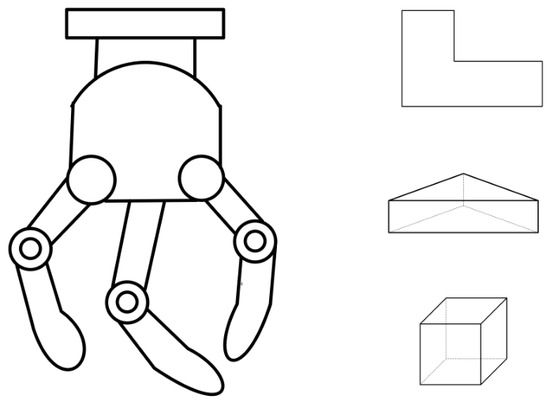
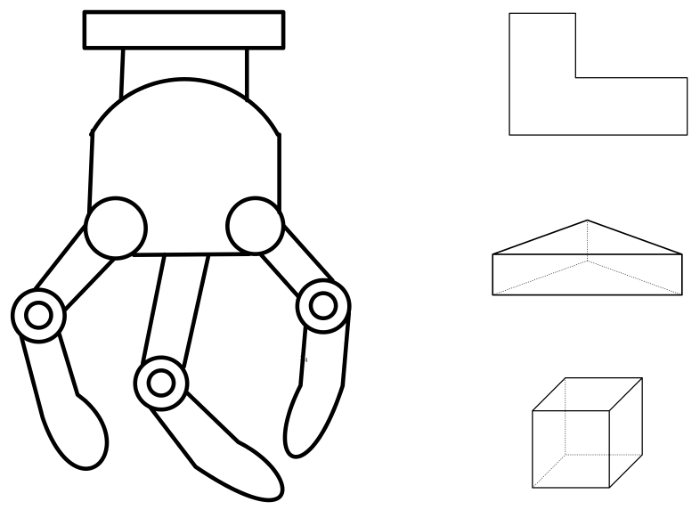
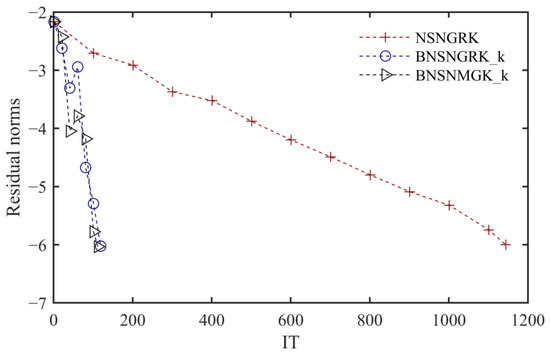
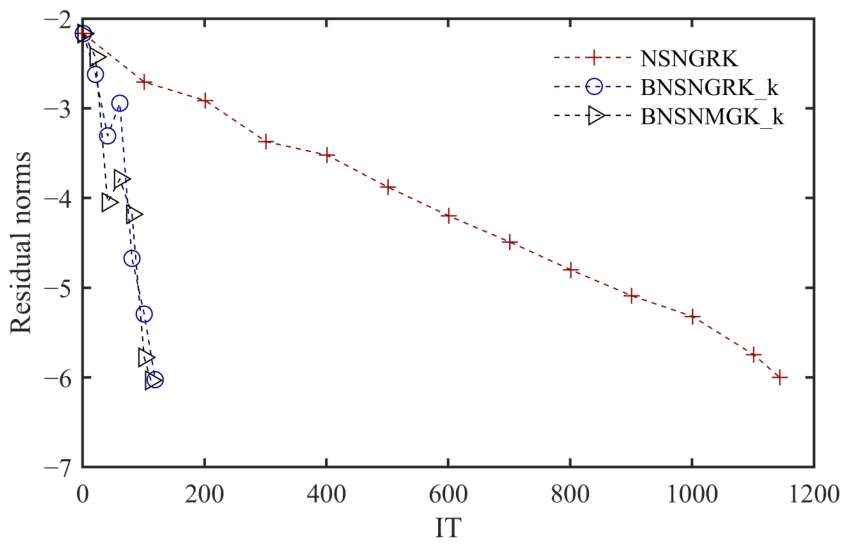
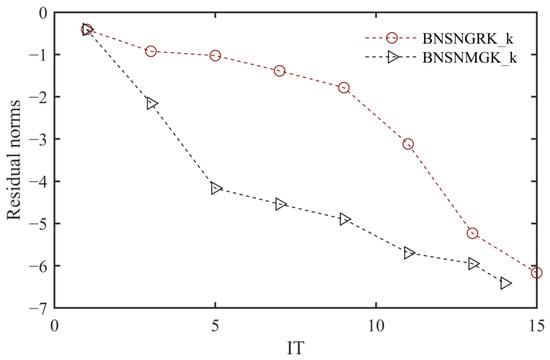
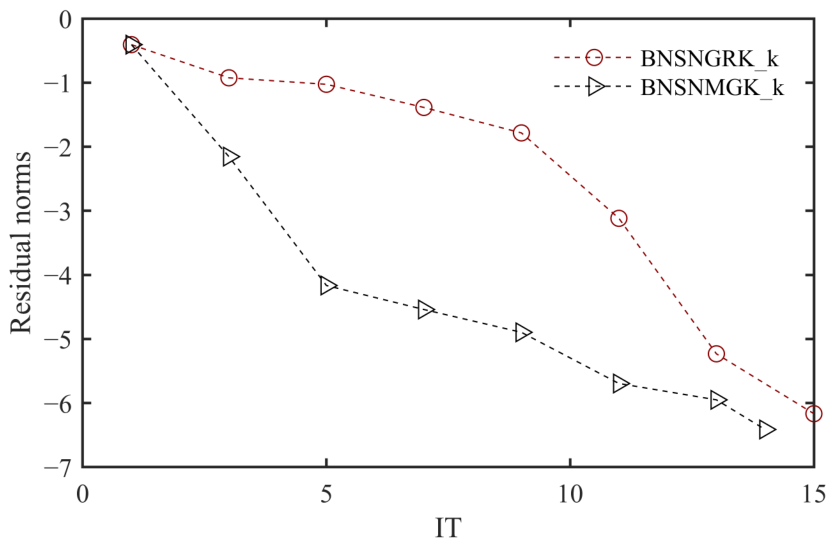
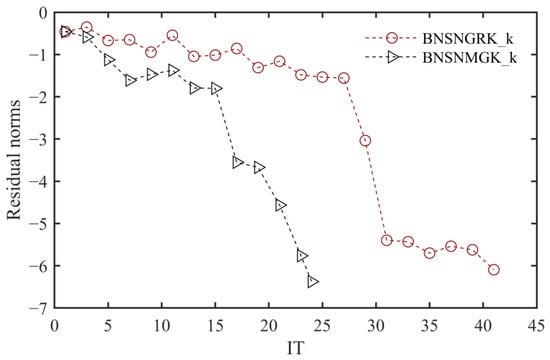
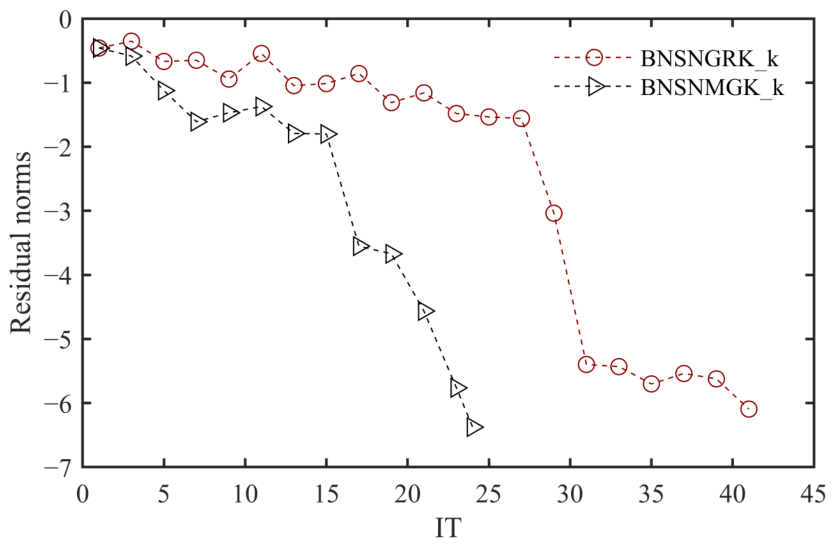
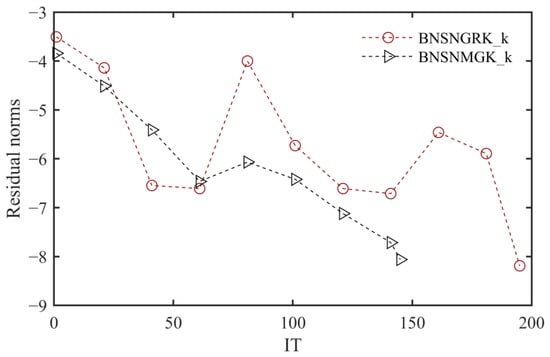
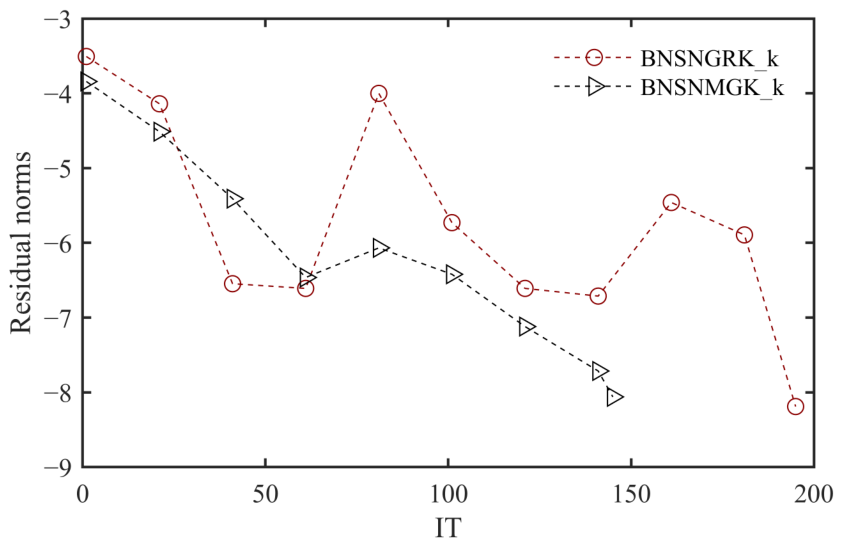
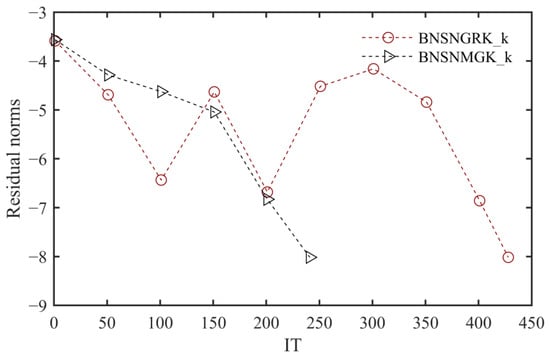
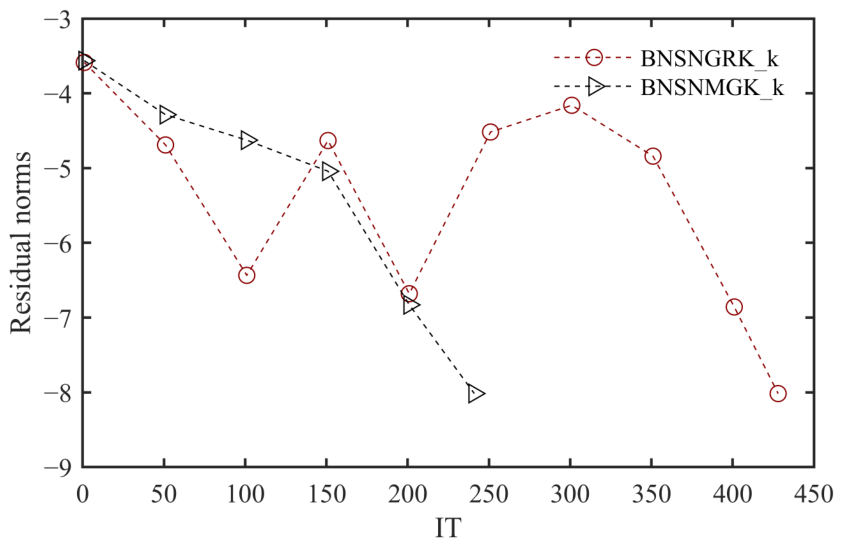
In this section, we focus on comparing our new methods, i.e., the BNSNGRK_k and BNSNMGK_k methods, with the current methods for solving grasping problems in terms of the grasping force and displacement. To verify the effectiveness of the proposed methods in practical grasping scenarios, we use the robot dexterous hand to grasp three typical objects [27]: an L-shaped planar block, a prism, and a cube, as shown in Figure 1. The numerical experiments are based on the grasping of these objects. In Figure 2, Figure 3, Figure 4, Figure 5 and Figure 6, the horizontal axis labeled “IT” denotes the outer iteration index k. For the BNSNMGK_k method, all block updates performed within one outer iteration are counted together as one iteration, rather than as separate iterations. The vertical axis reports the base-10 logarithm of the nonlinear residual norm,
Figure 1.
Grasping scenarios.
Figure 2.
Residual error vs. iteration count for the planar grasping problem.
Figure 3.
Iteration process for three-finger grasping of a prism with tetrahedral (4-sided) cone approximation.
Figure 4.
Iteration process for three-finger grasping of a prism with octahedral (8-sided) cone approximation.
Figure 5.
Iteration process for three-finger grasping of a cube with tetrahedral (4-sided) cone approximation.
Figure 6.
Iteration process for three-finger grasping of a cube with octahedral (8-sided) cone approximation.
Consequently, a lower value on the vertical axis indicates a smaller residual and hence a more accurate approximation to the solution. In particular, vertical-axis values of and correspond to residual norms of and , respectively.
4.1. Planar Grasping Problem
We begin with the planar grasping problem. The planar grasping problem can be modeled as a linear complementarity problem
where and are parametric variables, is the compliance matrix, is the grasping matrix, is the external wrench vector, is the initial gap, is the relative displacement vector, is the grasping force vector, and is the object displacement vector, with The coefficient matrix takes the form of a skew-symmetric saddle-point matrix
Through regularization, the regularized model can be solved directly by the Lemke method, which provides an exact reference solution. With the convergence tolerance set to , the comparisons between numerical and exact results are summarized in Table 1, and the decay of the residual versus iteration count is plotted in Figure 2. Table 1 and Figure 2 demonstrate that the block Kaczmarz approach is effective for systems with a skew-symmetric saddle-point coefficient matrix. Furthermore, the proposed algorithms exhibit a clear advantage over the NSNGRK method in terms of iteration numbers.
Table 1.
Planar grasping results (tol. ).
To examine the practical relevance of the sufficient contraction condition, the exact solution calculated by Lemke is used as the reference solution and empirical values for the Jacobian submatrix selected at each iteration of the first numerical example are recorded. Specifically,
where components with denominators close to machine precision were excluded.
For the first numerical example, empirical values of and are evaluated along the computed iteration trajectory. The first quartile, median, and third quartile of were respectively, while the corresponding values of were For the empirical contraction quantity the first quartile, median, and third quartile were respectively. These representative values show that the derived contraction condition is practically attainable along the computed trajectory.
4.2. Three-Finger Grasping of an Isosceles Prism
The grasping problem in three-dimensional space can be modeled as the following linear complementarity problem:
The associated nonnegativity and complementarity conditions are
Here, denotes the normal force, and are the grasp matrices associated with the normal and tangential forces, respectively, and and are the corresponding normal and tangential compliance matrices. The vector denotes the external wrench, denotes the normal relative displacement, and is the vector of initial normal distances between the fingertips and the object. Moreover, is the slip parameter associated with the approximated friction cone, is the corresponding friction-cone force parameter, and is the prescribed maximum normal force. The variables and form a complementary pair, while and are matrices arising from the linearization of the friction law.
The matrices and and the vector are defined by
The coefficient matrix takes the form of a general saddle-point block structure
For the three-finger grasping of an isosceles prism in 3D space, we approximate the friction cone with a 4-sided pyramid and an 8-sided pyramid, respectively, when formulating it as a linear complementarity problem. When using the 4-sided pyramid to approximate the friction cone, the Lemke method can obtain a set of exact solutions. We set the convergence tolerance for the numerical algorithms to . The results of numerical algorithms are compared with those of the Lemke algorithm in Table 2. The iteration process of the block Kaczmarz methods is shown in Figure 3. When using the 8-sided pyramid to approximate the friction cone, the Lemke method fails to find a solution. The similarity of the results computed by the two block-iterative numerical methods, as denoted by the mean absolute error, is shown in Table 3, and the iteration process is depicted in Figure 4. From Table 2 and Table 3, we observe that the same convergence tolerance does not guarantee the same solution quality. The grasping forces computed by the NSNGRK algorithm show noticeable errors compared to the exact solution. In contrast, both block Kaczmarz methods not only achieve high accuracy in computing grasping forces but also maintain high accuracy in computing grasping displacements. This advantage is particularly evident in ill-conditioned problems such as the grasping complementarity model, making the block Kaczmarz methods not only faster algorithms but also capable of providing higher-quality solutions.
Table 2.
Three-finger prism grasping results (4-sided cone, tol. ).
Table 3.
Three-finger prism grasping results (8-sided cone, tol. ).
4.3. Three-Finger Grasping of a Cube
For the problem of three-finger grasping a cube in three-dimensional space, we again approximate the friction cone using 4- and 8-sided pyramids. For this problem, we further tighten the convergence tolerance for the algorithms to . The Lemke method provides exact solutions when approximating the friction cone with a 4-sided pyramid, but not with an 8-sided pyramid. The NSNGRK method does not converge to the required tolerance in either case. We present the computational results and convergence iteration process for the three algorithms that successfully yield solutions under the tetrahedral pyramid approximation in Table 4 and Figure 5, and under the octahedral pyramid approximation in Table 5 and Figure 6. We observe that the grasping forces computed by the proposed methods are essentially consistent. The multi-step block Kaczmarz method requires fewer iterations than the block Kaczmarz method and demonstrates that the new algorithms effectively improve convergence accuracy.
Table 4.
Three-finger cube-grasping results (4-sided cone, tol. ).
Table 5.
Three-finger cube-grasping results (8-sided cone, tol. ).
The results in Table 1, Table 2, Table 3, Table 4 and Table 5 show that the proposed block methods attain higher numerical accuracy and require fewer outer iterations than the comparison method for the tested robotic grasping problems. These results demonstrate advantages in solution accuracy and iteration count. However, because K-means clustering is performed during the outer iterations, the reduction in the number of iterations does not by itself establish a reduction in total wall-clock execution time.
5. Conclusions
This work addresses accuracy in multi-fingered robotic grasping complementarity problems by introducing two novel algorithms: BNSNGRK_k and BNSNMGK_k. Leveraging K-means clustering for adaptive block partitioning of the generalized Jacobian matrix, these methods significantly enhance computational performance. Convergence is established and numerical experiments validate their efficacy in grasp planning for multi-fingered robotic hands. Although the proposed methods achieve higher numerical accuracy and require fewer outer iterations in the reported experiments, the repeated K-means clustering step introduces an additional computational overhead. Therefore, fewer outer iterations do not necessarily imply a shorter total wall-clock time for every implementation or computational platform. Reducing the clustering overhead is an important direction for future work. Possible strategies include warm-starting K-means with the centroids obtained at the preceding iteration, using incremental clustering, updating the block partition only when the generalized Jacobian changes significantly, and performing re-clustering periodically rather than at every outer iteration.
Author Contributions
Conceptualization, Z.A. and C.L.; methodology, Z.A. and C.L.; software, Z.A.; validation, Z.A.; formal analysis, Z.A.; investigation, Z.A. and C.L.; resources, Z.A. and C.L.; data curation, Z.A. and C.L.; writing—original draft preparation, Z.A.; writing—review and editing, C.L.; visualization, Z.A.; supervision, C.L.; project administration, C.L.; funding acquisition, Z.A. and C.L. All authors have read and agreed to the published version of the manuscript.
Funding
This work was supported by the National Natural Science Foundation of China (12161027) and partially supported by the Science and Technology Project of Guangxi, China (GuikeAD23023002).
Data Availability Statement
The data are contained within the article.
Conflicts of Interest
The authors declare no conflicts of interest.
References
- Ye, C.; Yao, Y.; Lin, W.; Yang, X.; Qiu, J. CSGrasp: Category-Level Semantically-Aware Grasping Method. IEEE Trans. Ind. Electron. 2026, 73, 2610–2619. [Google Scholar]
- Li, L.; Cherouat, A.; Snoussi, H.; Wang, T. Grasping with Occlusion-Aware Ally Method in Complex Scenes. IEEE Trans. Autom. Sci. Eng. 2025, 22, 5944–5954. [Google Scholar]
- Jin, J.; Qiu, L. A Robust Fast Convergence Zeroing Neural Network and Its Applications to Dynamic Sylvester Equation Solving and Robot Trajectory Tracking. J. Frankl. Inst. 2022, 359, 3183–3209. [Google Scholar] [CrossRef] [Scilit]
- Wang, F.; Chen, K.; Zhen, S.; Chen, X.; Zheng, H.; Wang, Z. Udwadia Theory-Based Performance Guaranteed Adaptive Robust Constraint-Following Control for Uncertain Robotic Manipulators with Sensor Noise. Nonlinear Dyn. 2026, 114, 233. [Google Scholar]
- Zhou, L.; Li, Z.; Li, Y.; Bai, S. Parallel MPPI with Gradient-Velocity Modulated SDF Cost for High-Performance Real-Time Dynamic Obstacle Avoidance by Robot Manipulators. IEEE Trans. Robot. 2025, 41, 5149–5168. [Google Scholar]
- Ai-Fahed, A.; Panagiotopoulos, P. A linear complementarity approach to the articulated multifingered friction gripper. J. Robot. Syst. 1993, 10, 871–887. [Google Scholar] [CrossRef] [Scilit]
- Carpentier, J.; Montaut, L.; Lidec, Q. From compliant to rigid contact simulation: A unified and efficient approach. arXiv 2024, arXiv:2405.17020. [Google Scholar]
- Lidec, Q.; Jallet, W.; Montaut, L.; Laptev, I.; Schmid, C.; Carpentier, J. Contact models in robotics: A comparative analysis. IEEE Trans. Robot. 2024, 40, 3740–3763. [Google Scholar] [CrossRef] [Scilit]
- Ai-Fahed, A.; Panagiotopulos, P. Multifingered frictional robot grippers: A new type of numerical implementation. Comput. Struct. 1992, 42, 555–562. [Google Scholar] [CrossRef] [Scilit]
- Gholami, F.; Nasri, M.; Kövecses, J.; Teichmann, M. A linear complementarity formulation for contact problems with regularized friction. Mech. Mach. Theory 2016, 105, 568–582. [Google Scholar] [CrossRef] [Scilit]
- Haas-Heger, M.; Iyengar, G.; Ciocarlie, M. Passive reaction analysis for grasp stability. IEEE Trans. Autom. Sci. Eng. 2018, 15, 955–966. [Google Scholar] [CrossRef] [Scilit]
- Ali, R.; Akgul, A. A new matrix splitting generalized iteration method for linear complementarity problems. Appl. Math. Comput. 2024, 464, 128378. [Google Scholar]
- Bai, Z. Modulus-based matrix splitting iteration methods for linear complementarity problems. Numer. Linear Algebra Appl. 2010, 17, 917–933. [Google Scholar] [CrossRef] [Scilit]
- Cruz, J.B.; Ferreira, O.; Németh, S.; Prudente, L.F. A semi-smooth newton method for projection equations and linear complementarity problems with respect to the second order cone. Linear Algebra Appl. 2017, 513, 160–181. [Google Scholar] [CrossRef] [Scilit]
- Ansorge, R. Connections between the cimmino-method and the kaczmarz-method for the solution of singular and regular systems of equations. Computing 1984, 33, 367–375. [Google Scholar]
- Strohmer, T.; Vershynin, R. A randomized kaczmarz algorithm with exponential convergence. J. Fourier Anal. Appl. 2009, 15, 262–278. [Google Scholar]
- Nutini, J.; Sepehry, B.; Laradji, I.; Schmidt, M.; Koepke, H.; Virani, A. Convergence rates for greedy kaczmarz algorithms, and faster randomized kaczmarz rules using the orthogonality graph. arXiv 2016, arXiv:1612.07838. [Google Scholar]
- Bai, Z.; Wu, W. On greedy randomized kaczmarz method for solving large sparse linear systems. SIAM J. Sci. Comput. 2018, 40, A592–A606. [Google Scholar] [CrossRef] [Scilit]
- Needell, D.; Tropp, J.A. Paved with good intentions: Analysis of a randomized block kaczmarz method. Linear Algebra Appl. 2014, 441, 199–221. [Google Scholar] [CrossRef] [Scilit]
- Needell, D.; Zhao, R.; Zouzias, A. Randomized block kaczmarz method with projection for solving least squares. Linear Algebra Appl. 2015, 484, 322–343. [Google Scholar] [CrossRef] [Scilit]
- Liu, Y.; Gu, C. On greedy randomized block kaczmarz method for consistent linear systems. Linear Algebra Appl. 2021, 616, 178–200. [Google Scholar] [CrossRef] [Scilit]
- Jiang, X.; Zhang, K.; Yin, J. Randomized block kaczmarz methods with k-means clustering for solving large linear systems. J. Comput. Appl. Math. 2022, 403, 113828. [Google Scholar]
- Jiang, X.-L.; Zhang, K. A randomized block extended kaczmarz method with hybrid partitions for solving large inconsistent linear systems. Appl. Math. Lett. 2024, 152, 109027. [Google Scholar] [CrossRef] [Scilit]
- Xiao, A.; Yin, J. On averaging block kaczmarz methods for solving nonlinear systems of equations. J. Comput. Appl. Math. 2024, 451, 116041. [Google Scholar] [CrossRef] [Scilit]
- Xiao, A.; Gao, X.; Yin, J. A fast block nonlinear bregman-kaczmarz method with averaging for nonlinear sparse signal recovery. J. Sci. Comput. 2025, 104, 71. [Google Scholar] [CrossRef] [Scilit]
- Ai, Z.; Li, C. Calculation of robot multi-fingered grasping force and displacement based on the newton–subgradient non-smooth greedy randomized kaczmarz method for solving linear complementarity problem. Sensors 2025, 25, 2309. [Google Scholar] [PubMed]
- Ai, Z.; Li, C. Accelerated computation of linear complementarity problem in dexterous robotic grasping via newton-subgradient non-smooth multi-step greedy kaczmarz method. Actuators 2025, 14, 307. [Google Scholar]
- Peñuñuri, F.; Peón, R.; González–Sánchez, D.; Escalante Soberanis, M.A. Dual numbers and automatic differentiation to efficiently compute velocities and accelerations. Acta Appl. Math. 2020, 170, 649–659. [Google Scholar] [CrossRef] [Scilit]
- Rockafellar, R.T. Convex Analysis; Princeton University Press: Princeton, NJ, USA, 1997; Volume 28. [Google Scholar]
- Clarke, F.H. Optimization and Nonsmooth Analysis; SIAM: New Delhi, India, 1990. [Google Scholar]
- Wang, Q.; Li, W.; Bao, W.; Gao, X. Nonlinear kaczmarz algorithms and their convergence. J. Comput. Appl. Math. 2022, 399, 113720. [Google Scholar] [CrossRef] [Scilit]
- Chen, J.; Sun, D.; Sun, J. The sc1 property of the squared norm of the soc fischer–burmeister function. Oper. Res. Lett. 2008, 36, 385–392. [Google Scholar] [CrossRef] [Scilit]
- Tan, L.; Guo, X. On nonlinear greedy randomized kaczmarz methods for solving large-scale systems of nonlinear equations. Preprint 2023. [Google Scholar] [CrossRef] [Scilit] [PubMed]
- Higham, N.J. Accuracy and Stability of Numerical Algorithms; SIAM: New Delhi, India, 2002. [Google Scholar]

Disclaimer/Publisher’s Note: The statements, opinions and data contained in all publications are solely those of the individual author(s) and contributor(s) and not of MDPI and/or the editor(s). MDPI and/or the editor(s) disclaim responsibility for any injury to people or property resulting from any ideas, methods, instructions or products referred to in the content. |
© 2026 by the authors. Licensee MDPI, Basel, Switzerland. This article is an open access article distributed under the terms and conditions of the Creative Commons Attribution (CC BY) license.