


Abstract
Giving the definitions of one-parameter family of frontals in lightcone and one-parameter family of spacelike Legendrian curves in and , and further using the variability condition and the tangency condition, the definitions of envelopes of these geometric objects are presented. The aim of this work is to explore the criterion conditions on the envelopes of a one-parameter family of frontals related to and in three pseudo-spheres. Thereby the characterizations of these envelopes are described via Envelope Theorems. The geometric relations among these envelopes are discussed in detail. It is demonstrated that the -duality or the -duality of one-parameter family of frontals among three pseudo-spheres leads to the fact that the one-parameter family of frontals that are -duality or -duality each other share the same envelope. In addition, the hyperbolic and de Sitter parallels of the one-parameter family of spacelike frontals are also defined, and the existence conditions of the envelopes of such parallels are investigated correspondingly. Finally, two examples are provided to understand the theoretical results.
MSC:
57R45; 53A35; 53B30; 53D10; 57R17
1. Introduction
The concept of an envelope, understood as a curve that makes tangential contact with each member of a prescribed one-parameter family, stands as a cornerstone of classical differential geometry [1,2,3,4,5,6,7,8]. Its practical relevance spans a wide array of disciplines, including the design of gears, the verification of CNC machining processes, signal processing, collision-avoidance algorithms in robotics, and error analysis in CAD systems. This broad applicability has sparked interest from researchers in astrophysics, particle physics, and geometry, prompting investigations into envelope behavior within non-Euclidean settings such as hyperbolic, de Sitter, and Minkowski spaces [8,9,10,11].
The field of singularity theory has undergone significant evolution in recent decades, broadening its focus from regular manifolds to include singular objects known as frontals, and extending its ambient spaces from Euclidean to non-Euclidean frameworks. This expansion furnishes powerful instruments for probing the geometric structure of manifolds. Inspired by the foundational work of V. I. Arnold, a substantial body of research has been dedicated to the study of fronts through the prism of singularity theory; key contributions are documented in [5,9,12,13,14,15,16,17,18] and the references therein, while regular planar curves possess well-defined tangents, the appearance of singularities introduces considerable complexity. To address this, Takahashi formulated an envelope definition tailored for parameter-dependent families of Legendrian curves residing in the unit tangent bundle over , subsequently analyzing their characteristics [7]. Building on this, Li and co-authors extended the framework to encompass families of singular spherical curves parametrized by a single variable, providing definitions and exploring their properties [5]. Concurrently, Pei et al. investigated families of framed curves in Euclidean 3-space depending on a parameter; their work involved constructing moving frames, formulating curvature functions, establishing existence and uniqueness theorems predicated on these curvatures, and concurrently defining envelope concepts for such families [19].
A novel perspective was introduced by Chen and his collaborators, who harnessed the and dualities from Legendrian theory to scrutinize smooth curves with singularities in Minkowski 3-space. This approach led to the formulation of parameter-dependent families of Legendrian curves and the definition of envelopes for frontals situated in hyperbolic and de Sitter 2-spaces [2]. A subsequent, more systematic investigation [9] delved into the envelopes of frontal families parametrized by a single variable within these spaces via duality principles. This work introduced families of Legendrian curves associated with and dualities and, departing from classical envelope theories applicable only to regular curves, devised new methodologies for defining envelopes applicable to singular frontals, accompanied by a thorough examination of their properties and interrelations.
The current study serves to complement and extend the findings of Chen et al. [9] regarding envelope families linked to and dualities. The and dualities occupy a distinctive position within Legendrian theory due to the inherent degeneracy of the light cone. When dealing with singular curves confined to the light cone, conventional techniques for constructing adapted frames prove insufficient, thereby necessitating the development of alternative constructions. The second author, along with various collaborators, has previously established several moving frames suitable for singular curves and lightlike submanifolds [20,21,22,23].
In this paper, we introduce precise definitions for parameter-dependent families of Legendrian curves and their associated envelopes, specifically for frontals exhibiting and dualities. Novel frames are constructed along these families, which permits a smooth definition and analysis of envelopes for frontal families parametrized by a single variable within the light cone, facilitated by the and dualities. This approach parallels the treatment of and duality-related envelope families in hyperbolic and de Sitter spaces previously explored in [9]. Furthermore, we conduct a detailed examination of the geometric properties characterizing envelopes derived from and -dual frontal families depending on a parameter.
The structure of the paper is as follows. Section 2 provides a review of Legendrian duality theory and formally introduces parameter-dependent families of spacelike frontals associated with and dualities. We define the corresponding families of spacelike Legendrian curves within and , establish their moving frames, derive the associated curvature functions, and investigate the fundamental properties of these frontal families. Section 3 employs variability and tangency conditions to define envelopes for these and -dual families, demonstrating that the resulting envelopes themselves constitute frontals in hyperbolic 2-space, de Sitter 2-space, or the light cone. Equivalent conditions for envelope existence are derived, alongside an examination of hyperbolic and de Sitter parallels and the conditions for the existence of their envelopes. Section 4 explores the relationships among envelopes of spacelike Legendrian curve families parametrized by a single variable associated with and dualities, confirming that mutually dual frontal families share identical pre-envelopes. Section 5 presents two illustrative examples to elucidate the theoretical findings.
Throughout this exposition, all mappings and manifolds are assumed to be of class unless explicitly stated otherwise.
2. Dualities for Parameter-Dependent Families of Spacelike Frontals
This section is dedicated to the differential-geometric study of families of smooth curves depending on a parameter, residing in hyperbolic 2-space, de Sitter 2-space, and the light cone. We commence by recalling essential concepts from Minkowski space, following the presentation in [24].
Let denote the familiar 3-dimensional real vector space. For vectors and in , the pseudo-scalar product is defined by . Endowed with this product, the pair is termed Minkowski 3-space, denoted henceforth as .
A non-zero vector is categorized as spacelike, lightlike, or timelike according to the sign of its pseudo-norm, i.e., if , , or , respectively. Two vectors and are said to be pseudo-orthogonal if their product vanishes: . The term causal collectively refers to vectors that are either timelike or lightlike. The norm of a vector is given by .
For given vectors and in , their wedge product is defined via the formal determinant
where constitutes the canonical basis of . For an arbitrary vector , a straightforward verification yields the identity
which confirms that is pseudo-orthogonal to both and . If is causal, it satisfies . When both and are causal, the Schwarz inequality leads to
demonstrating that two non-zero causal vectors cannot be pseudo-orthogonal unless they are both lightlike and proportional to one another.
Consider such that and the triple is linearly independent. In this situation, if at least one of or is causal, then is necessarily spacelike. Conversely, if both and are spacelike, then is causal.
We now define the following fundamental geometric objects within :
- (i)
- Hyperbolic 2-space: ;
- (ii)
- de Sitter 2-space: ;
- (iii)
- (Open) lightcone at the origin: .
The spherical tangent bundle is denoted
i.e., v is a unit spacelike vector (), a unit timelike vector (), or a lightlike vector ().
Definition 1.
A pair is called a Legendrian curve on the spherical tangent bundle if it satisfies the condition for every . In this context, is referred to as a frontal curve. If, moreover, the map is an immersion (a Legendre immersion), then is specifically designated a front curve (or a wavefront).
2.1. The Legendrian Duality Theorem
We begin by reviewing fundamental notions concerning contact geometry and Legendrian submanifolds; for a comprehensive treatment, the reader may consult [12,25]. Let N be a smooth manifold of odd dimension , and let be a field of tangent hyperplanes. Locally, such a field can be expressed as the kernel of a non-vanishing 1-form . The hyperplane field K is said to be non-degenerate if holds at every point of N. When K is non-degenerate, the pair is called a contact manifold; K itself is referred to as a contact structure, and any local 1-form with is a contact form. A diffeomorphism between two contact manifolds and is a contact diffeomorphism if it satisfies ; the two manifolds are said to be contact diffeomorphic when such a map exists.
A submanifold of a contact manifold is termed Legendrian provided its dimension equals n (the maximal possible for an integral submanifold) and its tangent space at every point is contained in the contact hyperplane: for all . A smooth fiber bundle is called a Legendrian fibration if its total space E is equipped with a contact structure for which the fibers are Legendrian submanifolds. For a Legendrian submanifold , the composition is a Legendrian map and its image is the wavefront set of L. Around any point one can introduce local coordinates such that the projection takes the form and the contact structure is given by the canonical 1-form
Consider now the product space . On it we define two 1-forms
These forms give rise to the following five double fibrations, which are fundamental for Legendrian duality:
- (i)
- , with projections , , and contact forms , .
- (ii)
- , with , , , .
- (iii)
- , with , , , .
- (iv)
- , with , , , .
- (v)
- , with , , , .
For each , the zero level sets and define the same tangent hyperplane field on ; we denote this field by . As established in [25], each pair is a contact manifold and both projections are Legendrian fibrations. If a point lies in , we say that is -dual to . The contact manifolds for are mutually contact diffeomorphic; further details can be found in [12]. The fibration was introduced by Chen and Izumiya in [26]; there it is shown that is a contact manifold with Legendrian fibrations , but it is not contact diffeomorphic to any with .
2.2. -Duality for Families of Spacelike Frontals
This subsection is devoted to introducing parameter-dependent families of spacelike frontals in hyperbolic 2-space that are associated with -duality. We also define the corresponding families of spacelike Legendrian curves in and introduce the concept of hyperbolic parallels, subsequently examining their geometric attributes.
Consider a smooth map , where J and are intervals (or possibly ). This map is termed a parameter-dependent family of spacelike frontals in if, for every fixed , the derivative with respect to the first argument, , is spacelike at all regular points t of the curve , and there exists a smooth map such that the pair maps into and satisfies the Legendrian condition
Here, embodies the -duality introduced by Izumiya [25]. The resulting map is called a family of spacelike Legendrian curves parametrized by a single variable in .
We now define an auxiliary vector field . The triple then provides a moving frame for along the frontal family (equivalently, along the Legendrian family ). Standard differential-geometric computations lead to the following relations, which we refer to as spacelike hyperbolic Legendrian Frenet–Serret type formulas:
where the curvature functions are defined by the following inner products:
(For brevity, the arguments are omitted here and in similar contexts where no confusion arises).
By assembling the coefficient matrices,
the integrability conditions , , and are equivalent to the matrix equation
which, upon expansion, yields the following system of partial differential equations for the curvature functions:
The ordered quintuple , subject to the integrability conditions above, is designated the spacelike hyperbolic Legendrian curvature of the family .
A few observations are in order. If is a family with curvature , then the modified families , , and are also parameter-dependent families of spacelike Legendrian curves. Their respective curvatures are , , and .
For a fixed real number , we introduce a new family , called the hyperbolic parallel of , defined by
The following proposition elucidates the properties of this parallel family.
Proposition 1.
Let be a family of spacelike Legendrian curves depending on a parameter, possessing spacelike hyperbolic Legendrian curvature . For any fixed real number ϕ, the pair , where
also forms a parameter-dependent family of spacelike Legendrian curves mapping into . Its spacelike hyperbolic Legendrian curvature is given by
Proof.
We first verify that lies in and satisfies the Legendrian condition. Using the definitions and the properties of the inner product, we compute
Since , , and , we obtain
so . Next, for the derivative with respect to t,
Using , , and the identity (which follows from differentiating ), we find that all terms cancel, yielding zero. Hence, the Legendrian condition holds.
A straightforward computation also shows that , so the moving frame for the new family can be taken as .
Now we differentiate this frame. Using the Frenet–Serret formulas for the original family and then employing the following formula (expressing , by , ):
we have
and
By comparing these expressions with the Frenet–Serret-type formulas for the moving frame , the curvature relations stated in the proposition become evident. □
2.3. -Duality for Families of Spacelike Frontals
This subsection introduces parameter-dependent families of spacelike frontals in de Sitter 2-space and the lightcone that are associated with -duality. We define the corresponding Legendrian curve families in and the concept of de Sitter parallels, and we investigate their geometric properties.
Let be a smooth map, with J and as before. This map is called a parameter-dependent family of spacelike frontals in if, for each fixed , the derivative is spacelike at every regular point t, and there exists a smooth map such that the pair maps into and fulfills the Legendrian condition
Here, is the -duality [25]. The resulting map is termed a family of spacelike Legendrian curves indexed by a parameter in .
Conversely, consider a smooth map . We call a parameter-dependent family of spacelike frontals in if there exists a smooth map (or ) such that the pair maps into (or , respectively) and satisfies for all . It is worth noting that, by definition, both and are instances of parameter-dependent families of spacelike frontals residing in .
For the family , we define a companion vector field . The triplet constitutes a moving frame along . The associated spacelike de Sitter Legendrian Frenet–Serret type formulas are
with the curvature functions defined by
Defining the coefficient matrices
the integrability conditions lead to the matrix equation , which is equivalent to the following system:
The quintuple , satisfying these relations, is called the spacelike de Sitter Legendrian curvature of the family .
Analogous to the hyperbolic case, if has curvature , then the families , , and are also spacelike Legendrian families depending on a parameter, with curvatures , , and , respectively.
For a fixed real , we define the de Sitter parallel of as the family given by
Proposition 2.
Let be a family of spacelike Legendrian curves parametrized by a single variable, endowed with spacelike de Sitter Legendrian curvature . For any fixed real ϕ, the pair , where
forms a parameter-dependent family of spacelike Legendrian curves in with curvature given by
Proof.
The proof follows the same pattern as that of Proposition 1. One first verifies that belongs to and satisfies the Legendrian condition by direct inner product calculations similar to those above, using , , , and the relations obtained from differentiating these. A straightforward computation also shows , so is a valid moving frame.
Differentiating this frame and employing the de Sitter Frenet–Serret formulas for the original family yields the expressions for the curvature functions. For instance,
which directly give and . The -derivatives are computed analogously, leading to the remaining curvature functions after expressing , in terms of , . □
3. Envelopes of Parameter-Dependent Frontal Families in Pseudo-Spheres
This section is dedicated to a detailed investigation of the differential-geometric properties of envelopes for families of frontals parametrized by a single variable, living in hyperbolic 2-space, de Sitter 2-space, and the lightcone. We establish the precise conditions that characterize envelopes associated with and dualities. Furthermore, we provide sufficient conditions for the existence of envelopes for the hyperbolic parallels of the frontal families and .
3.1. Envelopes of -Dual Spacelike Frontal Families in Hyperbolic Space
Let us consider a parameter-dependent family of spacelike Legendrian curves . We introduce a smooth map , where is an interval, and write its components as . Using this map, we define the restricted curves along the family
The definition of an envelope relies on the following three conditions:
(H1) Variability condition: The function is not constant on any non-trivial subinterval of .
(H2) Tangency condition (for ): The derivative is linearly dependent on the frame vector for every .
(H3) Tangency condition (for ): The derivative is linearly dependent on for every .
When conditions (H1) and (H2) are met, we call a hyperbolic envelope of the frontal family , and the map is referred to as a pre-envelope. Similarly, if (H1) and (H3) hold, then is termed a lightcone envelope of the frontal family , with again being a pre-envelope.
Proposition 3.
Assume is a family of spacelike Legendrian curves depending on a parameter, whose spacelike hyperbolic Legendrian curvature is . If constitutes a pre-envelope, then the induced pair itself forms a spacelike Legendrian curve. Its curvature functions are
Moreover, a necessary condition for to be a pre-envelope is the vanishing of along its image: for all .
Proof.
Condition (H2) directly implies that is parallel to , from which it follows that . Since , this is precisely the Legendrian condition, establishing as a Legendrian curve in .
A direct computation, employing the chain rule and the Frenet–Serret formulas, yields
Condition (H2) forces the terms not parallel to in the expression for to vanish. Given the variability condition (H1), which ensures , we deduce for all . Substituting this back simplifies the expressions and allows us to read off the curvature functions of the restricted curve as the coefficients of in and . □
The preceding proposition and its proof lead directly to the following fundamental characterization.
Theorem 1
(Envelope Theorem for ). Let be a parameter-dependent family of spacelike Legendrian curves possessing spacelike hyperbolic Legendrian curvature . Suppose is a smooth map fulfilling the variability condition (H1). Then the following assertions are pairwise equivalent:
- 1.
- is a pre-envelope of ;
- 2.
- holds for every ;
- 3.
- for all .
Proof.
We establish the equivalence by proving a cycle of implications.
(1) ⇒ (2): If is a pre-envelope, condition (H2) holds, so there exists a function such that . Differentiating and using , we obtain . Taking the inner product of this equation with and noting that is orthogonal to , we get . Since by (H1), the desired inner product must vanish pointwise.
(2) ⇒ (3): This follows directly from the expression for given by the Frenet–Serret formulas: . Taking the inner product with yields , because for points in . Thus condition (2) is equivalent to .
(3) ⇒ (1): If , the expression for computed in the proof of Proposition 3 reduces to , which is clearly parallel to . Hence, condition (H2) is satisfied, and with (H1) holding by hypothesis, is a pre-envelope. □
Remark 1.
For -dual families, the tangency conditions (H2) and (H3) are equivalent. This follows from the Frenet–Serret formulas and the fact that implies both and are parallel to (see Proposition 3). Therefore, a pre-envelope defined by (H1)
and
(H2)
automatically satisfies (H3), and vice versa. Theorem 1 lists both for completeness.
Proposition 4.
Let be a family of spacelike Legendrian curves indexed by a parameter, with spacelike hyperbolic Legendrian curvature . If is a pre-envelope of the original family , then is also a pre-envelope of the related families and .
Proof.
Consider the family . Its associated third frame vector is . Define . Then . Since is a pre-envelope for the original family, is parallel to . Consequently, is parallel to , satisfying the tangency condition for the new family. The variability condition (H1) is unchanged, so is a pre-envelope for . A completely analogous argument applies to the family . □
Proposition 5.
Let be a parameter-dependent family of spacelike Legendrian curves endowed with spacelike hyperbolic Legendrian curvature . Suppose is a smooth map satisfying the variability condition(H1). If the set of regular points of along is dense and the entire trace of lies within the singular set of , then is a pre-envelope of .
Proof.
From the Frenet–Serret formulas, we have and . The condition that is contained in the singular set of means that the partial derivative vectors are linearly dependent at those points, i.e., for all . Because the regular points are dense, is non-zero on a dense subset of . On this dense subset, provides a non-zero direction parallel to . For to be linearly dependent with this direction, its components along and must vanish, forcing . By continuity, for all . Theorem 1 then implies that is a pre-envelope. □
Remark 2.
The converse of Proposition 5 is not generally true. A pre-envelope indeed forces the derivatives and to be linearly dependent (as ), placing within the singular set. However, it is possible that itself vanishes identically along , which is a more degenerate situation.
Remark 3.
The density assumption is generic. If regular points were not dense, then would be singular on an open interval, a degenerate case that is usually excluded in the general theory of singularities (cf. [18]).
We now turn to the relationship between the envelopes of a family and those of its hyperbolic parallel. For a given , define .
Proposition 6.
Let be a family of spacelike Legendrian curves parametrized by a single variable, carrying spacelike hyperbolic Legendrian curvature . For a fixed real ϕ, let be the hyperbolic parallel of . Suppose satisfies the variability condition (H1). Then is a hyperbolic envelope of if and only if is a hyperbolic envelope of .
Proof.
By Theorem 1, is an envelope of precisely when is a pre-envelope, i.e., when the curvature function vanishes along
For the parallel family, a direct computation using the formulas from Proposition 1 (or following the same derivation as in Proposition 3) yields the derivative of :
Here, is the dual lightlike vector associated with and is the common frame vector . The curvature functions are given in Proposition 1, and importantly Proposition 1 also states that
Now assume that is an envelope of . Then for all s. From we obtain as well. Substituting this into (1), the first two terms vanish, leaving
Thus is everywhere parallel to , which is exactly the tangency condition (H2) for the parallel family. Since the variability condition (H1) holds by hypothesis, is a pre-envelope of , and consequently is a hyperbolic envelope of .
Conversely, if is an envelope of , then by Theorem 1 applied to the parallel family. Using we get , so is an envelope of . This completes the proof. □
3.2. Envelopes of -Dual Spacelike Frontal Families in De Sitter Space
We now develop the analogous theory for families associated with -duality. Consider a parameter-dependent family equipped with spacelike de Sitter Legendrian curvature . For a smooth map , we set and .
The relevant conditions are:
(H1) Variability condition: is non-constant on any non-trivial subinterval of .
() Tangency condition (for ): is linearly dependent on for all .
() Tangency condition (for ): is linearly dependent on for all .
When (H1) and () are satisfied, is a de Sitter envelope (with a pre-envelope) of . When (H1) and () are satisfied, is a lightcone envelope (with a pre-envelope) of .
The following results are the counterparts of those in the previous subsection. Their proofs are structurally similar to the case, relying on the appropriate de Sitter Frenet–Serret formulas.
Proposition 7.
Assume is a family of spacelike Legendrian curves depending on a parameter, whose spacelike de Sitter Legendrian curvature is . If constitutes a pre-envelope, then the induced pair itself forms a spacelike Legendrian curve. Its curvature functions are
Moreover, a necessary condition for to be a pre-envelope is the vanishing of along its image: for all .
Proof.
Condition () directly implies that is parallel to , from which it follows that . Since , this is precisely the Legendrian condition, establishing as a Legendrian curve in .
A direct computation, employing the chain rule and the Frenet–Serret formulas for , yields
Condition () forces the terms not parallel to in the expression for to vanish. Given the variability condition (H1), which ensures , we deduce for all . Substituting this back simplifies the expressions to
Thus is a spacelike Legendrian curve whose curvature functions are the coefficients of in and , namely and . The remaining curvature functions (e.g., , , ) are either zero or redundant; in particular, follows from the orthogonality . This completes the proof. □
The following results are the counterparts of those in the previous subsection. Their proofs are structurally similar to the case, relying on the appropriate de Sitter Frenet–Serret formulas. Since we have provided a complete proof of Proposition 7 as an illustration, the proofs of the remaining results (Theorem 2, Proposition 8, etc.) are omitted for brevity as they follow the same pattern.
Theorem 2
(Envelope Theorem for ). Let be a parameter-dependent family of spacelike Legendrian curves possessing spacelike de Sitter Legendrian curvature . Suppose satisfies the variability condition (H1). Then the following are equivalent:
- 1.
- is a pre-envelope of ;
- 2.
- for all ;
- 3.
- for all .
For the de Sitter parallel of , defined in Proposition 2, and with , we have:
Proposition 8.
Let be a family of spacelike Legendrian curves parametrized by a single variable, endowed with spacelike de Sitter Legendrian curvature . For fixed real ϕ, let be the de Sitter parallel of . Suppose satisfies the variability condition (H1). Then is a de Sitter envelope of if and only if is a de Sitter envelope of .
4. Relations Among Envelopes of Dual Frontal Families
This section explores the deep connections that exist between the envelopes of parameter-dependent frontal families that are linked by Legendrian duality.
Theorem 3.
Let and be families of spacelike frontals depending on a parameter. Define a new family in the lightcone by . If the pair is a parameter-dependent family of spacelike Legendrian curves with spacelike hyperbolic Legendrian curvature , then:
- (1)
- is a family of spacelike Legendrian curves indexed by a parameter. Its curvature is given by , , , , ;
- (2)
- The swapped pair is also a parameter-dependent family of spacelike Legendrian curves. Its curvature is given by
Proof.
The proof proceeds by direct computation using the given data and the definitions. Since lies in , we have a moving frame with , satisfying the hyperbolic Frenet–Serret formulas. The condition is used to compute its derivatives. For instance, . The inner products defining the new curvature functions are then evaluated using the known orthonormality relations among , , and , and the fact that and , . The calculations for the second family are analogous, noting that its third frame vector is . □
This theorem has an immediate and important corollary regarding the pre-envelopes of -dual families.
Corollary 1.
Let be a parameter-dependent family of spacelike Legendrian curves possessing spacelike hyperbolic Legendrian curvature . Suppose satisfies the variability condition (H1). Then is a pre-envelope of if and only if is a pre-envelope of .
Proof.
From Theorem 3, the curvature function corresponding to for the pair is , while for the swapped pair it is . The Envelope Theorem 1 states that is a pre-envelope for a given family iff the corresponding -function vanishes along . Therefore, is a pre-envelope for iff , which is exactly the condition for it to be a pre-envelope for . □
A completely analogous relationship holds for -dual families.
Theorem 4.
Let and be families of spacelike frontals parametrized by a single variable. Define a lightcone family by . If is a parameter-dependent family of spacelike Legendrian curves with spacelike de Sitter Legendrian curvature , then:
- (1)
- is a family of spacelike Legendrian curves indexed by a parameter. Its curvature is given by , , , , ;
- (2)
- The swapped pair is also a parameter-dependent family of spacelike Legendrian curves. Its curvature is given by
Proof.
The proof mirrors that of Theorem 3, but uses the de Sitter Frenet–Serret formulas for the frame , where . □
Corollary 2.
Let be a family of spacelike Legendrian curves depending on a parameter, endowed with spacelike de Sitter Legendrian curvature . Suppose satisfies the variability condition (H1). Then is a pre-envelope of if and only if is a pre-envelope of .
Remark 4.
The corollaries above encapsulate a key finding: the duality between and , and the duality between and , imply that these pairs of frontal families share precisely the same pre-envelopes. Consequently, their envelopes, whether in hyperbolic space, de Sitter space, or the lightcone, are determined by a common pre-envelope map .
5. Illustrative Examples
This section presents two concrete examples that illustrate the theoretical concepts developed in the paper. The accompanying figures provide a visual representation of the frontal families, their envelopes, and the duality relations.
Example 1
(A -dual family and its envelopes). Let be the open set defined by
where V and W are given below. Consider the maps defined by
where the auxiliary functions are
(These expressions are well-defined on the open subset of where and ; for our choice of below this condition is satisfied.) A direct but lengthy computation verifies that takes values in and satisfies the Legendrian condition, thus forming a parameter-dependent family of spacelike Legendrian curves. The associated frame vector is found to be
The spacelike hyperbolic Legendrian curvature functions can be derived from the Frenet–Serret formulas as follows
Now, choose the map given by , where we take (the symmetric branch yields a similar envelope by reflection). The restricted curves are
and the frame vector along is . Differentiating, we obtain , , and . Both derivatives are clearly parallel to for all . (When , approaches the lightlike point and the derivative diverges, so the envelope is defined only on the open interval .) Thus, conditions (H1),
(H2), and (H3)
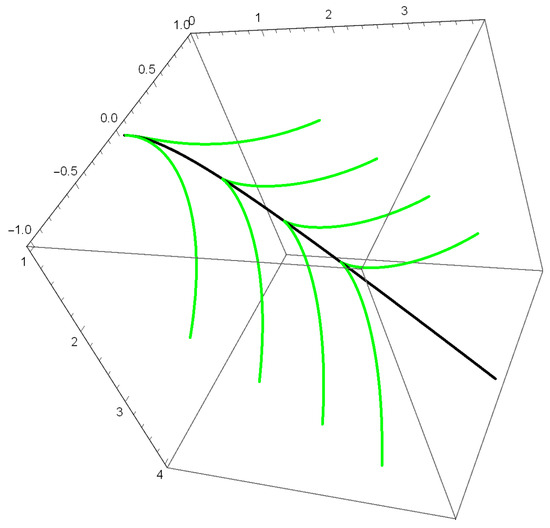
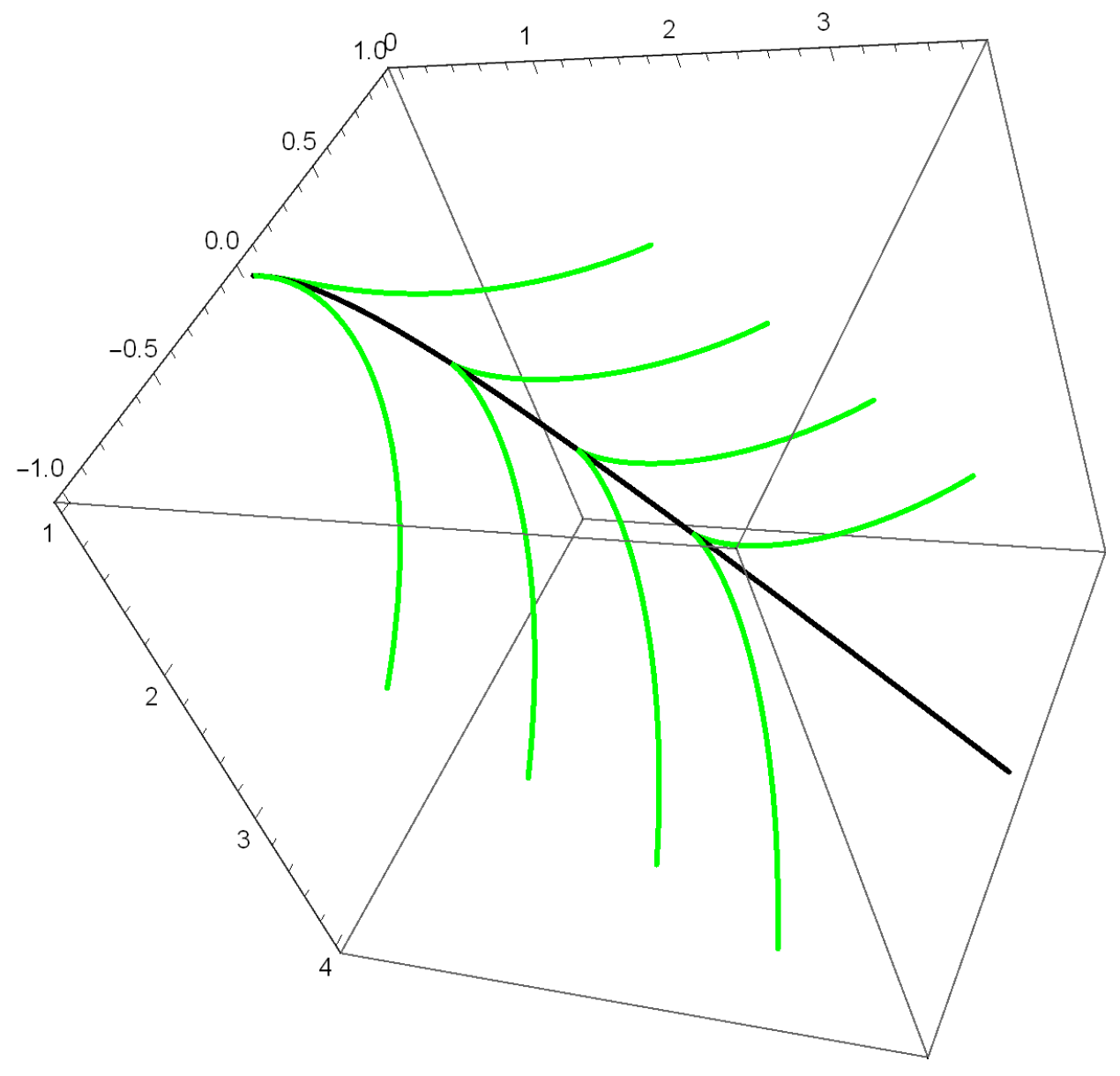
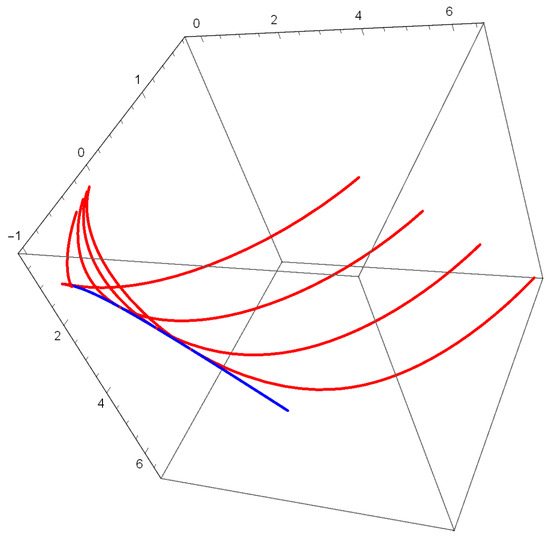
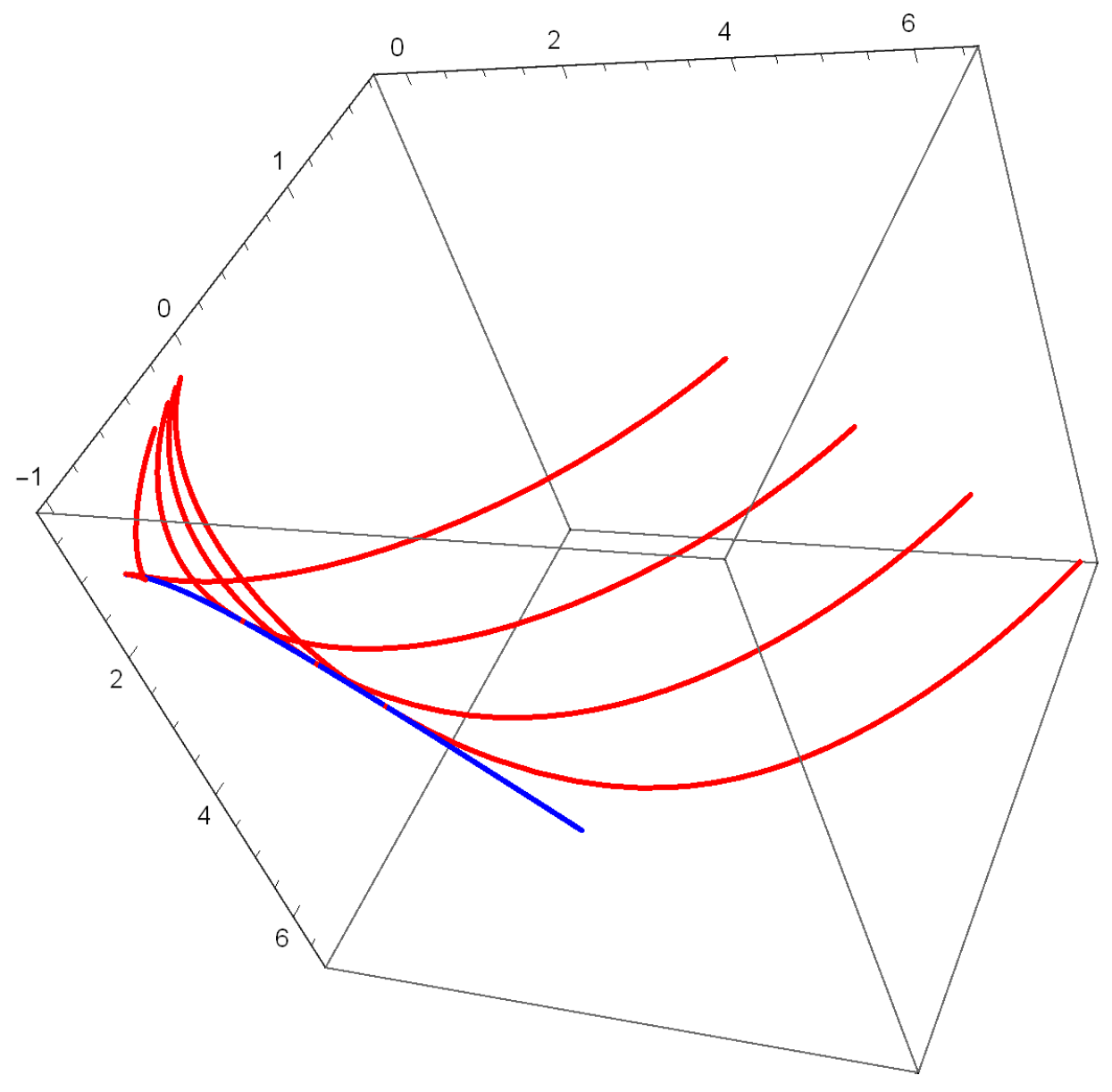
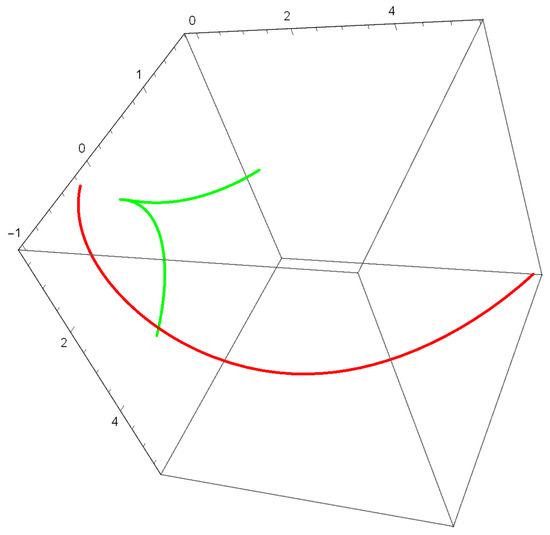
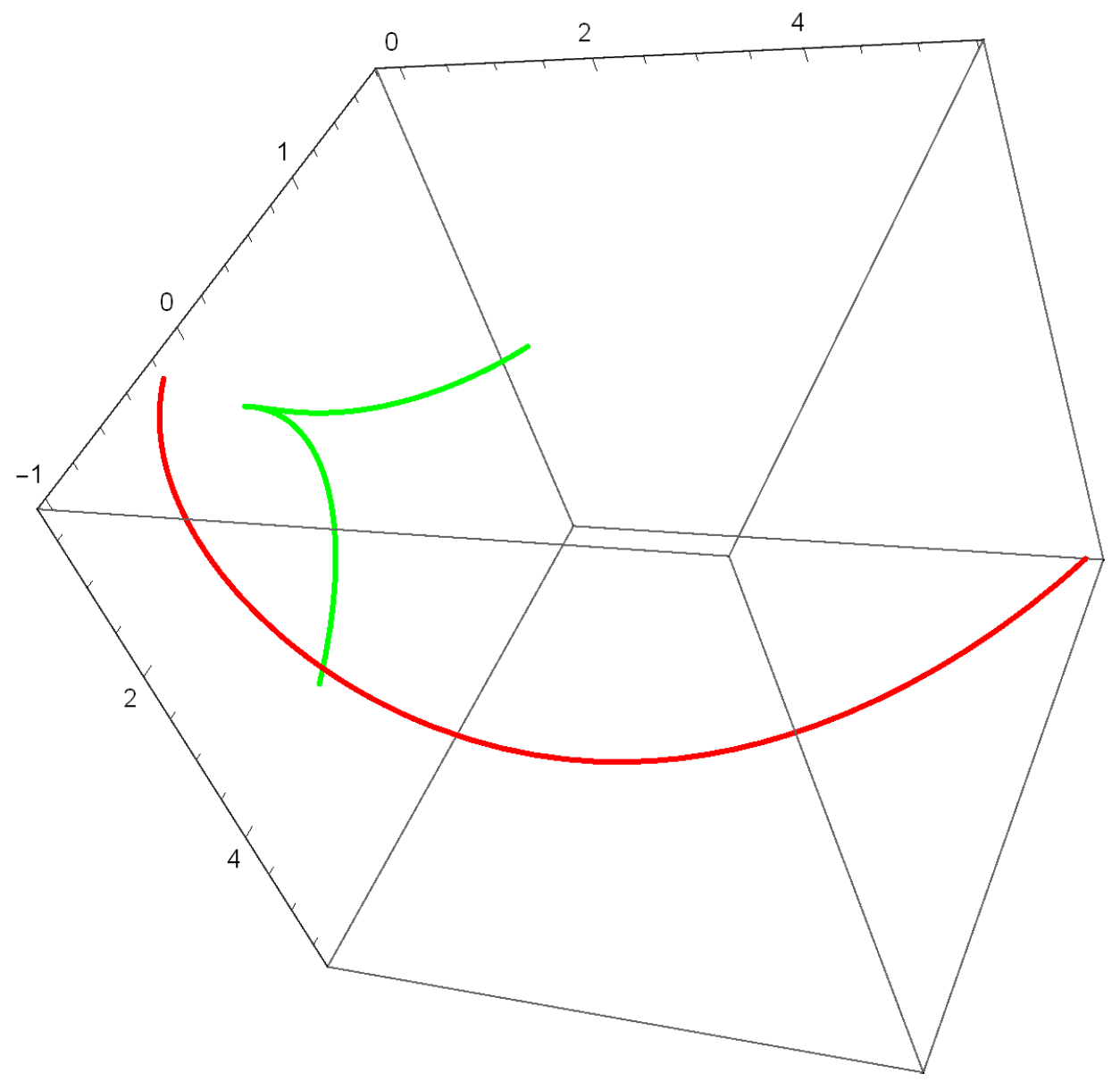
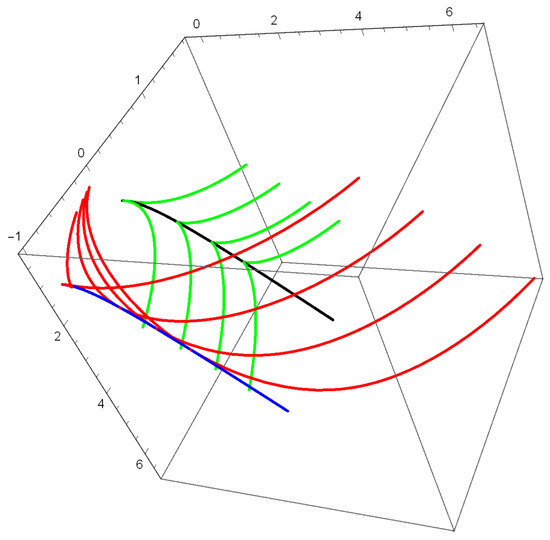
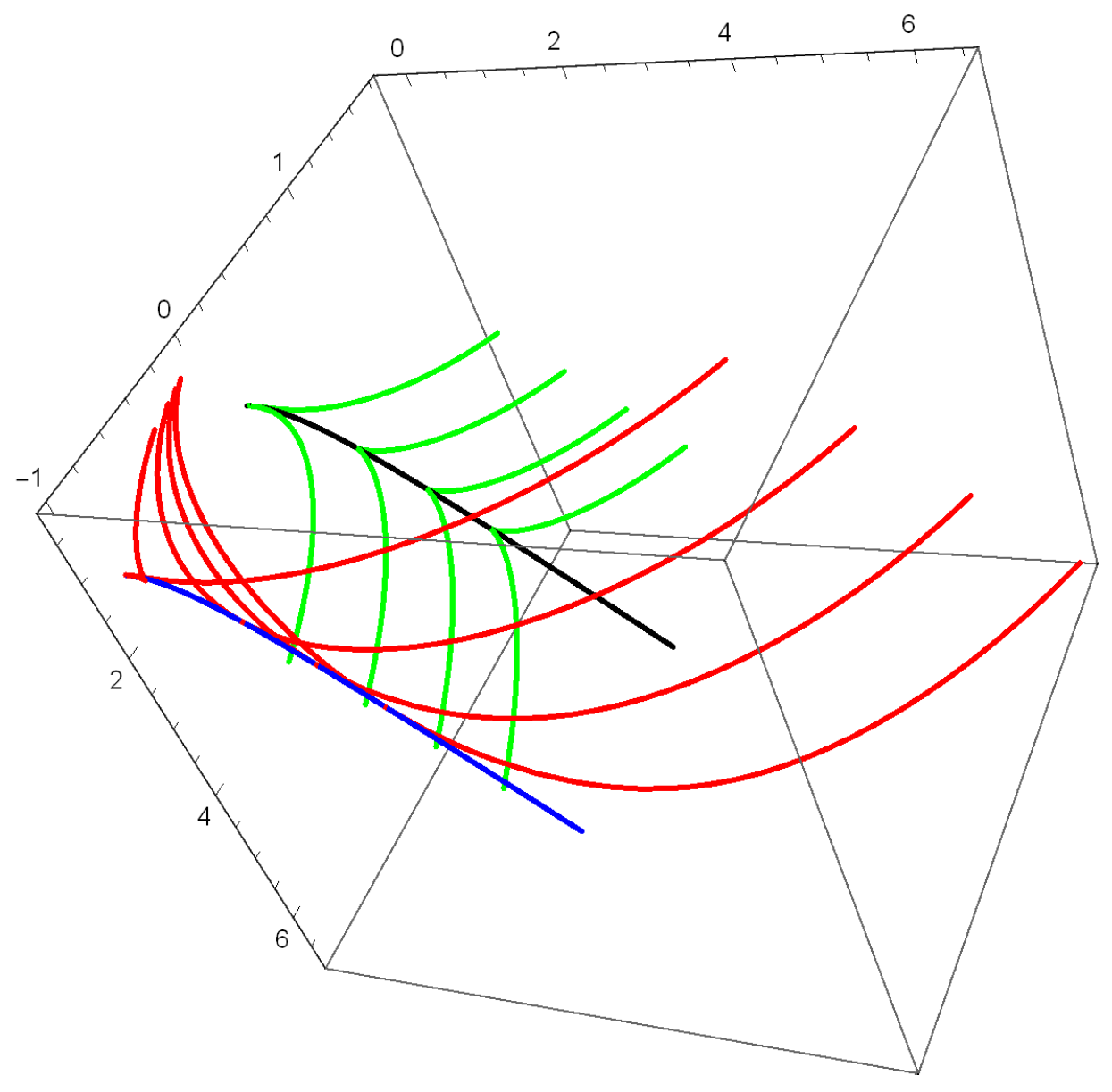
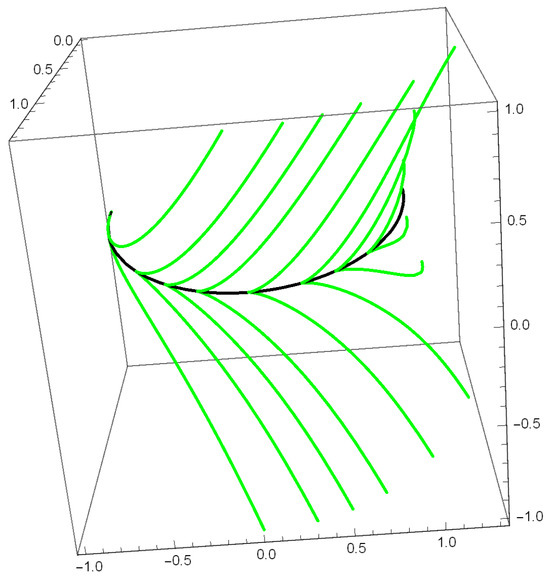
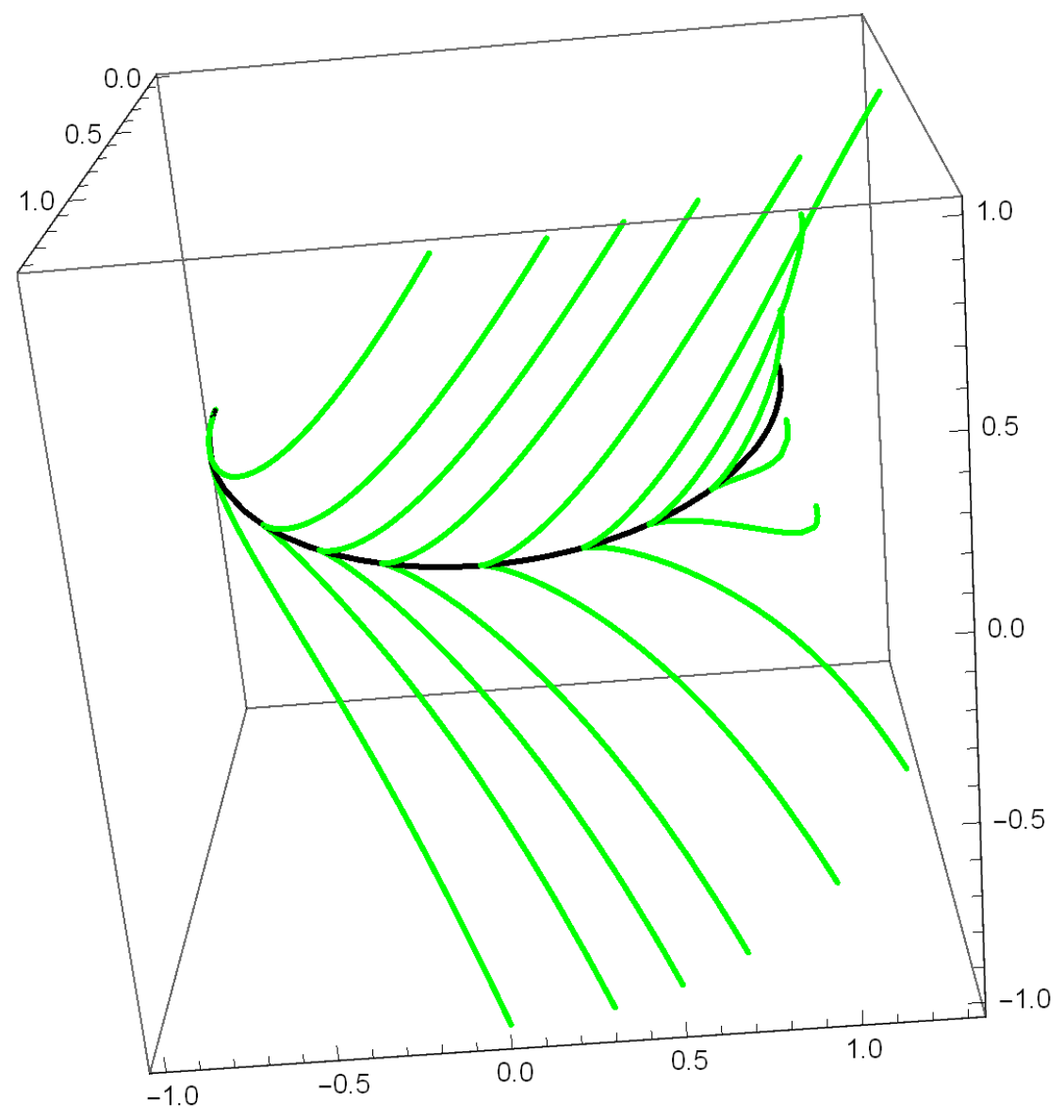
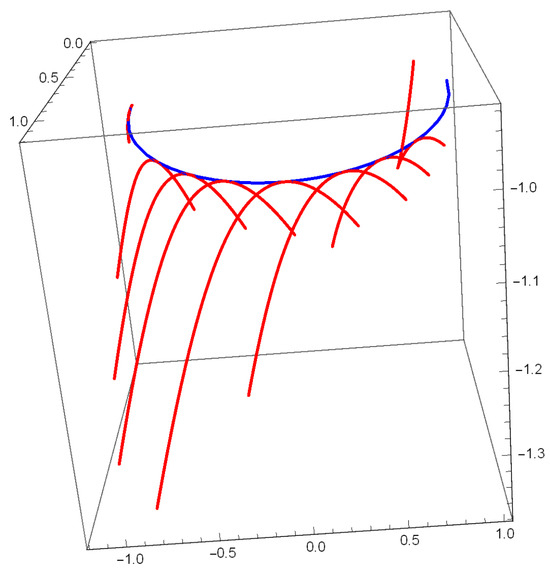
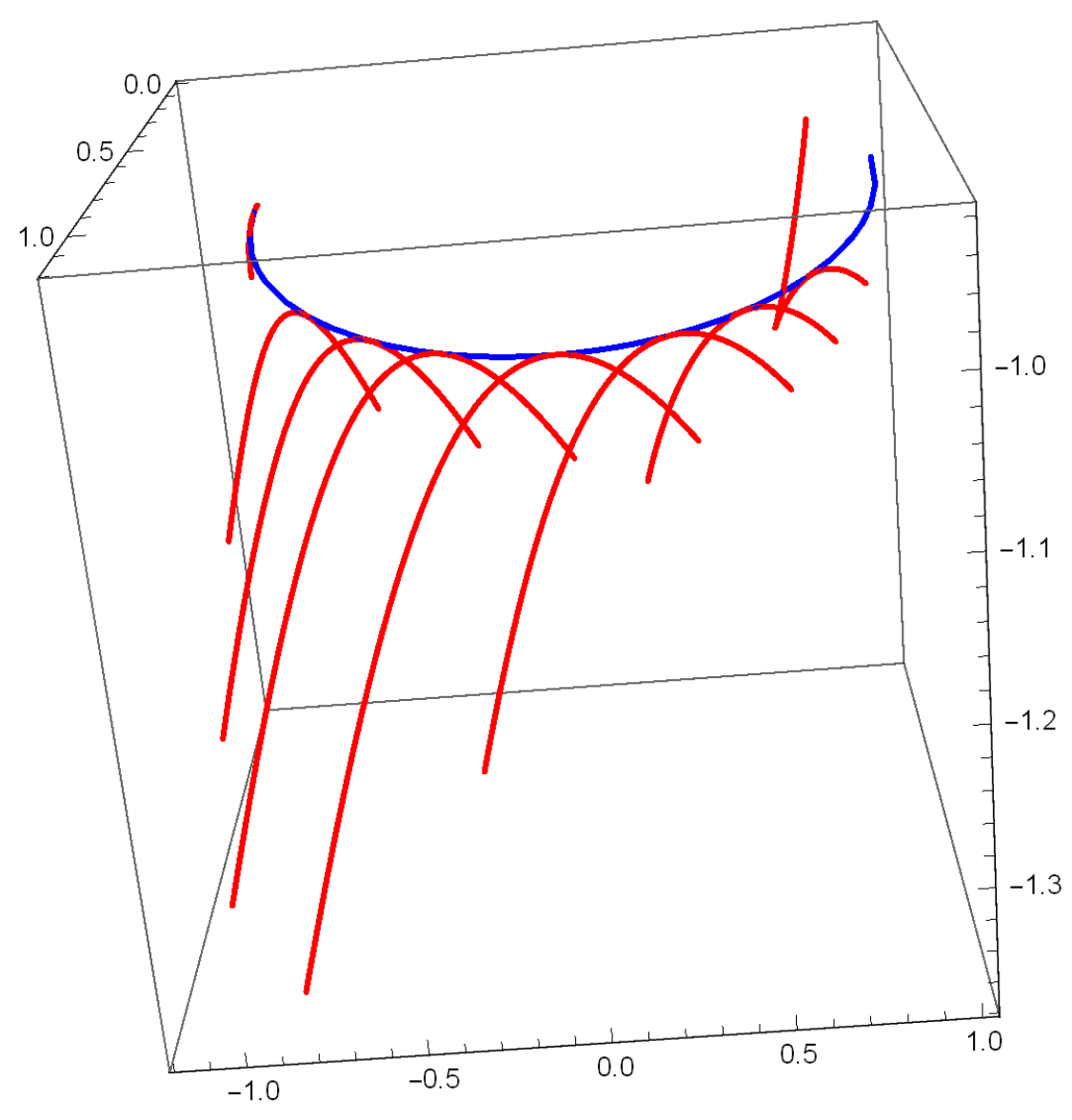
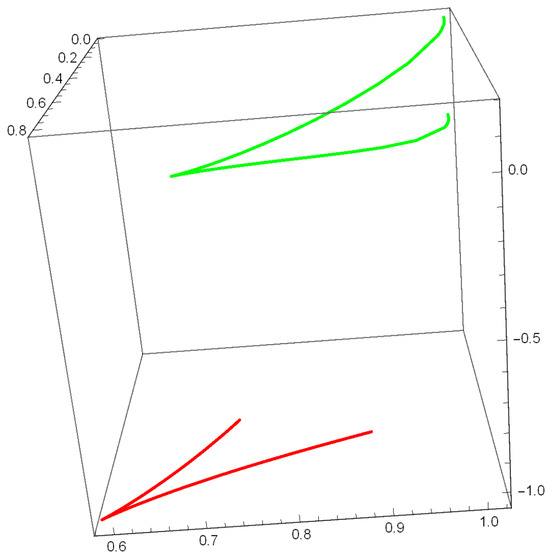
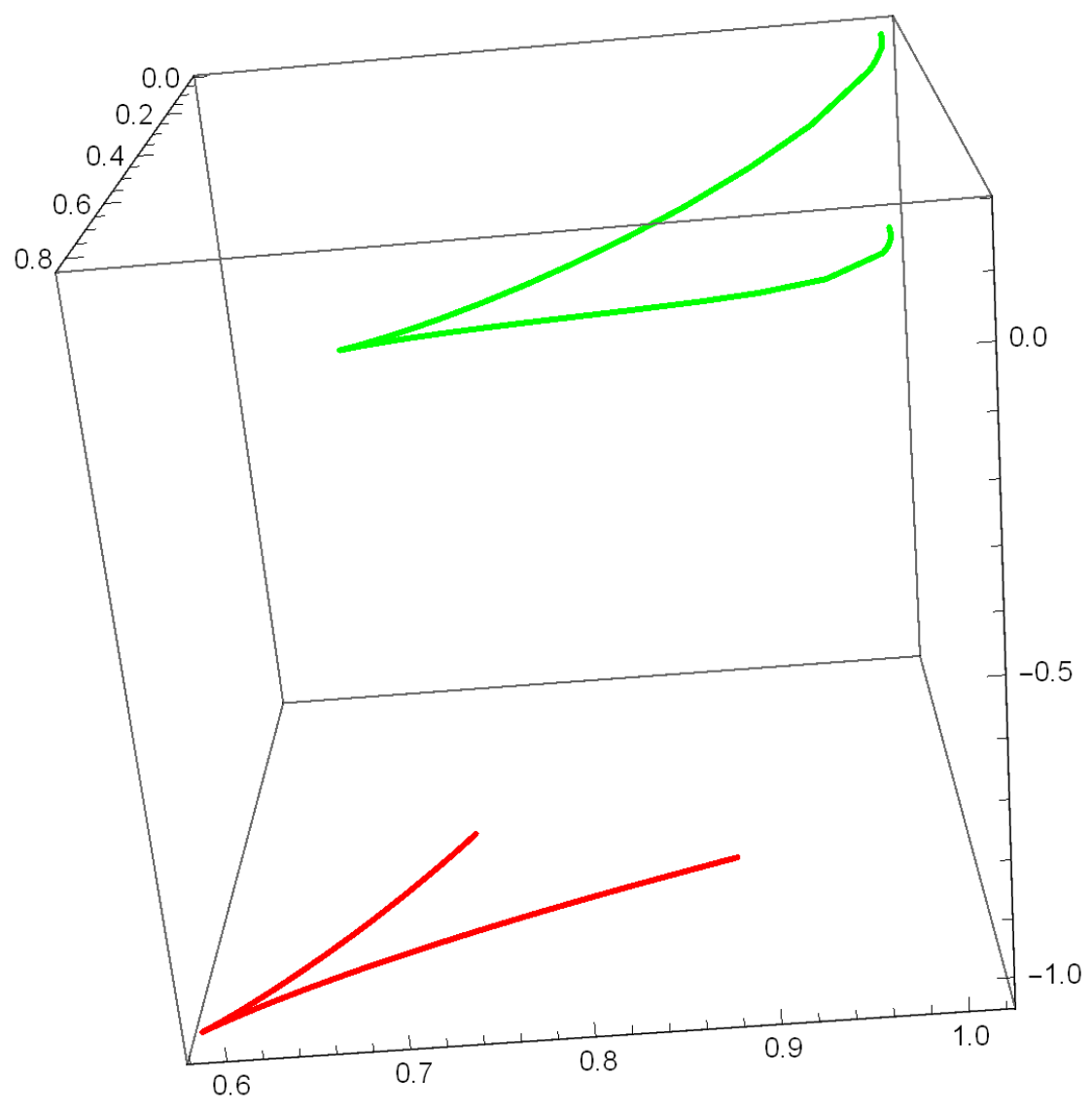
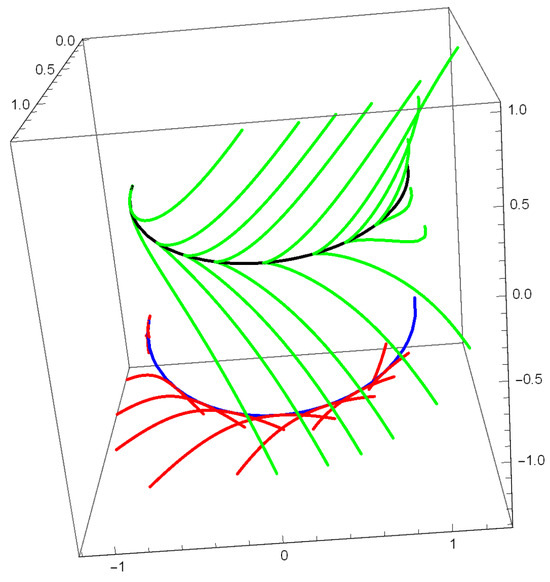
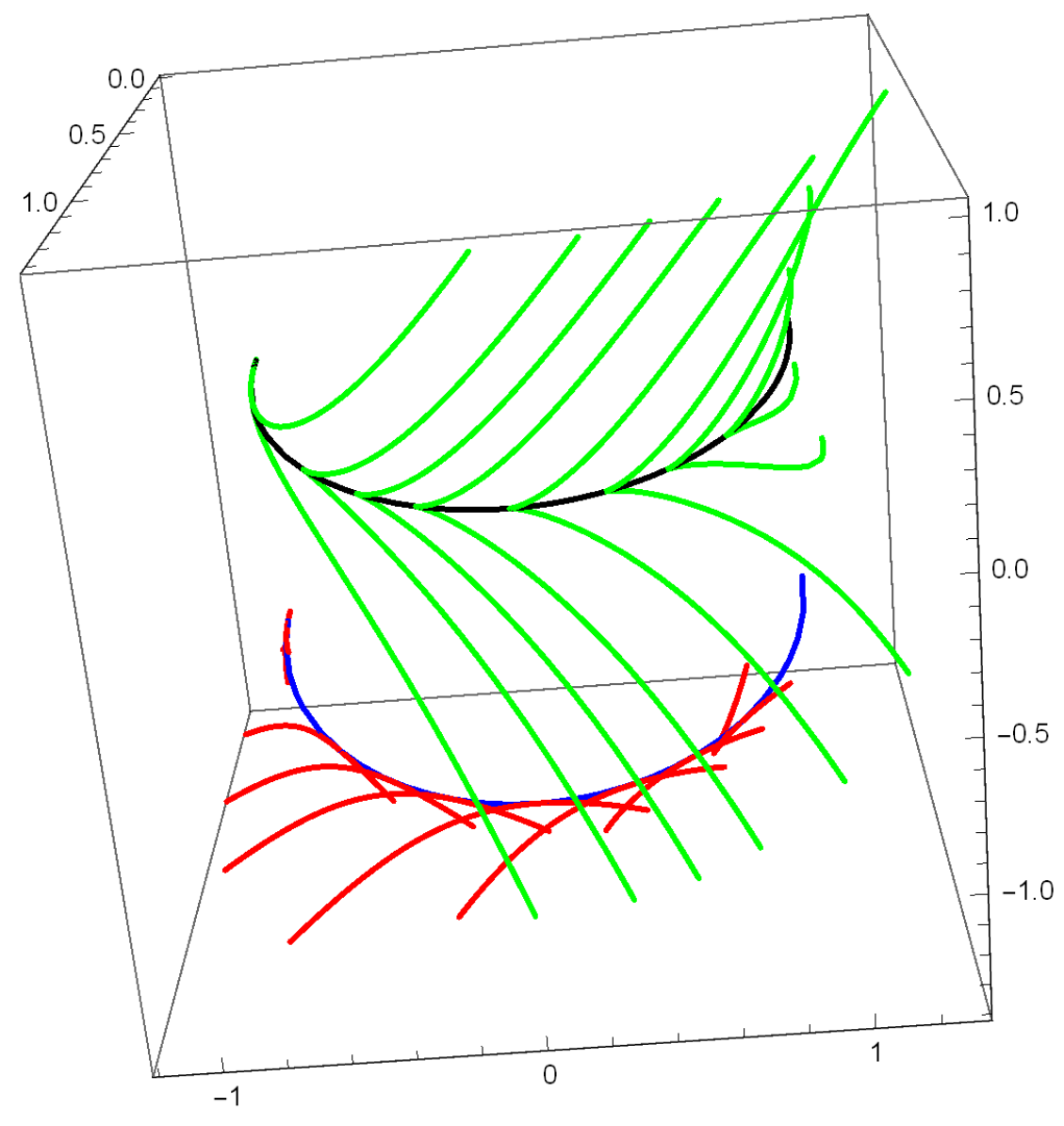
are satisfied. Consequently, is a pre-envelope, is a hyperbolic envelope (Figure 1), and is a lightcone envelope (Figure 2). The -duality between the two families is illustrated in Figure 3 for a fixed , and Figure 4 shows several members of the families for along with their envelopes.
Figure 1.
The images of and its envelope (in black), where .
Figure 2.
The images of and its envelope (in blue), where .
Figure 3.
The -duality of (in green) and (in red) when .
Figure 4.
The -duality of and when and their envelopes.
Example 2
(A -dual family and its envelopes). Let be the open set defined by
where V and W are given below. Consider the maps defined by
with the auxiliary functions
(Note that W takes the same form as in Example 1; it is linear in σ, not quadratic.) One can check that maps into and satisfies the Legendrian condition , making it a parameter-dependent family of spacelike Legendrian curves. The third frame vector is
The spacelike de Sitter–Legendrian curvature functions are given by
Now, choose the pre-envelope candidate given by , where we take . For , we have , , so and , hence . The restricted curves are
and . Differentiation yields , , and . Both derivatives are parallel to for all . (When , approaches the lightlike point and the derivative diverges, so the envelope is defined only on the open interval .) Hence, conditions (), (), and () are met. Therefore, is a pre-envelope, is a de Sitter envelope (Figure 5), and is a lightcone envelope (Figure 6). The -duality is depicted in Figure 7 for , and Figure 8 shows the families for various σ values () together with their envelopes.
Figure 5.
The images of and its envelope (in black), where .
Figure 6.
The images of and its envelope (in blue), where .
Figure 7.
The -duality of and when .
Figure 8.
The -duality of and and their envelopes, where .
6. Concluding Remarks
This work has established a comprehensive framework for understanding envelopes of parameter-dependent families of frontals that are governed by and dualities within the three pseudo-spheres. Through the formulation of Envelope Theorems, we have provided clear criteria for the existence of these envelopes and characterized them as frontals themselves in the respective spaces (hyperbolic, de Sitter, or lightcone). A pivotal result is the demonstration that -dual families, as well as -dual families, invariably share the same pre-envelope, underscoring the profound geometric link imposed by Legendrian duality. Furthermore, we have shown that the operation of taking a hyperbolic or de Sitter parallel commutes with the process of finding an envelope.
The primary methodological contribution of this paper lies in presenting an effective strategy for determining envelopes of frontal families depending on a parameter, particularly those residing in the degenerate light cone. Two complementary pathways are now available: a direct computation based on the definition involving variability and tangency conditions, and an indirect, often simpler, computation that leverages the duality relations. By transforming the problem to a dual curve family, one can bypass some of the complexities inherent in the light cone geometry.
Looking ahead, several avenues for future research present themselves. A natural extension is to investigate envelope problems for two parameter-dependent families of frontals that exhibit -duality, also within the light cone. The highly degenerate nature of this setting will necessitate the construction of entirely new types of frames adapted to light cone frontals and the formulation of appropriate tangency conditions to define light cone envelopes for families of light cone Legendrian curves indexed by a parameter. Another promising direction involves extending this study to families of curves parametrized by a single variable lying on more general surfaces—spacelike, timelike, or lightlike surfaces with non-constant Gaussian curvature. Such an investigation promises to yield more general and powerful results in the field of singularity theory and differential geometry. Inspired by Arnold’s classical work on Legendrian submanifolds in optics, the dualities developed here may also find applications in relativistic optics, a direction we leave for future investigation.
Author Contributions
Conceptualization, Z.W. and Y.Z.; Methodology, Z.W.; Software, P.Z., Z.W. and Y.Z.; Validation, Y.Z.; Investigation, P.Z., Z.W. and Y.Z.; Resources, Z.W.; Data curation, P.Z.; Writing—original draft, Z.W. and Y.Z.; Writing—review & editing, Z.W. and Y.Z.; Visualization, P.Z., Z.W. and Y.Z.; Supervision, Z.W.; Project administration, P.Z. and Z.W.; Funding acquisition, P.Z. and Z.W. All authors have read and agreed to the published version of the manuscript.
Funding
This work was supported by the Natural Science Foundation of the Heilongjiang Province of China (No. LH2024A015).
Data Availability Statement
The original contributions presented in this study are included in the article. Further inquiries can be directed to the corresponding author(s).
Conflicts of Interest
The authors declare no conflicts of interest.
References
- Bruce, J.W.; Giblin, P.J. What is an envelope. Math. Gaz. 1981, 65, 186–192. [Google Scholar] [CrossRef] [Scilit]
- Chen, L.; Takahashi, M. Dualities and evolutes of fronts in hyperbolic and de Sitter space. J. Math. Anal. Appl. 2016, 437, 133–159. [Google Scholar] [CrossRef] [Scilit]
- Court, L.M. Mathematical notes: Envelopes of plane curves. Amer. Math. Mon. 1950, 57, 168–169. [Google Scholar]
- Gibson, C.G. Elementary Geometry of Differentiable Curves. An Undergraduate Introduction; Cambridge University Press: Cambridge, UK, 2001. [Google Scholar]
- Li, Y.; Pei, D.; Takahashi, M.; Yu, H. Envelopes of Legendre curves in the unit spherical bundle over the unit sphere. Quart. J. Math. 2018, 69, 631–653. [Google Scholar] [CrossRef] [Scilit]
- Risley, W.J.; MacDonald, W.E. Envelopes of one-parameter families of plane curves. Ann. Math. 1911, 12, 73–102. [Google Scholar] [CrossRef] [Scilit]
- Takahashi, M. Envelopes of Legendre curves in the unit tangent bundle over the Euclidean plane. Results Math. 2017, 71, 1473–1489. [Google Scholar] [CrossRef] [Scilit]
- Yang, Z.; Li, Y.; Erdoǧdub, M.; Zhu, Y. Evolving evolutoids and pedaloids from viewpoints of envelope and singularity theory in Minkowski plane. J. Geom. Phys. 2022, 176, 104513. [Google Scholar] [CrossRef] [Scilit]
- Chen, L.; Pei, D.; Takahashi, M. Dualities and envelopes of one-parameter families of frontals in hyperbolic and de Sitter 2-spaces. Math. Nachrichten 2020, 293, 893–909. [Google Scholar] [CrossRef] [Scilit]
- Pacheco, R.; Santos, S.D. Envelopes of circles and spacelike curves in the Lorentz-Minkowski 3-space. Forum Math. 2020, 32, 693–711. [Google Scholar] [CrossRef] [Scilit]
- Silva-Ortigoza, G. Null Surfaces and Their Singularities in Three-Dimensional Minkowski Space-Time. General Relat. Grav. 2000, 32, 2243–2257. [Google Scholar] [CrossRef] [Scilit]
- Arnold, V.I.; Gusein-Zade, S.M.; Varchenko, A.N. Singularities of Differentiable Maps; Birkhäuser: Boston, MA, USA, 1985. [Google Scholar]
- Fukunaga, T.; Takahashi, M. Evolutes of fronts in the Euclidean plane. J. Singul. 2014, 10, 92–107. [Google Scholar] [CrossRef] [Scilit]
- Kokubu, M.; Rossman, W.; Saji, K.; Umehara, M.; Yamada, K. Singularities of flat fronts in hyperbolic 3-space. Pac. J. Math. 2005, 221, 303–351. [Google Scholar] [CrossRef] [Scilit]
- Kokubu, M.; Umehara, M.; Yamada, K. Flat fronts in hyperbolic 3-space. Pac. J. Math. 2004, 216, 149–175. [Google Scholar] [CrossRef] [Scilit]
- Martínez, A.; Milán, F. Flat fronts in hyperbolic 3-space with prescribed singularities. Ann. Glob. Anal. Geom. 2014, 46, 227–239. [Google Scholar] [CrossRef] [Scilit]
- Martínez, A.; Roitman, P.; Tenenblat, K. A connection between flat fronts in hyperbolic space and minimal surfaces in Euclidean space. Ann. Glob. Anal. Geom. 2015, 48, 233–254. [Google Scholar] [CrossRef] [Scilit]
- Saji, K.; Umehara, M.; Yamada, K. The geometry of fronts. Ann. Math. 2009, 169, 491–529. [Google Scholar] [CrossRef] [Scilit]
- Pei, D.; Takahashi, M.; Yu, H. Envelopes of one-parameter families of framed curves in the Euclidean space. J. Geom. 2019, 110, 48. [Google Scholar] [CrossRef] [Scilit]
- Li, Y.; Liu, S.; Wang, Z. Tangent developables and Darboux developables of framed curves. Topology Appl. 2021, 301, 107526. [Google Scholar] [CrossRef] [Scilit]
- Li, Y.; Wang, Z. Lightlike tangent developables in de Sitter3-space. J. Geom. Phys. 2021, 164, 104188. [Google Scholar] [CrossRef] [Scilit]
- Zhang, Z.; Fan, X.; Wang, Z. Singularities of worldsheets along framed particle trajectories in Minkowski three-space. Mod. Phys. Lett. A 2024, 39, 2450154. [Google Scholar] [CrossRef] [Scilit]
- Liu, Z.; Wang, Z. Duality and singularities of worldsheet along space-like framed curves in de Sitter 3-space. Mod. Phys. Lett. A 2026, 41, 2550212. [Google Scholar] [CrossRef] [Scilit]
- O’Neil, B. Semi-Riemannian Geometry; Academic Press: New York, NY, USA, 1983. [Google Scholar]
- Izumiya, S. Legendrian dualities and spacelike hypersurfaces in the lightcone. Mosc. Math. J. 2009, 9, 325–357. [Google Scholar] [CrossRef] [Scilit]
- Chen, L.; Izumiya, S. A mandala of Legendrian dualities for pseudo-spheres in semi-Euclidean space. Proc. Jpn. Acad. 2009, 85, 49. [Google Scholar] [CrossRef] [Scilit]
Disclaimer/Publisher’s Note: The statements, opinions and data contained in all publications are solely those of the individual author(s) and contributor(s) and not of MDPI and/or the editor(s). MDPI and/or the editor(s) disclaim responsibility for any injury to people or property resulting from any ideas, methods, instructions or products referred to in the content. |
© 2026 by the authors. Licensee MDPI, Basel, Switzerland. This article is an open access article distributed under the terms and conditions of the Creative Commons Attribution (CC BY) license.