1. Introduction
The asymptotic behavior of infinite-dimensional evolution equations under deterministic and stochastic perturbations is a fundamental problem with deep connections to stability theory, invariant manifold theory, and the qualitative analysis of stochastic partial differential equations. In many concrete models arising in physics, biology, and engineering, the linear part of the dynamics provides a natural splitting of the phase space into exponentially stable and unstable directions; this splitting is conveniently formalized by an exponential dichotomy of the linear semigroup. Understanding whether and how the asymptotic growth rates dictated by the linear part persist in the presence of (possibly multiplicative) stochastic forcing and nonlinear perturbations is the central question studied in this paper.
The asymptotic behavior of random dynamical systems, as
, is important both in theory and in applications. A key tool in this area is the concept of exponential dichotomy for linear evolution equations, which is closely related to stability and long-time behavior of solutions. Classical results of Daleckii and Krein [
1] describe conditions for exponential dichotomy of deterministic systems generated by
-semigroups and their spectral properties. Later, this idea became a standard tool in the study of perturbed linear and nonlinear systems, including stable and unstable manifolds and exponential stability.
For stochastic systems, the natural analogue is mean-square exponential dichotomy, which describes a splitting of the phase space into stable and unstable parts in the mean-square sense. In finite-dimensional systems, exponential dichotomy was studied in [
2] using quadratic forms. The relation between dichotomy and bounded solutions of inhomogeneous systems was investigated in [
3], and the persistence of dichotomy under small perturbations was studied in [
4]. For infinite-dimensional stochastic systems, dichotomy was studied, for example, in [
5,
6].
The concept of exponential dichotomy is also closely related to Lyapunov exponents. In the linear case, dichotomy is expected when the Lyapunov exponents do not vanish. The basic theory of Lyapunov exponents for stochastic systems was developed in [
7,
8]. Later, Lyapunov exponents were used in many problems, including Hopf bifurcation with noise [
9], lower bounds for Lyapunov exponents [
10], ergodic theory [
11], and synchronization of infinite-dimensional stochastic systems [
12]. However, the preservation of Lyapunov exponents for infinite-dimensional stochastic systems under asymptotically vanishing perturbations has not been studied in the same form.
We consider stochastic evolution equations on a separable Hilbert space
H of the form
where
generates a strongly continuous semigroup
and
W denotes a
Q-Wiener process. The unperturbed linear semigroup is assumed to admit an exponential dichotomy on
: there is a bounded projection that splits
and a rate
so that solutions originating in the negative subspace
decay exponentially at least at a rate
, while those associated with the positive subspace
grow at least at a rate
. This linear dichotomy provides the reference exponents
against which the perturbed dynamics will be measured.
The nonlinear terms are taken to satisfy two structural conditions. First, a global Lipschitz condition (assumption (H1)) ensures well posedness and permits mean-square estimates for solutions. Second, an asymptotic smallness condition (assumption (H2)) requires that the nonlinear drift and diffusion coefficients decay to zero, as , in a uniform, multiplicative manner. Intuitively, (H2) means that, for large times, the nonlinear stochastic perturbation becomes negligible in comparison with the linear dynamics; such a regime is natural in models with temporally vanishing forcing or coefficients and is crucial for comparing long-time growth rates with the linear reference.
Our main result (Theorem 1) states that, under (H1) and (H2), the asymptotic mean-square growth rates of nontrivial mild solutions coincide with the reference exponents provided by the linear dichotomy: any solution that remains bounded in mean-square decays with an upper mean-square Lyapunov exponent of at most , while any solution whose mean-square norm diverges grows with a lower mean-square Lyapunov exponent of at least . Equivalently, there is no intermediate mean-square growth rate: every nontrivial trajectory is either mean-square exponentially decaying or mean-square exponentially growing, and the corresponding mean-square Lyapunov exponent equals . This preservation of mean-square Lyapunov exponents demonstrates a robust dichotomy of asymptotic dynamics for the full stochastic system.
From a conceptual viewpoint, the result highlights a form of spectral rigidity for mean-square growth rates: when nonlinear and stochastic perturbations decay in time, they cannot create new asymptotic mean-square growth rates distinct from those already present in the linear part. Practically, this gives a simple and computable criterion to classify long-time behavior of a large class of stochastic evolution equations by inspecting the linear generator and verifying the mild decay of perturbations.
The hypotheses adopted here strike a balance between generality and technical transparency. The global Lipschitz assumption could be relaxed in future work (for instance, to local Lipschitz with suitable dissipativity), and the asymptotic smallness condition might be weakened to integrability-type assumptions; both directions raise interesting technical challenges, especially in controlling stochastic convolutions without uniform Lipschitz estimates. We briefly discuss such extensions and open problems in the conclusion.
A heuristic way to understand the result is the following. The exponential dichotomy of the linear semigroup splits the phase space into directions that decay exponentially and directions that grow exponentially. When the nonlinear drift and diffusion terms become small, as , their influence on the dynamics over large time intervals is negligible compared with the exponential action of the linear semigroup.
If a trajectory had an intermediate growth rate, lying between the stable and unstable exponential rates, then the projections of the solution onto the stable and unstable subspaces would have to balance each other in a very precise way over arbitrarily long time intervals. However, the dichotomy estimates imply that the stable component is exponentially damped, while the unstable component is exponentially amplified. Since the perturbation terms become arbitrarily small for large times, they cannot maintain such a delicate balance. As a consequence, the solution must eventually align with either the stable or the unstable directions of the linear dynamics, which leads to exponential decay or exponential growth in the mean-square sense. The extension from finite-dimensional systems to stochastic evolution equations in Hilbert spaces is not purely notational. In many classical results on exponential dichotomy and the preservation of Lyapunov exponents for stochastic systems, the analysis relies on Lyapunov functions given by quadratic forms. Such approaches reduce stability questions to properties of the corresponding quadratic functional and its generator along the system.
In infinite-dimensional spaces, however, the existence of suitable quadratic Lyapunov functionals generally requires additional structural assumptions on the operator or on the underlying semigroup. Therefore, arguments based directly on quadratic forms are not always readily applicable in the abstract Hilbert space setting.
Another technical difference concerns compactness arguments that are often used implicitly in finite-dimensional proofs. In the unit sphere is compact, which allows one to extract convergent subsequences and to perform certain maximization arguments. In an infinite-dimensional Hilbert space, the unit sphere is no longer compact, and such arguments cannot be used directly.
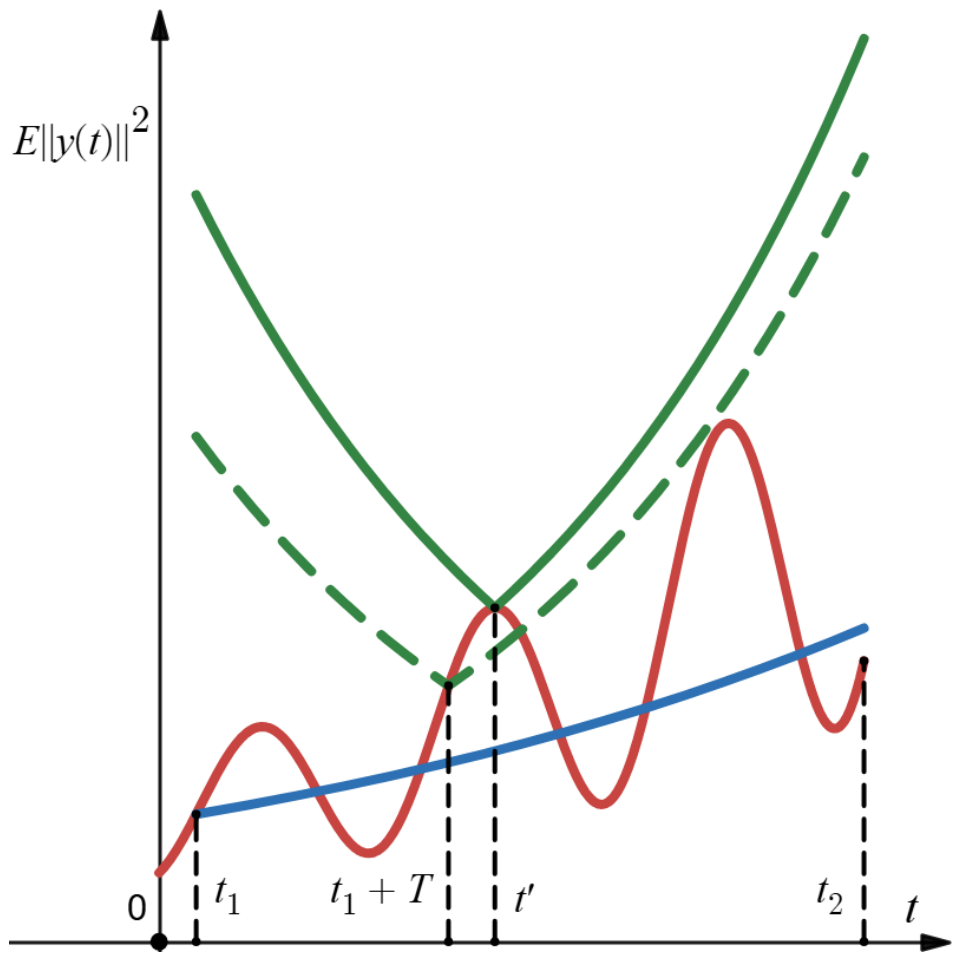
For this reason, the proof presented in this paper follows a different strategy. Instead of constructing Lyapunov functionals, we derive direct estimates for the second moment of the solution using the projections associated with the exponential dichotomy and elementary inequalities, such as the Cauchy–Schwarz inequality and Itô’s isometry. This leads to a simple comparison inequality that controls the present second moment of the solution by its past and future values.
From a methodological point of view, the proposed approach provides an alternative to the classical quadratic-form techniques and yields a relatively elementary proof of the preservation of mean-square Lyapunov exponents in the infinite-dimensional stochastic setting.
This paper is organized as follows. Immediately after this introduction, we present precise definitions, the standing hypotheses (H1)–(H2), the notion of a mild solution and mean-square Lyapunov exponents, and we state the main preservation theorem together with remarks on the interpretation of the driving noise (see
Section 2). In
Section 3, we give a detailed proof of Theorem 1.
Section 4 contains two concrete examples that illustrate the applicability of the abstract result to simple stochastic evolution models. This manuscript concludes with a discussion in
Section 5, outlining possible generalizations and further research directions.
Notation. Throughout this paper denotes the norm on H, denotes the space of bounded linear operators on H, and is the Hilbert–Schmidt norm for operators where it appears. We work in the mean-square framework and use standard notions for stochastic integrals in Hilbert spaces.
4. Examples
Here are examples illustrating Theorem 1.
Example 1. Let be a bounded domain with a sufficiently smooth boundary,where is a symmetric and bounded matrix, and are Hölder continuous with the Hölder exponent . Furthermore, assume there exists a constant , such thatfor all and . The boundedness of implies that there exists , such thatSet . It is well known that the operator A generates a -semigroup , and has a discrete spectrum: a sequence of eigenvaluesLet be the corresponding orthonormal eigenbasis in H, such thatAccording to standard results (see, e.g., [14]), such a basis always exists. Let , , and we introduce the covariance operator , such that Q is non-negative, , and .
This allows us to define an
H-valued stochastic process
which is a
Q-Wiener process. Here,
are standard, scalar, mutually independent Wiener processes. Denote
. It follows from ([
15], Lemma 2.2), that
. For any fixed
, we may now introduce the multiplication operator
defined by
Since and , the operator is well defined. Hence is a Hilbert–Schmidt operator.
In the sequel, we denote by
the space of Hilbert–Schmidt operators with the norm
. Then
Hence, if
is a predictable process, such that
then, following [
15], we can define the stochastic integral
and
We consider the following stochastic linear partial differential equation:
where the function
is Lipschitz continuous for
,
, and
, as
. The parameter
is chosen, such that
.
Then, obviously, all the conditions of Theorem 1 are fulfilled, and the mean-square Lyapunov exponents of Equation (
21) are preserved (i.e., they coincide with the reference exponents of the linear part).
In the following example, we consider the one-dimensional problem (
21) with
. In this case, the spectrum is given explicitly.
Example 2. Let . Consider the problem, , . The function satisfies the previous conditions. In this case, , and the operator , with . Then, as is well known [16], the spectrumis real and . Set Then and .
For any mild solution
of (
22), Theorem 1 implies:
- 1.
If the solution has an unbounded second moment, then
- 2.
If the solution has a bounded second moment, then
Thus, on the unstable spectral subspace, the mean-square Lyapunov exponent is not smaller than the minimal positive eigenvalue , while on the stable subspace, it does not exceed the negative of the minimal modulus of the negative eigenvalues, .
Remark 4. Inspecting the proof of Theorem 1, one can see that, if necessary, the exact rates and can be taken instead of the common value α.
5. Discussion
This paper studies the Lyapunov structure of nonlinear stochastic evolution equations in a separable Hilbert space driven by a Q-Wiener process. The linear operator A generates a -semigroup admitting an exponential dichotomy, which induces a splitting associated with positive and negative Lyapunov exponents. The nonlinear drift and diffusion terms are assumed to be globally Lipschitz and to decay in time.
The main result shows that the Lyapunov exponents of the nonlinear stochastic equation coincide with those of the linear part. In particular, no new mean-square growth rates appear due to the nonlinear perturbations, and the splitting induced by the operator A remains unchanged in the mean-square sense.
The analysis confirms that the linear exponential dichotomy provides a correct reference structure for the nonlinear stochastic system and that this structure is robust under small fading perturbations in both drift and diffusion terms. The proof relies on the spectral splitting of the semigroup generated by A and on mean-square estimates based on the Itô isometry.
From a physical viewpoint, assumption (H2) means that the nonlinear perturbation vanishes at the equilibrium state: indeed, and for all , so the system contains no additive forcing at the origin. In this sense, the nonlinear terms act only as state-dependent perturbations, which is consistent with a model of fading or self-regulating effects rather than external noise injected independently of the current state. The nonautonomous character of the coefficients is also natural in applications, since it allows the strength of the perturbation to change in time while still remaining asymptotically negligible.
We also remark that condition (H2) could likely be weakened to a more physically natural growth bound of the form or to a similar subcritical condition. Such a refinement would broaden the range of admissible models, but it would require additional technical estimates in the proof. On the other hand, assumption (H1) can probably be relaxed without essential difficulty; it is imposed here mainly to keep the statement and the exposition as transparent as possible.
The obtained results give a simple and verifiable criterion for the invariance in Lyapunov exponents in nonlinear stochastic evolution equations. Possible extensions include weaker decay conditions and almost-sure versions of the obtained statements.