


Abstract
C. F. Hansen’s NASA TR R-50 published in 1959 remains one of the most widely used analytic approximations for the thermodynamic and transport properties of high-temperature air. Although modern equilibrium and nonequilibrium models extend the temperature range and species sets, Hansen’s expressions continue to provide a transparent, closed-form representation valuable for hypersonic aerothermodynamics, preliminary design, and code verification studies up to 15,000 K. In this work, we reconstruct the full Hansen model from his source equations, implement the formulation in a consistent modern notation, and derive all thermodynamic and transport quantities explicitly. The transport-property model developed by Hansen is discussed in comparison to research by Thompson et al., Gordon and McBride, and D’Angola et al. The resulting implementation provides a clean, analytic 7-species-air model for high-speed/hypersonic applications where rapid evaluations of thermodynamic and transport properties are required.
Keywords:
high-temperature air; Hansen model; thermodynamic properties; transport properties; hypersonic flow MSC:
76N15; 76P05; 80A10; 82B30; 82B40
1. Introduction
Models for high-temperature air under thermochemical equilibrium assumptions are essential for predicting hypersonic aerothermodynamic flow variables, including stagnation-region heating, shock-layer structure, and viscous interactions relevant to aircraft, rocket, and ground-test facility design. Hansen’s 1959 NASA Technical Report R-50 [1] provides equilibrium mixture properties in a compact form as functions of temperature and pressure, enabling extremely rapid evaluation of thermodynamic and transport properties. The formulation presented by Hansen allows the air properties to be reproduced or reformulated from first principles, should modifications or extensions to the original equations be required.
In the 1950s, engineering calculations were performed using a combination of manual methods, mechanical desk calculators, and early electronic computers. Prior to the widespread availability of digital computing, many laboratories relied on teams of “human computers” who carried out calculations using slide rules and mechanical devices. These systems used mechanical gear mechanisms to perform arithmetic operations and were widely employed for scientific and engineering work throughout the 1940s and early 1950s. Early electronic computers such as the IBM 704 began to automate some calculations, but their capabilities were still extremely limited, typically providing only 4 k–32 k words of memory and processing speeds on the order of floating-point operations per second. Consequently, engineering models developed during this period were generally formulated in simplified forms so that they could be evaluated within the modest computational resources available at the time [2].
Several models exist for the aerothermodynamics of high-temperature air, as summarized by Zhang et al. [3], covering temperatures ranging from approximately 50 to 100,000 K [4,5]. Following Hansen’s work [1], a number of major developments extended the range and physical fidelity of high-temperature air modeling. Three of these models are noted here. The equilibrium and non-equilibrium models of Gupta, Yos, Thompson, and Lee [6,7,8,9] introduced consistent curve fits for thermodynamic and transport properties for an 11-species air mixture. The NASA CEA program [10,11] provided flexible equilibrium computations across a wide range of species sets. Transport models for ionized gases were advanced through the multicomponent plasma formulations of Devoto [12,13,14,15], Burgers [16], and Capitelli and his colleagues [5].
Most developments after 1959 are based on Chapman–Enskog theory [17], which presents a systematic expansion of the Boltzmann equation. The Boltzmann equation provides a kinetic description of a dilute gas by governing the evolution of the molecular velocity distribution function under the combined effects of free molecular motion and binary collisions, thereby forming the microscopic basis for macroscopic transport processes such as viscosity, thermal conductivity, and mass diffusion [17,18,19]. Although the theory itself was available in 1959, the computational resources required to evaluate the resulting collision integrals were not. The Chapman–Enskog approach enables the calculation of transport processes without lumping multiple species together, as is done in Hansen’s original model, and allows the extension, modification, and improvement of the formulation beyond 15,000 K. While Hansen’s method captures the essential mechanics of chemically reacting air, its transport–property predictions exhibit noticeable deviations from more detailed models and experimental data.
Modern hypersonic aerothermodynamics relies on accurate thermochemical modeling of high-temperature air. For computational efficiency, many early formulations were reduced to curve-fit representations, particularly during the development of numerical solvers in the 1970s–1990s [9,20]. While such representations remain useful, analytic models continue to play an important role in verification, reduced-order prediction, and the transparent interpretation of governing thermodynamic relations.
Hansen’s model provides a systematic and internally consistent formulation for thermodynamic properties, including enthalpy, internal energy, entropy, and specific heats, together with the auxiliary relations required for their evaluation. In Hansen’s model, air is represented as a seven-species mixture consisting of N2, O2, N, O, N+, O+, and e−, with NO and higher-order species neglected. This formulation is appropriate for temperatures up to approximately 15,000 K, a range encompassing most hypersonic flow applications of practical interest.
Hansen’s approach has served as a foundational reference for subsequent equilibrium air models. In particular, the works of Gupta et al. [9], Anderson [21], and Bertin [22] explicitly adopt or reference Hansen’s formulation [1] in their treatment of chemically reacting air. At higher temperatures, additional physical processes associated with plasma behavior become significant, requiring extended thermochemical and transport modeling. Such regimes are relevant both to extreme aerothermodynamic environments and to plasma-based applications, including material processing and surface treatment, as summarized by D’Angola et al. [23] and Capitelli et al. [4,5,24].
In this paper, we reconstruct Hansen’s thermodynamic and transport equations, derive all required auxiliary quantities, and implement the formulas in a MATLAB (MATLAB-R2025b-Update-3) environment for rapid evaluation. Hansen’s formulation is then used to calculate the transport properties: dynamic viscosity, thermal conductivity, and Prandtl number up to 15,000 K. The results are compared against the NASA 11-species equilibrium model [6,9,25], predictions of the NASA Chemical Equilibrium with Applications (CEA) model [10,11], and the 19-species model of D’Angola et al. [23]. The NASA 11-species model (referred to as the Gupta model in this paper) is recalculated using the curve fits provided by the NASA group [6,25], while the D’Angola et al. results are obtained directly from their published data [23]. Among the models shown, the D’Angola formulation is considered the most accurate for comparison purposes [23]. Capitelli et al. [24,26,27] provide a list of the governing equations and comparisons to the results of Yos et al. [28]. Throughout the text, references to Hansen’s original equation numbering appear as “H#” (e.g., H4). Otherwise, equation numbers appearing in this paper correspond to the derivations presented here.
2. Thermochemical Properties of Air
In Hansen’s model, high-temperature air is represented as a reacting mixture of seven species: . Dissociation of and , followed by the ionization of O and N, governs the thermochemical behavior over the temperature range 2000–15,000 K. Hansen’s formulation expresses all caloric and equilibrium quantities directly through analytic logarithmic partition functions .
High-temperature air exhibits strong coupling between thermodynamic, chemical, and transport processes. Hansen’s original formulation [1] expresses all mixture properties in terms of the key thermochemical parameters that are determined from the equilibrium constants through algebraic relations (H29, H33, H37). In the following sections, the equations presented by Hansen are reproduced, beginning with the partition–function representations of the individual molecular energy components, following the framework of statistical thermodynamics [29].
The partition function is defined as
where is the degeneracy, or statistical weight, of the energy level , defined relative to the zero-point energy (sensible energy). This formulation is used to define the four molecular energy modes: translational (t), rotational (r), vibrational (v), and electronic (e), and the two energy modes for atoms: translational and electronic. These sensible energy modes are then used in the subsequent calculation of thermodynamic properties.
The translational, rotational, vibrational, and electronic partition–function expressions given by Hansen (H2b, H2c, H2d, H2e) are as follows:
Here, for homonuclear diatomic molecules such as , , and , and for heteronuclear diatomic molecules such as and .
The logarithms of the partition functions required for subsequent calculations are given below for both molecules and atoms.
For molecules,
For atoms,
In each case, the terms grouped within the first brackets are constants.
The logarithmic representations of the partition functions for the seven species used by Hansen are given in Equations (8)–(14) (H3a–H3g). The corresponding constant values appearing in these expressions are listed separately in Table A1 for completeness.
The energy, enthalpy, and entropy per mole of a pure gas, following statistical mechanics, are given by
Here, . The quantities and are defined as
which correspond to the partition functions for the standard states of unit pressure and unit concentration, respectively.
The quantity denotes the zero–absolute-temperature reference energy and has a different value for each species. By convention, is taken as zero for nitrogen and oxygen molecules. For neutral atoms, is equal to one-half of the dissociation energy per mole of the corresponding diatomic molecule. For ionized atoms, is the sum of this dissociation energy and the ionization energy. For electrons, is taken as zero.
The equilibrium constants are required to determine the mole fractions of the species under chemical equilibrium conditions. From thermodynamics, a general chemical reaction is written as
where the are the reactants, the are the products, and and are their respective stoichiometric coefficients. The pressure-based equilibrium constant for this reaction is defined in terms of the partial pressures as
It is related to the partition functions through
where
The chemical reactions considered in the present equilibrium model consist of dissociation and ionization processes for oxygen and nitrogen. Each reaction is assumed to be in local thermodynamic equilibrium and is characterized by an associated pressure-based equilibrium constant , defined in terms of species partial pressures:
The temperature dependence of the equilibrium constants is obtained from the species partition functions following the formulation of Hansen [1]. In this approach, pressure-based partition functions are defined as
where Q denotes the atomic/molecular partition function. The equilibrium constants are evaluated using classical statistical thermodynamics.
For the reactions listed above, Hansen provides the following logarithmic expressions for the equilibrium constants (H20a–H20d):
These equilibrium constants are subsequently used to determine the species mole fractions through the law of mass action. Equivalent equilibrium constants may also be obtained from NASA polynomial thermochemistry, as implemented in CEA and Gupta-type equilibrium models.
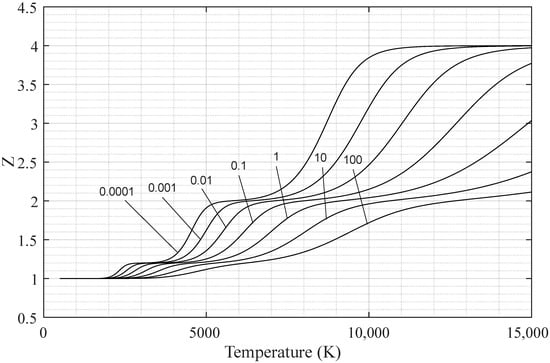
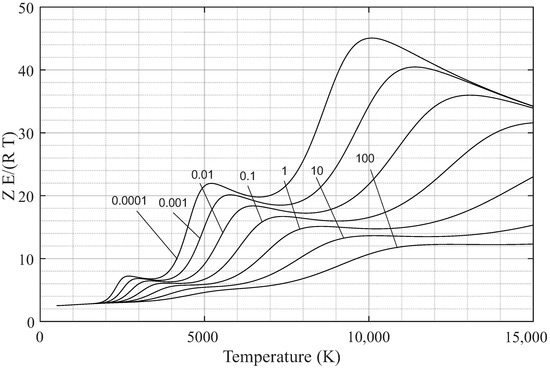
Hansen assumes that the initial undissociated air consists of and . Hansen’s original formulation [1] expresses all mixture properties in terms of the key thermochemical parameters , , and , where is the fraction of molecules that dissociate into oxygen atoms, is the fraction of molecules that dissociate into nitrogen atoms, and is the fraction of atoms that become ionized. These parameters are determined from the equilibrium constants , , and through algebraic relations (H30, H33, H36, and H37). Once , , and are determined, all thermodynamic quantities follow from mixture-averaged relations. Figure 1 shows the variations of the compressibility factor as a function of temperature at different atmospheric pressures.
Figure 1.
Compressibility function from Hansen’s analytic expression. Numbers shown in the figure denote pressure levels in atm.
The mixture compressibility factor and the equation of state are defined as
where is the molecular weight of undissociated air. The parameter is zero until the dissociation of begins and reaches once the dissociation is complete. Similarly, reaches once the dissociation of is complete at sufficiently high temperatures.
The dissociation equilibrium yields the following relations. The partial pressures of the neutral species are expressed in terms of the total pressure p and the dissociation fraction as
Similarly, for dissociation,
The ionization of nitrogen (and similarly oxygen) is written as
The equilibrium constant is taken as a population-weighted average of the oxygen and nitrogen ionization reactions using the corresponding variables,
These relations allow the mole fractions of all seven species to be written as
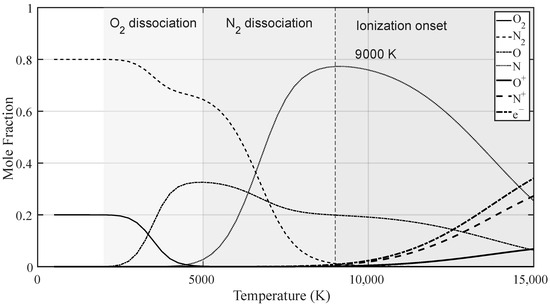
Figure 2 shows the mole fractions at 1 atmospheric pressure at different temperatures. The mixture molecular weight is then given by
Figure 2.
Species mole fractions from the reconstructed Hansen equilibrium model at 1 atm.
The equations presented below allow the determination of the derivatives of the variables with respect to temperature. These derivatives are required in subsequent sections for the evaluation of the mixture specific heats and .
The corresponding expressions in terms of , where , are given by
Once the mole fractions are calculated, the energy, enthalpy, and entropy per mole, in nondimensional form, are expressed by
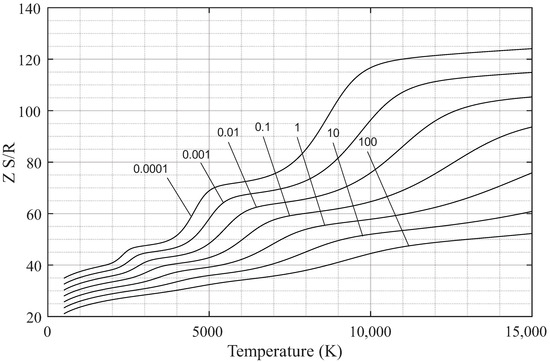
Figure 3 shows the nondimensional E, energy per mole, at different temperatures and pressures, while Figure 4 shows the nondimensional S, entropy per mole per Kelvin, at different temperatures and pressures.
where is the temperature derivative of the species energy.
Figure 3.
Nondimensional Internal-energy function from Hansen’s model. Numbers shown in the figure denote pressure levels in atm.
Figure 4.
Nondimensional Entropy function reconstructed from Hansen’s analytic formula. Numbers shown in the figure denote pressure levels in atm.
The expressions for the specific heats at constant volume and constant pressure (H7, H8), their ratio, and the speed of sound are given as follows:
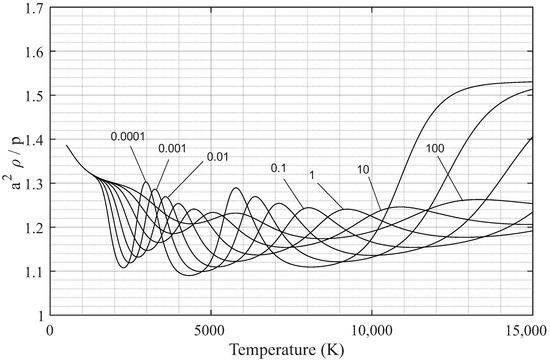
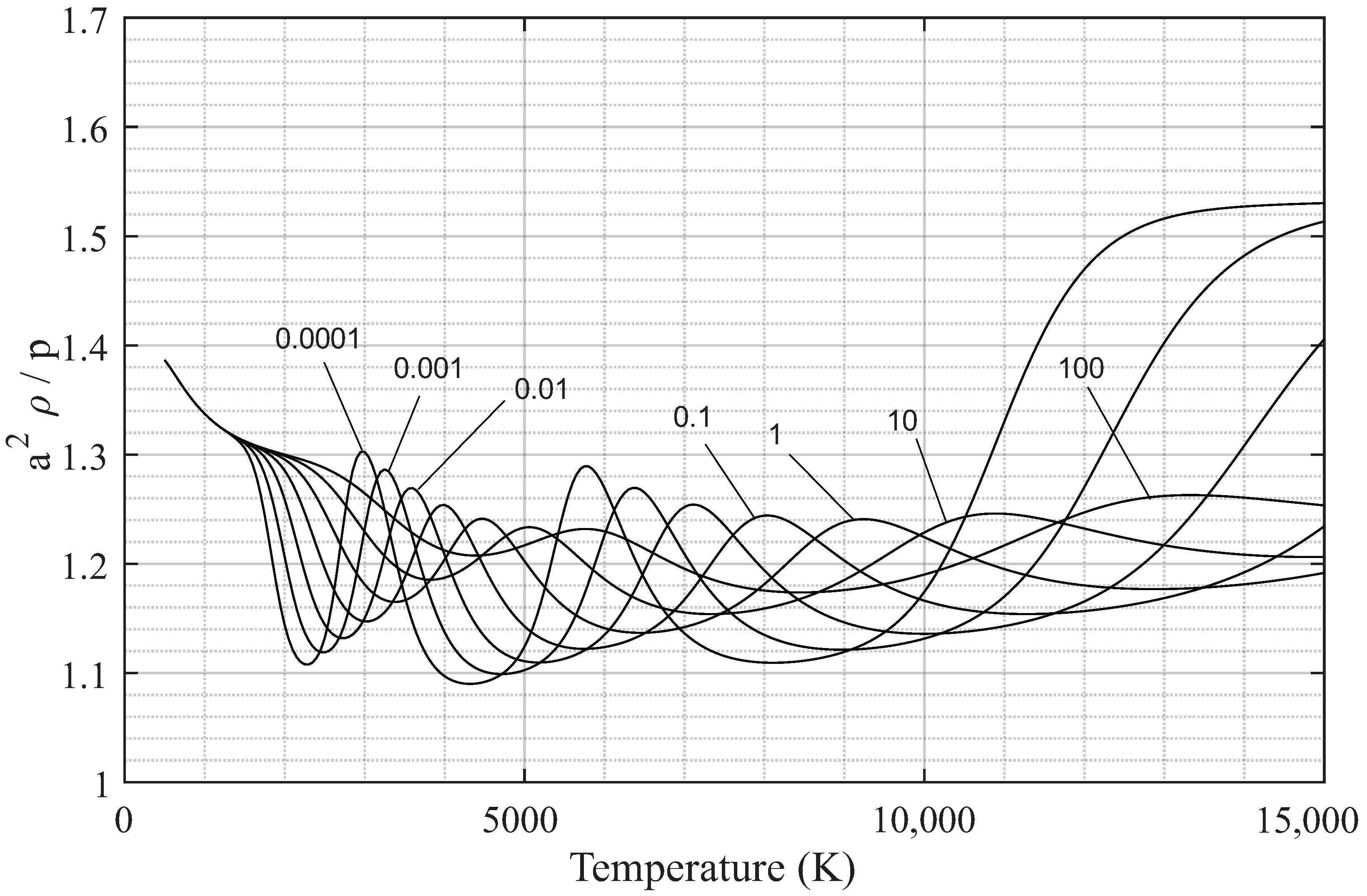
Figure 5 shows the variation illustrating how the values starting at 1.4 at low temperatures change with temperature and pressure.
Figure 5.
Speed of sound parameter, . Numbers shown in the figure denote pressure levels in atm.
Here, the thermochemical multiplier (H5), given below, modifies the ideal-gas acoustic relation:
These expressions highlight how thermochemical effects influence bulk thermodynamic behavior even under equilibrium conditions. The specific heat at constant pressure and the difference between the specific heats may be written as
This equation shows that when chemical reactions are present, is no longer equal to R. The expression for is obtained by expanding Equation (61) and using the derivatives of the variables together with the derivatives of the individual species energies . The expanded equation for is given below, illustrating the compactness of Hansen’s formulation.
Equation (64) shows the detailed energy terms as an example; for , the vibrational characteristic temperature is .
3. Transport Properties of High-Temperature Air
Hansen’s transport formulation provides an analytic method for evaluating viscosity, thermal conductivity, and the Prandtl number in high-temperature air. Rather than applying the full multicomponent Chapman–Enskog theory [17], which requires detailed pairwise collision information for all interacting species, Hansen reduces the transport coefficients to weighted sums involving mean molecular speed, mean free path, species heat capacities, and a normalized collision matrix . This yields a fast engineering model that is empirical in nature, yet captures key kinetic-theory trends over the temperature range of interest. Because the Hansen formulation replaces pair-specific collision integrals with grouped, semi-empirical cross sections, the resulting transport properties do not fully capture detailed intermolecular interaction physics, and deviations in viscosity and thermal conductivity are present throughout the temperature range and increase significantly at higher temperatures where species-specific interactions become dominant.
3.1. Mixture Viscosity
Hansen expresses the mixture viscosity as a sum of species contributions (H66–H72):
Here, is the partial density of species i, is its mean molecular speed, and is its mean free path.
A reference viscosity is defined using the reference species (taken as ):
Hansen provides an empirical fit for this reference viscosity (cgs units):
Ratios of translational speeds and partial densities follow from kinetic theory:
The ratio of mean free paths incorporates intermolecular interactions through the collision matrix [30]:
Hansen groups several atom–molecule cross sections, , , and , under the single representative value . Similarly, the atom–atom and atom–ion cross sections , , , , and are grouped under the notation . The atom–electron cross sections and are assigned a single average value listed under .
The parameters represent empirical, class-averaged momentum-transfer cross sections rather than collision integrals in the Chapman–Enskog sense. Hansen introduced these quantities as practical surrogates to represent the influence of interspecies collisions on transport properties, using kinetic-theory scaling arguments, available macroscopic transport data, and pragmatic grouping assumptions instead of explicit evaluation of pairwise collision integrals.
Substituting these expressions into the viscosity definition yields Hansen’s mixture formula (H72):
This expression constitutes one of the central practical results of Hansen’s report.
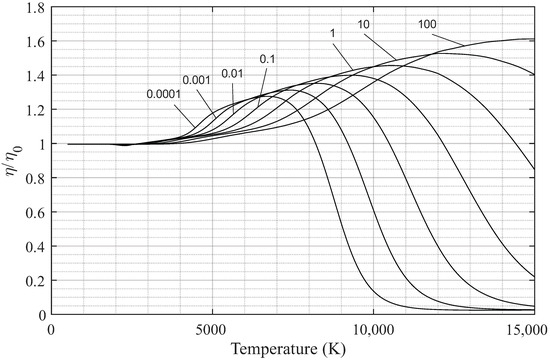
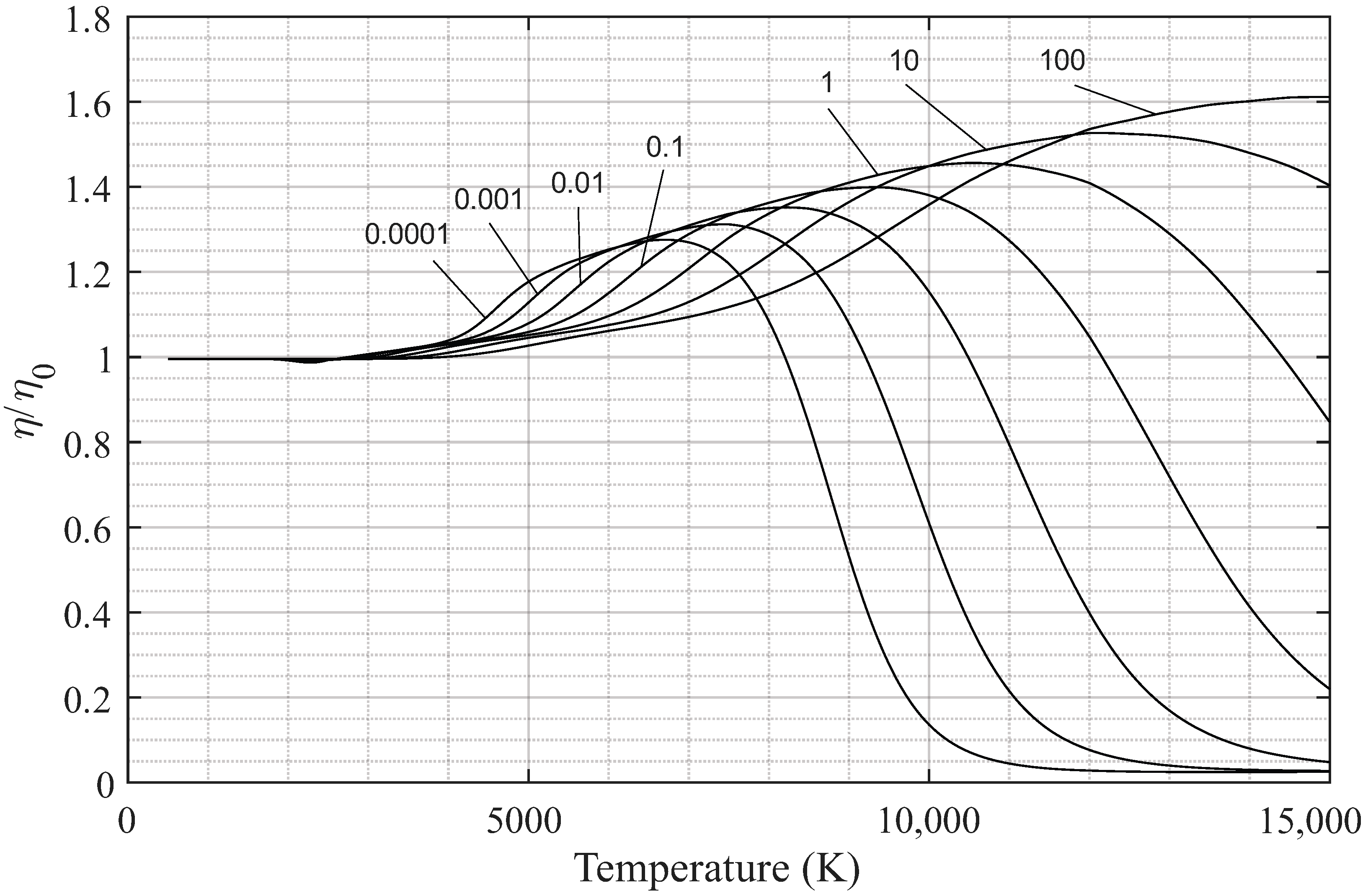
The viscosity ratio is evaluated using Hansen’s mixture mean-free-path formulation (H71–H72), with lumped collision cross section coefficients given in Table A2, (Hansen Table V). All heavy–heavy interactions (neutral–neutral, neutral–ion, and ion–ion) are retained. To model the weak momentum exchange between electrons and heavy neutrals in the present hard-sphere-style closure, electron–neutral collisions are neglected in the mean-free-path summations, while ion–electron and electron–electron collisions are retained. The resulting captures the observed pressure-dependent high-temperature trends (Figure 6). For completeness, we note that completely omitting the electron contribution from the summations leads to a monotonically increasing viscosity ratio with temperature and fails to reproduce the nonmonotonic behavior reported in Hansen’s Fig. 8.
Figure 6.
Viscosity ratio obtained from Hansen’s transport correlation. Numbers shown in the figure denote pressure levels in atm.
3.2. Thermal Conductivity
Hansen evaluates the thermal conductivity by separating it into two contributions: one due to energy transfer by molecular collisions, which describes the conductivity of a nonreacting gas, and a second arising from the diffusion of molecular species during chemical reactions as the gas attempts to maintain equilibrium. The total thermal conductivity of a chemically reacting gas is obtained as the sum of these two terms.
3.2.1. Molecular-Collision Conductivity (H73–H79)
A general molecular translational conduction term is written following the work of Eucken [31] and Butler and Brokaw [32]:
The total specific heat of species i is written as
After algebraic rearrangement, Hansen obtains the compact form
A reference conductivity is defined analogously to :
The reduced conductivity is then written as [33]
3.2.2. Chemical-Reaction Conductivity (H80–H84)
Chemical reactions induce composition gradients that drive species diffusion, and the associated enthalpy transport introduces an additional conductivity contribution . Hansen expresses this term in terms of stoichiometric coefficients , mole fractions , diffusion coefficients , and the equilibrium constant , adopting the formulation of Butler and Brokaw [32]:
Here, the denote the stoichiometric coefficients of components in a chemical reaction written in the form
The diffusion coefficients are given by [30]
Using the reference thermal conductivity in the form
Hansen reduces the chemical-conductivity term to the nondimensional form
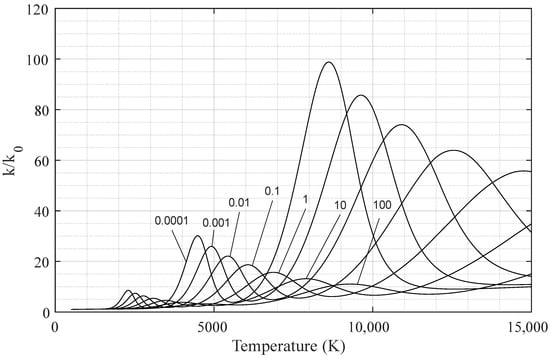
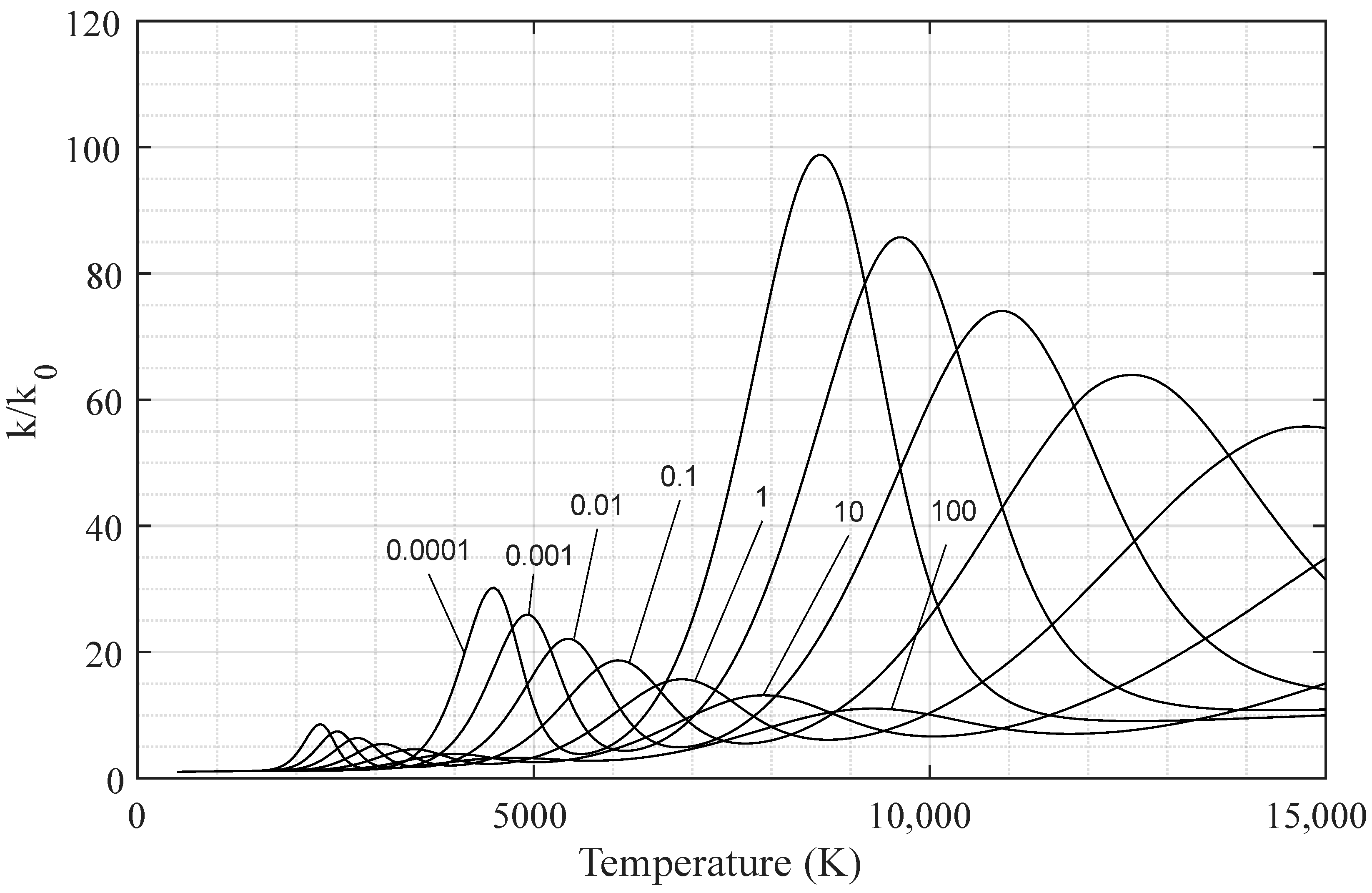
Hansen further simplifies the summation appearing in the denominator of Equation (80) by assuming that the oxygen and nitrogen molecular masses are equal. The quantity is the collision integral in the Chapman–Enskog sense, following the notation of Kennard [30] (Eqs. 165a,b, p. 192). Hansen assumes that collision cross sections for different species may be treated as approximately equal, allowing these integrals to be grouped into representative values listed in Table A2. The reaction (chemical-equilibrium) contribution to the thermal conductivity was evaluated using Hansen’s general Butler–Brokaw double-summation form (H84) with the Table A2 lumped coefficients . The closed-form reductions (H85–H87) were not used because, when implemented with equilibrium compositions containing trace species, their explicit structure is numerically ill-conditioned and introduced spurious amplification in the low-pressures (Figure 7).
Figure 7.
Thermal conductivity ratio from Hansen’s transport model. Numbers shown in the figure denote pressure levels in atm.
3.3. Prandtl Number
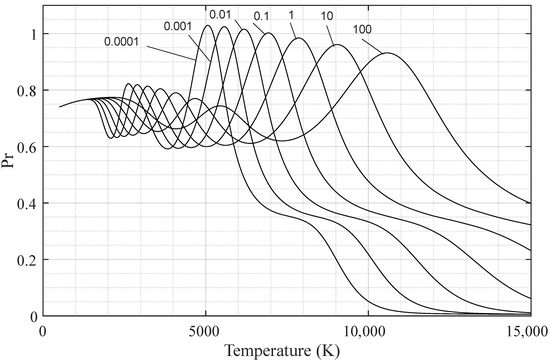
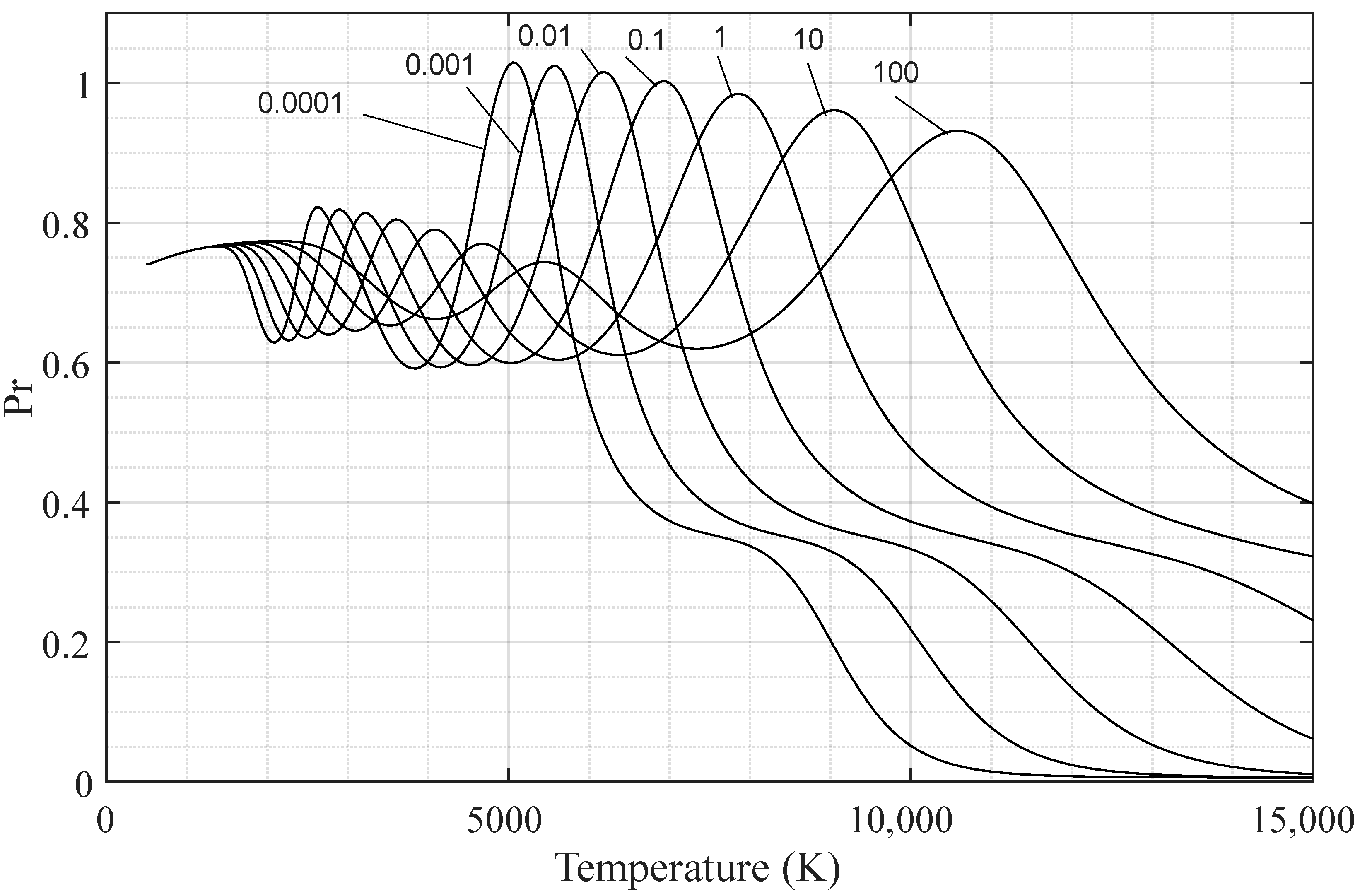
The Prandtl number is defined as (H88). Using Hansen’s reduced transport expressions, the model becomes
This expression incorporates the influence of dissociation, ionization, internal energy modes, and collision processes, thereby completing Hansen’s transport model (Figure 8).
Figure 8.
Prandtl number predicted using reconstructed Hansen transport functions. Numbers shown in the figure denote pressure levels in atm.
4. Transport-Property Models and Comparison
4.1. Overview and Scope
Hansen’s analytic equilibrium-air model [1] remains attractive because it is closed-form, self-contained, and computationally inexpensive, making it well suited for verification, reduced-order modeling, and preliminary design studies. However, Hansen’s original transport closure relies on lumped collision cross sections (the -type ratios) and associated simplifying assumptions. At temperatures exceeding , where dissociation and ionization become important, lumped representations introduce systematic biases in predicted viscosity and thermal conductivity relative to species-resolved, kinetic-theory-based approaches. In addition, the species present at these temperatures are not adequately captured by approximate models. Equilibrium calculations performed using CEA at a pressure of indicate that Hansen’s model substantially underestimates the mole fractions of electrons and ionic species above the range. Specifically, CEA analysis predicts mole fractions of , , , and as high as , , , and , respectively, at (see Figure 2).
The objective of the present work is not to replace or improve Hansen’s analytic framework, but rather to compare his transport-property predictions with contemporary equilibrium transport models. Hansen’s closed-form equilibrium thermodynamics are preserved and used consistently as input to alternative transport closures wherever possible. In this way, differences in predicted transport properties can be attributed primarily to the transport formulation itself rather than to differences in equilibrium composition.
For reference and benchmarking, three widely used equilibrium transport models are considered. The Gupta 11-species equilibrium air model [6,8,9] employs Chapman–Enskog (CE) theory with pair-resolved collision data. The NASA Chemical Equilibrium with Applications (CEA) code [10,11] provides equilibrium compositions obtained from Gibbs free-energy minimization, together with internally consistent thermodynamic and transport properties. The equilibrium air-plasma transport model of D’Angola et al. [23], based on a 19-species formulation, represents a high-fidelity kinetic-theory-based approach with explicit treatment of internal energy modes and reactive contributions.
The CE-based transport models of Gupta and D’Angola require detailed specification of intermolecular interaction potentials and collision cross sections for all species pairs, including atoms, molecules, and electrons. For a mixture of n species, the number of unique binary interactions scales as , requiring 66 and 190 distinct pair potentials and cross sections for the 11- and 19-species models, respectively. The construction of such datasets is demanding and depends on the availability and accuracy of interaction models for all species pairs.
In contrast, CEA is primarily designed to robustly compute equilibrium species compositions over wide thermochemical ranges, including systems for which detailed interaction potentials and collision cross sections are incomplete or unavailable. As a result, transport properties in CEA are evaluated using semi-empirical correlations and algebraic mixture rules rather than full CE-based kinetic theory. The CEA transport model is therefore included here for comparison because of its widespread use in aerospace equilibrium-flow calculations, rather than for its transport-property fidelity.
In practice, transport models developed by Thompson, Yos, Gupta, and Lee, as well as those by Capitelli, D’Angola, and their collaborators, are generally preferred when accurate transport properties are required, while CEA is commonly used for equilibrium composition and thermodynamic predictions. Direct Simulation Monte Carlo (DSMC) methods provide an alternative framework, in which transport properties are not prescribed explicitly but instead emerge statistically from simulated molecular collision dynamics.
A brief introduction to the Chapman–Enskog method and the transport modeling approach used in CEA is provided in Appendix A.
4.2. Transport Models
Hansen’s transport-property formulation [1] is fully analytic and closed-form. Viscosity and thermal conductivity are expressed as weighted sums of species contributions involving mean molecular speeds, mean free paths, and normalized interaction cross-section ratios (). These ratios represent empirical averages of intermolecular interaction cross sections grouped by molecular class (e.g., molecule–molecule, atom–atom, atom–ion). While computationally efficient and historically influential, this approach is not derived directly from the Boltzmann equation and does not employ explicit collision integrals.
In contrast, Gupta equilibrium model [6,8,9,25] is grounded in first-order Chapman–Enskog theory [17]. Transport coefficients are obtained from linear algebraic systems involving pair-specific collision integrals and binary diffusion coefficients derived from intermolecular potential models.
NASA CEA [10,11] determines equilibrium composition by Gibbs free-energy minimization using extensive thermochemical databases. Its transport properties are assembled from species-level correlations based on collision-integral fits [34,35,36,37], with mixture properties formed using Wilke-type or related mixture rules [38]. Although not written explicitly in Chapman–Enskog matrix form, its transport inputs ultimately trace back to kinetic-theory-based correlations.
The model of D’Angola et al. [23] represents a fully kinetic-theory-based treatment of equilibrium air plasmas. Transport coefficients are derived from the Chapman–Enskog solution of the Boltzmann equation using finite Sonine polynomial expansions. Electron and heavy-particle transport are decoupled following Devoto’s method [12,13], and the total thermal conductivity is decomposed into translational, internal, and reactive contributions using the Butler–Brokaw formalism.
4.3. Transport-Property Comparison
Hansen’s transport-property predictions are compared quantitatively against those obtained from Gupta, CEA, and D’Angola models over the temperature range considered. The comparison is organized to highlight differences arising from mixture rules, collision-integral resolution, and chemical-reaction coupling.
4.3.1. Viscosity
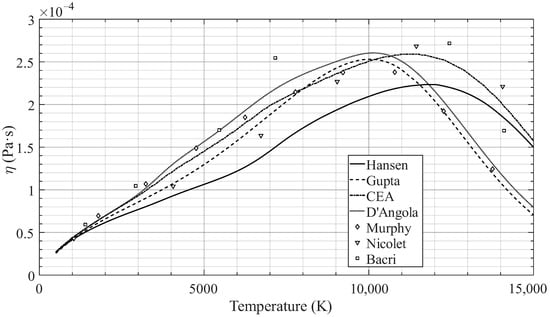
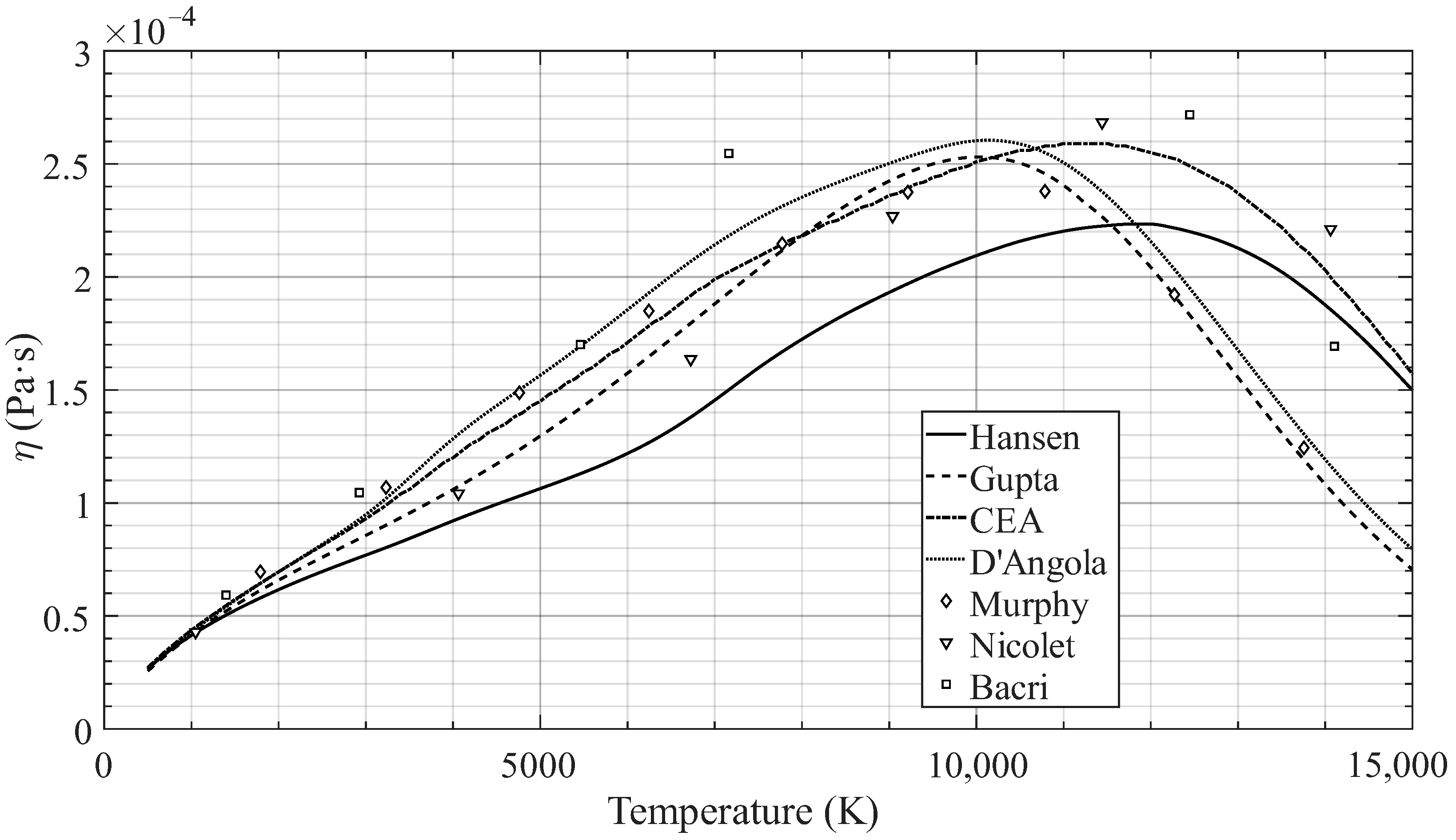
Hansen’s model underestimates the dynamic viscosity below approximately and overestimates it at higher temperatures (Figure 9). Below about , CEA results follow closely those of D’Angola et al. and Gupta et al., but overestimate viscosity at higher temperatures. Gupta and D’Angola results track each other closely over the full temperature range, with Gupta values consistently slightly lower.
Figure 9.
Comparison of equilibrium air viscosity predicted by the Hansen model [1], the Gupta formulation [6,8,9], the NASA CEA code [10,11], and the air-plasma model of D’Angola et al. [23]. Computational results from Murphy [39], Nicolet [40], and Bacri [41] are also shown for comparison.
4.3.2. Thermal Conductivity
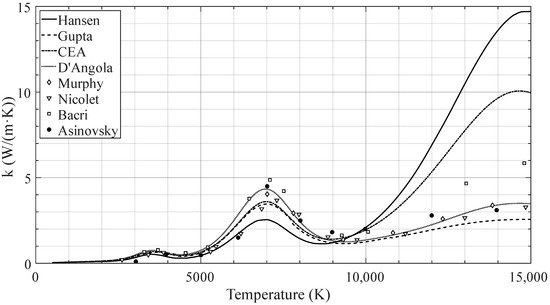
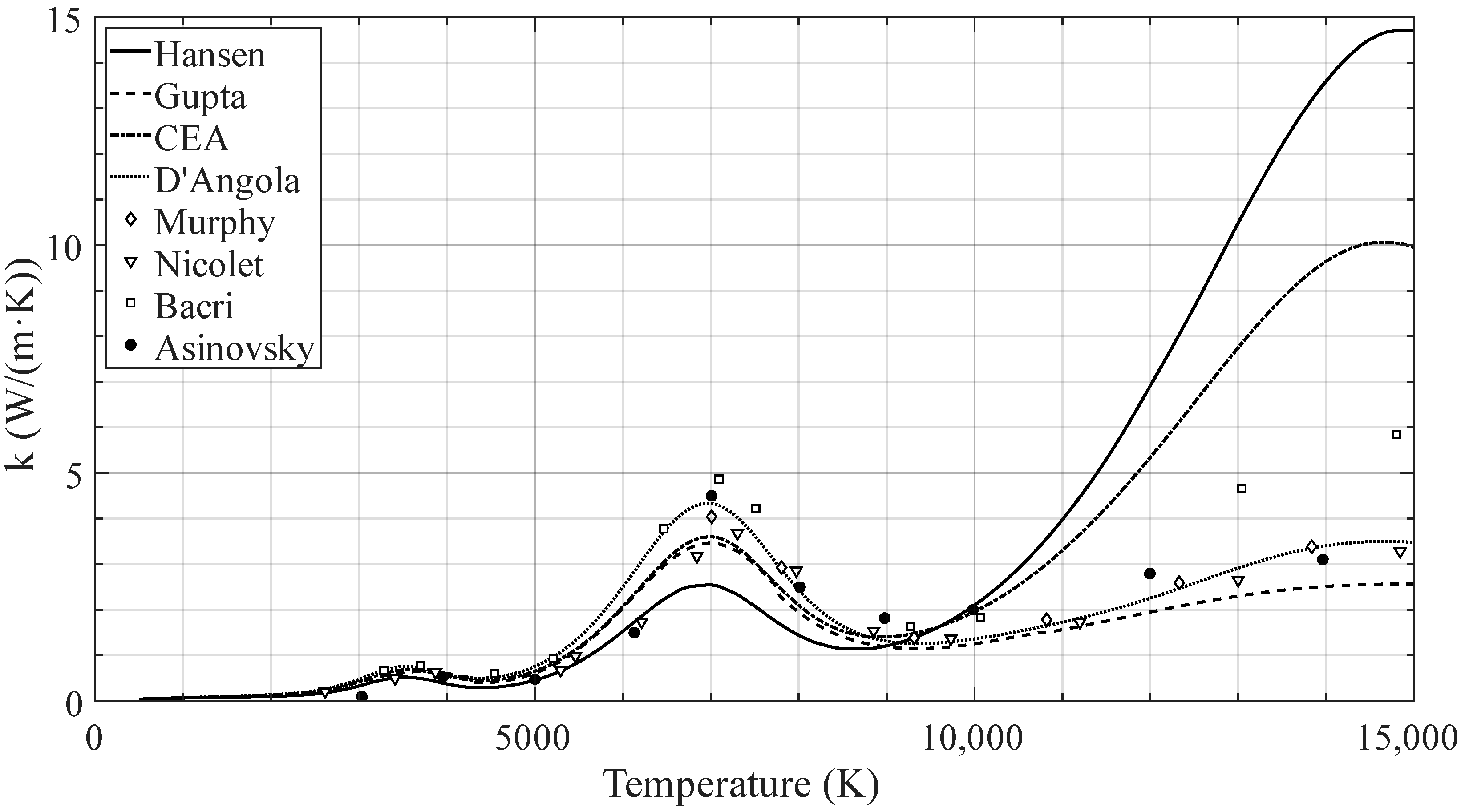
Thermal conductivity predictions from all models are similar below approximately (Figure 10). Hansen’s results are lower than those of the other models below about , but increase sharply at higher temperatures, reaching nearly four times the D’Angola values at . Between 5000 and , Gupta and CEA predictions follow each other closely, while the D’Angola results are somewhat higher. Above , the CEA thermal conductivity rise rapidly, reaching roughly thrice of the D’Angola values, while Gupta and D’Angola predictions again remain closely aligned, with slightly higher values of D’Angola.
Figure 10.
Thermal conductivity comparison between the Hansen model [1], the Gupta formulation [6,8,9,25], the NASA CEA code [10,11], and the air-plasma model of D’Angola et al. [23]. Computational results from Murphy [39], Nicolet [40], and Bacri [41] are also shown together with experimental thermal-conductivity measurements reported by Asinovsky et al. [42].
4.3.3. Prandtl Number
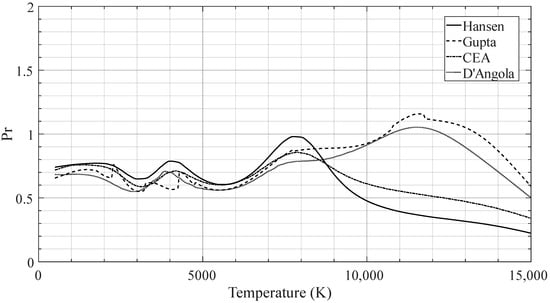
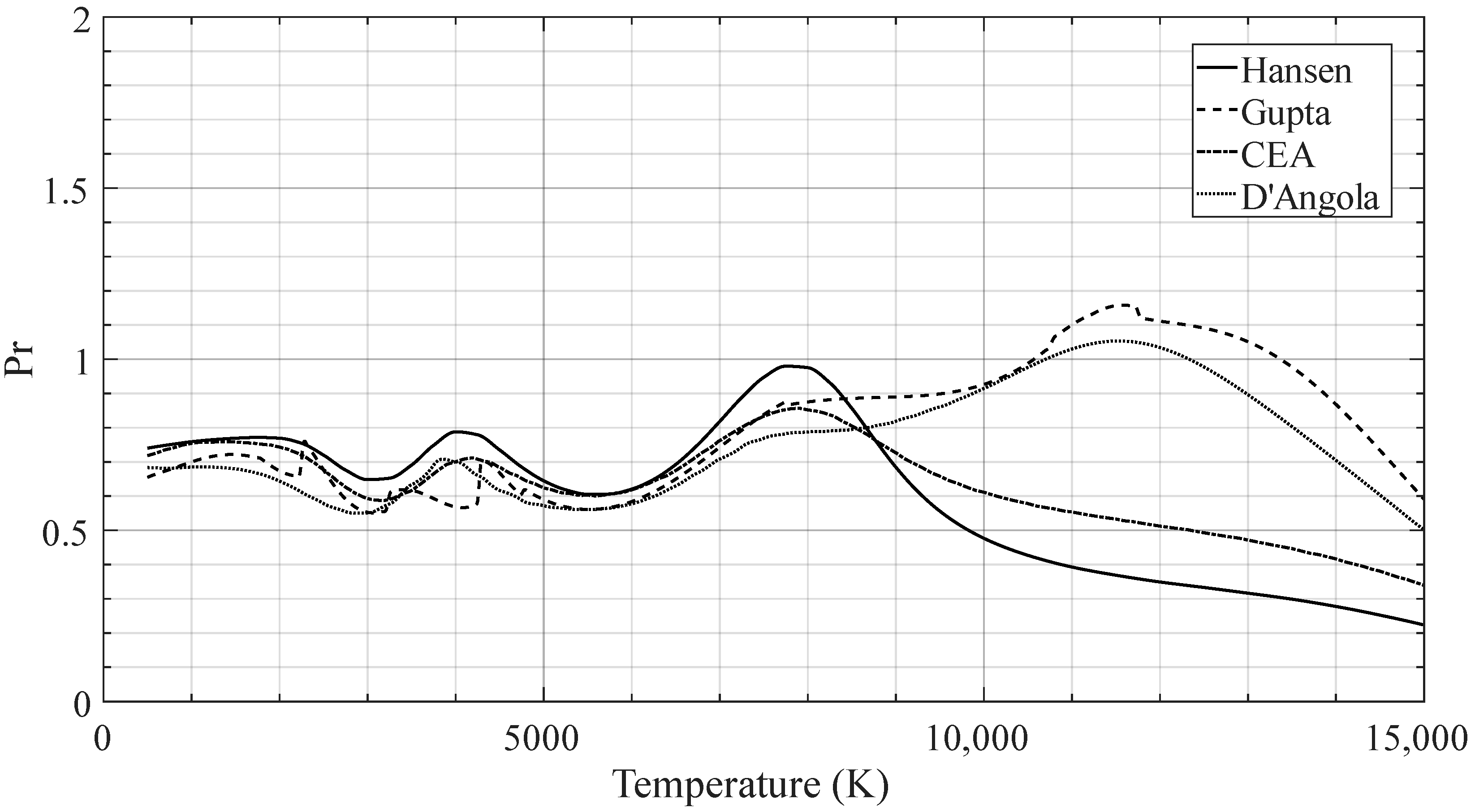
Prandtl number variations predicted by all models are similar below approximately (Figure 11). At higher temperatures, the Gupta and D’Angola models yield similar trends but differ quantitatively, with the Gupta model predicting higher values. In contrast, the Hansen and CEA predictions decrease monotonically and do not exhibit a peak near , as observed in both the D’Angola and Gupta models.
Figure 11.
Prandtl number comparison (Hansen [1], Gupta et al. [6,8,9,25], CEA [10,11], D’Angola et al. [23]).
5. Applicability and Validity Range of the Hansen Model
The Hansen model was originally developed for equilibrium air flows with temperatures up to approximately 15,000 K. However, comparisons with later equilibrium and transport-property models indicate that its accuracy becomes increasingly limited as temperature rises, particularly above about 10,000 K. In this range, differences in predicted species concentrations become more pronounced, and the resulting transport-property predictions deviate increasingly from higher-fidelity models. For this reason, a conservative upper validity limit of is adopted in the present work when assessing the range over which the model may be used with confidence.
The thermodynamic portion of the Hansen model remains useful because it provides a compact, closed-form equilibrium representation of high-temperature air that extends beyond the calorically perfect regime. As such, it is well suited for rapid engineering estimates, pedagogical applications. In contrast, the transport formulation is subject to more significant limitations. The Hansen model replaces pair-specific collision integrals with grouped, semi-empirical collision cross sections and therefore does not fully resolve detailed intermolecular interaction physics. As a result, the predicted viscosity and thermal conductivity exhibit systematic deviations relative to kinetic-theory-based models such as those of Gupta et al. [9] and D’Angola et al. [23]. These deviations are present at moderate temperatures and increase as temperature rises and the mixture composition becomes strongly influenced by dissociation and ionization.
Accordingly, the Hansen formulation should not be regarded as a high-fidelity transport model for high-temperature air. Its transport-property predictions remain useful for qualitative trends, approximate calculations, and baseline comparisons, but should be interpreted with caution in regimes where detailed collision physics, such as atom–atom, ion–neutral, and electron interactions, plays a dominant role.
The assumption of thermochemical equilibrium further limits applicability in flows where chemical and internal energy relaxation occur on time scales comparable to the flow residence time. Such conditions arise in very high-speed atmospheric entry flows, rarefied high-altitude flight, and scramjet combustors. In these regimes, finite-rate chemistry models coupled with nonequilibrium transport formulations are generally required.
To quantify the velocity range over which the Hansen model remains applicable, the freestream total enthalpy was compared with Hansen’s equilibrium enthalpy at 10,000 K using the relation
The limiting velocity was defined as the speed at which the equilibrium stagnation enthalpy corresponds to a temperature of 10,000 K. The resulting limits depend primarily on ambient pressure (or altitude) and only weakly on freestream temperature. For example, the limiting velocity is approximately 10.0 km/s at 7.62 km altitude, 10.6 km/s at 18.29 km, 11.1 km/s at 24.38 km, 12.9 km/s at 36.58 km, and 17.1 km/s at 64.92 km.
These results indicate that the Hansen model remains useful for many conventional hypersonic applications when applied within its appropriate range and with clear recognition of its simplifying assumptions. While its thermodynamic formulation remains attractive due to its simplicity and closed-form structure, its transport-property predictions become increasingly unreliable as temperature rises and detailed collision physics becomes important. Flows approaching orbital re-entry conditions or involving strong nonequilibrium effects therefore require more advanced modeling approaches.
A formal uncertainty propagation in collision integrals or dissociation energies was not performed in the present work. Collision integrals are not used in the Hansen formulation, and uncertainty information for these quantities is not reported in the Gupta et al. [9] or D’Angola et al. [23] transport-property references used for comparison. Similarly, dissociation energies enter the equilibrium formulation as fixed thermochemical constants rather than adjustable parameters. A rigorous uncertainty analysis would therefore require a separate and substantial study beyond the scope of the present work.
6. Conclusions
We have reconstructed the complete Hansen (1959) [1] thermodynamic and transport model for high-temperature air, expressed all relations in modern notation, and derived all auxiliary quantities necessary for implementation. The analytic form of the model provides transparent physical behavior and computational efficiency desirable for verification, reduced-order modeling, and preliminary design.
Comparisons with the D’Angola et al. 19-species, Gupta 11-species, and CEA equilibrium models delineate the validity and limitations of Hansen’s analytic approximations. Differences in transport properties are primarily attributable to the modeling of intermolecular collisions and the coupling between chemistry and transport. The D’Angola, CEA, and Gupta models show close agreement up to about 10,000 K, whereas Hansen’s model underestimates viscosity and thermal conductivity and overestimates the Prandtl number in this range. Above 10,000 K, both Hansen’s model and CEA overestimate viscosity and thermal conductivity and underestimate the Prandtl number.
The Appendix included gives a brief introduction to the Chapman–Enskog method and the methods used in CEA to calculate the transport properties.
Author Contributions
Conceptualization, S.Ö.; Methodology, A.D. and J.R.; Software, S.Ö.; Validation, A.D., J.R. and S.Ö.; Investigation, S.Ö.; Resources, A.D., J.R. and S.Ö.; Writing—original draft, S.Ö.; Writing—review & editing, A.D., J.R. and S.Ö. All authors have read and agreed to the published version of the manuscript.
Funding
This research received no external funding.
Data Availability Statement
The original contributions presented in this study are included in the article. Further inquiries can be directed to the corresponding author.
Conflicts of Interest
The authors declare no conflicts of interest.
Symbols and Nomenclature
The symbolic and numerical MATLAB codes used to reproduce Hansen’s high-temperature air model are available at: https://github.com/jaranstead/Reconstruction-of-Hansen-s-High-Temperature-Air-Model/tree/main (accessed on 6 April 2026).
| a | Speed of sound (zero frequency), | Stoichiometric coefficients for components , , dimensionless | |
| Components of a chemical reaction, dimensionless | C | Sutherland constant, | |
| Specific heat per mole at constant density for component i, | Specific heat per mole at constant pressure, | ||
| Partial specific heat at constant pressure, , | Specific heat per mole at constant density, | ||
| D | Dissociation energy per molecule, ; also diffusion coefficient, | Binary diffusion coefficient between species i and j, | |
| e | Base of natural logarithms, dimensionless | Electron, dimensionless (particle) | |
| E | Energy per mole, ; also electric field strength, | Energy per mole of component i, | |
| Energy per mole at zero absolute temperature, | Degeneracy of the ith state, dimensionless | ||
| Degeneracy of the nth electronic state, dimensionless | h | Planck constant, | |
| H | Enthalpy per mole, | Enthalpy per mole of component i, | |
| I | Molecular moment of inertia, ; also ionization energy per molecule, | Resonance potential for ionization, | |
| J | Rotational quantum number, dimensionless | Boltzmann constant, | |
| k | Thermal conductivity, | Reference thermal conductivity coefficient, | |
| Partial thermal conductivity due to molecular collisions, | Partial thermal conductivity due to chemical reactions, | ||
| Chemical equilibrium constant (concentration units) | Chemical equilibrium constant (pressure units) | ||
| Partial Lewis number, , dimensionless | ln | Logarithm to the base e, dimensionless | |
| m | Mass of a gas particle, | Molecular weight of species i, | |
| Mean molecular weight of a gas mixture, | Molecular weight of undissociated air, | ||
| n | Quantum number, dimensionless; also molar concentration, | Concentration of components , , | |
| N | Nitrogen atom; also atoms in general, dimensionless (species) | Avogadro number, | |
| Nitrogen positive ion; also positive ions in general, dimensionless (species) | Nitrogen molecule, dimensionless (species) | ||
| Nitric oxide molecule, dimensionless (species) | Oxygen atom, dimensionless (species) | ||
| Oxygen positive ion, dimensionless (species) | Oxygen molecule, dimensionless (species) | ||
| p | Pressure, | Reference pressure, | |
| Partial pressure of components , , | Prandtl number, , dimensionless | ||
| Partial Prandtl number, , dimensionless | Q | Total partition function, dimensionless | |
| Translational partition function, dimensionless | Rotational partition function, dimensionless | ||
| Vibrational partition function, dimensionless | Electronic partition function, dimensionless | ||
| Partition function for standard state of unit concentration, , dimensionless | Partition function for standard state of unit pressure, , dimensionless | ||
| Total partition functions for components , , dimensionless | r | Distance between atoms, | |
| Equilibrium distance between atoms, | R | Universal gas constant per mole, ; | |
| S | Entropy per mole, | Entropy per mole of component i at reference pressure, | |
| Collision cross section for undissociated air molecules, | or | Collision cross section for particle i with particle j, | |
| T | Absolute temperature, | Mean molecular velocity of species i, | |
| Mean molecular velocity of undissociated air, | U | Potential energy between gas particles, | |
| x | Mole fraction, dimensionless | Mole fraction of species i, dimensionless | |
| Mole fraction of component , dimensionless | Z | Compressibility factor, or , dimensionless | |
| Molecular symmetry number, dimensionless; also polarizability, | Morse function constant, dimensionless | ||
| Ratio of specific heats, , dimensionless | Fraction of molecules dissociated or atoms ionized, dimensionless | ||
| Energy of the ith state, | Energy of the nth electronic state, | ||
| Dimensionless distance parameter, | Coefficient of viscosity, | ||
| Reference coefficient of viscosity, | Mean free path for molecules of type i, | ||
| Reference mean free path, | Vibrational frequency, | ||
| Density, | Density of molecules of type i, | ||
| Reference density, | Collision diameter, | ||
| Subscripts | |||
| p | Partial derivative at constant pressure | Partial derivative at constant density | |
| s | Partial derivative at constant entropy | Indices referring to molecules of type i and j | |
| Translational, rotational, vibrational, and electronic modes | 1 | Oxygen dissociation reaction | |
| 2 | Nitrogen dissociation reaction | 3 | Atom ionization reactions |
Appendix A. Notes on Transport Equations
Appendix A.1. Brief Introduction to Chapman–Enskog Method
This section provides a brief introduction to the Chapman–Enskog expansion of the multicomponent Boltzmann equation. The objective is to establish the structure of the linearized kinetic equations that govern transport processes in a dilute gas mixture.
A gaseous mixture consisting of chemically distinct species is described by a set of distribution functions,
where denotes the number density distribution of species i as a function of position , molecular velocity , and time t, and is commonly referred to as the single-particle distribution function. The distribution function is defined such that
gives the expected number of molecules of species i whose positions lie within the spatial volume element about and whose velocities lie within the velocity-space volume element about at time t.
The time evolution of the single-particle distribution functions is governed by the Boltzmann equation. For a multicomponent mixture, this results in a coupled system of Boltzmann equations, one for each species, with coupling between species arising solely through binary collisions. These equations may be written as [33,43]
where the summation over j accounts for both self-collisions () and interspecies collisions ().
Here, is the position vector, is the molecular velocity of species i, t denotes time, and represents an external force acting on species i. The operators and denote gradients in physical space and velocity space, respectively. The function denotes the single-particle distribution of species j and represents collision partners of species i.
In the notation of Hirschfelder, Curtiss, and Bird [43], the binary collision operator describing elastic collisions (i.e., collisions that conserve total momentum and kinetic energy and do not alter internal molecular states) between species i and j is written as
where is the relative molecular speed, b is the impact parameter, and denotes the scattering angle. The primes indicate post-collision quantities, with and denoting the distribution functions evaluated at the post-collision velocities and . This form assumes binary, elastic collisions and the molecular chaos hypothesis [17], under which the velocities of two molecules just before collision are statistically uncorrelated. As a result, the pre-collision two-particle distribution may be written as the product of single-particle distributions, . Physically, this assumption states that any correlations created by previous collisions are destroyed by subsequent molecular motion before the next collision occurs, which is valid for dilute gases where the mean free path is much larger than the molecular interaction range.
Appendix A.2. Maxwellian Distribution Under Equilibrium Conditions
The Chapman–Enskog method [17] assumes that the gas mixture is close to local thermodynamic equilibrium. Under this assumption, each distribution function may be expressed as a small deviation from an equilibrium reference state. This reference state is given by the local Maxwellian distribution , which describes the velocity distribution attained when a gas is in equilibrium at the local macroscopic conditions.
The local Maxwellian distribution represents the velocity distribution that results when frequent molecular collisions have eliminated all memory of the initial conditions. In this state, the molecular velocities are completely randomized, subject only to the constraints imposed by the conserved quantities: mass, momentum, and kinetic energy. Consequently, the equilibrium distribution is universal and does not depend on the detailed form of the molecular interaction mechanism. In particular, the Maxwellian distribution arises regardless of whether molecules interact through idealized hard-sphere collisions, inverse power-law intermolecular forces, or more realistic potentials such as the Lennard–Jones model, which combines short-range repulsion with long-range attraction. While these interaction models influence the rates of momentum and energy exchange and therefore affect transport coefficients such as viscosity and thermal conductivity, they do not alter the form of the equilibrium velocity distribution. The Maxwellian distribution depends only on the conserved quantities of elastic collisions—mass, momentum, and kinetic energy—and not on the specific details of the intermolecular force law.
For species i, the local Maxwellian distribution is given by
where is the number density of species i, is the molecular mass, T is the temperature, is the local bulk flow velocity (mean velocity), and is the Boltzmann constant. The velocity dependence appears only through the peculiar velocity , indicating that thermal motion is isotropic about the mean flow.
The Maxwellian distribution is referred to as the equilibrium distribution because it is the unique velocity distribution that remains unchanged under elastic molecular collisions. When substituted into the Boltzmann collision operator, it satisfies detailed balance exactly (i.e., for every microscopic collision process there exists a corresponding reverse collision occurring with equal probability, so that the total momentum and total kinetic energy of each colliding molecular pair are conserved and no net change in the equilibrium distribution results). As a consequence, the collision term on the right-hand side of the Boltzmann equation vanishes identically when evaluated with the Maxwellian distribution. Physically, this reflects the fact that, in equilibrium, every microscopic collision process is balanced by its reverse, and no further macroscopic evolution occurs. In a multicomponent mixture, each species possesses its own Maxwellian distribution characterized by the same local temperature and bulk velocity, corresponding to a common state of thermodynamic equilibrium shared by all species.
Appendix A.3. Chapman–Enskog Expansion
Introducing an ordering in the Knudsen number (, where is the molecular mean free path and L is a characteristic macroscopic length scale of the flow), the distribution function for each species may therefore be written as a small perturbation about the local Maxwellian,
where is a dimensionless first-order correction measuring the relative deviation from local equilibrium.
Substitution of (A6) into the collision difference and retention of first-order terms yields
For elastic binary collisions, the Maxwellian product is unchanged under collision as a consequence of detailed balance, , and therefore
Thus, to first order, the collision operator becomes linear in the unknown functions .
On the left-hand side of the Boltzmann equation, substitution of (A6) and application of the product rule gives
In global equilibrium, the Maxwellian distribution is spatially and temporally uniform, so that all gradient terms on the left-hand side of the Boltzmann equation vanish, and the collision term on the right-hand side also vanishes by detailed balance. In this case, both sides of the Boltzmann equation are identically zero.
In contrast, the Chapman–Enskog method employs a state of local thermodynamic equilibrium as its reference. The distribution is Maxwellian in form, but its parameters, number density, temperature, and bulk velocity (mass-averaged mean velocity), are allowed to vary slowly in space and time. As a result, the time derivative and spatial gradients of do not vanish, even though the collision term evaluated with purely Maxwellian distributions is zero. This distinction is essential: local equilibrium describes a gas that is in equilibrium at the molecular level but not uniform at the macroscopic level.
In the Chapman–Enskog ordering, itself is of first order in the Knudsen number and is proportional to spatial gradients of the macroscopic fields. Consequently,
and derivatives of are neglected in the first Chapman–Enskog approximation.
With this ordering, the linearized Boltzmann equation reduces to
At this stage, the left-hand side is known, since depends on space and time only through the macroscopic fields (temperature, flow velocity, and composition). Its derivatives therefore generate only gradients of these quantities. On the right-hand side, the equation is linear in the unknown functions , and because the collision operator is isotropic in velocity space, the solution for must be linear in the same independent gradients.
Accordingly, the most general first-order form of may be written as
where is defined as the peculiar velocity. The symbol “” denotes the standard vector dot product, while “:” denotes the tensor contraction (often called the double dot product) between a second-order tensor and the velocity-gradient tensor, with the Einstein summation convention implied.
The unknown velocity-dependent functions , , and are determined by substituting (A13) into (A12) and solving the resulting linear integral equations subject to the solubility conditions [33], which enforce conservation of mass, momentum, and energy.
Appendix A.3.1. Decomposition of the First-Order Correction
It is convenient to decompose the first-order correction into distinct contributions driven by (i) the temperature gradient (heat transfer), (ii) the velocity gradient (viscosity), and (iii) diffusion driving forces. Accordingly,
where, consistent with (A13), the individual contributions are defined as
Appendix A.3.2. Symmetry Forms of the Velocity-Dependent Functions
The form of the velocity-dependent functions is constrained by the isotropy of the collision operator, which implies that collisions have no preferred spatial direction. Consequently, each contribution to must transform consistently with the tensorial nature of the corresponding macroscopic driving force.
In the Chapman–Enskog expansion, the functions , , and are unknown, velocity-dependent functions that determine the response of the distribution function to gradients of the macroscopic fields. The vector function governs the contribution of temperature gradients to the nonequilibrium correction and is therefore associated with heat transfer. The second-order tensor function multiplies the velocity-gradient tensor and describes momentum transfer through viscous stresses. The vector function accounts for species diffusion driven by composition gradients.
To produce nonzero macroscopic fluxes and to respect the symmetry and isotropy of the collision operator, and must transform as vectors and be odd functions of the peculiar velocity, while must transform as a second-order tensor and be even in the peculiar velocity. These symmetry properties may be written as
As a consequence of these symmetry requirements, may depend on only through the scalar and must be parallel to , so that
where is an unknown scalar function.
The viscosity contribution must be linear in the symmetric, traceless rate-of-strain tensor and must transform as a symmetric, traceless tensor (i.e., the sum of the diagonal terms is zero).
Second-order tensor in . Accordingly,
where is an unknown scalar function.
Finally, each diffusion-driven term must also transform as a vector and be odd in . Thus, for each driving force ,
where are unknown scalar functions.
In practice, the scalar functions , , and are expanded in Sonine polynomials of the dimensionless variable and truncated. This procedure yields the standard first-order Chapman–Enskog approximations for the viscosity, thermal conductivity, and diffusion coefficients. Further details of these expansions and the extraction of transport properties may be found in the classical treatments by [17,30].
Appendix A.4. Transport Properties in NASA CEA
NASA CEA evaluates transport properties in two distinct stages. First, each chemical species is assigned temperature-dependent correlations for viscosity and thermal conductivity. Second, mixture transport properties are formed using Wilke-type algebraic mixture rules, with temperature-dependent interaction functions accounting for species–species coupling.
Appendix A.4.1. Species Viscosity and Conductivity Fits
In CEA, the viscosity and thermal conductivity of each chemical species are represented by compact empirical or semi-empirical analytic fits as functions of temperature. These correlations are distributed as part of the CEA transport-property database and are evaluated at runtime using the internal transport routines of the code. The transport fits depend on temperature only and are not obtained by solving Chapman–Enskog equations or by explicitly evaluating collision integrals during the calculation.
A commonly used functional form in the CEA transport tables is a logarithmic correlation involving and inverse powers of T,
where and denote the species viscosity and thermal conductivity, respectively. The coefficients A, B, C, and D are species-specific constants supplied in the CEA transport database, as documented by Gordon and McBride [10,11], and are largely based on empirical transport-property correlations originally developed by Blottner et al. [37]. These coefficients encapsulate empirical knowledge of high-temperature transport behavior over wide temperature ranges rather than explicit kinetic-theory collision modeling [10,11,34,35,36].
The transport database also supplies fitted pair-interaction functions used in the mixture rules described below.
Appendix A.4.2. Mixture Viscosity (Wilke-Type Rule)
CEA forms the mixture viscosity from the set of species viscosities using a Wilke-type algebraic mixing rule [38],
where is the mole fraction of species i and is a dimensionless interaction function satisfying . These interaction functions serve as algebraic weighting factors that account for molecular-mass and transport-property differences between species.
A commonly used Wilke interaction model is
where is the molecular weight of species i.
In CEA practice, the interaction functions may be evaluated either from the closed-form expression above or from tabulated or fitted interaction functions supplied in the transport database. One common representation used in the database is a temperature-dependent correlation analogous in form to the species-property fits,
with constants , , , and provided for each interacting species pair [10,11,37].
Appendix A.4.3. Mixture Thermal Conductivity
Mixture thermal conductivity is formed in an analogous manner from the set of species conductivities using Wilke–Wassiljewa-type mixture rules [38,44]. CEA follows the same overall algebraic strategy used for viscosity, but applies it to with conductivity-specific interaction functions,
where is the conductivity interaction function. In practice, is often taken in the same functional form as with replacing , or is obtained directly from fitted pair-interaction tables in the CEA transport database. The thermal conductivity reported by CEA is therefore an effective mixture conductivity consistent with the assumed equilibrium composition, the selected species set, and the empirical transport-property database.
Appendix A.4.4. Prandtl Number
Once and have been evaluated, the Prandtl number is computed as
where is the mixture specific heat at constant pressure consistent with the thermochemical model used in the CEA calculation.
Table A1.
Partition–function constants for the major components of air (after Hansen [1]).
Table A2.
Collision Cross Sections (Hansen [1] Table V).
References
- Hansen, C.F. Approximations for the Thermodynamic and Transport Properties of High-Temperature Air; Technical Report NASA TR R-50; NASA: Washington, DC, USA, 1959.
- Grier, D.A. When Computers Were Human; Princeton University Press: Princeton, NJ, USA, 2005. [Google Scholar]
- Zhang, W.; Zhang, Z.; Wang, Z.; Su, T. A Review of the Mathematical Modeling of Equilibrium and Nonequilibrium Hypersonic Flows. Shock Waves 2022, 32, 251–285. [Google Scholar] [CrossRef] [Scilit]
- Capitelli, M.; Gorse, C.; Longo, S.; Giordano, D. Transport Properties of High Temperature Air Species. In Proceedings of the 7th AIAA/ASME Joint Thermophysics and Heat Transfer Conference, Albuquerque, NM, USA, 15–18 June 1998. [Google Scholar]
- Capitelli, M.; Bruno, D.; Laricchiuta, A. Fundamental Aspects of Plasma Chemical Physics: Transport; Springer: Cham, Switzerland, 2013. [Google Scholar] [CrossRef] [Scilit]
- Thompson, R.A.; Lee, K.P.; Gupta, R.N. Computer Codes for the Evaluation of Thermodynamic Properties, Transport Properties, and Equilibrium Constants of an 11-Species Air Model; Technical Report NASA TM-102602; NASA Langley Research Center: Washington, DC, USA, 1990.
- Gupta, R.N.; Yos, J.M.; Thompson, R.A. A Review of Reaction Rates and Thermodynamic and Transport Properties for the 11-Species Air Model for Chemical and Thermal Nonequilibrium Calculations to 30000 K; Technical Report NASA TM-101528; NASA: Washington, DC, USA, 1989.
- Gupta, R.N.; Yos, J.M.; Thompson, R.A.; Lee, K.P. A Review of Reaction Rates and Thermodynamic and Transport Properties for the 11-Species Air Model for Chemical and Thermal Nonequilibrium Calculations to 30000 K; Technical Report NASA RP-1232; NASA: Washington, DC, USA, 1990.
- Gupta, R.N.; Lee, K.P.; Thompson, R.A.; Yos, J.M. Calculations and Curve Fits of Thermodynamic and Transport Properties for Equilibrium Air to 30,000 K; NASA Reference Publication NASA RP-1260; NASA Lewis Research Center: Washington, DC, USA, 1991.
- Gordon, S.; McBride, B.J. Computer Program for Calculation of Complex Chemical Equilibrium Compositions and Applications. Part I: Analysis; NASA Reference Publication NASA RP-1311; NASA: Washington, DC, USA, 1994.
- Gordon, S.; McBride, B.J. Computer Program for Calculation of Complex Chemical Equilibrium Compositions and Applications. Part II: Users Manual and Program Description; NASA Reference Publication NASA RP-1311; NASA Lewis Research Center: Washington, DC, USA, 1994.
- Devoto, R.S. Transport Properties of Ionized Monatomic Gases. Phys. Fluids 1967, 10, 354–365. [Google Scholar] [CrossRef] [Scilit]
- Devoto, R.S. Simplified Expressions for the Transport Properties of Ionized Gases. Phys. Fluids 1967, 10, 3540–3541. [Google Scholar] [CrossRef] [Scilit]
- Devoto, R.S. Transport Coefficients of Partially Ionized Argon and Nitrogen. Phys. Fluids 1967, 10, 2105–2112. [Google Scholar] [CrossRef] [Scilit]
- Devoto, R.S. Third Approximation to the Viscosity of Multicomponent Mixtures. Phys. Fluids 1967, 10, 2704–2706. [Google Scholar] [CrossRef] [Scilit]
- Burgers, J.M. Flow Equations for Composite Gases; Academic Press: New York, NY, USA, 1969. [Google Scholar]
- Chapman, S.; Cowling, T.G. The Mathematical Theory of Non-Uniform Gases; Cambridge University Press: Cambridge, UK, 1940. [Google Scholar]
- Boltzmann, L. Lectures on Gas Theory; University of California Press: Berkeley, CA, USA, 1964. [Google Scholar]
- Tipton, E.L.; Tompson, R.V.; Loyalka, S.K. Chapman–Enskog Solutions to Arbitrary Order in Sonine Polynomials III: Diffusion, Thermal Diffusion, and Thermal Conductivity in a Binary, Rigid-Sphere Gas Mixture. Eur. J. Mech. B/Fluids 2009, 28, 353–386. [Google Scholar] [CrossRef] [Scilit]
- Tannehill, J.C.; Mugge, P.H. Improved Curve Fits for the Thermodynamic Properties of Equilibrium Air Suitable for Numerical Computation Using Time-Dependent or Shock-Capturing Methods; Technical Report NASA CR-2470; NASA: Washington, DC, USA, 1974.
- Anderson, J.D. Hypersonic and High-Temperature Gas Dynamics, 2nd ed.; AIAA Education Series; AIAA: Reston, VA, USA, 2006. [Google Scholar]
- Bertin, J.J. Hypersonic Aerothermodynamics; AIAA Education Series, American Institute of Aeronautics and Astronautics: Washington, DC, USA, 1994. [Google Scholar]
- D’Angola, A.; Colonna, G.; Gorse, C.; Capitelli, M. Thermodynamic and Transport Properties in Equilibrium Air Plasmas in a Wide Pressure and Temperature Range. Eur. Phys. J. D 2008, 46, 129–150. [Google Scholar] [CrossRef] [Scilit]
- Capitelli, M.; Celiberto, R.; Gorse, C.; Giordano, D. Transport Properties of High Temperature Air Components: A Review. Plasma Chem. Plasma Process. 1995, 16, S267–S302. [Google Scholar] [CrossRef] [Scilit]
- Thompson, R.A.; Lee, K.P.; Gupta, R.N. Computer Codes for the Evaluation of Thermodynamic and Transport Properties for Equilibrium Air to 30,000 K; Technical Report NASA TM-104107; NASA Langley Research Center: Washington, DC, USA, 1991.
- Capitelli, M.; Colonna, G.; Gorse, C.; D’Angola, A. Transport Properties of High Temperature Air in Local Thermodynamic Equilibrium. Eur. Phys. J. D 2000, 11, 279–289. [Google Scholar] [CrossRef] [Scilit]
- Capitelli, M.; Ferreira, C.M.; Gordiets, B.F.; Osipov, A.I. Plasma Kinetics in Atmospheric Gases; Springer: Berlin/Heidelberg, Germany, 2013. [Google Scholar]
- Yos, J.M. Transport Properties of Nitrogen, Hydrogen, Oxygen, and Air to 30,000 K; Technical Report RAD-TM-63-7; AVCO Corporation, Research and Advanced Development Division: Wilmington, MA, USA, 1963. [Google Scholar]
- Elstner, M.; Gruden, M.; Cui, Q. (Eds.) Physical Chemistry in Action: Introduction to Statistical Thermodynamics, A Molecular Perspective; Springer: Cham, Switzerland, 2024. [Google Scholar]
- Kennard, E.H. Kinetic Theory of Gases; McGraw-Hill: New York, NY, USA, 1938. [Google Scholar]
- Eucken, A. On the Thermal Conductivity, the Specific Heat, and the Internal Friction of Gases. Phys. Z. 1913, 14, 324–332. [Google Scholar]
- Butler, J.N.; Brokaw, R.S. Thermal Conductivity of Gas Mixtures in Chemical Equilibrium. J. Chem. Phys. 1957, 26, 1636–1643. [Google Scholar] [CrossRef] [Scilit]
- Hirschfelder, J.O.; Curtiss, C.F.; Bird, R.B. Molecular Theory of Gases and Liquids; John Wiley & Sons: New York, NY, USA, 1954. [Google Scholar]
- Gordon, S.; McBride, B.J.; Zeleznik, F.J. Computer Program for Calculation of Complex Chemical Equilibrium Compositions and Applications. Supplement 1: Transport Properties; NASA Technical Memorandum NASA TM-86885; NASA Lewis Research Center: Washington, DC, USA, 1984.
- Svehla, R.A. Estimated Viscosities and Thermal Conductivities of Gases at High Temperatures; Technical Report NASA TR R-132; NASA: Washington, DC, USA, 1962.
- Svehla, R.A. Transport Coefficients for the NASA Lewis Chemical Equilibrium Program; Technical Report NASA TM-4647; NASA Lewis Research Center: Washington, DC, USA, 1995.
- Blottner, F.G.; Johnson, M.; Ellis, M. Chemically Reacting Viscous Flow Program for Multi-Component Gas Mixtures; Technical Report SC-RR-70-754; Sandia Laboratories: Albuquerque, NM, USA, 1971. [Google Scholar]
- Wilke, C.R. A Viscosity Equation for Gas Mixtures. J. Chem. Phys. 1950, 18, 517–519. [Google Scholar] [CrossRef] [Scilit]
- Murphy, A.B. Transport Coefficients of Air, Argon–Air, Nitrogen–Air, and Oxygen–Air Plasmas. Plasma Chem. Plasma Process. 1995, 15, 279–307. [Google Scholar] [CrossRef] [Scilit]
- Nicolet, W.E.; Shepard, C.E.; Clark, K.J.; Balakrishnan, A.; Kesselring, J.P.; Suchsland, K.E.; Reese, J.J. Analytical and Design Study for a High-Pressure, High-Enthalpy Constrictor Arc Heater; Technical Report AEDC-TR-75-47; Arnold Engineering Development Center, Arnold Air Force Station: Nashville, TN, USA, 1975. [Google Scholar]
- Bacri, J.C.; Raffanel, S. Calculation of Transport Coefficients of Air Plasmas. Plasma Chem. Plasma Process. 1989, 9, 133–148. [Google Scholar] [CrossRef] [Scilit]
- Asinovsky, E.I.; Kirillin, A.V.; Klimovskii, I.I. Experimental Investigation of Transport Properties of Low-Temperature Plasma. Proc. IEEE 1971, 59, 592–593. [Google Scholar] [CrossRef] [Scilit]
- Curtiss, C.F.; Hirschfelder, J.O. Transport Properties of Multicomponent Gas Mixtures. J. Chem. Phys. 1949, 17, 550–555. [Google Scholar] [CrossRef] [Scilit]
- Wassiljewa, A. Heat-Conduction in Gaseous Mixtures. Phys. Z. 1904, 5, 737–742. [Google Scholar]
Disclaimer/Publisher’s Note: The statements, opinions and data contained in all publications are solely those of the individual author(s) and contributor(s) and not of MDPI and/or the editor(s). MDPI and/or the editor(s) disclaim responsibility for any injury to people or property resulting from any ideas, methods, instructions or products referred to in the content. |
© 2026 by the authors. Licensee MDPI, Basel, Switzerland. This article is an open access article distributed under the terms and conditions of the Creative Commons Attribution (CC BY) license.