


Abstract
We introduce Recognition Geometry (RG), an axiomatic framework in which geometric structure is not assumed a priori but derived. The starting point of the theory is a configuration space together with recognizers that map configurations to observable events. Observational indistinguishability induces an equivalence relation, and the observable space is obtained as a recognition quotient. Locality is introduced through a neighborhood system, without assuming any metric or topological structure. A finite local resolution axiom formalizes the fact that any observer can distinguish only finitely many outcomes within a local region. We prove that the induced observable map is injective, establishing that observable states are uniquely determined by measurement outcomes with no hidden structure. The framework connects deeply with existing approaches: C*-algebraic quantum theory, information geometry, categorical physics, causal set theory, noncommutative geometry, and topos-theoretic foundations all share the measurement-first philosophy, yet RG provides a unified axiomatic foundation synthesizing these perspectives. Comparative recognizers allow us to define order-type relations based on operational comparison. Under additional assumptions, quantitative notions of distinguishability can be introduced in the form of recognition distances, defined as pseudometrics. Several examples are provided, including threshold recognizers on , discrete lattice models, quantum spin measurements, and an example motivated by Recognition Science. In the last part, we develop the composition of recognizers, proving that composite recognizers refine quotient structures and increase distinguishing power. We introduce symmetries and gauge equivalence, showing that gauge-equivalent configurations are necessarily observationally indistinguishable, though the converse does not hold in general. A significant part of the axiomatic framework and the main constructions are formalized in the Lean 4 proof assistant, providing an independent verification of logical consistency.
Keywords:
recognition geometry; configuration spaces; event spaces; recognizer; quotient spaces; resolution cells; recognition distances MSC:
51A05; 54A05; 03B30; 81P15; 18B99
1. Motivation and Introduction
1.1. The Classical Paradigm
In geometry, from Euclid’s space to Riemann’s manifolds, the usual approach is to begin with a set of points equipped with some structure. Objects (points, lines, planes, etc.) are then located in the space, and one studies how they interact and what can be measured. Measurement is usually modeled as a function assigning an observable value to a pre-existing state. In this classical viewpoint, the existence of the state x is taken to be ontologically prior to the measurement . This space-first paradigm has dominated geometric thinking for over two millennia and remains the foundation of modern mathematical physics.
In the formulation of mathematical physics, one begins with a space or a spacetime manifold M, equipped with a topology T, a differential structure A, and sometimes a metric tensor g. Observables and measurements are then defined as functions on this space. While most of these points are not directly observable, the use of a topology and a metric provides a precise and flexible language for expressing locality, smoothness, and distance, which has proven extremely effective in physical modeling. In this sense, the continuum should be understood primarily as a mathematical idealization rather than as an ontological claim. Experimental limitations are typically incorporated later, either through approximations or effective descriptions, without denying the practical success of the underlying continuous framework.
This way of thinking dates back to Euclidean geometry, where the foundation was established through axioms regarding points, lines, and planes. Later, with Descartes, geometry became identified with , giving a coordinate-based algebraic formulation. In the 19th century, non-Euclidean ideas appeared in the work of Gauss, Lobachevsky, and Bolyai [1]. They still relied on the same foundation except for the fifth Euclidean postulate. This concept further evolved into the manifold framework [2] used in General Relativity [3,4], where space-time is modeled as a smooth four-dimensional continuum [5,6]. The geometric foundations of spacetime have been extensively analyzed from both physical [7,8] and philosophical perspectives [9]. Even in Quantum Mechanics, the underlying Hilbert space is again a continuous structure built over the field of complex numbers [10]. The mathematical formulation of quantum theory through operator algebras [11] and functional analysis [12] further reinforced the continuous paradigm. In this sense, the assumption of a pre-existing continuous substrate appears almost everywhere in modern theoretical physics.
1.2. Operational and Measurement-Based Approaches
Despite this classical picture, the operational foundations of quantum theory have long emphasized the primacy of measurement over state. Von Neumann’s axiomatization of quantum mechanics [13] placed measurement postulates on equal footing with unitary evolution, while the Wheeler–Zurek anthology [14] documented decades of debate over whether quantum states exist independently of observation. More recently, operational approaches [15,16] and quantum Bayesian (QBist) interpretations [17,18] have argued that quantum theory is fundamentally a calculus of expectations about measurement outcomes, not a description of an observer-independent reality. The relational interpretation of quantum mechanics [19,20] further suggests that quantum states are not absolute but relative to observers, reinforcing the measurement-centric viewpoint. Foundational investigations [21,22,23] have explored the mathematical structures underlying quantum theory, while quantum logic approaches [16,24] reformulate the theory in terms of lattices of propositions rather than points in Hilbert space. Information-theoretic reformulations [25,26] suggest that quantum mechanics may be fundamentally about information and distinguishability rather than ontological states in physical space.
In mathematical physics, the C*-algebraic formulation [27,28] constructs quantum observables without presupposing a Hilbert space, instead deriving the space from the algebra of measurements. The axiomatic foundations of quantum field theory [29,30] and the algebraic approach to quantum statistical mechanics [31] further develop this operator-algebraic viewpoint. Convex-geometric methods [32] provide structural results on state spaces and observables. Category-theoretic approaches [33,34,35] similarly privilege processes (morphisms) over states (objects), emphasizing the relational structure of physical theories. Higher categorical structures [36] and topos-theoretic foundations [37] provide even more abstract frameworks for physical theories. Information-geometric methods [38,39,40] treat probability distributions as the fundamental objects, with the manifold structure emerging from distinguishability measures between distributions. Fisher information metrics [41,42] provide operational distance structures on statistical manifolds, showing how geometric properties arise from measurement precision. Bayesian and entropic approaches [43,44] further emphasize the primacy of operational inference over ontological commitment to space.
In topology, the point-free approach via locales [45,46] and the categorical treatment of quotient spaces [47] demonstrate that spatial structure can be recovered from purely relational or logical primitives. Formal topology [48] and categorical frameworks [49,50] construct topological spaces from lattices of observable properties without presupposing an underlying set of points.
In quantum gravity and discrete approaches to spacetime, similar themes emerge. Causal set theory [51,52] constructs spacetime from discrete causal relations, while loop quantum gravity [53] derives geometric operators from gauge-theoretic foundations. Noncommutative geometry [54] replaces point-sets with operator algebras. Computational approaches [55] model physics through discrete rewriting rules. Information-theoretic proposals [56] suggest that gravity and geometry emerge from entropy and information. Even foundational investigations of infinity and continuum [57] question whether continuous structures are fundamental or emergent. Interpretive approaches to quantum field theory [58] further emphasize relational over substantival foundations.
These diverse threads suggest a common theme: the geometric structure of physical theory may be derivative rather than fundamental. Yet despite these hints, a systematic axiomatic framework that takes recognition (measurement) as primitive and derives space as a quotient structure has not been fully developed. Recognition Geometry fills this gap.
1.3. Related Work and Positioning
While each of the approaches mentioned shares aspects of a measurement-first philosophy, none provides a minimal axiom system that derives observable space as a quotient from recognition maps. RG fills this gap by synthesizing operational, categorical, and information-theoretic ideas into a unified framework.
Recognition Geometry is intentionally positioned at the intersection of several measurement-first programs, but differs from each in its construction principle:
- QBism/operational quantum foundations: These approaches emphasize that quantum theory is about agents’ expectations for measurement outcomes. RG abstracts this stance into a general mathematical framework where recognizers are primitive and observable space is derived as a quotient.
- Information geometry: Information geometry equips statistical models with metrics derived from distinguishability. RG is more basic: it starts from recognition events and only later introduces order/distance via comparative recognizers, without presupposing probabilistic structure.
- Causal sets/discrete spacetime: Discrete spacetime approaches postulate a discrete substrate. RG does not postulate discreteness; instead, discreteness can emerge operationally from finite local resolution (RG3).
- Noncommutative geometry: NCG replaces point-sets with operator algebras to encode geometry. RG is compatible with algebraic formulations but differs in emphasis: recognizers (maps to events) are primary, and quotienting by indistinguishability is the canonical construction of observable space.
- Topos approaches: Topos-theoretic foundations reformulate physical theories in a new logical setting. RG retains classical logic/set theory but imports a similar methodological idea: reconstruct structure from operational/logical primitives rather than assuming a background manifold.
- Sheaf theory: Sheaf-theoretic approaches to quantum theory [33,37] construct observables and state spaces from local data with compatibility conditions. RG’s locality structure (RG2) and the construction of the quotient from local recognizers share a sheaf-like local-to-global character. However, RG differs in a key aspect: rather than preserving all local compatibility (as sheaves do), RG quotients by indistinguishability—local configurations that cannot be distinguished by R are identified globally. This operational coarse-graining is central to RG, whereas sheaves emphasize faithful gluing of local sections. The relationship deserves further investigation: recognition quotients may be viewed as “observationally coarsened sheaves” where fine structure invisible to R is collapsed.
- Coarse-graining frameworks: The quotient construction is fundamentally a coarse-graining operation: fine details in that are indistinguishable under R are grouped into equivalence classes . This parallels coarse-graining in statistical mechanics (microstates to macrostates), renormalization group theory (integrating out short-distance degrees of freedom), and effective field theory (low-energy observables). RG provides an axiomatic foundation for measurement-based coarse-graining: finite resolution (RG3) makes coarse-graining a fundamental axiom rather than merely a computational tool. The framework formalizes the idea that observable space is what remains after coarse-graining by finite-precision measurements, connecting operational physics to the mathematics of quotient structures.
What RG adds: a minimal axiom system (RG0–RG4) for recognition-first models, a canonical quotient construction for observable space, a finite-resolution axiom (RG3) that encodes operational limitations, and comparative recognizers (RG4) as a route toward emergent order and distance.
1.4. Structure of the Paper
The paper is structured as follows. In Section 2 we develop the axiomatic foundations of Recognition Geometry. We introduce the primitive notion of a configuration space equipped with a locality structure (Section 2.1) and define recognizers as nontrivial maps to event spaces (Section 2.3). The indistinguishability relation leads to the construction of resolution cells and the recognition quotient (Section 2.5, Section 2.6 and Section 2.7). Theorem 1 shows that the induced observable map is injective, meaning that distinct observable states produce distinct events, and no hidden structure remains in the quotient. We give several examples following the concept: threshold recognizers, discrete lattices, quantum spin systems, and an instantiation from Recognition Science, which illustrate the abstract constructions. In Section 3 we develop more advanced structures. We introduce the composition of recognizers, finite local resolution, and comparative recognizers. We also show how order-type relations arise from comparative recognition and how recognition distances can be constructed under additional assumptions.
The main idea of Recognition Geometry (RG): a fundamental inversion of the usual viewpoint, where recognition is taken as primitive, and space with its geometric structure is derived from it.
1.5. Logical Structure of the Framework
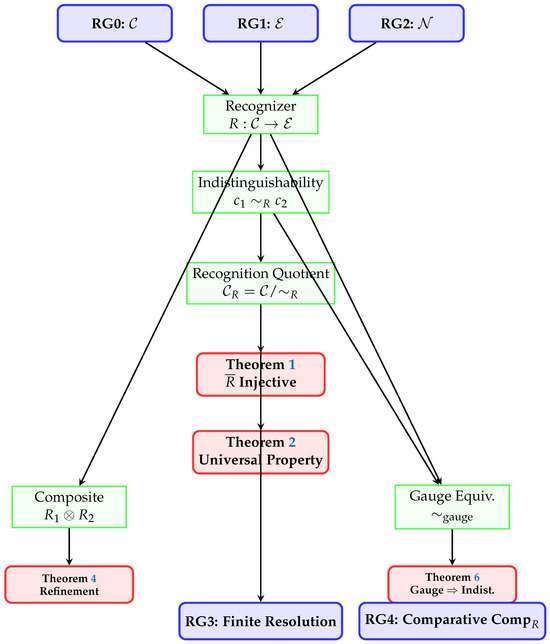
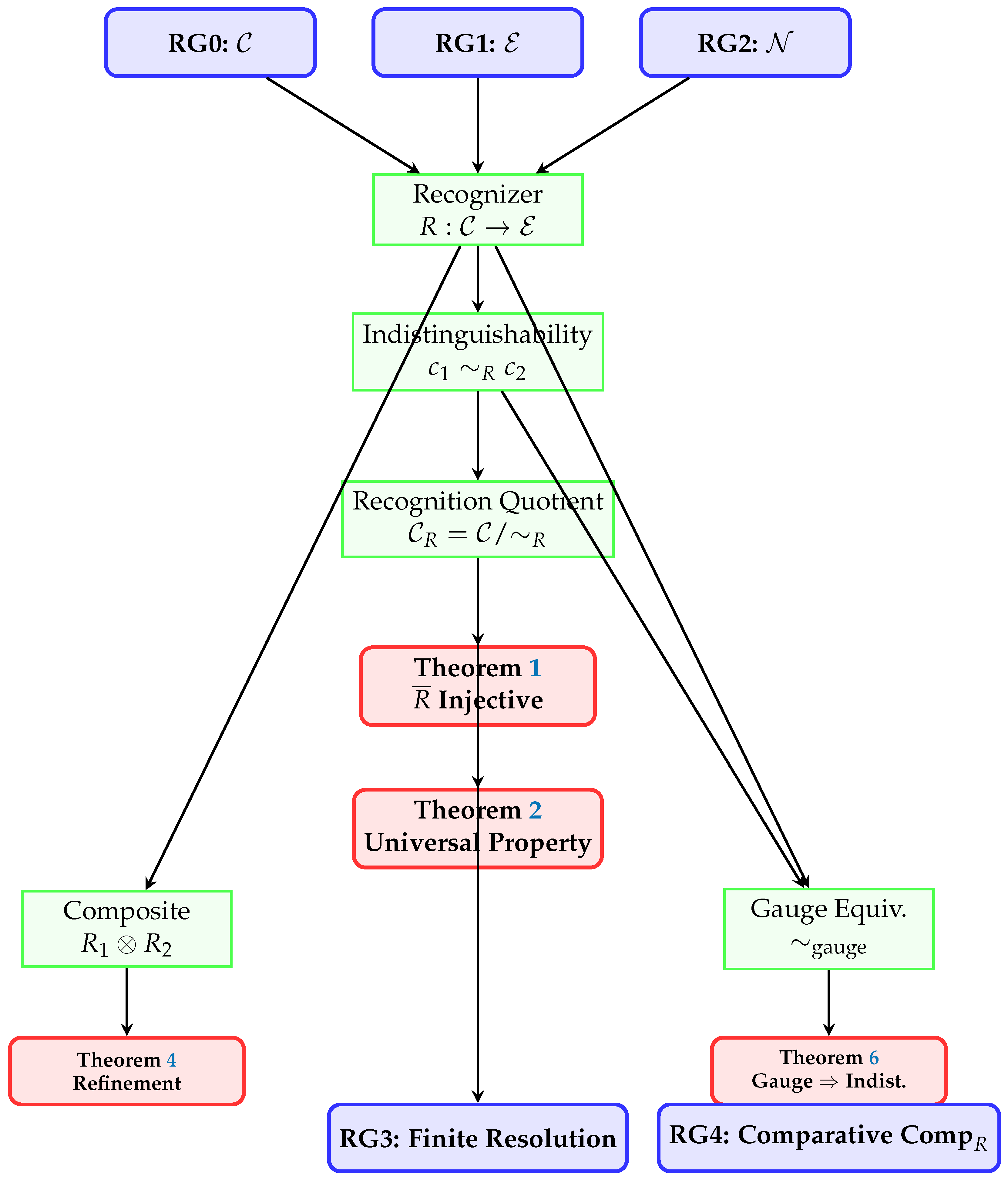
Figure 1 presents the logical architecture of Recognition Geometry, showing how the five axioms (RG0–RG4) lead to key definitions, which in turn yield the fundamental theorems establishing the framework’s mathematical properties. The diagram illustrates the dependency chain: primitive axioms define recognizers, which induce indistinguishability relations, which generate recognition quotients, culminating in the major structural results.
Figure 1.
Logical structure of Recognition Geometry.
2. Axioms and Basic Structure
In this section, we begin by specifying the basic axioms and primitive sets that define the underlying structure of the model. We assume that the ordinary set theory is consistent.
2.1. Configuration and Event Spaces
The starting point of the model consists of two primitive objects: a set of states and a set of observable outcomes. We postulate the existence of a set of configurations. A configuration represents a complete, precise specification of the state of the system.
Axiom 1
(RG0: Nonempty Configuration Space). There exists a nonempty set with at least two distinct elements, called the configuration space.
We explicitly do not assume that carries any topological, metric, or algebraic structure. The set may consist of vectors, graphs, labels, combinatorial objects, etc. Intuitively, recognizers (introduced in Section 2.3) map configurations to events. An event is an observable outcome: a pointer reading, a detector click, a boolean value, a distinctive pattern, etc.
Axiom 2
(RG1: Event Space). There exists a set with at least two distinct elements called the event space.
We do not impose any algebraic, metric, or topological structure on . All relevant structure is induced by recognizers through their action.
By assumption in Axiom 2 we exclude the trivial case. So, if a recognizer outputs the same event, it provides no information and induces no geometry. While we do not assume a topology on , we require a notion of locality.
Intuitively, geometry arises not from the points themselves, but from the way observable outcomes are produced and distinguished by measurements.
- Physical motivation. In physical experiments, measurements are inherently local operations. A thermometer records the temperature at its location, a Geiger counter responds to radiation within its detection volume, and a telescope observes only the light that reaches the instrument. Even in quantum mechanics, measurements are localized to the region where the apparatus interacts with the system [59].
This empirical fact that recognizers have a limited domain of sensitivity suggests that any mathematical framework should encode a notion of “local accessibility” among configurations. At the same time, we wish to avoid assuming a pre-existing topological or metric structure on , since such structure is intended to emerge from recognition rather than be postulated in advance.
We therefore introduce locality in a minimal way by postulating a neighborhood system as a primitive structure. The neighborhoods specify which configurations are locally accessible to measurements, without presupposing distance, continuity, or geometry. This leads to the following axiom.
Remark 1.
The locality structure is postulated as primitive data, specifying which configurations are considered "locally accessible" from any given configuration. While the physical motivation appeals to spatial locality, the mathematical framework treats as an abstract accessibility relation that need not presuppose metric or geometric structure. In applications, is typically derived from physical constraints (detector range, interaction locality, causal structure), but within the axiomatic framework it is a given structure, analogous to how a manifold’s atlas is specified rather than derived.
For each configuration we associate a family of subsets called the neighborhoods of c.
Axiom 3
(RG2: Local Configuration Space). A Local Configuration Space is a configuration space equipped with, for each configuration , a nonempty collection of subsets of , called the neighborhoods of c, satisfying:
- (i)
- Reflexivity:
- (ii)
- Intersection closure:
- (iii)
- Local refinement:
Intuitively, for each , the family specifies which subsets of configurations are considered locally accessible from c. Thus, every configuration is contained in each of its neighborhoods (reflexivity), any two local neighborhoods can be refined to a common, smaller one (intersection closure), and any point inside a neighborhood has its own neighborhood contained in the original one (local refinement).
Any map
satisfying Axiom 3 is called a locality structure on the configuration space .
2.2. Topology Generated by the Locality Structure
Although is not a neighborhood system in the topological sense, it nevertheless generates a canonical topology on .
Definition 1.
Let be a locality structure on . A set is open if and only if for every , there exists such that . The collection of all open sets is denoted by .
Clearly, is a topology on .
Remark 2.
Definition 1 provides a way to generate a topology from the locality structure . The construction declares a set open if it is locally a neighborhood: for every point in the set, the set contains a neighborhood of that point. This is a standard method for generating a topology from a neighborhood system (see [60], Chapter 2). Because is not assumed to be monotone, we do not claim that every topological neighborhood of c in is in . Rather, is the natural topology used in this paper: openness is defined by local containment of some -neighborhood.
2.3. Recognition Maps
In this section, we introduce the central object of the theory, the recognizer.
Definition 2
(Recognition triple). A recognition triple is an ordered triple where:
- is a nonempty set (configuration space, Axiom 1),
- is a set with (event space, Axiom 2),
- Σ is a nonempty set of functions such that for each .
Elements of Σ are called recognizers.
The condition ensures that every recognizer distinguishes at least two different configurations in . Constant functions convey no information and are therefore excluded.
This paper treats recognizers as total, deterministic functions. Several natural generalizations exist but require substantial modifications:
- Partial recognizers. If a recognizer R is only defined on a domain , the quotient construction (Section 2.6) applies only to . This models detectors with finite range but introduces complications in defining global geometric structures.
- Stochastic recognizers. A stochastic recognizer assigns a probability measure on to each configuration. Indistinguishability (see Definition 4) must then be defined via a metric on (e.g., total variation distance). This connects to POVMs in quantum theory [59] but requires additional measure-theoretic structure not assumed in this paper.
We work in ordinary set theory and treat recognizers as deterministic maps. We do not assume any intrinsic topology, metric, or smooth structure on or . The only primitive “geometric” input is the locality structure , Axiom 3 (RG2). We do not attempt to model dynamics, probabilities, noise, or experimental error in full generality (beyond the finite-resolution Axiom 4 (RG3) and the discussion of stochastic recognizers). The goal is to isolate a minimal axiomatic framework in which observable space and its induced structures are derived from recognition.
Definition 3
(Fiber). We let be a recognizer. For , the fiber over e is the set
Remark 3.
The collection of fibers forms a partition of , i.e., each configuration belongs to exactly one fiber.
Recognizers induce a very important relation on by the following definition:
Definition 4
(Indistinguishability). Given a recognizer , we say that two configurations and are indistinguishable with respect to R, and write
Consequently, the relation is an equivalence relation on , since it is defined by equality in .
2.4. The Quotient Space
The equivalence relation induces a quotient space.
Definition 5
(Quotient Space). Given a recognizer . The quotient space is
Remark 4.
The quotient is in natural bijection with with respect to the map . Each equivalence class is a fiber for some .
Example 1
(Threshold Recognizers). We let be the configuration space and be the event space. Let us define Σ as the family of threshold recognizers, i.e., the set of functions such that
where · denotes the standard Euclidean inner product on , and .
Each recognizer divides into two half-spaces, one “recognized” (event 1) and one “not recognized” (event 0). The family thus induces a geometric structure: two points are considered indistinguishable with respect to the recognizers if and only if they lie in the same collection of half-spaces.
Remark 5.
In this paper, indistinguishability is defined relative to a single recognizer . For a family of recognizers Σ, a standard way to package their joint observational content is the product map
and then to form the quotient /, which identifies configurations that agree on every recognizer in Σ. For the full family of threshold tests on , separates points (any two distinct points are separated by some half-space), so the resulting indistinguishability coincides with equality. This construction is formalized in Section 3, where we show that composite recognizers (Definition in Section 3.1) refine the quotient structure: the product map can be viewed as the composition , yielding progressively finer partitions of the configuration space as more recognizers are added (Theorem 4).
Example 2
(Discrete Lattice). We let be the configuration space and the event space. Let us define the recognizer by
This recognizer divides the integer lattice into two classes: points with an even sum of coordinates and points with an odd sum of coordinates. Therefore, the quotient has exactly two points. Here, denotes the quotient of by the equivalence relation induced by R (see Definition 5). This example shows that RG can be applied naturally to discrete spaces, without any continuity assumption.
Example 3
(Quantum Spin). We let be the Bloch sphere (the space of pure quantum spin- states) and . Given a unit vector , the spin measurement along direction is operationally defined via the Stern–Gerlach apparatus oriented along . For a fixed choice (e.g., the laboratory z-axis), the recognizer partitions the Bloch sphere into two regions corresponding to the two measurement outcomes. In this example, the manifold structure of (as the space of normalized spinors ) is assumed a priori; the recognizers partition this given space rather than constructing it. Adding the x-component recognizer refines the partition into four regions, and adding further refines it. However, no finite family of binary recognizers can distinguish all pairs of distinct points on ; the quotient remains finite and discrete. This illustrates the fundamental limitation imposed by finite-resolution measurements [59].
Example 4
(Recognition Science Instantiation). In the framework of Recognition Science, we let be the space of all ledger states (the complete ontological record of all entities and their properties), and let . We define the position recognizer that extracts the spatial coordinates of a given entity from the ledger. The recognition quotient is then (by Proposition 1). Points in the quotient are equivalence classes of ledger states indistinguishable with respect to position. In this construction, the three-dimensional Euclidean structure is present in the event space ; the quotient inherits this structure via the isomorphism to . This example illustrates the RG framework applied to the Recognition Science paradigm [19], showing how the mathematical formalism relates ontological states (ledger) to observable spatial structure.
The four examples above illustrate key structural features of RG:
- Configuration space structure: The framework applies equally to discrete spaces (Example 2: ), continuous manifolds (Example 1: ; Example 3: ), and abstract state spaces (Example 4: Ledger ). No topology, metric, or smooth structure is required a priori.
- Event space cardinality: Event spaces may be finite (Examples 2 and 3: binary outcomes) or continuous (Example 4: ). The quotient is always isomorphic to , so the “size” of observable space is determined entirely by the recognizer.
- Refinement and composition: Example 3 demonstrates that multiple recognizers (, , ) refine the partition. Adding recognizers never coarsens the quotient—it can only distinguish states that were previously indistinguishable. However, Example 3 also shows a fundamental limitation: no finite family of binary recognizers can recover the full continuous structure of . The quotient remains finite and discrete.
- Construction of observable space: Example 4 embodies the core philosophy of RG. The quotient provides a formal construction of observable space from the ledger and recognizer. The quotient’s structure (in this case, isomorphic to a subset of ) is inherited from the event space by Proposition 1. The conceptual contribution is the inversion of the usual order: rather than assuming physical space exists and defining measurements as functions on it, we take measurements (recognizers) as primitive and construct the observable space as the quotient. The geometric structure of the observable space depends on both the configuration space and the target event space .
2.5. Formalizing the Recognition Structure
In this section, we formalize the recognition elements introduced in the Definition 2, making explicit the structural assumptions underlying locality, recognition, etc.
Definition 6
(Recognition Structure). A Recognition Structure on a pair is a tuple
consisting of:
- a locality structure on ;
- a nonempty set Σ of functions , called recognizers.
In this way, a recognition structure specifies both what is observable (via the recognizers in Σ) and what is locally accessible (via the locality structure ).
To summarize, Definitions 2 and 6 provide
Definition 7
(Recognition Triple (formalized)). A Recognition Triple is a triple where:
- is a nonempty configuration space (Axiom 1);
- is an event space with (Axiom 2);
- is a recognition structure on in the sense of Definition 6.
For notational convenience, we may also denote a Recognition Triple by .
Remark 6.
The locality structure is global data on the configuration space and is independent of the choice of recognizer. Although does not enter the purely set-theoretic definition of the quotient associated with a single recognizer , it becomes essential when addressing questions of continuity, regularity, or induced topology on . The role of is to specify which configurations are "locally accessible" to measurements, independent of which specific recognizer is applied. This structure is part of the physical setup (e.g., which regions an instrument can access) rather than a property of individual observables.
When multiple recognizers act on the same configuration space, as in Example 3, they are treated as elements of the same set Σ within a single recognition structure and share the same locality structure . Operations relating to different recognizers rely on this common structure.
Remark 7.
From a categorical viewpoint [61], the quotient construction can be understood as defining a functor when appropriate morphisms are specified on configuration spaces and observable spaces. The injectivity of the induced map (Theorem 1) ensures that the quotient faithfully represents observable distinctions. A full categorical treatment, including functoriality and universal properties, is deferred to future work.
2.6. Recognition Quotient
We now arrive at the first major structural object of RG: the observable space obtained by identifying indistinguishable configurations.
Construction. Given a recognizer , the indistinguishability relation on partitions into resolution cells, i.e., equivalence classes .
Definition 8
(Recognition Quotient). The recognition quotient associated with the recognizer R is the quotient set
We denote by
the canonical projection that maps each configuration to its resolution cell.
Remark 8.
The quotient space represents the space of observationally distinguishable states: two configurations have the same image in if and only if the recognizer assigns them the same event. Thus, captures precisely the observable geometry determined by R.
Since is constant on each resolution cell , the recognizer descends to a well-defined map on the quotient. We denote the induced observable map by
This map is well defined because if , then and hence .
Clearly, we have the following two facts.
Theorem 1.
The induced map is injective.
Proposition 1.
The recognition quotient is naturally isomorphic to the image with respect to the map
Proof.
The map is well defined since R is constant on equivalence classes. It is surjective by definition of and injective since distinct observable states produce distinct events (Theorem 1). Hence, is a bijection. □
In the recognition quotient , observable states are completely and uniquely determined by the events they produce. Since the quotient is isomorphic to the image (Proposition 1), distinct observable states correspond to distinct events. Thus, distinct observable states correspond to distinct events, and no further distinctions exist within beyond those encoded by R, i.e., as a set, carries no distinctions beyond those induced by R (equivalently, ). If additional structure (e.g., a topology) is supplied or induced via the locality structure , then may carry further structure not determined by R alone.
The above observations lend themselves to a clear epistemic interpretation. Relative to a fixed recognizer R, all observable information about a configuration is exhausted by the corresponding event. In this sense, the quotient represents the effective state space accessible to an observer using R, and no finer distinctions are observable within this framework. (Here, “no finer distinctions” is understood in the sense of identification of configurations by ; additional, independently postulated structure on may still induce nontrivial topological properties on .)
The recognition quotient construction is mathematically equivalent to several well-known structures in differential geometry, probability theory, and physics. The conceptual contribution lies in the reinterpretation: taking recognizers (measurements) as the primitive objects that determine the quotient space, rather than assuming a space and then studying partitions on it. Key connections include:
Example 5
(Orbit spaces). In Lie theory, a group G acting on a manifold M partitions M into orbits, and the orbit space is the quotient by the equivalence relation . Recognition quotients are similar, with the recognizer R playing the role of the “observable” that is constant on orbits. Both constructions study quotients by equivalence relations. The interpretive difference is that RG emphasizes the recognizer (measurement) as the primitive object that induces the partition, whereas orbit space theory typically begins with the group action and derives the quotient. Mathematically, if is constant on G-orbits, then maps naturally into .
Example 6
(Level sets). For a smooth submersion , the level sets form a foliation of M. For any recognizer , the resolution cells are precisely the level sets (fibers) of R. When R satisfies appropriate regularity assumptions, these level sets may carry additional geometric structure analogous to a foliation. The quotient space identifies level sets to points and is isomorphic to the image (Proposition 1). Both classical differential geometry and RG study the same mathematical structure; the difference lies in which object is taken as primary (the manifold M with its foliation, versus the quotient as observable space).
Example 7
(Measurable partitions). In ergodic theory and probability [62], measurable partitions are used to define conditional expectations and factors of dynamical systems. The recognition quotient is the factor algebra corresponding to the partition induced by R. Our framework extends this to the non-probabilistic, purely geometric setting, emphasizing the quotient space itself rather than the σ-algebra structure.
Example 8
(Relational quantum mechanics). Rovelli’s relational interpretation [19] asserts that quantum states are relative to observers. RG formalizes this: the “state relative to observer R” is precisely the equivalence class in the quotient. Different recognizers (observers) induce different quotients (relative realities), unified by the underlying configuration space . The framework emphasizes the primacy of recognizers as the foundational objects: the observable space is constructed as the quotient induced by the recognizer R, rather than being assumed a priori. This reinterpretation connects naturally to operational and measurement-based approaches in quantum theory and provides a formal setting for studying how geometric structure relates to observational capabilities.
In the following theorem, we present the universal property of the recognition quotient.
Theorem 2.
We let be a recognizer, and let be the canonical projection. Then for any set X and any function that is constant on resolution cells (i.e., whenever , we have ), there exists a unique function such that
Theorem 2 is the standard universal property of quotient spaces (see [47,61]). The universal property characterizes the recognition quotient up to unique isomorphism. It states that is the “finest” or “most refined” quotient through which R factors: any other quotient on which R is well defined must factor through . In categorical terms, the pair is the coequalizer of the kernel pair of R, that is, the universal object that identifies precisely those configurations recognized as equivalent by R.
2.7. The Quotient Topology
We let denote the topology on generated by the locality structure (Definition 1). We now show that this structure descends naturally to the recognition quotient, endowing with the structure of a topological space.
Definition 9
(Quotient Topology on ). We let τ be the topology on generated by the locality structure . The quotient topology on is defined as follows: a subset is open if and only if its preimage under the canonical projection is open in :
Proposition 2.
The quotient topology is a topology on , and the canonical projection is continuous and surjective.
Proof.
We verify the axioms of a topology.
- (i)
- because . Similarly, because .
- (ii)
- We let be a family of open sets in . Then each is open in , and
Hence .
- (iii)
- We let . Then , and
Hence .
Continuity of follows from Definition 9, i.e., if , then . Surjectivity holds because every equivalence class is the image of under . □
Recall that a map between topological spaces is continuous if the preimage of every open set is open.
Proposition 3.
The quotient topology is the final topology (also called the coinduced topology ) with respect to π: it is the finest topology on that makes π continuous.
Proof.
We let be any topology on such that is continuous. Then for every , continuity implies
By Definition 9, this is equivalent to . Hence , showing that contains every topology on that makes continuous, and is therefore the finest (largest) such topology. □
Remark 9.
The quotient topology ensures that the observable space inherits a natural topological structure from the configuration space. Open sets in are precisely those subsets whose preimage , the union of all resolution cells in U, is open in . This topology encodes which observable states are "nearby" in a manner consistent with the locality structure on configurations. Intuitively, observable states and are topologically close in if the corresponding resolution cells (equivalence classes) in are close in the sense that their union forms an open set.
Having endowed with the topology generated by the locality structure (Definition 1), we can naturally define when a recognizer is continuous.
Definition 10
(Continuous Recognizer). We let be a topology on . A recognizer is called continuous (with respect to ) if, for every open set , the preimage is open in .
Proposition 4.
We let be the quotient topology on induced by the canonical projection , and let be a topology on . If the recognizer is continuous, then the induced map
is continuous.
Proof.
By definition of the quotient topology , a map is continuous if and only if the composition is continuous. Since and R is continuous by assumption, it follows that is continuous. □
Remark 10.
The locality structure encodes operational or experimental constraints, specifying which configurations are locally accessible for recognition and comparison. Different choices of on the same configuration space , even for a fixed recognizer R, may induce different topologies and consequently different quotient topologies on the observable space .
Example 9.
We let the configuration space be , the event space , and define a recognizer by
The induced equivalence relation identifies all non-positive points and all positive points. Hence, the recognition quotient as a set consists of exactly two resolution cells.
We now add to two different locality structures:
- contains the singleton . The generated topology is discrete. Consequently, the quotient topology on the two-point space is also discrete, so both points are open. Any map from to a topological space is continuous in this topology.
- for all x. The generated topology is indiscrete. Consequently, the quotient topology on is indiscrete, with only ∅ and open. The continuity condition is trivial.
This example demonstrates that the same recognizer on the same configuration space can lead to different observable geometries, depending solely on the chosen locality structure .
3. Advanced Structure
In this section, we study more advanced recognition structures, including composition of recognizers, finite resolution, comparative recognizers, and metric structures induced by recognition. Their study requires additional axioms and technical tools.
3.1. Composition of Recognizers
Physical measurement rarely involves a single isolated observation. For example, we can observe position and momentum, color and shape, etc. This combination of measurements is formalized as the composition of recognizers.
Definition 11
(Composite Recognizer). Given two recognizers and , their composition is the recognizer defined by:
From the definition, it is clear that the composite is a recognizer: its image satisfies
and is nontrivial, since there exist configurations with either or , implying .
Composition increases distinguishing power. If two configurations are distinguishable by or by , they are also distinguishable by the composite recognizer .
Theorem 3
(Composite Indistinguishability).
Proof.
By definition, means , i.e., . The last equality holds if and only if both coordinates are equal: and , which is equivalent to and . □
As an immediate consequence, the equivalence classes of the composite recognizer are given by intersections of the equivalence classes of its components.
Corollary 1.
For any ,
Proof.
⇔⇔ and ⇔ and ⇔. □
Further, the classes of the composite recognizer naturally map onto the classes of the individual recognizers via the canonical projections and . More precisely, the following theorem holds.
Theorem 4.
The recognition quotient of the composite refines the quotients of its components. There exist surjective canonical maps:
defined by and .
Proof.
We must show that and are well defined and surjective.
If , then , so , hence . Thus is well defined (and similarly for ).
For any , we have , so is surjective (and similarly for ). □
This theorem formalizes the intuition that “more measurement yields more geometry.” As we add recognizers, the quotient space unfolds, revealing more detail.
3.2. Symmetries and Gauge Equivalence
Transformations are mappings of a space that change the position or state of configurations while keeping certain properties unchanged. Geometry studies what is preserved and what is distinguished under these transformations.
Definition 12
(Recognition-Preserving Map). A transformation is recognition-preserving for R if it preserves all events, i.e.,
Proposition 5.
Recognition-preserving maps are closed under composition and contain the identity. Consequently, they form a monoid.
Proof.
We let be recognition-preserving for R. Then, for any ,
so is recognition-preserving. The identity map clearly satisfies . Associativity comes from function composition. □
Definition 13.
A recognition automorphism is a bijective recognition-preserving map. The collection of all recognition automorphisms for R is denoted .
Proposition 6.
forms a group under composition.
Proof.
By Proposition 5, is closed under composition and contains the identity.
If , then T is bijective, so exists. For any , we let , so . Then
where the second equality uses that T is recognition-preserving. Thus . Associativity comes from function composition. □
Theorem 5.
If T is recognition-preserving, then implies .
Proof.
If , then . Since T is recognition-preserving,
hence . □
In physics, a gauge transformation is a change in the mathematical description of a system that does not affect any observable quantities, i.e., physical observables are invariant (map-preserving) under such transformations. RG makes this idea precise through the concept of gauge equivalence. In RG, it is natural to distinguish between all recognition-preserving automorphisms (a large mathematical symmetry class) and the physically admissible gauge symmetries, which are typically restricted by regularity, locality, or implementability constraints.
Definition 14.
We fix a subgroup called the (admissible) gauge group for the recognizer R. Two configurations are said to be gauge equivalent, denoted , if there exists a transformation such that
So, gauge equivalence defines an equivalence relation on , partitioning the configuration space into orbits under the action of the chosen admissible gauge group .
Theorem 6.
If two configurations are gauge equivalent, then they are observationally indistinguishable by Definition 4, i.e.,
Proof.
We let such that . By Definition (13), for all . Therefore, and consequently . □
The converse of the gauge-to-indistinguishability implication (Theorem 6) does not hold in general. Two configurations can be observationally indistinguishable, but not gauge equivalent. Gauge equivalence requires the existence of a global symmetry transformation relating the configurations. In contrast, observational indistinguishability only means that they give the same measurement outcome. Let us construct counterexample with restricted gauge group.
Example 10.
We let and let with event space . Then since both have Event 1. Now we choose the admissible gauge group to be the subgroup generated by reflection across the x-axis (so ). This preserves R (hence ), but there is no with . Therefore while , showing that indistinguishability is strictly weaker than gauge equivalence when is a proper subgroup of .
In the case where , indistinguishability and gauge equivalence coincide: if , then there exists a recognition automorphism mapping to . In physical applications, however, the intended “gauge group” is typically a distinguished subgroup singled out by additional structure (e.g., dynamics, locality constraints, smoothness); then, -gauge equivalence can be strictly stronger than .
3.3. Finite Local Resolution
We now introduce the axiom that distinguishes RG from classical continuum geometry (such as and differentiable manifolds) and establishes a fundamental connection to finite observational resolution. The Finite Resolution Axiom says that, locally, a recognizer can distinguish only finitely many states, while in classical geometry infinite precision is assumed.
Axiom 4
(RG3: Finite Local Resolution). For every configuration and recognizer R, there exists a neighborhood such that the image is a finite set, i.e., .
Remark 11.
Axiom 4 means that a recognizer cannot distinguish infinitely many different outcomes inside a single local region of the configuration space.
Axiom 4 has a simple consequence: if a local neighborhood is infinite, but the recognizer has finite resolution there, then R cannot be injective on that neighborhood. More precisely, the following holds:
Theorem 7
(Local Non-Injectivity). We let and let be a neighborhood satisfying Axiom 4. If U is an infinite set (i.e., contains infinitely many configurations), then the restriction
is not injective.
Remark 12.
If an infinite neighborhood is mapped to a finite set of observable outcomes, then different configurations must belong to the same equivalence class. In continuum-based models, where local neighborhoods are typically infinite, this leads to observable resolution cells rather than mathematical points. In this sense, finite resolution gives a geometric explanation of effective discretization: distinct configurations become observationally indistinguishable due to limited resolution.
When RG3 Fails or Is Weakened
Axiom 4 (RG3) is physically motivated by the finite precision of any real measurement apparatus, but it is mathematically restrictive. It excludes certain idealized models that arise in pure mathematics and theoretical physics. Here, we briefly discuss scenarios where RG3 fails or must be weakened and the consequences for the framework.
- Classical smooth manifolds with continuous recognizers. We consider with the standard topology and a smooth real-valued recognizer . If R is non-constant (e.g., ), then for any neighborhood U, the image is an interval in , hence infinite. RG3 fails. In this case, the quotient inherits the structure of , and no discretization occurs. This is the classical continuum limit where measurement is assumed to have infinite precision.
- Weakening RG3: Countable resolution. One can weaken RG3 to require only that is countable rather than finite. This allows, for instance, recognizers on that distinguish rational numbers from irrationals locally, or lattice-valued recognizers. The quotient would then be at most countable locally. Most of the framework (equivalence relations, quotient construction, universal property) remains valid. However, Theorem 7 (Local Non-Injectivity) would need to be restated for infinite cardinalities, and the notion of “resolution cell” loses its finite, discrete character.
- No locality assumption: Global recognizers without RG3. If one drops both the locality structure (RG2) and finite resolution (RG3), the framework reduces to the study of arbitrary quotient spaces for arbitrary recognizers . The universal property (Theorem 2) and injectivity of (Theorem 1) still hold, but the connection to physical observability and the notion of “local resolution” is lost. This is the setting of pure set-theoretic quotients, which is mathematically well defined but lacks the operational and physical content that RG3 provides.
- Infinite-dimensional configuration spaces. In infinite-dimensional spaces (e.g., function spaces, path spaces in quantum field theory), RG3 may fail because local neighborhoods are inherently infinite-dimensional. For instance, a recognizer that measures all Fourier coefficients of a function would have infinite local resolution. To apply RG in such contexts, one must either restrict to finite-dimensional observable subspaces (as in effective field theory truncations) or accept that the quotient is itself infinite-dimensional and does not exhibit the discrete, finite-resolution structure that RG3 enforces in finite-dimensional settings.
- Physical interpretation. From a physical standpoint, RG3 is justified by the fact that any real measurement apparatus has finite precision, bounded energy, and finite time. However, in idealized or limiting models (e.g., taking the continuum limit of a lattice theory, or considering the limit in quantum mechanics), one may want to model recognizers with infinite resolution. In such cases, RG3 should be viewed as an axiom that is relaxed in the idealized limit, while the rest of the framework (RG0, RG1, RG2, RG4) continues to apply.
To conclude, RG3 is essential for deriving the discrete, operational character of observable space from finite measurements. Weakening or removing RG3 allows for classical continuum models and infinite-precision idealizations, but at the cost of losing the framework’s distinctive feature: the emergence of discrete resolution cells from finite observational capabilities. The choice to include RG3 thus reflects a commitment to modeling realistic, finite-resolution observations rather than idealized infinite-precision measurements.
3.4. Comparative Recognizers
Most often, to specify a geometry, a notion of distance is usually given. In RG, distance is not given in advance. Instead, it is derived from a weaker structure, called comparative recognition.
A standard recognizer assigns an event to a single configuration and induces the observable space by a quotient construction. In contrast, a comparative recognizer assigns an event to a pair of configurations. This allows us to compare configurations directly, after which notions of order and distance can be introduced.
Axiom 5
(RG4: Comparative Recognizers). We fix a distinguished recognition equality event . A comparative recognizer is a map
such that:
- 1.
- for all ;
- 2.
- is nontrivial, i.e., there exist with .
As an immediate consequence of Axiom 5, no symmetry, transitivity, or numerical structure is assumed for . In particular, it is not required that .
Additional regularity conditions may be imposed later, if needed. Comparative recognizers can be used to describe physical devices whose output depends on comparison rather than on absolute measurement. Typical examples include balance scales (“is object A heavier than object B?”), interferometers measuring relative phase, or devices comparing arrival times of signals.
3.5. Emergence of Order
Given a comparative recognizer , some events can be understood as indicating an order-type relation. We let be a chosen subset of events, interpreted as “strictly greater than” outcomes.
We define two binary relations:
In general, the relations obtained in this way do not need to be partial or total order relations. They only reflect order-like comparison information that is accessible at the level of recognition.
Remark 13.
The choice of and its interpretation are part of the physical modeling. The relations ≺ and ⪯ inherit their properties directly from the behavior of on the chosen subset . The equality refers to identity in the configuration space , and not to operational indistinguishability.
In this way, comparative recognizers provide order-type information based on operational comparison, before any notion of distance is introduced.
3.6. Emergence of Recognition Distance
Under additional assumptions, comparative recognizers can be used to define quantitative notions of distinguishability. The basic idea is that distance is not assumed in advance, but arises as a measure of how difficult it is to distinguish configurations using available measurements.
We let be a family of comparative recognizers on . For each , we let be a subset of events interpreted as indicating operational indistinguishability for . With these assumptions, we have the following definitions:
Definition 15.
Let us define a relation ≈ on by
Definition 16
(Recognition Distance). A recognition distance is a pseudometric
on the configuration space.
The distance d is called operationally grounded if for any , we have if and only if .
In other words, a distance d is operationally grounded if it is constructed from a family of comparative recognizers, in a way that reflects the operational effort required to distinguish configurations.
In particular, operational grounding requires that whenever all available comparative recognizers satisfy .
Remark 14.
We use a pseudometric since different configurations may have zero recognition distance if the available recognizers cannot distinguish them. This reflects finite resolution and limited observational power.
Remark 15.
Although a comparative recognizer itself need not be symmetric, in physical realizations the resulting distance is typically symmetric. This may follow from symmetry of the measuring device, from averaging over both and , or from other symmetrization procedures applied to comparison outcomes.
The precise construction of recognition distance depends on the choice of comparative recognizers and on additional assumptions, and is not fixed at the axiomatic level.
Example 11.
We define
We assume that for all c and all i. Then clearly ≈ is reflexive and thus . Next, we assume is closed under reversal, i.e., whenever then also , where . If , then for all i, hence also (using the reversed recognizers), so . If , then for some i we have , hence , so .
We assume now that ≈ is transitive. If and , then and , hence by transitivity, so . If , then at least one of or must be 1, otherwise both would be 0 and transitivity would give . We have thus proved that d satisfies the triangle inequality. Consequently, under the assumptions made, d is a pseudometric on . Moreover, d is operationally grounded: when none of the available comparative recognizers can operationally distinguish from , and as soon as at least one recognizer produces an outcome indicating distinguishability.
A recognition distance measures the minimal comparative effort required to distinguish two configurations. In other words, it formalizes the idea of “how hard it is to tell them apart” as a quantitative pseudometric, for example analogous to graph distances, where edges represent elementary distinction steps. Concrete constructions depend on the chosen family of recognizers and will be discussed in further work.
When the pseudometric d admits distinct configurations with , it induces a genuine metric on the quotient space , where configurations indistinguishable by all recognizers are identified. This is the standard passage from a pseudometric to a metric via quotienting by the zero-distance relation.
Recognition distances connect naturally to two geometric frameworks that generalize RG. When comparative recognizers are direction-sensitive, the induced recognition distance may depend on the path connecting configurations, leading to a Finsler-type structure. Recognition distances derived from statistical divergences naturally induce Hessian metrics on the corresponding quotient space, as in information geometry, where such metrics arise from convex divergences via their Hessian structure.
Example 12
(Balance-scale recognizer). A balance scale defines a comparative recognizer with event space , indicating equal mass, left heavier, or right heavier, respectively. Choosing induces a binary comparison relation on masses. If the associated indistinguishability relation (with ) is transitive, the construction in Example 11 yields a recognition distance that distinguishes masses in a discrete way.
Every comparative recognizer induces a family of recognizers , parametrized by a reference configuration c.
Comparative recognizers complete the conceptual inversion of RG: distance, and with it geometric structure, emerges as the operational cost of distinguishing configurations, not as an independently given primitive. Geometry appears only after recognition, as a secondary structure induced by what can be operationally distinguished.
4. Lean Formalization
An important part of the axiomatic framework presented in this paper is formalized in the proof assistant Lean 4 [63]. The Lean development is intended as a claims-hygiene layer: it forces explicit definitions, prevents hidden assumptions.
The formalization includes the primitives (configuration and event spaces, locality structures, recognizers, and indistinguishability), the recognition quotient, composition of recognizers, finite local resolution and the corresponding non-injectivity obstruction, and gauge constructions.
This formalization serves two purposes. First, it provides an independent check of the logical consistency of the postulated axiomatic framework, relations, definitions, and of the main structural results. Second, it makes explicit which assumptions are needed for the appearance of order, distance, and richer geometric structure. Lean is used here not as a replacement for mathematical reasoning, but as a precision tool. This is particularly important in a framework where geometry is not taken as a primitive concept, but is derived from recognition.
5. Conclusions
In this paper, we presented the basic framework of Recognition Geometry (RG), an axiomatic approach in which the observable space is not assumed in advance but is obtained from recognition processes. In RG, space appears as a quotient structure induced by recognition maps.
The main points of the paper can be summarized as follows.
- We reversed the usual geometric viewpoint by taking recognition as the primitive notion and deriving space from it, instead of starting with a given space and defining measurements on it.
- We introduced a minimal axiomatic system: a nonempty configuration space, an event space, a locality structure, and nontrivial recognizers, together with the induced indistinguishability relation. From this, we constructed the recognition quotient (resolution cells) and the induced observable map . We proved that is injective (Theorem 1), establishing that distinct observable states produce distinct events with no hidden structure. We also described how the locality structure generates a topology on and induces the quotient topology on via the final topology construction (Propositions 2 and 3).
- We described the recognition triple with and its role in constructing the observable space. The universal property of the recognition quotient (Theorem 2) characterizes as the finest quotient through which the recognizer factors, establishing its categorical uniqueness.
- Several examples were given to illustrate the framework, including threshold recognizers on , discrete lattice recognizers, quantum spin measurements, and examples from Recognition Science, where physical space emerges as a quotient structure.
- We developed the composition of recognizers in §3 and proved that composite recognizers refine quotient structures via intersection of resolution cells (Theorem 4). This formalizes the principle that “more measurement yields more geometry.” We also introduced symmetries through recognition-preserving maps and gauge equivalence, and proved that gauge-equivalent configurations are observationally indistinguishable (Theorem 6), while the converse is not true in general, as shown by a counterexample.
- We developed comparative recognizers and used them to define order-type relations and recognition distances as pseudometrics derived from operational distinguishability. This completes the conceptual inversion of RG: distance emerges as the operational cost of distinguishing configurations, rather than as an independently given primitive. Geometry appears only after recognition, as a secondary structure induced by what can be operationally distinguished.
- A significant portion of the axiomatic framework, including axioms RG0–RG4, recognizers, indistinguishability, quotient construction, finite resolution, and comparative recognizers, was formalized in the Lean 4 proof assistant. This formalization provides an independent verification of logical consistency and makes explicit the minimal assumptions required for deriving geometric structure from recognition.
Table 1 summarizes the main axioms, definitions, and theorems of the Recognition Geometry framework, showing how the measurement-first ontology is formalized into a rigorous mathematical structure.
Table 1.
Summary of main axioms, constructions, and theorems in Recognition Geometry.
The main message of RG is that space is not given in advance but is obtained through recognition. This measurement-first ontology unifies diverse approaches across mathematical physics, quantum foundations, information geometry, and discrete spacetime theories, while providing a rigorous axiomatic foundation amenable to formal verification. The framework naturally accommodates finite observational resolution, explaining why classical continua appear discrete at fine scales, and applies equally to discrete, continuous, and hybrid systems.
Author Contributions
Conceptualization, J.W.; methodology, J.W., M.Z. and E.A.; software, J.W.; validation, J.W., M.Z. and E.A.; formal analysis, J.W.; investigation, J.W., M.Z. and E.A.; writing—original draft preparation, J.W., M.Z. and E.A.; writing—review and editing, M.Z. and E.A.; visualization, J.W.; supervision, J.W.; project administration, M.Z.; funding acquisition, J.W. All authors have read and agreed to the published version of the manuscript.
Funding
This research received no external funding.
Institutional Review Board Statement
Not applicable.
Informed Consent Statement
Not applicable.
Data Availability Statement
Data are contained within the article.
Acknowledgments
The authors express their sincere gratitude to the anonymous referees for a number of insightful comments. These comments significantly improved both the accuracy and clarity of the manuscript.
Conflicts of Interest
The authors declare no conflicts of interest.
References
- Stanković, M.; Zlatanović, M. Non-Euclidean Geometry; Faculty of Sciences and Mathematics: Niš, Serbia, 2016. [Google Scholar]
- Lee, J.M. Introduction to Smooth Manifolds, 3rd ed.; Springer: Berlin/Heidelberg, Germany, 2012. [Google Scholar]
- Einstein, A. Die Grundlage der allgemeinen Relativitätstheorie. Ann. Phys. 1916, 354, 769–822. [Google Scholar] [CrossRef] [Scilit]
- Wald, R.M. General Relativity; University of Chicago Press: Chicago, IL, USA, 1984. [Google Scholar]
- Penrose, R. The Road to Reality; Jonathan Cape: London, UK, 2004. [Google Scholar]
- Weyl, H. Space, Time, Matter, 4th ed.; Dover Publications: Garden City, NY, USA, 1952. (In German) [Google Scholar]
- Malament, D.B. Topics in the Foundations of General Relativity and Newtonian Gravitation Theory; University of Chicago Press: Chicago, IL, USA, 2012. [Google Scholar]
- Geroch, R. Mathematical Physics; University of Chicago Press: Chicago, IL, USA, 1985. [Google Scholar]
- Ellis, G.F.R.; Rothman, T. Time and Spacetime: The Crystallizing Block Universe. Int. J. Theor. Phys. 2010, 49, 988–1003. [Google Scholar] [CrossRef] [Scilit]
- Riesz, F.; Sz-Nagy, B. Functional Analysis; Dover Publications: Garden City, NY, USA, 1990. [Google Scholar]
- Gelfand, I.M.; Naimark, M.A. On the embedding of normed rings into the ring of operators in Hilbert space. Mat. Sb. 1943, 12, 197–217. [Google Scholar]
- Segal, I.E. Postulates for general quantum mechanics. Ann. Math. 1947, 48, 930–948. [Google Scholar] [CrossRef] [Scilit]
- von Neumann, J. Mathematical Foundations of Quantum Mechanics; Princeton University Press: Princeton, NJ, USA, 1955. [Google Scholar]
- Wheeler, J.A.; Zurek, W.H. (Eds.) Quantum Theory and Measurement; Princeton University Press: Princeton, NJ, USA, 1983. [Google Scholar]
- Hardy, L. Quantum Theory From Five Reasonable Axioms. arXiv 2001, arXiv:quant-ph/0101012. [Google Scholar] [CrossRef] [Scilit]
- Piron, C. Foundations of Quantum Physics; W.A. Benjamin: New York, NY, USA, 1976. [Google Scholar]
- Fuchs, C.A.; Schack, R. Quantum-Bayesian Coherence. Rev. Mod. Phys. 2013, 85, 1693–1715. [Google Scholar] [CrossRef] [Scilit]
- Caves, C.M.; Fuchs, C.A.; Schack, R. Quantum probabilities as Bayesian probabilities. Phys. Rev. A 2002, 65, 022305. [Google Scholar] [CrossRef] [Scilit]
- Rovelli, C. Relational Quantum Mechanics. Int. J. Theor. Phys. 1996, 35, 1637–1678. [Google Scholar] [CrossRef] [Scilit]
- Laudisa, F.; Rovelli, C. Relational quantum mechanics. In Stanford Encyclopedia of Philosophy, Summer 2021 ed.; Zalta, E.N., Ed.; Metaphysics Research Lab, Stanford University: Stanford, CA, USA, 2021. [Google Scholar]
- Isham, C.J. Lectures on Quantum Theory: Mathematical and Structural Foundations; Imperial College Press: London, UK, 1995. [Google Scholar]
- Landsman, N.P. Foundations of Quantum Theory: From Classical Concepts to Operator Algebras; Springer: Cham, Switzerland, 2017. [Google Scholar]
- Varadarajan, V.S. Geometry of Quantum Theory, 2nd ed.; Springer: New York, NY, USA, 2007. [Google Scholar]
- Svozil, K. Quantum Logic; Springer: Dordrecht, The Netherlands, 1998. [Google Scholar]
- Zeilinger, A. A foundational principle for quantum mechanics. Found. Phys. 1999, 29, 631–643. [Google Scholar] [CrossRef] [Scilit]
- Wigner, E.P. The unreasonable effectiveness of mathematics in the natural sciences. Commun. Pure Appl. Math. 1960, 13, 1–14. [Google Scholar] [CrossRef] [Scilit]
- Bratteli, O.; Robinson, D.W. Operator Algebras and Quantum Statistical Mechanics, 2nd ed.; Springer: Berlin/Heidelberg, Germany, 1987; Volume 1. [Google Scholar]
- Haag, R. Local Quantum Physics: Fields, Particles, Algebras, 2nd ed.; Springer: Berlin/Heidelberg, Germany, 1996. [Google Scholar]
- Streater, R.F.; Wightman, A.S. PCT, Spin and Statistics, and All That; Princeton University Press: Princeton, NJ, USA, 2000. [Google Scholar]
- Schweber, S.S. An Introduction to Relativistic Quantum Field Theory; Row, Peterson and Company: Evanston, IL, USA, 1961. [Google Scholar]
- Raimondi, V.; Ropke, G. Statistical Approach to Quantum Field Theory, 2nd ed.; Springer: Cham, Switzerland, 2021. [Google Scholar]
- Krein, M.; Milman, D. On extreme points of regular convex sets. Stud. Math. 1940, 9, 133–138. [Google Scholar] [CrossRef] [Scilit]
- Abramsky, S.; Coecke, B. A Categorical Semantics of Quantum Protocols. In Proceedings of LICS 2004; IEEE Computer Society: Los Alamitos, CA, USA, 2004. [Google Scholar]
- Coecke, B. Quantum Picturalism. Contemp. Phys. 2010, 51, 59–83. [Google Scholar] [CrossRef] [Scilit]
- Lawvere, F.W.; Schanuel, S.H. Conceptual Mathematics: A First Introduction to Categories; Cambridge University Press: Cambridge, UK, 2009. [Google Scholar]
- Lurie, J. Higher Topos Theory; Princeton University Press: Princeton, NJ, USA, 2009. [Google Scholar]
- Döring, A.; Isham, C. A Topos Foundation for Theories of Physics. J. Math. Phys. 2008, 49, 053515. [Google Scholar] [CrossRef] [Scilit]
- Jaynes, E.T. Probability Theory: The Logic of Science; Cambridge University Press: Cambridge, UK, 2003. [Google Scholar]
- Amari, S. Differential-Geometrical Methods in Statistics; Lecture Notes in Statistics 28; Springer: Berlin/Heidelberg, Germany, 1985. [Google Scholar]
- Amari, S. Information Geometry and Its Applications; Springer: Berlin/Heidelberg, Germany, 2016. [Google Scholar]
- Frieden, B.R. Physics from Fisher Information; Cambridge University Press: Cambridge, UK, 1998. [Google Scholar]
- Caticha, A. Entropic Inference and the Foundations of Physics; Monograph commissioned by the 11th Brazilian Meeting on Bayesian Statistics; The International Society for Bayesian Analysis-ISBrA: Sao Paulo, Brazil, 2012. [Google Scholar]
- Kolmogorov, A.N. Foundations of the Theory of Probability, 2nd ed.; Chelsea Publishing Company: New York, NY, USA, 1956. [Google Scholar]
- Suppes, P. Representation and Invariance of Scientific Structures; CSLI Publications: Stanford, CA, USA, 2002. [Google Scholar]
- Johnstone, P.T. Stone Spaces; Cambridge Studies in Advanced Mathematics 3; Cambridge University Press: Cambridge, UK, 1986. [Google Scholar]
- Vickers, S. Topology via Logic; Cambridge Tracts in Theoretical Computer Science 5; Cambridge University Press: Cambridge, UK, 1989. [Google Scholar]
- Adámek, J.; Herrlich, H.; Strecker, G.E. Abstract and Concrete Categories: The Joy of Cats; Wiley: Hoboken, NJ, USA, 1990. [Google Scholar]
- Sambin, G. Intuitionistic formal spaces—A first communication. In Mathematical Logic and Its Applications; Skordev, D., Ed.; Plenum: New York, NY, USA, 1987. [Google Scholar]
- Ehresmann, C. Categories et Structures; Dunod: Paris, France, 1965. [Google Scholar]
- Grothendieck, A. Éléments de Géométrie Algébrique; Publications Mathématiques de l’IHÉS: Paris, France, 1960. [Google Scholar]
- Bombelli, L.; Lee, J.; Meyer, D.; Sorkin, R.D. Space-time as a causal set. Phys. Rev. Lett. 1987, 59, 521–524. [Google Scholar] [CrossRef] [Scilit]
- Sorkin, R.D. Causal Sets: Discrete Gravity. In Lectures on Quantum Gravity; Springer: Boston, MA, USA, 2005; pp. 305–327. [Google Scholar]
- Rovelli, C. Quantum Gravity; Cambridge University Press: Cambridge, UK, 2004. [Google Scholar]
- Connes, A. Noncommutative Geometry; Academic Press: Cambridge, MA, USA, 1994. [Google Scholar]
- Wolfram, S. A New Kind of Science; Wolfram Media: Champaign, IL, USA, 2002. [Google Scholar]
- Verlinde, E. On the Origin of Gravity and the Laws of Newton. J. High Energy Phys. 2011, 2011, 29. [Google Scholar] [CrossRef] [Scilit]
- Heller, M.; Woodin, W.H. (Eds.) Infinity: New Research Frontiers; Cambridge University Press: Cambridge, UK, 2011. [Google Scholar]
- Teller, P. An Interpretive Introduction to Quantum Field Theory; Princeton University Press: Princeton, NJ, USA, 1995. [Google Scholar]
- Busch, P.; Lahti, P.; Pellonpää, J.-P.; Ylinen, K. Quantum Measurement; Springer: Berlin/Heidelberg, Germany, 2016. [Google Scholar]
- Munkres, J. Topology, 2nd ed.; Prentice Hall: Upper Saddle River, NJ, USA, 2000. [Google Scholar]
- Mac Lane, S. Categories for the Working Mathematician, 2nd ed.; Springer: Berlin/Heidelberg, Germany, 1998. [Google Scholar]
- Chentsov, N.N. Statistical Decision Rules and Optimal Inference; American Mathematical Society: Providence, RI, USA, 1982. [Google Scholar]
- Moura, L.d.; Ullrich, S. The Lean 4 Theorem Prover and Programming Language. In Automated Deduction—CADE 28. CADE 2021; Platzer, A., Sutcliffe, G., Eds.; Lecture Notes in Computer Science; Springer: Cham, Switzerland, 2021; Volume 12699. [Google Scholar]

Disclaimer/Publisher’s Note: The statements, opinions and data contained in all publications are solely those of the individual author(s) and contributor(s) and not of MDPI and/or the editor(s). MDPI and/or the editor(s) disclaim responsibility for any injury to people or property resulting from any ideas, methods, instructions or products referred to in the content. |
© 2026 by the authors. Licensee MDPI, Basel, Switzerland. This article is an open access article distributed under the terms and conditions of the Creative Commons Attribution (CC BY) license.