


Abstract
This paper is concerned with an equilibrium problem for an elastic structure consisting of a plate and an elastic beam connected to each other at a given point. We consider two cases: In the first one, the elastic beam is connected to a rigid part of the elastic plate; in the second case, contact occurs between two elastic bodies. The elastic plate may contain a thin rigid delaminated inclusion. Neumann-type boundary conditions are considered at the external boundary of the plate. The existence of a solution to the considered problems is proven. A sufficient and necessary condition imposed onto the external forces for the solvability of the problems is found. Passages to the limit with respect to the rigidity parameter of the elastic beam are justified. For all problems, we analyze variational statements as well as differential ones.
Keywords:
T-shape structure; elastic plate; volume and thin inclusions; solution existence; asymptotic analysis; Neumann boundary condition MSC:
35J58; 74G22
1. Introduction
T-shape elastic and non-elastic structures are widely used in applications. The behavior of such structures depends on the geometry and material properties of the parts that it make up. The components of the considered structures may contain thin and volume inclusions, either elastic or rigid ones. Moreover, the junction conditions between the components have a big influence on the stresses emerging inside the structure. From the standpoint of mathematical modeling, various connections between the constitutive parts imply suitable boundary conditions imposed on the interfaces. Additional difficulties appear provided that the inclusions are delaminated from the surrounding deformable material. In recent decades, a lot of papers have been published related to the analysis of elastic bodies with thin and volume inclusions with delaminations. The presence of delamination means that there is an interfacial crack located between the inclusion and the surrounding body. In this case, suitable boundary conditions should be specified at the crack faces. We refer the reader to [1,2,3,4,5,6] and many other papers. In particular, in paper [5], one can find T-shape thin delaminated inclusions incorporated into elastic bodies, with the inequality-type boundary conditions imposed at the crack faces providing mutual non-penetration. In addition to the proof of the solution’s existence and an analysis of the solution’s dependence on the parameters, the junction conditions between the inclusions are found. Various junction problems are investigated in [7,8,9,10,11,12,13] and the literature therein. One more difficulty in these analyses is concerned with the Neumann-type boundary condition imposed at the external boundary. This leads to the need to find suitable conditions for the external forces to ensure the existence of a solution. In so doing, we have to present the Sobolev space as a sum of two orthogonal subspaces and find a unique solution in a suitable subspace. There are many results concerning equilibrium problems for elastic bodies with thin inclusions without delaminations [14,15,16,17,18,19,20,21,22,23]. As for general approaches to the analysis of composite structures, suitable results can be found in [24,25]. In the book [26], one can find results for contact problems between two inclined elastic plates, as well as for the contact between an elastic plate and an inclined elastic beam; see also papers [27,28,29,30,31] related to T-shape deformable structures.
In the present paper, we analyze a T-shape deformable structure consisting of a plate and a beam attached to the plate. The plate may contain volume and thin rigid inclusions. In fact, we can look at the considered T-shape structure with the junction between the bodies of different dimensions in mind. This paper is organized as follows. In Section 2 and Section 3, we analyze an equilibrium problem for a plate connected with an elastic beam provided that the Neumann-type boundary conditions are considered at the external boundary; the plate is assumed to contain a rigid volume inclusion. The existence of a solution is proven. An asymptotic analysis is provided as the rigidity parameter of the beam tends to infinity. Section 4 and Section 5 are concerned with a case without rigid inclusion. Sufficient and necessary conditions imposed on the external forces are found, proving the existence of a solution to the problem. To prove the solution’s existence in this case, we should present a suitable Sobolev space as a sum of two orthogonal subspaces. The passage to the limit is also analyzed as the rigidity parameter of the beam tends to infinity. In all cases, limit models are investigated. Section 6 takes the case of an elastic plate with a thin rigid delaminated inclusion.
2. Problem Statement
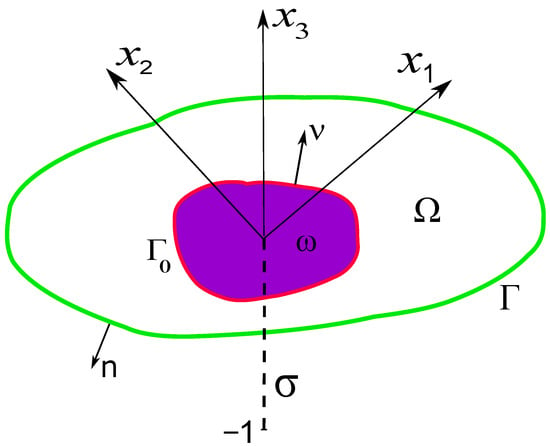
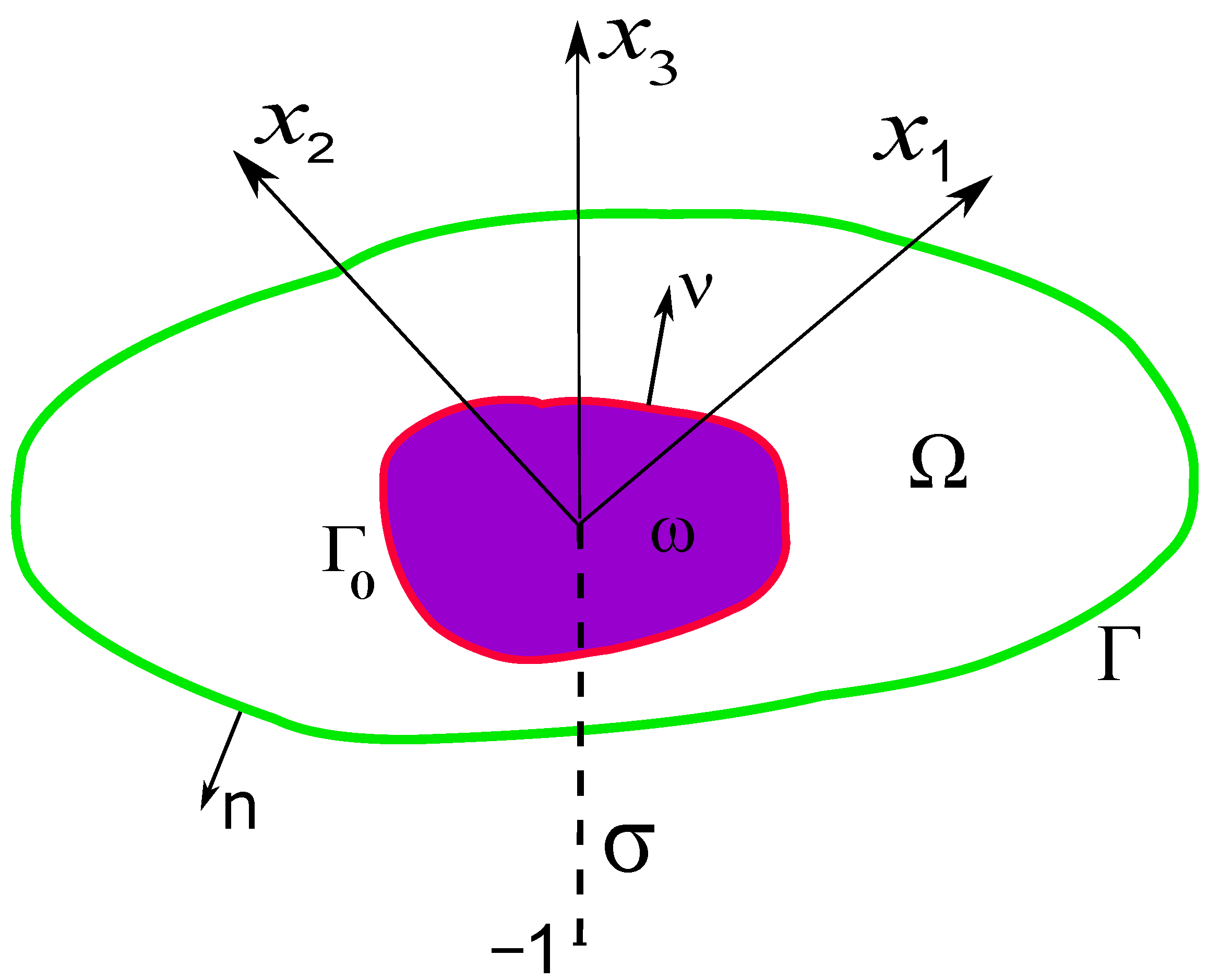
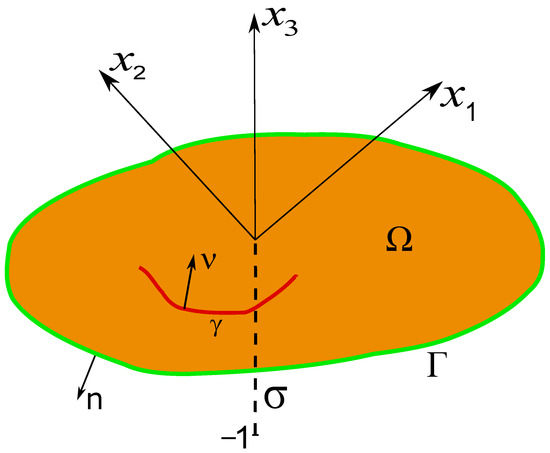
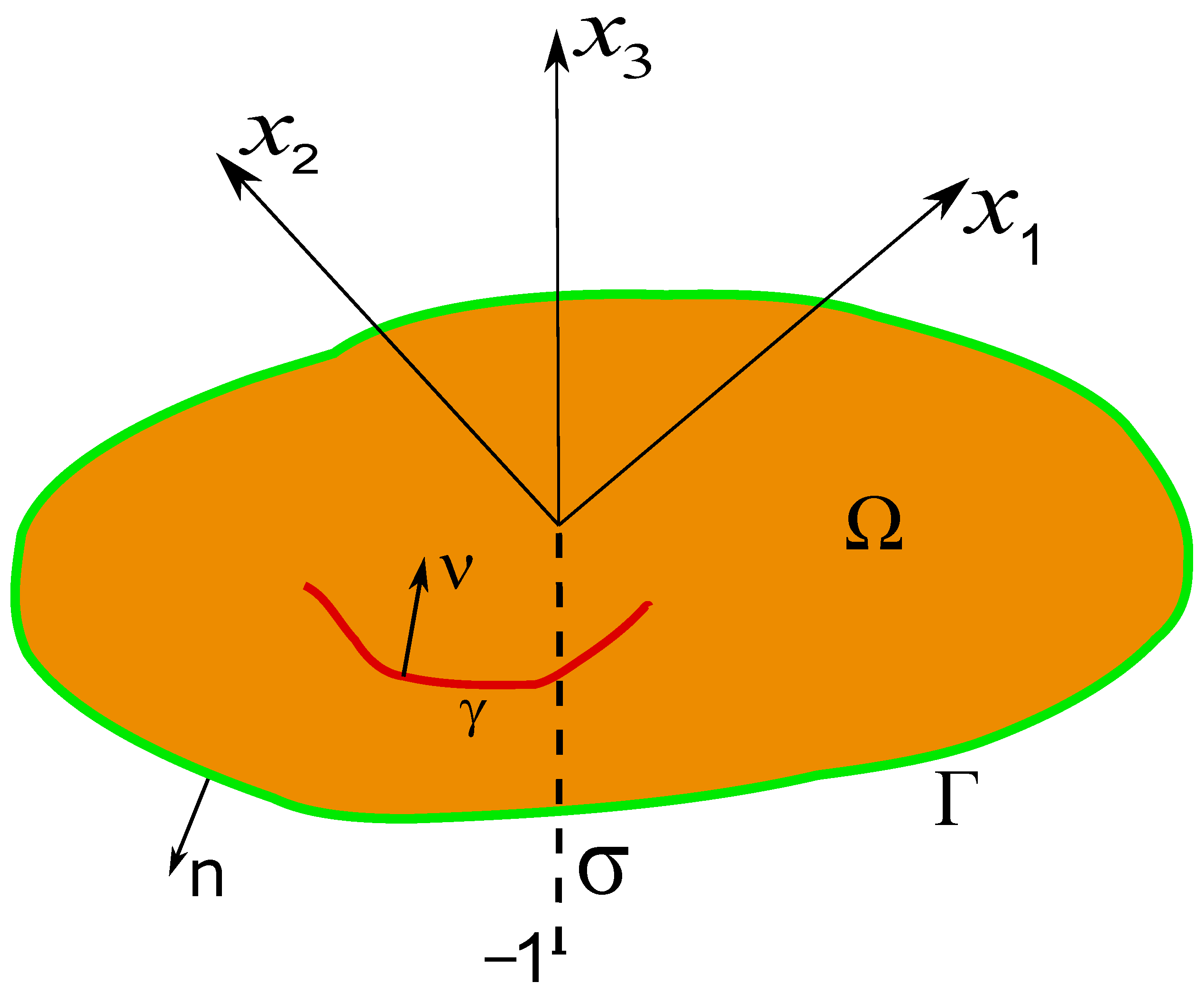
Let be a bounded domain with a smooth boundary and a subdomain with a smooth boundary . Assume that The interval of the axis is denoted by The axis is orthogonal to the plane The domain fits to the mid-surface of an elastic plate, and is a rigid part of the plate; corresponds to an elastic beam. Thus, the point is the joint point of the plate and the beam; see Figure 1. We denote using the unit external vectors to respectively.
Figure 1.
Volume rigid inclusion in the plate.
Let be given as the external forces acting on the plate and the beam, respectively. We introduce the Sobolev space with an arbitrary constant c
and the following space:
The norm in the space is defined as follows:
We first formulate the variational statement of the problem. Assume that is a given elasticity tensor with the usual properties of symmetry and positive definiteness, . For a scalar function w, we put If then The summation convention over repeated indices is used; all functions with two lower indices are assumed to be symmetric in those indices.
Wentroduce notations for a bending moment and a transverse force
We should take note of Green’s formula. For the smooth functions defined in we have [26]
where .
Consider the bilinear form
where and introduce the energy functional
The following variational problem would be analyzed:
This problem has a solution satisfying the identity
To prove the solvability of the problem (4), we have to check the coercivity of the functional on the space . In this case, the solvability of the problem (4) follows since the weak lower semicontinuity of the quadratic functional is clear. To this end, we will prove the following statement.
Proposition 1.
A constant exists such that
Proof.
Assume that the statement is not true. In this case, we can choose a sequence such that
Choosing a subsequence with the same notation, we can assume that as
According to (9), it follows that
From (11), we conclude that exist such that
On the other hand, on ; hence, Since , we obtain In addition to this, and consequently,
Note that the solution to the problem (5)–(6) is unique. Indeed, assuming the existence of two solutions from (5)–(6), we easily obtain the equality
with Hence, according to (7), it gives
Now, we are able to write a differential statement of the problem (5)–(6): it is necessary to find the functions defined in and , respectively, as well as a constant such that
Relations (14)–(15) are the equilibrium equation and the constitutive law for the elastic part of the plate; (16) is the equilibrium equation for the elastic beam. The boundary conditions (17) correspond to a free edge of the plate, i.e., the bending moment and the transverse force are equal to zero. The second group of boundary conditions (18) provides a glue condition at for v and . As for condition (20), it provides a zero principal vector of the forces acting on the rigid inclusion According to (19), the displacements of the plate and the beam coincide at the joint point; moreover, the displacement of the beam is zero at the point
The following assertion takes place.
Proof.
Let (5)–(6) be fulfilled. We substitute into (6) test functions of the form in This implies
This identity means that the equilibrium Equation (14) holds. Next, we substitute into (6) test functions of the form where In this case, the following identity follows:
Hence, Equation (16) is obtained.
Now, we integrate by the parts in (6) by using formula (3):
where are defined similarly to how they are defined in (2).
Taking into account the arbitrariness of the identity (21) implies Equations (14) and (16), as well as
where Since a is arbitrary, we obtain (20). The boundary conditions (17) can be derived from (6) by substituting the test functions such that is located in a small neighborhood of the boundary
Let us prove the converse. Assume that (14)–(20) hold. Then, for , it follows that
The integration by the parts in (23) implies that
Through the relation and (20), we obtain (6). Theorem 1 is proven. □
3. The Rigidity Parameter Tends to Infinity in Problem (5)–(6)
In this section, we introduce a positive parameter characterizing the rigidity property of the elastic beam into the model (5)–(6) and the pass to the limit as The energy functional has the form
Our aim is to pass to the limit in (24)–(25) as At the first step, we obtain a priori estimates for the solutions of (24)–(25). From (24)–(25), it follows that
According to Proposition 1, the relations (26) imply the estimate is uniform in :
Choosing a subsequence, if necessary, we can assume that as
Moreover,
We introduce the set of admissible displacements for the limit problem
Take any element Then, Substitute into (25) as a test function and pass using (29), (30) to the limit as This implies
Thus, we have proven the following assertion.
Theorem 2.
The differential statement of the problem (31)–(32) is as follows. We have to find the functions defined in respectively, such that in in
4. A Case Without Rigid Inclusion
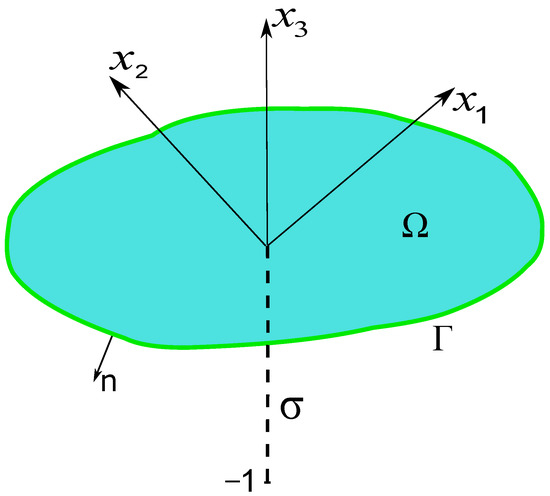
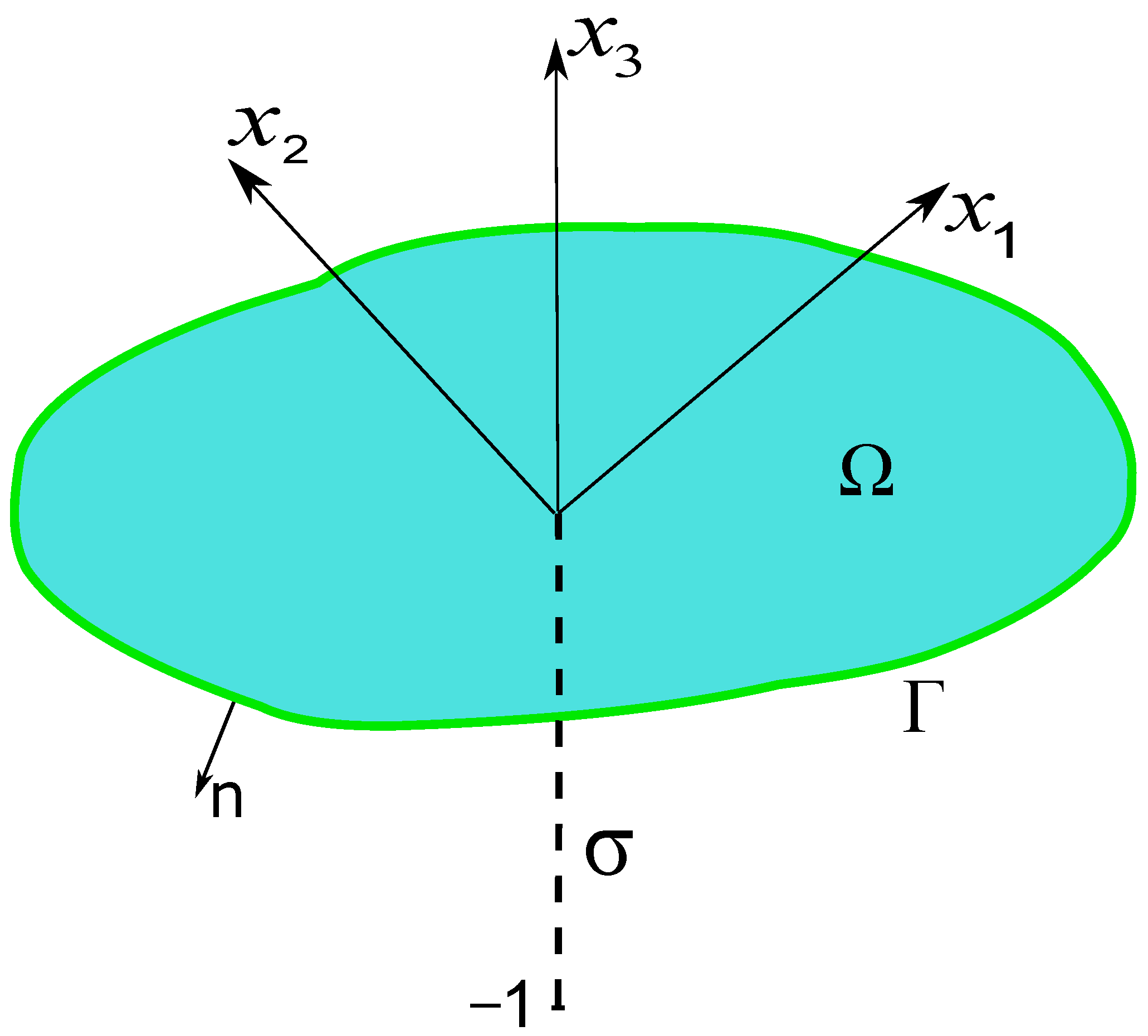
In this section, we consider a situation corresponding to a fully elastic plate. In this case, the rigid part of the plate is absent; see Figure 2. Due to the boundary conditions on corresponding to the free edge of the plate, a suitable boundary value problem would be non-coercive. In particular, for the problem to be solvable, we should impose a suitable condition onto the external forces.
Figure 2.
Contact between the plate and beam at point .
Consider the space
with the inner product
This inner product induces the norm equivalent to the standard one. To check this, using the embedding theorem, we first note that for a small , the following inequality holds:
Then,
On the other hand, and we can choose the following equivalent norm in the space
Hence,
and the proof is complete.
Introduce the subspaces into
The following statement applies.
Proposition 2.
The space W can be presented as a direct sum of two orthogonal subspaces with respect to the inner product (37),
Proof.
We take Then,
We see that a sufficient and necessary condition for the validity of the identity
has the form Proposition 2 is proven.
Consider the energy functional
and the following problem:
This problem has a solution satisfying the identity
To prove this statement, it suffices to check the coercivity of the functional on the space since the weak lower semicontinuity of is clear. □
Proposition 3.
A constant exists such that
Proof.
Assume that the statement is not true. In this case, we can choose a sequence such that
Choosing a subsequence, if necessary, we assume that as
Then, according to (42), we have
From (44), we see that exist such that
Since , we conclude that On the other hand, Consequently, on , i.e., Taking into account that , we conclude that
Then, according to (43), we conclude that
In this case, from (41), it follows that
and we obtain a contradiction to (45). Proposition 3 is proven.
Assume that the external forces satisfy the following condition:
where
We therefore arrive at the following statement. □
The uniqueness of the solution to the problem (50)–(51) is clear since for two possible solutions , we derive
According to Proposition 3, this equality implies that
Denote using the Dirac delta-function, i.e.,
We can formulate the differential statement of the problem (50)–(51): find functions defined in and , respectively, such that
Proof.
Let (50)–(51) be fulfilled. Substitute into (51) test functions of the form This provides the identity
i.e., we obtain the equation
Next, we substitute into (51) test functions of the form which implies
i.e., the following equation is obtained:
To prove the validity of the boundary conditions (55), we choose in (51) test functions of the form such that the support for is located in a small neighborhood of This gives
Accounting for (58) and the arbitrariness of to , the identity (60) implies the boundary conditions (55).
To conclude, we substitute into (51) test functions of the form According to (59) and the equality this substitution provides the identity
This identity means that Equation (52) holds in the distributional sense. Thus, all relations (52)–(57) are obtained from (50)–(51).
5. The Rigidity Parameter Tends to Infinity in Problem (50)–(51)
Similar to Section 3, we introduce a positive parameter into the model (50)–(51) and pass to the limit as Like in Section 3, this parameter describes the rigidity property of the beam The condition (46) is assumed to be fulfilled in this section.
The energy functional has the following form:
We know that for any fixed the solution to the problem
exists and is unique. Relations (63)–(64) imply
Consequently, according to Proposition 3, uniformly in we obtain
Introduce the set of admissible functions for the limit problem
Next, we take any element Then, This element can be substituted into (64) as a test function, and the passage to the limit can be fulfilled as The limit relations are as follows:
Thus, the following assertion has been proven.
Theorem 5.
The differential statement of the problem (69)–(71) is as follows: find functions defined in respectively, such that in :
We omit the proof of this assertion since it is easier compared to that for Theorem 1.
6. The Case of a Thin Delaminated Inclusion
In this section, we assume that the elastic plate contains a thin rigid inclusion. Let be a smooth curve without self-intersections and a unit normal vector to ; see Figure 3. The form of the inclusion coincides with . Assume that the inclusion is delaminated from the surrounding elastic body at the positive face with respect to i.e, at Denote
Figure 3.
Thin inclusion in the plate.
Introduce the space
where
In the definition of , the constants are arbitrary.
Denote
and consider the energy functional
with
Introduce the inner product into the space
Like in Section 4, we can check that the inner product (76) induces the norm in the space to be equivalent to the standard one.
Consider two subspaces in
We can prove the following assertion.
Proposition 4.
The space can be presented as a direct sum of two orthogonal subspaces with respect to the inner product (76):
The proof of this proposition reminds us of that for Proposition 2, so we omit it.
Now, consider the following variational problem:
Indeed, the energy functional is coercive on due to the following assertion.
Proposition 5.
A constant exists such that
We do not provide the proof of Proposition 5 since it follows the same lines of those for Proposition 3.
The weak lower semicontinuity of the functional is clear; hence, the problem (77) has a solution satisfying (78)–(79).
Now, assume that the following condition holds:
where the space is introduced similarly to in (47). In this case, from (78)–(79), we obtain
and according to Proposition 4, it follows that
Hence, we arrive at the following assertion.
Theorem 7.
Now, we are ready to write the differential statement for the problem (81)–(82): it is necessary to find functions defined in and , respectively, as well as a function such that
The following assertion applies.
Proof.
Let (83)–(90) be fulfilled. Multiply (83), (90) by respectively, and integrate over where This provides the relations
In (91), we can use the following Green’s formula valid for smooth functions :
where is the jump of a function p on The signs ± correspond to the positive and negative directions of This formula can be derived from (3) for the domain with the cut Taking into account that and boundary conditions (86)–(89), from (91)–(92), we obtain
which coincides with (82). □
Conversely, let us prove that (81)–(82) implies all relations (83)–(90). Assume that (81)–(82) holds. The proof of the validity of (83)–(86) can be obtained similarly to that for (52)–(55) in Theorem 4. Hence, it suffices to prove the first equality in (87) and the second group of relations (87), as well as (89). All of these relations follow from (82) using Green’s formula (93) and taking into account the arbitrariness of to and to . Theorem 8 is proven.
7. Conclusions
A rigorous analysis of the boundary value problems for a T-shape deformable structure is provided. The structure consists of a plate and a connected elastic beam. The plate may contain a volume rigid inclusion and a thin rigid delaminated inclusion. Neumann-type boundary conditions are considered at the external boundary of the plate, which imply the necessity of finding a suitable condition imposed onto the external forces acting on the structure for the problem to be solvable. The existence of solutions to the considered problems is established. To this end, the Sobolev space is presented as a sum of two orthogonal subspaces, and a unique solution is found in a suitable subspace. An asymptotic analysis of the solutions with respect to the rigidity parameter of the beam is performed, and statements of the limit problems are obtained. The technique proposed in this paper can be used for the analysis of various deformable T-shape structures with Neumann-type boundary conditions imposed at the external boundaries.
Funding
This research received no external funding.
Data Availability Statement
Data is contained within the article.
Conflicts of Interest
The authors declare no conflicts of interest.
References
- Lazarev, N.; Itou, H. Optimal location of a rigid inclusion in equilibrium problems for inhomogeneous Kirchhoff-Love plates with a crack. Math. Mech. Solids 2019, 24, 3743–3752. [Google Scholar] [CrossRef] [Scilit]
- Shcherbakov, V.V. Shape derivatives of energy and regularity of minimizers for shallow elastic shells with cohesive cracks. Nonlinear Anal. Real World Appl. 2022, 65, 103505. [Google Scholar] [CrossRef] [Scilit]
- Furtsev, A.I. On contact between a thin obstacle and a plate containing a thin inclusion. J. Math. Sci. 2019, 237, 530–545. [Google Scholar] [CrossRef] [Scilit]
- Khludnev, A.M. Thin inclusions in elastic bodies crossing an external boundary. J. Appl. Math. Mech. 2015, 95, 1256–1267. [Google Scholar] [CrossRef] [Scilit]
- Khludnev, A.M. T-shape inclusion in elastic body with a damage parameter. J. Comp. Appl. Math. 2021, 393, 113540. [Google Scholar] [CrossRef] [Scilit]
- Khludnev, A.M. Elasticity problem with a cusp between thin inclusion and boundary. Axioms 2023, 12, 1081. [Google Scholar] [CrossRef] [Scilit]
- De Maio, U.; Gaudiello, A.; Sili, A. An uncoupled limit model for a high-contrast problem in a thin multi-structure. Rend. Lincei Mat. Appl. 2022, 33, 39–64. [Google Scholar] [CrossRef] [Scilit]
- Gaudiello, A.; Hadiji, R. Asymptotic analysis, in a thin multidomain, of minimizing maps with values in S2. Ann. Inst. Henri Poincarè Anal. Non Linèaire 2009, 26, 59–80. [Google Scholar] [CrossRef] [Scilit]
- Popova, T.S. Numerical solution of the equilibrium problem fora two-dimensional elastic body with a thin semirigid inclusion. Math. Notes NEFU 2021, 28, 51–66. [Google Scholar]
- Popova, T.S. On numerical solving of junction problem for the thin rigid and elastic inclusions in elastic body. Lobachevskii J. Math. 2023, 44, 4143–4156. [Google Scholar] [CrossRef] [Scilit]
- Leugering, G.; Nazarov, S.A.; Slutskij, A.S. The asymptotic analysis of a junction of two elastic beams. J. Appl. Math. Mech. 2019, 99, E201700192. [Google Scholar] [CrossRef] [Scilit]
- Leugering, G.; Nazarov, S.A.; Slutskij, A.S.; Taskinen, J. Asymptotic analysis of a bit brace shaped junction of thin rods. J. Appl. Math. Mech. 2020, 100, E201900227. [Google Scholar] [CrossRef] [Scilit]
- Khludnev, A.M.; Popova, T.S. On junction problem with damage parameter for Timoshenko and rigid inclusions inside elastic body. Z. Angew. Math. Mech. 2020, 100, e202000063. [Google Scholar] [CrossRef] [Scilit]
- Rudoy, E. Asymptotic justification of models of plates containing inside hard thin inclusions. Technologies 2020, 8, 59. [Google Scholar] [CrossRef] [Scilit]
- Furtsev, A.; Rudoy, E. Variational approach to modeling soft and stiff interfaces in the Kirchhoff-Love theory of plates. Int. J. Solids Struct. 2020, 202, 562–574. [Google Scholar] [CrossRef] [Scilit]
- Serpilli, M. Asymptotic interface models in magneto-electro-thermoelastic composites. Meccanica 2017, 52, 1407–1424. [Google Scholar] [CrossRef] [Scilit]
- Serpilli, M.; Rizzoni, R.; Lebon, F.; Dumont, S. An asymptotic derivation of a general imperfect interface law for linear multiphysics composites. Int. J. Solids Struct. 2019, 180, 97–107. [Google Scholar] [CrossRef] [Scilit]
- Gaudiello, A.; Sili, A. Limit models for thin heterogeneous structures with high contrast. J. Diff. Equat. 2021, 302, 37–63. [Google Scholar] [CrossRef] [Scilit]
- Pasternak, I.M. Plane problem of elasticity theory for anisotropic bodies with thin elastic inclusions. J. Math. Sci. 2012, 186, 31–47. [Google Scholar] [CrossRef] [Scilit]
- Goudarzi, M.; Dal Corso, F.; Bigoni, D.; Simone, A. Dispersion of rigid line inclusions as stiffeners and shear band instability triggers. Int. J. Solids Struct. 2021, 210, 255–272. [Google Scholar] [CrossRef] [Scilit]
- El Jarroudi, M. Homogenization of an elastic material reinforced with thin rigid von Karman ribbons. Math. Mech. Solids. 2018, 24, 1965–1991. [Google Scholar] [CrossRef] [Scilit]
- Hu, K.X.; Chandra, A.; Huang, Y. On crack, rigid-line fiber, and interface interactions. Mech. Mater. 1994, 19, 15–28. [Google Scholar] [CrossRef] [Scilit]
- Pingle, P.; Sherwood, J.; Gorbatikh, L. Properties of rigid-line inclusions as building blocks of naturally occurring composites. Compos. Sci. Technol. 2008, 68, 2267–2272. [Google Scholar] [CrossRef] [Scilit]
- Kozlov, V.A.; Ma’zya, V.G.; Movchan, A.B. Asymptotic Analysis of Fields in a Multi-Structure; Oxford University Press: New York, NY, USA, 1999. [Google Scholar]
- Panasenko, G. Multi-Scale Modelling for Structures and Composites; Springer: New York, NY, USA, 2005. [Google Scholar]
- Khludnev, A.M. Elasticity Problems in Non-Smooth Domains; Fizmatlit: Moscow, Russia, 2010. [Google Scholar]
- He, A.; Liu, Y.; Sun, X.D.; Xu, Q.Q.; Jiang, D.Y.; Zeng, W. A new elastic T-shape joint of longitudinally connected slab ballastless track structure for releasing thermal stress caused by non-uniform temperature loads. Constr. Build. Mater. 2024, 416, 134997. [Google Scholar] [CrossRef] [Scilit]
- Choi, K.K.; Haug, E. Shape Design Sensitivity Analysis of Elastic Structures. J. Struct. Mech. 2007, 11, 231–269. [Google Scholar] [CrossRef] [Scilit]
- Titeux, I.; Sanchez-Palencia, E. Junction of thin plates. Eur. J. Mech. A Solids 2000, 19, 377–400. [Google Scholar] [CrossRef] [Scilit]
- Gaudiello, A.; Monneau, R.; Mossino, J.; Murat, F.; Sili, A. On the junction of elastic plates and beams. Comptes Rendus Math. 2002, 335, 717–722. [Google Scholar] [CrossRef] [Scilit]
- Gruais, I. Modeling of the junction between a plate and a rod in nonlinear elasticity. Asymptot. Anal. 1993, 7, 179–194. [Google Scholar] [CrossRef] [Scilit]
Disclaimer/Publisher’s Note: The statements, opinions and data contained in all publications are solely those of the individual author(s) and contributor(s) and not of MDPI and/or the editor(s). MDPI and/or the editor(s) disclaim responsibility for any injury to people or property resulting from any ideas, methods, instructions or products referred to in the content. |
© 2025 by the author. Licensee MDPI, Basel, Switzerland. This article is an open access article distributed under the terms and conditions of the Creative Commons Attribution (CC BY) license (https://creativecommons.org/licenses/by/4.0/).